Scorching plains, screaming cactus

One of my greatest pleasures with collecting insects is not only the sights of the habitats that I visit, but the sounds. How many a night I’ve spent camped out in the Ozarks and watched royal moths fluttering at the blacklight sheet while dueling katydids traded their raspy “ch ch ch“s in the tree branches above and a whip-poor-will sang it’s haunting, eponymous song off in the distance. What joy to be hiking the canyon-lands out west and hear the musical, descending “t-te-tee-teee-teew-teeew-teeeew-teeeeew” of the canyon wren echoing off the tall, sheer rock faces. Even large-treed urban parks offer the hypnotizing “wee-er, wee-er, wee-er, weeeeeeeee” of scissor grinder cicadas (Tibicen pruinosa) on a hot summer night. Ah—cicadas! Few other animals can match their ability to fill a landscape with song, and with more than 100 species in North America it’s a safe bet that no matter where you go you can hear cicadas.
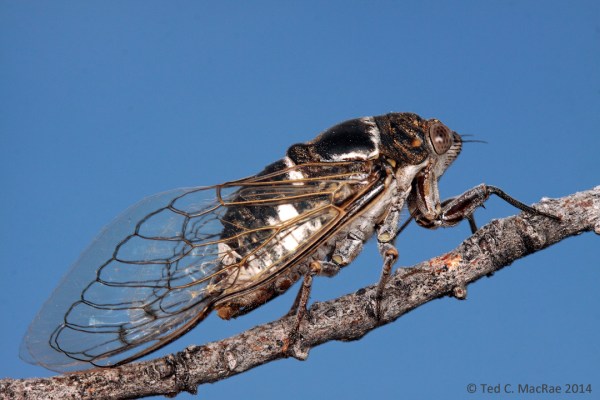
Cacama valvata

Cacama valvata (Uhler, 1888) | New Mexico, Harding Co., 5 mi W of Mills

Scissor grinders were the cicadas of my urban youth in Kansas City; I was a teenager the first time I heard the rich, pulsing buzz of bush cicadas (Tibicen dorsata) in the prairies around my house farther east in Blue Springs; and I experienced my first periodical cicada (Magicicada spp.) event as a young adult in St. Louis with Brood XIX and their whirring, “flying saucer” chorus. More recently, I’ve made several trips to the western Great Plains, where particularly large cicadas known as “cactus dodgers” (Cacama valvata) perch on prickly pear (Opuntia spp.) and cholla (Cylindropuntia imbricata) cacti and sing their loud, distinctive songs in the scorching, mid-summer heat. The male song has been described as a high pitched “metallic zing” (Beamer & Beamer 1930) or as an intense shrill, often in short bursts (Kondratieff et al. 2002); however, to me it sounds like a dull-bladed table saw cutting through a piece of ironwood and hitting a nail!

Cylindropuntia imbricata | Otero Co., Colorado.

Cholla (Cylindropuntia imbricata, Otero Co., Colorado) is a preferred host for Cacama valvata.

Fast flying and alert, cactus dodgers often defy the attempts of collectors (Kondratieff et al. 2002) and have the amazing ability to usually land safely on their spined hosts without becoming impaled (although occasionally this does happen—see photo below). The perils of dodging cactus spines, however, seem to pale compared with the benefits of utilizing these widespread hosts, as the association appears to have facilitated the spread of the species into a wide variety of environments across the southern Great Plains and westward to California (Sanborn & Phillips 2013).
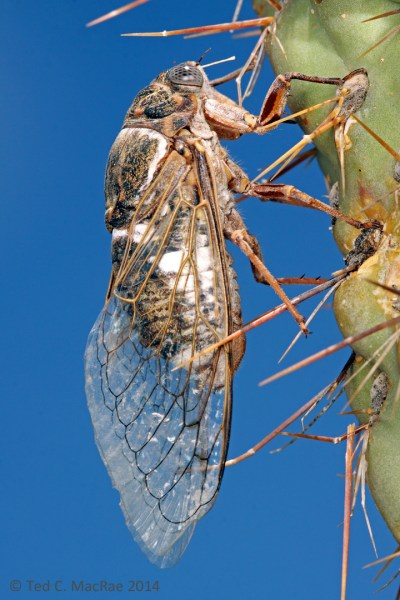
Cacama valvata female

This female has a cactus spine impaled on her head.

The photos in this post were taken during late June 2014 in the scorching, cholla-studded, shortgrass prairies of southeastern Colorado and northeastern New Mexico. Given their alertness and fast flying capabilities, they were a challenge to photograph before eventually finding the somewhat more cooperative subjects shown in the above photographs. Eventually, I was lucky enough to encounter two individuals sitting on a dead cholla stem in the mid-afternoon heat near Vogel Canyon, Colorado, one of which (the lower) was singing (and thus a male) and the other I surmised to be a female (this I confirmed once I got a better look through my camera viewfinder).
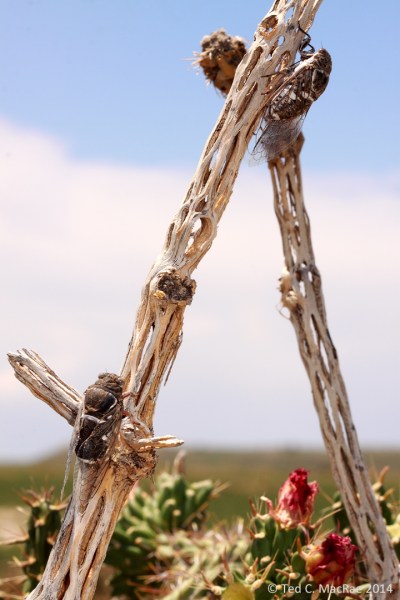
Cacama valvata male (bottom) & female (top)

A male Cacama valvata (bottom) sings to a female (top).

The male was creeping slowly towards the female as it sang, pausing occasionally and interrupting his song before resuming both. I presumed I was witnessing courtship singing, a behavior Kondratieff et al. (2002) have described in detail. They observed males perched on the ends of branches producing long, wavering, repeated shrills as they moved closer to the female. The song changed to a long shrill followed by shorter sequence of shrills as they made their final approach, which was followed by touching with the legs, mounting, and copulation.
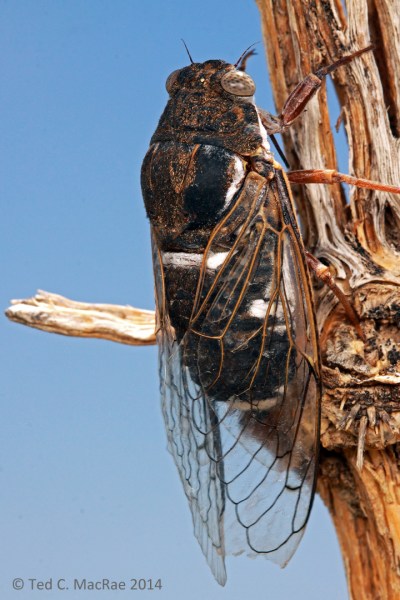
Cacama valvata male singing

Cacama valvata male singing.

Unfortunately for this male, the female was already in the act of oviposition (poor male—wasting his time flirting with a married woman!). In cactus, females oviposit almost exclusively in dry, dead, skeletonized stems and rarely utilize green material (Beamer & Beamer 1930). The eggs laid by this female might remain in the dry stem for another three months or more, where they will await a fall rainstorm to wet the stem and ground and bring cooler temperatures to improve their chances of survival before hatching, dropping to the ground, burrowing into the soil, and searching for roots upon which they can feed.

Cacama valvata female ovipositing on dead cholla stem.

REFERENCES:

Beamer, L. D. & R. H. Beamer. 1930. Biological notes on some western cicadas. Journal of the New York Entomological Society 38(3):291—305 [pdf].

Kondratieff, B. C., A. R. Ellingson & D. A. Leatherman. 2002. Insects of Western North America 2. The Cicadas of Colorado (Homoptera: Cicadidae, Tibicinidae). Contributions of the C. P. Gillette Museum of Arthropod Diversity, Department of Bioagricultural Sciences & Pest Management, Colorado State University, Fort Collins, 63 pp. [pdf].

Sanborn, A. F. & P. K. Phillips. 2013. Biogeography of the Cicadas (Hemiptera: Cicadidae) of North America, North of Mexico. Diversity 5:166–239 (doi:10.3390/d5020166) [abstract].

© Ted C. MacRae 2014

Chicharra que canta, calor adelanta

Dorisiana drewseni - male singing

There is a species of cicada (“chicharra” in Spanish) that strikes me as quite common in the central Humid Pampas region of Argentina. I saw numerous individuals during March of last year at La Reserva Ecologica Costanera Sur (where these photos were taken), and again during the past week I’ve noted them abundantly in the trees around my base station in western Buenos Aires Province. Thanks to cicada expert Barry University’s Allen Sanborn (apparently himself an endangered species), I now know these to be the species Dorisiana drewseni (Stål, 1854), occurring in Argentina, Uruguay and southern Brazil (Aoli et al. 2010).

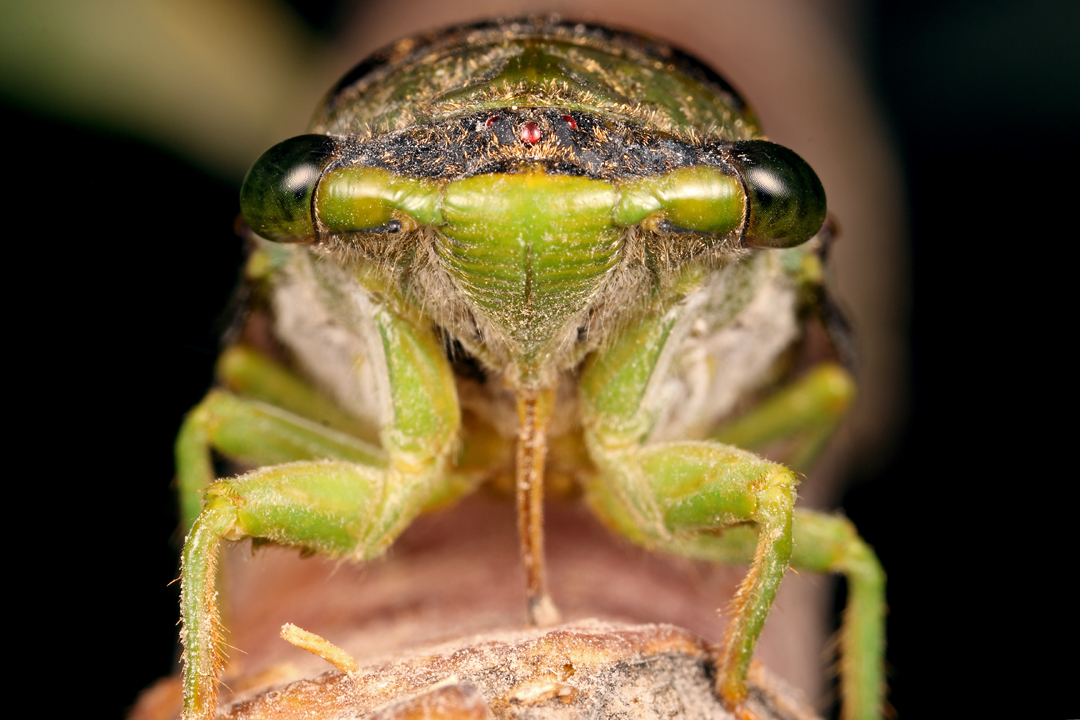
Dorisiana drewseni, female resting on thistle

As in North America, the song of the cicada is associated with the dog days of summer and their midday heat. “Chicharra que canta, calor adelanta” is a Spanish idiom that loosely translates to “Cicadas singing, heat follows”. March is late summer in Argentina, and the days can still be quite hot even at temperate latitudes (yesterday was 34°C, or 93°F). Despite being half-a-world away from St. Louis, the droning song of the cicada sounds a bit like home in late August. While I was at the Reserva last March I really wanted to photograph a male in the midst of song, but the above photo was the only shot I managed from several males. Singing males are extremely difficult to approach to within even a long-handled net’s reach—much less a camera lens’ focal distance. I think the only reason I was able to photograph the male above was because I approached him from slightly below and behind (though certainly still within the field of vision of those huge, bulging eyes). One shot was all I got, and off he flew, shrieking noisily as he crashed and thrashed through the foliage before reaching open air and completing his escape.

Females, on the other hand, seemed to be much more approachable (perhaps because they, unlike singing males, never do anything to draw attention to themselves). The female in the photo above was calmly sitting on a thistle-like plant at eye-level, never flinching at my approach (albeit cautious) and calmly staying put while I snapped a few photos. One look at her tattered wings, however, suggests that she had already seen better days and perhaps no longer had the strength to attempt to flee (maybe even expectedly awaiting predation at this point in her life).

A second female rests calmly on a tree branch

Not long after taking the photographs of the first female, I saw another female sitting on a tree branch. As I mentioned, females don’t call attention to themselves the way males do, so finding females is a bit more of a crapshoot—I only happened to see this one because she was on a tree branch at eye level with an unobstructed view hanging right next to the path I was following. Obviously much fresher and in better shape than the previous female, she nevertheless allowed me to get as close as I wanted, with the photographs above and below representing the two that I am happiest with.

That's one heck of a cibarial pump!

I haven’t had quite the same luck during the present trip in securing one of these—probably because my lone attempt so far was during the heat of the day on a day that was already warm enough. Come to think of it, I didn’t manage any of the above photographs last year until quite late in the afternoon when temperatures began to drop off a bit. We’ll see what the next few weeks brings—I am still committed to getting the money shot of a male in the midst of his song. Chicharra que canta, Ted adelanta!

REFERENCE:

Aoki, C., F. Santos Lopes & F. Leandro de Souza. 2010. Insecta, Hemiptera, Cicadidae, Quesada gigas (Olivier, 1790), Fidicina mannifera (Fabricius, 1803), Dorisiana viridis (Olivier, 1790) and Dorisiana drewseni (Stål, 1854): First records for the state of Mato Grosso do Sul, Brazil. Check List 6(1):162–163.

Copyright © Ted C. MacRae 2012

Vinerunt, futuerunt, ierunt

Very rough translation: They loved us, then left us. (the cicadas, that is.)¹ 

¹ Guest blogger’s subtext — Maybe if I dazzle the readers with a title in the colorful language of Pompeiian graffiti, they’ll forgive me for not posting pictures as beautiful as Ted’s. Well, anyway…

On this year’s US Independence Day, we in the St. Louis area were able to proclaim our freedom from the 5-week-long din of cicadas, or so the TV “news” reporters would have us believe. For me, it was more of a return to the dominance of human-made noise; the faint drone of a distant highway, the monotone roar of a neighbor’s lawn mower, the repetitively plosive engine of one of the many diesel pickups that float by, with the CD player’s bass thumping at an almost certainly hearing-damaging decibel level.

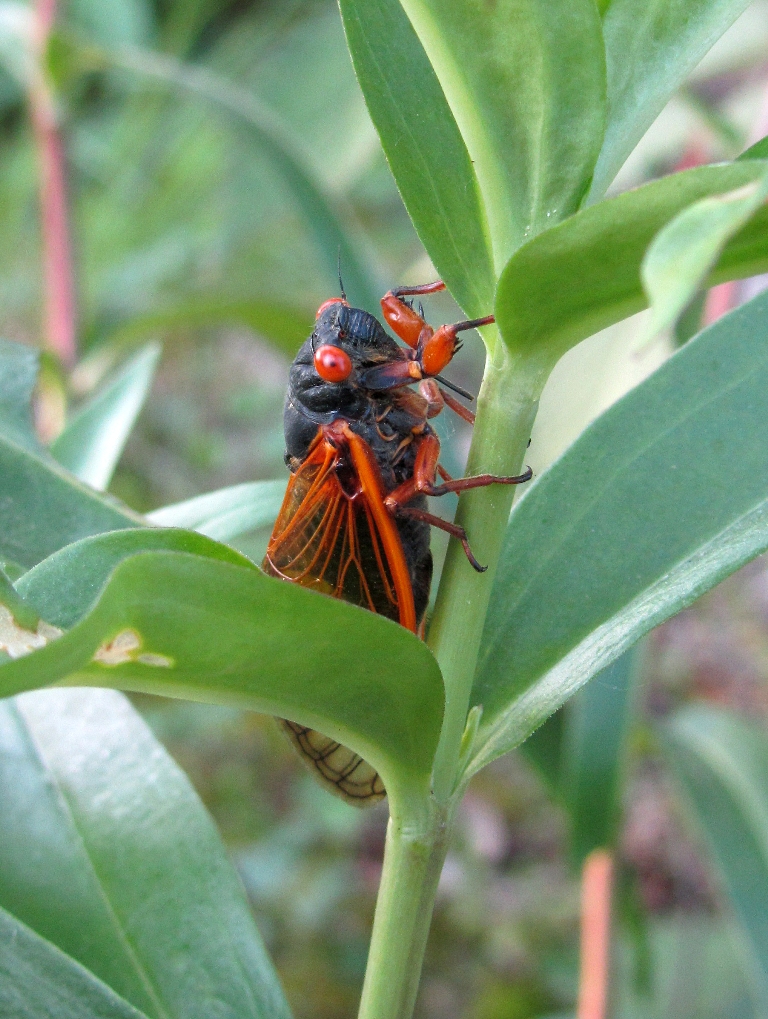
Magicicada burrows

I started my celebration early in the day, by doing some gardening and rearranging in the yard. Moving a pile of concrete paving stones, I reached the bottom one and lifted it, and was greeted with a view of abandoned nymphal emergence burrows made by just a few of the many thousands of periodical cicadas that graced my yard with their presence this year. The burrows were already showing wear at the edges in their disuse. A little later later in the morning, I heard the whoooooooa-ooh of a last, lone Magicicada tredecim male from the hackberry tree—first one call, then another, then no more. But nature’s course proceeds, and as afternoon drifted into evening, I was pleased to hear the first of the dogday, or annual, cicadas of the genus Tibicen. These are not truly annual; They emerge every year, but actually take several years—4 or 5, it is said—to develop from egg to adult. 

The four Magicicada species that can be found in the St. Louis area, near the western edge of Periodical Cicada Brood XIX (a.k.a. the Great Southern Brood), are famous for their intermittent emergence as adults, every 13 years. (Life spans of 17 years occur in three, more northern species that do not occur in the St. Louis area). In fact, during years to either side of the two emergences of Brood XIX that I’ve experienced since moving to this area 24 years ago, I have always heard, and if really lucky, seen a few, one or two years before and after the “scheduled” emergence. But, the vast majority stick to the plan of feeding on the xylem sap of tree roots as subterranean, tan-colored nymphs for 13 seasons before coming out of the ground, then molting to the ever-so-buggy-looking, winged, black insects with red eyes and wing veins, that “freak everyone out” during their mass emergences. 

The mass emergence is all about reproduction, the successful transmission of genes to the next generation—you know, Darwinian fitness. When a female happens to “like” the song of a particular male, she flies to him, then is courted a for a bit with a different song, before “succumbing to his charms”. Mating typically takes place up in trees. But, being amoral creatures of little brain or scruples, they may choose indelicately to copulate on a porch rail or other such public place. 

Magicicada mating

Magicicada sipping Gentiana andrewsii

Consumed with sex, the adults don’t eat much, but occasionally one sees a cicada poking its proboscis into some soft plant tissue for a drink of sap (clearly exhibiting the relationship of these large insects to those smaller sap-feeders, the aphids and such). A little sap-drinking does little damage to plants, but the insertion of eggs by the mated females into small twigs of woody plants can do quite a bit of “natural pruning”. This would be more of a concern if it happened every year, I suppose, but it really also does little damage in the long run, especially on a mature tree. Still, I would have appreciated it they hadn’t found my recently planted black gum tree such an attractive oviposition site. 

Magicicada damage on Acer saccharum

Magicicada meets Nyssa sapling

But I don’t begrudge them this. I miss their mass serenade. I treasure the remembered sight of a corpulent hairy woodpecker muddying itself to pull one nymph after another from rain saturated ground. I delighted in seeing a surprisingly chubby chipmunk perched fearlessly on an exposed root as it munched a cicada whose wings never properly expanded. Perhaps best of all was watching a red-shouldered hawk clumsily hop about on the lawn to snarf up cicadas that weakly fluttered to the ground. But now, the periodical cicadas are, till May of 2024, mere shells of their former selves. 

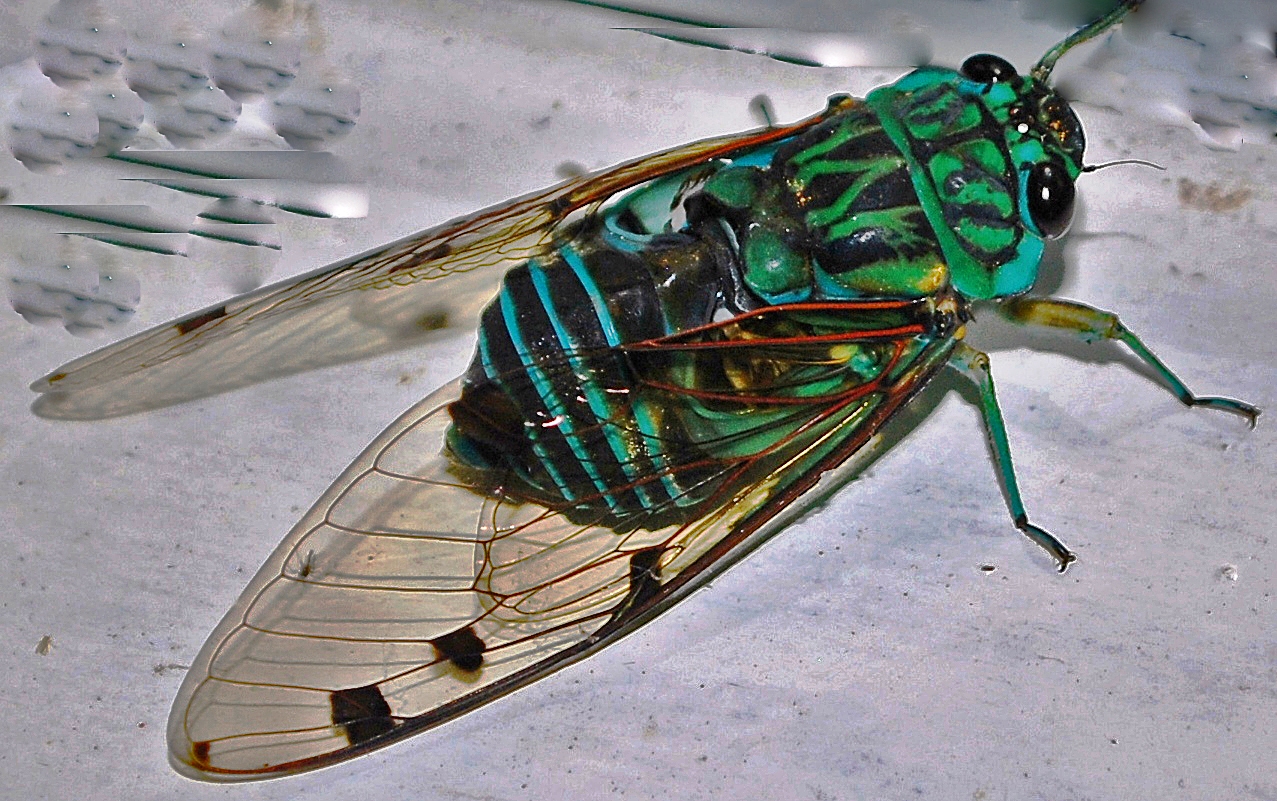
To end on a pretty note, here’s a gaudy cicada that was attracted to lights of the scientific station’s laboratory building in Yasuní National Park, Ecuador, and obligingly posed for a photo on the windowsill.

Ecuadorian cicada

Copyright © James Trager 2011

Predator Satiation

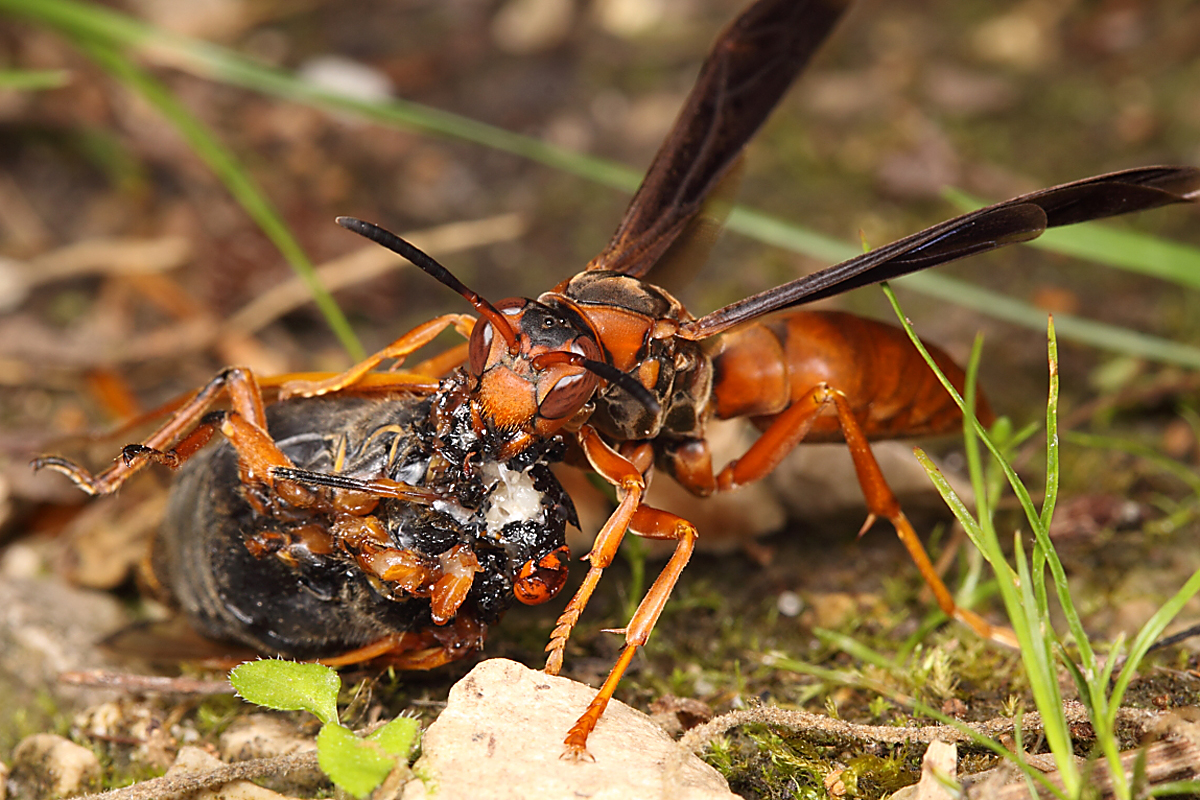
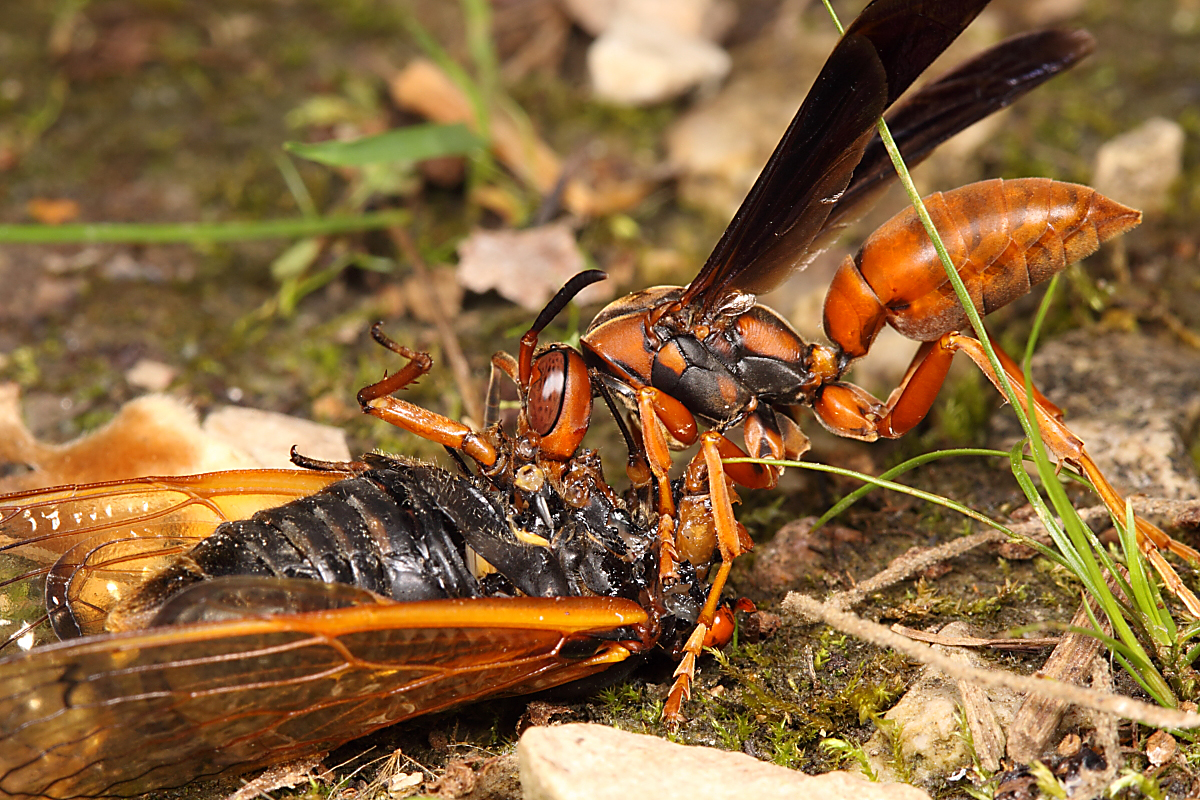
Polistes carolina/perplexus with Magicicada prey | Shaw Nature Reserve, Missouri

I’ve probably used the term predator satiation more often during the past couple of weeks than I have during the entire rest of my life.  Students of ecology know this as an antipredator adaptation in which prey occur at such high population densities that they overwhelm predator populations.¹  This ‘safety in numbers’ strategy reduces the probability that any given individual will be consumed, thereby ensuring that enough individuals survive to reproduce.  With St. Louis currently experiencing the appearance of Brood XIX of periodical cicadas, I’ve gotten lots of questions recently from many coworkers and friends wanting to know more about these cicadas.   Often the first question is “What is their purpose?”  My standard reply begins with a statement that they, like all living organisms, are the products of natural selection, which then presents an opportunity to explain how natural selection might result in such massive, temporally synchronized, multiple-species populations.  A few eyes have glazed over, but I think most have found my answer interesting, often even leading to further questions about where they lay their eggs, what is their life cycle, why are they so loud, how do they “do it” and select mates, etc.  Of course, as an entomologist with a strong natural history orientation, I’m always anxious to introduce people to ecological concepts, and right now the periodical cicada is providing a conspicuous, real-life example of such.

¹ Also called “predator saturation,” although this term might be misconstrued to mean that it is the predators that are over-abundant.

First the eyes...

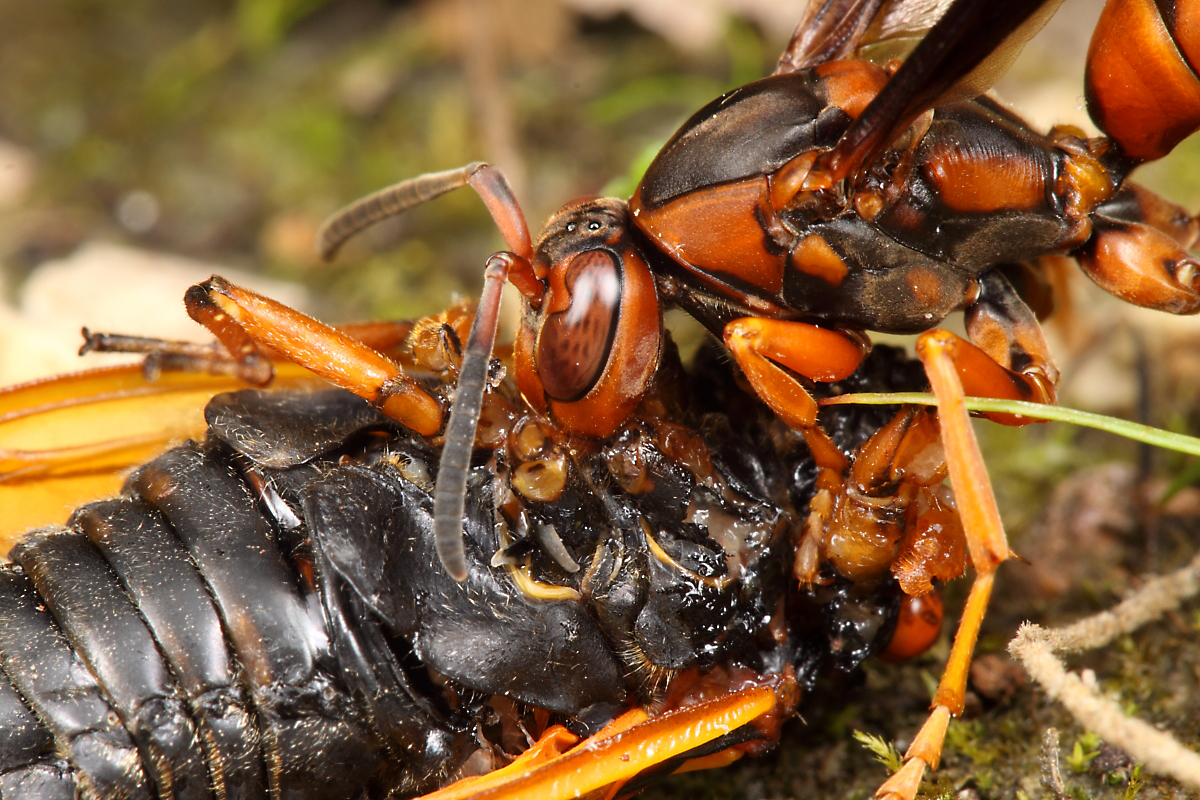
A few weeks ago, right at the beginning of their emergence in the St. Louis area, my friend Rich Thoma and I observed predator satiation in action.  While hiking one of the trails at Shaw Nature Reserve, we heard the unmistakable shriek and cellophane-sounding wing flapping of a just-captured male cicada.  Tussling on the ground ahead of us was the cicada in the grasp of a Polistes carolina/perplexus wasp, which was repeatedly stinging the hapless cicada on the underside of the abdomen.  The shrieking and wing-flapping grew less frequent as the stinging continued, until at last the cicada lay quiet.  As we approached, the wasp spooked and flew off, but we knew it would be back—we parked ourselves in place while I setup the camera, and before long the wasp returned.  It took several minutes of searching from the air and on the ground before the wasp finally relocated her prey, but once she did she began voraciously devouring it.  As the wasp was searching, we hypothesized that our presence had altered the visual cues she had memorized when flying off, resulting in some confusion when she returned, and thus the long period of time required to relocate her prey.

...then the legs!

We watched for awhile—first the eyes were consumed, then the legs.  As it consumed its prey, Rich remarked that he bet he could pick up the wasp and not get stung—likely the entirety of its venom load had been pumped into the cicada.  Both of us declined to test his hypothesis.  We also wondered if the wasp would butcher the cicada after consuming part of it and bring the remaining pieces back to the nest.  We had seen a European hornet do this once with a band-winged grasshopper, consuming the head, then cutting off the legs from the thorax and flying away with it before returning to collect the abdomen as well.  No butchering took place this time, however, the wasp seemed content to continue eating as much of the cicada as possible—a satiated predator if there ever was one!

Leg after leg is consumed.

One eye and all six legs down, time to start on the abdomen.

Copyright © Ted C. MacRae 2011

They’re baaaaack… finally!

For almost a month I waited—waited for that spaceship-sounding drone from the trees; waited for their bodies to drip from the vegetation and their skins to litter the yard; waited for their delightful shrieks every time I jostle a tree branch. I had seen them mass emerging from the ground in southern Missouri in late April, but just 100 miles north in my hometown it seemed they would never show. Cold, rainy springs must not be to their liking, as it was not until the sun finally broke through and temperatures climbed into the 80s that they finally made their appearance in St. Louis—nearly a month after that mass emergence event further south had me looking and listening daily for one of North America’s most spectacular natural history events, Brood XIX of the periodical cicada!

Finally, on May 21 I saw the first adults of the year at Shaw Nature Reserve not too far from my house (not intending to claim this as the date of their first appearance in my area!). They were not yet singing, but the adults were everywhere, many sitting right next to the skins they had just emerged from the previous evening. I had to travel on business through the southeastern U.S. that following week, and it was while visiting the beautiful MSU campus in Starkville, MS that I got my first taste of their late-afternoon synchronized, pulsating song. Upon my return to St. Louis at the end of the week, the eery drone filled the air as soon as I stepped out of the airport. It had been 13 years since I’d heard that sound, but euphoric recall instantly transported me back to 1998 and 1985 and my experiences with these marvels of evolution.

I don’t know that there is anything I can say about the periodical cicada that hasn’t already been said—repeatedly—by the numerous, more erudite sources that are following this event as if it were the approach of Haley’s comet. I don’t even know for sure which species are in my area and how to tell them apart. All I do know is that the constant droning of their singing is both maddening and amazing—a spectacle to behold for what it is, knowing that it will be the year 2024 before I have my next chance to witness it.

As I write this, I’m sitting in my hotel room in Salem, AR, where the cicadas are even more abundant than around my home in the woods—several stops to check building lights for beetles have ended in frustration because the cicadas were so numerous that they virtually swamped the space on the walls under the lights. There do seem to be two species here—a smaller one with a completely dark underside and the raspy, screeching sound that I am familiar with, and a larger one with the abdominal segments light along the posterior margins and a softer trill that almost reminds me of the song of an American toad. Maybe there are other species mixed in that I have not discerned, but I’ll not concern myself with that. Instead, I will continue to marvel at the extraordinary event unfolding before me, watch it as it cycles out, and chuckle at the complaints of the masses bemoaning their temporary inconveniences.

Copyright © Ted C. MacRae 2011

“They’re baaaaack!”

The recent run of seemingly interminable rains and HF4 tornadoes may have delayed the Annual-Birthday-First-Bug-Collecting-Trip-of-the-Year™, but it could not cancel it.  On Thursday this week, for the first time since the same time last week, a strange ball of hot gas appeared in the sky, temperatures tickled the 70°F mark, and the only moisture we encountered was already on the ground.  The weatherman said several days ago it would happen, so I put my faith in his word and made plans with my dad to do what I had planned to do last week – officially open the 2011 bug collecting season.  It was a marvelous day in which many interesting stories unfolded, one of which I’ve heard (literally) a few times already.

One of our stops was Sam A. Baker State Park in southeastern Missouri.  My original reason for coming here involved dead wood retrieval (success) and rattlesnakes (failure, though with a consolation prize – more later).  As we were walking the trail in the bottomland forest along Big Creek, I noticed all these holes in ground.  At first I assumed a group of hikers wielding their fashionable trekking poles had gone before us and left their mark in the muddy, recently flooded soil, but the holes were just too numerous and not all perfectly round.  I had just commented to my dad, “What the heck caused all these holes?”, when I saw the culprit – a fully grown periodical cicada nymph crawling on the ground looking for a tree to climb and begin life as one of the noisiest insects on earth.  I looked around and saw another one, and another… they were everywhere!  Boy, are we gonna be in for it this year!

Missouri and several other Midwestern states will be hosting periodical cicada Brood XIX—the Great Southern Brood!  All four of the 13-year species (Magicidada tredecassini, M. tredecula, M. tredecim, and M. neotredecim) participate in this brood, the largest of the 13-year broods by geographical extent, and occur in Missouri in variously overlapping ranges.  Magicicada tredecim and M. neotredecim are the two most common species in the Ozark Highlands across the southern part of the state, so the nymphs shown here likely represent one or both of those species.

I remember well the previous two appearances of brood XIX in Missouri in 1998 and 1985, when beating for buprestids during May and June was an exercise in futility due to every tree branch literally dripping with these bumbling, screeching insects (too bad I never find buprestids dripping from tree branches like this).  Those that didn’t land flapping clumsily on the sheet ended up desperately clinging to my head or flying into my face.  If swatting at these flying bullets wasn’t maddening enough, the ceaseless, droning, omnipresent cacophony of their singing was almost enough to send me to the local psycho ward begging for admittance.

I think I’ll skip trying to use the beating sheet this year.

Copyright © Ted C. MacRae 2011

Brazil Bugs #2

A few more photographs from this past week in Campinas, Brazil.  It rained during the afternoon but stopped by the time I arrived back at the hotel, allowing me to stroll the lavishly landscaped grounds during the mild evening hours.  There is a pink-flowered shrub forming a hedge row in back of the hotel that is highly attractive to many types of insects.  The identity of the shrub remains a mystery to me, and most of the insects I’m finding on it I can recognize only to family – I’m hoping the hotel staff will be able to name the former and that the readers of this blog might be able to provide IDs for the latter.

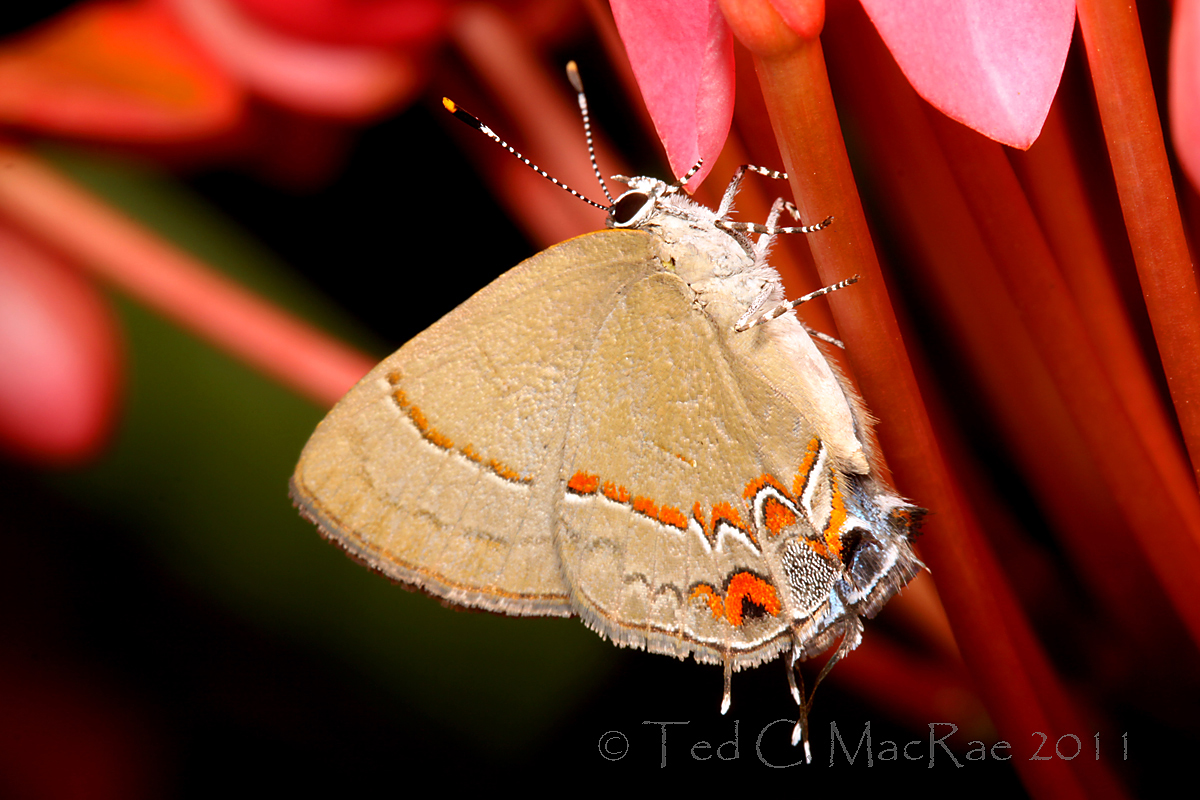
Calycopis sp. poss. origo (Lepidoptera: Lycaenidae). ID by Dave Hubble and Chris Grinter.

It took a bit of effort to find an unobstructed view of this hairstreak butterfly (family Lycaenidae) as it visited the flowers within the shrub.  Every time I tried to move foliage out of the way to get a good view, the butterfly became alarmed and flew to another part of the hedge row.  My antics drew the attention of a hotel worker, who was apparently interested enough in what I was doing to act as a spotter whenever the butterfly flew to help me relocate it.  Eventually I got a few shots that I was happy with, including the above.

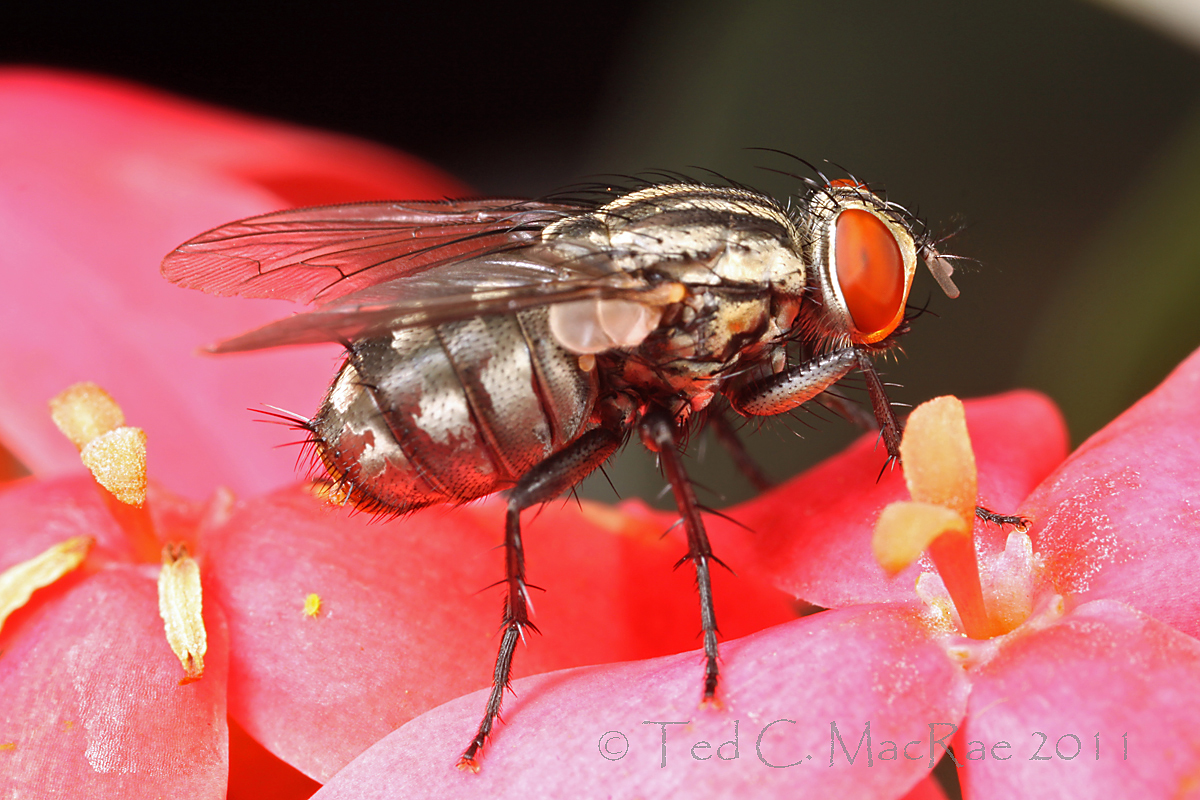
A flesh fly (Diptera: Sarcophagidae).

I presume this to be a type of flesh fly (family Sarcophagidae) based on the stout bristles and color pattern that seems typical for the family.  I like the striking contrast in coloration between the fly and the flower.  There are a few fly bloggers who I’m hoping might be able to give a better identification.

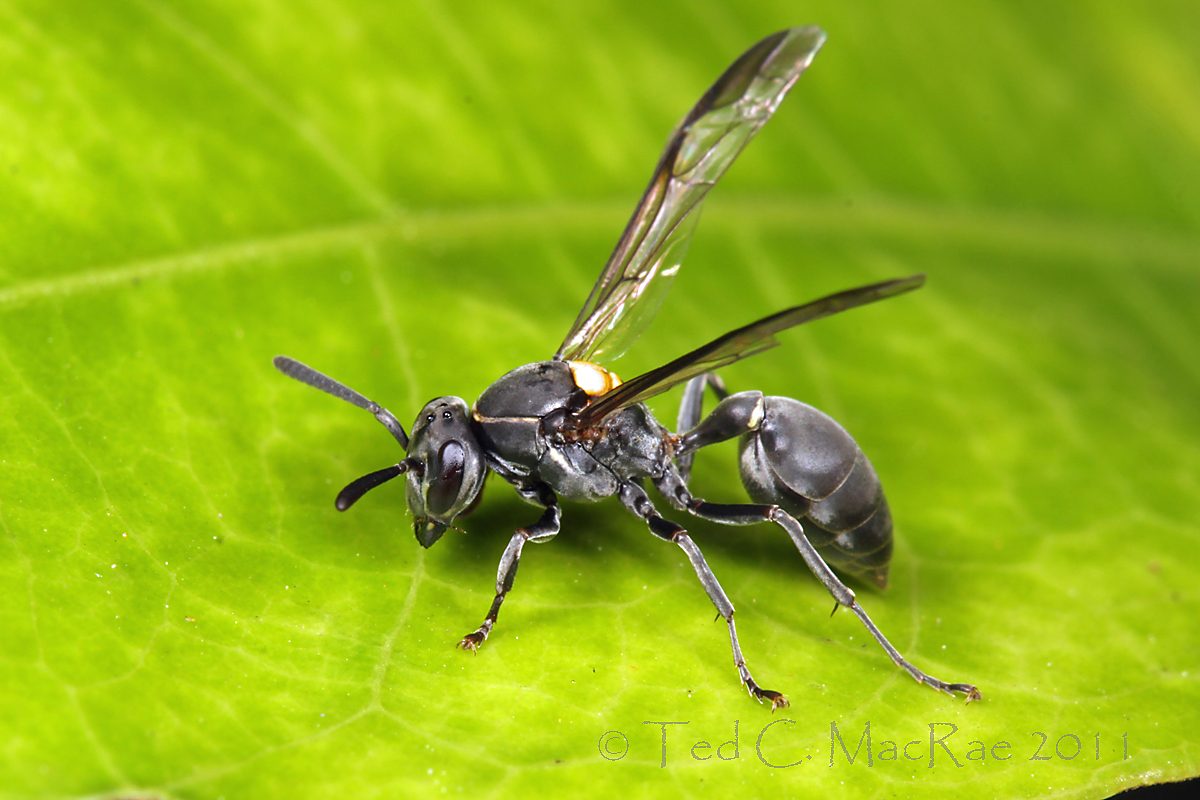
A potter/mason wasp? (Hymenoptera: Vespidae).

This appears to me to be some kind of potter or mason wasp (family Vespidae, subfamily Eumeninae) – it was a bit smallish at only about 12mm in length.  I hope one of the knowledgeable wasp bloggers out there (ahem… Eric?) can at least confirm this level of identification and perhaps the tribe or genus as well. 

Azya orbigera (Coleoptera: Coccinellidae). ID by Tucker Lancaster.

Every ladybird beetle (family Coccinellidae) I’ve ever seen is some variation of black and red/orange/yellow and has a smooth, glabrous appearance.  This beetle is cobalt blue with a dense pubescence over the dorsal surface, but it still seems to me to be some type of ladybird beetle.  It was a tiny little thing, so I suppose it could be one of the multitude of small beetle families with which I am unfamiliar.

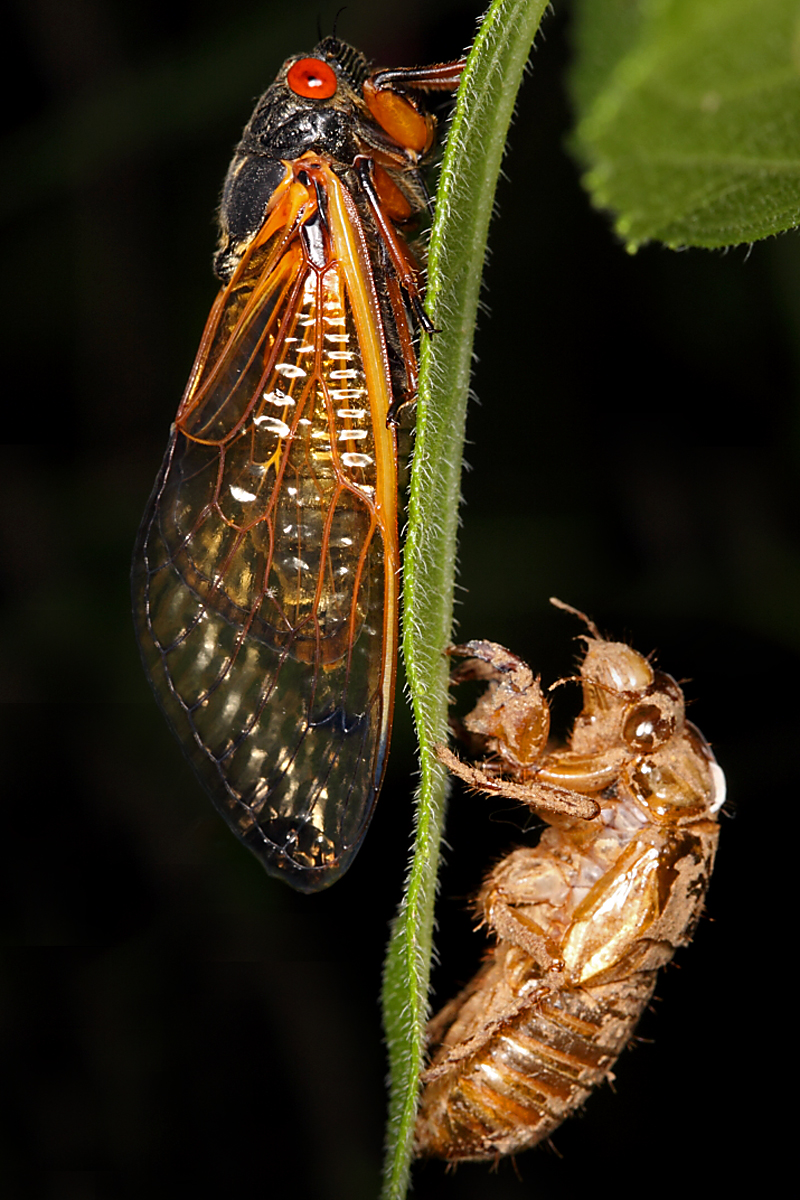
Quedas sp.? (Hemiptera: Cicadidae).

This cast cicada exuvium was not on the shrub, but on a nearby tree at about eye level.  I really wish I could have seen the cicada that emerged from it, because this is certainly the biggest cicada exuvium I have ever seen.  I was about to simply label it “family Cicadidae” but seem to recall that cicada higher classification is in a bit of flux these days.  At any rate, given its great size I wonder if it might represent one of the giant cicadas in the genus Quesada.

I still have many more insect photographs from the past week and will certainly increase that number over the next week as well.  Stay tuned!

Copyright © Ted C. MacRae 2011

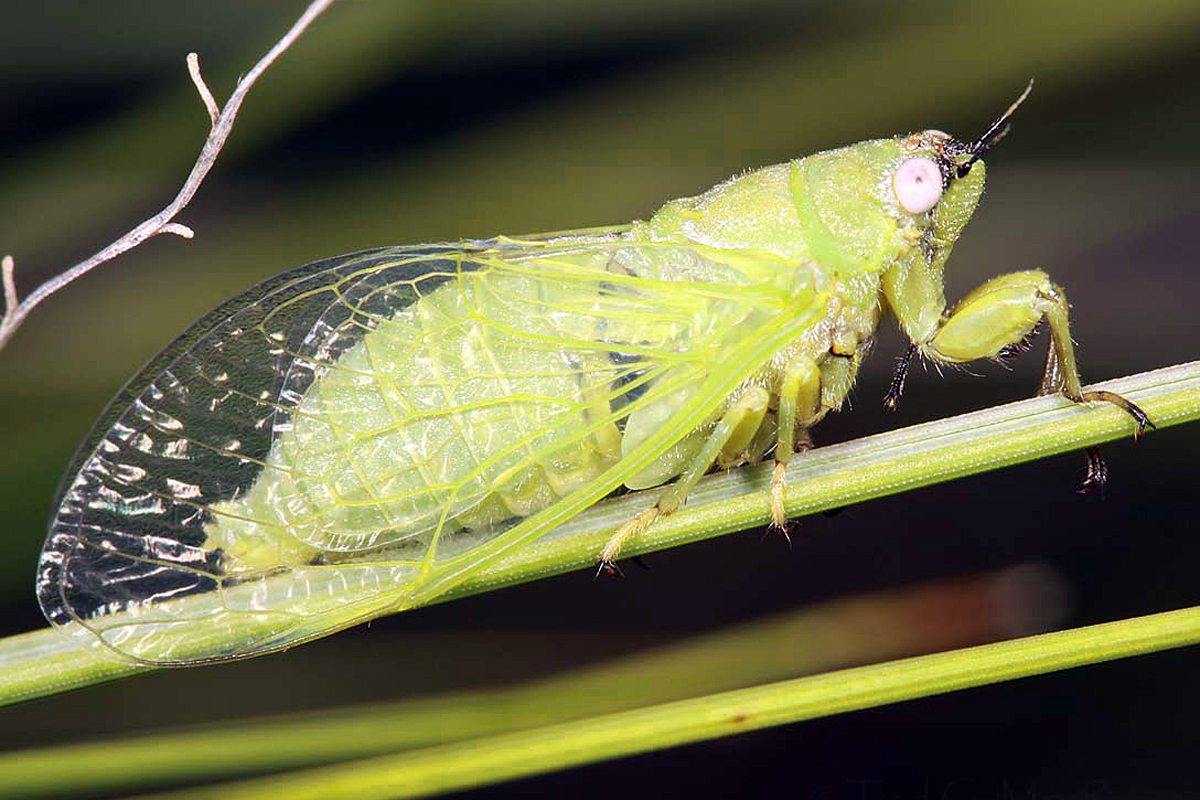
Cicadetta kansa in Oklahoma

Photo details: Canon 100mm macro lens on Canon EOS 50D, ISO 100, 1/250 sec, f/14, MT-24EX flash 1/4 power w/ Sto-Fen diffusers.

Another of the insects that I saw this past June at Four Canyon Preserve in northwestern Oklahoma was this small cicada, Cicadetta kansa. Though not as small as the diminutive Beameria venosa (see North America’s smallest cicada), their barely audible call – a soft buzz – makes them even more difficult to notice.  I only realized what they were after noticing something odd about the small, green “grasshoppers” that flitted in front of me as I walked through the mixed shortgrass prairie.  They didn’t quite fly “right” and landed delicately within the grass rather than crashing into it clumsily.  Even after realizing that they weren’t grasshoppers, it was difficult to say what they were at first due to their wariness and lime green coloration that helped them blend marvelously into their grassy surroundings.  A few sweeps of the net solved that problem, and I discovered what was at the time the smallest and most beautiful cicada I had seen to that point (Beameria venosa took both honors later that month in the Loess Hills of northwestern Missouri).

Despite being the only world-wide genus of cicadas, Cicadetta is represented in the U.S. by only two species—C. kansa and C. calliope.  In addition to its pale green coloration, C. kansa is distinguished from C. calliope by having only 4 or 5 apical cells in the hind wing (6 in C. calliope).  Cicadetta kansa occurs from Texas north to South Dakota, while C. calliope is found from Texas to Florida and northwards to Iowa, Ohio and New Jersey.  Little is known about the biology of Cicadetta kansa; however, presumably it is similar to that of C. calliope, which emerges and lays eggs in late spring.  Eggs hatch by late summer, at which time the nymphs burrow into the ground again begin feeding on the roots of grasses.  This feature of their biology protects them from the negative impacts of managed spring and fall burns, and indeed C. calliope is known to increase in prairies that are managed by such burns.  This is in contrast to other prairie cicadas (genus Tibicen), which overwinter as eggs in the above-ground portion of grasses and, thus, are negatively impacted by fall and spring burns.

A number of websites are dedicated to these charismatic insects; however, Cicada by Andy Hamilton at the Canadian National Collection of Insects, Arachnids and Nematodes is the most informative and comprehensive that I’ve found.

Copyright © Ted C. MacRae

Add to FacebookAdd to NewsvineAdd to DiggAdd to Del.icio.usAdd to StumbleuponAdd to RedditAdd to BlinklistAdd to TwitterAdd to TechnoratiAdd to Furl