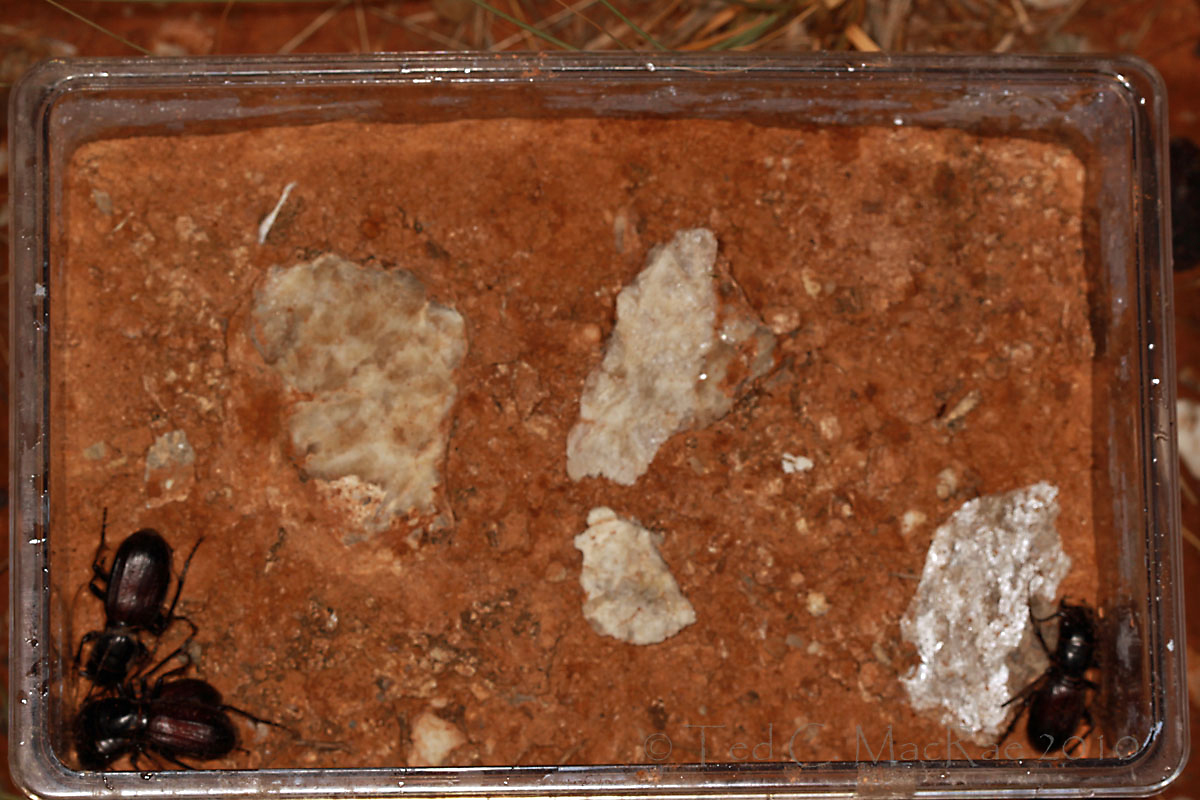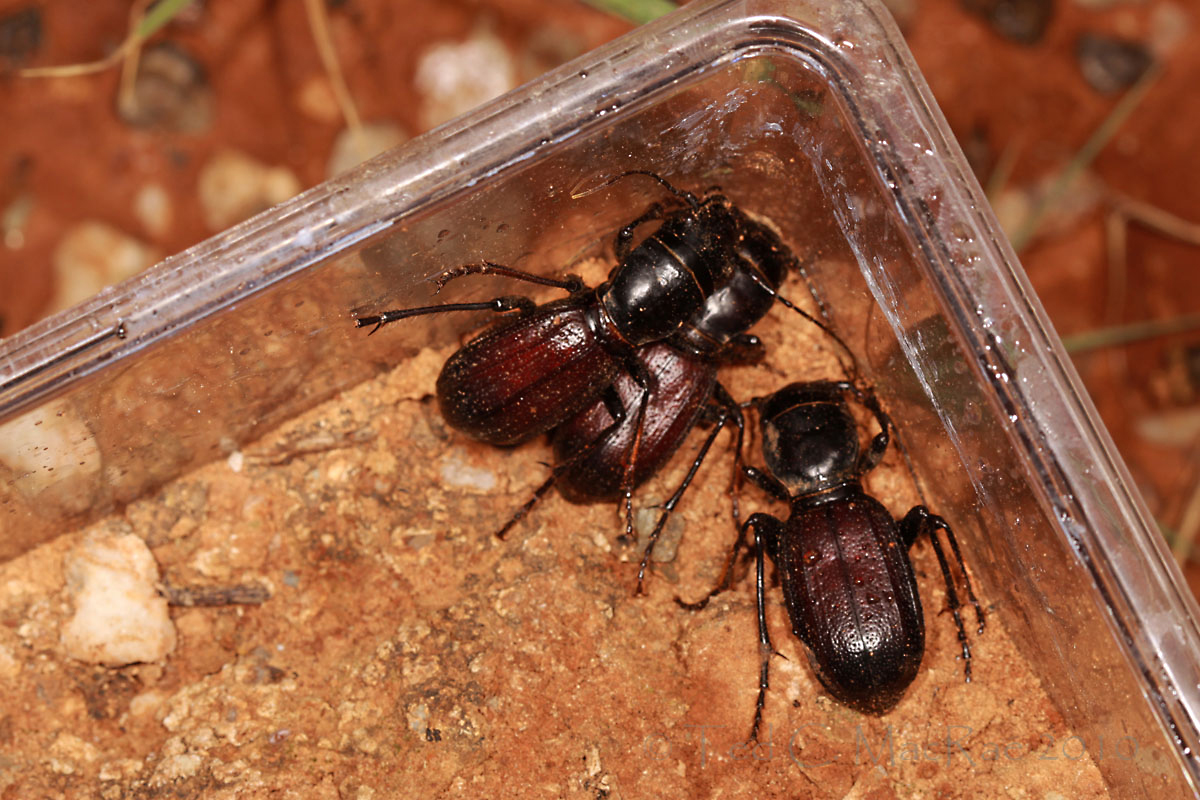
Amblycheila success!

I love it when a plan comes together!

Another one was caught after these photos for a total of five individuals. They’ve been setup for now in a container of native soil. I hope you’ll forgive these rather rushed photos – they were hurriedly taken at half past midnight with rain beginning to fall. Details and much better photographs will, of course, be forthcoming.

I don’t think I have ever worked as hard for five specimens as I did tonight!

Copyright © Ted C. MacRae 2010

Add to FacebookAdd to DiggAdd to Del.icio.usAdd to StumbleuponAdd to RedditAdd to BlinklistAdd to TwitterAdd to TechnoratiAdd to Yahoo BuzzAdd to Newsvine

Email to a friend

The Power of Impulse

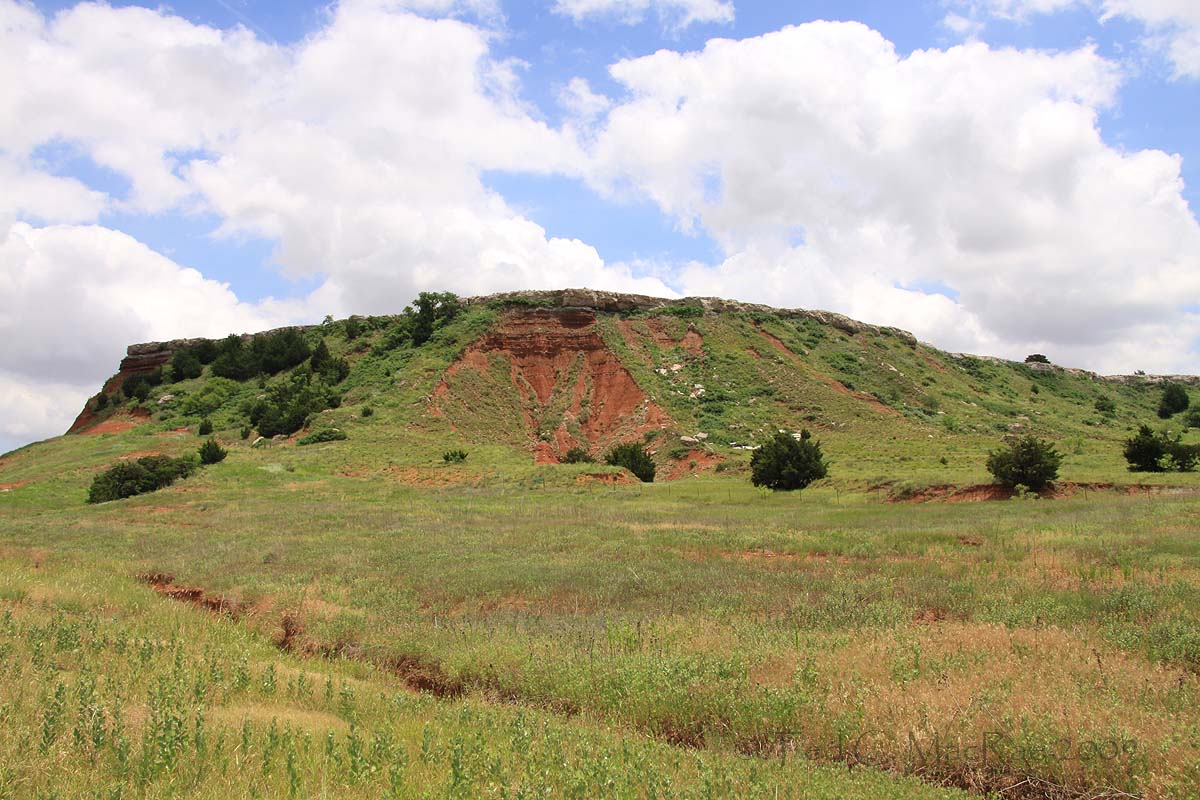
Glass Mountains, Oklahoma

Since figuring out a couple weeks that I had the larva of North America’s largest tiger beetle (Amblycheila cylindriformis, or Great Plains giant tiger beetle) in a rearing tub in the lab, I haven’t been able to think about anything except how cool it would be to go back out to the Glass Mountains in northwest Oklahoma (where I collected the larva last June) and look for the adults.  I have every reason not to do this trip – I just spent a long weekend up in northwest Missouri on follow up surveys for our newly discovered population of Cylindera celeripes (swift tiger beetle) (my second such trip in the past three weeks¹), and in a mere week and a half I leave for a 2-week trip to France.  Bills need to be paid, the grass needs cutting, and (as of today) a broken spoke needs to be repaired.  My collecting trips are normally planned far in advance – their timing and frequency part of a delicate balance between the goals I set for the season and the responsibilities that go along with having a job and a family.

¹ More on this in an upcoming post.

But for Amblycheila, it’s now or never – at least for this season, and the thought of waiting until next year before I can take my first valid shot at finding this species in the wild (and perhaps a previously unrecorded population, at that²) is just too unbearable.  So here I am, halfway to the Glass Mountains on as impulsive a trip as I’ve taken in a long time, hoping that my hunch pays off and I’ll find the strikingly large adults of A. cylindriformis lumbering below the flat-topped mesas in the mixed grass prairie where a little more than a year ago I was collecting its enormous larva. It’s a drive-collect-drive trip, and if successful I won’t be the first person to photograph them, even well, but it will nevertheless fulfill my longtime desire to locate this species in the wild and see it with my own eyes – a far more gratifying experience than looking at the lone dead specimen acquired long ago through trade that sits in my cabinet. Wish me luck!

² Drew and Van Cleave (1962) saw only a single specimen from the state in neighboring Woodward Co., although this is now a rather old reference.

REFERENCES:

Drew, W. A. and H. W. Van Cleave.  1962. The tiger beetles of Oklahoma (Cicindelidae).  Proceedings of the Oklahoma Academy of Science 42:101–122.

Copyright © Ted C. MacRae 2010

Add to FacebookAdd to DiggAdd to Del.icio.usAdd to StumbleuponAdd to RedditAdd to BlinklistAdd to TwitterAdd to TechnoratiAdd to Yahoo BuzzAdd to Newsvine

Email to a friend

Where’s Ted now?

…in the Loess Hills of northwest Missouri, looking for additional sites for Cylindera celeripes (swift tiger beetle). Recall that we (Chris Brown and I) finally found this rarely collected species last year in Missouri (after many years of looking) in high quality remnants of loess hilltop prairie (a critically endangered natural community in Missouri).  The beetle was found at Brickyard Hill, Star School Hill Prairie, and McCormack Loess Mounds Conservation Areas, which combined contain nearly half of the 50 or so acres of loess hilltop prairie still existing in Missouri. The remaining acres are located at Squaw Creek National Wildlife Refuge and on private lands – my sincere appreciation goes out to Squaw Creek Refuge staff and three private landowners, who have all graciously extended to me (and my able field assistant Madison) access to the loess hilltop prairie remnants under their stewardship to better characterize the beetle’s distribution in the area. The sites I am visiting have varied burn histories, ranging from recent to 6 years or more since the previous burn, thus, I am also hoping to better understand the possible impact of prescribed burns on the species’ occurrence in loess hilltop prairie remnants. The beetle needs these remnants to survive, and prescribed burning is an important tool for helping to restore this natural community after decades of shrinkage due to woody encroachment. The trick will be to design management plans that accomplish these restoration objectives while at the same time minimizing possible negative impacts of the burns on existing beetle populations.

Copyright © Ted C. MacRae 2010

Add to FacebookAdd to DiggAdd to Del.icio.usAdd to StumbleuponAdd to RedditAdd to BlinklistAdd to TwitterAdd to TechnoratiAdd to Yahoo BuzzAdd to Newsvine

Email to a friend