Moustached Tiger Beetle

Lake Wales Ridge

Dry sand scrubland on Lakes Wales Ridge in central Florida—home to Cicindela highlandensis and Ellipsoptera hirtilabris

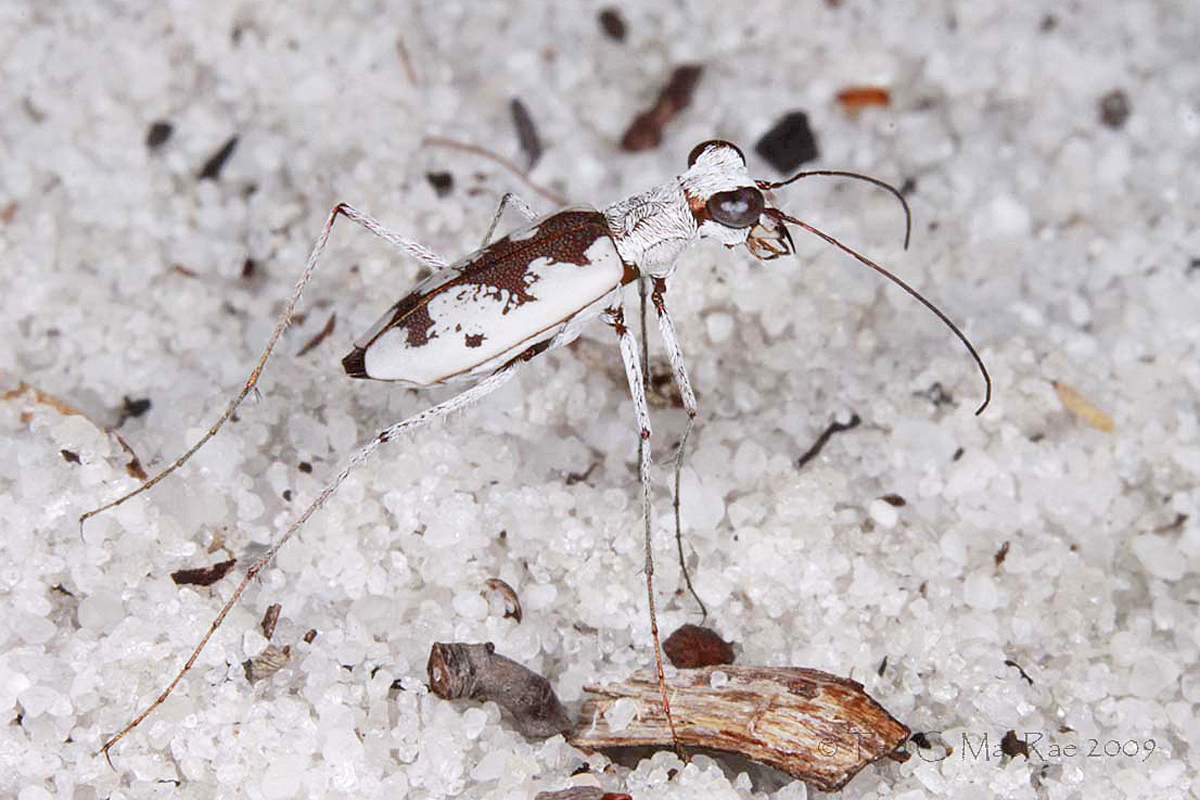
In my previous post, I featured the rare Cicindela highlandensis (Highlands Tiger Beetle), restricted entirely to sand scrubland and pine woodland habitats along the Lake Wales Ridge in central Florida (Choate 2003).  However, that would not be the only Florida endemic tiger beetle that I would encounter during my early August visit.  Another of the several tiger beetle species that I’d hoped to see would also be found that day, although in much lower numbers.  Ellipsoptera hirtilabris (Moustached Tiger Beetle) is so named¹ because of the dense covering of prostrate hairs on its labrum that distinguish it from the closely related E. gratiosa (Whitish Tiger Beetle). Both of these species exhibit striking white maculations that cover almost the entire elytral surface and dense white pubescence covering the head, thorax, underside and legs.  They are the only species of the genus occurring in Florida, but their ranges do not overlap (Pearson et al. 2006)—E. gratiosa occurs in the coastal pine barrens of Virginia, the Carolinas, southern Georgia and the Florida panhandle, while E. hirtilabris is restricted to peninsular Florida in pine woodlands, sand hills and other habitats with open white sand.  Although the latter is considered a Florida endemic, it has been found just outside of Florida in extreme southeastern Georgia on St. Simon’s Island (Choate 2003)In addition to the pubescence of the labrum and their allopatric distributions, the two species may further be distinguished by the slightly less expanded markings and more diffuse edges where they contact the central bronze area in E. hirtilabris and the slightly larger size of E. gratiosa.    Like C. highlandensis and C. abdominalis, it seems likely that E. hirtilabris and E. gratiosa evolved from a common ancestor, diverging in isolation from each other during the pre-Pleistocene separation of peninsular Florida from the North American mainland.   

¹ The species epithet is derived from the Latin words hirtum meaning “hairy” and labrum meaning “lip”.

Ellipsoptera_hirtilabris_IMG_1091_1200x800_enh

Ellipsoptera hirtilabris in the alert position

I found E. hirtilabris to be exceedingly difficult to see and photograph.  Unlike C. highlandensis, which resemble bits of debris laying on the surface of the white sands where it lives, the largely white E. hirtilabris blend into the white sand itself and are almost impossible to see until they move.  The small bronze-colored patches along the elytral suture augment their cryptic capabilities by resembling small bits of debris, which is especially evident in the photo below.  Both Pearson et al. (2006) and Erwin and Pearson (2008) state that adults of this species freeze in position when approached, which may be the reason why I saw so few individuals.  Once I did see them, they were extremely wary and difficult to photograph no matter how cautiously I approached.  The photos shown here represent the only two individuals that I succeeded in photographing, and in neither case did I succeed in getting a frontal perspective to show the pubescent labrum (stifling heat and oppressive humidity during the photo session did not help matters, either).

Ellipsoptera_hirtilabris_IMG_1131_1200x800_enh

The white coloration with small brown markings helps adults blend in perfectly in their white sand habitats

Photo details:
Photo 1: Canon 100mm macro lens on Canon 50D (landscape mode) ISO-100, 1/250 sec, f/16, natural light.
Photos 2 & 3: Manual mode, f/25, MT-24EX flash w/ Sto-Fen diffusers @ 1/8 ratio.

REFERENCES:

Choate, P. M., Jr. 2003. A Field Guide and Identification Manual for Florida and Eastern U.S. Tiger Beetles.  University Press of Florida, Gainesville, 224 pp.

Erwin, T. L. and D. L. Pearson. 2008. A Treatise on the Western Hemisphere Caraboidea (Coleoptera). Their classification, distributions, and ways of life. Volume II (Carabidae-Nebriiformes 2-Cicindelitae). Pensoft Series Faunistica 84. Pensoft Publishers, Sofia, 400 pp.

Pearson, D. L., C. B. Knisley and C. J. Kazilek. 2006. A Field Guide to the Tiger Beetles of the United States and Canada. Oxford University Press, New York, 227 pp.

Copyright © Ted C. MacRae 2009

Add to FacebookAdd to NewsvineAdd to DiggAdd to Del.icio.usAdd to StumbleuponAdd to RedditAdd to BlinklistAdd to TwitterAdd to TechnoratiAdd to Furl

North America’s smallest rattlesnake

Despite tramping through the brush with great frequency during most of my life, I haven’t really seen that many noteworthy reptiles.  I don’t know whether its because I’ve failed to actually encounter them or whether my singleminded obsession with insects above all other things natural has instead prevented me from seeing what was right in front of me.  Regardless of the reason, all that has seemed to change during the past two seasons (strangely coincident with my decision to start carrying a camera), and I now seem to be enjoying a bit of a reptile bonanza.  Last summer I featured a super-aggressive prairie rattlesnake from a trip to the Black Hills of South Dakota and an uncooperative dusty hognosed snake from Missouri’s critically imperiled sand prairies (both first-time sightings for me).  The reptilian treats continued this year – I saw my first juvenile Osage copperhead in May to go along with the several adults that I’ve encountered, and shortly afterwards during a June trip to northwestern Oklahoma I was treated to a gorgeous male eastern collard lizard, two Texas horned lizards, and a much more cooperative western hognosed snake (the last two being first-time sightings for me).  There was another herp that I saw during that Oklahoma trip, but I did not feature it here because I had stupidly declined to strap the camera bag to my back during a quick look at a roadside habitat.  That sighting was another first-timer for me – a western pygmy rattlesnake (Sistrurus miliaris streckeri).  I’m no herp expert, so wasn’t sure what it was at the time, but I later learned that its small size and distinctive markings were quite diagnostic.

IMG_1014_1200x800
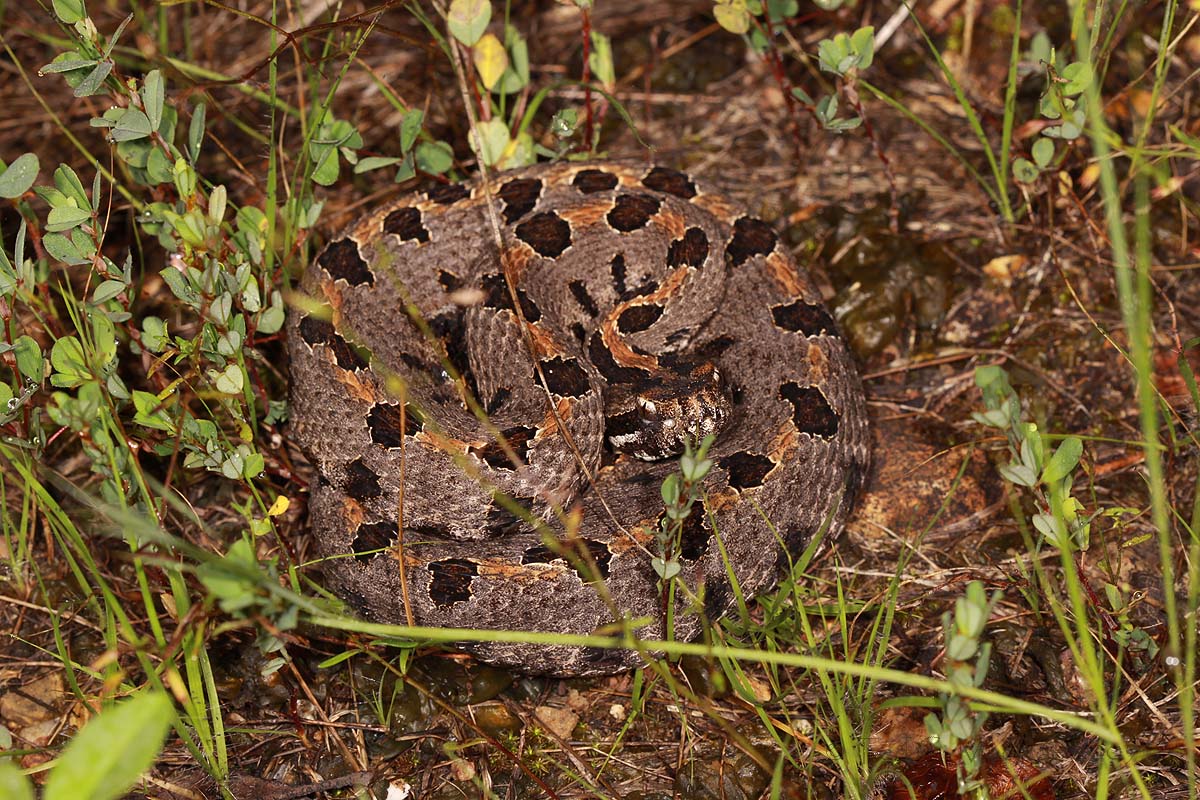
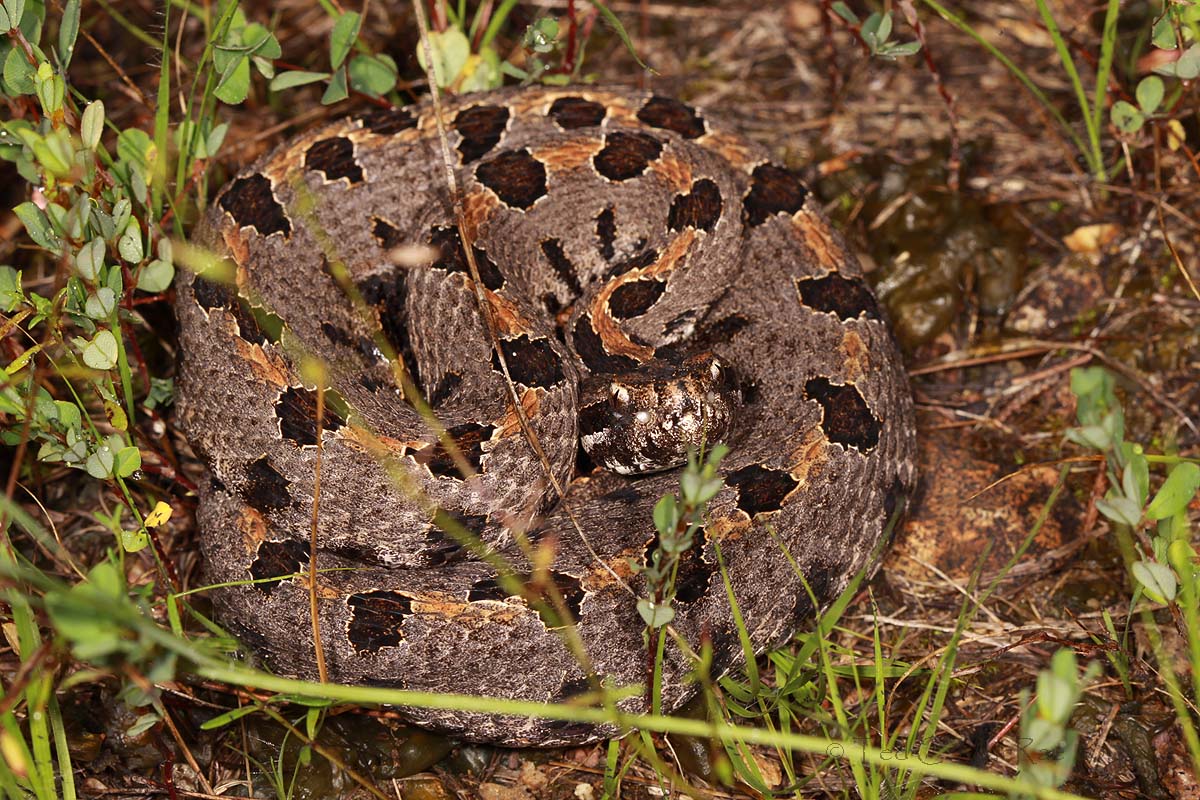
Western pygmy rattlesnake – Sistrurus miliarius streckeri

Amazingly, I encountered this same species again just a few weeks later during a visit to the White River Hills of extreme southwestern Missouri.  It was during the second of two trips to the region to search for the stunningly beautiful bumelia longhorned beetle, Plinthocoelium suaveolens plicatum (family Cerambycidae), and the weather during that day – continuous drizzle and low, threatening clouds – had not been at all conducive for finding such a sun loving beetle.  After searching an area where I knew the beetles occurred, without success, daughter Madison and I resigned that the drizzle was here to stay and decided to pass the rest of the day with some hiking at one of Missouri’s most spectacularly wild and beautiful places, Hercules Glades Wilderness.  A splendid mix of post oak savannahs and limestone glades intersperses through the oak/hickory forests in these rugged hills, creating some of Missouri’s most scenic vistas.  Near the end of the hike at the edge of one of these glades on the high point of Coy Bald, I saw this little individual coiled up underneath an eastern red-cedar (Juniperus virginiana) tree.  Unlike the terrifyingly aggressive prairie rattlesnakes I encountered in South Dakota last fall, this snake seem to be relying upon its cryptic coloration to avoid detection, rattling only after I had approached quite closely… or maybe it was only then I could actually hear the rattle, which was barely audible and sounded much like the buzz of a small katydid.

Pygmy rattlesnakes are the smallest rattlesnakes in North America, growing to around 15-25 inches long – this individual looked to be about 18-20 inches in length.  They are one of only two U.S. species in the primitive rattlesnake genus Sistrurus – the other being the larger wet prairie inhabiting massasauga (S. catenatus).  All other rattlesnakes (28 species, 13 in the U.S.) belong to the genus Crotalus (Smith et al. 2001).  Western pygmy rattlesnakes are not really a western U.S. species, but rather the westernmost subspecies of this southeastern U.S. species (with subspecies miliarius and streckeri occupying the northeastern and southeastern portions, respectively, of its range).  In Missouri, it is not nearly as common as the timber rattlesnake (Crotalus horridus), occurring only in the extreme southern Ozarks along the border with Arkansas and up into the St. Francois Mountains of the eastern Ozarks (Johnson 1997).  Although no known human deaths have ever been caused by this species, known locally as the “ground rattler,” it is nevertheless poisonous and worthy of respect.  I must admit to having been lulled a little bit by its calmness – much like the juvenile copperhead I photographed in May – and found myself tempted to approach ever closer for photographs.  The photograph below represents the closest that I was able to get before it began “striking” at me – whether these were bluff strikes intended to frighten or actual attempts to bite I do not know.  Suffice it to say that I “got the message” and ended my attempts to get even closer.  Daughter Madison watched in nervous amazement as all this was going on, and afterwards I tried to impress upon her young, virgin mind what a rare and wonderful experience we’d just had.  Perhaps I succeeded, as this was the first story she told to her head-shaking mother upon our return home the following evening!

IMG_1016_1200x800

Photo details: Canon 100mm macro lens on Canon EOS 50D, ISO 100, 1/250 sec, f/9-10, MT-24EX flash 1/2 power through diffuser caps.

REFERENCES:

Johnson, T. R. 1997. The Amphibians and Reptiles of Missouri. Missouri Department of Conservation, Jefferson City, 368 pp.

Smith, H. M., E. D. Brodie, D. M. Dennis and S. Barlowe. 2001. Reptiles of North America: A Guide to Field Identification. Golden Field Guide from St. Martin’s Press, New York, 240 pp.

Copyright © Ted C. MacRae 2009

Add to FacebookAdd to NewsvineAdd to DiggAdd to Del.icio.usAdd to StumbleuponAdd to RedditAdd to BlinklistAdd to Ma.gnoliaAdd to TechnoratiAdd to Furl

North America’s longest insect

This past June might be the most successful month entomologically that I’ve ever had.  The excitement of discovering a robust population of Cylindera celeripes (swift tiger beetle) (previously considered one of North America’s rarest tiger beetles) in northwestern Oklahoma lasted only two weeks before being eclipsed by our long-awaited success at finding this same species also in Missouri.  Icing on the cake was provided by finding Ellipsoptera macra (sandy stream tiger beetle) – the last tiger beetle species we had yet to encounter in Missouri, and significant new records for the tiny prairie cicada, Beameria venosa, and the impressive robber fly, Ospriocerus abdominalis, in Missouri’s critically imperiled loess hilltop prairies.  With that rapid-succession-success, my thoughts immediately turned to another of Missouri’s unique natural communities – the dolomite glades of the White River Hills in the extreme southwestern part of the state.  In fact, I had already been yearning to return to the White River Hills, having last visited some years ago and recalling – from the perspective now as an insect photographer – the many photogenic insect species that I’ve encountered there.  Chief among them is Plinthocoelium suaveolens (bumelia borer), a spectacularly beautiful longhorned beetle of neotropical affinity that must be seen to be believed and which I had observed here several years ago in fair numbers as they perched on the lower trunks of their presumed larval host, Sideroxylon (= Bumelia) lanuginosa of the family Sapotaceae.  I had even mentioned to my colleague Chris Brown, as we began the first day of our planned multi-weekend search for C. celeripes and C. macra in northwestern Missouri, that my dream scenario was that we would find both celeripes and macra on that first weekend, negating the need for additional survey the following weekends, in which case we could shoot down to the White River Hills to look for Plinthocoelium.  Who knew how prescient that comment would be!

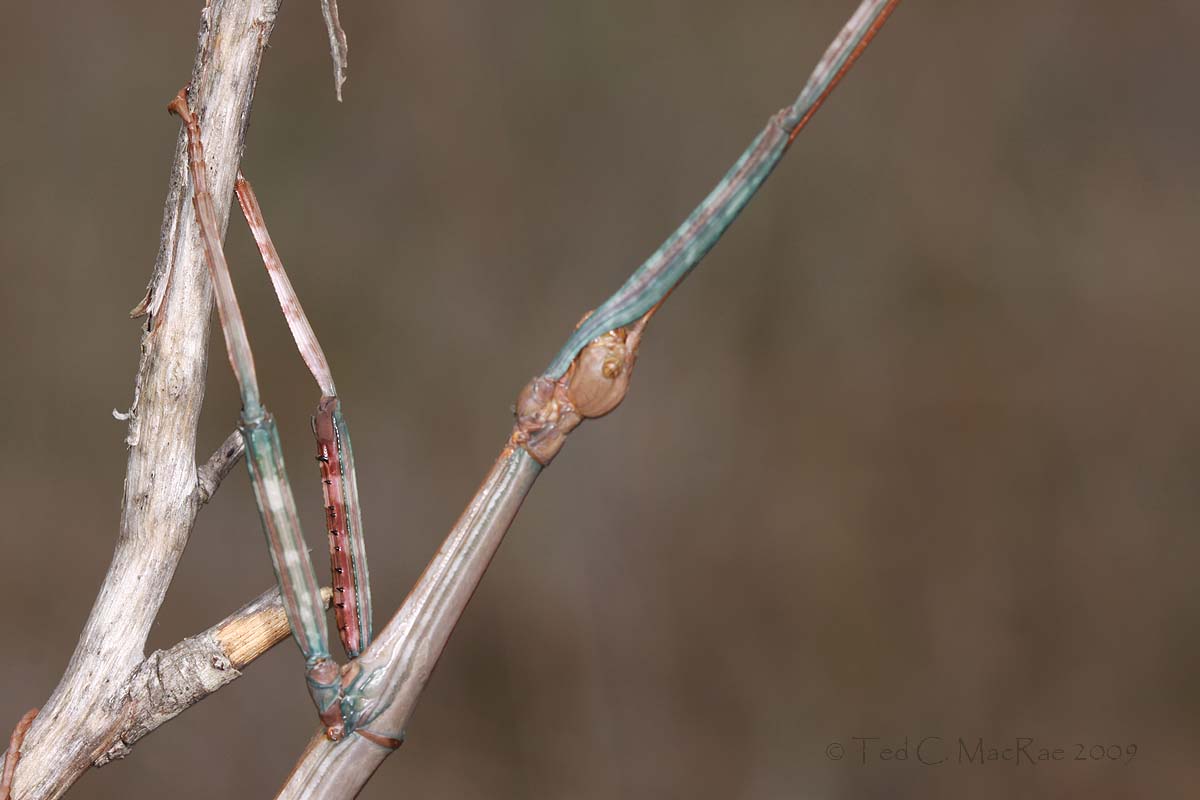
Megaphasma denticrus - giant walkingstick

Megaphasma denticrus - giant walkingstick

I won’t keep you in suspense – I succeeded in finding and photographing Plinthocoelium, although (happily) there is more to the story than just that.  I’ll share that experience here soon, but first I want to discuss another insect I saw on the first of my two July visits to the White River Hills – Megaphasma denticrus¹ (giant walkingstick).  As implied by its common name, this walkingstick is enormous – females (typically larger than males) can reach lengths of 150+ mm (that’s 6 inches, folks!), making it officially the longest insect species in all of North America.  IMG_0909_1200x800The female I feature here was solidly in that range, and with her front legs held outstretched in front of her (as pictured above), total length exceeded 8 inches.  Of course, this pales in comparison to a related species from Borneo, individuals of which have been documented measuring more than 18 inches in length!  The giant walkingstick is distributed primarily in the south-central U.S. – especially Texas, although records do exist from as far north and east as Iowa, Wisconsin, and Indiana (Arment 2005). I have encountered this species a few times before – always in the White River Hills, but Arment (2005) also records the species from several other counties in the Ozark Highlands across southern Missouri and Arkansas.  In addition to its great size, both sexes of this species can be distinguished from other walkingsticks by the rows of numerous teeth on the underside of the middle (meso-) femur (easily seen in the enlarged view of Photo 2 above) and by the very long antennae (longer than the front femur).  Color is variable – other individuals I have seen are tan with bright red dorsal stripes on the thoracic segments.

¹ Formerly classified with grasshoppers and their kin in the order Orthoptera, walkingsticks are now placed their own order, Phasmatodea, the name being derived from the Greek phasma (apparition, ghost) in reference to their cryptic appearance and behavior (the alternative spellings Phasmodea and Phasmida are improper formations from the Greek root – see Grimaldi and Engel 2005).  The genus name, Megaphasma, thus means “giant walkingstick.”  The specific epithet, denticrus, is derived from the Latin den (tooth) and crus (leg), presumably a reference to the toothed underside of the mesofemur. Many authors, including even some taxonomists (e.g., Beamer 1932), have mispelled the name as “dentricus” – nonsensical in Latin – with some even using both spellings in the same paper (e.g., Maginnis et al. 2008)!

Of course, an outstanding feature of this species, and all walkingsticks in general, is its uncanny resemblance to sticks and twigs.  This cryptic appearance is further augmented behaviorally by the habit of “swaying” back and forth to simulate movement in a gentle breeze.  I must confess that I did not even notice this large female individual – less than two feet away on a low branch – until she started moving about.  Once spotted, a walkingstick of this size would seem to be a tasty – and defenseless – morsel for some avian predator; however, they have another defensive tactic up their sleeve – autotomy (i.e., the ability to shed appendages in response to predatory attack). IMG_0913_1200x800While it may seem that their long, delicate-looking legs are simply “pulled off” by the predator, fortuitously allowing the walkingstick to clamber to safety, leg shed is actually controlled by the central nervous system in response to external stimuli (e.g., grabbing of the leg).  Breakage occurs at predetermined abcission points, which are rapidly sealed after shedding to prevent excessive loss of body fluids.  I experienced this first hand – lacking any container large enough to hold the enormous female, I gently placed her into my net and gingerly carried her back to the truck, only to find a hind leg already shed by the time I got back.  I decided the effort to glue one (or more) legs in place to acheive a well-curated specimen exceeded my interest in starting a collection of this particular group of insects, so I let her go.  Presumably she crawled away to safety, though sadly no longer the ‘perfect’ specimen that I first encountered.

Photo details:
Photo 1 (full insect): Canon 100mm macro lens on Canon EOS 50D (auto mode), ISO 200, 1/320 sec, f/5.6, natural light.
Photos 2 (midrange) and 3 (closeup): same except (manual mode), ISO 100, 1/60 (Photo 2) or 1/250 (Photo 3) sec, f/10 (Photo 2) or f/20 (Photo 3), MT-24EX flash 1/4 power w/ diffuser caps.

REFERENCES:

Arment, C. 2005. Stick Insects of the Continental United States and Canada: Species and Early Studies. Coachwhip Publications, Landisville, Pennsylvania, 202 pp.

Beamer, R. H. 1932. The giant walking-stick (Megaphasma dentricus (Stal.)) found in Kansas. Journal of the Kansas Entomological Society 5(1):28.

Grimaldi, D. and M. S. Engel. 2005. Evolution of the Insects. Cambridge University Press, New York, xv + 755 pp.

Maginnis, T. L., Cool, C. L. and J. L. Muniz. 2008. Some observations on the mating behavior of the giant walkingstick, Megaphasma dentricus (Orthoptera: Phasmidae). Texas Journal of Science 60(1):57-62.

Copyright © Ted C. MacRae 2009

Add to FacebookAdd to NewsvineAdd to DiggAdd to Del.icio.usAdd to StumbleuponAdd to RedditAdd to BlinklistAdd to Ma.gnoliaAdd to TechnoratiAdd to Furl

North America’s smallest cicada

Photo details: Canon 100mm macro lens on Canon EOS 50D, ISO 100, 1/250 sec, f/18, MT-24EX flash 1/2 power w/ diffuser caps.

Photo details: Canon 100mm macro lens on Canon EOS 50D, ISO 100, 1/250 sec, f/18, MT-24EX flash 1/2 power w/ diffuser caps.

While searching the hilltop prairies for Cylindera celeripes (swift tiger beetle) at McCormack Loess Mounds Natural Area in northwestern Missouri, I ran across a species of cicada that I’d not yet encountered in the state – Beameria venosa.  Cicadas as a rule are quite large insects, but with a body measuring only 16 mm (well under an inch) in length, B. venosa is one of – if not the – smallest species of this group in all of North America.  Had it not been for its distinctly cicada-esque call I might have thought it was some sort of fulgoroid planthopper (albeit a rather large one).  But a cicada it is, and a beautiful one at that despite its small size.

Beameria venosa is a prairie obligate species occurring from Nebraska and Colorado south to Texas and New Mexico.  To my knowledge, it has not been formally recorded from Missouri, although it is certainly already known from the state (it is listed in the 2009 issue of Missouri Species and Communities of Conservation Concern Checklist as “vulnerable” due to the restricted occurrence in Missouri of the prairie habitats in which it lives).  Froeschner (1952) listed 14 species of cicadas from Missouri but did not include this species even among those of possible occurrence in the state.  In my younger days, I managed not only to find all 14 of those species, but also a fifteenth species – the magnificent Tibicen superbus – in the southwestern corner of the state (formally recorded from the state some years later by Sanborn and Phillips 2004).  The occurrence of B. venosa in Missouri now brings to 16 the number of cicada species known from Missouri.

Despite its small size, the calling song of B. venosa is quite audible.  In fact, it was only due to its call that I noticed and began looking for this individual.  This brings up an interesting point regarding conspicuous insect songs and their role in enhancing predation risk.  Many predators are known to orient to the calls of cicadas (Soper et al. 1976), which in turn exhibit a variety of predator avoidance behaviors such as high perching, hiding, fleeing, and perhaps even mass emergence in the periodical cicadas.  Beameria venosa appears to avoid predators by producing its continuous train of sound pulses at a very high frequency.  Although audible to humans, the high frequency call apparently is not audible to birds and lizards – their chief predators (Sanborn et al. 2009).  In the open, treeless prairies where B. venosa lives, high frequency calling appears to provide the selective advantage for predator avoidance that fleeing, hiding, and high perching cannot.

REFERENCES:

Froeschner, R. C.  1952. A synopsis of the Cicadidae of Missouri. Journal of the New York Entomological Society 60:1–14.

Sanborn, A. F., J. E. Heath and M. S. Heath.  2009.  Long-range sound distribution and the calling song of the cicada Beameria venosa (Uhler) (Hemiptera: Cicadidae).  The Southwestern Naturalist 54(1):24-30.

Sanborn, A. F. and P. K. Phillips.  2004.  Neotype and allotype description of Tibicen superbus (Hemiptera: Cicadomorpha: Cicadidae) with description of its biogeography and calling song.  Annals of the Entomological Society of America 97(4):647-652.

Soper, R. S., G. E. Shewell and D. Tyrrell. 1976. Colcondamyia auditrix nov. sp. (Diptera; Sarcophagidae), a parasite which is attracted by the mating song of its host, Okanagana rimosa (Homoptera: Cicadidae).  The Canadian Entomologist 108:61-68.

Copyright © Ted C. MacRae 2009

Add to FacebookAdd to NewsvineAdd to DiggAdd to Del.icio.usAdd to StumbleuponAdd to RedditAdd to BlinklistAdd to Ma.gnoliaAdd to TechnoratiAdd to Furl

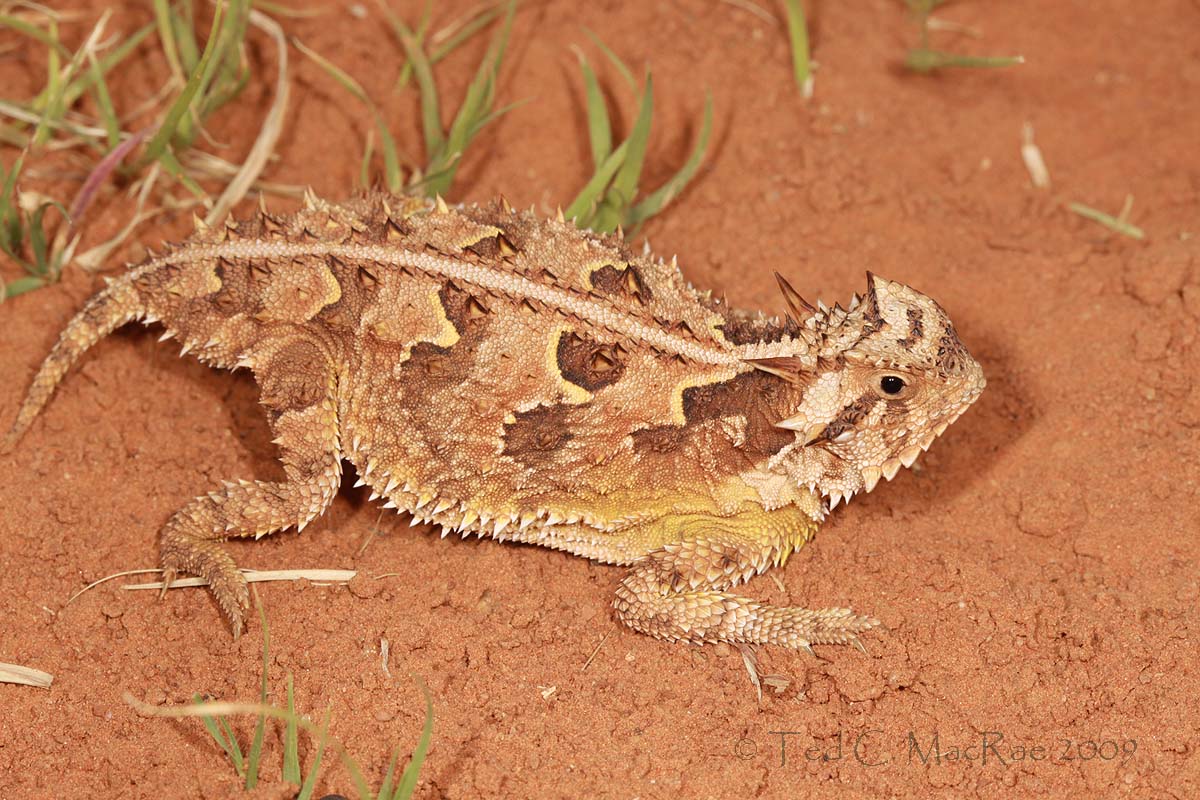
North America’s most bizarre lizard

Hmm, something funny going on here.  This is a bug blog – specifically a beetle blog, yet it’s a post about a lizard that generates a flurry of comments.  I don’t know if lightning will strike twice so quickly, but I did have this second ‘lizard’ post already lined up in the queue.

IMG_0390_1200x800

The day after seeing a couple of male eastern collared lizards at Four Canyon Preserve in northwestern Oklahoma, I got my second saurian treat with this horned lizard (genus Phrynosoma).  There are actually some dozen species of horned lizards in North America, but the majority are found further west in the U.S. and down into Mexico and Central America.  Of the two that occur in Oklahoma, this particular individual can be identified as a Texas horned lizard (P. cornutum) by the two occipital (back of the head) spines, presence of lateral abdominal finge scales, and dorsal white stripe.  Oklahoma’s other horned lizard (round-tailed horned lizard, P. modestum) is restricted to the northwestern corner of the panhandle and differs from the Texas horned lizard by having four occipital spines, lacking lateral abdominal fringe scales, and more solid pale coloration.

IMG_0392_1200x800Again, my claim of “most bizarre” might be open to debate, as there are certainly many bizarre lizards in North America.  The gila monster once more comes to mind, but I think grotesque is a better descriptor for that animal, and the fan-shaped toe pads of geckos might also get them some votes.  Nevertheless, do a Google search on the phrase “bizarre North American lizard” and the results will be overwhelmingly dominated by references to horned lizards.  It’s no surprise – their squat body form is more suggestive of toads than lizards¹, for which they are commonly called “horned toads” or “horny toads,” and their covering of “horns” (actually modified scales) gives them an otherworldly, almost dinosaurian appearance.  Who among my generation wasn’t terrorized by the sight of these lizards, cheaply magnified, as they threatened the scientists that encountered them in the 60’s sci-fi classic The Lost World?

¹ Even the genus name, derived from the Greek words phrynos (toad) and soma (body), alludes to its toad-like appearance.

IMG_0397_1200x800In reality, these lizards are anything but terrifying.  Instead they employ multiple strategies to avoid being eaten themselves. These adaptations were all on display as I initially passed this individual without even noticing it lying motionless in the middle of the road. Once I had passed I noted movement out of the corner of my eye and turned to see it scurrying towards the vegetation along the side of the road. It’s mottled coloration, blending well with its background, and spine-broken silhouette made it almost invisible. Feeling threatened by my too-close approach, it made a rapid burst for cover, but I cut it off at the pass and blocked its erratic scampers towards the roadside to keep it out in the open so I could take some photographs. Once cornered in the open, it resorted to a third strategy – puffing of the body to make it appear larger. Had I been a true predator, it would’ve had two more strategies up its sleeve that it could have employed as a last resort – bleeding from the eyes (which apparently has a foul taste and will cause a predator to drop the lizard from its mouth) along with the mechanical defense of its hard, spiny scales. Since I didn’t actually try to eat this little guy, I didn’t have a chance to experience these final lines of defense.

The photos here actually represent two individuals – the middle picture is a second lizard that suddenly appeared while I was photographing the first.  The second individual was somewhat smaller than the first and not as boldy marked (note the lack of a distinct dark stripe behind the eye).  Whether these were male and female is difficult to say – horned lizards lack outward sexual characters allow them to be easily distinguished in the field (females do tend to grow a little bit larger). While not threatened or endangered, Texas horned lizards, like many other horned lizard species, have experienced dramatic reductions in its range. Oklahoma has a year-round closed season for both species that makes it illegal to kill or capture horned lizards without written permission. I would see a few more of these fascinating little lizards during my three days at Four Canyon Preserve, suggesting that, at least in this part of the state, horned lizards are doing just fine.

Photo details: Canon 100mm macro lens on Canon EOS 50D, ISO 100, 1/250 sec, f/11-13, MT-24EX flash 1/4 power through diffuser caps.

Copyright © Ted C. MacRae 2009

Add to FacebookAdd to NewsvineAdd to DiggAdd to Del.icio.usAdd to StumbleuponAdd to RedditAdd to BlinklistAdd to Ma.gnoliaAdd to TechnoratiAdd to Furl

The “obscure” Dicerca

IMG_0533_1200x800

Photo details (first 2 photos): Canon 100mm macro lens on a Canon EOS 50D, ISO 100, 1/250 sec, f/13, MT-24EX flash 1/4 power through diffuser caps

During my recent trip to northwestern Oklahoma, we visited Packsaddle Wildlife Management Area, a 17,000-acre chunk of land containing mixed-grass prairie, shinnery oak (Quercus havardii) shrublands, and mesic woodlands along the South Canadian River.  In one of these woodlands, I encountered a small grove of persimmon (Diospyros virginiana) trees – some of which had recently died.  Whenever I see dead persimmons, I immediately think of the jewel beetle species, Dicerca obscura (family Buprestidae).  This attractive species is one of the larger jewel beetles occurring in our country, and although it is fairly commonly encountered in collections, seeing the living beetles in the field is always a treat.  Dicerca obscura is most commonly associated with persimmon, from which I have reared it on several occasions, but Knull (1920) also recorded rearing it from staghorn sumac (Rhus typhina).

IMG_0534_1200x800I began inspecting the dead trees for the presence of the beetles but didn’t see any at first.  Then, I saw something moving right where I had been looking.  I had, in fact, looked right over this beetle without seeing it – even though I knew what could be there and what it looked like.  I don’t know if the species name (from the Latin obscurus, meaning indistinct) was actually given because of its marvelous cryptic abilities, but it certainly could have been.  As I continued to inspect the trees more closely, I found several additional adults – all sitting on trunks that I had just inspected a few minutes prior.  I couldn’t help but think of the irony – in collections, Dicerca beetles are quite gaudy and conspicuous appearing, with their shiny, brassy colors and exquisite surface sculpturing (as exemplified by Dicerca asperatathis photo of a pinned specimen in my collection of a similar species, D. asperata).  However, in the context of their environment, their coloration and sculpturing helps them blend in and become almost invisible.

Dicerca obscura occurs across the eastern U.S. but is absent from much of New England, the Appalachian Mountains, the Allegheny Plateau, and the upper Midwest – apparently due to the absence of persimmon in those regions.  It has been been recorded in Oklahoma as far west as Oklahoma City (Nelson 1975), so my record from Ellis Co. in far northwestern Oklahoma represents a bit of a range extension.  This is not surprising – the species will probably be found wherever persimmon grows.  You’ll just have to look carefully if you want to find it!

REFERENCES:

Knull, J. N.  1920.  Notes on Buprestidae with descriptions of new species.  Entomological News 31:4-12.

Nelson, G. H.  1975.  A revision of the genus Dicerca in North America (Coleoptera: Buprestidae).  Entomologische Arbeiten aus dem Museum G. Frey tutzing bei München 26: 87-180.

Copyright © Ted C. MacRae 2009

Add to FacebookAdd to NewsvineAdd to DiggAdd to Del.icio.usAdd to StumbleuponAdd to RedditAdd to BlinklistAdd to Ma.gnoliaAdd to TechnoratiAdd to Furl

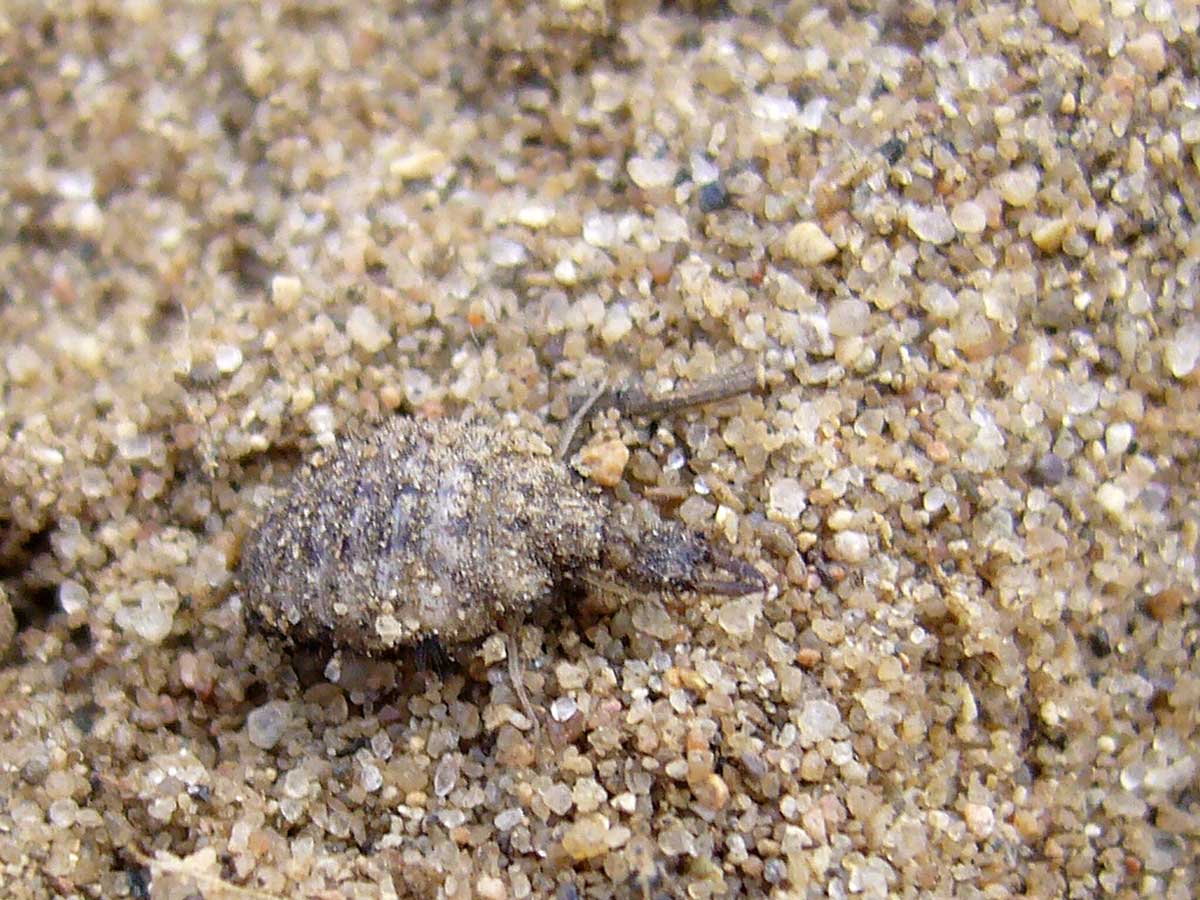
Now you see me…

Myrmeleon_sp_P1020915_2

…now you don’t!
Myrmeleon_sp_P1020914_2

In a previous post, I lamented the fact that I had never actually seen a live antlion larva, or doodlebug (family Myrmeleontidae). Lovers of sand, I’ve seen their famous pitfall traps many times, especially in recent years as I’ve searched sand habitats for my beloved tiger beetles. Occasionally, I’ve stopped to jab my knife under a pit, give it a quick flip, and search the freshly turned sand for the maker of the pit – never seeing anything. It never bothered me much either – there were always beetles to catch!  Two weeks ago I returned to the sand prairies of southeastern Missouri to look for additional sites for Cicindela scutellaris (festive tiger beetle), and as we searched one particular site on the Sikeston Sand Ridge I once again saw the characteristic funnel-shaped pits amongst sparse vegetation in the sandy soil.  I decided this time I needed to give it a good effort – how can any self-respecting entomologist accept not having ever seen a live doodlebug?  As I’d done many times before, I kneeled down, gently put the tip of the knife about an inch away from the edge of the pit, and then jabbed its full length assertively into the sand and under the burrow and flipped it over.  Like previous times, I studied the turned sand and saw nothing.  I stirred the sand gently with the tip of the knife and studied it again – nothing.  I tried another burrow – again, nothing.  I decided right then and there that I was doing something wrong – I could not simply be picking ’empty’ pits.  I continued staring at the turned sand, and then I saw movement – I looked closer, and it seemed as though the sand itself was moving.  At last I made out its outline – I had finally succeeded in finding a doodlebug!  I dug up another burrow, and knowing what I was looking for this time I had no problem quickly locating the little creature.  I watched it as it lay motionless – perfectly camouflaged by its color and with sand grains sticking to its body, and chuckled as it buried itself almost instantly with a quick, backwards shuffle into the sand. Who knows how many doodlebugs I’d successfully dug up in the past, completely overlooking them as they lay disguised and motionless in the sand.

More than 100 species of antlions, representing at least 19 genera, live in the Nearctic Region, although much of this diversity occurs in the southwestern U.S. and Mexico.  Despite the commonly drawn association between antlions and pitfall traps, in North America only those in the genus Myrmeleon actually exhibit this behavior.  This larva dug a pit and so must represent a species of Myrmeleon – perhaps M. immaculatus, a common species in North America and one whose adult I observed last fall on a nearby sand prairie remnant.  Species in other genera have free-living larvae that hide under objects or roam underneath the sand, from where emerge briefly to hunt for prey.

For those interested in learning more about antlions, Mark Swanson has an excellent website called The Antlion Pit.

REFERENCE:

Swanson, M.  1996. The Antlion Pit: A Doodlebug Anthology. http://www.antlionpit.com/

Copyright © Ted C. MacRae 2009

Add to FacebookAdd to NewsvineAdd to DiggAdd to Del.icio.usAdd to StumbleuponAdd to RedditAdd to BlinklistAdd to Ma.gnoliaAdd to TechnoratiAdd to Furl

Bizarre, beautiful extremes

No niche, it seems goes unfilled. Specialization is likely to be pushed to bizarre, beautiful extremes.–E. O. Wilson, The Diversity of Life

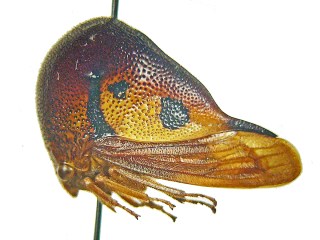
Wilson didn’t mention treehoppers specifically when he made the above quote, referring to the exuberance of extreme behavioral and morphological adaptations seen in the biota of the tropics, but he could have just as easily led off with them.  Treehoppers (order Hemiptera, family Membracidae) are well-known for their variety of oddly grotesque shapes resulting from a curiously inflated pronotum – presumably having evolved to resemble thorns and buds on their host plants, or the ants that vigorously defend numerous treehopper species in exchange for their sweet honeydew, or perhaps to aid in the dispersal of volatile sex pheromones (an attractive hypothesis but lacking experimental support). Despite inordinate attention in relation to their low economic importance, it remains that the pronotal modifications of many treehoppers are so bizarre that they continue to defy any logical explanation.

I must admit that, despite my passion for beetles, treehoppers were my first love.  (Well, actually anything that I could bring home from my solo wanderings in the urban woodlands and vacant lots near my childhood home and keep alive in a terrarium was my first true love, but from an academic standpoint, treehoppers were the first group to arouse my taxonomic interest as I began my transformation from child collector to serious student.) I had just begun graduate school in the Enns Entomology Museum under the late hemipterist Tom Yonke to conduct leafhopper host preference and life history studies, and although far more Cornell drawers in the museum contained Cicadellidae, it was the treehopper drawers that I found myself rifling through each afternoon after completing the day’s thesis duties. Despite their lesser number, the treehopper drawers had recently benefited from the attentions of a previous student, Dennis Kopp, whose efforts during his time at the museum concentrated on collecting treehoppers from throughout Missouri and culminated in the four-part publication, The Treehoppers of Missouri (1973-1974). I was enamored by these little beasts – specifically by their exaggerated pronotum – and started collecting them whenever I could on my forays around the state surveying for leafhoppers. They were closely enough related to leafhoppers to make them relevant to my work, only cooler – like leafhoppers on steroids! With The Treehoppers of Missouri as my bible and my desk located a half dozen footsteps from the largest treehopper collection within a several hundred mile radius, I delved into their taxonomy and, for a time, considered a career as a professional membracid taxonomist.

Fast forward nearly 30 years, and my involvement as a taxonomist is neither professional nor deals with membracids. Beetles have taken over as my focal taxon, and I conduct these studies strictly as an avocation. Still, I continue to collect treehoppers as I encounter them, and although such efforts have been largely opportunistic, I’ve managed to assemble a fairly diverse little collection of these insects as a result of my broad travels. Much of this has occurred in the New World tropics, and it is this region that is the center of diversity for the family Membracidae (fossil evidence suggests that subfamily diversification and subsequent New World radiation began during Tertiary isolation about 65 million years ago after South America separated from Africa, since only the primitive subfamily Centrotinae occurs in both the Old and the New Worlds – all other subfamilies are restricted the New World (Wood 1993)).  Every now and then, as I accumulate enough material to fill a Schmidt box, I sit down and study what I’ve collected, comparing it to my meager literature to attempt identifications.  For material I collect in eastern North America, this works fairly well, as there have been a number of publications covering different parts of this area.  Outside of this area, however, my only hope is to entice one of the few existing membracid specialists into agreeing to look at what I’ve accumulated and ask for their help in providing names, in exchange for which they will be granted retention privileges to benefit their research.

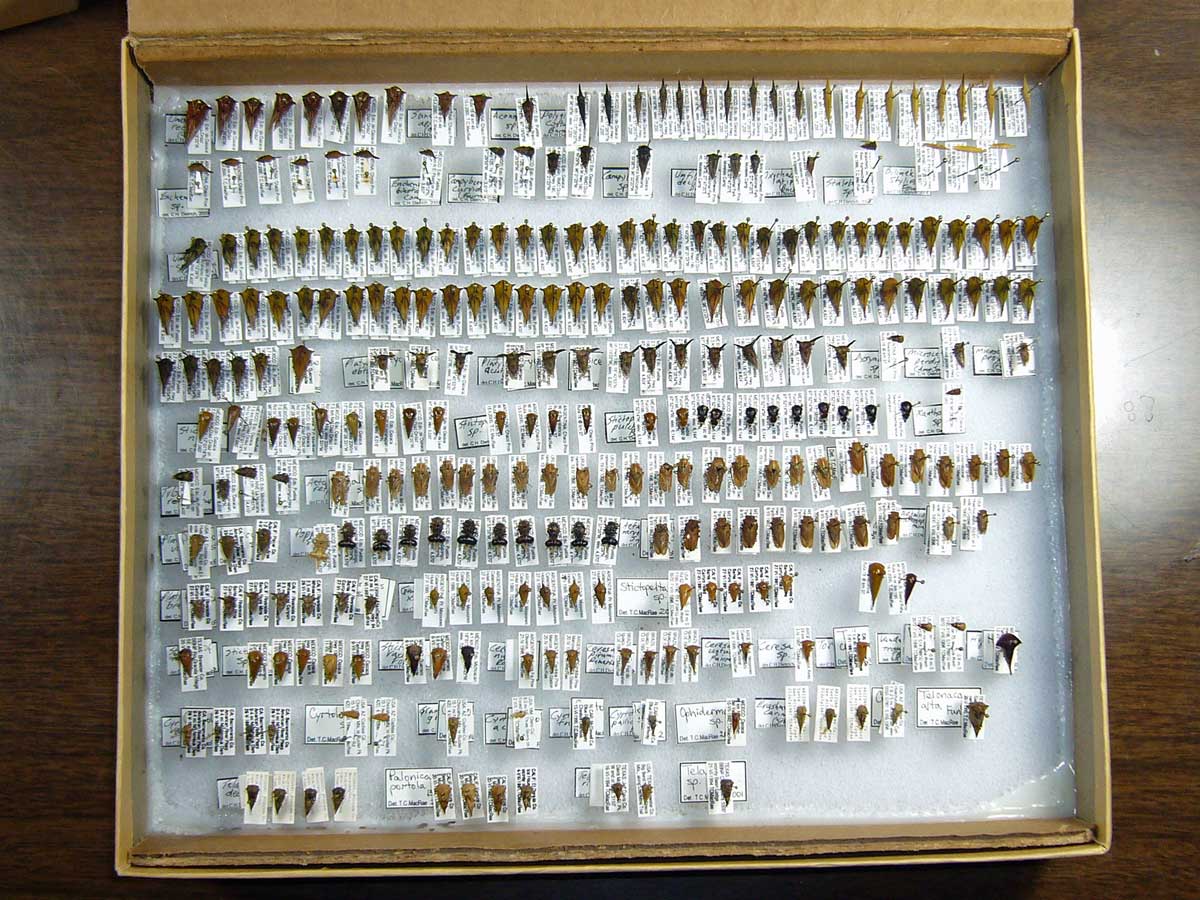
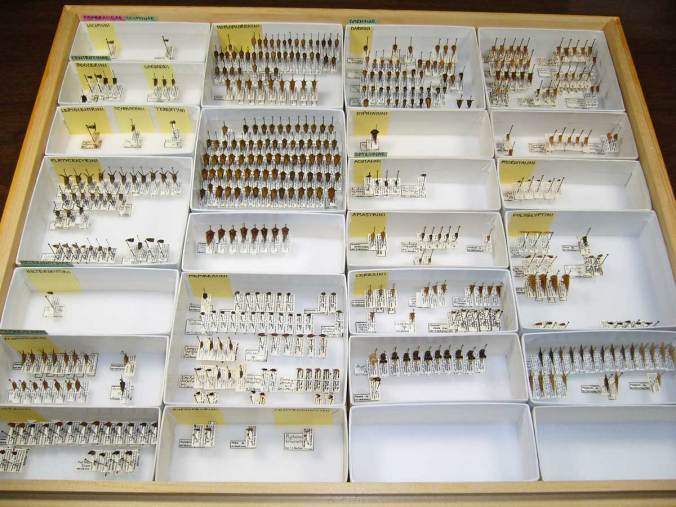
idd-treehoppersMost recently, I was able to convince Illinois Natural History Survey entomologist Chris Dietrich to take a look at the material I had accumulated during the past ten years or so, which included many specimens from Mexico and a smattering from other world areas, including South Africa. Chris did his doctoral work at North Carolina State University under “Mr. Membracid” himself, Lewis Deitz, and has since been conducting evolutionary and phylogenetic studies on Membracidae and the related Cicadomorpha. I recently received this material back from Chris (photo above), the majority of which he had been able to identify to species – only a few specimens in the more problematic genera were left with a generic ID.

Oaxaca)

Campylocentrus sp. (Mexico: Oaxaca)

Oaxaca)

Hyphinoe obliqua (Mexico: Oaxaca)
Puebla)

Poppea setosa (Mexico: Puebla)

Oaxaca)

Umbonia reclinata (Mexico: Oaxaca)

Puebla)

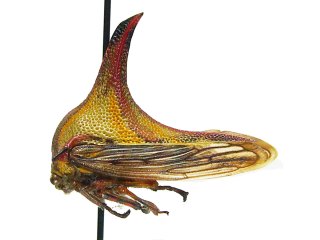
Umbonia crassicornis male (Mexico: Puebla)
umbonia_crassicornis_female

Umbonia crassicornis female (Mexico: Puebla)

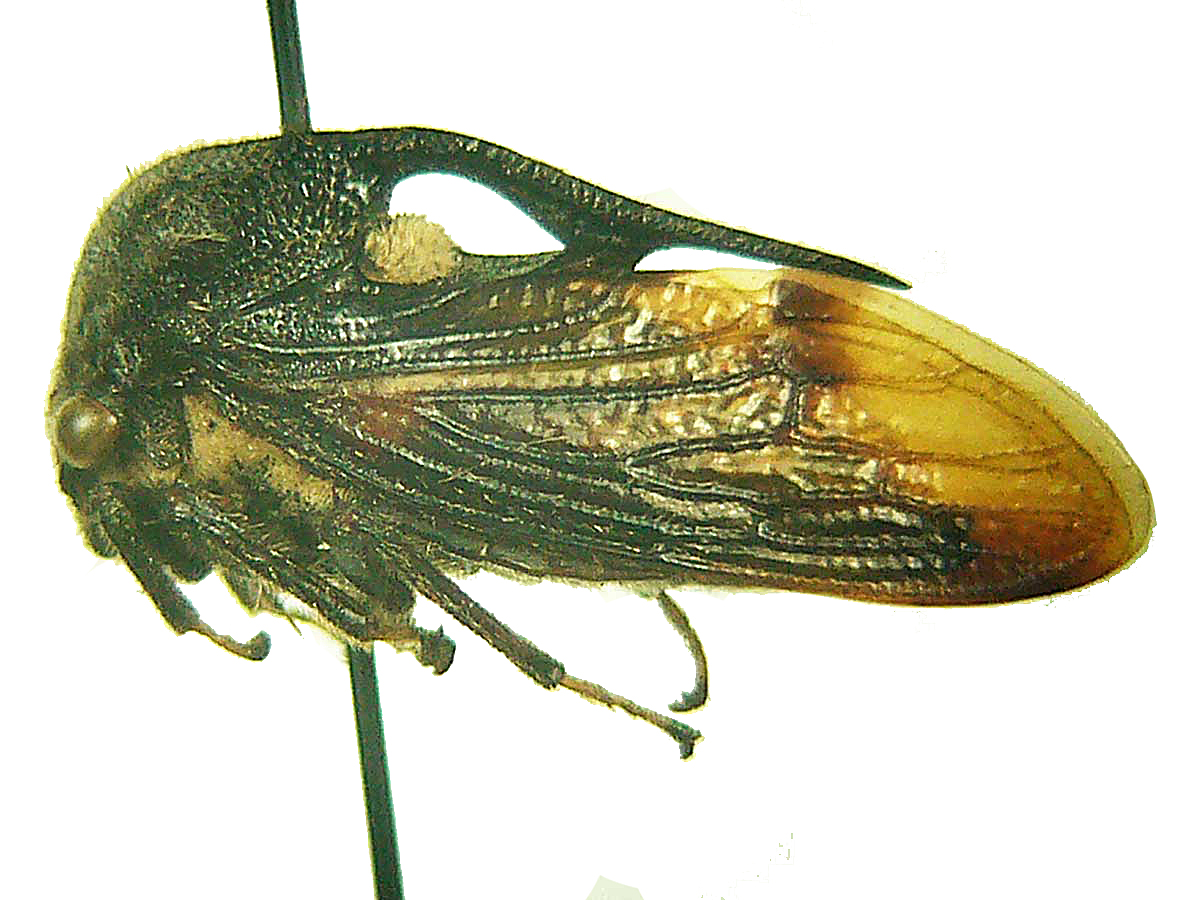
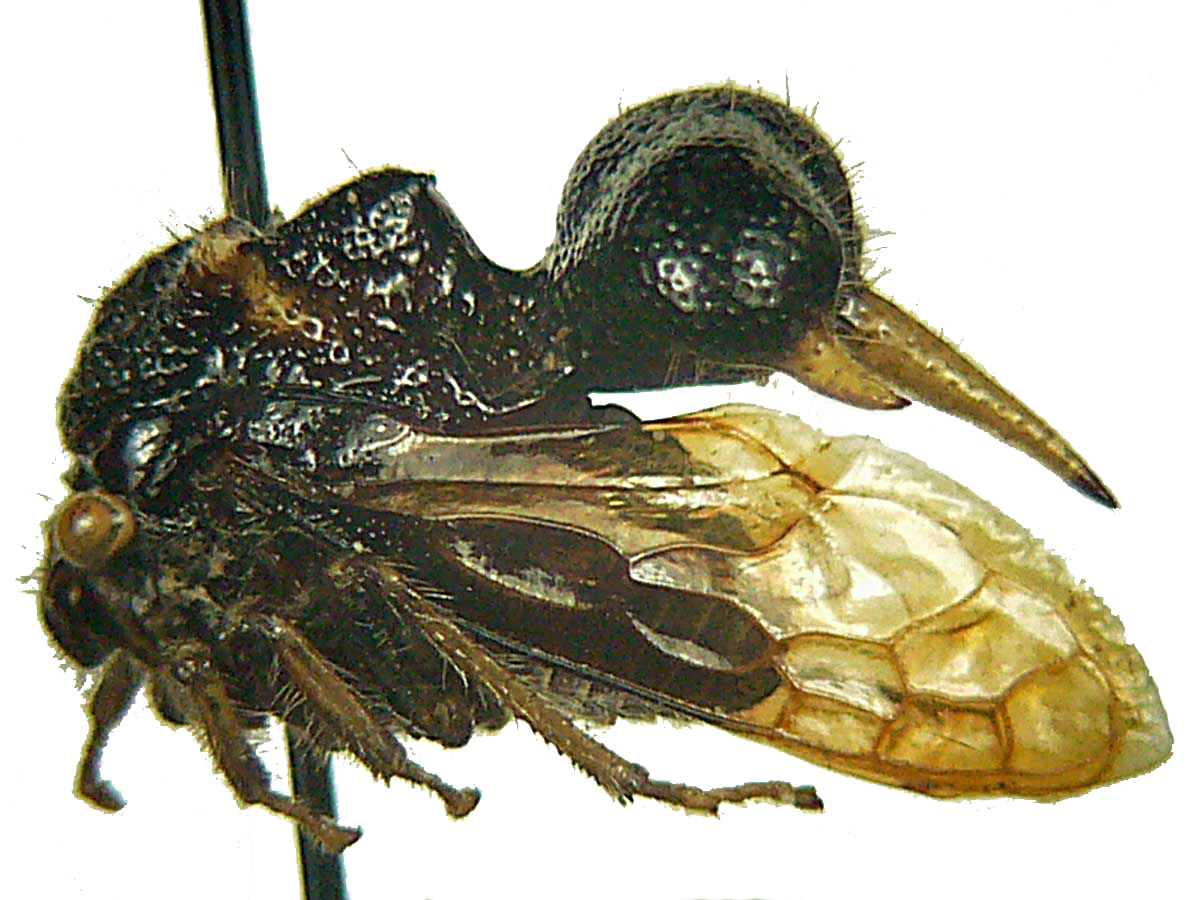
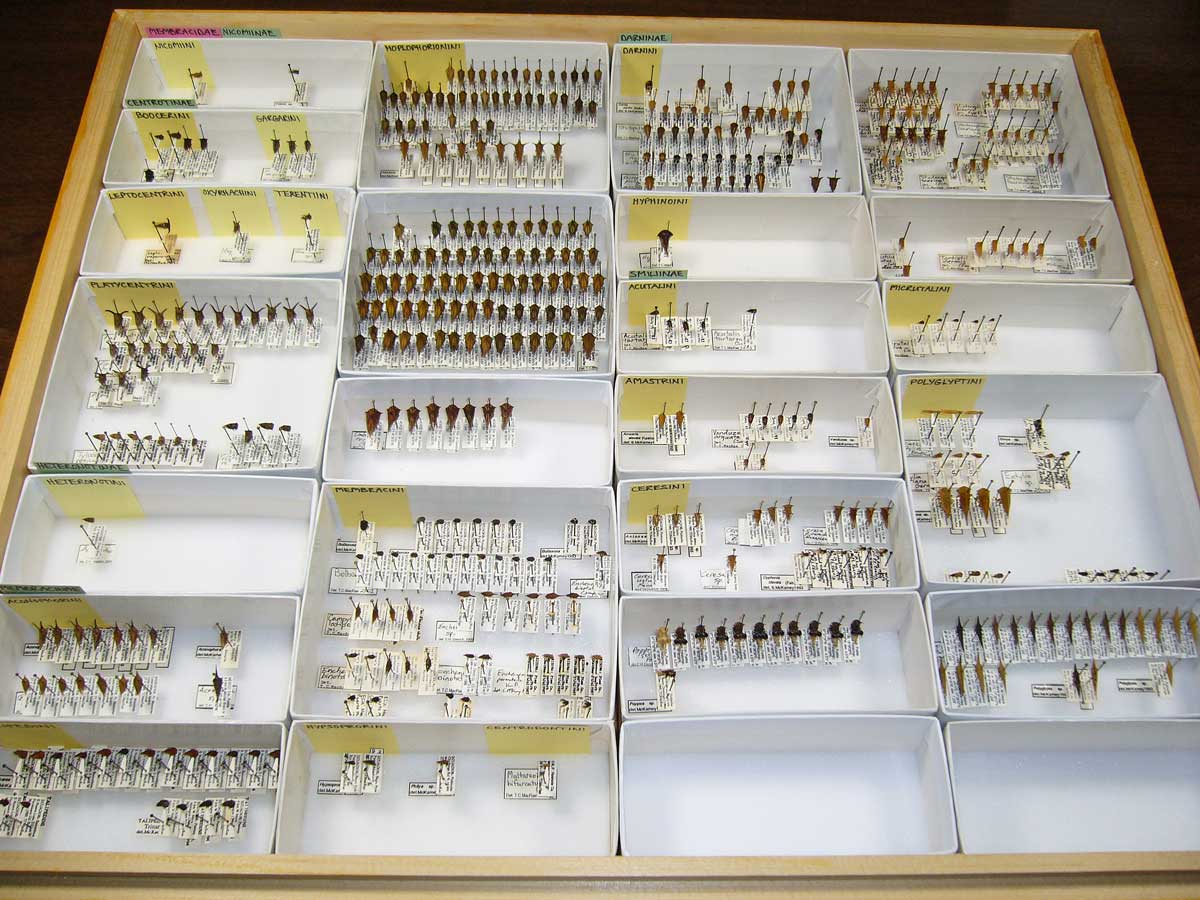
The selection of photos here show a sampling of some of the more interesting forms contained within this batch of newly identified material – all of which hail from southern Mexico. Campylocentrus sp. is an example of the primitive subfamily Centrotinae, distinguished among most membracid subfamilies by the exposed scutellum (not covered by the expanded pronotum).  Hyphinoe obliqua is an example of the largely Neotropical subfamily Darninae, while Poppea setosa represents one of the more bizarre ant-mimicking species of the subfamily Smiliinae.  Umbonia is a diverse genus in the subfamily Membracinae, occurring from the southern U.S. south into South America. Umbonia crassicornis is one of the most commonly encountered species in this genus, with the photos here showing the high degree of sexual dimorphism it exhibits.  As membracids go, these species are quite large (10 mm in length from frons to wing apex for Campylocentrus sp. and P. setosa, a slightly larger 11-13 mm for the others); however, the many smaller species in this family are no less extraordinarily ornamented.  I’ve also included a photo (below) of one of the drawers from the main collection after incorporating the newly identified material – this drawer represents about half of my treehopper collection, with the largely Nearctic tribe Smiliini and the primitive family Aetalionidae contained in another drawer. In all, the material contained one new subfamily, six new tribes, 13 new genera¹, and 30 new species for my collection. For those with an appetite for brutally technical text, a checklist of the species identified, arranged in my best attempt at their current higher classification, is appended below (any treehopper specialist who happens upon this should feel free to set the record straight on any errors). For each species, the country of origin (and state for U.S. specimens) is indicated along with the number of specimens, and higher taxa new to my collection are indicated with an asterisk(*). Don’t worry, I didn’t type this up just to post it here – it’s a cut/paste job from my newly updated collection inventory for Membracoidea. Happy reading!

¹Wildly off topic, and perhaps of interest only to me, but two of the genera represented in the material are homonyms of plant genera: Oxyrhachis is also a Madagascan genus of Poaceae, and Campylocentrus is a Neotropical genus of Orchidaceae. Scientific names of plants and animals are governed by separate ruling bodies (ICBN and ICZN, respectively), neither of which specifically prohibit (but do recommend against) creating inter-code homonyms. The number of such homonyms is surprisingly high – almost 9,000 generic names have been used in both zoology and botany (13% of the total in botany) (source).  Fortunately, there is only one known case of plant/animal homonymy fr BOTH genus- and species-level names – Pieris napi japonica for a subspecies of the gray-veined white butterfly (Pieridae) and Pieris japonica for the popular ornamental plant Japanese andromeda (Ericaceae).
treehopper_drawer
REFERENCES:

Kopp, D. D. and T. R. Yonke. 1973-1974. The treehoppers of Missouri: Parts 1-4. Journal of the Kansas Entomological Society 46(1):42-64; 46(3):375-421; 46(3):375-421; 47(1):80-130.

Wood, T. K. 1999. Diversity in the New World Membracidae. Annual Review of Entomology 38:409-435.
.


.
Superfamily MEMBRACOIDEA
Family MEMBRACIDAE
Subfamily CENTROTINAE

 *Tribe BOOCERINI
*Campylocentrus curvidens (Fairmaire) [Mexico] – 4
Campylocentrus sp. [Mexico] – 1

*Tribe GARGARINI
*Umfilianus declivus Distant [South Africa] – 3

*Tribe OXYRHACHINI
*Oxyrhachis latipes (Buckton) [South Africa] – 1

Tribe PLATYCENTRINI
Platycentrus acuticornis Stål [Mexico] – 11
Platycentrus obtusicornis Stål [Mexico] – 3
Platycentrus brevicornis Van Duzee [USA: California] – 7
Tylocentrus reticulatus Van Duzee [Mexico] – 4

*Tribe TERENTIINI
*Stalobelus sp. [South Africa] – 1

*Subfamily HETERONOTINAE

*Tribe HETERONOTINI
*Dysyncritus sp. [Argentina] – 1

Subfamily MEMBRACINAE

Tribe ACONOPHORINI
Aconophora sp. female [Mexico] – 1
*Guayaquila xiphias (Fabricius) [Argentina] – 7

Tribe HOPLOPHORIONINI
Platycotis vittata (Fabricius) [USA: Arizona, California] – 3
Umbonia crassicornis (Amyot & Serville) [Mexico] – 73
Umbonia reclinata (Germar) [Mexico] – 8

Tribe MEMBRACINI
Enchenopa binotata complex [Mexico] – 1
Enchenopa sp. [Argentina] – 6

Subfamily DARNINAE

Tribe DARNINI
Stictopelta nova Goding [Mexico] – 9
Stictopelta marmorata Goding [USA: Texas] – 1
Stictopelta pulchella Ball [Mexico] – 11
Stictopelta varians Fowler [Mexico] – 3
Stictopelta sp. [USA: Arizona, California] – 5
Stictopelta sp. [Mexico] – 5
Stictopelta spp. [Argentina] – 6
*Sundarion apicalis (Germar) [Argentina] – 2

*Tribe HYPHINOINI
*Hyphenoe obliqua (Walker) [Mexico] – 1

Subfamily SMILIINAE

Tribe AMASTRINI
Vanduzeea triguttata (Burmeister) [USA: Arizona] – 2

Tribe CERESINI
Ceresa nigripectus Remes-Lenicov [Argentina] – 3
Ceresa piramidatis Remes-Lenicov [Argentina] – 4
Ceresa ustulata Fairmaire [Argentina] – 1
Ceresa sp. female [Argentina] – 1
Poppea setosa Fowler [Mexico] – 11
Tortistilus sp. [USA: California] – 1

Tribe POLYGLYPTINI
*Bilimekia styliformis Fowler [Mexico] – 3
Polyglypta costata Burmeister [Mexico] – 18

Tribe SMILIINI
Cyrtolobus acutus Van Duzee [USA: New Mexico] – 1
Cyrtolobus fuscipennis Van Duzee [USA: North Carolina] – 1
Cyrtolobus pallidifrontis Emmons [USA: North Carolina] – 1
Cyrtolobus vanduzei Goding [USA: California] – 4
Cyrtolobus sp. [USA: Arizona] – 2
*Evashmeadea carinata Stål [USA: Arizona] – 4
*Grandolobus grandis (Van Duzee) [USA: Arizona] – 1
Ophiderma sp. [Mexico] – 1
Palonica portola Ball [USA: California] – 4
Telamona decora Ball [USA: Missouri] – 4
Telamona sp. [USA: Texas] – 1
*Telamonanthe rileyi Goding [USA: Texas] – 2
*Telonaca alta Funkhouser [USA: Texas] – 1
Xantholobus sp. [Mexico] – 1

Subfamily STEGASPINAE

Tribe MICROCENTRINI
Microcentrus perditus (Amyot & Serville) [USA: Texas] – 1
Microcentrus proximus (Fowler) [Mexico] – 1

Family AETALIONIDAE
Subfamily AETALIONINAE

Aetalion nervosopunctatum nervosopunctatum Signoret [Mexico] – 9
Aetalion nervosopunctatum minor Fowler [USA: Arizona] – 2
Aetalion reticulatum (Linnaeus) [Argentina, Uruguay] – 26

Copyright © Ted C. MacRae 2009

Add to FacebookAdd to NewsvineAdd to DiggAdd to Del.icio.usAdd to StumbleuponAdd to RedditAdd to BlinklistAdd to Ma.gnoliaAdd to TechnoratiAdd to Furl