🪲 Entomologizing w/ the WGNSS Entomology Group at Hughes Mountain Natural Area — 11 Oct 2025

L-R: Ted “BugMan” MacRae, Pete Kozich, David Seidensticker, “Ozark Bill” Duncan, Lisa Meihls, Chris Brown.

The Webster Groves Nature Study Society (WGNSS) Entomology Group began its final outing of the 2025 field season when eight participants (Chris Brown, Nathalie de Rocquigny, “Ozark Bill” Duncan, Jack Hambene, Pete Kozich, Ted “BugMan” MacRae, Lisa Meihls, and David Seidensticker) met up in the parking lot at Hughes Mountain Natural Area. Tucked into the southeastern corner of Washington Co., this gem of a natural area features 1.5 billion year old Precambrian outcrops that are among the oldest continuously exposed rocks in North America. Once molten as a result of volcanic activity associated with the St. Francois Mountains, the now hardened and weather-resistant rhyolite that formed after it cooled lies still exposed at the summit and surrounding areas. To the geologist, the polygonal columnar pattern of cracking at the summit—resulting in a unique formation called the “Devil’s Honeycomb”—might be the area’s most interesting feature. To the botanist, the xeric grasslands that formed on the surrounding exposures—i .e., “igneous glades”—might instead take this honor. To the entomologist, however, the unique fauna of insects associated with this interesting natural community earns top billing.

Rhyolite glade at Hughes Mountain Natural Area.

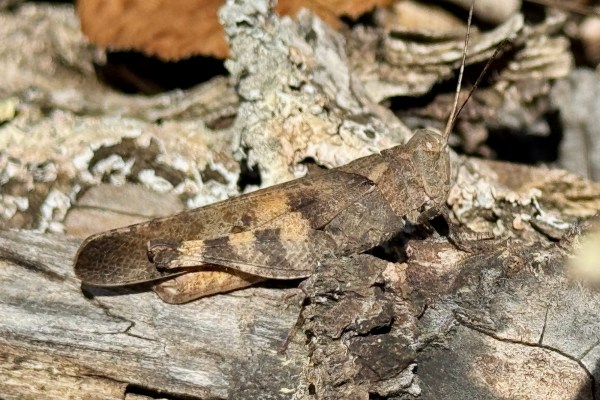
On two previous visits, the group has been fortunate to see one of Missouri’s rarest and most beautiful longhorned beetles—Tragidion coquus. Velvety black with vivid orange elytra, this charismatic species is usually seen during fall, and we hoped to be fortunate enough to see it again. Two species of fall tiger beetles—Cicindela limbalis (claybank tiger beetle) and Cicindela splendida (splendid tiger beetle), both colored iridescent green and brick red—were additional possibilities. A clear consensus quickly became apparent, however, when most participants voiced a desire to see Trimerotropis saxatilis—the famously and colorfully cryptic lichen grasshopper! It didn’t take long to see the first ones as soon as we began reaching the swathes of exposed rhyolite with their coverings of green and black lichens. Sitting motionless on the lichen-encrusted rocks, the grasshoppers were almost impossible to see, so perfectly colored and patterned was their camouflage.
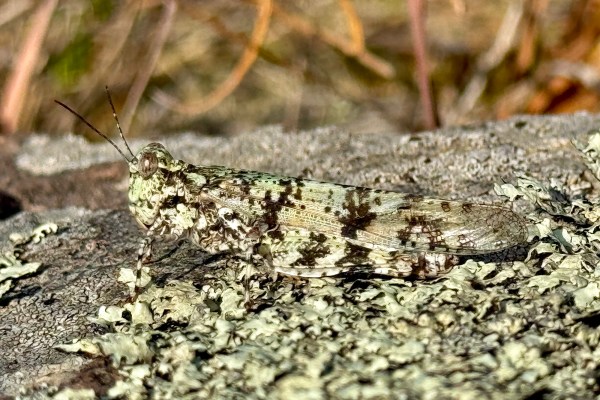
Trimerotropis saxatilis (lichen grasshopper—family Acrididae).

The abundance of lichen grasshoppers on the glades was somewhat expected, but what was not was the diversity of other grasshoppers also present at the margins of the glades and in the surrounding dry woodlands. Four such species were documented, including Hippiscus ocelete (wrinkled grasshopper), Melanoplus ponderosus (ponderous spur-throat grasshopper), Melanoplus rusticus (obovate-winged grasshopper), and Spharagemon bolli (Boll’s grasshopper)—all possessing their own forms of cryptic coloration that made relocating them after they jumped difficult.

Hippiscus ocelote (wrinkled grasshopper—family Acrididae).
Melanoplus ponderosus (ponderous spur-throat grasshopper—family Acrididae).
Melanoplus rusticus (obovate-winged grasshopper—family Acrididae).
Spharagemon bolli (Boll’s grasshopper—family Acrididae).

Two non-grasshopper orthopterans as well were found—several Scudderia furcata (fork-tailed bush katydid), ranging from green to tan to almost pinkish(!), were seen in the glades and woodlands, and an unusually cooperative Ceuthophilus sp. cave cricket (family Rhaphidophoridae) was also seen.
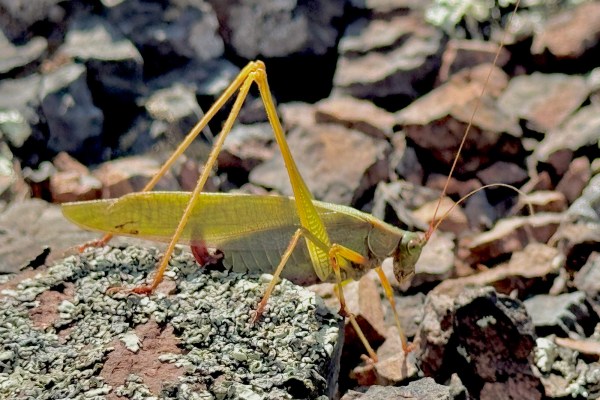
Scudderia furcata (fork-tailed bush katydid—family Tettigoniidae).
Ceuthophilus sp. (cave cricket—family Rhaphidophoridae).

The group fanned out across the glades as they worked their way up towards the summit. Of special interest were flowers that might host pollinating insects (and possibly even T. coquus). Few flowers would be found, however—a consequence of abnormally dry conditions since late July, and we found ourselves looking for other targets. Ted managed to photograph a beautiful red-marked variegated meadowhawk dragonfly (Sympetrum corruptum), while David “captured” (through the viewfinder) a male black swallowtail butterfly (Papilio polyxenes).
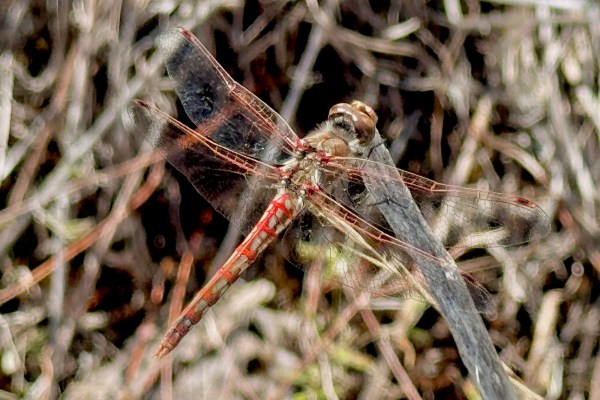
Sympetrum corruptum (variegated meadowhawk—family Libellulidae).

Eventually the group reached the summit, where the “Devil’s Honeycomb” and a spectacular vista awaited us. An unexpected feature at the summit was white splotches on the tops of many of the projecting columns of rock, which the group surmised to indicate use of the summit as a roosting site by turkey vultures.

“Devil’s Honeycomb” at summit of Hughes Mountain.

The group lingered to take in the crisp air, blue skies, and spectacular view created by 1200’ of elevation before turning back to begin the descent back down the mountain.

Buford Mountain (2nd highest point in Missouri) in the distance.

Descending the mountain, however, did not mean an end of things to see. Even before getting off the summit, Lisa noticed Chelinidea vittiger (cactus leaffooted bug) on pads of Opuntia cespitosa (eastern prickly pear). This species feeds and develops almost exclusively on the pads, fruits, and young growth of prickly pear cacti (Opuntia spp.), thus, its range coincides with the distribution of these cacti.

Chelinidea vittiger (cactus leaffooted bug—family Coreidae) on Opuntia cespitosa (eastern prickly pear).

Further down the mountain, another “variegated” species was seen—this time a variegated fritillary (Euptoieta claudia) butterfly. This well-worn individual was only the third butterfly species seen on the day, the aforementioned black swallowtail and a particularly fresh common buckeye (Junonia coenia) being the other two. This one was probably making its way south to overwinter in the southern U.S., where the species is a year-round resident.

Euptoieta claudia (variegated fritillary—family Nymphalidae).
Junonia coenia (common buckeye—family Nymphalidae).

Along the way, the lichen grasshoppers continued to attract our attention due to their abundance and striking diversity of coloration. We were treated to a particularly obvious example of this when we encountered a mating pair with the much smaller male exhibiting shades of brown instead of the greens exhibited by the much larger female.

It had been a leisurely descent off the main glade, and once clearing the woodland to emerge into the last glade fragments before the final descent, Chris and Ted were further delayed by a trio of observations in rapid succession. A large, impressively marked Neoscona crucifera (spotted orbweaver) spider hunkered down on a twig first caught Chris’ attention. Photographing it turned into an adventure when an effort to manipulate the twig on which it was resting ended up alarming the spider and causing it to drop down to the ground. They returned the spider to the twig using other twigs and leaves, but invariably it dropped again. Eventually, they learned they could “reel” the spider back up to the twig by its silk line if they acted quickly enough, and with repeated efforts both succeeded in getting photographs of the spider back up on the twig.

Neoscona crucifera (spotted orbweaver—family Aranaeidae).

While this was going on, the unmistakable droning buzz of Milesia virginiensis (yellowjacket hover fly or Virginia flower fly) caught their attention. The resemblance of the adults of this species to wasps is remarkable, and they are often seen hovering in midair, making erratic shifting movements, and then suddenly flying away. This particular fly, however, cooperated by landing on a rock (briefly) and allowing a few photographs before it abruptly departed.

Spider and fly photographs in hand, Ted and Chris resumed their descent but took only a few steps before another sighting demanded photographs—a rough green tree snake (Opheodrys aestivus) peering quizzically from amongst the rust-red leaves of a stunted blackjack oak. The snake cooperated at first, allowing a few closeup photographs before making a run for it. Fortunately, this is a very docile species that rarely (if ever) bites when handled, so Chris and Ted were able to corral it for additional photos before returning it back to the tree from whence it came.
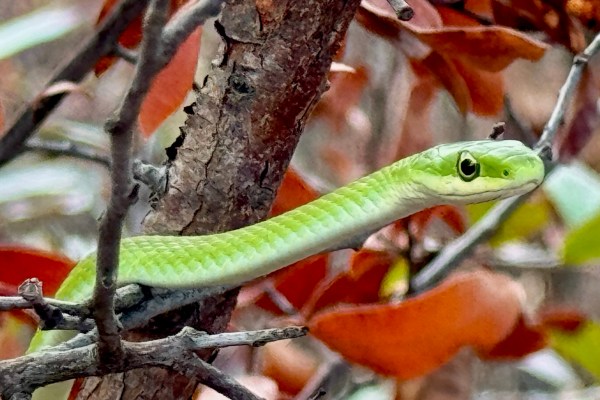
Opheodrys aestivus (rough green snake—family Colubridae).

At last, they were able to complete the descent and join the rest of the group in the parking lot, but not before making one last interesting find—the bizarrely beautiful caterpillar of Isa textula (crown slug moth). Like many members of the family Limacodidae (slug moths), the pale green, flattened caterpillars bear stinging spines/-in this case on lobes that radiate out from around the edge of the body. The caterpillar was found on the ground (it is probably mature and was looking for a protected place to spin a cocoon in which to spend the winter) and coaxed onto a leaf to bring it to the parking lot so everyone could have a chance to photograph it (it looked particularly stunning when set on a bright red sumac leaf).

Isa textula (crown slug moth—family Limacodidae).

©️ Ted C. MacRae 2025

Botanizing at Creve Coeur Lake

Mallard Lake at Creve Coeur Lake Park.

The forecast over the weekend called for possible rain, so the WGNSS Botany Group chose a location close to home in case we got rained out. I would have never thought of Creve Coeur Park as a place to botanize, but the environs surrounding the lakes, particularly Mallard Lake, get good moisture and have been allowed to revert to semi-native vegetation (with a few significant exotic invasives) for many years now. We first examined a few native garden plantings near the parking lot and saw several things not typically found in this part of the state, but the most interesting to me was Liatris scariosa (savanna blazingstar), one of our less common species, and it’s large fantastically showy blooms.

Liatris scariosa (savanna blazingstar) inflorescence.
Liatris scariosa (savanna blazingstar) floret.

Eupatorium serotinum (late boneset) was blooming profusely along the margins of the lake—I scanned the flowers for a while hoping to see some interesting beetles, with several Euphoria leucographa (a common flower chafer) being the only beetles seen. As I looked, I enjoyed Steve’s explanation of the common name of late boneset compared to another common Missouri species, Eupatorium altissimum (tall boneset)—the former actually blooms later than “late boneset,” and the latter is actually as tall as “tall boneset”!

Further along the lake margin we found a stand of “Helianthus” sunflowers, but these proved to be the lookalike Heliopsus helianthoides (false sunflower)—I’d been fooled by their straight yellow color versus the orange-yellow color that is more typical of the species. A good character to distinguish this species when the color is not diagnostic is the double-rank of phyllaries on the underside of the flower head, with the inner ones short and rounded and the outer ones long and pointed-recurved.

Heliopsus helianthoides (false sunflower).
Heliopsus helianthoides (false sunflower) inflorescence.
Heliopsus helianthoides (false sunflower) involucre.

There is also another easy way to distinguish false sunflower—by noting the presence of Lygaeus turcicus (false milkweed bug, also called the heliopsis bug), a close relative of L. kalmii (small milkweed bug) which looks very similar to the latter but, as indicated by the common name, feeds exclusively on false sunflower instead of milkweed. We eventually found several of the bugs (which, sadly, did not cooperate for photos), further confirming our identification of the plants.

We diverted to a dry, sandy spot under the bridge to check out some ant lion pits. Also called “doodlebugs,” these relatives to lacewings are surely the inspiration for the brain-eating “Ceti eels” in Star Trek: The Wrath of Khan! In the area, a super-fresh Limenitis arthemis astyanax (red-spotted purple) probed for salts on the ground, posing beautifully for a few photos.

Limenitis arthemis astyanax (red-spotted purple).

Walking along the trail north of Mallard Lake, we saw two species of vining plants: Amphicarpaea bracteata (hog peanut), and Apios americana (groundnut). Both of these plants belong to the bean family (Fabaceae) and have underground edible portions—the former in the form of peanut-like fruits formed from self-fertilizing, “cleistogamous” flowers that bloom near the ground (or even underground), and the latter in the form of tubers that form like strings of beads along the underground rhizomes of the vine. Both were important food sources for indigenous cultures. I’ve never seen either of these species in bloom (the flowers of groundnut, in particular, were unlike any other I’ve seen), so it was nice to be able to compare them on plants growing nearly side-by-side.

Amphicarpaea bracteata (hog peanut) inflorescence and leaves.
Amphicarpaea bracteata (hog peanut) inflorescence.
Apios americana (groundnut).
Apios americana (groundnut) inflorescence.
Apios americana (groundnut) leaf.

Walking back towards the cars, we had one more “DYC” (damned yellow composite) to test our ID skills. Fortunately, Helenium spp. (sneezeweed) are easily distinguished from other DYCs by their wedge-shaped ray florets with lobed tips and protuberant, nearly spherical disks. Helenium autumnale (common sneezeweed) is identified to species by its combination of yellow disk florets and broad leaves attached to a conspicuously winged stem.

Helenium autumnale (common sneezeweed).
Helenium autumnale (common sneezeweed) inflorescences.
Helenium autumnale (common sneezeweed) stem/leaves.

By the time we reached our cars, I was as hungry, sweaty, and thirsty as I’ve ever been on one of these walks. My thirst and appetite for knowledge, however, were, for the moment, completely satiated.

A dragonfly perched on the branch above me.

©️ Ted C. MacRae 2021

ESA Insect Macrophotography Workshop

Today is the last day of the Entomological Society of America (ESA) Annual Meeting in Austin, Texas, and it has been an action packed week for me. Annual meetings such as this serve several purposes. In addition to seeing talks on a variety of subjects—in my case covering subjects ranging from insect resistance management to scientific outreach to beetle systematics—they also offer the chance to establish new connections with other entomologists that share common interests and reinforce existing ones. Of course, a major part of my interest in entomology revolves around insect macrophotography, and in recent years ESA has begun to cater to the entomological photographer contingent within the society. Last year’s meetings featured a macrophotography symposium titled, “Entomologists Beyond Borders” (for which I was one of the invited speakers), and this year featured an Insect Macrophotography Workshop led by Austin-based entomologist/photographer Ian Wright. Having done this for a few years now I figured a lot of the workshop might be review for me, but I still have much to learn and am willing to accept new ideas from any source. Besides, the workshop involved a field trip to a local habitat to try out our insect photography skills, and for a field junkie like me time in the field at an otherwise all-indoor event spanning close to a week is always welcome. The location of the meetings in Austin this year made this possible, as even in mid-November there still remain insects out and about that can be photographed if the weather cooperates (and it did).

This will be a somewhat different post than what I usually post here. Rather than featuring photos of a certain species and using them as a backdrop for a more detailed look at their taxonomy or natural history, I’m just going to post all the photos that I ended up keeping from the field trip portion of the workshop with just a comment or two about each. We went to the city’s nearby waste-water treatment facility, the grounds of which are wild and woolly enough to provide habitat for insects, and spent about an hour and a half seeing what we could find. For myself, it was a chance to photograph some insects I’ve not normally tried to photograph (i.e., dragonflies, ambush bugs) and get more practice on my blue sky technique. I did appreciate the chance to spend some time talking to Ian during while we traveled to the site and back, and I also ended up helping other participants with their camera equipment questions and technique suggestions. With that, here are the photos I took—I’ll be curious to see what readers think of this post format versus my more typical style.

Micrutalis calva

Micrutalis calva (Hemiptera: Membracidae) on silverleaf nightshade (Solanum elaeagnifolium).

Micrutalis calva

This species of treehopper is restricted to herbaceous plant hosts.

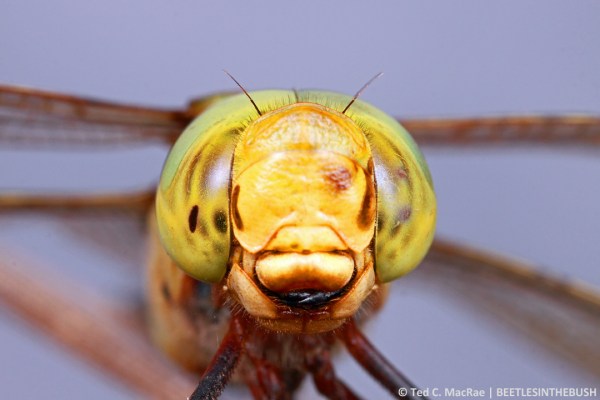
Anax junius

Anax junius (Odonata: Aeshnidae), one of the darner species of dragonfly.

Anax junius

This adult was perched on a dead twig tip and seemed to be “asleep.”

Anax junius

I clipped the perch and held it up for these “in-your-face” shots – it then awoke with a start and flew off.

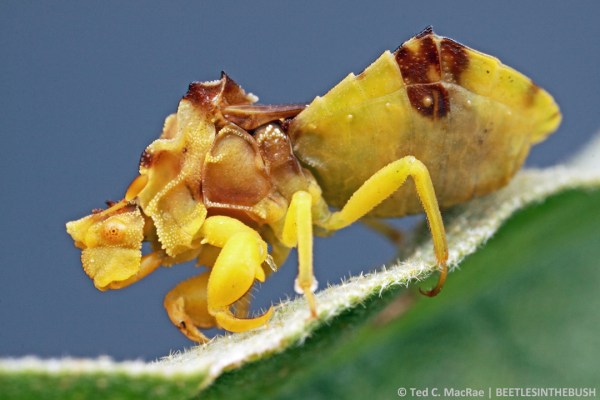
Phymata sp.

Phymata sp. (Hemiptera: Reduviidae), one of the so-called “jagged ambush bugs.”

Phymata sp.

Formerly a separate family, ambush bugs are now combined with assassin bugs (family Reduviidae).

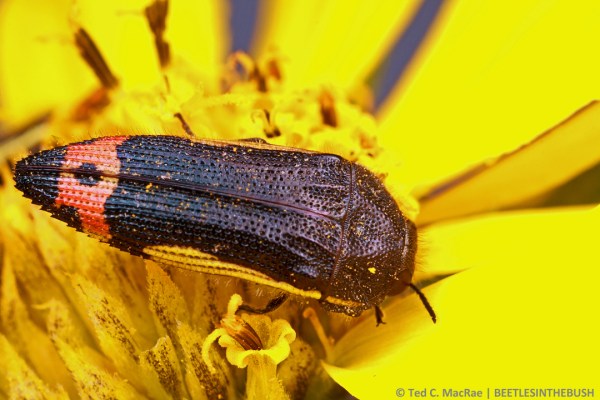
Acmaeodera flavomarginata

Acmaeodera flavomarginata (Coleoptera: Buprestidae).

Acmaeodera flavomarginata

This is one of a few species of jewel beetle in the southcentral US that are active during the fall.

Mecaphesa sp.

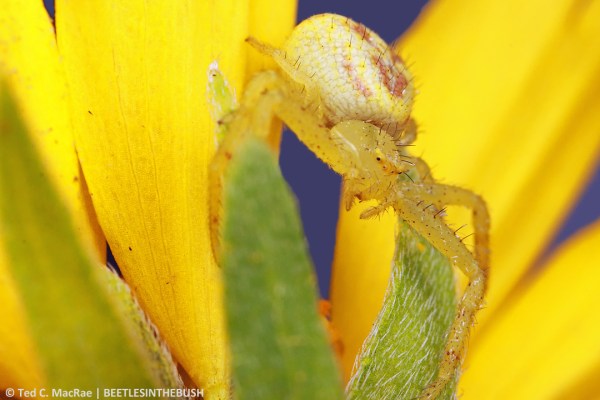
Mecaphesa sp. (Araneae: Thomisidae), one of the crab spiders

Mecaphesa sp.

Cryptic coloration allows the spider to lurk unseen by potential insect prey visiting the flower.

Gratiana pallidula

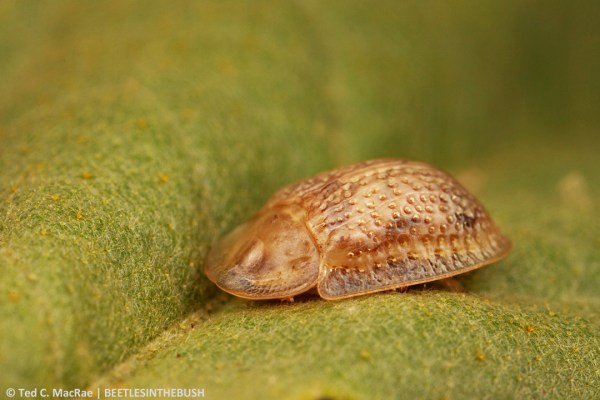
Gratiana pallidula (Coleoptera: Chrysomelidae) on silverleaf nightshade (Solanum eleagnifolium).

Gratiana pallidula

A type of tortoise beetle, adults “clamp” down against the leaf as a defense against predators.

Copyright © Ted C. MacRae 2013

Circus of the Spineless #47

When I started participating in blog carnivals last year, Circus of the Spineless was – for me – the pinnacle of blog carnivals.  I wanted to take my shot at hosting this venerable celebration of creepy crawlies, and even though the waiting list for hosting was almost a year long, I offered my services and settled in for the long wait until February 2010.  Ten months have passed and the time has come.  In the meantime, I did my blog carnival host dĂ©but with Berry Go Round #21 and snatched the sophomore slot for nature blogging’s newest carnival with House of Herps #2.  Through those efforts, I learned that blog carnival hosting is an incredible amount of work/fun, and while plants and herps are fascinating, inverts are my true love.  It is, thus, with great pride that I join the ranks of previous hosts in presenting this, the 47th edition of CotS.  Featured below are 16 submissions by 14 contributors that cover representatives from 5 classes in 3 invertebrate phyla.  A humorous look at some of the personalities behind invertebrate study is presented as a bonus for those who make it to the end.

If you missed last month’s issue, you can find Circus of the Spineless #46 at Kate’s Adventures of a Free Range Urban Primate, and next month’s edition will be hosted by Matt Sarver at The Modern Naturalist.

Phylum CNIDARIA
–Class ANTHOZOA

Coral Reefs
The Voltage GateJeremy at The Voltage Gate reports on peer-reviewed research on the impact of herbivorous fish on the recovery of coral reefs in his post, Protecting herbivorous fishes significantly increases rate of coral recovery.  Coral reefs have been hard hit by the challenges of bleaching and disease, pressures likely linked to climate change, and macroalgae, when given the opportunity to dominate, provide even further challenges.  This can happen when populations of herbivorous fish, major grazers of macroalgae, are reduced through commercial harvest.  The study authors evaluated ten sites over a two-and-a-half year period in and around the Exuma Cays Land and Sea Park (ECLSP), which was established as a no-take marine reserve in 1986, finding an increase of coral cover during the study period from 7 percent to 19 percent.  However, ECLSP reefs were responsible for all of this increase, with no net recovery occurring outside the ECLSP.  These results illustrate the importance of reserves as a refuge for biodiversity and the service they provide in keeping marine systems intact.

Phylum MOLLUSCA
–Class GASTROPODAÂą
—-“Informal Group” OPISTHOBRANCHIA

Sea slug (Glaucus atlanticus)
Deep-Sea NewsThis gorgeous nudibranch species got a foul slandering when they started washing up on Gold Coast beaches in Australia.  Miriam Goldstein debunks this unfair treatment in her post, Sea slugs have self esteem too, at Deep-Sea News, noting its absolutely stunning iridescent blue and silver color with gorgeous feathery tentacles.  Further exception is taken with such descriptors as “slimy”, “venomous”, “blue-bottle eating”, and “cannibals” – with the truth behind each of these terms far more fascinating than the visceral reaction their use was intended to elicit.  Good news as well – you don’t have to travel to Australia to see these things – they live throughout the world’s open oceans (but you will have to get far from shore, where the pelagic jellys upon which they feed can be found).

—-“Informal Group” PULMONATA

Iron-clad snail (Cyrsomallon squamiferum)
Deep-Sea NewsI’ve known about iron-clad beetles, species of Zopheridae whose exoskeleton is so hard and thick it is almost impossible to impale them with an insect pin.  I’d never heard of an iron-clad snail, however, until I read Dr. M’s post, The Evolution of Iron-Clad Samurai Snails With Gold Feet, at Deep-Sea News.  Unlike the seemingly iron-impregnated beetles, these snails actually utilize iron sulfide in a series of armor plates covering the “foot.”  Just described in 2003 from a hydrothermal vent in the Indian Ocean, it is the only known animal known to use iron sulfide as skeletal material.  Only time will tell if these snails achieve the same popularity as living jewelry as the beetles.

Âą The taxonomy of the Gastropoda is under constant revision, as the results of DNA studies increasingly reveal as possibly polyphyletic many of the former orders (including the Opisthobranchia and Pulmonata, now known as “informal groups”).

Phylum ARTHROPODA
–Class CRUSTACEA
—-Order DECAPODA

Samurai crab (Heikea japonica)
ArthropodaMike Bok at Arthopoda shares two stories about this crab – one an ancient Japanese legend, the other a modern piece of scientific folklore – in his post, Samurai Crabs: Transmogrified Japanese warriors, the product of artificial selection, or pareidolia?  In the first, popular legend alleges that these crabs were transformed from drowned samurai warriors, each one identifiable by the face of the fallen samurai that it bears on its backs and for whom the crab searches in the depths of the oceans around Japan.  This ancient legend has led to a modern scientific quibble about whether the stylized face that can be seen on the crab’s carapace is the result of artificial selection by generations of superstitious Japanese fishermen, who have selectively released crabs bearing any resemblance to a human face.  This may make for compelling scientific debate, but Mike counters even the considerable eloquence of Carl Sagan in providing his own thoughts on why this likely is not true.

—-Order AMPHIPODA

Amphipod (Phronima spp.)
ArthropodaIn another example of the intermixture of science and culture, Mike Bok (Arthopoda) asks, Did Phronima inspire the design of the Alien Queen?  Mike agrees with the claim that the original “soldier” alien morph seen in “Alien” (1979) was based on a painting by artist H. R. Giger, but he thinks that Phronima more likely influenced the design of the queen alien morph in “Aliens” (1986).  The truth may remain hidden at Stan Winston Studios, but the broad crest atop the head of Phronima, bearing tubular, upward-pointing eyes, its “necro-parasitic” tendencies, and a chillingly suggestive photograph of the beast from a 1981 paper lend an air of plausibility to Mike’s hypothesis.

–Class ARACHNIDA
—-Order PHALANGIDA

Harvestmen, daddy-long-legs
Kind of CuriousJohn at Kind of Curious follows up on David Attenborough’s Life in the Undergrowth Episode 1 with his post, Daddy Long Legs Daddies (aka Harvestman).  Looking like spiders but lacking their venomous and silk-spinning abilities, it seems that nobody can agree on the proper name for these spider relatives.  Brits call them “harvestmen”, but Americans call them “daddy-long-legs”, a term that in the UK refers rather to crane flies (which less informed Americans simply call “giant mosquitoes”).  Let’s not even mention the daddy-long-legs spider (Pholcus phalangioides), which actually is a spider.

—-Order ARANEA

Neoscona crucifera (barn spider)
XenogereAnyone who hikes along woodland trails in the eastern U.S. during autumn knows what a “spider stick” is – i.e., any handy stick that can be waved probingly in front of one as they hike, lest they run smack into the web of any number of orb weavers that are fond of stretching their large webs across such natural insect flyways. Jason, at Xenogere, has some biggun’s in his neck of the woods, which he describes in intriguing detail in his post, Walking with spiders – Part 3. Barn spiders are some of the biggest, allowing one to fully appreciate their polychroism and polymorphism. I challenge even the most arachnophic of readers to look at Jason’s photographs and not be mesmerized by their beauty.

–Class INSECTA
—-Order ODONATA

Autumn meadowhawk dragonfly (Sympetrum vicinum)
Rambling Woods~The Road Less TraveledMichelle at Rambling Woods~The Road Less Traveled presents a stunning series of photographs of this gorgeous red dragonfly in her post, Circus of The Spineless~Curiosity will conquer fear even more than bravery will.~James Stephens.  Perching on her hanging basket of pink-flowered begonias, colors matching perfectly, it was almost as if the dragonfly has staked a claim on the hanging basket as it own personal territory.  Where there is one, there are others, and her neighbor’s deck had both a red male and a blue female doing… well, see Michelle’s diagram.

—-Order COLEOPTERA

Horned passalus (Odontotaenius disjunctus)
Anybody Seen My Focus?Joan Knapp at Anybody Seen My Focus?  shows photographs of this beetle in her post, Bess Beetle: Horned Passalus (Odontotaenius disjunctus), as it lumbered slowly and gracefully over a fallen tree branch.  Perhaps the cool temperatures were the reason for its sloth.  Or perhaps the missing antenna indicated a feeble, old individual on its last (six) legs.  A brief interruption for photographs seemed not to deter the beetle from its destination, somewhere in the leaf litter beyond the log…

—-Order LEPIDOPTERA

Skipper butterflies (family Hesperiidae)
Nature of a ManRandomtruth at Nature of a Man loves skippers (are they butterflies, or aren’t they?), and you’ll love his photographs of these delightful little half-butterflies in his post, Day Skippers.  While there is some slight doubt about the identity of individuals he sees in his backyard (skippers are notoriously difficult to identify in the field), there is no doubt that these little guys are loaded with personality.  You won’t believe the “natural history” moment he caught on film (er… pixels?) and presented in the final photo sequence.

Monarch butterfly (Danaus plexippus)
GrrlscientistGrrlscientist summarizes a recent peer-reviewed paper in her post, Migratory Monarch Butterflies ‘See’ Earth’s GeoMagnetic Field.  The paper reports on photoreceptor proteins in monarch butterflies known as “cryptochromes” that not only allow the butterflies to see ultraviolet light, but also allows them to sense the Earth’s geomagnetic field.  These highly conserved proteins evolved from the light-activated bacterial enzyme phytolase, which functions in DNA damage repair.  Most animals have one of two types of cryptochromes, but monarchs have both – providing the first genetic evidence that the vertebrate-version of cryptochrome is responsible for the magnetoreception capabilities in migratory birds.  Further research may provide insight on the workings of the circadian clock, which could lead to better understanding of sleep disorders and mental illnesses such as depression and seasonal affective disorder, as well as development of new treatments for jet lag and shift-work ailments.

—-Order HYMENOPTERA

Ants (family Formicidae)
Wild About AntsKatydids, grasshoppers, cicadas – what do ants have on these singers of the insect world?  Plenty, as Roberta at Wild About Ants points out in her post, Ants: No Longer the Strong Silent Types.  It turns out that ants have patches of ridge-like structures on their gaster, which they rub against a curved ridge (called a “scraper”) on the petiole to communicate with each other via stridulation.  While lacking the decibel level of a cicada, these sounds are nevertheless in the audible range for human ears and are thought to have alarm, mating, and recruitment functions.  Even more fascinating, stridulation is not the only tool in the ant music chest – drumming and rattling have also been documented.  Curiously, however, ants do not possess ears, rather likely sensing sounds through their legs or by specialized hairs on their antennae.  Check out the provided links to SEM photographs and a sound recording.

Bald-faced hornet (Dolichovespula maculata)
Hill-Stead's Nature BlogDiane Tucker, Estate Naturalist at the Hill-Stead Museum in Farmington, Connecticut, writes at Hill-Stead’s Nature Blog. In her post, Be it ever so humble, she takes a look at some of the different animal nests that become revealed during autumn’s leaf drop – particularly those made by the bald-faced hornet (and also birds such as oriole’s).  From its start as simple cluster of chambers, to its growth over the course of the summer – growing fatter until the summer’s apex of warmth and light, then tapering off with the approach of fall, these insect homes are a marvel of nature – intricately constructed homes made entirely of paper.

—-Order DIPTERA

Common green bottle fly (Lucilia sericata)
Bug Girl's BlogBug Girl discusses the resurging use of bottle fly larvae in her post, Maggot therapy.  The academic among us will appreciate her discussion of the mechanisms that allow these seemingly disgusting vermin to function as incredibly delicate microsurge0ns in cleaning and disinfecting open wounds.  The morbid among us will appreciate the links to the most entertainingly disgusting medical photos one can imagine.  Check it out – but not over your lunch hour!

BUGS IN FIR

Wanderin' Weeta (With Waterfowl and Weeds)Wanderin’ Weeta (With Waterfowl and Weeds) was going to make an owl out of Douglas fir cones, but instead she found globular springtails, a crab spider, and a ladybug in a sprig of fir.  We’re glad she has an interest in little hitchhikers such as these, even if the kids at school when she was growing up didn’t.

ENTOMOLOGY HUMOR

Bug Girl shows that entomologists have a sense of humor with her post, Monday Morning bug jokes – a video compilation of jokesters from the recent Entomological Society of America Annual Meeting in Indianapolis.  My favorites were the best dung beetle pickup line (“Is this stool taken?”) and Marvin Harris’ rendition of the minimum number of insects needed to elicit control (1 pubic louse, or 1/2 codling moth larva :)).  J. McPherson was equally, if unwittingly, hilarious due to his Christopher Lloyd-esque mannerisms.  My favorite entomological joke of all, however, was not featured, so I offer the following addendum to Bug Girl’s post:

Copyright Ted C. MacRae 2010

Add to FacebookAdd to DiggAdd to Del.icio.usAdd to StumbleuponAdd to RedditAdd to BlinklistAdd to TwitterAdd to TechnoratiAdd to Yahoo BuzzAdd to Newsvine

Email to a friend