 I’ve been meaning to write about ARKive for awhile now. ARKive is a unique collection of videos, images and fact-files assembled from among the world’s very best wildlife videographers and photographers in an attempt to create a centralized digital library of life on Earth. Their short to mid-term priority is the completion of audio-visual profiles for the 16,300-plus species on The IUCN Red List of Threatened Species, before moving on to profiling all species that have ever been filmed or photographed. With backing from many of the world’s leading conservation organizations, ARKive hopes to “promote public understanding and appreciation of the world’s biodiversity and the need for its conservation, through the power of wildlife imagery.”
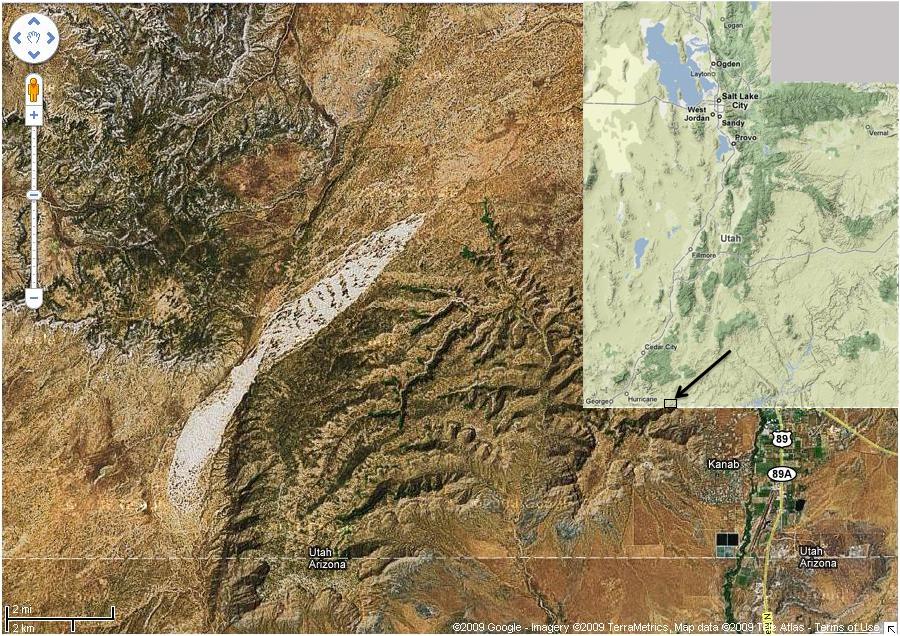
With tiger beetle season almost now upon us, it seems appropriate to highlight the media collection that ARKive has assembled for one of North America’s most spectacularly beautiful and critically imperiled tiger beetles, Cicindela albissima (Coral Pink Sand Dune tiger beetle). This amazing species is not only stunning in appearance, with its nearly pure white elytra, but has perhaps the most restricted habitat of any tiger beetle species in North America – the entire population being restricted to 400 hectares within  Utah’s Coral Pink Sand Dunes State Park and the adjacent Bureau of Land Management (BLM) dune management area (Pearson et al. 2006). The Google screen shot at right shows the entire range of this species as a light pink swath (inset shown on larger map of the state of Utah). Regarded initially as a subspecies of the widespread C. limbata (sandy tiger beetle), recent molecular studies showed this beetle to be only distantly related to that species and, thus, deserving of full species status (Morgan et al. 2000).
Unfortunately, the beetle’s highly restricted habitat continues to be adversely affected by ongoing, recreational off-road vehicle use, especially in the interdunal swales used by the larvae. Impacts occur not only by direct run-over mortality, but also through disruption of normal adult and larval activity, damage to vegetation, reduction of arthropod prey of C. albissima, and mixing of the upper soil layer which increases desiccation of the larval microhabitat (Knisley and Hill 2001). The species was nominated for federal protection under the Endangered Species Act in 1996 (when it was still considered a subspecies of C. limbata), and two years later a Conservation Agreement between BLM, U.S. Fish and Wildlife Service, Utah Department of Parks and Recreation and Kane County was established in an effort to protect the critically sensitive habitats in which this species lives. Despite these conservation measures, ongoing monitoring and research within the protected areas has documented a continuing decline in the population, suggesting that these areas may not be of sufficient size to enable the population to increase, and off-road vehicle use continues outside of the protected areas (U.S. Department of Interior, Fish and Wildlife Service (FWS) 2008). While still only a candidate for federal listing as an endangered or threatened species, the FWS now considers the magnitude of the threat from off-road vehicles, in view of these recent findings, to be high and imminent. As a result, the FWS has increased the priority of the species’ candidacy from 8 to 2 (1 being the highest priority a candidate species can receive).
While I would dearly have loved to embed one of ARKive’s extraordinary videos or photographs of C. albissima within this post, copyright considerations do not allow that. What I can do is provide hyperlinks directly to the site, and I encourage everyone to visit ARKive and see their images of this gorgeous species.
Photos by Christine Breton: adult beetle, dorsal view, adult beetle, adults mating, habitat
Videos by Ganglion Films: overview, adults mating, adult burrowing in sand, OHVs threatening protected habit.
In addition to the ARKive images, Chris Wirth, author of the blog Cicindela, has taken photographs of this species and presents stunning examples of both the larva and the adult in his post Cicindela albissima (Re-post). I myself am making plans to visit Coral Pink Sand Dunes – perhaps this season – to find and photograph this species for myself. When I succeed, rest assured those photographs will appear on this site.
REFERENCES:
Knisley, C. B., and J. M. Hill. 2001. Biology and conservation of the Coral Pink Sand Dunes tiger beetle, Cicindela limbata albissima Rumpp. Unpublished report.
Morgan, M., C. B. Knisley and A. Vogler. 2000. New taxonomic status of the endangered tiger beetle Cicindela limbata albissima (Coleoptera: Cicindelidae): evidence from mtDNA. Annals of the Entomological Society of America 93(5):1108-1115.
Pearson, D. L., C. B. Knisley and C. J. Kazilek. 2006. A Field Guide to the Tiger Beetles of the United States and Canada. Oxford University Press, New York, 227 pp.
U.S. Department of Interior, Fish and Wildlife Service. 2008. 50 CFR Part 17. Endangered and threatened wildlife and plants; review of native species that are candidates for listing as endangered or threatened; annual notice of findings on resubmitted petitions; annual description of progress on listing actions; proposed rule. Federal Register 73(238) (December 10, 2008):75176-75244.
Copyright © Ted C. MacRae 2009


 Beetles In The Bush