Tiger Beetle Safari

In looking back at my posts over the past few weeks, I realized that it has been far too long since I’ve actually talked about beetles.  Perhaps “Petals In The Bush” would be a better name for this blog!  I still have some botanical thoughts to get off my chest before the insect season starts in earnest, but until then, and in anticipation of the upcoming summer’s hunts, I offer this fun, light-hearted introduction to collecting and keeping tiger beetles by Peter Schriemer.  Pay particular attention to the method he uses to capture these elusive little creatures:

Tiger Beetles are my favorite type of beetle! Entomologist John Acorn got me hooked on these little guys. They live across the country in various habitats, so you may not need to travel far to go on a Tiger Beetle Safari of your own!

Vodpod videos no longer available.

more about “Tiger Beetle Safari“, posted with vodpod

Capturing tiger beetle adults can a little (lot) more difficult than implied by this video. Adults have excellent eyesight, and many species are extremely wary. It takes practice, patience, and lots of second chances. The collecting method shown in the video is what I refer to as the “stalk and slap” method – the beetle is slowly stalked until within net reach, and the net bag is slapped over the beetle.  This method works well enough, but it has its limitations.  If there are any gaps between the ground and the net rim, the beetle will quickly dart through them and fly away.  This is easy to prevent on sandy and soft clay substrates, as the net rim can be sealed against the ground by kneeling quickly on each side of the rim to embed it slightly and using the hands to hold up the net bag and locate the beetle.  Still, there are a few things I don’t like about this method – the beetle may hide against the inside of the rim and be difficult to locate, and once found it may be difficult to grab the beetle through the net if it is against the ground (don’t even try lifting the rim and reaching under – the beetle will zip out and be gone).  This method can also be taxing on the legs, as each attempted capture involves kneeling and standing back up (getting harder and harder for these 50+ year old knees to do).

The major limitation of the slap method, however, is that it doesn’t really work on hard, uneven surfaces. Many species are found in glades and other habitats with exposed rock substrates. In these types of habitats, the net rim simply cannot be clamped tightly enough to eliminate the gaps (not to mention the added difficulties in kneeling on these surfaces).  Because of this, I have adopted a technique that I call the “tap and swipe” method.  Here again, the beetle is stalked until within net reach (made easier with a longer handle), but rather than slapping the net bag over the beetle, the rim of the net is tapped against the ground next to the beetle and then assertively swiped sideways to catch the beetle just as it starts flying.  A quick 180° flip of the net rim closes the opening to prevent the beetle from escaping, and it is easily seen in the hanging net bag, where it can be grabbed from outside the net bag with one hand to secure it before reaching into the net bag with the other hand.  With a little practice, one eventually learns to reach down into the open net bag and grab the beetle while preventing it from flying up and out.  All of this can be done while standing, so it’s easier on the knees.

The tap method does require more knowledge about the beetle’s escape behavior in order to anticipate how quickly and in which direction the beetle will fly – some species delay take off just slightly, thus requiring a slight “pause” between the tap and the swipe. However, once their behavior is learned I have found this method to be more consistently successful than the slap method – even on soft substrates.  For species that I haven’t encountered in the field before, I use the slap method at first (if I can) until I have a feel for their escape behavior. If I can’t, I use the tap method and hope for the best!

Copyright © Ted C. MacRae 2009

Add to FacebookAdd to NewsvineAdd to DiggAdd to Del.icio.usAdd to StumbleuponAdd to RedditAdd to BlinklistAdd to Ma.gnoliaAdd to TechnoratiAdd to Furl

Expanding blogroll

I’m still looking for the correct answers to Winter botany quiz #2.  Several commentors have correctly identified the plant family for one of the three plants and gotten close with the second (it’s not a true Liliaceae), and Doug properly surmised that the photos were indeed taken in South Africa (specifically, in Limpopo Province near the Matlaba River in the vicinity of the Waterberg Range).  With the additional clues I’ve given in the comments to that post, I still think generic and even specific identifications are possible for #1 and #2, while for #3 an ID at any level may prove to be quite a challenge.

While we wait for those answers, I thought I would feature some of the recent additions to my ever-expanding blogroll.  Some of these blogs seem to be already well-known, but only recently have I stumbled onto them myself.  Others I think may not be so widely known, but should be.  All struck a chord with me for some reason, whether it be their entomology-related subject matter, focus on life or nature in my beloved Ozarks, or the brilliance of their writing or photography.  I encourage you to pay them a visit and see what they have to offer.

Botany
Several new links in this section are worth mention. A Neotropical Savanna is an excellent weblog by Mary Farmer about her experiences with plants in Panama (and occasionally their insect associates). Closer to home, Get Your Botany On! features contributions by a consortium of astute botanists, one of which is Missouri-based Justin Thomas.  Justin also writes his own blog – The Vasculum – his exquisite and informative writings are reminiscent of those found on my long-time personal favorite, Ozark Highlands of Missouri (by the ever-eloquent Allison Vaughn).

Insects & Invertebrates
The number of links in this section has grown tremendously in recent weeks.  Bug Eric is one of the newest of these on my list, but its author – Eric Eaton, of Kaufman Field Guide to Insects of North America fame, has been around the bug scene for a long time.  Bug Shutterbug! is the work of Kolby Kirk, whose just published book, Insects & Spiders of Nicaragua, showcases some of his extraordinary photography. Coleop-Terra is written in German, but author Robert Perger’s beautiful beetle photographs can be understood in any language. For regular lessons about the insects around us and their impact on humankind, visit Debbie’s Insects Blog by Debbie Hadley, and orthopteroid specialist Ed Baker keeps us updated on activities from “across the pond” at Invertebrate Diaries (Ed also recently hosted Circus of the Spineless Issue 36). Shelly Cox has joined our growing ranks of Missouri entomologists, posting insect photos on MObugs while she prepares a field guide to the common insects of my beloved home state. Sections, a relatively new blog by British entomologist Laurence Livermore, contains enough information in each post to satisfy even the most erudite among us, and some spectacular captive insects can be seen at SIAM Insect-Zoo & Museum. Rounding out this section, weirdbuglady gives a refreshing view of entomology from an unconventional (and sometimes delightfully immature) perspective.

Missouri & My Beloved Ozarks
This section features a second blog by Shelly Cox – Explore Missouri, which features non-insect nature photos from our beautiful state, while Beau thoughtfully chronicles life in rural Missouri with Fox Haven Journal.

Nature & Conservation
I added Brewster’s linnet . com because of a series of posts about a recent trip to the lower Rio Grande Valley of south Texas. Lindsay and Scott bill Through Handlens and Binoculars as a blog about “Botany… Birds… Butterflies…”, but its subject matter is, in reality, even more diverse (including this recent, informative post about gray tree frogs). I suspect Tom Arbour’s Ohio Nature Blog needs no introduction, considering his current post contains 30 comments as of the time of this writing!

Nature Photography
Some strong photography blogs are joined by Voyages Around My Camera, which features stunning photography by Adrian Thysse (who also authors Evolving Complexity).

Uncategoricalizable
Finally, I’ve added this completely new section specifically for Maggie’s quirky, vexing, and truly unique giroofasaurus-vexed. Nuff said!

Copyright © Ted C. MacRae 2009

Add to FacebookAdd to NewsvineAdd to DiggAdd to Del.icio.usAdd to StumbleuponAdd to RedditAdd to BlinklistAdd to Ma.gnoliaAdd to TechnoratiAdd to Furl

What’s bugging you?

It’s not often that I use this forum to write about other blogs. There are so many to choose from – good ones – that it’s hard to know where to start.  Besides, I’d rather use the limited time I have to write doing so about bugs. Given this, it might seem remarkable that I’m going to write about a blog that – as of now – has only three postings. The writer of this new blog, however, is no ordinary writer, and I expect his blog will prove to be no ordinary blog.

Dr. Arthur V. Evans hardly needs introduction in the world of entomology. His prowess as a collector of insects – especially Scarabaeidae – is legendary, but it is his talent for writing that has earned him his true renown.  While his list of research papers is impressive enough, his books are what set him apart from the rest of us.  Blending depth of knowledge with humor and a passion for his subject, Dr. Evans’ books have been equally embraced by professional entomologists and the general public alike.  His field guides (Field Guide to Beetles of California, Field Guide to Insects of North America, and Introduction to California Beetles) have helped to introduce the fabulous world of insects to nature lovers across the country, and the breathtakingly beautiful An Inordinate Fondness for Beetles (coauthored with my friend and colleague, Dr. Charles L. Bellamy) has become a staple on coffee tables around the world.  His latest book, What’s Bugging You?, is a charming collection of essays that have appeared over the years as a column in the Richmond Times-Dispatch.  It is also the name of his new blog, and this excerpt from its very first post suggests it will live up to the reputation of its author:

As I bent down to inspect the corpse a panicked wave of blow flies buzzed up past my face. Their tiny wings churned the air to propel their brassy green bodies out of harm’s way. But within minutes they were back. For scavengers like blow flies, life is short and the aroma of decaying flesh promising food, mates, and egg laying sites is just too much to ignore.

Dr. Evans is an artist, and words are his palette.

If you like insects, you will love What’s Bugging You? Check it out, bookmark it, and be prepared to enjoy what results when love of insects meets truly gifted writing.

Copyright © Ted C. MacRae 2009

Add to FacebookAdd to NewsvineAdd to DiggAdd to Del.icio.usAdd to StumbleuponAdd to RedditAdd to BlinklistAdd to Ma.gnoliaAdd to TechnoratiAdd to Furl

In Memoriam – Gayle H. Nelson

It was a very productive first day in the Black Hills of South Dakota, with several rather significant finds. However, I’m going to forego an update on these and instead dedicate this post to the memory of my friend and colleague, Dr. Gayle H. Nelson, who passed away on this day three years ago. Gayle was not only one of North America’s premier experts on Buprestidae but was also an outstanding teacher of human anatomy. With a career spanning nearly five decades and generating some 70+ beetle publications, Gayle had the opportunity to interact with many of the world’s most important coleopterists. Despite this, he was one of the most humble and accessible persons I’ve had the honor to meet. I think about Gayle often, especially while on collecting trips – remembering the places we visited and the lessons he taught me. On this 3rd anniversary of his passing, I reproduce here a remembrance that I wrote for a memorial issue of the The Pan-Pacific Entomologist, published September 24, 2006 on the 1st anniversary of his death.

“I had the privilege of calling Gayle Nelson both a mentor and a friend. I first corresponded with Gayle in 1984 as a young collector with a budding interest in beetles, and my first communication with him probably mirrors that of many others – me asking him for help identifying specimens. And, as he likely did for those many others, he graciously agreed. For the next several years, I would send him my “catch” at the end of each season and anxiously await the return shipment. Opening a box of specimens after he’d looked at them was as exciting as Christmas morning, not only to see how well I had fared in my tentative identifications, but also in anticipation of the “gifts” Gayle more often than not included for my collection. On one occasion, I had included examples of a strange looking Agrilus from south Texas that I had found during one of my earliest collecting trips outside of Missouri. They turned out to be A. toxotes, known previously only from Mexico, and a species not represented in Gayle’s collection (a true rarity by that point in his life). In his return letter, Gayle’s excitement about this find was obvious as he politely asked permission to retain a male/female pair. I agreed readily, and when the box of beetles was returned, I found added to its contents several dozen especially colorful examples of western U.S. Acmaeodera. To this young Midwesterner, those beetles were as “exotic” as if they had come from Brazil or Africa. During those early years, Gayle’s letters were rich with advice on collecting and suggestions for localities I should explore, and his kindnesses did much to solidify my passion for buprestids and eventually led to the first of our several coauthored publications.

“It was not until 1991, however, that I finally met Gayle in person while he was still residing in California. I had moved from St. Louis to Sacramento and was eager to explore the “buprestid heaven” that is southern California. Gayle had extended an open invitation to collect with him, so in early June I traveled to his home in Rancho Cucamunga, where he and his wife Jean graciously hosted me for the first two days of a weeklong collecting trip. That first evening I marveled at what was undoubtedly the most impressive private insect collection I had ever seen. Not only was it larger than any collection I had seen, but the exacting and careful manner in which the specimens had been curated and organized was enough to impress even the most retentive among us. We talked about the collecting localities he planned to show me and what species we might find there. To this still relatively “green” buprestophile whose collecting experience was limited primarily to the Missouri Ozarks, the prospect of collecting species of such “exotic” genera as Acmaeoderoides, Anambodera, Prasinalia, and Lepismadora – in one trip – almost seemed too good to be true. But true it was! Our first day in the field I met his longtime friend George Walters, and the three of us visited several of their favorite collecting localities in the San Bernardino Mountains near Wrightwood and in Lone Pine Canyon. I collected around 15 species of buprestids that day – more than I had ever collected on any previous field trip. The next day he took me to the beautiful Santa Rosa Mountains and its fabled Pinyon Flats, Whitewater Canyon and Palm Desert localities, where I added another dozen or so species to my catch – all different from the previous day. During those two days, I was not only astounded by Gayle’s endurance – he was well into his 60s by then – but also impressed with his dogged persistence in searching for his quarry. It didn’t take me long to figure out that this was one of the secrets to his great success as a collector. By the end of the second day, I was so exhausted that I slept during most of the long drive back to his home. I spent the rest of the following week visiting many of the other southern California localities Gayle had recommended, looking on the plants he had suggested, and ended up with a whopping trip total of ~60 buprestid species. During the years that followed, I had the good fortune to accompany Gayle on field trips as far away as southern Mexico and close to home in Missouri and Kansas. Each time he taught me something new and re-energized my passion for collecting buprestids. I knew I was “learning from the Master!” Gayle Nelson was large in stature and in life. He was a scientist, a teacher, a dedicated family man and a friend to us all. He will be missed by all who knew him.”

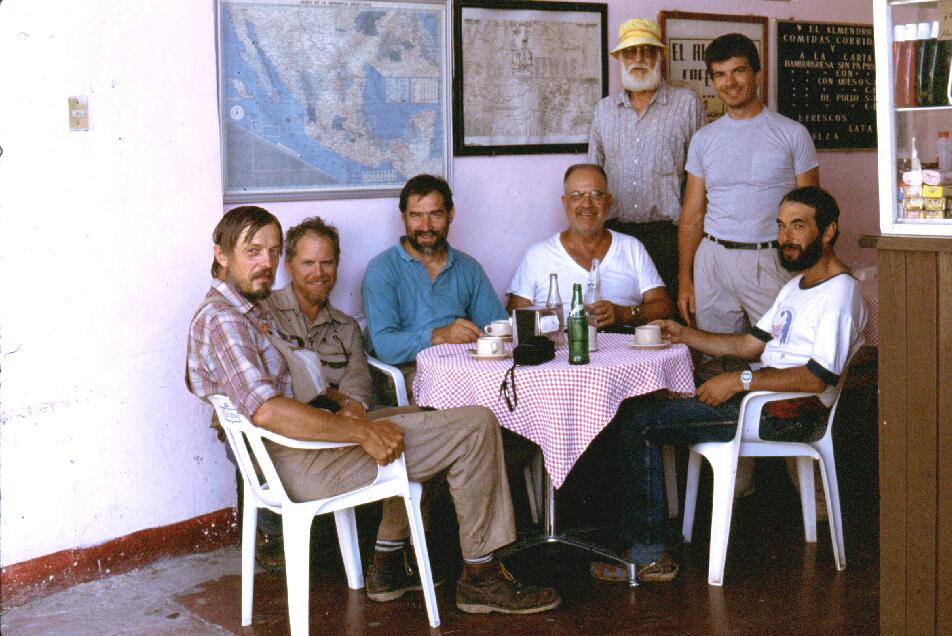
Below is a photograph of Gayle and several other buprestophiles (including a much younger me!), taken July, 1992 in Tehuantepec, Oaxaca, México during a world buprestid workers gathering (this photo was also published in the Pan-Pac memorial issue). The day this photograph was taken, Gayle and I had collected the first specimens of what we would later describe as Oaxacanthaxia nigroaenea – the second species in an odd little genus with Old World affinities that had been described just one year earlier by Chuck Bellamy from specimens collected in the very same area.

L-R: Svata Bílý (Czech Republic), Chuck Bellamy (USA), Hans Mühle (Germany), Gayle Nelson (USA), Dave Verity (USA), me, Mark Volkovitsh (Russia). Photo by Rick Westcott (USA).