It’s been awhile since our last ID Challenge. I’ll give 2 pts each for correctly naming the order, family, genus, and species and whatever supporting information you can provide. Bonus points if you can surmise host plant, location, etc. Standard ID Challenge rules apply. No trick questions this time – it’s just about the bug!

Copyright © Ted C. MacRae 2011
entomology
Brazil Bugs #16 – Outro Percevejo

Proxys sp. | Barão Geraldo, Campinas, Brazil
Another stink bug (family Pentatomidae) from my recent travels to South America, but this one from southeastern Brazil rather than Argentina. Although the white spot at the apex of the scutellum is a common theme across the family, the jet black coloration and strongly acute clypeus (“nose”) immediately reminded me of Proxys punctulatus from eastern North America. Although that species does also occur south through Mexico and Central America into northern South America, the lack of distinctively black femoral apices (“knees”) on this individual suggest it is likely a different species. I’ve not found much information on other species in this genus, as my old standby Flickr repeatedly proffers images of P. punctulatus in its Pentatomidae pages but not other species in the genus. Grazla and Campos (2010) list P. hastator from “Cayenna” (likely French Guiana) and P. victor from “Brésil,” and an illustration of the latter in the monumental Biologia Centrali-Americana (Distant 1880-1893) agrees reasonably well (but not completely) with this individual. For now, this will have to stand as Proxys sp.
REFERENCES:
Distant, W. L. 1880-1893. Biologica Centrali-Americana. Insecta. Rhynchota. Hemiptera-Heteroptera. Volume I. London: published for the editors by R. H. Porter, 462 pp.
Grazia, J. and L. A. Campos. 2010. Neotropical Pentatomidae (Insecta: Hemiptera: Heteroptera) of the collection of Massimiliano Spinola preserved in the “Museo Regionale de Scienze Naturali”, Turin, Italy. ZOOLOGIA 27(3):413–424.
Copyright © Ted C. MacRae 2011
Bichos Argentinos #4 – Balancing Act

Nezara viridula (southern green stink bug) | Pergamino, Pcia. Buenos Aires, Argentina
I encountered this adult Nezara viridula (southern green stink bug) (Hemiptera: Pentatomidae) in a soybean field in Buenos Aires Province, Argentina. I liked the way it balanced itself on the leaf on which it was sitting to keep its body level.
Copyright © Ted C. MacRae 2011
Bichos Argentinos #3 – “Bicho Torito”

Diloboderus abderus, male | Buenos Aires, Argentina
In her appeal for submissions for her upcoming issue of An Inordinate Fondness, Susannah lamented the paucity of beetles in the closing weeks of her northern winter and mentioned in passing that even I had gone more than a week without posting about this great order. I hadn’t realized that myself, so here I present Diloboderus abderus, one of the beetles that I encountered during my visit last weekend to La Reserva Ecológica Costanera Sur in Buenos Aires, Argentina. This species, known commonly in Argentina as bicho torito (“little bull bug”) is common enough in Argentina and southern Brazil, where its white grub larvae have become somewhat of a pest in lawns, pastures, and grass crops such as wheat by way of feeding on the roots. I first encountered this species during one of my previous trips to Argentina, where during a rain storm I saw literally hundreds of adults emerging from mowed grass medians in the city streets of Pergamino. These photographs show two of numerous dead individuals that I found laying on the ground of similar medians just outside the reserve. As with many scarab beetles in the subfamily Dynastinae (containing also the recently featured Dynastes tityus), males (above) are armed with pronotal and cephalic horns – presumably for use in sexual combat – while females (below) are unarmed.

Diloboderus abderus, female | Buenos Aires, Argentina
Copyright © Ted C. MacRae 2011
Bichos Argentinos #2 – Pseudomyrmex sp.

Pseudomyrmex sp. (twig ant) | Reserva Ecológica Costanera Sur, Buenos Aires, Argentina
One of the insects I tracked at La Reserva Ecológica Costanera Sur in Buenos Aires, Argentina last weekend was this twig ant in the genus Pseudomyrmex. I had noticed these slender, wasp-like ants previously on trips to the U.S. desert southwest, but it wasn’t until I read a couple of recent posts about them at Myrmecos and 6legs2many that I knew specifically what they were.
Alex characterizes these ants as “delightfully gentle, quirky little insects.” What he didn’t mention is how frenetic and unceasing they are as they forage amongst the shrubbery. I must have taken a couple dozen shots of several individuals over the course of the day, deleting every single one on the spot because I couldn’t get a clear, close, focused, nicely composed, unobstructed image. Their habit of crawling rapidly along slender twigs is problematic enough, with little opportunity to brace the camera against anything steady and spend time composing the shot. Add to that the frequently thorny nature of the trees they were roaming and their annoying habit of darting around to the backside of whatever twig they were on whilst trying to follow them in the viewfinder, and I almost decided I’d met my match and could do without the shot. In the latter part of the day I encountered this individual, and as I already had my 65mm lens mounted I decided to give it another try. I can’t say that I actually figured out the secret to getting the shot, but rather that I just lucked out and happened to have hit the shutter release at just the right moment – and with reasonable focus – as I tracked the ant along the branch on which it was crawling. It was the only shot of one of these ants that stayed on the card that day.
The genus is huge, with 209 species occurring primarily throughout the Neotropics. As a result, it would be foolish for me to even attempt a species ID. Still, I can’t help noticing its great resemblance to this photo of Pseudomyrmex phyllophilus, taken by Alex in – you guessed it, Buenos Aires, Argentina. I’ll wait for the correction, but in the off-chance that I’m right I think I deserve points on somebody’s scorecard!
Copyright © Ted C. MacRae 2011
Bichos Argentinos #1 – Eristalinus taeniops

Eristalinus taeniops - a hover fly in the family Syrphidae
It figures that perhaps the most striking insect I saw at La Reserva Ecológica Costanera Sur in Buenos Aires, Argentina would be an introduced species, as the area itself is a man-made reconstruction of the wet Pampas grasslands endemic to coastal areas of the Rio de la Plata. My identification of this fly as Eristalinus taeniops is based on its great resemblance to the many online photographs that exist from both South America and the U.S. and also the Old World where it is apparently native. I found no more authoritative sources with which to confirm the ID, so this online comparative will have to do (muscophiles feel free to comment or correct).
According to BugGuide, E. taeniops is a recent import to the U.S. from Africa, and in fact it has apparently successfully invaded much of the world. I suppose most folks will be inclined to forgive the fly for all this because of its strikingly patterned eyes, which I would have dearly loved to have gotten in tight for a closeup. This shot with the 100mm lens dialed in to the max (and only slightly cropped for composition), however, was the only one I managed – the fly bolted as I quickly tried to switch to the 65mm lens, and although I saw two more individuals afterwards, I couldn’t get anywhere close to them in the day’s heat. Eyes notwithstanding, the species is a near perfect mimic of a honey bee, making one wonder what selective pressures drove the development of these fantastically contrasting eyes.
Copyright © Ted C. MacRae 2011
North America’s largest scarab beetle

Dynastes tityus male - USA: Missouri, Jefferson Co., DeSoto
As one of North America’s largest, most written about, and most photographed beetles, Dynastes tityus (eastern Hercules beetle) hardly needs an introduction. I photographed this male specimen from my collection back in December while testing my DIY diffuser for the MT-24EX twin flash and 100mm macro lens. It’s a good test subject for such – its glossy exoskeleton may be beauty to the eye but is the bane of flash photographers, and its nearly 60mm of length demand a huge subject-to-lens distance that gives even the largest lens-mounted flash a small apparent size. Nevertheless, the diffuser did a pretty good job of creating even illumination and preventing harsh specular highlights, giving almost the effect of an indirect strobe in a white box.

Dense setae adorn the underside of the thoracic horn of the male.
I hadn’t really noticed until I took the photos the dense adornment of setae (hairs) on the underside of the thoracic horn. While setae in insects most often perform a tactile function, the density and placement on the horns of the males of these beetles makes me wonder if they might serve more of a display function.
Despite the overwhelming popularity of this beetle amongst hobbyist breeders and its widespread occurrence across the eastern United States (and the internet), it is not one that I have encountered with much frequency myself. I suspect this is due to the position of Missouri near its western limit of distribution – likely a function of the species’ preference for moist treehole cavities with rotting wood in which the larvae can develop. This particular specimen was given to me many years ago by a nursery grower in Jefferson Co. during my first job out of graduate school – before I’d ever found one myself, but since then I’ve encountered perhaps half a dozen or so at blacklights in mesic forests across the eastern Ozark Highlands. Most recently (last summer) I found a female sitting on my driveway, apparently attracted to the mercury vapor lamp above the garage that I leave on occasionally during the months of June and July just for such purpose.
Copyright © Ted C. MacRae 2011
Brazil Bugs #15 – Formiga-membracídeos mutualismo
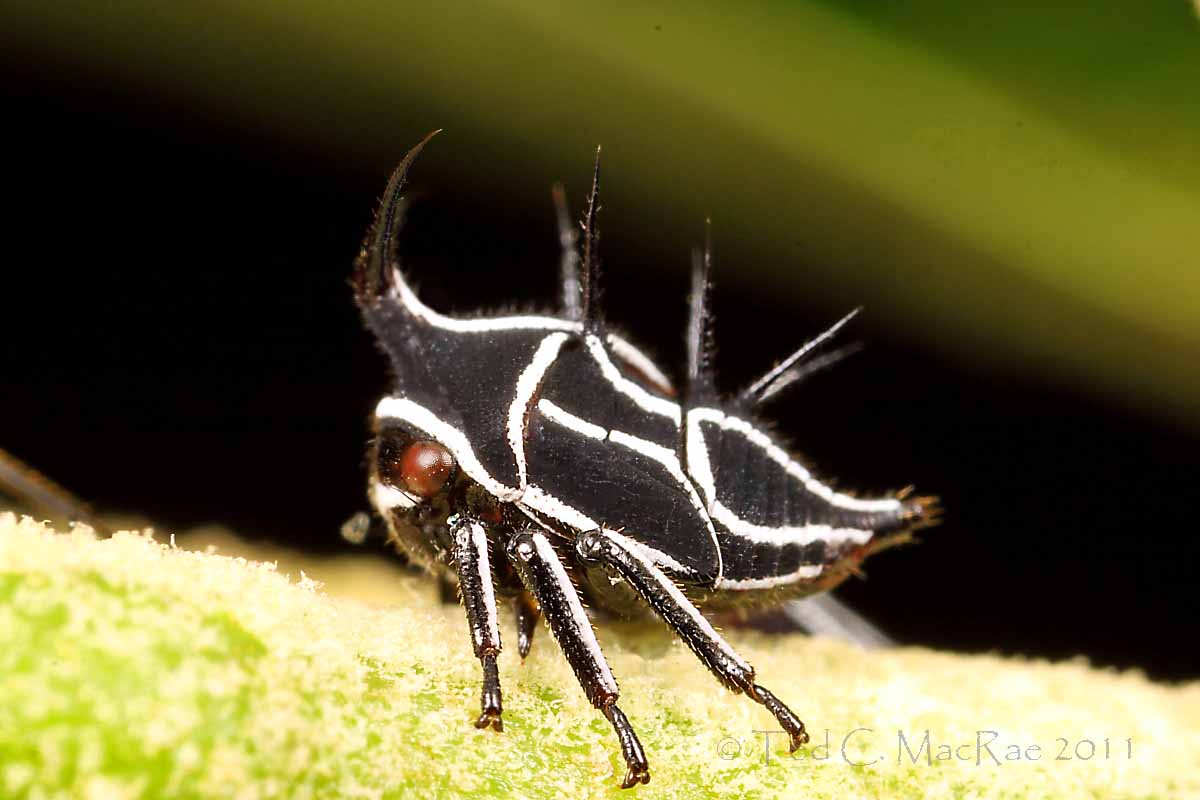
 Of the several insect groups that I most wanted to see and photograph during my trip to Brazil a few weeks ago, treehoppers were near the top of the list. To say that treehoppers are diverse in the Neotropics is certainly an understatement – South America boasts an extraordinary number of bizarre and beautiful forms that still, to this day, leave evolutionary biologists scratching their heads. The development of this amazing diversity is a relatively recent phenomenon (thinking geological scale here), as there are no known membracid fossils prior to Oligo-Miocene Dominican and Mexican amber – well after the early Cretaceous breakup of Gondwanaland split the globe into the “Old” and “New” Worlds. With its origins apparently in South America, numerous groups continued to spring forth – each with more ridiculous pronotal modifications than the last and giving rise to the dazzling diversity of forms we see today. Even North America got in the evolutionary act, benefiting from northern dispersal from South America’s richly developing fauna via temporary land bridges or island stepping stones that have existed at various times during the current era and giving rise to the almost exclusively Nearctic tribe Smiliini (whose species are largely associated with the continent’s eastern hardwood forests). Only the subfamily Centrotinae, with its relatively unadorned pronotum, managed to successfully disperse to the Old World, where it remains the sole representative taxon in that hemisphere. With a few notable exceptions, treehoppers have virtually no economic importance whatsoever, yet they enjoy relatively active study by taxonomists, evolutionists, and ecologists alike – due almost completely to the bizarreness of their forms and unique mutualistic/subsocial behaviors.
 I did manage to find a few species of treehoppers during the trip (a very primitive species being featured in Answer to ID Challenge #4 – Aetalion reticulatum), and of those that I did find the nymphs in this ant-tended aggregation on a small tree in the rural outskirts of Campinas (São Paulo State) were perhaps the most striking in coloration and form. Most were jet black, although a few exhibited fair amounts of reddish coloration, and all exhibited sharply defined white bands of wax and long erect processes on the pronotum, mesonotum, and abdomen. I’ve seen a fair number of treehopper nymphs, but I did not recognize these as something I had seen before, and given the incomplete state of immature taxomony I feared an identification might not be possible. Still (and I know this is probably beginning to sound like a broken record), I gave it the old college try.
 I usually like to start simple and get more creative if the results aren’t satisfactory, so I went to my old friend Flickr and simply typed “Membracidae” as my search term. Predictably, pages and pages of results appeared, and I began scanning through them to see if any contained nymphs at all resembling what I had. After just a few pages, I encountered this photo with very similar-looking nymphs, and although no identification beyond family was indicated for the photo, I recognized the lone adult sitting with the nymphs as a member of the tribe Aconophorini – a diverse group distinguished from other treehoppers by their long, forward-projecting pronotal horn. Luck was with me, because I happen to have a copy of the relatively recent revision of this tribe by Dietrich and Deitz (1991). Scanning through the work, I learned that the tribe is comprised of 51 species assigned to three genera: Guayaquila (22 spp.), Calloconophora (16 spp.), and Aconophora (13 spp.). The latter two genera can immediately be dismissed, as ant-interactions have not been recorded for any of the species in those two genera – clearly the individuals that I photographed were being tended by ants. Further, the long, laterally directed apical processes of the pronotal horn, two pairs of abdominal spines, and other features also agree with the characters given for nymphs of the genus Guayaquila. In looking at the species included in the genus, a drawing of a nymph that looked strikingly similar to mine was found in the species treatment for G. gracilicornis. While that species is recorded only from Central America and northern South America, it was noted that nymphs of this species closely resemble those of the much more widely distributed G. xiphias, differing by their generally paler coloration. My individuals are anything but pale, and reading through the description of the late-instar nymph of the latter species found every character in agreement. A quick search of the species in Google Images was all that was needed to confirm the ID (at least to my satisfaction).
 In a study of aggregations of G. xiphias on the shrub Didymopanax vinosum (Araliaceae) in southeastern Brazil, Del-Claro and Oliveira (1999) found an astounding 21 species of associated ant species – a far greater diversity than that reported for any other ant-treehopper system. The most frequently encountered ant species were Ectatomma edentatum, Camponotus rufipes, C. crassus, and C. renggeri, and after perusing the images of these four species at AntWeb I’m inclined to believe that the ants in these photos represent Camponotus crassus (although I am less confident of this ID than the treehoppers – corrections welcome!). The authors noted turnover of ant species throughout the day in a significant portion of the treehopper aggregations that they observed, which they suggest probably reflects distinct humidity and temperature tolerances among the different ant species and that might serve to reduce interspecific competition among ants at treehopper aggregations. Since treehopper predation and parasitism in the absence of ant mutualists can be severe, the development of multispecies associations by G. xiphias results in nearly “round-the-clock” protection that can greatly enhance their survival.
Update 3/3/11, 9:45 a.m.: My thanks to Chris Dietrich at the Illinois Natural History Survey, who provided me in an email exchange some clarifying comments on the origins and subsequent dispersal of the family. The first paragraph has been slightly modified to reflect those comments.
REFERENCES:
Del-Claro, K. and P. S. Oliveira. 1999. Ant-Homoptera interactions in a Neotropicai savanna: The honeydew-producing treehopper, Guayaquila xiphias (Membracidae), and its associated ant fauna on Didymopanax vinosum (Araliaceae). Biotropica 31(1):135–144.
Dietrich, C. H. and L. L. Deitz. 1991. Revision of the Neotropical treehopper tribe Aconophorini (Homoptera: Membracidae). North Carolina Agricultural Research Service Technical Bulletin 293, 134 pp.
Copyright © Ted C. MacRae 2011
 Beetles In The Bush