A Brazilian longhorned beetle – Oxymerus aculeatus

Oxymerus aculeatus aculeatus | January 2011 | nr. Campinas, São Paulo, Brazil

I was going through photographs from my visit to Brazil this past January and came across this forgotten photo of a longhorned beetle taken near Campinas in São Paulo.  Although I didn’t recognize the genus immediately, I was rather sure it belonged to the great tribe Trachyderini, generally characterized by medium to large-sized, brightly colored, diurnal (active during the day) species.  Knowing this it didn’t take me long to identify the species as Oxymerus aculeatus, occurring from Nicaragua and the West Indies south to Bolivia and Uruguay and, thus, the most widely distributed of the ten species in this exclusively Neotropical genus. As is typical with such widespread species, a few subspecies have also been described—this one should be the nominate subspecies, widely distributed throughout central, eastern, and southeastern Brazil (Hingrid et al 2010).

Like most other members of the family Cerambycidae, O. aculeatus is presumed to utilize dead or dying wood for larval development, but little else is known regarding its habits and host plants. Members of the tribe are often found frequenting flowers, although this and a few other individuals were encountered resting on the underside of foliage on an unidentified tree. The Florida Department of Agriculture & Consumer Services has become concerned about the possible establishment of this species in the U.S. after two recent collections of the West Indian subspecies in south Florida (Thomas 2006). Whether it goes on to have any economic impact remains to be seen, but if recent history with other wood boring beetles is any indication (e.g., Asian longhorned beetle, Anoplophora glabripennis; emerald ash borer, Agrilus planipennis; etc.) the concern may be warranted.

REFERENCE:

Hingrid Y. S. Q., J. P. Botero R. and M. L. Monné. 2010. Insecta, Coleoptera, Cerambycidae, Cerambycinae, Trachyderini: New state and country records from South America. Checklist 6(3):364–376.

Thomas, M. C. 2006. Another Neotropical longhorn beetle (Coleoptera: Cerambycidae) apparently new to the mainland of Florida. UF/IFAS Pest Alert (website accessed 7 Nov 2011).

Copyright © Ted C. MacRae 2011

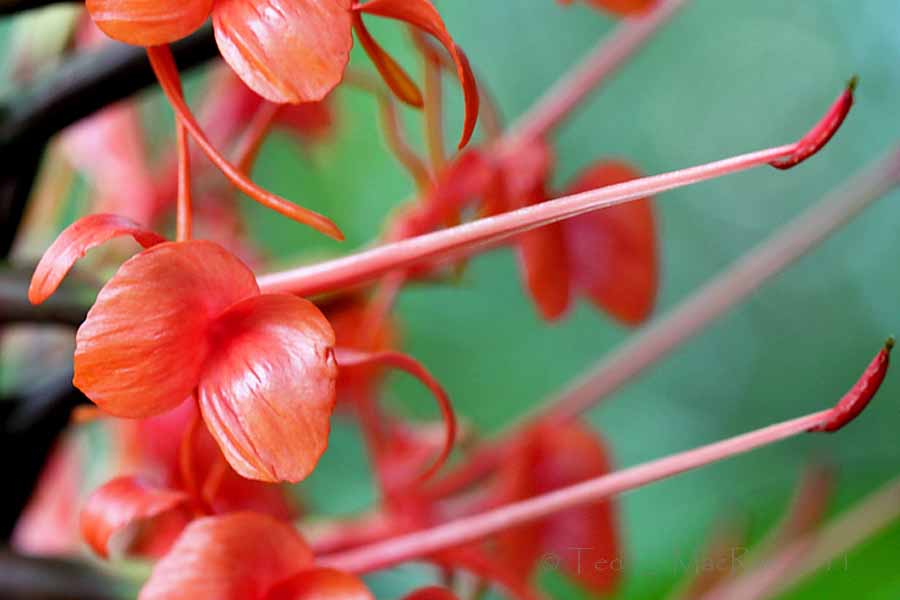
Friday Flower – Hedychium coccineum

Distrito Joaquim Igidio is one of four “districts” surrounding Campinas, Brazil.  It is the most remote of the four, with farmsteads dating back more than a century interspersed amongst some of the most significant tracts of Atlantic forest still remaining in the area.  Many of the farmsteads have recently been converted to bars and restaurants featuring live music, making the area a popular weekend getaway for Campineros.  I joined my colleague and some of his friends on a visit to one of these—Bar do Cachoeira—over the weekend during my visit this past January.  After a sumputuous lunch of Brazilian cuisine (including tohesmo torresmo—my new favorite dish) and cerveja, I walked the grounds to look for insects to photograph.  Despite only having an hour or so to look around, the two species of treehoppers I found and photographed made it a successful little venture.  Coming back to rejoin my friends, I saw a few plants with these marvelously bizarre inflorescenses growing alongside a forested stream running through the grounds.  I could tell they were some type of monocot, but beyond that I had no idea.  Something inside me suspected, however, that this was likely not a native species—it just had that introduced, tropical ornamental look to it.  My suspicions were confirmed when I showed the photos to Dr. George Yatskievych, Curator at the Missouri Botanical Garden and Director of the Flora of Missouri Project.  George identified the plant as Hedychium in the Zingiberaceae (ginger family), likely one of the cultivars of Hedychium coccineum.  He added:

This species is native to tropical Asia, but is commonly cultivated in warm regions of the world. A number of cultivars and hybrids involving related species are sold, so it’s hard to be sure which one you photographed.  The most common cultivar seems to be cv. ‘Tara’ and that’s a possibility for your plant.

Known by a number of common names (red gingerlilly, orange gingerlily, scarlet gingerlily, orange bottlebrush ginger, etc.), H. coccineum hails from the eastern Himalyas, where it grows along forest edges and in mountain grasslands.  This herbaceous perennial can reach one to two metres in height and, in some places, has become somewhat invasive.  The existence of rhizomes and bulbs can make control particularly difficult.

An interesting feature of the plant is the long, exserted stamens and stigmas of the flowers.  This feature is suggestive of an interesting pollination mechanism that relies on pollen attachment to the wings rather than the main body of its moth and butterfly pollinators. Pollen transfer is effected as the lepidopterans move from flower to flower seeking nectar, brushing their wings against the floral parts in the process and thus pollinating the flowers (Zomlefer 1994).

REFERENCE:

Zomlefer, W. B. 1994. Guide to flowering plant families. University of North Carolina Press, Chapel Hill, 430 pp.

Copyright © Ted C. MacRae 2011