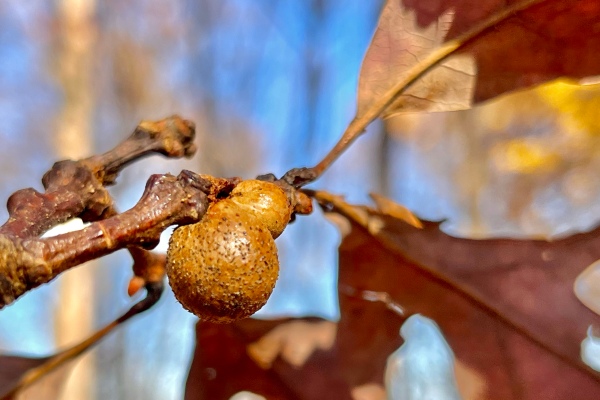
Galls of Disholcaspis quercusglobulus (round bullet gall wasp) on twig of Quercus alba (white oak).
Not all gall wasps (family Cynipidae) affect the leaves of their hosts—some instead affect the twigs. One example of such is Disholcaspis quercusglobulus (round bullet gall wasp), which forms round, detachable galls, singly or in small clusters, on the twigs of Quercus alba (white oak).
There are about a dozen other species in this genus, all of which seem to to have succeeded in eliminating the need for males (Weld 1959). All galls produce female wasps, which emerge from their galls during the fall and immediately lay eggs in twigs to begin the next year’s crop of females—no males needed. Ain’t evolution grand?!
Literature Cited
Weld, D. 1959.Cynipid Galls of the Eastern United States. Privately printed in Ann Arbor, Michigan [pdf].
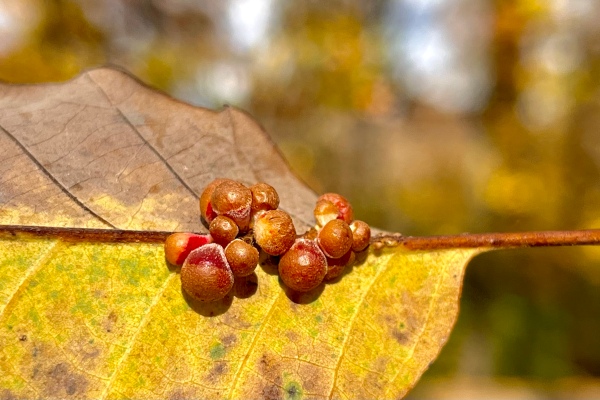
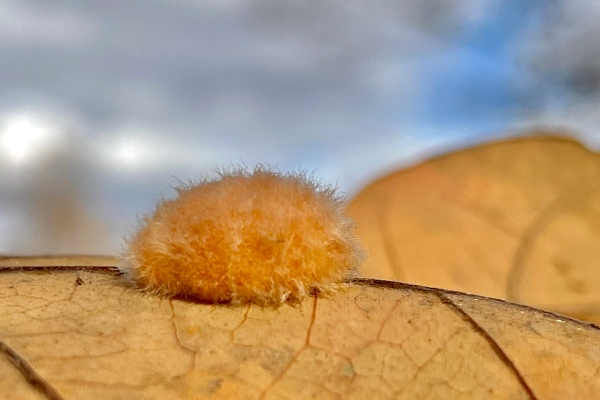
Walking Beau Diddley (my black lab) and blowing leaves today gave me an opportunity to glimpse into the world of leaf galls. Lots of organisms, both animal and disease, cause these bizarre structures to grow on the leaves and stems of various plants. In the case of the two shown here, they are cause by tiny wasps called cynipid gall wasps. There are thousands of different species of gall wasps, each creating their own characteristic type of gall and restricted to one or a few closely related host plants, but in each case the adult female wasp lays one or more eggs in the leaf—their “stinger” being used like a hypodermic needle to inject the eggs inside the leaf tissues (but completely unable to sting humans). When the eggs hatch, the larvae (called grubs) do not begin feeding directly on the existing leaf tissue, but instead secrete plant growth-like hormones that cause the plant to grow a specialized structure—called a gall—inside which the grub lives and feeds. It’s sort of like “Invasion of the Body Snatchers” on a micro-scale. When the grub has completed its development, it transforms into a pupa (kind of a wasp version of a butterfly chrysalis), and eventually the adult wasp emerges and chews its way out of the gall. It’s a marvelously elegant life cycle that goes unnoticed by most people.
Andricus dimorphus (clustered midrib gall wasp, family Cynipidae) on abaxial lower midrib of leaf of Quercus muhlenbergii (chinquapin oak).
Andricus pattoni (family Cynipidae) on abaxial leaf surface of Quercus stellata (post oak).
Today’s outing for the Webster Groves Nature Study Society (WGNSS) Botany Group was Prairie Fork Conservation Area, a newish Missouri Department of Conservation (MDC) property that is open to the public only by appointment. The 911-acre property lies within the historic 9-mile long prairie of Callaway County, Missouri—namesake for Nine Mile Prairie Township. Prior to MDC ownership, the property was owned by Ted Jones, son of the founder of Edward Jones Financial Company, and his wife Pat, who began dedicated conservation practices beginning in the 1950s. Obviously, conservation in those days—with its reliance on plantings of many now-invasive exotics such as Lespedeza sericea (sericea lespedeza), Lonicera mackii (bush honeysuckle), and Elaeagnus angustifolia (Russion olive), meant something very different than it does today. Nevertheless, the foresight and generosity of Ted and Pat Jones ultimately led to the creation a conservation area where more than half of its area has been or is being restored to claypan prairie resembling as much as possible its presettlement character.
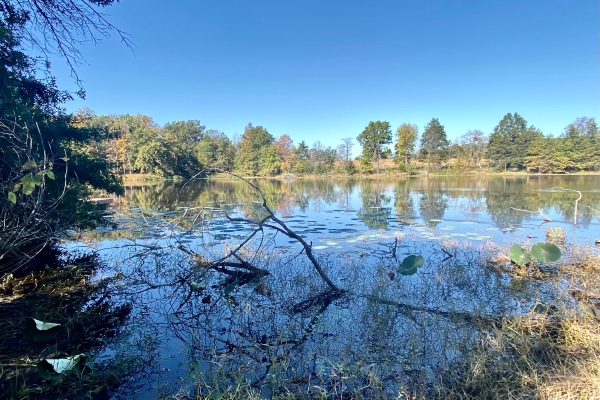
Crow Pond.
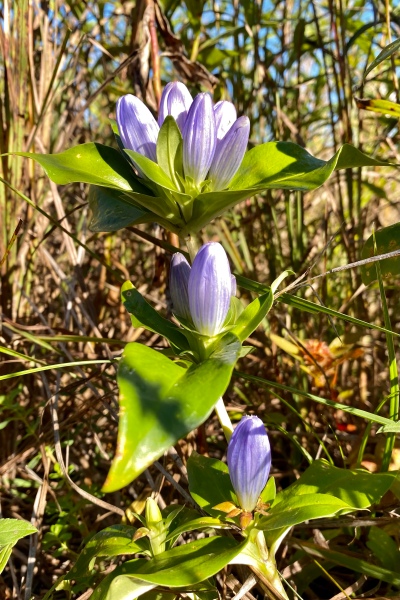
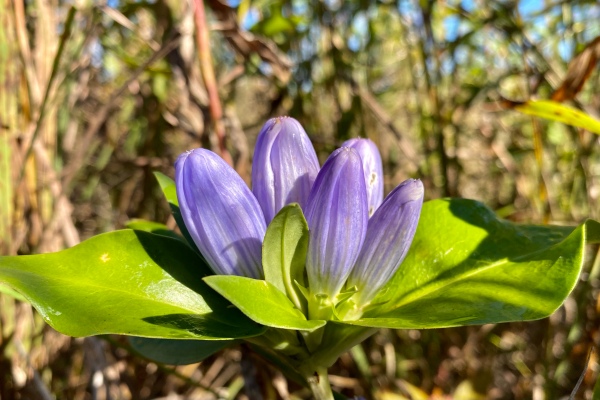
The group engaged in two short hikes—the first through several garden plantings and then at the interface between tallgrass prairie and upland forest surrounding the perimeter of Crow Pond. Almost immediately we were treated to the sight of Gentiana andrewsii (closed gentian) in bloom. To the uninitiated, the mature flowers appear to be still-unopened buds. In fact, the corolla in this species remains closed, and the flowers are pollinated by bumblebees, which must force their way through the closed corolla. We would see numerous plants as we traveled around the pond, with most being difficult to access and photograph due to the thick, surrounding vegetation.
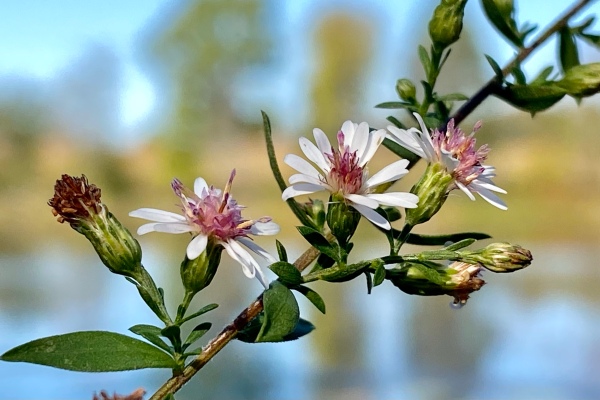
At pond’s edge, we found several examples of Symphyotrichum laterifolium (calico aster), one of the few white fall asters that can be identified fairly easily in the field due to its profusion of smaller-than-average-sized flowers along lateral branches with relatively few rays (9–16) and disc florets turning from pale yellow to purple, lance-elliptic leaves with a “Mohawk” (i.e., hairs only along the midvein) on the underside, and stems covered in soft, white hairs.
Symphyotrichum laterifolium (calico aster).
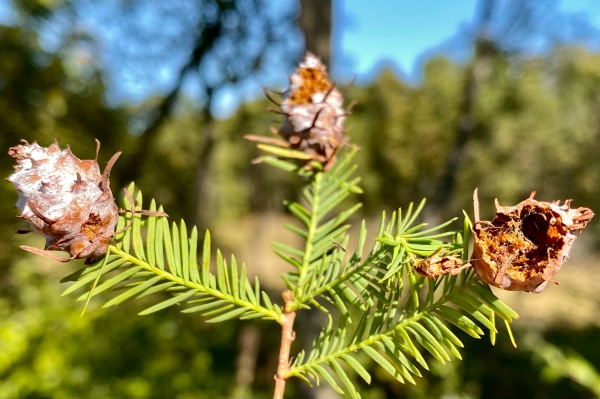
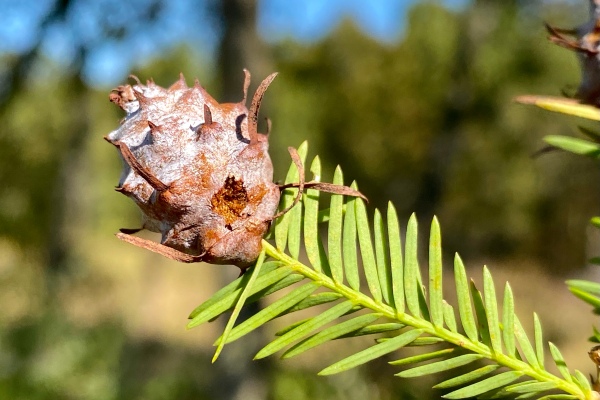
At the far end of the pond, the group noticed Taxodium distichum (bald cypress) trees (native to southeastern Missouri but not this far north) with strange-looking galls on the twigs. There was some discussion about whether they were caused by an insect or a fungus—their rusty-brown color and numerous spikes brought to mind the galls on Juniperus virginiana (eastern red-cedar) caused by the fungus Gymnosporangium juniperi-virginianae (cedar-apple rust). The fact that both Taxodium and Juniperus are in the family Cupressaceae made the idea of a rust fungus being the culprit seem even more likely. Nevertheless, a little online sleuthing (thank goodness for smart phones!) revealed that the actual culprit was, indeed, and insect—specifically Taxodiomyia cupressiananassa (cypress twig gall midge), a tiny fly. The spongy galls are snow-white at first and then turn brown with age, eventually dropping from the tree as leaves are shed. Maggots pupate inside the galls and adults may emerge from galls that are still on the tree later in the season. Maggots usually overwinter inside fallen galls to pupate and emerge as adults the following spring.
Galls caused by Taxodiomyia cupressiananassa (cypress twig gall midge) on Taxodium distichum (bald cypress).
Galls start out snow-white but turn brown with age.
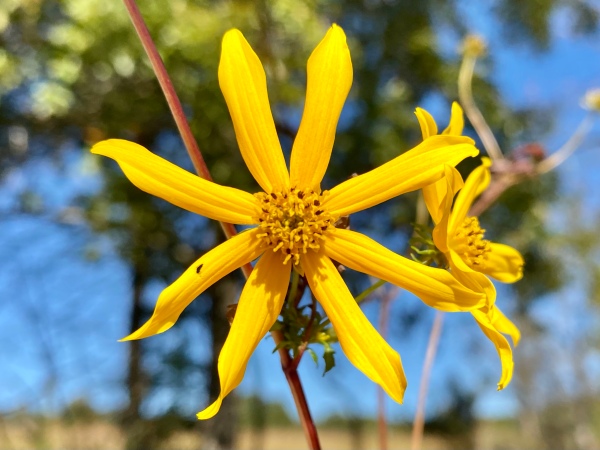
As we walked, some of the more adventurous among us partook in freshly fallen fruits of Diospyros virginiana (persimmon). Those that were plucked from trees just as they were ready to drop were found to be the tastiest and least stringent, and sucking on the five or so seeds per fruit stretched out the flavor as long as possible. As we enjoyed the impromptu snack, a few still-flowering plants of Bidens aristosa (bearded beggarsticks or tickseed sunflower) were seen near the pond margin.
Bidens aristosa (bearded beggarsticks or tickseed sunflower).
Bidens aristosa (bearded beggarsticks or tickseed sunflower).
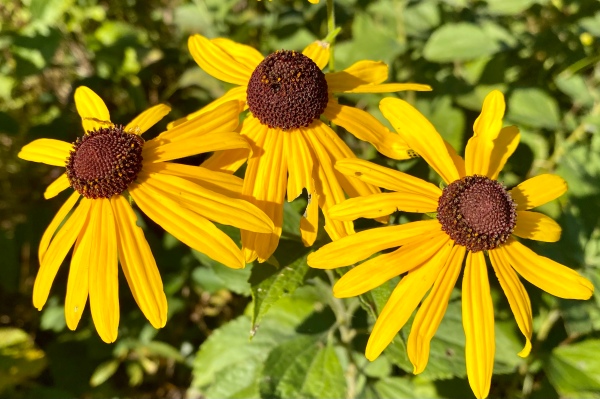
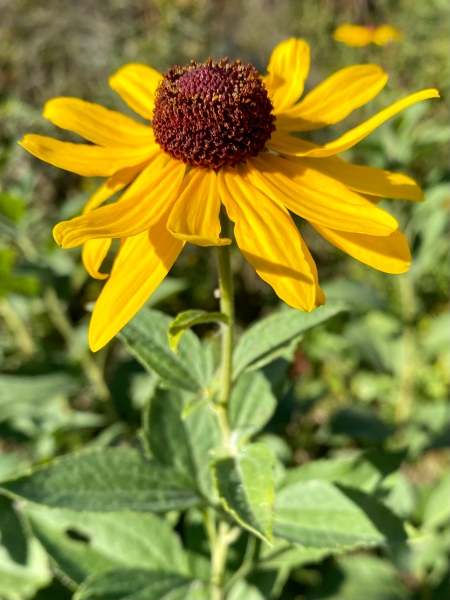
Eventually, we spotted from afar a large patch of bright, yellow-flowered composites in the distance. Their brown-purple discs brought the genus Rudbeckia immediately to mind, and our initial thought was R. subtomentosa (sweet coneflower) after seeing some of the large leaves with lobes. Still, the time of bloom seemed very late, and the plants were not as tall nor the leaves as “gray” as would be expected for that species. In reality, the majority of leaves were not lobed, and we decided they instead represented a form of R. fulgida (orange coneflower)—a highly variable and taxonomically difficult complex of populations.
Rudbeckia fulgida (orange coneflower).
Rudbeckia fulgida (orange coneflower).
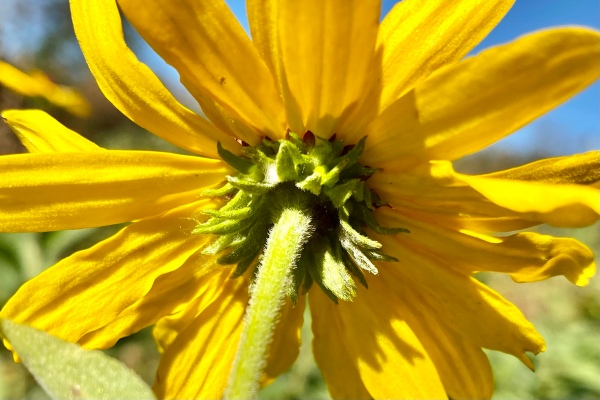
Rudbeckia fulgida (orange coneflower) involucre.
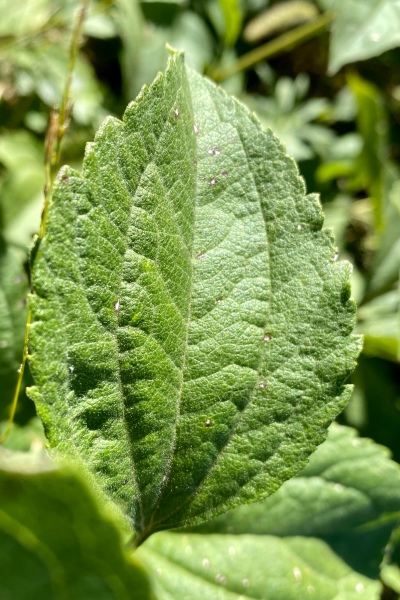
Rudbeckia fulgida (orange coneflower) leaf.
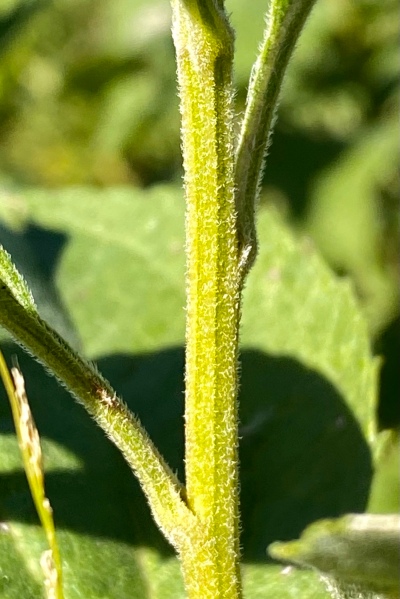
Rudbeckia fulgida (orange coneflower) stem.
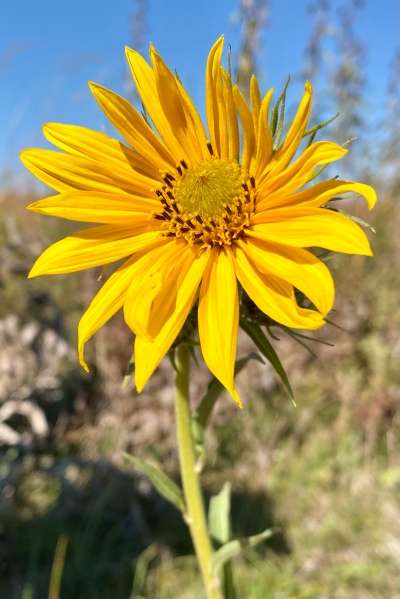
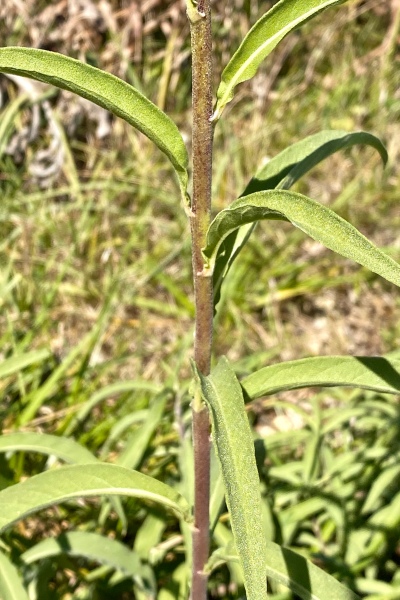
After completing the circuit around Crow Pond, the group caravanned to the northernmost and most recently renovated quarter on the property. Most of the plants established in this large tract of now-tallgrass prairie were well on their way to fall seed (and, in fact, had been combine-harvested for such), but mowing along the gravel access road allowed some still-green regrow the—the most dramatic being Helianthus maximiliani (Maximilian sunflower). This uncommon sunflower is most similar to H. grosseserratus (sawtooth sunflower) due to its large attractive flowers and narrow, curved leaves. However, leaves of the former are grayish due to the presence of many tiny hairs covering the surface of the leaf (in the latter leaves are glabrous), and the stem is rough—also due to the presence of hairs (in the latter the stem is glabrous and has a glaucus coating that can be rubbed off).



 Beetles In The Bush