North America’s most beautiful tiger beetle

Cicindela pulchra pulchra (beautiful tiger beetle) - Fall River Co., South Dakota.

Five years ago this month, I got my first glimpse of North America’s most beautiful tiger – Cicindela pulchra.  This is not just my opinion – its name, given to it by Father-of-North-American-entomology Thomas Say, literally translates to “beautiful tiger beetle.”  Like Amblycheila cylindriformis, it was a species that I longed to see in the field ever since receiving a single specimen from tiger beetle guru Ron Huber.  That specimen came from the Gypsum Hills of Barber Co. in south-central Kansas – a known “hot spot” for the species.  For years I stared at that spectacular specimen as it sat in my cabinet, and in September 2004 Chris Brown and I finally made our first attempt to see it in the field for ourselves.  Unfortunately, we arrived ahead of the fall rains that seem to trigger emergence of this species, and C. pulchra would not be among the few species that we saw on that trip.  I don’t handle defeat very well, so the very next fall I resolved to try again – this time waiting until early October and also enlisting the assistance of local entomologist “Beetle Bill” Smith for access to better sites than what are available along the roadsides.  That trip was a tremendous success and was detailed in one of my Nature Notes articles (MacRae 2006), but Chris, unfortunately, was unable to join me on that second attempt.  He couldn’t join me last year, either, for my search of the species in the nearby Cimarron Gypsum Hills of northwestern Oklahoma.  Good thing, however, as a turn of the weather left me just cold and wet (although I do remain convinced that the species will eventually be found on those red clay slopes that have so far produced such prizes as Cylindera celeripes, Dromochorus pruinina, and Amblycheila cylindriformis).

Matt Brust (L) and Chris Brown (R). Matt discovered this site for Cicindela pulchra in 2009.

Fortunately, while I was getting skunked in Oklahoma, Matt Brust was discovering new populations of the species further north in the southwestern corner of South Dakota.  These discoveries were prompted by the initial discovery of the species on Pierre Shale exposures at a single site near the Black Hills (Larsen and Willis 2008).  The soft, dark gray soils of the Pierre Shales are in distinct contrast to red clay exposures with which the species has been typically associated further south, and by scouting a broader area for similar exposures Matt was able to find the species at six new sites during late summer 2009 (Brust 2010).  He found them associated not only with the Pierre Shale but also the Mowry Shale formation (and suspects they may eventually be found on Belle Fourche Shale formations as well).  When I learned of these discoveries, I decided I just had to see them for myself.  I had enjoyed my Fall 2008 trip to northwestern Nebraska and southwestern South Dakota, and the thought of seeing these beetles while spending time in the field with Matt once again seemed the perfect basis for another trip to the area.  It didn’t take much convincing for Chris to agree, thus, C. pulchra became goal of the 2010 Fall Tiger Beetle Trip™.

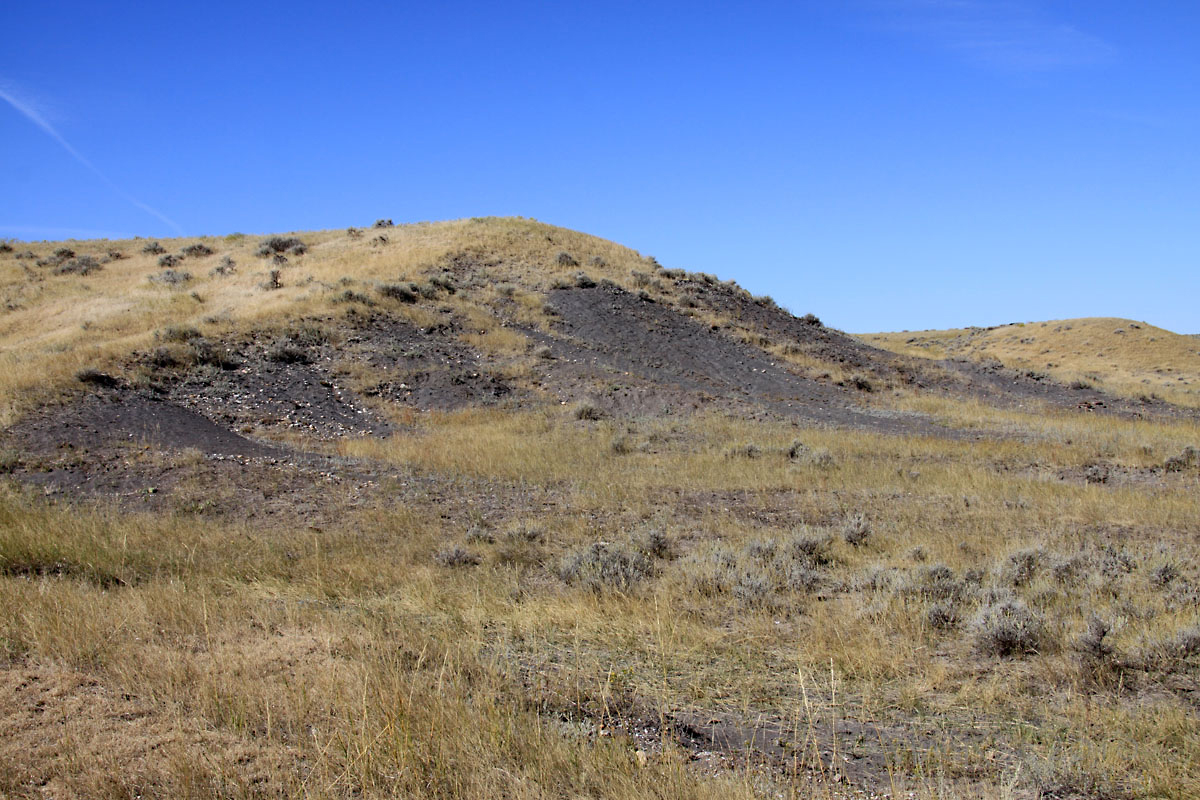
Habitat for Cicindela pulchra in Fall River Co., South Dakota. Adults and larval burrows are found in sparsely vegetated gray shale slopes and open flats beneath.

As we drove to the site that Matt had selected for us to explore, I felt nothing but optimism.  The skies were clear and the temperature was already nearing 70°F.  Matt, however, was hedging his bets – “I hope they’re still out, I’ve never seen them this late!”  Still, I wasn’t worried.  We were two weeks earlier in the season than the 2005 Kansas trip, and the weather was simply spectacular – it just had to be a good tiger beetle day!  My optimism was justified, as within minutes of arriving at the site we saw the first individual.  I collected this one alive as a backup for photographs in the studio should that be the last one we saw, but no such contingencies were necessary – we began seeing individual after individual as we trolled across the barren gray slopes.

Adult male Cicindela pulchra taking in the morning sun.

These beetles are simply a marvel to see in the field.  Brilliant dark red with metallic green, blue, and purple borders on the head, thorax, and elytra, this relatively large tiger beetle (certainly among the largest in the genus) can be confused with no other tiger beetle in North America.  Unlike adults of most other species, which exhibit color patterns resembling the texture and hue of the soil substrate on which they occur, C. pulchra adults are obvious and non-cryptic.  It apparently mimics the large, similarly colored velvet ants of the genus Dasymutilla with which they are sympatric – even exhibiting similar behavior when alarmed such as stridulating (creating vibrations by scraping body parts across one another) and giving off defense chemicals (Pearson 1988).  Adults are powerful fliers that can fly long distances when alarmed (Spomer et al. 2008), but in the still relatively cool morning air Chris and I had relatively (emphasis on relatively!) little trouble getting close enough to attempt those coveted field photographs.  This, however, was a double-edged sword – the same cool temperatures that allowed us to get close enough for photographs also caused to the beetles to assume the most non-photogenic poses as they sprawled torpidly on the ground, sometimes hugging it closely in an attempt to conserve heat until incident radiation from the sun warmed them sufficiently to go about the day’s activities.  Once this did happen, we found getting close enough for photographs nearly impossible.  In the 2+ hours that we chased after them, we took many shots but failed to get that “perfect” shot of a brilliant beetle standing tall and alert.

Adult male Cicindela pulchra hugs the ground during the cool morning hours.

Cicindela pulchra is a “spring/fall” species – i.e., sexually immature adults emerge during fall to feed, then return to their burrows to overwinter before emerging again in spring to mate and lay eggs.   Pearson et al. (2006) state the fall period lasts from July to September; however, as I observed in Kansas in 2005 adults can remain active well into October as long as suitable weather prevails.  Larvae hatch shortly after eggs are laid in the spring, but larval burrows can be seen during the entire season since they require 2-3 to complete development.  It was actually the presence of the large larval burrows (see photo below) that alerted Matt to the occurrence of the species at this site.  Several other tiger beetle species are also found here, e.g. C. purpurea (cow path tiger beetle) and C. tranquebarica (oblique-lined tiger beetle); however, these species – and hence their larval burrows – are considerably smaller than C. pulchra.  The only other species of Cicindela in North America that matches C. pulchra in size is C. obsoleta (large grassland tiger beetle), a southwestern species that is not known to range as far north as Nebraska and South Dakota, and the slightly smaller C. formosa (big sand tiger beetle) larval burrow has a distinctive “pitfall trap” with the burrow opening situated horizontally above it (it is also restricted to dry sand rather than clay habitats).  We saw several C. pulchra larval burrows during our visit but no active larvae, and none of my attempts to “fish” them out of their relatively shallow burrows met with success.  I could have tried digging them out, but that is a time-intensive activity, and I decided instead to bring a few live adults back in a terrarium of native soil and see if I could rear the species from egg.

Despite the presence of at least two other tiger beetle species at the site, this can only be that of a 3rd-instar Cicindela pulchra due to its large size.

I had tried persistently during the last hour we were there to get a good field photograph of an active adult beetle standing tall and alert, but the following is the closest I was able to achieve.  Leaving the site without that “perfect” shot was difficult – as Matt put it, we had “pulchra fever”!  Still, there were other tiger beetles – e.g. C. nebraskana (prairie long-lipped tiger beetle) and C. decemnotata (badlands tiger beetle) – that we wanted to find in the limited time we had to explore the region, so I prepared a terrarium for the live adults I was bringing back with me and chalked up our first big success of the trip as we headed towards the shortgrass prairie sitting atop the nearby Nebraska Pine Ridge.

I chased this adult female for some time trying to get a closer photograph, but warming temperatures made this impossible.

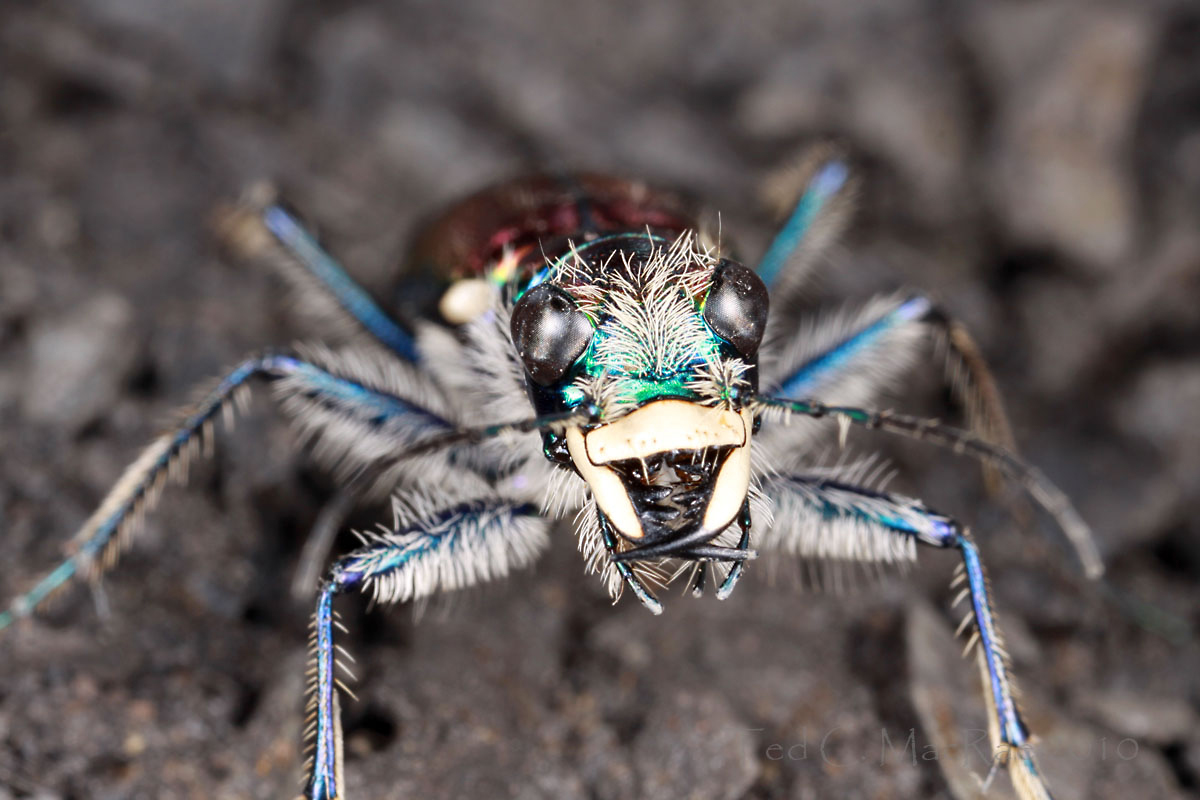
In addition to attempting to rear the species,  bringing live adults back with me also gave me more opportunity to photograph them.  In addition to the native crumbly shale soil that I used to fill the terrarium, I placed in it one of the nicely colored, presumably volcanic, rocks that littered the slopes on which the beetles occurred.  The dark color of the rock makes a nice backdrop to really show off the extraordinary colors of this species – especially the bright white labrum and mandibles of the particularly impressive male in the following photograph.  The beetles are all now sound asleep for the winter in a 10°C incubator.  Hopefully, when I move the terrarium back into warm temperatures next spring they will re-emerge, mate, and lay eggs (hmm, photographs of a mating pair would be really nice!).

The all-white labrum and mandibles of this male Cicindela pulchra are displayed nicely in this terrarium photograph.

Photo Details:
Insects: Canon 50D w/ 100mm macro lens (ISO 100, 1/250 sec, f/16), Canon MT-24EX flash w/ Sto-Fen + GFPuffer diffusers.
Habitat: Canon 50D w/ 17-85mm wide-angle lens (ISO 100, 1/160 sec, f/11), natural light.
Matt and Chris: Canon 50D w/ 17-85mm wide-angle lens (ISO 100, 1/250 sec, f/11), natural light.
All photos w/ typical post-processing (levels, minor cropping, unsharp mask).

REFERENCES:

Brust, M. L.  2010. New distribution records for Cicindela pulchra pulchra Say in South Dakota and notes on habitat use and natural history.  Cicindela 42:1–10.

Larsen, K. J. and H. L. Willis.  2008. Range extension into South Dakota for Cicindela pulchra (Coleoptera: Carabidae).  The Coleopterists Bulletin 62(4):480.

MacRae, T. C. 2006. Beetle bits: The “beautiful tiger beetle”. Nature Notes, Journal of the Webster Groves Nature Study Society 78(4):9–12.

Pearson, D. L.  1988. Biology of tiger beetles.  Annual Review of Entomology 33:123–147.

Pearson, D. L., C. B. Knisley and C. J. Kazilek. 2006. A Field Guide to the Tiger Beetles of the United States and Canada. Oxford University Press, New York, 227 pp.

Spomer, S. M., M. L. Brust, D. C. Backlund and S. Weins.  2008. Tiger Beetles of South Dakota & Nebraska.University of Nebraska, Department of Entomology, Lincoln, 60 pp.

Copyright © Ted C. MacRae 2010
Sweet Sixteen!

The 7th Annual Fall Tiger Beetle Trip™ is officially over – Chris and I rolled back into town a little after midnight last night. It was an amazing trip – perfect weather, unparalleled scenery, and a record-breaking 16 species of tiger beetles seen in 13 localities across four states. Not only does this beat my previous trip record of 13 species, but we did it with only five days in the field. At the time of my previous update, we had visited several locations in the South Dakota Badlands and Nebraska Pine Ridge and found ten different tiger beetle species, including Cicindela pulchra (beautiful tiger beetle) – our top priority for the trip – C. nebraskana (prairie long-lipped tiger beetle), and C. lengi (blowout tiger beetle). Our plan for the next day was to visit the Badlands of Wyoming to look for C. decemnotata (Badlands tiger beetle – appropriately) and the Yampa River Valley of northwestern Colorado to look for C. scutellaris yampae and C. formosa gibsoni, all three of which we managed to find (though with caveats – stay tuned). Our originally planned final field day was to take us back into Wyoming to look for C. longilabris (boreal long-lipped tiger beetle) in the mountains east of Laramie and the Nebraska Sand Hills to look for the delicate little C. limbata before heading back home. However, we were finally paid a visit by “the skunk” and did not see any of these species (although our sighting of C. limbata (common claybank tiger beetle) in Wyoming did officially break the old trip record). Not wanting to end the trip on a disappointing day, we delayed our departure for home yesterday and visited two more sites at the eastern edge of the Nebraska Sand Hills (sites M and N in the above map) – a clay bank site where we saw a robust population of C. denverensis (to augment the single individual we had seen earlier in the trip) and several C. splendida (splendid tiger beetle), and another sand dune/blowout system where we at last succeeded in finding C. limbata.

The day after the end of the Annual Fall Tiger Beetle Trip™ is usually a somewhat depressing day for me. Not only is the trip over, but likely so is the entire insect collecting season. I know I need the down time to process the specimens and knowledge acquired during the season, but the field work itself remains my favorite aspect of this pursuit. Nevertheless, the experiences from this trip will fuel my memories for years to come, and in the next weeks I’ll share some of the stories that unfolded. Until then, I leave you with this portrait of C. pulchra – looking rather annoyed with me for my persistent efforts to take his photograph.

Cicindela pulchra - the ''beautiful'' tiger beetle

Copyright © Ted C. MacRae 2010

Reunion in the Badlands… and beyond

Two years ago I targeted Nebraska and South Dakota for that year’s Fall Tiger Beetle Trip. I had gotten my first experience with what Nebraska had to offer with a long weekend trip to the Nebraska Sand Hills during the previous fall, and with my appetite fully whetted as a result of that trip, I made a full-blown week-long trip through not only the Sand Hills, but further west to the Pine Ridge area in northwestern Nebraska and the Black Hills of South Dakota. It was a phenomenal trip that featured not only tiger beetles (13 species in all), but rare longhorned beetles, aggressive rattlesnakes, and a stunning array of autumn-flavored Great Plains landscapes.

Ted MacRae and Matt Brust stand in Cicindela nebraskana habitat (northwestern Nebraska).

Probably the species that I was happiest to encounter on that trip were Cicindela nebraskana (prairie long-lipped tiger beetle), C. lengi (blowout tiger beetle), and C. limbata (sandy tiger beetle).  I can’t claim sole credit for those finds, since I had made arrangements to meet Nebraska tiger beetle expert Matt Brust and have him show me some of his favorite sites. With Matt’s help, both in taking me to localities and directing me to others, I found nearly every species that I was hoping to see. Nearly, but not every species that is. The one species I really hoped to see but knew was a long shot was Cicindela decemnotata (Badlands tiger beetle). It’s right at the easternmost limit of its distribution in northwestern Nebraska, and only a handful of individuals have been seen in the state. Another species I did not see was Cicindela pulchra (beautiful tiger beetle). You’ve heard me talk about this species on several occasions, referring to my experience with it in south-central Kansas (written up in this little note) and my later obsession – so far unfulfilled – with finding it in nearby northwestern Oklahoma. I didn’t even try to look for this species… because nobody knew it was there! It was not until the following year that Matt found it in the Badlands of South Dakota, and since then he has located a number of populations in that area.

It is with C. decemnotata and C. pulchra in mind that I make return trip to the South Dakota Badlands for the Annual Fall Tiger Beetle Trip™. This time I am accompanied by fellow cicindelophile and field companion Chris Brown, and by the time you read this we will be on our way to meet up with Matt once again and focus our efforts on finding these two species. In this far northern area, it is already late in the season, so success is not assured. However, with Matt showing or directing us to some of the localities where he’s found these species, we’ve got the biggest bullets in our guns possible. Since I’ve already seen many of the other interesting tiger beetle species up that way (C. nebraskana, C. lengi, C. limbata, etc.) from the previous trip, we will be free to devote all of our attention to finding these two species – including driving even further west into the heart of Wyoming, where C. decemnotata occurs a little more reliably. If I come back from this trip with nothing more than some great photos of one of these species, the trip will have been a success. If I come back with photos of both of them, the trip will have been a huge success. Along the way, I’ll still keep an eye out for other tiger beetles – especially C. nebraskana, C. lengi, and C. limbata, because about the only thing I would wish for on top of success as photographing C. decemnotata and C. pulchra is nicer photographs of these other species as well to replace the dreadful point-and-shoot versions that I have from my 2008 trip.

Copyright © Ted C. MacRae 2010
The real Eleodes suturalis

I recently posted a photograph of a clown beetle (Eleodes hispilabris) (family Tenebrionidae) that I found last July in the Glass Mountains of northwestern Oklahoma.  I had encountered that individual while stumbling through the mixed-grass prairie in the middle of the night in search of the Great Plains giant tiger beetle (Amblycheila cylindriformis).  Although I eventually found the latter species, it took a few hours, during which time I was forced to examine numerous individuals of another clown beetle, Eleodes suturalis – perhaps the most conspicuously common clown beetle in the Great Plains.  I didn’t bother to take photographs of them, focused as I was on my tiger beetle search and owing to the fact that this was not the first time I’d encountered that species in abundance (the first time being many, many years ago as they crossed the highway en masse just a few miles north of the Glass Mountains in Barber Co. Kansas).  In fact, I was becoming rather annoyed with them due to their great similarity in size and coloration to the object of my desire¹, and only when I found the previously photographed individual doing the defensive “head stand” so characteristic of the group did I relent and break out the camera for a series of shots (not easy in the dark of night).

¹ Wrigley (2008) even suggested a mimetic association for Amblycheila cylindriformis and Eleodes suturalis due to their similarity in size, shape and coloration (black with a reddish-brown sutural stripe).

Of course, that individual turned out not to be E. suturalis, but the closely related species E. hispilabris, a fact that I did not realize until several days later as I was examining the photographs more closely. Fortunately, I happened to bring home with me a live individual of what truly represents E. suturalis, which I show in these photographs.  I’m not sure exactly why I brought a live one home with me – I’ve done more and more of this in recent years, mostly just to observe them and see what they do.²  I think in this case, I was intrigued by the possible mimetic association between this species and A. cylindriformis and wanted an individual for comparison with the several live A. cylindriformis individuals that I also brought back with me.

² The singular focus on collecting “specimens” that I had during my younger years seems to be giving way to a desire to know more about species as living entities and not just their external morphology.

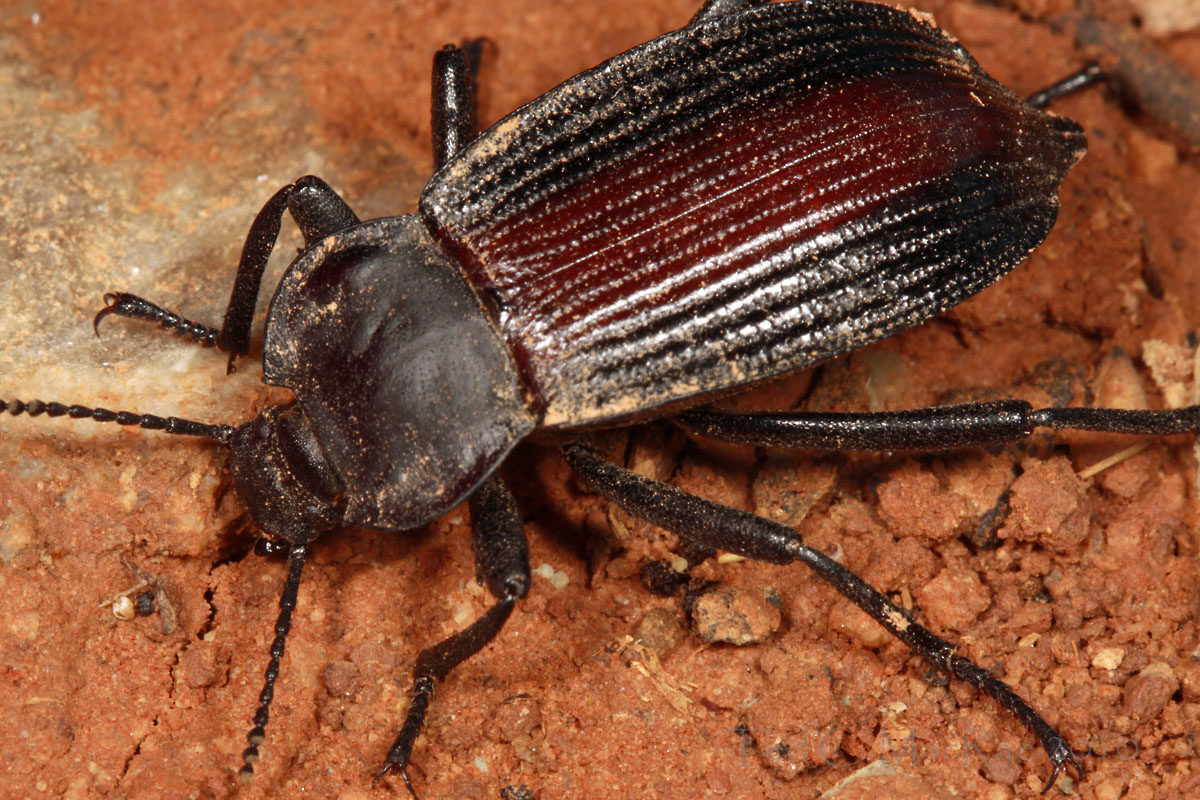
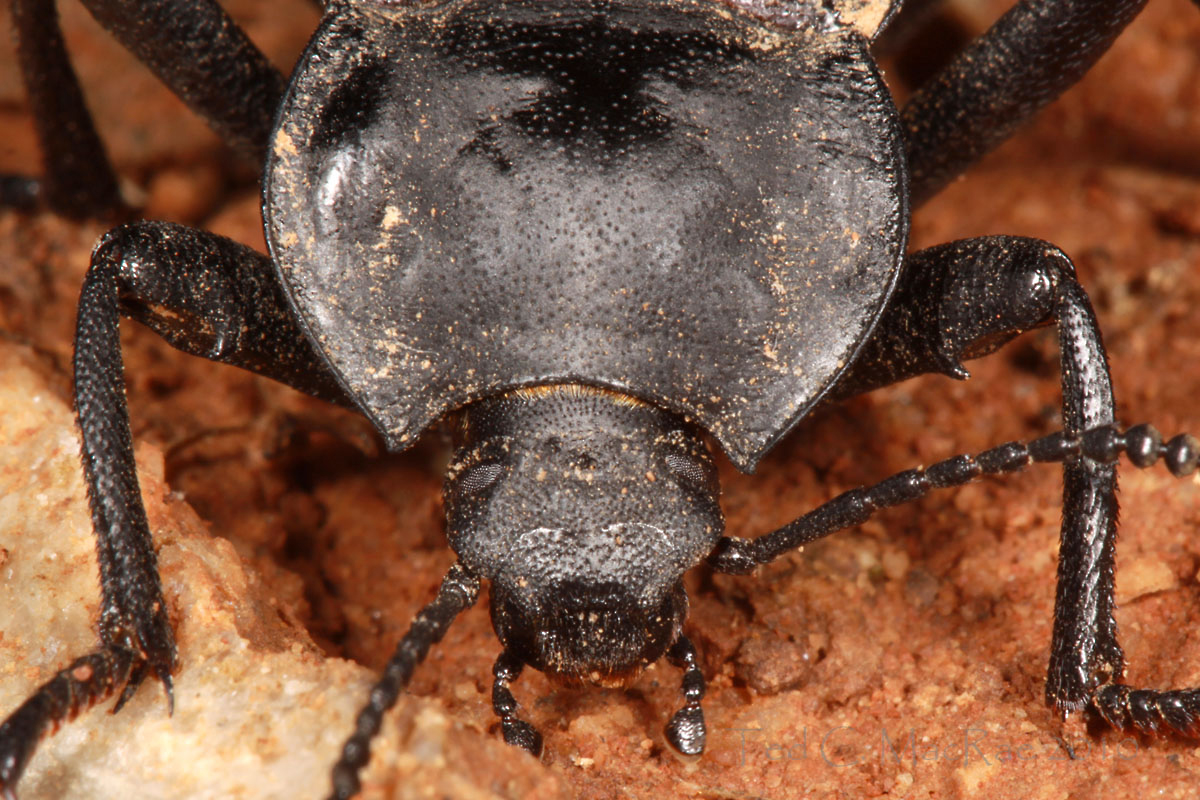
Unlike E. hispilabris (my identification of which I only consider tentative), there can be little doubt that the individual in these photographs represents E. suturalis.  No other clown beetle in the Great Plains exhibits the sharply laterally carinate elytra and broadly explanate (spread outward flatly) pronotum (Bernett 2008).  The reddish-brown sutural stripe of the distinctly flattened elytra is also commonly seen in this species, although occasional individuals of a few other clown beetle species exhibit the stripe as well (including E. hispilabris, which likely was the reason I assumed it represented E. suturalis).  All of the characters mentioned above can be seen in the photographs shown here.  However, I nevertheless find the photos rather unsatisfying.  If you think you know why, feel free to comment, otherwise you can wait for the “better” photos…

Photo Details: Canon 50D w/ 100mm macro lens (ISO 100, 1/250 sec, f/18), Canon MT-24EX flash w/ Sto-Fen diffusers. Typical post-processing (levels, minor cropping, unsharp mask).

REFERENCES:

Bernett, A. 2008. The genus Eleodes Eschscholtz (Coleoptera: Tenebrionidae) of eastern Colorado. Journal of the Kansas Entomological Society 81(4):377–391.

Wrigley, R. A.  2008. Insect collecting in Mid-western USA, July 2007.  The Entomological Society of Manitoba Newsletter 35(2):5–9.

Copyright © Ted C. MacRae 2010
North America’s largest centipede

As I prowled the remote mixed-grass prairie of northwestern Oklahoma in the middle of the night, an enormous, serpentine figure emerged frenetically from a clump of grass and clambered up the banks of the draw I was exploring.  Although I was still hoping for my first glimpse of the Great Plains giant tiger beetle, I was keeping a watchful eye out for anything that moved within the illuminated tunnel of my headlamp due to the potential for encountering prairie rattlesnakes (perhaps the most aggressive of North America’s species).  This was clearly no snake, but at up to 8″, Scolopendra heros (giant desert centipede) easily matches some smaller snakes in length.  Also called the giant Sonoran centipede and the giant North American centipede, it is North America’s largest representative of this class of arthropods (although consider its South American relative, S. gigantea – the Peruvian or Amazonian giant centipede, whose lengths of up to 12″ make it the largest centipede in the world).

Although I had never before seen this species alive, I recognized it instantly for what it was.  Many years ago I was scouting the extreme southwest corner of Missouri for stands of soapberry (Sapindus saponaria), a small tree that just sneaks inside Missouri at the northeasternmost limit of its distribution, in hopes of finding dead branches that might be infested with jewel beetles normally found in Texas.  I had heard that these centipedes also reach their northeastern extent in southwestern Missouri, and just a few miles from the Arkansas and Oklahoma borders I found a road-killed specimen.  I stood there dejected looking at it – too flattened to even try to salvage for the record.

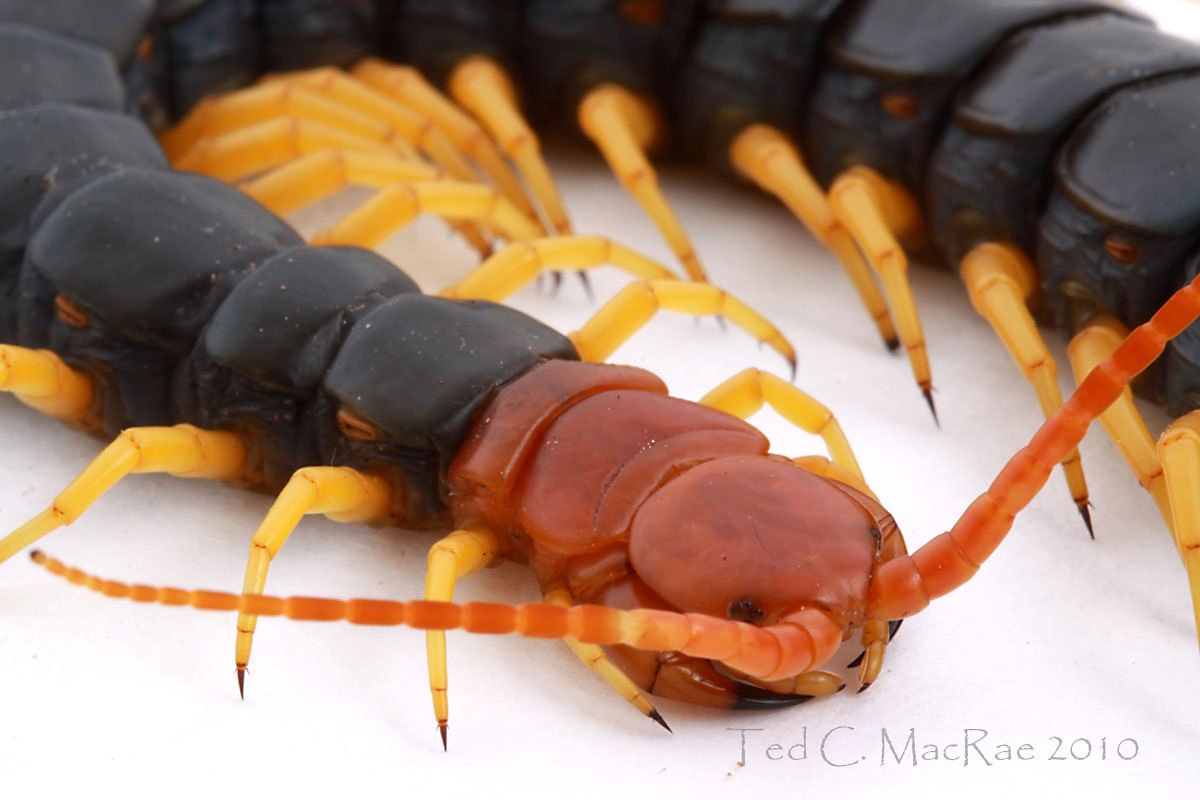
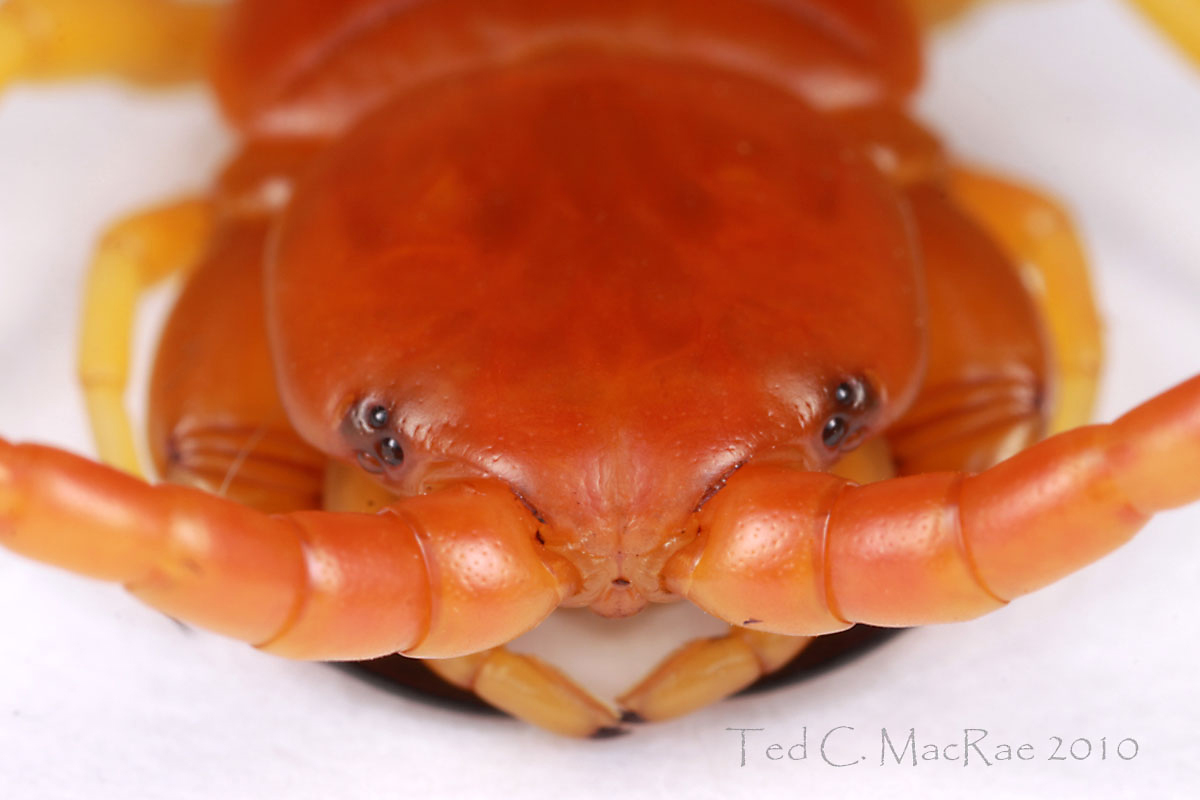
Centipedes, of course, comprise the class Chilopoda, which is divided into four orders.  The giant centipedes (21 species native to North America) are placed in the order Scolopendromorpha, distinguished by having 21 or 23 pairs of legs and (usually) four small, individual ocelli on each side of the head (best seen in bottom photo).  The three other orders of centipedes either lack eyes (Geophilomorpha) or possess compound eyes (Scutigeromorpha and Lithobiomorpha).  These latter two orders also have only 15 pairs of legs (shouldn’t they thus be called “quindecipedes”?).  Among the scolopendromorphs, S. heros is easily distinguished by its very large size and distinctive coloration.  This coloration varies greatly across its range, resulting in the designation of three (likely taxonomically meaningless) subspecies.  This individual would be considered S. h. castaneiceps (red-headed centipede) due to its black trunk with the head and first few trunk segments red and the legs yellow.  As we have noted before, such striking coloration of black and yellow or red nearly always indicates an aposematic or warning function for a species possessing effective antipredatory capabilities – in this case a toxic and very painful bite.

The individual in these photographs is not the first one I saw that night, but the second.  I had no container on hand to hold the first one and not even any forceps with which to handle it – I had to watch in frustration as it clambered up the side of the draw and disappear into the darkness of the night.  Only after I returned to the truck to retrieve a small, plastic terrarium (to fill with dirt for the giant tiger beetles that I now possessed) did I luck into seeing a second individual, which I coaxed carefully into the container.  It almost escaped me yet again – I left the container on the kitchen table when I returned home, only to find the container knocked onto the floor the next morning and the lid askew.  I figured the centipede was long gone and hoped that whichever of our three cats that knocked the container off the table didn’t experience its painful bite.  That evening, I noticed all three cats sitting in a semi-circle, staring at a paper shredder kept up against the wall in the kitchen.  I knew immediately what had so captured their interest and peeked behind the shredder to see the centipede pressed up against the wall. The centipede had lost one of its terminal legs but seemed otherwise none the worse for wear – its terrarium now sits safely in my cat-free office, and every few days it enjoys a nice, fat Manduca larva for lunch.

There are a number of online “fact sheets” on this species, mostly regarding care in captivity for this uncommon but desirable species.  I highly recommend this one by Jeffrey K. Barnes of the University of Arkansas for its comprehensiveness and science-focus.

Photo Details: Canon 50D (ISO 100, 1/250 sec) w/ Canon MT-24EX flash in white box.
Photos 1-2: Canon 100mm macro lens (f22), indirect flash.
Photo 3: Canon MP-E 65mm 1-5X macro lens (f/13), direct flash w/ Sto-Fen + GFPuffer diffusers.
Post-processing: levels, minor cropping, unsharp mask.

Copyright © Ted C. MacRae 2010
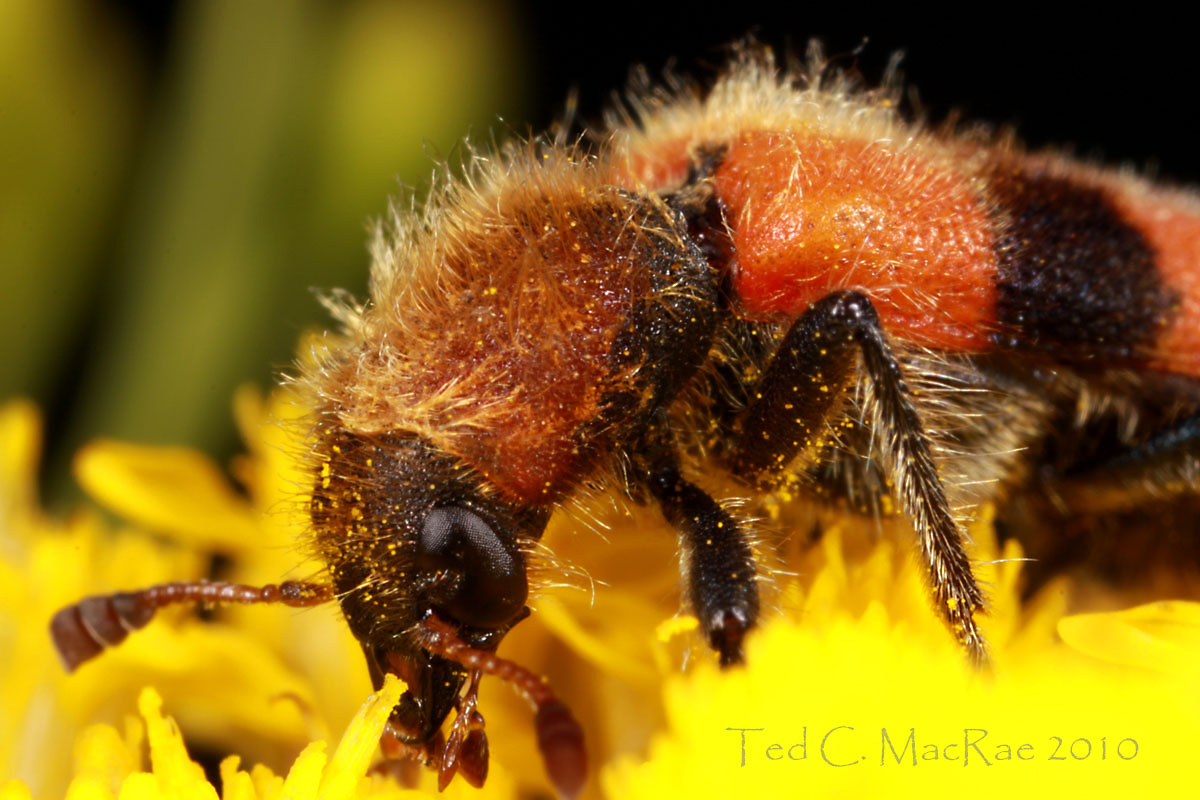
Trichodes bibalteatus in Oklahoma

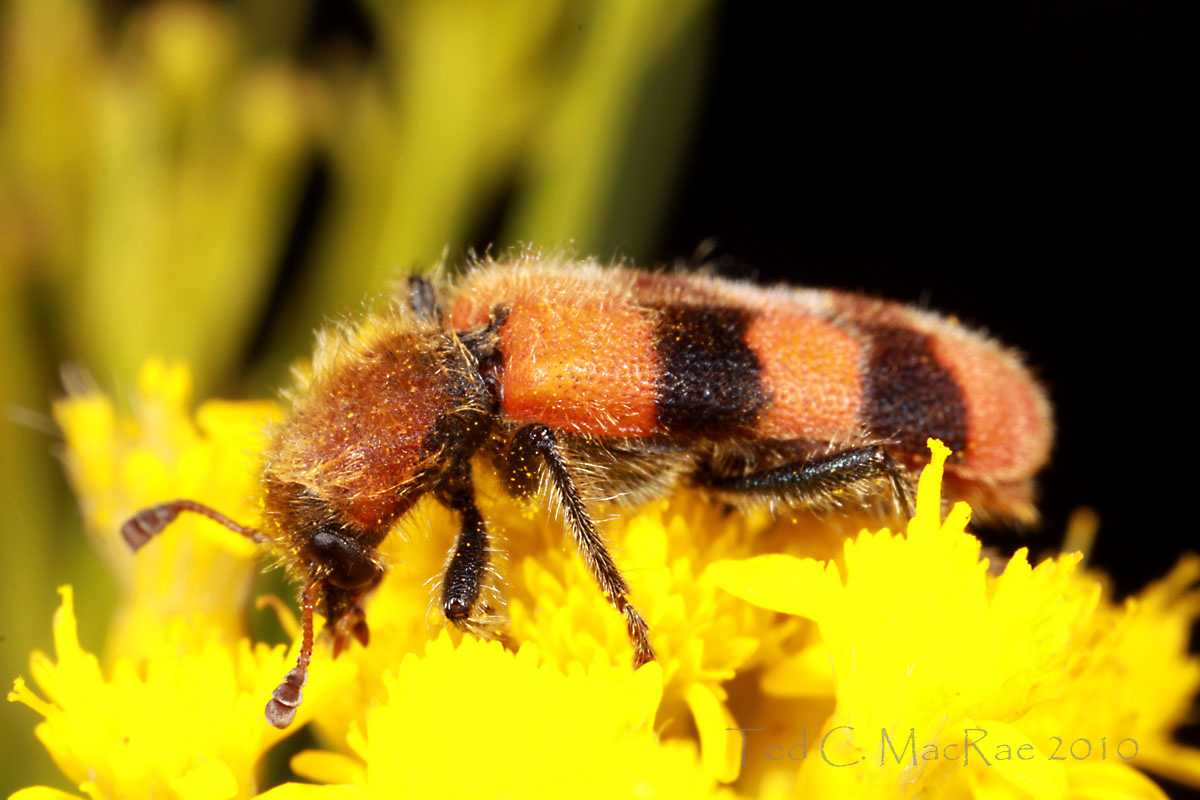
Among checkered beetles (family Cleridae), the genus Trichodes contains among the largest and most strikingly-colored species.  The 11 North American species of this predominantly Holarctic genus are primarily western in distribution, although two species (T. nuttalli and T. apivorus) do occur in the eastern U.S.  The individual in these photos was one of several I encountered feeding on the flowers of a yellow composite in the Gloss Mountains of northwestern Oklahoma during early July.  I take them to represent the species T. bibalteatus based on their close resemblance to the holotype of that species from the LeConte Collection in the Museum of Comparative Zoology at Harvard University.  While these photographs are admittedly far from perfect, they were about the best I could manage at the time considering the gusty post-storm winds that I encountered atop the mesa where these beetles were found (along with my continuing difficulty in achieving proper exposure with subjects on bright yellow flowers).

The striking colors of adult Trichodes and their frequent association with flowers for feeding and mating belies a more treacherous aspect of their life history.  While adults may serve as important pollinators of native plant species (Mawdsley 2004), they also lay their eggs on flowers.  The larvae that hatch from these eggs don’t eat the flower itself, but rather attach themselves to bees and wasps that visit the flower as they gather pollen for provisioning their own nests (Linsley & MacSwain 1943).  The larvae hitch a ride back to the hymenopteran’s nest, where they then prey on the developing brood and usurp pollen provisions for themselves.

Photo Details: Canon 50D w/ MP-E 65mm 1-5X macro lens (ISO 100, 1/250 sec, f/16), Canon MT-24EX flash (1/8 ratio) w/ Sto-Fen + GFPuffer diffusers. Typical post-processing (levels, minor cropping, unsharp mask).

REFERENCE:

Linsley, E. G. & J. W. MacSwain. 1943. Observations on the life history of Trichodes ornatus (Coleoptera, Cleridae), a larval predator in the nests of bees and wasps. Annals of the Entomological Society of America 36:589–601.

Mawdsley, J. R. 2004. Pollen transport by North American Trichodes Herbst (Coleoptera: Cleridae). Proceedings of the Entomological Society of Washington 106(1):199-201.

Copyright © Ted C. MacRae 2010

Rejoicing the end of summer

Russet browns of big bluestem (Andropogon gerardii) and Indian grass (Sorgastrum nutans) blend with still-green foliage in early autumn at White River Balds Natural Area in southwestern Missouri.

Last week I awoke to refreshingly cool temperatures for the first time in a long time – a brutal heat wave that had gripped the Midwest for some time had finally (if only briefly) passed. Missouri typically experiences substantial heat and humidity during the height of summer, a result of warm, moisture-laden air sweeping up from the Gulf of Mexico and over our mid-continental position.  The first cool snap in mid-August, however, usually marks the beginning of the end of protracted heat. High temps may return (and usually do), but they are intermittent and the writing is on the wall – summer’s end is near, and fall is on its way! For most of my life, the coming of fall has always been something to which I looked forward eagerly – it really is my favorite time of year.  I don’t just love fall, I adooore it!!!  As a result, I sometimes forget that not everyone shares my feelings, so when I mentioned to a colleague last week how excited I was that fall was on the way, I was a little surprised by her less-than-pleased reaction. Kids I can understand –  fall means a return to school and the end of fun and sun and no responsibilities.  However, for most adults, fall does not entail as dramatic a paradigm shift – we get up and go to work everyday regardless of the season. Indeed, to my colleague, fall was not dreaded so much for what it is but what it portends – winter! I convinced myself that if she was as interested in natural history as I, surely she would appreciate fall as a time of transition in the natural world.  This logic proved faulty, however, when just a few days later one of my favorite entomologist/natural historian bloggers voiced a similar lamentation.

Xeric calcareous prairie (''cedar glade'') in southwestern Missouri - habitat for Cicindela obsoleta vulturina.

That the charms of fall are not immediately apparent to everyone is beyond me.  Who in middle America doesn’t rejoice the end of long, sweltering days as they cede to the cool days of fall?  Who dreads the crisp, clean, autumn air and its pungent, earthy aromas?  Who doesn’t marvel as they watch the landscape morph from summer’s monotonous shades of green – its forests becoming a riot of red, orange, and yellow, its grasslands a shifting mosaic of tawny, amber, and gold, and in all places shadows cast long and sharp by a cool yellow sun riding low in a deep blue sky?  For the natural historian, fall offers even more than just these sensory gifts – it’s not the end of the season, but rather part of a repeating continuum that includes birth, growth, senescence and quiescence.  Plants that have not yet flowered begin to do so in earnest, while those that have shift energy reserves into developing seeds.  The spring wildflowers may be long gone, but only now do the delicate blooms of Great Plains Ladies’-tresses orchids rise up on their tiny spires.  Grasses also, anonymous during the summer, now reach their zenith – some with seed heads as exquisite as any summer flower.  Insects and other animals step up activity, hastily harvesting fall’s bounty to provision nests or fatten their stores in preparation for the long, winter months ahead.

Gypsum Hills in south-central Kansas. Habitat for Cicindela pulchra.

For myself, it is tiger beetles that are fall’s main attraction.  Yes, tiger beetles are out during spring and summer as well, but there is something special about the fall tiger beetle fauna.  Glittering green, wine red, and vivid white, a number of tiger beetles make a brief appearance in the fall after having spent the summer as larvae, hidden in the ground while feeding on hapless insects that chanced too close to their burrows, until late summer rains triggered pupation and transformation to adulthood.  As the rest of the nature prepares for sleep, these gorgeous beetles take their first, tentative steps into the autumn world for a brief session of feeding and play before winter chases them back underground for the winter.  Every fall for the past several years now, I have looked forward to the annual fall tiger beetle trip to see some of the different species and the unique landscapes which harbor them.  From the “cedar glades” of Missouri’s Ozark Highlands and Gypsum Hills of south-central Kansas, to the Sandhills of central Nebraska and Black Hills of South Dakota, I’ve acquired an even greater passion for a season that I already loved.  I’ll never forget the first time I saw Cicindela pulchra (beautiful tiger beetle) flashing iridescently across the barren red clay.  I still remember the excitement of seeing my first C. obsoleta vulturina launching itself powerfully from amongst the clumps of big bluestem. I recall my amazement at my first encounter with C. limbata (sandy tiger beetle) as it danced across deep sand blows, undaunted by scouring 30 mph winds.  No doubt I have many equally vivid memories awaiting me in the future, as I intend to keep the annual fall tiger beetle trip a long-standing tradition.  For this year, I’m hoping that C. pulchra and a few other species will reward a late-September drive to the Nebraska and South Dakota Badlands.  Whether they do is almost irrelevant – I love fall, and the chance to see new localities during my favorite time of year will be reward enough.

Copyright © Ted C. MacRae 2010

Clown beetle surprise

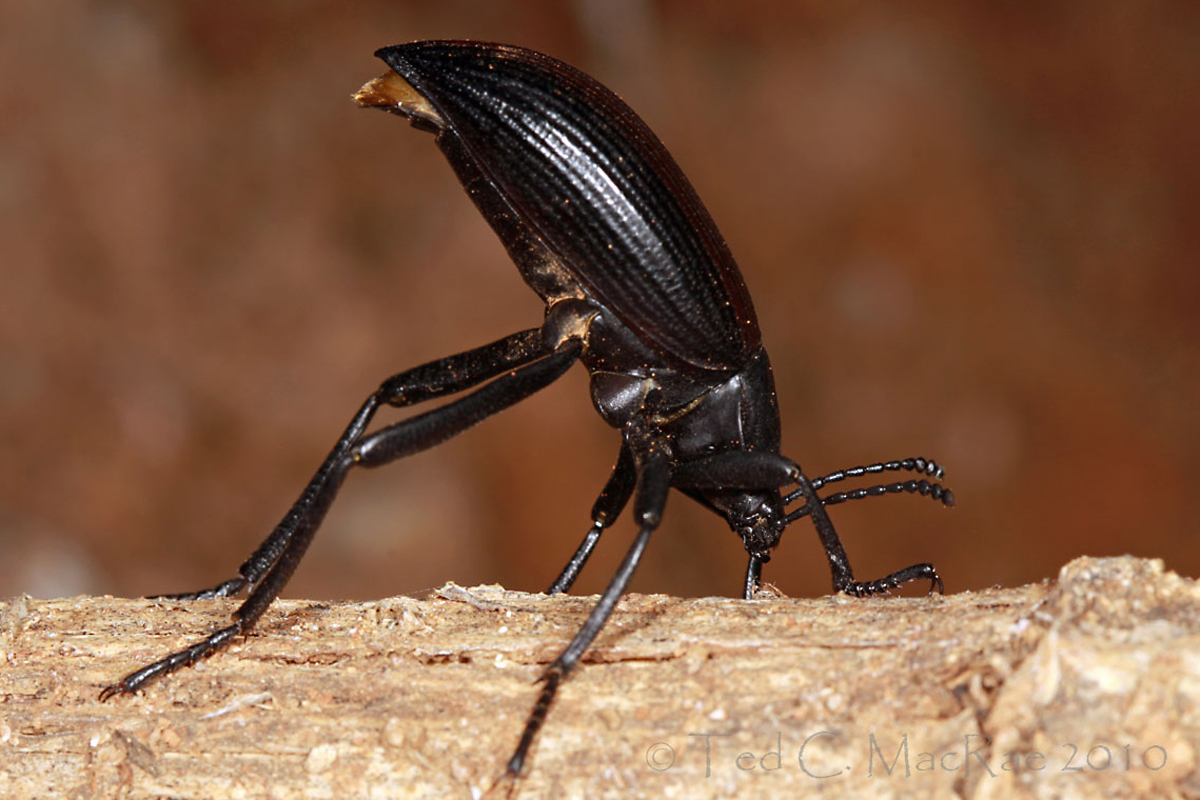
As I slowly scanned my flashlight through the darkness across the mixed-grass prairie in the Glass Mountains of northwestern Oklahoma last July, there was one thing that I hoped not to see (prairie rattlesnake, unless from afar) and one thing that I hoped more than anything to see (Great Plains giant tiger beetle, Amblycheila cylindriformis). Fortunately, I encountered none of the former and found several of the latter.  It took awhile before I saw the first one, but in the meantime I saw all too abundantly the clown beetle, Eleodes suturalis.  A member of the family Tenebrionidae, this species is one of the most conspicuous components of the Great Plains beetle fauna.  Adults are commonly encountered walking about the grasslands or crossing roads, especially after summer rains.  I recall my first encounter with this species when I made my first insect collecting trip to the Great Plains in 1986, marveling as I literally watched hundreds of individuals crossing a remote highway in southwestern Kansas.  Now, they were just an annoyance – close enough in size and appearance to the object of my search that I had to pause and look at each one I encountered to verify its identity.¹

¹ In fact, a mimetic association has been suggested for Amblycheila cylindriformis and Eleodes suturalis due to their similarity in size, shape and coloration (black with a reddish-brown sutural stripe) (Wrigley 2008).  This may be true, as Eleodes suturalis is an abundant species capable of defending itself with noxious sprays that contain benzoquinone and other hydrocarbons, while Amblycheila cylindriformis is a much rarer species (as mimics tend to be) that lacks defensive compounds.

After finding a few of the Amblycheila, I encountered this particular individual clinging to a root sticking out of the side of a wash.  My closer look caused it to immediately assume its characteristic defensive headstand pose (from which the name ‘clown beetle’ comes), so I decided to take a few photographs (not an easy task at night).  The photos have been sitting on my hard drive since, but in examining them more closely, I realized that this particular beetle is not E. suturalis.  Rather, it is one of several similar appearing species that co-occur with E. suturalis in the Great Plains and sometimes resemble it due to their large size, sulcate elytra, and occasional presence of a similar reddish-brown sutural stripe.  From these species, E. suturalis is at once distinguished by its broadly explanate (flanged) pronotum and laterally carinate, distinctly flattened elytra.  This individual clearly exhibits more rounded elytra and as best as I can tell keys to E. hispilabris – distinguished from E. acuta and E. obscurus by possessing a normal first tarsal segment (not thickened apically) on the foreleg (Bennett 2008).  Presumably this and the other related species of Eleodes also possess chemical defenses similar to E. suturalis – an example of Müllerian mimicry where multiple species exhibit similar warning coloration or behavior (in this case headstanding) along with genuine anti-predation attributes.

Photo Details: Canon 50D (ISO 100, 1/250 sec, f/14), Canon 100mm macro lens, Canon MT-24EX flash (1/4 ratio) w/ Sto-Fen diffusers. Post-processing: levels, unsharp mask, slight cropping.

REFERENCES:

Bernett, A. 2008. The genus Eleodes Eschscholtz (Coleoptera: Tenebrionidae) of eastern Colorado. Journal of the Kansas Entomological Society 81(4):377–391.

Wrigley, R. A.  2008. Insect collecting in Mid-western USA, July 2007.  The Entomological Society of Manitoba Newsletter 35(2):5–9.

Copyright © Ted C. MacRae 2010