When is a stag beetle not a stag beetle?

A: When it’s a longhorned beetle!

Parandra (Tavandra) polita

Parandra (Tavandra) polita | Alexander Co., Illinois

Last week I traveled to northwestern Tennessee to visit research plots, and on the way back I took the opportunity to stop by Fort Defiance Park near Cairo, Illinois. Fort Defiance represents the southernmost tip of Illinois, lying at the confluence of the Ohio and Mississippi Rivers, and on previous visits I had thought that the wet bottomland forest remnants present there looked like promising habitat for the ant-like tiger beetle (Cylindera cursitans). The type locality of a synonym (Cicindela alata) is in northern Illinois, but the type specimens are considered to have been introduced and, to my knowledge, no bona fide records of the species are known from the southern part of the state. I have taken the species nearby on the Missouri side of the Mississippi River (MacRae et al. 2011), so I thought the chances were good of finding it here as well. And find it I did—in good numbers! Success already in hand, I decided to stick around for nightfall and set up some blacklights to see what other beetles might be attracted from the surrounding forests.

Parandra (Tavandra) polita

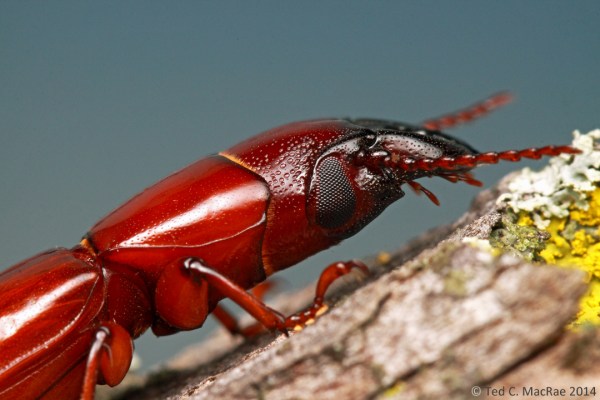
The color and shape of the body and prominent jaws give the appearance of a small stag beetle.

Sadly, not much of interest was coming to the lights. Temperatures and humidity were good, but a waxing moon with clear skies didn’t help. Worse, the sheets were inundated with caddisflies—always a predictable consequence when blacklighting near large rivers but especially annoying because of their habit of flying into your face (and up nostrils, down shirts, in ears…) when checking the sheet for other insects. A few longhorned beetles did show up, as did some male and female reddish-brown stag beetles (Lucanus capreolus), and later a single coppery tiger beetle (Ellipsoptera cuprascens) also made an appearance. By 10 pm, however, I had decided enough was enough and went to one of the sheets to begin taking it down. As I did, I noticed a reddish-brown, large-mandibled beetle sitting on the sheet that, for all intents and purposes, looked like a small stag beetle. I wasn’t fooled, however, as I knew exactly what this beetle was—I had previously seen this species in the form of two individuals at a blacklight in southern Missouri very near to my current location (although it was 28 years ago!). It was Parandra polita, an usual longhorned beetle belonging to the archaic subfamily Parandrinae, and those specimens (MacRae 1994) plus another collected more recently a few miles north—also at a blacklight in wet bottomland forest along the Mississippi River (McDowell & MacRae 2009)—to date represent the only known occurrences of this uncommon species in Missouri.
Parandra (Tavandra) polita

The entire rather than emarginate eyes distinguish this species from Neandra brunnea,

Linsley (1962) noted the tenebrionid (darkling beetle)-like appearance of beetles in this genus. Perhaps the glabrous, parallel-sided body recalls the appearance of some darkling beetles, but I have always thought these beetles looked more like stag beetles because of the reddish-brown coloration and, notably, fairly large, forward-projecting mandibles that even show the same type of size dimorphism as stag beetles—larger in “major” males, smaller in females and “minor” males. Parandrines differ from most other subfamilies of longhorned beetles by having the antennae short and equal-segmented and the tarsi distinctly pentamerous with slender, padless segments. Another small subfamily of longhorned beetles, the Spondylidinae, shares these characters, but parandrines are easily distinguished from them by several characters including the margined pronotum—also a most lucanid-like character.

Parandra (Tavandra) polita

Parandra polita also has the mandibles contiguous at the base and a narrower, more flattened body.

Although Parandrines are reasonably diverse in South America and Africa, North America boasts only four taxa, with P. polita and Neandra brunnea being the only two occurring in the eastern part of the continent. Annoyingly, I have collected just as few specimens of the latter as the former, despite the fact that N. brunnea is considered to be the most commonly encountered of all four North American taxa. The specimens were all taken in Japanese beetle traps that I ran while working for the Missouri Department of Agriculture in the 1980s, so I have never actually seen a live individual of that species. Parandra polita and N. brunnea are, however, fairly easy to distinguish, as the former has the mandibles triangular and contiguous at the base while in the latter they are sickle-shaped and well separated at the base. The former also has the eyes entire on the inner margin while the latter has them distinctly emarginate, and in basic gestalt P. polita has a narrower, more flattened body than N. brunnea.

A frontal portrait of this beetle was featured a few days ago in ID Challenge #23. A few people were fooled by its lucanid- and even cucujid-like appearance, but Stephen, Harry Zirlin, Nikola Rahme, Jon Quist, and Ben Coulter all correctly guessed this species. By virtue of being first, Stephen rises above the 5-way tie to get the win. However, I should note that Harry was the first to actually provide names for each of the four requested taxa (as did Jon and Ben subsequently), so he could make a valid claim for the win. Also, nfldkings and froglady made really nice comments about my blog and the featured photo, so I award them with honorable mentions!

REFERENCES:

Linsley, E. G. 1962. The Cerambycidae of North America. Part II. Taxonomy and classification of the Parandrinae, Prioninae, Spndylinae, and Aseminae. University of California Publications in Entomology 19:1–102, 1 plate [OCLC WorldCat].

MacRae, T. C. 1994. Annotated checklist of the longhorned beetles (Coleoptera: Cerambycidae and Disteniidae) known to occur in Missouri. Insecta Mundi 7(4) (1993):223–252 [pdf].

MacRae, T. C., C. R. Brown & K. Fothergill. 2011. Distribution, seasonal occurrence and conservation status of Cylindera (s. str.) cursitans (LeConte) (Coleoptera: Cicindelidae) in Missouri.  CICINDELA 43(3):59–74 [pdf].

McDowell, W. T. & T. C. MacRae. 2009. First record of Typocerus deceptus Knull, 1929 (Coleoptera: Cerambycidae) in Missouri, with notes on additional species from the state. The Pan-Pacific Entomologist 84(4) (2008):341-343 [pdf].

© Ted C. MacRae 2014
Quick Guide to Armyworms on Soybean

Throughout the soybean growing areas of the southern U.S. and South America, lepidopteran caterpillars are the most important pest complex affecting the crop. Millions of pounds of insecticides are sprayed on the crop each year in an effort to minimize their impact—a practice that is not always successful and entails significant exposure risks to the environment and farm workers alike. A variety of lepidopteran species occur in soybeans, and proper identification is essential to ensure adequate control and avoiding unnecessary applications. While the most important and commonly encountered species are velvetbean caterpillar (Anticarsia gemmatalis) and soybean looper (Chrysodeixis includens), others include soybean podworms (Helicoverpa zea in the U.S.; H. gelotopoeon and—now—H. armigera in Brazil and Argentina), sunflower looper (Rachiplusia nu), bean shoot moth (Crocidosema aporema), and armyworms of the genus Spodoptera. The last group contains several species that can affect soybean, and while they have traditionally been considered minor pests of the crop a number of species have increased in importance during the past few years.

I have been conducting soybean field trials in both the U.S. and South America for many years now and have had an opportunity to photograph most of the species known to occur on soybean in these regions. Identification of armyworm larvae can be rather difficult due to their similarity of appearance, lack of distinctive morphological differences (e.g. number of prolegs), and intraspecific variability in coloration. Conclusive identification is not always possible, especially with younger larvae; however, the different species do exhibit subtle characters that can usually allow for fairly reliable identification of large larvae. Considering the dearth of direct comparative resources—either in print or online—I offer this quick guide to the six armyworm species that I’ve encountered in soybean.


Spodoptera frugiperda (fall armyworm) | Jerseyville, Illinois

Spodoptera frugiperda (fall armyworm) | Jerseyville, Illinois

Spodoptera frugiperda (fall armyworm). This is not the most important armyworm pest of soybean, in contrast to its great importance in other crops such as corn and cotton. It is, however, the most widely distributed of the species, occurring in both the southern U.S. and throughout soybean growing areas of Brazil and Argentina. When problems do occur on soybean they are usually a result of larvae moving from grassy weeds to small soybean plants in late-planted or double-crop fields. Larvae can damage all stages of soybean, from seedlings (cutting them off at ground level) to later stages by feeding primarily on foliage and even pods. Larvae are somewhat variable in coloration but are distinctive among armyworms by virtue of the pinaculae (sclerotized tubercles) visible over the dorsum, each bearing a single stout seta. Four pinaculae are present on each of the abdominal segments, with those on the eighth abdominal segment forming a square, and larvae also exhibit a pronounced inverted, white, Y-shaped mark on the head.


Spodoptera exigua (beet armyworm) | Stoneville, Mississippi

Spodoptera exigua (beet armyworm) | Stoneville, Mississippi

Spodoptera exigua (beet armyworm). This species is better known as a pest of vegetables but will occasionally damage soybean in the southern U.S. In soybean larvae prefer to feed on foliage of seedling plants but will, if present during reproductive stages, also feed on blossoms and small pods. Late-instar larvae can be rather variable in appearance, but most tend to be green above and pinkish or yellowish below with a white stripe along the side. Larvae can be confused with Spodoptera eridania (southern armyworm) because of a dark spot that might be present on the side, but in southern armyworm the spot is on the first abdominal segment while in beet armyworm (when present) it is on the mesothorax.


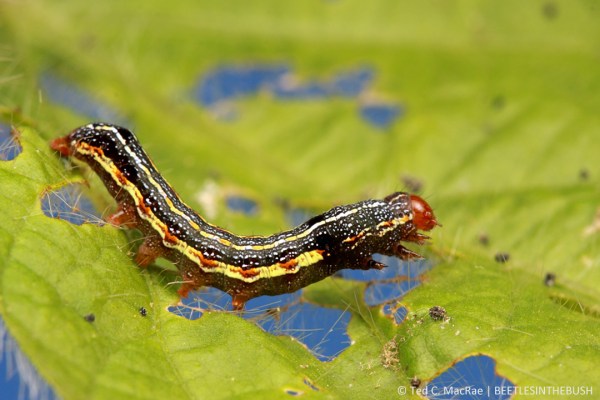
Spodoptera ornithogalli (yellowstriped armyworm) | Jerseyville, Illinois

Spodoptera ornithogalli (yellow-striped armyworm) | Jerseyville, Illinois

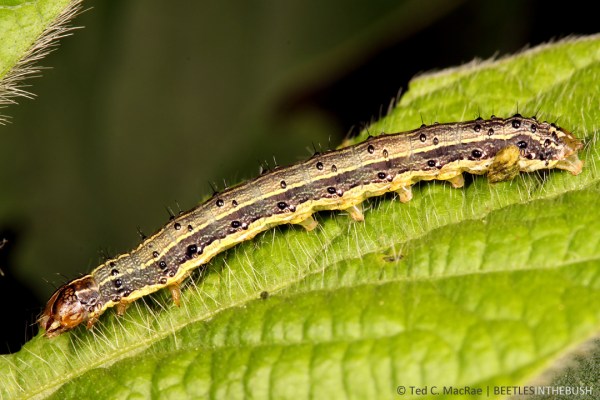
Spodoptera ornithogalli (yellow-striped armyworm). This species is widely distributed throughout North and South America, but its status as an occasional pest of soybean is limited practically to the southeastern U.S. It is often encountered in soybean in low numbers but can reach pest status in double-crop fields with small plants that have been planted after wheat (similar to fall armyworm). Compared to other species in the genus the larvae are rather uniform in appearance, exhibiting paired, black, triangular spots along the back of each abdominal segment with thin to prominent yellow stripes running lengthwise adjacent to and not interrupted by the spots. Larvae oftentimes have an almost black velvety appearance with distinctly contrasting bright yellow stripes.


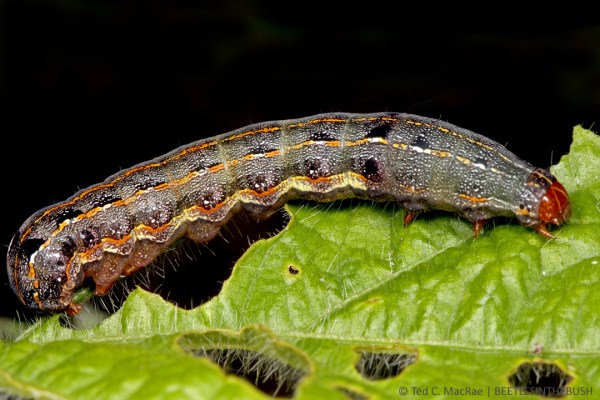
Spodoptera eridania (southern armyworm) | Jerseyville, Illinois

Spodoptera eridania (southern armyworm) | Jerseyville, Illinois

Spodoptera eridania (southern armyworm) | Union City, Tennessee

Spodoptera eridania (southern armyworm) | Union City, Tennessee

Spodoptera eridania (southern armyworm). This species is, like fall armyworm, widely distributed from the southern U.S. through Brazil and Argentina. In the U.S. it occurs only sporadically on soybean, usually causing “hot spots” of damage by groups of many larvae hatching from a single egg mass and skeletonizing the nearby foliage before dispersing as they grow larger. In Brazil and Argentina this species has emerged during recent years as one of the most important armyworm pests of soybean, especially in regions where cotton is also grown. Larvae can be somewhat variable in appearance and, in South America, can be easily confused with those of the black armyworm (S. cosmioides), both of which often exhibit prominent black markings on first and eighth abdominal segments and a subspiracular light-colored line along the length of the thorax and abdomen. Southern armyworm, however, rarely exhibits an additional black marking on top of the mesothoracic segment. Additionally, when the subspiracular line is present it is interrupted by the black marking on the first abdominal segment and is less distinct in front of the spot than behind, and if the line is not present then the black spots on top of the first abdominal segment are larger than those on top of the eighth abdominal segment.


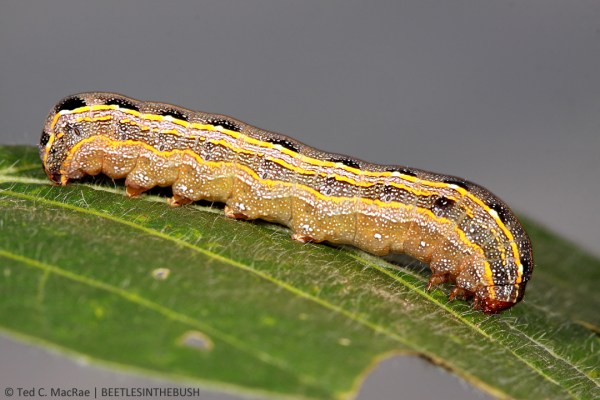
Spodoptera cosmioides (black armyworm) | Acevedo (Buenos Aires Prov.), Argentina

Spodoptera cosmioides (black armyworm) | Acevedo (Buenos Aires Prov.), Argentina

Spodoptera cosmioides (black armyworm) | Chaco Prov., Argentina

Spodoptera cosmioides (black armyworm) | Saenz Peña (Chaco Prov.), Argentina

Spodoptera cosmioides (black armyworm) | Acevedo (Buenos Aires Prov.), Argentina

Spodoptera cosmioides (black armyworm) | Acevedo (Buenos Aires Prov.), Argentina

Spodoptera cosmioides (black armyworm). No accepted English common name exists for this strictly South American species that was previously considered a synonym of the North and Central American species Spodoptera latifascia. In Brazil it has been referred to by such names as “lagarta preta” (black caterpillar) and “lagarta da vagem” (pod caterpillar). The latter name has also been applied to other soybean pests, including southern armyworm, so to me “black armyworm” seems the most appropriate English name to adopt. Like southern armyworm, this species is a sometimes pest of cotton and in recent years has become increasingly important in soybean throughout Brazil and northern Argentina. Larvae often resemble and can be easily confused with those of southern armyworm; however, there is almost always a dark spot on top of the mesothoracic segment that is lacking in southern armyworm. Additionally, the light-colored subspiracular line, when present, is not interrupted by the black spot on the first abdominal segment and is equally distinct in front of and behind the spot. When the line is not present the black spots on top of the first abdominal segment are smaller than than those on top of the eighth abdominal segment.


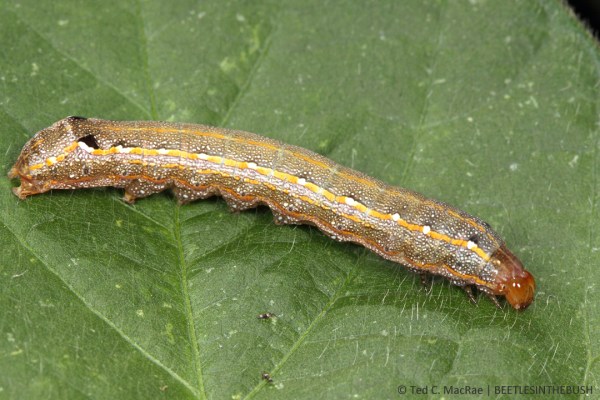
Spodoptera albula

Spodoptera albula (gray-streaked armyworm) | Saenz Peña (Chaco Prov.), Argentina

Spodoptera albula (unbarred or gray-streaked armyworm). While known to occur in extreme southern U.S., this species has been cited as a pest of soybean only in Brazil, although its importance has not matched that of southern or black armyworm. Like most armyworms it is polyphagous, but this species seems to prefer amaranth (Amaranthus spp.). Larvae of this species can be distinguished from other South American armyworms that feed on soybean by the trapezoidal black marking on the mesothorax (usually semicircular to slightly trapezoidal in black armyworm), the black marking on the first abdominal segment not larger than that on the sixth abdominal segment, both of which are smaller than those on the seventh and eight abdominal segments, the white-only rather than white and orange dorsolateral stripe, and the triangular black markings on the abdominal segments each with a small white spot in the middle or at the apex of the marking.

Copyright © Ted C. MacRae 2013

Not quite a one-shot

This little jumping spider (~8 mm in length) was in one of my soybean fields in west-central Illinois last week. She(?) was quite fidgety and kept jumping from the leaf on which I found her as I tried to carry the leaf out of the field to a more open and convenient place  to take photographs. Once I got out to the grassy field border, I managed to get one photograph (not shown but similar to this one) right before she jumped off the leaf yet again. However, I was able to find her and coax her back onto the leaf for this last shot before she jumped off again—never to be found again! I presume this spider belongs to the genus Phidippus based on the cephalic tufts, and within that genus maybe a species in the P. clarus group (corrections welcome!).

When I look at insect macrophotographs, I like to do reverse engineering on the lighting to figure out what was the flash/diffuser setup. I have a few different diffusers that I use depending on which lens I’m using and how important the photographs are. In this case, I was taking photographs of soybean insects for work purposes and didn’t bother putting on the larger concave diffuser that I use when I’m really concerned about getting more even lighting. Instead, I was just using my snap-on Sto-Fens+Gary Fong Puffers. The difference between these two diffuser setups and their effect on lighting is minor in many cases, but when photographing very shiny surfaces (such as the eyes of this spider) the differences are much more apparent, and it is obvious from this photo that I was using a twin flash unit with separate diffusers on each flash head.

There is one more feature apparent about the lighting in this photograph—note that the “left” flash head appears much more diffuse than the “right” flash head. This is because the right diffuser had actually fallen off of the flash head without me noticing (also never to be found again!). As a result, the light from only one of the flash heads was diffused, while that from the other hit the subject in all its harsh glory. I don’t really like the twin highlights that are the hallmark of twin macro flash units, and if I had known I was going to be photographing jumping spiders when I was in the soybean field I would have gone ahead and used my concave diffuser. I’ve also learned, however, that great photographs are not something that I can expect to pop off while concentrating on other activities—I need to concentrate fully on the photographs and spend a good amount of time doing it until I feel like I’ve gotten the shots that I want. I never really liked the Sto-Fen+Puffer diffusers, as they were only marginally better than no diffuser (and this photograph shows it), so losing one of them might be a blessing in disguise as now I’ll be motivated to try out some of the many other diffuser ideas I’ve been toying around with but never really taken the time to sit down and try them out.

Copyright © Ted C. MacRae 2012

Life at 8X—soybean aphid

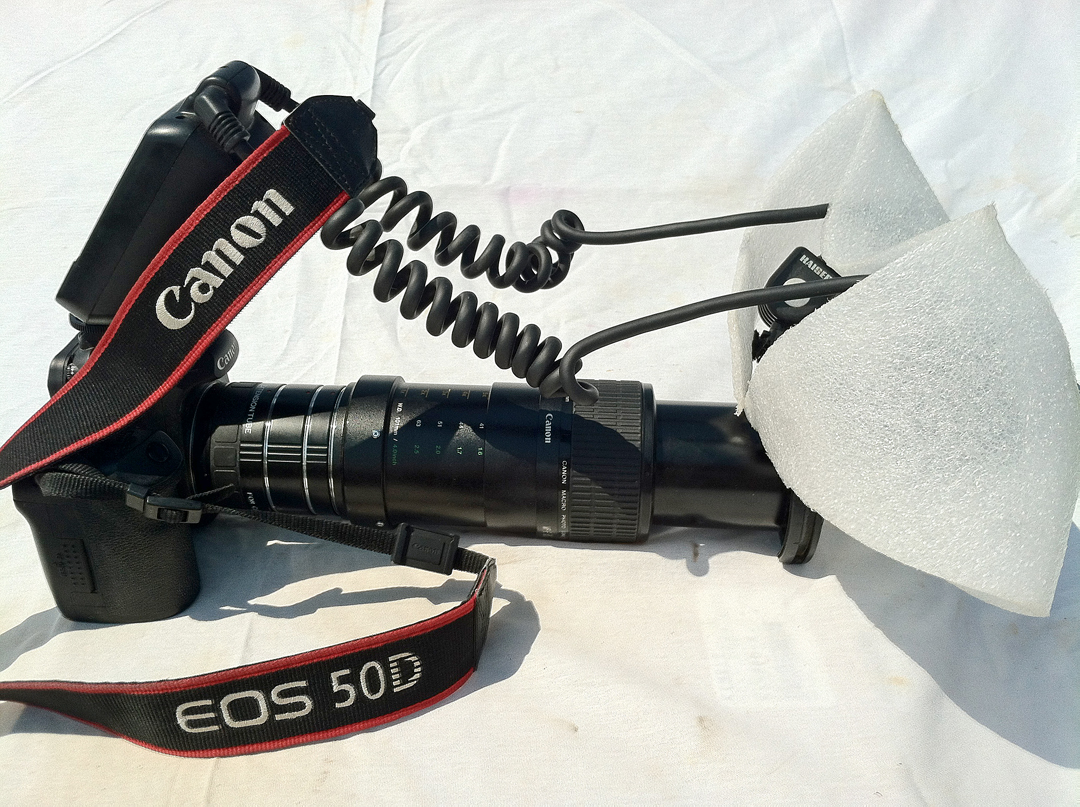
Although my first attempt at adding extension tubes to my Canon MP-E 65mm macro lens, effectively converting it from a 1–5X to a 1.7–8.0X lens, was nearly a year ago, it has only been recently that I’ve actually started experimenting with this combination to obtain high-mag photographs of very small insects in the field. The first example that I showed of such a photograph was a tiny seed weevil (Althaeus sp.) on its hibiscus host plant. I’ve since photographed a number of other insect subjects at high-mag using this setup and am getting a better feel for the capabilities—and limitations—inherent in using it. First, here is what the setup actually looks like:

Canon 50D body, MP-E 65mm macro lens on 68mm extension, MT-24EX twin flash w/ DIY diffuser.

Not the normal photo quality for this site (just a quick field setup photographed with my I-Phone), but it shows just how long the lens component becomes when fully extended to achieve 8X magnification. The camera is quite front-heavy, making the camera difficult to use hand-held, and the very shallow DOF (depth of field) due to the extreme level of magnification makes precise focusing difficult and magnifies the effect of any motion between the camera and subject. Obviously, one solution for these problems is to mount the camera on a tripod and place the subject on a stable surface; however, for reasons I’ve mentioned elsewhere, it is unlikely that I will ever take to bringing a tripod into the field, and the whole point of this exercise is to develop the capability for getting usable hand-held field photographs no matter what level of magnification they may require. As an alternative, I use a number of other techniques, discussed in my prior post on the subject, to stabilize the camera without using a tripod.

One of the recent subjects I photographed with this setup is the soybean aphid, Aphis glycines (order Hemiptera, family Aphididae). This distinctive Asian species has recently established in the U.S. as invasive pest of soybeans; adult females measure only 1–2 mm in length (and the nymphs are even smaller) and can quickly develop very high densities on the leaves and upper stems of soybean plants. The following photograph was taken at the camera setup’s minimum magnification of 1.7X and provides a typical view of adult aphids and their progeny:

Aphis glycines (soybean aphid) | Warren Co., Illinois

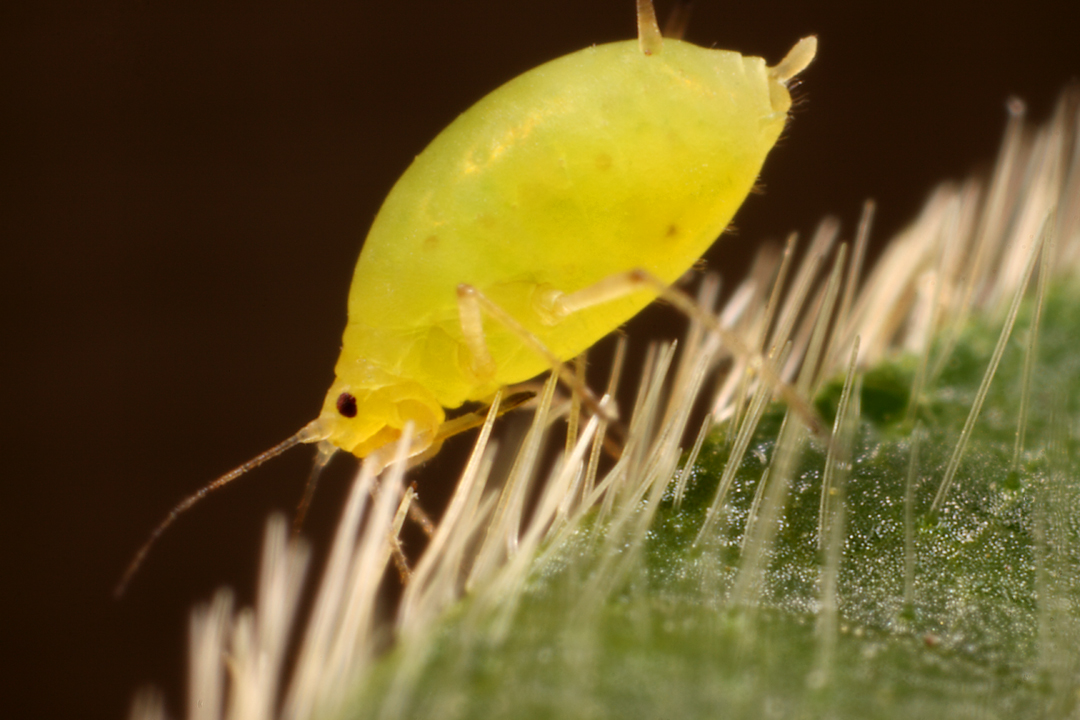
While the above photograph does a very good job of showing the colonial appearance of infestations by these aphids on soybean foliage, what about the aphids themselves? It would be nice to get a better look at individual aphids. The following photographs were all taken with the lens fully extended to achieve 8X magnification (and completely hand-held):

Adult female aphid—note the eye spots of the unborn nymphs visible within the body.

Another adult female navigates the hairs on the surface of the soybean leaf (I never knew soybean leaves were so hairy!).

A mother surrounded by her progeny. As above, eye spots of unborn nymphs can be seen inside her body.

These photographs are not without their problems—they are a bit soft, probably due to motion blur that results from the camera being hand-held and the extremely thin DOF that makes it difficult to get all of the desired components of the photos equally in focus. Lighting also is a challenge, as the very small subject-to-lens distance forces light from the flash to come from directly above or even behind the subject while minimizing front lighting (especially evident in the last photo with its straight down view). Nevertheless, these are decent, usable photographs that provide an uncommon view of these exceedingly tiny insects—without the encumbrance of carrying a tripod in the field, the time investment of studio photography and/or focus-stacking, or the expense of a microscope-mounted camera system (for those of us without access to such systems).

Copyright © Ted C. MacRae 2012

Cicada killer on the fly

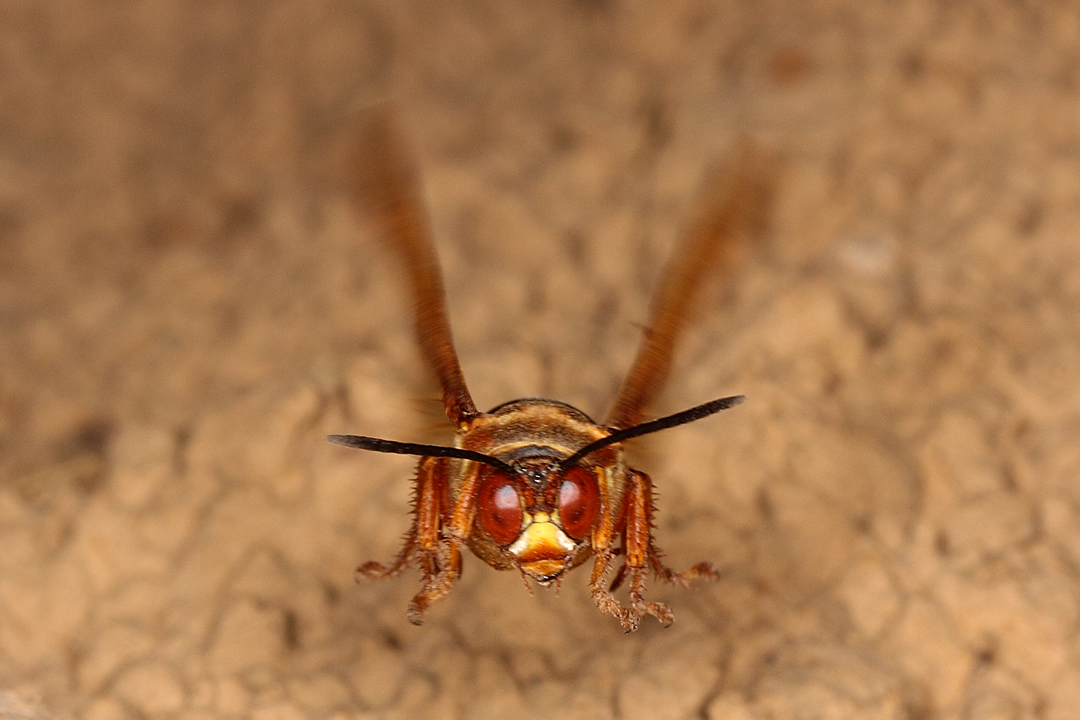
An eastern cicada killer (Sphecius speciosus) searches for her burrow | Jacksonville, Illinois.

I don’t normally spend much time trying to photograph insects in flight. To really do it right requires some rather specialized equipment, including very high-speed flash, and a bucketload of patience and skill. John Abbott exemplifies those whose great talent has produced stunning photographs of insects in mid-flight. That’s not to say that it can’t be done “on the fly,” so to speak, and even a hack like me can get lucky every now and then.

Earlier today I found a rather large number of eastern cicada killers (Sphecius speciosus) in a ball field in Jacksonville, Illinois. These impressive wasps are the largest wasp in eastern North America and have the rather gruesome habit of paralyzing cicadas with their sting, and then dragging them down into their burrows to be eaten alive by their grubs. I’ve recently become interested in solitary wasps (for reasons to be discussed later) and decided to see if I could get some decent photographs. I got a few I like (more on this later), but my favorite is this total luck-out shot of a wasp face-on in mid-flight. As I watched them, I noticed that each wasp spent a fair amount of time trying to identify its burrow amongst the dozen or more that were clustered along one side of the field. Occasionally they would land and search about a bit on foot, then take wing again to continue their search. I decided the best way to get a shot of one on the wing would be to watch for a wasp to arrive and begin its search. When I spotted one I would slowly close distance so I could be ready to get down on my elbows as soon as it landed (closing distance without spooking the wasp was not easy). I had just my center focal point set and autofocus turned on (normally I don’t use autofocus) and had already worked out a good flash exposure compensation setting. As soon as I got on my elbows, I would quickly frame the wasp and repeatedly trigger the autofocus as I got even closer, and when the wasp took flight I took the shot. This was still a crap shoot—I ended up with lots of out-of-focus and out-of-frame photos. Nevertheless, a few turned out fairly decent, one of which was this single, perfectly head-on and well-focused photo (though admittedly somewhat cropped).

Too bad I didn’t collect any of the wasps—at $49 each I could’ve made enough cash to buy that flash bracket I’ve been eyeing!

Copyright © Ted C. MacRae 2012

One-Shot Wednesday: two-striped grasshopper nymph

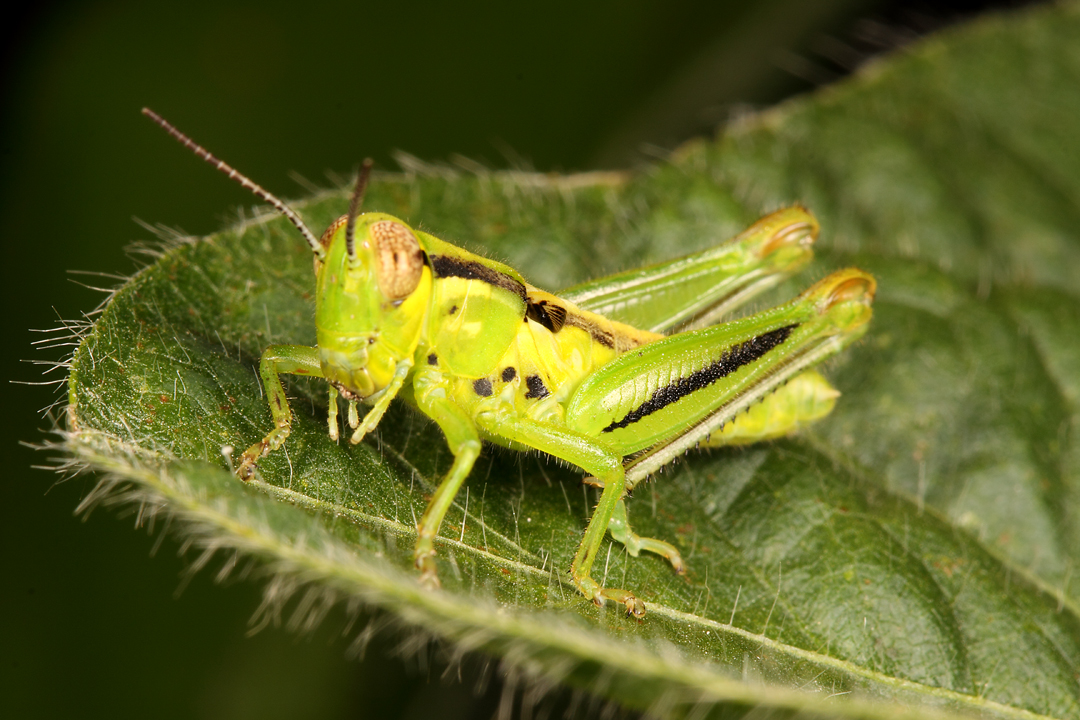
Melanoplus bivittatus (Two-striped Grasshopper) nymph | Jerseyville, Illinois

As the heat of summer solidifies its chokehold over the middle and southern latitudes of North America, grasshopper nymphs will begin to ramp up their development. I see grasshoppers commonly in my soybean field trials, where their feeding presents more of an annoyance to me than an actual threat to yields.

I photographed this particular individual on almost this same date last year in one of my Illinois soybean trials, not knowing for sure which species it represented. There was no particular reason for only taking this one single photograph, other than it was perched nicely when I saw it and that I did not feel like taking the time to chase it into another good pose after my first shot disturbed it.

Later in the season I saw numerous adults representing Melanoplus differentialis (differential grasshopper), a common species in this area, and assumed this was its nymph. However, a closer look at the photo suggests it represents the closely related M. bivittatus (two-striped grasshopper). While adults of these two species are easily distinguished based on coloration, the nymphs can look very similar (especially in their earlier instars) and are distinguished on the basis of the black femoral marking—more or less solid in M. bivittatus and broken into chevrons that create a “herringbone” pattern in M. differentialis.

Wing pad size and relative body proportions suggest this is a fourth-instar nymph.

Copyright © Ted C. MacRae 2012

Peek-A-Boo!

Dissosteira carolina (Carolina grasshopper) | Jersey Co., Illinois

Despite the geographic specificity of its scientific and common names, the Carolina grasshopper (Dissosteira carolina) can be found in every state of the contiguous United States and adjacent provinces of Canada. Its large size, cryptic coloration with yellow hind wings, tendency of males to crepitate during flight (a snapping or crackling sound made by rubbing the under surface of the forewings against the veins of the hind wings), and distinctively chunky nymphs would normally be enough to attract a lot of attention were it not also among the most overwhelmingly ubiquitous of grasshoppers throughout much of its range. I could give all sorts of information about its food habits, migration and dispersal behavior, daily activities, etc., but this would be redundant given the excellent Species Fact Sheet that has been generated for it by the Wyoming Agricultural Experiment Station (Pfidt 1996).

This individual was found in a soybean field in Jersey Co., Illinois. They are extremely wary and perhaps the most difficult-to-approach grasshopper I’ve encountered yet. Considering my particular fascination with oedipodine grasshoppers, I felt compelled to take some photographs—but, my God, there are already a godzillion photos of this species on the web.  I decided to limit myself to this one rather unusual perspective and leave it at that!

REFERENCE:

Pfidt, R. E.  1996. Carolina Grasshopper Dissosteira carolina (Linnaeus). Wyoming Agricultural Experiment Station Bulletin 912, Species Fact Sheet, 4 pp.

Copyright © Ted C. MacRae 2011

Illinois Butterfly Monitoring Network

For those of you who plan to be in the Chicago area on Saturday, March 7th, perhaps you’ll be interested in attending the 2009 Illinois Butterfly Monitoring Network Annual Indoor Workshop. I’ll be giving a talk entitled, “From Hilltops to Swamps: Insects in Missouri’s Rarest Prairies,” in which I’ll focus on the natural history and some associated insects in two of Missouri’s most critically imperiled natural communities – the loess hilltop prairies in the northwestern corner of the state, and the sand prairies of the southeastern lowlands. How a beetle guy ended up being invited to talk to a butterfly group is still a little confusing to me, but apparently IBMN Director, Doug Taron (author of Gossamer Tapestry) put in a good word for me.

The Illinois Butterfly Monitoring Network (IBMN) is a citizen scientist program monitoring the health of butterfly populations throughout northeastern and central Illinois.

The IBMN was initiated in 1987 by The Nature Conservancy to explore the effects of habitat management on invertebrates. From 7 sites in the Chicagoland area in its first year, the program has expanded greatly and is now monitoring more than 100 sites throughout Illinois.  Butterflies are ideal “indicator organisms” with which to monitor the effects of prescribed burning and other management techniques, since many species are restricted to intact prairie and savanna remnants by narrow habitat requirements.  The fact that they are relatively easy to identify allows them to be monitored in a cost effective manner with the help of dedicated amateurs.  Much the same can be said for tiger beetles (which will – surprise! – be featured prominently my talk).

The workshop will be held Saturday, March 7, 2009, 9:30 AM until 3:00 PM at the Gail Borden Public Library, 270 North Grove Avenue, Elgin (directions).  Registration is required, contact Mel Manner at (847) 464-4426 or by email.

Copyright © Ted C. MacRae 2009

Add to FacebookAdd to NewsvineAdd to DiggAdd to Del.icio.usAdd to StumbleuponAdd to RedditAdd to BlinklistAdd to Ma.gnoliaAdd to TechnoratiAdd to Furl