As a long-time professional and avocational entomologist, I find beauty and fascination in all manner of joint-legged creatures. Of course, beauty is in the eye of the beholder, and most people don’t exactly share my passion for these animals. Sure, butterflies enjoy almost universal approval, but beetles are just too crunchy, flies too filthy, wasps too aggressive, and cockroaches… well, eww! Even crabs and lobsters, tasty as they are, just move too robotically to engender any feelings of affection. None of these groups, however, seem to be as universally reviled as spiders – scuttling blurs of leg and fur with beady little eyes, just waiting to launch a sneak attack with their venomous gnashers. Few other coin-sized animals can cause an otherwise lucid adult to run screaming from their bathroom with such terror.
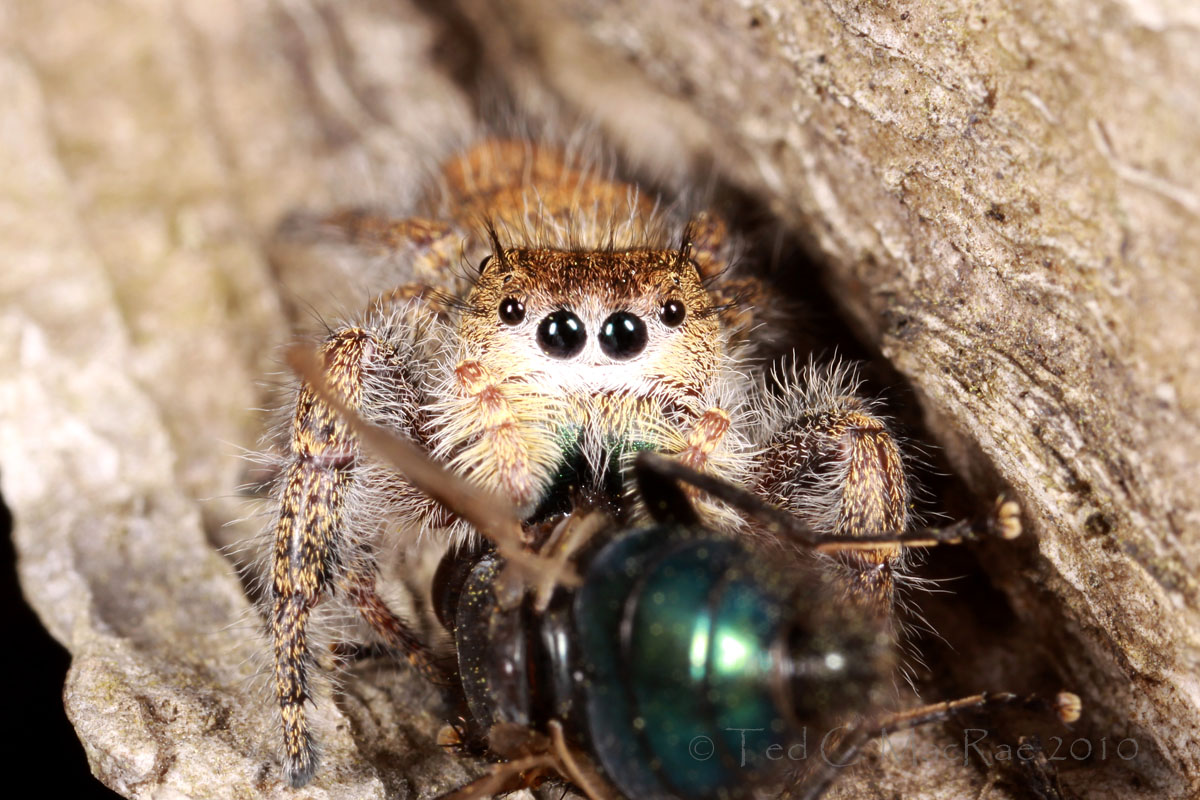
Except jumping spiders! Jumping spiders (family Salticidae) possess many of the same traits that condemn other spiders to the ranks of the creepy – hair and venom and lots of eyes; yet they have other unique qualities that make them nevertheless endearing, almost cuddly, to all but the most ardent of arachnophobes. Their human-like “face” featuring two large, forward-facing eyes and inquisitive nature give them a charisma that almost invites interaction. Approach any other spider, and it scampers back into the nearest crevice. Jumping spiders, on the other hand, turn and face the intruder – you can almost see them sizing you up – perhaps even moving forward a little to have a better look. It makes them seem, well… intelligent. Add to that their stunning diversity (~5,000 species), dazzling colors, and the sometimes impressively elongated choppers of the males, and you’ve got the perfect recipe for charm. Bouncy, furry, smart, cute, and big bright eyes – almost sounds like a kitten!
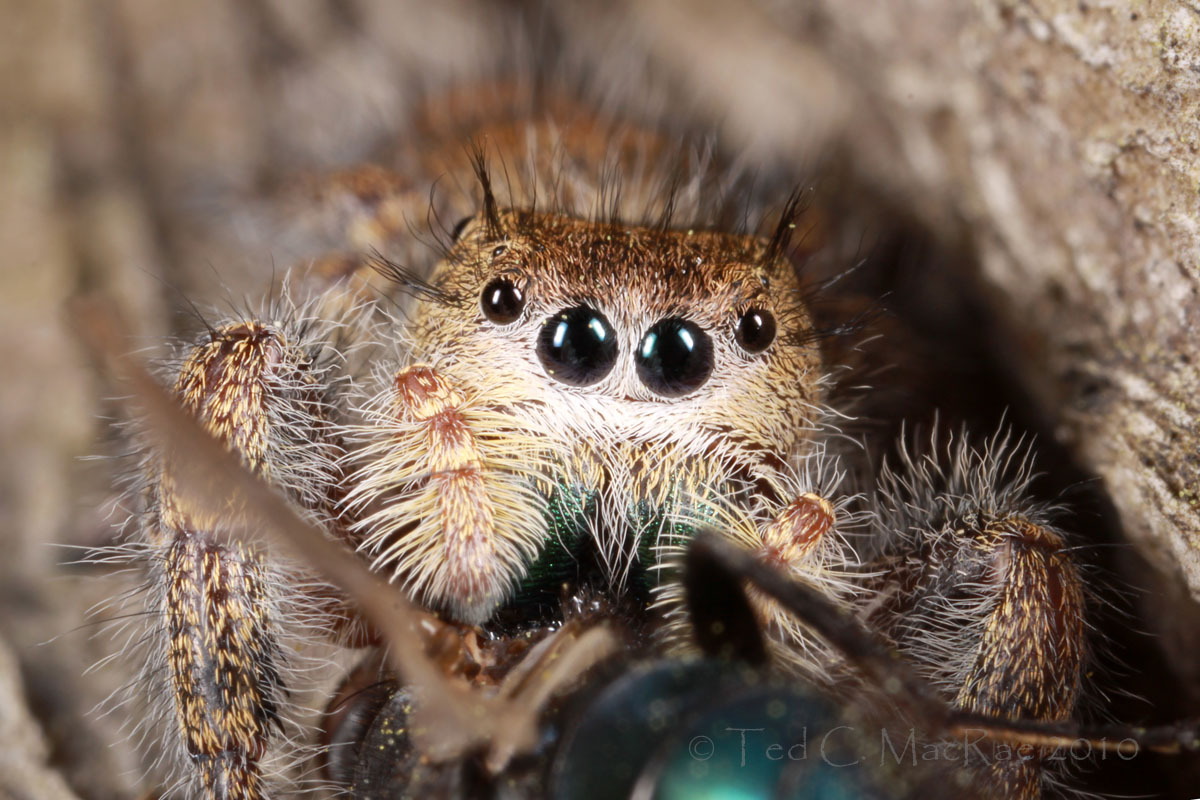
The result of all this charm is that jumping spiders are wildly popular subjects for macrophotography. Accordingly, there has been a veritable explosion of online photographs of jumping spiders, dominated by close-ups of that irresistible face. These shots here represent my first attempt to photograph one of these endearing creatures, and while I’m happy with them considering my relative newness to the field, they are a far cry from the spectacular images being produced by some other photographers. Perhaps the best of these is Thomas Shahan, whose focus-stacked facial shots of these spiders are among the most stunning that you will find. Another photographer who has produced some excellent photographs of Malaysian jumping spiders is Kurt at Up Close with Nature. Perhaps someday my jumping spider photographs will be considered on par with those that these two gentlemen are producing – if that day comes, you can say it began right here!
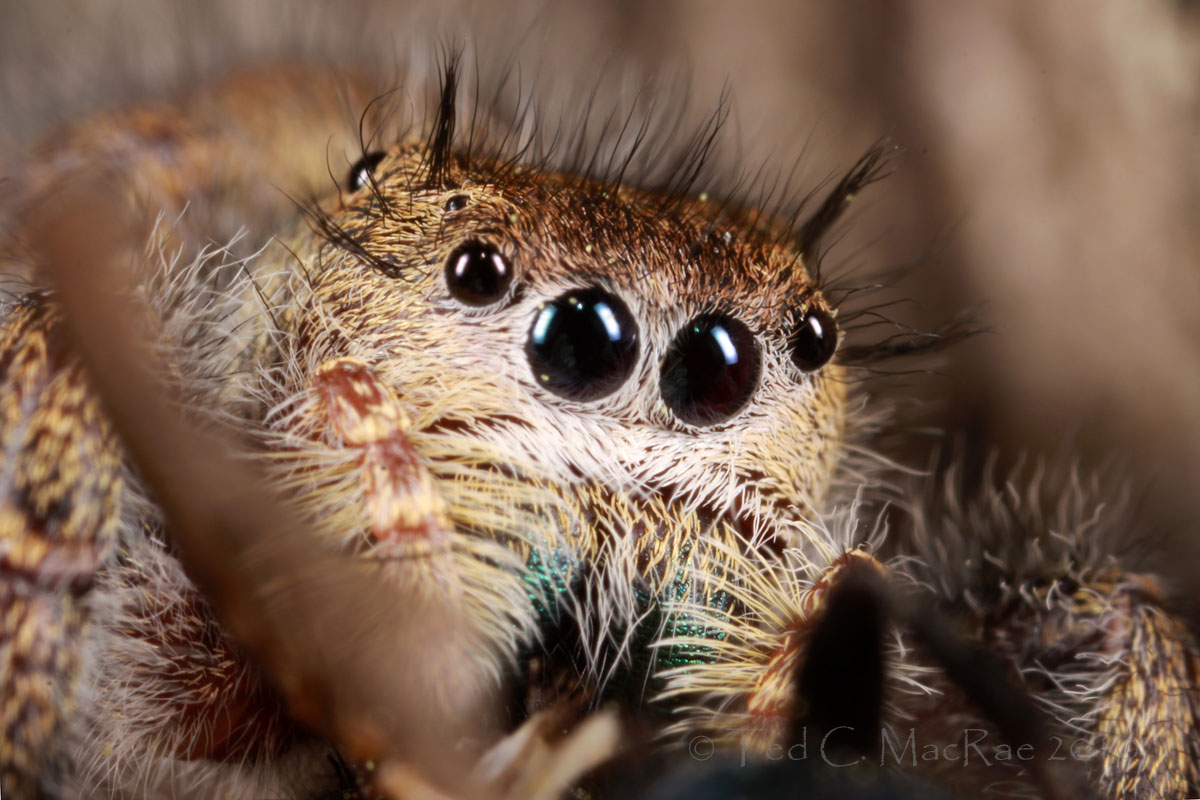
I’m a beetle-man, so except for a brief attempt at ant taxonomy my area of expertise lies with the Coleoptera. Nevertheless, perusing the well-stocked archives at BugGuide leads me to believe that the individual I photographed is a subadult female in the genus Phidippus – perhaps something in the putnami species-group. I found her on a lower branch of sweetgum (Liquidamber styraciflua) in a wet-mesic bottomland forest along the Black River in Missouri’s southeastern Ozarks feeding on a blow fly (family Calliphoridae). While relatively drably-colored compared to many other species in the family, a glimpse of her bright blue-green chelicerae (fangs) can still be seen. I tried to get her to drop her prey to get a better look at the fangs, but she wasn’t having anything to do with that – mealtime is mealtime!
Photo Details: Canon MP-E 65 mm 1-5X macro lens on Canon 50D, ISO 100, 1/250 sec, f/13-14, MT-24EX flash 1/8 power w/ Sto-Fen diffusers. Minimal cropping and post-processing.
Copyright © Ted C. MacRae 2010


 Beetles In The Bush