Hook-faced Conehead – Pyrgocorypha uncinata

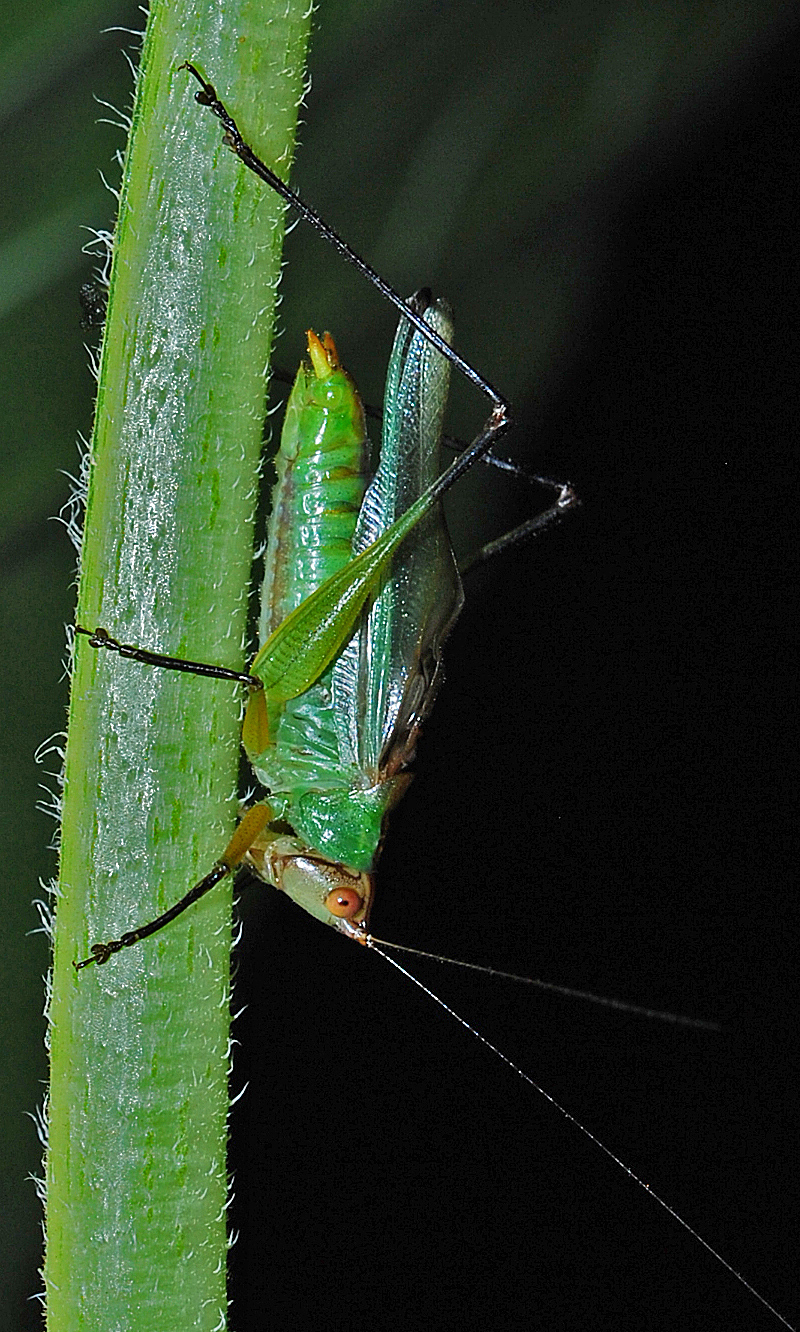
Pyrgocorypha uncinata at UV lite | Lake Norfork, Arkansas

I had high hopes as I setup the blacklights in the pine/oak-hickory forest at Jordan Recreation Area on Lake Norfork in north-central Arkansas. The late June timing  and warm, humid conditions with no moon were perfect for wood boring beetles, and as dusk settled in I awaited their expected arrival.  But the beetles never came, and as dusk waned to full darkness I knew it was going to be one of those inexplicably mediocre nights.  If I’d had a hotel room waiting for me, I would’ve closed up shop as soon as this became apparent and headed on back.  This night, however, I was camping so there was really nothing else to do but see what else came to the lights anyway.  One of the more interesting was this conehead katydid, whose bizarre hook-shaped cone immediately identify it as the hook-faced conehead, Pyrgocorypha uncinata.  There are a number of coneheads in the eastern U.S., but I couldn’t recall ever seeing one with such a bizarre-shaped cone before.  There is good reason for this, as Singing Insects of North America shows this southeastern U.S. species to be at the limit of its distribution in northern Arkansas.

Looking at the above photo at home, I couldn’t help but notice the “face” formed by the eyes and cone, with the gap between the cone and the rest of the frons forming the “mouth” and the cone itself the “nose”—it looked to me like some weird, garrishly grinning fish!  Thus was born Super Crop Challenge #7, and since four participants correctly identified the individual in the photo down to species this challenge was decided on bonus points.  Max Barclay (Natural History Museum) earned the most (11) to win the challenge, while Patrick Coin and Sam Heads each earned 10 to round out the podium with a 2nd-place tie.  This was the last challenge of the BitB Challenge Session , so we can now crown a winner.  Today’s win vaults Max Barclay from 4th place in the overalls to the top spot with 29 pts—congratulations (and contact me for your loot).  Tim Eisele‘s 5 points in this challenge gave him a total of 24 pts, which was just enough to edge out former front-runner Troy Bartlett for 2nd place by a single point.  Troy keeps a foot on the final podium ahead of Dave with 23 points, also by a single point.

My thanks to the record 27 participants who took part in BitB Challenge Session .  The final overall standings are shown below, and look for the first challenge of BitB Challenge Session #4 coming up.

Place Participant IDC SSC #5 SSC #6 IDC #9 Bonus 7/9 SSC #7 Total
1 Max Barclay 8     10   11 29
2 Tim Eisele 3 6 6 4   5 24
3 Troy Bartlett     11 12     23
4 Dave   11 3 8     22
5 Mr. Phidippus       11   4 15
6 Patrick Coin         2 10 12
7 Dennis Haines        11     11
8 Josh Basham       10     10
  Sam Heads           10 10
10 Alex Wild 9           9
  James Trager    4     9
  Brady Richards       9     9
13 Roy     5 3     8
  FlaPack           8 8
15 Traci       6     6
16 Johnson Sau       5     5
17 Annie Ray       4     4
  The Ozarkian       1   3 4
19 David Winter 3           3
  Ani       3     3
  Laurie Knight       2   1 3
22 Bob Cochran   2         2
  dragonflywoman     2       2
  Chris Grintter       2     2
25 David Rentz 1           1
  Anne McCormack   1         1
  Mike       1     1

IDC = ID Challenge; SCC = Super Crop Challenge.

Copyright © Ted C. MacRae 2011

Red-eyed Devil

In June 1994, I made my first insect collecting trip to Big Bend National Park.  Both of my previous visits to Texas had been to the Lower Rio Grande Valley, so I was anxious to see what beetle treasures awaited me in this huge chunk of western Texas.  For three days I sampled the astounding diversity of beetles found in the park’s low desert scrub, oak/juniper woodlands, and high pine forests, and on the final day I decided to visit the sotol grasslands – a transitional habitat between the desert and woodlands in the Chisos Mountains foothills.  Sotol (Dasylirion wheeleri) is the host plant of jewel beetles in the genus Thrincopyge – exquisitely beautiful beetles of metallic blue or green and vivid yellow.  Larvae bore through the plant’s dried flower stalks, while adults wedge themselves in the base of this agave-like plant, hidden from view by the plant’s long, strap-like, saw-toothed leaves.  I had not yet seen these beetles for myself, so I began searching the through the plants – carefully prying apart the wicked leaves in hopes of seeing adults peering up from the base, and then using my foot-long forceps to extract them.  It’s a painful process, as no amount of care completely prevents the plant’s stout, recurved spines from impaling and ripping forearm flesh while trying to grab and pull out the beetles! 

While prying apart the leaves of one particular plant, I was startled by one of the most imposing-looking insects that I have ever seen as it jumped up on top of the foliage and assumed this decidedly aggressive posture.  Although I recognized it as some type of katydid, it was unlike any I’d seen before – large and robust, vivid green and yellow with flashing red eyes, its short spotted hind wings outstretched, spiny forelegs held high, and huge jaws spread wide open.  Her long dagger-like ovipositor only added to her impressiveness.  So spectacularly terrifying was its threat display that I couldn’t resist the opportunity to collect it for eventual mounting in life-like position.  I felt a little silly being scared of a katydid but nevertheless took great care to avoid getting my fingers anywhere near those jaws as I gingerly corraled it into a jar. 

Neobarrettia spinosa is also known as the greater arid-land katydid or spiny bush katydid, but I prefer the name that has been coined by some – “red-eyed devil”!  This species belongs to a small genus of primitive katydids largely restricted to northern Mexico, with only two species extending north into the south-central and southwestern U.S.  The black front edge of the pronotum and (in life) red eyes identify this individual as N. spinosa (N. victoria, also occurring in Texas, has the pronotal front edge green and the eyes pale).  Unlike most katydids, which have adopted omnivorous or hervivorous feeding habits, species of Neobarrettia and their subfamilial relatives are pure carnivores capable of capturing and consuming prey as large as themselves.  Its bulging eyes, elongate and heavily spined forelegs, and massively robust mandibles on a large head (presumably for enlarged mandibular musculature) clearly represent adaptations for predation (Cohn 1965).

The painting above from Cohn’s revision of the genus shows the true colors of a living female and its threat display.  I collected this specimen before the days of the internet or my own interest in photography, so I had nothing but my memory to guide me as I tried to recreate the threat display during mounting.  I got it mostly right but missed on a few details – the wings should have been placed more vertically, and the insect also rears back more on its hind legs to display the brightly colored cephalic portion of its abdominal venter.  I could try to relax and remount the specimen, but given its fragility and the fact that doing so would do little to make it any more imposing, I think the pose I have it in now is just fine.

This turned out to be a more difficult ID Challenge than I anticipated, but a record number of participants played along anyway.  Dave wins this challenge with 11 pts on the basis of a correct identification and entertaining logic to accompany it.  Ben Coulter was the only other person to correctly identify the genus and species, earning 9 pts for 2nd place, while BitB’s own James Trager and TGIQ share the final podium spot with 5 pts each.  Ben continues to dominate the overall competition with 32 pts now, but the battle for 2nd place has really heated up – Janet Creamer (14 pts) and TGIQ (13 pts) have the edge, but Dave (11 pts), James Trager (11 pts), and Christopher Taylor (10 pts) are all within easy striking distance.

REFERENCE:

Cohn, T. J. 1965. The arid-land katydids of the North American genus Neobarrettia (Orthoptera: Tettigoniidae): their systematics and a reconstruction of their history.  Miscellaneous Publications of the University of Michigan Museum of Zoology 126:1-179.

Copyright © Ted C. MacRae 2011

The joys of ecological restoration

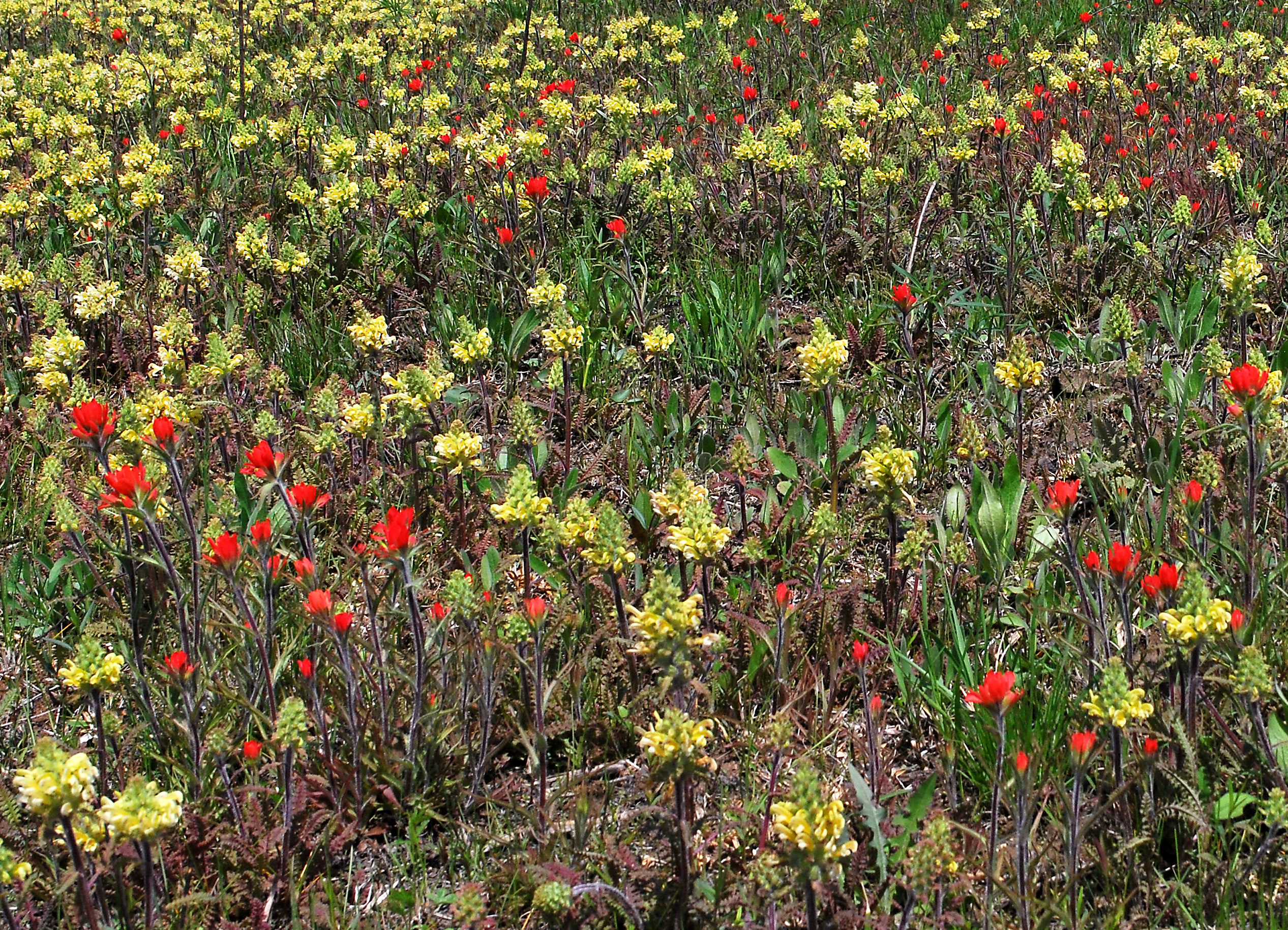
Indian paintbrush and lousewort now dominate patches of SNR

I moved to Missouri in the summer of 1988, having experienced 8 years of generous support of my family’s livelihood by my research on the infamous imported fire ants of the US Southeast, and their relatives in South America. When I arrived in the Midwest, I  hoped to land a job as an insect taxonomist in a university or museum, a goal of mine since before entering college. But this dream was one that even before moving to Missouri was dimming, and then receded ever further from the realm of possibility for me (and for traditionally trained taxonomists, generally), once here. So, I began to re-think what I might do with my work life. It would be something, I hoped, that would make some use of all the course work (mostly in entomology and botany) and research (on ant systematics) I had done during my 24 years (!) of getting educated and four additional years as a post-doc. As or more important, whatever job I ended up in would somehow have to allow me to share my life-long love of nature with others.

A museum drawer of ant specimens mounted for taxonomic study, the ants no doubt frustrated by the years of inattention they have received as I have tended to the duties of my day job.

Early in my residence in eastern Missouri, I made the acquaintance of the naturalist at a 2500-acre (1000-hectare) nature reserve outside of St. Louis. Shaw Arboretum, as it was then known, is country cousin to the world-renowned Missouri Botanical Garden, and is named after the Garden’s founder Henry Shaw. Long story short, in the summer of 1990 the naturalist mentioned to me that he would soon retire, the position would become available, and that I ought to apply. So I applied, and was hired as the arboretum’s naturalist in January 1991.

A dolomite glade plant endemic to a few counties in eastern Missouri, this leatherflower was established at SNR in the 1930s, but expanded exponentially after prescribed fire was introduced in the 1990s. Here, an ant characteristic of glades and dry prairies forages on the flower.

When I came on board, the “Arboretum” had mostly ceased to be an arboretum (a formal collection of trees for display, breeding and research), and most folks seemed unable to either pronounce or define the word. Indeed we learned, through a public survey, that the strange name and the stone wall in the front actually dissuaded people unfamiliar with it from entering! Yes, there were a few patches of exotic trees scattered around the property, especially in the conifer collection near the front entrance know as the “Pinetum”, but ever since the Garden had decided around 1930 that it would not, afterall move all of its horticultural operations to this then very rural site (the original intent of its purchase), formal arboretum and botanical garden type activities had been few and far between, and the site began gradually reverting from abandoned farmland to a wilder sort of place, as well as a haven for native biota. Thus, on its 75th anniversary in the year 2000, Shaw Arboretum was renamed Shaw Nature Reserve.

Colony-founding queen bumblebees are the primary actors in loosening pollen with ultrasound from shootingstar anthers, and distributing it about the plant population.

Around that time, my title changed too, to “Restoration Biologist”. The job is multifaceted; presenting public programs and classes on various aspects of the site’s natural history, writing and reviewing articles, acting as liaison to the vigorous regional group of academic ecologists who use the site for research and teaching, a very intermittent personal research program on ants resulting in sporadic publications, and last but certainly not least, ecological restoration.

Ecological restoration, in the broad sense, consists of  two primary practices:

  • Restoration of a natural community to structure and species composition presumed characteristic of an  ;;earlier condition (however arbitrary or ill-defined).
  • Reconstruction of regional, native-like habitats, de novo, using locally acquired native plant propagules in the appropriate settings of soil, hydrology,  slope aspect and climate.

Both  require essentially perpetual, follow-up maintenance, including invasive species control, mowing, haying, grazing, selective timber removal, species richness enhancements, and prescribed burning. All of these have many variations and nuances in application, and there can be impassioned arguments about their implementation in the literature, at conferences, and in forums and blogs on ecological restoration, native plants, butterflies, beetles, etc..

An ecologically conservative lily ally of undisturbed moist soil habitats now thrives in prairie plantings at the Reserve.

Attitudes about ecological restoration vary, among practitioners, among sociologists and philosophers, and in the general public. One broad attitudinal schism lies along the lines of  whether ecological restoration activities are some sort of primitivist, grand-scale gardening, or do they represent ecologically valid landscape conservation? Another question some pose is to what extent we should interfere with “natural successsion”? Be this as it may be, most people with functioning sensory perception agree the results can be very beautiful. The loveliness of the mosaic of colors in the herb layer of a spring woodland is inarguable, especially so after it has had its woody stem density reduced, and had the leaf litter burned off, to allow more light, rain and seeds to the soil surface — even where there is genuine concern about damage to invertebrate assemblages residing in forest duff. A waving meadow of grasses and flowers in a tallgrass prairie planting, intended to replace just a few of the tens of millions of acres of this ecosystem that have succumbed to the plow, has its own grand beauty, though its per-square-meter species density of plant species remains less than half that of a native prairie remnant and it is dominated mainly by habitat-generalist insect species rather than prairie specialists, even after 30 or more years.

A self-introduced grassland ant forages among a thriving, human-introduced population of this wet prairie gentian.

The smaller, daily rewards of restoration, to the practicing ecological restorationist and to those who visit his or her work, are many. Over 20 years, in the opened-up woods, restored glades and prairie and wetland plantings at SNR, I repeatedly have enjoyed the “sudden appearance” and increase in populations of ant species (of course) that I never observed during my early years of working at SNR (then scouring it for purposes of preparing an annotated ant list). The feeling I get upon discovering that a grouping of shooting star, royal catchfly, bunch flower or bottle gentian plants, are in bloom at a site where I spread their seeds five, seven, or even ten years earlier is a bit like that one feels when a child is born. The spontaneous colonization of SNR grassland plantings by prairie ragged orchid never fails to amaze me. Bird, or frog, or katydid and cricket songs in a former crop field or pasture, as the “restored” vegetation fills in and matures, is as pleasing to my ear as it is to my soul.

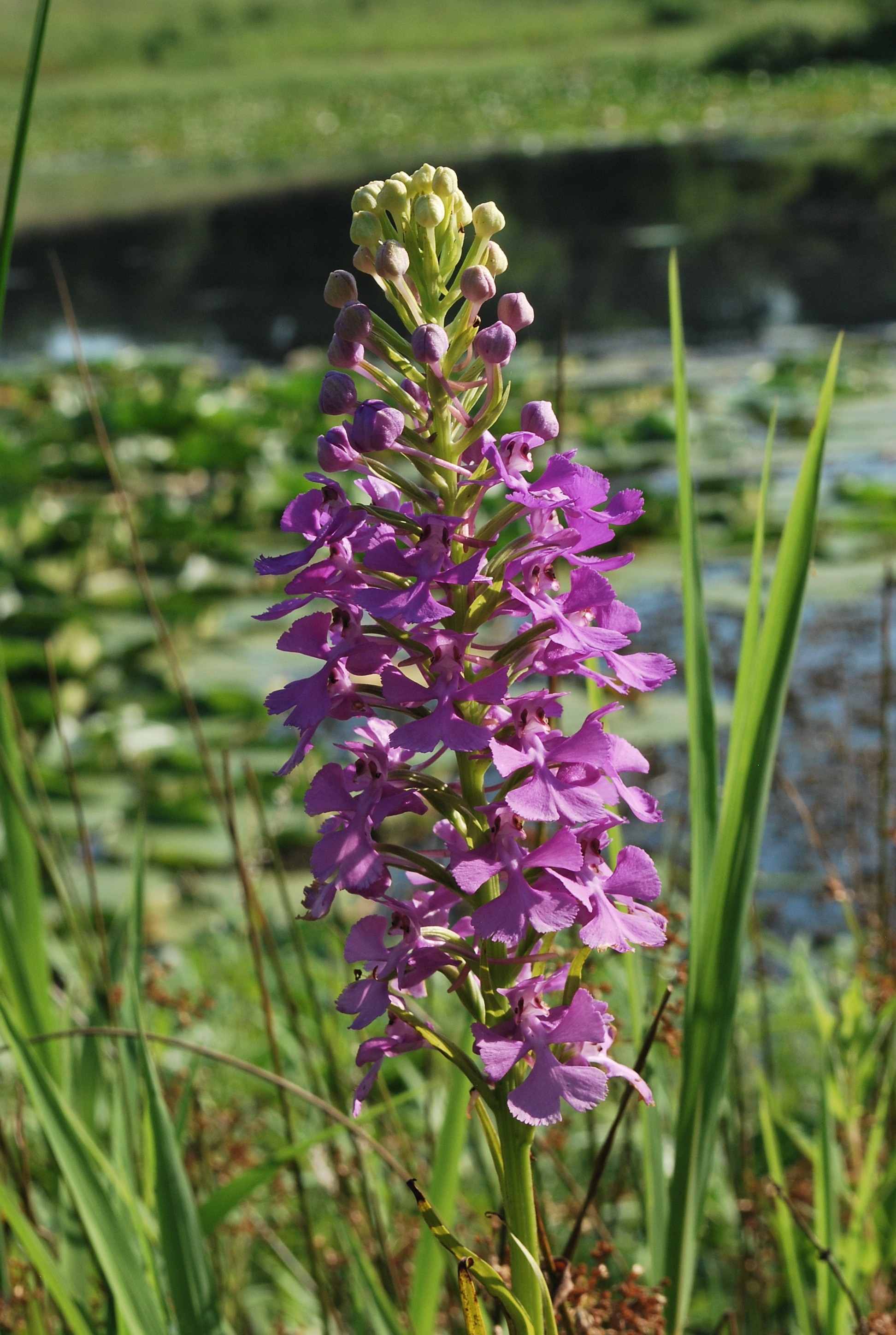
A few days ago (in early July), the director of the Reserve came to my office asking if I had noticed a purply pink, “possibly orchid” flower growing on a section of a berm (planted with native vegetation) in our 32-acre wetland complex. I had not been in the area recently, but headed right out to see what it was. Joyously, and not a little surprised, I learned that seeds of the purple fringeless orchid, sowed at a location nearby 17 years previously, had washed to this site, taken root, and as terrestrial orchids are wont to do, flowered after so many years!

The black-legged greater meadow katydid thrives in low areas and near bodies of water in SNR

The prairie ragged orchid began to appear in old fields and prairie plantings where prescribed burning occurs at SNR. It has not been seen in fields maintained exclusively by mowing or haying.
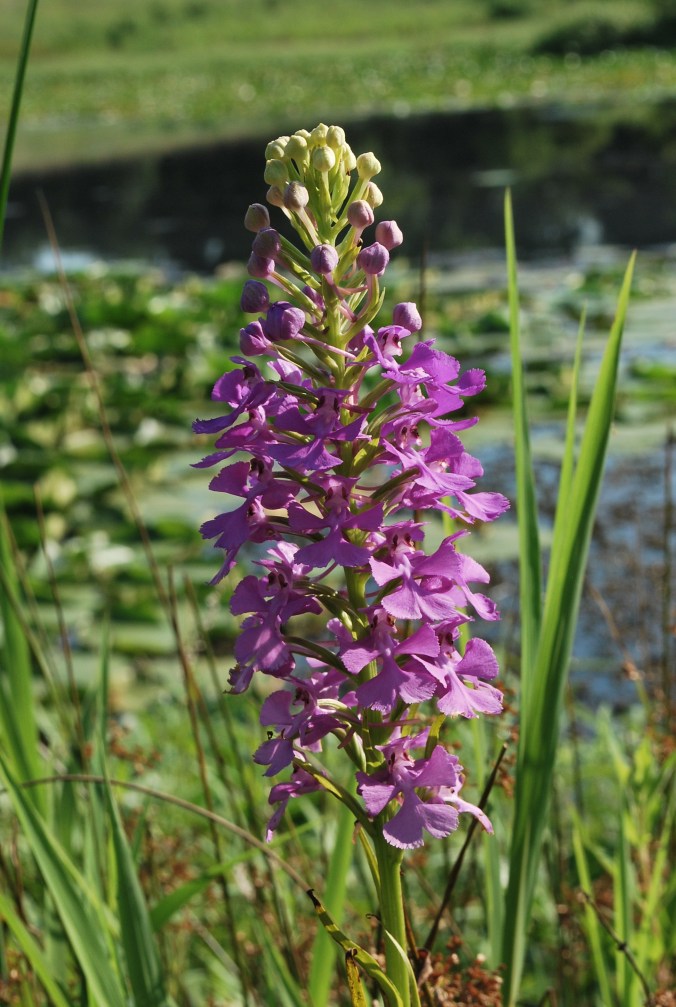
The purple fringeless orchid surprised the restorationist and St. Louis area botanists by flowering in the SNR wetland area 17 years after the original sowing.

Copyright © James Trager 2010

Add to FacebookAdd to DiggAdd to Del.icio.usAdd to StumbleuponAdd to RedditAdd to BlinklistAdd to TwitterAdd to TechnoratiAdd to Yahoo BuzzAdd to Newsvine

Email to a friend