Merci!

View from the Col du Soulor, French Pyrénées.

Most of you have probably surmised by now that I’ve been away for the past two weeks.   More specifically, I’ve been in Europe following the Tour de France and testing my own mettle as a cyclist in the French Pyrénées and the streets of Paris.  In the past two weeks, I’ve logged 710 km (I’m too tired to figure out what that is in miles) – most of it in the mountains over the same Cols and descents as this year’s Tour de France.  I’ve climbed (and descended) 10 mountain passes totaling well over 10,000 m of vertical ascent, reached speeds of 75 kph, rubbed elbows with more than 10,000 other cyclists in the 181-km Etape du Tour (finishing in the top 10%), seen six stages of the Tour de France, sought autographs from the world’s top pro cyclists, and sprinted against some seriously fast guys in Paris.  Add gorgeous 200-year old hotels, sumptuous French cuisine, and the comradery of 17 other like-minded individuals (including my lovely wife), and you have the makings of a trip that will not soon be forgotten.

My sincerest thanks to Anne McCormack, Alex Wild, James Trager, and Rich Thoma for filling in for me during my absence with their guest posts here at Beetles in the Bush.  I hope you enjoyed their contributions as much as I did (a safe bet, judging from the many comments their posts generated).  I’m a little bleary-eyed from the trip back home today, but life should return to normal quickly.  My trip was light on natural history – sometimes one has to make choices, and for this trip I decided to maintain cycling as the focus.  The big camera stayed home, and the point-and-shoot was used mostly for capturing race action.  Still, scenes like the one above – taken from the ascent of the Col du Soulor – captivated the natural historian in me and left me wanting to learn more about the unique flora and fauna that must exist in these gorgeous mountains.  Perhaps next time…

Copyright © Ted C. MacRae 2010

Add to FacebookAdd to DiggAdd to Del.icio.usAdd to StumbleuponAdd to RedditAdd to BlinklistAdd to TwitterAdd to TechnoratiAdd to Yahoo BuzzAdd to Newsvine

Email to a friend

The Power of Impulse

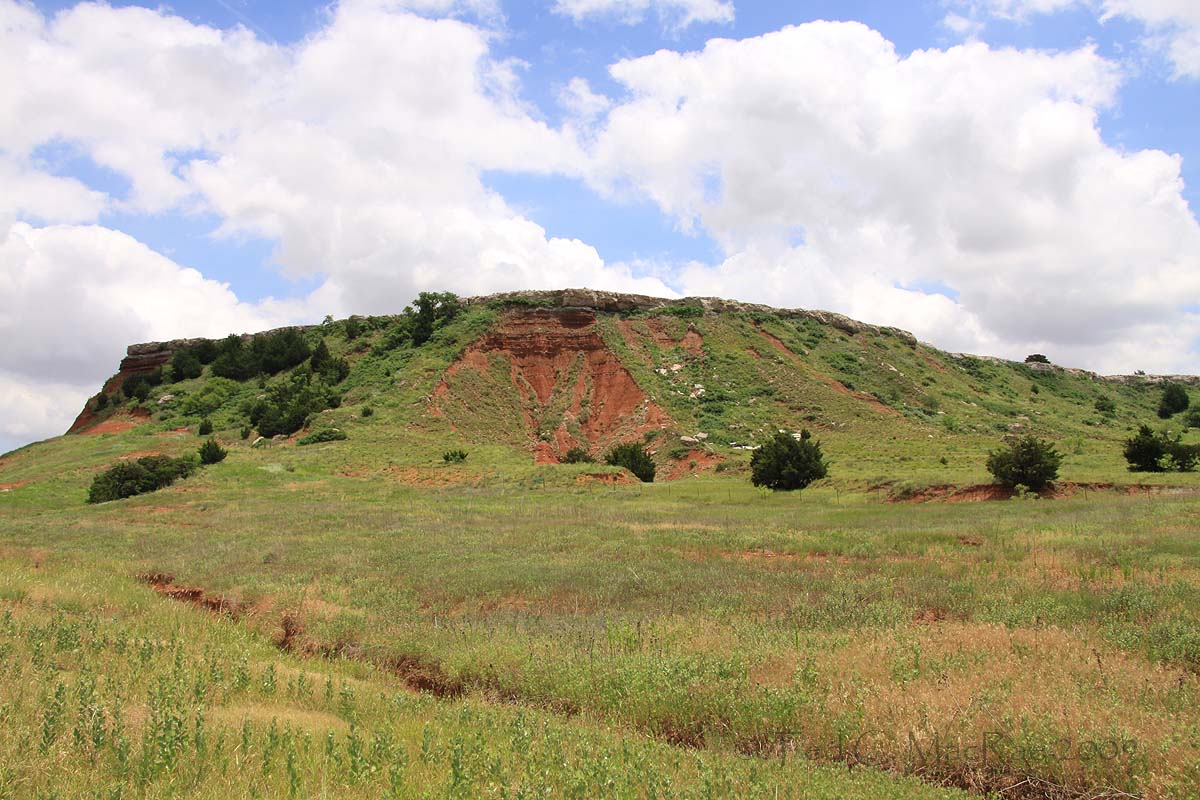
Glass Mountains, Oklahoma

Since figuring out a couple weeks that I had the larva of North America’s largest tiger beetle (Amblycheila cylindriformis, or Great Plains giant tiger beetle) in a rearing tub in the lab, I haven’t been able to think about anything except how cool it would be to go back out to the Glass Mountains in northwest Oklahoma (where I collected the larva last June) and look for the adults.  I have every reason not to do this trip – I just spent a long weekend up in northwest Missouri on follow up surveys for our newly discovered population of Cylindera celeripes (swift tiger beetle) (my second such trip in the past three weeks¹), and in a mere week and a half I leave for a 2-week trip to France.  Bills need to be paid, the grass needs cutting, and (as of today) a broken spoke needs to be repaired.  My collecting trips are normally planned far in advance – their timing and frequency part of a delicate balance between the goals I set for the season and the responsibilities that go along with having a job and a family.

¹ More on this in an upcoming post.

But for Amblycheila, it’s now or never – at least for this season, and the thought of waiting until next year before I can take my first valid shot at finding this species in the wild (and perhaps a previously unrecorded population, at that²) is just too unbearable.  So here I am, halfway to the Glass Mountains on as impulsive a trip as I’ve taken in a long time, hoping that my hunch pays off and I’ll find the strikingly large adults of A. cylindriformis lumbering below the flat-topped mesas in the mixed grass prairie where a little more than a year ago I was collecting its enormous larva. It’s a drive-collect-drive trip, and if successful I won’t be the first person to photograph them, even well, but it will nevertheless fulfill my longtime desire to locate this species in the wild and see it with my own eyes – a far more gratifying experience than looking at the lone dead specimen acquired long ago through trade that sits in my cabinet. Wish me luck!

² Drew and Van Cleave (1962) saw only a single specimen from the state in neighboring Woodward Co., although this is now a rather old reference.

REFERENCES:

Drew, W. A. and H. W. Van Cleave.  1962. The tiger beetles of Oklahoma (Cicindelidae).  Proceedings of the Oklahoma Academy of Science 42:101–122.

Copyright © Ted C. MacRae 2010

Add to FacebookAdd to DiggAdd to Del.icio.usAdd to StumbleuponAdd to RedditAdd to BlinklistAdd to TwitterAdd to TechnoratiAdd to Yahoo BuzzAdd to Newsvine

Email to a friend

Taum Sauk Mountain – Missouri’s High Point

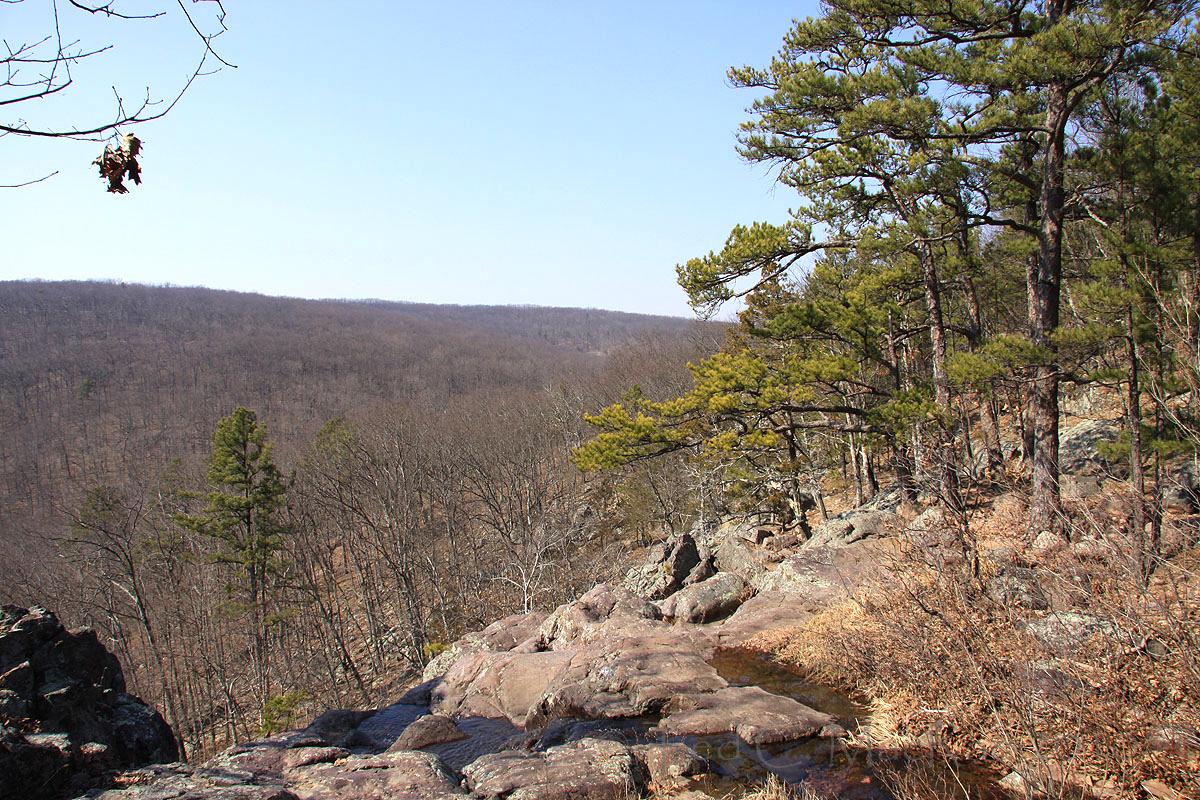
Although spring is now well underway in the middlin’ latitudes of Missouri, it was only a few short weeks ago that winter was still with us.  For my last winter hike of the season, I returned to perhaps my favorite stretch of my favorite trail in all of Missouri – the Mina Sauk portion of the Taum Sauk Trail on Taum Sauk Mountain.  Located in the rugged St. Francois Mountains (the “epicenter” of the Ozark Highlands), Taum Sauk Mountain is Missouri’s highest peak.  I say “peak” with a bit of reservation – at 1,772 feet it hardly compares with the high peaks of the Rocky Mountains or even the much mellower Appalachians (and certainly not with those of my beloved Sierra Nevada).  Nevertheless, unlike the remainder of the Ozark Highlands, the St. Francois Mountains are true mountains initially formed through a series of volcanic events occurring well over a billion years ago.  They, and the rest of the Ozark Highlands, have been shaped to their current form by repeated cycles of uplift and subsequent erosion.  

During their Precambrian prime, the St. Francois Mountains reached heights of 15,000 feet (the “ancient” Appalachians, in the meantime, were still just a twinkle in Mother Earth’s eye).  Rain and wind and the vastness of time have reduced them to nubs, leaving only the most ancient of volcanic rocks as testament to their former glory.  Although most of what is now the Ozark Highlands was inundated repeatedly later in the Palaeozoic (laying down the sediments that were then uplifted and “carved” to their current shape), the highest peaks of the St. Francois Mountains may be among the few areas in the United States never to have been completely submerged under those ancient seas.  Standing atop Taum Sauk Mountain, it is tempting to visualize today’s craggy terrain as a fossil of that ancient landscape – the peaks representing the former islands of rhyolite, their slopes barren and lifeless in stark contrast with the exploding diversity of bizarre life forms appearing in the tropical waters that surrounded them.

The sterile, volcanic rocks of the St. Francois Mountains support an abundance of open, rocky glades – especially on their peaks and southern and western slopes – that are home to a number of plants and animals more typically found in the tallgrass prairies further west.  Indian grass (Sorghastrum nutans) and little bluestem (Schizachyrium scoparium) thrive in clumps between the large, pink boulders that are strewn across the landscape and which provide shelter and sunning spots for animals ranging from the charismatic eastern collared lizard (Crotaphytus collaris) to the smaller but no less beautiful splendid tiger beetle (Cicindela splendida).  The surrounding forest is historically an open woodland with a rich, herbaceous understory and widely-spaced, drought-tolerant trees such as shagbark hickory (Carya ovata), post oak (Quercus stellata), and blackjack oak (Quercus marilandica).  These woodlands and glades are a fire-mediated landscape dependent upon periodic burns to maintain their vegetative character.

A trail begins at “High Point”, marking the summit of Taum Sauk Mountain and the highest point in Missouri.  A granite slab next to the summit rock documents the elevation at 1,772.68 feet MSL (Mean Sea Level).  The Mina Sauk Falls Trail, a rugged three-mile loop that joins the Taum Sauk Section of the Ozark Trail, leads to the tallest wet-weather waterfall in Missouri, Mina Sauk Falls.  During periods of high water flow, water gushes over the edge and drops 132 feet over a series of rocky ledges.  Water was flowing lightly during my late winter visit; nevertheless, looking out from above the falls (see photo above) offers one of the most spectacular vistas available in Missouri.  A rather difficult hike down the side of the mountain to the bottom of the falls is also well worth the effort, although clear views of the entire falls are difficult to find in the dense, moist forest below (it was here that I photographed the spectacular Ozark Witch Hazel).

A second unique geological feature lies about a mile farther down the Ozark Trail – Devil’s Toll Gate.  The rocks stand 30 feet high on either side of this eight-foot-wide, 50-foot-long fissure.  The gap probably began as a vertical fracture in the rock that has been enlarged by subsequent weathering. Over time the fissure will continue to widen, as the rocks on either side lose height.

Returning to High Point at the end of the hike, I noticed that the summit was a little higher than when I started my hike – whether this was through additional uplift of the underlying mountain or a depositional event I cannot say.  Nevertheless, I estimated Missouri’s new highest elevation to be approximately 1,773.01 feet MSL!

Copyright © Ted C. MacRae 2010

Add to FacebookAdd to DiggAdd to Del.icio.usAdd to StumbleuponAdd to RedditAdd to BlinklistAdd to TwitterAdd to TechnoratiAdd to Yahoo BuzzAdd to Newsvine

Email to a friend

Bicycle ride around Lake Tahoe

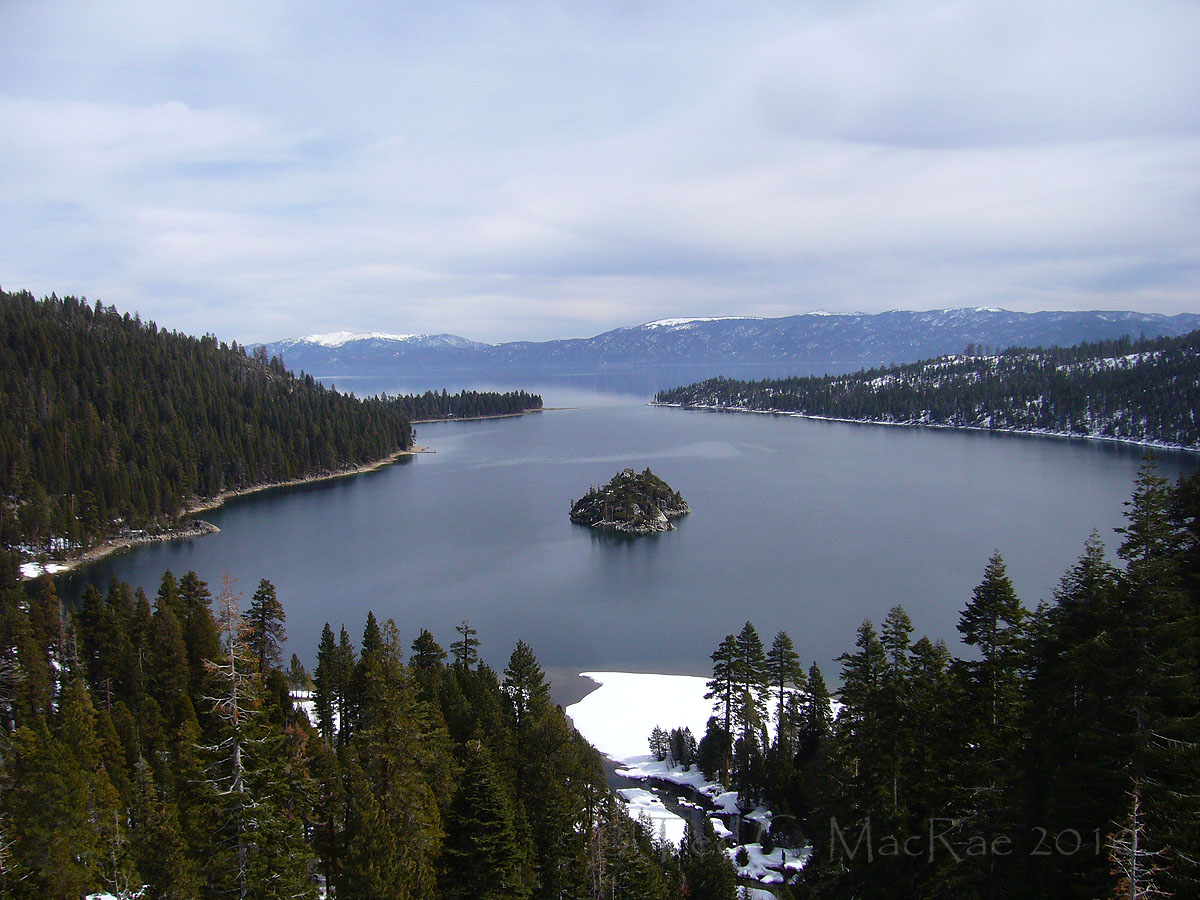
Overlooking Emerald Bay from Emerald Bay Pass.

Perhaps some of you have by now deduced that, in addition to insects and natural history, I have a second passion – cycling! In fact, I raced bikes competitively as an amateur for seven years (going by the local nickname “BugMan“) before hanging it up at the end of 2008.  However, even though I’m not racing anymore, I still ride as much as ever, only now it’s purely for the fun of it!  I’m a dedicated roadie, riding year-round and averaging around 5,000-6,000 miles a year.  I love the speed and the smoothness of the road and the opportunity it provides to cover long distances and enjoy the sights (not to mention the resulting freedom to eat like a horse and stay relatively trim!).

One of my most memorable cycling experiences was in 1995, when I joined a group that rode the entire circuit around Lake Tahoe.  I was living in Sacramento at the time and was a relative newbie – the 72-mile ride with 3,500 feet of climbing at elevations ranging from 6,200 feet at lake level to more than 7,000 feet near Carson Pass was without question the most difficult ride I had ever attempted at that point.  Now, as a seasoned ex-racer, such a ride is not extraordinarily difficult for me – in fact, I do rides in the 60-80 mile range with as much climbing or more almost every weekend.  Still, my memories of the challenge and the unbelievable scenery have kept that ride high in the ranks of my most epic, and since we began going back to Lake Tahoe two spring ago I’ve wanted to do it again.  It would not have been possible during our first trip back, as the roads still had quite a bit of snow on them; however, last year the roads were clean and dry, and I resolved to bring my bike with me on this year’s trip in the event that such was again the case.  Madonna del Ghisallo (patron saint of cycling) must have been smiling down upon me, because this year the roads were again in beautiful condition, despite the amount of snow blanketing the surrounding landscapes.  It made for one of the most beautiful bike rides I have ever done in my life.

There was a comforting familiarity to the ride, despite the 15 years since the last – the stunning landscape that I have come to cherish so dearly, the massively shaded solitude of the west shore, lunching on California cuisine in a quaint village along the north shore, and the long climbs and screaming descents through open Jeffrey pine forests along the east shore.  It was also different – I was by myself, yet despite that I was stronger and briming with confidence; not only a seasoned cyclist, but also much more knowledgeable of and closely attuned to the natural history of the area.  I didn’t fear the climbing, I relished it!  I didn’t overcome the challenge, I enjoyed it!  I stopped at a few places to take photographs (taken with my small point-and-shoot, for obvious reasons) and share some of them here – I hope they give you a tiny taste of the flavor of that day.

Near the summit of Emerald Bay Pass, looking back at Mt. Tallac.

High point on Emerald Bay Pass.

The descent to Eagle Falls at Emerald Bay.

 This is an avalanche zone (note deep snow deposits on steep slopes on left side – these extend high up the mountain here).  Moments after taking this photo, an avalanche fell onto the road right as I was descending by this spot. At ~35 mph there was no stopping – I rode right through it as the initial snow drop hit the pavement and then watched in amazement as the main drop dumped onto the road behind me.  It was not big enough to bury anything, but I surely would have crashed had I gotten there just a moment or two later!

Overlooking Emerald Bay from Emerald Bay Pass.

Emerald Bay is a glacial scour formed during the last glacial period ending only 10,000 years ago. Fannette Island, Lake Tahoe’s only island, is thought to be a resistant rib of granite rock that was overridden by the glacial ice. Lateral glacial morraines enclose each side of the bay, and an incomplete terminal morraine connects Emerald Bay to the main lake. Last year, I stood atop the outermost rock of the left side of the terminal morraine and took photographs looking back in this direction

Grove of sugar pines at D. L. Bliss State Park.

Sugar pine, Pinus lambertiana, is among my favorite of all pines.  More common on the west shore due to their preference for higher levels of moisture, their towering, ragged, asymmetrical crowns with long, pendulous cones (usually a foot or more in length) hanging from the branch tips are immediately recognizable from afar.  These majestic trees are the world’s tallest pine and bear the longest cones in the genus; they stand in defiant contrast to the uniformly symmetrical crowns of the more common Jeffrey pines (Pinus jeffreyi) and white firs (Abies concolor) that surrounded them.  For a more thorough treatment of the trees of Lake Tahoe, please visit my three-part series covering the pines, the “other” conifers, and the deciduous trees.

Some might think it was still a little too early in the season for bike riding.

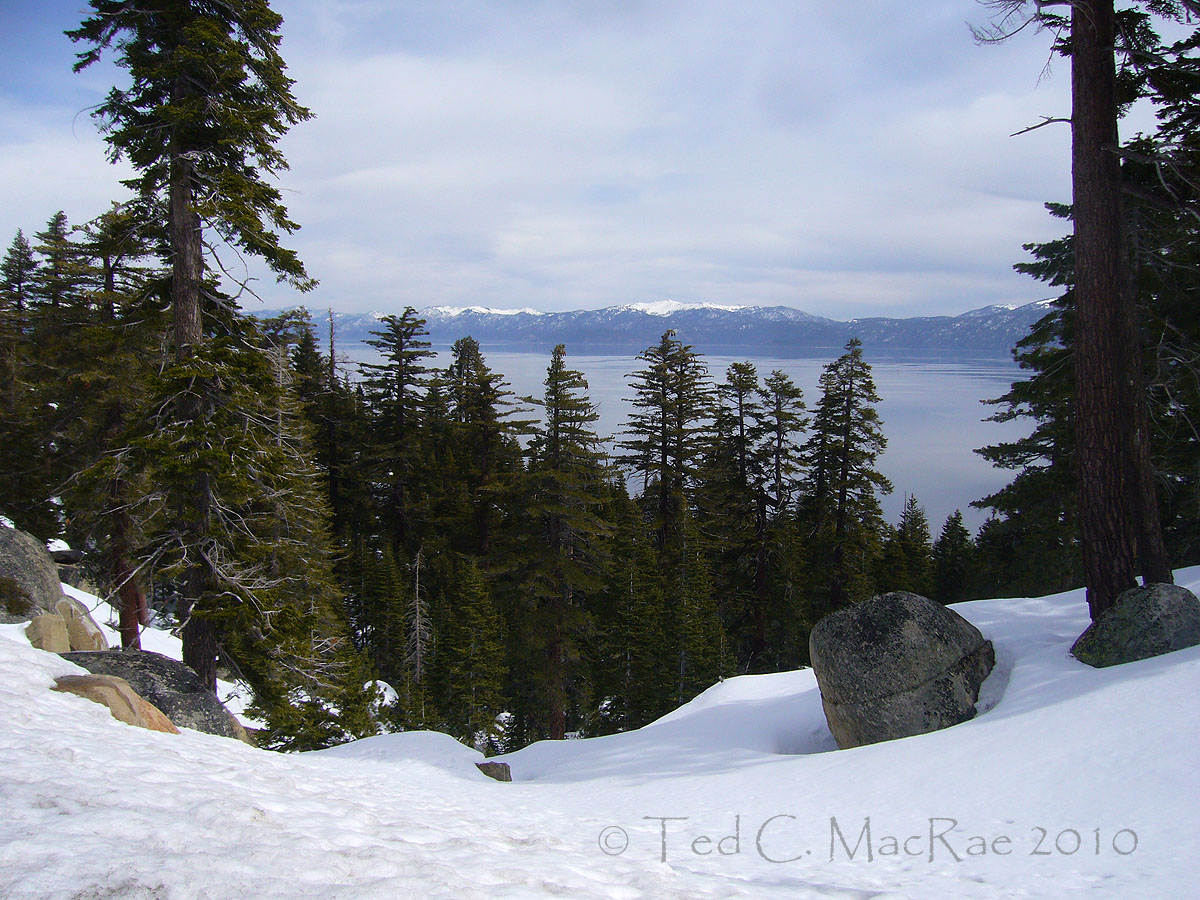
Looking west across Lake Tahoe from Logan Shoals Overlook.

The east shore in Nevada is decidedly drier than California’s west shore.  The forest on the Nevada side is a more open, fire-mediated landscape dominated by Jeffrey pine, as opposed to the denser forests on the west shore with higher incidence of shade-tolerant trees such as white fir and incense-cedar (Libocedrus decurrens).

View of Cave Rock (left center) from Logan Shoals Overlook.

Cave Rock was and still is a sacred place for people of the Washoe tribe, whose ancestors occupied Lake Tahoe during the summers and performed religious ceremonies inside the largest of its caves.  These caves, sitting several hundred feet above the current lake level, were carved by wave action shortly after Lake Tahoe’s formation nearly 3 million years ago when lake levels were much higher than they are today.  The first of two highway tunnels was blasted through the rock in 1931 (much to the dismay of the Washoes), and the second was added in 1957.

Looking north along Lake Tahoe's east shore from atop Logan Shoals Overlook.

Copyright © Ted C. MacRae 2010

Add to FacebookAdd to DiggAdd to Del.icio.usAdd to StumbleuponAdd to RedditAdd to BlinklistAdd to TwitterAdd to TechnoratiAdd to Yahoo BuzzAdd to Newsvine

Email to a friend

Up the Glacial Staircase

During last year’s visit to Lake Tahoe, we attempted to hike Eagle Falls Trail, one of Lake Tahoe’s most scenic and popular trails.  Beginning at the Hwy 89 trailhead above Emerald Bay, this trail climbs a dramatic ‘glacial staircase’ with steep, narrow gorges connecting a series of deep lakes and meadows.  Each of these lakes, and indeed Emerald Bay itself, was formed as a result of glaciers that carved Lake Tahoe’s granite shores until as recently as 10,000 years ago – leaving behind scars of incomparable beauty.  Eagle Lake perches atop one of these steps – only a short, one-mile hike up the trail but rising nearly 2,000 feet above the trailhead.  Summer hikers have trouble enough dealing with this elevation gain, but winter hikers – as we learned last year –  find it impossible without the assistance of snowshoes.  The first steep section just short of Upper Eagle Falls would prevent any further progress, leaving me with only a teasing view up the gorge and a commitment to try again on our next visit.

There was even more snow this year than last – a good 4-6′ it appeared, but our rented snowshoes made this irrelevant (even desirable), and the four of us began the arduous task of climbing the snow-laden slopes all the way up to Eagle Lake.  It was a family affair, so the pace was dictated by 10-yr old Madison, who got us to Eagle Lake – serenely beautiful and frozen solid – in a leisurely 1 hour 45 minutes.  The hike back down the gorge passed more quickly (almost too quickly) but provided spectacular views of Emerald Bay and Lake Tahoe below. Those of you with an interest in the geological history of Lake Tahoe may refer to my earlier posts, Lake Tahoe, California (Mar 2008) and Born of Glaciers (Mar 2009).  The rest of you may just enjoy these pretty pictures.

View of Upper Eagle Falls - it was here where our hike last year would end.

View back down the gorge from bridge over Upper Eagle Falls.

Looking back down at Emerald Bay from Eagle Falls Trail.

Further up the trail, one looks back upon this spectacular view of Jake's Peak.

Eagle lake lies at 8,500' elevation (frozen lake surface visible through trees left).

Copyright © Ted C. MacRae 2010

Add to FacebookAdd to DiggAdd to Del.icio.usAdd to StumbleuponAdd to RedditAdd to BlinklistAdd to TwitterAdd to TechnoratiAdd to Yahoo BuzzAdd to Newsvine

Email to a friend

Lake Tahoe – 2010 Preview

How does an entomologist/wannabe botanist-ecologist-geologist-cyclist-nature photographer spend his time on a family vacation?

  • Thursday evening to Saturday late afternoon:
    – Drive from St. Louis to Lake Tahoe.  In between driving shifts:
    – Complete manuscript on Cylindera cursitans surveys
    – Complete manuscript on Dromochorus pruinina surveys.
    – Arrive late afternoon, quick 1-hr bike ride before dark.
  • Sunday:
    – Cross-country skiing with the family: Spooner Lake (~6 miles).
    – Sight-seeing: Sand Harbor Overlook on the east shore.
    – Hang out at the hot tub with the family and a glass of wine.
  • Monday:
    – Drive to Sacramento with the family.
    – Visit buprestid-colleagues Chuck Bellamy (CDFA) and Mark Volkovitsh (Russian Academy of Science).
    – Private lesson from Mark on how to dissect buprestid larvae for taxonomic description.
    – Dinner with my favorite brothers-in-law.
    – Drive back to Lake Tahoe.
  • Tuesday:
    – Snowshoe hike with the family: Emerald Bay to Eagle Lake and back (2 miles, 1,900′ of climbing).
    – Bike ride: South Lake Tahoe to Bliss State Park and back (33 miles, 1,100′ of climbing).
  • Wednesday:
    – Bike ride: all the way around Lake Tahoe (72 miles, 3,500′ of climbing).
    – Hang out at the hot tub with the family and a glass of wine.
  • Thursday:
    – Botanizing and hiking with daughter Madison at Mt. Rose (4 miles, 1,300′ feet of climbing).
    – Hang out at the hot tub with the family and a glass of wine.
  • Friday:
    – Alpine skiing with the family at Heavenly Ski Resort.
    – Join a 2-hour ski tour with US Forest Service rangers discussing natural and cultural history of Lake Tahoe.
    – Hang out at the hot tub with the family and a glass of wine.
  • Saturday morning to Sunday night:
    – Drive from Lake Tahoe back to St. Louis.  In between driving shifts:
    – Process/file photographs from trip (~250).
    – Complete reports for 2009 collecting permits.
    – Complete new applications for 2010 permits.
    – Begin manuscript on Cylindera celeripes conservation status.
  • Monday:
    – Return to work mentally refreshed!

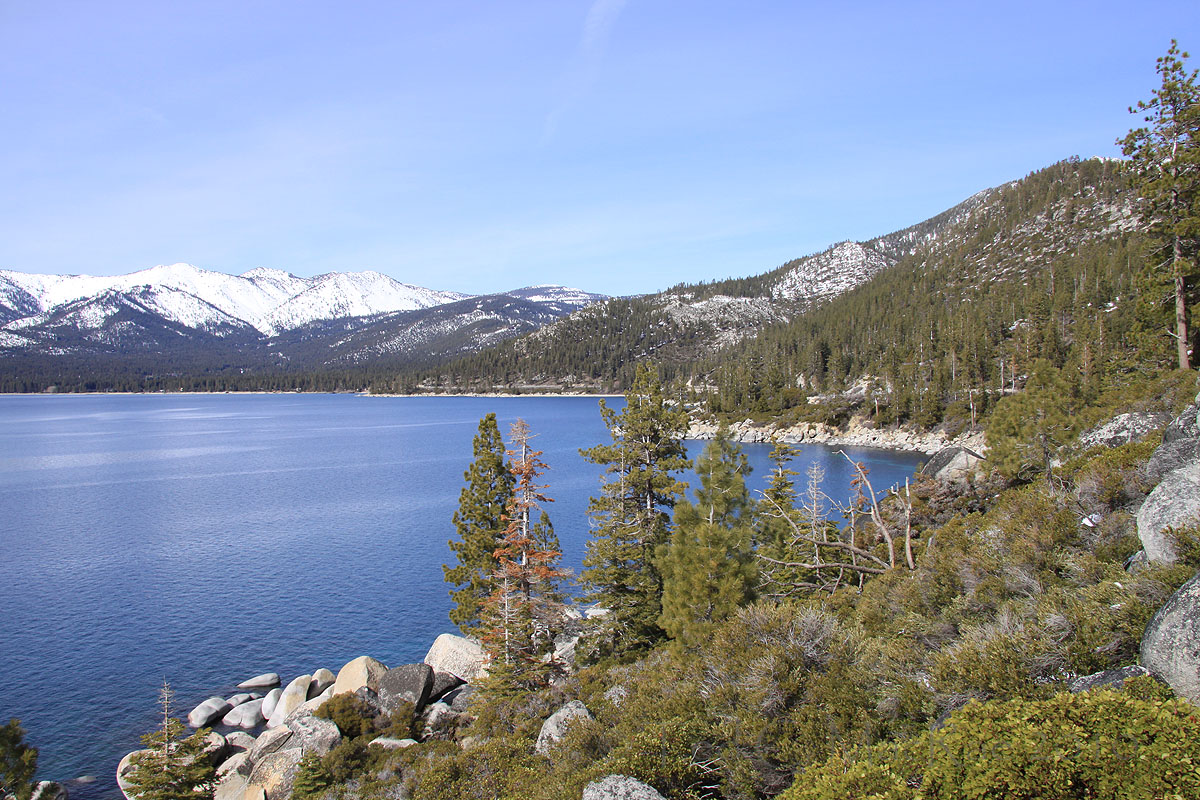
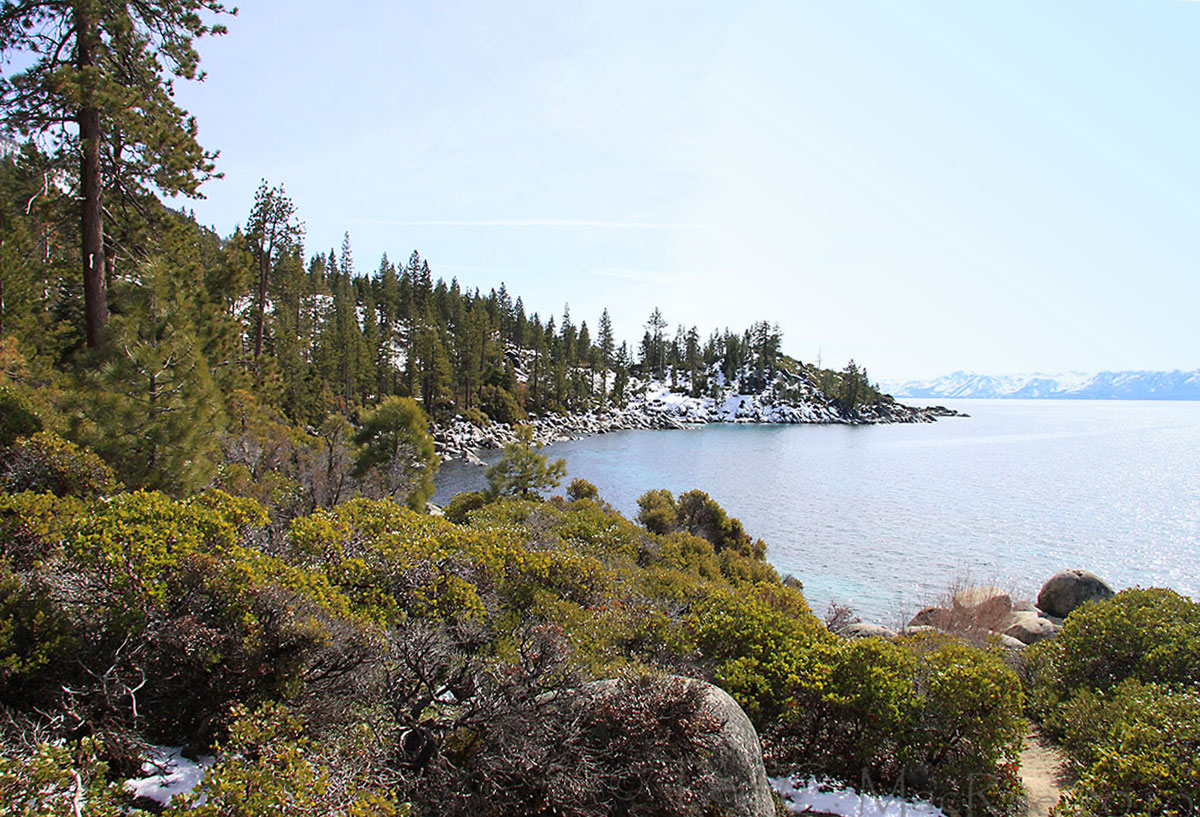
I’ve already shared a bit of the trip with a view of Mt. Rose from 7,000′ and ensuing pismire quagmire.  Today I share some views of one of the most scenic of lakeside spots on the east shore – Sand Harbor Overlook.  I featured this spot in this post from last year’s trip due to its stunning beauty, and this year I was no less impressed.  I still had that same, annoying, afternoon sun to deal with (next year I’ve resolved to get here during the morning) but managed to get some passable photographs.  The one above is my favorite, and I hope you enjoy the following as well. (p.s. if someone knows how to fix a sun-blown sky in Photoshop Elements, please let me know).

Copyright © Ted C. MacRae 2010

Add to FacebookAdd to DiggAdd to Del.icio.usAdd to StumbleuponAdd to RedditAdd to BlinklistAdd to TwitterAdd to TechnoratiAdd to Yahoo BuzzAdd to Newsvine

Email to a friend

Euhagena nebraskae in Kansas

Gypsum Hills region of south-central Kansas (Barber Co.)

One of my favorite destinations for insect collecting is the Gypsum Hills region in Barber County of south-central Kansas.  I first went there in May 1986 after seeing a diverse selection of more typically Texan Buprestidae that J. Richard Heitzman, an iconic lepidopterist in the Kansas City area and author of Butterflies & Moths of Missouri, had collected there on soapberry (Sapindus saponaria).  I had my own success with Buprestidae as well during that trip, but in recent years I have returned to Barber County several times during the fall to look for one of North America’s most beautiful tiger beetles, Cicindela pulchra (Beautiful Tiger Beetle).  This species had been recorded in the area by the well-known cicindelophiles Ron Huber and Dave Brzoska, who suggested that I look in the red clay hills just west of Medicine Lodge.  My first trip to look for this beetle in 2004 was unsuccessful, and I suspect the early September timing of my trip may have been a tad too early.  I returned again in 2005, this time in early October and also enlisting the help of local entomologist “Beetle Bill” Smith, who knew of a population on private land near his home in Hardtner (south of Medicine Lodge).  Although at first it looked like success might again elude me, in the end I saw a robust population of these spectacular beetles and published an account of that marvelous experience (MacRae 2006).

As with so many of the things that I have seen over the years, they came before my interest in photography, and I now find myself wanting to re-find some of the more spectacular insects that I’ve previously found so that I can properly photograph them.  Such is the case with C. pulchra, so in October of last year I returned to Barber County in hopes of seeing this species armed not only with an aerial net, but also a Canon 50D.  Sadly, this would not come to pass – the same sudden cold snap that dashed my hopes of finding this species in nearby Woodward/Major Counties, Oklahoma would keep any tiger beetle activity to a bare minimum the following day in Barber County as well.  Despite bright sunny skies, I would see only two tiger beetles the entire day, both representing the dreadfully ubiquitous Cicindela punctulata (Punctured Tiger Beetle).  Not all insect activity, however, was squelched, and after scanning the red soils for an hour or so without seeing the object of my desire I began to notice some of these other not-so-temperature-finicky species.  One of the more magnificent of these is shown in the photo below — Euhagena nebraskae in the family Sesiidae (cess-EYE-id-ee) (formerly Aegeriidae).

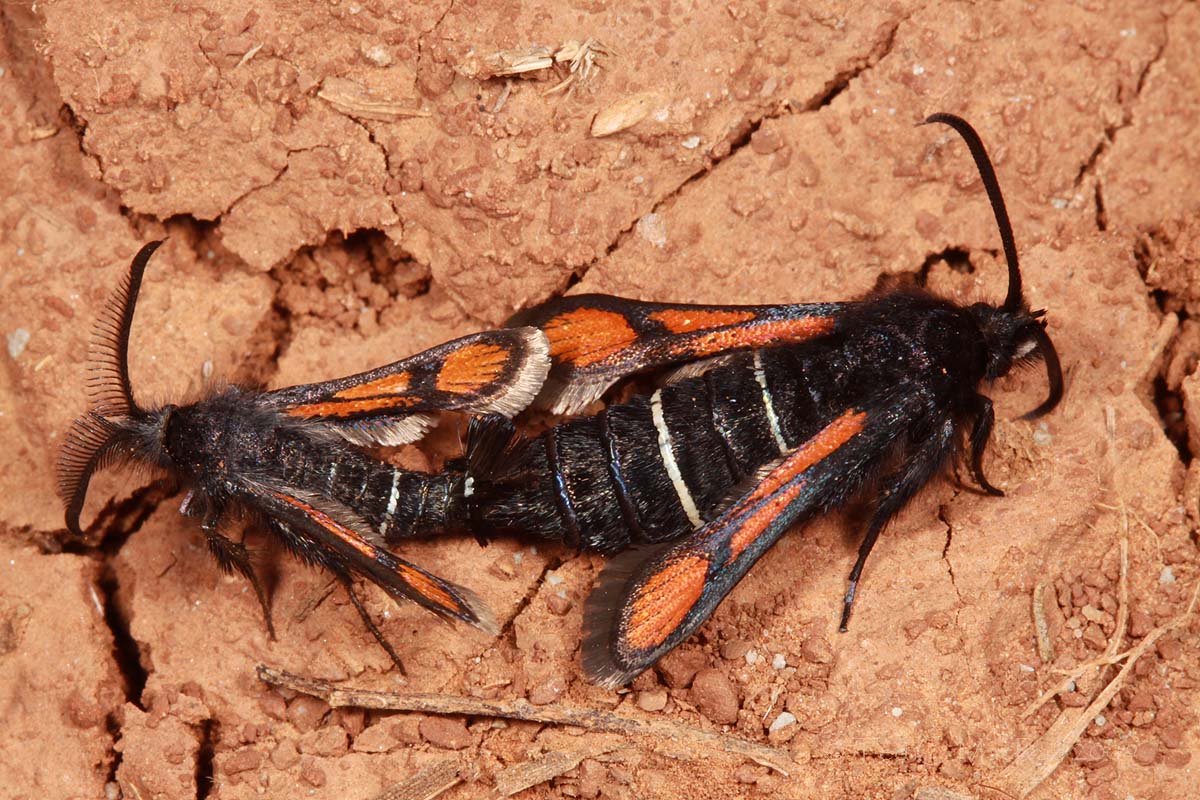
Euhagena nebraskae

Euhagena nebraskae (Lepidoptera: Sesiidae)

Although I wasn’t sure of the species at first, I recognized it immediately as a clearwing moth.  I had an interest in this family of moths for a time in my early days as a field entomologist with the Missouri Department of Agriculture.  Many species are important pests of woody plants in orchard and ornamental landscapes, and it was during that time that synthetic pheromones became widely used for monitoring purposes.  I often walked around with a pheromone tag pinned to my bag to attract the male moths — it was fun watching people seeing these moths “buzzing” me and thinking I was under attack by the wasps that they so effectively mimic (despite my calmness in these situations, I still found it hard to actually grab one from the air with my hand – so convincing is their mimicry).

Euhagena nebraskae is one of two species in the genus in North America, both of which develop as larvae in the roots of plants in the evening primrose family (Onagraceae) (Eichlin and Duckworth 1988).  In fact, I had seen its congener — E. emphytiformis — many times in the 1980s in pheromone traps that I used to place in the glades of Jefferson County just south of St. Louis, where it presumably breeds in one or both of two Oenetherea species growing there (O. gaura and O. macrocarpa).  Euhagena nebraskae is a more western species that does not occur in Missouri, occurring instead across the Great Plains west to California and from southern Alberta and Saskatchewan south to Mexico.  It is likely that many entomologists never see this species, as adults are active only during late fall.  Thus, its perception as an uncommon species may be an artifact of its late seasonality. 

I thought it odd that nearly every individual that I saw was sitting on the ground rather than perched higher on a plant.  At first I wondered if the cold temperatures were a reason for this, perhaps causing the moths to seek out the ground as a source of radiant heat.  This seems doubtful, however, since females always seemed to be “calling” – their tufted abdominal tips raised in the air with the scales spread apart, apparently releasing pheromone.  I was fortunate to find this mating pair, which shows nicely the rather high degree of sexual dimorphism seen in these moths.  Note the much more highly bipectinate antennae of the male (pectinate = resembling a comb, bipectinate = ‘teeth’ on both sides of the main stem) versus the simple antennae of the female — males use their antennae for detecting female pheromones, and the bipectinate form presumably provides greater surface area for placement of sensory pores. Note also the male’s smaller size, “hairier” head and thorax, and greater amount of white coloration on the abdomen and wings.  Engelhardt (1946) supposed that the excessive hairiness of adult Euhagena species was an adaptation to their late-season emergence (principally during October and sometimes as late as November), a time when frosty nights prevail in their high-elevation haunts.    

REFERENCES:    

Eichlin, T. D. and W. D. Duckworth. 1988. The Moths of America North of Mexico, Fascicle 5.1, Sesiodea: Sesiidae. Wedge Entomological Research Foundation, Washington, 176 pp.

Engelhardt, G. P. 1946.  The North American clear-wing moths of the family Aegeriidae. Bulletin of the United States National Museum 190:1-222.

MacRae, T. C. 2006. Beetle bits: The “beautiful tiger beetle”. Nature Notes, Journal of the Webster Groves Nature Study Society 78(4):9–12.

Copyright © Ted C. MacRae 2010

Add to FacebookAdd to DiggAdd to Del.icio.usAdd to StumbleuponAdd to RedditAdd to BlinklistAdd to TwitterAdd to TechnoratiAdd to Yahoo BuzzAdd to Newsvine

Email to a friend

Alkali Tiger Beetle

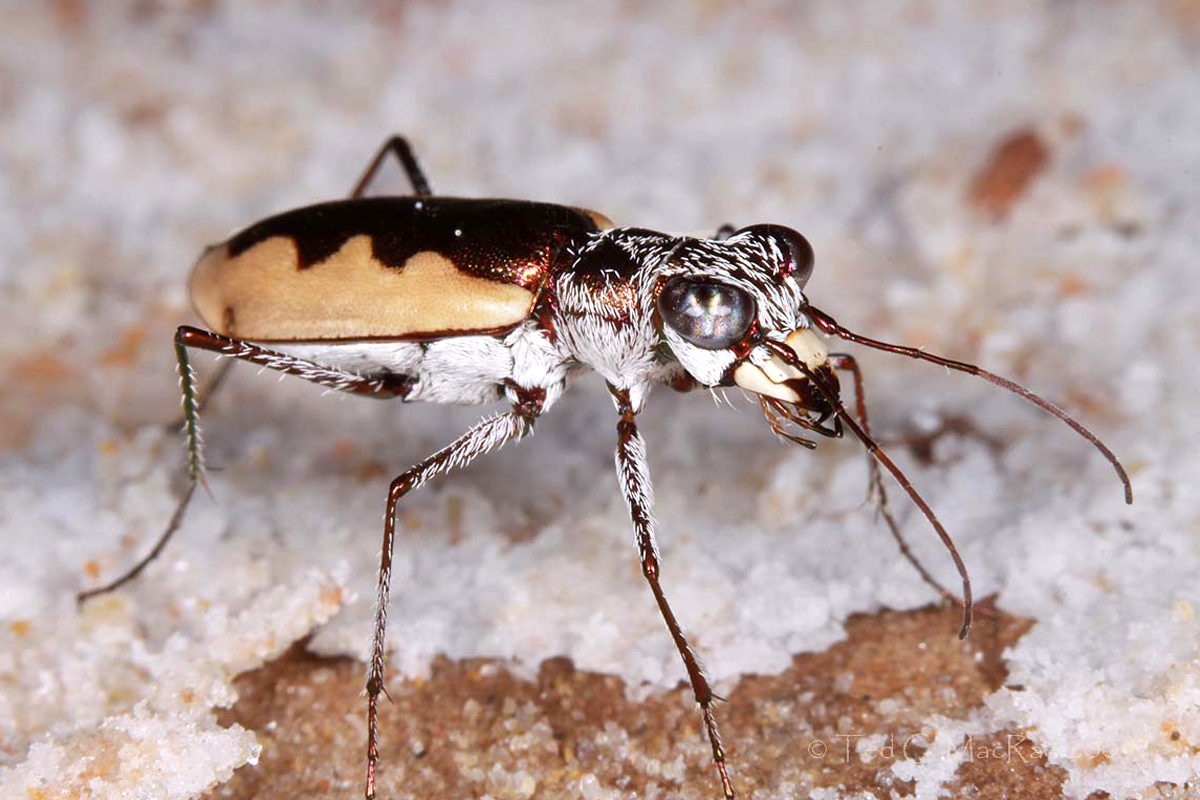
Eunota togata globicollis - Salt Plains NWR, Oklahoma

I haven’t written much about my early October trip to Oklahoma, where I had hoped to confirm a hunch that the gorgeous Cicindela pulchra (Beautiful Tiger Beetle) would be found in the red clay/gypsum hill habitats of Woodward and Major Counties (the same place where I had found the much rarer Cylindera celeripes the previous June).  Unfortunately, a sudden cold snap and overcast skies conspired against me for the duration of that short, 5-day trip, reducing tiger beetle activity to near zero and sending me back to Missouri with little to show for my efforts — save a scorpion, a torpid Cicindela splendida, and some very beautiful ladie’s-tresses orchids in peak bloom.  I did have one moderately successful day, however, when I returned to Salt Plains National Wildlife Refuge in north-central Oklahoma, a place where I observed seven species of tiger beetles during my June trip.  An eighth species that I did not see on that trip, but which I had observed in previous years, was my goal this time, and despite the cold temperatures and cloudy skies I was fortunate to find several individuals of Eunota togata globicollis.  Occurring primarily on saline flats in the central and southern Great Plain, this subspecies was called the Alkali Tiger Beetle¹ by Erwin and Pearson (2008), who reserved for the nominate form (found in salt marshes and tidal flats along the Gulf Coast) the more descriptive name White-cloaked Tiger Beetle².  A third subspecies, E. togata fascinans (Salt Flat Tiger Beetle) is restricted to salt flats in central New Mexico and west Texas (Pearson et al. 2006) (you may remember this subspecies from my habitat partitioning post last month).

¹ In reality, I have come to consider the term ‘alkali’ as a bit of a misnomer, as it is saline soils specifically — not just those with high pH (alkaline) — that the species is fond of. Moreover, there are many species of tiger beetles in addition to this one that are associated with saline soils.

² Okay, I might as well just get all this off my chest. Pearson et al. (2006) gave common names to each species of tiger beetle in the U.S., but not subspecies. I think most non-taxonomists probably consider this a good thing, although it is not without its problems (some species already had multiple common names applied to them, forcing choices that are sure not to please everyone). Erwin and Pearson (2008) took this further and came up with common names for all of the subspecies as well, and like any good taxonomist they steadfastly applied existing common names only to nominate forms. Eunota togata, however, is an example where the original common name would have been better applied to one of the non-nominate subspecies. The species epithet togata means “cloaked” (being derived from the Latin word toga — a reference to the broad white band running along the elytral margins). Each of the two non-nominate forms are distinguished by the white band being more broadly expanded (indeed, almost entirely covering the elytra in subspecies fascinans), yet it is the nominate subspecies — the least “cloaked” of the three — that retains the original common name. A silly argument I suppose, but if we start applying the “prinicple of priority” to common names in the same manner as scientific names, then what have we gained? Of course, I am of the opinion that most insect groups are too diverse and their taxonomy still too unstable to warrant a rigid system of “official” common names. Is it really any easier to learn White-cloaked Tiger Beetle than Eunota togata? How about Mount Ashland Night-stalking Tiger Beetle instead of Omus cazieri? And this is not even considering what happens when category-level shifts occur. For example, the genus Tetracha was formerly called the Big-headed Tiger Beetles; however, its former subgenera were recently elevated to genus level. Erwin and Pearson, accordingly, applied the common name to the entire subtribe containing Tetracha and its relatives and applied a new common name, Metallic Tiger Beetles, to the new, more limited concept of Tetracha. Thus, in an ironic case of common name instability despite no change in scientific name, the Virginia Big-headed Tiger beetle (Tetracha virginica) became the Virginia Metallic Tiger Beetle. Are your eyes bugging yet? Common names may be appropriate for higher vertebrates, but can they really be used effectively for beetles and other insect groups where the increasing use of molecular tools is sure to result in additional, perhaps radical, shifts in taxonomy? There — I said it, and I feel a lot better!

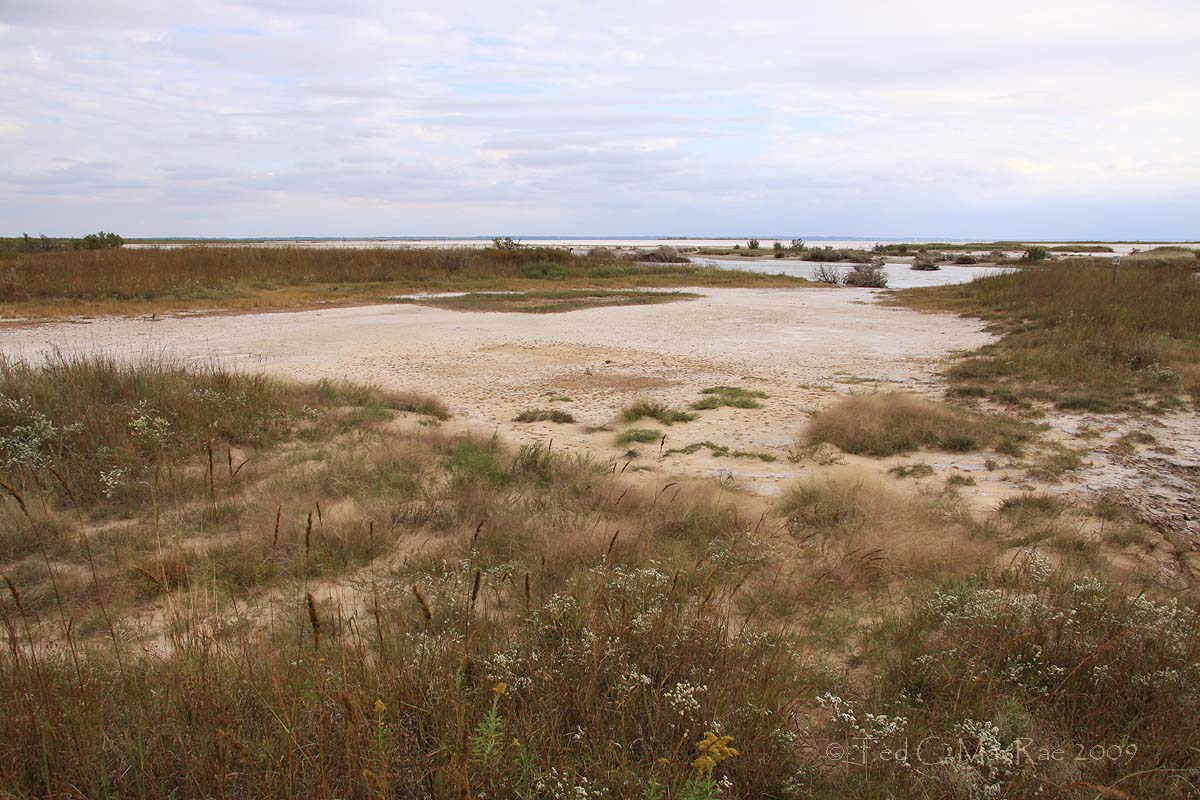
This species is restricted to saline flats in the central/southern Great Plains.

Of the eight tiger beetle species that I’ve now observed at Salt Plains NWR, half of them (Cicindela fulgida, C. nevadica knausii, E. togata globicollis, and Habroscelimorpha circumpicta johnsonii) are true saline habitat specialists.  One of the other four species (Cicindela tranquebarica kirbyi) is also fond of saline habitats but also occurs commonly on dry, sandy soils as well, and two show a high affiinity for nearly any moist (Cicindela repanda) or moist to dry (Cicindela punctulata) soils with little regard for salinity.  Only Cicindela formosa, a denizen of dry, deep sands seems a little out of its element on the moist, salty mud at Salt Plains NWR — perhaps the few individuals I’ve observed here are incidental visitors, mistaking the white, barren expanses of salt-encrusted soil for the dry sand the species prefers during disperal searches.  This again brings up the question of habitat partitioning for competition avoidance among tiger beetle species sharing the same habitat.  Eunota togata globicollis is active during the spring and fall and, thus, temporally isolated from C. nevadica knausii and H. circumpicta johnsonii (both summer-active species).  The other saline specialist at Salt Plains NWR (C. fulgida) is active during the same seasons as E. togata globicollis; however, in my observations that species prefers the sparsely-vegetated zone at the edge of the saline flats, while E. togata globicollis prefers to stay out in the more open areas.  These observations mirror those of Melius (2010) for E. togata fascinans and the other seven species he noted in the Laguna del Perro area of New Mexico, and of Willis (1967), who recorded as many as 11 sympatric tiger beetle species in saline habitats in the central U.S.

Saline flats at Salt Plains NWR are home to eight species of tiger beetles.

Microhabitat selection and seasonal occurrence are not the only isolating mechanisms that can minimize interspecific competition among the different tiger beetle species at Salt Plains NWR.  Cicindela tranquebarica kirbyi is also a spring/fall species and doesn’t appear to display a preference for open versus vegetated areas, potentially allowing it to compete directly with both E. togata globicollis and C. fulgida.  However, C. tranquebarica kirbyi is a decidely larger species, while the other two are smaller, and correlated with such differences in overall size is the size of their mandibles.  Mandibular size directly correlated to prey size in a number of tiger beetle species (Pearson and Mury 1979), thus providing another mechanism for avoiding competition between these three co-occurring species. 

Photo details:
Beetles: Canon 100mm macro lens w/ 68mm Kenco extension tubes on Canon EOS 50D (manual mode), ISO 100, 1/250 sec, f/18-20, MT-24EX flash 1/4 power w/ Sto-Fen diffusers.
Landscapes: Canon 17-85mm zoom lens (22mm) on Canon EOS 50D (landscape mode), ISO 100, 1/100 sec, f/10, natural light.

REFERENCES:

Erwin, T. L. and D. L. Pearson. 2008. A Treatise on the Western Hemisphere Caraboidea (Coleoptera). Their classification, distributions, and ways of life. Volume II (Carabidae-Nebriiformes 2-Cicindelitae). Pensoft Series Faunistica 84. Pensoft Publishers, Sofia, 400 pp.

Melius, D. A. 2009. Post-monsoonal Cicindela of the Laguna del Perro region of New Mexico. CICINDELA 41(4):81-89.

Pearson, D. L., C. B. Knisley and C. J. Kazilek. 2006. A Field Guide to the Tiger Beetles of the United States and Canada. Oxford University Press, New York, 227 pp.

Pearson, D. L. and E. J. Mury. 1979. Character divergence and convergence among tiger beetles (Coleoptera: Cicindelidae). Ecology 60:557–566.

Willis, H. L.  1967.  Bionomics and zoogeography of tiger beetles of saline habitats in the central United States (Coleoptera: Cicindelidae).  The University of Kansas Science Bulletin 47(5):145-313.

Copyright © Ted C. MacRae 2010

Add to FacebookAdd to DiggAdd to Del.icio.usAdd to StumbleuponAdd to RedditAdd to BlinklistAdd to TwitterAdd to TechnoratiAdd to Yahoo BuzzAdd to Newsvine

Email to a friend