“Rare jewel beetles discovered in Mexico by team of scientists!”

I hope you’ll excuse the hyperbolic title, but such has been my impression with some of the headlines I’ve seen recently in the popular media regarding newly described insect taxa in various parts of the world. The “discovery” of new species in far away, tropical lands sounds exciting and ground-breaking to many people, who envision teams of scientists wearing pith helmets and cargo shorts machete-slashing their way through miles of virgin forest before stumbling into a secret biodiversity hot-spot, their weeks of toil and sweat finally paying off by becoming the first white men to lay eyes upon a bounty of strange, exotic, never-before-seen creatures. In reality, new species of insects are not at all hard to find—in fact, depending on where you go it can be downright easy. Admittedly the chances are greater in the tropics, where many areas remain little explored, but even in well-studied North America new species turn up regularly. This includes popularly collected beetles in the very well-studied eastern U.S., where I’ve already described one new jewel beetle (family Buprestidae) and one new longhorned beetle (family Cerambycidae) from right here in my home state of Missouri (MacRae 2000, 2003) and am in the process of describing another new jewel beetle. No, finding new species is easy—recognizing them as such is the hard part. That’s not to say that new species cannot be recognized when first encountered, but I suspect that a majority of new insect species aren’t actually “discovered” until they’ve been brought back from the field, curated, and sat in a cabinet for years or decades—unrecognized for what they really are due to resemblance to known species until somebody comes along and examines them more critically.

Such is the case with two jewel beetle species that Chuck Bellamy and I describe in a paper just published in The Pan-Pacific Entomologist (MacRae & Bellamy 2013). I joined Chuck on several trips to Mexico in 1992 and again from 2004–2006 to explore the tropical thorn woodlands in the southern states of Oaxaca, Puebla, Guerrero and Michoacán. Jewel beetle diversity is high in these still relatively intact woodlands, with a number of new species already having been described from the area in recent years, and all-told we collected well over 100 species. At least a dozen or more of these look to be new, and considering that the Mexican jewel beetle fauna as a whole includes more than 800 known species the actual number could greatly exceed 1,000. The two described in this most recent paper resemble the common, widespread species Actenodes calcaratus. This big, beautiful jewel occurs from the southwestern U.S. through Mexico and Central America to northern South America, developing as larvae in dead wood of a variety of fabaceous hosts. We collected several of what we thought was this species during our trips, but a number of subtle but consistent differences in punctation and surface sculpturing emerged as we began comparing them more critically against A. calcaratus from other locations. The coup de grâce, however, was the coloration of the male face—normal bronze in A. calcaratus (Fig. 5) and similar to the female (Fig. 6), but flash-green in male A. scabrosus (Fig. 2) and green-violaceous in male A. michoacanus (Fig. 8). It’s quite remarkable that both of these species differ from their more widespread relative by subtle morphological characters but such striking sexually dimorphic facial coloration, and we subsequently found a similar situation with another species in the genus (A. undulatus) that otherwise bears little resemblance to A. calcaratus.

Figs. 1–9. Actenodes spp. 1–3. Actenodes scabrosus. 1–2. Male holotype. 1. Dorsal habitus. 2. Frontal view. 3. Female paratype (Guerrero). 4–6. A. calcaratus. 4–5. Male (MEXICO, Guerrero, Hwy 95, 5 km S Milpillas, 7.vii.1992, "big dead tree", G. H. Nelson [FSCA]). 4. Dorsal habitus. 5. Frontal view. 6. Female (MEXICO, Hwy 95, 2 km S Milpillas, 6.vii.1992, on Acacia farnesiana, G. H. Nelson [FSCA]), frontal view. 7–9. A. michoacanus. 7–8. Male holotype. 7. Dorsal view. 8. Frontal view. 9. Female paratype, frontal view. All scale bars = 5 mm.

Figs. 1–9. Actenodes spp. 1–3. Actenodes scabrosus. 1–2. Male holotype. 1. Dorsal habitus. 2. Frontal view. 3. Female paratype (Guerrero). 4–6. A. calcaratus. 4–5. Male (MEXICO, Guerrero, Hwy 95, 5 km S Milpillas, 7.vii.1992, “big dead tree”, G. H. Nelson [FSCA]). 4. Dorsal habitus. 5. Frontal view. 6. Female (MEXICO, Hwy 95, 2 km S Milpillas, 6.vii.1992, on Acacia farnesiana, G. H. Nelson [FSCA]), frontal view. 7–9. A. michoacanus. 7–8. Male holotype. 7. Dorsal view. 8. Frontal view. 9. Female paratype, frontal view. All scale bars = 5 mm.

In the case of both of these new species, the first specimens were actually collected more than 40 years ago but remained “hidden” among specimens of A. calcaratus until we examined the collections containing them more closely. While it might seem that the striking male facial coloration both of these species exhibit should have resulted in their quick recognition as undescribed species, even seemingly obvious characters such as this can be overlooked when an otherwise great resemblance to a common, widespread species prevents their critical examination.

REFERENCES:

MacRae, T. C. 2000. Review of the genus Purpuricenus Dejean (Coleoptera: Cerambycidae) in North America. The Pan-Pacific Entomologist 76(3):137–169.

MacRae, T. C. 2003. Agrilus (s. str.) betulanigrae MacRae (Coleoptera: Buprestidae: Agrilini), a new species from North America, with comments on subgeneric placement and a key to the otiosus species-group in North America. Zootaxa 380:1–9.

MacRae, T. C. & C. L. Bellamy. 2013. Two new species of Actenodes Dejean (Coleoptera: Buprestidae) from southern Mexico, with distributional and biological notes on Buprestidae from Mexico and Central America. The Pan-Pacific Entomologist 89(2):102–119.

Copyright © Ted C. MacRae 2013

Cover photo for the June 2013 issue of The Coleopterists Bulletin

Eurhinus cf. adonis on Solidago chilensis | Chaco Province, Argentina

Did anybody think that weevil photograph on the cover of the June 2013 issue of The Coleopterists Bulletin (vol. 67, no. 2) looked familiar? If so, it’s  because you saw it first in my April 28, 2013 post,  This is Eurhinus cf. adonis (ID courtesy of Charles O’Brien), which I photographed near La Escondida in Chaco Province, Argentina on flowers of Solidago chilensis. This photo reminds me that I need to pay more attention to portrait-style photographs, as landscape oriented photos don’t often fit very well on magazine and journal covers.

Beyond being my first cover for The Coleopterists Bulletin (and I hope not the last), the issue contains a number of papers that I will be studying with interest. These include a paper describing new species of Chrysobothris (Buprestidae) from the West Indies with notes on others, a checklist of longhorned beetles (Cerambycidae) from Montana, and the synonymization of Megacyllene comanchei under M. angulifera—all by Mike Ivie and colleagues (I did have the privilege of reviewing the Chrysobothris paper, and my Megacyllene comanchei“—now M. angulifera—specimens were among those examined). Also of interest to me is a paper about wood-boring beetle emergence (including Buprestidae and Cerambycidae) from ponderosa pines killed by mountain pine beetle and fire in the Black Hills of South Dakota. Finally, Brett Ratcliffe has included a primer on best writing and curatorial practices for describing a new species of beetle—as a somewhat but not highly practiced alpha taxonomist, this should be an interesting read for me that will hopefully give me a chance to correct any nascent bad habits that I may be developing. Scarabaeologists and weevil specialists should be equally pleased with this issue, with a half-dozen or more papers in each group filling most of the remaining pages.

Copyright © Ted C. MacRae

Cicindela 44(3–4) is issued

Cicindela_44(3-4)

The latest issue of the journal Cicindela arrived in my mailbox yesterday, and it’s safe to say that I’ve got the issue “covered.” The issue features three papers, one of which documents my recent encounter with Cicindelidia ocellata rectilatera (Reticulated Tiger Beetle) in Arkansas (MacRae 2012), the first confirmed occurrence of the subspecies in that state and a northeastern extension of its known range. (This paper is an expansion of my post Just repanda… er, wait a minute…) Normally restricted to (though abundant in) Texas and New Mexico (Pearson et al. 2006), the only previous records of this subspecies east of Texas are at two localities near the eastern side of the Sabine River dividing Texas and Louisiana (Graves & Pearson 1973). More recently, however, the subspecies was also recorded just north of Texas in southwestern Oklahoma Schmidt 2004). Whether these recent extensions to its known range reflect an expanding distribution or are merely artifacts of sampling is unknown; however, one of the Arkansas localities has been visited frequently by tiger beetle enthusiasts over the years, as it is a known locality for the very attractive Cicindela formosa pigmentosignata (Reddish-green Sand Tiger Beetle), lending some support to the range expansion hypothesis.

In addition to the paper, one of the photographs that I took of C. ocellata rectilatera in Arkansas graces the cover of the issue.

Two other papers are also contained in the issue, one documenting an additional occurrence of Opisthencentrus dentipennis in Brazil by Ron Huber (2012), and another by Kristi Ellingsen featuring photographs and habitat description for the first tiger beetle to be found in Tasmania, Australia (Ellingsen 2012). A truly international journal!

Lastly, please consider subscribing to Cicindela. Subscription rates are only $10 in the U.S. and $13 outside of the U.S., amounts that even the most casually interested can justify! Also, if you have a more serious interest in tiger beetles, I hope you’ll consider submitting a manuscript for consideration. Subscription information and editorial policy can be found inside the front cover of a recent issue or at this post.

REFERENCES:

Ellingsen, K. 2012. Discovery of the first tiger beetle found on the island of Tasmania, Australia. Cicindela 44(3–4):55–57.

Graves, R. C. & D. L. Pearson. 1973. The tiger beetles of Arkansas, Louisiana, and Mississippi (Coleoptera: Cicindelidae). Transactions of the American Entomological Society 99(2):157–203.

Huber, R. L. 2012. Another locality record for Opisthencentrus dentipennis (Germar) in Brazil. Cicindela 44(3–4):55–57.

MacRae, T. C. 2012. Occurrence of Cicindelidia ocellata rectilatera (Chaudoir) (Coleoptera: Cicindelidae) in Arkansas. Cicindela 44(3–4):49–54.

Pearson, D. L., C. B. Knisley and C. J. Kazilek. 2006. A Field Guide to the Tiger Beetles of the United States and Canada. Oxford University Press, New York, 227 pp.

Schmidt, J. P. 2004. Tiger beetles of Fort Sill, Comanche County, Oklahoma, with a new state record for Cicindela ocellata rectilatera Chaudoir. Cicindela 36:1–16.

Copyright © Ted C. MacRae 2013
It’s always a happy day…

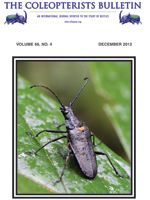
072_066_0400_cover…when the latest issue of The Coleopterists Bulletin arrives in my mailbox. On this occasion it was the December issue of Volume 66—nine papers and eight scientific notes filling 84 pages of beetle awesomeness. It’s pure elytral ecstasy! I presume I am like most subscribers—rapidly scanning the Table of Contents on the back cover to see if any deal directly with my preferred taxa. Yes! Two papers dealing with Buprestidae (jewel beetles), one on Cerambycidae (longhorned beetles), and one on Cicindelinae (tiger beetles)—a real bonanza. After that, a more cursory look through the rest of the Table of Contents to see what other papers look interesting enough to at least scan through.

For me the most interesting are the two Buprestidae papers, with Hansen et al. documenting new state records, larval hosts, and biological notes for 47 North American species and Westcott & Murray reporting the introduction into the U.S. of yet another Eurasian exotic (Trachys minutus) and its apparent establishment in Massachusetts. As the current “keeper” of distributional records and host plant associations for North American jewel beetles (along with Rick Westcott, Salem, Oregon), I will be busily updating my database over the next few days to reflect these new records. I am a great fan of “notes” papers such as these (and am, in fact, currently finishing a similar manuscript with co-author Joshua Basham, who is also a co-author on the Hansen et al. paper). However, I do have a few quibbles—Hansen et al. report Agrilus  quadriguttatatus as a new record for Tennessee, but it is already known from that state, and Cercis canadensis (eastern redbud) is reported as a new larval host for Anthaxia (Haplanthaxia) cyanella despite the prior records from that host by Knull (1920) and Hespenheide (1974). More puzzlingly, the authors record Agrilus lecontei celticola from locations in eastern Tennessee despite guidance from me on several occasions that this subspecies, while perhaps distinctive in Texas, transitions broadly across Louisiana and Mississippi  with the nominate subspecies. As such, material from eastern Tennessee cannot be regarded conclusively to represent this subspecies (and I remain unconvinced even that the subspecific distinction is warranted). Lastly, in recording Actenodes simi from Tennessee, the authors mention that the closest previous record is from Missouri with no specific locality mentioned (Fisher 1942), even though I recently recorded several specific locations for the species in eastern and southern Missouri (MacRae & Nelson 2003). The overall impression is that the authors are not fully versed in recent literature on Buprestidae and have instead relied exclusively on the recent Nelson et al. (2008) catalogue—known amongst buprestid workers to be incomplete and with errors—as the only source for determining the status of their records.

Among Cerambycidae, Raje et al. report the results of molecular analyses on two color forms of Sternidius alpha. This broadly distributed and highly variable species exhibits multiple color variants across its range, leading to the description of multiple subspecies that were eventually synonymized under the current name. Their analysis of the barcoding region of the cytochrome oxidase I gene, however, revealed three distinct clades among the two color forms, suggesting the potential for taxonomic significance. More work, of course, is needed from additional color morphs from different localities.

Finally, my friend Matt Brust and colleagues discuss the ovipositional behavior of numerous species of North American tiger beetles, unexpectedly finding that many oviposit only after digging some distance below the surface of the soil. This information is extremely valuable for those interested in rearing tiger beetles for description of larval stages, expanding the window of survey for species with limited temporal occurrence, and cross-breeding studies. To that end, and of greatest interest to me, they have included numerous observations from their own studies that have resulted in the development of successful protocols and rapid rearing of large numbers of larvae to adulthood.

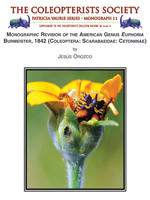
cso 66-4Mco14.qxdActually, there is one more thing… For several years now the December issue, as a bonus, has been accompanied by the Patricia Vaurie Series Monograph as a supplement to that year’s volume. This year’s issue features a revision of the scarab genus Euphoria by Jesús Orozco, and although I have not studied it carefully it looks like a robust treatment of the group. Yes, I know that scarabs are not one of my primary interest groups, but show me a coleopterist that—regardless of the group they work on— does not stop and collect these gorgeous, colorful, flower-loving beetles whenever they encounter them and I’ll show you a coleopterist that is far too restrictive in their natural history interests! Based on examination of nearly 19,000 specimens from 67 collections, the work considers 59 valid species (ten of which are described as new) distributed throughout the Western Hemisphere. Complete with keys to species and, for each, synonymy, description, diagnosis, taxonomic history, natural history, temporal occurrence geographic distribution, and—of critical importance in my opinion—full data for all specimens examined, it is everything a good revision should be. Then there are the color plates—one full page for each species—with a large dorsal habitus view, closeups of the head, male genitalia, and color variants, a temporal distribution chart, and a map of its geographical distribution. Again, while I may not be a serious student of scarabs, you can bet that I’ll be going back through my holdings of Euphoria beetles and checking them to make sure they conform to this new standard of knowledge on the group.

REFERENCES:

Brust, M. L., C. B. Knisley, S. M. Spomer & K. Miwa. 2012. Observations of oviposition behavior among North American tiger beetle (Coleoptera: Carabidae: Cicindelinae) species and notes on mass rearing. The Coleopterists Bulletin 66(4):309–314.

Fisher, W. S. 1942. A revision of North American species of buprestid beetles belonging to the tribe Chrysobothrini. U. S. Department of Agriculture, Miscellaneous Publication 470, 1–275.

Hansen, J. A., J. P. Basham, J. B. Oliver, N. N. Youseef, W. E. Klingeman, J. K. Moulton & D. C. Fare. 2012. New state and host plant records for metallic woodboring beetles (Coleoptera: Buprestidae) in Tennessee, U.S.A. The Coleopterists Bulletin 66(4):337–343.

Hespenheide, H. A. 1974.  Notes on the ecology, distribution, and taxonomy of certain Buprestidae.  The Coleopterists Bulletin 27(4) [1973]:183–186.

Knull, J. N. 1920. Notes on Buprestidae with description of a new species (Coleop.). Entomological News 31(1):4–12.

MacRae, T. C. and G. H. Nelson. 2003. Distributional and biological notes on Buprestidae (Coleoptera) in North and Central America and the West Indies, with validation of one species. The Coleopterists Bulletin 57(1):57–70.

Nelson, G. H., G. C. Walters, Jr., R. D. Haines, & C. L. Bellamy.  2008.  A Catalogue and Bibliography of the Buprestoidea of America North of Mexico.  Coleopterists Society Special Publication No. 4, The Coleopterists Society, North Potomac, Maryland, 274 pp.

Orozco, J. 2012. Monographic revision of the American genus Euphoria Burmeister, 1842 (Coleoptera: Scarabaeidae: Cetoniinae). Coleopterists Society Monographs, Patricia Vaurie Series No. 11, 182 pp.

Raje, K. R., V. R. Ferris & J. D. Holland. 2012. Two color variants of Sternidius alpha (Say) (Coleoptera: Cerambycidae) show dissimilar cytochrome oxidase I genes. The Coleopterists Bulletin 66(4):333–336.

Westcott, R. L. & T. C. Murray. 2012. An exotic leafminer, Trachys minutus (L.) (Coleoptera: Buprestidae), found in Massachusetts, U.S.A. The Coleopterists Bulletin 66(4):360–361.

Copyright © Ted C. MacRae 2013

Friday Editor’s Tip: Lose the formatting!

As Managing Editor of The Pan-Pacific Entomologist, I have the privilege of guiding manuscripts through the entire publication process—from submission and review through acceptance and preparation for final printing. It’s gratifying to see the results of a researcher’s efforts come to fruition, and it is also a good time to be an editor—due in no small part to the plethora of digital tools we have at our disposal. Knowing the amount of effort required to be an editor in today’s environment, I can’t imagine fulfilling the role in pre-computer days when manuscripts were prepared on a typewriter, submitted as hard copy, mailed to reviewers, collated upon their return (after interpreting hand-scribbled reviewer notations), and mailed back to authors for retyping. My heartiest congratulations to and respect for anyone who served as an editor in those days!

One of the holdovers from those days is the use of double-spaced text and numbered lines in draft manuscripts. This was necessary back then to provide space for reviewer comments and facilitate quick reference to specific portions of the manuscript. Of course, most journals today utilize fully electronic processes for submitting and reviewing manuscripts, and in some cases (including The Pan-Pacific Entomologist) a hard copy version of the manuscript may never be produced until the journal itself is issued. While the ability of reviewers to directly insert comments and suggested edits into an electronic version of the manuscript obviates the need to include line spacing and numbers, some authors still find themselves in the habit of preparing their manuscripts with such format. A bigger issue, however, brought on by the change from manual to electronic manuscript preparation is the temptation by some authors to overly “format” their manuscripts. Modern word processing programs (e.g., Microsoft Word) make it easier than ever to give documents visual appeal when printed, and most authors thus find themselves wanting to apply at least some formatting to their manuscripts. Indeed, some even go so far as to format their manuscript so that it closely resembles the printed journal! The problem is that most printers utilize file conversion software that automatically applies formatting according to a journal’s style sheet. Formatting commands used by word processing programs often interfere with those used by file conversion software, thus, to avoid conflicts any formatting applied to a draft manuscript must be stripped out prior to file conversion. The more of this that is done by the author prior to submission, the less potential for errors during printing. Unfortunately, just as secretaries don’t often make very good scientists, many scientists wouldn’t make good secretaries and find the prospect of “cleaning” an overly formatted manuscript more intimidating than it really is. Accordingly, I offer here this little “cheat sheet” for those who would like help in making sure their manuscript is clean prior to submission. These tips assume the use of Microsoft Word (since its file formats are acceptable for submission to The Pan-Pacific Entomologist), but a similar process should be possible with most other word processing programs.

Step 1. Select the entire document by pressing “Ctrl+A”.

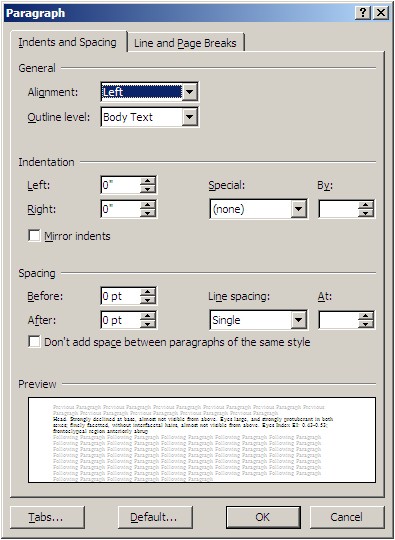
Step 2. Click on “Home” in the menu ribbon and open the “Paragraph” dialogue box.

Step 3. Click on the “Indents and Spacing” tab. Set all of the commands as shown in the figure below.

Step 4. Click on the “Line and Page Breaks” tab. Set all of the commands as shown in the figure below and click “OK”.

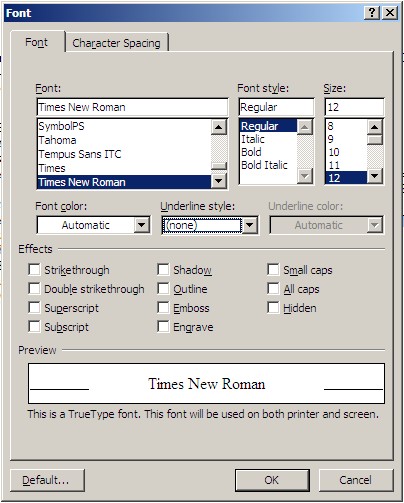
Step 5. Open the “Font” dialogue box (also under “Home” in the menu ribbon). Set all of the commands as shown in the figure below and click “OK”.

Step 6. Click on “Page Layout” in the menu ribbon and open the “Page Setup” dialogue box.

Step 7. Click on the “Margins” tab. Set all of the commands as shown in the figure below and click “OK”.

Voila! Your manuscript is free of all extraneous formatting commands and is ready for submission (assuming its contents are complete and well written). If there are portions of text that simply must be formatted (e.g., italics for scientific names) those can be reapplied. Of course, my best advice is to ensure the manuscript contains the above settings before it is even started. This not only ensures that formatting is limited to text that must be formatted, but also that the author will not need to spend additional time stripping out unneeded formatting during the preparation of final files for printing.

Copyright © Ted C. MacRae 2012

Book Announcement: Field Guide to the Jewel Beetles (Coleoptera: Buprestidae) of Northeastern North America

It’s not often that I anticipate the release of a book as much as I have with the soon-to-be-released Field Guide to the Jewel Beetles (Coleoptera: Buprestidae) of Northeastern North America. Fortunately, the wait is now almost over—Morgan Jackson, author of Biodiversity in Focus and co-author of the book, has just announced its planned released in early 2013. Even better, he has provided a sneak peak at its contents that is as smartly designed as the book itself.

Obviously, as a serious student of the family Buprestidae, this book would make it into my bookshelf no matter what, and I plan to do a more detailed review of the book once I have a copy permanently in my hands. However, I can tell you that I am already very impressed with the design of the book and the quality of the product. I was fortunate to meet up with Morgan at last month’s Entomological Society of America meetings in Knoxville, Tennessee, and Morgan kindly allowed me to leaf through the carefully guarded copy he had with him (it was difficult handing it back to him). The Prezi preview for the book covers some of the more important features that will set this book apart from other field guides, but worthy of special mention are: 1) the minimum/maximum size silhouette figure in the upper left-hand corner of each species treatment—a tremendously useful feature, 2) inclusion of the both the author and date of the original description of the species (to keep us more taxonomically inclined happy), 3) super high quality dorsal and lateral habitus photographs and of additional key features to aid in identification, 4) geographical range maps coded to show both presumed and recorded ranges, and 5) keys to all treated species, richly augmented with high quality photographs.

There is another reason I am so excited about this book, and that is the authors chose my photograph of Buprestis rufipes (red-legged buprestis), one of North America’s most striking jewel beetle species, to grace the cover of the book. I also provided specimens of a number of uncommonly encountered species which were used for the photographs in their respective species treatments.

Quite remarkably, this book will be available at NO COST—including free shipping anywhere! As a consequence, the book will not be available from commercial book and literature sources. You can request your copy by emailing your mailing address to Morgan at morgandjackson@gmail.com. I don’t know how many copies of the book are being printed, but I have a feeling that supplies will not last long, and in the coming years one will have to beg/borrow/steal from a kindly old colleague to get a copy (you can have my copy when you pry it from my cold, dead fingers!).

Copyright © Ted C. MacRae 2012

Life at 8X: MPMI Cover


The January 2013 issue of Molecular Plant-Microbe Interactions (volume 26, number 1) is now online. Why do I mention this? You may recall the cover photos of the soybean aphid, Aphis glycines, from my post —one of a series of posts I’ve done featuring insects photographed at 8X life-size.

MPMI is a publication of The American Phytopathological Society, and I have Dr. Gustavo MacIntosh at Iowa State University to thank for the appearance of these photos on the cover of this Special Focus Issue. Dr. MacIntosh is Associate Professor of Biochemistry, Biophysics and Molecular Biology and studies hormone-based defense mechanisms in soybeans. In a paper appearing in this special issue, Dr. MacIntosh and co-author Matthew Studham published the results of a study that suggests soybean aphids are able to “short-circuit” soybean defense mechanisms, making it easier for other pests (e.g., soybean cyst nematode) to colonize infested plants as well. Their study revealed large differences in transcription profiles of soybean varieties with and without an endogenous resistance gene (Rag1) in response to aphid infestation and suggested that the aphids are able to circumvent the defense response in susceptible plants by triggering activation of abscissic acid (normally associated with abiotic stress responses) as a “decoy” strategy (Studham & MacIntosh 2013). Plants infested with aphids have been shown to also become more susceptible to soybean cyst nematode—even varieties with genetic resistance to nematodes (McCarville et al. 2012). Dr. MacIntosh saw my photos when I posted them here and asked permission to submit them as candidates for the cover of the MPMI issue in which his paper was to appear.

Dr. Macintosh hopes that his research will enable the development of soybean varieties that will be more resistant to aphids and other pests.

REFERENCE:

McCarville, M. T., M. O’Neal, G. L. Tylka, C. Kanobe & G. C. MacIntosh. 2012. A nematode, fungus, and aphid interact via a shared host plant: implications for soybean management. Entomologia Experimentalis et Applicata 143(1):55–66 [DOI: 10.1111/j.1570-7458.2012.01227.x].

Studham, M. E. & G. C. MacIntosh. 2013. Multiple Phytohormone Signals Control the Transcriptional Response to Soybean Aphid Infestation in Susceptible and Resistant Soybean Plants. Molecular Plant-Microbe Interactions 26(1):116–129 [DOI: 10.1094/MPMI-05-12-0124-FI].

Copyright © Ted C. MacRae 2012

PPE Call For Submissions

Over the past two years, we have made great progress in working through a backlog of manuscripts as we bring the journal closer to our eventual goal of on-schedule publishing. I thank the authors who contributed manuscripts, the Editorial Board for their efforts to work through this backlog, and especially the many reviewers who contributed their time and expertise to ensure that the manuscripts met our high standards of quality research.

With the backlog of manuscripts cleared and existing manuscripts moving quickly through the review process, we are in need of new submissions to maintain the momentum we have established as we finish out volume 88 and look forward to the publication of volume 89. The Pan-Pacific Entomologist is an international journal publishing manuscripts on taxonomy and biosystematics of insects and other closely related arthropods. Manuscripts from all world areas are welcome, with those from regions around the Pacific Rim especially desired.

For those of you conducting taxonomic or biosystematic research on insects and their relatives, I hope you’ll consider The Pan-Pacific Entomologist as an outlet for the publication of your research. Among the many journal choices that are available to you, we offer 60% reduced page charges for all members of The Pacific Coast Entomological Society, an additional 50% reduction of the first 5 pages for members that meet other qualifications, and a complete waiver of normal page charges for authors who follow our “pre-reviewed” process (up to 20 pages per volume). The Pan-Pacific Entomologist has long been and continues to be one of the lowest cost print journals for entomology with an international scope.

If you have a manuscript that you would like to consider publishing in The Pan-Pacific Entomologist, please don’t hesitate to contact me (Ted C. MacRae, Managing Editor) on this page or by direct message. I look forward to hearing from you!

Copyright © Ted C. MacRae 2012