Some recent publications

I’ve had a few papers published in recent months that may be of interest to some. After a string of papers in 2011 focused exclusively on tiger beetles (five in all), these latest three represent sort a return to my “roots”: taxonomy and biosystematics of woodboring beetles (Buprestidae and Cerambycidae). Summaries are provided below, and hyperlinks in the citations lead to downloadable PDFs for those wishing to see the gory details.

  • MacRae, T. C. & R. L. Westcott. 2012. Nomenclatural history of Melanophila drummondi ab. nicolayi Obenberger, 1944 (Coleoptera: Buprestidae), a change of authorship and synonymy under Phaenops drummondi (Kirby 1837), and a new distribution record and summary of larval hosts for the species. The Pan-Pacific Entomologist 88(1):87–91.
     
    This paper can be considered of the “taxonomic housekeeping” sort. It concerns an “aberration” of the common, widespread jewel beetle species Phaenops drummondi. The current version of the International Code of Zoological Nomenclature (ICZN 1999) considers aberrations and other infrasubspecific (rank lower than subspecies) taxa as unavailable names with no taxonomic standing. However, they may be considered valid depending on date of publication and how they were treated by subsequent authors. In the majority of cases the guidance is clear on whether a given aberration, variety, form, etc. is considered unavailable or valid. However, there are times when multiple, conflicting interpretations are possible. The case described in this paper is one example, and even though the taxon clearly falls within the range of variability exhibited by the parent species, careful study of multiple provisions of The Code were required to determine its proper status. In the end, a change of authorship followed by formal synonymy were deemed the best course of action. Updated information on the distribution of P. drummondi and a summary of known larval hosts are also provided.
     
  • MacRae, T. C., L. G. Bezark & I. Swift. 2012. Notes on distribution and host plants of Cerambycidae (Coleoptera) from southern México. The Pan-Pacific Entomologist 88(2):173–184.
     
    From 2004–2006 I made three collecting trips to México with my friend and colleague, Chuck Bellamy. Our main focus was the rich diversity of jewel beetles that occur in the relatively intact, dry, tropical thorn forests that stretch across the southern states of Guerrero, Michoacan, Oaxaca, and Puebla, and in this respect we were quite successful. I also have an interest in longhorned beetles, but I try to limit my scope in this family to the Nearctic fauna and didn’t specifically target these beetles during those trips. Still, many species were encountered during the course of beating potential jewel beetle host plants. As with jewel beetles, the longhorned beetle fauna of México is rich but very incompletely known, with distributional data below the country level and knowledge of host plants lacking or inadequate for most species. This paper presents specific distributional and host plant information for 78 species in 50 genera of longhorned beetles collected during those trips. Included within the data presented are 47 new state records, 47 new adult host records, and 60 new flower records.
     
  • Steury, B. W., T. C. MacRae & E. T. Oberg. 2012. Annotated list of the metallic wood-boring beetles (Insecta: Coleoptera: Buprestidae) of the George Washington Memorial Parkway, Fairfax County, Virginia.  Banisteria 39:71–75.
     
    Lead author Brent Steury of the U.S. National Park Service contacted me last year about identifying jewel beetles that had been collected at a number of units in the George Washington Memorial Parkway during recent BioBlitz surveys and as by-catch from studies targeting other arthropods. The surveys were worthy of reporting on, as 23 species in nine jewel beetle genera were represented in the material collected—including two species reported for the first time from Virginia: Paragrilus tenuis (LeConte) and Pachyschelus purpureus purpureus (Say). Information is also provided on the collecting methods used during the surveys, with Malaise traps, hand netting, and pan traps being the only ones successful in capturing jewel beetles (Lindgren funnel and pitfall traps did not capture any).

REFERENCE: 

International Commission on Zoological Nomenclature [ICZN]. 1999. International Code of Zoological Nomenclature, 4th Edition. The International Trust for Zoological Nomenclature, c/o Natural History Museum, London. xxix + 306 pp.

Copyright © Ted C. MacRae 2012

The Pan-Pacific Entomologist 88(2)—Penrose Memorial issue

It is with great pleasure that I announce the publication of The Pan-Pacific Entomologist Penrose Memorial issue (volume 88, number 2), mailed 14 September 2012. Published by the Pacific Coast Entomological Society, this issue is dedicated to the memory of the late Richard L. Penrose (1943–2011); long time member of the guild of California coleopterists. As Managing Editor, I had the distinct honor and pleasure of overseeing the assembly and production of this issue; however, it is only from the selfless efforts of many individuals that this issue came to fruition. I would like to thank the PCES Executive and Editorial Boards, the contributing authors and the reviewers for their participation in making this issue possible. Three individuals deserve special mention for their particularly stellar efforts: Richard Westcott (Oregon Department of Agriculture) and Chuck Bellamy (California Department of Food and Agriculture) for their dogged persistence in promoting the idea and recruiting contributing authors, and Floyd W. Shockley (Smithsonian Institution), who as the journal’s Coleoptera Subject Editor oversaw the review, revision and acceptance of the bulk of the papers appearing in this coleopcentric issue.

If you are not a PCES member, now is a good time to join. Membership is only $25/year ($12.50 for students) and includes four quarterly issues of The Pan-Pacific Entomologist. Following are the contents of the Penrose Memorial issue with hyperlinks to online versions through BioOne. Abstracts & References are open access, while Full Text and PDF versions are available to BioOne subscribers.

The Pan-Pacific Entomologist 88(2)
Contents

Richard L. Penrose
Ted C. MacRae
The Pan-Pacific Entomologist 88(2):i–i
Citation | Full Text | PDF (83 KB)

BIOGRAPHICAL SKETCH

Richard Lynn Penrose (11 January, 1943–17 March 2011): Biographical sketch and memories
Richard L. Westcott and Richard E. Morel
The Pan-Pacific Entomologist 88(2):105–116
Citation | Full Text | PDF (1903 KB)

PAPERS

A new species of Cregya LeConte (Coleoptera: Cleridae: Peloniinae) from Florida, U.S.A. and Puebla, México
Jacques Rifkind
The Pan-Pacific Entomologist 88(2):117–121
Abstract & References | Full Text | PDF (107 KB)

Synetocephalus penrosei Gilbert & Clark (Chrysomelidae: Galerucinae: Luperini), a new species from California, U.S.A
Arthur J. Gilbert and Shawn M. Clark
The Pan-Pacific Entomologist 88(2):122–129
Abstract & References | Full Text | PDF (1970 KB)

Distribution and phenology of Rhagoletis fausta (Osten Sacken 1877) and Rhagoletis indifferens Curren 1932 (Diptera: Tephritidae) in California
Robert V. Dowell and Richard L. Penrose
The Pan-Pacific Entomologist 88(2):130–150
Abstract & References | Full Text | PDF (573 KB)

Acmaeodera penrosei Westcott (Coleoptera: Buprestidae), a new species from Chiapas, Mexico
Richard L. Westcott
The Pan-Pacific Entomologist 88(2):151—153
Abstract & References | Full Text | PDF (238 KB)

A new species of Trichoxys Chevrolat (Cerambycidae: Cerambycinae: Clytini) from Mexico, with a key to known species
Steven W. Lingafelter and James E. Wappes
The Pan-Pacific Entomologist 88(2):154—162
Abstract & References | Full Text | PDF (2333 KB)

Three new species of the genus Dysphenges Horn 1894 (Coleoptera: Chrysomelidae: Galerucinae: Alticini) from the United States
Arthur J. Gilbert and Edward G. Riley
The Pan-Pacific Entomologist 88(2):163–172
Abstract & References | Full Text | PDF (1826 KB)

Notes on distribution and host plants of Cerambycidae (Coleoptera) from southern México
Ted C. MacRae, Larry G. Bezark, and Ian Swift
The Pan-Pacific Entomologist 88(2):173–187
Abstract & References | Full Text | PDF (135 KB)

Hybopteroides, a new genus in the Cryptobatida group of subtribe Agrina, with three new species and notes on their way of life (Insecta: Coleoptera, Carabidae, Lebiini)
Terry L. Erwin and George E. Ball
The Pan-Pacific Entomologist 88(2):188–201
Abstract & References | Full Text | PDF (1702 KB)

A new species of sap beetle (Coleoptera: Nitidulidae) from Baja California Sur, Mexico, with a review of the genus Lobiopa Erichson
Andrew R. Cline and Scott A. Kinnee
The Pan-Pacific Entomologist 88(2):202–211
Abstract & References | Full Text | PDF (304 KB)

Addition of two new species and a previously unknown female to the ammoplanine complex, and a species of Pulverro Pate, 1937 is entered into synonymy (Hymenoptera: Crabronidae)
Norman J. Smith
The Pan-Pacific Entomologist 88(2):212–221
Abstract & References | Full Text | PDF (234 KB)

Dactylotrypes longicollis (Wollaston) (Coleoptera: Curculionidae: Scolytinae): an exotic bark beetle new to California and North America
James R. LaBonte and Curtis Y. Takahashi
The Pan-Pacific Entomologist 88(2):222–230
Abstract & References | Full Text | PDF (1390 KB)

Diurnal flight response of the walnut twig beetle, Pityophthorus juglandis Blackman (Coleoptera: Scolytidae), to pheromone-baited traps in two northern California walnut habitats
Steven J. Seybold, Jennifer A. King, Daren R. Harris, Lori J. Nelson, Shakeeb M. Hamud, and Yigen Chen
The Pan-Pacific Entomologist 88(2):231–247
Abstract & References | Full Text | PDF (1105 KB)

An analysis of the larval instars of the walnut twig beetle, Pityophthorus juglandis Blackman (Coleoptera: Scolytidae), in northern California black walnut, Juglans hindsii, and a new host record for Hylocurus hirtellus
Paul L. Dallara, Mary L. Flint, and Steven J. Seybold
The Pan-Pacific Entomologist 88(2):248–266
Abstract & References | Full Text | PDF (600 KB)

Penroseius lienosus, a new monotypic genus of Coraebini from Madagascar (Coleoptera: Buprestidae: Agrilinae)
C. L. Bellamy
The Pan-Pacific Entomologist 88(2):267–273
Abstract & References | Full Text | PDF (521 KB)

SCIENTIFIC NOTES

First occurrence of the goldspotted oak borer parasitoid, Calosota elongata (Hymenoptera: Eupelmidae), in California
Laurel J. Haavik, Tom W. Coleman, Yigen Chen, Michael I. Jones, Robert C. Venette, Mary L. Flint, and Steven J. Seybold
The Pan-Pacific Entomologist 88(2):i-i
Citation | Full Text | PDF (44 KB)

Recent collecting reveals new state records and geographic extremes in the distribution of the walnut twig beetle, Pityophthorus juglandis Blackman (Coleoptera: Scolytidae), in the United States
Steven J. Seybold, Tom W. Coleman, Paul L. Dallara, Norman L. Dart, Andrew D. Graves, Lee A. Pederson, and Sven-Erik Spichiger
The Pan-Pacific Entomologist 88(2):i-i
Citation | Full Text | PDF (325 KB)

Copyright © Ted C. MacRae 2012

“Dear Author”

On April 1st of this year, I celebrated one year as Managing Editor of The Pan-Pacific Entomologist. For many years, I thought an editorship might be something I’d like to do; however, I must confess that when this opportunity did arise, it was with some trepidation that I accepted. Could I learn the role quickly enough? What was the process for dealing with the printer (a process I knew nothing about)? Could I effectively organize the manuscript process from submission to publication, influence the Editorial Board on policy matters and maintain high journal standards? Most importantly, could I return the journal to on-schedule publishing? Despite these doubts, I couldn’t have asked for a better first opportunity than The Pan-Pacific Entomologist—rich in history, biosystematic in focus and fairly well-known without being too terribly large. I’ve gained some comfort in the role now and am, to this point, pleased with the quality of the papers published and the progress made towards returning to on-schedule publishing.

In my previous role as Subject Editor, I dealt with authors primarily from the standpoint of getting their manuscripts reviewed, communicating reviewers’ feedback back to them and ensuring that their revised manuscripts appropriately addressed that feedback. In my current role I still deal with authors, but now it is on the front end—in receiving their submissions—and the back end after the manuscript has been accepted by the Subject Editor. In theory, the latter should be the more involved process—providing guidance on final formatting (or doing it myself if necessary) to ensure that text and figure files meet requirements for printing and managing corrections/alterations to galley proofs before final publication. In practice, however, receiving submissions has proven to be the more time-intensive process. The reason for this is that manuscripts are often submitted before they are truly “ready for review.” i.e., properly prepared and relatively free of mechanical, language or formatting problems. Our reviewers willingly and freely give of their time and expertise to ensure that the papers published in our journal meet the highest scientific standards. Ideally, their efforts should be focused on the manuscript’s scientific content; however, the extent to which a manuscript contains structural and mechanical problems needlessly detracts from that focus. Even if such problems are set aside until final formatting, they still require resolution before the manuscript can truly be considered ready to publish. In my experience authors who neglect to address these areas before submission usually have trouble dealing with them after acceptance as well, increasing delays in publication.

Of the 97 manuscripts I inherited or have received since taking on the role of Managing Editor, 57 have been published or are currently in press, while 19 were rejected or withdrawn (the remaining 21 are currently in queue awaiting decision). In looking back over these submissions, I am amazed at how many I received for which it was evident that the author paid little, if any, attention to the guidelines for preparing and submitting manuscripts given in our Author Instructions. It goes without saying that compulsive review of author instructions (printed inside the back cover of each issue and posted at our website) prior to beginning and during preparation of a manuscript and then again before submission is the best way to ensure that a manuscript satisfies journal requirements, minimize the introduction and propagation of errors and avoid omitting critical manuscript components. That said, and despite guidance to the contrary, there seem to be certain areas that are consistent pitfalls for authors. If I could write a “Dear Author” letter, the following items are what I would include:

1.       Don’t try to format your manuscript to resemble the printed journal
While a few smaller journals employ a “camera-ready” process—i.e., the journal is printed off of hard copy manuscripts that are formatted for the journal’s particular style, most, including The Pan-Pacific Entomologist, prepare and format manuscripts for publication via electronic file conversion. Formatting commands in most word processing programs can interfere with commands in the conversion software used by the printer, creating layout errors that must be manually corrected. A basic text file that uses as little formatting as possible may not be the prettiest thing to look at, but it will convert with the least chance of introducing errors that need to be corrected or, worse, make it past galley reviews and into the final publication. The most common formattings applied by authors are those that also appear in the printed journal, including bolded and center justified titles and headings, italics for subheadings, tabbed or indented paragraphs, insertion of hard returns within titles to force line breaks and “even out” the width of multiple lines, and use of hanging indents to format literature citations.

2.       Create “real” tables, but don’t worry about making them “look nice”
Along with manuscript formatting, table formatting also is applied automatically by the printer during file conversion to achieve the desired layout. I’m not sure why some authors create “pseudo-tables” using tabs and spaces rather than using the table function in their word processor, but such manually created tables will not convert properly. Even authors who use the  table function are often tempted to format their tables with various lines, re-size cells or text (including manual hyphenation of long words) so that the table fits the page nicely, and even use spaces or hard returns within cells to manually align the text contained within them. Again, all this accomplishes is to introduce errors that must be corrected or that will compromise the printed article.

3.       Know your “dashes”
It is a shame that modern keyboards contain a key for only one of the three types of dashes that authors will find useful: 1) hyphens, 2) ‘en’ dashes and 3) ’em’ dashes. The result of this is a tendency by most authors to simply use a hyphen whenever any one of these three types of dashes are called for. In fact, I suspect that many authors aren’t even aware of the existence of the latter two! Hyphens, however, are properly restricted to joining words or terms (e.g., Pan-Pacific, species-group, wood-boring, 10-m diameter plot, etc.) but should not be used for connecting value ranges. These, which include page ranges in literature citations, are more properly connected with an ‘en’ dash (–). Note that an ‘en’ dash is slightly longer than a hyphen (basically the width of the letter “n” in fixed-font type) and is achieved in MS Word by holding down the ‘Alt’ key while typing “0150” on the numeric keypad (on my own keyboard I have made this much easier by using the AutoCorrect function to insert an ‘en’ dash whenever I type two consecutive hyphens). Examples of proper ‘en’ dash usage include “pages 76–99”, “1–3 June 2012” and “Figs. 3–5”. The third type of dash, or ’em’ dash (—), is not used by most authors (although I tend to use it quite commonly!); however, it is very useful for connecting unrelated clauses within a sentence (see examples earlier in this article). This is the longest of the three dashes (equal to the width of the letter “m” in fixed type font) and is achieved in MS Word by typing “Alt+0151” (or, on my keyboard by typing three consecutive hyphens). Authors who become proficient in the use of all three dashes will do much to enhance the professionalism of their manuscripts and minimize the need for manual corrections or the chance of errors in print.

4.       Literature Cited
I give this area its own paragraph, because it seems to be one of the most problematic for authors. The Pan-Pacific Entomologist, like most journals, uses a precise format for literature citations. Many authors seem to have their own personal formatting preference for literature citations, but to the extent that personal style varies from the requested journal format in the final file, reviewers, editors or typesetter will need to make manual corrections. I’ve already mentioned the most common one; use of hyphens rather than ‘en’ dashes to connect page ranges, and it is also common not to adhere precisely to specifications for spaces or punctuation (or their lack) in author name(s) and journal volume/issue/page range formatting. Another error that I take special interest in is citing “Pan-Pacific Entomologist” rather than “The Pan-Pacific Entomologist. Without doubt, however, the most frustrating habit by some authors is the practice of inserting hard returns and tabs within the citation in an effort to simulate hanging indents. While hanging indents can more properly be created using paragraph commands, all use of tabs and indenting should be avoided to begin with (see above). Simulated hanging indents with manually inserted hard returns and tabs require manual correction—again by reviewers, editors or typesetter if the author does not do it.

5.       Line spacing and numbering
I sometimes receive manuscripts in which the text is double-spaced, oftentimes with line numbering also turned on. This seems to be a holdover practice among authors accustomed to the days of hard copy manuscript review. In that process, reviewers and editors needed room between lines to mark their annotations or line numbers to easily summarize their location. Nowadays, most journals use fully electronic processes for reviewing manuscripts and communicating reviewer feedback to authors. Use of “Track Changes” for marking changes and inserting comments has obviated the need for reviewers to print out a copy of the manuscript and annotate it manually (this also makes unnecessary the use of headers/footers to indicate page number), and in fact with electronic submission procedures now commonly used (by both the journal for receiving submissions and by the printer for receiving ready-to-publish files), most manuscripts need never appear in hard copy until final printing in the journal!

6.       Don’t create “pseudosymbols”
Many authors are familiar enough with the use of symbols, e.g., male and female (♂ and ♀), degrees (°), etc. Most of these symbols are not found on normal keyboards and, thus, must be inserted using the word processor’s Insert Symbol tool. There are, however, a few symbols for which reasonable facsimiles do exist on the keyboard, usually the letter “x” rather than a multiplication (×) symbol and “+/-” rather than a plus-minus (±) symbol. Once again, the use of “pseudosymbols” requires manual correction and should be avoided.

7.       If English is not your native language, have your ms reviewed by a native English-speaking colleague
If you are reading this, then you probably already know English well enough. However, I just need to say this: The Pan-Pacific Entomologist is an English language journal, and although we welcome manuscripts by all authors from around the world, they must be written in proper English. In an effort to satisfy this requirement, it has become common for authors whose native language is not English to submit their manuscript to commercial translation services. Unfortunately, while the translators may speak English, they do not know science—and certainly not the author’s research. As a result, oftentimes the manuscripts I receive that have gone through such services are written as poorly as a manuscript that has not been reviewed for English at all. I have returned a number of submitted manuscripts strictly because the English was unsatisfactory and, in some cases, even received a terse response from author stating that their manuscript had already been proofed for English by a commercial service (even attaching the “certificate” they received from the service). Nevertheless, my advice is this: the best way to ensure that your manuscript truly satisfies the English language requirement is to have it reviewed by a native English-speaking colleague who understands your research!

p.s. it might be fun for you, the reader, to “proof” this letter and let me know of any errors in English that you find. Imagine the satisfaction of getting to tell an editor about mistakes in writing that he has made (and I can take it… really!).

Copyright © Ted C. MacRae 2012

Just published: Cicindela 44(1) March 2012

Issue 44(1) of the journal Cicindela is now hitting mailboxes. This one-paper issue features an article by Chandima D. Dangalle and Nirmalie Pallewatta (University of Colombo, Sri Lanka) and Alfred P. Vogler (The Natural History Museum, London) reporting the results of a survey of tiger beetles of Sri Lanka and analysis of their habitat specificity. The authors sampled 94 locations on the island representing six habitat types: coastal and beach habitat, river and stream banks, reservoir systems, urban man-made sites, agri-ecosystems and marshy areas, finding ten species in the genera Cylindera, Calomera, Hypaetha, Lophyra and Myriochile at 37 locations representing all habitat types except the last two. The study further revealed that the species of tiger beetles were restricted to different habitat types, with most displaying a high degree of habitat specificity. Statistical analysis revealed significant differences between two or more species in four factors: solar radiation (i.e., sun or shade), soil salinity, soil moisture and wind speed. This suggests that these are the key factors involved in habitat selectivity in Sri Lankan tiger beetle species. Other factors such as temperature, relative humidity, soil type and soil color did not differ significantly between habitats for the different species, suggesting that these criteria are essential for tiger beetle survival in any habitat type.

You may also notice that my photo of Cicindela arenicola, taken last fall in Idaho Falls, graces the cover of this latest issue. Contact Managing Editor Ron Huber to begin your subscription—membership is a very nominal $10 per year in the U.S., a little more elsewhere to cover additional postage.

REFERENCE:

Dangalle, C. D., N. Pallewatta & A. P. Vogler. 2012.  Habitat specificity of tiger beetle species (Coleoptera, Cicindelidae) of Sri Lanka. Cicindela 44(1):1–32.

Tiger beetles in southeast Missouri

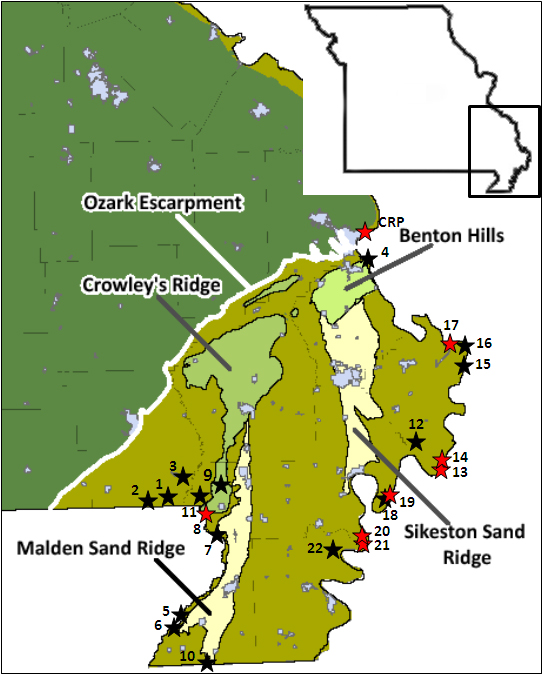
Figure 1. Sites surveyed in southeastern Missouri for Cylindera cursitans during 2007–2010. Site numbers are referenced in Table 1 (CRP = Cape Rock Park), with red stars indicating sites where C. cursitans was observed. Black box on inset map of Missouri denotes main map area (bordering states include AR to the south and TN, KY, and IL to the east).

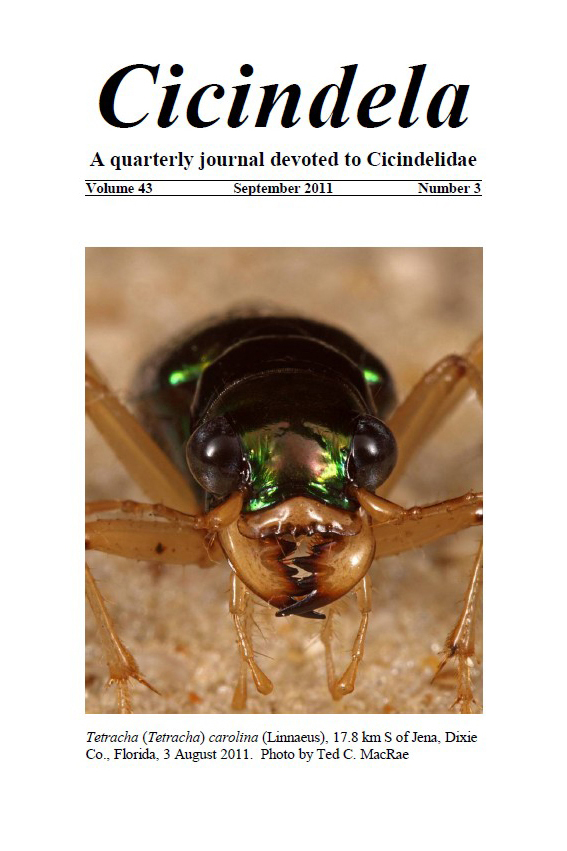
ResearchBlogging.orgVolume 43(3) of the journal CICINDELA was published a few weeks ago, and I can truly lay more claim to the issue than anybody else (except perhaps Managing Editor Ron Huber). In addition to having one of my photos (a face-on shot of Tetracha carolina) featured on the cover, I was coauthor on the first of two papers included in the issue and lead author on the second. (And to complete my stamp of ownership, I did the final assembly of the issue as the journal’s Layout Editor.) The two included papers each report the results of surveys conducted in the Mississippi Alluvial Plain of southeastern Missouri (also called the “bootheel” in reference to its shape—see Fig. 1) for tiger beetles whose occurrence in that part of the state was previously not well known. In the first, Fothergill et al. (2011) used a novel survey technique that involved searching beneath irrigation polypipe in agricultural fields to find Tetracha carolina (Carolina Metallic Tiger Beetle); while the second paper (MacRae et al. 2011) reports the results of a multi-year survey to characterize the distribution, habitat associations and conservation status of Cylindera cursitans (Ant-like Tiger Beetle). Together with our three papers on Habroscelimorpha circumpicta johnsonii (Saline Spring Tiger Beetle), Dromochorus pruinina (Loamy Ground Tiger Beetle) and Cylindera celeripes (Swift Tiger Beetle)—all published in the past year—these two papers officially complete the battery of publications that describe our survey efforts for the five tiger beetle species considered of potential conservation concern in Missouri when Chris Brown and I began our faunal studies of the group more than ten years ago.

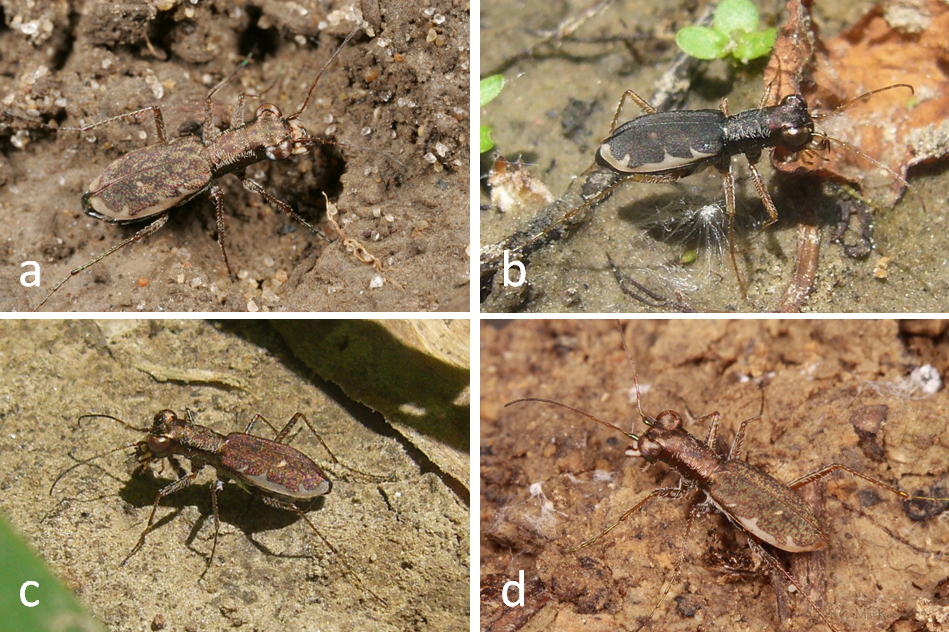
The first three papers clearly painted a rather gloomy picture—H. circumpicta johnsonii is possibly extirpated from saline spring habitats in central Missouri, D. pruinina is limited to a 2.5 mile stretch of roadside habitat in western Missouri, and C. celeripes is restricted to a few patches of critically imperiled loess hill prairie habitat in extreme northwestern Missouri. Happily, prospects for T. carolina and C. cursitans in Missouri are much better. While both are limited in the state to the southeastern lowlands, our surveys indicated that populations are sufficiently robust and widespread in the area to alleviate any concerns about the potential for extirpation. Tetracha carolina in particular was found abundantly in agricultural habitats and appears to have adapted well to the extensive modifications caused by conversion of the cypress-tupelo swamps that formerly covered the region. Cylindera cursitans (Fig. 2) hasn’t shown nearly the same adaptive capability as T. carolina; however, it has nevertheless found suitable refuge in the ribbons of wet, bottomland forest that persist between the Mississippi River and the levee systems that protect the region’s farmland. For a time it seemed that the same habitats along the St. Francois River that bound the western side of the region weren’t suitable for the species, but after much searching (in often tough conditions!) Kent finally managed to locate a population on the Missouri side of the river opposite a known population in Arkansas.

Figure 2. Cylindera cursitans in southeast Missouri: a) New Madrid Co., Girvin Memorial Conservation Area, 6.vii.2007; b-c) Mississippi Co., Dorena Ferry Landing, 6.vii.2008; d) Mississippi Co., Hwy 60 at Mississippi River bridge, 20.vi.2009. Photos by CRB (a) and TCM (b-d).

Both of these species illustrate how healthy populations of insects are able to hide right beneath our noses. Previous to our surveys, records of T. carolina and C. cursitans in southeastern Missouri were scarce (the latter consisting of a single specimen in the Enns Entomology Museum at the University of Missouri in Columbia, and with considerable searching required before the first field population was finally located). In both cases, perceived rarity was a result not of actual rarity, but rather specific habitat requirement or unusual behavior. While I get great satisfaction out of finding populations of “rare” species and increasing our understanding of their habitat requirements, I also can’t help but wonder if they truly are rare and how many populations I might still have missed—populations that I would have found had I searched in a slightly different manner or at a slightly different time.

REFERENCES:

Fothergill, K., C. B. Cross, K. V. Tindall, T. C. MacRae and C. R. Brown. 2011. Tetracha carolina L. (Coleoptera: Cicindelidae) associated with polypipe irrigation systems in southeastern Missouri agricultural lands. CICINDELA 43(3):45–58.

MacRae, T. C., C. R. Brown and K. Fothergill. 2011. Distribution, seasonal occurrence and conservation status of Cylindera (s. str.) cursitans (LeConte) (Coleoptera: Cicindelidae) in Missouri. CICINDELA 43(3):59-74

Copyright © Ted C. MacRae 2012

Another cover photo

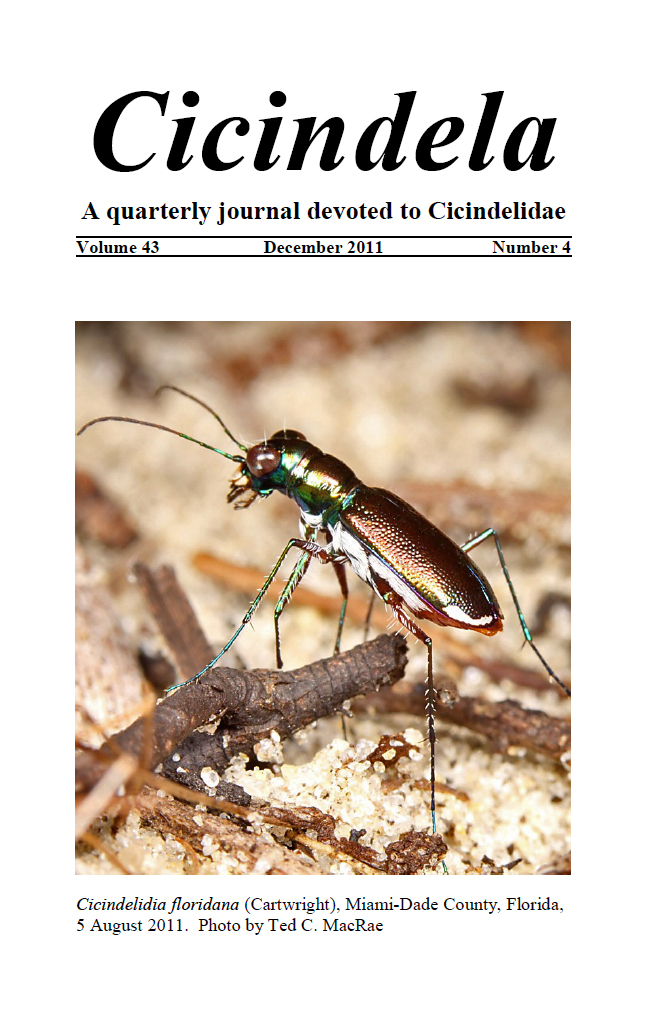
Issue 43(4) of Cicindela (A quarterly journal devoted to Cicindelidae) is now hitting mailboxes (my copy arrived earlier this week), and for the second issue in a row the cover features one of my tiger beetle photos. Gracing the cover this time is the recently rediscovered Cicindelidia floridana, known only from a small area in the Miami metropolitan area of south Florida, and which I was fortunate to have the opportunity to see this past summer. Because the species is regarded as critically imperiled and a likely candidate for listing as an endangered species, the precise whereabouts of its habitat have not been disclosed. So far I am one of only a few people who have had the chance to photograph it in the field.

Now, some of you may think that because I serve as Layout Editor for the journal that I can horn in and put one of my own photographs on the cover whenever I want. This is not the case, and it was only because Managing Editor Ron Huber asked me if I had anything for the issue that I supplied the photo after having just done so for the previous issue. In actuality, we encourage others to submit their tiger beetle photographs for consideration, and since a majority of U.S. species have already been featured at some point over the years we especially encourage ex-U.S. photographers to submit their photos so that we can limit repetition. Obviously, C. floridana has never been featured on the cover before now, so it was a no-brainer choice for this issue.

The issue contains two delightful papers. The first is another by Mathew Brust on the stunningly gorgeous Cicindela pulchra that discusses not only additional northern range extensions in South Dakota and Wyoming, but also the rediscovery of the species in Nebraska far from the single previously known collection record in the state nearly 100 years ago! It is amazing to me that one of North America’s most conspicuously beautiful tiger beetle species has gone undetected for so long in such a large part of its range. The second paper by Dave Brzoska and Ron Huber is a long overdue biography of tiger beetle icon Norman Rumpp, who in his professional life was a rocket scientist (literally!) and as an avocation became one of North America’s leading authorities on tiger beetles (I am proud to claim ownership of Rumpp’s nearly complete set of The Coleopterists Bulletin). In addition to numerous publications and unpublished reports on tiger beetles in the western U.S., Rumpp described 12 species and subspecies of tiger beetles—including three of the western sand dune endemics that I have featured in recent weeks (Cicindela scutellaris yampae, C. arenicola, and C. albissima). What may not be appreciated is Rumpp’s sense of humor—well, just read the paper and see!

Copyright © Ted C. MacRae 2012

Speaking of cover photos…


…here is my first—a tropical house gecko (Hemidactylus mabouia) that I photographed in Campinas, Brazil this past January. The photo (originally from my post Brazil Bugs #5 – Lagartixa) was selected for the cover of the October 2011 issue of Ecology and Evolution, having been used by Kristen H. Short and Kenneth Petren (with my permission) for their article, Multimodal dispersal during the range expansion of the tropical house gecko Hemidactylus mabouia.

Although it’s exciting to have that first cover photo under my belt, I find it mildly ironic that it’s not a beetle, insect, or even invertebrate!

Copyright © Ted C. MacRae 2011

Arriving now in a mailbox near you…


The latest issue of Cicindela (A quarterly journal devoted to Cicindelidae) has just been issued. My copy arrived yesterday and features on the cover a photograph that I took of Tetracha carolina in Florida this past August (original photo and more can be seen in my post ).

I’m also happy to report that I was lead author and co-author on the two papers included this issue. I’ll provide a more detailed summary of those papers in another post—look for it in the near future, or better yet contact Managing Editor Ron Huber to begin receiving your own copies of this fine journal (subscription and contact information here).

Copyright © Ted C. MacRae 2011