BitB Top 10 of 2010

Welcome to the 3rd Annual BitB Top 10, where I pick my 10 (more or less) favorite photographs of the year.  My goal for 2010 was to continue the progress that I began the previous year in my quest to become a bona fide insect macrophotographer.  I’m not in the big leagues yet, but I have gotten more comfortable with using my equipment for in situ field photographs and am gaining a better understanding of lighting and the use of flash.  I also began experimenting with different lighting techniques (e.g. white box) and diffusers and am putting more effort into post-processing techniques to enhance the final appearance of my photographs.  I invite you to judge for yourself how successful I’ve been toward those goals by comparing the following selections with those from 2009 and 2008 – constructive feedback is always welcome:


Best Tiger Beetle

Cicindela denverensis - green claybank tiger beetle

From ID Challenge #1 (posted December 23).  With numerous species photographed during the year and several of these dramatic “face on” shots, this was a hard choice.  I chose this one because of the metallic colors, good focus throughout the face, and evenly blurred “halo” of hair in a relatively uncluttered background.


Best Jewel Beetle

Buprestis rufipes - red-legged buprestis

From Special Delivery (posted July 13).  I didn’t have that many jewel beetles photos to choose from, but this one would have risen to the top no matter how many others I had.  The use of a white box shows off the brilliant (and difficult-to-photograph) metallic colors well, and I like the animated look of the slightly cocked head.


Best Longhorned Beetle

Desmocerus palliatus - elderberry borer

From Desmocerus palliatus – elderberry borer (posted November 18).  I like the mix of colors in this photograph, and even though it’s a straight dorsal view from the top, the partial dark background adds depth to the photo to prevent it from looking “flat.”


Best “Other” Beetle

Enoclerus ichneumoneus - orange-banded checkered beetle

From Orange-banded checkered beetle (posted April 22).  The even gray background compliments the colors of the beetle and highlights its fuzziness.  It was achieved entirely by accident – the trunk of the large, downed hickory tree on which I found this beetle happened to be a couple of feet behind the twig on which it was resting.


Best Non-Beetle Insect

Euhagenia nebraskae - a clearwing moth

From Euhagena nebraskae… again (posted October 21).  I photographed this species once before, but those photos failed to capture the boldness of color and detail of the scales that can be seen in this photo.


Best “Posed” Insect
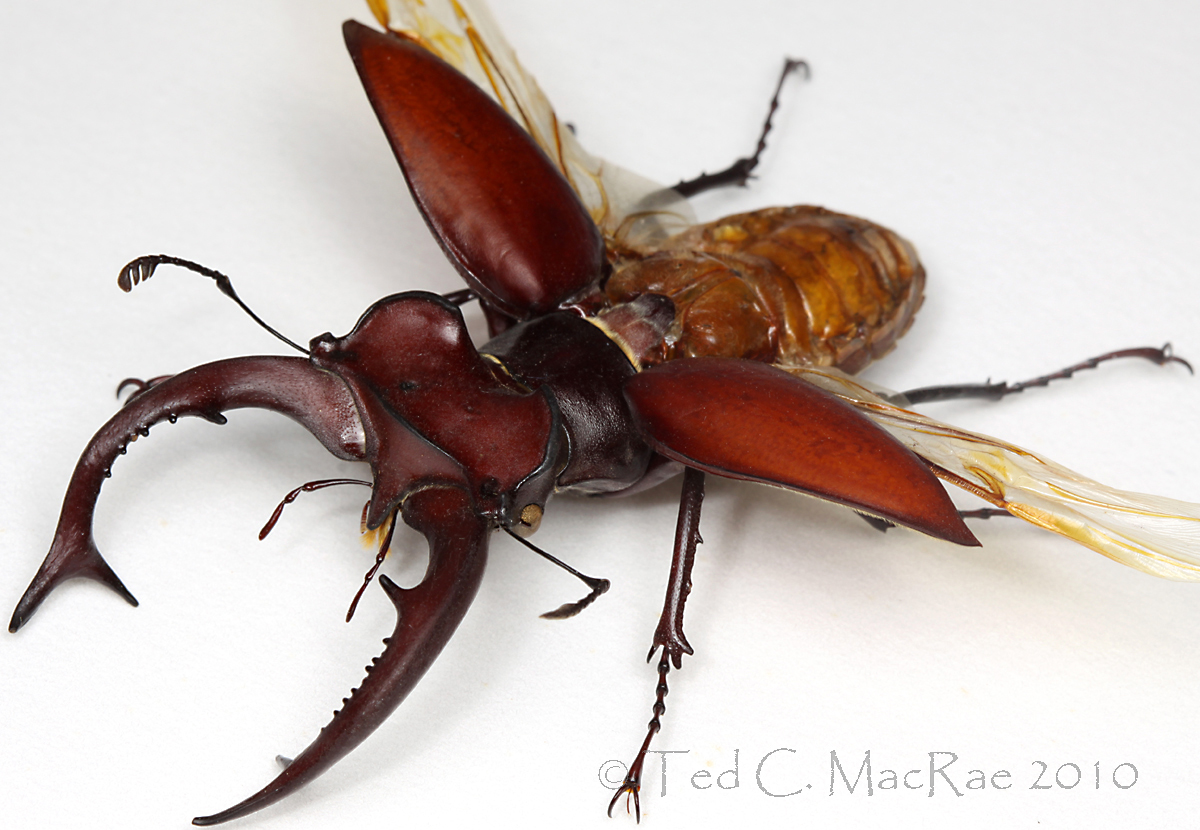
Lucanus elaphus - giant stag beetle

From North America’s largest stag beetle (posted December 30).  I’ve just started experimenting with photographing posed, preserved specimens, and in fact this male giant stag beetle represents only my second attempt.  It’s hard to imagine, however, a more perfect subject than this impressively stunning species.


Best Non-Insect Arthropod

Scolopendra heros - giant desert centipede

From North America’s largest centipede (posted September 7).  Centipedes are notoriously difficult to photograph due to their elongate, narrow form and highly active manner.  The use of a glass bowl and white box allowed me to capture this nicely composed image of North America’s most spectacular centipede species.


Best Wildflower

Hamamelis vernalis - Ozark witch hazel

From Friday Flower – Ozark Witch Hazel (posted March 26).  The bizarre form and striking contrast of colors with the dark background make this my favorite wildflower photograph for the year.


Best Non-Arthropod
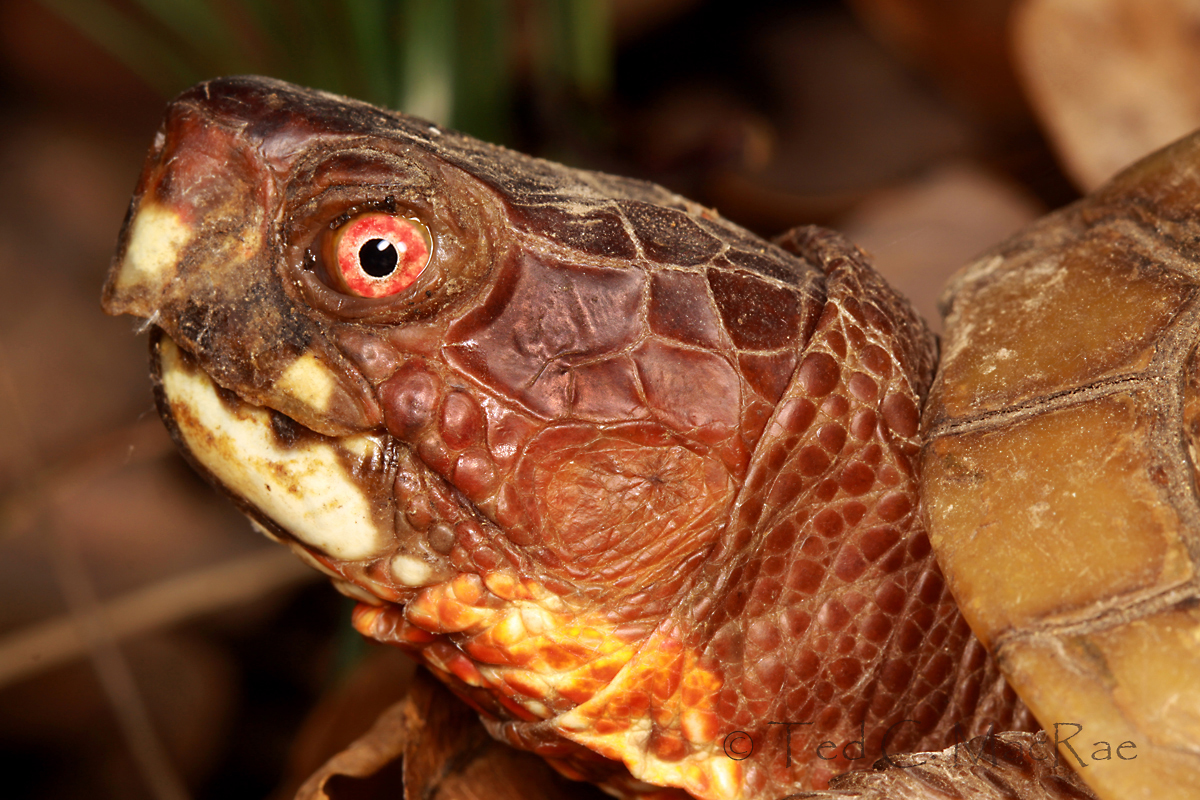
Terrapene carolina triunguis - three-toed box turtle

From Eye of the Turtle (posted December 10).  I had a hard time deciding on this category, but the striking red eye in an otherwise elegantly simple photograph won me over.  It was also one of two BitB posts featured this past year on Freshly Pressed.


Best “Super Macro”

Phidippus apacheanus - a jumping spider

From Jeepers Creepers, where’d ya get those multilayered retinae? (posted October 5).  I’m not anywhere close to Thomas Shahan (yet!), but this super close-up of the diminutive and delightfully colored Phidippus apacheanus is my best jumping spider attempt to date.  A new diffuser system and increasing comfort with using the MP-E lens in the field at higher magnification levels should allow even better photos this coming season.


Copyright © Ted C. MacRae 2011
Desmocerus palliatus – elderberry borer

Desmocerus palliatus (elderberry borer), Squaw Creek Natl. Wildlife Refuge, Missouri.

Last June I made two trips to the Loess Hills in northwestern Missouri to survey additional sites for Cylindera celeripes (swift tiger beetle), which my colleague Chris Brown and I had discovered in some of the area’s few remaining loess hilltop prairie remnants the previous year. One of these potential new sites was  Squaw Creek National Wildlife Refuge, where a few tiny slivers of hilltop prairie can still be found on the fingers of loess bluffs that border the refuge’s several thousand acres of restored wetlands that famously host large concentrations of snow geese and bald eagles during the fall and spring migrations.  On the first visit, I had arranged to meet with Corey Kudrna, Refuge Operations Specialist, who was kind enough to take several hours out of his day to personally guide me to each of the site’s loess hilltop prairie remnants. 

As we crossed the highway right-of-way at the base of the bluffs on our way to the one of the remnants, we passed through a large patch of common elderberry, Sambucus nigra ssp. canadensis.  Anytime I see patches of this plant, especially in June, I immediately think of Desmocerus palliatus (elderberry borer) – a spectacularly colored longhorned beetle (family Cerambycidae) that breeds exclusively in the living stems and roots of this plant.  It is not a particularly rare species, but for some reason I have not had much success in finding this species.  In my close to three decades of collecting beetles, I had encountered perhaps a half dozen individuals – never more than two at the same time.  Still, when I get the chance to look at elderberry I look for this beetle, and when I did so this time I was delighted to see one within a few moments of entering the patch.  I was ecstatic when I saw another one almost immediately after the first, and I was stunned when I realized that they were all around me!  Good fortune continued on my subsequent visit two weeks later, when I was able to spend a little more time trying to get a good field photograph.  Wind was a problem, the beetles were easily alarmed, and their tendency to rest in the upper reaches of the plant made it difficult to brace myself and the camera while shooting, making this a rather difficult subject to get a good photograph of.  The photo shown here is literally the last of around two dozen that I took and is the only one that I really like.

Many cerambycid beetles are mimics of other more noxious species, mostly ants and wasps.  However, elderberry borers appear to be the exception in that they are themselves noxious.  The cobalt blue and bright orange coloration of the adults screams aposematic (warning) coloration, and it is reasonable to assume that they accumulate in their bodies for defensive purposes the cyanogenic glucosides produced by elderberry plants (Huxel 2000).  Even their movements are those of a chemically protected model – lumbering and clumsy, without the alert evasiveness usually seen with other flower longhorn species.  Presumably this species participates in a Müllerian mimicry complex involving netwinged beetles (family Lycidae, particularly species in the genus Calopteron) and perhaps Pyromorpha dimidiata (orange-patched smoky moth, family Zygaenidae) as well, and it may serve as a Batesian model for the equally colorful but completely innocuous Lycomorpha pholus (black-and-yellow lichen moth, family Arctiidae).

Photo Details: Canon 50D w/ 100mm macro lens (ISO 100, 1/250 sec, f/10), Canon MT-24EX flash w/ Sto-Fen diffusers.

REFERENCE:

Huxel, G. R.  2000.  The effect of the Argentine ant on the threatened valley elderberry longhorn beetle.  Biological Invasions 2:81–85.

Copyright © Ted C. MacRae 2010

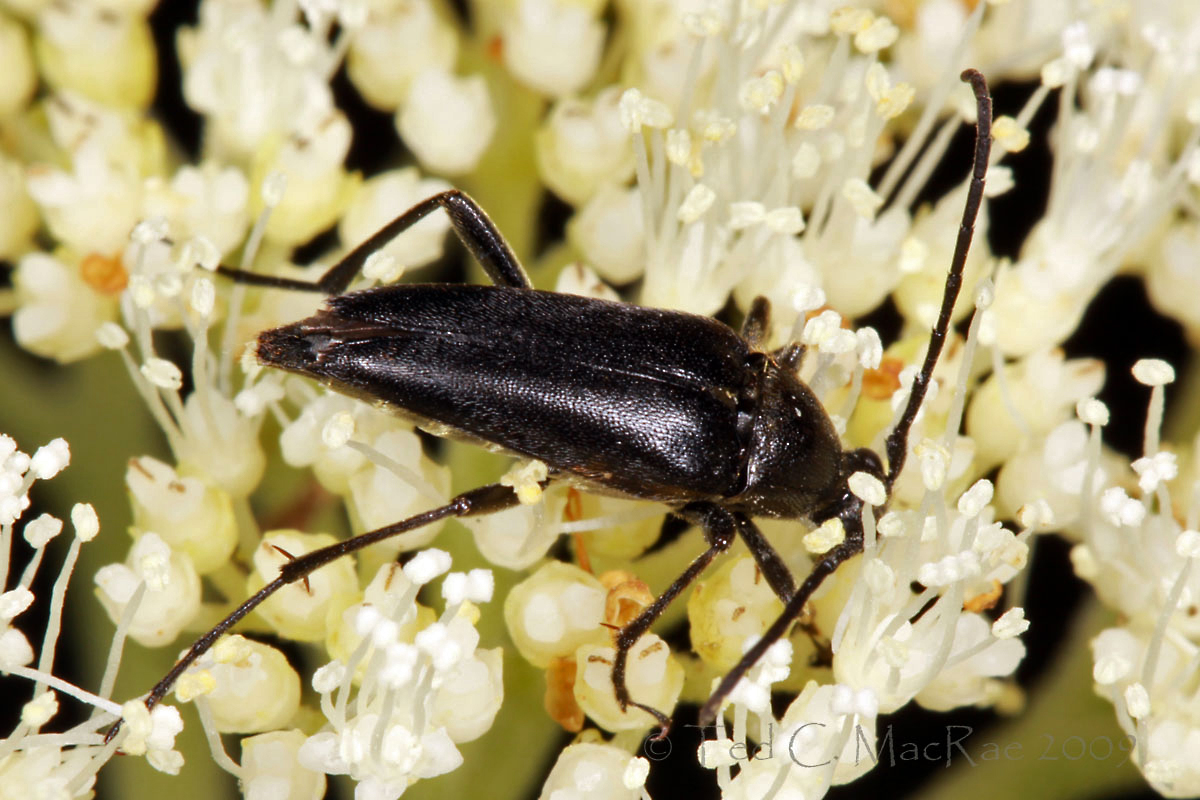
Typocerus lugubris

Typocerus lugubris on Hydrangea arborescens, Trail of Tears State Park, Missouri.

Members of the genus Typocerus are among the more commonly encountered species of the so-called “flower longhorns” (family Cerambycidae, subfamily Lepturinae) in eastern North America. In addition to the narrow-necked, broad-shouldered appearance characteristic for the subfamily, species in this genus are recognizable by their strongly tapering elytra, strongly basally depressed prothorax, and apically produced antennal segments with distinct poriferous areas (Linsley and Chemsak 1976).

Eight of the 15 species known from North America occur in Missouri, where they are commonly encountered on a variety of flowers during the months of June and July. Some of these species can be difficult to distinguish from each other – in fact, Missouri’s rarest species (Typocerus deceptus) is almost identical in appearance to one of Missouri’s commonest species (Typocerus velutinus), and several other species resemble them closely enough to require careful attention details of coloration when attempting identification.

Typocerus lugubris is not one of those species, its all-black coloration making it quite distinctive within the genus. Two other species in Missouri are mostly black, but unlike T. lugubris they always bear yellow blotches in the basal area of the elytra (T. lunulatus) or exhibit yellow transverse bands (T. zebra). Typocerus confluens also is a rather uncommon species in Missouri that varies from chestnut brown to nearly all black, but it is much more robust than T. lugubris (and also bears erect hairs on the pronotum and lacks poriferous areas on antennomere 6). The remaining species tend to be chestnut colored, at least in the basal area of the elytra, with more or less distinct transverse yellow banding.

Photo Details: Canon 50D (ISO 100, 1/250 sec, f/18), Canon 100mm macro lens, Canon MT-24EX flash (1/4 ratio) w/ Sto-Fen diffusers. Post-processing: levels, minimal crop, unsharp mask.

REFERENCES:

Linsley, E. G. and J. A. Chemsak.  1976. The Cerambycidae of North America.  Part VI, No. 2.  Taxonomy and classification of the subfamily Lepturinae. University of California Publications in Entomology 80:ix + 1–186.

Copyright © Ted C. MacRae 2010

Add to FacebookAdd to DiggAdd to Del.icio.usAdd to StumbleuponAdd to RedditAdd to BlinklistAdd to TwitterAdd to TechnoratiAdd to Yahoo BuzzAdd to Newsvine

Email to a friend

Nomenclatural changes in Phymatodes

ResearchBlogging.orgI’ve mentioned before the considerable taxonomic challenges facing students of the family Buprestidae (jewel beetles) in North America, owing largely to fact that more than half of its species are assigned to one of just three hyper-diverse genera (Acmaeodera, Agrilus, and Chrysobothris). New species continue to be described, but the most recent comprehensive treatments of these three genera were published more than 60 to 100 years ago (Fall 1899, Fisher 1928, Fisher 1945)! The situation is not as dire in the “other” major woodboring beetle family – the Cerambycidae (longhorned beetles), thanks in great part to the efforts of Gorton Linsley and John Chemsak and their monographic series of the family’s North American species (Linsley 1961-1964, Linsely and Chemsak 1972-1997). Although somewhat more speciose in North American than the Buprestidae, diversity in the Cerambycidae is more apparent at the generic level (1000+ species in 325 genera, compared to 787 species in only 54 buprestid genera). This does not mean, however, that the Cerambycidae lacks problematic, speciose genera, and in a recently published paper, Ian Swift and Ann Ray (2010) tackle one of these – the genus Phymatodes. While no new species are described, their treatment does propose numerous nomenclatural changes based on examination of type specimens that affect several North American species, including correcting misapplied names and recognizing multiple synonymies. These problems resulted from the practice of many earlier authors who did not examine type specimens when describing new species, relying instead only on written descriptions to compare taxa.

  • Phymatodes blandus is no longer divided into subspecies, with P. blandus concolor now being recognized as a full species.
  • The name Phymatodes decussatus has been used for the wrong species, which is actually P. obliquus. It is distinct from true P. decussatus, which has until now been called P. juglandis. The subspecies formerly placed under P. decussatus are also synonymized under P. obliquus.  Linsley (1964) confused things by applying the name decussatus to this common, oak-associated species and the name juglandis to the species associated with walnut. The type of decussatus, however, matches the walnut species and, since it is the older name, takes priority. The common oak species is thus left without a name, and obliquus is the oldest of the many synonyms created by Thomas Casey.
  • Phymatodes hirtellus is no longer divided into subspecies.
  • Phymatodes lecontei is synonymized under P. grandis.
  • Phymatodes mojavensis is synonymized under P. nitidus.
  • Phymatodes oregonensis is synonymized under P. nigrescens.
  • Phymatodes ursae is synonymized under P. hirtellus.

While this paper is not a full revision of the genus, it does include diagnostic and comparative notes, full color dorsal habitus photographs (example plate below), and an updated key to all of the species found in North America.

PLATE 1. 1) Phymatodes aeneus, male; 2) P. aereus, female; 3) P. amoenus, female; 4) P. amoenus, female ventral; 5) P. ater, female; 6) P. ater, female; 7) P. blandus, male; 8 ) P. concolor, male; 9) P. decussatus, male. © Swift & Ray 2010.

The genus Phymatodes is most diverse in the western states and provinces – I haven’t spent as much time out there as in other areas of North America, so representation of this genus in my collection is rather weak at only 10 of the 26 species currently recognized in North America. Missing from my cabinet are the following – if anyone is able to help me out with these I would be most grateful:

  • Phymatodes aeneus LeConte, 1854
  • Phymatodes ater LeConte, 1884
  • Phymatodes concolor Linsley, 1934
  • Phymatodes decussatus (LeConte, 1857)
  • Phymatodes fulgidus Hopping, 1928
  • Phymatodes infuscatus (LeConte, 1859)
  • Phymatodes lengi Joutel, 1911
  • Phymatodes lividus (Rossi, 1794) – introduced to eastern U.S.
  • Phymatodes maculicollis LeConte, 1878
  • Phymatodes nigerrimus Van Dyke, 1920
  • Phymatodes nigrescens Hardy & Preece, 1927
  • Phymatodes obliquus Casey, 1891
  • Phymatodes rainieri Van Dyke, 1937
  • Phymatodes shareeae Cope, 1984
  • Phymatodes tysoni Chemsak & Linsley, 1984
  • Phymatodes vulneratus LeConte, 1857

REFERENCES:

Fall, H. C.  1899. Synonpsis of the species of Acmaeodera of America, north of Mexico. Journal of the New York Entomological Society 7(1):1–37 [scroll to “Journal of the New York Entomological Society”, “v. 7 1899”, “Seq 12”].

Fisher, W. S.  1928. A revision of the North American species of buprestid beetles belonging to the genus AgrilusU. S. National Museum 145, 347 pp.

Fisher, W. S.  1942. A revision of North American species of buprestid beetles belonging to the tribe Chrysobothrini.  U. S. Department of Agriculture, Miscellaneous Publication 470, 275 pp.

Linsley, E. G.  1961. The Cerambycidae of North America.  Part I.  Introduction.  University of California Publications in Entomology 18:1–97.

Linsley, E. G.  1962. The Cerambycidae of North America.  Part II.  Taxonomy and classification of the Parandrinae, Prioninae, Spondylinae and Aseminae.  University of California Publications in Entomology 19:1–102.

Linsley, E. G.  1962. The Cerambycidae of North America.  Part III.  Taxonomy and classification of the subfamily Cerambycinae, tribes Opsimini through Megaderini.  University of California Publications in Entomology 20:1–188.

Linsley, E. G.  1963. The Cerambycidae of North America.  Part IV.  Taxonomy and classification of the subfamily Cerambycinae, tribes Elaphidionini through Rhinotragini.  University of California Publications in Entomology 21:1–165.

Linsley, E. G.  1964. The Cerambycidae of North America.  Part V.  Taxonomy and classification of the subfamily Cerambycinae, tribes Callichromini through Ancylocerini.  University of California Publications in Entomology 22:1–197.

Linsley, E. G. and J. A. Chemsak.  1972. The Cerambycidae of North America.  Part VI, No. 1.  Taxonomy and classification of the subfamily Lepturinae.  University of California Publications in Entomology 69:viii + 1–138.

Linsley, E. G. and J. A. Chemsak.  1976. The Cerambycidae of North America.  Part VI, No. 2.  Taxonomy and classification of the subfamily Lepturinae.  University of California Publications in Entomology 80:ix + 1–186.

Linsley, E. G. and J. A. Chemsak.  1984. The Cerambycidae of North America, Part VII, No. 1: taxonomy and classification of the subfamily Lamiinae, tribes Parmenini through Acanthoderini.  University of California Publications in Entomology 102:ix + 1–258.

Linsley, E. G. and J. A. Chemsak.  1995. The Cerambycidae of North America, Part VII, No. 2: taxonomy and classification of the subfamily Lamiinae, tribes Acanthocinini through Hemilophini.  University of California Publications in Entomology 114:xi + 1–292.

Linsley, E. G. and J. A. Chemsak.  1997. The Cerambycidae of North America, Part VIII: bibliography, index, and host plant index.  University of California Publications in Entomology 117:ix + 1–534..

Swift, I. P. & A. M. Ray. 2010. Nomenclatural changes in North American Phymatodes Mulsant (Coleoptera: Cerambycidae). Zootaxa 2448:35–52.

Copyright © Ted C. MacRae 2010

Add to FacebookAdd to DiggAdd to Del.icio.usAdd to StumbleuponAdd to RedditAdd to BlinklistAdd to TwitterAdd to TechnoratiAdd to Yahoo BuzzAdd to Newsvine

Email to a friend

When is a locust borer not a locust borer?

…when it is a hickory borer!

Hickory borer (Megacyllene caryae) mating pair on trunk of fallen mockernut hickory (Carya alba).

The hickory borer, Megacyllene caryae, is perhaps the most frequently misidentified beetle in eastern North America due to its almost perfect resemblance to the closely related locust borer, M. robiniae.  Unlike the latter species, however, which is encountered abundantly during the fall on flowers of goldenrod (Solidago spp.) and attacks living black locust (Robinia pseudoacacia), the hickory borer is active only during the spring and breeds in the dead wood of hickories (Carya spp.).  Adults emerge from the wood as soon as temperatures begin to warm in early spring, a fact which causes it to be most frequently encountered during winter when it emerges indoors from firewood brought in from outdoors.  Many times this causes the alarmed homeowner to post a photo of the insect on BugGuide and ask if it will cause damage to their home.  So close is its resemblance to the locust borer that novice insect enthusiasts often identify it as such based on comparison to photos and refuse to believe it is not that species, even when told otherwise.

Of course, there are distinguishing characters that, with a little practice, become quite obvious – the legs of the hickory borer are often distinctly reddish (as seen in the above photo), and the bands of the elytra will many times show an alternating pattern of yellow and white (not quite so apparent in the above photo).  The elytral bands are also slightly narrower and often broken and incomplete in this species, while in the locust borer they are wider and nearly always extend completely across the elytra.  Lastly, the pronotum of the locust borer is narrowly margined with yellow on the anterior edge, while in the hickory borer the anterior margin is black.  That’s a tough character to see without magnification, and all of these characters really are only necessary when examining specimens in a collection (and even then only if there is no date on the collection label).  Season is the easiest distinguishing character – if it occurs during spring it is the hickory borer, and if it occurs during fall it is the locust borer.  There are several other species in the genus that can be confused with these two, but they do not occur in eastern parts of North America.

This mating pair was encountered on the trunk of a recently wind-thrown mockernut hickory (Carya alba) during our early April hike of the lower Wappapello Section of the Ozark Trail.

Photo Details: Canon 50D (ISO 100, 1/250 sec, f/14), Canon 100mm macro lens, Canon MT-24EX flash (1/4 ratio) w/ Sto-Fen diffusers. Typical post-processing (levels, unsharp mask).

Copyright © Ted C. MacRae 2010

Add to FacebookAdd to DiggAdd to Del.icio.usAdd to StumbleuponAdd to RedditAdd to BlinklistAdd to TwitterAdd to TechnoratiAdd to Yahoo BuzzAdd to Newsvine

Email to a friend

Hitchin’ A Ride

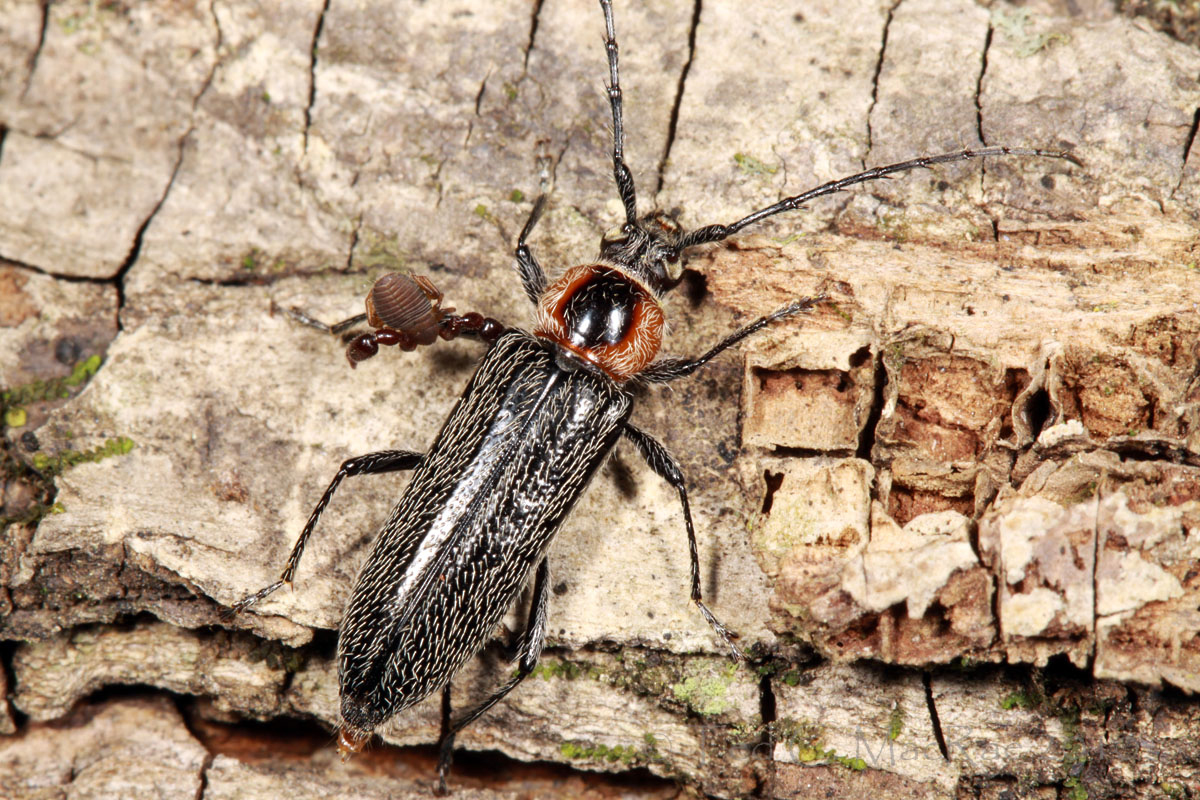
One of the more common species of longhorned beetles (family Cerambycidae) in Missouri, and throughout the eastern U.S., is Stenosphenus notatus.  Despite its commonness, however, it is a species that is easily overlooked because of its very early seasonality, emerging during the first warm days of spring (late March here in Missouri) and disappearing by the time the bulk of longhorned beetle species become active during late spring and early summer.  I found this individual on a recently fallen mockernut hickory (Carya alba) during the 2nd week of April, as Rich and I hiked the lower portion of the Wappapello Section of the Ozark Trail in southern Missouri (along with several other wood boring beetles species such as Dicerca lurida, Megacyllene caryae, and the woodboring beetle predator Enoclerus ichneumoneus).  Longhorned beetles display a variety of host fidelities, ranging from highly polyphagous to strictly monophagous – this species falls near though not quite at the latter end of the spectrum, being associated almost exclusively with the genus Carya (hickories and pecan).  I have reared adults from dead branches and trunk sections of not only C. alba, but also C. aquatica (water hickory), C. laciniosa (shellbark hickory), and C. ovata (shagbark hickory) (MacRae 1994, MacRae and Rice 2007).  Linsley (1963) also records Celtis (hackberry) as a host, but I have not seen the species myself in association with plants of that genus, nor have I seen other literature references to such – I suspect this may, in fact, be an incidental adult association rather than indicative of a true larval host (an all too common problem in interpreting literature on woodboring beetle host plants).

The very early spring occurrence of this insect can be traced to a peculiarity of its life cycle shared by few other cerambycid species in the eastern U.S. – overwintering in the adult stage.  Most eastern U.S. longhorned beetles overwinter within the host wood as either partially or completely grown larvae.  Warming temperatures in the spring trigger resumption of growth in the former and a transformation to the pupal stage in the latter, which emerge as adults a few weeks later during mid-late spring.  In contrast, S. notatus – which requires two seasons to complete its development – pupates in the latter part of the second season and transforms into the adult before the onset of winter.  When warm temperatures return in spring, the adults are ready to emerge and search out fresh hickory wood that has died within the past few months on which to lay their eggs and begin the cycle anew.

As I photographed this individual, I noticed an object attached to its left mesothoracic (middle) leg.  Zooming in on the object showed it to be a pseudoscorpion – a type of arachnid (relative of spiders, mites, and true scorpions) in the order Pseudoscorpiones.  I have not the resources nor the expertise to attempt a more specific ID, but its attachment to the beetle almost surely represents an example of phoresy – defined as a phenomenon in which “one animal seeks out and attaches to the outer surface of another animal for a limited time during which the attached animal (termed the phoretic) ceases feeding and ontogenesis, such attachment presumably resulting in dispersal from areas unsuitable for further development, either of the individual or its progeny” (Farish and Axtell 1971).  Pseudoscorpions have been reported attached to insects from several orders, primarily Diptera but also beetles and including longhorned beetles (Perry et al. 1974, Haack and Wilkinson 1987).  Many species of pseudoscorpions develop beneath the bark of dead trees and prey upon the many other small insects and mites found there, and it would be reasonable to presume that their most effective means of dispersal to new habitats (i.e., dead trees) would be by “hitching a ride” with adult woodboring beetles as they emerge and fly to these new sites.  As obvious as this explanation might seem, few data have actually been generated to demonstrate it is actually the case, and several competing hypotheses such as accidental boarding (hitching a ride by accident), obligate symbiosis (the pseudoscorpions live exclusively on the beetles), and phagophily (preying upon other beetle associates such as mites) have been offered as alternative explanations. However, at least one fairly recent investigation on the pseudoscorpion, Cordylochernes scorpioides, a frequent inhabitant under the elytra of the giant harlequin beetle, Acrocinus longimanus (family Cerambycidae), does seem to not only support the dispersal hypothesis, but also suggests that large male C. scorpioides even defend a beetle’s abdomen as a strategic site for intercepting and inseminating dispersing females (Zeh and Zeh 1992).

REFERENCES:

Farish, D. J. and R. C. Axtell. 1971. Phoresy redefined and examined in Macrocheles muscaedomesticae (Acarina: Macrochelidae). Acarologia 13:16–29.

Haack, R. A. and R. C. Wilkinson. 1987. Phoresy by Dendrochernes Pseudoscorpions on Cerambycidae (Coleoptera) and Aulacidae (Hymenoptera) in Florida. American Midland Naturalist 117(2):369–373.

Linsley, E. G. 1963. The Cerambycidae of North America. Part IV. Taxonomy and classification of the subfamily Cerambycinae, tribes Elaphidionini through Rhinotragini. University of California Publicatons in Entomology 21:1–165, 52 figs.

MacRae, T. C. 1994. Annotated checklist of the longhorned beetles (Coleoptera: Cerambycidae and Disteniidae) known to occur in Missouri. Insecta Mundi 7(4) (1993):223–252.

MacRae, T. C. and M. E. Rice. 2007. Distributional and biological observations on North American Cerambycidae (Coleoptera). The Coleopterists Bulletin 61(2):227–263.

Perry, R. H., R. W. Surdick and D. M. Anderson. 1974. Observations on the biology, ecology, behavior, and larvae of Dryobius sexnotatus Linsley (Coleoptera: Cerambycidae). The Coleopterists Bulletin 28(4):169–176.

Zeh, D. W. and J. A. Zeh. 1992. On the function of harlequin beetle-riding in the pseudoscorpion, Cordylochernes scorpiones (Pseudoscorpionida: Chernetidae). Journal of Arachnology 20: 47––51.

Copyright © Ted C. MacRae 2010

Add to FacebookAdd to DiggAdd to Del.icio.usAdd to StumbleuponAdd to RedditAdd to BlinklistAdd to TwitterAdd to TechnoratiAdd to Yahoo BuzzAdd to Newsvine

Email to a friend

Friday Flower – Pawpaw

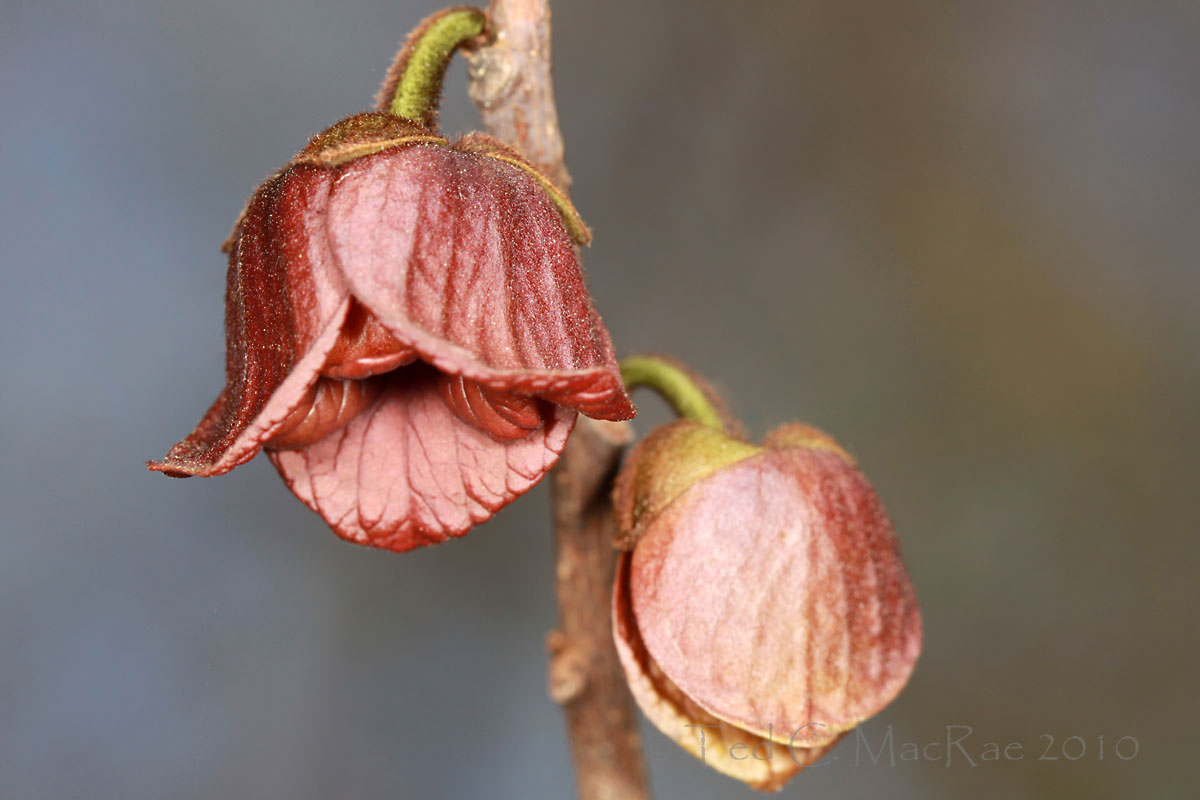
As my friend Rich and I stood in the verdent understory admiring the spectacular panicles of red buckeye punctuating the green lushness, a small brown flower on a leafless branch above me caught my eye.  “Pawpaw!” I exclaimed, perhaps partly in amazement that it took us awhile to notice the trees that were, in fact, all around us.  Pawpaw (Asimina triloba) is a member of the only temperate genus in the otherwise exclusively tropical and subtropical family Annonaceae (Custard Apple Family).  Although not nearly as restricted in occurrence in Missouri as the red buckeyes with which they were growing, they are nevertheless always a treat to see. Scattered throughout the state, they can be found growing in bottomland forests, ravines in mesic upland forests, along woodland streams, and at bases of bluffs (Yatskievych 2006).

Pawpaws are, of course, famous for their large edible fruits, sometimes called Indian bananas, Missouri bananas, Michigan bananas, [insert eastern state here] bananas, etc.  Technically, however, the pawpaw fruit is a berry, since it is derived from a single pistil and has multiple seeds embedded within the pulpy matrix.  I’ve not tried the fruit myself, not for lack of desire but rather an inability to find them when they ripen in fall before the birds and mammals get to them.  Some effort has been made to cultivate the plant for fruit production, but low fruit set seems to be a persistent problem due to reproductive self-incompatibility.

Pawpaw also famously serves as the larval food plant for the zebra swallowtail butterfly, Eurytides marcellus (family Papilionidae).  Beyond this, however, there seem to be not many insects associated with the plant.  I have collected dead wood of pawpaw in an effort to determine the species of wood-boring beetle species that are associated with it.  The only species I’ve reared is the longhorned beetle, Elaphidion mucronatum (whose common name “spined oak borer” belies the fact that it is one of the most polyphagous of all North American species), and two other longhorned beetles, Eupogonius pauper and Urgleptes querci (also highly polyphagous), have also been reported being reared from dead wood of this plant.  I have not associated any jewel beetles with pawpaw, nor have any such associations been reported in the literature.  It would appear that woodboring beetles are not fond of the soft, weak wood of pawpaw, perhaps due to the plant’s annonaceous acetogenins with known pesticidal qualities (Ratnayake et al. 1993) (acetogenins are also under investigation as anti-cancer drugs).  Other poisonous compounds, chiefly alkaloids, are found in various parts of the plant, especially the seeds and bark, and likely play a role in herbivore defense. Insect pollinators also seem to be infrequent, as I have not noted any insects on its flowers. Most members of the family are pollinated by beetles (Yatskievych 2006), but the meat-colored, downward-facing, not-so-sweet-smelling flowers of pawpaw suggest pollination by flies, perhaps those attracted to carrion.

REFERENCE:

Ratnayake, S., J.K. Rupprecht, W.M. Potter, and J.L. McLaughlin. 1993. Evaluation of the pawpaw tree, Asimina triloba (Annonaceae), as a commercial source of the pesticidal annonaceous acetogenins. p. 644-648. In: J. Janick and J.E. Simon (eds.), New Crops. Wiley, New York.

Yatskievych, G. 2006. Steyermark’s Flora of Missouri, Volume 2. The Missouri Botanical Garden Press, St. Louis, 1181 pp.

Copyright © Ted C. MacRae 2010

Add to FacebookAdd to DiggAdd to Del.icio.usAdd to StumbleuponAdd to RedditAdd to BlinklistAdd to TwitterAdd to TechnoratiAdd to Yahoo BuzzAdd to Newsvine

Email to a friend

Monday Ménage – Brachyleptura rubrica

Photo details: Canon 100mm macro lens on Canon EOS 50D, ISO 100, 1/250 sec, f/18, MT-24EX flash w/ Sto-Fen diffusers.

This mating pair of longhorned beetles represents Brachyleptura rubrica, one of several so-called “flower longhorns” (including the rare Typocerus deceptus) that I saw on flowers of Hydrangea arborescens last June at Trail of Tears State Park in southeastern Missouri.  Flower longhorns collectively represent the subfamily Lepturinae, which among the Cerambycidae are distinguished by their posteriorly tapering elytra and generally narrow pronotum that give them a rather broad-shouldered look.  Their conical coxae (basal segment of the leg) and eyes that usually do not surround the base of the antennae distinguish them from the subfamily Cerambycinae, and the prognathous (forward slanting) face distinguishes them from the Lamiinae (flat-faced longhorns).  Additionally, a great majority of Lepturinae are diurnal (active during the day) and visit flowers as adults, whereas most other Cerambycidae (with notable exceptions) are nocturnal and seldom active during the day (most often being encountered by their attraction to lights).  The subfamily is named for its type genus, Leptura — derived from the Greek word λεπτός (leptos), or narrow, which I presume to be a reference to their relatively more slender appearance compared to other Cerambycidae.  Species in the genus Brachyleptura are distinguished from other Lepturinae by their often abbreviated elytra (“brachy” derived from the Greek word βραχύς, or short), although this is only scarcely the case in B. rubrica.  I’m confident most of you can determine the derivation of the species name.

Although fairly widespread across the eastern U.S., I can remember being really excited the first time I saw this species back in the mid-1980s when I was beginning my faunal study of the Cerambycidae of Missouri (MacRae 1994).  It is by no means rare, but at the same time it is not so routinely encountered as other common flower longhorns in the state such as Strangalia famelica solitaria, S. luteicornis, S. sexnotata, Typocerus octonotatus, and T. velutinus.  Unlike those more commonly seen species, B. rubrica shows a distinct preference for plants with white, compound, flat-topped floral structures.  No plant in Missouri meets this description better than Hydrangea arborecens, and it is on flowers of this plant that I have most often seen the species.  Other flowers on which I have collected it include Ceanothus americanus, Cornus drummondiiDaucus carota, and Parthenium integrifolium — all white, compound, and (except Ceanothus) flat-topped.  Larvae have been recorded breeding in a variety of hardwood species such as beech, birch, elm, hickory, and maple; however, I have only reared this species once — a single individual that emerged from a rather punky dead branch of Carpinus caroliniana (blue beech, musclewood, hornbean) (MacRae and Rice 2007).  I suspect that the condition of the wood (slightly decayed rather than freshly dead) is more important than the actual tree species (although perhaps it is confined to hardwoods and does not utilize conifers).

There is a related species in Missouri, Brachyleptura vagans, which resembles B. rubrica in form and by its white-annulated antennae, but it is distinguished by the elytra being wholly black except for small (usually) red patches behind the humeri (shoulders).  I haven’t encountered this species quite as commonly in Missouri, mostly in shortleaf pine (Pinus echinata) forests of the Ozark Highlands.  I’ve collected it on most of the same flowers as B. rubrica, but rather than H. arborescens it seems to be most fond of C. americanus.

REFERENCES:

MacRae, T. C. 1994. Annotated checklist of the longhorned beetles (Coleoptera: Cerambycidae and Disteniidae) known to occur in Missouri. Insecta Mundi 7(4) (1993):223–252.

MacRae, T. C. and M. E. Rice. 2007. Distributional and biological observations on North American Cerambycidae (Coleoptera). The Coleopterists Bulletin 61(2):227–263.

Copyright © Ted C. MacRae 2010

Add to FacebookAdd to DiggAdd to Del.icio.usAdd to StumbleuponAdd to RedditAdd to BlinklistAdd to TwitterAdd to TechnoratiAdd to Yahoo BuzzAdd to Newsvine

Email to a friend