Springtime Acmaeodera

Last weekend I mustered up the courage to begin experimenting with the 1-5X macro lens with my new camera. I had played around with it a little, trying to get a feel for finding the subject (it seemed hard) and the working distance (it seemed close). Really though, no amount of fiddling around could take the place of taking it out into the field and using it. I found some ideal subjects to experiment with – springtime Acmaeodera. With more than 150 species, this is one of the largest genera of jewel beetles (family Buprestidae) in North America. This genus is in terrible need of revision – new species continue to be recognized on a regular basis from the desert southwest and Mexico, where the group reaches its greatest diversity. Only a handful of species, however, are found in the eastern part of the U.S.

Acmaeodera_tubulus_IMG_0110_enh2

Photo details: Canon MP-E 65mm macro lens on a Canon EOS 50D, ISO 100, 1/200 sec, f/11, MT-24EX flash 1/8 power through diffuser caps

One of the most abundant and widespread of these is Acmaeodera tubulus (first two photos). Measuring only 5-7mm in length, it is among the smallest members of the genus and can be recognized by its black color with bronzy sheen and 8 (usually) small, yellow spots forming two longitudinal rows on each elytron. Adults of this species feed on the petals of a great variety of flowers – this individual was feeding on the petals of eastern beebalm (Monarda bradburiana). The larvae of this species are wood borers in twigs and small branches of various hardwood trees – I myself have reared it from dead branches of green hawthorn (Crataegus viridis), several species of hickory (Carya spp.), hackberry (Celtis occidentalis), honey locust (Gleditsia triacanthos), walnut (Juglans nigra), eastern hophornbeam (Ostrya virginiana), willow (Salix sp.), and slippery elm (Ulmus rubra).
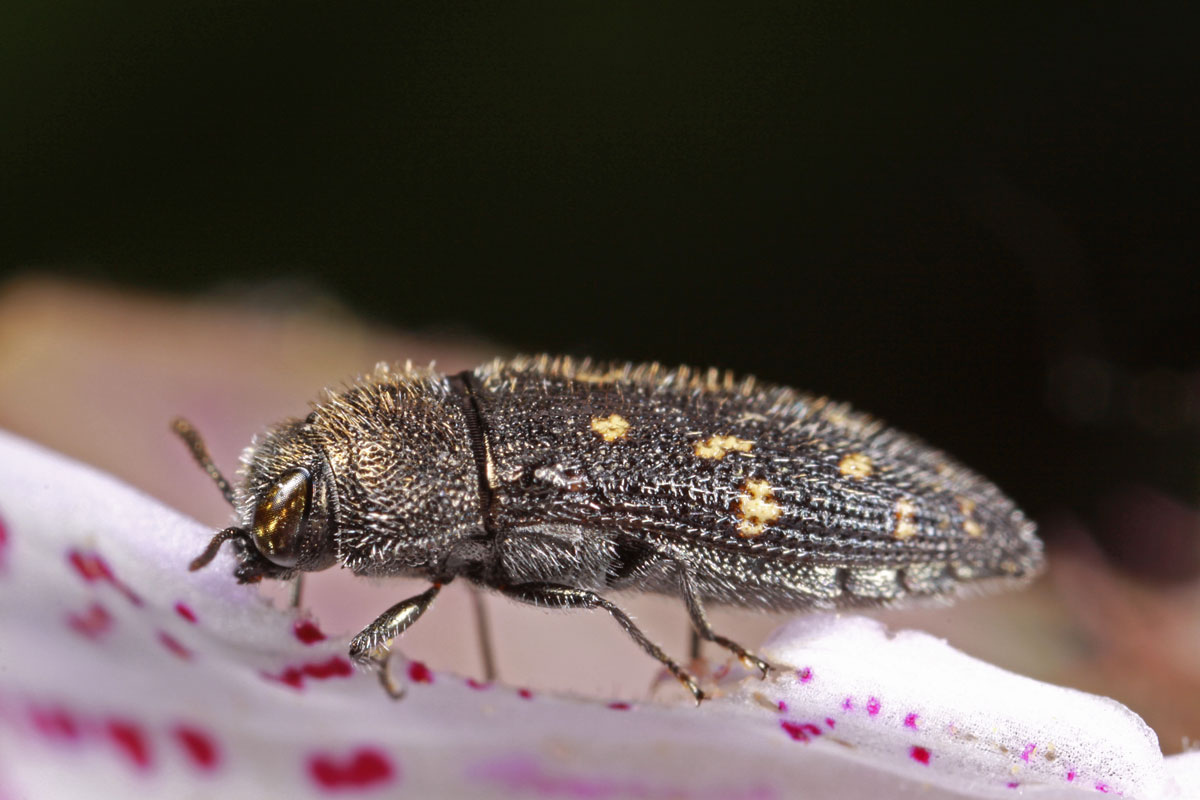
Acmaeodera_tubulus_IMG_0123_enh2

Photo details: Canon MP-E 65mm macro lens on a Canon EOS 50D, ISO 100, 1/200 sec, f/11, MT-24EX flash 1/8 power through diffuser caps

While not apparent from these photos, adults in flight have the appearance of small bees. The elytra of all Acmaeodera are fused and do not separate during flight as in most other beetles, which in this small species results in a profile during flight similar to that of a small halictid (sweat bee). There is another species in Missouri (A. neglecta) that closely resembles A. tubulus but which can be distinguished by its larger punctures, duller surface, and the yellow spots of the elytra often longitudinally coalesced into irregular “C”-shaped markings on each side. Acmaeodera neglecta occurs primarily in the south-central U.S., and in Missouri I have found it most often in glade habitats.

Acmaeodera_ornata_IMG_0155_enh2

Photo details: Canon EF 100mm macro lens on a Canon EOS 50D, ISO 100, 1/200 sec, f/11, MT-24EX flash 1/8 power through diffuser caps

Another common (though much less so than A. tubulus), springtime Acmaeodera in the eastern U.S. is Acmaeodera ornata (last photo). This handsome species is distinctly larger than A. tubulus, usually around 8-11mm in length, and has a broader, more flattened appearance with a distinct triangular depression on the pronotum. The elytra have a bluish cast rather than the bronzy sheen of A. tubulus, and the spots on the elytra are smaller, more numerous, and more of a creamy rather than yellow color. No other species in the eastern U.S. can be confused with it, although there is a very similar species (A. ornatoides) that occurs in Oklahoma and Texas.

This species, too, is fond of a great variety of flowers – especially asteraceous species, with this individual photographed on the widespread (but unfortunately exotic) ox-eye daisy (Leucanthemum vulgare). The body is covered with numerous long, thin hairs which may function in pollination – enlarge the photo to see the large amount of pollen that has become trapped among the hairs of this individual. Despite its widespread occurrence across the eatern U.S., larval host records are almost non-existent for this species – limited to some very old (and not entirely reliable) reports of it breeding in hickory and black locust (Robinina pseudoacacia). I have not managed to rear this species yet, despite the large number of rearings I’ve done from a wide variety of woody species in Missouri.

Copyright © Ted C. MacRae 2009

Add to FacebookAdd to NewsvineAdd to DiggAdd to Del.icio.usAdd to StumbleuponAdd to RedditAdd to BlinklistAdd to Ma.gnoliaAdd to TechnoratiAdd to Furl

Osage copperhead

Copperhead

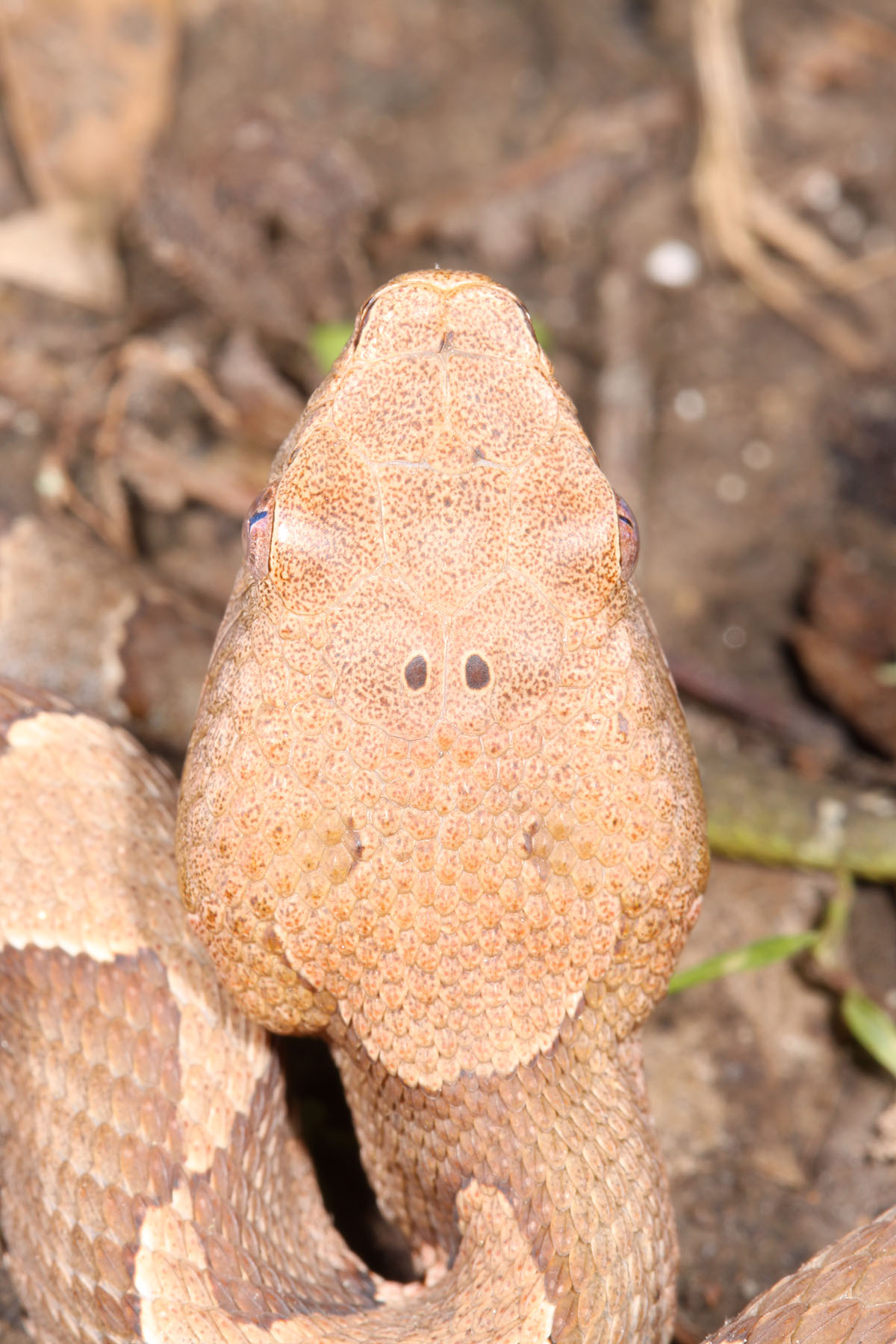
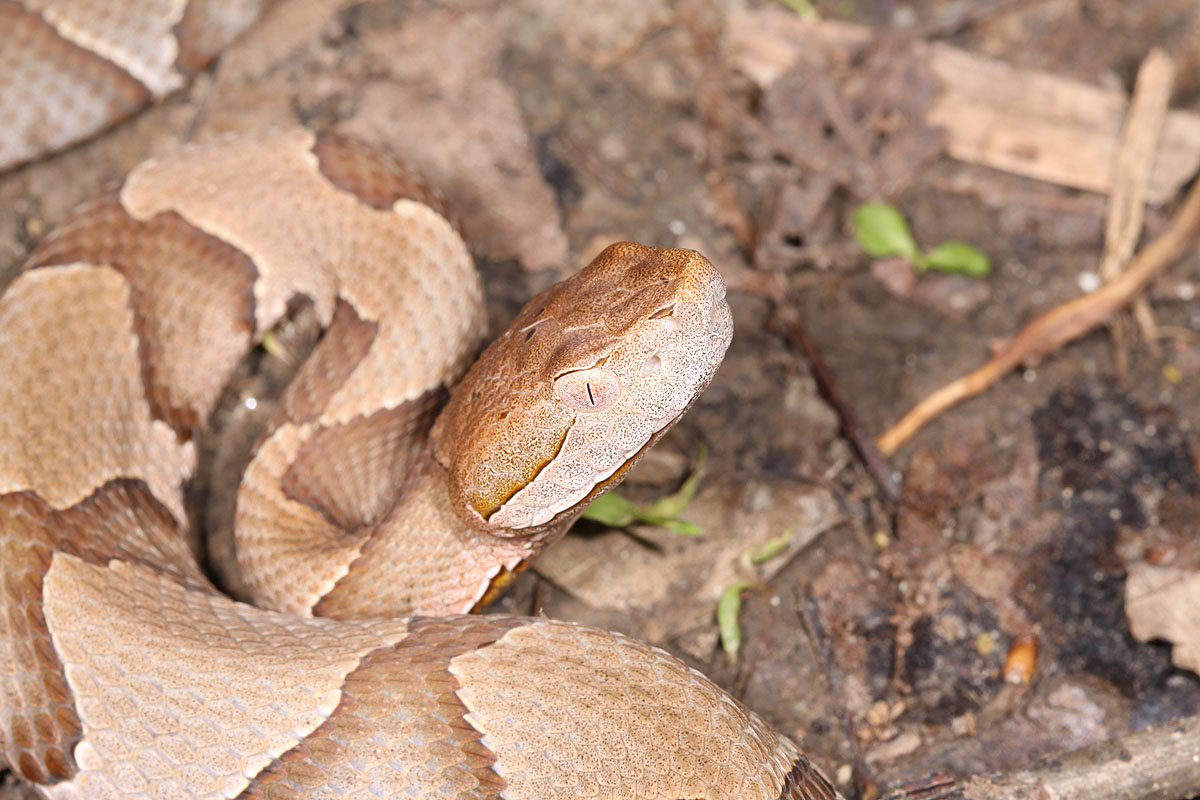
While photographing Cicindela sexguttata last weekend, Chris and I encountered this young copperhead snake (Agkistrodon contortrix).  It was the second copperhead I had seen in as many days – unusual, since I can count on my two hands the number of copperheads I’ve encountered in my many years of tramping through Missouri’s woodlands.  I did not even see my first copperhead (other than in the zoo) until early adulthood, one of many unfortunate consequences of my strictly urban childhood (more on that first encounter later).

Copperhead

Missouri copperheads don’t really have “copper heads” – the common name is derived from the northern subspecies that lives in the northeastern U.S. and down into Appalachia.  Instead, most of Missouri’s copperheads have a pinkish tan head that matches the color of the body.  Three of North America’s five copperhead subspecies live in Missouri, but it is the Osage copperhead (A. contortrix phaeogaster) that is most commonly encountered – the northern and southern subspecies being confined, respectively, to the extreme northern and southern portions of the state.  Osage copperheads are distinguished by the light bordering around each of their dark markings.

Copperhead

This individual can be recognized as a juvenile not only by its small size (it was just over 1 foot long), but also by the greenish yellow tail with small, white markings edged in black.  Juvenile copperheads need help capturing prey because of their small size and use their colorful tails for “caudal-luring” – that is, they use their tails to lure prey to within striking distance.  When prey approaches, the coiled juvenile snake moves its tail near the center of the coil and wiggles the colored portion – perhaps it looks like a caterpillar to the lizard or frog.  Copperheads lose their juvenile tail coloration at about 18 months to two years of age when they are large enough to capture prey without assistance.

Copperheads are famously non-aggressive – even though the majority of snake bites that occur in Missouri each year are from this snake (due to its abundance), nearly all are a result of human attempts to handle, capture, or (tragically) kill the snake.  I suppose someone might accuse me of doing likewise, since I used a stick to pick this individual up from the leaf litter in which it was lying, brilliantly camoflauged, and lay it down on the trail for photographs.  The snake did strike several times at the stick, but with my hand safely out of reach, and after it was in place it cooperated fully for these ever closer photographs.  My first encounter with a copperhead, however, was not so uneventful.  I was a budding entomologist fresh out of school and had just discovered the wonderful little herbaceous islands in the forest known as glades.  On my way back to St. Louis from a meeting in Jefferson City, I stopped by Graham Cave State Park in Montgomery Co. – a park I had not yet explored.  Of course, there’s a cave that one must see – in this case an unusual sandstone overhang cave (significant for its Native American artifacts dating back 10,000 years).  On top of the broad, sandstone arch above the cave I noticed a little glade habitat and clambered up to take a peek.  As I was standing atop the cave looking at the glade, I felt something hit my ankle.  I looked down and saw a full-grown copperhead coiled right next to my foot and instinctively jumped up and away from the snake (and fortunately not over the edge of the cave top).  Almost immediately, my leg started feeling tingly, and as I pulled up my pant leg, pushed down my sock, and began searching frantically for the wounds on my ankle my leg started going completely numb.  I was 40 miles from the nearest hospital, alone, and had not the wisdom to know that no fatalities from the bite of any of Missouri’s venomous snakes have been recorded for many decades.   Convinced I was going to die, I continued my frantic search for the wounds, but no amount of careful examination around the ankle revealed any broken skin (what I would have done had I actually found wounds I do not know).  I got up and tried to walk, almost collapsing at first on the completely numb leg.  Eventually I was able to walk some feeling back into the leg, and once the leg was feeling close to normal again I concluded that the numbness must have been a purely psychosomatic response to the perceived bite.  I went back to the snake, still coiled up where I first encountered it, and admired it for awhile – with due respect!

An excellent article on Missouri copperheads, by Missouri Department of Conservation herpetologist Tom R. Johnson, appeared in the May 1999 issue of The Missouri Conservationist.

Copyright © Ted C. MacRae 2009

Add to FacebookAdd to NewsvineAdd to DiggAdd to Del.icio.usAdd to StumbleuponAdd to RedditAdd to BlinklistAdd to Ma.gnoliaAdd to TechnoratiAdd to Furl

A new look at an old friend

Chris Wirth just wrote a nice post summarizing the use of digital SLR camera systems for insect macrophotography.  Having just gone through the process of upgrading to a dSLR system from a point-and-shoot myself, I can relate to much of what he discusses.  The advantages are clear – higher image quality, far greater magnification capabilities, and control over lighting, shutter speed, aperture, etc.  He also discusses the disadvantages – chiefly co$t, weight, and initial learning curve.  He ends with this recommendation:

…if you are serious about insect photography and have the monetary resources, a DSLR is your only choice. Again, as of yet, nothing else provides similar quality or control.

Although I dabbled in insect photography many years ago with an Olympus OM-10 SLR film camera and a Zeiko 50mm macro lens, it wasn’t until I started this blog 18 months ago that I started making a real effort to photograph insects, using a Panasonic Lumix DMC-FX3 point-and-shoot that my dad had given to me for my birthday earlier that year. At first, I was amazed at the macro capabilities of this little camera – point, autofocus, and shoot! Yes, the photo needed to be cropped, and the reliance on natural light was not only limiting but often resulted in deep shadows – but nothing a little Photoshop couldn’t fix! It wasn’t long, however, before I began to see the limitations – not just on size, with tiger beetles being near the lower end of the size of subject I could photograph, but also with the quality of the images themselves. The perfectionist in me started envisioning what I could do if only I had the equipment. Mind you, I’m proud of the photographs I’ve acquired over the past months, given what I had to work with. But now that I have the equipment to do it right, I see a conflict on the horizon – do I attempt to go back and re-photograph all of those species that I’ve already photographed, or do I move on and and not look back? Perhaps a little of both is the best approach.

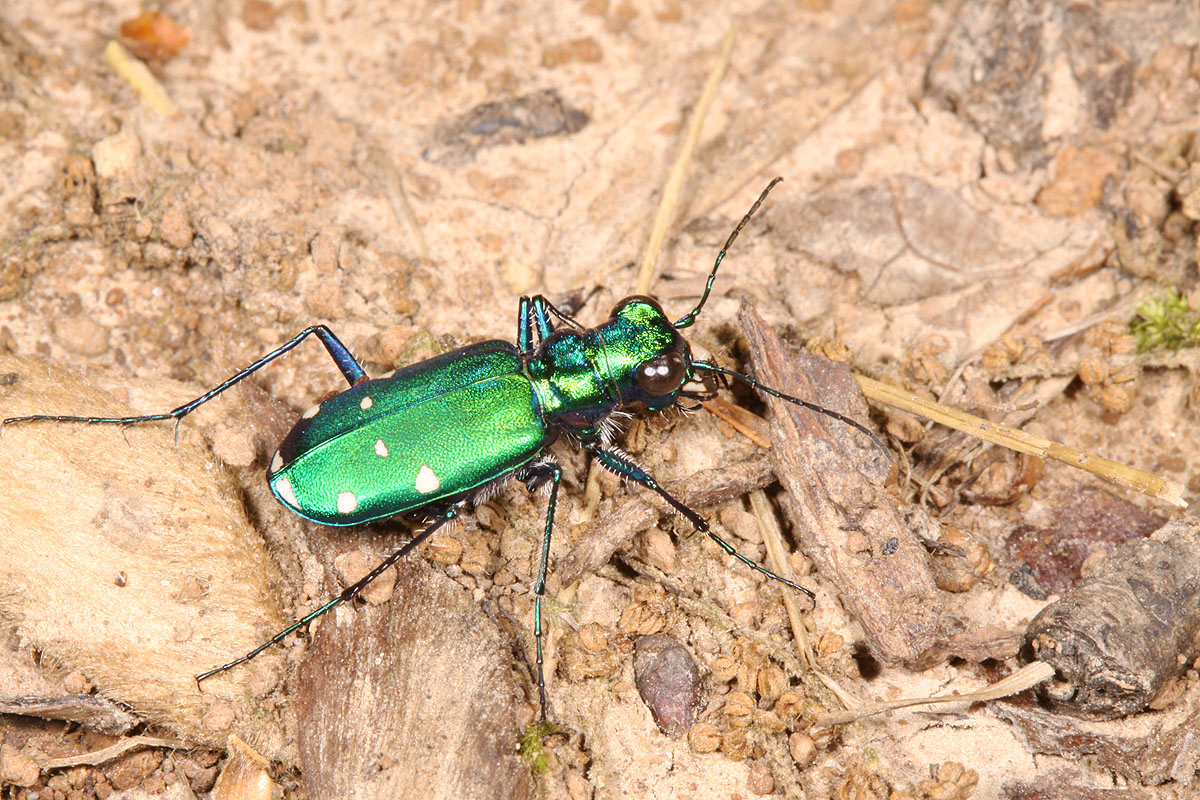
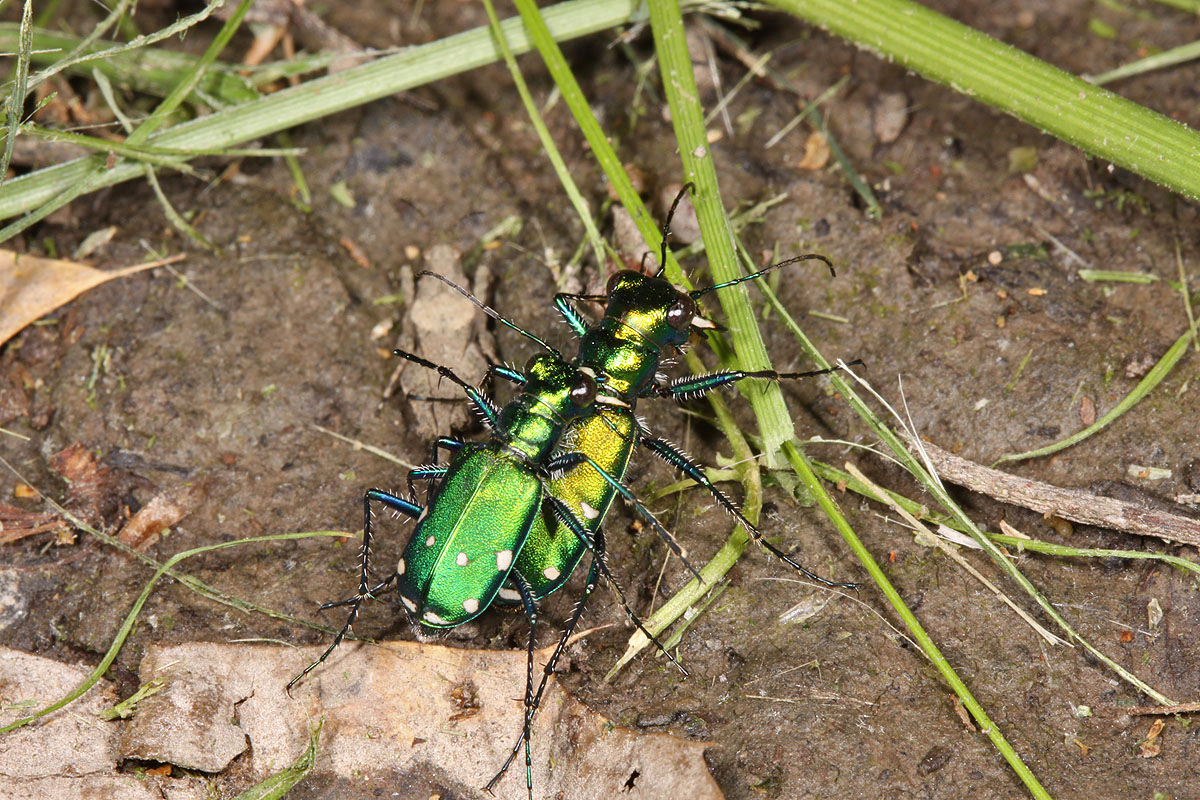
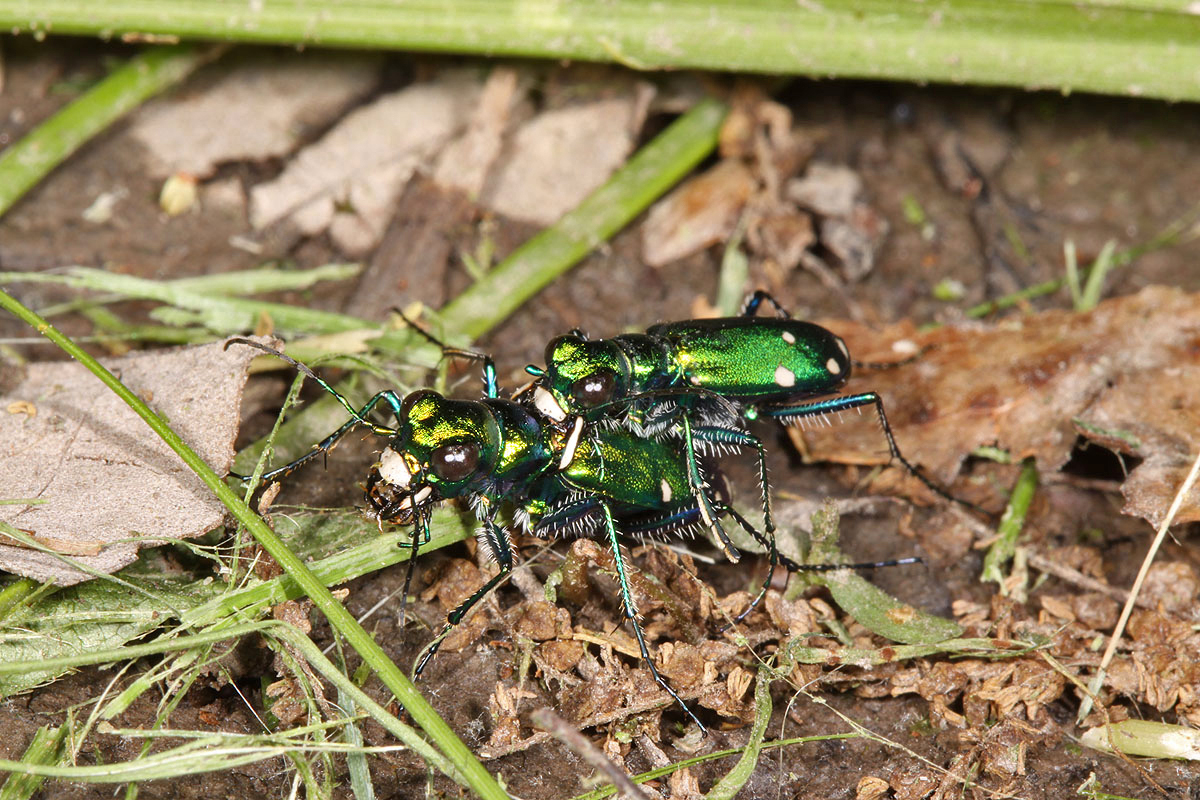
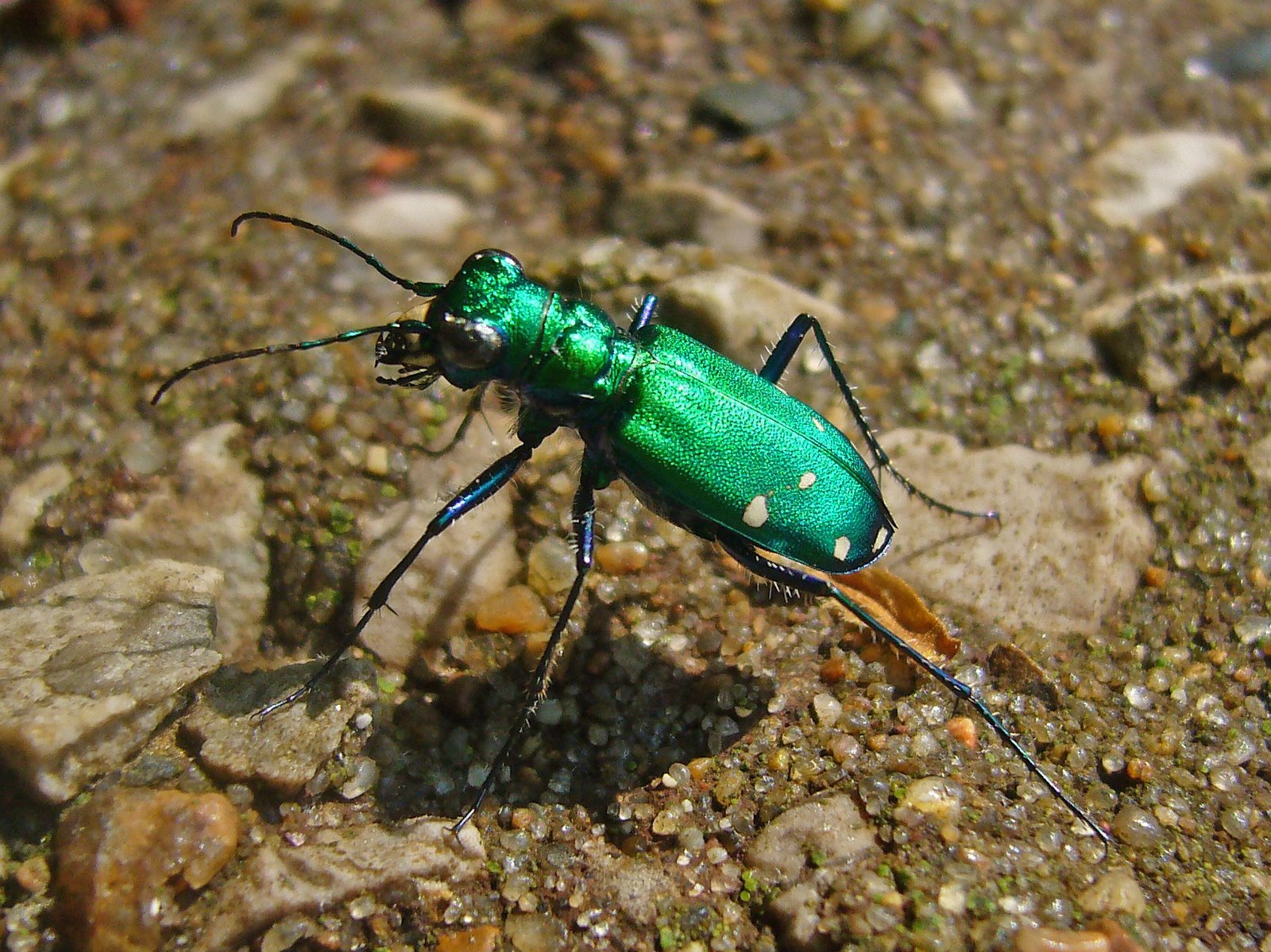
Cicindela sexguttataIn the meantime, I’ve got to learn how to use this camera. The first weekend I had it, I accompanied my friend and colleague, Chris Brown, to nearby Shaw Nature Reserve, where Chris had previously noted good populations of the very uncommon Cicindela unipunctata (one-spotted tiger beetle) [now Cylindera unipunctata, fide Erwin & Pearson 2008 – more on this in a future post] – what a fantastic species for my first photo shoot with the new setup. Unfortunately, we did not find this species (although I will eventually). Instead, I focused on the very prolific population of Cicindela sexguttata (six-spotted tiger beetle) that we found at this site. Cicindela sexguttata is the one tiger beetle that is, more than any other North American species, known by entomologists and non-entomologists alike. Cicindela sexguttataAnyone who has ever taken a walk in the eastern forests during spring has encountered this beetle – flashing brilliant green in the dappled sunlight, always a few yards ahead on the path. While belonging to the “spring/fall” group of species, adults of this species break ranks and stay put in their burrows during fall while other spring/fall species come out and explore for a bit before digging back in for the winter (Pearson et al. 2006). While many individuals do show the six white spots on the elytra that give the species its common name, this character is actually quite variable, with some northern populations completely lacking spots.

Cicindela sexguttataAs tiger beetles go, it’s one of the more difficult to photograph because of its shiny, metallic coloration (as opposed to the flat, dull coloration of Cyl. unipunctata). This was probably a good thing in terms of starting the learning process. I limited myself during this session to the 100mm macro lens (leaving the 1-5x beast for another day), with the photographs shown here being some of the better ones. While I like them, I also see a few things I did wrong. First was the flash – I set the flash units to 1/4 power and didn’t use any kind of diffusers, and as a result the lighting turned out harsh – especially for this brilliantly-colored, metallic species. Cicindela sexguttata I’ve softened the highlights a little bit in Photoshop, but the results are still not as good as if I had used a lower power and diffused the light, and ultimately my goal is to achieve well lit photographs that do not need post-processing to make them look right. Other than that, the day was mostly about getting used to handling the camera and learning how to judge f-stop based on my manual settings for exposure (1/200 sec) and ISO (100). The single individuals (above) were taken in full sunlight, and in that situation my f-stops tended to be too low (resulting in overexposure), while the mating pair was in shade where my f-stops tended too high (underexposed). Next time, I’ll try the diffusers I bought, use less flash power, and do more f-stop bracketing until I get a good feel for what I need in a given situation.

For comparison, here is the one C. sexguttata photograph I took with the point-and-shoot last year. This is about as good a photograph as I could get of this species using that camera. Besides being heavily cropped, it differs by being not very well exposed (despite post brightening), showing heavy shadows (despite post lightening), and lacking detail.
Cicindela sexguttata

REFERENCES:

Erwin, T. L. and D. L. Pearson. 2008. A treatise on the Western Hemisphere Caraboidea (Coleoptera). Their classification, distributions, and ways of life. Volume II (Carabidae-Nebriiformes 2-Cicindelitae). Pensoft Series Faunistica 84. Pensoft Publishers, Sofia, 400 pp. + 33 color plates.

Pearson, D. L., C. B. Knisley and C. J. Kazilek. 2006. A Field Guide to the Tiger Beetles of the United States and Canada. Oxford University Press, New York, 227 pp.

Copyright © Ted C. MacRae 2009

Add to FacebookAdd to NewsvineAdd to DiggAdd to Del.icio.usAdd to StumbleuponAdd to RedditAdd to BlinklistAdd to TwitterAdd to TechnoratiAdd to Furl

BitB Goes dSLR

That’s right, I’ve finally acquired a bona fide digital SLR camera system and am taking the plunge into real insect macrophotography. I’ve been playing with my little point-and-shoot over the past 18 months or so, and the more I used it to take photographs of tiger beetles and other insects, the more I realized what I could do if I had a true macro system.  I made the decision several months ago and got lots of good advice on what kind of system I should put together from my colleague, field companion, and insect macrophotographer-extraordinaire Chris Brown, as well as from Adrian Thysse over at Voyages Around My Camera. For a time, I was trying to design a system on a rather tight budget, and Adrian graciously wrote an excellent post (Basic DSLR Macro System on a Budget) in response to my query.  The problem was, I could get the macro lens that I wanted but would have to really skimp on the flash and the camera body.  Or, I could get both the lens and the flash that I wanted, but then I’d have no money for a camera (kind of hard to take photographs with a lens and flash only).  I was thinking that maybe I could come up with a cheap body somewhere that I could live with for awhile, but in the end I realized that if I was going to do this I had to do it for real and find some way to scrape up the funds for a real system.  I decided to sell all of my bike racing equipment, keeping just my one really nice carbon road bike and a backup.  Happily, my equipment sold for a lot more than I thought it would, and I ended up raising enough funds not only to purchase a real system, but to purchase the system of my dreams.  I present to you the new BitB (Beetles in the Bush) insect macrophotography system¹:

Canon_P1020977_2

¹ It is ironically amusing that I had to take this photograph with my old point-and-shoot camera!

The system includes:

  • Canon EOS 50D Camera
  • Canon EF 100mm f/2.4 Macro Lens
  • Canon MP-E 65 mm 1-5X Macro Lens
  • Canon EF-S 17-85mm Zoom Lens
  • Canon MT-24EX Macro Twin Lite Flash
  • Kenco extension tubes (12mm, 20mm, 36mm)

At this point, I feel like I have just jumped into the ocean after having taken one introductory swim class at the YMCA.  I really have no experience with SLR photography since putting away my old Olympus OM-10 with a Zeiko 50mm macro lens some 20 years ago (pulling it out briefly for my trip to South Africa almost 10 years ago), and my digital experience has been limited to the Panasonic Lumix DMC-FX3 I’ve been using since I started this blog.  However, I’m a smart fellow and am reading everything I can right now, and I have the able tutelage of my colleague Chris, who has been more than willing to help show me the ropes with insect macrophotography in much the same way that I helped him get up to speed on our state’s fascinating tiger beetle fauna.

I suspect I’ll use mostly the 100mm out in the field, as most tiger beetles require slightly less than 1:1 magnification.  The extension tubes will also be useful in the field when I need to get a little more than 1:1 but don’t want to pull out the 1-5X beast.  Above 1.5, which I’ll need for many of the smaller buprestids (that the rest of the insect macrophotography world has overlooked to this point), I’ve got no choice – I’ll have to pull out the 1-5X.  I’m a little fearful of this lens (see Alex‘s fine review), which seems to have a steep learning curve (I haven’t even taken a shot with it yet), but I’ll just have to deal with it if I want to get the kind of photos I’m looking for with our beautiful, but small, jewel beetles.  Perhaps someday I’ll earn a listing under people’s “Insect Macrophotographers” blogrolls, but I doubt I’ll be posing much competition to the likes of Alex, Adrian, Chris, Kolby, Dalantech, and Mark for the time being.

For now, I present to you the very first tiger beetle photograph taken with my new system, the common spring woodland species, Cicindela sexguttata (six-spotted tiger beetle).  It’s not real close up, but it is tiger beetle photograph number one!

Cicindela sexguttata

Photo details: Canon EF 100mm macro lens on a Canon EOS 50D, ISO 100, 1/200 sec, f/18, flash at 1/4 power

Copyright © Ted C. MacRae 2009

Add to FacebookAdd to NewsvineAdd to DiggAdd to Del.icio.usAdd to StumbleuponAdd to RedditAdd to BlinklistAdd to Ma.gnoliaAdd to TechnoratiAdd to Furl

Tiger Beetle Rearing

I recently found an interesting website called Tiger Beetle Rearing.  This website by doctoral candidate Rodger Gwiazdowski in the Joseph S. Elkinton lab, University of Massachusetts, Amherst contains a wealth of information and photographs covering equipment, techniques, and methods for rearing tiger beetles from egg to adult, with a primary focus on rearing endangered and threatened species of tiger beetles for conservation and re-release into the wild.  The lab has reared a number of tiger beetle species but is particularly interested in the Puritan tiger beetle (Cicindela puritana), threatened in the northeastern U.S.  After the first year of rearing, 90 2nd and 3rd instar C. puritana larvae were obtained and, as of the last update, were overwintering in individual tubes.  You’ll need to register with the site with a username and password to access the site, but this is accomplished quickly and easily.

Welcome to the Hotel Cicindela!

Welcome to the Hotel Cicindela!

I found this website of great interest as I begin my own efforts at rearing these beetles in the laboratory.  My primary interest is in rearing larvae that I collect in the field to adulthood – adults are much more easily identified than larvae (indeed, the larvae of many species remain undescribed), and rearing field-collected larvae is one way to get around the often limited temporal occurrence that many tiger beetle species exhibit as adults.  My operation isn’t nearly as sophisticated as the one developed in the Elkinton lab, but then I’m just a working stiff trying to do this (and a million other things) on the side. Despite this, I have had my first success, rearing to adulthood a larva I collected during the summer last year (see my post It’s a girl!).  In addition, I currently have a number of larvae collected last fall in Nebraska and South Dakota, which I put in terraria of native soil and kept in a cold incubator during the winter.  I pulled them out earlier this spring, and soon afterwards a number of larvae opened up their burrows and have been feasting on fall armyworm and corn earworm caterpillars every 2-3 days or so.  The larvae were collected from a variety of habitats and soil types, including sand, alkaline seeps, and red clay banks, so I’m hopeful that the ensuing adults will represent a variety of interesting species – perhaps some that I did not encounter in the field during that trip.

Cicindela_scutellaris_rearing_P1020931_2Beyond this, however, I am also interested in trying my hand at cross-breeding experiments – particularly with Missouri’s unique population of Cicindela scutellaris (festive tiger beetle).  I’ll need to wait until fall for this, however, since adults that are active in the field right now are sexually mature and have presumably already mated.  In the fall, a new generation of sexually-immature adults will emerge and feed for a time before burrowing back in for the winter and re-emerging the following spring ready to mate.  I would like to cross individuals from southeastern Missouri – representing an intergrade between the northern subspecies lecontei and the southern subspecies unicolor – with individuals from the northern part of the state that are clearly assignable to subspecies lecontei.  If possible, I would also like to obtain individuals from even further south that are clearly assignable to subspecies unicolor and cross them with both the southern and northern Missouri populations.  These crossing experiments may provide some insight into which of the subspecies the intergrade population is more closely related to, and it will be interesting to see how closely the progeny from the lecontei x unicolor cross resemble individuals from the intergrade population and the range of variation that they exhibit.  I should mention that Matt Brust (Chadron State College, Nebraska) has done a number of these inter-subspecific crosses with C. scutellaris, with some very interesting results among the progeny.

What I can do right now is work on techniques to make sure I can get females to lay eggs and then rear the larvae all the way through to adulthood.  For this, I brought back 9-10 live individuals from two localities of the intergrade population encountered on my recent trip to the southeastern lowlands.  Adults imbibing moisture from polymer gelI put equal numbers of males and females from each locality into separate terraria – each filled with native soil and a hydrophilic polymer gel made of anionic polyacrylamide. The beetles, who normally obtain moisture from their food or by “chewing” moist soil, chew instead on the gel. This eliminates the need to maintain a water dish or cotton batting that must be changed daily in order to prevent the growth of mold and bacteria. A few of the adults in each terrarium died shortly afterwards, possibly a result of stress or dehydration during transport (the photo right shows how eagerly they imbibed moisture from the polymer gel after being placed in the terrarium), but the remainder have lived for four weeks now and have been digging burrows and feeding whenever food is offered.  According to Matt Brust, C. scutellaris does not lay eggs on the surface of the soil (as does C. celeripes), but rather lays them about 1.5 to 2 inches below the surface.  It takes 2-3 weeks before the eggs start hatching, so I am expecting to see larval burrows appearing anytime now.  Matt tells me the key to getting eggs is to feed the adults “big-time” – thus, I have been offering fat, juicy fall armyworm or corn earworm larvae to the adults whenever they are out of their burrows.  Watch this entertaining video of one adult having lunch:

Copyright © Ted C. MacRae 2009
Add to FacebookAdd to NewsvineAdd to DiggAdd to Del.icio.usAdd to StumbleuponAdd to RedditAdd to BlinklistAdd to Ma.gnoliaAdd to TechnoratiAdd to Furl

Now you see me…

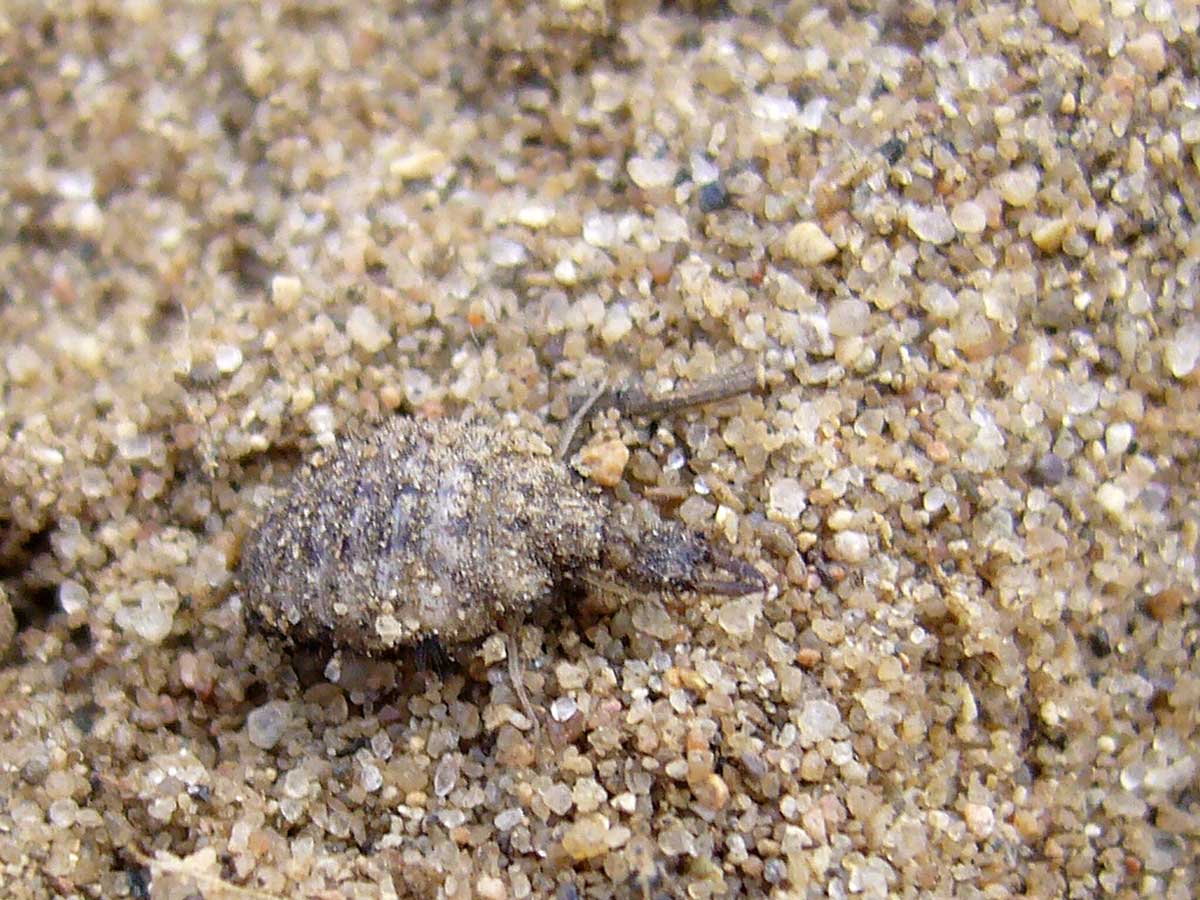
Myrmeleon_sp_P1020915_2

…now you don’t!
Myrmeleon_sp_P1020914_2

In a previous post, I lamented the fact that I had never actually seen a live antlion larva, or doodlebug (family Myrmeleontidae). Lovers of sand, I’ve seen their famous pitfall traps many times, especially in recent years as I’ve searched sand habitats for my beloved tiger beetles. Occasionally, I’ve stopped to jab my knife under a pit, give it a quick flip, and search the freshly turned sand for the maker of the pit – never seeing anything. It never bothered me much either – there were always beetles to catch!  Two weeks ago I returned to the sand prairies of southeastern Missouri to look for additional sites for Cicindela scutellaris (festive tiger beetle), and as we searched one particular site on the Sikeston Sand Ridge I once again saw the characteristic funnel-shaped pits amongst sparse vegetation in the sandy soil.  I decided this time I needed to give it a good effort – how can any self-respecting entomologist accept not having ever seen a live doodlebug?  As I’d done many times before, I kneeled down, gently put the tip of the knife about an inch away from the edge of the pit, and then jabbed its full length assertively into the sand and under the burrow and flipped it over.  Like previous times, I studied the turned sand and saw nothing.  I stirred the sand gently with the tip of the knife and studied it again – nothing.  I tried another burrow – again, nothing.  I decided right then and there that I was doing something wrong – I could not simply be picking ’empty’ pits.  I continued staring at the turned sand, and then I saw movement – I looked closer, and it seemed as though the sand itself was moving.  At last I made out its outline – I had finally succeeded in finding a doodlebug!  I dug up another burrow, and knowing what I was looking for this time I had no problem quickly locating the little creature.  I watched it as it lay motionless – perfectly camouflaged by its color and with sand grains sticking to its body, and chuckled as it buried itself almost instantly with a quick, backwards shuffle into the sand. Who knows how many doodlebugs I’d successfully dug up in the past, completely overlooking them as they lay disguised and motionless in the sand.

More than 100 species of antlions, representing at least 19 genera, live in the Nearctic Region, although much of this diversity occurs in the southwestern U.S. and Mexico.  Despite the commonly drawn association between antlions and pitfall traps, in North America only those in the genus Myrmeleon actually exhibit this behavior.  This larva dug a pit and so must represent a species of Myrmeleon – perhaps M. immaculatus, a common species in North America and one whose adult I observed last fall on a nearby sand prairie remnant.  Species in other genera have free-living larvae that hide under objects or roam underneath the sand, from where emerge briefly to hunt for prey.

For those interested in learning more about antlions, Mark Swanson has an excellent website called The Antlion Pit.

REFERENCE:

Swanson, M.  1996. The Antlion Pit: A Doodlebug Anthology. http://www.antlionpit.com/

Copyright © Ted C. MacRae 2009
Add to FacebookAdd to NewsvineAdd to DiggAdd to Del.icio.usAdd to StumbleuponAdd to RedditAdd to BlinklistAdd to Ma.gnoliaAdd to TechnoratiAdd to Furl

Newly emerged rabbit bot fly

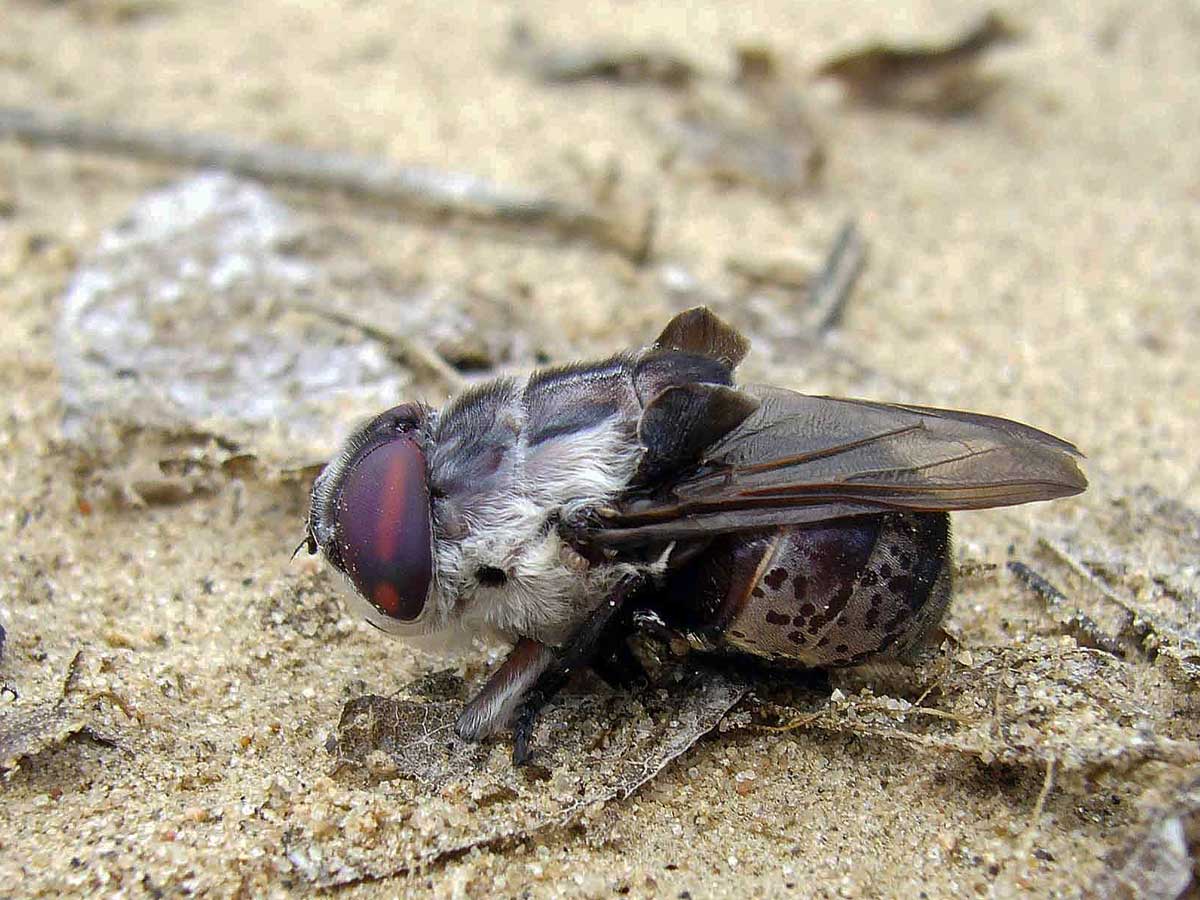
Cuterebra buccata_P1020896_2

First things first – congratulations to Mark Deering (Sophia Sachs Butterfly House, right here in St. Louis) and Rod Rood (Washington State University) for correctly identifying yesterday’s “What the heck?” as the cast puparium of an oestrid bot fly.  Mark eventually staked his claim on the genus Cuterebra, and Rod as well included this genus in his short list.  They are more astute naturalists than I – had I not found the newly emerged adult right next to it, I doubt that I would have known or figured out what it was.  Thanks also to the many other people who played the game – most were united in thinking it was some kind of insect, with many noting its distinctly abdominal appearance.  It seems, at least among my readers, that shed insect cuticle is a more popular quiz subject than plants.

Cuterebra buccata_P1020891_2I encountered this individual on open sandy ground while searching for my beloved  southeastern Missouri festive tiger beetles.  When I first saw the adult, it was on its back on the ground, feebly waving a couple of legs in the air.  I at first thought it was some kind of clumsy beetle but realized what it was as I approached it.  Clearly the fly was in distress, and I thought it odd that the puparium was laying on the ground next to it.  Bot flies in the genus Cuterebra have among the most deliciously gruesome of all insect life histories.  The ultra short-lived adults (lacking even functional mouthparts) lay their eggs near rodent and lagomorph burrow entrances, with the different species showing a fair degree of host specificity (Catts 1982).  When the fly larva hatches, it migrates to the host and enters the animal’s body through a natural orifice or break in the skin.  It then finds a subcutaneous location to feed, creating a cyst-like structure within a swelling of subcutaneous tissue and with a hole at the skin surface to allow respiration.  Once mature, the larva exits and drops from the host and burrows into the ground for pupation. We could find no emergence hole nearby, so perhaps the puparium was exposed by rain prior to emerging and suffered some desiccation, or perhaps the adult had gotten stuck in the tough puparium and pulled it to the surface as it emerged – burning its limited energy reserves in the process. At any rate, it is rather unusual to find these things emerging with the pupal case.

Cuterebra buccata_P1020894_2Cuterebra spp. are known collectively as New World skin bot flies (formerly family Cuterebridae, but now classified as a subfamily of Oestridae).  I suspected this was the rabbit bot fly (C. buccata) due to its general appearance – notably the red bands in the eyes, which is a characteristic of rabbit-infesting species.  However, the genus is diverse, with 34 recognized North American species – seven of which belong to the rabbit-infesting group (Sabrosky 1986).  I don’t have a copy of Sabrosky’s revision, and my efforts to locate it electronically turned up only retail listings for $70 or more.  That’s serious coin for someone who really needs to stay focused on his beetles, so I sent these photographs to bot fly specialist Jeff Boettner at the University of Massachusetts.  Jeff confirmed that it is indeed a Cuterebra rabbit bot and will confirm a species identity after checking his collection.

Jeff also sent the following note and interesting link:

Speaking of red eyed bots…there is one on Bugguide that a woman from NM posted. It is Cuterebra mirabilis and it may be the rarest photo on BugGuide. It’s only known from 2 previous specimens (also from NM). Its the largest of the rabbit bots. Much darker than yours.

Jeff notes that “mirabilis” in Latin means “extraordinary” – a truly appropriate name for this beautiful insect. Even though I am a devout coleopterist, I must confess – cuterebrids rock!

REFERENCES:

Catts, E. P.  1982.  Biology of New World bot flies: Cuterebridae.  Annual Review of Entomology 27:313-338.

Sabrosky, C. W. 1986. North American species of Cuterebra, the rabbit and rodent bot flies (Diptera: Cuterebridae). Entomological Society of America Thomas Say Foundation Monograph, College Park, Maryland, 240 pp.

Copyright © Ted C. MacRae 2009

Add to FacebookAdd to NewsvineAdd to DiggAdd to Del.icio.usAdd to StumbleuponAdd to RedditAdd to BlinklistAdd to Ma.gnoliaAdd to TechnoratiAdd to Furl

Wednesday “What the heck?”

p1020893_2

This might be the hardest nature quiz ever – I don’t think I would’ve ever figured out what this was had I not found what I did next to it.  I found it on my recent trip to look for Cicindela scutellaris (festive tiger beetle) in southeastern Missouri. Of course, now knowing what it is, the image does seem to provide enough clues about its identity – perhaps some crack naturalist will figure it out.

I’ll provide the answer with additional photos tomorrow.

Copyright © Ted C. MacRae 2009

Add to FacebookAdd to NewsvineAdd to DiggAdd to Del.icio.usAdd to StumbleuponAdd to RedditAdd to BlinklistAdd to Ma.gnoliaAdd to TechnoratiAdd to Furl