A cicada that snaps, crackles, and pops!

Last summer during a collecting trip through the western Great Plains, field partner Jeff Huether and I made a quick stop in the foothills of the Rocky Mountains just a few miles north of the Colorado/New Mexico state line. Most of the woody vegetation turned out to be New Mexico locust (Robinia neomexicana), which can be a good host for certain species of jewel beetles and longhorned beetles, and since it was mid-late June the timing was also right (assuming there had been good rains in the area). We began beating branches, picking up regular numbers of small longhorned beetles in the genus Sternidius and jewel beetles in the genus Agrilus—nothing unexpected. As I was beating I happened to notice a cicada sitting in a branch in a nearby tree. Usually I don’t see cicadas until they take flight after I unknowingly approach them—more often than not also letting out a metallic screech as they take flight if they are male, and even if I do see them beforehand I rarely am able to get close enough to attempt capture, much less photography. Perhaps the morning temps still had not risen to a point sufficient for the more active behaviors with which cicadas are usually associated.

Platypedia putnami

Platypedia putnami | Las Animas Co., Colorado

The slender, hairy, black body, orange highlights and pronotal collar, and black eyes identify this as a member of the genus Platypedia, and while the genus is large—21 species and four subspecies in western North America (Sanborn & Phillips 2013), its gestalt and occurrence in south-central Colorado make P. putnami the likely choice. Cicadas, of course, are famous for their singing abilities, which is most commonly accomplished through the use of structures at the base of the male abdomen called timbals (or ‘tymbals’). These paired, ribbed membranes make a loud click when buckled, and the male uses musculature to rapidly and rhythmically buckle/unbuckle the timbals to produce their characteristic song (Young & Bennet-Clark 1995). Cicadas of the genus Platypedia, however, belong to a group of genera that have lost the ability to produce sound through timbal organs, instead communicating through an alternate mechanism of sound production called crepitation where the wings are snapped together above the body or banged against the body or on vegetation (Sanborn and Phillips 1999). (Think of the snapping sound that some grasshoppers make as they fly, which is produced by the same mechanism.) You can hear the sound (I can’t really call it a ‘song’) and see a collection of videos of these cicadas at Cicada Mania.

Of course, replacement of one sound production mechanism by another begs the question—is there a selective advantage to sound production by crepitation over timbals? The fact that females also produce sound by crepitation hints at one possible advantage—2-way communication between males and females may provide another mechanism for minimizing the chance of interspecies mate selection, in contrast to the one-way communication (from males to females) that occurs in species that use timbal organs. It is also possible that crepitation is metabolically more efficient than timbal singing, although experimental comparisons of the energetic cost of crepitation versus timbal singing in cicadas are lacking (Sanborn & Phillips 1999).

REFERENCES:

Sanborn, A. F. & P. K. Phillips. 1999. Analysis of acoustic signals produced by the cicada Platypedia putnami variety lutea (Homoptera: Tibicinidae). Annals of the Entomological Society of America 92:451–455 [pdf].

Sanborn, A. F. & P. K. Phillips. 2013. Biogeography of the cicadas (Hemiptera: Cicadidae) of North America, north of Mexico. Diversity 5(2):166–239 [abstractpdf].

Young, D. & H. C. Bennet-Clark. 1995. The role of the tymbal in cicada sound production. The Journal of Experimental Biology 198:1001–1019 [pdf].

© Ted C. MacRae 2015

Why is this male carrion beetle “biting” one of the female’s antennae?

American carrion beetles (Necrophila americana) aggregating at sap flow on the trunk of an oak (Quercus sp.) tree.

American carrion beetles (Necrophila americana) aggregation at sap flow on trunk of oak (Quercus sp.) tree.

Earlier this spring I came upon an interesting aggregation of insects at a sap flow at the base of the trunk of a large oak (Quercus sp.) tree. Sap flows are famous for the diversity of insects that are attracted to them (e.g., see my previous post, Party on a pin oak), although the mix of species present can vary from sap flow to sap flow. In this case, the majority of insects present were American carrion beetles (Necrophila americana)¹ (order Coleoptera, family Silphidae), a species encountered much more often on animal carcasses (in fact, the genus name literally translates to “attracted to corpses“) but also occasionally attracted to sap flows (Evans 2014). This is not surprising to me, as I have seen adults regularly in the fermenting bait traps (Champlain & Knull 1932) that I have set out over the years (although I have been unable to find any reference to such attraction in the literature). I had never seen such an aggregation of these beetles before or even yet had the chance to photograph them (although I have photographed its Ceti Eel-like larva), so I paused to setup the camera and take a few photographs.

¹ Not to be confused with the federally endangered American burying beetle (Nicrophorus americanus).

Necrophila americana mating pair.

Necrophila americana mating pair.

Among the many single adults present was a mating pair, which I selected as my subjects. As I was photographing the pair, I noticed the male had a firm grasp of one of the female’s antennae within his mandibles. As I watched them through the lens, I saw the male suddenly release his hold of the female’s antenna, move backward on top of her, and begin using his own antennae to stroke her pronotum (sadly I was unable to snap a photograph at that time). As suddenly as he had released it, the male moved forward and grabbed hold of the female’s antenna once again. It seemed unlikely to me that this represented an act of aggression, but instead must be an important part of their courtship behavior. The female, for her part, did not seem to be bothered too much by the grasping and continued to slowly lumber about around the sap flow as the male went through his routine under my voyeuristic watch.

The male has a firm grasp of the female's antenna.

The male has a firm grasp of the female’s antenna.

Intrigued by this behavior, I searched for other photos of mating/coupled carrion beetles—easy to do considering the many pages of photographs of this species at BugGuide. While the great majority of those photos are of individual beetles, I found this photo and this one of coupled pairs, each also clearly showing the male firmly grasping one of the female’s antennae with his mandibles. Neither photo makes mention of the antennal grasping, but a little further searching did turn up this YouTube video of coupled American carrion beetles, again clearly showing the male grasping of the female’s antenna and even leading the videographer to comment, “Disturbingly, it even appears that this male is threatening to lop off the female’s left antenna if she refuses to mate!” Of course, retribution seems not to be a common behavior among insects, and in looking into this further I found a short note by Anderson (1989) in which the behavior is recorded not only for N. americana but also another silphid, Oiceoptoma noveboracense. Apparently mating actually occurred during the time the male had released his hold of the female’s antenna and was stroking her pronotum with his antennae. He further noted that the antennal grasping behavior continues until eggs and larvae are present at a carcass, at which time it is no longer observed. This suggests that the behavior represents an especially proactive form of “mate guarding” by which males actively ensure their paternity of the offspring of the particular female with which they were mating.

REFERENCES:

Anderson, R. S. 1989. Potential phylogenetic utility of mating behavior in some carrion beetles (Coleoptera: Silphidae: Silphinae). The Coleopterists Bulletin 43(1):18 [pdf].

Champlain, A. B. & J. N. Knull. 1932. Fermenting bait traps for trapping Elateridae and Cerambycidae (Coleop.). Entomological News 43(10):253–257.

Evans, A. V. 2014. Beetles of Eastern North America. Princeton University Press, Princeton, New Jersey, 560 pp. [Google Books].

© Ted C. MacRae 2015

Multiple Megarhyssa males

Today while hiking at Hilda Young Conservation Area (north-central Jefferson County, Missouri), I encountered a declining sugar maple (Acer saccharum) with lots of woodboring insect holes in the trunk. As I approached I noticed numerous giant ichneumon wasps in the genus Megarhyssa flying about the trunk and resting on its surface. Giant ichneumons belong to the family Ichneumonidae and are, as the name suggests, the largest members of the family in North America. Interestingly, all of the wasps that I initially saw were males. I have never seen male giant ichneumon wasps before, and certainly not in such numbers, so this was quite exciting. We have two species of giant ichneumons here in Missouri—M. atrata and M. macrurus, the females of which I have seen only rarely, but I couldn’t immediately decide which of these two species the males represented. I looked up higher on the trunk, and there I saw a female M. macrurus in the act of oviposition, so I decided that the males must also represent this species. However, one of the males was smaller and differently colored than the others, having more brown than black on the body and the wings clear with a well developed spot on the costal margin. The other males were noticeably larger and had more black than brown on the body and the wings smoky with only a narrow spot on the costal margin. After a little bit of digging, I know believe that the smaller male is also M. macrurus—the same species as the ovipositing female, while the larger males all represent the larger species M. atrata.

Megarhyssa macrurus (male) | Hilda Young Conservation Area, Jefferson Co., Missouri

Megarhyssa macrurus (male) | Hilda Young Conservation Area, Jefferson Co., Missouri

Megarhyssa atrata (male) | Hilda Young Conservation Area, Jefferson Co., Missouri

Megarhyssa atrata (male) | Hilda Young Conservation Area, Jefferson Co., Missouri

As I watched the males that had landed on the trunk of the tree, I observed both the M. macrurus male and one of the M. atrata males to bend their abdomen forward beneath their body rub the tip of the abdomen against the bark, a behavior called “tergal stroking”, and at times inserted the tip of the abdomen into cracks in the bark in an almost prehensile-looking manner. These behaviors belong to a suite of behaviors exhibited by male Megarhyssa aggregations. Previously thought to be function in early insemination of as-yet-unemerged females, the precise function of these behaviors remains unknown but seems somehow related to enabling sex discrimination of emerging wasps and/or increasing the rate at which virgin females are encountered (Matthews et al. 1979).

All species of Megarhyssa parasitize the woodboring larvae of Pigeon horntails (Tremex columba) (order Hymenoptera, family Siricidae), which the females reach by inserting their long, thin ovipositor deep into the wood where the horntail larvae live. Multiple species of giant ichneumons occurring in the same area at the same time and utilizing the same resource seems to violate a basic ecological concept; the competitive exclusion principle, which states that two species competing for the same resource cannot coexist at constant population values because one species will always eventually outcompete the other. In the case of Megarhyssa, it seems that size differences between the species allow them to share a common resource (horntail larvae), as females of the larger M. atrata have longer ovipositors than the smaller M. macrurus, thus allowing them to penetrate deeper into the wood to parasitize horntail larvae that M. macrurus females cannot reach. By the same token, M. macrurus females tend to parasitize horntail larvae tunnel at shallower depths and that tend not to be utilized by M. atrata females.

REFERENCE:

Matthews, R. W., J. R. Matthews & O. Crankshaw. 1979. Aggregation in male parasitic wasps of the genus Megarhyssa: I. Sexual discrimination, tergal stroking behavior, and description of associated anal structures behavior. The Florida Entomologist 62(1):3–8 [pdf].

© Ted C. MacRae 2015

A little extra cash

Earlier this month the Webster Groves Nature Study Society (WGNSS) sponsored their second Nature Photo Contest. I’ve been a member of this group since I first moved to St. Louis after college in the early 1980s—primarily as a participant in the Entomology Natural History Group but for the past six years also as board member and editor of the Society’s newsletter, Nature Notes. The photo contest was run much like the first one in 2013, again with nice cash prizes for the winners, except two things: 1) the categories were a little different (see below), and 2) I was tapped to be one of the three judges in the two categories that I did not submit photos. The categories were:

  • Invertebrates
  • Vertebrates
  • Plants & Fungi
  • Natural Communities
  • Seasons

I submitted two photos each to the first three categories—the maximum allowed in both cases. One limitation for me was that the photographs had to be taken in Missouri or an adjacent state. Remarkably, during the past few years I’ve taken most of my photos in places further afield—primarily in the western U.S. in states such as California, Colorado, New Mexico, and Nevada. I have many photographs from earlier years, but frankly I don’t consider much of that body of work to be photo contest worthy. Still, I was able to come up with a few more recent photographs that I thought would be competitive.

How did it go for me? Pretty good, with two of my photos taking cash-winning prizes (see below). This may not be as good as I did last time, when I won one 1st place, one 2nd place, and one 3rd place—the last of these also voted by the audience as the Grand Prize winner. Nevertheless, the cash award is much welcomed and will be put to good use. Remarkably, it turns out that two winning photographs have never been posted at this site, so here they are:


3rd Place—Vertebrates

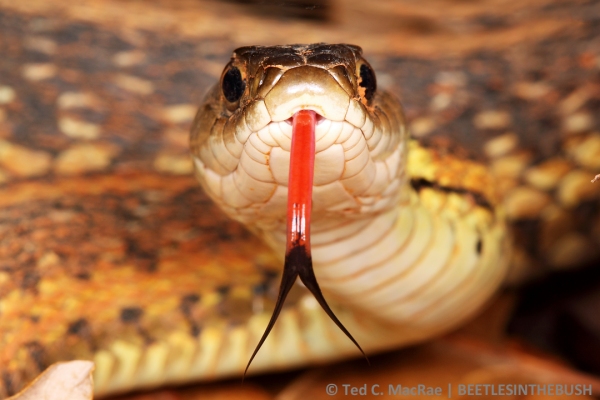
Eastern garter snake (Thamnophis sirtalis)

Eastern garter snake, Thamnophis sirtalis | Ozark Trail, Wappapello Section, Wayne Co., Missouri

The judges regarded that it represents the true “essence” of a snake. Technically they liked the position of and focus on the tongue, the contrasting red color working well in the composition, with the blurred, winding body of the snake adding depth in a cleaner fashion than a cluttered jumble of leaves. I can’t tell you how many shots I took hoping to get one with the tongue in the perfect position—knowing all along that at any moment the snake could stop flicking it or decide to make a run for it


2nd Place—Plants & Fungi

Dicentra cucullaria

Dutchman’s breeches, Dicentra cucullaria | Battle of Athens State Park, Clark Co., Missouri

Unfortunately, I didn’t get a chance to hear the judges’ feedback regarded this photo, as I was busy judging the photos in the ‘Natural Communities’ and ‘Seasons’ categories. This photo also took many shots, even though I didn’t have to worry about the subject not cooperating. Flash on white is tricky—not enough and you don’t get the stark contrast with the black background; too much and you end up blowing the highlights and losing the delicate detail. Add to that trying to get the subject perfectly symmetrical within the frame (I wanted to achieve this ‘for real’ and not through subsequent cropping), and I probably took close to two dozen shots before I felt like I had it right.

Perhaps you noticed that neither of the photos were in the ‘Invertebrates’ category. This just goes to show that the amount of interest in and effort one puts into a certain type of photography does not guarantee success—or prevent success in photographing other, less-familiar subjects. For my part I am pleased that any of my photographs were deemed good enough to receive a cash prize and thank WGNSS for giving local nature photographers the opportunity to have their work recognized and rewarded.

© Ted C. MacRae 2015

Cover Photo—The Coleopterists Bulletin 69(1)

cso69-1co14.indd

The March 2015 issue of The Coleopterists Bulletin (vol. 69, no. 1) is out now (I got mine yesterday), and while I’m always happy to see the latest issue of this journal in my mailbox I am especially pleased with this one because it features my photograph of an adult female Crossidius coralinus fulgidus on flowers of gray rabbitbrush (Ericameria nauseosa). I photographed this beetle in September 2011 near Vernal, Utah at the beginning of a trip with Jeff Huether to find and photograph endemic sand dune tiger beetles across the western U.S. We had just visited the dunes near Maybell, Colorado and were on our way to Idaho to visit the St. Anthony and Bruneau Sand Dune systems before dropping south to Coral Pink Sand Dunes in Utah and the Great Sand Dunes in Colorado. I was still a “Crossidius virgin” at that point—my first real Crossidius collecting trip would not come until two years later when Jeff and I visited the Great Basin and surrounding areas in a dedicated effort to find as many species/subspecies of Crossidius as possible (we succeeded in finding 12 of 14 targeted taxa). Having never seen C. coralinus before, you can imagine my excitement at seeing the spectacularly colored adults sitting atop flowers of their rabbitbrush host plants. I am especially fond of this photo, however, because it actually represents one of my earliest attempts to combine a natural blue sky background with a flash-illuminated subject—a technique I had learned from John Abbott just a few weeks earlier at the inaugural BugShot Workshop in Gray Summit, Missouri (just 15 miles from my home). I didn’t quite get the shade of blue I was looking for in this particular shot, but it’s close enough and the subject depth-of-field couldn’t be better. I have worked a lot on this technique since then and now consider blue sky background as part of my signature style.

This is the third issue of The Coleopterists Bulletin to feature one of my photographs on the cover. The first was the June 2013 issue (vol. 67, no. 2), which featured a beautiful, metallic green weevil, Eurhinus cf. adonis (2nd photo) that I photographed on flowers of Chilean goldenrod (Solidago chilensis) in northern Argentina, and the very next issue (September 2013, vol. 67, no. 3) featured my photograph of Chrysobothris octocola on dead mesquite (Prosopis glandulosa) in western Oklahoma (and a new state record).

If you’re not one already, consider becoming a member of The Coleopterists Society (I’ve been one for 33 years now!). Their flagship journal, The Coleopterists Bulletin, is your one-stop shop for all things beetley—a quarterly fix of pure elytral ecstacy! In addition to the latest issues of the journal, your membership also gives you online access to archives of past issues via JSTOR and BioOne.

© Ted C. MacRae

Flower ants? Check again!

Last spring while hiking the North Fork Section of the Ozark Trail in southern Missouri (Howell Co.), I made sure to check the abundant flowering dogwood (Cornus florida) blossoms that were in gorgeous peak bloom at the time (early May). I’ve learned to check flowers of dogwood whenever I can, as they are quite attractive to a variety of insects but especially those groups of longhorned beetles (family Cerambycidae) that tend to frequent flowers as adults. In the case of flowering dogwood, most of the cerambycids that I encounter belong to two genera: Molorchus and Euderces. Both of these genera are known for their great resemblance to small ants, no doubt representing examples of Batesian mimicry (where a harmless species adopts the appearance or warning signals of a harmful species to gain protection from predators).

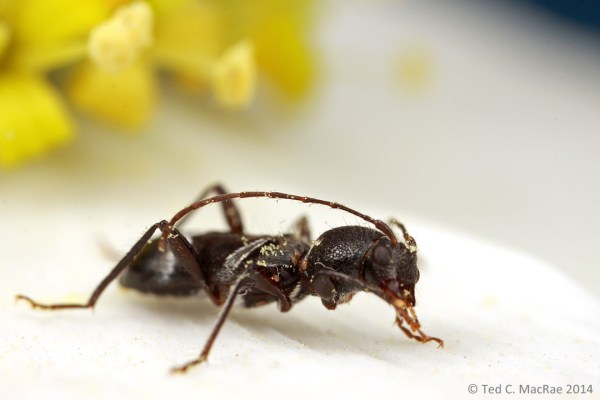
Tilloclytus geminatus

Tilloclytus geminatus on Cornus florida | North Fork Section, Ozark Trail, Howell Co., Missouri

During this particular hike I was determined to photograph Molorchus bimaculatus, common in Missouri during early spring on a great variety of flowering trees. On this day, however, the tiny (<10 mm length) beetles were rather scarce, and I had been frustrated in my attempts to get good photographs of the few that I had found. I’ve seen enough of these beetles over the years that I can recognize them quickly for what they are without the need to closely examine every “ant” that I see. So when I saw an “ant” that was too big and convex in profile to be Molorchus I almost discounted it as a true ant. Something about it, however, gave me pause, and when I looked closer I saw that it was, indeed, a longhorned beetle. But, it was not Molorchus, nor was it Euderces. Instead, it was the species Tilloclytus geminatus—an exciting find!

Tilloclytus geminatus

Adults in profile greatly resemble ants of the same size.

Tilloclytus geminatus has been recorded only sporadically from across the eastern U.S., where it has been reared from a variety of deciduous hardwoods (Craighead 1923, Rice et al. 1985). Perry (1975) did report rearing this species from Pinus virginiana (along with several other species normally associated with hardwoods); however, that record likely represents an ‘‘overflow’’ host (Hespenheide 1969) that is not typical of the species’ normal host preferences. I myself had never seen the species until the years after I published my checklist of Missouri cerambycids (MacRae 1994), having succeeded in rearing adults from a variety of previously unrecorded hardwood hosts that I collected at several localities across southern Missouri (MacRae & Rice 2007). It remains, for me, an infrequently encountered species—perhaps part of this a result of being overlooked due to its effective ant mimicry.

Tilloclytus geminatus

The anterior, oblique markings give the illusion of a constricted “waist”, while the posterior, transverse markings resemble the “sheen” of a shiny abdomen.

Unlike Molorchus and Euderces, this species has not been frequently associated with flowers as adults. In fact, the only report I am aware of is that of Rice et al. (1985), who reported adults on flowers of hawthorn (Crataegus sp.). Perhaps this additional find on Cornus is indicative of a true adult attraction to flowers by T. geminatus, although a single adult provides only weak support. However, a related ant-mimicking longhorned beetle—Cyrtophorus verrucosus—has been collected on flowers of roughleaf dogwood (Cornus drummondii) (MacRae 1994) as well as flowering dogwood (Scheifer 1998a). The floral attraction of ant-mimicking cerambycids may be more characteristic of species in the subfamily Cerambycinae, as only one flower record exists (Physocarpus opulifolius) for Psenocerus supernotatus (Wheeler & Hoebeke 1985) and none exist for Cyrtinus pygmaeus, both in the subfamily Lamiinae rather than Cerambycinae and the only other true ant-mimicking species in Missouri of which I am aware.

REFERENCES:

Craighead, F. C. 1923. North American cerambycid larvae. A classification and the biology of North American cerambycid larvae. Dominion of Canada, Department of Agriculture, Technical Bulletin No. 27 (new series), 239 pp. [Internet Archive].

Hespenheide, H. A. 1969. Larval feeding site of species of Agrilus (Coleoptera) using
a common host. Oikos 20:558–561 [JSTOR].

MacRae, T. C. 1994. Annotated checklist of the longhorned beetles (Coleoptera: Cerambycidae and Disteniidae) known to occur in Missouri. Insecta Mundi 7(4) (1993):223–252 [pdf].

MacRae, T. C. & M. E. Rice. 2007. Distributional and biological observations on North American Cerambycidae (Coleoptera). The Coleopterists Bulletin 61(2): 227–263 [pdf].

Perry, R. H. 1975. Notes on the long-horned beetles of Virginia, part III (Coleoptera: Cerambycidae). The Coleopterists Bulletin 29(1):59 [JSTOR].

Rice, M. E., R. H. Turnbow Jr. & F. T. Hovore. 1985. Biological and distributional observations on Cerambycidae from the southwestern United States (Coleoptera). The Coleopterists Bulletin 39(1):18–24 [pdf].

Schiefer, T. L. 1998a. A preliminary list of the Cerambycidae and Disteniidae (Coleoptera) of Mississippi. Transactions of the American Entomological Society 124(2):113–131 [JSTOR].

Wheeler, A. G., Jr. & E. R. Hoebeke. 1985. The insect fauna of ninebark, Physocarpus opulifolius (Rosaceae). Proceedings of the Entomological Society of Washington 87(2):356–370 [BioStor].

© Ted C. MacRae 2015

Just how widespread is Prionus heroicus?

On our insect collecting trip to the western Great Plains last June, Jeff Huether and I encountered several species of beetles in the genus Prionus—longhorned beetles (family Cerambycidae) known commonly as “prionid root borers”. I’ve already recounted our experiences with two of them—P. integer in southeastern Colorado and P. fissicornis in northeastern New Mexico, both of which we encountered unexpectedly and by the “bucketload” using prionic acid baited traps in shortgrass prairie habitats. The third species we encountered was also rather unexpected, so much so that we were not even sure about its identity until we examined the collected specimens more closely. Unlike the two previously mentioned species, however, the behavior of this third species—P. heroicus, especially regarding its attraction to prionic acid, was quite different, and one of the localities where we found it raises some interesting questions regarding its recorded distribution.

Prionus heroicus male

Prionus heroicus male | Mills Canyon, Harding Co., New Mexico.

Prionus heroicus is among the largest species in the genus, and we first encountered it in northeastern New Mexico while searching for suitable habitat around the small town of Mills (Harding Co.) where several grassland-associated species in the genus had been found by other collectors. While we were searching we were intrigued by the USDA Forest Service road sign pointing to “Mills Canyon” and decided to head down the gravel road to see what it looked like. A few miles down the road the endless shortgrass prairie quickly changed to sandstone canyonland with oak/pine/juniper woodland. By now it was late afternoon, and the rich, pulsing buzz of cicadas filling the air as we drove slowly through the area suggested the potential for good insect activity. We stopped to take a closer look at things, and within minutes an enormous prionid beetle came flying up to the car—apparently attracted to the prionic acid lures inside!  We netted the beetle, and shortly afterwards another beetle flew into the vicinity… and another! We hurriedly set out some lure-baited traps, and over the next hour or so we collected close to a dozen beetles. Our first thought, based on their large size and the presence of 12 antennal segments, was that they might be P. californicus. This was a bit of a letdown, as our goal was to find little known and uncommonly encountered Great Plains species, not common and widespread western species like P. californicus. However, the blackish rather than reddish color and relatively broad pronotum eventually convinced us that we had actually found P. heroicus—not a rare species, but also not something we expected to see at this relatively northeastern location compared to its usual haunts in southeastern Arizona.

Prionus heroicus male

Males generally landed in the vicinity of the prionic acid lures but seemed unable to locate its precise whereabouts.

Interestingly, none of the beetles came directly to the lure-baited traps but, rather, flew to the vicinity and then either circled broadly in the air or landed some distance from the trap and ran rapidly on the ground as if searching. We missed a few that we tried to net in mid-air, which responded by immediate straight line flight far away into the distance. Those that we watched while on the ground searched for up to several minutes but seemed unable to locate the lure, eventually taking flight and flying away. This suggests that prionic acid is more important as a component of the female’s calling pheromones for long distance detection, but that other components might be necessary to allow the males to locate females in the immediate vicinity. We returned to the site the following day around noon and were surprised to see males flying to our lures immediately after our arrival, since we had observed P. integer and P. fissicornis activity to occur almost exclusively during the morning and evening hours. Linsley et al. (1961), however, also note that adults of this species fly during the day, as well as at night. Again, none of the beetles seemed capable of finding the precise location of the lure.

Prionus heroicus male

Males rapidly searched the ground after landing but seemed unable to locate the lures and eventually flew off.

The larval habits of P. heroicus are not known, but the closely related P. californicus feeds on roots of living oaks or occasionally in dead oak logs or stumps (Linsley 1962). Prionus heroicus may have similar habits, since adult females have been found in leaf litter at the bases of living oak trees and stumps (Hovore & Giesbert 1976, Skiles 1978). Presumably the Mills Canyon population is associated with Gambel oak (Quercus gambelii), which was the only oak species noted at this location. An interesting defensive behavior was observed for an adult beetle that I kept alive and photographed later in the hotel room. I had put the beetle on a light-colored tray, and while I was getting the camera ready to take some shots the beetle began crawling away. I picked it up and put it back into position, and for a brief period it assumed the rather comical-looking “standing-on-its-butt” pose shown in the accompanying photograph. It maintained this pose for some seconds and then gradually lowered itself in the front before beginning to crawl again. If I poked it before it finished lowering itself it immediately pushed its front all the way back up again and held the pose briefly before beginning to lower itself again. I did not encounter this behavior in the field—beetles on the ground immediately tried to flee when I handled them and took flight if allowed to.
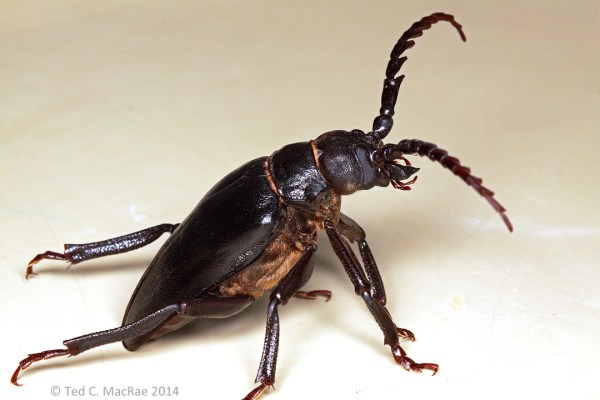
Prionus heroicus male

Defensive posturing as a result of being disturbed.

The story does not end here, however, as this would not be our last encounter with the species. While we were traveling back towards the east, we decided to visit the area around Black Mesa in the extreme northwestern corner of the Oklahoma panhandle. I had been to this site the previous summer, and although conditions were very dry at the time the presence of Gambel oak in the area—perhaps the easternmost outpost of this western species—had me thinking about the possibility of the area serving as an unknown eastern outpost for western species of jewel beetles (family Buprestidae). Conditions were once again dry, and no jewel beetles were found, but this quickly became a moot point as not long after our arrival a large prionid beetle came flying up to me—again in the same manner as P. heroicus at Mills Canyon and in the middle of the afternoon. We decided these, too, represented P. heroicus and remained in the area for the rest of the day, counting at least a dozen males attracted to the vicinity of the lures that we’d set out. As with the males we observed in New Mexico, none seemed able to find the precise location of the lure, and some circling only briefly and then flew off without even landing. Unlike New Mexico, however, we did succeed in trapping a few males in lure-bated traps that we set out overnight and checked the next morning.

Prionus heroicus male

This Prionus heroicus male  near Black Mesa, Oklahoma confirms the presence of this species in the state.

Our capture of P. heroicus at Mills Canyon in northeastern New Mexico and near Black Mesa in northwestern Oklahoma not only seems to suggest an association of this species with Gambel oak, but also confirms the previously questionable occurrence of the species in Oklahoma. Alexander (1958) reported the species (under one of its synonyms, P. tetricus) from Payne Co. in north-central Oklahoma. This record is dubious, since Payne Co. is well east of the 100th meridian and has a decidedly eastern flora, including its oaks. That record has not been mentioned by any subsequent authors addressing the overall distribution of P. heroicus (Linsley 1962, Chemsak 1996). The presence of P. heroicus in the Black Mesa area, with its decidedly western flora, does not necessarily give credence to the Payne Co. record, but it does bring up the question of just how broadly distributed P. heroicus really is. Most records of this species are from mountainous areas of southern Arizona and New Mexico, but more recently it has been recorded from Texas (Big Bend National Park) by Van Pelt (1999, 2007) and extreme northwestern Colorado (Moffat Co.) by Heffern (1998). The latter record is particularly interesting, as this represents a considerable range extension from any previously recorded locality and begs the question regarding its occurrence in other parts of Colorado.

REFERENCES:

Alexander, D. R. 1958. A preliminary survey of the cerambycids (Insecta: Coleoptera) of Oklahoma. Proceedings of the Oklahoma Academy of Science 38:43–52 [pdf].

Chemsak, J. A. 1996. Illustrated Revision of the Cerambycidae of North America. Volume I. Subfamilies Parandrinae, Spondylidinae, Aseminae, Prioninae. Wolfsgarden  Books, Burbank, California, x + 149 pp., plates I–X [description].

Heffern, D. J. 1998. Insects of Western North America 1A Survey of the Cerambycidae (Coleoptera) or Longhorn Beetles of Colorado. Gillette Museum of Arthropod Diversity, Department of Bioagricultural Sciences and Pest Management, Colorado State University, Fort Collins, i + 32 pp., 1 color plate [summary].

Hovore, F. T. & E. F. Giesbert. 1976. Notes on the ecology and distribution of western Cerambycidae (Coleoptera). The Coleopterists Bulletin 30:350 [JSTOR].

Linsley, E. G. 1962. The Cerambycidae of North America. Part II. Taxonomy and classification of the Parandrinae, Prioninae, Spndylinae, and Aseminae. University of California Publications in Entomology 19:1–102, 1 plate [OCLC WorldCat].

Linsely, E. G., J. N. Knull & M. Statham. 1961. A List of Cerambycidae from the Chiricahua Mountain area, Cochise County, Arizona (Coleoptera). American Museum Novitates 2050:1–34 [pdf].

Skiles, D. D. 1976. Taxonomy and description of two prionine Cerambycidae from southern Arizona: a new species of Stenodontes and new status for Neomallodon arizonicus (Coleoptera). Proceedings of the Entomological Society of Washington 80:407–423 [Biodiversity Heritage Library].

Van Pelt, A. F. (ed.). 1999. Inventory of insects of Big Bend National Park, Texas. Big Bend Natural History Association, Big Bend National Park, and Texas.

Van Pelt, A. F. (ed.). 2007. Inventory of insects of Big Bend National Park, Texas. Report to Big Bend National Park, 204 pp.

© Ted C. MacRae 2015

Mexican Siesta

Summertime is go time for most entomologists, especially those who conduct field work both as a profession and as a hobby. Far flung field sites and the need to travel between them eats up most of each week, while on weekends clipboard and spreadsheets are exchanged for beating sheet and hatchet before traveling to other sites with the promise of some cool species of beetles. Even the most peripatetic entomologist, however, needs a break, and in late July I packed up my swim trunks, rounded up the girls, and headed off for a week of rest and relaxation on the beaches of Cabo San Lucas, Mexico.

Of course, you’re not a real entomologist if you don’t sneak off once or twice for a peak at the local flora and fauna with a vial that just happens to be in your pocket. Despite the rampant development in the area, reasonably extensive parcels of the original San Lucan xeric scrub habitat are accessible to those willing to hike a few miles up the beach. This unique, dry shrubland occurs only at the southern tip of the peninsula, extending from the coast up to about 250 meters in elevation. About ten percent of San Lucan scrub biota is endemic as a result of separation from more northern parts of the peninsula until the Miocene (23–5 mya). Xeric scrub is normally dry, brown, and dusty, but rains prior to my visit had created a verdant landscape with (relatively) lush foliage and an abundance of flowers. Insects were strangely scarce, however, save for a nice diversity of heavily sculptured darkling beetles (family Tenebrionidae), which I encountered along 2-tracks running through the habitat, and a few wood-boring beetles that were found on recently wind-thrown branches of palo verde (Cercidium floridum).

Chrysobothris octocola | Cabo San Lucas, Baja California Sur, Mexico

Chrysobothris octocola on Cercidium floridum ssp. peninsulare | Cabo San Lucas, Baja California Sur, Mexico

Adults were numerous on fresh wind-thrown branches of Cercidium floridum ssp. peninuslare

Adults ran rapidly on the fresh wind-thrown branches

Given the level of endemism in the area, I was hoping the beetles would prove to be examples of such, or at least species restricted to Baja California that I had not encountered before. Alas, both proved to be not only more widespread in Mexico but species occurring commonly in the southwestern U.S. as well. I suppose finding endemic species right off the bat after a quick jaunt up the beach while on a family vacation is a bit much to expect, although I suspect the palo verde trees on which I found the beetles represents the endemic subspecies Cercidium floridum ssp. peninsulare. And I got some nice photos.

Stenosphenus sobrius | Cabo San Lucas, Baja California Sur, Mexico

Stenosphenus sobrius on Cercidium floridum ssp. peninsulare | Cabo San Lucas, Baja California Sur, Mexico

This species was not as abundant on Cercidium branches as Chrysobothris octocola

Adults were found resting on the undersides of fresh wind-thrown branches

© Ted C. MacRae 2015