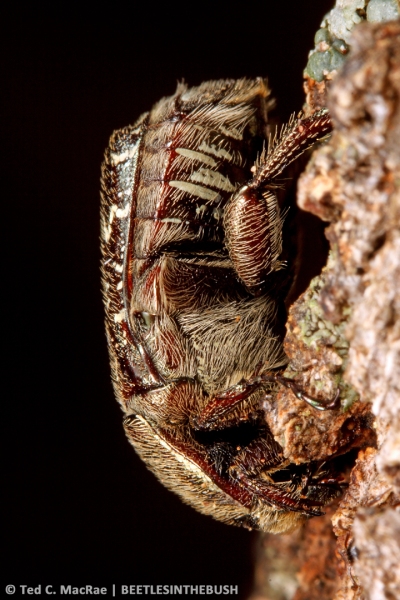
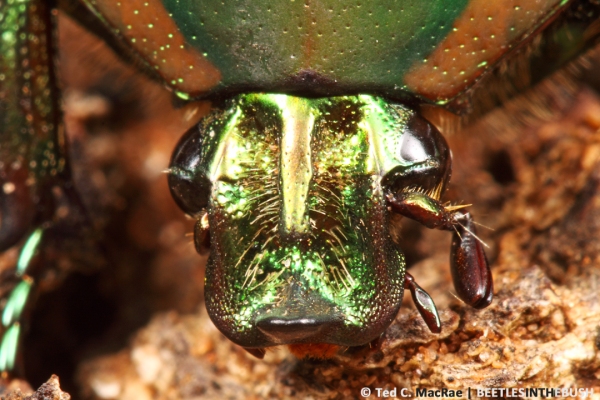
Hairy milkweed beetle

Across the Great Plains of North America, sand dune fields dot the landscape along rivers flowing east out of the Rocky Mountains. Formed by repeated periods of drought and the action of prevailing south/southwest winds on alluvium exposed by uplifting over the past several million years, many of these dunes boast unique assemblages of plants and animals adapted to their harsh, xeric conditions. Some are no longer active, while others remain active to this day. Among the latter is Beaver Dunes in the panhandle of northwestern Oklahoma.

Beaver Dunes, Oklahoma

Beaver Dunes State Park, Beaver Co., Oklahoma

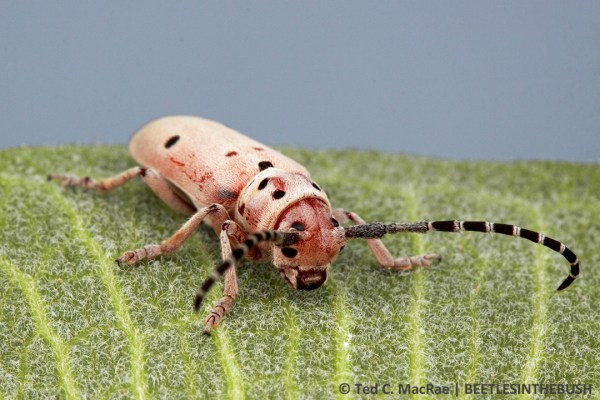
As I explored the more vegetated areas around the perimeter of the dunes, I spotted the characteristically hairy, fleshy, opposite leaves of Ascelpias arenaria. Known also as “sand milkweed,” this plant is associated with sand dunes and other dry sandy soil sites throughout the central and southern Great Plains. I always give milkweeds a second look whenever I encounter them due to the association with them by longhorned beetles in the genus Tetraopes. It wasn’t long before I spotted the black antennae and red head of one of these beetles peering over one of the upper leaves from the other side.

Tetraopes pilosus on Asclepias arenaria

Tetraopes pilosus on Asclepias arenaria | Beaver Dunes State Park, Oklahoma

This was no ordinary Tetraopes, however. Its large size, dense covering of white pubescence, and association with sand milkweed told me immediately that this must be T. pilosus (the specific epithet meaning “hairy”). Like its host, this particular milkweed beetle is restricted to Quaternary sandhills in the central and southern Great Plains (Chemsak 1963), and also like its host the dense clothing of white pubescence is presumably an adaptation to prevent moisture loss and overheating in their xeric dune habitats (Farrell & Mitter 1998).

Tetraopes pilosus

Species of Tetraopes have the eyes completely divided by the antennal insertions—thus, “four eyes.”

Tetraopes is a highly specialized lineage distributed from Guatemala to Canada that feed as both larvae and adults exclusively on milkweed (Chemsak 1963). Larval feeding occurs in and around the roots of living plants, a habit exhibited by only a few other genera of Cerambycidae but unique in the subfamily Lamiinae (Linsley 1961). Milkweed plants are protected from most vertebrate and invertebrate herbivores by paralytic toxins, commonly termed cardiac glycosides or cardenolides. However, a few insects, Tetraopes being the most common and diverse, have not only evolved cardenolide insensitivity but also the ability to sequester these toxins for their own defense. Virtually all insects that feed on milkweed and their relatives have evolved aposematic coloration to advertise their unpalatability, and the bright red and black color schemes exhibited by milkweed beetles are no exception.

Species of the genus Tetraopes are characterized by the completely divided eyes.

Adult beetles, like the leaves of their hosts, are clothed in white pubescence.

As  noted by Mittler & Farrel (1998), variation in coloration among the different species of Tetraopes may be correlated with host chemistry. Milkweed species vary in toxicity, with more basal species expressing simpler cardenolides of lower toxicity and derived species possessing more complex and toxic analogs. Most species of Tetraopes are associated with a single species of milkweed, and it has been noted that adults of those affiliated with less toxic milkweeds on average are smaller, have less of their body surface brightly colored, and are quicker to take flight (Chemsak 1963, Farrell & Mitter 1998). Thus, there seems to be a direct correlation between the amount of protection afforded by their host plant and the degree to which the adults advertise their unpalatability and exhibit escape behaviors. Asclepias arenaria and related species are the most derived in the genus and contain the highest concentrations of cardenolides. In fact, they seem to be fed upon only by Tetraopes and monarchs while being generally free from other more oligophagous insect herbivores such as ctenuchine arctiid moths and chrysomelid beetles that feed on less derived species of milkweed (Farrell & Mitter 1998). Accordingly, T. pilosus is among the largest species in the genus and has the majority of its body surface red. Also, consistent with it being more highly protected than others in the genus, I noted virtually no attempted escape behavior as I photographed this lone adult.

Asclepias arenaria

Asclepias arenaria (sand milkweed) growing at the base of a dune.

In addition to metabolic insensitivity to cardenolides, adult Tetraopes also exhibit behavioral adaptations to avoid milkweed defenses (Doussard & Eisner 1987). The milky sap of milkweed is thick with latex that quickly dries to a sticky glue that can incapacitate the mouthparts of chewing insects that feed upon the sap-filled tissues. Adult Tetraopes, however, use their mandibles to cut through the leaf midrib about a quarter of the way back from the tip. This allows much of the sticky latex-filled sap to drain from the more distal tissues, on which the beetle then begins feeding at the tip. Leaves with chewed tips and cut midribs are telltale signs of feeding by adult Tetraopes.

REFERENCES:

Chemsak, J. A. 1963. Taxonomy and bionomics of the genus Tetraopes (Coleoptera: Cerambycidae). University of California Publications in Entomology 30(1):1–90, 9 plates.

Doussard, D. E. & T. Eisner. 1987. Vein-cutting behavior: insect counterploy to the latex defense of plants. Science 237:898–901 [abstract].

Farrell, B. D. & C. Mitter. 1998. The timing of insect/plant diversification: might Tetraopes (Coleoptera: Cerambycidae) and Asclepias (Asclepiadaceae) have co-evolved? Biological Journal of the Linnean Society 63: 553–577 [pdf].

Linsley, E.G. 1961. The Cerambycidae of North America. Part 1. Introduction. University of California Publications in Entomology 18:1–97, 35 plates.

Copyright © Ted C. MacRae 2013

How to be an “iPhone nature photographer”

My passion for insect macro-photography is well known, so it may come as a surprise to learn that I have, during the past year or so, also become an avid “iPhone photographer”—i.e., I actually use my iPhone for “real” photography and not just selfies or quick snapshots. This is not to say that an iPhone can do everything that a digital SLR camera can do, especially when one considers the resolution of and wealth of lens options available for the latter. Nevertheless, as the world’s best selling smart phone, the iPhone has, by way of its camera function, also become the world’s best selling camera, and even though it cannot match the power of a dSLR, there are certain situations and types of photos for which the iPhone is perfectly adapted. Having gained some level of proficiency in learning what the iPhone can and cannot do when it comes to photography, I thought I would offer this photo set of a hike I did today along the Courtois Section of the Ozark Trail as a primer for the types of photos at which iPhones excel, along with some tips and tricks I’ve learned to get the most of the iPhone’s capabilities.

An iPhone is basically a fully automated, wide-angle camera (although the user can control exposure to some extent by touching the screen at the desired point). As such, it excels at landscape and general nature photos, and its small-diameter lens also allows some use for “wide-angle macro.” iPhones do not do well in low light situations or take true macro photographs (although one can use a variety of “clip-on” lenses to achieve fairly decent macro-photographs of larger insects—I have not tried this myself). As a result, I tend to use the iPhone mostly in good light situations and break out the big camera when the lighting is more challenging or if I want to take “real” macrophotographs. As with all digital photographs, good post-processing is necessary for making iPhone photos look their best, and in general a more aggressive approach than is typical for dSLR photographs will be required. The photos that follow are intended not only to give a flavor of the day’s hike, but also demonstrate my photographic approach and provide tips on composition, exposure, and post-processing. If you have gained experience in iPhone photography and have additional tips and tricks that you would like to share, I would greatly appreciate hearing about them in the comments.

Courtois Creek - immediately at the start we had to make a decision whether we could ford the creek. It was obviously too deep in most places, and we almost turned back, but then saw a path that looked like it might be passable. With air temps of 22F, we stripped off our pants, boots, and socks, packed them in our backpacks, and waded through frigid water that reached just below our hips before reaching the other side. Rich brought a towel, so we were able to dry off before getting dressed again. The whole process took almost a full half-hour.

Courtois Creek – immediately at the start we had to make a decision whether we could ford the creek. It was obviously too deep in most places, and we almost turned back, but then saw a path that looked like it might be passable. With air temps of 22F, we stripped off our pants, boots, and socks, packed them in our backpacks, and waded through frigid water that reached just below our hips before reaching the other side. Rich brought a towel, so we were able to dry off before getting dressed again. The whole process took almost a full half-hour.

This photo was taken into the sun, which can easily result in a washed out sky. To avoid this, I minimized the amount of sky in the photo (which also allowed the ripples in the foreground to be included for a sense of motion) and then touched the screen on the sky to set the exposure. This resulted in a dark photo, but it preserved the rich colors which could then be brought out with aggressive brightening and increasing the contrast in Photoshop. A standard set of commands that I generally use for all iPhone photos (slightly increased saturation, sharpening, and de-speckling) produced the finished version.

Bluffs along Courtois Creek - massive bluffs along the other side of the creek sported fallend boulders the size of dump trucks.

Bluffs along Courtois Creek – massive bluffs along the other side of the creek sported fallen boulders the size of dump trucks.

Another photo taken in the direction of the sun, causing the shadowed side of the rock to turn out very dark. Again I touched the screen on the sky to preserve the blue color and then aggressively lightened in Photoshop. Aggressive brightening generally requires a more aggressive increase in contrast, followed by the standard command set mentioned for the first photo.

We were feeling good about our decision to ford the creek as we hiked below spectacular bluffs.

We were feeling good about our decision to ford the creek as we hiked below spectacular bluffs.

This photo required fairly minimal post-processing since it was shot away from the sun and, thus, had decent native exposure. The bluff face was a little dark and needed minor brightening, but as always I set the exposure in the brightest area of the photo and then post-corrected the dark areas (this is much easier than the opposite, i.e., darkening areas that are too bright, as such areas are often blown and cannot be fixed).
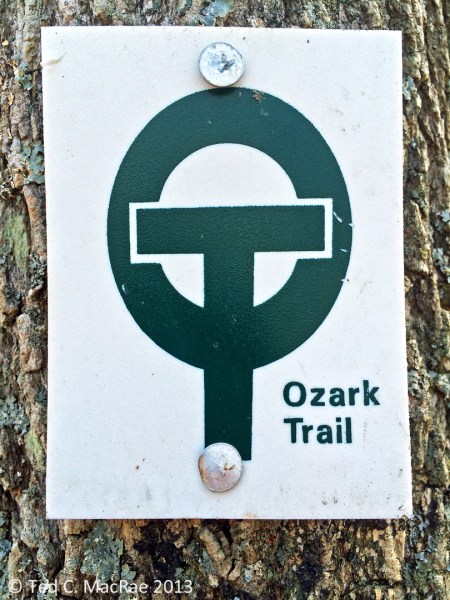
Ozark Trail blaze.

Ozark Trail blaze.

A very close-up shot of a trail blaze. The main watch out with such photos is to ensure the plane of the camera matches the subject precisely, otherwise distortion will cause elongation of one side (making the blaze a trapezoid rather than a rectangle). In post-processing I set the white point in levels by greatly magnifying the image and clicking on a very white part of the blaze to get a more natural looking white rather than the dirty gray that often results when shooting largely white subjects.

Blufftop view of Courtois Creek - from a vantage point several hundred feet above the creek we could look down on our crossing point. I have a fear of heights but nevertheless hung onto the treefall in front of me to inch out for a clear view.

Blufftop view of Courtois Creek – from a vantage point several hundred feet above the creek we could look down on our crossing point. I have a fear of heights but nevertheless hung onto the tree fall in front of me to inch out for a clear view.

This was another photo taken fairly towards the sun. I wanted just a thin band of sky to add a sense of scale to the downward-looking view, but with little sky the camera automatically wanted to expose for the darker foreground, thus blowing the sky. To prevent this, I tilted the camera up slightly to get more sky, touched the screen on the sky to set exposure, then tilted back down to the composition I wanted and took the shot. Post-processing involved aggressive brightening as described for the first two photos above.

Sapsucker damage on an old tree.

Sapsucker damage on an old tree.

I approached this tree from an angle facing the sun, so I simply waited until we passed it and could turn to place the sun behind me while shooting this tree. The trick is to get the right distance for a composition that doesn’t include too much wasted space at the foot of the tree or in its canopy, so this requires some walking back and forth until the right composition is achieved (I do not use the zoom function on the camera unless I have to because of the loss of resolution).
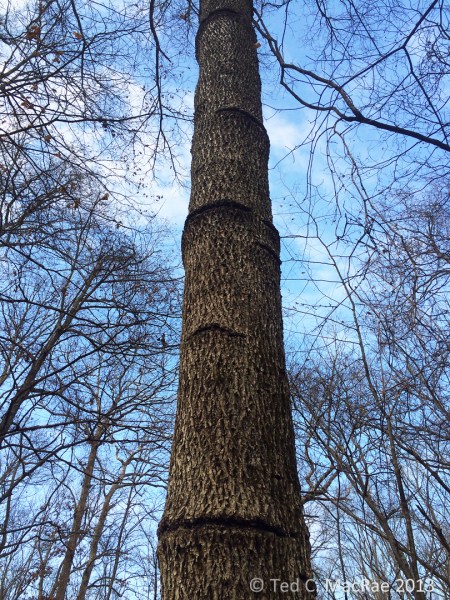
Close-up view of sapsucker damage. Obviously they have been using this tree for many years

Close-up view of sapsucker damage. Obviously they have been using this tree for many years

A closer view of the sapsucker damage—again this is mostly a compositional challenge, which I met by getting close enough to have this interesting “looking up” perspective but still far enough away to include the lowest ring of damage at the bottom of the photo and the highest at the top. Little post-processing other than the standard set was required for this sun-behind-me photograph.

Crystallifolia forms when water drawn from the soil by certain plants oozes out of the stem and contacts frigid air. Additional water pushes out the ice, then freezes itself, resulting in long, thin ribbons of ice that curl around themselves

Crystallofolia forms when water drawn from the soil by certain plants oozes out of the stem and contacts frigid air. Additional water pushes out the ice, then freezes itself, resulting in long, thin ribbons of ice that curl around themselves

For photographing crystallofolia and other small, ground-dwelling features, I like to turn the iPhone so that the lens is on the bottom edge to achieve a true ground-level perspective. The macro capabilities of the iPhone are limited, so in this case I used the zoom function (maybe about 1/3 to full zoom), centered the feature in the photo to get the best exposure and focus, and then did a little more cropping post-processing at the bottom of the photo to minimize the amount of blurred foreground. Again, a mostly white subject such as this tends to come out dull in the native photograph, so I enlarged the image greatly in Photoshop, opened Levels, clicked on set white point, and then clicked on the whitest portion of the subject that I could find to achieve a more ‘naturally’ white subject. It can take a few tries to find a spot in the image that doesn’t result in unnatural over-whitening of the subject—one must play around a bit to find it.

Crustose lichens abound on the dolomite bedrock exposures along the "Narrows" - a long, narrow ridge between the Courtois and Huzzah Creek Valleys.

Crustose lichens abound on the dolomite bedrock exposures along the “Narrows” – a long, narrow ridge between the Courtois and Huzzah Creek Valleys.

Again, I like to use a low perspective for ground features such as these lichen-encrusted rocks strewn across the forest floor. If you let the iPhone focus naturally, it tends to focus on subjects closer to the middle of the photo, so be sure to touch the screen on the foremost subject to set the focus in the foreground. Photos with contrasting colors such as the greens, browns, and blues in this one generally benefit from a little more aggressive increase in saturation (maybe 15-20%) than I normally use for iPhone photos (usually 5-10%).
Close-up view of crustose lichens.

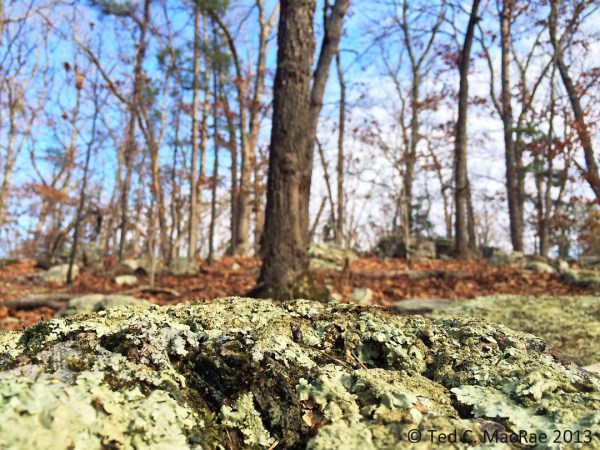
Close-up view of crustose lichens.

A semi- wide-angle macro photograph that combines a lichen encrusted rock in the foreground with forest and sky in the background. The camera will automatically focus on the background, so touch the screen at the top of the foreground object to set focus. It also helps to pan back a little bit to include more in the frame than is desired, then crop a little in Photoshop as the lower part of the foreground object will tend to be out of focus unless it is a perfectly vertical surface (rare). In this photo I cropped out about 1/5 from the bottom and a corresponding amount on each side to maintain original aspect ratio.

More dolomite exposures with crustose lichens.

More dolomite exposures with crustose lichens.

Highly dimensional foreground objects add depth and perspective to low-angle shots. Again, it is better to get a little more in the photo than desired and the crop slightly afterwards than to get too close and not be able to do anything about it. Taking the native shot a little further back also ensures that the entire foreground object is in focus.
Fruticose lichens and moss intermingle in particularly moist spots.

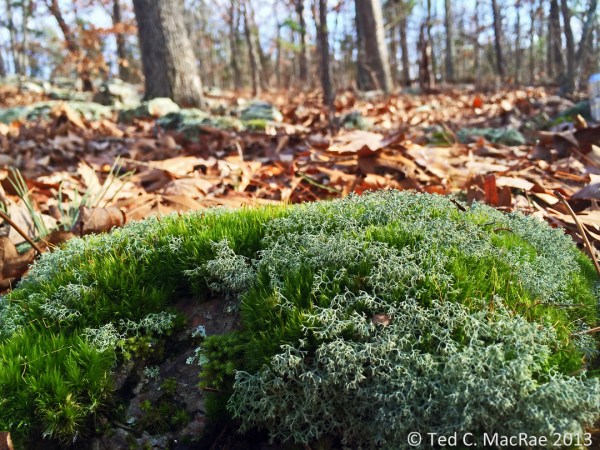
Fruticose lichens and moss intermingle in particularly moist spots.

Like the close-up photo of the lichen-encrusted rock above, this photo of intermingled moss and fruticose lichens benefits from a low perspective with a high color contrast immediate background (fallen leaves) and blurred deep background (forest/sky) to add perspective. While the latter is not completely blurred, but it’s enough that it doesn’t detract from the main subject. The latter has maximal focus by backing up slightly for the shot and then cropping off the bottom out-of-focus portion in Photoshop. Again, I increased saturation a little more than usual to emphasize the value contrast.
Friend and Ozark Trail co-conspirator Rich Thoma looks out over the Huzzah Creek Valley.

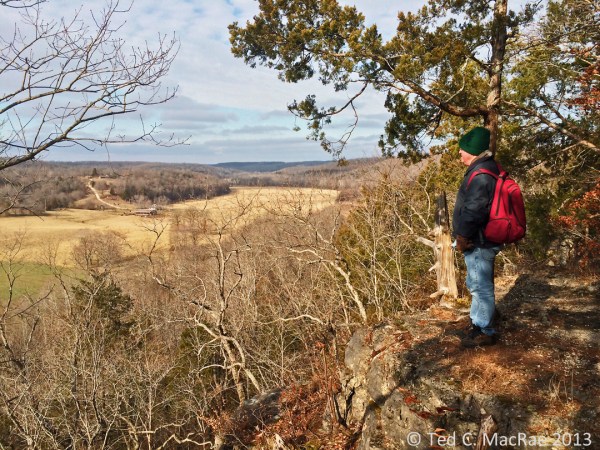
Friend and Ozark Trail co-conspirator Rich Thoma looks out over the Huzzah Creek Valley.

The main challenge with this photo was the shadow cast over Rich by the trees behind him. Setting the exposure on him resulted in a washed out sky, which I really wanted to preserve because of the textured clouds. I also wanted to include a good portion of the sky to give the sense of looking out over a far-below valley, so I set the exposure for the sky. The resulting photo had a good sky, but Rich was hidden in a darkly shadowed area. I used lighten shadows in Photoshop to brighten Rich and the shadowed area where he is standing, and I used aggressively increased saturation to make the many different shades of brown in the rest of the photo pop out.
An ancient red-cedar snag hugs the bluff tops overlooking the Huzzah Creek Valley.

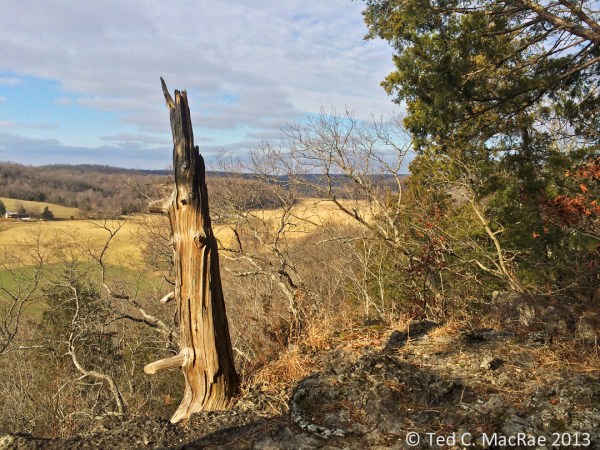
An ancient red-cedar snag hugs the bluff tops overlooking the Huzzah Creek Valley.

This photo had largely the same challenges and was dealt with in the same manner as the previous. The ancient red-cedar snag is an interesting and unusual subject, and I first tried a portrait orientation, but I decided I liked this landscape orientation better because of the ability to include living red-cedar to add a sense of time contrast.
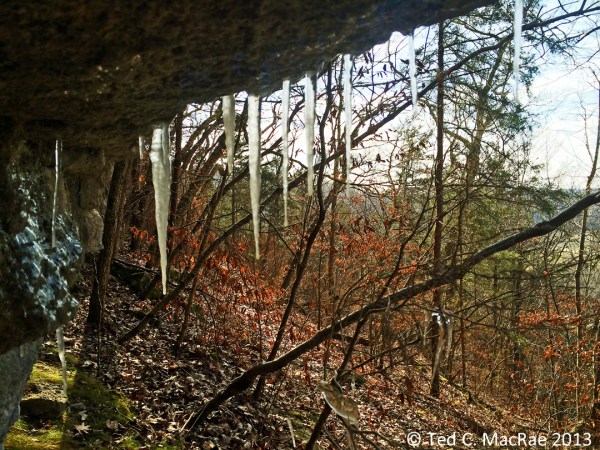
Icicles form on an undercut below the bluff top.

Icicles form on an undercut below the bluff top.

Whenever I find icicles hanging from a rock overhang, I like to provide a more unusual perspective by getting behind the icicles and looking out onto the landscape. It can be hard to get the camera to focus on the icicles rather than the distant landscape—just keep touching them on the screen until it works. I used shadow lightening in Photoshop to brighten the dark rock surfaces in the foreground.

A cap of resistant dolomite lines the top of the Huzzah Creek Valley.

A cap of resistant dolomite lines the top of the Huzzah Creek Valley.

This was a difficult photograph—sun on the pines/cedars on the left overexposed them, while shadows on the naturally dark rock bluff surfaces left them underexposed. This photo was made fairly acceptable by using both “darken highlights” and “lighten shadows” (careful—too aggressive with these features results in unnatural-looking photos), followed by brightening and increasing the contrast, and finally by increasing the saturation. It’s still not a great photo, but sometimes you get what you get.

More icicles.

More icicles.

This larger set of icicles was nicely positioned in front of an interestingly sloped landscape with the sun coming from the left. Again, I got behind them, kept touching the screen on the icicles until the iPhone focused on them, and then adjusted the white point setting in Levels in Photoshop to really make them pop against the rich browns of the landscape behind.

Icicles were especially abundant in this section of the bluff tops.

Icicles were especially abundant in this section of the bluff tops.

A fairly easy shot due to the direction of the sun that required no more than the usual amount of post-processing. Note the perspective, which was to have the rock feature begin right at the bottom left corner of the photograph with some sky above it.

Despite subfreezing air temperatures, sunlight causes water to drip from overhanging icicles, causing ice stalagmites on the ground beneath.

Despite subfreezing air temperatures, sunlight causes water to drip from overhanging icicles, causing ice stalagmites on the ground beneath.

This photo had some dark areas in the foreground that were cropped out, and to emphasize the ice I was more aggressive post-processing with brightening and increasing the contrast. Again, as with most photos with a lot of white in the subject, I adjusted the white point in Photoshop Levels to reduce the “dinginess” that seems natural for ambient light iPhone photos.

Icicles glisten in the frigid sunlight.

Icicles glisten in the frigid sunlight.

In this case, the sun glistening on the icicles and a deep recess behind them provided a natural contrast that I further emphasized in post-processing, along with brightening and setting white point. The icicles suffer from distortion due to my low angle (I’m not that tall!), which I tried to fix with Photoshop’s distort feature but wasn’t satisfied with the result.
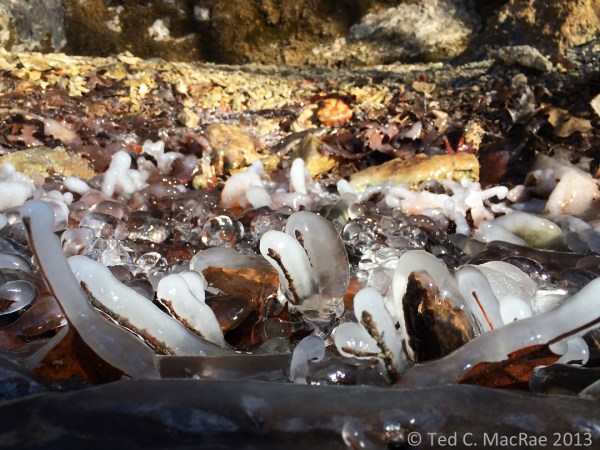
Close-up of ice stalagmites, revealing the twigs and petioles around which they have formed.

Close-up of ice stalagmites, revealing the twigs and petioles around which they have formed.

The approach with this photo was very much like that used for the close-ups of the lichen-encrusted rocks and intermingled lichens/moss photos—i.e., I backed up a bit to include more foreground than I wanted (which will be blurred at the bottom after setting the focus point on one of the stalagmites) and then cropped it out in post-processing. White subject = setting white point and using more aggressive brightening and contrast.
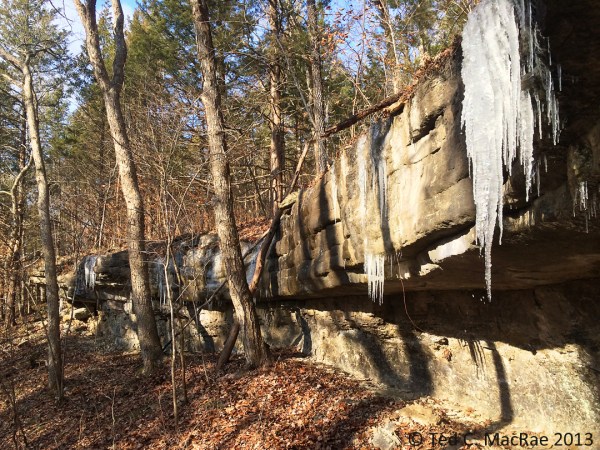
 Ted MacRae Yesterday ·  Rock, ice, and sunlight converge along the bluff tops


Rock, ice, and sunlight converge along the bluff tops

Again, the formation starts at the lower corner, and in this case the foreground (the right side) also contains an interesting clump of icicles. With the sun behind me, little was required to assure proper exposure, and only normal post-processing was required.

Moss with fruiting structures on a fallen log.

Moss with fruiting structures on a fallen log.

This moss on a fallen log was actually one of the more difficult photographs I took. I took the photo at an angle so that the background fruiting structures would form a solid, blurred red horizon to add depth, but in doing this the iPhone didn’t know where I wanted to focus and kept choosing the background. To force it to “choose” the foreground fruiting structures, I tilted the camera down so that only the foreground was in the frame, touched the screen on the fruiting structures in the back part of the screen to set focus where I wanted, then tilted the screen back again to include the background fruiting structures distant blurred background for perspective. One must shoot quickly when doing this or the iPhone will automatically readjust its focus to the background. I’ve tried shots such as this with the sky in the background, but in my experience the iPhone cannot focus on very thin foreground objects with the sky in the background, and the difference in brightness between the background and foreground is especially difficult to correct. Like the other semi- wide-angle macro shots above, I used the zoom feature (slightly), included a little more in the photo than I wanted, and then cropped out the overly blurred bottom portion of the photo.

Mushrooms on a fallen log.

Mushrooms on a fallen log.

Here is a typical photograph that someone might take of these large, saucer-sized mushrooms on a fallen log. In addition to being a pedestrian view of such a subject, it seems that iPhones sometimes have difficulty registering the correct color for photos taken straight down to the ground. This photo required quite a bit of color correction, and I’m still not overly satisfied with the result.
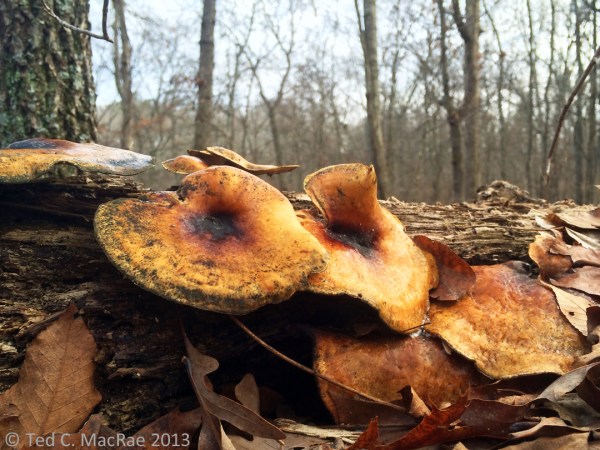
"Bug's eye" view of mushrooms on a fallen log.

“Bug’s eye” view of mushrooms on a fallen log.

As an alternative, I suggest getting low to photograph subjects such as this. The iPhone, with its lens against one edge and screen view, is well-adapted to take such low-angle photos, resulting in a much more interesting photo than the typical “looking down” perspective exemplified above. Inclusion of a little bit of sky in the background also provided some nice color contrast, made easier by shooting away from the sun, which was further emphasized in post-processing by increasing the saturation. As with the other semi- wide-angle macro photographs, a little bit of cropping along the bottom (but do keep the original aspect ratio) also benefited the photograph.

Moss covering the rock exposures in a delightful valley leading up from the Huzzah Creek Valley indicate an abundance of moisture.

Moss covering the rock exposures in a delightful valley leading up from the Huzzah Creek Valley indicate an abundance of moisture.

Last, but not least, this photograph of shaded, heavily moss-laden rock outcroppings bordering a small waterfall needed to be shot very dark in order to avoid “blowing” the sky in the background. Simply pointing and shooting into the shade will cause the iPhone to correctly expose the rocks, but the sky will be blown rather than retaining its blue color. Like the first two photos, I composed the image, then touched the screen on the sky to reduce the exposure. Again, this resulted in a photo that was very dark in the foreground, but this was easily corrected by aggressive brightening, adding contrast, and increasing the saturation post-processing to achieve a nice mix of browns and greens while preserving the blue sky background. In forest shots such as this with a lot of vertical objects, pay attention to distortion while composing the photo to avoid having trees at the edge of the photo “bowing” inwards at their tops. Sometimes this can be avoided by minor adjustments to the tilt of the iPhone while taking the shot, but if your position in the landscape is such that camera tilt alone is not enough to prevent this without losing the desired composition then go ahead and shoot the desired composition and use the “distortion” tool in Photoshop to correct the distortion this works best if bowing is minor).

I hope you have enjoyed this iPhone nature photography tutorial. If you have additional ideas or suggestions please let me know, and also I would be glad to hear of any related subjects you would like me to cover.

Copyright © Ted C. MacRae 2013

A polypipin’ we will go!

A polypipin’ we will go, a polypipin’ we will go
Heigh ho, the dairy-o, a polypipin’ we will go
A polypipin’ we will go, a polypipin’ we will go
We’ll catch a tiger beetle and put him in a vial
And then we’ll let him go (not!)

Okay, maybe my adaptation of the popular children’s song A Hunting We Will Go isn’t the best, but if you want to collect tiger beetles in the genus Tetracha then you’ve got to try the method that my friend Kent Fothergill has dubbed “polypipin’.”

The author polypipin’ in a soybean field in Starkville, Mississippi, September 2013. Photo by Lisa G. Ruschke.

What exactly is polypipin’? Well, it’s when you look for stuff under polypipe—a big plastic tube with holes in it that some farmers use to irrigate their crops. The tube is laid across one end of their field, and when water is pumped into it the water leaks out of the holes along the length of the tube and runs down the furrows between the rows. This is a popular method of irrigation in the Mississippi Delta because the terrain is flat and the equipment costs are much lower than center pivot irrigation systems. Of course, the tube also provides excellent cover for insects and other small critters that live in and around agricultural fields, and these include tiger beetles in the genus Tetracha.

Tetracha carolina under polypipe in a soybean field in Starkville, Mississippi

Tetracha carolina under polypipe in a soybean field in Starkville, Mississippi

I wish I could take the credit, but it was Kent who had the great idea to use polypipin’ as a way to survey for T. carolina (Carolina metallic tiger beetle) in the Mississippi Lowlands (“bootheel”) in southeast Missouri. This is a common species across the southern tier of the United States, but prior to this survey the occurrence of this species in Missouri was not well understood. While a number of specimens had been collected in the bootheel over the years prior to the survey, some regarded Missouri records of the species to be a result of vagrants migrating into the state rather than residents (Pearson et al. 2006). Tiger beetles in the genus Tetracha are nocturnal and take refuge during the day, so they are not often encountered unless one goes at at night with a flashlight. Kent was interested in determining the status of this species in Missouri and had noticed their tendency to take refuge under polypipe—where they could be easily found during the day by simply lifting up the pipe. Rather than give up on sleep, Kent and colleagues surveyed agricultural fields throughout the bootheel by looking under polypipe and demonstrated not only that T. carolina is well established in and a resident of the bootheel, but that it is actually quite abundant and may reside even further north in Missouri than just the bootheel (Fothergill et al. 2011).

Adults are amazingly calm if the polypipe is lifted carefully so as not to disturb them.

Adults are amazingly calm if the polypipe is lifted carefully so as not to disturb them.

I don’t know what it is, but there is just something really fun about polypipin’. Being an agricultural entomologist by day, I have ample opportunity to do a little polypipin’ of my own as I travel across the southern U.S. looking at soybean fields, including this past September when I found myself in fields with polypipe in Arkansas and Mississippi. These photos were taken in Starkville, Mississippi near the Mississippi State University campus, and as has happened in every other case where I’ve looked, I found adults of T. carolina quite abundant underneath the polypipe. Some were found simply resting on the soil surface beneath the pipe, but a great many were observed to have dug burrows under the pipe for added shelter.

Adults often construct burrows underneath the polypipe for additional refuge.

Adults often construct burrows underneath the polypipe for additional refuge.

Polypipin’ works as a survey tool for T. carolina because of that species’ propensity for agricultural fields and other moist, treeless habitats. I’ve not yet found T. virginica (Virginia metallic tiger beetle) under polypipe, but that species is more fond of forested rather than treeless habitats. Perhaps an agricultural field next to forest with polypipe laid on the side adjacent to the forest might produce this species. At any rate, polypipin’ might offer a tool to better define the entire northern distributional limit of T. carolina—all one has to do is look.

REFERENCE:

Fothergill, K., C. B. Cross, K. V. Tindall, T. C. MacRae and C. R. Brown. 2011.Tetracha carolina L. (Coleoptera: Cicindelidae) associated with polypipe irrigation systems in southeastern Missouri agricultural lands. CICINDELA 43(3):45–58 [pdf].

Pearson, D. L., C. B. Knisley & C. J. Kazilek. 2006. A Field Guide to the Tiger Beetles of the United States and Canada. Oxford University Press, New York, 227 pp. [Oxford description].

Copyright © Ted C. MacRae 2013

ID Correction: Megaloxantha bicolor palawanica

In a few previous posts (here and here), I used a particularly large jewel beetle specimen as a subject to test several different flash diffusers I was working on. I chose that particular specimen because of its large size (necessitating long subject-to-lens distance), bright colors, and brilliantly shiny surface—all features that complicate illumination with flash, thus revealing any weaknesses in the diffuser design. In those posts, I had used the name Megaloxantha pupurascens peninsulae, based on the identification label that was on the specimen when I received it; however, I recently received the following e-mail from Raymond “Ted” Frey:

Sir, This can not be Megaloxantha  purpurascens. The beautiful beetle shown  has  yellow/orange bulbous pronotal  areas. Purpurascens does not have these  yellow  ones.

A quick perusal of my limited literature on southeast Asian Buprestidae confirmed this to be the case—interesting, since I received the specimen (many years ago) from Yoshihiko Kurosawa of Japan. Kurosawa was a long-time buprestid worker who had described the subspecies indicated on the label in his revision of the genus Megaloxantha (Kurosawa 1978) (a paper which I did not know about before—but do now thanks to the internetz). Ted (not me, the other one) suspected that the beetle actually represented Megaloxantha bicolor palawanica, which he confirmed after I sent to him the dorsal habitus photograph shown below.

Megaloxantha bicolor palawanica (Kurosawa 1978b:215)

Megaloxantha bicolor palawanica Kurosawa 1978

This, too, is interesting, as M. b. palawanica was also described by Kurosawa in that very same work! Kurosawa was already at an advanced age when I had my exchange with him (early 1993) and is now deceased. I seriously doubt that Kurosawa actually misidentified the specimen, but rather committed a lapsus calami (“slip of the pen”) when preparing labels for the material he had assembled to send to me. We all do it—from a slip of the pen to an outright misidentification (and I wonder what future blog post will detail some error of mine!).

My thanks to Ted Frey for noticing the error and helping to correct it.

REFERENCE:

Kurosawa, Y. 1978. A revision of the buprestid beetles of the genus Megaloxantha Kerremans. Bulletin of the National Science Museum (Tokyo) series A, Zoology 4(3):207–232 [pdf].

Copyright © Ted C. MacRae 2013

Why did it take 30 years to collect these beetles?

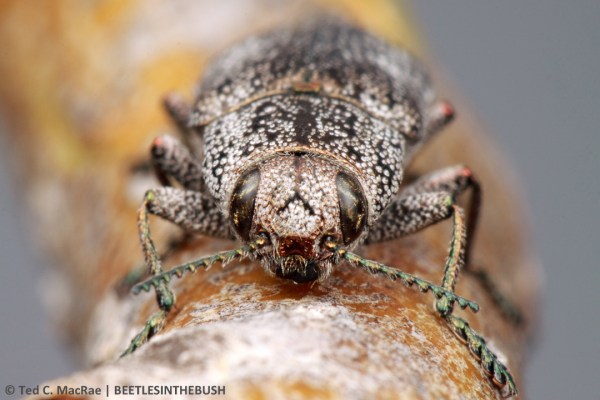
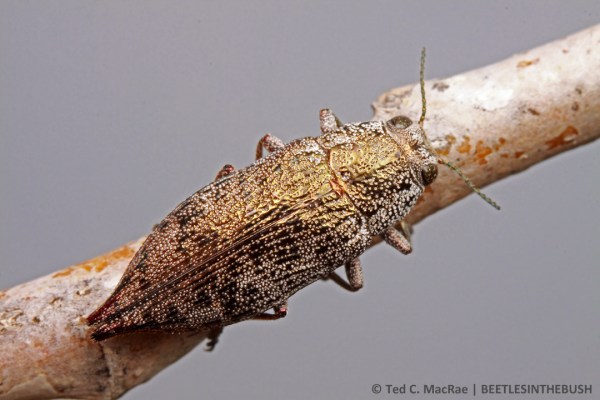
Poecilonota cyanipes

Poecilonota cyanipes (eastern poplar jewel beetle) | Beaver Dunes State Park, Oklahoma

This is the best known of the American species of Poecilonota, and the one most commonly collected east of the Rocky Mountain.—Evans (1957)

I’ve been interested in insects since I was a kid, but I didn’t really become a dedicated coleopterist until after I’d finished graduate school and started working as a field entomologist with the Missouri Department of Agriculture. It was a perfect job for a young entomologist with a bent for collecting—being outside all day inspecting nursery stock and driving the back roads checking insect traps. It wasn’t long before I found myself focusing on wood-boring beetles, due initially to their horticultural importance but eventually to their astounding diversity and intrinsic beauty. So began my formal survey of the families Buprestidae and Cerambycidae in Missouri, and I spent the next eight years collecting them in all corners of the state and examining every insect collection, public and private, that I could find that might contain Missouri representatives of these families. In the end, I documented a cool 350 species and subspecies in the two families combined, more than a fifth of which represented new state records (MacRae 1991, 1994).

Poecilonota cyanipes

The specific epithet ‘cyanipes‘ refers to the blue feet

One species, however, that I had expected to find almost completely eluded me. This, despite the quote above by Evans (1957) in his revision of the genus Poecilonota in North America. Although it had been recorded from much of North America east of the Rocky Mountains in association with poplars (Populus spp.) and willows (Salix spp), I never actually encountered P. cyanipes in the field and found just two specimens labeled simply “Mo” in the insect collection at the University of Missouri in Columbia. This puzzled me, as I had beaten countless branches of cottonwood (Populus deltoides) and willow in search of this species and found many of the other known poplar/willow associates. I had even already collected two specimens of its much rarer congener, P. thureura, off of a redbud tree at the entrance to the Entomology Building on campus while still in graduate school!

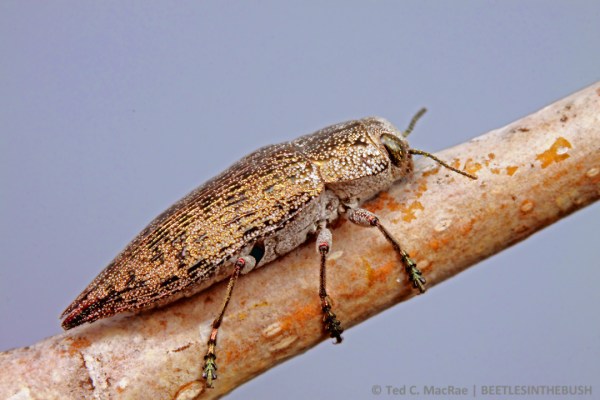
Poecilonota cyanipes

This species can be recognized by its coppery color and elongate, distinctly reddish elytral apices,

As is often the case, good comes to those who wait, and I’ve finally gotten my chance during the past two seasons to encounter this species in numbers—last year as prey taken from nest sites of the buprestid-specialist crabronid wasp, Cerceris fumipennis, and this past June on cottonwood trees in northwestern Oklahoma at Beaver Dunes State Park. The individual in these photos was the first one I found—beaten from the lower branch of a small, living cottonwood exhibiting significant branch dieback, and over the course of the next two days I managed to beat close to three dozen specimens from the small, stunted cottonwoods that dotted the park. I suspect that the combination of good timing—buprestids of many types were common on a number of woody plant species in the area—and susceptible hosts with abundant branch dieback due to protracted drought conditions over the past few years was the reason I was able to find so many of the beetles. A perfect storm for wood-boring beetles, so to speak!

Poecilonota cyanipes

The non-angulate pronotal sides distinguish this species from another eastern species, P. ferrea.

As suggested above, larvae of this species are associated exclusively with dead or dying branches of Populus and Salix (both in the family Salicaceae), often in association with galls made previously by other species of wood-boring beetles, e.g., Saperda concolor in poplar (Knull 1920) and Agrilus criddlei in willow (Wellso et al. 1976). In fact, with one exception (P. viridicyanea on Chilopsis linearis) all members of the genus seem to be associated exclusively with plants in these two genera. However, in addition to these plants, Nelson et al. (2008), in their catalogue of the Buprestidae of the U.S. and Canada, also included black locust (Robinia pseudoacacia) in the family Fabaceae as a larval host for P. cyanea. I am convinced that this record represents at best a mere incidental adult association, and there are other examples of such in the catalogue (the final preparation of which was completed after the untimely death of the senior author). This is unfortunate, since erroneous records in such ‘standard’ references tend to be propagated in subsequent literature, which already seems to have happened in the case of black locust as a larval host for P. cyanipes (Paiero et al. 2012).

REFERENCES:

Knull, J. N. 1920. Notes on Buprestidae with description of a new species (Coleop.). Entomological News 31(1):4–12 [BioStor].

MacRae, T. C. 1991. The Buprestidae (Coleoptera) of Missouri. Insecta Mundi5(2):101–126 [pdf].

MacRae, T. C. 1994. Annotated checklist of the longhorned beetles (Coleoptera: Cerambycidae and Disteniidae) known to occur in Missouri. Insecta Mundi 7(4) (1993):223–252 [pdf].

Nelson, G. H., G. C. Walters, Jr., R. D. Haines, & C. L. Bellamy.  2008.  A Catalogue and Bibliography of the Buprestoidea of American North of Mexico.  Coleopterists Society Special Publication No. 4, The Coleopterists Society, North Potomac, Maryland, 274 pp. [description].

Paiero, S. M., M. D. Jackson, A. Jewiss-Gaines, T. Kimoto, B. D. Gill & S. A. Marshall. 2012. Field Guide to the Jewel Beetles (Coleoptera: Buprestidae) of Northeastern North America. 1st Edition. Canadian Food Inspection Agency, 411 pp. [pdf].

Wellso, S. G., G. V. Manley & J. A. Jackman. 1976. Keys and notes on the Buprestidae (Coleoptera) of Michigan. The Great Lakes Entomologist 9(1):1–22.

Copyright © Ted C. MacRae 2013

Stalking tigers in Argentina

Brasiella argentata

Brasiella argentata | banks of Rio Paraná, Corrrientes, Argentina

Most of you know that I have spent a lot of time in Argentina over the years, and while most of my time there has been for work I have had a fair bit of opportunity to collect insects as well. This includes tiger beetles, and in fact I recall one trip some years ago during which I spent the better part of a week chasing tigers in northeastern Argentina around Corrientes and west into Chaco Province. I think I collected maybe a dozen species or so—some in great numbers and others not, and with the help of tiger beetle expert David Brzoska I’ve managed to put names on most of the material. Despite this, however, I’ve never actually posted any photos of tiger beetles from Argentina here on BitB. I guess the main reason for this is that my efforts to photograph tiger beetles is still a relatively new pursuit (compared to the time that I’ve been going to Argentina), and most of my luck with tiger beetles in Argentina has preceded my time with a camera. The other reason for the delay is that, while I have managed to photograph a few tiger beetles in Argentina, I’ve only recently been able to determine their identity (and you all know how I dislike posting photos of unidentified insects). Well, time to change that, and for this post I am featuring the very first tiger beetle that I was able to photograph in Argentina—the aptly named Brasiella argentata.

Banks of Rio Paraná, habitat for Brasiella argentata.

Banks of Rio Paraná, habitat for Brasiella argentata.

The individuals in this post were photographed on 1 April 2011 during the early part of a week-long visit to Corrientes and neighboring Chaco Province in northern Argentina. Remember, this is the southern hemisphere, so early April is way late in the season and, in this part of Argentina, typically on the back end of a very long dry period. Still, it is far enough north to be borderline subtropical climate, and with the stifling heat it could, for all intents and purposes, have been the middle of summer. I knew tiger beetles could be found along the banks of the Rio Paraná, as I had collected them there during my trip some 10 years previous, so in late morning of my first day after arrival in the city I kitted up and walked down to the river. Sand and mud beaches are not plentiful along the mostly rocky shoreline, and I was perturbed to see the area where I had collected during my last visit had since been “developed.” Nevertheless, I found promising-looking habitat a short distance further north and walked to its moister edges (photo above). I saw nothing at first, but eventually I came to a small, moist drainage where the sand was mixed with more mud, and there they were! It took a little bit of looking, as this species is quite small—adults average only ~7 mm in length, and despite the impression you may get from these photos they are well camouflaged to match the color of the wet, muddy sand and, thus, difficult to see before they take flight and again after they land.

An individual sits long enough to allow a few close, lateral profile shots.

Brasiella argentata is one of the most widely distributed Neotropical species of tiger beetles, occurring from Panama and the West Indies south to Peru and Argentina (Cassola & Pearson 2001). Numerous subspecies have been described from throughout its range, but in truth it seems to actually be a “species swarm” comprised of multiple species, many of which can only be determined by examination of characters contained within the male aedeagus (Sumlin 1979). The genus Brasiella itself, like many others, was until recently considered to be a subgenus of Cicindela, but the distinctiveness of these mostly small (Pearson et al. 2007 refer to them as “Little Tiger Beetles”), cursorial (running) beetles has been recognized in most of the more recent comprehensive treatises (e.g., Cassola & Pearson 2001, Erwin & Pearson 2008). Unlike most of its related genera (subtribe Cicindelina), Brasiella is almost exclusively Neotropical in distribution—only one of its 45 species, B. wickhami, reaches the U.S. in southern Arizona (Pearson et al. 2007).

Brasiella argentata

The only photo I managed looking towards the front of an individual.

If their smallness must be recognized, so must their running abilities. This was one of the most difficult species I’ve ever attempted to photograph, and with those difficulties added to the heat of the day and its “perfect storm” habitat it’s a wonder I got any photographs at all. It was a good half hour before I even got the first photo (top), and another hour and a half of effort was required before I managed to get a selection of photos that included a good, close lateral profile shot (middle). As is often the case with very wary tiger beetles, frontal portraits were almost impossible due to their persistent efforts to flee, so I feel fortunate to have managed the last photo. It’s not as close as I typically like to get, but I am pleased with the composition and also the fact that it shows the species’ truncate labrum—a key character.

REFERENCES:

Cassola, F. & D. L. Pearson. 2001. Neotropical tiger beetles (Coleoptera: Cicindelidae): Checklist and biogeography. Biota Colombiana 2:3–24 [pdf].

Erwin, T. L. & D. L. Pearson. 2008. A Treatise on the Western Hemisphere Caraboidea (Coleoptera). Their classification, distributions, and ways of life. Volume II (Carabidae-Nebriiformes 2-Cicindelitae). Pensoft Series Faunistica 84. Pensoft Publishers, Sofia, 400 pp [Amazon description, book review].

Pearson, D. L., C. B. Knisley & C. J. Kazilek. 2006. A Field Guide to the Tiger Beetles of the United States and Canada. Oxford University Press, New York, 227 pp. [Oxford description].

Sumlin, W. D., III 1979. A brief review of the genus Cicindela of Argentina (Coleoptera: Cicindelidae). Journal of the New York Entomological Society 87(2):98–117 [JSTOR].

Copyright Ted C. MacRae 2013

Party on a pin oak

In September 2012 while collecting in western Oklahoma (Weatherford) I came across this interesting scene. It had been exceedingly dry in the area, and because of this few insects were out and about in the small city park that I stopped by to check for the presence of tiger beetles. I had nearly completed my circuit of the park when I came upon a moderate-sized pin oak (Quercus palustris) tree and noticed something on the lower trunk:

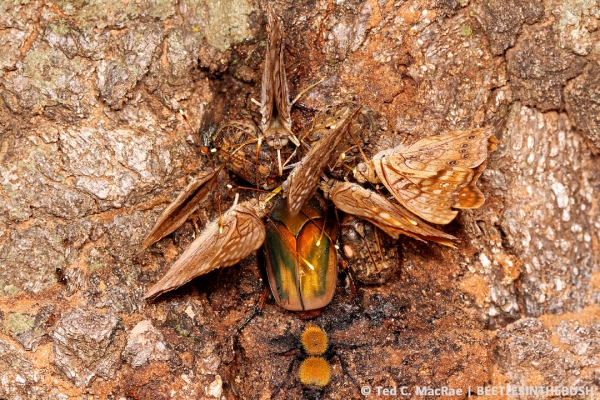
Six insect species representing five families in four orders share a sap flow.

Six insect species representing five families in four orders share a sap flow on the trunk of a pin oak.

No less than six insect species representing four orders were seen all huddled together at a darkly stained sap flow. This could be the result of slime flux, a bacterial disease that usually affects deciduous hardwoods that are under stress and results in darkly stained weeps on the trunk that are known to be attractive to a variety of insects. At the center sat a green June beetle (Cotinis nitida) and three bumble flower beetles (Euphoria inda)—all in the family Scarabaeidae (subfamily Cetoniinae). Covering the scarab beetles were half a dozen Texas Tawny Emperor (Asterocampa clyton texana) butterflies (family Nymphalidae, or Brushfooted Butterflies), and milling around the perimeter was a velvet ant (Dasymutilla creusa, I believe) in the family Mutillidae, an apparent flesh fly (family Sarcophagidae), and a true ant (family Formicidae). I guess this would be the equivalent to a watering hole in Africa with a lion, a hyena, a baboon, three vervet monkeys and six zebras all crouched shoulder-to-shoulder at its edge.

Euphoria sepulchralis feeds on a sap flow higher up on the trunk.

Euphoria sepulchralis feeds on a sap flow higher up on the trunk.

Further up on the trunk, yet another species of scarab beetle, a dark flower scarab (Euphoria sepulchralis) was found feeding on a smaller sap ooze. Unlike the diverse aggregation of insects on the lower ooze, this guy had managed to keep the ooze all to himself.

Cotinus nitidus | Weatherford, Oklahoma

Cotinis nitida | Weatherford, Oklahoma

Green June beetles, especially, are known for their feeding on sap oozes. The beetles are actually attracted to the odors caused by fermentation of the sap rather than the sap itself. It has been reported that the presence of alcohol in fermenting sap can affect the behaviour of insects that feed upon it, causing them to act “stupid and lethargic.” I did not see any such behavior, but I did notice that the insects were not at all skittish and loath to leave the sap.

Copyright © Ted C. MacRae 2013
A belated Happy Birthday

It seems that November 24th came and went without me even realizing that BitB turned six years old that day! Six years—wow, has it really been that long? I guess forgetting birthdays officially puts me in the old-timer camp (both as a person and as a blogger). No fanfare or celebration. Instead, I blithely wrote my 778th post (Q: How do you photograph cactus beetles?) and carried on as usual.

I guess it’s too late now to make a big deal of it, but I will make the observation that November 2013, with its 15 posts, was one of my heaviest blogging months ever (the most since 18 posts in December 2012 and the overall high of 21 in April 2010). This may come as a surprise to those who have heard me grouse periodically about the decline of blogging, both of my blog in particular and as a platform in general. It’s a different world than it was when I started BitB—Twitter and Facebook have taken over much of the social interaction that used to take place on blogs, relegating the latter primarily to satisfying a small but persistent niche demand for long-content. Throughout the course of these changes, however, motivation to blog still comes to me consistently and often. Mostly it seems to be an internal need to express myself, but the occasional and very much appreciated feedback in the form of comments and emails also helps. So, with that, thank you for the past six years, and here’s looking at the next six!

Enough blather—here are a few colorful net-winged beetles in the genus Calopteron (family Lycidae) to help with the celebration. They were photographed in northern Argentina (Chaco Province) in April 2012 while visiting flowers of Chilean goldenrod (Solidago chilensis). I’m not sure if they represent more than one species, as the taxonomy of the genus in the Neotropics appears to be very poorly known at this time—if so it would seem there exists in this area a mimicry complex that is ripe for study.

Calopteron sp. on flowers of Solidago chilensis| Chaco Province, Argentina

Calopteron sp. on flowers of Solidago chilensis | Chaco Province, Argentina

Calopteron sp. on flowers of Solidago chilensis| Chaco Province, Argentina

Calopteron sp. on flowers of Solidago chilensis | Chaco Province, Argentina

Calopteron sp. on flowers of Solidago chilensis| Chaco Province, Argentina

Calopteron sp. on flowers of Solidago chilensis | Chaco Province, Argentina

Copyright © Ted C. MacRae 2013