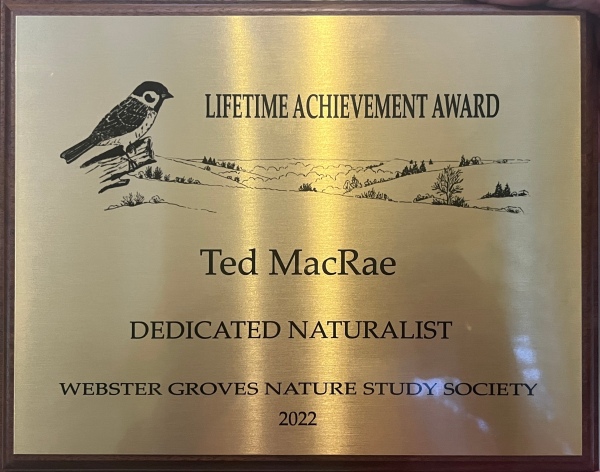
Earlier this month on May 10th, the Webster Groves Nature Study Society (a.k.a., “WGNSS”) held its annual Spring Banquet at the Palm House in Tower Grove Park, St. Louis, Missouri—-the first Spring Banquet since 2019 (the last three years having been cancelled due to the COVID-19 pandemic). It was a lovely event in a beautiful venue with fantastic food, and I think all in attendance were happy to resume this annual society tradition. Part of this tradition includes announcing the year’s recipient of the WGNSS Lifetime Achievement Award—given to individuals that have made significant and sustained contributions to the Society. With three “lost” years to make up for, the WGNSS Board selected three individuals as recipients for those years. The 2020 recipient was the night’s featured keynote speaker and Past-President, George Yatskievych, formerly Curator of Botany at the Missouri Botanical Garden and now at the University of Texas in Austin. The 2021 recipient was my longtime friend and collecting partner, Richard Thoma, also Past-President, former leader of the Entomology Natural History Group, and current Society Historian. The 2022 recipient was, well… me! It was a complete surprise (at least until Rich began his introduction and it became clear who he was talking about), so I gave only a few short remarks in appreciation of the award. I am deeply grateful to the Society for the honor, and I can only thank their membership and the deep natural history talent that so many of them possess for helping me become the naturalist that I am.
Last fall, my good friend Richard Thoma and I visited “Snake Road” is a famous snake viewing area in southern Illinois—part of the LaRue-Pine Hills/Otter Pond Research Natural Area. Early October is prime season for viewing snakes there, principally northern cottonmouths (a.k.a. water moccasins—Agkistrodon piscivorus) as they move from the wetlands on the west side of the road to the towering limestone bluffs on the east side seeking crevices in which to shelter for the winter. With a string of cool nights and sunny skies and a forecasted high of 78°F, we couldn’t have picked a better day to look for them.
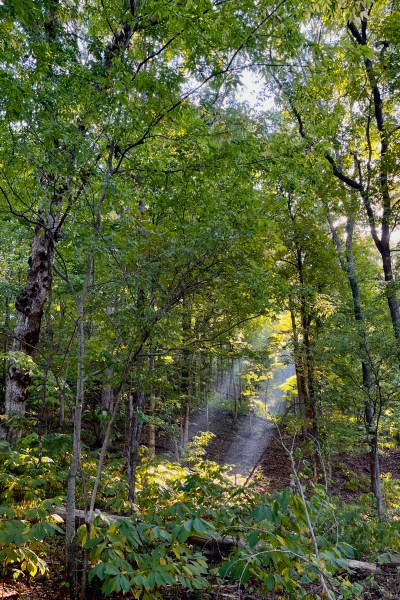
Shafts of morning sunlight stream through the forest.
We arrived a little after 9am, so conditions were still a bit too cool for the snakes. Shafts of morning sunlight streaming through the trees were a sight to behold, and we used the opportunity to notice some plants that we’d not seen before, including two species of goldenrod—i.e., Solidago caesia (bluestem goldenrod) and S. flexicaulis (broadleaved or zigzag goldenrod), Decodon verticillatus (swamp loosestrife), and Laportea canadensis (wood nettle). I noticed small green berry-like structures on some of the latter, which I at first took to be fruits, but something about them said “gall” and I cut one open to find a small insect larva inside verifying this to be the case. I presume this to gall to have been caused by Dasineura investita (wood nettle gall midge) in the family Cecidomyidae.
Solidago caesia (blue-stemmed goldenrod) in mesic bluff base forest.
Inflorescence of Solidago caesia (blue-stemmed goldenrod) in mesic bluff base forest.
Solidago flexicaulis (broadleaved or zigzag goldenrod) in mesic bluff base forest.
Inflorescence of Solidago flexicaulis (broadleaved or zigzag goldenrod) in mesic bluff base forest.
Decodon verticillatus (waterwillow or swamp loosestrife) in Mississippi River floodplain oxbow lake.
Laportea canadensis (Canada nettle or wood-nettle) in mesic bluff base forest.
Gall on Laportea canadensis (Canada nettle or wood-nettle), presumably caused by Dasineura investita (wood nettle gall midge).
Dissected Dasineura investita (wood nettle gall midge) gall on Laportea canadensis (Canada nettle or wood-nettle) revealing the larval inhabitant.
As we hiked south along the road (closed to automobiles during spring and fall to protect the migrating snakes), and especially when temperatures climbed above 70°F, we began looking in earnest for snakes, reasoning that they might best be found by searching along the base of the bluffs and in nearby crevices. We searched one particularly promising rock ledge without success, then encountered a spring draining from the main bluffs and followed it to the base, where we split up and looked along the base in both directions. My direction took me around a bend and up the hillside, with many nice-looking crevices but no snakes in them, and when I reached to top of the exposed bluff face I turned back and retraced my steps. Just after reaching the bottom I noticed movement near where I’d taken a step, and there it was—a gorgeously-marked juvenile cottonmouth! I called Rich over, and together we spent about a half-hour taking turns trying to get the perfect photograph of the snake while trying to minimize the degree to which we disturbed it (lest it make a dash for the nearest crevice, or worse yet, take a lunge at one of us). The majority of the photos shown here are of this individual, and the only photo I wish I would have gotten was one with a fully-extended, flickering tongue.
Our spirits buoyed by the experience, we bushwhacked back to the road and almost immediately encountered not one but two fully mature individuals—both having already lost the distinctive patterning seen on the juvenile but beautiful nonetheless. We spent more time photographing these as well, as we were able to get several great shots of the distinctly marked throat and mandible as they reared their heads in cautious defiance. I used the big camera exclusively for these shots, as they were much too large and I would have had to have gotten much too dangerously close to photograph them with my iPhone (look for photos to appear eventually on my natural history blog—‘Beetles in the Bush’).
Further south we found an exposed bluff face very close to the road, and several additional mature individuals were seen there—two deeply ensconced within their chosen crevice but one fully exposed (two photos here) who even cooperated by gaping his mouth in alarm to show off the cottony-pink tissues inside.
Adult northern cottonmouth (Agkistrodon piscivorus) with mouth agape, revealing the cottony-pink tissues inside that give rise to its common name.
In all, we would see nine individuals by the time we hiked to the southern parking lot and turned around, and on the way back, not trying nearly as hard and making a more direct line to the car, we would see another five individuals (two of which could have been individuals we’d seen on the way out) for a total of 14. We also watched in amazement as a tiny juvenile eastern yellow-bellied racer (Coluber constrictor flaviventris) chased down a fly on the road before dashing back towards the forest, and we were particularly amused by a nine-banded armadillo (Dasypus novemcinctus) who lumbered stupidly out of the underbrush straight towards us, completely unaware of our presence until Rich made a sudden movement with his hand that sent the little brute scurrying back into the underbrush.
Nine-banded armadillo (Dasypus novemcinctus).
Almost as we reached the car, we found a ribbon snake (Thamnophis sauritus) stretched out across the road. Snake sightings notwithstanding, the return hike back to the car was not nearly as enjoyable as the hike out, as by this time quite a number of other people had shown up and we no longer had the place to ourselves. I can only imagine what it must be like here during the weekend! Nevertheless, we couldn’t have imagined a more successful and enjoyable outing than the one we experienced today.
Welcome to a new series that I’m calling “BitB Bits,” an irregular collection of random natural history observations recorded in my notes over the previous month. The individual snippets are, by themselves, too short for stand-alone posts, but I hope that readers will find their collective and chronological nature interesting and informative.
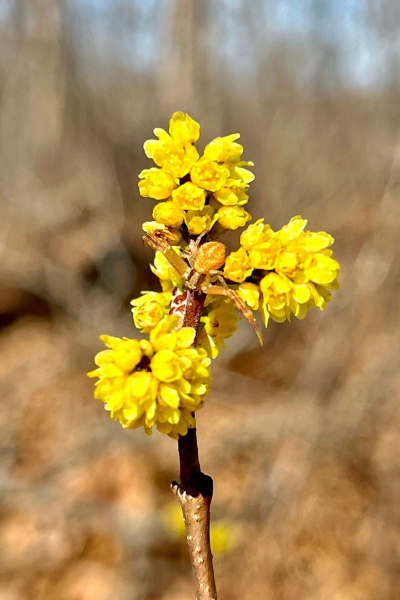
March 9. Welcome home walk. Good to be home and glad to see we didn’t miss the start of spring here. Non-native daffodils are blooming everywhere (I must admit they make an impressive display); however, we also have our first native blooming plant—spicebush (Lindera benzoin). Apparently only the male plants are blooming so far (distinguished by their flowers with stamens/anthers only but lacking a central pistil); the female plants should follow suit shortly.
Lindera benzoin (northern spicebush)
March 12. Spring on hold. Now that spicebush is in bloom, a succession of flowering trees and shrubs should follow. Fragrant sumac (Rhus aromatica) would be the next to follow, but the rain of the last few days has put it on hold. The buds are swollen and ready, however, to burst forth on the next sunny day.
Rhus aromatica (fragrant sumac).
March 13. In my happy place. I didn’t get enough hiking at St. Francois State Park to satisfy my desires, so on the way back home I decided to stop off at Victoria Glades, one of my favorite places, and walk the perimeter of the main glade. I don’t think there’s another place on earth where I feel more connected to myself as a naturalist than here. I first visited way back in 1983 – the year after I moved to St. Louis after finishing grad school, and every year for the next eight years I came here once or twice per week throughout the summer to collect insects. I essentially “grew up“ here as an entomologist! In the time since moving back to St. Louis (now 27 years ago), I have resumed my regular visits – more in some years, less in others, and each time I do I feel rejuvenated. I have instructed Madam to sprinkle my ashes here (at least some of them) – if I depart and you happen to read this, please follow up with her to make sure that she does just that!
Victoria Glades Conservation Area, Jefferson Co., Missouri
March 15. Beware the Ides of March. On this day, in 44 B.C., Julius Caesar was stabbed to death by a mob of Roman senators led by his friend Brutus. The senators believed that Julius had consolidated too much power (he had only a year earlier been named dictator for life and was implementing sweeping imperialist offensives in an effort to expand Roman territory), and that his death would lead to the restoration of the Republic. Sadly (or fortunately, depending upon your perspective), the “Ides of March” plunged Rome into centuries of civil war that ultimately led to utter collapse by the 5th century. In the final years of the empire, a series of emperors took the throne in quick succession (usually after the murder of their predecessor by the Praetorian Guard, the emperor’s personal bodyguards), each of whom plundered the state while they had the opportunity. The Roman Senate, engaged in their own corrupt practices and suffering from incompetence, was unable to curb the excesses of these emperors, leading to a waning of civic pride and loss of trust by the Roman citizenry before the final collapse.
March 17. C-c-cold! Once again, the bright sunshine was deceptive, belying how cold it really was – especially with that wind! Temps plummeted even further once the sun set, but the views around my home are still spectacular.
“The pond” on Pond Rd
March 21. Still waiting… …for native blooms to begin. Until then, here is yet another non-native early bloomer—Scilla forbesii (Forbes’ glory-of-the-snow), which invaded the woods near my home after a neighbor planted some in their woodland garden. They are not nearly the problem that some other invasives are (like bush honeysuckle or burning bush) in that they don’t smother out nearby native plants, but they can provide a pollinating “sink” that competes for insects that would otherwise be pollinating the flowers of native plants.
Scilla forbesii (Forbes’ glory-of-the-snow)
March 22. Vernal equiNOT. Spring began two days ago, yet I’m still waiting for the first appearance of any native wildflowers in the neighborhood. Until that happens, here is yet another non-native species—the thankfully noninvasive hyacinth—that my neighbor planted in their garden.
Hyacinthus sp. (hyacinth)
March 24. Spring at last, spring at last, thank God Almighty, spring at last! Finally, after sitting dormant for more than a week, the flowers of Rhus aromatica (fragrant sumac) have opened—in my opinion the true opening salvo of spring. Even so, it’s not like the weather suddenly turned spring-like, but more like the sumacs finally said F this and decided to open despite the continued dreary conditions.
Rhus aromatica (fragrant sumac).
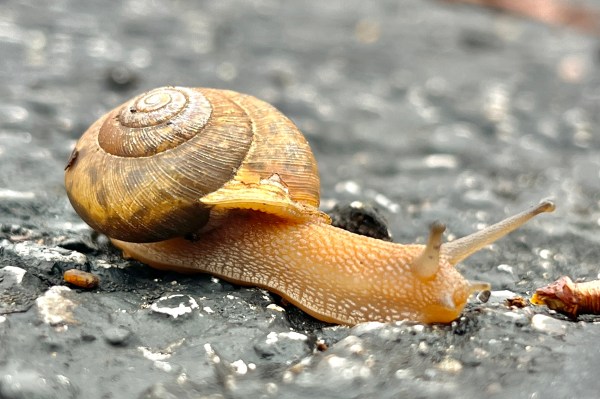
March 25. How do snail’s eyes differ from slug’s? They don’t—they’re both eye tentacles. 🥁
Mesodon thyroidus (white-lipped globe snail)
March 26. Spring beauty. Now that spring is truly here, Claytonia virrginica (spring beauty)—the icon of spring ephemeral wildflowers—has begun popping up everywhere.
Claytonia virrginica (spring beauty)
March 26. Water spider. I saw this large fly sitting on the curb. Of course, I knew it was a crane fly—a member of the family Tipulidae, but I hear people often confuse them for a “giant mosquito.” There is no such thing, and while I admit that they do look superficially like a mosquito on steroids (they happen to be distantly related to mosquitos), they do not bite or suck blood—arguably the most important part about being a mosquito. In fact, crane flies often do not eat anything once they become adults, with some species even lacking functional mouthparts. The family name is derived from the Latin word for “water spider,” perhaps because the larvae live in water and have a ring of tentacles around their head—just guessing. Anyway, I snapped a few pics of the little guy before he feebly began flapping his wings in the chilly air and took flight, probably looking for something to not eat.
Tipula sp. (crane fly)
March 28. Back to winter (midge). A few tantalizingly warm, sunny days had my hopes up that spring was finally here, but the return of cool, wet conditions have brought back that late winter feel. Perhaps appropriately, one of the first insects I’ve seen this season is this small, mosquito-looking fly that is actually a distant relative belonging to a group known as winter midges (genus Diamesa—also called snow midges—in the family Chironomidae). As their common names imply, the adult flies are seen active primarily during winter and can even be seen walking about on snow during warm spells during the winter (a scenario mimicked by the styrofoam on which this individual was photographed). Like the crane flies that I featured a couple days ago, winter midges do not feed as adults—if only for lack of suitable food sources, while the larvae feed on organic debris in cold, running water.
Diamesa sp. (winter midge)
March 29. What’s up, buttercup? Buttercups are popping up in the “more natural“ lawns of my neighborhood. We have a number of species buttercups in Missouri – this one is Ranunculus harveyi (Harvey’s buttercup). In general, you can distinguish buttercups by their small, bright yellow flowers and bristle of anthers surrounding the central disc.
Ranunculus harveyi (Harvey’s buttercup)
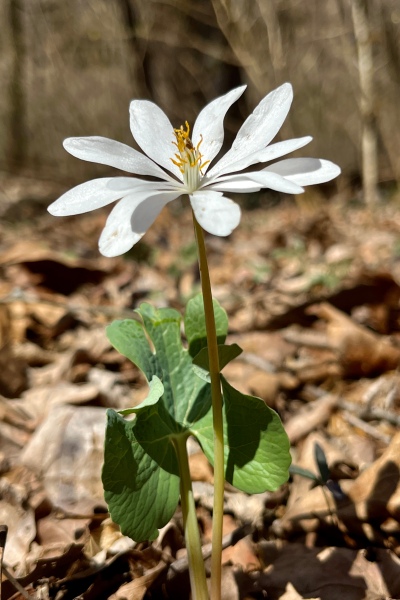
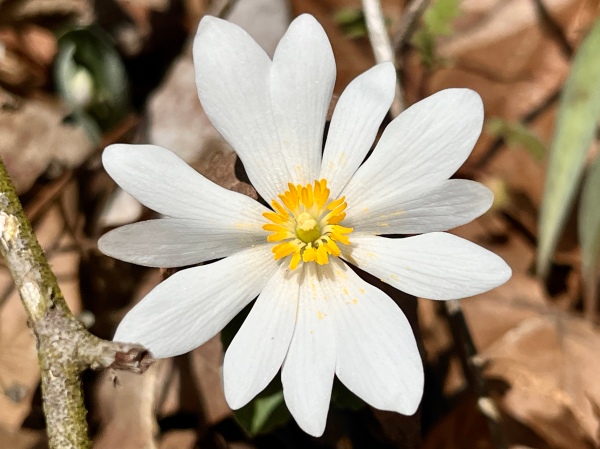
March 30. Bloodroot. I made a rather exciting wildflower find in the woodlands around my house this morning—a small patch of Sanguinaria canadensis (bloodroot) with (thus far) but a single bloom. This poppy relative (family Papaveraceae) is so named because of red, fleshy root, which gets its color from alkaloids, chiefly sanguinarine, in its toxic sap. First Americans traditionally used bloodroot to treat fever, rheumatism, ulcers, ringworm, and skin infections, and it is still used to produce natural red, orange, and pink dyes. There is likely some truth to the bioactive properties of bloodroot alkaloids, as they are currently being studied for use as anti-cancer agents, particularly for the treatment of skin cancer, and as a dissolving agent for skin growths such as warts. Bloodroot is also interesting from a natural history standpoint in that the seeds have fleshy appendages that are attractive to ants. The ants collect the seeds and bring them to their nest, thus effecting dispersal of the seeds. This is an advantage for these small plants growing in wooded habitats, where wind speeds are usually too low to aid natural seed dispersal.
Sanguinaria canadensis (bloodroot)
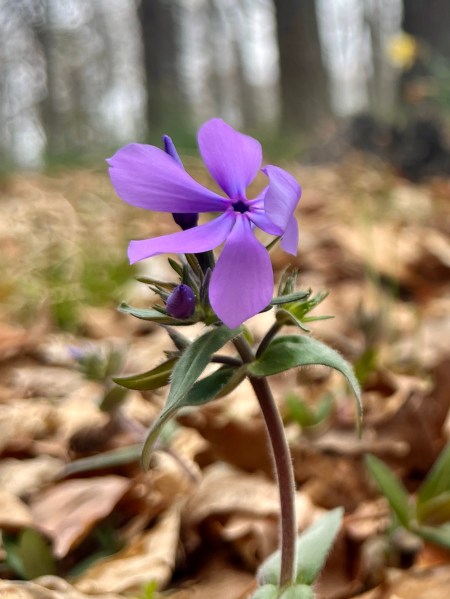
March 31. Sweet William. I saw these plants yesterday while their blooms were still closed and wondered if they would open before March closed out. I normally think of Phlox divaricata (sweet William) as a mid-April bloomer, but clearly it can begin earlier if conditions are right (as they have been the past several days).
I had a good showing at this year’s WGNSS (Webster Groves Nature Study Society) Photo Contest—held last night at the Webster Groves Public Library. All four photos that I entered—one each in four different categories—were selected for a prize: 1st place in the Invertebrates category, 2nd place in the Bonus category (Missouri Species of Conservation Concern), 3rd place in the Vertebrates category, and Honorable Mention in the Plants and Fungi category. There was a fifth category (Habitats and Landscapes), but I don’t take many landscape photos (at least, not with my “real” camera) so did not submit to that category. Three of the four photos are now eligible (along with 13 others) for the Grand Prize (the bonus category is not included in the grand prize competition), which will be selected via popular vote at the WGNSS Spring Banquet, to be held next month at the Piper Palm House in Tower Grove Park.
1st Place – Invertebrates
The spotted orb weaver (Neosconacrucifera) builds an impressively large web each night, which it consumes in the morning before hiding during the day. Despite their size, they are not aggressive and are of no medical significance. This female was photographed at Pinewoods Lake Recreation Area in Carter Co., Missouri on 11 August 2015.
2nd Place – Bonus (Missouri Species of Conservation Concern)
The swift tiger beetle (Cylindera celeripes) was unknown to occur in Missouri until it was discovered in the critically imperiled loess hilltop prairies of extreme northwestern Missouri in 2010 by Ted MacRae and Chris Brown. The species was designated a Missouri Species of Conservation Concern due to the critically imperiled nature of the habitat in which it lives, and detailed surveys since its discovery in the state have shown the species to be limited to just four loess hilltop prairie remnants – all under conservation management – in Holt and Atchison Counties. This individual was photographed on a sparsely vegetated red clay/gypsum exposure in mixed-shortgrass prairie at Alabaster Caverns State Park in Woodward Co., Oklahoma on 10 June 2009.
3rd Place – Vertebrates
The eastern hognose snake (Heterodon platirhinos) is famous for their variety of defensive behaviors, ranging from the innocuous (puffing their neck and hissing) to the repugnant (vomiting) to the extreme (feigning death). This individual was photographed at Sam A. Baker State Park in Wayne Co., Missouri, on 23 April 2012.
Honorable Mention – Plants & Fungi
The flesh-colored flowers of pawpaw (Asimina triloba) are pollinated by flies more typically attracted to fermenting substances rather than “typical” flower-loving flies seeking pollen and nectar, which they attract by emitting yeasty-smelling fermentation volatiles — rare in floral scent blends.These pawpaw flowers were photographed in mesic forest on an east-facing slope along the lower Wappapello Section of the Ozark Trail in Wayne Co., Missouri on 10 April 2010.
Today the WGNSS Botany Group visited Little Lost Creek Conservation Area to see Dirca palustris (eastern leatherwood) in bloom. Leatherwood is a distinctive, slow-growing shrub that occurs sporadically in primarily the Ozark and Ozark Border region of Missouri. Like the much more Lindera benzoin (common spicebush), the flowers open in spring before the foliage appears, during which time the planta are easily identified by the pendulous blooms surrounded by wooly bracts. The species has toxic properties and was used by First Americans as an emetic, and it has been cultivated for many years despite its sporadic natural occurrence. As the name implies (palustris means “growing in a swamp”), the plant grows in moist (though not necessarily swampy) habitats, and as such we would have to hike across the dry-mesic upland deciduous forest and down into the riparian forests along Little Lost Creek where the plant can be found.
With sharply warmer temperatures arriving yesterday after a rather protracted cool period, the early-flowering trees and shrubs were ready and waiting, seemingly popping open before our very eyes. A patch of Prunus americana (American plum) in a more open area along the trail caught our attention, it’s blooms just beginning to open. We based our identification on the shrubby growth habit and apparently clonal nature of the stand of plants, which distinguishes P. americana from the closely related P. mexicana (Mexican plum), which generally grows as more tree-like individual plants.
Prunus americana (American plum).
Also in the more open areas along the trail was Rhus aromatica (fragrant sumac) in full bloom. I stopped to examine one particular individual with especially dense clusters of inflorescences and noticed movement on the flowers. Closer examination revealed a crab spider (family Thomisidae) which I took to be Mecaphesa asperata (northern crab spider)—perfectly camouflaged on the bright yellow flowers and awaiting the arrival of an unsuspecting bee or other pollinator.
Mecaphesa asperata (northern crab spider) on on flower of Rhus aromatica (fragrant sumac).
As the trail veered directly into the forest, I noticed several butterfly species—a Vanessa atalanta (red admiral) that paused briefly on the trail before bolting erratically into the distance, several Eurytides marcellus (zebra swallowtail), presumably males patrolling for females among stands of the still leafless Asimina triloba (pawpaw) which it utilizes as a larval host, and—most interesting for me—several Anthocharis midea (falcate orangetip) which, for the time being, frustratingly refused to perch and allow even an attempt at a photograph.
As the trail began the long descent into the valley and the forest became increasingly mesic, spring ephemerals began appearing on the forest floor in abundance. Most abundant was Claytonia virginica (spring beauty) and Cardamine concatenata (cutleaf toothwort), which have been in bloom for some time now, but finally making their appearance as well were Sanguinaria canadensis (bloodroot)—the first seen being a charming little patch nestled against a rock—a single blooming plant among the stands of Erythronium albidum (white trout lily), and several still-unblooming Trillium sp. (wakerobin).
Sanguinaria canadensis (bloodroot).
Erythronium albidum (white trout lily).
Trillium sp. (wakerobin).
At last we reached the valley floor, and immediately the leatherwood plants were seen in abundance and in full bloom. Leatherwood plants in bloom are not among the showiest of blooming shrubs, but the distinctiveness of their flowers, sporadic occurrence, and lack of close relatives provided ample botanical interest that resulted in me spending a fair bit of time observing and photographing them.
Dirca palustris (eastern leatherwood).
Dirca palustris (eastern leatherwood).
As I looked at the leatherhood, I encountered a an unusual cocoon-like structure at the tip of one of its branches. Closer examination revealed it to be “packed” white tiny, white, grub-like larvae, at which time I noticed the cadaver of a moth caterpillar also clinging to the branch tip. I knew then that the grubs were the mature larvae of a parasitic wasp in the family Braconidae, likely in the subfamily Microgastrinae, that had just exited their host and were spinning cocoons nearby in communal fashion. (Many people have seen one of these wasps in the form of cocoons on the backs of tomato hornworm caterpillars.) Braconid wasps are often quite host specific, but a more specific identification is difficult since the identity of the caterpillar itself or whether it was utilizing Dirca as a host plant are also unknown.
Braconid larvae, possibly subfamily Microgastrinae, spinning communal cocoons after exiting unidentified lepidopteran caterpillar on Dirca palustris.
If the spring ephemerals were abundant during the descent, they were overwhelming in the valley proper. A few blooming plants of Collinsia verna (blue-eyed Mary), a winter annual were seen, their distinctive bicolored white and blue flowers a pleasant contrast to the mostly white to pinkish color of the majority of the ephemerals. Some especially large-flowered individuals of bloodroot were seen underneath a patch of blooming leatherwoods, prompting me to spend a bit more time photographing them. As I was doing so, I found it ironically humorous that I was crouched on the ground photographing what is by all measures a rather common plant while surrounded by a much less frequently encountered plant.
Collinsia verna (blue-eyed Mary).
Sanguinaria canadensis (bloodroot).
Sanguinaria canadensis (bloodroot).
The hike back up out of the valley was long and deliberate, the pitch in some stretches reaching as steep as I ever encounter on trails in the state, but the slow pace allowed an opportunity to look for things missed on the way down. At one point I picked up a fallen oak branch that looked like it might have been pruned by a twig pruner (Anelaphus sp.), a type of longhorned beetle (family Cerambycidae) whose larvae feed within living branches of deciduous trees—primarily oak—and then cut the branch internally before pupation. The cut end is distinctive, and I checked the base of the branch to see if it demonstrated this distinctive cut pattern. It did not, but I explained what I was looking for to a curious member of our group. Just as I finished the explanation, I saw another oak branch laying on the trail, picked it up to examine the base, and, sure enough, it exhibited the cut. I believe the branch is that of black oak (Quercus velutina), and I kept the branch to place within a rearing box so I can see the adult when it emerges later this spring.
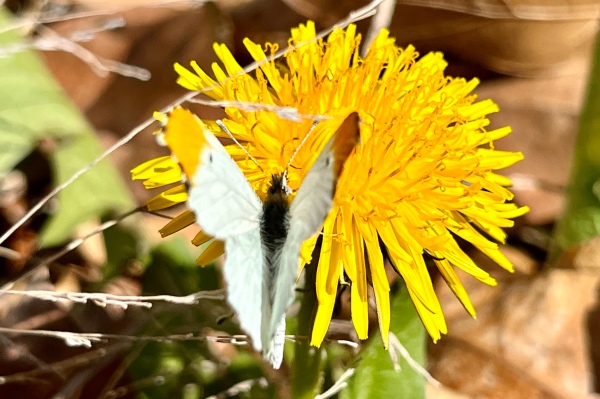
Along the final stretch back to the parking lot, the falcate orangetip butterflies continued to torment me with their erratic, never-ending flight. I watched a few after reaching the parking lot, hoping one would alight and give a chance to photograph it, but no such luck. At the edge of the parking lot I noticed some Taraxacum sp. (dandelion) flowers with small insects on them, which turned out to be Acmaeodera tubulus—usually the first jewel beetles (family Buprestidae) to appear in the spring and commonly found on dandelions. I crouched to take a few photographs, and as I was doing so a falcate orangetip butterfly landed on the dandelion flower right next to the one with the beetles I was photographing. I managed to get one shot of the butterfly, it’s wings not well spread out but the orange tips still easily visible, before it took flight again—a nice punctuation to end the outing with.
Acmaeodera tubulus on on flower of Taraxacum sp. (dandelion).
Anthocharis midea (falcate orangetip)on flower of Taraxacum sp. (dandelion).
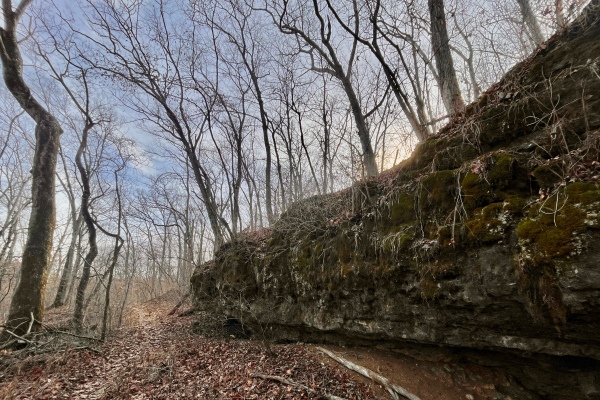
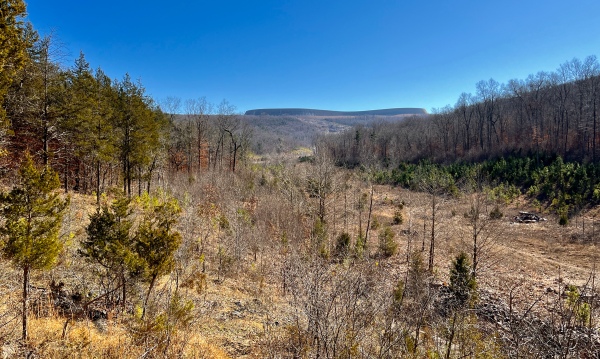
Two days ago, the WGNSS Botany Group met in the Visitor Center parking lot on a not-as-cold and not-as-cloudy day compared to previous days with the plan to walk the Natural Wonders Trail—a relatively easy 1.3-mile loop that features mesic forest on north-facing slopes, dry forest and glades on the south-facing slopes, and a spring-fed creek that meanders through the riparian corridor below. The upland portions of the trail pass through Meramec Mosaic Natural Area, boasting an amazing diversity of natural communities and associated flora all in relatively close proximity.
North-facing dolomite bluff in dry-mesic deciduous upland forest supporting at least six species of ferns.
We walked clockwise around the loop, which took us up and out of the riparian forest onto the north-facing slopes. Lindera benzoin (spicebush) was abundant in the understory at the lower elevations, with male and female plants both being immediately recognizable—the former sporting noticeably swollen buds that will produce the male flowers in spring, and the latter still bearing many of their now-faded berries, their earlier bright red color lost to a dull purple-black. Two members of the Betulaceae were also seen commonly in the understory—Ostrya virginiana (hop hornbeam), with its hop-like fruit clusters and almost always adorned with rich-brown marcescent leaves, and Corylus americana (hazelnut) sporting distinctive hanging male catkins.
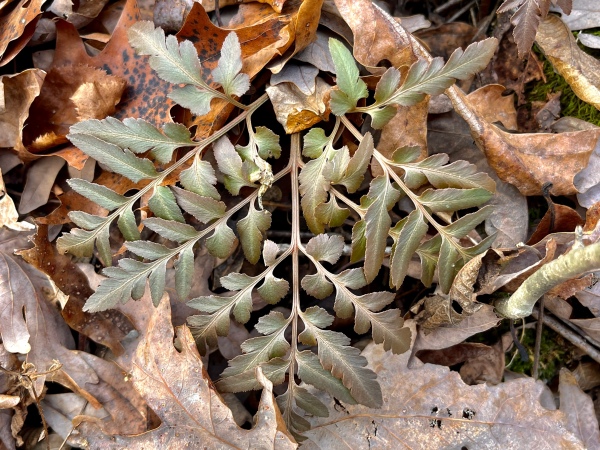
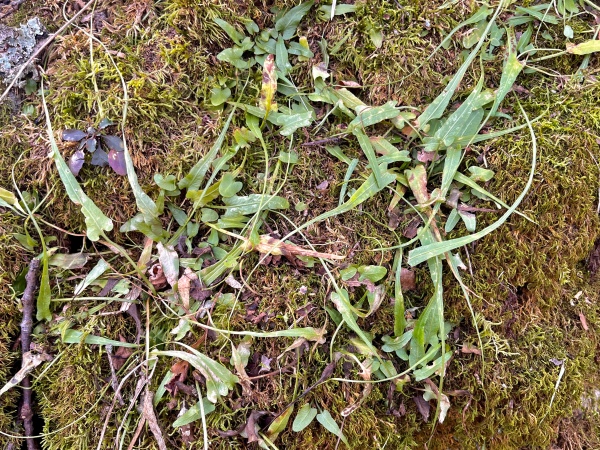
We had scarcely reached the upper slopes when we began noticing a diversity of green foliage—not from the numerous trees and shrubs, but rather from a variety of ferns, hangers-on from earlier times that continue to find niches within the woody-dominate community that now dominate the landscape. The first example seen was a single Sceptridium dissectum (cutleaf grape-fern), its leaf now in reddish-bronze winter dress. Shortly afterwards we began to see prominent outcrops of dolomite as we neared the north-facing bluffs, their surfaces thickly covered with mosses and providing a perfect situation for Asplenium rhizophyllum (American walking fern). The long, tapering leaves of this species root at their tips and give rise to new plantlets—an asexual method of reproduction that allows a single plant to quickly colonize an entire rock surface.
Sceptridium dissectum (cutleaf grape-fern) in dry-mesic deciduous upland forest.
Asplenium rhizophyllum (American walking fern) on north-facing dolomite bluff in dry-mesic deciduous upland forest.
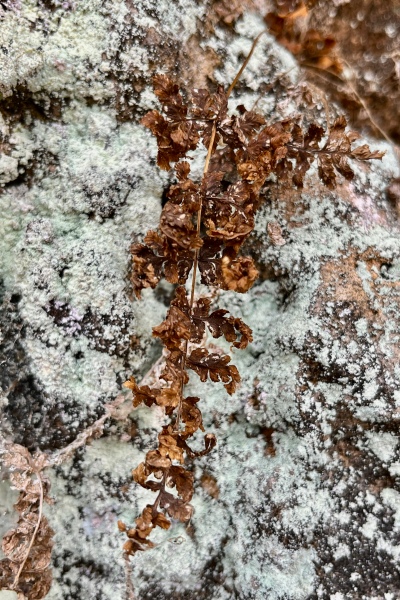
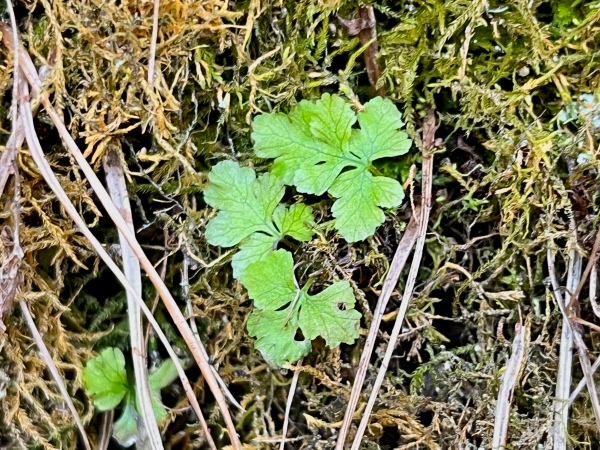
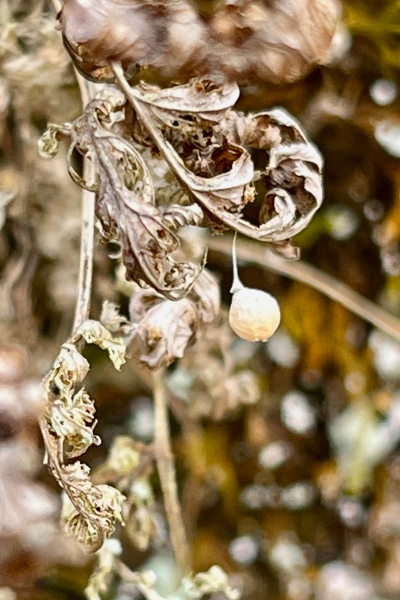
The bluff faces themselves provided the greatest diversity of ferns. An unusual species observed in abundance was Cystopteris bulbifera (bulblet fern, bulblet bladderfern, or bulblet fragile fern). Unlike many ferns, the fronds of this species turn completely brown during the winter (although a few small green plantlets of what may be this species were observed growing among them). It’s most notable feature, however, is the small “bulblets” that form on the underside of its leaves, providing the plant a most unusual method of asexual reproduction.
Winter foliage of Cystopteris bulbifera (bulblet fern, bulblet bladderfern, or bulblet fragile fern) on north-facing dolomite bluff in dry-mesic deciduous upland forest.
Possible plantlet of Cystopteris bulbifera (bulblet fern, bulblet bladderfern, or bulblet fragile fern) on north-facing dolomite bluff in dry-mesic deciduous upland forest.
Vegetative bulblet on winter foliage of Cystopteris bulbifera (bulblet fern, bulblet bladderfern, or bulblet fragile fern) on north-facing dolomite bluff in dry-mesic deciduous upland forest.
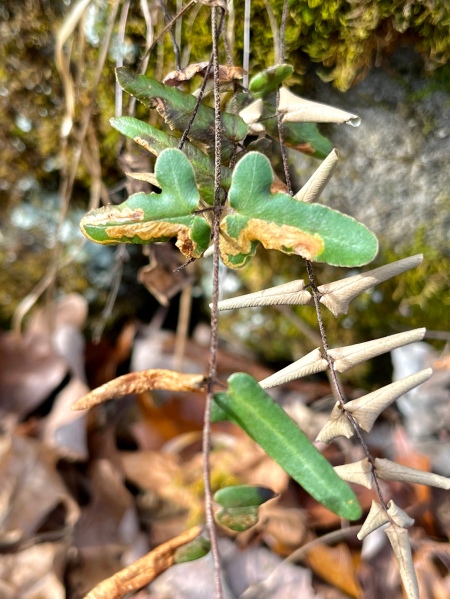
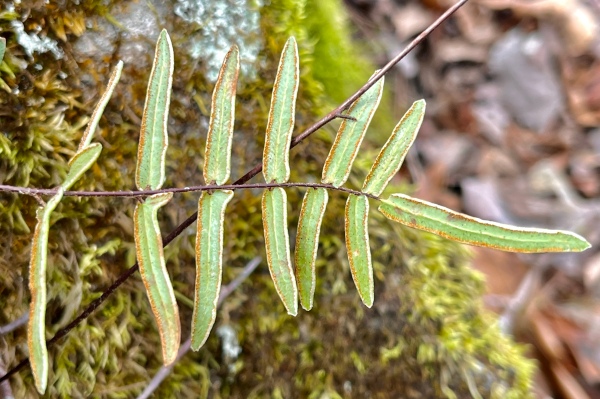
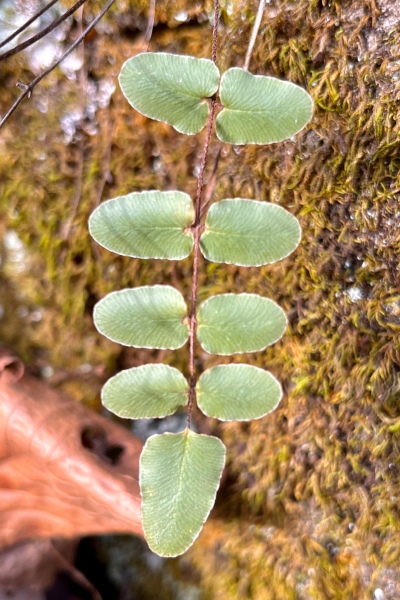
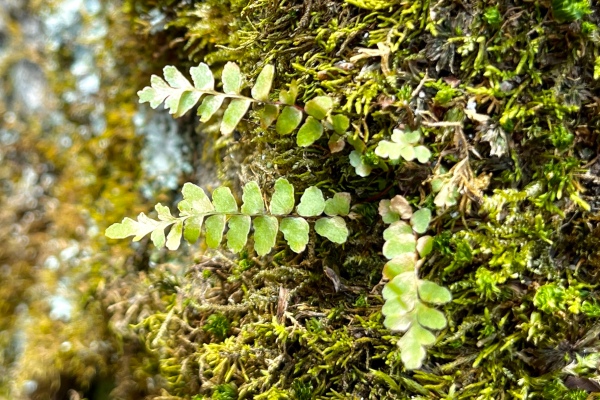
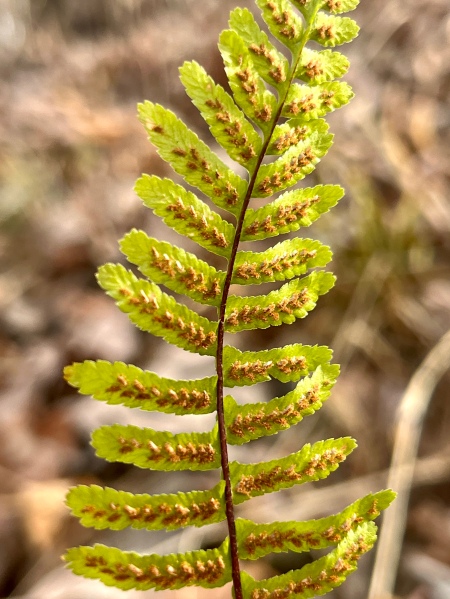
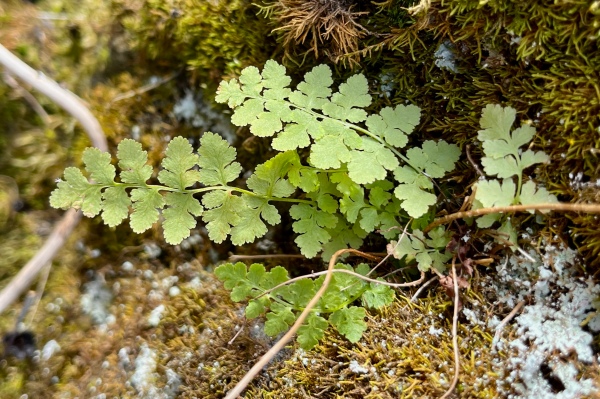
Two Pellaea spp. (cliffbrake) we’re found as well growing from crevices on the bluff face: P. atropurpurea (purple-stem cliffbrake or purple cliffbrake) and the more uncommonly encountered P. glabella (smooth cliffbrake). In some cases the plants were growing very near each other, allowing the group an opportunity to compare and contrast. Pellaea atropurpurea is distinctive in both habit and appearance, with fertile leaflets narrowly elongate—sporangia arranged along the curled under margin and the sterile leaflets broader and “T-shaped” at the base. In addition to its dimorphic leaves, the distinctly pubescent, purplish-brown rachis separates it from P. glabella. The latter species can be found scattered throughout the Ozarks and a few northern counties and is less likely to be seen growing in soil as opposed to exposed rock.
Pellaea atropurpurea (purple-stem cliffbrake or purple cliffbrake) on north-facing dolomite bluff in dry-mesic deciduous upland forest.
Underside of fertile frond of Pellaea atropurpurea (purple-stem cliffbrake or purple cliffbrake) on north-facing dolomite bluff in dry-mesic deciduous upland forest.
Pellaea glabella (smooth cliffbrake) on north-facing dolomite bluff in dry-mesic deciduous upland forest.
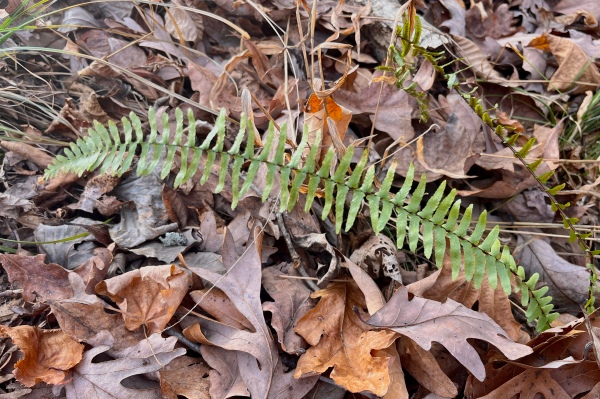
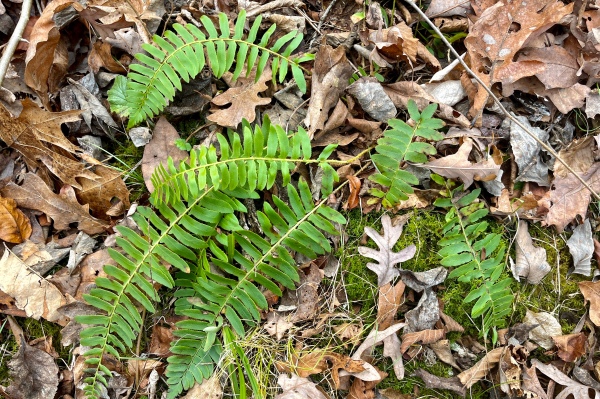
Two more species of Asplenium were found as we continued to examine the moss-covered rock exposures, one being the commonly encountered A. platyneuron (ebony spleenwort or brownstem spleenwort)—distinctive by its purple-brown rachis and “offset” pinnae with asymmetrical basal lobes, and an as-yet-undetermined species provisionally assigned to this genus. We would see additional examples of A. platyneuron away from the rock faces growing in the soil—their fertile fronds tending to grow more erect than the sterile fronds. This same habit was seen in the eighth and final fern of the day, the very common Polystichum acrostichoides (Christmas fern) which we encountered regularly in more mesic areas of the forest floor.
Asplenium platyneuron (ebony spleenwort or brownstem spleenwort) on north-facing dolomite bluff in dry-mesic deciduous upland forest.
Fertile frond of Asplenium platyneuron (ebony spleenwort or brownstem spleenwort) on north-facing dolomite bluff in dry-mesic deciduous upland forest.
Fertile frond underside of Asplenium platyneuron (ebony spleenwort or brownstem spleenwort) on north-facing dolomite bluff in dry-mesic deciduous upland forest.
Asplenium sp. (spleenwort) on north-facing dolomite bluff in dry-mesic deciduous upland forest.
Sterile fronds of Polystichum acrostichoides (Christmas fern) on north-facing dolomite bluff in dry-mesic deciduous upland forest.
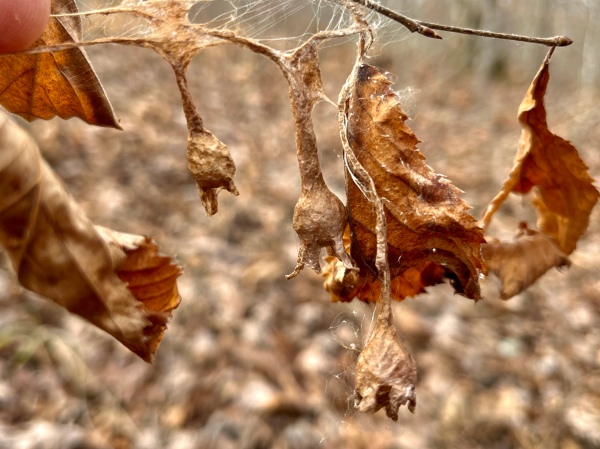
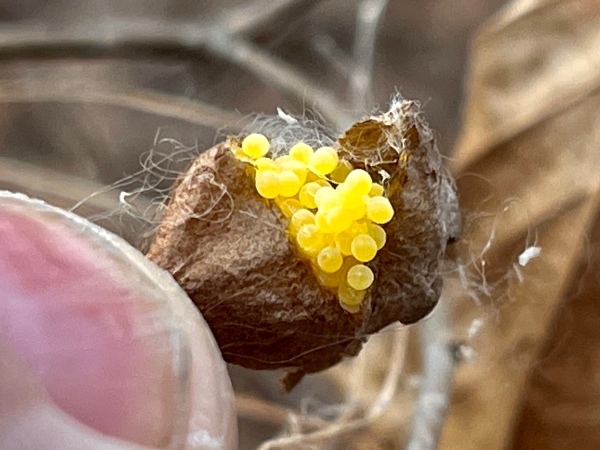
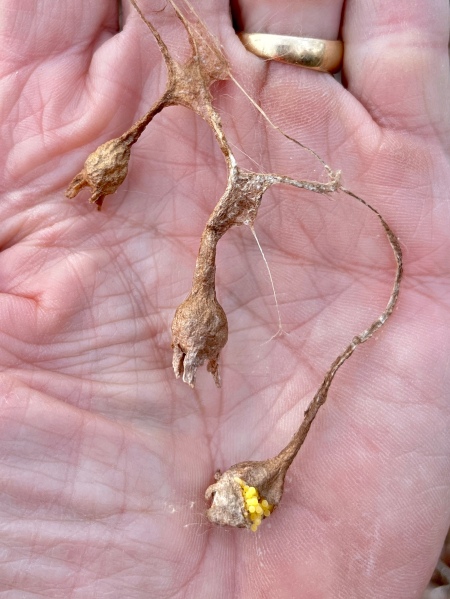
Despite the botanical focus of the walk, we are all naturalists at heart and quick to notice anything that piques our natural history curiosity, regardless of what kingdom of life it pertains to, and when John called out, “Okay Ted, here’s a quiz for you,” I suspected my entomological skills would be put to the test. What he’d found were three strange-looking structures hanging from a small Ostrya sapling that would have, to anybody less-observant, been passed off as some plant fruiting structure. Of course, we knew that Ostrya fruits bore no resemblance to these structures, and when we noticed they were connected to each other and had apparently been “tied” to the twig by some sort of insect, we then guessed they may have been the fruiting structures of an as yet unidentified herbaceous plant or vine. That idea was quickly dispelled, however, when cutting into one of the structures revealed it was filled with bright yellow spheres that I can only surmise to be lepidopteran eggs, with the structures themselves and their attachments to the twig consisting of the silk that many caterpillars use to construct cocoons in which to pupate. Could these be the eggs of an usual type of bagworm moth, the females of which are typically wingless and larvicida and remain in their cocoon after emergence, where they mate, lay eggs, and die? The structures and their egg-like contents, at this point, remain a mystery, but I did collect them and am attempting to hatch the “eggs” (if that is what they are) in an effort to gain further clues about their identity.
Unknown structures tied to a sapling Ostrya virginiana (hop hornbeam) in dry-mesic deciduous upland forest.
Cutting into the structure revealed what must be eggs, possibly lepidopteran.
The structures were tied together along but independent the tree branch.
Turning back to the east the forest changed dramatically. The tall canopy of mesic-loving hardwoods such as Quercus alba (white oak) and Acer saccharum (sugar maple) gave way to a shorter, more open canopy of trees preferring dry to xeric conditions such as Q. muhlenbergii (chinquapin oak), Rhamnus caroliniana (Carolina buckthorn), and Sideroxylon lanuginosum (wooly buckthorn or gum bumelia). Entomologist that I am, I couldn’t resist the chance to check the ground around the bases of the trunks of each of the latter, hoping to see evidence of larval activity by the spectacular and highly host-specific Plinthocoelium suaveolens (bumelia borer), but no such evidence was seen. At one point, the dry oak woodland yielded to a bona fide dolomite glade (more properly called “xeric dolomite prairie”), with evidence of mechanical removal of woody plants and prescribed burns serving as testament to dedicated management practices intended to restore and preserve the original character of the glade by park management.
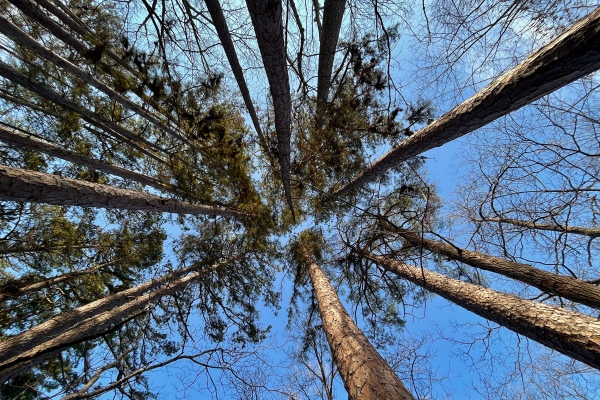
The final stretch led back down into the valley, where a disturbing amount of Lonicera japonica (Japanese honeysuckle) was observed on the forest floor and growing up the smaller trees. A grove of Pinus echinata (shortleaf pine), apparently planted some time ago, looked oddly out of place given the dolomitic substrate in the area but did provide an opportunity for dramatic up views. After regrouping in the parking lot (and remarking on what a “fern-tastic” walk it had been), a number of participants caravanned to Clark Street Cade and Bakery in nearby Sullivan for a welcome resumption of the traditional post-walk lunch.
Grove of planted Pinus echinata (shortleaf pine) in dry-mesic deciduous upland forest.
It’s been too long since I’ve been able to go out with the WGNSS Botany Group on their weekly Monday outing—a consequence of travel and renovations on top of the frenetic-as-usual insect-collecting season. The result is that my attendance on the Botany Group outings is semi-regular during fall/winter but spotty at best during spring/summer. That may seem exactly the opposite of what would be optimum for studying plants, but as a naturalist to the core I have no trouble finding things of interest no matter the season. Especially when the destination is a place as fascinatingly diverse as Johnson’s Shut-Ins State Park—best known previously for its rhyolite “shut-ins” but now mostly for the gashing scour zone that was ripped across it in Dec 2005 when a catastrophic failure of the reservoir atop nearby Proffit Mountain released one billion gallons of water that tore through the landscape in a matter of 12 minutes. The geology exposed by the scour and the living experiment of biological succession that began afterwards are both fascinating, making the Scour Trail one of the Missouri Ozarks’ most interesting day hikes.
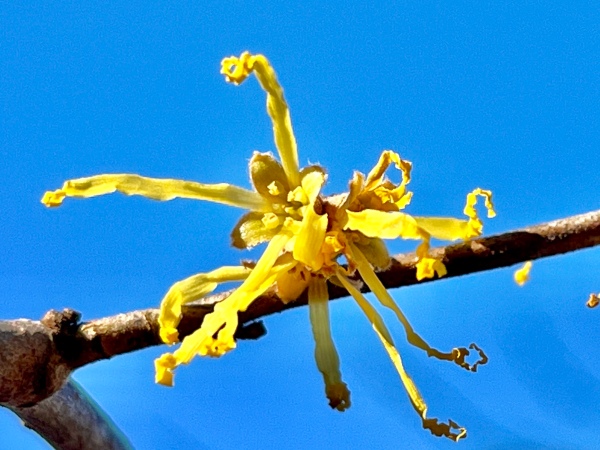
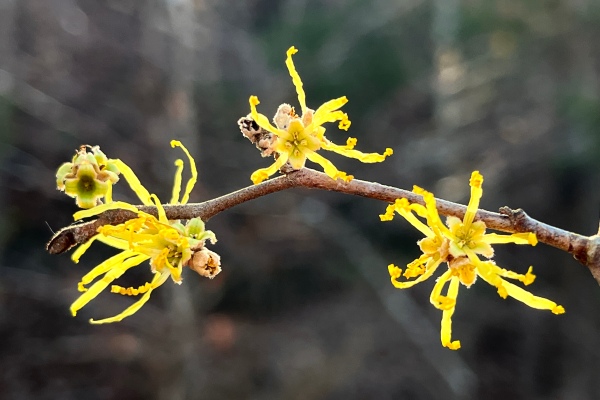
Our chief target for the day was Hamamelis virginiana (common or American witch-hazel), which blooms in November and December and is restricted in Missouri to a few counties in the St. Francois Mountains and the extreme southwestern corner of the state. Interestingly, there is a second species of witch hazel—H. vernalis (Ozark witch hazel), more common in Missouri but much more restricted globally—that occurs here, but as it blooms later in winter (January/February) we did not expect to see it on this trip. We found the former reliably, though not abundantly, and among the last plants we found in bloom were some with the freshest (and best-illuminated by the low-angled sun) flowers. At one point while we were still within the dry-mesic upland deciduous forest uphill from the scour zone, we saw a nice colony of the patch-forming Diarrhena obovata (beak grass). This is an attractive grass that does well in shade and should be utilized more as an ornamental.
Hamamelis virginiana (common or American witch-hazel).
Hamamelis virginiana (common or American witch-hazel).
Diarrhena obovata (beak grass) in dry-mesic upland deciduous forest.
The overlook provided a stunning overview of the scour zone from an elevated vantage—the since rebuilt Proffit Mountain Reservoir rising ominously above it as an almost deliberate reminder of its potential power—before the descent down into the scour zone. It’s an almost alien landscape with an irregular, unweathered floor of exposed bedrock strewn with rocks ranging from pebbles to boulders. Sycamore and willow are the early leaders in the now 17-year-old race to recolonize the barren swath of land, but lack of toeholds for roots to grow is a bigger problem for this future forest than lack of sunlight by taller neighbors. At one point, we spotted a large bush heavily laden with dense clusters of berries atop a pile of rocks. While the more astute botanists in the group recognized it for what it was, I was dumbfounded as to its identity until it was revealed to me to be none other than Toxicodendron radicans (poison ivy)—the largest, densest, most heavily berry-laden “bush” form of the species I have ever seen. So impressive it was that seven botanists gave it much more than just a trifling look.
“Bush” form of Toxicodendron radicans (eastern poison ivy).
Dense clusters of berries on “bush” form of Toxicodendron radicans (eastern poison ivy).
About halfway down the scour zone we encountered the “great unconformity”—previously hidden by topsoil and forest but now exposed. Here, knobs of 1.3 billion-year-old granite are surrounded by 540 million-year-old dolomite deposited atop the granite in the shallow Cambrian seas that once covered all but the tallest of these by then already ancient knobs—mere nubs of the towering mountains they once were but worn down nearly to sea level by nearly a billion years of relentless rain and wind. The exposures of pink granite, their large embedded crystals glistening sharply in the sunlight, contrasted starkly with the dark gray dolomite surround them, representing an incomprehensible gap of nearly 800 million years in the record of Earth’s history preserved in the rocks. The entire history of multicellular life on Earth could be swallowed by such a gap!
Unconformity with 1.3 billion-year-old Precambrian granite (pink rock) surrounded by 540 million-year-old Cambrian dolomite (gray rock) in scour zone below Profitt Mountain
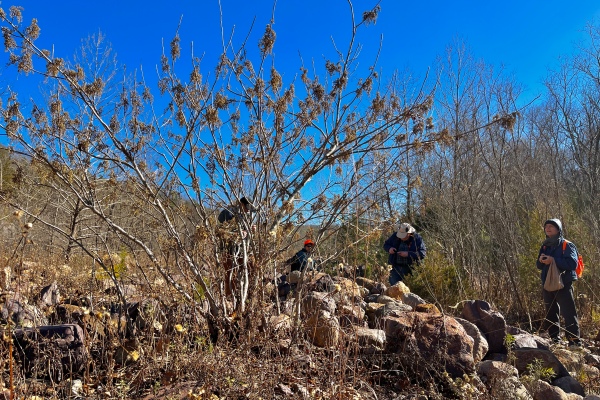
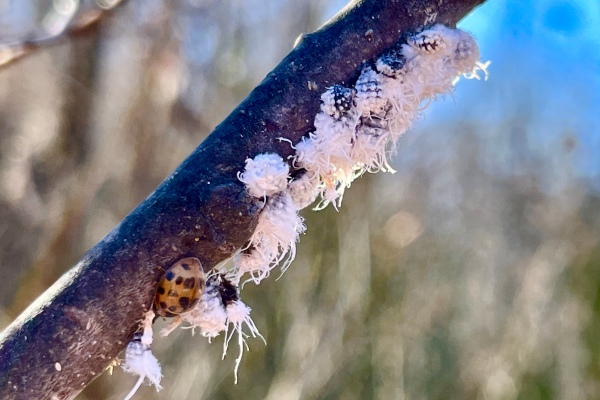
As an entomologist, I cannot ever stop being on the lookout for insects, no matter what the season. Even though temps were well on the chilly side, I still managed to discern a couple of small wolf spiders, and somehow I managed to see a small ant cadaver on a twig that had succumbed to an insect-pathogenic fungus in the Ophiocordyceps unilateralis complex. Even the botanists around me started taking advantage of the opportunity for insect education. Len and Michael noticed a gall on a small Quercus muhlenbergii (chinquapin oak) which turned out to be the work of Disholcaspis quercusglobulus (round bullet gall wasp), and John noticed a colony of Prociphilus tessellatus (woolly alder aphid) on Alnus glutinosa (European alder). Closer inspection revealed an adult Harmonia axyridis (Asian lady beetle) preying upon the aphids.
Small wolf spider (family Lycosidae) on moss-covered rock in dry-mesic upland deciduous forest.
Pardosa sp. (thin-legged wolf spider) on exposed granite in 17-year old scour zone through dry-mesic upland deciduous forest.
Ophiocordyceps unilateralis complex insect-pathogenic fungus infecting ant (family Formicidae) in dry-mesic, deciduous, upland forest.
Disholcaspis quercusglobulus (round bullet gall wasp) on Quercus muhlenbergii (chinquapin oak) in dry deciduous upland forest.
Harmonia axyridis (Asian lady beetle) preying upon Prociphilus tessellatus (woolly alder aphid) on Alnus glutinosa (European alder)
It was as enjoyable an outing as I’d hoped (how can four hours in the woods be anything BUT enjoyable), and I hope not to let so much time pass before the next time I’m able to join the group!
Madam and I are staying in South Lake Tahoe this week, so today I took advantage of this rare opportunity to do some fall insect collecting in western North America. In many insect groups, most species have finished their business for the season by the time autumn arrives. This is especially true for my beloved longhorned beetles, whose spring/early summer flush is now but a distant memory. There are a few genera of longhorned beetles, however, that wait precisely until autumn before making their appearance—Megacyllene and Tragidion being the best-known examples in eastern North America, and Crossidius being the best known out west. I adore autumn collecting, both in the east and in the west—its cooler temperatures and lower humidity make conditions incredibly pleasant, and the longer shadows cast by a low-hanging sun make the landscape—gently morphing from monotonous tones of greens to dazzling shades of amber, tawny, and gold—even more stunning.
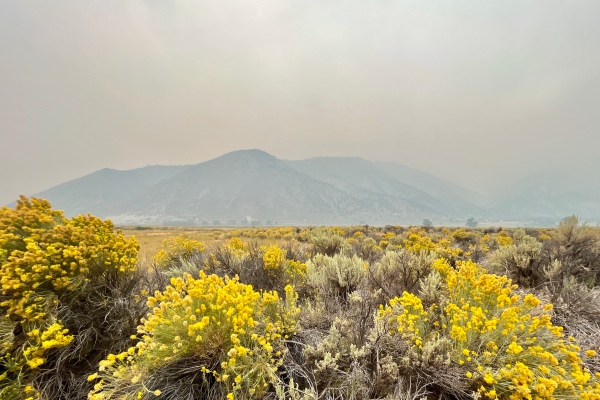
Ericameria nauseosa (rubber rabbitbrush) blooming in the valley below a smoke-shrouded eastern slope of the Sierra Nevada.
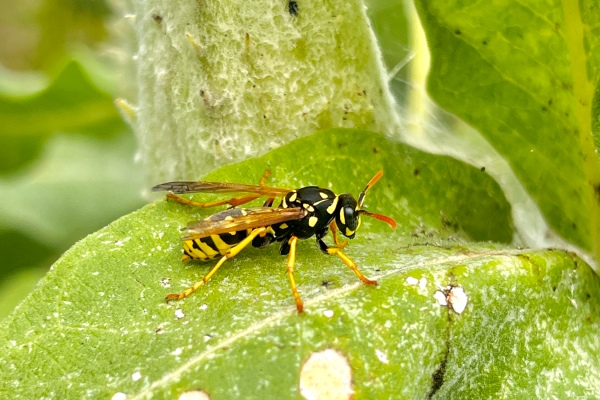
I figured my best shot for Crossidius was in the sagebrush habitat below the eastern slope of the Sierra Nevada, so I took the Kingsbury Grade over Dagget Pass and found some good looking habitat near Genoa with nice stands of Ericameria nauseosa (rubber rabbitbrush)—host of Crossidius coralinus—in peak bloom. It took quite a bit of work to find the beetles, and for the first half-hour the only insects I saw were non-native honey bees (eventually I did see a few native bees as well, which I collected for Mike Arduser). I also checked some Asclepias speciosa (showy milkweed) that I found hoping to find Tetraopes femoratus (red-femured milkweed borer) but saw only Polistes dominula (European paper wasp).
Polistes dominula (European paper wasp) on Asclepias speciosa (showy milkweed) planted in sagebrush habitat.
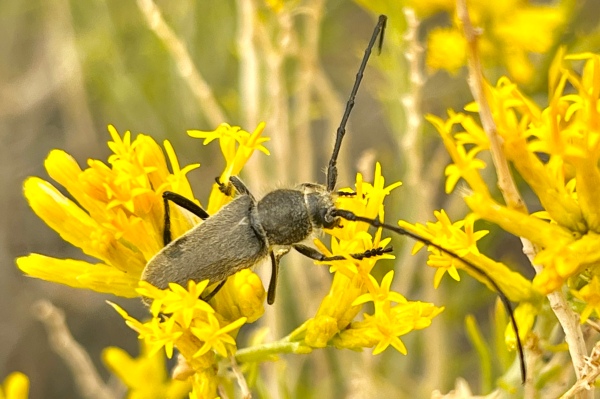
After quite a bit of seeching, I finally found a Crossidius adult, although it was not C. coralinus but rather the all-black C. ater.
Crossidius ater on inflorescence of Ericameria nauseosa (rubber rabbitbrush) in sagebrush habitat.
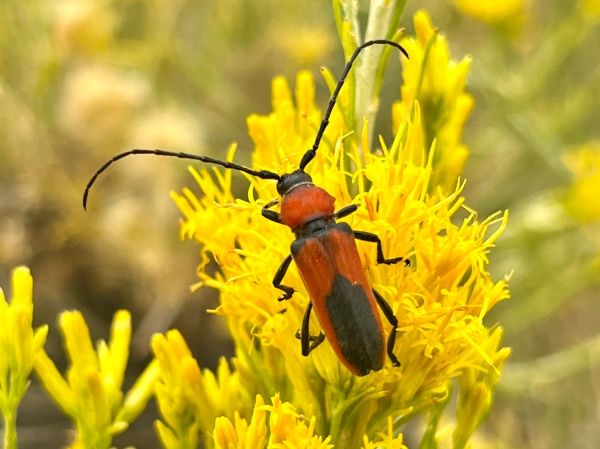
Very quickly afterwards, however, I found the first C. coralinus, and over the next half-hour I collected about a dozen males and females of C. coralinus and one more C. ater.
Crossidius coralinus temprans on inflorescence of Ericameria nauseosa (rubber rabbitbrush) in sagebrush habitat.
Crossidius coralinus has been divided into several subspecies based on differences in markings and coloration across its geographical range—in this area, the species is assignable to subspecies C. coralinus temprans. I did a final check of the stands near where I parked and found one more adult C. coralinus, after which I decided I’d seen enough and went to another spot to look for different species of Crossidius.
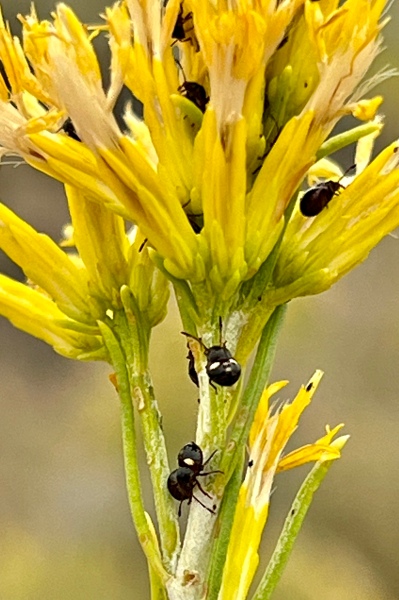
Newly-hatched stink bug (superfamily Pentatomoidea) nymphs on inflorescence of Ericameria nauseosa (rubber rabbitbrush) in sagebrush habitat.
After having such good luck with C. coralinus on E. nauseosa, I went a few miles further north to Jack’s Valley Habitat Management Area where I saw a different species of rabbitbrush (Chrysothamnus viscidiflorus, or yellow rabbitbrush) in bloom.
Chrysothamnus viscidiflorus (yellow rabbitbrush) blooming in the valley below a smoke-shrouded eastern slope of the Sierra Nevada.
Yellow rabbitbrush is the host of a different species of Crossidius in this area—C. hirtipes, and I hoped I might be able to find this species as well. It didn’t take long, as I found a small female hiding in the inflorescence of one of the first rabbitbrush plants that I looked at. As sometimes happens, however, my early success was followed by an extended time without seeing another beetle.
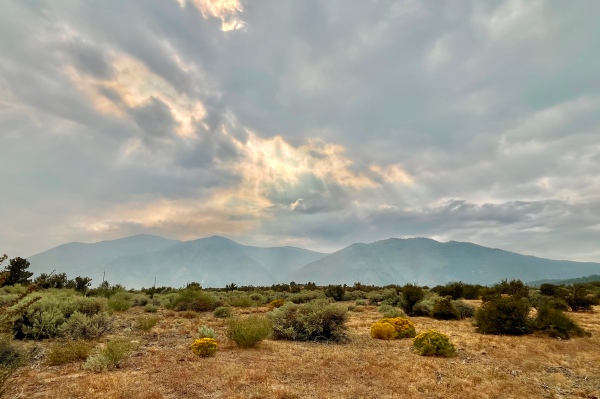
Sagebrush habitat below the east slopes of a smoke-shrouded Sierra Nevada.
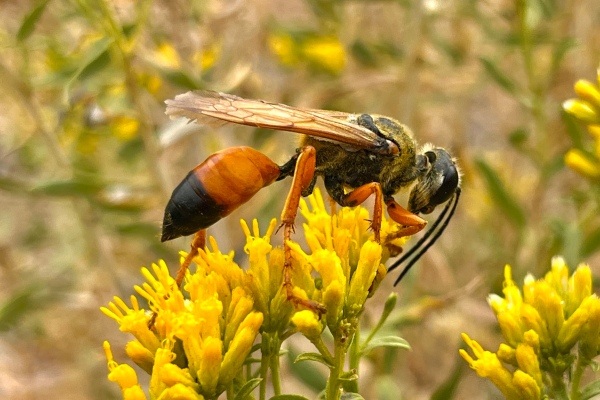
The plants were sparse in the sagebrush habitat, and I zigzagged my way from plant to plant going west from the trailhead. Despite the lack of beetles, there were other insects active on the flowers, including assassin bugs and digger wasps.
Zelus tetracanthus (four-spurred assassin bug) on inflorescence of Chrysothamnus viscidiflorus (yellow rabbitbrush) in sagebrush habitat.
Sphex ichneumoneus (great golden digger wasp) on inflorescence of Chrysothamnus viscidiflorus (yellow rabbitbrush) in sagebrush habitat.
Eventually, I came upon an area where the plants were more abundant, and I started encountering beetles more regularly, including several big males perched atop the flowers and another C. ater adult hiding inside the flowers on one of these same plants.
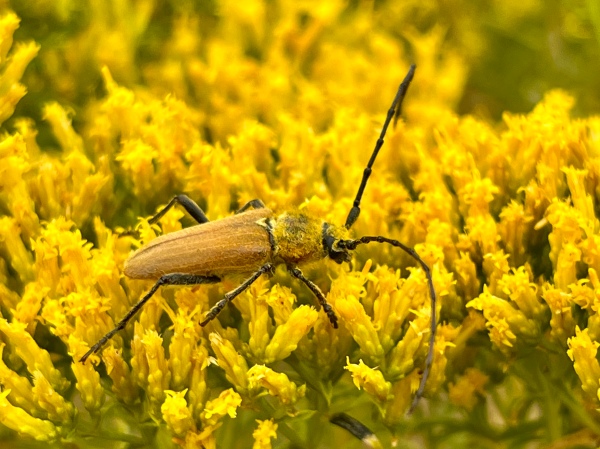
Crossidius hirtipes immaculatus on inflorescence of Chrysothamnus viscidiflorus (yellow rabbitbrush) in sagebrush habitat.
Bees—other than honey bees—were scarse, but I managed to pick up a few for Mike, and I also collected a few Eleodes sp. (desert stink beetles) that were, for some reason, crawling and perching on the rabbitbrush flowers. I’ve never thought of darkling beetles—at least those in the genus Eleodes—as anthophilous, and maybe this habit isn’t strict anthophily, per se, but it was remarkable to see so many of these beetles associated with the plants and hardly a single individual crawling about on the ground.
Eleodes sp. (desert stink bug) on inflorescence of Chrysothamnus viscidiflorus (yellow rabbitbrush) in sagebrush habitat.
After a couple hours worth of effort, I’d secured about a dozen C. hirtipes, which, like C. coralinus, has been assigned to several subspecies (populations in this area being assignable to subspecies C. hirtipes immaculatus)—enough for my purposes, and I left to head back up into the mountains.
Smoke and clouds combine above the eastern slope of the Sierra Nevada.
I’d hoped to find one more spot up in the mountains, but the sinking sun and rising elevation conspired to make conditions much too cool for all but the most persistent insects. I did stop at a powerline cut, where recently-cut Jeffrey pine (Pinus jeffreyi) trunks, stumps, and branches provided a perfect attractor for wood-boring beetles. Sadly, none were seen, even on the undersides of the logs and branches. Thus, my rare chance for fall insect collecting in western North America came to a close.


















 Beetles In The Bush