ID Challenge #8

It has been almost two months since the last ID Challenge and more than a month since the last challenge of any kind, thus it’s high time we kick off BitB Challenge Session #3.  This is a straight up identification challenge: 2 pts each for order (a gimme!), family, genus, and species.  Bonus points will be awarded for additional relevant information, but I’m going to be somewhat more selective about what I award such points for rather than just anything that happens not to be incorrect—my discretion.

Standard challenge rules apply, including moderated comments to give everyone a chance to participate.  However, starting this session there’s a twist—if multiple people answer correctly, those who submit their answers earlier get bonus points over those they beat to the punch.  The actual number of points will depend on how many correct answers there are, but I’m hoping it adds a bit of competitive urgency to the game.  We’ll see if it works.

Copyright © Ted C. MacRae 2011

Bichos Argentinos #12 – Lace Bugs

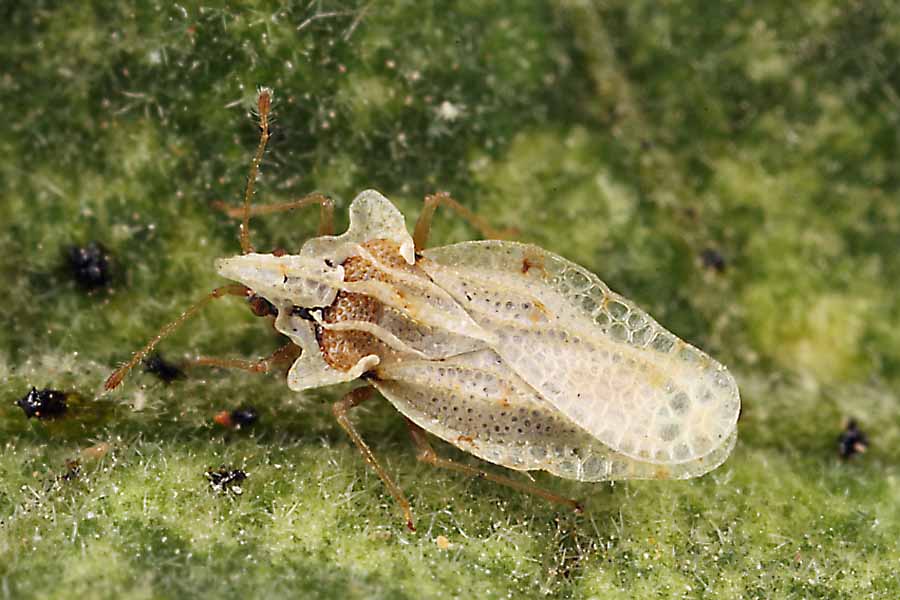
Corythaica cyathicollis on upper leaf surface of Solanum granuloso-leprosum.

Shortly after entering La Reserva Ecológica Costanera Sur (Buenos Aires, Argentina) during my early March visit, I noticed a fairly large patch of solanaceous-looking shrubs.  Even from a distance, I could see patterns of white stippling on the foliage immediately identifiable as signs of lace bugs, true bugs (order Hemiptera) in the family Tingidae.  As the only arborescent solanaceous plant recorded from the reserve, I was quickly able to identify the plant as Solanum granuloso-leprosum (Haene and Aparicio 2007), but I expected an identification of the bug to be much more difficult to come by.  Afterall, 84 species of tingids distributed in 25 genera have been recorded from Argentina (Montemayor and Cascarón 2005), and lace bug photos aren’t very frequently encountered in the variety of web sites that I visit when trying to get a lead on the identity of insects outside my area of expertise.

Corythaica cyathicollis adult. The black spots either represent frass or protective egg coverings.

Still, I had a clue—the association of the species with Solanum. Lace bugs are predominantly specialist feeders, with many species showing fidelity to a particular plant genus or group of related genera. The genus Solanum contains a number of economically important species, thus, it was a good bet that this species has at some point been considered an economic pest. With this in mind, I opened my volume of Heteroptera of Economic Importance (Schaefer and Panizzi 2000) to the chapter on lace bugs (Neal and Schaefer 2000) and began looking through the species accounts for South American species recorded on Solanum or other species in the family Solanaceae. I only had to reach the second species account before finding Corythaica cyathicollis and the statement “This Neotropical species is a pest on many solanaceous crops…” The identification was confirmed when I found a rather complete description of the species’ systematics, biology, and economic importance (Kogan 1960), complete with line drawings of the adults and all immature stages. Comparison of my photos with these drawings leaves little doubt that this is, indeed, C. cyathicollis.  (Interestingly, Montemayor and Cascarón (2005) list 28 species of Solanum as recorded hosts for C. cyathicollis in their Argentina checklist; however, S. granuloso-leprosum is not among them…)

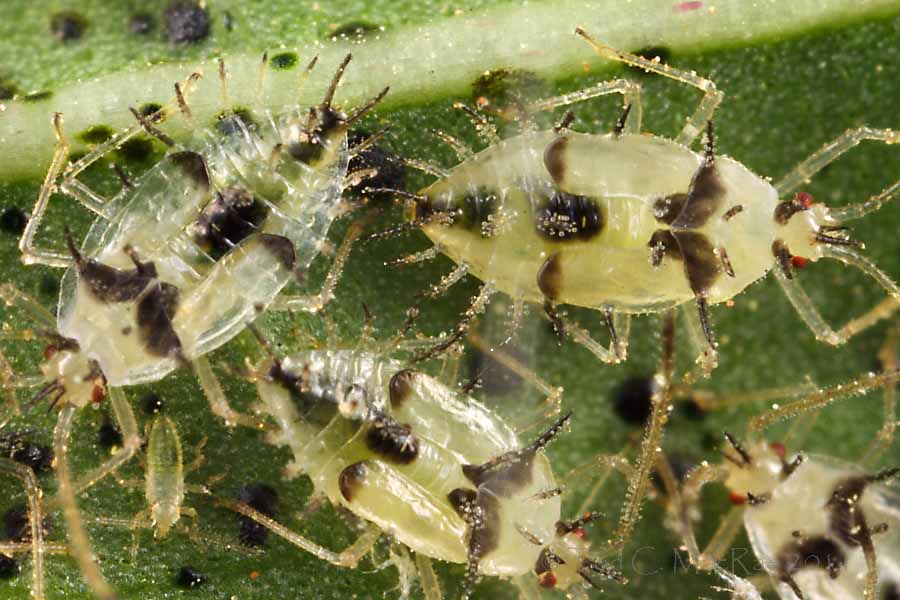
Corythaica cyathicollis late-instar nymphs.

The bristles of needle-like setae exhibited by the nymphs may be useful for species identification by entomologists (and even phylogenetic analyses—see Guilbert 2005), but for the nymphs themselves it seems fairly obvious that they serve some adaptive function for protection. Neal and Schaefer (2000) note that nymphs of many species of Tingidae seem to be protected by a wide variety of other adaptive mechanisms as well, including maternal care, the production of alarm pheromones and possibly the secretion of noxious compounds. Indeed, most tingids occur in multiple aggregations with large numbers of nymphs of the same species on a single host plant relatively free of predation and parasitism—it is difficult to imagine that such aggregations could exist without employing a strong arsenal of multiple defense mechanisms.
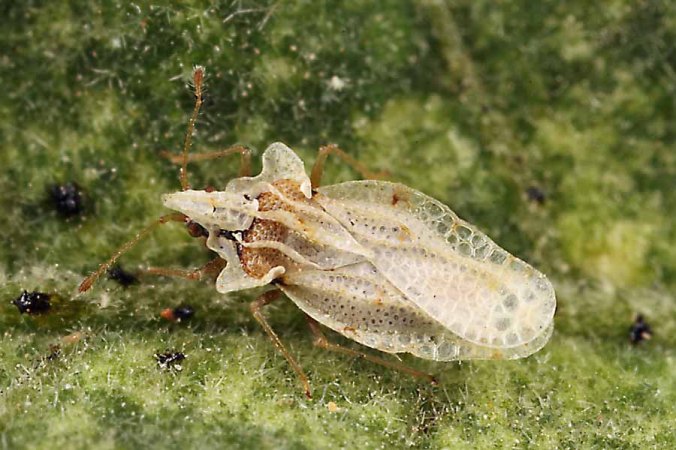
A presumably teneral adult Corythaica cyathicollis.

Occasional adults were seen within the aggregations that showed decidedly lighter coloration than the majority of adults seen. The aggregations were comprised primarily of adults and late-instar nymphs, so I presume these light-colored adults represented newly molted, teneral individuals that will eventually assume normal coloration once their new adult exoskeleton fully hardens.

Adult Gargaphia lunulata on lower leaf surface of Ricinus communis.

Later in the day, I encountered a different lace bug species on a different shrub—Ricinus communis.  This is the famous castor oil plant, a member of the Euphorbiaceae, native to the Old World and now widely distributed throughout tropical regions.  Despite castor oil’s reputed ability to heal wounds and cure ailments, the beans and other plant parts also contain ricin—a toxin with known insecticidal properties.  Apparently these lace bugs possess some mechanism that makes them immune from its effects.
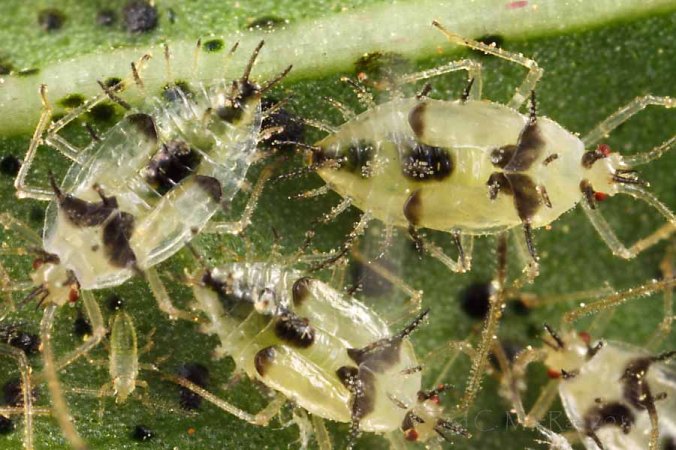
Gargaphia lunulata 5th instar nymphs (and an apparent 1st instar in lower left corner).

This species was also fairly easy to identify—one of the species listed in Neal and Schaefer (2000) as feeding on Ricinus is Gargaphia lunulata, which they note feeds on several useful South American plants belonging to a number of families, including the Euphorbiaceae.  Photographs and drawings of this species can be found in Ajmat et al. (2003) and agree well with the adults and nymphs I found on this plant.  Unlike C. cyathicollis, which were found on the adaxial (upper) surface of the leaves, I found G. lunulata exclusively on the abaxial (lower) surfaces.  Nevertheless, the characteristic white stippling was easily visible on the leaves and gave immediate clue to their presence.

Photo Details: Canon 50D w/ MP-E 65mm 1-5X macro lens (ISO 100, 1/200 sec, f/13), Canon MT-24EX flash w/ Sto-Fen + GFPuffer diffusers. Typical post-processing (levels, minor cropping, unsharp mask). Photo 1 taken at 1X, photos 2 through 6 taken at or near 5X.

REFERENCES:

Ajmat, M. V., S. G. Bado, M. A. Coviella and M. J. Pannuzio. 2003. Aspectos morfológicos, biológicos y daño de Gargaphia lunulata (Mayr) 1865 (Heteroptera: Tingidae) sobre Passiflora caerulea L. (Passifloraceae). Boletin Sanidad Vegetal Plagas 29:339–346.

Guilbert, É. 2005. Morphology and evolution of larval outgrowths of Tingidae (Insecta, Heteroptera), with description of new larvae. Zoosystema27(1):95–113.

Haene, E. and G. Aparicio.  2007.  100 Trees of Argentina. Editorial Albatros, Buenos Aires, República Argentina, 128 pp.

Kogan, M.  1960.  Corythaica cyathicollis (Costa, 1864), aspectos sistemáticos, biológicos e econômicos (Hemiptera, Tingidae). Memorias Instituto Oswaldo Cruz 58(1):59–88.

Montemayor, S. and M. del Carmen Coscarón. 2005. List of Argentinian Tingidae Laporte (Heteroptera) with their host plants. Zootaxa 1065:29–50.

Neal, J. W., Jr. and C. W. Schaefer. 2000. Chapter 4. Lace Bugs (Tingidae), pp. 85–137. In:C. W. Schaefer and A. R. Panizzi (Eds.). Heteroptera of Economic Importance, CRC Press LLC, Boca Raton, 828 pp.

Copyright © Ted C. MacRae 2011

Big, Bold, and Beautiful

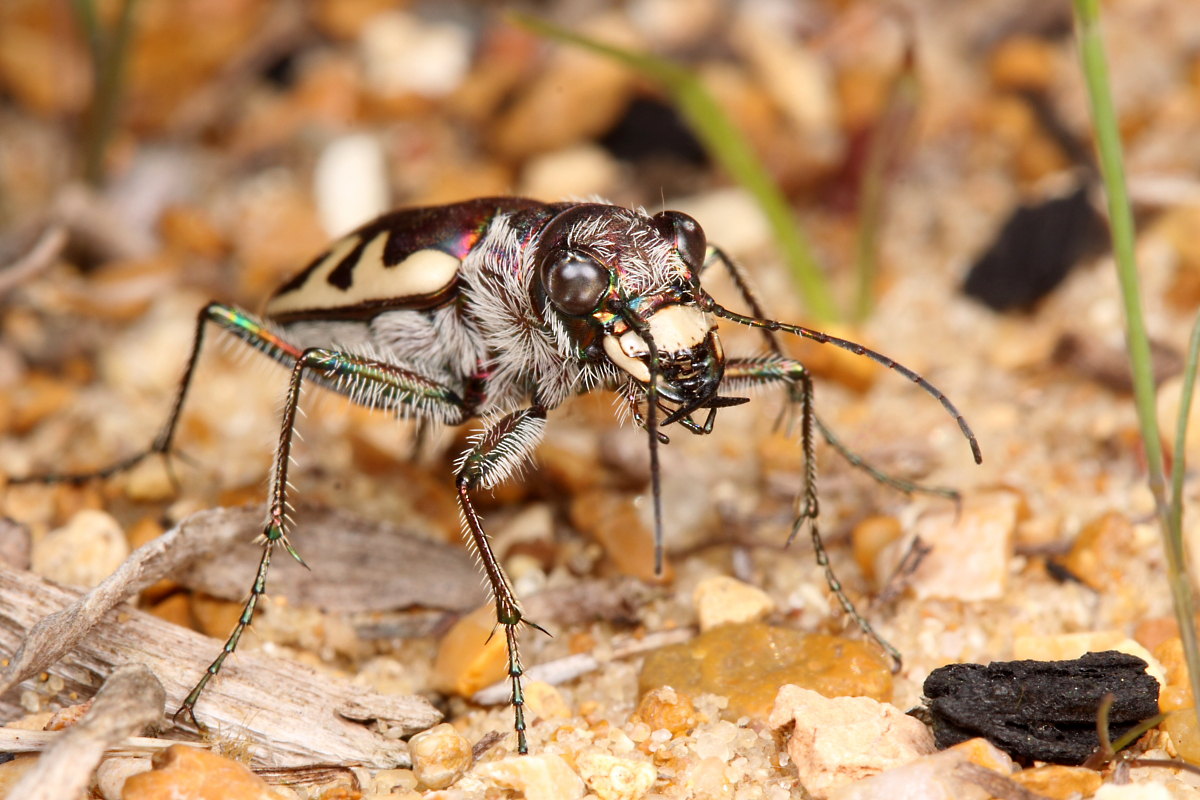
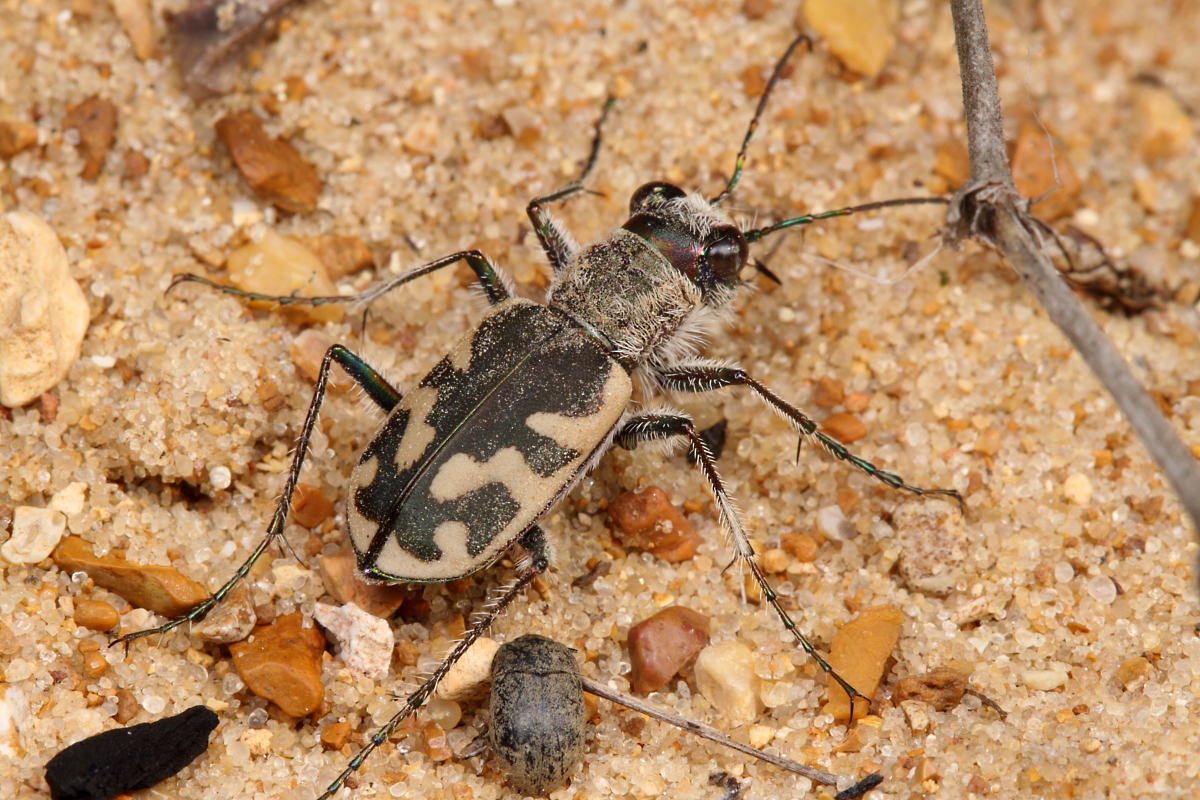
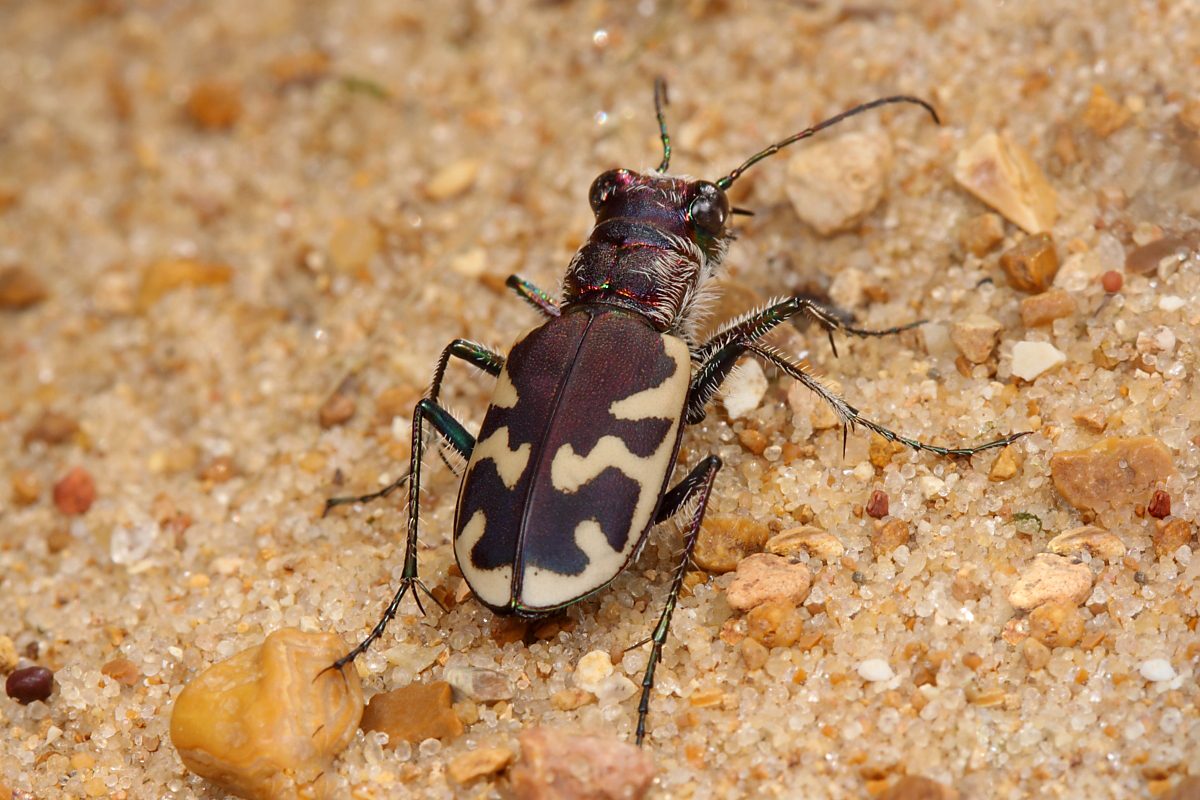
Cicindela formosa generosa | Castlewood State Park, Missouri.

Last fall I took my younger daughter to the Al Foster Trail on the western side of Castlewood State Park, just a few miles down the road from my house.  As we walked the trail through typical bottomland forest next to the Meramec River, I noticed what appeared to be open ground on a rise to the north of the trail.  When I went up to investigate, I saw a rare sight for Missouri—dry sand!  Obviously a deposit from some past flood event, the post oaks established around its perimeter and native warm season grasses sparsely dotting its interior suggested it had been laid down many years ago.  Such sights were likely common along the big river systems of pre-settlement Missouri, as natural flooding cycles laid sand deposits up and down the river courses, each deposit gradually succumbing to vegetation as new deposits were laid down elsewhere.  Today, with channelization and levees for flood control, the Missouri and Mississippi Rivers are just narrow, hemmed-in shadows of their former selves, unable to lay down such deposits in most years until, at last, catastrophic flooding occurs on a grand scale (as is occurring now).  Feeding into the Mississippi River just south of the Missouri River is the Meramec River—as the state’s only still-undamned undammed river system, it still has opportunity on occasion to lay down these interesting dry sand habitats.

The dark brown coloration of this rather ''dirty'' individual is typical of most Missouri populations.

When I see dry sand habitats in Missouri, three tiger beetle species immediately come to mind—Cicindela formosa (big sand tiger beetle), C. scutellaris (festive tiger beetle), and Ellipsoptera lepida (ghost tiger beetle).  My colleague and co-cicindelophile Chris Brown and I have spent many a weekend traveling up and down the state’s river systems with these species in mind.  None of them are rare in the state, but their fidelity to deep, dry sand habitats also makes them by no means common.  It is always cause for celebration when a new site is discovered for one of these species somewhere in Missouri.  Thus, it was in anticipation of one (or more) of these species that I returned to the spot last week on the first truly gorgeous spring day of the season.  Could it really be that, after ten years of searching for these species throughout the state, I would find a population just a few miles down the road from my house?!

A number of individuals in this population show traces of the bright coppery red coloration more typical of nominotypical populations west of Missouri.

Walking onto the site, I began to see tiger beetles immediately.  However, they were Cicindela tranquebarica (oblique-lined tiger beetle), a common species in Missouri that enjoys not only dry sand habitats, but also wet sand, wet mud, dry clay, and even concrete habitats—hard to get excited about such a habitat slut!  Nevertheless, within minutes I began seeing more robust beetles that were unmistakably big sand tigers.  Big, bold, and beautiful, the beetles were wary in the late afternoon heat and quickly launched into their powerful escape flights that ended comically some 20 yards away with a characteristic bounce and a tumble.  Such behavior might seem to make them impossible to photograph, but I’ve been at this for awhile and know their behavior pretty well—a slow, cautious approach, crouching carefully at the right distance, and crawling deliberately on elbows and knees while peering from behind the camera until it shows up in the lens set to 1:3 (one-third life size).  Then it’s a matter of even more slowly closing the distance and scooting around to get the desired angles and composition.  Move slowly enough and they’ll forget you’re there and resume normal behavior—you’ll be richly rewarded with views of foraging, stilting, and other classic tiger beetle behaviors.

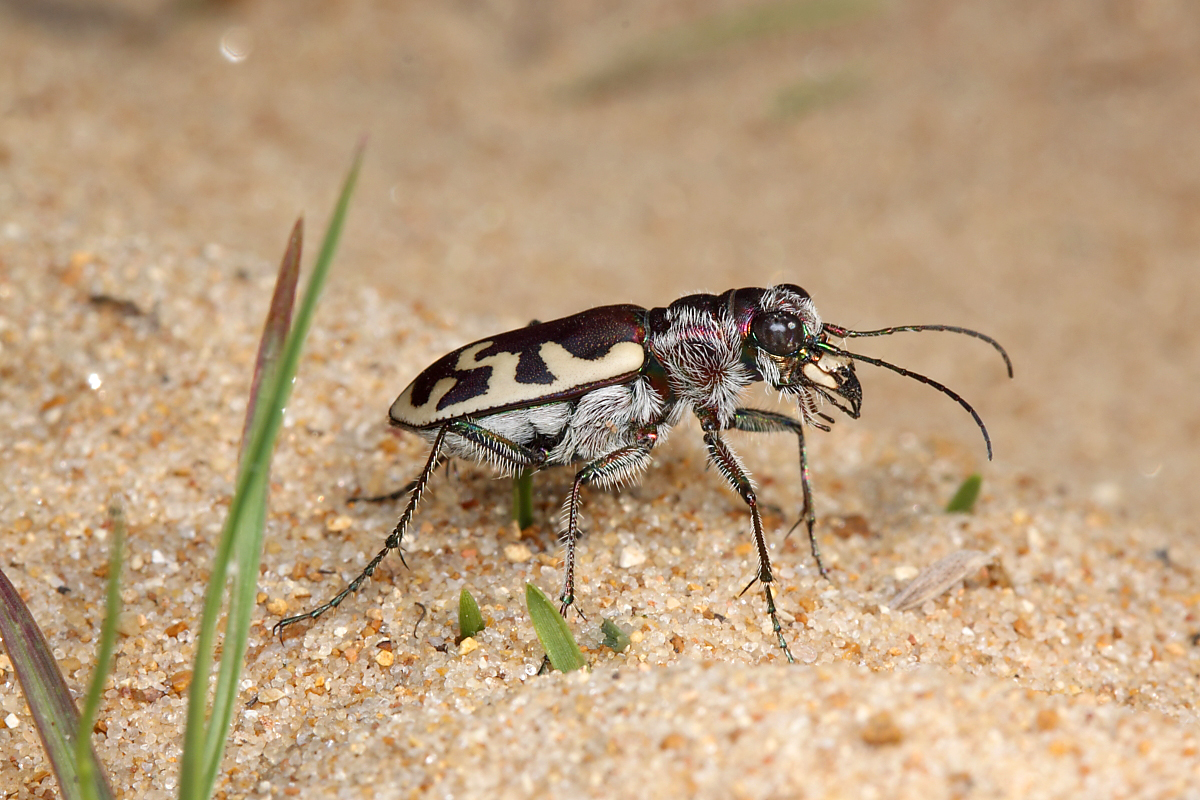
Coloration and markings may seem conspicuous but provide excellent camouflage against the pebbley-sand substrate.

Most of the big sand tiger beetle populations we have found in Missouri are typical of the eastern subspecies C. formosa generosa, distinguished from other named subspecies by the dark brown dorsal coloration and thick white markings that are separate dorsally and joined along the outer edges of the elytra (Pearson et al. 2006).  This subspecies is predominantly midwestern and northeastern in distribution, while the typically bright coppery-red individuals assigned to the nominotypical subspecies are found further west in the Great Plains.  There are, however, certain populations in Missouri that show more or less suffusion of coppery-red coloration.  This is typically explained as hybrid influence, as Missouri lies on the western edge of the distributional range of subspecies generosa.  However, we have only seen these coppery-red indications on the eastern side of Missouri, while populations on the western side of the state along the Missouri River exhibit typical dark brown coloration.  The population here in St. Louis Co. is the third population we have found to show this coppery-red influence, and in fact most of the individuals I saw exhibited greater or lesser amounts of this coloration.  My personal belief is that there is no genetic basis for this subspecific distinction, but that the differences in color are instead related to conditions of the soil in which they live—possibly pH.  Sand habitats in the eastern United States are typically acidic, while alkaline soils abound in the Great Plains (formerly a vast sea bottom).  Hey, it’s a thought!

Big sand tiger beetles remain one of my favorite beetle species in Missouri.

The combination of striking coloration and bold white markings exhibited by big sand tiger beetles might seem to make them quite conspicuous and vulnerable to predation—especially in the open, sparsely vegetated areas that they inhabit; however, against the textured sandy substrates on which they are found they are almost impossible to detect until they move.  I’ve learned not to try to see them first and sneak up on them, as this is a lesson in futility.  Rather, I simply walk through an area and fix my sights on individuals as they take flight, watching them as they fly and eventually land and then sneaking up to the spot where I saw them land.  I generally need to stop about 8-12 feet out and study the spot carefully to pick them out, and then I can continue sneaking up on them.

Photo Details: Canon 50D w/ 100mm macro lens (ISO 160, 1/200 sec, f/16), Canon MT-24EX flash w/ DIY oversized concave diffuser. Typical post-processing (levels, minor cropping, unsharp mask).

REFERENCES:

Pearson, D. L., C. B. Knisley and C. J. Kazilek. 2006. A Field Guide to the Tiger Beetles of the United States and Canada. Oxford University Press, New York, 227 pp.

Copyright © Ted C. MacRae 2011

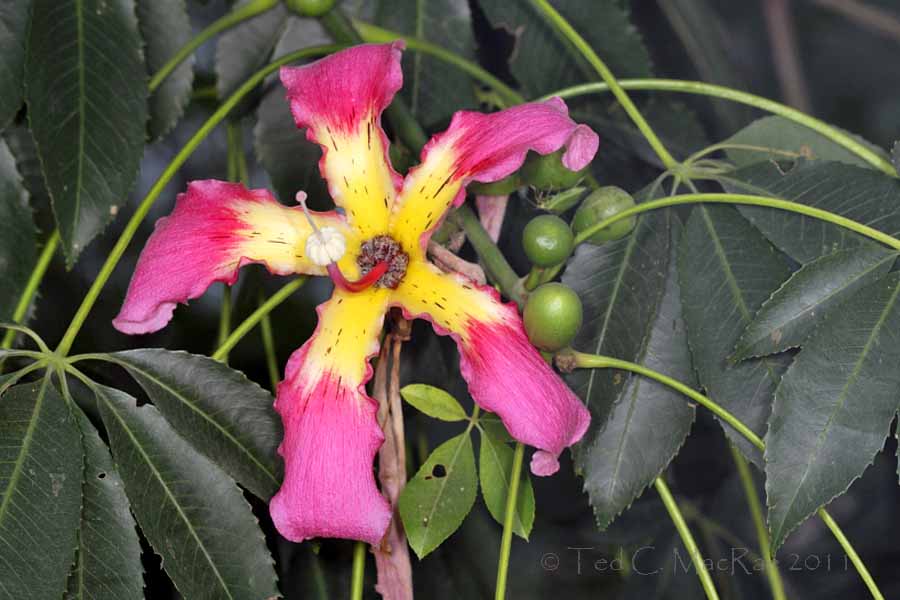
Friday Flower – “Palo Borracho”

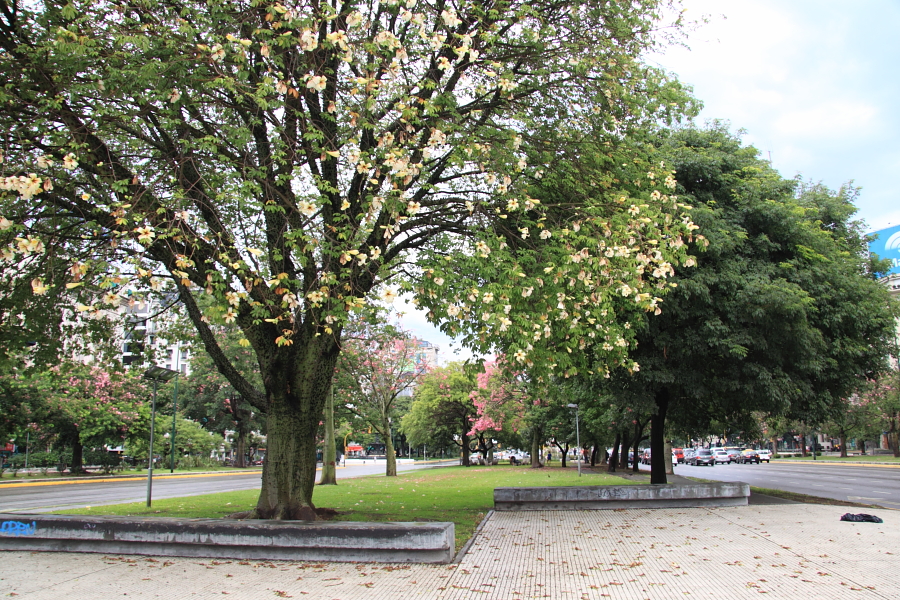
Ceibo may be Argentina’s national flower, but Ceiba is its most iconic flower.  That’s right—Ceibo and Ceiba are two, completely unrelated species!  Ceibo is the common name in Argentina for Erythrina crista-galli, a tree in the family Fabaceae, while Ceiba is a genus of flowering trees in the family Bombacaceae that includes the species pictured above—Ceiba speciosa (syn. Chorisia speciosa), known in Argentina as “Palo Borracho.”  This translates literally to “drunken stick”—a reference to the pot-bellied trunk with narrowed base that gives the tree the appearance of a wine bottle (Haene and Aparicio 2007).  Native to the dry forests of northeastern Argentina, C. speciosa has become an enormously popular street tree in the country due to their dazzling displays of hot pink blossoms, especially in Buenos Aires whose green spaces and wide boulevards are lined with grand old specimens.

Interspersed amongst the pink flowering trees are occasional specimens with the flowers mostly white but otherwise looking much the same as C. speciosa.  These are the closely related species C. chodattii (syn. Chorisia insignis), or Yuchán.  This species is native to more western, even drier areas of northern Argentina than C. speciosa and has also become popular as an ornamental tree in urban areas, though it has been planted with less frequency than its hot pink-flowered congener.

Bombacaceae also contains the famously odd baobab and kapok trees—also distingished by bulging trunks that serve as an adaptation for water storage in seasonally dry environments.  The trunks of Ceiba trees exhibit an additional water conservation adaptation with thick, conical-shaped thorns that are also capable of water storage.  The young tree picture here was photographed in Campinas, Brazil and exhibits the green coloration typical of younger trees that functions to augment their photosynthetic capabilities. In fact, the dry forests in which Ceiba spp. evolved often contain a number of unrelated plants that also are thorny and have green bark.

REFERENCE:

Haene, E. and G. Aparicio.  2007.  100 Trees of Argentina. Editorial Albatros, Buenos Aires, República Argentina, 128 pp.

Copyright © Ted C. MacRae 2011

Feasting on the bounty

Brood XIX periodical cicadas were not the only insects appearing en masse last week at Sam A. Baker State Park in Missouri’s southeastern Ozark Highlands.  As I walked the upland trail, I thought I felt ‘raindrops’ for awhile before realizing that it was frass.  Little pieces of fresh young leaves littered the trail around me, and I realized that an outbreak of caterpillars was hammering the oak trees in this forest.  Unlike the cicadas, which were encountered primarily in the bottomland forest along Big Creek, the rain of poop was restricted to the uplands.  Not surprisingly, I saw caterpillar hunters, Calosoma spp. (family Carabidae—the real Carabidae, not the tiger beetle Carabidae that I’ve begrudgingly had to accept) about as abundantly as I’ve ever seen them.  At first I didn’t notice them until I would scare one up, then spend several frustrating minutes trying to photograph a beetle that just would not stop running.  I tried a few and gave up—after all, they’re just ground beetles (i.e., real ground beetles).  Eventually, I realized that if I noticed them before they noticed me, I could sneak up on them and have my way with them (photographically speaking, that is).  I even found that I could preen nearby leaves and sticks for composition if I did it carefully enough.  Here are a couple of my favorite shots on the day.

I would presume these to represent the fiery searcher, Calosoma scrutator, but apparently C. wilcoxi is similar in appearance.  According to comments by several BugGuide users, C. scrutator is larger (25mm or more in length), has more elongated mandibles and head, and the color of the central purple area of the pronotum is more intense.  Based on those comments, I would say the two individuals in these photographs are C. scrutator.  However, they also note some differences in temporal occurrence that don’t seem to support that.  Moreover, the many individuals I saw that day ranged in size from these larger individuals to some notably smaller ones.

Copyright © Ted C. MacRae 2011

Love is in the air!

My first tiger beetle photograph of the season. There’s nothing more adorable than Spring love!

Cicindela tranquebarica (oblique-lined tiger beetle) | St. Joe State Park, Missouri

Photo details: Canon 50D w/ 100mm f2.4 macro lens (ISO 160, 1/200 sec, f/16), Canon MT-24EX twin flash w/ DIY oversized concave diffuser.

Copyright © Ted C. MacRae 2011
“They’re baaaaack!”

The recent run of seemingly interminable rains and HF4 tornadoes may have delayed the Annual-Birthday-First-Bug-Collecting-Trip-of-the-Year™, but it could not cancel it.  On Thursday this week, for the first time since the same time last week, a strange ball of hot gas appeared in the sky, temperatures tickled the 70°F mark, and the only moisture we encountered was already on the ground.  The weatherman said several days ago it would happen, so I put my faith in his word and made plans with my dad to do what I had planned to do last week – officially open the 2011 bug collecting season.  It was a marvelous day in which many interesting stories unfolded, one of which I’ve heard (literally) a few times already.

One of our stops was Sam A. Baker State Park in southeastern Missouri.  My original reason for coming here involved dead wood retrieval (success) and rattlesnakes (failure, though with a consolation prize – more later).  As we were walking the trail in the bottomland forest along Big Creek, I noticed all these holes in ground.  At first I assumed a group of hikers wielding their fashionable trekking poles had gone before us and left their mark in the muddy, recently flooded soil, but the holes were just too numerous and not all perfectly round.  I had just commented to my dad, “What the heck caused all these holes?”, when I saw the culprit – a fully grown periodical cicada nymph crawling on the ground looking for a tree to climb and begin life as one of the noisiest insects on earth.  I looked around and saw another one, and another… they were everywhere!  Boy, are we gonna be in for it this year!

Missouri and several other Midwestern states will be hosting periodical cicada Brood XIX—the Great Southern Brood!  All four of the 13-year species (Magicidada tredecassini, M. tredecula, M. tredecim, and M. neotredecim) participate in this brood, the largest of the 13-year broods by geographical extent, and occur in Missouri in variously overlapping ranges.  Magicicada tredecim and M. neotredecim are the two most common species in the Ozark Highlands across the southern part of the state, so the nymphs shown here likely represent one or both of those species.

I remember well the previous two appearances of brood XIX in Missouri in 1998 and 1985, when beating for buprestids during May and June was an exercise in futility due to every tree branch literally dripping with these bumbling, screeching insects (too bad I never find buprestids dripping from tree branches like this).  Those that didn’t land flapping clumsily on the sheet ended up desperately clinging to my head or flying into my face.  If swatting at these flying bullets wasn’t maddening enough, the ceaseless, droning, omnipresent cacophony of their singing was almost enough to send me to the local psycho ward begging for admittance.

I think I’ll skip trying to use the beating sheet this year.

Copyright © Ted C. MacRae 2011
Bichos Argentinos #11 – Takes Two to Tango

Epilachna vigintioctopunctata (vaquita de las solanáceas) | Buenos Aires, Argentina

Another of the insects that I photographed at La Reserva Ecológica Costanera Sur, Buenos Aires, Argentina during my early March visit.  I found quite a few of these beetles feeding on the newly sprouting growth from cut stumps of a small, multi-stemmed tree.  At first I thought they were leaf beetles of the family Chrysomelidae because of the way they were actively feeding on the fresh, succulent growth; however, a closer look quickly revealed them to be members of the family Coccinellidae (ladybird beetles).  Their phytophagous, gregarious behavior immediately identified them as members of the subfamily Epilachninae, and in fact they bear a remarkable resemblance to Epilachna varivestis (Mexican bean beetle) and E. borealis (squash lady beetle) – the best known examples of this subfamily in North America.

Armed with confidence in at least a subfamilial placement, I looked for references on the group and quickly found a reasonably recent revision of the subfamily for the entire Western Hemisphere (Gordon 1975) – jackpot!  I reasoned an abundant species seen in the heart of the 3rd largest city in South America would likely show up on page one, but after several increasingly careful passes through the entire revision, it became clear that whatever species this was, it was not among the nearly 300 species (2/3 of them in the genus Epilachna) treated in that work. 

Now, the exuberant, young, not-very-sage entomologist that I was 30 years ago would have immediately gotten all excited that I had found a new species, but the older, battle-tested, more cautious entomologist that I am now instead started suspecting I was dealing with an introduced species.  After all, some of the insects and plants I’ve already featured from this man-made nature reserve are introduced.  I figured as abundant as the beetles were, the species had to be featured on some website, so I started with the obvious and Googled “Coccinellidae Argentina,” clicked on the very first result (appropriately titled Coccinellidae of Argentina), and found a seemingly authoritative site with links to the different subfamilies.  Clicking on Epilachninae and scanning the photos, there it was – Epilachna vigintioctopunctata (28-spotted ladybird beetle).  Native to India and southeastern Asia, this species is well known for its attacks on numerous solanaeous and cucurbitaceous crops (Richards 1983).  It made its first appearance in the Western Hemisphere in southern Brazil (Schroder et al. 1993) and in 1994 was observed on experimental eggplant plots at the School of Agronomy, University of Buenos Aires (Folcia et al. 1996).  Poetically, those initial specimens were sent to Robert Gordon at the U.S. National Museum (and author of the Western Hemisphere revision), who confirmed their identity.  It seems that Argentinians are not the only ones that like to tango!

REFERENCES:

Folcia A. M., S. M. Rodriguéz and S. Russo. 1996. Aspectos morfológicos, biológicos y de preferencia de Epilachna vigintioctopunctata Fabr. (Coleoptera Coccinellidae). Boletin de Sanidad Vegetal Plagas 22:773–780.

Gordon, R. D. 1975. A revision of the Epilachninae of the Western Hemisphere (Coleoptera: Coccinellidae). U. S. Department of Agriculture, Technical Bulletin No. 1493, ii+409 pp.

Richards, A. M.  1983.  The Epilachna vigintioctopunctata complex (Coleoptera: Coccinellidae).  International Journal of Entomology 25(1):11–41.

Schroder, R. F. W., M. M. Athanas and C. Pavan. 1993. Henosepilachna vigintioctopuctata (Coleoptera-Coccinelidae), new record for Western Hemisphere, with a review of host plants. Entomological News 104(2):111–112.

Copyright © Ted C. MacRae 2011