Typocerus deceptus in Missouri

It has been fifteen years now since I published an annotated checklist of the longhorned beetles (families Cerambycidae and Disteniidae) of Missouri (MacRae 1994).  That publication (and a similar one on Buprestidae) was the product of eight years of collecting – of specimens in the field and of data in any other public or private collection I could find that contained Missouri specimens – during my stint as a field entomologist with the Missouri Department of Agriculture.  I collected during the week while on my rounds.  I collected on weekends as well.  I visited every college and university in the state that had an insect collection of any size, and a few in neighboring states as well.  I made the acquaintance of private collectors with significant Missouri material – most notably Richard Heitzman, Marlin Rice, and the late Gayle Nelson.  By the time I left Missouri for a new position in Sacramento, I had documented 219 species and subspecies of longhorned beetles from the state – 66 of which were new state records.

Typocerus deceptus on flower of Hydrangea arborescens

Typocerus deceptus on flower of Hydrangea arborescens

Despite my best efforts, however, I knew the list was not complete – they never are.  In the years since returning to Missouri, I’ve documented an additional 10 species and subspecies in the state (MacRae and Rice 2007), and in a newly published paper (McDowell and MacRae 2009) the rare species, Typocerus deceptus, is documented from Missouri for the first time.  I cannot take credit for this discovery – that honor goes to the paper’s lead author, Tom McDowell of Carbondale, Illinois.  Tom first encountered this species in 2005 at Trail of Tears State Park in southeastern Missouri near Cape Girardeau while conducting routine insect surveys.  After seeing additional individuals on a subsequent visit to the park the following year, Tom contacted me to tell me of his find and graciously invited me to join him on further studies of this rarely encountered species.  I readily agreed, and in July of last year I met up with Tom at Trail of Tears to see the beetle for myself.

Typocerus deceptus on flower of Hydrangea arborescens

Typocerus deceptus on flower of Hydrangea arborescens

Typocerus deceptus has been recorded sporadically from across the eastern U.S.  Nothing is known of its biology other than adult flower hosts and activity periods, and the larva and larval host(s) remain completely unknown.  The species is aptly named, as its appearance is deceptively similar to the common and widespread species, T. velutinus.  Both of these species belong to the so-called “flower longhorn” group (subfamily Lepturinae), characterized by adults that are largely diurnal (active during the day) and attracted to a great variety of flowers upon which they feed.  Tom had found T. deceptus feeding on flowers of wild hydrangea (Hydrangea arborescens) in the company of several other flower longhorns, including T. velutinus.  The similarity of T. deceptus to T. velutinus makes distinguishing individuals amongst the vastly more abundant T. velutinus quite difficult.  However, Tom was able to recognize the species during his surveys as a result of prior experience with it in Illinois.  As Tom and I searched the wild hydrangea plants growing along an intermittent drainage between the road and the park’s unique mesic forest, we succeeded in picking out a total of four individuals of this species amongst the dozens of T. velutinus and other lepturines also feeding on the flowers.

Typocerus velutinus on flower of Hydrangea arborescens

Typocerus velutinus on flower of Hydrangea arborescens

I gradually developed a sense of the subtle differences that distinguish this species from T. velutinus and that allow its recognition in the field.  Typocerus deceptus is slightly more robust than T. velutinus, and whereas the transverse yellow elytral bands of the latter are distinct and well delimited, they are weaker and often interrupted at the middle in T. deceptus, giving the beetle a slightly darker brownish appearance.  The lateral margins of the elytra are also more strongly emarginated near the apices, giving the beetle a more distinctly tapered appearance.  Finally, while both species possess a distinct band of dense, yellow pubescence along the basal margin of the pronotum, this band is interrupted at the middle in T. deceptus. My ability to recognize this species in the field was confirmed a few weeks ago when I returned to Trail of Tears (with longtime field companion Rich Thoma) to attempt what seemed to be an impossible task – photograph these active and flighty insects in the field on their host plants.  Conditions were brutally humid, and I only saw two individuals that day – the first I immediately captured and kept alive as a backup for studio photographs should I fail to achieve my goal in the field, but the second individual (not seen until almost two hours later!) posed just long enough for me to whip off a series of frames, two of which turned out well enough to share with you here.  The first photo clearly shows the interrupted basal pubescent band, and both photos show the distinctly emarginate lateral elytral margins and weak transverse yellow bands (compare to the uninterrupted pronotal pubescent band and well developed transverse elytral bands of T. velutinus in the third photo).

Me with the discoverer of Typocerus deceptus in Missouri Trail of Tears State Park, July 2008

TCM with the discoverer of Typocerus deceptus in Missouri at Trail of Tears State Park, July 2008

It is possible that T. deceptus is not as rare as it appears and is simply overlooked due to its great resemblance to another much more abundant species. However, I believe this is unlikely given its rarity in collections of eastern U.S. Cerambycidae by casual and expert collectors alike.  Moreover, T. deceptus is not the only “rare” longhorned beetle to have been documented at Trail of Tears State Park – a number of other species have also been found there but not or only rarely elsewhere in Missouri (e.g., Enaphalodes cortiphagus, Hesperandra polita, Metacmaeops vittata, and Trigonarthris minnesotana).  This may be due to the unique, mesic forest found at Trail of Tears, being one of only a few sites in southeastern Missouri that support more typically eastern tree species such as American beech (Fagus grandifolia), tulip poplar (Liriodendron tulipifera), and cucumbertree (Magnolia acuminata).  Whether one of these trees serves as a larval host for T. deceptus is unknown.  Nevertheless, I will be returning to Trail of Tears in the future to see what other treasures remain hidden within its unique forests.

Photo details (insects): Canon 100mm macro lens on Canon EOS 50D, ISO 100, 1/250 sec, f/18-20, MT-24EX flash 1/4 power through diffuser caps.

REFERENCES:

MacRae, T. C. 1994. Annotated checklist of the longhorned beetles (Coleoptera: Cerambycidae and Disteniidae) known to occur in Missouri. Insecta Mundi 7(4) (1993):223–252.

MacRae, T. C. and M. E. Rice. 2007. Distributional and biological observations on North American Cerambycidae (Coleoptera). The Coleopterists Bulletin 61(2):227–263.

McDowell, W. T. and T. C. MacRae. 2008. First record of Typocerus deceptus Knull, 1929 (Coleoptera: Cerambycidae) in Missouri, with notes on additional species from the state. The Pan-Pacific Entomologist 84(4):341-343 DOI: 10.3956/2008-23.1

Copyright © Ted C. MacRae 2009

Add to FacebookAdd to NewsvineAdd to DiggAdd to Del.icio.usAdd to StumbleuponAdd to RedditAdd to BlinklistAdd to Ma.gnoliaAdd to TechnoratiAdd to Furl

North America’s most bizarre lizard

Hmm, something funny going on here.  This is a bug blog – specifically a beetle blog, yet it’s a post about a lizard that generates a flurry of comments.  I don’t know if lightning will strike twice so quickly, but I did have this second ‘lizard’ post already lined up in the queue.

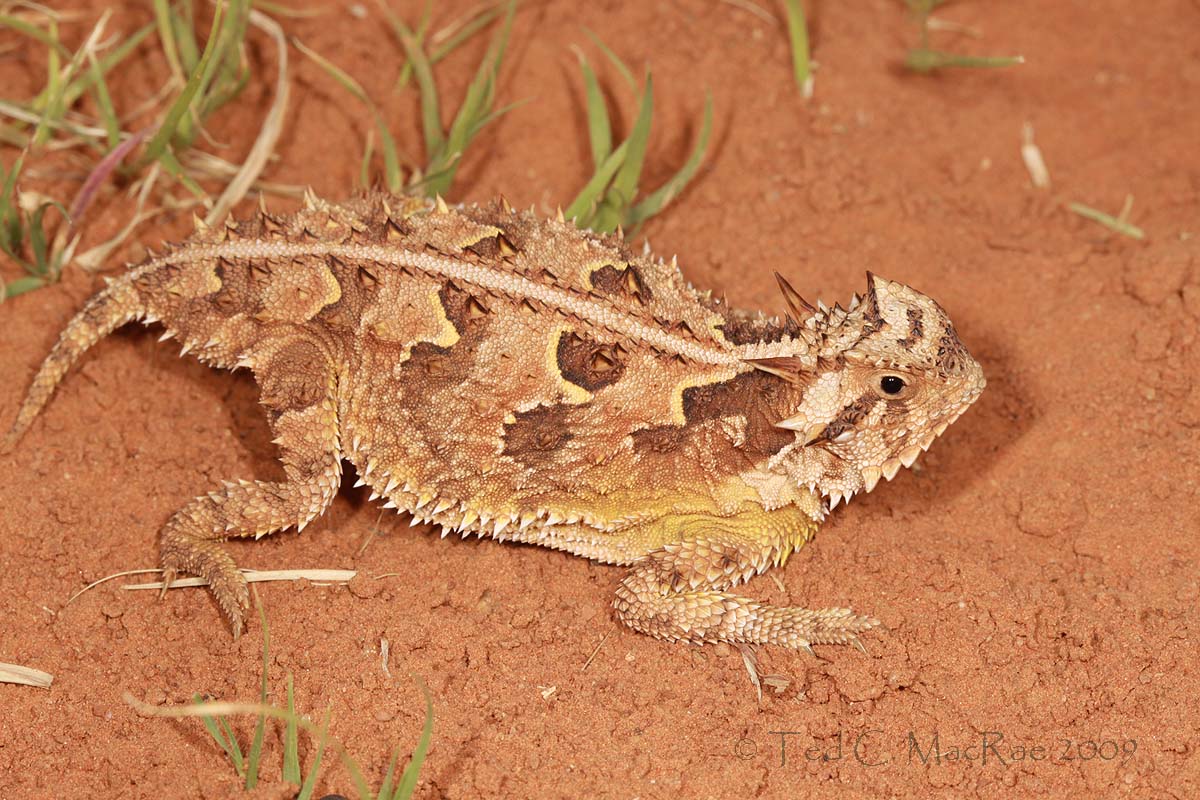
IMG_0390_1200x800

The day after seeing a couple of male eastern collared lizards at Four Canyon Preserve in northwestern Oklahoma, I got my second saurian treat with this horned lizard (genus Phrynosoma).  There are actually some dozen species of horned lizards in North America, but the majority are found further west in the U.S. and down into Mexico and Central America.  Of the two that occur in Oklahoma, this particular individual can be identified as a Texas horned lizard (P. cornutum) by the two occipital (back of the head) spines, presence of lateral abdominal finge scales, and dorsal white stripe.  Oklahoma’s other horned lizard (round-tailed horned lizard, P. modestum) is restricted to the northwestern corner of the panhandle and differs from the Texas horned lizard by having four occipital spines, lacking lateral abdominal fringe scales, and more solid pale coloration.

IMG_0392_1200x800Again, my claim of “most bizarre” might be open to debate, as there are certainly many bizarre lizards in North America.  The gila monster once more comes to mind, but I think grotesque is a better descriptor for that animal, and the fan-shaped toe pads of geckos might also get them some votes.  Nevertheless, do a Google search on the phrase “bizarre North American lizard” and the results will be overwhelmingly dominated by references to horned lizards.  It’s no surprise – their squat body form is more suggestive of toads than lizards¹, for which they are commonly called “horned toads” or “horny toads,” and their covering of “horns” (actually modified scales) gives them an otherworldly, almost dinosaurian appearance.  Who among my generation wasn’t terrorized by the sight of these lizards, cheaply magnified, as they threatened the scientists that encountered them in the 60’s sci-fi classic The Lost World?

¹ Even the genus name, derived from the Greek words phrynos (toad) and soma (body), alludes to its toad-like appearance.

IMG_0397_1200x800In reality, these lizards are anything but terrifying.  Instead they employ multiple strategies to avoid being eaten themselves. These adaptations were all on display as I initially passed this individual without even noticing it lying motionless in the middle of the road. Once I had passed I noted movement out of the corner of my eye and turned to see it scurrying towards the vegetation along the side of the road. It’s mottled coloration, blending well with its background, and spine-broken silhouette made it almost invisible. Feeling threatened by my too-close approach, it made a rapid burst for cover, but I cut it off at the pass and blocked its erratic scampers towards the roadside to keep it out in the open so I could take some photographs. Once cornered in the open, it resorted to a third strategy – puffing of the body to make it appear larger. Had I been a true predator, it would’ve had two more strategies up its sleeve that it could have employed as a last resort – bleeding from the eyes (which apparently has a foul taste and will cause a predator to drop the lizard from its mouth) along with the mechanical defense of its hard, spiny scales. Since I didn’t actually try to eat this little guy, I didn’t have a chance to experience these final lines of defense.

The photos here actually represent two individuals – the middle picture is a second lizard that suddenly appeared while I was photographing the first.  The second individual was somewhat smaller than the first and not as boldy marked (note the lack of a distinct dark stripe behind the eye).  Whether these were male and female is difficult to say – horned lizards lack outward sexual characters allow them to be easily distinguished in the field (females do tend to grow a little bit larger). While not threatened or endangered, Texas horned lizards, like many other horned lizard species, have experienced dramatic reductions in its range. Oklahoma has a year-round closed season for both species that makes it illegal to kill or capture horned lizards without written permission. I would see a few more of these fascinating little lizards during my three days at Four Canyon Preserve, suggesting that, at least in this part of the state, horned lizards are doing just fine.

Photo details: Canon 100mm macro lens on Canon EOS 50D, ISO 100, 1/250 sec, f/11-13, MT-24EX flash 1/4 power through diffuser caps.

Copyright © Ted C. MacRae 2009

Add to FacebookAdd to NewsvineAdd to DiggAdd to Del.icio.usAdd to StumbleuponAdd to RedditAdd to BlinklistAdd to Ma.gnoliaAdd to TechnoratiAdd to Furl

North America’s most beautiful lizard

Whew! My fingers and keyboard are still smoking after that long series on Cylindera celeripes (parts 1, 2, and 3). Exciting as my celeripes finds were, there were other “tiger beetle moments” from the Oklahoma trip as well that I want to highlight in future posts. However, I thought I’d give everyone a break from tiger beetles (and my rambling prose) and remind everyone that I can not only talk about other insects, but even non-insects.

IMG_0318_1200x800

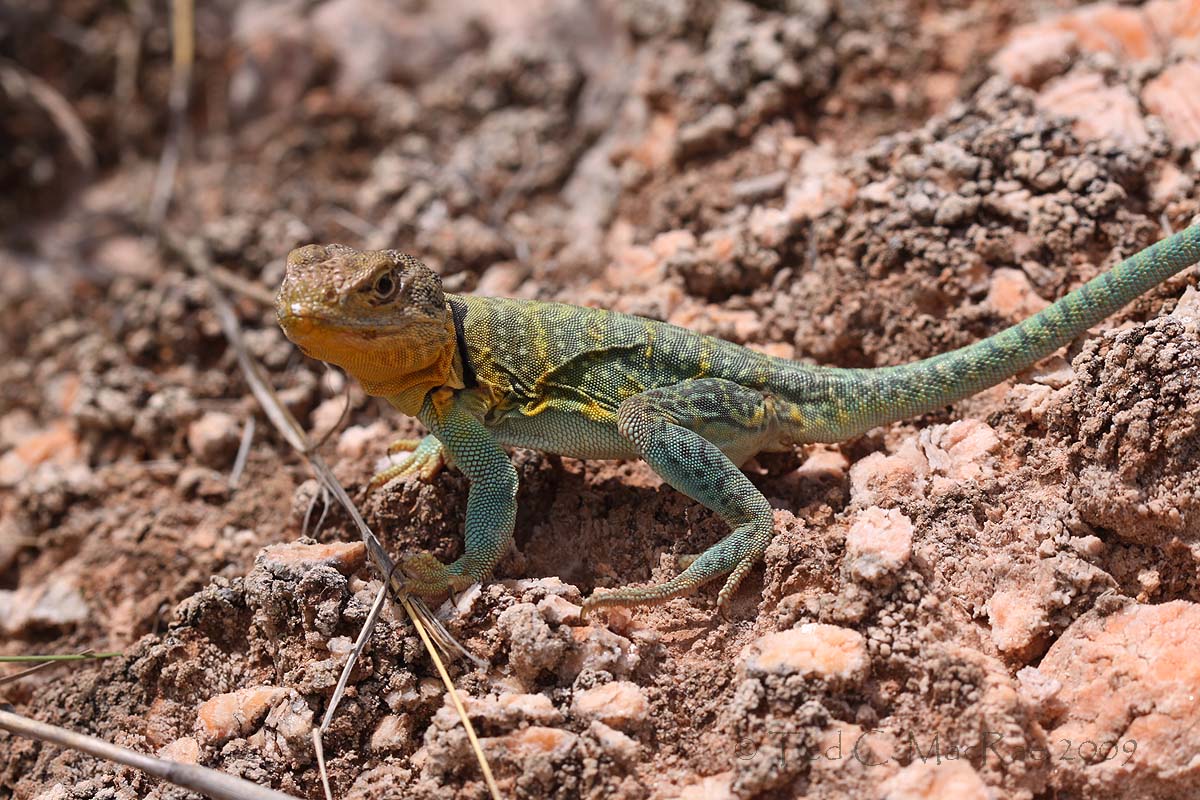
Isn’t he a looker?!  I came upon this this male eastern collared lizard (Crotaphytus collaris collaris) during my first day at Four Canyon Preserve – fitting, since the species is Oklahoma’s state reptile (a fine choice, unlike their dreadfully pedestrian choice for state insect – the honey bee!  Huh?  It’s not even native!).  When I first saw this fellow he skirted under a branch, then across the trail, under a ledge, up and over to another rock…  By the time I got him accustomed to my persistent approaches (remember, I stalk tiger beetles!) he was posing nicely at chest level and with the sun behind my shoulder for a nice series of photographs.  I have never been able to approach a “mountain boomer” this closely before (encountering them only a few times previously on igneous glades in the the St. Francois Mountains of my beloved Ozark Highlands), and the first time I do I have a Canon 50D and 100mm macro lens in my backpack – que suerte!

IMG_0328_1200x800Perhaps my title is a little presumptuous – surely there are other gorgeous lizards in North America.  However, I can’t imagine anything more breathtaking than the vivid blues, greens, and yellows with sharply contrasting black stripes of male eastern collared lizards.  Perhaps the gila monster might get a vote, although its impressiveness is more grotesque than beautiful.  Horned lizards as well are quite impressive, but again more bizarre than beautiful.  Added to the collared lizard’s visual appeal is their comically dinosaurian ability to run swiftly on their hind legs with the fore legs and head held upright (this is how most of my previous attempts to approach them have ended).

IMG_0314_1200x800The name “mountain boomer” probably originated with the early pioneers, who erroneously believed that they emitted sounds that echoed through the canyons and valleys.  An oft-cited theory in field guides (and also the Oklahoma Department of Wildlife Conservation and the Missouri Department of Conservation websites) states that the pioneers may have associated the sunning lizards with the barking of frogs.  This seems unlikely; frogs that make barking noises are creatures of wetlands – far from the rocky outcroppings of the glades and pinyon-juniper, sagebrush, desertscrub, and desert grassland habitats of the central and west-central U.S. where collared lizards are encountered.  Regardless of the source of its nickname, collared lizards in reality make no vocalizations at all (although like most lizards they can hiss when they feel threatened).

IMG_0316_1200x800

Copyright © Ted C. MacRae 2009

Add to FacebookAdd to NewsvineAdd to DiggAdd to Del.icio.usAdd to StumbleuponAdd to RedditAdd to BlinklistAdd to Ma.gnoliaAdd to TechnoratiAdd to Furl

Revisiting the Swift Tiger Beetle – Part 3

…continued from Revisiting the Swift Tiger Beetle – Part 2.

The Oklahoma trip had been an unqualified success. Not only had I managed to find the rare Cylindera celeripes (swift tiger beetle) at Alabaster Caverns, I had also determined the population there was healthy and, in fact, occurred robustly across a large swath of red clay/gypsum hill habitat in the vicinity of the Cimarron River (Woodward and Major Counties) in northwestern Oklahoma. This is good news for the species, who some have regarded as a potential candidate for federal listing on the endangered species list. There is no doubt that the species has suffered greatly in many parts of its range during the past century – most likely due to loss of habitat; however, the presence of a strong population in Oklahoma gives reason for optimism about its long-term prospects. It would have been even better had I found the species at the two Nature Conservancy preserves (Four Canyon and Tallgrass Prairie) that I had targeted, and the reasons for its apparent absence at those two sites despite an abundance of apparently suitable habitat remain a mystery to me (although I have my suspicions). Nevertheless, I returned to St. Louis happy, with new localities in my database and live individuals in containers of native soil for another attempt at rearing.

Our work with this species was not done, however. While C. celeripes has never been recorded in Missouri, my colleague Chris Brown and I have long suspected that it might occur here – most likely, we felt, in extreme northwestern Missouri where the Loess Hills landform reaches its southern terminus. We had looked for it in this area a few times before on the few remaining dry, hilltop prairie relicts that are so common further north in Iowa, and we had also looked for it in the larger tallgrass prairie remnants of west-central Missouri. None of these searches were successful, and with each unsuccessful effort it seemed less and less likely that the species actually occurred within the state – especially considering the declines that the species has experienced throughout its range. However, when we managed to find a small, newly discovered population of the species last summer in the Loess Hills of southwestern Iowa, just 60 miles north of Missouri (see The Hunt for Cicindela celeripes), we decided that one more thorough effort to locate the species in Missouri was in order.

Star School Hill Prairie Natural Area (north tract), Atchison Co., Missouri.

Star School Hill Prairie Natural Area (north tract), Atchison Co., Missouri.

Our plan was straightforward – we would travel to northwestern Missouri each weekend beginning in late June and search the most promising hilltop prairie relicts that still remain in Missouri. There aren’t many of these, so I contacted Tom Nagel of the Missouri Department of Conservation – who probably knows more about Missouri’s hilltop prairie relicts than anyone else – for assistance in identifying these parcels. Tom graciously sent me descriptions and aerial photographs of the highest quality relicts still remaining in Missouri. None of these are large (12 contiguous acres or less), and all have been impacted to some degree by woody encroachment and are in various stages of restoration. We had already searched one of these tracts (Star School Hill Prairie) a few times, but two others were new to us. So, on a Friday evening before the first of three planned weekends for our study (and only two weeks after returning from Oklahoma), Chris and I made the long drive across Missouri and north along the Missouri River and began our search the next morning.

Fieldmate Chris Brown surveys loess hilltop prairie habitat at Star School Hill Prairie Natural Area, Atchison Co., Missouri

Fieldmate Chris Brown surveys loess hilltop prairie habitat at Star School Hill Prairie Natural Area (south tract), Atchison Co., Missouri

Our first stop was High Creek Hill Prairie in Brickyard Hill Conservation Area (Atchison Co.). We had been to Brickyard Hill a few times but had not previously found this particular hilltop prairie. We found the tract, a long, narrow series of ridge tops and southwest-facing slopes, thanks to Tom Nagel’s map and began searching with all the enthusiasm and optimism that accompanies any new search. Our optimism waned with each hilltop ridge that we traversed not seeing the beetle, until we reached the easternmost ridge amidst a jumble of eastern red-cedar cadavers that halted any further progress or promise. As we stood atop that last hill, we debated our next move. Chris had noted apparently good habitat on the lower slopes below us, while I had spotted another very small hilltop tract across a wooded ravine and disjunct from the main prairie. We decided these areas should be explored before moving on to the next site, but as we searched those lower slopes our optimism continued to wane. The habitat was perfect based on what we had seen in Iowa last year and what I had seen in Oklahoma earlier in the month – small clay exposures amongst clumps of undisturbed little bluestem and grama, but still no beetles. Chris, refusing to accept defeat, continued to search the slope, while I worked my way over to the smaller hilltop tract I had seen from above. After crossing through the wooded ravine, I found an old 2-track running along the base of the tract and began walking along it. The small slope above the 2-track was littered with large cadavers of the invasive eastern red-cedar (Juniperus virginiana), apparently left in place after chainsawing to provide fuel for a planned, future burn. As I walked, a white-tailed deer bolted from a nearby cadaver, giving me a bit of a start, and I veered towards the cadaver to have a look at where it had bedded down. By this time I almost wasn’t even really thinking about C. celeripes anymore – we had been there for about an hour and a half and searched the most promising habitats without success – the small tract where I was now working was almost a last gasp before moving on. As I approached the deer’s bedding site, a “flash” in the thick vegetation caught my eye, and I knew instantly what it was. Immediately I dropped to my knees and tried to “trap” the evasive little beetle (I’ve found that forming a “trap” between the crotches of my hands and gradually closing my hands together forces the beetle to run up and over one of my hands, at which time I can try to pin it down with my other). The beetle behaved exactly as expected, running over my left hand – but I missed it. I trapped it again, and once again it ran over my hand too fast to pin down. I tried to follow it as it zigzagged erratically through the thick vegetation, but in the blink of an eye it was gone. I spent the next several minutes frantically pulling apart the vegetation in a 2-foot radius around the spot in what I knew was a vain attempt to relocate the beetle before ultimately accepting that I had missed it. No matter – I had seen it and had absolutely no doubt about what it was – C. celeripes does indeed occur in Missouri! Wow – big news! I knew if I had seen one, I had a good chance of seeing another, so I began searching the area again – now with much more deliberation. I walked back and forth along the old 2-track, up and down the cadaver-littered slope, and back to the original spot several times. As time passed, a gnawing fear began to grow inside me that this new state record might lack a voucher. Suddenly, very near the original spot, I saw another. This time I pounced with authority and made no mistakes, and after securing the live beetle in a vial I gloated and congratulated myself unabashedly inside while bursting to give the news to Chris. I searched the slope some more, but I couldn’t take it anymore – I had to tell someone. I pulled out my cell phone and began texting a message to my daughter Mollie (who really doesn’t care about beetles but loves to receive text messages). As I was texting, Chris appeared on the lower slope, obviously noting that my net had been left on the ground purposely to mark a spot. As I finished texting I told Chris to come here, I wanted to show him something, and then non-chalantly handed him the vial. I would give anything to have a video of the look on Chris’ face as it changed from quizzical dumbfoundedness to shocked elation. Chris, too, had reached a low point in his optimism after thoroughly searching the previous slope without success, but now we were both as giddy as school boys – our long efforts had finally paid off with a new state record for one of North America’s rarest tiger beetles (the way we were acting, you’d have thought we’d just discovered plutonium!). We searched the slope for another half hour or so, with Chris seeing one more individual very close to where I had seen the first one. Whether it was the same or a different individual is unknown, so we decided that we had seen at least two individuals at this site. The discovery of C. celeripes here caused us to once again search the lower slope that Chris had previously searched so thoroughly, but again the beetle was not seen. Our giddiness was beginning to give way to concern over the few individuals we had seen and how localized they seemed to be. We had been at the site now for about three hours, and I was famished. I hiked back to the truck, noting some habitat at the far western end of the main prairie where we had begun our search that looked like it deserved another search. As I ate, Chris worked his way over to that spot, and after a period of time I heard him yell down to me and give me the “thumbs up.” I hurriedly finished eating and worked my way up to where he stood, and together we located two more individuals – taking one as a voucher for the site and ganging up on the other to keep it pinned into an open area where each of us could take field photographs before we finally let it “escape.” Seeing the species on the larger parcel had relieved our concern a little bit, and we felt a little less worried about its status here now.

Cylindera celeripes - High Creek Hill Prairie, Brickyard Hill Conservation Area, Atchison Co., Missouri (new state record)

Cylindera celeripes - High Creek Hill Prairie, Brickyard Hill Conservation Area, Atchison Co., Missouri (new state record)

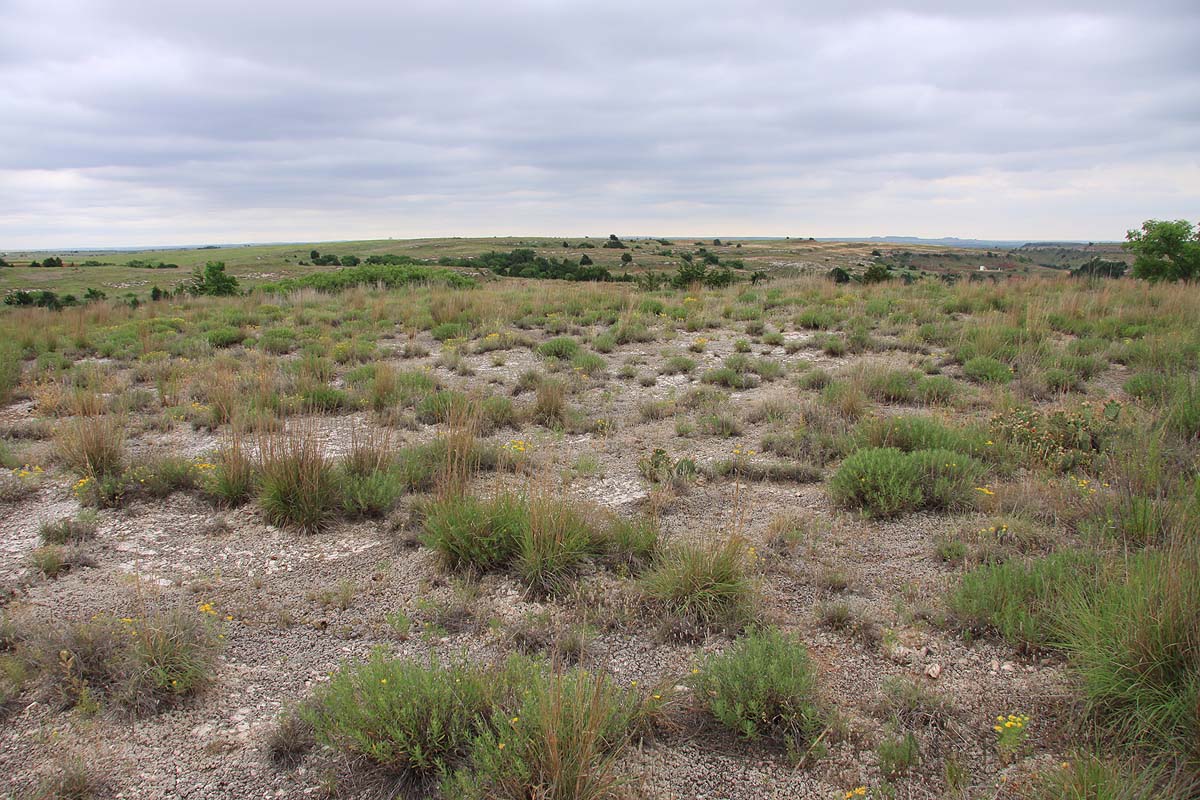
Later in the day we would see the species again at Star School Hill Prairie Natural Area , the northernmost substantial loess hilltop prairie within Missouri, and one that we had searched at least twice previously for the species. Again, we saw only two individuals in almost three hours of searching, confirming the impression first gained at Brickyard Hill that the species is not present in very high densities. Like Brickyard Hill, the beetles at this site were found in areas of undisturbed hilltop prairie with moderately thick shortgrass vegetation and were seen only when they IMG_0789_1200x800ran from one grass clump to another after being disturbed by our approach. We also looked for it at a smaller disjunct parcel just to the north, but the lateness of the hour limited the time we had to explore this site. Star School Hill Prairie is some 6 miles north of Brickyard Hill, thus, finding C. celeripes at two sites not in close proximity increased our optimism that the species might actually occur in many of the loess hilltop prairie remnants still remaining in northwestern Missouri. This optimism was further increased the next day when we saw two more individuals at one of Missouri’s southernmost hilltop prairie relicts at McCormack Loess Mounds Natural Area in Holt Co. However, our optimism is tempered by the fact that, again, we saw only two individuals, both of which were seen in a small, unburned spur extending northward off the main prairie, while none were seen in the much larger main parcel that appeared to have been recently burned in its entirety.

Cylindera celeripes macrohabitat at Star School Hill Prairie.  Beetles were seen along the narrow trail in the foreground and on the mild upper slopes (below bur oak in upper left).

Cylindera celeripes macrohabitat at Star School Hill Prairie. Beetles were seen along the narrow trail (foreground) and on the mild upper slopes (below bur oak, upper left).

The presence of this rare Great Plains species in Missouri’s critically imperiled hilltop prairies is cause for both excitment and concern. Cylindera celeripes represents a unique and charismatic addition to the state’s rich natural heritage. However, like soapweed yucca (Yucca glauca var. glauca), skeletonweed (Lygodesmia juncea), and the dozen or so other plant and animal species of conservation concern found within the hilltop prairies of IMG_0774_1200x800Missouri’s Loess Hills, C. celeripes appears to be entirely dependent upon these habitats for its survival within the state. Ensuring its continued survival will require careful reconsideration of the management approaches used for these rapidly shrinking natural communities. Prescribed burning has been and will continue to be an important tool in restoring our hilltop prairies; however, nonjudicious use of fire could lead to local extirpaton of C. celeripes within these habitats. Should that occur, recolonization from nearby parcels is unlikely due to the small, highly disjunct, and upland character of Missouri’s hilltop prairie remnants and the flightless nature of C. celeripes. As a result, rotational cool-season burns should be utilized as much as possible to avoid localized extirpations, especially on smaller parcels (Panzer 2002).

Hilltop prairie at McCormack Loess Mounds Natural Area, Holt Co., Missouri.  The main tract (pictured) was recently burned - beetles were found in a small unburned spur (off left center).

Hilltop prairie at McCormack Loess Mounds Natural Area, Holt Co., Missouri. The main tract (pictured) was recently burned - beetles were found in a small unburned spur (off left center).

Photo details:
Beetles: Canon 100mm macro lens w/ 68mm extension on Canon EOS 50D, ISO 100, 1/250 sec, f/18, MT-24EX flash 1/2 power through diffuser caps.
Landscapes: Same except Canon 17-85mm zoom lens (17mm at Star School, 20 mm at McCormack), 1/60 sec, f/8-9 (Star School) or f/13 (McCormack), natural light.

REFERENCE:

Panzer, R. 2002. Compatibility of prescribed burning with the conservation of insects in small, isolated prairie reserves. Conservation Biology , 16(5):1296-1307.

Copyright © Ted C. MacRae 2009

Add to FacebookAdd to NewsvineAdd to DiggAdd to Del.icio.usAdd to StumbleuponAdd to RedditAdd to BlinklistAdd to Ma.gnoliaAdd to TechnoratiAdd to Furl

Revisiting the Swift Tiger Beetle – Part 2

…continued from Revisiting the Swift Tiger Beetle – Part 1.

The rain that cut short my visit to Alabaster Caverns in northwestern Oklahoma followed me as I drove east towards Tallgrass Prairie Preserve in northeastern Oklahoma. I had called Mike when I began my drive to tell him the great news – I had located Cylindera celeripes at Alabaster Caverns, and the population appeared to be quite robust. This was great news for the species, which seems to have disappeared from many parts of its range and is holding out primarily in the Flint Hills of Kansas. Mike and Jane had just arrived at Tallgrass Prairie when I called, and I told them to expect me to show up in about three hours. Tallgrass Prairie preserve is the largest intact tallgrass prairie remnant in the world, but my interest in it was due to the fact that ecologically it lies within the southern realm of the Flint Hills. I thought there might be a chance of finding C. celeripes in the preserve, extending its currently known distribution further south into northeastern Oklahoma as well. As I continued the drive, however, the rain came down harder and harder, and after I had driven about halfway to the preserve, I got a call from Mike. It had started raining there as well, and the weather forecast was calling for rain through tomorrow and possibly into Friday. They had decided to call it quits and start heading back towards St. Louis.

Me? I wasn’t nearly ready to punt on the trip. However, I hadn’t made any contingency plans and, thus, didn’t have a clue what to do next. I decided to drive into the next town and look for a coffee house where I might get a wi-fi connection, study the weather forecasts for surrounding areas, and then decide what to do next. There were several possibilities – I could drive north up into Kansas to look for the Flint Hills population of C. celeripes, but that area still seemed in the path of the frontal disturbances that would be ripping through Oklahoma and Texas for the next day or two. Or, I could continue on into southern Missouri and do some blacklighting in the Ozarks, but that just seemed like spending time without a real purpose, and eventually the rain would make it there as well.  While studying my map of Oklahoma, I noticed that Alabaster Caverns was actually one of a cluster of state parks in Woodward and adjacent Major Counties.  I thought maybe I could look for similar habitats in or near these other parks to see if C. celeripes might actually be more broadly distributed in northwestern Oklahoma. There was also Salt Plain National Wildlife Refuge in the area, which had impressed me during two recent October trips with its diversity of tiger beetles associated with saline habitats. Thus, I decided to head back west over the very roads that took me to the east earlier in the day.

IMG_0620_1200x800

Gloss Mountains State Park, Major Co., Oklahoma

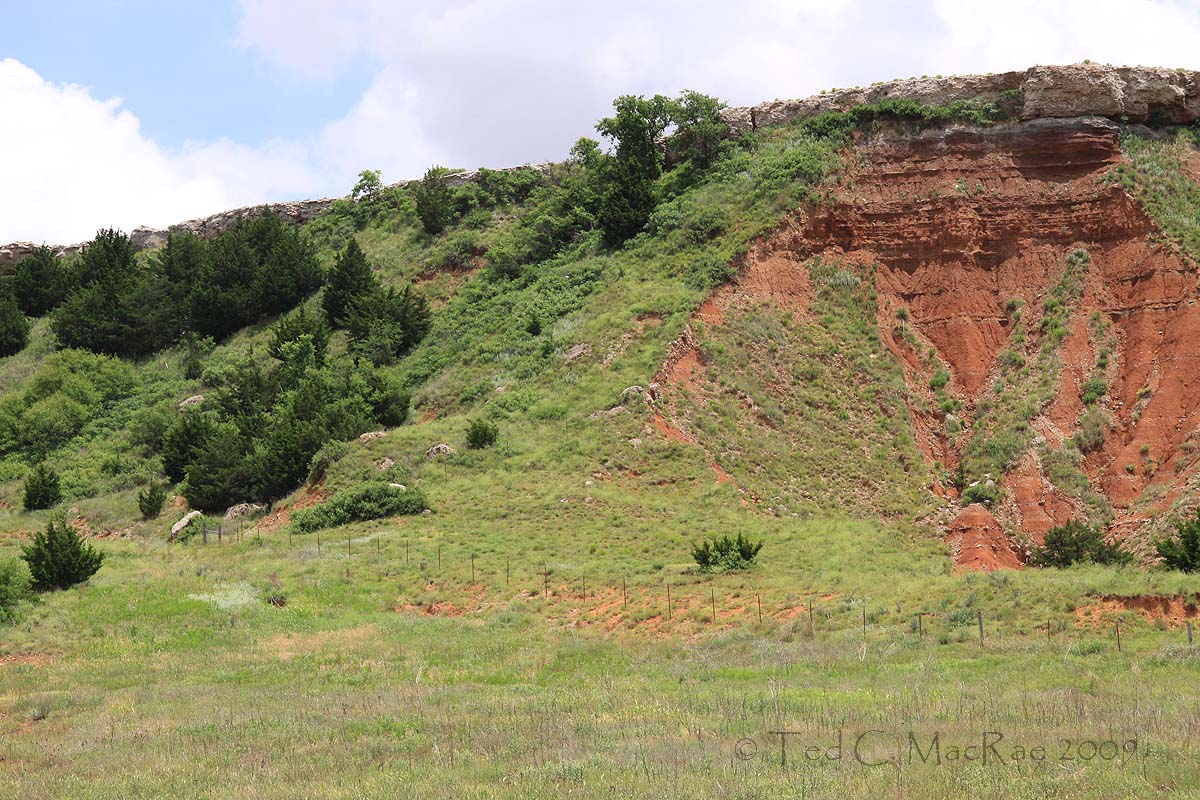
The following day, my plan was to visit the three state parks I had seen on the map and assess their habitat – if any looked promising I would try to obtain permission to collect, and failing that I would try to hunt out similar habitats in areas adjacent to but outside of the parks. One of these parks is located on a feature called the “Gloss (Glass) Mountains,” and the highway that cut through the area was designated on my map as a scenic route.  I don’t know why this place picqued my interest above the others – perhaps it was the idea of “mountains” in Oklahoma, but I pretty much made a bee line for the Gloss Mountains in the morning.  As I approached coming from the east on Hwy 412, I saw the massive, flat-topped mesas rising above the surrounding landscape and knew, if nothing else, it would be interesting scenery.  At the entrance to the state park there was a parking lot right along the highway for a designated scenic overlook – yeah, maybe I could find some good habitat to kick around in outside of the park.  I spent some time walking along the roadsides – there was plenty of exposed clay that would be a typical situation to look for tiger beetles, but I didn’t see anything in these areas.  Across the highway there were two mesas – a small one (visible in the photo above on the left side) accessible in its entirety and another very large one (also visible in distance at center) that was accessible only on its northern flank.  I walked to the smaller one first and looked it over but didn’t find much – certainly none of the little “flashes” that I was hoping to see that would confirm a broader occurrence of C. celeripes in northwestern Oklahoma (although I did find one Dromochorus pruinina – another flightless tiger beetle that just sneaks into Missouri as a highly disjunct population).  After looking over the smaller mesa, I walked over the the large mesa and cut across the lower talus slope – much of it seemed disturbed, probably from when the highway was constructed, and still I saw little of interest. 

Cylindera celeripes macrohabitat along Hwy 412 in the Gloss Mountains

Cylindera celeripes macrohabitat along Hwy 412 in the Gloss Mountains. Adults were encountered primarily on lower talus slopes (lower center).

As I reached the western edge of the talus slope, I began walking along a natural drainage down towards the roadside – and I saw it!  The appearance and movement were unmistakable and didn’t fool me for a second.  I bolted straight for it and slapped at the ground as it zig-zagged erratically amongst the grass clumps before finally eluding me.  Arghh!  However, my frustration at missing the capture was completely overshadowed by my excitement at having found the species at an entirely new locality.  This prompted a much more deliberate and thorough examination of the surrounding area, and it wasn’t long before I saw another, and another…  While not quite as abundant as I had seen them at Alabaster Caverns, they certainly weren’t uncommon, and it wasn’t long before I had collected a sufficient voucher series to allow spending some time observing the behavior of the beetles in their habitat. The beetles were primarily on the lower (and milder) talus slopes and away from the roadside in more undisturbed areas.  They appeared to prefer areas of moderate vegetation cover with grass clumps spaced approximately 12-24 inches while avoiding more barren areas.  As I had observed the previous day at Alabaster Caverns, the beetles were first noticed primarily upon being disturbed by my approach as they ran from the grass clumps against which they were hiding and into the open.  They look very much like large ants when running, but the style is a little more urgent and erratic.

After several hours at this site, I decided that I should check the two other State Parks that I had seen on the map. Niether had promising habitat.  The first of these – Little Sahara State Park – lies midway along the Cimmaron River between Alabaster Caverns and the Gloss Mountains, but in contrast to the red clay/gypsum exposures that characterized Alabaster Caverns and Gloss Mountains, Little Sahara featured primarily sand substrates – great for other tiger beetles such as Cicindela formosa (big sand tiger beetle) and C. scutellaris (festive tiger beetle), but not for C. celeripes.  The other one – Boiling Springs State Park, lies in another drainage system along the Canadian River and features a wooded, riparian habitat with mostly sandy substrates along the northern slopes of the river valley (where I did spend some time looking around).  Between these parks and Gloss Mountains, however, along Hwy 412 I saw vast expanses of the same red clay/gypsum exposures that characterized the two localities where I had seen C. celeripes.  About 20 miles west of Gloss Mountains, I stopped at a rather unspectacular example of one of these exposures along the roadside – just to see if I could find the beetle in as pedestrian-looking a place as that.  I didn’t take 20 steps from the car when I saw the first one, and as before, I quickly encountered enough individuals to adequately voucher the site and allow some time for observation.  This site was very similar to Alabaster Caverns, with numerous lichens encrusting the clay substrate between the white gypsum exposures.  I looked out onto the broad expanse of clay supporting shortgrass prairie as far as the eye could see, and I knew the beetles were running around out there in untold numbers.  Cylindera celeripes not only occurs in northwestern Oklahoma, but its population is robust and likely extends throughout the red clay/gypsum exposure that characterizes the Cimarron River Valley in this part of the state.

Cylindera celeripes macrohabitat at Gloss Mountains State Park.  Adults were quite common on the mesa top.

Cylindera celeripes macrohabitat at Gloss Mountains State Park. Adults were quite common on the mesa top.

 With some time left in the day, I decided to head back to Gloss Mountains State Park – I hadn’t even looked in the park proper, and with the beetles occurring abundantly at three other nearby sites offering similar habitat, it seemed a sure bet that I would find them there as well.  The park offers no real facilities but for an incredibly scenic trail that ascends the steep southern flank of a large mesa to allow access to the top.  Once on top, it was only a matter of minutes before I saw the first beetle, and I would eventually see numerous beetles running between the grass clumps over the lichen-encrusted clay.  The views from the mesa top were spectacular as well, and only the impending dusk chased me from enjoying both the site and the beetles.  I had a tremendous feeling of satisfaction – not just from finding the beetles, but also in the newfound knowledge that the beetles were doing so well in this part of its range.

The next day I looked for tiger beetle species associated with saline habitats at nearby Salt Plain National Wildlife Refuge – that will be the subject of a future post, and it the evening I completed the drive over to northeastern Oklahoma to resume the originally planned itinerary at Tallgrass Prairie Preserve.  Like Four Canyon Preserve, this TNC property is heavily managed with prescribed burns to maintain diversity of the prairie flora and prevent invasion by woody plants.  And likewise I observed verdent seas of grass interspersed with classic prairie forbs – and few insects.  I won’t blame this on the burns because I lack any empirical basis for making such claim.  However, each visit I make to freqently burned prairies further increases my skepticism that the invertebrate fauna isn’t somehow being impacted.  The lack of litter and absence of lichens on the soil surface results in an almost ‘sterile’ look that I don’t see in areas where fires occur with less frequency. I looked at a few different places within the vast preserve but didn’t find much, and midday I sighed and began the 7-hour drive back to St. Louis.  The trip was over, and so was the hunt for C. celeripes. Or so I thought… (to be continued).

Copyright © Ted C. MacRae 2009

Add to FacebookAdd to NewsvineAdd to DiggAdd to Del.icio.usAdd to StumbleuponAdd to RedditAdd to BlinklistAdd to Ma.gnoliaAdd to TechnoratiAdd to Furl

Revisiting the Swift Tiger Beetle – Part 1

Photo details: Canon 100mm macro lens with 68mm extension on a Canon EOS 50D, ISO 100, 1/250 sec, f/13, MT-24EX flash 1/4 power through diffuser caps

Photo 1 - Cylindera celeripes at Alabaster Caverns State Park in northwestern Oklahoma.

When my hymenopterist friend, Mike Arduser, came back from his first trip to Oklahoma’s Four Canyon Preserve last September, my first thought upon seeing his photos of the area was, “Ooh, that looks like a good place for tiger beetles!” Its rugged red clay and gypsum exposures reminded me of similar country I had seen in the not-too-distant Gypsum Hills of south-central Kansas, where I was fortunate enough to observe a nice population of the fantastically beautiful Cicindela pulchra (beautiful tiger beetle) back in 2005. When I later realized that the area was only 30 miles southwest of a confirmed recent sighting of Cicindela celeripes (swift tiger beetle, now Cylindera celeripes), I thought, “Ooh, I wonder if celeripes might occur there also.”

Photo details: Canon 100mm macro lens with 68mm extension tube on a Canon EOS 50D, ISO 100, 1/250 sec, f/13, MT-24EX flash 1/4 power through diffuser caps

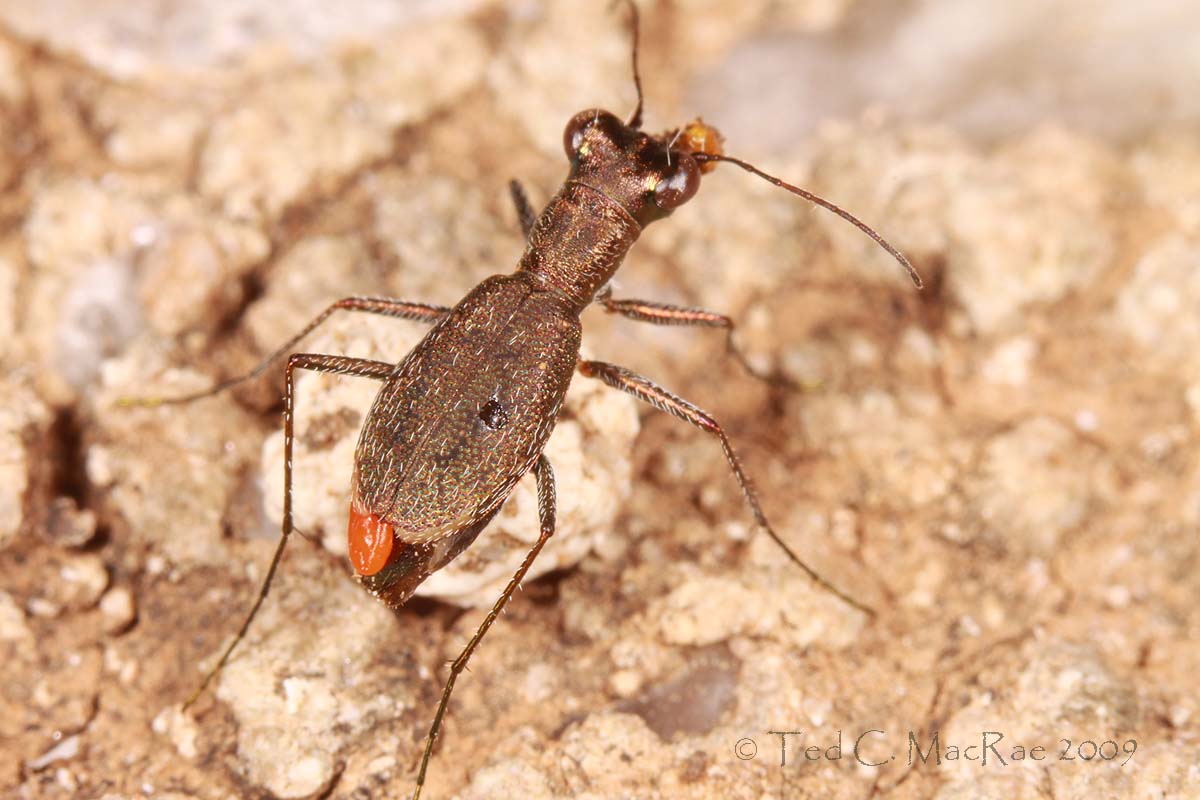
Photo 2 - Cylindera celeripes on lichen-encrusted clay soil at Alabaster Caverns State Park.

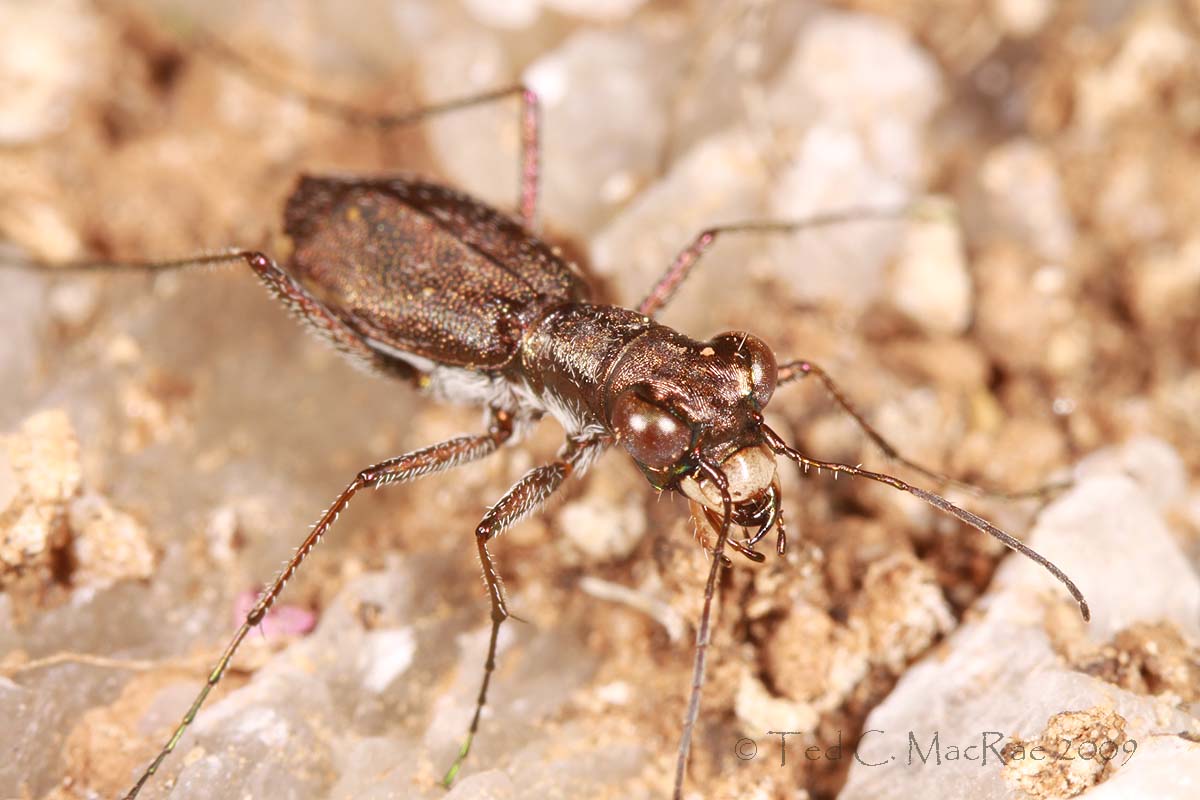
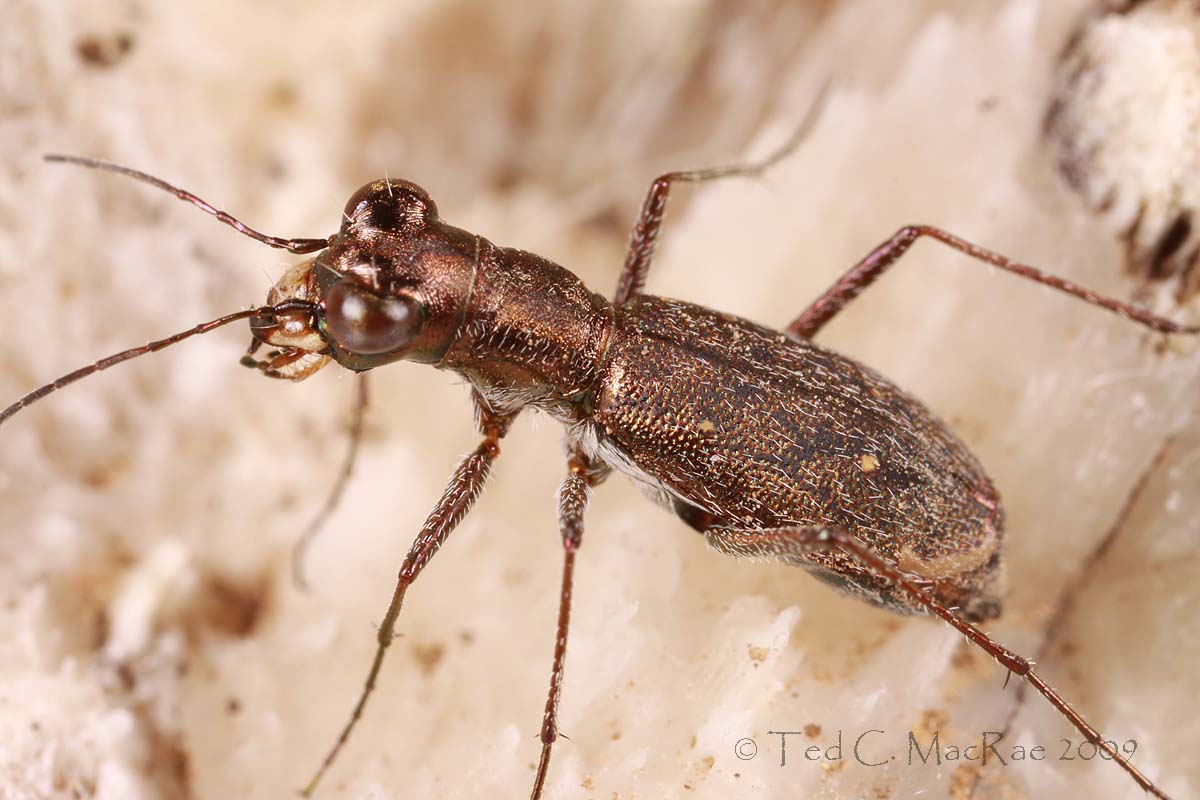
Recall that C. celeripes is one of North America’s rarest and least understood tiger beetles. This tiny, flightless, ant-like species has been recorded historically from eastern Nebraska south to north-central Texas, but its range appears to have become highly restricted over the past century. It hasn’t been seen in Nebraska for nearly 100 years now, and most recent records have come from its last known stronghold in the Flint Hills of Kansas. In 2003, however, a photographer by the name of Charles Schurch Lewallen posted on BugGuide a photograph of this species taken at Alabaster Caverns State Park in northwestern Oklahoma, and last year small numbers of adults were seen in the Loess Hills of western Iowa. This last sighting triggered an immediate trip to the site by myself and Chris Brown, who has been co-investigating the tiger beetle fauna of Missouri with me for several years now. The occurrence of this species in Iowa’s Loess Hills had reignited our hopes – faint as they were – that the beetle might yet occur in extreme northwestern Missouri, where the Loess Hills reach their southern terminus. We wanted to see the beetle in the wild to better understand its habitat requirements before resuming our search for this species in northwestern Missouri. We succeeded in finding the beetle – an amazing experience in itself – and brought three adults of this never-before-reared species back to the lab for photographs and an attempt at rearing. We did manage to obtain viable eggs, but we were not successful in rearing the larvae beyond first instar. I wrote about that experience last August in a post entitled, “The hunt for Cicindela celeripes” (that post is now currently in press as an article in the journal CICINDELA).

Photo details: Canon 100mm macro lens with 68mm extension tube on a Canon EOS 50D, ISO 100, 1/250 sec, f/11, MT-24EX flash 1/4 power through diffuser caps

Photo 3 - Cylindera celeripes on gypsum exposure at Alabaster Caverns State Park.

Thus, when my friend Mike asked me earlier this year if I might be interested in joining him on his return trip to Four Canyon Preserve in June, I jumped at the chance. I figured I could look for celeripes at the preserve, and if I failed to find it there then I would go to Alabaster Caverns and see if I could relocate the beetle where it had been photographed in 2003. My goals were modest – I simply wanted to find the beetle and voucher its current presence in northwestern Oklahoma (and if possible photograph it in the field with my new camera!). Before leaving, I wrote to Charles Lewallen, who graciously responded with details regarding the precise location and time of day that he had seen the beetle at Alabaster Caverns, and on the first Friday of June I followed behind Mike and his lovely wife Jane during our ten-hour drive out to Four Canyon Preserve. For three days, I roamed the mixed-grass prairie atop the narrow ridges and dry woodland on the steep, rugged canyon slopes of the preserve – always on the lookout for that telltale “flash” between the clumps of bluestem and grama, ever hopeful that one would prove not to be the ant or spider that it appeared to be (and, indeed, always was). Many tiger beetles would be seen – chiefly the annoyingly ubiquitous Cicindela punctulata (punctured tiger beetle), but celeripes would not be among them. Whether this is due to historical absence from the site or a more recent consequence of the wildfires that swept the area a year earlier is hard to say, but its absence at Four Canyon meant that I would need to make a quick, 1-day detour to Alabaster Caverns before rejoining Mike and Jane at Tallgrass Prairie Preserve in northeastern Oklahoma, where we planned to spend the second half of the week.

Photo details: Canon 65mm 1-5X macro lens on a Canon EOS 50D, ISO 100, 1/250 sec, f/13, MT-24EX flash 1/4 power through diffuser caps

Photo 4 - Cylindera celeripes on gypsum exposure at Alabaster Caverns State Park.

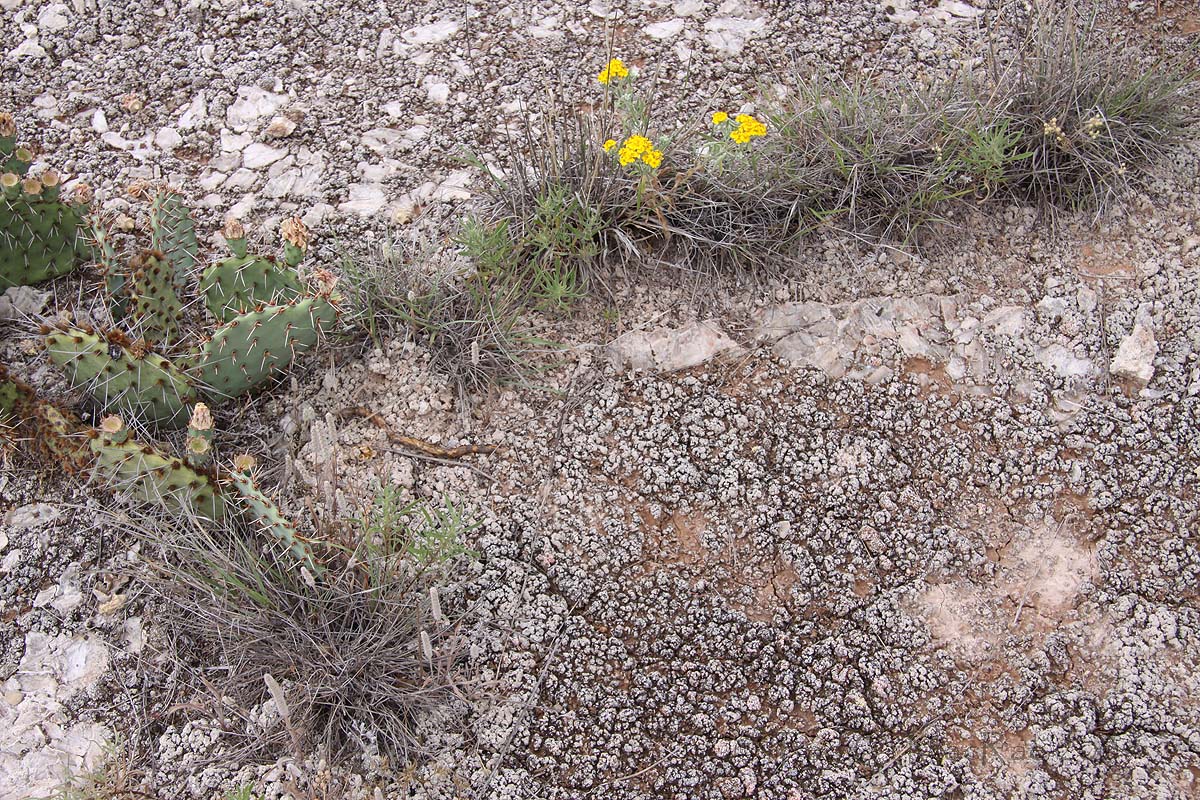
Arriving at Alabaster Caverns I was filled with nervous, excited anticipation. Would I find the species, as Charles Lewallen had, or would I get skunked? I kitted up and started walking towards the area where Charles wrote that he had seen the beetle, noting the annoying “Removal of plants and animals prohibited” sign along the way. I hadn’t taken ten steps off the parking lot when I saw it! I froze at first, hardly believing that I had found it that quickly, then started watching the tiny beetle as it bolted urgently from one grass clump to the next. Recalling my experience with this beetle in Iowa (and fearing I would lose it amongst the vegetation), I captured the specimen and placed it live in a vial – I would talk to the park staff later about taking the beetle, but for now I needed to guarantee I had a backup for the lab in case I was unable to get field photographs of the beetle. I started walking again, and within a few minutes I saw another one – okay, they’re here in numbers. I carefully took off my camera bag and assembled the components, all the while keeping my eye on the beetle, and then I began trying to do what last year had seemed impossible – getting field photographs. It was easier this time – the vegetation was not so dense, so I could keep an eye on the beetle as he darted from one clump to another. I tried to wait until he settled in an open spot, but it soon became apparent that just wasn’t gonna happen without a “helping” hand. I started blocking the path of the beetle as he tried to dart away and then removing my hand to see if he would stay put. There were a few false starts, where the beetle looked like he would sit still and then dart just as I was set to take the shot, but eventually it wore down and started sitting still long enough for me to shoot a few frames. Torn between the need to get as many photographs as possible and the desire to look for more beetles, I decided to look around more to see how common the beetle was. As I walked out into the shortgrass prairie above the canyons, I began to see adults quite commonly. Most often they were seen as they bolted out into the open from a clump of vegetation when disturbed by my approach. The substrate was red clay and gypsum – just as I had seen in Four Canyon Preserve, but unlike that area the clay exposures were heavily colonized by a mottling of green, blue, and gray lichens. It made the beetles almost impossible to see when they were not moving – even at close range! I spent about an hour taking photographs of several individuals, even managing to photograph one that appeared to be parasitized by what I take to be a dryinid hymenopteran.

Photo 5 - Cylindera celeripes with parasite (dryinid hymenopteran?).  Note also the ant head attached to right antenna.

Photo 5: Cylindera celeripes with parasite (dryinid hymenopteran?). Note also the ant head attached to right antenna.

After getting a sufficient series of photographs (is there really such thing?), I went to the park office hoping to convey the significance of this find to the Park Naturalist and to convince him/her to let me take some live individuals with me for another attempt at rearing. The Park Naturalist was out of the office, but the Park Historian was there. I could hardly contain my excitement as I explained to her what I had found, why it was so important, and my hope to try to rear the species with adults collected in the field. She not only responded as positively as I had hoped, but accompanied back out into the field so that I could show her the beetles. She told me it would be no problem to take some live individuals for rearing and to please let them know if there was anything else they could do to help me.  She then provided me with the day’s natural history “dessert” by pointing out a Mexican free-tailed bat (Tadarida brasiliensis) – Oklahoma’s state flying mammal – roosting up in the top of a nearby picnic shelter. Standing atop the picnic table put me within arm’s length of the little chiropteran – close enough to see his tiny little eyes looking quizzically back at me.

Photo 6 - Cylindera celeripes macrohabitat, Alabaster Caverns State Park, Oklahoma.  Note rather widely spaced clumps of vegetation (photo details: Canon 17-85mm zoom lens (17mm) on a Canon EOS 50D, ISO 100, 1/64 sec, f/8).

Photo 6 - Cylindera celeripes macrohabitat at Alabaster Caverns State Park. Note rather widely spaced clumps of vegetation.

It had begun sprinkling rain by then, so with some urgency I got my tools, extracted a couple of chunks of native soil and transferred them to the small “Critter Totes” that I had brought for the purpose, and began searching for live individuals to place within them. The beetles had become scarce as the drizzle turned to light rain, and by the time I had split about a dozen individuals between the two containers the rain was coming down hard enough to start puddling. I continued a last ditch effort to find “just one more,” but a lightning strike within a mile of the park put an end to that – the air now felt electric as I hurriedly walked back to the car (gloating unabashedly inside) and began the three-hour drive towards Tallgrass Prairie Preserve… (to be continued).

IMG_0580_1200x800

Photo 7 - Cylindera celeripes microhabitat at Alabaster Caverns State Park. Note thick encrustation of lichens on clay substrate amidst white gypsum exposures.

Photo details:
#1-3, 5: Canon 100mm macro lens w/ 68mm extension on Canon EOS 50D, ISO 100, 1/250 sec, f/13 (photo 3, f/11), MT-24EX flash 1/4 power through diffuser caps.
#4: Same except Canon 65mm 1-5X macro lens, flash 1/8 power.
#6: Same except Canon 17-85mm zoom lens (17mm), 1/64 sec, f/8, natural light.
#7: Same except Canon 17-85mm zoom lens (35mm), 1/100 sec, f/7, natural light.

Copyright © Ted C. MacRae 2009
Add to FacebookAdd to NewsvineAdd to DiggAdd to Del.icio.usAdd to StumbleuponAdd to RedditAdd to BlinklistAdd to Ma.gnoliaAdd to TechnoratiAdd to Furl

Friday flower

Photo details: Canon MP-E 65mm 1-5X macro lens on a Canon EOS 50D, ISO 100, 1/250 sec, f/16, MT-24EX flash 1/8 power through diffuser caps

Photo details: Canon MP-E 65mm 1-5X macro lens on a Canon EOS 50D, ISO 100, 1/250 sec, f/16, MT-24EX flash 1/8 power through diffuser caps

While photographing small Acmaeodera beetles on flowers of Tradescantia ohioensis at Packsaddle Wildlife Management Area, I thought I should take a photo of the flower itself.  Flowers of Tradescantia species, or spiderworts, are notable for their bright yellow anthers and filaments with numerous hairs. Each of the (usually) six stamens possesses around 70-100 hairs, which in turn are composed of a chain of about 20 large, single cells that are purple in color and contain a large, water-filled central vacuole. The cells can be seen easily with low magnification – click on the photo to see the larger version, with the individual cells that make up each hair clearly visible. I haven’t been able to ascertain the function of these hairs for the plant, but their usefulness in observing division in plant cells (the flowing cytoplasm and nucleus can be seen easily) and their sensitivity to radiation and chemical mutagens have been recognized for many years. The hairs turn pink when exposed to radiation, allowing them to be used as a sort of ‘natural’ Geiger counter.

Update: While writing this post, I sent an email to George Yatskeivych, botanist at the Missouri Botanical Garden and author of Steyermark’s Flora of Missouri (1999, 2006), asking if he knew the function of the filamental hairs.  After reading his response (below), I don’t feel quite so bad for not being able to determine the answer myself:

I don’t know that I have ever heard anyone express a particular use for the hairs on the filaments of Tradescantia species.  Sometimes, hairy filaments help to trap pollen from visiting insects in proximity to the stigma or act as nectar guides, but I do not think that anyone has determined such “uses” in Tradescantia.  There may not be a selective advantage to hairy filaments in the genus.

If any botanist happens to read this post and has some insight about this, a comment would be most appreciated.

REFERENCES:

Yatskievych, G. 1999. Steyermark’s Flora of Missouri, Volume 1. Missouri Department of Conservation, Jefferson City, 991 pp.

Yatskievych, G. 2006. Steyermark’s Flora of Missouri, Volume 2. The Missouri Botanical Garden Press, St. Louis, 1181 pp.

Copyright © Ted C. MacRae 2009

Add to FacebookAdd to NewsvineAdd to DiggAdd to Del.icio.usAdd to StumbleuponAdd to RedditAdd to BlinklistAdd to Ma.gnoliaAdd to TechnoratiAdd to Furl

A Silver Anniversary

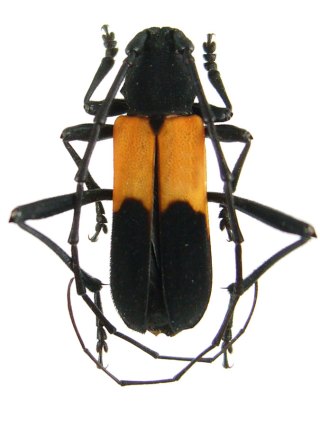
Twenty-five years ago tomorrow, I discovered my first new species.  I didn’t know it at the time – in fact, it would be several years later before the budding, young entomologist that I was would finally conclude that the large, spectacularly beautiful, cerambycid beetle that I was capturing in my fermenting bait traps just south of St. Louis did indeed represent a previously unrecognized species.

In my first job out of school as a field entomologist for the Missouri Department of Agriculture, I worked with nursery growers to identify insect pest problems on their crops and provide recommendations for control.  Wood boring beetles – especially the longhorned beetles – are a major problem for growers of trees, and it was that importance, combined with a latent interest in taxonomy, that led to my interest in this group (and the beginnings of my identity as a “coleopterist”).  I didn’t just work in entomology – I lived it, and when I wasn’t inspecting rows of trees, checking gypsy moth traps, or scouting for musk thistle weevil release sites in the three counties around St. Louis, I was collecting insects and the primary literature about them.  One of the early papers I came across (Champlain and Knull 1932) described the use of fermenting bait traps for collecting Cerambycidae, in particular species in the genus Purpuricenus.  I desperately wanted some of these beetles – large, showy, velvety black, with vivid red or orange basal markings on the elytra – but had not yet encountered either of the two species then known in eastern North America.   I made a batch of the stuff – basically molasses, beer, yeast, and water – and placed buckets of the slurry at a few spots that I would be able to check periodically while on my rounds.  Much to my delight, I quickly began trapping numerous species of Cerambycidae – including the two species of Purpuricenus.  Most of these specimens were coming to a trap I had placed at one of my favorite collecting spots – Victoria Glades Natural Area in Jefferson Co., some 30 miles south of St. Louis.  Over the next few weeks I acquired a nice little series of the two species, and I increased their number during the following three years with continued trapping.

purpuricenus_humeralis

Purpuricenus humeralis (Fabricius)

The two species were easily distinguished – in Purpuricenus humeralis the basal elytral markings were triangular and covered just the humeri, while in P. axillaris they were transverse and covered the entire basal half of the elytra.  As I studied the series of the latter, however, something seemed amiss.  Some of the specimens were distinctly larger and more robust, while others were smaller and more gracile.  Moreover, the color of the elytral markings on the larger specimens seemed to be consistently more reddish than the pale orange markings of the smaller specimens.  At first I dismissed it as variation – common among longhorned beetles, which can vary greatly in size depending on the quality of the larval host.  But as I studied them more I noted other consistent differences between the two “forms” – the larger with more well-developed pronotal tubercles (the middle one of which bore a distinctly polished apex and the lateral ones more acutely angled), a distinct “tooth” at the apex of the elytral midline, and coarser punctures at the base of the elytra.  It seemed obvious that the two forms represented two different species, but the only other species I could find in Linsley’s (1962) monograph of North American Cerambycidae (my bible!) was P. linsleyi – known then only by the holotype and one paratype from an unspecified location in Texas.  Neither series matched the description of that species very well – the shape of the elytral marking was wrong – but I concluded the larger one must be that species and the smaller was axillaris.  There was another possibility – but that young entomologist just couldn’t entertain the idea of a large, showy, longhorned beetle still undescribed in eastern North America.

purpuricenus_axillaris

Purpuricenus axillaris Haldeman

Some time later I received a series of a Purpuricenus that my colleague Dan Heffern had collected near San Antonio, Texas.  Dan had also taken up collecting cerambycids with fermenting bait traps, and while he was quite proficient with Texas species he wasn’t quite sure what to make of these particular specimens.  He sent them to me for my opinion, and it was quite clear – they were the real P. linsleyi.  The rediscovery of that rare species was an exciting find in itself, but it rekindled the puzzle of the Missouri Purpuricenus – if they were not P. linsleyi, then what were they?  The only conclusion was that two species were masquerading under a single name, and that I would have the privilege of naming one of them.  Wow, my first new species – something every amateur taxonomist dreams about, but I had no idea it would happen so soon, or with such a spectacularly beautiful species!  By then I was living in Sacramento, so I traveled to nearby Berkeley to meet with the late John Chemsak at the University of California and show him my material.  John was a longtime associate of the late, great E. Gorton Linsley, co-authoring with Linsley several later volumes of the North American Cerambycidae monograph, and had managed to borrow type material of P. axillaris from the Museum of Comparative Zoology at Harvard University.  We found that both species were present in the small type series, so together we decided which specimen should be designated as a lectotype for P. axillaris – and thus, which of the two species would be named as new.

purpuricenus_paraxillaris

Purpuricenus paraxillaris MacRae

It would take several more years before I actually published a description of the new species, naming it P. paraxillaris (meaning “near” axillaris) and selecting as holotype the very first specimen I collected – on June 25, 1984.  I wanted to know its distribution, which meant borrowing material from museums and willing individuals.  I also recognized that some collectors of Cerambycidae might view the description of a large, showy species from eastern North America with some skepticism, so I wanted to be as thorough as possible.  (There were a few private collectors that declined to loan their material to me because of such skepticism.)  During that process, I learned that P. paraxillaris is quite common across the eastern U.S. – in fact, many of the literature references to P. axillaris actually refer to this species, but it wasn’t until collectors began using fermenting bait traps widely that large series of specimens became available for study.  By examining the few available reared specimens, I learned that P. axillaris prefers hickory (Carya) as a host, while P. paraxillaris prefers oak (Quercus) and chestnut (Castanea).  With several hundred specimens of the two species at my disposal, I became more convinced than ever that they were distinct, and with the many specimens of other species in the genus that I had borrowed as well, I decided to expand the scope of the paper to a general review of the entire genus in North America.  This would allow me not only to describe the new species, but report the rediscovery of P. linsleyi as well.  Finally, after several years (remember, I was/am just an amateur), the description was published in the October 2000 issue of The Pan-Pacific Entomologist (MacRae 2000).

For those of you with an interest in such things, I include here a key to the three eastern North American species of Purpuricenus.

Key to adult Purpuricenus in eastern North America 
(adapted from MacRae 2000)

1.         Posterior margin of basal elytral markings distinctly oblique; apical dark area extending forward along suture and reaching scutellum……………. P. humeralis (Fabricius)

1′.        Posterior margin of basal elytral markings more or less transverse; apical dark area not extending forward along suture to scutellum ………………………………………………………. 2

2 (1′).   Discal calluses of pronotum weak, median callus without polished apical line; lateral pronotal tubercles small, angles obtuse; basal elytral punctation relatively finer and sparser; elytral apices subtruncate, angles not distinctly dentate; basal elytral markings yellow to orange ………………………………………………………………………. P. axillaris Haldeman

2′.        Discal calluses of pronotum distinct, median callus prominent and with polished apical line; lateral pronotal tubercles well-developed, angles acute; basal punctation of elytra relatively coarser and denser; elytral apices emarginate, angles distinctly dentate; basal elytral markings orange to red-orange ………………………………. P. paraxillaris MacRae

REFERENCES:

Champlain, A. B. and J. N. Knull. 1932. Fermenting bait traps for trapping Elateridae and Cerambycidae (Coleop.). Entomological News 43:253–257.

Linsley, E. G. 1962. The Cerambycidae of North America. Part III. Taxonomy and classification of the subfamily Cerambycinae, tribes Opsimini through Megaderini. University of California Publications in Entomology 20:1–188, 56 figs.

MacRae, T. C. 2000. Review of the genus Purpuricenus Dejean (Coleoptera: Cerambycidae) in North America. The Pan-Pacific Entomologist 76:137–169.

Copyright © Ted C. MacRae 2009

Add to FacebookAdd to NewsvineAdd to DiggAdd to Del.icio.usAdd to StumbleuponAdd to RedditAdd to BlinklistAdd to Ma.gnoliaAdd to TechnoratiAdd to Furl