This—the 18th “Collecting Trip iReport”—covers the second of two insect collecting trips to the southwestern U.S. this season—this first one occurring from June 4–13, during which I placed “bottle traps” and “jug traps” at several locations, and this one from September 3–14 to retrieve the traps and take advantage of any late-season collecting opportunities. I was fortunate on this trip to have longtime collecting buddy and melittologist Mike Arduser joining me, during which we visited the same 15 localities that I visited on my precious trip back in June (one in northwestern Oklahoma, six in northern Arizona, six in southern Utah, and two in southern Nevada) plus two additional localities (one each in northwestern Oklahoma and northeastern New Mexico).
I’m on my way out west with fellow collector Mike—today being only a travel day but with a quick stop in Texas Co., Oklahoma to retrieve bottle traps set back in June and then a night of camping at Black Mesa State Park before continuing the drive west tomorrow. After 7 hours, we needed to stretch our legs and stopped at Salt Plain National Wildlife Refuge’s Sandpiper Trail—a spot we both have visited several times and know well. Recent rains had the alkaline flats filled with more water than I’ve seen during any previous visit, …
Salt Plain National Wildlife Refuge, Alfalfa Co., Oklahoma.
… and only a few Ellipsoptera nevadica knausi (Knaus’ tiger beetle) and Eunota circumpicta johnsoni (Johnson’s tiger beetle) were seen on the drier margins of the alkaline flats. Several Epicauta conferta (red-cornered blister beetle) were seen lumbering across the path, and a Diogmites angustipennis (prairie robber fly) posed nicely on the trail for pictures as well.
Showy Eustoma russellianum (prairie gentian)—a plant I’ve never seen before—were blooming spectacularly and prolifically in the vegetated areas bordering the alkaline flats.
It was a quick but interesting stop that rejuvenated the legs before we continued our journey westward.
The first “real” stop of the trip was ~5 miles north of Goodwell in Texas Co., Oklahoma where I placed three white bottle traps in early June hoping to capture the very rare Acmaeodera robigo, which had been photographed here on flowers of Melampodium leucanthemum (blackfoot daisy) and the photos posted on BugGuide. I was never able to contact the photographer, but since bottle traps are so effective at sampling species of Acmaeodera I reasoned placing three traps here (one at the precise spot and two more several hundred yards to the north and to the south) would give me the best chance of collecting it. It had already been dark for an hour before we reached the spot, but despite the darkness and late hour I had no trouble finding each of three traps. I was happy to see all three traps still in place, undisturbed, and filled to the brim with insects. I tried to pick out the larger insects (mostly crickets and grasshoppers) and stir through the remaining contents of each trap a bit to see if I could detect any Acmaeodera, but the majority of insects appeared to be small blister beetles, followed by bees. The darkness made further sorting impossible, so I bagged the contents of each trap and saved for later sorting. [Edit: later sorting found only a couple of Acmaeodera mixta? in just one of the traps and no A. robigo.]
We arrived at our first overnight spot—Black Mesa State Park—quite late (~11:30 pm) and quickly setup camp before retiring for the evening. In the middle of the night I got up, came out of the tent, and was greeted by an incredible amazing starscape that is normally only seen during winter. Taurus was already high in the sky, and Orion was well above the horizon with a brightly shining Jupiter not too far to its left.
Night sky at Black Mesa State Park. Orion has risen, with Taurus above and Jupiter just rising in the lower left.
Day 2
In the morning, a canyon towhee (Melozone fusca) kept us company as we prepared breakfast and then broke camp for another mostly travel day
Canyon towhee (Melozone fusca).
Our destination this evening is Devils Canyon Campground near Monticello, Utah, to which we will travel by way of northeastern New Mexico and then southwestern Colorado.
Abandoned homestead outside of Clayton, New Mexico.
Shortly after crossing into Colorado we made a pit stop for ice and I began searching the pavement around the gas station looking for beetles that may have come into the previous night’s lights. I didn’t find any cerambycids but I did find a small tenebrionid beetle that didn’t look like familiar to me.
Crossing the Sangre de Cristo and then the San Juan ranges were as spectacular a mountain crossings as any that Colorado has to offer, and a coffee stop in Pagosa Springs (at Faire Society Cafe and Patisserie) provided not only good coffee and pastries to fuel me for the rest of the drive to Devils Canyon Campground near Monticello, Utah, but interesting and creatively framed art work to treat the eyes while waiting for our orders.
“Art wall” in Faire Society Cafe and Patisserie, Pagosa Springs, Colorado.
“Butterflies”—Faire Society Cafe and Patisserie, Pagosa Springs, Colorado.
“Gentleman Frog”—Faire Society Cafe and Patisserie, Pagosa Springs, Colorado.
“Cow”—Faire Society Cafe and Patisserie, Pagosa Springs, Colorado.
Weather during the drive had been good all day, but on the final approach to Devils Canyon Campground the skies began looking worryingly threatening. The last time I came here (early June) I had intended to camp here but got rained out and took a motel in town. I did not want a repeat of that, so we kept our fingers crossed and made the final drive to the campground. Although still threatening, it was not actually raining when we arrived (unlike last time), so we took our chances and set up camp. No sooner than that did the rain start! Fortunately, the tent was already up, so it just meant that instead of cooking dinner at the site, we would instead go to town and have dinner (Dave’s BBQ). When we got back to camp, the rain had stopped (although we could tell that it had rained hard), so I decided to walk the roads looking for night-active beetles. I knew this was probably a fruitless exercise—by then the post-rain temps at this 7000’ site were already down to the mid-50s, but it would give me a chance to stretch my legs after two straight days of driving, and I could also take that opportunity to retrieve the bottle and jug traps that I had set back in June. The bottle trap was disappointing, especially after seeing the ones I’d set near Goodwell, Oklahoma filled to the brim with insects—just a handful of bees (for Mike) and no beetles of any kind. This was surprising given the many Acmaeodera I have collected in alpine habitats just like this (Ponderosa pine and Gambel oak). The SRW-baited jug trap, on the other hand, was nicely (if not overwhelmingly) productive (Tragosoma sp., Enaphalodes sp., small elaphidiines, small acanthocine with very long antennae, Xestoleptura?)—enough to make it worth the effort. I was also pleased to see that the jug trap was in still place and intact with the catch in good shape despite three months in the field. The bait bottle was still about half full of red wine, but since the propylene glycol had dried the trap was no longer trapping insects. As I’d expected, no night-active insects were seen in the way to the traps or on the way back.
Day 3
It was a chilly morning, and though it had not rained since our arrival last night the skies remained overcast. The day’s plan was to continue west to the Ponderosa Grove Campground in southwestern Utah (north of Kanab), but with only five hours of driving required to get there we would have time to make a few stops along the way. Before leaving I started checking the Ericameria nauseosa (rubber rabbitbrush), several of which had begun blooming in the campground, and found a few Crossidius coralinus and Acmaeodera amabilis on the flowers. I was tempted to suggest staying put—at least for a short time—and exploring the area a little more fully, but my real objectives were further west and I elected to stick with the plan.
Crossidius coralinus (family Cerambycidae) on flowers of Ericameria nauseosa (rubber rabbitbrush).
Acmaeodera amabilis (family Buprestidae) on flowers of Ericameria nauseosa (rubber rabbitbrush).
One of the stops I’d made along this way last June was 4 miles east of Bluff in San Juan Co., Utah, where the famous Mont Cazier had collected what would later be described as Agrilus utahensis. I did not find it in June (nor did I fully expect to, since the record was from late July), and I was equally skeptical about my chances this time given how much later it was in the season. On the way here, we got caught behind an oversized load on the highway that was so big it required three highway patrol chaperone vehicles to clear the road ahead. Going at about half the speed limit, I worried we might have to follow it the entire way to our turnoff, which would nearly double our travel time to the first spot. Fortunately, the caravan pulled over at one point to let the long train of trsffic that had accumulated behind it pass, and we were on our way (the convoy would later pass us at the very spot where we had stopped to collect).
Oversized convoy!
The location was disappointing dry and crispy, although Gutierrezia sarothroides (broom snakeweed) was coming into bloom. Sweeping it eventually produced about a dozen Crossidius pulchellus and two other beetles (a clytrine leaf beetle and a weevil), and Mike collected a handsome series and diversity of bees off of flowering Eriogonum sp. (buckwheat).
Crossidius pulchellus (family Cerambycidae) on flowers of Gutierrezia sarothrae (broom snakeweed).
Our drive afterwards through southeastern Utah and northeastern Arizona took us through some of the most amazing scenery that the American West has to offer—red sand/siltstones sculpted through the eons by wind and rain have created a landscape that can only be described as “planetary.”
Monument Valley, southeastern Utah.
Eventually, the dramatic landscape gave way to a more monotonous series of desert plateaus periodically interrupted by dramatic descents and canyons as we got deeper into north-central Arizona. Though pleasing to the eye, there were few signs of greenery of flowers to tempt the passing entomologist except occasional stands of Ericameria nauseosa (rubber rabbitbrush) beginning to bloom in higher elevation spots. We kept our nose to the grindstone, hoping to see better things once we passed through Page and crossed back into south-central Utah, but the landscape became even crispier, with a stop about 20 miles northwest of Page to look for Nanularia brunnea on Eriogonum inflatum (which I had found two years ago in late June) being a total bust. We expected/hoped that the higher elevations around Ponderosa Grove Campground (~6000’) would provide better collecting and continued there without haste. Our expectations/hopes proved well-founded, as blooming rabbitbrush was seen with greater frequency as we traveled north of Kanab and even more so along Hancock Rd approaching the campground. We took a few moments to scout out a good campsite and setup camp before spending the rest of the available daylight hours exploring. For me the rabbitbrush was most tempting, and scouting plants in the campground and the vicinity east produced small but nice series of Crossidius coralinus and Typocerus balteatus. As I was doing so, a sinking sun and virga to the east produced an impressive rainbow that became irresistible for photography—not only as a subject itself but as a backdrop for the beetles I was finding.
Rainbow at Ponderosa Grove Campground.
Crossidius coralinus (family Cerambycidae) on flowers of Ericameria nauseosa (rubber rabbitbrush).
Typocerus balteatus (family Cerambycidae) on flowers of Ericameria nauseosa (rubber rabbitbrush).
After some downtime back at camp (and grilled sirloin steaks for dinner), I did my customary nighttime patrol to check for night-active insects. This campground was especially productive when I did this back in June and found several Zopherus utahensis and other tenebrionids on the trunks of the massive Ponderosa pines that are the namesake of this campground.
A near-full moon rises over our campsite at Ponderosa Grove Campground.
This time was no different—while I found only a single Z. utahensis, I did also find a few specimens of Coelocnemis sulcata, including a mating pair, on the trunks of the trees …
Coelocnemis sulcata (family Tenebrionidae) mating pair on trunk of Pinus ponderosa (Ponderosa pine) at night.
… and a single Embaphion sp. on the ground at the base of another. There are several massively-trunked Juniperus osteosperma (Utah juniper) in the campground as well, on which another C. sulcata was found. Despite this success and the relatively early hour, I was exhausted and called it quits for the night and retire. We will spend the entirety of the day here tomorrow, so I’ll have another chance to check the tree trunks again tomorrow night.
Day 4
After a relaxing morning at the campsite (during which time I caught up on my field notes while enjoying double-pour-through coffee), I walked over to the sand dune-adjacent woodlands to retrieve the traps that I’d set there back in June and brought them back to the campsite for sorting. I was happy to see Ericameria nauseosa (rubber rabbitbrush) and many other plants in bloom and looked forward to checking them more closely after servicing the trap catches.
Ericameria nauseosa (rubber rabbitbrush) blooming in sand dune habitat at Moquith Mountain Wilderness Study Area.
The yellow bottle trap had ~15-20 beetles, including several Acmaeodera spp., a lepturine cerambycid, and a tiny Dichelonyx-like scarab (a relief after getting skunked with the bottle trap I’d set in Devils Canyon). There were also a fair number of bees in the trap, which I gave to Mike. The SRW-baited jug trap also did well, containing Tragosoma sp., Enaphalodes sp., several Psyrassa sp., and another colorful little lepturine along with several Euphoria inda, several small clerids, a mantispid, and numerous small beetles I take to be oedemerids. After processing the trap catch, I went back over to the woodlands and dunes, spending more than three hours collecting off the flowers of E. nauseosa and other flowers.
Typocerus balteatus was found not uncommonly on the flowers in most of the areas that I covered, while Crossidius coralinus and C. suturalis were found a bit more sparingly.
Crossidius coralinus (family Cerambycidae) on flowers of Ericameria nauseosa (rubber rabbitbrush).
Crossidius suturalis (family Cerambycidae) on flowers of Ericameria nauseosa (rubber rabbitbrush).
I also found Acmaeodera rubronotata on the flowers of Grindelia squarrosa (curlycup gumweed), Dieteria canescens (hoary tansyaster), and E. nauseosa, but they were limited to the woodlands and not seen in the dunes.
Acmaeodera rubronotata (family Buprestidae) on flowers of Dieteria canescens (hoary tansyaster).
I also found several individuals of an interesting little weevil on the rabbitbrush flowers, its gray/black longitudinally striped body making a good subject for photography (for which I also brought back a live A. rubronotata and a mating pair of ambush bugs), and spent a bit of time photographing some of the other blooming plants in the area.
By the time I feel like I’d gotten a good enough look at the area, nearly four hours had gone by and I was famished. Sardines and Triscuits did the trick, after which we did a quick ice run into town and back—the highlights being an authentic Sinclair dinosaur (he’s smiling!) and an real (though non-functioning) pay phone.
The famous “Sinclair dinosaur.”
He’s smiling!
An authentic (though non-functional) pay phone.
Returning to the campground, I walked with Mike back into the dunes to retrieve his bowl traps. I had hoped that some of them would pick up Acmaeodera (as is often the case with bowl traps and why I have started utilizing them on my own collecting trips), but the only species that would be out in this area at this time of season would be A. rubronotata, which I had already collected earlier in the day (there were none).
Mike services a “bowl trap.”
After a period relaxing (with a cold beer and burgers hot off the grill), I began my customary night walk. I have yet to find a cerambycid on tree trunks at night here, but still I enjoy night walks here as much as anywhere due to the consistent presence of ironclad beetles and other tenebrionoids on the trunks of the massive Ponderosa pine trees that give the campground its name.
Another near-full moon rises over the campsite.
Tonight would be no different—I found Zopherus uteanus on just the second tree that I examined (right in our campsite), and I would also find two species of tenebrionids in the vicinity on the trunks of ponderosas (Coelocnemis sulcata and Eleodes obscura sulcipennis) and a third species (ID unknown) on the ground at the base of one of them.
Zopherus uteanus (family Zopheridae) on trunk of Pinus ponderosa (Ponderosa pine) at night.
Coelocnemus sulcata (family Tenebrionidae) on trunk of Pinus ponderosa (Ponderosa pine) at night.
Eleodes obscura sulcipennis (family Tenebrionidae) on trunk of Pinus ponderosa (Ponderosa pine) at night.
At that point, I decided to go outside of the loop towards a couple of large P. ponderosa at the entrance, and on the way I found another E. obscura sulcipennis on the trunk of a massively old Juniperus osteosperma (Utah juniper). There was nothing on the P. ponderosa trees that I had targeted, but nearby was another large one, and high up on the trunk (as far as my fully extended net could reach) was another Z. uteanus, and several C. sulcata—including a mating pair—were found on the ground at its base.
At that point I decided to limit my tenebrionoid collecting to only Zopherus unless I saw species that I hadn’t seen before, so I passed by some additional tenebrionids of the same species as the previous on a large P. ponderosa in the RV loop, then saw a large, multi-branched Pinus edulis (Colorado pinyon pine) that I thought might be interesting to check. I did not find any beetles on it, but I did locate at eye level—with considerable difficulty!—a male Oecanthus californicus (western tree cricket). I was not only able to take a photograph of it with its wings fanned but also record an audio track up close (posted on iNaturalist).
Oecanthus californicus (western tree cricket—family Oecanthidae) male singing on trunk of Pinus edulis (Colorado pinyon pine) at night (song).
Returning to the tent loop, I checked all of the large P. ponderosa trees and junipers that had—during the past visit and last night—been so productive, but the only beetles I found was a very small tenebrionid that, fortunately, was yet another species I had not previously seen here (ID unknown). After two hours of searching tree trunks, I called an end to the night, which also meant a close to the collecting at this spot—tomorrow we will drive to Kyle Canyon in southern Nevada!
Day 5
Our exit from Ponderosa Grove took us through more of the spectacular canyonland that southern Utah is famous for and past the incredible Coral Pink Sand Dunes State Park (so spectacular it is that I think it could—despite its small size—be a national park). A dramatic descent down into the Virgin River valley and the town of Hurricane was only the first such descent—the second one being even more dramatic as I-15 dropped off the edge of the Colorado Plateau along the Virgin River Gorge. The remainder of the drive to Kyle Canyon northwest of Las Vegas was mindnumbing in its contrast—an endless stretch of interstate highway through a vast expanse of low, hot, featureless desert punctuated at regular intervals by palm tree dotted oases, each with a gaudy, glittering casino at its center. Driving up Kyle Canyon Rd put an end to this, however, as each thousand foot gain in elevation brought with it an increasingly interesting landscape. At about 4500’ elevation, I had set a couple of bottle traps—one yellow, one blue—hoping to catch the recently described Acmaeodera raschkoi (whose namesake—Mike Raschko—I had happened to meet at Ponderosa Grove Campground last June a few days before I set the traps!). Mike R. had also placed a bottle trap (white) at the site and was kind enough to reset it for me so I would have three colors sampling the area. Both of my traps were still in place, intact, and filled with numerous Acmaeodera that I take to be A. quadrivittata (along with many bees for Mike A.) and the yellow also containing a larger species that I didn’t immediately recognize (not unusual since I have never collected this area). Unfortunately, I did not see any specimens that appeared to be A. raschkoi, and even more unfortunately the white bottle trap had been pulled from the ground (although I was able to recover a few A. quadrivittata that were still inside the trap). Not much else was going on at the site—only a few things in sparse bloom but no beetles visiting the flowers, nor was there any rabbitbrush around on which to look for Crossidius.
We got a scare when we arrived at the campground and saw a sign at the entrance saying “Campground Full.” This was bad—if this campground was full, then surely the much more heavily used one down below was also full, and I didn’t look forward to spending the rest of the afternoon scrambling for a campsite somewhere in the Spring Mountains. We drove through the campground anyway, and, in fact, there were many campsites available! Looks like somebody forgot to do their job!
“Campground Full” sign at a not-full Hilltop Campground above Kyle Canyon, Nevada.
Crisis averted, we selected a nice spot overlooking the desert below and set up camp. Cool evening temps come early at this high elevation (~8300’), so with the remaining afternoon hours I retrieved and sorted my SRW-baited jug trap, finding several Tragosoma sp. but, curiously, not a single other longhorned beetle (or any beetle for that matter). Searching around the area afterwards, I extracted a dead Dicerca tenebrosa partial carcass in its emergence hole in a stump of Pinus monophylla (single-leaf pinyon pine), then went back down to the area I had collected last time, focusing especially on the two large half-dead Juniperus osteosperma (Utah juniper) trees on which I had seen damage from the rarely collected Semanotus juniperi (on one of which I collected three adults later that night). There was nothing on the first (the one on which I found the beetles), but at the second one I saw a large wind-thrown branch that I had not noticed last time. It exhibited S. juniperi damage and emergence holes on the lower part, and chopping into it I quickly recovered a dead but intact carcass of yet another S. juniperi adult. Further chopping turned up nothing, and I was about to walk away when I thought maybe I should cut into the upper part of the branch as well to look for evidence smaller woodboring species. Doing so, I quickly encountered a Chrysobothris sp. larva, and with that I decided to bring the entire upper part of the branch back for rearing. There wasn’t much else going on—few plants were in flower and nothing was seen on the trunks of trees or various pieces of downed wood that were laying about, so I went back to camp.
Alpine pinyon/juniper woodland at Hilltop Campground above Kyle Canyon, Nevada.
An elevation of 8300’ affords spectacular views into the desert below.
Later in the evening, we watched a spectacular moonrise, then enjoyed “surf ‘n’ turf” (grilled sirloin steak and salmon) before I started up my customary night walk to check tree trunks for night-active beetles.
Angel Peak Radar Station at sunset.
“Corn Moon” rising.
Peeking through the trees.
Last time here when I did this, I found not only S. juniperi but also a few Zopherus uteanus, so I was hopeful for my chance tonight despite the lateness of the season. It started out well—on the first P. monophylla tree that I checked (right at our campsite), I found Oeme costata and a weevil.
Oeme costata (family Cerambycidae) on trunk of P. monophylla (single-leaf pinyon pine) at night.
Those would be the last live beetles I would see (other than an occasional tenebrionid beetle, none of which I collected). However, I would still find success—back at the J. osteosperma on which I had found three S. juniperi back in June, I found three more. They were not alive, however, but dead carcasses at the base of the tree—two nearly completely intact and the other partially so.
Western deer mouse (Peromyscus sonoriensis) at night.
Day 6
We had planned to visit few localities at middle and lower elevations but stopped to check out the profusely-blooming Ericameria nauseosa (rubber rabbitbrush) right outside the campground entrance for bees and beetles. Curiously, hardly anything was seen on the flowers despite the by then late-morning hour, sunny skies, and temps above 70°F. It seemed odd to me that there were no Crossidius beetles on the blooms, and the thought occurred to me that maybe the occurrence of E. nauseosa in the area itself could be a relatively recent phenomenon since it is only seen—albeit profusely—along the roads and highways in the area but nowhere further within the native habitats. With nothing going on, we pushed down to the lowest elevation point that caught our eye on the way in yesterday—the Step Ladder Trailhead at ~6700’.
Again, E. nauseosa was blooming profusely around the parking lot, but a quick perusal made it clear the situation would be similar here as well. Mike, on the other hand, was having good success collecting bees off of E. nauseosa and especially Gutierrezia sarothrae (broom snakeweed), so I was content to stay and refocus by searching for infested wood. I noticed a lot of Quercus gambelii (Gambel oak) and quickly found one with a dead but still attached, fully-barked branch. I broke the branch off the tree, and there in the broken butt of the branch was a large chrysobothroid larvae! This quickly prompted a decision to collect the infested branch and put it up for rearing. A second larvae was found in a small dead (but still fully-barked) tree nearby, which was added to the bundle. While this was going on, Mike found what seemed to be Agrilus blandus? in his net while sweeping bees from the flowers of G. sarothrae. I recall collecting this species in southern California in flowers of Eriogonum (wild buckwheat), so finding it on other flowers—particularly if Eriogonum is in the area (but not seen because it was not blooming) did not seem out of the question. My much more thorough sweeping of the plants around the area where he found it, however, produced no additional specimens. I was also interrupted in my sweeping attempts by a couple of curious bystanders—one a woman from Ukraine who wondered what the plant was that I was sweeping (I told her “broom snakeweed”) and what it was good for (“brooms” I wryly replied and then quickly clarified its role in the ecosystem), and then offered me a beetle collecting tip by telling me about large beetles they call “bombers” and that bite people sitting in spas in Southern California (I presume these are diving beetles in the family Dytiscidae); and the other a young man who was pleased to hear I was from St. Louis because he used to live there when he was married to his ex-wife. This all happened while I was in the middle of my sweeps, so I held the net bag firmly to keep insects from escaping my net until I could resume my sweeping. Eventually, I gave up the ghost and resumed my search for dead, infested wood, eventually finding a Cercocarpus ledifolius (curl-leaf mountain mahogany) tree with one recently-dead and one older dead branch, the former buprestid-infested (verified by cutting into the wood and finding young buprestid larvae) and which I collected for rearing.
View of Fletcher Peak from Step Ladder Trailhead.
After lunch back at the campground and some time spent processing specimens (as well as enjoying the antics of our resident golden-mantled ground squirrel [Callospermophilus lateralis certus]), …
Mount Charleston golden-mantled ground squirrel (Callospermophilus lateralis certus).
… I wanted to check out the nearby Deer Creek Picnic Area where I’d seen a lot of iNaturalist observations (suggesting it might be an interesting place). At first all I saw was the massive parking lot below an equally massive road-cut slope—the only thing that looked like a trail was a steep drop down to the creek below. I checked it out, only to find it dead-ending at the creek and clambered back up.
A massive Ponderosa pine looms above.
Then I saw a gravel trail behind the guardrail on the opposite side of the highway and found it leading to a paved path up the creek. Much of the trail was covered with a deep layer of gravel from flooding (and indeed some of the picnic tables were also nearly completely buried). I hiked the trail as it ascended alongside the creek under massive ponderosa pines until it dead-ended at a gravel road and turned around. The only plants in flower was Ericameria nauseosa (rubber rabbitbrush), and it was only near the highway, and while I saw no insects that I wished to collect, I did see a large Adejeania vexatrix (orange bristle fly) that frustrated my attempts to photograph it until I finally “pre-set” the focus, exposure, and zoom and quickly fired off a few shots at the distance I’d set it for as soon as the fly landed. The virtual lack of insect activity here confirmed what we’ve been seeing in the area as a whole, so I’ll be anxious to leave tomorrow and head for (hopefully) greener pastures at Leeds Canyon back in southwest Utah.
Adejeania vexatrix (orange bristle fly—family Tachinidae) on flowers of Ericameria nauseosa (rubber rabbitbrush).
Day 7
The drive from Kyle Canyon to Leeds Canyon was essentially a straight shot on I-15—normally a recipe for extreme boredom; however, coming back up through the Virgin River Gorge was a different, even more awe inspiring experience than the descent two days earlier. Ascending such a steep narrow canyon has the breathtakingly tall canyon bluffs looming high overhead, dwarfing the traffic, even the largest semi tractor trailers, snaking up below, whereas descending into a seemingly bottomless chasm feels a little more “dangerous.” We arrived at Leeds Canyon relatively early thanks to the “only” 3-hours drive. The area looked very dry, but a variety of blooming plants kept us optimistic as we made our way up the canyon road towards Oak Grove Campground at the top.
Leeds Canyon in southwestern Utah.
Sadly, optimism turned to dismay in an instant when we encountered a “Road Closed” sign about halfway up—a result of the ongoing fire risk that has bplagued the area this season. We checked to see if the campground on the other side of the mountain range was available, only to learn that it was closed due to fire damage. At that point, our decision was made for us—we would need to continue another two hours to the Kaibab Plateau where I had my last sets of traps to retrieve and where we could camp at Jacob Lake. While we were here, however, we took the opportunity to stop at a spot along Leeds Creek and see what we could find.
Oak Grove Rd crosses Leeds Creek in the lower part of Leeds Canyon.
Several different plants were in bloom, on which I’d hoped to find either Acmaeodera or longhorned beetles, the first that I looked at being Dieteria canescens (hoary tansyaster), but I only saw small dasytines (a few of which I collected). Nothing was seen on Solidago velutinus (velvety goldenrod) or Sphaeralcea grossulariifolia (gooseberry leaf globemallow) flowers, but then Mike came up with a Crossidius discoideus on flowers of Gutierrezia sarothrae (broom snakeweed).
Crossidius discoideus (family Cerambycidae) on flowers of Gutierrezia sarothrae (broom snakeweed).
Careful searching of the plants in the surrounding area atop a small hill turned up an additional half-dozen individuals, but none were seen on any of the plants further up or down along the road. By this time, we’d spent about an hour and decided to finish the additional 2-hours drive needed to get to Jacob Lake.
Megaphorus sp. (family Asilidae).
Historic home in nearby Harrisburg, Utah.
Some of the western U.S.’s worst fires this season occurred on Arizona’s Kaibab Plateau. The Dragon Bravo Fire destroyed over 100 structures on the Grand Canyon’s North Rim—including the historic Grand Canyon Lodge and the North Rim Visitor Center, while the White Sage Fire simultaneously burned significant areas of Kaibab National Forest north and east of Jacob Lake. It was the latter that, unfortunately, swept across both of the sites where I had placed traps a month earlier in June, so I was not optimistic about the likelihood that they had survived. Fortunately, the fires did not reach the immediate vicinity of Jacob Lake, so the campground was unaffected and—unusual in my experience—nearly devoid of people. After setting up camp, I went back north into the burn zone to see if my traps 1) had survived and 2) could be retrieved. The area around the site was almost completely destroyed, with charred black skeletons of trees dotting blackened soils devoid of any vegetation.
Aftermath of the White Sage Fire in the Kaibab National Forest.
I had low expectations for the traps at this site even before the fires, as the area had already burned several years early and was in the early stages of recovery (I had decided to place traps here anyway because I wanted to see what the woodboring beetle fauna in a recovering area might look like).
Blackened trunks punctuate a stark landscape.
I continued walking the 2-track toward the trap location surveying the damage, came around a bend, and saw it—a lone, still-green pinyon pine with my jug trap hanging from a branch and a bottle trap, its yellow funnel only slightly heat deformed, still planted in the soil beneath the tree!
A lone green tree amongst the destruction—with my traps in the tree and below it both intact!
At first I was elated, but then I saw the jug trap reservoir was dry and almost completely empty save for a few dried beetle carcasses—the trap had survived the fires, but the associated winds had blown the trap and dumped the contents (none of which could be detected on the ground beneath). The bottle trap, on the other had, looked to be full of insects with plenty of liquid still in the reservoir, so I was hopeful that I would retrieve some good specimens from it. This proved to be the case (sort of!) as I pulled a few Anthaxia sp., a meloid, and lots of bees (for Mike) from the trap. The dried carcasses in the SRW-baited jug trap turned out to be an elaphidiine & several silphids.
After leaving the first trap site and driving towards the second (a few miles east of Jacob Lake), I saw little to no fire impacts as I continued east of Jacob Lake. However, as I got closer to the site I began to see impacts—first along the ridge above, then down the slope and engulfing the area where I had placed my traps. Fortunately, the fire did not seem to have been as severe in the immediate area, so I remained hopeful.
Intact jug trap in burned woodland east of Jacob Lake, Arizona.
The bottle trap was found first and was in much the same condition as the bottle trap at the previous location—it’s blue funnel slightly heat-deformed, but the reservoir was filled with liquid and insects. Later sorting yielded an Acmaeodera diffusa?, a Melanophila sp., a couple of Anthaxia sp., a clerid, and lots of bees (for Mike). The Melanophila sp. was especially welcome—known collectively as “fire beetles” for their attraction to active fires, its presence in the trap may have been been a direct result of the fire. The SRW-baited jug trap was quickly found next, and much to my relief the trap was not only intact and undamaged but also filled with insects (in fact, the propylene glycol had not even completely dried). Later sorting would yield only a single longhorned beetle (plus a silphid and a Euphoria inda), but that longhorned beetle would prove to be the catch of the trip—Calloides nobilis mormonus! I have reared a single individual of the nominate subspecies from fire-damaged oak collected in Missouri, so I suspect the presence of this beetle is also a direct result of the fires that swept through the area—a satisfying irony.
Calloides nobilis mormonus (family Cerambycidae) attracted to sweet red wine-baited jug trap.
Back at camp and after another “surf & turf” dinner of sirloin steak and salmon, I did my customary nighttime walk to look for night-active beetles on the ground and in tree trunks. I had good luck with this here back in June, finding a Zopherus uteanus and several other beetles, but tonight’s catch consisted of just a single Temnochila sp. (family Trogosittidae) and a single weevil (superfamily Curculionoidea) crawling on the large trunks of Pinus ponderosa.
Unidentified weevil (superfamily Curculionoidea) on trunk of Pinus ponderosa (Ponderosa pine) at night.
Day 8
I’d seen a fair amount of Ericameria nauseosa (rubber rabbitbrush) in bloom at the second site the previous day when I retrieved my traps but didn’t see any insects (or, at least, beetles or bees) on them. I figured this was due to the early evening hour, so we decided to come back during the day to try again. The E. nauseosa flowers were still, puzzlingly, devoid of insects (save for honey bees and enormous numbers of a large, black, bristly tachinine fly—possibly Archytas metallicus or Juriniopsis adusta).
Tachinine fly (possibly Archytas metallicus or Juriniopsis adusta—family Tachindae) on flowers of Ericameria nauseosa (rubber rabbitbrush).
Like at Kyle Canyon, the absence of Crossidius spp. on E. nauseosa flowers was surprising, as I have seen them on this plant at almost every other location I have ever checked. You can’t make things appear no matter how hard you look, however, so we continued into some openings farther up the slop and encountered a few other plants in bloom. One was Dieteria canescens (hoary tansyaster), on the flowers of which I found a few small beetles of an unknown family. Nearby I saw several dead main branches in a clump of Quercus gambelli (Gambel oak)—cutting into them revealed a very small woodboring beetle larvae, so I collected several of the stems for rearing. Coming back down the slope I found a single cryptocephaline on the flower of Eriogonum racemosa (redroot buckwheat) and a single Acmaeidera rubronotata on flowers of Gutierrezia sarothrae (broom snakeweed)—the latter on which Mike had also found a single Crossidius discoideus. (This seems to be the first record of any species of Crossidius from the Kaibab Plateau! Maybe the other species are here as well but are not quite out yet at this relatively early date in fall.)
Crossidius discoideus (family Cerambycidae) collected on flowers of Gutierrezia sarothrae (broom snakeweed).
We were getting ready to leave when I spotted a large, fallen Pinus ponderosa (Ponderosa pine) with the twigs brown but still attached (indicating it might be the right “amount” of dead to host woodboring beetles. Damage by such could be seen on the smaller branches, and cutting into them confirmed the presence of larvae and led to a second wood-cutting/bundling session to bring the beetle-infested twigs and branches back for rearing.
Chasing more floriferous pastures, we went back up to higher elevations and stopped at a spot close to the campground where we 1) saw a great diversity of plants in bloom and 2) could safely pull off the highway. A huge diversity of blooming plants were seen (from which Mike collected ~20 species of bees), but the only beetles of interest that I saw and collected were numerous small black/red cryptocephalines on the flowers of Eriogonum racemosum (redroot buckwheat). After Mike was satisfied he’d sufficiently sampled the diversity of bees at the site, we looked for another place to collect.
We drove south towards DeMotte Campground on Hwy 67, but much of the landscape was complete devastation due to the fires and no access was allowed beyond Kaibab Lodge. It was depressing to see the immense scale of destruction and loss of natural resources, but as one forest worker that Mike talked to put it, “It’s just trees, and he didn’t have to call anybody’s family [i.e., there was no loss of life].” We then drove back down past my second trap location where we had collected earlier in the day to see if we could find better stands of Gutierrezia sarothrae (broom snakeweed) on which to look for more Crossidius discoideus (still represented in the area by the single individual Mike had collected earlier). We drove through even more complete and utter destruction but eventually found undamaged areas at about 6600’ elevation. Not only was there G. sarothrae in bloom, but also Chrysothamnus visicidiorus (green rabbitbrush) and Ericameria nauseosa (rubber rabbitbrush)—all three species serving as hosts for various Crossidius and providing a perfect scenario for comparing and contrasting the sometimes-tricky-to-identify plants! The promise of Crossidius, however, would not be realized, and after an hour of searching—finding only a lone weevil on the flowers of E. nauseosa—did I finally admit defeat and concede that Crossidius from this after would have to come some other time.
Inflorescences of Gutierrezia sarothrae (left), Chrysothamnus viscidiflorus (middle), and Ericameria nauseosa (right). Note the distinct ray florets of G. sarothrae and blue-green leaves of E. nauseosa.
I hadn’t planned to do my customary nighttime walk this evening—my motivation waning after the less than meager success of the previous night, continuing relative absence of beetle life I’d seen during the day, and temps now dropping towards the 50s. A cute but shy Uinta chipmunk in our campsite captured my photographic interest as we relaxed, and the setting sun turned the clouds a stunning pink!
An Uinta chipmunk (Neotamias umbrinus) climbs a Ponderosa pine to stay as far from my camera as possible!
However, as night fell the siren song of the nighttime walk began singing its tune and I was unable to resist.
The setting sun turns the clouds an exceptional pink.
It turned out to be a more successful night than I’d expected—I found a small species of tenebrionid [Edit 10/1/25: Eleodes pimelioides] on the rocks surrounding the campsite, and there turned out to be dozens of the little buggers crawling though the pine duff in the campground.
Eleodes pimelioides (family Tenebrionidae) in alpine coniferous forest at night.
Nothing else was seen, however, and since tomorrow would be a long travel day I called it an early night.
Day 9
On a mostly travel day, we tried to take a big bite out of the many miles that still separate us from St. Louis, where we planned to be in three days time. We got another look at the devastation east of Jacob Lake before reaching the dramatic drop off the Kaibab Plateau and down into the Vermilion Cliffs National Monument—their massive red bluffs accompanying us all the way to Mojave Canyon. Just south of there as the highway climbed up and out of the valley, we made a quick stop to remove excess clothing (having gone from high elevation to low), and alongside the road I spotted a Crossidius pulchellus on the flowers of Gutierrezia sarothrae (broom snakeweed). This is the furthest southwest I have collected this species, and I was tempted to continue looking to see if I could find the other G. sarothrae associate—C. discoideus—as well. We still had a long drive ahead of us, however (destination Mills Rim Campground in northeastern New Mexico), so I resisted temptation and we continued the drive.
The Vermilion Cliffs, stunning as they were, still weren’t the highlight of the drive. That honor would come from the moonscape formations along Hwy 89 as it followed the Echo Cliffs and then turned east onto Hwy 160 towards Tuba City. We then passed through a series of stunning plateaus and drops on Hwy 264 as it passed through the Navajo and Hopi Reservations. One abandoned house as we dropped down off the Ganado Mesa was especially picture-worthy.
Abandoned home on the Ganado Plateau near Kykotsmovi Village, Arizona.
Eventually we crossed the state line at Picture Rocks into New Mexico, and, suddenly, the landscape seemed more “tame” and less hostile. I don’t normally like interstates, and the stretch of I-40 to Albuquerque did nothing to change my opinion of them, but I must admit that I-25 north towards Santa Fe was among the most picturesque I have ever seen. Eventually, we left the mountains and found ourselves once again on the western edge of the Great Plains—its vast featureless expanse a true contrast to the landscape we had witnessed throughout most of the day. This apparent homogeneity, however, is misleading—tucked away in places unknown to most are some remarkable natural areas, and Mills Rim is one such place. We arrived after dark, so the explorations of its hidden charms would have to wait until the next day, but after getting camp set up I did a short nighttime walk to see what was out and about.
Night sky at Mills Rim Campground, Harding Co., northeastern New Mexico.
Only one beetle, Stenomorpha sp. (family Tenebrionidae) ambling across the ground, was seen.
Many plants in bloom were also seen however, so I went to bed optimistic about my prospects for finding beetles the next day.
Day 10
Mosquitoes were bad during the previous night, and they were bad again the following morning, prompting liberal use of repellent to a much greater degree than I am used to. At the same time, the presence of mosquitoes indicates abundant moisture in an area, and it was with that optimism that I set about searching for jewel beetles, longhorned beetles, tiger beetles, and whatever other insects could catch my eye in this hidden jewel of a place. Surrounded by treeless grasslands (and preserved as the Kiowa National Grasslands), Mills Rim Campground sits at the edge of Mills Canyon—a chasm in the landscape at the edge of a plateau bordering the foothills of the Rocky Mountains. Firmly embedded in the Great Plains, the juniper/pine/oak woodland at the edge of and down in the canyon features plants and animals at their easternmost extent—residents of the Rocky Mountains that have found an isolated home in the middle of the grasslands. Pinus edulis (Colorado pinyon pine), Pinus ponderosa (Ponderosa pine), Juniperus monosperma (one-seed juniper), Juniperus scopulorum (Rocky Mountain juniper), Quercus grisea (gray oak), and Quercus × undulata (wavy leaf oak) all make their homes here, hosting innumerable insect species that are normally more at home in the Rocky Mountains.
View into Mills Canyon from Mills Rim Campground.
I’ve collected here several times and recorded many different western species of beetles, but the height of the season seems to be in June and July. Mid-September, in contrast, seems to be near the tail end of the season, the numbers and diversity of beetles and other insects dropping from their highs earlier in the season. The flowers of Gutierrezia sarothrae, however, were hosting lots of insects. In addition to Crossidius pulchellus, Chauliognathus basalis, Bothrotes canalicularis, and Collops sp., Mike found numerous bee species, mostly females, collecting pollen from the flowers.
Crossidius pulchellus (family Cerambycidae) on flowers of Gutierrezia sarothrae (broom snakeweed).
Chauliognathus basalis (family Cantharidae) on flowers of Gutierrezia sarothrae (broom snakeweed).
Bothrotes canalicularis (family Tenebrionidae) on flowers of Gutierrezia sarothrae (broom snakeweed).
A couple of species of robber flies—Ospricerus sp. and Efferia sp.—were also taken in flight, presumably patrolling the flowers of G. sarothrae for bee prey.
Ospricerus sp. (family Asilidae) patrolling flowers of Gutierrezia sarothrae (broom snakeweed) for bee prey.
Nysius sp. (false chinch bugs—family Lygaeidae) on flower of Erigeron divergens (spreading fleabane).
Mirabilis linearis (narrowleaf four o’clock—family Nyctaginaceae).
After a rest and rehydration break, I followed the road down Mills Canyon as it approaches the Canadian River to see if I could find Ericameria nauseosa—should I be able to, it would surely be at or near the easternmost limit of occurrence for the species in this part of New Mexico.
Mills Canyon above the Canadian River.
A bit further down Mills Canyon Road.
About half a mile down the road I began seeing Acmaeodera rubronotata on the flowers of G. sarothrae, and I eventually secured a series of about a half dozen specimens. This is a nice record, as I found a single specimen a couple of years ago at Black Mesa in northwestern Oklahoma—a new state record and northeastern range extension, and this record helps bridge the gap between that record and the species’ more normal range of distribution across New Mexico and Arizona. Finally, nearly a mile into the canyon, I found one large blooming E. nauseosa and a smaller pre-bloom plant, but there were no Crossidius beetles on them, nor were any additional plants were seen a hundred yards or so further down the road, so I turned around.
Ericameria nauseosa (rubber rabbitbrush—family Asteraceae) along Mills Canyon Road.
On the way back out of the canyon, I collected a Calopteron sp. (family Lycidae) on senescing Melilotus alba (white clover) and photographed a female Stagmomantis limbata (Arizona mantis—family Mantidae).
Stagmomantis limbata (Arizona mantis—family Mantidae) on flowers of Gutierrezia sarothrae (broom snakeweed).
Back at camp, a couple of scarabaeoid beetles flew to the light of the lamp while we were relaxing with refreshments in hand and waiting for the coals to be ready. This suggested that maybe conditions were favorable for setting up the ultraviolet lights to attract other insects.
A final night of relaxing at camp with refreshments in hand.
After finishing dinner, we did exactly that and saw a few interesting insects show up, but shortly after setting up the lights the wind began to kick up, the temps began to drop, and increasingly frequent gusts making further lighting impossible!
Stagmomantis limbata (Arizona mantis—family Mantidae) male attracted to ultraviolet lights.
Schistocerca nitens (gray bird grasshopper—family Acrididae) attracted to ultraviolet lights.
Ophion sp. (short-tailed ichneumon wasp—family Ichneumoidae) attracted to ultraviolet lights.
Day 11
It was a rather sleepless final night in the tent—winds whipped as we turned in for the night, and shortly afterwards we awoke to rain splattering our faces through the fly-less tent roof. We quick got up and put on the rain fly, then listened to light but steady rain for most of the rest of the night. By the time we got up it had mostly stopped, but cool conditions with low-hanging, fast-moving clouds caused us to quickly break camp and save coffee and breakfast for Mocks Coffee Shop in Clayton, New Mexico near the Oklahoma state line (let me tell you how difficult it was for me to drive two hours first thing in the morning without coffee!). We had wanted to make our final collecting stop at a a lot near Kenton in the Black Mesa area of extreme northwestern Oklahoma, but the forecast for the area showed only slightly warmer temperatures and very gusty winds. This would make collecting there pointless, so we instead traveled four more hours east to get in front of the cold front at another of our favorite collecting spots, Gloss Mountain State Park in Major Co.
Gloss Mountain State Park features gypsum-capped mesas atop Permian red siltstones.
I was hoping to see an attractive late-season jewel beetle—Acmaeodera macra, which I had collected here and at nearby Alabaster Caverns State Park in previous years during late September. Temps were good (well over 80°F) when we arrived but the hour was already late (near 4:00 p.m.), so we had limited time for collecting before insects would start bedding down for the evening (usually around 5:00 to 6:00 p.m. at this point in the season). Megatibicen dorsata (bush cicada) and Neotibicen aurífera (prairie cicada) males were still singing abundantly, filling the air with their distinctive songs (video of M. dorsata male singing here).
Megatibicen dorsata (bush cicada—family Cicadidae) male singing on my hand after being taken from the stem of Helianthus annuus (annual sunflower).
Helianthus annuus (annual sunflower) and Grindelia ciliata (wax goldenweed) were blooming prolifically, off the flowers of which Mike collected a fair diversity of bees. I’d hoped to find beetles on the flowers as well, but they were limited almost exclusively to Chauliognathus limbicollis.
Chauliognathus limbicollis (family Cantharidae) on flower of Grindelia ciliata (wax goldenweed).
I did collect a male/female pair of Tetraopes femoratus (red-femured milkweed borer) on the seed pod of Asclepias engelmanniana (Engelmann’s milkweed) and photographed the striking and beautiful caterpillar of Schinia gaurae (clouded crimson moth) on the stem of Oenethera glaucifolia (false gaura).
Tetraopes femoratus (red-femured milkweed borer—family Cerambycidae) on seed pod of Asclepias engelmanniana (Engelmann’s milkweed).
Schinia gaurae (clouded crimson moth—family Noctuidae) on the stem of Oenethera glaucifolia (false gaura).
After that, I went up on top of the main mesa where I expected A. macra to occur. Heterotheca stenophylla (stiffleaf false goldenaster), on the flowers of which I collected A. macra in previous years, was blooming abundantly, but intense searching their flowers produced no beetles. I also noticed that Gutierrezia sarothrae (broom snakeweed), abundant in the area as well, was in only the earliest stages of bloom, suggesting to me that it might still be a bit too early for the jewel beetles to be out. By the time the 6:00 hour arrived, insect activity was noticeably diminished, and we wrapped up this, our final, collecting stop of the trip.
No camping is available at Gloss Mountain State Park, so we knocked out another hour and a half of travel by driving to Ponca City in north-central Oklahoma and taking a hotel there. For the first time since we left, we enjoyed dinner at a restaurant (fried catfish for me!), a hot shower, and a real bed!
Day 12
The following morning, we were surprised to learn that the only coffee shops in town were Starbuck’s and drive-throughs. This just wasn’t going to cut it for us on our final travel day, so we drove 15 minutes north to the small town of Newkirk and enjoyed great coffee, breakfast sandwiches, and scones at “Savvy Cactus” (Newkirk Mercantile Boutique & Espresso Bar). (The coffee was good enough that I bought a bag of their coffee!)
“Savvy Cactus” Newkirk Mercantile Boutique & Espresso Bar in Newkirk, Oklahoma.
The rest of the drive back to St. Louis was spent reflecting on the many experiences we’d just had and synthesizing the new knowledge while enjoying the landscape as it skirted the southern edge of the Flint Hills of Kansas and traversed the familiar hills and dales of our beloved Missouri Ozarks—the end of a 3,931-mile trip!
Welcome to the 16th “Collecting Trip iReport” covering this season’s third—and final—insect collecting trip to eastern and southern New Mexico. This trip occurred during September 9–18, following “Act 2” on June 17–28 and “Act 1” on May 14–25, and had the objective of retrieving 18 “jug traps” and six “bottle” traps placed on the first trip. Unlike the previous two trips, I traveled solo this time, but I still managed to visit 16 different localities—14 in New Mexico, one in Oklahoma, and one in Kansas.
3.2 mi SSW of Piqua Woodson County,Kansas On my way to Black Mesa State Park (in the northwestern corner of Oklahoma) where I will be spending the night, I stopped at this abandoned quarry at the suggestion of Dan Heffern, who grew up in the area and collected his first Megacyllene decora (amorpha borer) here as a teenager on the Amorpha fruticosa that grows commonly on the steep banks surrounding the now water-filled reservoir.
Abandoned quarry lined with Amorpha fruticosa.
The timing seemed right, as patches of goldenrod (Solidago sp.) surrounding the reservoir were also just coming into bloom, but no adults were seen on either the stems of amorpha or the flowers of goldenrod. I did get to see a garter snake try (and fail) to catch a leopard frog. The snake had hold of the frog by one of its hind legs, but the frog used its other hind leg to eventually free himself while peeping desperately. I was kind of rooting for the frog, even though it would have been interesting to watch the snake as it ingested its prey.
A common garter snake (Thamnophis sirtalis) captures—momentarily—a leopard frog (Lithobates sp.).
I was hoping to make it to Black Mesa State Park (at the far western end of the Oklahoma panhandle) before dark, but the sun setting on a lonely stretch of highway well beforehand told me that wouldn’t be possible.
The sun sets in a lonely stretch of highway in far southwestern Kansas.
Black Mesa State Park West Canyon Campground Cimarron County, Oklahoma I arrived at the park well after sunset, but the tent went up quickly and I found a Cicindelidia punctulata (punctured tiger beetle) on the exposed clay after I finished.
Cicindelidia punctulata (punctured tiger beetle—family Cicindelidae) on clay exposure in juniper chaparral. The greenish cast suggests the population in this area represents an integrade between the nominotypical eastern subspecies and the western C. p. chihuahuae.
This prompted me to put the headlamp on and walk the roads to look for beetles. Amblycheila cylindriformis (Great Plains giant tiger beetle) has been taken in the park, though in July (September is likely a bit too late). Nevertheless, I walked to the spot where it had been found about a mile up the road, scanning the road with my headlamp as I walked.
Phoetaliotes nebrascensis (large-headed grasshopper—family Acrididae) in juniper chaparral at night.
A few big black Eleodes darkling beetles gave me the occasional false start, but in the end I did not find the tiger beetle. I did, however, get to see a beautiful 1st-quarter moonset amidst light high clouds and a starry starry night.
A waxing crescent moon glows feebly in the western sky.
Day 2
0.1 mi S Hwy 325 on D0035 Rd Cimarron County, Oklahoma There is an iNat record of an Amblycheila cylindriformis (Great Plains giant tiger beetle) larval burrow at this spot. Even though the record is a couple of years old, I thought I’d stop by and see if I could find one for myself. I did, fairly quickly I might add, right along the top edge of the steeply-sloped clay embankment alongside the road.
Amblycheila cylindriformis (Great Plains giant tiger beetle—family Cicindelidae) larval burrow at top edge of sloped clay embankment in mesquite chaparral.
A bit more searching nearby revealed the carcass of an adult embedded in the clay slope—I dug it out (in pieces) and saw the abdomen covered with a bit of spider webbing. I’m still not sure how it came to be embedded within the clay with only the head and probotum exposed.
Amblycheila cylindriformis (Great Plains giant tiger beetle—family Cicindelidae) cadaver embedded in sloped clay embankment in mesquite chaparral.
Amblycheila cylindriformis (Great Plains giant tiger beetle—family Cicindelidae) cadaver excavated from sloped clay embankment in mesquite chaparral.
Mills Rim Campground Kiowa National Grassland Harding County, New Mexico It took a couple of hours of driving to get to this, the first of six trap locations I have in New Mexico. I was happy to see all three jug traps still hanging, intact, and full of catch. All three had lots of Euphoria (mostly fulgida) and a fair number of elaterids, but other than a single Tragosoma sp. (I haven’t collected one of these in many years!) in the SRW trap the cerambycids seemed limited to just a few elaphidiines. The bottle trap had lots of bees (for Mike) and Euphoria kerni, but I did see a few Acmaeodera spp. and—remarkably—another Tragosoma sp. (an unusual catch for a bottle trap!).
Rim above Mills Canyon.
While I was checking the traps, I kept an eye out for tiger beetles and flower-visiting longhorns and buprestids. I did see one Acmaeodera rubronotata on flowers of Gutierrezia sarothroides (broom snakeweed), but this was the only one despite looking at many flowers and I chose not to linger.
“San Jon Hill” 9.3 mi S of San Jon Quay County, New Mexico Another two-hour drive brought me to “San Jon Hill”—a sandstone escarpment at the edge of a plateau featuring juniper/oak/pinyon woodland. Again, all three of my jug traps were still hanging and intact, and the SRW and SRW/EtOH traps were full of beetles! The EtOH trap, on the other hand, was bone-dry with far fewer specimens. Like Mills Rim, Euphoria (again, mostly fulgida) were dominant, but I was elated to see multiple Enaphalodeshispicornis (a species I’ve never collected) along with a few E. atomarius in all the traps. The SRW/EtOH and EtOH traps also had several Aethecerinus wilsonii—a great find that I first got near Kenton last year. There was also a Stenaspis solitaria in the EtOH trap along with the expected smattering of elaphidiines and elaterids in all three traps. The bottle trap also was overwhelmed, primarily with bees (for Mike), but I did see a fair number of Acmaeodera spp. (I’m hoping this includes A. robigo, one of which was in this trap last time).
Aethecerinus wilsonii (family Cerambycidae) taken in EtOH-baited “jug” trap in juniper/oak/pinyon woodland on sandstone escarpment.
Stenaspis solitaria (family Cerambycidae) taken in EtOH-baited “jug” trap in juniper/oak/pinyon woodland on sandstone escarpment.
Enaphalodeshispicornis (family Cerambycidae) taken in EtOH-baited “jug” trap in juniper/oak/pinyon woodland on sandstone escarpment.
Otherwise, I saw little insect activity despite the abundance of plants in flower—a Eusattus reticulatus (sand darkling beetle) crawling on the ground being my only other capture.
Eusattus reticulatus (sand darkling beetle—family Tenebrionidae) in juniper/oak/pinyon woodland on sandstone escarpment.
Continuing further south towards Oasis State Park, there is a field of wind turbines that, on my previous passing, provided a picturesque scene. This time again provided such opportunity.
Bovines bunch beneath a wind turbine.
Oasis State Park Roosevelt County, New Mexico The drive from my last stop was supposed to be only 1½ hours, but having to reroute after sitting a while for a motionless train and an unexpected but welcome FaceTime call with my grandson conspired to delay my arrival at the park until well after darkness had settled. No problem—I’ve set up many a tent in the dark, and the burger cooked on the grill afterwards was no less tasty. (I also had sufficient reception to relish watching Kamala Harris clean TFG’s clock, which was followed “Swiftly” by a major endorsement and only served to further buoy my mood.) After the evening’s entertainment, I set out to check a couple of light sources in the park to see if they’d attracted any beetles—a small utility building near the RV campground, and a mercury-vapor streetlight closer to the tent campground. Tenebrionids abounded in number and diversity under both light sources, and I took from each several examples of the weirdly-explanate Embaphion muricatum.
Embaphion muricatum (family Tenebrionidae) under mercury mercury-vapor light in sand dune habitat.
Scarabs were limited mostly to small melolonthine, but I did pick up nice series of at least two species of bolboceratine geotrupids.
Eucanthus sp. (family Geotrupidae) under mercury mercury-vapor light in sand dune habitat.
I had hoped to encounter the sand dune endemic longhorned beetle, Prionus spinipennis (I don’t know if it actually occurs here), but on my last visit in June I encountered its early-season counterpart P. arenarius. None were seen, however, so I am hopeful that I find it further south at Mescalero Sands, where it is known to occur and where I plan to go in the next couple of days.
Day 3
Passing through Portales in the morning, I did a double-take as I passed this “low rider.” I circled around the block so I could get another look, and for the rest of the day I had the eponymous song from Cheech & Chong’s Up In Smoke as a brain-worm.
“All my friends know the low rider (yeah)”
Portales Recreation Complex Roosevelt County, New Mexico My first stop for the day turned out to feature little-disturbed (i.e., ungrazed) dry grassland surrounding the ballfields. There are some iNat records of a couple of fall-occurring longhorned beetles (Megacyllene angulifera, Tragidion coquus) from here, so I thought I’d try my luck as I head south towards Mescalero Sands. The season felt a little early, as even though there were plenty of Helianthus annuus (annual sunflower) in bloom, the Gutierrezia sarothrae (broom snakeweed) was not. Still, I checked the sunflowers but saw only Chauliognathus basalis (Colorado soldier beetles) in abundance. The visit was “not for naught,” however—walking the sandy loam 2-track through the lower west side I encountered three species of tiger beetles: Jundlandia lemniscata rebaptisata (rouged tiger beetle), Cicindelidia punctulata chihuahuae (Chihuahua punctured tiger beetle), and—my favorite—Cicindelidia obsoleta obsoleta (large grassland tiger beetle).
Jundlandia lemniscata rebaptisata (rouged tiger beetle—family Cicindelidae) on sandy-loam 2-track through dry grassland.
Cicindelidia punctulata chihuahuae (Chihuahua tiger beetle—family Cicindelidae) on sandy-loam 2-track through dry grassland.
Cicindelidia obsoleta obsoleta (large grassland tiger beetle—family Cicindelidae) on sandy-loam 2-track through dry grassland.
“Mydas Alley” 6.6–6.9 mi S of Floyd Roosevelt County, New Mexico There are some iNat records of several interesting tiger beetles at this spot—an endless dry grassland with a sandy/red clay 2-track cutting through it. These include Cicindela formosa rutilovirescens (Mescalero Sands tiger beetle)—a main target for the trip, Cicindelidia obsoletaobsoleta (large grassland tiger beetle), and Cicindelidia nigrocoerulea (black sky tiger beetle).
Sandy-loam 2-track at “Mydas Alley.”
I didn’t have much expectation for the latter, since the record is based on a single, dead individual, and I’d just found C. o. obsoleta at the previous site closer to Portales, but I was really hoping to find C. f. rutilovirescens. Almost immediately I caught what I thought could be C. nigrocoerulea on the sandy/red clay 2-track near where I parked; however, it turned out to be the similar Cicindelidia punctulata chihuahuae (Chihuahua punctured tiger beetle), distinguishable by the single seta on the basal antennomere instead of two (an eyeglass on a lanyard around the neck at all times can really come in handy), its subparallel elytra that are slight wider posteriorly rather than subarcuate, and the generally shinier rather than opaque surface of its elytra.
Cicindelidia punctulata chihuahuae (Chihuahua tiger beetle—family Cicindelidae) on sandy-loam 2-track through dry grassland.
I found more C. punctulata further down the 2-track (although they looked more like the nominotypical subspecies due to their dark brown rather than greenish coloration), and I found myself paying attention to almost every C. punctulata that I encountered hoping one might be C. nigrocoerulea. Sadly, none would prove to be the latter (at least based on my examination in the field—subsequent closer examination at home may prove otherwise). I did, however, encounter a single Cicindela scutellaris scutellaris (festive tiger beetle) to add another tiger beetle species to the trip list.
Cicindela scutellaris scutellaris (festive tiger beetle—family Cicindelidae) on sandy-loam 2-track through dry grassland.
At the far end of the 2-track, I noticed something sitting on the stem of Eriogonum annuus (annual buckwheat) and was delighted to see it was Crossideus discoideus—one of the genera of fall-active longhorned beetles that I was hoping to encounter on the trip.
Crossidius discoideus (family Cerambycidae) on stem of Eriogonum annuum (annual buckwheat) in dry grassland.
A bit of careful searching in the immediate vicinity revealed more individuals on the stems and flowers of the plants growing in the area, and on the way back I found another C. discoideus on the spent flower of Heterotheca subaxillaris (camphorweed) near the front part of the 2-track. I had not, however, seen my main objective—C. f. rutilovirescens—and was beginning to resign myself to getting skunked on the species. As I reached the car and turned to go briefly down the 2-track to the east, however, I saw one on the more wide open section of the 2-track, then quickly saw another! Those would be the only two I would see until I turned back and approached the car again, seeing the third and final individual of the stop.
Cicindela formosa rutilovirescens (Mescalero Sands tiger beetle—family Cicindelidae) on sandy-loam 2-track through dry grassland.
I was hoping to get field photos with the “big” camera, but their scarcity made me decide to wait for my next chance at Mescalero Sands, where I hope to find them as well. The number of tiger beetle species seen on the trip now stands at six (if I include the Amblycheila cylindriformis carcass seen yesterday in the Oklahoma panhandle).
Presler Lake Chaves County, New Mexico Over the past couple of years, I have begun to rely ever more heavily on the natural history platform iNaturalist as a source for finding promising localities for interesting species. The first two localities I visited today were both found prior to my departure on this trip while searching for localities where species of Buprestidae, Cerambycidae, and Cicindelidae have been recorded. This locality was not found before I left, but rather after I left the last spot and saw that several species of beetles, including Eunota togata globicollis (alkali tiger beetle), had been reported from the area around this alkaline lake.
Alkaline flats around Presler Lake.
As I walked toward the lake, I noticed lots of Isocoma pluriflora (southern goldenbush), normally a good host for Crossidius longhorned beetles, that was already past bloom and wondered if any Crossidius would still be found on them. As I reached the lake margin, I saw a Crossidius suturalis male, but it was instead perched on Atriplex canescens (four-winged saltbush). No sooner than after I had photographed the beetle, marked its location, and made an entry in my notes, I noticed another—this one a big female perched on the spent bloom of I. pluriflora.
Crossidius suturalis suturalis (family Cerambycidae) on flowers of Isocoma pluriflora (southern goldenbush) along margin of alkaline lake.
The locality where E. t. globicollis had been recorded was on the far west side of the lake, so I walked the lake margin in that direction while checking the saltbush and goldenbush along the way. It was quite a while before I found another C. suturalis on I. pluriflora, and on another plant very nearby I found a nice little cetoniine scarab: Euphoria pilipennis—a species I’ve never collected before.
Euphoria pilipennis (family Scarabaeidae) on flowers of Isocoma pluriflora (southern goldenbush) along margin of alkaline lake.
The walking and checking was eating up time, however, and I noticed that the sun was beginning to dip rather low in the western sky. I needed to focus on finding E. t. globicollis if I wanted to get back to the car before it got dark (I would still have another hour’s drive to get to my campground near Roswell). I’d walked towards the lake margin earlier, going as far as I could go toward the water before my shoes started sinking into the thick, alkaline-encrusted mud, and didn’t see any tiger beetles, so I was not really expecting to see the species (it had been recorded there during the height of the summer). Remarkably, right as I made my closest approach to the spot, I saw one—E. t. globicollis running on the wet mud near the water’s edge of the alkaline lake.
Eunota togata globicollis (alkali tiger beetle—family Cicindelidae) along wet margin of alkaline lake.
I walked the margin all the way back to where I needed to divert back to the car and saw several more individual, but I was unsuccessful in capturing any beyond the first one!
Bedtime for tiger beetles approaches.
As I neared the car and the sun sank behind the horizon, I assumed the day’s collecting was done. Just then, I noticed a Gyascutus sp. sitting on Atriplex canescens (based on location, I suspect it is G. planicosta obliteratus), and within a few steps from there I saw another C. suturalis on I. pluriflora. This prompted some additional looking in the area around the car, but eventually the light became too dim to allow effective searching. It was an impromptu stop at an unlikely location and ended up being a successful stop for the trip.
Day 4
Palmer Lake Campground Bottomless Lakes State Park Chaves County, New Mexico I arrived at my favorite campsite in this campground well after dark last night, so I was pleased to see the area as green as could ever be imagined when I awoke this morning. Copious blooms of Allionia incarnata (trailing four o’clock) and Kallstroemia parviflora (small-flowered carpetweed) were blanketing the adjacent gypsum/red siltstone slopes.
Allionia incarnata (trailing four o’clock—family Nyctaginaceae) on slope below gypsum/red siltstone escarpment.
Not much of note was seen on the blooms, but I did find the fascinatingly-inflated Cysteodemus wislizeni (black bladder-bodied blister beetle) crawling on the ground amongst them.
A quick walk up into the draw behind the campsite also revealed little besides a variety of darkling beetles (family Tenebrionidae)—some of them monstrously-sized. However, once back at the campsite I found a rather beat up right elytron of what I believe to be Amblycheila picolominii (plateau giant tiger beetle). Since I included A. cylindriformis (Great Plains giant tiger beetle) to my running list of tiger beetle species seen on the trip, I’ll add this one as well as #8.
Amblycheila picolominii (plateau giant tiger beetle—family Cicindelidae) right elytron on slope below gypsum/red siltstone escarpment.
Bitter Lake National Wildlife Refuge Chaves County, New Mexico I found another iNaturalist record of Cicindelidia nigrocoerulea (black sky tiger beetle) at this refuge, which is located just north of Bottomless Lakes. I didn’t find this species at the previous spot where I looked for it (as far as I know), and since the refuge is managed by the U.S. Fish & Wildlife Service, I can only “look but don’t touch” (no collecting permit). Because of this, I decided to make today a “big camera” day instead of an “insect net” day.
Alkaline flats at Bitter Lake National Wildlife Refuge.
Tiger beetles were scarce on the dry alkaline flats where the record was taken (albeit, many years ago and in July) and limited to the über-common Eunota circumpicta johnsonii (Johnson’s tiger beetle) and Eunota togata globicollis (alkali tiger beetle). I’ve photographed both of these species already but attempted a few shots of each anyway to get some practice (photographing tiger beetles is challenging at best, requiring patience, persistence, and a willingness to get down on the ground no matter how dirty you will get). I found it difficult to approach either species (but especially the latter) in what was by then the heat-of-the-day, and the only shots I managed were of two individuals (one of each species)—engaged in shade-seeking behavior. I did find the mostly complete skeleton of what I take to be a common snapping turtle (Chelydra serpentina).
Common snapping turtle (Chelydra serpentina) skull along alkaline lake margin.
The margins of the oxbow lake on the other side of the parking lot were much wetter, and accordingly the tiger beetles were much more abundant there as well. In addition to the aforementioned E. c. johnsonii, which here also was by far the most abundant species, I observed Cicindelidia ocellata ocellata (ocellated tiger beetle)—common throughout the southwest, and Cicindelidia tenuisignata (thin-lined tiger beetle)—much less commonly encountered and a species I’d first seen during my previous trip to Bottomless Lakes in June. I managed to photograph a mating pair of E. c. johnsonii, but try as I might I was unable to photograph C. o. ocellata or C. tenuisignata—a rather deflating failure for someone who prides himself in his tiger beetle photography skills. For now, the iPhone photos that I took last time of individuals of the latter species attracted to ultraviolet light at night will have to do. There was a good amount of Isocoma pluriflora (southern goldenbush) still in good bloom around the parking lot, and I managed to photograph a fine male Crossidius suturalis suturalis on the flowers.
Palmer Lake Campground Bottomless Lakes State Park Chaves County, New Mexico The day’s high heat not only made futile any further attempts to photograph tiger beetles at Bitter Lake, but gave me pause about going out for more collecting as soon as I returned to my campsite—I needed a bit of time to chill. Eventually, however, I worked up the motivation to strap on the pack and grab the net. I had earlier noticed a nice stand of Isocoma pluriflora (southern goldenweed)—a good host for Crossidius longhorned beetles—at the end of the campground road, and that became my first destination. It took a bit of time before I found C. s. suturalis on the flowers, but after working the stand for about an hour I had a nice handful.
Crossidius suturalis suturalis (family Cerambycidae) on flowers of Isocoma pluriflora (southern goldenbush) in saltbush chaparral.
Many other insects were also visiting the flowers, most visibly a large Pepsis tarantula hawk (prob. P. grossa)—which I could not photograph—and numerous colorful blister beetles that I take to be Pyrota concinna—which I did photograph.
Pyrota concinna (a blister beetle—family Meloidae) on flowers of Isocoma pluriflora (southern goldenbush) in saltbush chaparral.
I next visited the small, slightly elevated picnic area next to the campground, where last time I had collected a small series of a nice, large buprestid, Gyascutus planicosta obliteratus, on Atriplex canescens (four-winged saltbush). I saw one yesterday at Presler Lake, and I hoped they might be still hanging around here as well, but no dice. I did, however, notice a small beetle clinging onto the foliage of Neltuma glandulosa (honey mesquite, formerly Prosopis glandulosa), which turned out to be a very late-occurring Acmaeodera mixta. I noticed that the temps were suddenly getting milder, signaling the onset of evening and reminding me to head back to camp since I wanted to drive to Mescalero Sands (about 40 miles away) for some evening/night collecting.
Mescalero Sands Recreation Area Chaves County, New Mexico There are two species of Prionus longhorned beetles endemic to the sand dunes of southeastern New Mexico and western Texas—P. arenarius, which occurs during spring and early summer, and P. spinipennis, which occurs during late summer and fall. I’ve collected the former twice—once several years ago here at this very spot, and again this year at Oasis State Park back in June. I’ve never collected P. spinipennis, however, and figured they should be out by now. I had brought with me a few prionic acid lures, to which the males are attracted (prionic acid is a main component of the pheromones that females of all Prionus species release to call mates), and I also hoped to find and photograph the sand dune subspecies of Cicindela formosa—i.e., C. f. rutilovirescens (which I found yesterday near Portales but did not photograph). Unfortunately, my arrival just 20 minutes before sunset precluded the latter possibility, so instead I hiked into the dunes a short distance to place the pheromone lures and enjoyed a spectacular sunset and moonrise, with the sky morphing from blue to orange before finally turning black.
Mescalero Sands at sunset.
A first-quarter moon rises above a flock of roosting vultures.
The sky morphs from blue to orange.
Sunset impression.
As soon as darkness fell, I began scanning the sand for anything crawling. Darkling beetles (family Tenebrionidae) appeared in numbers and diversity—my favorites, as always, being the weirdly-explanate Embaphion muricatum, which were as common as I’ve ever seen them.
Embaphion muricatum (family Tenebrionidae) in sand dunes at night.
A sand dune endemic Jerusalem cricket, Ammopelmatus mescaleroensis (Mescalero Jerusalem cricket), some of them being quite large, was also quite common.
Ammopelmatus mescaleroensis (Mescalero Jerusalem cricket—family Stenopelmatidae) in sand dune habitat at night.
About an hour after sunset, I finally saw one—a male P. spinipennis walking urgently across the sand in the general direction of the pheromone lure. I was glad my hunch had paid off and waited to see when the next male would arrive.
Prionus spinipennis (family Cerambycidae) attracted to prionic acid lure in sand dune habitat at night.
Sadly, I waited and waited—expectantly walking the dunes in the area around the vicinity of the lure looking for the next one, but it never came. Perhaps I am a bit on the early side of their adult activity period. Nevertheless, one is better than none, and it gives me a reason to look forward to returning to the dunes some other time during the heart of the fall season. After an hour had passed with no other individuals seen, I called it a night and drove back to my camp at Bottomless Lakes, where the pre-dawn sky was a star-studded as I’ve ever seen!
Orion rises in the moonless, early morning sky.
Day 5
7 mi E of Queen, X Bar Rd Eddy County, New Mexico My original plan was to leave today and spend the next two days at Dog Canyon Campground in Guadalupe Mountains National Park just across the Texas state line. That would serve as a base from where I could service the traps that I have on the New Mexico side of the line and also afford me an opportunity to take a day off of collecting and hike the park’s spectacular system of trails. Unfortunately, when I went online a few days earlier to reserve my campsite, I learned that the campground was closed until December due to a water line break! This was a major disruption to my plans, because the only other campgrounds between Bottomless Lakes and Dog Canyon are private KOA-types (ugh!) and the dreadfully ugly Brantley Lake State Park! I decided then to keep my campsite at Bottomless Lakes and just drive to the Guadalupes to service my traps. Afterwards I would drive back and spend an extra night in the far roomier and more beautiful campground at Bottomless Lakes. Again, I was pleased to see the SRW trap hanging and intact, although the reservoir had developed a slow leak and was nearly drained. The catch, however, was still moist, suggesting that the leak had developed only recently and, thus, had no negative impact on data collection. The catch was similar to “San Jon Hill” in that there were numerous Enaphalodes hispicornis and smaller numbers of E. atomarius, Eburiahaldemani, and a variety of smaller elaphidiines. Sadly, the SRW/EtOH trap had self-destructed—the bottom half of the trap was found lying on the ground not far from its still-hanging upper half (w/ bait even in the still-hanging bait bottle). The EtOH trap was also hanging and intact, though the bait bottle was dry (I’m seeing this pattern repeatedly—SRW and SRW/EtOH bait bottles still have some bait after 10 weeks in the field, but EtOH bait bottles are dry); however, there were only a few small elaphidiines representing the cerambycids. The white bottle trap had a decent catch of Acmaeodera spp. and bees (for Mike). However, there wasn’t much else going on insect-wise (the chunky, remarkably rock-like nymph of Leprus sp.—either L. intermedius [Saussure’s bluewinged grasshopper] or L. wheelerii [Wheeler’s bluewinged grasshopper]—notwithstanding).
Leprus sp. (bluewinged grasshopper—family Acrididae) in juniper/oak/pinyon woodland.
The lack of insect activity had me ready to leave as soon as I finished retrieving the traps. However, as I was emptying the last jug trap, I noticed that Dasylirion leiophyllum (smooth sotol) was growing in the area and decided I should check them for Thrincopyge buprestids—colorful species that breed in the newly senesced flowering stalks of the plants. I checked a few without success and suspected it was probably too late in the season to find the adults, then broke an old flowering stalk off of one of the plants and saw the characteristic adult emergence holes of the beetles in the lower part of the stalk. This at least confirmed their presence in the area. Then I saw a plant with a newly senescing flowering stalk. Cutting into the lower portion of the stalk revealed a fresh, frass-packed larval gallery, suggesting larvae are currently working inside the stalk, so I broke the stalk from the plant, carried it back to the car, and cut/bundled it up for transport back home and placement in a rearing box. With luck, the larvae will complete their development to adulthood and emerge next spring.
5.6 mi E of Queen Eddy County, New Mexico On my last visit to the area, I found Cicindelidia laetipennis (polished-winged tiger beetle, formerly C. politula petrophila) just over the Texas state line at high elevations in Guadalupe Mountains National Park. I was hoping to see (and properly photograph) it again this time, but the closure of Dog Canyon Campground nixed those plans. Fortunately, I found an iNat record for the species on the New Mexico side of the line (in fact, less than two miles from my previous trapping spot) and made plans to see if I not only could find it but photograph it with the “big camera.” As it turned out, the habitat was perfect—a wash of exposed limestone on a short 2-track above 5000’ elevation.
Exposed limestone habitat for Cicindelidia laetipennis (polished-winged tiger beetle) in juniper/oak/pinyon woodland.
Portulaca pilosa (shaggy portulaca—family Portulacaceae) in exposed limestone juniper/oak/pinyon woodland.
For the majority of the time I was there, however, I didn’t see any individuals. I did find the occasional Acmaeodera rubronotata on flowers of Eriogonum hieraciifolium (hawkweed buckwheat) and a lumbering Tenebrionidae that I take to be Philolithus aeger crawling on the clay portion of the 2-track.
Eriogonum hieraciifolium (hawkweed buckwheat—family Polygonaceae) in limestone/clay juniper/oak/pinyon woodland.
Philolithus aeger (family Tenebrionidae) on limestone/clay 2-track in juniper/oak/pinyon woodland.
On the way back, however, I saw the first individual, and not too long afterwards I saw the second. These would be the only individuals I would see—not nearly enough to get my camera gear and hike back in an effort to get proper field photos. Once again, my previous iPhone photos will have to do for now.
Back at the car I was about to pack up and move on to my next trap location when I noticed Grindelia nuda (curlycup gumweed) in bloom around the parking area. Since I’d collected a small handful of A. rubronotata on buckwheat flowers, I thought I might check out the gumweed flowers as well. Not only did I find several more individuals of that species, I also found one individual of A. opacula (formerly A. disjuncta).
Acmaeodera rubronotata (family Buprestidae) on flowers of Grindelia nuda (curlytop gumweed) along roadside in limestone/clay juniper/oak/pinyon woodland.
Acmaeodera opacula (family Buprestidae) on flowers of Grindelia nuda (curlytop gumweed) along roadside in limestone/clay juniper/oak/pinyon woodland.
Klondike Gap Rd, Hamm Vista Lincoln National Forest Eddy County, New Mexico As with the season’s previous two visits to this spot, the area looked dry and flowerless. Such conditions rarely warrant making the effort to take a closer look at things, and I wanted to get back to Bottomless Lakes with enough daylight left to search for tiger beetles at an area in the park that I not checked before—Lea Lake Recreation Area. With this in mind, I set about retrieving the traps and was happy to see the SRW trap hanging and intact (this trap was down last time due to rope failure). Also, even after nearly three months, the reservoir was moist and the bait bottle still had bait. There were lots of cerambycids in the catch, including several Enaphalodes hispicornis, E. atomarius, Tragidion coquus, Eburia haldemani, and smaller elaphidiines. The SRW/EtOH trap also, thankfully, was still hanging and in much the same condition as the SRW trap, but I did note far fewer cerambycids. This also seems to be the trend that I have noticed over the last two seasons of comparing these baits (although I must await stats analysis to see how real this is). The EtOH trap was also hanging and intact with plenty of liquid in the reservoir, but the bait bottle was dry (same as other locations), and there were hardly any cerambycids (same as some, but not all, other locations). Sadly, the white bottle trap was completely missing—I even managed to find the exact hole where it was pulled from, but the trap itself was nowhere in sight. This was frustrating, because it was by far the best-performing bottle trap on my last visit. I hate to think that someone deliberately stole it, but the thought is hard to resist—animals (primarily raccoons) often pull traps to eat the catch, but they don’t take the trap with them.
Lea Lake Recreation Area Bottomless Lakes State Park Chaves County, New Mexico I’d been wanting to look for tiger beetles around Lea Lake since I arrived and was planning on today being the day. Unfortunately, the extra time I spent at the previous spots beyond retrieving the traps (i.e., for cutting up the sotol stalk and looking for Cicindelidia laetipennis)—along with an unplanned but needed stop for supplies—resulted in me arriving only 20 minutes before sundown. There was a particular tiger beetle species I was looking for—Cicindelidia haemorrhagica woodgatei (Woodgate’s tiger beetle), of which several observations from here had been posted on iNat. The alkaline flats right alongside the lake looked perfect for tiger beetles, and I immediately began finding and collecting a variety of tiger beetle species.
Lea Lake.
Most were expected—Eunota circumpicta johnsonii (Johnson’s tiger beetle), E. togata globicollis (alkali tiger beetle), and Cicindelidia ocellata ocellata (ocellated tiger beetle). One individual, however, gave me pause—both when I first saw it and then when I pulled it from the net. At first glance it looked like the über-common and widespread Cicindelidia punctulata (punctured tiger beetle), but it didn’t seem quite right for the species, and its dark coloration contrasted with the greenish color exhibited by most individuals in this area (representing the western subspecies, C. p. chihuahuas, or Chihuahua tiger beetle). Then I noticed the rather rounded elytral sides and the generally dull elytral surface and immediately suspected that I had just collected my first Cicindelidia nigrocoerulea (black sky tiger beetle)—a goal for the trip and one that I had not succeeded in finding at three locations I had gleaned from iNaturalist and visited earlier! Closer examination of the photo and the specimen convinced me I was correct, so even though I did not find the species I was looking for, I still found another one that was a priority for the trip. [Edit: after some discussion, the consensus on iNaturalist is that this individual represents C. punctulata. Alex Harmon noted the elytra sides aren’t round enough for C. nigrocoerulea and that the texture is better for C. punctulata. He also noted that, for what it is worth, that C. nigrocoerulea are either blue, green, or black rather than brown as in this individual. After looking at my field guide upon my return back home, I am inclined to agree with him.]
Cicindelidia punctulata (punctured tiger beetle—family Cicindelidae) on alkaline flats along lake margin.
With the sun setting rapidly and so many tiger beetles still around, I decided that I would delay my departure from the area in the morning and come back to Lea Lake—perhaps I will still find C. h. woodgatei after all!
Dusk on the alkaline flats adjacent to the lake.
Pasture Lake Campground Bottomless Lakes State Park Chaves County, New Mexico Back at camp after cooking dinner (salmon—more on this), I decided to “night walk.” I hadn’t had a chance to do this the previous two nights because of reasons, and I wanted to take advantage of one last opportunity to look for Amblycheila picolominii (plateau giant tiger beetle), which I found on both of my previous visits here this year. The closest and easiest place to get to where I had found one was at the bottom of the steep, narrow ravine coming off the gypsum/red siltstone slopes just behind my campsite, so I headed there first. Within minutes after clambering down into the bottom of the ravine, I found one!
Amblycheila picolominii (plateau giant tiger beetle—family Cicindelidae) in bottom of gypsum/red siltstone ravine at night.
Filled with optimism about finding more, I searched the remainder of the ravine bottom, but no more were seen. After emerging from the ravine back at the campsite, I sat at the table briefly to update my field notes before continuing to other areas. At one point I looked up, and there was another one right at my feet! I looked away briefly to grab a vial, and when I looked back it was gone—nowhere to be seen! I searched the entire campsite in a gradually enlarging spiral, but to no avail. I started questioning whether I had actually seen what I was sure I had seen—there are few places to hide anywhere in this very large campsite, and I could not understand how such a large and conspicuous beetle could completely evade me like that. That would ultimately prove to be the last individual “seen” during the entire evening. Nevertheless, during my spiral search I encountered an interesting situation at the “salmon oil pit” (I had rinsed the accumulated oils from the salmon before cooking it and dumped the wash into a small pit that I dug in the soil). There were two tiger beetles inside the pit—Tetracha carolina carolina (Carolina metallic tiger beetle) and Eunota circumpicta johnsonii (Johnson’s tiger beetle)—presumably scavenging on the tasty oils saturating the soil (tiger beetles are well known scavengers when the opportunity arises).
Tetracha carolina carolina (Carolina metallic tiger beetle—family Cicindelidae) attracted to salmon oil on ground at base of gypsum/red siltstone slope at night.
Eunota circumpicta johnsonii (Johnson’s tiger beetle—family Cicindelidae) attracted to salmon oil on ground at base of gypsum/red siltstone slope at night.
Also during my spiral search, I found several Cysteodemus wislizini (black bladder-bodied blister beetle), each perched on the foliage of Tribulus terrestris (puncture vine). I didn’t know if there was any significance to the association, but I found them on no other plant (the significance would be revealed the next morning). Lastly, I encountered several individuals of a tank-like species of Stenomorpha darkling beetle in the mesquite/saltbush chaparral next to the campsite. I am unsure of the species (the genus is super diverse), but I collected a few specimens and will eventually update their identity in the iNat observation that I posted.
Stenomorpha sp. (family Tenebrionidae) in gypsum/red siltstone mesquite chaparral at night.
I spent a fair bit of time walking the roads afterwards and even went to the picnic area on the other side of Pasture Lake Campground to see if I could find more A. picolominii, but as alluded to earlier that effort would prove futile. At the end of the fifth collecting episode for the day (interspersed with five hours of driving), I collapsed exhausted onto my cot with a few minutes to spare before midnight!
Day 6
As I was drinking my morning coffee and working on yesterday’s field notes, I noticed another Cysteodemus wislizini (black bladder-bodied blister beetle) on Tribulus terrestris (puncture vine) where I had collected a few on the same plants the night before. This one, however, was not only perched on the plant, but also consuming its flowers. I would see two more on the same plants during the course of the morning, so it seems there is at least an adult floral host association between the beetle and this plant.
Cysteodemus wislizeni (black bladder-bodied blister beetle—family Meloidae) feeding on flower of Tribulus terrestris (puncture vine) in mesquite/saltbush chaparral below gypsum/red siltstone slopes.
Lea Lake Recreation Area Bottomless Lakes State Park Chaves County, New Mexico Before leaving the park, I wanted to spend some time looking for tiger beetles at Lea Lake. I’d gotten only a quick taste of the fauna there with yesterday’s 20-minutes-before-sunset visit, during which time I’d collected four species, including the new-for-me Cicindelidia nigrocoerulea (black sky tiger beetle), and I was hoping today to add a fifth—Cicindelidia haemorrhagica woodgatei (Woodgate’s tiger beetle) which has been reported here several times already. This time I started at the east end of the alkaline flats, seeing and collecting another C. nigrocoerulea as well as a few individuals each of the other three species I’d seen yesterday—Cicindelidia ocellata ocellata (ocellated tiger beetle), Eunota circumpicta johnsonii (Johnson’s tiger beetle), and Eunota togata globicollis (alkali tiger beetle)—on the alkaline flats along the lake margin. I noticed Isocoma pluriflora (southern goldenbush) at the far end of the flats and checked them for Crossidius suturalis, finding a handful of individuals on the flowers, before turning my attention back to tiger beetles and working my way towards the west side of the lake. I wanted to get proper field photographs of the species I had not yet done so (at least, with the “big camera”), which at that point were only C. nigrocoerulea and C. o. ocellata. I never did see another of the former, but the latter were common enough that I was able to “work” a few individuals before finding a (relatively) cooperative one. I hadn’t planned on collecting any more individuals of E. c. johnsonii, but then I encountered two beautifully sumptuous green individuals and couldn’t resist.
Eunota circumpicta johnsonii (Johnson’s tiger beetle—family Cicindelidae) green form on alkaline flats along lake margin.
Shortly afterwards, I noticed several individuals of a species I’d not yet seen at that location—Cicindelidia tenuisignata (thin-lined tiger beetle)—in an area of the alkaline flats that was wet from lake water lapping over the edge. I was able to not only collect a handful of specimens, but also get decent photographs of one of them—making moot my inability yesterday to photograph this species and C. o. ocellata.
Cicindelidia tenuisignata (thin-lined tiger beetle—family Cicindelidae) on alkaline flats along lake margin.
In the same area, I thought I’d collected a third C. nigrocoerulea, but it turned out to be the common Cicindelidia punctulata (punctured tiger beetle) with which it can be confused. Interestingly, it was dark-colored (as in the eastern subspecies—C. p. punctulata), not green (as in the western subspecies—C. p. chihuahuae). In the end, the number of species seen around the lake increased to six, but—unfortunately for me—C. h. woodgatei was not one of them. By then I’d been at it for two hours, and the heat of the day (99°F) was upon me. Such temps are no good for trying to photograph tiger beetles, so I found some shelter to eat a bit of lunch and then started west towards my next set of traps at a high elevation site near Cloudcroft.
Escaping the heat during lunch.
Switchback Trailhead Lincoln National Forest Otero County, New Mexico I always enjoy the drive from Roswell to Cloudcroft—searing desert heat yields to cool mountain air, and the landscape morphs from a flat, featureless, heavily-populated (and, thus, littered) plain, to sweeping, undulating hills of juniper chaparral, to foothills of oak woodland, and finally to bonafide mountains with dense forests of stately pines and firs.
Prime property south of Roswell.
Poetically, I was greeted at the higher elevations by not only cool air, but rain (I think it has done this on every trip I’ve made in this direction). The rain was nothing more than sprinkles, though with a brief 1–2-minute windshield-cleaning episode. By the time I reached my trap locality, clouds remained, but the rain had moved on. I picked this locality because of its ease of access to the precise habitat I wanted to sample—Gamble’s oak forest. When I first encountered the location in May (and again when I returned to service the traps in June), the area was deserted—just what I want in a trapping locality to minimize the chance of vandals finding and disturbing the traps. This time, however, I was horrified to find the area choked with vehicles and tents—the place was literally teeming with people. I got a bad feeling in the pit of my stomach about whether I would find my traps still hanging and intact, and these fears were confirmed when I approached the location of the SRW trap and found it was completely missing—not a shred of evidence that the trap had ever been there! This was really disappointing for obvious reasons, but, additionally, this was the trap that produced the most interesting catch of all traps at all locations on the previous visit. Fortunately, the SRW/EtOH trap was still hanging and intact with liquid in the reservoir and bait in the bottle. The catch was voluminous and appeared to consist largely of flies, yellowjackets, and butterflies; however, fingering through it I did find some interesting longhorned beetles: Tragidion coquus, Stictoleptura canadensis (a new addition to the list of species trapped), and the previously captured Stenocorus copei. This lifted my spirits a bit knowing that at least one trap had survived the human onslaught. The lift, however, was short lived when I approached the EtOH trap and found it lying on the ground—completely disassembled! I found most of the parts, but the nylon rope and carabiner used to hang the trap were gone—someone actually had to untie the rope at one end and unclip the carabiner at the other to take them. I really don’t understand the depravity of people that mess with other people’s stuff with no regard or remorse. Vandalizing traps not only wastes my time, effort, and expense, but in this case it also negatively impacts the integrity of the study I am conducting. It’s hard enough trying to anticipate and mitigate against weather, animals, equipment failure, and errors in deployment without also having to outfox the criminal element. I’ll have to consult with a statistician on the best way to analyze the trapping results while taking into account the loss of some trap events (i.e., unique trap/date combinations). On a positive note, the white bottle trap that I reset last time was still in place and had captured a nice quantity of both Acmaeodera and Anthaxia.
Hwy 70 at “Point of Sands” Otero County, New Mexico After checking the traps near Cloudcroft, my original plan was to camp at Upper Karr Canyon, a high elevation national forest campground south of Cloudcroft. However, seeing the zoo of campers at the trapping site, along with the throngs of people and cars I’d seen in town, suggested to me that any campground in the area was probably already filled to capacity on what I realized was a Saturday night of a holiday weekend (Monday is Mexican Independence Day). I noted that my next trapping location at Aguirre Springs Campground in the Organ Mountains-Desert Peaks National Monument was another 2-hour drive, but that I had plenty of time to make it there before dark—even if I stopped and collected along the way. Heading straight there wouldn’t solve the problem of finding an open campsite on a Saturday night, but at least the location was further removed from a town teeming with visitors. As for collecting along the way, I could think of no better spot than “Point of Sands”—a spot along U.S. Hwy 70 where the dunes of White Sands National Monument breach the fenceline and continuously spill out onto the highway. It’s a chance to get a quick taste of the dune flora and fauna without the need for permits, entry fees, etc. I stopped here also on both trips earlier this season, and while I didn’t find much out of the ordinary either time, I keep returning for two reasons—Acmaeodera recticollis and Sphaerobothris ulkei, two rather uncommon and desirable buprestid species that breed in Ephedra (jointfir). I collected a small series of the former here a couple of years ago, but my only evidence that the latter occurs here is a carcass I found lying on the ground a few years earlier. Someday, I will come to this spot at the right time and find adults of that species active on the Ephedra. Once again, however, that time would not be this time—despite the much more comfortable conditions than last time (when temps were 108°F), the only insect I saw worth putting into a bottle was the tank-like darkling beetle, Philolithusaeger, crawling on the white sand.
Philolithus aeger (family Tenebrionidae) on white sand at sand dune/saltbush chaparral interface.
I also had hopes of finding Crossidius longhorned beetles when I noted stands of Isocoma pluriflora (southern goldenbush) and Gutierrezia sarothrae (broom snakeweed) in bloom—both of which are favored hosts for beetles in this genus. None were found, however—just blister beetles, so after completing the circuit up one side of the road and down the other, I continued the drive to Aguirre Springs.
Lytta biguttata (two-spotted blister beetle—family Meloidae) on flowers of Gutierrezia sarothrae (broom snakeweed) in saltbush shrubland.
Aguirre Springs Campground Organ Mountains-Desert Peaks National Monument Doña Ana County, New Mexico My fears about the campground being filled seemed realized as I entered the loop and saw site after site already occupied. Fortunately, on the backside of the loop I found a few unoccupied sites, one of which was quite nice—buffered from the view of the road and nearby sites by trees and shrubbery and with a nice level area for the tent. It felt good to be back in one of my favorite places, and another “dirty burger” dinner tasted quite good!
“Dirty burger” on the grill.
Afterward, I walked the loop to see if I could find any beetles (hoping for Amblycheila, of course), but the only thing I saw were the occasional Eleodes darkling beetle and the glowing eyes of spiders, including the always charismatic Geolycosa sp. (burrowing wolf spider).
Geolycosa sp. (burrowing wolf spider—family Lycodidae) in juniper/oak/pinyon woodland at night.
Day 7
In the morning, I decided to relax a bit and work on my field notes while enjoying coffee and the views, then headed out to retrieve my traps.
The spectacularly jagged peaks of the Organ Mountains loom over oak woodlands below.
Yesterday’s poor trap fortune turned around completely when all three traps were found in place, intact, … and loaded with beetles! These included several species of elaphidiine longhorned beetles and a diversity of cetoniine scarabs. Two species of the latter group were Cotinis mutabilis (figeater beetle) and Gymnetina cretaceasunbbergi—both new for me! I don’t think the former is all that uncommon, but the latter apparently represents a recently-described subspecies that is endemic to the Organ Mountains.
Cotinis mutabilis (figeater beetle—family Scarabaeidae) in sweet red wine (SRW)-baited “jug trap” in juniper/oak/pinyon woodland.
Gymnetina cretacea sundbergi (family Scarabaeidae) in sweet red wine (SRW)-baited “jug trap” in juniper/oak/pinyon woodland.
The same pattern of fewer beetles in the EtOH trap was found here, although all three traps displayed greater total mass than their respective counterparts at other locations. After retrieved the EtOH trap, it hit me that I had just taken down the last trap at the last location in the final season of the 3-year study! There is still much work still to do—specimens to sort, prep, mount, and identify… data to assemble, crunch, and ponder… manuscripts to write, polish, submit, and revise… co-authors to correspond with and coordinate. However, with all that said, finishing the field work still feels like a major victory! At this point, I have no other place where I must go, so I am content to spend the rest of the trip exploring this beautiful area (this makes up for me not getting to spend a day hiking in Guadalupe Mountains National Park).
Ferocactus wislizeni (fishhook barrel cactus—family Cactaceae) flowers in juniper/oak/pinyon woodland.
As I was retrieving the traps, I scanned the nice variety of plants in bloom for beetles and quickly encountered not only Crossidius pulchellus on flowers of Gutierrezia sarothrae (broom snakeweed), but also Acmaeodera opacula, A. amplicollis, and A. rubronotata on the same as well. These are all late-season, mid- to high-altitude species, and surely the floral associations are well known. However, i did find two potential new ones—A. amplicollis (observed) and A. rubronotata (collected) on flowers of Pectis papposa (chinchweed). I don’t recall encountering this plant in my review of literature on host associations of North American Buprestidae and will have to look into this when I return from the field.
Crossidius pulchellus (family Cerambycidae) on flowers of Gutierrezia sarothrae (broom snakeweed) in juniper/oak/pinyon woodland.
Acmaeodera amplicollis (family Buprestidae) on flowers of Gutierrezia sarothrae (broom snakeweed) in juniper/oak/pinyon woodland.
Acmaeodera rubronotata (family Buprestidae) on flowers of Pectis papposa (chinchweed) in juniper/oak/pinyon woodland.
On the way back to camp to drop off the traps and refuel, I saw a Euphoria verticalis crawling on the broken granite substrate.
Euphoria verticalis (family Scarabaeidae) crawling on ground in juniper/oak/pinyon chaparral.
I’d gotten iPhone images of three of the Gutierrezia-associates, but since I have some flex time I decided to grab the big camera and see what kind of real photos I could get. I walked to an area with blooming Gutierrezia much closer to my camp on the south side. I found several C. pulchellus, photographing a mating pair, but persistent searching beyond the area never turned up any of the buprestids. So I looped back through the campground and walked back to the ravine I’d visited earlier. There, back up and down the ravine, I photographed C. pulchellus, A. rubronotata, and A. amplicollis (I never saw another A. opacula beyond the first). I then tuned my attention to other subjects: a snout butterfly, a scoliid wasp, a few plants, and something for a future quiz. I was content with the day and strolled back to camp to rest and cook dinner (steak!).
Dusk settles over Aguirre Springs Campground.
After dinner (and a thrilling football game between my beloved Chiefs and rival Bengals!), I did my “night walk,” this time leaving the campground loop and walking along Aguirre Springs Rd a short distance before turning back. Again, I encountered Eleodes darkling beetles—this time congregating on the trunk of a very large juniper cadaver—and the siren call of a wolf spider’s glowing eyes luring me in for images. I managed a dorsal shot, but she skedaddled before I could fire off a frontal portrait. [Edit: discussion on iNaturalist suggests this is an undescribed species currently known as the “big-eyed” Hogna with its pale, ghost-like markings. It seems to be common in New Mexico.]
Hogna n. sp. (“big-eyed” wolf spider—family Lycosidae) wanders about the juniper/oak/pinyon woodland at night.
The waxing gibbous moon threw enough light on the majestic peaks above to make for one the most beautiful night skies you’ll ever see!
A waxing gibbous moons throws light on the nighttime mountain landscape.
A tiny lantern lights up a lone campsite.
Day 8
I didn’t sleep well—my stomach began rumbling in the middle of the night, and by the time I got up I had full-blown GI problems. I had wanted to go down to lower elevations before the temperatures got too high in hopes of finding late-season “hangers on” of larger southwestern buprestids in the genera Gyascutus and Lampetis, but it seemed prudent instead to take it easy during the morning and give myself a chance to feel better. This did seem to happen… eventually… or perhaps it was just the product of wishful thinking!
Morning at Aguirre Springs Campground.
Bar Canyon Trail Organ Mountains-Desert Peaks National Monument Doña Ana County, New Mexico I went to a spot where late-season occurrences of Gyascutus, Lampetis, and Acmaeodera had been recorded on iNat.
Bar Canyon Trail ascends from Soledad Canyon Rd on the west slope of the Organ Mountains.
I got an early indication of good luck when I found Acmaeodera rubronotata and A. opacula on the flowers of Picradeniopsis absinthifolia (hairyseed bahia). I also found another Cotinis mutabilis (figeater beetle), this one on flowers of Gutierrezia sarothrae right around the parking lot.
Cotinis mutabilis (figeater beetle—family Scarabaeidae) on flowers of Gutierrezia sarothrae (broom snakeweed) in mesquite/acacia thornscrub.
A bit further up the trail, I found two additional species—A. amplicollis and A. maculifera—also on P. absinthifolia, and further still along the trail I found more of the former.
Acmaeodera maculifera (family Buprestidae) on flower of Picradeniopsis absinthifolia (hairyseed bahia) in mesquite/acacia thornscrub.
Alongside the trail was a wash, where Fallugia paradoxa (Apache plum) was growing—checking the flowers was, for the most part, fruitless; however, I did find on them singletons of A. opacula and A. rubronotata. There were other plants in flower as well that seemed like they should be good beetle hosts—notably Gymnosperma glutinosum (gumhead), from which I collected a single A. rubronotata. Otherwise, however, there was little to be seen (except the occasional monstrous lubber grasshopper).
Brachystola magna (plains lubber grasshopper—family Romaleidae) in mesquite/acacia thornscrub.
I was happy to see the variety of Acmaeodera on P. absinthifolia flowers—especially A. maculifera, a species I had not seen for two decades(!), but my GI problems seemed to worsen as I felt increasingly weak and overheated. Less than one mile up the trail, I simply couldn’t continue further and turned back towards the car for—what I thought—was an end to the day’s activities.
North Fork Las Cruces Arroyo Doña Ana County, New Mexico After a quick stop in town to purchase symptom relief, I intended to go straight back to the campground and rest for the remainder of the day. Apparently unable to stick to a good plan, however, I decided to scan iNat one last time to see if there were interesting records of Buprestidae from nearby areas and saw that A. maculifera had been taken in a wash just a few miles away. I couldn’t resist the temptation to take one more look at one more spot before heading back up the mountain. Walking down into the wash felt like descending into a furnace! It was by then mid-afternoon, and even though I had rehydrated I still felt weak on the feet. The promise of beetles, however, continued singing its siren song, and I quickly found what proved to be Heterotheca zionensis (Zion false goldenaster) abundantly in bloom and looking like a perfect host for Acmaeodera.
Heterotheca zionensis (Zion false goldenaster—family Asteraceae) in xeric wash.
At first I found nothing, but with continued searching I found a spot where several Crossidius pulchellus and a single Acmaeodera scalaris were seen clinging to its flowers—the latter being another buprestid species for the trip (though, admittedly, a rather common species). I managed to finally find several A. maculifera on the flowers after additional searching (along with A. opacula), but I was declining rapidly and decided best to turn around. Passing near the spot where I had first found beetles, I found more A. maculifera (along with A. rubronotata) and lingered to better my series. This last little delay, however, proved to be too much for me, and for the first time ever I experienced “being sick” in the field! My body was sending me a message, and it was loud and clear (not that it wasn’t loud and clear before then!). I went back up the mountain and spent the rest of the day sleeping and resting in the cool mountain air back at camp.
The view from my campsite is simply breathtaking!
Day 9
My original plan for the day (depending on how I was feeling) was to break camp and start heading back to the northeast. With luck, I would make it to the Oklahoma panhandle with enough daylight to explore a few localities in Texas Co. that I hadn’t visited before. I did get a much better night’s sleep; however, I still felt weak and had to take my time breaking camp. This delayed my planned early morning departure a bit, and the need for frequent stops made a pre-evening arrival even less likely. In the end, it didn’t matter as rain moved through the area, bringing abruptly cool, cloudy conditions and wiping out any hope of any insect activity in the waning hours of the day. I did, however, get to see an oversized Texan as I sliced through the uppermost tip of that oversized state and was greeted by an ironically hypocritical welcome sign as I entered adjacent Oklahoma.
An oversized Texan!
An “unwelcoming” welcome sign. Do they even see the irony?
Day 10
3.2 mi SSW of Piqua Woodson County, Kansas I got another text yesterday from Dan Heffern, who told me that his brother had found several Megacyllene decora (amorpha borer) on Amorpha fruticosa near his home in eastern Kansas. I had already checked the nearby locality near Piqua (where he had seen this species many years ago) without success, but I reasoned that it may have been too early and that another look (now that the species is known to be out) was warranted. I was feeling better, but not great, and was, thus, glad to encounter relatively mild conditions when I arrived. On the very first clump of Amorpha that I checked, I found a big Megatibicen dorsatus (bush cicada) female sitting on its stem, …
Megatibicen dorsatus (bush cicada—family Cicadidae) female on stem of Amorpha fruticosa along margin of quarry.
…and shortly afterwards I found the left elytron of M. decora on the ground amidst Amorpha and flowering Solidago sp.
Megacyllene decora left elytron on ground amidst Amorpha fruticosa and flowering Solidago sp. along margin of quarry.
“What luck!”, I thought, and proceeded to inspect each Amorpha clump and flowering Solidago that I could find. Remarkably, my search for adults would prove fruitless, and for the second time on the trip I would have to walk away from the spot empty-handed. I was also starting to feel weak and overheated again after an hour of searching, suggesting that I was still not recovered and that perhaps I should focus on finishing the drive to St. Louis so I could recover in the comfort of my home—a rather inauspicious ending to what was, by all other measures, as fun and successful a collecting trip as I could ever hope for!
Welcome to the 15th “Collecting Trip iReport” covering the second 11-day insect collecting trip to eastern New Mexico this year. This trip, which took place on June 17–28, was a follow-up to “Act 1” on May 14–25 with the purpose of servicing “jug traps” placed on the first trip. Joining me this time was Rich Thoma, who has accompanied me on more field trips than anyone else over the past four decades! Initially I had planned to pick up the traps that I’d placed on the first trip; however, I found the idea of sampling just the early part of the longhorned beetle season to be unsatisfying and decided shortly before the trip to service the traps but leave them in place for another sampling period and make a third trip later in the season to retrieve them. It will be a coupe of months, however, before I can make that third trip, meaning the traps will be out for much longer than normal and making desirable any modifications that I can make to extend their effectiveness. To that end, I prepared larger bait bottles (500-ml capacity versus 250-ml) and purchased enough propylene glycol to fill the jug reservoirs to the limit of their capacity (1250 ml versus the 900 ml used previously). The prototype trap that I made prior to the trip seemed to work, so it was only a matter of deploying them in the field and keeping my fingers crossed. Similar to the last trip, we ended up making 16 visits to 16 different localities—15 in New Mexico, one in Oklahoma (versus 13 localities previously), but unlike last trip we also spent time at two localities (one in Oklahoma, one in Texas) strictly for hiking and observation.
Salt Plain National Wildlife Refuge Alfalfa County, Oklahoma Rich and I are repeating the 12-hour drive from St. Louis to Black Mesa State Park in the northwestern corner of the Oklahoma panhandle that I did last month with Mike Arduser. I decided not to do the dreadful I-44 through Tulsa route, even though it is quicker, because I really just dread the boredom of the interstates and especially dislike the traffic and highways around Tulsa. Instead, we cut into southern Kansas at the last mile in Missouri and skimmed the bottom edge of that state—a very scenic route—until dropping down into Oklahoma once we’d gotten past I-35. Since we were passing by Salt Plain National Wildlife Refuge and it had been probably ten or more years since we’d stopped there, we decided to take a look around the alkaline flats to see what tiger beetles we might see.
Alkaline flats at Salt Plain National Wildlife Refuge.
Ellipsoptera nevadica knausii (Knaus’ tiger beetle) was out in abundance, allowing easy cell phone photography.
Ellipsoptera nevadica knausii (Knaus’ tiger beetle—family Cicindelidae) along water’s edge in alkaline flat.
There was also the occasional individual of the dreadfully pedestrian Cicindelidia punctulata punctulata (punctured tiger beetle), but none of the other alkaline flat specialties like Eunota circumpicta johnsoni (Johnson’s tiger beetle) or Eunota togata globicollis (white-cloaked tiger beetle) were seen.
Cicindela punctulata punctulata (punctured tiger beetle—family Cicindelidae) along water’s edge in alkaline flat.
We were fooled, however, by a tiny species of “tiger beetle” that, upon closer inspection, proved to be a shore bug (Pentacora signoreti—family Saldidae).
Pentacora signoreti (shore bug—family Saldidae) along water’s edge in alkaline flat.
It was dreadfully windy (as it often is in the wide open reaches of the vast Great Plains), so nothing was found on the few flowers that were found along the trail. Not wanting to delay our arrival at Black Mesa this evening too much, we cut the visit short and continued on the way.
“Beetle’s-eye-view” of the alkaline flat.
The rest of the drive along the northern edge of Oklahoma was stunningly beautiful. Not only did we get to enjoy the non-interstate landscape and the more intimate experience it provided, but we also watched a spectacular storm system as it bloomed across the skies to the north and west. Radar and forecasts calmed our fears that we would experience it more directly—it was slated to sweep across Kansas but not touch Oklahoma, letting us admire stunning vistas of golden fields of sunlit wheat against a backdrop of blackened clouds …
Storm in Kansas over wheat in Oklahoma.
…and, as sunset approached, fiery skies peaking out between them.
The setting sun peaks between the storm and the wheat.
Black Mesa State Park Cimarron County, Oklahoma By the time we reached Black Mesa State Park, it was well dark, but we got camp set up with enough time left to enjoy a beer and relax a bit before walking the roads to see what beetles might be out and about. I was hoping to see Amblycheila cylindriformis (Plains giant tiger beetle), but our finds were limited to darkling beetles (Eleodes suturalis and E. longicollis)…
Eleodes suturalis (red-backed darkling beetle—family Tenebrionidae) “headstanding” at night in juniper woodland.
…a couple of Pasimachus californicus (California warrior beetle—family Carabidae)…
Pasimachus californicus (California warrior beetle—family Carabidae) at night in juniper woodland.
…and an interesting aggregation of Epicauta sp. prob. maculata species-group blister beetles (family Meloidae).
Epicauta sp. prob. bispinosa aggregated at night in juniper woodland.
Satisfied we’d given the area a good enough look, we settled into the fly-less tent to admire the stars while falling to sleep in the cool night air.
Unsettled skies at night portend trouble ahead.
After resting up a bit, we decided to head back out of the park (and, thus, into New Mexico) to nearby Queen to replenish our ice and liquids and then visit the Lincoln National Forest’s Sitting Bull Falls Recreation Area. Both of those decisions did not work out as planned. The (only) convenience store in Queen was closed, despite the posted hours of business stating they were open until 5 pm, so the little ice that we had left would have to last until the morning. Then, when we arrived at the turn off to Sitting Bull Falls, we saw that the area closed at 4 pm—less than an hour away. We drove to the entrance anyway, where we found a parking area for a trailhead and looked around a bit. The area was very lush, obviously having enjoyed the recent rains, but there was almost no insect activity to speak of. Our already tired legs didn’t help with our motivation, and we decided to call it a day and head back to the park.
Day 2
Conditions turned quickly and unexpectedly on us! There was no hint of rain in the local forecast, but we awoke at 2 am to drizzle coming through the roof of the tent and quickly installed the rain fly. It rained the rest of the night—sometimes heavily, and while we were able to eat breakfast and then break camp in the morning before heavy rains returned it was still a cold, windy, drizzly experience. (I’ve now camped here seven times in the last two years, and this is the fourth time I’ve experience blustery cold and/or rainy weather here!) We had planned to collect during the morning at our favorite nearby spot—a sandstone outcropping just east of Kenton where I have collected five new state records—two cerambycids and three buprestids—in the last few years. Steady rain and cold temperatures, however, cancelled those plans, and radar and forecasts made it appear we might spend the next two or three days dealing with such unless we made significant progress towards the south. We decided to go to our next stop—Mills Rim Campground—where I had the first set of my traps to service, and then see how conditions developed before deciding whether to stay or move on.
Mills Rim Campground Kiowa National Grassland Harding County, New Mexico Rains did let up as we approached Mill Rim Campground and while we were there, but only temporarily while cool (almost cold!) conditions persisted. We stopped on the road into the campground to check out a pile of recently-cut juniper wood hoping to see woodboring beetles, but all I saw was a solitary bee fly (though one I’d never noticed before—Aphoebantus sp. (bee fly—family Bombyliidae).
Aphoebantus sp. (bee fly—family Bombyliidae) in juniper woodland.
In the campground, I was pleased to see that all three traps were still in place, though the bait and reservoir liquid were both completely gone in them. I was also pleased to find that the traps redeployed nicely with my changes (larger 500-ml bait bottle and a larger volume—1250 ml—of diluted propylene glycol in the reservoir).
“Jug trap” hanging in ponderosa pine with two improvements: larger (500-ml) bait bottle, and larger volume of diluted propylene glycol (1250 ml instead of 900 ml).
Catch results, however, were a bit disappointing. The SRW and SRW/EtOH traps had lots of moths and Euphoria fulgida but no cerambycids, while the EtOH trap had nothing but a single E. fulgida (I suspect the trap reservoir may have been “dumped” during high winds). The white bottle trap had a few Acmaeodera spp. and about 12–15 bees, which I collected for my mellitologist friend Mike Arduser.
The “rim” of Mill Canyon.
Once all the traps had been serviced, the continuing rain and cold conditions made it an easy decision to keep moving south and forget about trying to collect or camp here!
“San Jon Hill” Quay County, New Mexico The forecasts showed temperatures about 10°F higher once we got as far south as San Jon, near which I had a set of traps that needed to be serviced, and about an hour further south was Oasis State Park where we would have a place to camp and possibly collect if the conditions were right. Conditions did indeed improve as we neared San Jon, with solid overcast skies beginning to brighten in the south and intermittent sun beginning to reach the ground. By the time we reached the spot where my traps were located, temps were well above 80°F and skies were partly sunny—but what wind!
We set about servicing the traps, and here I had another concerned calmed—this was the last place I had set traps last month, so the traps were the older style body made from shorter water jugs—nevertheless, the larger bait bottles fit inside the traps (barely), and the reservoir was able to handle the higher liquid amount. Results for the SRW and SRW/EtOH traps were nearly identical to Mills Rim—both filled with lots of moths and Euphoria fulgida but no cerambycids (or at least very few—I did see at least one as I dumped the catch into the plastic bag). Again, I bagged the catch from both traps for later sorting. The EtOH trap, unfortunately, was down—the hanging rope was cut, apparently snapped due to rubbing against a branch in the wind. Just in case the culprit was hominid, however, I installed a new trap in a different nearby tree where it couldn’t be seen from the previous spot. The white bottle trap was absolutely overwhelmed with both Acmaeoderamixta and A. ligulata (and hopefully other species as well) and bees (for Mike), which I bagged for later sorting. We spent another hour or so collecting, but it was not terribly productive for me—beating Prosopis glandulosa produced lots of leaf-footed bugs and tiny beetles from the flowers, but I kept only a single Cleridae. I also beat a lot of oaks (Quercus mohriana and Q. x undulata) hoping to find more Brachys barberi (got one last time) but found nothing except a couple of elaterids. I also swept several stands of Quercus havardii but found nothing but grasshopper nymphs. All of the Opuntia camanchica (tulip pricklypear) from which I had collected Acmaeodera spp. last time were bloomed out, but I paid attention to them anyway hoping to see cactus beetles and finally found one Moneilema armatum on the pad of one.
Moneilema armatum (black cactus longhorned beetle— family Cerambycidae) on Opuntia camanchica (tulip pricklypear cactus) in pinyon/oak/juniper woodland).
I also encountered a single plant in flower, from which I collected one Trichiotinus texanus (Texas flower scarab) and a couple of Euphoria kernii (Kern’s flower scarab). There were a few A. mixta on various flowers (primarily Thelesperma megapotamicum and Xanthisma spinulosa), but I let Rich have them and didn’t see any other species. Having satisfied ourselves that we’d gotten a good enough look, we continued south towards Oasis State Park.
Sunlit windmills stretch across the horizon under changeable skies.
Oasis State Park Roosevelt County, New Mexico Nice conditions and brightly sunlit windmills followed us during the 90-minute drive further south to our campground near Portales, with a spectacular bonus sunset greeting us upon our arrival.
Sunset on the Sand Dune Trail at Oasis State Park.
I quick ran over to the Sand Dune Trail to get a photo, knowing that colored sunsets of that sort are fleeting at best, and then we set about putting up camp and grilling some brats. Afterwards, we began our night walk to see what critters might be out and about, but first I wanted to go to a small, nicely-lit building near the restrooms to see what the lights may have pulled in (despite the presence of nearly full moon). At first I found only a few tenebrionids, though in nice variety and including one of the fantastically explanate tenebrionid Embaphion muricatum, and a crummy Cicindelidia punctulata chiricahuae (western subspecies of the punctured tiger beetle), but then I found several bolboceratine geotrupids—the large chunky Bradycinetulus fossatus, and several of the smaller Eucanthus sp. Then I saw a big something crawling frenetically nearby in the road, went over to look at it, and saw that it was a female Prionus arenarius—what a find!
Prionus arenarius (sandwalker prionid—family Cerambycidae) dead female on road through sand dune habitat.
There wasn’t much on the Sand Dune Trail loop, but another Embaphion muricatum on the loop and dead but perfectly intact specimens on the road through the campground of yet another Bradycinetulus fossatus and female Prionus arenarius—the two best finds of the night—made the walk worth it. Afterwards, we returned to the building lights to see if more Prionus (male or female) had arrived, but by then it was close to midnight and the cool night air had a decided “things are over” feel to it.
Arethaea mescalero (Mescalero thread-leg katydid—family Tettigoniidae) under light at night in sand dune habitat.
A species of straight-faced windscorpion (family Eremobatidae) under building light at night in sand dune habitat.
Day 3
We stayed dry all night and awoke to sunny skies early, but clouds increased as the morning progressed and the forecast called for rain starting around 10 am. Rich wanted to look around while we had the chance, but I’d seen enough and instead worked on my notes while he was out and about. Eventually we broke camp and headed out—no sooner had we done that then the rain started! We eventually learned that all this rain we were dealing with had a name—Tropical Storm Alberto, which had made landfall the day before in Mexico and was throwing moisture everywhere in its wake. At least it now made sense to us why the entire eastern half of the state was so persistently rainy no matter where we went. As we drove towards our next stop (Mescalero Sands Recreation Area), we formulated Plan B to blast all the way south and west to near Las Cruces, which seemed to be escaping the rains, and hole up there for the next two days until things cleared up. However, we arrived at the dunes under partly sunny skies and nicely warm, though quite windy, conditions.
Mescalero Sands Recreation Area Chaves County, New Mexico The first order of business was to service my jug traps, which I had hung in the Sapindus saponaria ssp. drummondii (western soapberry) stands that dot the highway rights-of-way along the edge of the sand dune area. This has been one of my best collecting spots over the years—being the only place where I have reliably found in numbers the beautiful lime-green Agrilus sapindi in association with the soapberry. Unfortunately, all three jug traps were empty—compromised in some way by the strong winds that seem to persist in this area. One trap was “spun around” the branch on which it was hanging, another dropped when the rope came undone, and the third simply swung wildly in the wind, throwing the bait bottle and emptying the reservoir. I elected not to rehang any of the traps here, having little confidence that I would be able hang them any more securely than I had already done. It’s a shame, because I was really interested in seeing what longhorned beetles the traps would pull, not only from the soapberrys in which they were hanging but also from the surrounding Quercus havardii (shinnery oak)-dominated sandhill shrubland. Right on queue, however, I found several A. sapindi and one Neoclytus mucronatus vogti on the soapberries as I was retrieving the last trap.
Agrilus sapindi (family Buprestidae) on foliage of Sapindus saponaria ssp. drummondii (western soapberry) in sand shrubland.
Also, though not an insect, I noticed a partial mammal cranium (missing the maxillae) half-buried in the sand. I picked it up and looked at it, thinking it might be a javelina because of the far rear-situated cranial crest. Then I noticed the other half of the cranium lying teeth-upwards nearby. The two pieces fit together nearly perfectly (some minor warping notwithstanding), and the large canine tusks convinced me even more so that it represented a javelina. I bagged it and will glue it together when I return home for display in my “bone shelf”!
Assembled fragments of collared peccary (Pecari tajacu) cranium found along roadside through sand shrubland.
As I started heading back to the car, I saw—and missed!—a Chrysobothris mescalero on the shinnery oak in that spot—damn! Happily, I did manage to sweep another individual from the plants back near where we parked. Continued sweeping failed to produce any more individuals, but what I really wanted to find was Agrilus hespenheidei—also beautiful green but completely unrelated to A. sapindi and which I have collected only sparingly in the past but failed completely to find on my most recent visit. I swept the grasses along the roadside and found none (for now!), then went into the recreation area entrance to retrieve the white bottle trap—it was overwhelmed with Acmaeodera spp. and bees, which I bagged and will sort later. Very little else was seen, and by the time I returned to the car Rich was satisfied with the myriad pollinating insects he’d collected off the soapberry flowers and specimens of A. sapindi and C. mescalero that he’d swept. It was still early enough in the day after refueling and rehydrating that we decided to visit the dunes proper and see what might be out.
Distant sand dunes frame an even more distant escarpment.
I wasn’t very optimistic about collecting in the dunes, given that paucity of insects seen in the shrubland along the highway and just inside the entrance, but there was still enough time left in the day to spend time here and not enough to move on to the campground near Roswell and collect there. For much of the time, my pessimism prevailed, as I did a bit of sweeping here and there and saw (but did not collect) only the occasional mutillid (velvet ant) and tenebrionid (darkling beetle). The scenery was nice, however, and the temperatures comfortable, and at the furthest point out we had a bit of fun “working” a common blotch-sided lizard (Uta standsburiana) female into a place where we were able to photograph her.
Me taking a photo of a Uta stansburiana (common side-blotched lizard) female. Photo by Richard Thoma.
On the way back, I happened to notice a buprestid sitting on the dried stem of Sporobolus giganteus (giant dropseed) and realized it was the one buprestid I was hoping to collect here—Agrilus hespenheidei! This led to a renewed round of sweeping in all the neighboring plants and others along the way back, resulting in several interesting captures such as an ataxiine cerambycid, one Macrosaigon sp., two Selenodon sp., and a couple of small weevils—but no additional A. heapenheidei! I also found an interesting little Eusattus sp. tenebrionid on the sand, so it was nice leaving the place knowing that I would not be “skunked” for the first time on the trip!
We drove through rain on the drive going west towards Roswell, and shortly afterwards I saw a male Texas brown tarantula (Aphonopelma hentzi) crossing the highway. I did a U-turn and went back to it to 1) move it off the highway so it wouldn’t get run over and 2) take photos of it. Several cars passed over it as we were backtracking, but fortunately none ran over it, and we had a clear road to turn around once again and pull over. We took a few quick photos while it was still on the road—one amazingly capturing the newly formed rainbow in the background—before a semi bearing down from the distance forced us to quickly “guide” it off the road. It really wanted to continue to the other side, so we had to be quite insistent on forcing it off the road, and after traffic cleared we coaxed it into a jar and delivered it to the other side of the highway all the way to the fenceline.
Aphonopelma hentzi (Texas brown tarantula—family Theraphosidae) after rain crossing road in mesquite chaparral (framed by rainbow!).
Bottomless Lakes State Park Chaves County, New Mexico We arrived at the park with some good daylight to spare and snagged the choicest campsite in the entire campground (why the people at the two already occupied sites didn’t take it is beyond me!), explored our new home for a bit, and then set about putting everything in place.
Premier campsite at Bottomless Lakes State Park.
As soon as we finished, we noticed a rain shower in the distance and debated the direction it was moving. I thought it would pass to our east, but within minutes it was raining—and a few minutes later it was pouring! But we watched in comfort under the large metal shelter covering our table and admired the incredible rainbow that formed over the canyon wall bordering the eastern side of our campsite.
Rains appearing on the horizon.
Rainbow-framed canyon walls at the edge of our campsite.
Eventually the rain stopped and we fired up some burgers on the grill. Wildlife competed for my interest while the burgers were cooking, apparently brought out by the fresh rain and coming darkness. These included a kangaroo rat (Dipodomys sp.) and a red-spotted toad (Anaxyrus punctatus).
Kangaroo rat (Dipodomys sp.—family Heteromyidae) after rain at night in saltbush/mesquite chaparral.
Red-spotted toad (Anaxyrus punctatus—family Bufonidae) after rain at night in saltbush/mesquite chaparral.
The fresh rain, coolish temps, and near-full moon made setting up the lights to attract insects out of the question, but after dinner when darkness had fully settled we walked the road through the campground to look for nocturnal beetles. I was hoping to find Amblycheila picolominii (Plateau giant tiger beetle), one of which had had found up on the rock slope the last time I was here, but I wasn’t thrilled with the idea of clambering over steep, wet rocks in the dark and settled for the pavement up to the beginning of the tent campground and back. Large tenebrionid darkling beetles were expected, thus the two we saw were no surprise, but what did surprise and delight us was another male tarantula—and not the common Texas brown tarantula (Aphonopelma hentzi) but the much less commonly encountered Chihuahuan gray (A. gabeli)! This was a delight and becomes the fourth species of tarantula I’ve found in the wild. We trailed it back and forth as it ambled along the road trying to get good photos, but it never stopped long enough to allow such. Eventually it did stop along the side of the road, where we took some “okay” photos before moving on.
Aphonopelma gabeli (Chiricahuan gray tarantula—family Theraphosidae) after rain at night in saltbush/mesquite chaparral.
As we began to walk away, I had second thoughts and decided to try for one more frontal portrait shot, but I had to move a little plant stem that was obscuring the view. I did this as carefully as I could, but the tarantula sensed something and suddenly took off like a shot. I followed as it bolted across the road, where suddenly it stopped and hunkered down right out in the open—as if it had fled the danger and was now willing to wait it out for a bit before resuming its wandering. At that point, I was able to easily take the frontal portrait photos that I desired—all that following and frustration, when all I really needed to do was scare it and wait for it to stop running.
The sight a cricket does not want to see!
By the time we returned to the campsite, I was exhausted and turned in early (rare for me!).
Day 4
It started raining again around 2 am and didn’t really let up until after noon. We took advantage of the chance to update our field notes and process specimens before going into town to pick up a few supplies. It was still raining when we returned later in the morning, but only lightly and allowing us to stop at the cenote next to the visitor center. I never took the opportunity to look at one of the cenotes last time, so this was my first actual look at one of them.
Rich admites a “cenote” (Cottonwood Lake) at Bottomless Lakes State Park.
Chlorochroa ligata (conchuela bug—family Pentatomidae) mating pair on seedpod of Prosopis glandulosa (honey mesquite) in saltbush/mesquite chaparral.
We headed back to our campsite and continued working on our field notes and adding captions to our photographs until the rain finally stopped around 1:30 pm, and by 2:30 conditions had dried out and temps warmed enough to warrant going out and collecting.
Plathemis subornata (desert skimmer—family Libellulidae) near cenote in saltbush/mesquite chaparral.
I started out by hiking the ravine from our campground down to where it drained into a cenote (Pasture Lake) near the adjacent campsite and found lots of Sphenophorus aequalis (clay-colored billbug) on the ground near and within a stand of Schoenoplectus americanus (American three-square bulrush) along the lake margin where they were walking about, mating, and burrowing into the soil at base of the plants—especially dead remnants.
Sphenophorus aequalis (clay-colored billbug—family Curculionidae) near stand of Schoenoplectus americanus (American three-square bulrush) along cenote shoreline.
I also scoured the barren alkaline soil along the lake margin for tiger beetles and found a couple of Tetracha carolina (Carolina metallic tiger beetle) elytra and several adult Cicindelidia ocellata ocellata (ocellated tiger beetle). Before leaving the lake area I also snagged an Acmaeodera gibbula in flight and then wandered over to the area where I found Atriplex canescens (four-winged saltbush) infested with longhorned beetles (Amannus sp., which I still have not identified). I was hoping to see adults now emerged and in the plants, but none were seen. I also kept an eye out for buprestids on the Ephedra torreyana (Torrey’s jointfir) but never saw anything. I was starting to think buprestids were (puzzlingly) out-of-season as I wandered up into the picnic area where I found several things last time and quickly saw a beautiful Gyascutus planicosta obliterata adult sitting on the foliage of A. canescens. Over the next couple of hours I would collect a handful of these beautiful beetles. It’s been a long time since I’ve seen members of this genus in the field, and I’d forgotten whether they were skittish or sluggish—this one was the latter and let me take a nice close photo before obligingly dropping into the net. Probably it depends on temperature, as I remember collecting these in Texas in blazing hot conditions and seeing them zip off instantly and fly far into the distance upon sensing my approach. Today’s temps were much more modest (thankfully), so the adults were rather easy to collect.
Gyascutus planicosta obliterata (family Buprestidae) on foliage of Atriplex canescens (fourwinged saltbush) in saltbush/mesquite chaparral.
As I looked for Gyascutus on the slopes and around the picnic area, I took the opportunity to beat the mesquites (Prosopis glandulosa)—especially those in flower. [Edit: the genus Prosopis was recently split up into several genera, with P. glandulosa being assigned to the new genus Neltuma. I don’t reject this new placement but will use the older, more familiar name on this blog until the new name receives greater acceptance.] Most of what I saw were leaffooted bugs, but I did pick up one more A. gibbula, one Acmaeoderopsis hulli, a few Epicauta sp., and a couple each of a darnine and a centrotine membracid. I also continued to inspect A. canescens plants for signs of infestation by Amannus but was unable to find any larvae or unemerged adults in the few living plants that I broke apart when they exhibited emergence holes. What I did find, however, was an Acmaeodera sp. partial cadaver of an adult that had failed to emerge. I was able to retrieve its elytral shield (Acmaeodera sp. have fused elytra, which they lift up during flight rather than spread apart like most other buprestids), and hopefully it will be enough to enable a species identification and a confirmed larval host plant association. By the time I looked at the last plant, it was going on 6 pm. I was hot, thirsty, and hungry, and I had a lot of specimens from previous days still to process, so I headed back to the campsite.
Rich admires another cenote (Pasture Lake) while I scale the canyon walls above.
It took a couple of hours to write up my notes and complete processing of the specimens I’d collected from the bottle trap yesterday at Mescalero Sands (I’m guessing there were at least 100, if not 200, Acmaeodera specimens as well as a few dozen bees for Mike). As darkness descended, the full moon rising in the east dampened any enthusiasm I may have had for putting up the full UV/MV (ultraviolet/mercury vapor) light setup, but what we did do was much simpler: just lay a UV light on a white sheet on the ground. Despite the increasingly intense moonlight, tiger beetles began to show up on and near the sheet. Eunota circumpicta johnsonii (Johnson’s tiger beetle) was the first to arrive and turned out to be abundant.
Eunota circumpicta johnsonii (Johnson’s tiger beetle—family Cicindelidae) at ultraviolet light in saltbush/mesquite chaparral.
Jundlandia lemniscata repaptisata (rouged tiger beetle) also was common, but it took longer for them to come in.
Jundlandia lemniscata rebaptisata (rouged tiger beetle—family Cicindelidae) at ultraviolet light in saltbush/mesquite chaparral.
What I was most recited about, however, were the two individuals of Cicindelidia tenuisignata (thin-lined tiger beetle) that showed up.
Cicindela tenuisignata (thin-lined tiger beetle—family Cicindelidae) at ultraviolet light in saltbush/mesquite chaparral.
Rich also found a Tetracha carolina (Carolina metallic tiger beetle running on the ground nearby. Eventually we decided to walk the road—Rich was hoping to see snakes, and I was hoping to see Amblycheila picolominii (Plains giant tiger beetle), a single individual of which I had seen during my previous visit up on the gypsum/red siltstone slope bordering the campground. Neither of us saw what we were hoping to see, or anything else for that matter, so we returned to the campground. I still had Amblycheila on my mind, however, so I decided to go back up onto the slopes where I had seen the species before to at least give myself a chance of seeing it again. I clambered semi-directly to the spot where I had seen it before, continued across the slope to the northern canyon limit, and then went downslope a bit to traverse the again in the opposite direction. Right as I started across again, I found one ambling across the rocks much as the previous one I’d seen. This charged my motivation, and though traversing the slope several more times proved fruitless, I was still a happy camper!
Amblycheila picolominii (Plateau giant tiger beetle—family Cicindelidae) on gypsum/red siltstone slope at night.
After returning to the campsite, I decided to explore the steep, narrow, canyon ravine behind our campsite, which I still had not yet done, and picked my way over the rocks to as far as I could go. I kind of expected/hoped to see Amblycheila, but not really—just wanted to explore the unique canyon feature. Near the furthest point I shine my headlamp on the steep clay slope at the bottom of the canyon wall and saw a Texas brown tarantula (Aphonopelma hentzi). It was not, however, just any ol’ Texas brown, but a female—recognizable as such by her relatively shorter legs and larger abdomen and also the fact that she was sitting right next to her burrow. I’m sure Madam will be rightly excited when she finds out we have a new pet named Bertha!
Aphonopelma hentzi (Texas brown tarantula—family Theraphosidae) near burrow on floor of narrow gypsum/red/siltstone canyon.
You’d think this would be the perfect swan song for the evening, but as I picked my way back down the canyon floor I spotted another A. picolominii, which made me want to keep exploring even more. This I did, going down to the spot along the Bluff Trail where I’d had so much success with Gyascutus earlier in the afternoon, but the only thing all this extra walking resulted in was an even later bedtime. Nevertheless, I couldn’t have been more pleased at finding six tiger beetle species during this visit (after finding only the single Amblycheila last time and thinking I was losing my tiger beetle mojo!).
Amblycheila picolominii (Plateau giant tiger beetle—family Cicindelidae) on floor of narrow gypsum/red/siltstone canyon.
Day 5
Despite the great success we’d had collecting insects in Bottomless Lakes State Park the previous day or so, there was one thing I was glad to be leaving—the house flies! They swarmed our campsite in numbers I’d never seen before, relentlessly landing on everything including our supplies, hands, faces, etc. it then took an hour or so getting all of the thousand or so that had infiltrated our vehicle out of the vehicle as we drove towards our next stop in the southernmost tract of the Lincoln National Forest in Eddy Co. Before leaving Roswell, however, we had to stop by the “Alien Welcome Monument” at the edge of town. I was disappointed to see that my version of “Kilroy was here” graffiti from last time’s visit was gone (apparently the monument gets painted over periodically), so I added it back.
Rich (L) and me in the requisite Roswell alien selfie.
“Entomological graffiti.”
X Bar Rd Eddy County, New Mexico The gradual ascent from the desert floor up into the pinyon/oak/juniper zone of the mountains is among the remotest-feeling that I have ever experienced, and just shy of the National Forest boundary we found our next spot. My biggest concern was whether the area was still experiencing drought conditions, but we were happy to see that the area has actually received rain—enough in the last day or so to thoroughly wet the soil. We could see it in the way the area looked, with most of the oaks and acacias having sprouted new leaves and the surrounding slopes exhibiting a greenish “cast.” The catches from all three traps were similar to each other and to what we had seen further north—i.e., mostly moths, but without the Euphoria fulgida. The SRW and SRW/EtOH traps seemed to have caught more than the EtOH trap, but the difference was not as large as further north. I did see a few elaphidiine cerambycids in the first two (as I bagged them for later sorting), but not many. I was hoping to see my primary target—Purpuricenus opacus, but I also knew that it may be a bit early for that species (and with the prevailing droughty conditions I may never see it). The white bottle trap, on the other hand, was loaded with Acmaeodera spp. and bees (the latter which I kept for Mike). Seeing the fresh foliage on the plants in the area, I set about beating some of them hoping things were starting to come out. Beating Senegalia greggii (catclaw acacia), however, produced only a few chrysomelids, as did beating the oaks (Quercus grisea—gray oak, I believe). There was very little in bloom, and sweeping the roadside vegetation produced nothing. Even the the few Opuntia camanchica (tulip pricklypear cactus) from which I’d collected a fair number of Acmaeodera spp. last time were devoid of flowers. Hopefully the recent rains will continue to trigger further beetle emergence, and my traps will collect some of these over the next two months.
Chihuahuan spotted whiptail (Aspidoscelis exsanguis) in juniper/oak/pinyon woodland.
Klondike Gap Rd, Hamm Vista Lincoln National Forest Eddy County, New Mexico We were optimistic about what we might see at this, my highest priority location for the jug traps, as it was from here that the west Texas specialty Purpuricenus opacus was recently reared from oak. Since the previous spot had seen rain, it seemed likely that this one had as well. Sadly, the landscape turned bone dry as we approached—dust on the plants with no sign of fresh foliage proving that it hadn’t rained for some time. My spirits were further dampened when I found the SRW trap down due to a frayed and broken rope. I rehung the trap with replacement rope (I always bring a spare trap and parts just in case) and was pleased to find both the SRW/EtOH and EtOH-only traps still hanging and—remarkably—with even more numerous trap catches than at the previous spot despite the lack of rain. Again, I did see a few elaphidiine cerambycids in each, but not many, and not a single scarab. The real surprise, however, came with the white bottle trap—literally hundreds of Acmaeodera, perhaps three or four times as many as were in the bottle trap at the previous spot. There were even a couple of still-living beetles walking about on top of the mass of beetles that were testing the limits of the volume of propylene glycol in the trap, suggesting that the beetles are currently active even with the dry conditions—but where are they?! There are no flowers to speak of, and beating produced nothing, yet the beetles must be flying about. All I can do is hope that conditions will improve sometime over the next two months that the traps are out and that they will be able attract whatever emerges whenever that happens.
“Jug trap” supplies with bagged catch.
Dog Canyon Campground Guadalupe Mountains National Park Culberson County, Texas Last month when I came here with Mike, our only reason for coming here was that it was a campground close to my trap localities where we could spend the night after setting the traps and then move on the next morning. When we arrived, however, we were immediately captivated by the stunning beauty of the canyon, and we decided that my next trap run should include an extra day to allow some hiking and exploring. That’s exactly what I planned for this visit, with two nights of camping bracketing a full day of hiking. The approach to the park is, in itself, spectacular, starting with a steep drop off the plateau and an expansive vista of the valley below—the highway leading to the park appearing as a thin, straight line between the massively tall canyon walls on either side.
Queen Hwy approach to Dog Canyon, Guadalupe Mountains National Park.
A small sign at the park border announces that you are also entering the great state of Texas!
A Texas welcome!
To our surprise, the campground was deserted—a marked contrast from last time when we were lucky enough to snag the last available campsite as Saturday night walk-ins. I can’t say I was disappointed, as that was my only real complaint about my previous visit. We weren’t totally alone, however—Kitty quickly stopped by to see us, at once skittish yet desperately wanting affection (and probably food). Of course, insect collecting is not allowed in a national park without a permit, so this visit was strictly for observing and (hopefully) lots of photographs. Both of these began shortly after we finished dinner (including Kitty, who scored a couple of sardines) and dusk had settled over the canyon when several large male Prionus californicus flew by at our campsite.
Prionus californicus (California prionus—family Cerambycidae) at dusk in juniper/oak/pinyon woodland.
Afterwards, we decided to walk the gravel road through the campground and back past the state line to the paved highway in hopes of seeing snakes and other critters. We saw no snakes, but we say plenty of other critters—Xyloryctes thestalus (western rhinoceros beetle—family Scarabaeidae), a couple of Omorgus sp. (carcass beetles—family Trogidae), Scolopendra polymorpha (common desert centipede—family Scolopendridae), a juvenile tarantula (likely Aphonopelma sp.—family Theraphosidae), and my favorite—a couple of Amblycheila picolominii (Plateau tiger beetle—family Cicindelidae).
Xyloryctes thestalus (western rhinoceros beetle—family Scarabaeidae) on road at dusk through juniper/oak/pinyon woodland.
Omorgus sp. (skin beetle—family Trogidae) on road at dusk through juniper/oak/pinyon woodland.
Scolopendra polymorpha (common desert centipede—family Scolopendridae) on road at night through juniper/oak/pinyon woodland.
Aphonopelma sp. (family Theraphosidae) juvenile on road at night through juniper/oak/pinyon woodland.
Amblycheila picolominii on road at night through juniper/oak/pinyon woodland.
We also saw numerous tenebrionid beetles in diversity far too great to photograph as well as two species of toads.
Red-spotted toad (Anaxyrus punctatus) on road at night through juniper/oak/pinyon woodland.
Great Plains toad (Anaxyrus cognatus) on road at night through juniper/oak/pinyon woodland.
Smile for the camera!
The most puzzling observation of the evening was two large ants apparently locked in tug-of-war combat—each momentarily gaining momentum and then just as quickly losing it to the other in a back-and-forth seesaw battle. Perhaps our local formicid specialist James Trager can shed light on this observation. Edit: James writes:
This looks like a couple of major workers of Camponotus sp. tussling at a territorial boundary of two colonies. These look like and might be C. americanus, but I’m frankly not sure about the ID from that location, without looking at specimens.
Camponotus sp. (carpenter ants—family Formicidae) playing “tug-of-war” on road at night through juniper/oak/pinyon woodland.
Day 6
Bush Mountain Trail Guadalupe Mountains National Park Culberson County, Texas Today’s plan was to spend the first part of the morning relaxing with coffee while catching up on the previous day’s field notes, then hike up Bush Mountain to Marcus Overlook. Gaining nearly 1000 feet in just under three miles, it would be enough of a challenge for either one of us, especially considering how slow Rich and I tend to be on our hikes due to constantly stopping to look at things.
View from lower part of Bush Mountain Trail.
As we passed through the grasslands beyond the horse corrals, we started seeing one of my favorite tiger beetles—Cicindelidia obsoleta (large grassland tiger beetle). The first two we saw were black, suggesting they were assignable to the nominate subspecies, but then we saw a green individual (that I got barely close enough for a crappy photo) which suggests subspecies C. o. santaclarae—a subspecies I’ve never seen in the field before and this spot surely on the eastern edge of its distribution (perhaps in an intergrade zone with nominate C. obsoletus). Perhaps in the morning before we leave I’ll go back and see if I can get a more acceptable photograph.
Cicindelidia obsoleta santaclarae (Santa Clara grassland tiger beetle) on clay trail through montane grassland.
For a while the trail was not too steep as it followed a rocky wash, and most of the herbaceous plants were just beginning to produce new foliage (late June seems to me like an awful late start to the season!). As we ascended the mountain, the habitat turned from pinyon/juniper/oak woodland to alpine grassland with large ponderosa pines dotting the steep hillsides. The ascent was quite steep in places, causing us to stop frequently; however, our reward for doing so was the chance to take our eyes off our feet and instead admire the expansive vistas sprawling before us!
View from lower part of Bush Mountain Trail.
About halfway up I noticed what must have been a webbed-over (and thus occupied) tarantula burrow—my second tarantula burrow after having never seen one in my emite life.
Apparently occupied tarantula burrow in montane grassland.
Along a ridge near the top we found a very colorfully marked juvenile greater short-horned lizard (Phrynosoma hernandesi—the first horned lizard that I’ve seen in the field that was not a Texas horned lizard (P. cornutum).
Rare shade along the middle part of Bush Mountain Trail.
Greater short-horned lizard (Phrynosoma hernandesi) on limestone trail through montane grassland.
The best find of the day, however, was the least expected—several tiger beetles whose identity I did not recognize and which proved to be Cicindelidia laetipennis! This particular population was, until very recently, considered a subspecies of C. politula (limestone tiger beetle) that was endemic to the Guadeloupe Mountains (C. p. petrophila—rock loving tiger beetle) and characterized by extreme variability in coloration despite its very small geographic range. Indeed, the two individuals I managed to get close enough to photograph (thanks to my new cell phone’s zoom function!) showed part of this variability—one being bright coppery-red and the other almost greenish. Molecular analysis, however, has shown that the population is instead conspecific with C. laetipennis, which was until then considered restricted to Mexico. Whether an endemic subspecies of a more common species or a distinct phenotype of a Mexican species, it was a thrill for me to see in the field for the first time.
View from hairpin turn on middle part of Bush Mountain Trail.
Cicindelidia laetipennis (formerly C. politula petrophila—family Cicindelidae) on limestone trail through montane grassland. This individual is quite red.
Another individual of Cicindelidia laetipennis, this one decidedly greenish.
“Beetle’s-eye-view” of limestone habitat for Cicindelidia laetipennis in montane grassland.
At Marcus Overlook, we enjoyed a bit of a food and rest while viewing the expanse of mountains further west and south in the park, thankful that such immensely wild, unspoiled places still exist. The hike back down was more about the destination than the experience—the careful footing required to navigate the at times steep grades keep our eyes mostly on our feet, and by the time we reached our campsite at mid-afternoon we were ready for some rest, food, and rehydration!
View of Guadalupe Mountains from Marcus Overlook.
After resting up a bit, we decided to head back out of the park (and, thus, into New Mexico) to nearby Queen to replenish our ice and liquids and then visit Sitting Bull Falls Recreation Area. Neither decision worked out as planned. The (only) convenience store in Queen was closed (despite the posted hours of business stating they were open until 5 pm), so the little ice that we had left would have to last until the morning, and when we arrived at the turn off to Sitting Bull Falls, we saw that the area closed at 4 pm—less than an hour away. We drove the road anyway and found a trailhead parking area just before the entrance that looked interesting enough to explore. The area was very lush, obviously having enjoyed recent rains, but there was no insect activity to speak of. Our already tired legs further lowered our motivation, and we decided to call it a day and head back to the park.
Hamm Vista Lincoln National Forest Eddy County, New Mexico On the way back, I had an idea—stop by the traps I’d serviced the previous day on Klondike Gap Rd (not too far off the main highway) and see if they were beginning to pull anything in. I checked only the bottle trap and the SRW/EtOH traps, and both had fresh catch—Acmaeodera in the former and Euphoria in the latter. Of course, I was hoping (but did not expect) to see Purpuricenus opacus, and though I did not see it after 24 short hours I remain optimistic that it will come to the traps in the next few weeks. While we were there, I noticed a particular oak tree (Quercus grisea—gray oak, I believe) alongside the road. Something about it said “Beat me!”, so I went back and got the beating sheet out of the car, beat another oak on the way back to the tree without seeing anything, and in the first whack of the tree I got Chrysobothris axillaris—an oak associate that I’ve only seen in west Texas. Of course, that motivated me to starting beating other oaks, but I never saw another beetle. Certainly not a productive stop, but at least getting C. axillaris made it worth the effort.
Agave havardiana (Harvard’s century plant—family Agavaceae) in juniper/oak/pinyon woodland.
Dog Canyon Campground Guadalupe Mountains National Park Culberson County, Texas This being our last evening in the park, we brought out the bison steaks for a celebratory dinner, and they were quite good despite having to be cooked in a skillet over my tiny stove (no charcoal grills allowed!). Perhaps the “dirty skillet” imparted some flavor. Kitty joined the celebration, scoring four sardines for dinner instead of just two! Afterwards once darkness had settled, we walked the roads again hoping to see snakes and other crawlies, but there was far less on the roads this time compared to last night, with two notable exceptions—a Zopherus concolor (family Zopheridae), and a large male Prionus californicus (California prionid—family Cerambycidae), both on the trunks of the massive alligator junipers (Juniperus deppeana) that dot the campground. Perhaps the cooler and more blustery conditions had things hunkering down.
Zopherus concolor (family Zopheridae) at night on trunk of Juniperus deppeana (alligator juniper) in juniper/oak/pinyon woodland.
Prionus californicus (California prionus—family Zopheridae) at night on trunk of Juniperus deppeana (alligator juniper) in juniper/oak/pinyon woodland.
Before turning in for the night, I started to hike the short (0.6 mi) Meadow Nature Trail. I’d made it about halfway around when I decided that hiking the trail on a moonless night by myself was not such a bright idea and turned around. I really got spooked on the way back out when I saw two glowing eyes not far away but breathed a sigh of relief when their owner turned out to be a mule deer, who was equally spooked by my approach and bolted, crashing away through the darkness.
Day 7
I normally dislike mornings that we have to break camp and move on—I’d rather relax for an hour or so and enjoy a cup (or two) of French press coffee while catching up on the previous day’s field notes. Today was supposed to be such a day, but I negotiated with Rich to delay our departure until mid-morning to give the grassland tiger beetles (Cicindelidia obsoleta santaclarae) that we saw beginning yesterday’s hike a chance to become active again so I could try for better photographs. The coffee tasted good this morning, and three wild turkeys strutting nonchalantly through our campsite made my leisure hour just that much more enjoyable. Once it warmed up a bit, I went to the corrals where we’d seen them before—nothing! We decided to go ahead and break camp, then go back and check again after we were all packed up—nothing! This was puzzling, since we were there at the time we’d seen them the day before. All I can say is figuring out insects is hard—especially in the West, and if I live to be 100 I don’t think I’ll ever fully figure them out. With that, we said our goodbyes to Dog Canyon—I truly look forward to coming back!
Wild turkey (Meleagris gallopavo) strolling through our campsite.
It was a long drive between Eddy Co. and our first collecting spot of the day, and we stupidly made it even longer by going all the way back to Roswell to restock on groceries for the coming week. While we were there, we decided to each lunch at a restaurant instead of out of the car—further adding to our travel time (but the burritos from Burrito Express were so good!). The last leg from Roswell to near Mayhill was—like last time—the worst, with temperatures soaring up to 100°F and the landscape providing so very little of interest.
Carr Canyon Rd Lincoln National Forest Otero County, New Mexico We arrived at about 4:30 pm—still plenty of time to collect and, if we didn’t like what we saw, move on, and we were happy that the higher elevation was providing some temperature relief. We had come to this spot last time based on a prior record of a rather fine buprestid species (Buprestis prospera) from the area, but it was bone dry at the time and we moved on without even getting out of the vehicle. Conditions seemed much better this time, but still I saw no pinyon pine (the larval host) to inspect—and certainly no dead ones to chop into. We were here, however, and decided to give it a shot. I did find a few small dead Juniperus deppeana (alligator juniper), but beating them produced only a single Anomoea sp. (likely an incidental association). The scrub oaks (not sure which Quercus species they represent) as well were leafing out nicely, but sweeping them produced only a smattering of Chrysomelidae (leaf beetles), Elateridae (click beetles), and Curculionidae (weevils)—no Buprestidae (jewel beetles) or Cerambycidae (longhorned beetles). A dry creekbed ran through the area, and I noticed rather lush growth of grassy vegetation in and alongside the creekbed. Recalling that I’d swept such growth along the roadside in nearby Mayhill a few years ago and got a series of Taphrocerus schaefferi, I began sweeping. This was much more productive—each sweeping pass produced one or two Taphrocerus (will need to examine closely to determine if they also represent T. schaefferi, also that is likely), and by the time I finished I had a nice little series of around eight individuals. Checking back with Rich, neither he nor I were seeing much else of interest, so we decided to continue on to the next locality near Cloudcroft.
Pasimachus californicus (California warrior beetle—family Carabidae) in montane coniferous forest.
Switchback Trailhead Lincoln National Forest Otero County, New Mexico The threatening clouds that had just started appearing as we were leaving the previous spot developed into full-blown rain showers as we continued up the mountains to Cloudcroft. Just as quickly as they had come, however, they abated and we arrived to this spot under broken clouds and cool early evening temps. Of all the locations where I had placed traps, my expectations were lowest for this one due to its combination of high elevation (nearly 9000’) and dense, coniferous forests (wine-based baits typically do not attract beetles associated with conifers). I went ahead and placed traps here, however, because 1) I already had several sets at lower elevation woodlands, 2) the presence here of Quercus gambelii (Gambel oak)—a high elevation oak that could be hosting a variety of interesting beetle species, and 3) perhaps the ethanol component of the bait might still attract conifer associates. What I found was completely unexpected—all three traps contained several species of Cerambycidae, none of which I immediately recognized to species! The most abundant species appears to be a large, blonde lepturine, and there was also a smaller Stenocorus sp. as well as a few even smaller species that will require closer examination to identify. I was happy to see all three traps not only still hanging, but also with a little bit of bait still in the bottle and the propylene glycol in the reservoirs not completely dried out. This is in contrast to the traps at all the other lower-elevation localities, which exhibited bone-dry bait bottles and little to no propylene glycol remaining in the reservoir. The thought occurred to me that perhaps the reason these traps were so much more productive was because they remained attractive for the entire one-month period following their placement, while traps at other localities dried up after two or three weeks and failed to attract beetles during the latter part of the period—potentially after beetles had begun to appear in numbers. On the other hand, the very different habitats could also easily explain such a difference. As for the traps, expectedly the SRW/EtOH trap had the largest catch volume, the EtOH-only trap had the smallest (though still good numbers and variety of beetles), and the SRW-only trap volume was in between. Sadly, the white bottle trap was not only pulled out of the ground but completely missing—I can only guess that one of the many hikers that pass through the area saw it and couldn’t resist their inner vandal. The lateness of the hour precluded much further collecting, but I noticed a couple of Anthaxia (Haplanthaxia) caseyi on flowers of Rosa woodsii (Woods’ rose). Based on locality and their dark coloration, they should represent the subspecies A. c. pseudotsugae—unlike the bright green individuals of the nonimate subspecies found further west in California.
Rosa woodsii (Woods’ rose—family Carabidae) in montane coniferous forest.
There were lots of other plants of various types in bloom, suggesting that a return to this spot with sunny conditions might be warranted. It also convinced me that I should replace the bottle trap here (using the one I retrieved from Mescalero Sands), given the uniqueness of this locality—I’ll just need to find a more secluded spot to place it.
Upper Karr Canyon Campground Lincoln National Forest Otero County, New Mexico During my last visit with Mike, we camped at Lower Karr Canyon Recreation Area on the west side of the mountains below Cloudcroft. It was a nice place to camp but with no table or restroom. This time, Rich and I decided to try Upper Karr Canyon, and boy were we impressed—high elevation (9350’!) with a spacious campground and, most importantly, tables! There were other people in the campground, but everyone was spaced so far apart that it still felt private—at least, until the toddler in the next campsite had a meltdown and woke the infant, who himself then had a meltdown! It was dark by then, so I decided to take a walk to look for night-active critters and hoped that the frazzled parents would manage to get things under control by the time I returned. I saw lots of tenebrionids, of course, but also far more Carabidae (ground beetles) than I typically see out west—perhaps because of the high elevation. Nothing, however, warranted placement in my bottle, so I returned to a (thankfully) quiet campground and admired the amazing starscape in the sky above in the time before the waning gibbous moon began rising in the east.
Becoming acquainted with “aliens” that we encountered this morning in Roswell.
Oenothera flava (yellow evening primrose—family Onagraceae) flowering at night in alpine coniferous forest.
Our tent illuminated beneath the night sky.
Day 8
I was tempted to do a bit of collecting before we broke camp—Cicindela purpurea (pasture tiger beetles) were flitting amongst clay exposures in the campground, and Trimerotropis verruculata (crackling forest grasshopper) serenaded us with their snap-crackle-popping flights. We decided instead to break camp anyway and head back to Switchback Trailhead.
Trimerotropis verruculata (crackling forest grasshopper—family Acrididae) in alpine coniferous forest.
Mexican Canyon Trestle—the last of 49 such trestles built in 1899 to transport timber from the Sacramento Mountains.
View from Mexican Canyon Overlook. White Sands National Moniment can be seen in the distance.
Switchback Trailhead Lincoln National Forest Otero County, New Mexico After a quick stop at Mexican Canyon Overlook (I actually made it to the far end of the cantilever lookout deck!), we went back to Switchback Trailhead so we could get a better look than allowed by our quick trap check stop the previous evening. This included examining the variety of flowers and sweeping the large patches of mature Gambel oaks in hopes of finding the recently described Brachys rileyi. I also wanted to reset a new bottle trap to replace the one that was stolen, except this time I hid the trap in an exposed area inside a large patch of Rosa woodsii (Woods’ rose). I barely got the trap set when I noticed more Anthaxia on the flowers and collected a nice series of what I now believe are two species—A. (Haplanthaxia) caseyi pseudotsugae (due to its dark coloration) and A. (Melanthaxia) expansa (due to the two pronotal impressions). I went back to the car to get my long-handled net for sweeping the Gambel oak and found nearby a stand of Ratibida columnifera (Mexican hat) with more Anthaxia plus Acmaeoderavariegata on the flowers. Sweeping the Gamble oak was disappointing—no Buprestidae of any kind, much less B. rileyi, but I did collect a small variety of other beetles including a very tiny adult of what must be Neoclytus irroratus. I was about to go back and see if Rich was having any luck when I spotted a large flowering Sambucus cerulea neomexicana (western elderberry). My long-handled net came in very handy, as I was able to seep the flowers high up out of normal reach. The first tree yielded what I suspect is Agrilaxia arizonae, and after sweeping the four different tree in the area I collected two more adults. I’m not aware of the occurrence of this species east of western New Mexico, so we will have to see how it compares to the very similar species A. texana. The last plant was very close to one of my bait traps (SRW-only bait)—I couldn’t resist the temptation to take a peak and was happy to see a lepturine longhorn already in the trap. It was the smaller, darker species that I thought yesterday was a species of Stenocorus, and a little bit of internet sleuthing revealed it to be the very local and uncommonly collected S. copei—a very nice species that I have never collected before! Now I am even more excited about the trap results from this spot and am anxious to see what they trap in the next couple of months. (I also sleuthed the larger yellow species and believe it is Centrodera spurca [yellow Douglas-fir borer]—not an especially rare species, but one that I have never collected and this population representing one that is interestingly disjunct from the main population in the Pacific Coast states.)
Stenocorus copei (family Cerambycidae) taken in sweet red wine-baited jug trap hanging in Quercus gambelii (Gamble oak) along margin of alpine coniferous forest.
In the meantime, Rich learned from a passing Forest Service worker that a small protected area for the Sacramento Mountains checkerspot butterfly (Euphydryas anicia cloudcrofti), currently proposed for listing on the endangered species list, could be found just up the road. Rich had to promise that we were not interested in collecting the butterflies before the worker agreed to tell him where the caged butterfly food plots were located, so we went up to take a look at them.
Bailey Canyon Rd Lincoln National Forest Otero County, New Mexico While Rich examined the food plots (he did not see either larvae or adults), I examined the flowers alongside the road, collecting more Acmaeodera variegata and Anthaxia spp. of the flowers of Hymenoxys hoopsii (owlsclaws) and Achillea millefolium (common yarrow).
Acmaeodera variegata (family Buprestidae) on flower of Hymenoxys hoopesii (owlsclaws) in alpine coniferous forest.
There were several additional flowering Sambucus cerulea neomexicana (western elderberry), but sweeping the flowers produced no additional Agrilaxia. Nothing else sparked our interest, so we then headed to Trestle Depot Recreation Area in nearby Cloudcroft.
Trestle Recreation Area Lincoln National Forest Otero County, New Mexico This little picnic spot caught my eye when I was here last month, looking like it might be good for a quick stop and look around. Musk thistle (Carduus nutans) in flower along the roadside may be an exotic invasive plant, but the flowers attracting a variety of butterflies were of immediate interest to Rich. I looked as well to see if there were any beetles on the flowers, but there were not and so went back to the picnic area. Immediately I spotted a freshly dead Douglas-fir (Pseudotsuga menziesii) and walked toward it. As I approached, I saw two Buprestis lyrata adults on the trunk—one of which flew off as I spotted them and the other I caught. I checked the trunk carefully to see if there were others, and failing to find any I checked out a nearby cut Ponderosa pine (Pinus ponderosa) stump. I suspected, however, that the first one would eventually come back to the tree, and when I returned it was there. It was too high to reach, however, so I found a long dead stick, placed the loop of my net right beneath it, and used the tip of the stick to cause it to drop into the net. I would catch two more adults this way on successive returns to the tree, and while these would be my only specimens from the visit I was quite happy to have found them.
Buprestis lyrata (pink-faced jewel beetle—false Buprestidae) collected on trunk of freshly dead Pseudotsuga menziesii (Douglas fir) in alpine coniferous forest.
“Point of Sands” Otero County, New Mexico By the time we finished up at Trestle Depot, it was mid-afternoon and I wanted to show Rich “Point of Sands” where White Sands National Monument spills across the park border and down onto Hwy 70. I’ve collected some very nice Buprestidae associated with Ephedra torreyana (Torrey’s joint-fir) on previous visits (Acmaeodera recticollis and Sphaerobothris ulkei), but last month when I visited here with Mike it was bone dry with very little in flight. This time, it was not only bone dry, but also 108°F—seriously! We were here, and I didn’t want to assume that we would find nothing, but for the first 20 minutes it felt like we were walking in an oven. Somehow, I adapted and the heat stopped bothering me, and when I found a male cicada (Diceroprocta eugraphica) singing in an Atriplex canescens (four-wing saltbush) I was motivated to continue looking to see if something else might be out. This was the case, although it was limited to cicadas at the far south end of the stop—a female Hadoa townsendii on the old fruiting stalk of Yucca elata (soaptree yucca), and a female D. eugraphica on A. canescens, both of which cooperated for photos nicely.
Hadoa townsendii (family Cicadidae) on old fruit stem of Yucca elata (soaptree yucca) at edge of white sand dune.
Diceroprocta eugraphica (family Cicadidae) on Atriplex canescens (fourwing saltbush) at edge of white sand dune.
Rich had long ago returned to the car to cool off in the air conditioning but then became worried when I went out of view and didn’t return shortly—I’d just started heading back to the car as I saw him coming to look for me! We both decided that we’d had enough of 108°F temperatures and continued on to our next destination, the fantastically beautiful Organ Mountains-Desert Peaks National Monument!
Aguirre Springs Campground Organ Mountains-Desert Peaks National Monument Doña Ana County, New Mexico The ascent up into the Organ Mountains is among the most spectacular of any—tall dried stalks of sotol give the slopes a “brushy” appearance in front of sharp, jagged peaks.
Sotol-covered hillsides at lower elevations.
The campground itself is also gorgeous; however, beauty is one thing—the presence of insect activity is another, and the parched-looking, still-quite-warm landscape (though nothing like the oven that we encountered at the previous stop) had us wondering if it would even be worth staying one night, much less the two that we had planned. I suggested spending a little bit of time beating the local vegetation—if I found beetles we would stay, but if not (as I fully expected), we would go back to Upper Karr Canyon to enjoy another night at its high, deliciously cool elevation and then head north in the morning to search for “greener pastures.”
View from our campsite in Aguirre Springs Campground.
I got out the beating sheet and whacked the branch of a nearby hackberry, and to my surprise onto the sheet fell an Agrilus sp. (in fact, I was so surprised that I’d neglected to ready my aspirator and the damn thing got away!). More whacks of the hackberry produced nothing, so I regarded it as a fluke and turned my attention to the gray oaks (Quercus grisea). With one whack, onto the sheet dropped two Sternidius decorus—a species I know only from Arizona, and with continued beating I collected an additional individual or two at regular intervals.
Okay, so it looked like things might be happening here—despite the very dry-looking conditions, and we went about setting up camp. Dusk settled in as we finished our dinner, and I set up not only the ultraviolet lights but also the mercury vapor lamp. To make things interesting, I also set out a prionic acid lure near the lights in case there were any Prionus beetles in the area. It didn’t take long for the first male to show up—a remarkably small P. heroicus, and over the next hour several additional, more normal-sized males showed up.
Prionus heroicus (family Cerambycidae) male attracted to prionic acid lure near ultraviolet/mercury vapor lights at dusk in montane juniper/oak/pinyon woodland.
The lights alone also began attracting Cerambycidae as soon as full darkness arrived—many individuals of Methia mormona showed up, but so did other species such as Hypexilis sp. and what I take to be a species of Elaphidiini.
Methia mormona (family Cerambycidae) attracted to ultraviolet/mercury vapor lights at dusk in montane juniper/oak/pinyon woodland.
Chrysina gloriosa (glorious jewel scarab—family Scarabaeidae) attracted to ultraviolet/mercury vapor lights at dusk in montane juniper/oak/pinyon woodland.
A female Aphonopelma hentzi (Texas brown tarantula—family Theraphosidae) also paid a visit to the lights looking for a free meal (I never saw a female tarantula ever and then see two in five days!).
Aphonopelma hentzi (Texas brown tarantula—family Theraphosidae) female at night in montane juniper/oak/pinyon woodland.
Additional cerambycid individuals arrived regularly, and we would have left the lights up longer had occasional gusts and distant lightning not become blustering winds and certain rain. We got the lights taken down and put away with little time to spare, then spent the rest of the night not sleeping while high winds buffeted and heavy rain pelted the tent. (Its a good thing I got a new tent last year—my old one would not have survived!)
Day 9
La Cueva Recreation Area Organ Mountains-Desert Peaks National Monument Doña Ana County, New Mexico Given the heat we experienced yesterday, we decided to do any lower elevation collecting first thing in the morning and then come back up into the mountains for the afternoon when (hopefully) the higher elevations would provide some relief. Some good species of Buprestidae have been taken by others in the vicinity of La Cueva picnic area on the other side of the mountain range, so we headed down there to take a look.
Backlit, backside peaks!
It was already hot by mid-morning as we headed out on the Arroyo Trail. Conditions were dry, but the mesquites (Prosopis glandulosa) had fresh foliage and the whitethorn acacias (Vachellia constricta) even had flowers. Hackberries (Celtis reticulata) were thick along the trail, and large oaks (Q. grisea and Q. turbinella) dotted the arroyo margins. Beating, however, produced nothing—no Buprestidae, no Cerambycidae, not even Chrysomelidae. I didn’t feel like continuing to “beat” a dead horse, especially when temperatures were skyrocketing and the mountains were beckoning, so we cut bait and headed back up the slopes.
La Cueva Recreation Area.
Pine Tree Loop Organ Mountains-Desert Peaks National Monument Doña Ana County, New Mexico The Pine Tree Loop is purported to be a 4-mile loop with 1000 ft of ascent (all within the first two miles!). My main objective was the small leafmining buprestid Brachys rileyi, which is known only from higher elevations in New Mexico and west Texas on Gambel oak (Quercus gambelii), and it was found a few years ago along this very trail. This was not my first attempt to find the species here—I stopped by two years ago guided by that record, which had been placed on the popular citizen scientist platform iNaturalist. Unfortunately, the record was inaccurately placed at a lower elevation (below the Gambel oak zone). I (incorrectly) assumed that the host must have been misidentified and that the species had been collected instead on gray oak (it is not unusual for buprestids thought to be associated with one host to eventually be found on another) and was rather frustrated to later learn that the inaccurate placement was intentional—the beetle had been photographed after it was collected, and because the true location had (amazingly!) not been recorded, the record was instead placed at a random point somewhere near the start of the hike. I must have beaten every oak within 100 feet of that (erroneous) location—obviously without success! I have since found other examples of such “malplacements” on iNaturalist, a practice which I can only describe as sloppy at best, and I implore all iNaturalist users (especially practicing entomologists) to record the most accurate placements for observations of insects photographed later as collected specimens rather than as live individuals out in the field. Obviously, this will involve more detailed note-taking; however, accuracy is, after all, a basic tenet of science! [Now climbing down from my soapbox.]
Greeting at the beginning of the Pine Tree Loop Trail.
Okay, so now knowing that the record actually came from the Gambel oak zone on the upper part of the trail, we readied ourselves to hike the trail in its entirety. The scenery grew increasingly spectacular as we ascended, during which time I beat selected trees—mostly Quercus grisea (gray oak), from which I got a lone Acmaeodera quadrivittatoides on the lower slopes and a couple of Polycesta arizonica—represented in my collection until now by just a couple of specimens collected many years ago in west Texas—from a bit further up.
Lower Pine Tree Loop Trail.
Polycesta arizonica (family Buprestidae) beaten from Quercus grisea (gray oak) in montane juniper/oak/pinyon woodland.
Massive alligator junipers (Juniperus deppeana), both alive and as cadavers, graced the landscape, providing both visual interest and opportunities for shade during our frequent breaks from the hot sun and the relentless ascent.
Juniperus deppeana (alligator juniper) cadaver along the Pine Tree Loop Trail.
Ornate tree lizard (Urosaurus ornatus) on granite exposure in montane juniper/oak:pinyon woodland.
The “Old Man.” Also, an enormous Juniperus deppeana (alligator juniper) along Pine Tree Loop Trail! 😊
At long last, we reached the Gambel oak zone and I began beating stands near the trail in earnest. Almost immediately I add another Sternidius decorus to the series I’d gotten the previous evening, giving me hope that further beating would bring success. After only a few more minutes, a Brachys landed upside-down on my sheet! I quickly picked it up and popped it into the vial, then turned the vial until I could see the upper side. I was looking for the blue coloration with red apices to confirm its identity as B. rileyi, but instead its uniform coppery color indicated it was B. querci. Until a couple of years ago when I collected a good series of this species in the Davis Mountains of west Texas, I would have been very excited by this capture. Instead, my momentary elation turned to disappointment. Still having collected one species of Brachys gave me hope that I would still find the other, but that would not be the case—continued beating of Gambel oak was fruitless, and even my ability to do that was cut short when a popup thunderstorm moved in and drenched everything (including us!). I will admit that we welcomed the break in temperatures, as the heat and effort from the ascent had by then begun to take its toll on us, but eventually the rain moved out (creating some spectacular views as it moved across the slopes below us), and I resumed my beating.
Rain showers the northern slopes of the Organ Mountains.
For a long time nothing hit my beating sheet (except a shower of water drops, which I had to continually shake off the sheet). Just before we passed back out of the Gambel oak zone after beginning our descent, I got a sort of consolation prize—a large(-ish) sp., and as I was putting the beetle in the vial a Prionus heroicus male flew by and circled slowly back towards me to within net’s reach. Not long after, as I was beating the last of the Gambel oaks that we would see, Rich called out to me from further down on the trail saying he saw another Prionus crawling on the ground and that it had crawled under a dead log. We lifted the log (gray oak), and there she sat—the most enormous gravid female P. heroicus I’d ever seen! I wanted a photo, but she started running so I blocked her with my finger to get her to stay still. This did not work despite repeated attempts, and at one point when I became rather careless with my finger placement she gave me the most painful beetle bite I’ve ever had—bringing blood right on the most sensitive part of my fingertip! I guess giving me a good nip brought her some satisfaction, because after that she stayed put long enough for me to snap the photos I wanted. By this point, we were really feeling the combination of miles, heat, thirst, and hunger and focused on completing the rest of the descent back to the parking area, where we enjoyed a (very) late lunch and cold liquids under a table with shade!
Prionus heroicus (family Cerambycidae) gravid female under fallen dead trunk of Quercus grisea (gray oak) in montane juniper/oak/pinyon woodland.
Aguirre Springs Campground Organ Mountains-Desert Peaks National Monument Doña Ana County, New Mexico When we got back to the campground, I was so drained that all I wanted to do was rest (and continue rehydrating!). But, I still had the set of jug traps (that I’d taken down from Mescalero Sands) and had decided that the juniper/oak woodland around the campground with large gray oaks could be an interesting place to set them. We’d seen very few people in the area since our arrival (apparently camping in the heat of the summer is not popular here!), but I still wanted to eliminate any chance of the traps being molested so hoofed it past the barbed-wire fence on the west side and bushwhacked across the slope to a line of large gray oaks on the other side of the ravine. The SRW-only trap was placed furthest up the slope, the SRW/EtOH trap in the ravine, and the EtOH-only trap above the ravine nearest the road. On the way back to the campsite, another P. heroicus male flew within net’s reach, which I nabbed and gave to Rich. I also watched a large, orange/black female velvet ant (family Mutillidae) crawling on the ground and soon noticed a male that must have been the same species (smaller but identical coloration) fly in, circle around, and land on the ground not far from the female. I hoped he would encounter her, but when he was within a couple of feet he suddenly took flight and disappeared—perhaps she didn’t smell right or, in fact, was not a conspecific!
Post-rain view from our campsite at Aguirre Springs Campground.
Spotty showers and gusty breezes prevented another night of lighting, but honestly we were both so exhausted from the day that we welcomed the opportunity to relax after dinner and catch up on our field notes.
Day 10
We enjoyed a much more restful night than previously thanks to cooler temperatures and awoke to spectacular views over the valley below. It was hard to think about turning around and heading back to the north and east, but both of us had committed to returning to St. Louis by late Friday—if we were going to keep that commitment we would have to make significant progress today. Our plan was to go back to Black Mesa in the extreme northwestern corner of Oklahoma (where we had been rained out at the beginning of the trip). At about a 7½-hour drive, we would have plenty of time to collect in the area before facing Friday’s 12-hour slog back to St. Louis. I did get a “goodbye gift” before we left—another Polycesta arizonica that was sitting on the tent as we broke camp!
Morning view from our campsite at Aguirre Springs Campground.
Pajarito Rest Stop Roosevelt County, New Mexico At the halfway point of the drive—approaching Tucumcari in east-central New Mexico, we decided to stop at an interstate rest stop for lunch and were pleased to find sheltered picnic tables to enjoy our meal. Afterwards, while exploring the grounds a bit (never pass up an opportunity to look for bugs!), I spotted a lidless white cooler sitting next to the fence along the back edge of the area. I don’t know what I expected to see inside of it, but when I looked I saw standing water in the bottom… and beetles! It was nothing more than a giant bowl trap! We brought the cooler back to the car, poured the contents through a sieve and rinsed before dumping out, and picked out a cerambycid (Strangalia sexnotata), two scarabs (Euphoria kernii), and a few other miscellaneous beetles (but, unfortunately, no Acmaeodera).
“Cooler trap” at Pajarito Rest Area.
Kenton Cimarron County, New Mexico As we continued northward through northeastern New Mexico, we noticed what looked like rainclouds in the distance, and checking the radar forecast showed spot thundershowers moving through the area around Black Mesa. All we could say was “Here we go again!” and spent the remaining few hours of the drive watching the clouds and constantly checking the radar updates trying to predict if rain would actually occur at our planned collecting spot—a sandstone outcropping with juniper/oak/pinyon woodland just east of the tiny town of Kenton. Rain seemed certain as we passed through Clayton—about 30 minutes south and west of Kenton—when we got drenched while making a quick pit stop, but as we neared our destination the clouds started breaking up a bit, even allowing occasional peaks of sunlight. We arrived at the spot at either 5 pm or 6 pm, depending on whether we followed Central or Mountain Time (the time zone boundary passes right through the area), and though it had rained, it was neither cool nor overly wet. I had discovered Prionus heroicus in this area a number of years ago (with the help of prionic acid lures), and given our repeated sightings of this species the previous two days, I set out lures to see if they were active in this area. Almost immediately the males started flying in, easily recognized from afar by their enormous size, peculiar waving of their hind legs while flying, and diesel engine-like sound of their flight!
Prionus heroicus (family Cerambycidae) males attracted to prionic acid during late afternoon in juniper/oak/pinyon woodland on sandstone escarpment.
I collected a few to document the occurrence, but what I was most interested in doing here was beating the oaks. There are two species here, Quercus × undulata (wavylweaf oak) being the more abundant and Q. mohriana (Mohr oak) represented by sporadic individuals. I had beaten a nice series of Brachys barberi (and one B. aeruginosus) from the former last month and collected a few cerambycid-pruned branches from the latter, but beating on this day produced little. I did, however, note several additional cerambycid-pruned branches on the very same Q. mohriana from which I had collected them last month, which I bundled for rearing, and beating the living branches produced a single Chrysobothris purpureovittata purpureovittata.
Chrysobothris purpureovittata purpureovittata (family Buprestidae) beaten from Quercus mohriana (Mohr oak) in juniper/oak/pinyon woodland on sandstone escarpment. (Perhaps an incidental association.)
Also from Q. mohriana, I beat a large, impress caterpillar that I soon decided must be one of the Hemileuca spp. (sheep and buck moths—family Saturniidae). The only species known from the area is H. oliviae (range sheep moth), but it clearly did not look match images of that species, so Rich decided to see if he could rear the caterpillar to adulthood and collected foliage from the tree to provide additional food until it pupated. [Edit: The host, location, and gestalt (especially the reddish dorsal coloration between the segments) suggest it is Hemileuca grotei diana (Grote’s buck moth). Apparently this species has not yet recorded from Oklahoma, but the location in far northwest corner is very close to several Colorado records, and the species also occurs in Texas, New Mexico, and Arizona. Rich also wrote the following update on his attempts to rear the caterpillar to adulthood:
The caterpillar made it home safely. I put the caterpillar in a large jar with cactus soil, and some of the oak leaves I collected off the bush where it was collected. For the next three days, it fed on the leaves at night and left lots of frass behind. During the day, it remained motionless on the dirt. Since last night, the caterpillar has not moved which could mean that it has died or is parasitized. It may also be taking its time to form a pupa. This is what I am hoping for.]
Hemileucagroteidiana (Grote’s buck moth—family Saturniidae) caterpillar beaten from Quercus mohriana (Mohr oak) in juniper/oak/pinyon woodland on sandstone escarpment.
I continued beating the oaks but found only a few weevils on Q. × undulata before turning back to look around the flats around the parking area. Along the way, I noted a lone Celtis reticulata (net-veined hackberry) along the roadside, from which I beat a single Agrilus. Its chunky size and coppery color had me fooled until I realized it was a stray A. sapindi—normally associated with Sapindus saponaria ssp. drummondii (western soapberry). I’m not aware of the occurrence of soapberry at this particular spot, but it is common at nearby Black Mesa State Park and likely also occurs in other closer areas.
Agrilus sapindi (family Buprestidae) beaten from Celtis reticulata (net-veined hackberry) in juniper/oak/pinyon woodland on sandstone escarpment. (Must be an incidental association.)
Checking the flats around the parking area, I found not only Moneilema armatum on Cylindropuntia imbricata (cholla), but also Cacama valvata (common cactus dodger).
Cacama valvata (common cactus dodger—family Cicadidae) on Cylindropuntia imbricata (cholla) in juniper/oak/pinyon woodland on sandstone escarpment.
After taking photos of the latter, I noticed a large beetle crawling on the ground and realized it was a female P. heroicus—only the second female of this species I’ve seen (the first being only one day earlier at Organ Mountains-Desert Peaks National Monument). This brings me to an idea I have about attraction to pheromones in Prionus beetles—released by females (none of which fly to my knowledge) to attract males (which are powerful fliers). The use of prionic acid pheromone lures has greatly facilitated the collection of male Prionus beetles (all species of Prionus appear to be attracted to prionic acid); however, I have also collected females of several species (P. arenarius, P. fissicornis, P. integer, and—now—P. heroicus) while using prionic acid lures to collect male Prionus. In each case, I found the females walking on the ground in the general direction of the lures, suggesting to me that they may be “cheaters”—i.e., rather than producing and releasing their own pheromone, they detect pheromone being released by another female and walk towards the source in hopes of “stealing” a male. If this is true, the energetic cost of producing/releasing pheromone must be sufficiently high to allow cheaters to persist in the population. In today’s case as well, the female was walking in the general direction of the lure from a distance of about 60 meters. It would be interesting to test this hypothesis experimentally (but it will be up to someone else to do this). On the way back to the car, I collected one more M. armatum—this one on Opuntia phaeacantha (brown-spined pricklypear cactus).
Moneilema armatum (family Cerambycidae) on Opuntia phaeacantha (brown-spined pricklypear cactus) in juniper/oak/pinyon woodland on sandstone escarpment.
Rich came back to the car about the same time, so I checked in with him to see how he had done. He gave me an Acmaeodera (prob. A. mixta/immaculata) that he’d collected on the flower of Pediomelum tenuiflorum (slimflower scurfpea) and wanted to walk back down the gravel road to check for other flowers. I accompanied him, beating oaks along the way without success (but seeing a very impressive Climaciella brunnea—brown wasp mantidfly) until, finally, a B. barberi from Q. mohriana near the bottom of the hill landed on my sheet.
Climaciella brunnea (brown wasp mantidfly—family Mantispidae) beaten from Quercus×undulata (wavyleaf oak) in juniper/oak/pinyon woodland on sandstone escarpment.
By then it was getting close to dusk, but I hadn’t yet checked the dead Pinus edulis (Colorado pinyon pine) from which I’d beaten two new state records (Oeme rigida deserta and Haplidus testaceus) on my visit here last month. I was keen to see what else might be on the tree a month later and, amazingly, got two more new state records this time as well: Buprestis laeviventris beaten from a branch, and a dead Monochamus clamator clamator (spotted pine sawyer) female stuck on the trunk.
Buprestislaeviventris (family Buprestidae) beaten from dead Pinus edulis (Colorado pinyon pine) in juniper/oak/pinyon woodland on sandstone escarpment. This represents yet another new state record for the area.
Monochamus clamator clamator (family Cerambycidae) on trunk of dead Pinus edulis (Colorado pinyon pine) in juniper/oak/pinyon woodland on sandstone escarpment. Two new state records on one tree (again!)?
These would be the last insects that I would collect on the trip, and what a final duo they were! On the way back to the car, I picked up a couple of cerambycid-pruned branches of Q. × undulata that I had set aside earlier for rearing. It will be interesting to see if it is the same species that is pruning the two oak species (Q. × undulata and Q. mohriana). With dusk approaching and us still needing to get to the state park and setup camp, we decided that three hours of collecting at the final spot was a good way to close out 10 straight days of collecting!
Black Mesa State Park Cimarron County, New Mexico Our “favorite” campsite in the park was unavailable—in fact, the entire West Canyon campground was closed due to installation of a new dump station for the nearby RV campground. As an alternative, we secured a spot at the nearby Lake Etling Campground. I’ve never stayed there because there are no toilets, but the sites are much larger and come with shelters over the picnic tables—something that would have come in handy during my several previous visits with rain. Site #24, in particular—located at the far end of the campground, nestled up against a low cliff, and well out of sight from the rest of the campground, may well now be my new favorite campsite at the park.
Charcoal “fireworks”!
After enjoying a celebratory rib-eye steak dinner, I walked the roads hoping to see night-active beetles. Unfortunately, the same rains that killed the possibility of setting up the lights also apparently kept the beetles holed up, and I saw nothing. It occurred to me then that this was my tenth visit to the park in the past three years, and it has rained on six of those visits! So much for western Oklahoma being a “dry” place!
A final campfire!
Day 11
The drive from Black Mesa to St. Louis was predictably boring and unfulfilling. Normally I would eschew interstates and divided highways in favor of backroads, but at 12 hours even on the quickest route I had to bite the bullet. At least we did not have to get out of the car while the hottest temperatures of the trip (111°F!) settled over us, and the memories of the trip will feed my souls for a long time to come.
The highest temperature of the trip—111°F! Thankfully, this occurred during the drive home!
Welcome to the 14th “Collecting Trip iReport” covering an 11-day insect collecting trip to eastern New Mexico on May 14–25, 2024. Joining me (again!) for the trip was Mike Arduser, melittologist-extraordinaire with whom I’ve collected on and off for nearly 40 years! This is actually the first of two planned trips to New Mexico this summer—not only to collect, but also to set (on the first trip) and pick up (on the second) “jug” and “bottle” traps placed at several locations. Thus, this will be the third (and final!) season of data collection for a jug trap study that I have been conducting for the past two years (2022 across southern Missouri and 2023 in the Oklahoma panhandle). For this season, my plan was to collect and set traps up and down the eastern half of New Mexico (which seems to have been largely ignored by insect collectors and, thus, could yield some interesting records). As with the previous two seasons, placing and retrieving traps provides an opportunity to see distant habitats at multiple times during the season, thereby increasing the opportunity to see different things. It can also help “make up” for bad weather or off-timing during one of the visits. On this trip, we ended up making 16 visits to 13 different localities (12 in New Mexico, three in Oklahoma, and one in Kansas). I also placed traps at six of the localities in New Mexico in habitats ranging from low elevation sandhill scrub to mid-elevation pinyon/oak/juniper woodland to high elevation alpine forest. I’ll return to New Mexico in late June to pick up the traps—hopefully within the 5-week period that they will have been out they will attract a nice variety of interesting beetle species.
Yesterday was a largely uneventful 12-hour drive from St. Louis to Black Mesa State Park in the northwestern corner of the Oklahoma panhandle.
Sunset in the Oklahoma panhandle.
Day 2
vic. Kenton Cimarron County, Oklahoma I’ve grown to love this spot over the past few years, and it seems to be the perfect starting point for an insect collecting trip into the western U.S. While my goal is to hang “jug” traps throughout eastern New Mexico as part of my trapping study, we had to stop at this spot just east of Kenton, a favorite because of the sandstone escarpment featuring pinyon/oak/juniper woodland—typical of further west but very unusual for Oklahoma—and the correspondingly unusual insects that we have been finding here. Spring seems to have just arrived here, as some greening has taken place and most of the deciduous trees have leafed out. However, the soapberry is just beginning to leaf out and the oaks not quite finished, so definitely on the early side of the season. Right off the bat after getting out of the car I found Moneilema annulatum (ambulated cactus beetle) on Opuntia phaeacantha (brown-spined pricklypear cactus), but from then on it was pretty slim pickings for a good while as I waited for temperatures to warm slowly through the 60s up towards 70.
As I headed towards the woodland atop the sandstone outcrop, I noted Melampodium leucanthum in bloom but saw no Acmaeodera on the flowers. I beat the oaks and pines for a bit, seeing only chrysomelid leaf beetles on the former until I came upon a dead Pinus edulis (Colorado pinyon pine) and beat Oeme rigida deserta and Haplidus testaceus—both I believe to be new state records for Oklahoma—as well as a small acanthocinine cerambycid (all singletons) from the branches.
Oeme rigida deserta (family Cerambycidae) beaten from branch of dead Pinus edulis (Colorado pinyon pine).
Haplidus testaceus (family Cerambycidae) beaten from branch of dead Pinus edulis (Colorado pinyon pine).
At the bottom of the outcropping I finally beat one Brachys sp. (prob. barberi) from Quercus x undulatus (wavyleaf oak)—finally I have found this species in Oklahoma! I continued to beat the heck out of the oaks and collected a variety of mostly cryptocephaline and chlasmisine leaf beetles but never did see another Brachys. In the plain below the outcropping I collected another M. annulatum on O. phaeacantha. Sphaeralcea coccinea (scarlet globemallow) was also abloom in the plain near and along the gravel road, and in the flower of one of the first plants I looked at I found a single Agrilus sp. (prob. malvastri). Frustratingly, no more were seen in the many flowers that I looked at afterwards. Xanthisma spinulosa (golden golden spineweed) was also blooming along the gravel road, and for awhile I only saw and picked up a couple of meloids, but finally I saw one Acmaeodera sp. on one of the flowers. This individual looks very much like the eastern A. tubulus, which would be an extraordinarily western occurrence for the species! Meeting back up with Mike back at the parking area, we discussed our respective successes and looked around a little bit more. These final efforts resulted in another Moneilema—this one M. appressum—on O. phaeacantha. Mike also gave me a meloid he collected from the flower of Oenothera lavandulifolia (lavenderleaf sundrops).
Mills Rim Campground Harding County, New Mexico After a quick ice stop in Kenton, we headed towards Mills Rim in northeastern New Mexico. I’ve been to this canyon-edge where the toe slopes of the Rocky Mountains drop down to the western edge of the Great Plains proper. Temps were nice and skies sunny when we left, but after entering New Mexico we kept our eye on a large thundercloud in the distance that seemed to be right where we were going. The closer we got, the more it seemed that was the case, and as we entered the grassland it was raining hard with plummeting temps. It eventually blew through, but alternating periods of light rain with cold winds and calm conditions with patchy sun ensued. I took the opportunity while conditions were iffy to place the first set of jug traps for the trip around the rim of the canyon, and on the way back I placed a white bottle trap in the rock plain where I’d had such good luck last July collecting Acmaeodera.
Mills Rim looking towards Mills Canyon.
By the time I returned to the car, conditions had improved to the point that we decided to continue to look around and see if any insects might be active. I found a patch of Sphaeralcea coccinea (scarlet globemallow) and searched the flowers and foliage hoping to find Agrilus malvastri. All I found instead were a few bees, which I gave to Mike. (Ironically, these would be the only bees that Mike would leave with from the visit!)
Echinocereus coccineus coccineus (scarlet hedgehog cactus—family Cactaceae) in pinyon/oak/juniper woodland.
I had spotted a freshly dead Pinus edulis (Colorado pinyon pine) along the campground road (off which I also collected a few longhorned beetles last year) and headed over to start beating it. Right off the bat I got an Anthaxia sp. (something in the subgenus Melanthaxia, but who knows what it is?!), and continued beating produced another Haplidus testaceus (not a new state record for New Mexico) and a clerid (Enoclerus sp.).
Scathophaga stercoraria (golden dung fly—family Scathophagidae) in pinyon/oak/juniper woodland.
I then started beating the oaks (Quercus x undulata—wavyleaf oak) and at first got only cryptocephaline leaf beetles, but quickly I got another Anthaxia sp.—this one in the subgenus Haplanthaxia (I can’t think of an oak-associated species that might be out here)—followed quickly by not one but two Brachys sp. prob. barberi! That provided plenty of motivation to continue beating the oaks, and I did so for another couple of hours, alternately dodging rain drops, having my arm nearly torn off by wind gusts, and getting some respite during brief sunny periods. I did collect a few more Haplanthaxia during that time as well as a variety of cryptocephalines, but no more Brachys.
Dalea formosa (feather dalea—family Fabaceae) in pinyon/oak/juniper woodland.
Eventually, hunger and the need to set up camp forced me back to the campsite, where we enjoyed bourbon salmon cooked in our trademark “dirty skillet”. After dinner and the ensuing darkness, I went out to walk the roads to see if anything might be out and about. I didn’t expect to see anything—and didn’t, but I also wanted to check out the dead pinyon pines and found two more H. testaceus on one nearer the canyon.
Mills Rim Campground after sunset.
Day 3
The forecast for the day was not good—scattered thunderstorms and very cool temperatures. This was true not only for Mill Canyon, but anywhere else in New Mexico for that matter. That being the case, instead of remaining here in not ideal conditions, we decided to make ground to the south while we had the chance. Perhaps on the way back we can revisit Mill Canyon—likely the rains and a week of sun and warm temperatures will do a lot to move things along. We drove through a spectacular canyon south of Mill Canyon—all apparently private land, unfortunately—but eventually ended up in driving rain for most of the way to Roswell (though not before we were able to check out a fascinating abandoned homestead).
Abandoned homestead in Newkirk, New Mexico.
We had intended to check out Bosque Redondo Park along the Pecos River near Fort Sumner, but heavy rain forced us to cancel that idea. After passing through Roswell, we checked out Bottomless Lake State Park just east of town in the Pecos River valley as a possible place to camp, then continued on to Mescalero Dunes (and checking out an even more fascinating abandoned homestead!).
Abandoned homestead east of Roswell, New Mexico.
10 mi W Caprock Chaves County, New Mexico There had been a break in the clouds while we were at the park, but as we approached the dunes we drove back into heavy clouds, light drizzle, and cold winds. We debated whether to camp there that night and then decided to defer our decision until after I placed a set of jug traps in the soapberry stands along the highway in the north side of the recreation area.
“Jug” trap baited with a 50:50 mixture of sweet red wine and 99% ethanol hanging in soapberry tree.
On the way back to the car I found a Batyle suturalis (sutured longhorned beetle) hunkered down on the flower of Hymenopappus flavescens (collegeflower)—the first insect of the day (and what I thought would be the last of the day!). Back at the car, we decided that it was simply too cold and windy to camp here and that it would be (somewhat) more comfortable at Bottomless Lakes where it was a little bit warmer and probably better protected from the wind. That would turn out to be an incredibly fortunate decision!
Batyle suturalis (sutured longhorn beelte—family Cerambycidae) on flower of Hymenopappus flavescens (collegeflower) along roadside through sand dune habitat.
Bottomless Lakes State Park Chaves County, New Mexico We picked out a nice, relatively isolated campsite bordering a rocky gypsum/red siltstone slope and immediately started exploring. There were a few plants in bloom, and almost right away I found an Acmaeodera mixta on the flower of Thelesperma magnicamporum (rayless threadleaf). I would eventually collect a few more on the same a bit further up the slope and also on the flower of Prosopis glandulosa (honey mesquite).
Acmaeodera mixta (family Buprestidae) on flower of Thelesperma magnicamporum (rayless threadleaf) in mesquite/saltbush chaparral.
Mike also found a large Eleodeslongicollis doing its classic headstand. Further up the slope we started finding buprestids on the mesquites—without the aid of a beating sheet! The beetles were torpid because of the cool temps (and possibly also the late hour) and we easily picked off the plants by hand. I collected another A. mixta but was more excited to find several Acmaeoderopsis hulli and then very excited to find first a male and then a female of Chrysobothris humilis—a strikingly sexually dichromatic species that I had never collected!
Acmaeoderopsis hulli (family Buprestidae) on Prosopis glandulosa (honey mesquite) on rocky gypsum/red siltstone hillside in mesquite/saltbush chaparral.
A few Agrilus sp. and other Chrysobothris spp. were also collected, along with Plionoma suturalis and Aethecerinus latecinctus—the former not uncommon and the latter not rare but always nice to find.
Plionoma suturalis (family Cerambycidae) on Prosopis glandulosa (honey mesquite) on rocky gypsum/red siltstone hillside in mesquite/saltbush chaparral.
Aethecerinus latecinctus (family Cerambycidae) on Prosopis glandulosa (honey mesquite) on rocky gypsum/red siltstone hillside in mesquite/saltbush chaparral.
With a little over an hour left before sunset, we decided we’d best get dinner cooked (burgers!) and the tent set up, and afterwards I went back up onto the slope with my beating sheet and collected nice series of the buprestids and cerambycids I’d collected earlier (but no more C. humilis, unfortunately). I also picked up a few darkling beetles, including another E. longicollis.
Eleodes longicollis (family Tenebrionidae) on rocky gypsum/red siltstone hillside in mesquite/saltbush chaparral at night.
However, the prize of the night was when I found an Amblycheila picolominii (plateau giant tiger beetle) crawling on the slopes—a species I do not have in my collection! I kept my eye out hoping to see more and did not, but who knows what tomorrow will bring?
Amblycheila picolominii (plateau giant tiger beetle—family Cicindelidae) on rocky gypsum/red siltstone hillside in mesquite/saltbush chaparral at night.
Night lights of Roswell.
Day 4
This location was not originally in our sights as a possible collecting locality, and our original plan was to return to Mescalero Sands and spend the day collecting there. However, we were so surprised by the diversity we saw last evening after our late arrival at this spot that we decided to spend at least the morning here instead and then regroup around lunch to decide what we wanted to do. This being the case, it was nice to be able to relax a bit after breakfast while catching up on our field notes instead of breaking down camp and moving on.
One of the many “cenotes” (water-filled collapsed underground cavern) along the base of the slope along the east side of the park.
Things started off good almost immediately! I found a single clump of Senna roemeriana (two-leaved senna) across the road from the campsite, from which I beat Acmaeodera pubiventris lanata—seems like an unusually eastern occurrence for the species! After making my way to the Bluff trail, I started beating Prosopis glandulosa (honey mesquite) around the vicinity of the trailhead and collected several Chrysobothris spp. (likely C. octocola and C. lateralis) and more Aethecerinus latecinctus along with a few clytrine leaf beetles.
Brephidium exilis (western pygmy blue—family Lycaenidae) on flower of Xanthisma spinulosum (spiny goldenweed) in riparian saltbush chaparral.
The fun really started, however, when I started taking a closer look at the stems of living Atriplex canescens (fourwing saltbush). I remembered cutting Amannus vittatus from such near El Paso, Texas a couple of years ago and, thus, knew what to look for—emergence holes on not-too-small, still-living stems. I found such almost immediately when I began looking closely inside the plants, and on the very first stem that I decided to break open I found not only a larva in its gallery but a teneral, unemerged adult! I broke open more stems and found a few more larvae, so I went back to the car to retrieve a saw, where I encountered Mike and us both agreeing that we should just spend the rest of the day here. Hiking back to the saltbushes, I cut the stems in which I’d found larvae, along with several more that seemed like they might be right for infestation, and bundled them up to bring back for rearing.
Amannus vittatus (family Cerambycidae) unemerged teneral adult in stem of Atriplex canescens (fourwing saltbush) In mesquite/saltbush chaparral.
It was then past noon and I’d had made it no further than the vicinity of the trailhead; progress was further delayed when I got back on the trail and encountered a stand of Thelesperma magnicamporum (rayless greenthread) in bloom. I looked at the flowers hoping to find some interesting Acmaeodera spp., but all I found were a few A. mixta and Trichodes orestes. The name of the trail led me to believe it would go up on top of the bluff, where I thought the habitat might be more interesting than the mesquite/saltbush chaparral that I was following, so I continued further. That never happened, so I began bushwhacking the slope where I found the occasional Opuntia macrocentra (black-spined pricklypear cactus) in bloom. Pricklypears flowers are normally Acmaeodera magnets, so I inspected each blossom that I encountered carefully but found only a single A. mixta for the effort.
By then curiosity was getting the better of me and I just had to see where the trail actually went. The mesquite/saltbush chaparral gave way to more of a tamarisk wasteland, and I began to suffer a bit from heat and thirst as I carefully metered my water bag, but at o e point along the trail I encountered a patch of yellow asters in flower that remain undetermined (they key to Senecio flaccidus in “Flora Neomexicana” but are precluded from that species by their succulent, linear, undissected leaves). Edit: these were determined by George Yatskievych at the University of Texas in Austin to be Pseudoclappia arenaria, or Trans-Pecos false clapdaisy). I monitored the patch for a while but collected only a small series of A. mixta from its flowers.
Lordotus striatus (family Bombyliidae) on flower of Pseudoclappia arenaria (Trans-Pecos false clapdaisy—family Astersceae) in alkaline flat of tamarisk/saltbush chaparral.
The trail, disappointingly, terminated not in some interesting blufftop habitat, but at the RV campground on the south end of the park, so I turned around and made the long, hot, thirsty slog back to the tent campground where I chugged a bottle of sport drink and scarfed down a can of sardines on crackers (a favorite field lunch!). Mike had done exceedingly well collecting bees near the campsite on a variety of flowers and in bowl traps that he’d set on the lower slope behind the campsite. He also gave me the few buprestids that had been attracted to the latter, most being the common A. mixta but also a female Chrysobothris humilis, bringing to three my series of this fine, uncommonly encountered species!
On our first trip into the park to look at the campground, I spotted the alkaline shore of “Lazy Lagoon.” I thought there must be tiger beetles there, so after a bit of rest and rehydration I went back to the lake and hiked down to the shore to see what cool tiger beetles I would find.
Late afternoon sun over “Lazy Lagoon” at Bottomless Lakes State Park.
I stalked and scanned and searched and surveyed, but nary a tiger beetle was to be seen! If I hadn’t found Amblycheila picolominii the previous night, I would have begun to wonder if I was losing my tiger beetle mojo.
Stalking tiger beetles!
I ended up walking the entire perimeter of the southmost lakebed and saw few insects at all except Erynephala puncticollis (beet leaf beetle—family Chrysomelidae) feeding on the fleshy, succulent foliage of Allenrolfea occidentalis (iodine bush), so I headed back to the campsite to process the day’s catch and work on my field notes.
Erynephala puncticollis (beet leaf beetle—family Chrysomelidae) on Allenrolfea occidentalis (iodine bush) in dry alkaline lakebed.
After a dinner of bison steaks, I had considered setting up the lights to attract nocuturnal insects, but my motivation was dampened by the strenuous day and waxing, now first quarter moon. I was also more interested in walking the rocky gypsum/red siltstone slope behind our campsite to see if I could find more Amblycheila picolominii to go with the one I found the previous night and beating the Prosopis glandulosa (honey mesquite) in hopes of finding more individuals of Chrysobothris humilis to go with the three I had. Beating the mesquite was productive, but only for Chrysobothris octocola and C. lateralis—no C. humilis were seen, nor were any of the other buprestids I’d seen the previous night such as Acmaeoderopsis hulli or Agrilus spp. I also struck out with A. picolominii, finding only a single small tenebrionid (darkling beetle) crawling over the rocks. The nighttime views, however, were spectacular—with the moonlit slope behind the campsite, the stars featuring a prominent Big Dipper, and the hauntingly beautiful flowers of Anulocaulis leiosolenus (southwestern ringstem—family Nyctaginaceae), being the standout memories!
Rocky gypsum/red siltstone slope at night.
Night sky featuring the Big Dipper.
Anulocaulis leiosolenus (southwestern ringstem—family Nyctaginaceae) on rocky gypsum/red siltstone slope at night.
Day 5
Mescalero Sands Recreation Area Chaves County, New Mexico We were happy to be leaving the area this morning and heading to Mescalero Sands, as the day’s forecast was even hotter than the previous day and the slightly higher elevation at the dunes would help to mitigate some of that heat. We arrived at the dunes mid-morning, and almost immediately I noticed dung beetles flying low to the ground. The culprit was freshly deposited droppings from a dog, and while most of the beetles flying around and tumbling over the pieces were Canthon sp., I did pick up a female Phanaeus vindex.
Canthon sp. (dung beetle—family Scarabaeidae) rolling dog dropping in sand dune habitat.
One of my priority species for the locality was Agrilus hespenheidei, which I have collected only sparingly during previous visits; however, I also hoped to see other species associated with the stands of Quercus havardii (shinnery oak) that dot the sand dunes and surrounding areas here such as Brachys barberi and Chrysobothris mescalero. Sweeping the oak immediately turned up both species, and continued sweeping a few C. purpureovittatus and a nice series of a very tiny Agrilus sp. (possibly something I’ve not collected before) along with a few Cyrtolobus sp. (treehoppers) and some very tiny Enoclerus sp. (checkered beetle). In between sweepings of the oak patches, I saw several small dung beetles (possibly Boreocanthon sp.) rolling rodent scats, one Aethecerinus latecinctus a small meloid in flight, and a much larger meloid—Lytta reticulata—perched on the underside of a leaf on Phacelia integrifolia.
Lytta reticulata (family Meloidae) on foliage of Phacelia integrifolia in sand dune.
Hiking north out of the dunes into the chaparral I encountered the first of several Prosopis glandulosa (honey mesquite), off which I beat one Plionoma suturalis along with another small meloid and tiny clerid, but further beating of mesquite was not productive and I turned my attention to other things. One was a lone, fading flower on Oenothera albicaulis (most other plants of this species seemed to be finished blooming, off which I took a single Acmaeodera quadrivittatoides, and a bit further to the north I started encountering Hymenopappus flavescens (collegeflower) in bloom, almost all that I looked at hosting one or two resting Batyle suturalis. Though I was now well north of the dunes, patches of Q. havardii still dotted the area, and sweeping them produced not only more C. mescalero as expected, but also several Acmaeoderopsis hulli and another A. quadrivittatoides. The former especially was a bit of a surprise to me, as I have collected that species exclusively on mesquite; however, in checking the Nelson catalogue I see that oak has been reported as a larval host for the species. From that point on I focused on finding flowers which might be hosting Acmaeodera or longhorned beetles and encountered Lorandersonia pulchella (southwestern rabbitbrush) hosting several B. suturalis on its flowers.
Batyle suturalis (family Cerambycidae on flower of Lorandersonia pulchella (southwestern rabbitbrush) in mesquite/oak chaparral.
Xanthisma spinulosum (golden spinyweed), usually a good at attracting Acmaeodera, were sparse, but I did find a few hosting A. quadrivittatoides, and along the roadside I found a few Psilostrophe tagetina (woolly paperflower) blooming, with one or two A. mixta on the flowers. The floral host prize, however, went to the lone pricklypear cactus that I found in bloom—Opuntia macrorhiza (prairie pricklypear cactus), which was literally overwhelmed with A. mixta and especially A. quadrivittatoides.
Opuntia macrorhiza (prairie pricklypear cactus—family Cactaceae) in mesquite sand chaparral.
By this time I was hot and tired and thirsty and started heading back towards the car, collecting a few A. mixta and B. suturalis on the flowers of Thelesperma magnicamporum (green threadleaf). I met up with Mike back at the car—he himself had also collected a nice diversity of bees off the flowers in the area, and we decided we’d seen what we needed to and that we’d head south to Eddy Co. for the next day’s collecting. On the way out of the area, I stopped inside the entrance and set a white bottle trap near the pay station.
Our next insect collecting destination was the southernmost tract of the Lincoln National Forest, where I suspected species more typical of west Texas may be found. Along the way, we decided to check out the campground at Bentley Lake State Park—we were extremely unimpressed and decided to drive to Dog Canyon Campground in Guadeloupe National Park just over the Texas state line.
Crossing the state line into Dog Canyon in the Guadeloupe Mountains of west Texas.
We were taking a chance—drop-in camping at a National Park on a Saturday night is generally unsuccessful, but the season was still early and we managed to snag the last site available in the tent loop. The three-quarters moon was spectacular as it rose above the massive cliffs across the canyon, and the cool night air was a welcome change from the blistering 100°F that we experienced most of the day at lower elevations.
Our campsite in Dog Canyon Campground.
Day 6
In the morning we broke camp and headed back into New Mexico to a spot where the Davis Mountains specialty Purpuricenus opacus was recently taken, expanding its known range to beyond the confines of west Texas. Before we had gone very far, however, we had to save a prairie rattlesnake (Crotalus viridis) that we saw stretched out across the road. Of course, we had to stop and gawk at it and take photos. He was none too happy with us, quickly assuming a ready-to-strike pose and rattling persistently as I approached from various angles to photograph it (from a safe distance).
Prairie rattlesnake (Crotalus viridis) on road through juniper chaparral.
After finishing, we had little faith that the next person that came along would be as snake friendly as us, so we decided to move him off the road. We couldn’t find a stick long enough with which to push it and still keep a safe distance, so we got my telescoping insect net, extended it all the way out, and pushed him gently with the net bag. Of course, instead of “running” away from the net, he struck at it several times and then crawled inside it! We then carried it in the net to well away from the road and laid the net out along the ground so that it eventually found its way out. Now that it was on a natural surface, I needed more pics, to which he took just as much offense as he did during the previous photo session. We decided to name him “Ryan the Rattlesnake,” and he was probably very happy to see us leave.
The rattlesnake was no less angry after being placed on a more natural substrate!
“Hamm Vista” Klondike Gap Rd EddyCounty, New Mexico After saving Private Ryan, we arrived shortly at this locality southwest of Queen. Like we had seen driving in yesterday, the area was bone dry—apparently none of the rains that rolled through New Mexico earlier in the week had touched this mountain range. As a result, there was no fresh foliage on the oaks to beat nor flowers from which to pick insects. Despite this, I was motivated to hang a set of jug traps in the hope that rain would eventually hit the area and trigger emergence. Should such be the case, having traps hung in the area would be my best chance of trapping P. opacus. I hung the traps in a roughly equilateral triangle centered on the road pull-off and set a white bottle as well for good measure. With no insects actually seen, however, we decided to cut bait and move on.
View from Hamm Vista along Klondike Gap Rd. in Lincoln National Forest.
“Wooded draw” XBar Rd Eddy County, New Mexico As we were driving, I mentioned to Mike that I’d like to hang one more set of traps in the area, and that an ideal spot would be around 5000’ elevation and still in the oak zone—preferably a wooded draw that crossed the road so I could hike up into and place the traps. As we approached the 5000’ mark east of Queen, we saw just such a draw off to the east, and almost immediately afterwards we came to a road that turned off the highway towards the draw. We took it, and about ½ mile down we found a pull out right next to the draw, which was filled with oaks! Amazingly, the elevation where we parked was exactly 5000’—talk about fate! It was as bone dry as the last spot, but again I hung the traps anyway—all three in the ravine with a white bottle trap near the parking area just above the draw.
Wooded draw through pinyon/oak/juniper woodland.
As I was setting traps, I found a couple of Opuntia camanchica (tulip pricklypear cactus) in bloom, one of which was drawing lots of Acmaeodera. Most appeared to be A. quadrivittatoides (although I must now be on the lookout for a lookalike new species that we found in west Texas a couple of years ago); however, one seems to be the recently described A. natlovei, and another seems to be A. gillespiensis—a west Texas specialty that I’m not sure has been reported from New Mexico. Upon returning to the car, Mike gave me a vial of Acmaeodera that he had collected from bowl traps that he’d set out—again, most appeared to be A. quadrivittatoides but with at least one A. natlovei and one A. gillespiensis. Thus, despite the dry conditions I walked away with a few good finds.
Opuntia camanchica (tulip pricklypear cactus—family Cactaceae) in pinyon/oak/juniper woodland.
Switchback Trailhead Otero County, New Mexico It was a frustrating drive from Eddy Co.—temperatures through the low elevations soared up to 100°F, and the landscape provided little of interest. As we climbed in elevation, however, the temperatures began to decrease, and as we entered the national forest I was happy to see pines and oaks beginning to replace mesquite. Our first locality after entering the national forest, however, was a bust—conditions were still bone dry, and with nothing but pines and junipers on which to collect there was no point in even trying. Perhaps on my next trip back here in late June there will be a reason to stop and look for conifer-associated buprestids. We decided to continue on towards Cloudcroft, but before we did we stopped at a gas station in Mayhill for ice. As I was approaching the front door, I found a Zopherus concolor sitting on the sidewalk—freshly dead but intact and apparently having crawled there sometime during the previous evening before expiring. One of the best gas stations finds I’ve ever had!
Shortly afterwards we arrived in Cloudcroft, where I had two localities I wanted to check out. One was Trestle Depot Recreation Area, and the other was Switchback Trail. We went to to former first but were unimpressed by the closed coniferous forest with only small patches of small Gambel’s oaks. The trailhead area for Switchback Trail was much more interesting—a large open expanse with a variety of flowers and many large patches of mature Gambel’s oaks.
Alpine meadow at Switchback Trail trailhead.
The latter was my primary interest, as I believe the recently described Brachys rileyi—collected on Gambel’s oak at several high mountain locations in southeastern New Mexico and west Texas—should also occur here. The leaves, however, were just beginning to expand—a consequence of the +8000’ elevations, so I considered it unlikely that Brachys would yet be out. I used the telescoping tropics net to sweep the high branch tips anyway, and while I did not find B. rileyi, I did collect a series of alticine leaf beetles that, curiously, resemble B. rileyi in their size and coloration—metallic blue with a narrowed reddish “apex.” In the case of these beetles, however, the narrowed reddish apex is the head and pronotum, while in B. rileyi it is the elytral apex. Satisfied that further sweeping would not yield any buprestids, I set about hanging the jug traps—again in a roughly equilateral triangle along the edges of the forest with a white bottle trap in the open area near the parking area.
Conopholis alpina (alpine cancer-root—family Orobanchaceae) in alpine forest under Quercus gambelii (Gambel’s oak). This achlorophyllous (lacking chlorophyll) plant is a root parasite (holoparasite) of oaks.
With evening approaching, we wrapped up the collecting and headed to Lower Karr Canyon, where we enjoyed “dirty burgers” for dinner and a very pleasant night of sleep (elevation 7830’—it got quite cold!).
“Dirty” burgers!
Day 7
“Point of Sands” Vista Eddy County, New Mexico After breaking camp, but before heading to other locations further north, we made a quick detour to this cool place where White Sands National Monument spills across the park border and down onto Hwy 70. Three years ago when Jeff Huether first took me to this spot, I found a carcass of Sphaerobothris ulkei, which likely breeds in the Ephedra torreyana (Torrey’s jointfir) growing here. I brought Jason Hansen, Joshua Basham, and Tyler Hedlund here the following year hoping to find Sphaerobothris—we did not, but we did find Acmaeodera recticollis, another species associated with Ephedra and one which I had not collected before. I was hoping to find either/or this time, but the dry conditions made it clear from the start that it was unlikely.
Scanning the dunes for signs of insects.
We walked the area anyway—down the E side of the highway and back up the W (sand dune) side where we parked. It wasn’t until I reached the sand dune that I saw anything of note—a few bees in the flowers of Thelosperma megapotamicum (rayless threadleaf), which I collected for Mike. I half expected an agent or two from the Border Patrol station up the road to pay us a visit (which happened to me last time I stopped here), but no such visit occurred. No longer desiring to beat a dead horse, we decided to travel back north to the Lincoln National Forest and see if some localities even further north might be more productive.
Paradise State Park Union County, New Mexico The localities further north in the Lincoln National Forest around Ruidosa were just as bone dry as further south. We actually stopped and got out of the car at Grindstone Lake, but the combination of high elevation with no deciduous trees, lack of plants in flower, and crowds of people choking the trails caused us to get right back in the car. An hour’s drive to another small mountain range to the east was equally disappointing, with the same dry conditions and the campground unexpectedly closed to overnight camping! At that point, we decided we needed to bite the bullet and blast as far east as we could, where we knew rains had soaked the area the previous week, and decided on Oasis State Park as a place that might offer the combination of moist conditions, interesting habitat, and ability to camp that we desired. The shift from brown, dusty dry to verdant green across the landscape once we got east of Roswell was sudden and striking, and the landscape remained green the rest of the way to the park, which appears to be a northern extension of the same sand dune system that is found further south in Mescalero Sands and still further south near Kermit, Texas. We were quite hopeful as we found a campsite and got out of the car to start exploring. There was a nice variety of dune-type plants in bloom, including pricklypear cactus—always a favorite of mine for hunting jewel beetles in the genus Acmaeodera.
Opuntia camanchica (tulip pricklypear cactus—family Cactaceae) in sand prairie.
Sadly, there seemed to be very little insect activity going on—perhaps a result of our relatively late hour of arrival (6 pm). I checked the pricklypears in the prairie near the campsite for a while, but after not seeing insects in the flowers I decided to walk the Sand Dune Trail. There wasn’t nearly as much pricklypear in the dunes as in the area near the campsite, but I checked them anyway. On the back end of the trail I finally found a buprestid beetle—Acmaeodera mixta bedded down inside a curled petal on the flower of Helianthus annuus.
Acmaeodera mixta (family Buprestidae) bedded down for the evening on a flower of Helianthus annuus (common sunflower) in vegetated sand dune habitat.
Shortly afterwards I found an Eleodes hispilabris (clown beetle) crossing the sandy trail—as soon as he saw me he assumed the classic “headstand” defensive pose and allowed me to take a pic.
Eleodes hispilabris (family Tenebrionidae) doing the classic “headstand” in sand dune.
Nothing else was happening (although Mike did get a small variety of bees off the various blooms), so we setup camp and cooked “dirty bratwursts”!
Cooking “dirty brats” on a propane stove.
After dinner, I went to check out the restroom lights, as they were nice and bright (not the “yellow” anti-bug lights that most parks use!). Unfortunately, there were no beetles to speak of, but there were a few moths and a very large, very cool Hogna carolinensis (Carolina wolf spider—family Lycosidae) that actually “hopped” to escape my molestations and eventually ended up in a great pose for photos.
Hogna carolinensis (Carolina wolf spider—family Lycosidae) in sand dune at night.
A face only a mother could love!
Day 8
“Caprock Amphitheater” Quay County, New Mexico We spent the morning catching up on our field notes before breaking camp. No new insect activity was showing up by the time we were packed up, so rather than spend more time here we decided to head back up to Mills Canyon where we had started the trip last week. The landscape north of Portales is stunningly featureless, so imagine our surprise when we happened upon a spectacular escarpment that dropped precipitously as we approached San Jon just east of Tucumcari. Unlike the unendingly treeless plains above and below, the escarpment itself was covered with pinyon/oak/juniper woodland. Mike and I had the same idea at the same time—find a place to pull over and give the place a look!
“Caprock Amphitheater.”
Right off the bat I found Acmaeodera mixta on the flowers of Thelosperma magnicamporum (rayless greenthread), but further inspection of various “Acmaeodera flowers” (e.g., Opuntia and Melampodium) was fruitless. Beating oaks was fruitless as well, so I went back to examining flowers.
Opuntia camanchica (tulip pricklypear cactus—family Cactaceae) in pinyon/oak/juniper woodland.
After about half and hour to 45 minutes, activity seemed to pick up—I started seeing Acmaeodera ligulata on the flowers of both Melampodium leucanthum (blackfoot daisy) and Opuntia camanchica (tulip pricklypear), and over the next hour or so I continued to add to the series and found a few A. quadrivittatoides on each as well.
Acmaeodera ligulata (family Buprestidae) on flower of Melampodium leucanthum in pinyon/oak/juniper woodland.
I also resumed beating and picked up a few misc. insects before finally beating a single Brachys barberi from the branch of Quercus x undulata (wavyleaf oak). I beat a lot more oak after that but never found another Brachys, then turned my attention to Prosopis glandulosa (honey mesquite). The very first branch I whacked yielded a large Chrysobothris merkelii, but afterwards all of my beating produced only a few other misc. insects. The area around the pulloff was limited in area by steep cliffs on one side and the road on the other, so I crossed the road where Mike was already monitoring flowers. I did collect more A. ligulata on the flowers of Senecio flaccidus (threadleaf ragwort), but the hillside was steep, difficult to traverse, and yielded only more A. ligulata on M. leucanthum.
Senecio flaccidus (threadleaf groundsel—family Asteraceae) along roadside through pinyon/oak/juniper woodland on sandstone escarpment.
Feeling like I’d gotten a good sampling of what was out, I decided that this would also be a good spot to hang a set of traps, as it was far removed from any of the other sets of traps that I’d hung in the state. I hiked up the road to the top of the canyon (finding a single A. ligulata on the flower of Erigeron sp. along the way), hung a trap from a tree in the drainage, hiked back down to the parking pulloff to hang another trap, then crossed the highway and hiked down about 1/8 mile to the top of the slope to hang the third trap.
Echinocereus reichenbachii ssp. perbellus (family Cactaceae) in pinyon/oak/juniper woodland on sandstone escarpment.
When I returned to the car, Mike was picking up his bowl traps (in which he’d also collected several Acmaeodera spp.). Considering that a melittologist thought it was a good spot to place bowl traps to attract flower-visiting bees, I decided it should also be a good spot for placing a bottle trap to attract flower-visiting Acmaeodera. By the time I had all my traps in place, we’d spent about four hours at the spot—an unexpected end to our frustrating (and literal) dry spell!
Mills Rim Campground Harding County, New Mexico Fresh from success at the previous spot, and seeing how green the landscape had become as we continued further north, we were filled with optimism about what we might find at Mills Rim after rains had soaked the area a week ago a d sunny skies had warmed the landscape since. The landscape also had become much more interesting than further south, as hints of canyonlands appeared with greater frequency (with the occasional abandoned homestead still dotting the landscape).
Abandoned homestead near San Jon, New Mexico.
The final ascent through a spectacular canyon south of our destination back up onto the plateau let us know our drive was almost done. We stopped at a pile of freshly-cut juniper just inside the boundary of the Grassland, expecting the branches to be crawling with longhorned beetles in the genera Callidium/Semanotus or jewel beetles in the genus Chrysobothris, but alas none were seen. Still, we arrived at the campground (unfortunately, our favorite site was occupied, so we had to settle for the neighboring site) full of optimism about what we might see in the day that was left. My first target was a stand of Sphaeralcea coccinea (scarlet globemallow) near the campsite, from the flowers of which I hoped to find Agrilus malvastri. I did eventually find one, but only after looking at a lot of plants and seeing only leaf beetles and other misc. insects.
Nemognatha nigripennis (family Meloidae) on flower of Tetraneuris acaulis in pinyon/oak/juniper woodland.
I then returned to the dead Pinus edulis from the branches of which I’d beaten both buprestids and cerambycids the previous time but this time beat only one Acanthocinus sp. and a few other misc. insects. Likewise with Quercus x undulatus (wavyleaf oak)—I’d beaten some (not a lot) of nice buprestids from their branches during the previous week’s visit, but this time only a few misc. other insects were found.
Castilleja integra (wholeleaf Indian paintbrush—family Orobanchaceae) in pinyon/oak/juniper woodland.
Mike fared little better, seeing very few bees on the flowers (in fact, the bees I collected on S. coccinea formed the bulk of his collections from this visit). We debated about whether it was too early in the season or too late in the day, but in my opinion the area still had the feel of “early” (I took a peek inside one of the jug traps that I’d hung last week and, other than moths, saw only a single beetle—Euphoria fulgida). I suspect it will be still later in May or even early June before insect activity really starts to pick up at the site.
Penstemon jamesii (James’ penstemon—family Plantaginaceae) in pinyon/oak/juniper woodland.
Nevertheless, it was an enjoyable visit (as always), and a special treat was the Texas horned lizard (a.k.a. “horny toad”, Phrynosoma cornutum) that visited the campsite and entertained us while dining on harvester ants. While it may have been on the early side for insects during this visit, I will be returning in mid-June, during which time insect activity should be in full swing!
Texas horned lizard (Phrynosoma cornutum) in pinyon/oak/juniper woodland.
Of all North American reptiles, these are the most “dinosaurian”-looking
After dark, I returned to the dead P. edulis after dark and found a single Zopherus concolor on the ground at the base of the trunk (I found several of these on the trunks of dead P. edulis last year at this same location).
Zopherus concolor (family Zopheridae) on ground at night at base of trunk of dead Pinus edulis (Colorado pinyon pine) in pinyon/oak/juniper woodland.
On the trunk of another dead P. edulis (on the branches of which I’d collected a couple of cerambycids during the previous visit), I found one Cymatodera sp.
Cymatodera sp. (family Cleridae) at night on trunk of dead Pinus edulis (Colorado pinyon pine) in pinyon/oak/juniper woodland.
Day 9
The lack of insect activity continued during the morning, and with forecast temperatures not even reaching 70°F, it became clear that waiting would not change anything. We had considered continuing north to Sugarite State Park very near the Colorado state line. However, the forecast there was no better—in fact, cool temperatures were forecast across northeastern New Mexico, and only in areas further east did the forecasts look more promising. Rather than beat a dead horse and try to collect in New Mexico anyway, we decided to head back to one of our favorite spots in Oklahoma—the sandstone outcropping near Kenton that we visited at the start of the trip (and from which I have already found so many great records over the past few years). We could then camp at Black Mesa State Park, drive to Gloss Mountain State Park the following day, and camp at nearby Alabaster Caverns State Park for the final night of camping before heading home in Friday. I kept an eye out for someplace to set my last set of traps (I’d brought seven sets), but all we saw before entering Oklahoma were smiling dinosaurs!
Dinosaurs are everywhere in this part of the country!
He’s smiling!
nr. Kenton Cimarron County, Oklahoma Temperatures were already well above 70°F by the time we arrived, and the sunny skies further increased my optimism. I started out checking the flowers of Xanthisma spinosa (spiny goldenweed) along the gravel road behind the outcropping but saw only a few blister beetles & bees (the latter I collected for Mike). Thelosperma megapotamicum (rayless slenderthread) was also in bloom, from which I collected Trichodes oresterus.
Trichodes oresterus (family Cleridae) on flower of Thelosperma megapotamicum in pinyon/oak/juniper woodland on sandstone escarpment.
What I was really after, however, was Brachys after beating a single specimen (prob. B. barberi) from Quercus x undulata (wavyleaf oak) last week. It didn’t take long before I found one, and it didn’t take long after that to find another one. Over the next hour or so, I accumulated a nice series of about a dozen specimens by working the oaks in an expanding zone around the tree from which I’d collected the first specimen. In addition, I also collected a very small Brachys that looks like B. aeruginosus—if that’s what it is, then it is a very unusual far western record for the species—and a variety of other misc. beetles (mostly cryptocephaline and chlamisine leaf beetles). While I was beating the oaks, I found Opuntia polyacantha in flower (the only such plant I saw all day) and collected a small bee (for Mike) & misc. beetle from its flower.
Opuntia polyacantha (plains pricklypear cactus—family Cactaceae) in pinyon/oak/juniper woodland on sandstone escarpment.
After beating all the oaks along the gravel road, I went up on top of the outcropping to continue beating the oaks situated above those I’d been beating along the gravel road, which ultimately added a few more specimens to my series of Brachys. Before doing that, however, I went over to a small area where I had seen Melampodium leucanthum (blackfoot daisy) in bloom the previous week to see if they were by now attracting Acmaeodera. Only a few were seen, all at first representing only A. quadrivittatoides (which I first collected here as a new state record in 2022), but when I returned a short while later I found a couple more plus one A. ligulata, which I believe itself to be a new state record! Returning to the oaks, I noticed some “flagged” branches on one of the Quercusmohriana (Mohr oak). This seems to be an unusual northern outpost for the species, which is more commonly found throughout much of Texas, and pulling the branches off the plant revealed cerambycid-pruned larval galleries inside, prompting me to gather and bundle the branches for rearing.
Quercus mohriana (Mohr oak—family Fagaceae) in pinyon/oak/juniper woodland on sandstone escarpment.
Quercus x undulata (wavyleaf oak—family Fagaceae) in pinyon/oak/juniper woodland on sandstone escarpment.
As I worked my way east along the outcropping, I encountered some small, recently (and apparently deliberately) cut branches of Pinus edulis (Colorado pinyon pine), and inspecting the branches revealed a couple of small Chrysobothris that must be C. cuprescens. By this time, I was near the dead P. edulis tree from which I’d beaten a few longhorned beetles the previous week (including two potential new state records!). I did not beat any beetles off of its branches this time, but I did collect one of the branches for rearing. By this time, I’d been out for more than three hours and was getting hot, thirsty, and hungry, so I headed back to the car to check in with Mike. Collecting had been a bit slower for him, though still productive, and he gave me a few Acmaeodera—two A. mixta and one A. ligulata—that he’d collected on the flowers of M. leucanthum across the highway, along with three clytrine leaf beetles that he’d collected on flowers of Eriogonum sp. I went over to the Melampodium spot to see if I could find more Acmaeodera (I did not, as it was starting to get late in the day), but what I did find might be one of the coolest finds of the trip—a perfectly complete, perfectly clean, wholly intact skull amongst the skeletal remains of a gray fox (Urocyon cinereoargenteus)—a truly spectacular find!
Gray fox (Urocyon cinereoargenteus) cranium amongst skeletal remains along roadside in pinyon/oak/juniper woodland on sandstone escarpment. Subspecies schotii (Arizona gray fox)?
A perfectly clean, perfectly complete skull!
Black Mesa State Park Cimarron County, Oklahoma Our usual campsite was taken, so we had to “settled for the neighboring site. After setting up camp; however (and seeing the neighbor’s tent flapping noisily in the wind), we decided that our smaller but more sheltered and private site was actually even more desirable!
Full moon (almost) rising!
We cooked the last of the meat—“dirty” burgers, and after darkness had settled I went out to hunt the roads and trails to see what might be out and about. Immediately upon hitting the road, I found Eleodes longicollis lumbering across the pavement and goaded it into a headstand for photos.
Eleodes longicollis (family Tenebrionidae) on road through juniper chaparral at night.
Nothing else, however, was seen during the entire rest of the walk (other than the “pet” dinosaur outside the campground supply store).
“Pet” dinosaur!
The nearly full moon, however, was a sight to behold, especially in this area which is known for its darkest of night skies!
A near-full moon (12 hours shy) shines brightly over Black Mesa State Park.
Day 10
Gloss Mountain State Park Major County, Oklahoma Early last week as we made our way out to Black Mesa State Park at the beginning of the trip, it felt really strange to pass right by Gloss Mountain State Park without even stopping. It has been among my favorite collecting localities over the past 15 years, and nearly every collecting trip I’ve made to northwestern Oklahoma since I “discovered” this spot in 2009 has started here. Cool weather in New Mexico, however, chased us back east a few days earlier than we had planned, and we both welcomed the sudden opportunity to collect at a time of year (late May) that neither of us have been here before.
Return to Gloss Mountain!
Mike immediately found a stand of Astragalus (milkvetch) below the front slopes that were pulling in bees and stationed himself there. I knew exactly where I wanted to go—a small woody copse of Celtis reticulata (net-veined hackberry) and Sapindus saponaria var. drummondii (western soapberry) where in previous years I’ve collected great species such as Paratyndaris prosopis (on hackberry) and Agrilus limpiae (on soapberry). I had started up the trail on the slope face when I noticed an all-black Euphoria sp. (flower scarab) on the flower of Tamarix ramosissimus (saltcedar) near the trail. I thought at first that it was a species I’d never seen before, but some quick online sleuthing revealed that it was merely a color variant of the common E. kernii (Kern’s flower scarab). A little more searching in a neighboring plant also produced a few of its dreadfully common congener, E. sepulcralis (dark flower scarab).
Euphoria kernii (Kern’s flower scarab—family Scarabaeidae) on flower of Tamarix ramosissima (saltcedar) in mesquite chaparral below gypsum/siltstone slope.
The distraction over and puzzle solved, I continued up the slope, stopping at a few patches of Mimosa nuttallii (Nuttall’s sensitive-briar) along the way to pick a few Typocerus octonotatus (eight-spotted flower longhorn) and Trichiotinus texanus (Texas flower scarab) from its flowers. About halfway up the slope is another copse of hackberry and soapberry, and beating branches of the former produced numerous Chrysobothris purpureovittata (some unusually coppery-colored, and few the bright blue and green that is typical of the species), one C. caddo, several Agrilus lecontei celticola, several A. paracelti, and one A. obolinus? along with a few other misc. beetles. I’ll need to follow up on the A. obolinus—that is a species I’ve collected only once before (in west Texas). There was also one dead hackberry tree in the copse, from the branches of which I beat a few additional A. lecontei celticola and A. paracelti.
Winds were incredibly strong out of the south, and they actually helped push me up the last bit of the slope and onto the top of the mesa, where I met my old friend again—Parvindela celeripes (swift tiger beetle, formerly Cylindera celeripes)—on the clay exposures between the areas of vegetation. It had been many years since I’d seen this species, which I first found occurring abundantly in the gypsum/red clay landscape across this part of the state back in 2009–2010. I believe this is the earliest date that I’ve seen adults of the species active, which I’ve more normally recorded during June and early July.
Turning my attention to the copse on top of the mesa, I began beating the hackberry and, for a while, collected some the same species I’d collected on the slope below—C. purpureovittata, A. lecontei celticola, A. paracelti—along with a few misc. beetles. Finally, on a hackberry on the backside of the copse, I found what I was looking for—Paratyndaris prosopis! This single individual is the first I’ve seen since I collected about a dozen specimens in the exact same spot back in 2013! I also beat the soapberries in the copse, and unlike the trees on the lower slopes which produced nothing, the trees in the copse produced a nice series of Agrilus egeniformis (normally associated with honey locust but also utilizing western soapberry, thus, giving it an unusual distribution) and a few A. ornatulus. I had hoped to also find A. limpiae (a small series of which I collected here last year during mid-May) or A. sapindi (which I’ve never collected here) as well, but no such luck. I continued further around the perimeter of mesa beating the few hackberries that dot the edge but found only a few more C. purpureovittatus, A. lectontei celticola, and A. paracelti but no more P. prosopis. The wind didn’t make things easy, but I only lost a few of the specimens I’d beaten to the wind (one, however, being only the only other C. caddo that I found during the day). Hiking back towards the edge of the mesa, the winds continued unabated, making it the most difficult descent over the mesa rim and down onto the slope that I’d ever experienced—trying to hold onto my net and beating sheet with one hand while grabbing the rail with the other required a level of acrobatism that I’ve lacked for many years now! Eventually, however, I did make it down off the slope. By then, it was almost evening, and we celebrate the final day of collecting with dinner at a restaurant in Woodward before continuing on to our campsite at Alabaster Caverns.
Alabaster Caverns State Park Woodward County, Oklahoma We both enjoyed fish (and beer!) at Longshots Bar & Grill in Woodward (the last time we tried to have dinner here in May 2022, the kitchen caught fire after we placed our order and we had to find another restaurant. At least they didn’t charge us for the beer!). We got to our campsite with enough daylight left after setting up camp to allow a little beating of the trees around the camp. I beat a couple of leaf beetles from the branch of a Quercus macrocarpa (burr oak—probably planted) and a few Agrilus paracelti from the partially dead branches of a nearby Celtis occidentalis (common hackberry). Further beating of the healthier hackberries in the campground yielded nothing, so we settled down for the evening, reminisced about the past two weeks, and contemplated tomorrow’s long drive home.
Our campsite in Canyon Campground at Alabaster Caverns State Park
Day 11
Gypsum Hills Scenic Byway Information Kiosk Barber County, Kansas The final day of a long field trip is always a mixture of sadness and satisfaction—sadness that the fun is over, but satisfaction with the memories. We talked about some of the more memorable events of the trip and made plans for follow up on ideas discussed, but also looked forward to getting back home and resuming our normal lives (after a bit of rest!). We weren’t quite done with the collecting, however—I knew of this spot in south-central Kansas (sort of on the way home) where a beautiful tiger beetle species has been taken during the spring: Cicindela pulchra. Its common name is, in fact, beautiful tiger beetle, which is a direct translation of its scientific name! I haven’t seen this species in many years (since 2011 in the Black Hills of South Dakota!), so I wanted to take the opportunity as it presented itself. Arriving at the spot with sunny skies and temps above 70°F seemed promising, but it became clear fairly quickly that the tiger beetles I was after were not active at this site at this time. There were, however, flowers in bloom, and I collected a few other things from them (though nothing special). These included Batyle suturalis (sutured flower longhorn) on Thelosperma magnicamporum (rayless greenthread) and Typocerus octonotatus (eight-spotted flower longhorn), Euphoria kernii (Kern’s flower scarab), and a few more bees on Mimosa nuttallii (Nuttall’s sensitive-briar) and Callirhoe involucrata (winecups). I was really hoping to find Agrilus muticus on the latter plant, as I’ve only collected a few specimens of this species, and that was many years ago.
Typocerus octonotatus (eight-spotted flower longhorn beetle—family Cerambycidae) on flower of Mimosa nuttallii in shortgrass prairie.
Eventually, we knew it was time to go—there was no more “one more stop,” and we settled into a beautiful drive across the southern edge of Kansas before the final drive up through familiar terrain across the Missouri Ozarks!
p.s. “Little Bits” (my little black kitty cat 🐈⬛) was sure glad to see me!
Welcome to the 13th “Collecting Trip iReport” covering a 20-day insect collecting trip to the southwestern U.S. from June 20 to July 9, 2023. Joining me for the entire trip was Mike Arduser, a hymenopterist specializing in native bees with whom I’ve collected on and off for nearly 40 years! (For those who don’t know, Mike discovered what became the holotype of Acmaeodera chuckbellamyi, a species I described to honor my friend and mentor, the late Chuck Bellamy. That holotype remains the only known representative of the species.)The trip started with three days in the Oklahoma panhandle, where I checked traps that I’d placed a month earlier. We then collected for a couple of days in southern Colorado as we made our way west and spent 10 days collecting across southern Utah and northern Arizona. On our way back east, we spent three days in northern New Mexico and a couple of days in the Texas panhandle before making the long drive back to St. Louis on Day 20.
Alabaster Caverns State Park Woodward County, Oklahoma After an 8-hour drive from St. Louis I was rarin’ to go. Unfortunately, it was blazing hot and humid—so much so that I really wasn’t prepared for it. Nevertheless, I had a job to do, and that job was to do the first check on the insect “jug” traps that I set out last month. I hiked down into the canyon and was glad to see the first trap still hanging (I always worry about people molesting my traps, and if the people don’t do it the raccoons will). My happiness quickly turned to dread when I saw how many beetles it had captured—it was literally overflowing with Euphoria flower scarabs (both E. fulgida and E. sepulchralis)! Oh well, I’m out for three weeks and don’t have to be anywhere by anytime, so it’s not a problem however long it takes to count the traps. In addition to Euphoria, traps baited with sweet red wine (SRW) or a 50:50 mixture of SRW and pure ethanol (EtOH) also had a nice variety of Cerambycidae. The trap baited with EtOH only had far fewer Euphoria and Cerambycidae—consistent with what I saw in my trapping study last year in Missouri; however, I was surprised to see the SRW-baited trap perform as well as it did (more Euphoria and only slightly fewer Cerambycidae compared to the mixture). If it continues to perform this well, I may opt to using SRW only for these traps. The most exciting find was Trigonarthris atrata (one of each in the SRW and SRW/EtOH traps)—I’ve never collected this species, and it seems to be relatively uncommon throughout the south-central U.S. where it occurs.
Trigonarthris atrata (family Cerambycidae) taken in “jug trap” baited with 50:50 ethanol/sweet red wine in juniper/bumelia/hackberry forest in gypsum collapsed cave canyon.
Hiking out of the canyon was difficult—the path I chose was almost vertical, especially at the top, and carrying equipment and a net as well made keeping my balance precarious. At least the gypsum rock is very “tacky” and made it easy to get a secure foothold. Lastly, I set a white “bottle” trap in the gypsum/clay shortgrass prairie along Raptorsroost Trail above the canyon—hoping it catches Acmaeodera during the next month.
Escobaria vivipara (spinystar cactus—family Cactaceae) in gypsum-red clay shortgrass prairie.
Afterwards we went to the Canyon Campground and set up our camp, cooked some delicious burgers, and drank some beer (tasted so good considering how hot it was). I was, however, simply too exhausted to be motivated enough to setup the lights. Instead, we chilled for awhile before turning in and hoping for lower temperatures (which eventually did come down enough that we were able to get a good night’s sleep).
Calosoma marginale (family Carabidae) on the trunk of a large Juniperus virginiana (eastern red-cedar) greets us at our campsite.
Hexagenia limbata (family Ephemeridae) sub-imago attracted to light in our campground in juniper/bumelia/hackberry forest in collapsed gypsum cave canyon.
Day 2
We awoke to cloudy skies—a bit of a surprise, and as we we taking down camp it actually began to rain a bit. We hadn’t put the rain fly on the tent last night—hoping to maximize circulation because of the heat. I’m glad we didn’t get woken up at 3 am with rain coming down and have to quick put the rain fly over the tent in the middle of the night! After breaking down camp, I checked the Lindgren funnel trap that I placed in the juniper/bumelia/hackberry forest near the camp site the last time I was here and was happy to see it hadn’t been overrun by Euphoria (which I did not count or keep) but did have a few elaphidiines and Neoclytus. The find of the day, however, occurred while we were breaking down camp and I saw what I thought was a Dicerca sp. on the tent. I casually took a photo and then put it in a vial and took a closer look to decide if it was D. lurida or D. obscura. As I was looking at it, I noticed the impunctate pronotal midline and realized that it was not a Dicerca but a Poecilonota, and the shape and size suggested it was P. thureura, a species I had not collected since the first time I found it in 1980! What a fantastic find to start the day.
Poecilonota thureura (family Buprestidae) on my tent in juniper/bumelia/hackberry forest in collapsed gypsum cave canyon.
Gloss Mountain State Park MajorCounty, Oklahoma We were not optimistic as we drove back towards the Gloss Mountains—a thick cloud layer blanketed the sky, and the rain while taking down our campsite had us thinking we might be spending much of the day dodging rain. As we approached the state park, however—its iconic profile looming in the distance as we approached, a patch of sun appeared over the park; a welcome sight along with the much more reasonable temps compared to the oven we dealt with yesterday. Blooms were diverse and plentiful—I’ve never seen this area so much and green, and Mike got to work looking at them in search of bees. I would have loved to have done the same thing (except beetles), but with the business of trap-checking at hand (and six traps the check, at that!) I put my nose down and headed up the slope to the first set of traps near and on the top of the mesa.
“Stairway” up the the top of the mesa.
The SWR trap had suffered wind-throw—some of the beetles were on the ground below the trap; however, it must have happened very recently (not more than a couple days) because the beetles on the ground were still pliable and easily located/counted. Once again the traps were inundated with Euphoria flower scarabs, while Cerambycidae were almost non-existent but did consist of two more Trigonarthris atrata to double my series of this excellent find. The SRW/EtOH trap suffered negligible wind-throw and, like the previous, was inundated with Euphoria with only two Cerambycidae (Neoclytus acuminatus and N. mucronatum). The EtOH trap suffered the worst wind-throw, with a branch falling on it and dumping the entire contents. Again, this must have happened recently because all the beetles on the ground below the trap were still pliable and easily located/counted (again, mostly Euphoria). While I was atop the mesa, I set one white “bottle” trap in the gypsum/clay shortgrass prairie near the EtOH trap, and as I was doing this I collected an Onthophagus sp. on the ground in the mixed-grass prairie atop the mesa.
Trigonarthris atrata (family Cerambycidae) in “jug” trap baited with sweet red wine placed in soapberry/bumelia copse on south slope of gypsum/red clay mesa.
Epicauta immaculata (family Meloidae) on flower Oenethera serrulata (yellow sundrops) on slope of gypsum-capped clay mesa.
Back down on the slope, I encountered Mike, who had collected one Plinthocoelium suaveolens and seen a mating pair on the flowers of Sapindus drummondii; I checked for more periodically throughout the rest of the afternoon and didn’t see any, but I did collect a nice series of Trichodesbibalteatus off the flowers.
Plinthocoelium suaveolenssuaveolens (bumelia borer—family Cerambycidae) on flower Sapindus drummondii on clay slope of gypsum-capped mesa.
Back down in the plains below along the south edge of the park, I was disappointed to find that all three jug traps were wind-thrown and completely dumped with no possibility of data collection. Because the only trees in the area are short-statured mesquites, I clipped the traps directly to a branch, but the strong winds were able to “spin” the traps on their hooks. I reset all the traps, and to prevent a repeat of this I looped guide lines through the jug handle in several directions and tied them to the branches. Hopefully next time I’ll be able to collect data from this set of traps.
Jug trap secured with guide lines to prevent wind-throw.
While I was there, I set a white bottle trap in gypsum/clay mixed-grass prairie near the SRW trap, then found several Chrysobothris octocola and Actenodes mendax (new state record?!) and on a wind-thrown branch of Prosopis glandulosa. Back in the parking lot, I checked the mesquite (where many years ago I first found C. octocola and Plionoma suturalis (as new state records) and found several more of each as well as a single Acmaeodera sp. prob. mixta, all on dead branches of Prosopis glandulosa. By this time, I was exhausted and needed to eat something before heading back up the slope to check the soapberry flowers one last time before heading off to our next destination.
Actenodes mendax (family Buprestidae) on branch Prosopis glandulosa (honey mesquite) in clay/gypsum mixed-grass prairie.
Chlorochroa osborni (family Pentatomidae) on red clay mixed-grass prairie.
Beaver Dunes Park BeaverCounty, Oklahoma It took about two hours to drive here from Gloss Mountain State Park, and given the amount of time it took to process the traps there it was too late to do the same here. Instead, we got a few supplies in town and enjoyed a spectacular sunset as we setup camp and cooked dinner (ballpark brats!).
Sunset at Beaver Dunes Park.
Sunset at Beaver Dunes Park.
Day 3
We spent a good part of the morning curating specimens and updating our field notes from yesterday, then broke camp and headed out to check the traps. We did notice that temps were cooling rapidly and skies looking more ominous, and as we arrived at the site we began to hear rumblings of thunder. I decided to forge ahead but try to stay close in case the skies opened up. Winds were picking up as I reached the first trap (SRW), but I got it checked quickly as there were few beetles to deal with (but tons of moths!). I was frankly glad to see it was not overwhelmed with Euphoria flower scarabs, which would have meant much more time counting beetles. It had dropped but not spilled, and the bait bottle was laying nearby, and since the reservoir was full I considered the data not compromised. The SRW/EtOH trap was also full of moths, but in this case I dumped the contents into the strainer, reset the trap (still hanging but the bait bottle blown out), and brought the contents back to the car to count in case the skies opened up. It threatened to do so as I was counting, but I used the hatch as a shield (and took advantage of the lights it offered). In this case there were a few more Euphoria, but not the overwhelming numbers seen at the two sites further east— makes me wonder if we are right at the edge of the range for E. fulgida. Cerambycidae included 21 elaphidiines (I’m sure there are 3 or more species involved). After conditions began improving, I retrieved the EtOH trap contents and brought the contents back to the car for sorting/counting. The number of cerambycids was surprising (73—the highest of any trap so far on the trip), given that EtOH traps have consistently shown poorer efficacy during the course of this study. I won’t know whether to be excited about any of the cerambycids until I can do IDs, but again there appear to be at least three or more species involved. Before leaving, I set out a bottle trap for Acmaeodera in open sand dune prairie near a lot of flowers and near the SRW trap. Traps all checked and reset, and the rain, thunder, and lightning continuing to roll, we decided to head west!
Black Mesa State Park & vicinity CimarronCounty, Oklahoma We arrived at Black Mesa State Park mid-afternoon, and with the continued threat of rain we decided to setup camp while conditions were dry rather than waiting until later. Once done, we marveled at the amazing abundance and diversity of wildflowers in bloom—every time I’ve been here before the place has been bone dry! Given this, Mike decided to search for bees around the campground while I worked the traps I had placed in the area last month. There are two sets—one in the park in a canyon filled with hackberry and soapberry, and another north of the park at an interesting sandstone outcrop near Kenton with oaks and pines—unusual for the area! I decided to check the latter because I thought it had the better chance to produce something interesting. Boy, was that an understatement; as soon as I walked up to the SRW trap and looked inside, I saw it—a live Aethecerinus wilsonii walking over the hoards of Euphoria and other insects that had been attracted to the trap! I’ve been looking for this species since forever, and here was a big, beautiful male. I picked it out, dried it off a bit, and set it on a tree branch for a few photographs before getting down to counting the rest of the trap catch. This included 130 Euphoria fulgida (I thought they might be a different species at first, but then I determined that they are simply the western “fuscocyanea” form of the species—clearly I had not reached the western limit of the species at the previous spot!) and 30 elaphidiines. The SRW/EtOH trap was even more loaded with Euphoria and elaphidiines, but as expected the EtOH trap had lower numbers and diversity.
Aethecerinus wilsonii (family Cerambycidae) in “jug” trap baited with sweet red wine hanging in oak pine woodland on sandstone outcrop.
Euphoria fulgida (western “fuscocyanea” form—family Scarabaeidae). In “jug” trap baited with sweet red wine hanging in oak pine woodland on sandstone outcrop.
I was hoping I would have enough time to check the last set of traps before it got too late but decided doing so would be cutting things too close. I did decide, however, that I had time to set out the last Lindgren funnel trap in the North Canyon of the park and the last bottle trap at the Scenic Overlook. I placed the bottle trap first in an area with lots of wildflowers (where it will, hopefully, be visible to Acmaeodera visiting the flowers), then bushwhacked to a large cottonwood I’d spotted earlier in the North Canyon. When I reached the tree, I realized a hiking trail passed right by it, which would make the trap too vulnerable to vandals (amazing that, even out in nature, I have to worry about that), plus the understory around the tree was thick with poison ivy. I hiked instead up the canyon to the road and found a large hackberry off the trail where I could hang the trap discretely.
“Bottle” trap for trapping flower-visiting insects such as Acmaeodera (family Buprestidae).
Traps placed, I went back to the campground where Mike and I enjoyed cool temps, a nice warm campfire, and grilled-to-perfection strip steaks while admiring incredible evening skies!
Sunset in West Canyon Campground at Black Mesa State Park.
Enjoying a brew and the campfire at sunset.
Day 4
It rained overnight, but our tent worked to perfection and we slept well under cool nighttime temps. Mike had set out bowl traps at the campground for bees and while doing so encountered a Moneilema armatum mating pair in the flower of Opuntia phaeacantha. I’ve never seen an individual of this or any species of Moneilema in the flower of the host cactus! After breaking camp, we headed out to check the final set of traps, but on the way we stopped at the “Petrified Forest” to see what we might find on the spectacular blaze of wildflowers that the park is sporting right now. I imagine that such a spectacle is unusual for the area and that most years are not like this. Despite the abundance and diversity of bloom, there wasn’t a lot of corresponding insect activity. There are some iNaturalist records of two Tetraopes spp. from this area, but I found very little milkweed along the Bird Haven Trail leading off of the area and no beetles. I suspect it is still too early for them, as the plants that I did find were all very small.
Burnsius communis (common checkered-skipper—family Hesperiidae) on flower Senecio flaccidus (threadleaf ragwort) in shortgrass prairie.
Lycomorpha pholus (black-and-yellow lichen moth—family Erebidae) on flower of Senecio flaccidus (threadleaf ragwort) in shortgrass prairie.
Back at the “forest” I did find a single Acmaeodera in the mixta/immaculata complex on the flower of Engelmannia peristenia, a Trichiotinus texanus on the flower of Cirsium undulatum, and a rather darkly marked Batyle suturalis on the flower of Thelesperma magnicamporum.
Batyle suturalis (sutured longhorned beetle—family Cerambycidae) on flower of Thelesperma megapotamicum (rayless greenthread) in shortgrass prairie.
I also got a chuckle when I was photographing one of the petrified logs and Mike just then realized it was not a regular log that I was photographing!
Petrified log.
We then returned to the Canyon Overlook so I could check my traps. The floral diversity atop the overlook was just as amazing as down in the canyon, and as Mike set about searching for bees I got down to the business of checking the last set of traps. I expected results similar to the traps I’d checked last evening, and I was not surprised, with Euphoria fulgida “fuscocyanea” and elaphidiine Cerambycidae forming the bulk of the catch. I did, however, find not only some very interesting mantidflies (Climaciella brunnea) but a few individuals of the Polistes paper wasp species that must serve as the model for the mantidfly. I kept both, as this will be an interesting association to document.
Apiomerus spissipes (family Reduviidae) in flower of Opuntia phaeacantha (brown-spined pricklypear) in shortgrass prairie.
Copestylum caudatum (hairy-horned bromeliad fly—family Syrphidae) on flower of Thelesperma megapotamicum (rayless greenthread) in shortgrass prairie.
Before leaving the area, we stopped again at the sandstone outcrop north of the park where I’d checked my traps the day before. I didn’t see much going on then, but it had been cool and cloudy and I hoped today’s sunshine and warmer temps would bring out more insect activity. Mike actually did pretty well with bees at the spot, but I found almost nothing—beating the oaks yielded nothing, beating the pines yielded nothing, and beating the junipers yielded nothing. Only when I beat the mesquites did I find a few blister beetles and mesquite bugs (none of which I kept). I did find a single Lycus arizonensis on Asclepias aspera (antelope horn), which I thought seemed way out of range for the species. In fact, it is way out of the normal range (central Texas through New Mexico and Arizona), but another person has already recorded this species on iNaturalist from a location very near to this one. Given the lack of beetle activity (and Mike now satisfied with the bees he had picked up over the past two days in the area), we decided to head north into Colorado on our eventual way to Utah.
Nemognatha nigripennis (family Meloidae) on flower of Xanthisma spinulosum (spiny goldenweed) in shortgrass prairie.
Trichodes oresterus (family Cleridae) on flower on Thelesperma megapotamicum (rayless greenthread) in shortgrass prairie.
Brachystola magna (plains lubber grasshopper—family Romaleidae).
Vogel Canyon Picnic Area OteroCounty, Colorado The drive north into Colorado and towards Vogel Canyon took us through some quite remote areas, the state line crossing actually occurring on a gravel road. I last came here about ten years ago with Jeff Huether, and I thought it might be a good stop before spending the night on our way to Utah. By now temps were in the 90s and the winds were whipping strongly from the south, so I opted not to use the beating sheet and instead just carried an aerial net. Not long after hiking down the Overlook Trail I saw what I thought was an Eleodes clown beetle crawling on the ground and then doing its characteristic “headstand” when it saw me. I figured I’d take a photo, but as I was doing so I realized it had long antennae—and that it was actually a Moneilema cactus beetle (M. armatum to be precise)! Cactus beetles look very much like clown beetles, which I believe are models that the cactus beetles mimic (the former are noxious, but the latter are not), but I’ve never seen cactus beetles actually mimicking the clown beetles behaviorally! Of course, no amount of coaxing could convince the cactus beetle to resume his headstand mimicry, so I had to be content photographing it clinging to the ground. I believe it came from a patch of Opuntia polyacantha very near where I first saw it, and from that point in I searched not only this plant but also patches of a second species of pricklypear cactus (O. phaeacantha) as well as tree cholla (Cylindropuntia imbricata)—without success! I did note that other iNaturalist records of cactus beetles in southeastern Colorado were later than this date, so it seems it may still be a bit early for them.
As at Black Mesa State Park, I also checked lots and lots of Asclepias latifolia (broadleaved milkweed) for Tetraopes milkweed beetles but saw none (again, it’s probably a bit too early for them). As I was doing this, I noticed Cacama valvata (cactus dodgers) bolting from the chollas whenever I got too close to them, but I did manage to sneak up on one for a photo.
Cacama valvata (common cactus dodger—family Cicadidae) on Cylindropuntia imbricata (cholla) in juniper chaparral.
Frustratingly, the abundance and diversity of flowers here (the entire area around Oklahoma, Colorado, and Texas seems to have been inundated with rain this year) was void of insect activity—Mike did get some interesting bees at Escobaria cactus flowers, but for me beetle activity was almost zero. After reaching the end of the Overlook Trail and looking at the petroglyphs (disappointing, as vandalism has made it impossible to discern the original etchings), I hiked back along the Canyon Trail and—finally—doubled my beetle count for the spot when I found a Typocerus octonotatus (not at all uncommon) on the flower of Thelesperma megapotamicum! Not much else was seen during the remainder of the hike, save for an Efferia sp. robber fly holding as prey a green lacewing (family Chrysopidae).
Overlook Trail.
Efferia sp. (family Asilidae) with chrysopid (green lacewing) prey in juniper chaparral.
Back up at the trailhead, we decided Colorado is not where it’s happening right now and in the morning we’ll head towards Utah. On the way out, we saw a gorgeous Coluber constrictor flaviventris (yellow-bellied racer) crossing the road so stopped to take photographs. It was not very cooperative, but I managed to get a few good (enough) shots of it.
Distant thunderclouds.
Coluber constrictor flaviventris (eastern yellow-bellied racer—family Colubridae) in juniper chaparral.
Rocky Ford, Colorado There weren’t any public land campgrounds in or around Vogel Canyon as far as we could determine, so we hoteled it in Rocky Ford near La Junta a few miles north of the canyon. The High Chaparral Inn was comically small town, and finding something to eat for dinner turned into a major fiasco due to the lateness of the hour. After a fruitless drive north of town and back, we ended up having to sit for half an hour in the parking lot of the Sonic right across the street from the hotel just to get a burger—without a milkshake because the ice cream machine was broken!
High Chaparral Inn—Rocky Ford, Colorado.
Day 5
If last night’s dinner fiasco represented the worst of road tripping, the following morning coffee stop represented the very best. Actually, I’ve found some of the best coffee in the smallest of towns out west, and “The Coffea (not a typo) Shop” had it all—casual atmosphere, fun trinkets, delicious burritos, darling baristas, and most importantly incredible coffee, bold in flavor and brewed strong. It was so good I bought a pound of bulk to bring home with me.
The Coffea Shop—Rocky Ford, Colorado.
The drive west along Hwy 50 later that afternoon was one of the most scenic I’ve ever encountered, and it all started in Cañón City at the foothills of the Rocky Mountains. A Tyrannosaurus rex clad in yellow tennis shoes welcomed us to the dinosaur theme that dominates the western U.S. Driving west, we oohed and aahed at every turn as the road followed the twists and turns of the Arkansas River amidst steep canyon walls until eventually we made it over Monarch Pass.
Yellow tennis shoe clad Tyrannosaurus rex—Cañón City, Colorado.
5 mi SE Montrose MontroseCounty, Colorado Last year Rick Westcott sent me label information for an undescribed species in the genus Nanularia—a very unusual location for a genus whose known members reside almost exclusively in California (the exception being the relatively widespread N. brunnea and the enigmatic N. pygmaea, the latter still known only from the unique holotype labeled simply “Texas”).
Eriogonum pelinophilum habitat near Montrose, Colorado.
The specimen was collected in mid-July on Eriogonum pelinophilum (all species in the genus seem to feed exclusively on plants in this genus), but our path to Utah took us right through the city of Montrose so I decided to give it a shot. I’m pretty sure I found the locality (despite the somewhat imprecise label data—“8 km SE Montrose, 1875m”). The spot was small, but the elevation was spot on and—more importantly—there was lots of Eriogonum that seemed to be restricted to just that area. I searched the plants thoroughly, and while I did collect a few leaf beetles (a small series of Saxinus sp. and a single Neochlamisus sp.) and photographed a stunning clearwing moth (Synanthedon polygoni) associated with the plant, I did not see any Nanularia. For now, I’ll file this spot away and keep it in mind for the next time I happen to pass through this area—hopefully around mid-July!
Synanthedon polygoni (buckwheat root borer moth—family Sesiidae) on Eriogonum pelinophilum.
Hyles lineata (white-lined sphinx—family Sphingidae) caterpillar on Eriogonum pelinophilum.
27 mi ENE Gateway MesaCounty, Colorado As we continued in our way west towards Utah, we passed through a spectacular canyon in Colorado’s “mesa country” with towering, jagged red bluffs lining either side of the highway. As we gained elevation and passed over the summit, conditions suddenly seemed greener and we started seeing lots of wildflowers in bloom along the roadsides. This is always a good sign for potential insect collecting, and if even greater interest to me were the stands of Quercus gambelii (Gambel’s oak) along the fencerows—a good host for buprestid beeltes (Brachys rileyi being the one I’d be most interested in finding). We found a turnout and pulled over to inspect the wildflowers and see what we might find. Mike found bees coming to Penstemon (foxglove), but I did not see beetles of any kind visiting the various flowers present. I then turned my attention to the Gambel’s oak and got out the long-handled net to works the high branches—collecting a nice series of Cyrtolobus treehoppers, Curculio weevils, and other miscellaneous beetles but no buprestids. I also collected a few Curculio weevils off the Cercocarpus (mountain mahogany) trees growing alongside the oaks. By now it was nearly 7 pm, so we continued west with the goal of making it to Gateway and finding lodging.
A very scenic Hwy 141 in western Colorado.
John Brown Canyon MesaCounty, Colorado We had expected to find lodging in the town of Gateway, but it was nothing more than a closed convenience store and a few private residences. Fortunately, we found this spectacular canyon just outside of town with camping allowed.
Mike enjoys a brew while dinner cooks.
Me enjoying our campfire in John Brown Canyon.
A phenomenal night sky!
Hesperumia sulphuraria (sulphur moth—family Geometridae) at light in juniper/pinyon chaparral.
Day 6
We broke camp early and continued west. Once we drove up to the top of the canyon and breached the rim, the morning light gave us a chance to look back and see exactly how spectacular the canyon was where we’d spent the night.
John Brown Canyon—Mesa County, Colorado.
above Hideout Canyon Manti-La Sal National Forest GrandCounty, Utah It was another morning of driving through spectacular canyonlands as we made out way to the next planned locality. Road conditions were tough—it took us an hour and a half to drive the 30 mile distance over incredibly rocky and steep terrain, and in fact we were stopped short just a mile from our destination by a rock ledge drop-off that was a bit too much for my loaded-to-max-capacity Bronco Sport to handle without risk of damage (a full-sized Bronco probably would have had no problem). The habitat, however, was surely what we were looking for—high elevation pinyon pine and juniper woodland, the former tree being the probable host of the recently described Buprestis pinyoni—so we parked the off the road and began to explore.
Pinyon/juniper woodland.
There was—again—a diversity and abundance of bloom for Mike to look for bees and me to look for Acmaeodera, but I first began by beating a dying pinyon (Pinus edulis) and promptly got a small series of Enoclerus sp. Beating other dying and dead pinyons throughout the course of the afternoon would produce more Enoclerus and also several acanthocine longhorned beetles and a Monochamus clamator. Besides the junipers, which produced nothing, the only other truly woody plants were Cercocarpus sp. (mountain mahogany) and what I would later determine to be Amelanchier utahensis (Utah serviceberry), the latter producing a single very tiny clerid. Opuntia fragilis (brittle pricklypear cactus) were blooming nicely, and after not seeing anything in the blooms at first I eventually started picking up Trichodes ornatus and Acmaeodera bowditchi.
Acmaeodera bowditchi (family Buprestidae) on flower of Opuntia fragilis (brittle pricklypear cactus) in pinyon/juniper woodland.
Among the diversity of flowering plants present, the only other one that I saw attracting beetles was Tetraneuris acaulis (stemless four-nerved daisy), from which I picked a few A. bowditchi and also some smaller Acmaeodera (perhaps two species). I did do some beating of living Pinus edulis, not expecting much but alway hopeful, and got only a couple of Dichelonyx sp. scarabs. The collecting was not fast and furious, but I encountered different things with enough frequency to keep me motivated and ended up spending much of the afternoon there. Eventually we decided to leave, having sufficient series of what we’d found and not seeing anything new, and began the long, rocky, bouncy trek out of the wilderness.
Trichodes ornatus (ornate checkered beetle—family Cleridae) on flower of Erigeron flagellaris (trailing fleabane) in pinyon/juniper woodland.
Euphydryas sp. (family Nymphalidae) on flower of Tetratneuris acaulis (stemless four-nerved daisy) in pinyon/juniper woodland.
On the way towards the last stop, I’d noticed a large Pinus edulis (Colorado pinyon pine) along the side of the road with several large, recently-dead branches on the roadside—apparently injured by heavy machinery (perhaps a road scraper). I’d passed it by on the way up, anxious to reach our destination, but I wasn’t about to pass it by on the way out (and it’s fortunate that I stopped). I saw little on the branches at first, but after careful inspection of the trunk (hoping to see Buprestis pinyoni) I noticed several small Enoclerus sp. running rapidly upon it—a sure sign that the tree was the right stage for attracting woodboring beetles. Then I saw it—sitting right on the trunk at a spot I must have looked at before, a nice big Dicerca tenebrosa; not a rare species but one I’ve never collected before. I searched the trunk and all branches again carefully and did not find another, but I did pick up a few of the Enoclerus. My curiosity quenched (and feeling a bit vindicated for wanting to stop), we continued on our way.
Dicerca tenebrosa tenebrosa (family Buprestidae) on trunk of injured Pinus edulis (Colorado pinyon pine) in pinyon/juniper woodland.
Day 7
Our destination last night was Sandthrax Campground. It was a beautiful primitive campground in a gorgeous sandstone canyon lined with large cottonwoods, but it was not what we expected since it lacked pinyon pines—the host of same beetle I was looking for at the previous spot and recorded from this locality in the type series. Perhaps the specimen is mislabeled, or perhaps it was able to fly a long distance and happened to be picked up by an entomologist camping at the campground—who knows! Nevertheless, we had a wonderful campfire after we arrived and enjoyed comfortable sleeping temperatures through the night.
Morning in Sandthrax Campground.
After briefly looking around in the morning and not seeing enough (anything!) of interest to warrant spending time there, we packed up and started making our way to the area around Page, Arizona. It would take all day, as we left open the possibility of stopping anywhere that caught our fancy along the way.
Hog Springs Recreation Area GarfieldCounty, Utah The first such place was Hog Springs Recreation Area, just a few miles down the road. It was a chance to explore up close the stunning red sandstone canyon leading down to the Colorado River as it flowed through Glen Canyon National Recreation Area.
Hog Springs Recreation Area.
There was a lot of Sphaeralcea, mostly past bloom but with still enough individual blossoms to make them attractive. Diadasia sp. bees were utilizing the flowers, but did not see any of the Buprestidae or Cerambycidae that utilize Sphaeralcea and that I’d hoped to see.
Diadasia sp. (family Apidae) in flower of Sphaeralcea sp. (globe mallow) in cottonwood canyon.
I walked up the canyon a ways and saw a Trimerotropispallidipennis (pallid-winged grasshopper) and a largish and very skittish lizard that I take to be Sceloporus magister (desert spiny lizard) that let me take only two photos of it (and not very good ones at that) before it scampered up a large cottonwood tree out of view. The lack of insect activity was a bit concerning, especially considering that our previous location also had little to offer, so we continued our way with hopes of better collecting ahead.
Canyon Trail—Hog Springs Recreation Area.
Trimerotropis pallidipennis (pallid-winged grasshopper—family Acrididae) on sandstone in cottonwood canyon.
Sceloporus magister (desert spiny lizard—family Phrynosomatidae) in cottonwood canyon.
We passed through some of the most amazing canyon scenery that either one of us had ever seen on our way down through Glen Canyon National Recreation Area to a raging Colorado River. I’ve visited southern Utah briefly before and knew that the landscape was incredible, but what we saw today was otherworldly!
Hwy 95 passes through spectacular canyons.
After climbing back up on the other side we reached pinyon/juniper woodland, and it became increasingly impossible for me to resist stopping every time I saw a pinyon pine with light green to brown needles—meaning the tree was dying or had recently died and was, thus, ripe for infestation by woodboring beetles!
Harmony Flat San JuanCounty, Utah We finally decided to stop in an area called Harmony Flat, where we saw not only scattered dead trees within the woodland but also low roadcuts boasting a bit of floral bloom. I looked at the blooms first, hoping that at this higher elevation I might see species of Acmaeodera on the flowers, but none were seen (nor were beetles of any kind for that matter—only bees, which Mike did find of interest!).
Dianthidium (Dianthidium) sp. (family Megachilidae) on flower of Heterotheca sp. (showy goldenaster).
Diadasia diminuta complex (globemallow chimney bees—family Apidae) on flower of Heterotheca sp. (showy goldenaster).
I turned my attention to checking out some of the dead/dying Pinus edulis (Colorado pinyon pibe) in the area. The first one I approached had a big, recently wind-thrown branch lying underneath an otherwise healthy tree, and when I started inspecting it I quickly found a Chrysobothris sp. on one of the branches. More careful inspection of the entire branch failed to turn up any additional individuals, so I turned my attention to an older dead branch lying underneath the more recently fallen one. I did not expect to see beetles in the branch, but I thought maybe there would be some still inside of it and used my knife to cut into the wood and hopefully follow galleries to their still-resident inhabitant. Very quickly I found a small Pogonocherus sp. in its pupal chamber—a fresh and perfectly formed adult but not yet emerged from the wood. Sadly, the only other beetle I found within the wood was a dead Chrysobothris sp. that had successfully pupated and neared adult emergence but then died before completing such. I searched for additional dead/dying pinyon pines but encountered fencing that prevented me from reaching those that I could see until spotting another one (living but with a few dying branches) near where I’d parked the car—along the way collecting a Cryptocephalus sp. that dropped off of an Artemisa sp. (sagebrush) as I approached. The dying branches produced only Enocleruslecontei, a small series of which I collected. Finally, after checking in with Mike, who was having decent luck collecting bees off the blooms along the roadside, I spotted one fairly large dying pinyon line in the distance and went to sample it. The tree itself produced only more E. lecontei, which I did not feel the need to collect more of, but then I noticed a largish branch that had broken off earlier and seemed to be in perfect condition for attracting woodboring beetle adults. This was born out when I collected first one and then another Chrysobothris sp. (not the same species as the previous individual) on the main branch portion. Having spent a good hour at the site, and still needing to reach an area with cellular service to contact Paul Kaufman—another collector planning to meet up with us, we decided to continue on ahead.
Chrysobothris sp. (family Buprestidae) on branch dying Pinus edulis (Colorado pinyon pine) in pinyon/juniper woodland.
Enoclerus lecontei (blackbellied clerid—family Cleridae) beaten from branch of dying Pinus edulis (Colorado pinyon pine) in pinyon/juniper woodland.
The drive toward Page, Arizona took us off the plateau and down Moki Doug Way Grade—a terrifyingly steep but incredibly scenic drop into the lowlands below.
Moki Doug Way Grade.
Approaching Mexican Hat, we finally got into cellular service and heard from Paul, who had just passed through town and was approaching the grade (we apparently crossed paths shortly after coming down the grade). We made arrangements to meet and then caravanned to our next planned stop to look for a tiny buprestid species called Acmaeodera navajo.
8 mi E Page CoconinoCounty, Arizona Conditions were incredibly windy, and while Mike did find a few bees there were no beetles of interest (or even not of interest!). There was Sphaeralcea (globe mallow) in bloom (a known flower host for A. navajo), though it was a bit past its prime, and I hoped the lack of almost any insect activity was not a bad omen for the area. Fortunately I had other localities recorded for finding this species, so we packed up and moved onto the next one.
Near Page, Arizona.
15 mi S Page CoconinoCounty, Arizona The area east of Page not producing any of the Acmaeodera navajo I had hoped to find, we next came to this spot south of town. It was more of the same, however, with brutal winds and no beetles of interest despite the presence of Sphaeralcea sp. (globe mallow) in bloom. I did find Trirhabdanitidicollis on Ericameria nauseosa (rabbitbrush), a few of which I collected.
Trirhabda nitidicollis (rabbitbrush leaf beetle—family Chrysomelidae) on Ericameria nauseosa (rabbitbrush) in pinyon/juniper woodland.
While I was photographing the beetle, a diminutive Brephidium exilis (western pygmy blue) flitted around and landed on the plant. I managed to photograph it (but missed the focus!).
Brephidium exilis (western pygmy blue—family Lycaenidae) on Ericameria nauseosa (rabbitbrush) in pinyon/juniper woodland.
Since it seemed not much was happening in the area, the three of us discussed our options for what to do next. We considered skipping the other localities I had recorded for the area and just driving on to the area north of Kanab where we planned to collect next. However, it would be approaching dark when we arrived (not fun setting up camp in the dark), so we opted to hotel it in Page instead. Since the other planned localities in the area were outside of town and on the way to Kanab, we could check them in the morning and move on if nothing was happening. Driving into town towards our hotel, we happened upon a restaurant called “Gone West” and were pleasantly surprised at the delicious amber ale on draft, excellent fish and chips, and live music covering some pretty cool songs—most with a bit of an electric guitar bent (much to my liking!).
Day 8
Hwy 89 at State Line CoconinoCounty, Arizona We awoke to calm conditions with no trace of the battering winds we experienced yesterday, and after coffee, a bite to eat, and stocking up on provisions we navigated to another locality west of town where Acmaeodera navajo has been collected (right at the state line between Arizona and Utah).
Arizona/Utah State Line.
Literature records indicate that adults are attracted to flowers of Sphaeralcea, Linum, and Opuntia, and we quickly began finding blooming plants of the first two. Almost immediately we began finding Acmaeodera pubiventris lanata—a species I’ve collected only sparingly before, on flowers of Sphaeralcea grossulariifolia, and after a bit of time I finally found my first A. navajo(!) on the same along with an occasional A. immaculata on. On the south part of the loop (up one side of the road and down the other), there were scattered plants of Helianthus ambigua, on the flowers of which we found a few individuals of the same three species. By the time I finished the loop, I wasn’t quite satisfied with the sparing numbers of specimens I had collected, especially of A. navajo, so I did another loop. During this time, insect activity had picked up considerably, and I collected more than enough of all three species for my needs.
Acmaeodera navajo (family Buprestidae) on flower of Helianthus anomalus.
Acmaeodera pubiventris lanata (family Buprestidae) on flower of Sphaeralcea grossulariifolia (gooseberryleaf globemallow).
Acmaeodera immaculata (family Buprestidae) on flower of Helianthus anomalus.
I also took the chance to cross the state line so I could label some specimens from Utah (Kane Co.), collecting a few A. pubiventris lanata and a single A. navajo on flowers of S. grossulariifolia.
I think we probably arrived at the spot just as the insects were starting to become active (~10 am), and over the course of the next two hours their activity really picked up. At any rate, full collecting bottles has a way of replenishing enthusiasm for the hunt, and we headed towards the next spot full of optimism about our chances of success. POSTSCRIPT: Mike found a live male Prionus sp. in the door-well of our vehicle. I doubt that it is really from this locality, but rather that it flew into the car at a previous site a result of being attracted to residual prionic acid from lures that I have had previously. For now I will place it with this locality but reassess which of the previous localities it might have come from after identification of the species.
23 mi NW Page KaneCounty, Utah There exists a very old record of Nanularia brunnea in the University of California—Davis collection from this locality. It is a species I’ve never collected, despite living for five years in California—part of the range of this, the most widespread and commonly encountered species in the genus. I was heartened to see its host plant—Eriogonum inflatum—as soon as I got out of the vehicle, and the plant appeared to be common along a sandy 2-track paralleling the highway. Paul walked one way and I walked the other, and almost immediately Paul came back showing me something he’d collected on the stem of one of the plants—it was, indeed, N. brunnea! My motivation now sky high, we continued to look at the plants while working our way west along the highway. At one point, the stand thinned out and confined itself to just along the 2-track, so Paul continued west and I turned around to re-examine the more extensive stand of plants. As it turned out, I should have been more patient and continued along with Paul, as he eventually found three more individuals while I found none. He offered to let me have one, but I was determined to see and collect the species for myself, so I returned to the area where he had seen them and eventually found it for myself. I found three individuals—one crawling along the bottom of a low branch of the plant and two more sitting on the stem just below the lowest branch point (the latter also dropping as soon as I saw them but, fortunately, seen on and recovered from the ground). Paul was happy that I’d succeeded (not only was it my target for the site, but it also meant that he didn’t have to give me one of his specimens!). It may have taken well over two hours for me to find the first individual, but the time spent searching up to that point was not fruitless—also present and blooming at the site was Sphaeralcea ambigua, and on its flowers I found occasional individuals of the three species of Acmaeodera I’d collected at the previous spot (A. navajo, A. pubiventris lanata, and A. immaculata). Also present on the Sphaeralcea were a few individuals of Amannus sp. (pectoralis or vittiger), neither of which I’ve ever collected before. In this regard, I was able to repay Paul the favor, as he had not seen this species while we were there. I offered to give him one of mine for another specimen of Nanularia, a deal he readily accepted! A small series of my target for this spot now in the bottle, we set our sites on the next location and next target species.
Amannus sp. (family Cerambycidae) on flower of Sphaeralcea ambigua (apricot globemallow).
Kitchen Corral Wash Rd Grand Staircase-Escalante National Monument Kane County, Utah Another target species for the trip is Chrysobothris nelsoni, a species associated with Eriogonum and described from various localities in southern Utah but mostly near the Coral Pink Sand Dune system near Kanab. We plan to visit that area eventually, but part of the type series was collected at this spot, which was not too far out of the way as we continued west, and given the success we’ve already had today and that we still had a good amount of daylight left before reaching Kanab, I decided to give the area a look. It was a long drive over sometimes rough, sometimes sandy roads to reach the location, but the scenery of carved canyons was just spectacular!
Grand Staircase-Escalante National Monument.
The pinyon/juniper woodland had some small “dune-ish” areas of sand within it, but I didn’t encounter any Eriogonum plants or any of the more extensive sand areas that I expected would be needed to support stands of the plant. As I searched the area, I didn’t encounter many flowering plants, but I did see a couple of Opuntia aurea in bloom (yellow form) and collected Trichodes ornatus and a few of the hoards of nitidulids that congregate in the flowers of plants this genus, and I also found a single Acmaeodera diffusa on the flower of a lone blooming Sphaeralcea parvifolia plant. Beating was only somewhat more productive—just one Dichelonyx sp. and a curculionoid were found while beating the branches of living Pinus edulis; however, I did find a few Chrysobothris spp. on a dead P. edulis—two smaller ones that may be C. cuprascens beating one of the branches and a larger one of the “sculptured group” on the trunk itself. Ever on the lookout for Buprestis pinyoni, I spotted a largish P. edulis cadaver with Buprestis-sized emergence holes in one of the remaining large branches and began chopping into the branch in hopes of finding a Buprestis cadaver. I didn’t find an intact cadaver, but I did find a single Buprestis sp. elytron fragment in the branch and collected it hoping I will be able to determine the species. Mike found a variety of bees, but he was most excited about a pollen-collecting wasp in the genus Pseudomasaris that he had collected from the flowers of Lupinus sp. I remembered this as I later walked by the plant and saw a large wasp fly from it out of the corner of my eye, instinctively swinging my net and remarkably capturing another individual that Mike was happy to have.
Vanessa sp. (family Nymphalidae) on Sphaeralcea sp.
Opuntia aurea (golden pricklypear cactus—family Cactaceae) in pinyon/juniper woodland.
While the small dune areas did not produce C. nelsoni or the Eriogonum plants they feed on, we did find a couple of nice large Eleodes beetles, one E. obscura sulcipennis and one E. caudifera, crawling across the sand.
Eleodes obscura sulcipennis (family Tenebrionidae) crossing small sand dune in pinyon/juniper woodland.
Eleodes caudifera (family Tenebrionidae) crossing small sand dune in pinyon/juniper woodland.
The drive back out through the canyon was just as spectacular as the drive in, but this time we had an added obstacle to contend with—an angry bovine! We came upon the big, black bull standing in the middle road, and he very clearly took our approaching vehicle as a challenge! We tried slowly moving to the far side of the road, but he moved as well to block us—tail twitching as he continued to stare us down! All we could do was wait until he got bored enough and slowly strolled off the road and into the brush, at which time we gunned it a bit going through in case he changed his mind and wished to resume the stand off!
Ponderosa Grove Campground Kane County, Utah Mike and I had planned to camp in Coral Pink Sand Dunes State Park, but Paul mentioned a BLM (Burrau of Land Management) campground north of the state park that sounded like a much better option—not only was it less likely to be a crowded, RV parking lot, but we would be able to collect insects with no permit requirements. When we arrived at the campground, our expectations were not only met but greatly exceeded! It was a beautiful campground, with widely spaced sites located within a grove of large, stately ponderosa pines (hence the name).
Ponderosa Grove Campground.
Our campsite sign—note the tiger beetle!
After setting up camp and cooking dinner (steak!), I opted to gather firewood instead of setting up my lights as temperatures were already tumbling below the threshold for longhorned beetles. Paul, however, decided to set up his lights anyway (both ultraviolet and mercury vapor), and I’m glad he did—a nice number of Polyphylla uteana came to the lights, more than enough for both he and I to each collect a small series for our collections.
Sunset at our campsite.
Venus shines brightly in the western evening sky.
Day 9
Hancock Rd Kane County, Utah Sleeping temps were delicious last night, and the crisp air made made the morning coffee routine especially enjoyable. I had two targets for this general area—Chrysobothris nelsoni and Xylotrechus rameyi, both described recently from nearby localities by my friend and fellow coleopterophile Ron Alten. Ron had given me some locations and tips for finding the two species, and my plan for the day was to visit the various localities and hope that my combination of timing and experience would yield success. This was the first of the localities I had marked for C. nelsoni, but from the start it didn’t feel “right”—pinyon/juniper woodland with little of the open sand that seemed needed for stands of Eriogonum host plants. Nevertheless, one never knows what else they might find as they explore an area, so we gave the area a good look. There was Sphaeralcea present, but all of it was past bloom and yielded no beetles. I also found some recently windthrown branches of juniper that I hoped might yield woodboring beetles, but again none were found. The only beetle I did find was a small tenebrionid walking in the sand. Fortunately, I was able to get ahold of Ron by phone, who advised me to go closer to the dunes—not in the state park, but in the BLM lands north of the park. I should have guessed this would be the case and thanked Ron for his help, then headed back to the west a few miles where we had seen the dunes approaching the highway.
Habitat along Hancock Rd.
Moquith Mountain Wilderness Study Area Kane County, Utah The northernmost extent of the sand dunes cross the highway at this location, so we decided to stop here to see if we could find the Eriogonum host for Chrysobothris nelsoni—and find it we did (the host, not the beetle). In fact, not only was E. alatum, the recorded host for the species, abundant, but there were several other species of Eriogonum present as well. I spent quite a bit of time in the dunes searching the Eriogonum, focusing on E. alatum but also paying attention to the other species I was seeing (especially E. inflatum, a known host for other buprestids such as Nanularia brunnea), but no amount of searching turned up the beetle. I began to wonder if I was too late—most records of the species are from May and it was now the end of June. I also wondered if I had the proper search image—Ron had told me that the beetles would be on the basal leaves rather than up on the stems. Could they be underneath? I lifted the leaves on several plants as I looked, but this slowed things down considerably. After over an hour on the dunes without success I decided to check back in with the other guys and worked my way back to the roadside.
Sand dune habitat at Moquith Mountain Wilderness Study Area.
As I walked toward the car, I noticed Sphaeralcea parvifolia blooming abundantly along the roadside in a stretch of pinyon juniper woodland and collected a number of Acmaeodera diffusa on the flowers. Back at the vehicles, Mike was busy collecting bees from flowers in a small wet meadow surrounded by the dunes—I swept through the meadow thinking there may be sedges off which I might find Taphrocerus, but all I found was a single A. diffusa and a curculionoid. Mike had, however, found a single Anthaxia (Haplanthaxia) caseyi on the flower of Hymenopappus filifolius in the nearby sand dunes; so I spent a bit of time searching the same in hopes of finding more. None were found, however—a few miscellaneous beetles being the only things I collected off the flowers. When I returned to the vehicles, I encountered Paul taking shelter under the shade of a large ponderosa pine at the edge of the dune—he also had had no success finding C. nelsoni, and our hopes of finding the species dimmed further.
Satyrium behrii (Behr’s hairstreak—family Lycaenidae) on flower of Hymenopappus filifolium in sand dune habitat.
Before heading to potential localities for our next target, I wanted to stop at a roadside pull off along Hancock Rd that looked like it could be interesting—pinyon/juniper woodland at the edge of the dunes and bordering open sagebrush chaparral. I thought more insects might be out compared to this morning at the first stop. Unfortunately, the results were similar, with not much in bloom although I did find a few Acmaeodera diffusa and one Meloidae on the flower of Hymenopappus filifolius—one of the few flowering plants we found in the area.
Undetermined blister beetle (family Meloidae) on flower of Hymenopappus filifolium (fineleaf woollywhite) in sand dune habitat.
5 mi S Mt. Carmel Junction Kane County, Utah Having failed in our attempt to find Chrysobothris nelsoni, we turned our attention to another target we had for the area, Xylotrechus rameyi—also described by Ron Alten with the type and paratypes taken at several nearby localities. This was one of them, and the grove of Quercus gambelii (Gambel oak) which the paratype series had been collected on amidst the pinyon/juniper stands dominating the area confirmed that we were at the right spot. I spent a fair bit of time beating the lower branches of the oaks—without success, and Paul also had no success beating the oaks on the other side of the small turn off from the highway. For awhile I turned my attention to the flowers of Hymenopappus filifolius (fineleaf woollywhite) that were abundant in the area, collecting a few Acmaeodera diffusa from them, but eventually I turned my attention back to the oaks to give X. rameyi another shot by using the tropics net to better sample the higher branches that I hadn’t reached with the beating sheet. This yielded a single Agrilus sp. and a few other miscellaneous insects but still no X. rameyi. As I was sweeping the oaks with the tropics net, I encountered a pretty little pricklypear cactus in bloom that proved to be Opuntia aurea, off which I collected more A. diffusa. By now we’d been in the field all day and were feeling a bit exhausted, and failing to find either of our desired targets further decreased motivation, so we decided to make an ice run into town and take another shot at X. rameyi at the nearby type locality just outside of town.
Acmaeodera diffusa (family Buprestidae) on flower of Hymenopappus filifolium (fineleaf woollywhite) in pinyon/juniper woodland.
2 mi S Mt. Carmel Junction Kane County, Utah The type of Xylotrechus rameyi was reared from infested Acer negundo (boxelder maple) collected at this site, so we came here to look for boxelders that might be harboring adults of the species. Unfortunately, no boxelder trees were found anywhere in the area—in fact, the only trees of any kind that were seen was a few Populus fremontii (Fremont’s cottonwood). Failing to find any boxelder, I started looking for other flowering plants, but none were found except an isolated stand of Asclepias speciosa hosting a few large scoliid wasps, which I collected and gave to Mike. We decided to travel further down the river to try to see if boxelder occurred elsewhere but soon encountered a private property sign preventing further progress. By now it was getting late enough that we decided to head back to the campground to process the day’s catch and prepare dinner. It seemed the day would end without success on either of the day’s targets.
Habitat along Elephant Gap Rd.
Moquith Mountain Wilderness Study Area Kane County, Utah When we got back to the campground, I looked at the dunes across the road and felt like I had to give Chrysobothris nelsoni one more shot. The season for it may have been late, but I reasoned that sooner or later I was bound to run into a straggler. If nothing else, I could cut into dead plants from the previous season in hopes of finding a reasonably intact cadaver from an adult that had failed to emerge this year.
Moquith Mountain Wilderness Study Área—Kane Co., Utah.
As I was walking the dunes I collected a few bees on yellow form flowers of Opuntia aurea to give to Mike and continued looking (admittedly rather casually) at the Eriogonum alatum host plants dotting the dunes.
Scabrethia scabra (Badlands mule-ears) in sand dune habitat.
I’d been on the dunes for a while when suddenly the phone range—it was Ron Alten asking if I’d been successful in finding C. nelsoni after we’d talked in the morning. I confessed that I had not but took the moment to verify with him that I was looking at the correct host plant. He described it as a tall, single-stemmed, plant with a branching inflorescence and a basal rosette of elongated leaves. This increased my confidence that I was looking at the correct plants, and to confirm this I walked up to one of the plants to describe it to him. We had just begun discussing where on the plant the beetles occur when I looked at the basal rosette of leaves of the plant I’d walked up to, and there it was sitting right there—a bright metallic green beetle that clearly had to be C. nelsoni! I yelled out “I’ve got it!” and described it to Ron to assure him that I had, indeed, found the species, and then we marveled at the irony of finding my first individual at the very moment I was on the phone with the person who described it telling me how to find it!
Chrysobothris nelsoni (family Buprestidae) on basal leaf of living Eriogonum alatum (winged buckwheat) in sand dune habitat.
Chrysobothris nelsoni (family Buprestidae) on basal leaf of living Eriogonum alatum (winged buckwheat) in sand dune habitat.
Success now in hand, I thanked Ron for his help and for checking back with me (I may have given up without finding the species had he not called me back) and continued my now much more deliberate search of other plants in the area. It would take another hour to find the second adult—again, sitting down on the basal rosette of leaves, but in the meantime I pulled several dead plants and found evidence of the larval workings in the crown of the plant.
Split plant view of damage by larvae of Chrysobothris nelsoni (family Buprestidae) in taproot of Eriogonum alatum (winged buckwheat) in sand dune habitat.
After finding the second individual, I reasoned that the setting sun made the prospect of finding additional individuals too low to warrant continuing the search and started heading back to the campground (anxious as heck to tell Paul and Mike the news!). Along the way, I found another Eleodes caudifera—apparently a male based on its highly elongated apical elytral projections—walking across sand.
Eleodes caudifera (family Tenebrionidae) taken in sand dune habitat.
Ponderosa Grove Campground Kane County, Utah Paul elected not to set up his lights at the campground, but rather bring them to the dunes across the road. The brightening moon and rapidly cooling evening temperatures, however, killed any desire I may have had to do the same. Instead, Mike and I chose to enjoy a few brews and dine on bratwurst cooked over an open flame while admiring the brightly moonlit western sky with its marvelous views of Venus and the Big Dipper. The next morning I found an Asemum sp. cerambycid dead on the floor inside my tent—apparently it had flown in the night before (perhaps following my flashlight) and then gotten stepped on.
The Big Dipper and the North Star a stand out in the night sky.
Day 10
Moquith Mountain Wilderness Study Area Kane County, Utah Paul had planned to head back to Phoenix this morning while Mike and I headed further west. However, given my success late yesterday in finding Chrysobothris nelsoni still out we decided to spend a bit more time this morning to see if we could get some specimens for Paul and a few more for me. We broke down camp to give more time for temperatures to warm and the beetles to become active, then walked back over to the dunes across the road. After a quick tutorial session on what the plants look like and where the beetles could be found, we split up and checked plants in different areas of the dunes. It took an hour before I found the first adult of the day—sitting on the basal rosette of leaves just as both of the adults I encountered yesterday were doing. After another half-hour I saw an adult fly from a plant I was approaching, but I was able to chase it down and net it before it escaped. The last beetle I would see during the morning almost escaped as well, but I was able to secure it from its perch in the basal rosette of leaves. With three more specimens in hand, I decided that I had an acceptable series of adults and headed back to the campground, and when I got there Mike told me that Paul also had been successful (finding five individuals!) and had already left for Phoenix. Mission accomplished, we began what would be a mostly driving day to eventually reach Leeds Creek Canyon near St. George in far southwestern Utah.
Litaneutria sp. (ground mantis—family Mantidae) in sand dune.
Morsea sp. (monkey grasshoppers—family Eumastacidae) in sand dune.
Tradescantia occidentalis (prairie spiderwort, western—family Commelinaceae) in sand dune habitat.
The day was one of the most spectacular “transfer” days I’ve ever had on a collecting trip—our route took us right through the heart of Zion National Park! I knew of Zion’s reputation as one of Utah’s most stunning of national parks, but I really wasn’t prepared for just how stunning it is—massively expansive canyons etched in multicolored sandstone with jagged peaks and ridges. Every turn of the bend revealed a more spectacular vista then the previous, culminating in a precipitous drop down through the western canyon. Part of me wanted to stop at every turn and take a photograph, but I knew this would radically increase our travel time as I was constantly seeing sights more beautiful than the previous. I decided instead to wait until I came here again—as my wife and I have talked about—and do proper photography on a proper visit.
Leeds Canyon Washington County, Utah If leaving Zion felt like an end to the stunning vistas for the day, arriving at Leeds and making our way up the rough, rocky road into the canyon above was an unexpected surprise. Dry chaparral at the bottom gradually transitioned to pinyon/juniper woodland, with Gambel oak appearing at even higher elevations and eventually ponderosa pine forest once we surpassed 6000’ elevation. It was a Thursday before a holiday weekend, so we were a bit apprehensive about whether the campground at the top of the canyon would have any available spots and then pleasantly surprised to find it virtually empty with our choice of any spot. We chose one at the very back of the campground— well isolated from other sites, should they eventually become occupied, and with a stunning view through towering pines framing the canyon peaks towering above at heights of 10,000’.
View from our campsite at Oak Grove Campground—Leeds Canyon, Utah
The cool, moist air with low-hanging clouds belied recent rain and the likelihood of more on the way, but having been in the vehicle much of the day we were anxious to begin collecting and opted to explore rather than first setting up camp. I began by beat-sampling the living branches of the different trees around the campground but found nothing other than a few Elateridae on Pinus ponderosa, Quercus gambelii, and Cercocarpus ledifolius and a crabronid wasp inspecting holes in the trunk of a large standing dead Pinus ponderosa (maybe looking for potential nesting sites, or perhaps hunting?).
Trypoxylon sp. (family Crabronidae) inspects holes in the trunk of a large standing dead Pinus ponderosa for potential nesting sites.
We began hiking a trail off the west end of the campground, where we passed an enormous ponderosa pine—it’s crown damaged by lightning many years ago and a secondary leader taking its place, near which I encountered a pricklypear cactus with a couple of blooms of the brightest pink I’d ever seen. This proved to be the pink form Opuntia aurea (I’d seen the yellow form of this species yesterday near Coral Pink Sand Dunes), and nestled down in the flowers—apparently already a bedded down for the evening—was Acmaeodera diffusa.
Opuntia aurea (golden pricklypear cactus—family Cactaceae) in ponderosa pine/Gambel oak forest.
It was then that we felt the first raindrops, so we decided we’d better go back to the site and set up camp—lest we found ourselves doing it later in the rain, but as we hustled back the raindrops became larger and began falling with great intensity. Whipping winds soon accompanied the rain, making setting up the tent a real challenge, but we were able to setup the tent and bring our things inside—including our chairs for a place to hang out—before the heavy rain began. Curiously, the heavy rain never materialized, and quickly enough the winds as well subsided. As a bonus, the previous occupants had left some uncut bolts of mountain mahogany—completely dry and ready to burn if one was willing to cut them up. I did exactly that (it was some of the hardest wood I’ve ever encountered!), allowing us to enjoy yet another campfire on a cool mountain evening.
Mesmerizing campfire.
Day 11
We came to the canyon above Leeds based on the recommendation of Denanthony Fernandez. Denanthony and I have never met, but we’ve corresponded some and I know him to be an indefatigable collector of Buprestidae and Cerambycidae in the southwestern U.S. Denanthony was also kind enough to send GPS coordinates for some of the spots where he has collected within the canyon, ranging from pinyon/juniper woodland at the lower elevations to ponderosa pine and Gambel oak forest at the top. We decided to try the lower elevations first and then, depending on how successful we were, work our way up to the higher elevations. The first spot coincided with a creek crossing (it was gushing with water!) where we found a place to park and then started exploring. Immediately I found Acmaeodera bowditchi on the flowers of Sphaeralcea grossulariifolia, but it was apparently an isolated plant and no other plants in bloom were found. I soon got distracted photographing a small lizard, while Mike started examining stands of a white-flowered shrub lining the roadway for bees. I began examining it as well, at first finding only several galerucine leaf beetles on its foliage.
Uta stansburiana (common side-blotched lizard) in pinyon/juniper woodland.
Galerucine leaf beetle (family Chrysomelidae) on foliage of Eriodictyon angustifolium in pinyon/juniper woodland.
Callophrys gryneus siva (Siva’s juniper hairstreak—family Lycaenidae) on flower of Eriodictyon angustifolium in pinyon/juniper woodland.
Eventually, however, Mike saw an Acmaeodera fly to one of its flowers, and when we started watching the plants more could be seen. We quickly realized that the plant was Eriodictyon angustifolium—the precise plant that Denanthony had mentioned as hosting a variety of Acmaeodera in the area. The beetles were sporadic at first and never really became abundant, but after some amount of time I had collected a decent series of what turned out to be A. angelica as well as one or two specimens each of A. bowditchi, A. perlanosa, and A. pubiventris lanata on its flowers. While I was doing this, Mike wandered off and found a well-maintained little trail but reported only a single blooming pricklypear cactus off which he’d collected a few bees and a single A. diffusa. I decided to see if I could find it and bushwhacked in the direction he’d come from, encountering not one but several Opuntia woodsii with its salmon-colored flowers and collecting both A. diffusa and A. ligulata on them.
Opuntia woodsii (Woods’ pricklypear cactus—family Cactaceae) in pinyon/juniper woodland.
I decided to follow the trail to look for more pricklypear cactuses in bloom but had little luck. Beating was fruitless as I walked the trail, but eventually I saw a small creek from the trail (with the promise of plants in bloom) and found a spur in the trail that led me down to it. Creekside I found a few large patches of Psoralia tenuifolia actively visited by bees (collecting a few for Mike) but nothing else. However, in the other side of the creek (near an old historic kiln) I found several Heliomeris multiflora in bloom with A. bowditchi and bee on its flowers.
Historic kiln.
Heliomeris multiflora (showy goldeneye—family Asteraceae) in pinyon/juniper woodland.
Frasera albomarginata (desert green gentian—family Gentianaceae) in pinyon/juniper woodland.
The spur ended at the kiln, but a foot trail continued through the woodland, which I followed hoping to find more plants in bloom. This resulted in limited success—I found single flowering individual of Cylindropuntia whipplei, off the flowers of which I collected a few A. quadrivittatoides, and Opuntia camanchica, off which I collected a single A. bowditchi (and a bee for Mike). At this point I decided we’d sampled this spot well enough and turned around to find Mike and head for the next spot up the road.
Cylindropuntia whipplei (whipple cholla—family Cactaceae) in pinyon/juniper woodland.
Just one-half mile further up the canyon from the previous stop, we could already see the activity on the flowers of pricklypear cactus along the roadside as we drove up and parked. The first of such we approached was Opuntia woodsii, with its sumptuously salmon-colored blooms, and on this plant alone I collected several species of Acmaeodera including A. bowditchi, A. diffusa, A. ligulata, and A. quadrivittatoides from its flowers. Several blooming Opuntia camanchica—its flowers brighter yellow with salmon-colored centers—were growing nearby and attracting Acmaeodera in droves, and over the next hour or so I collected good series of the same species I’d collected from O. woodsii.
Acmaeodera bowditchi, A. ligulata, and A. quadrivittatoides (family Buprestidae) on flower of Opuntia camanchica (tulip pricklypear cactus) in pinyon/juniper woodland.
Eventually I tired of finding more of the same on these two species of pricklypear cactus flowers and began looking for other flowers that may be harboring Acmaeodera. They were few and far between, but I did find a couple of Penstemon palmeri still in bloom (most seemed well past), one of which had a single A. ligulata on its flower, and a small area with a few Psoralea tenuiflora in bloom produced but a single Acmaeodera sp. (I could not decide at the time if it represented the common A. rubronotata or a small individual of the localized target A. knowltoni). As I searched, a male Okanagana utahensis singing in a nearby Quercus turbinella caught my attention, and I was able to sneak up on it and locate it. I noticed another individual nearby—a female attracted to the call in presumed—and after photographing it managed to capture the male (but not the female).
Okanagana sp. poss. utahensis (sagebrush cicada—family Cicadidae) male singing in pinyon/juniper woodland.
By now I’d had enough of pricklypear cactus Acmaeodera, and Mike and I decided we had enough time in the day to try one more lower elevation spot—this one another mile or so up the canyon road.
We noticed oaks had become more abundant amongst the pinyons and junipers as we found a place to pull off the road, and almost immediately after getting out of the vehicle I noticed Eriodictyon angustifolium blooming much more abundantly along the road than the more spent-looking plants at the first stop that morning. Even before I had gotten ready, I saw an Acmaeodera ligulata and an A. pubiventris lanata on flowers of the plant closest to me—I managed to capture the former, but the latter eluded me (and of course I never saw another at that stop!), and I eventually collected good series of A. bowditchi, A. diffusa, and A. rubronotata/knowltoni. I also collected a few non-buprestid beetles on the E. angustifolium flowers, including a red/black Saxinus sp. and a red/black Trichodes ornatus. Penstemon palmeri was in better bloom here, and I collected one Acmaeodera diffusa on its flowers and a single Elateridae on Artimisia sp. (sagebrush). A bit further up the road Mike had found an even more robust stand of E. angustifolium in peak flower, from which I collected additional specimens of Acmaeodera angelica, A. bowditchi, A. diffusa, and A. rubronotata/knowltoni. I also noticed more of the red/black Trichodes ornatus (red/black) and then realized that the several other beetle species on the flowers all seemed to be following a red/black coloration theme. These included Collops sp., Lycidae, and Coccinellidae (the latter which I did not collect).
Efferia sp. (family Asilidae) female in pinyon/juniper woodland.
Limenitis weidemeyerii (Weidemeyer’s admiral—family Nymphalidae) on flowers of Eriodictyon angustifolium in pinyon/juniper woodland.
Once we’d collected our fill, I got out the tropics net and spent some time sweeping the canopy of the Gambel oaks (common here but not further down the canyon), but I found no beetles and little else of interest. Beyond the trees, however, we found an east access to Leeds Creek, it’s course swollen with gushing water. We had been in the field all day and were quite hot, and I couldn’t resist the opportunity to clean off and refresh myself in the clear mountain water. The rocky creek-bed and rapid current made securing footing (with bare feet) difficult, so proper handholds became paramount, and the frigid temperatures limited the time I could keep any part of my body submerged, but the refreshment and invigoration made it well worth the effort. What a fantastic way to wind down the day of collecting!
When we returned to the campground, we saw that every other site had become occupied (it was now Friday before a holiday weekend), and we thanked our lucky stars that we’d gotten here when we did and were able to claim such a choice spot! There was a fair bit of daylight remaining, so before starting dinner and settling down for the evening I wanted to return to the flowering Opuntia aurea that we’d found yesterday and check it again for Acmaeodera. I found the plant, but the flowers were now spent and nearly closed—their vivid pink now dulled and browned. However, I pried apart the petals and found, nevertheless, a couple of A. diffusa bedded down within the flower. I searched a bit more but did not find other cactus in bloom, so I returned to the campsite where Mike and I processed our day’s catch while we still had daylight.
The ”Bee Tree,” a 550 year-old ponderosa pine that has survived several forest fires and lightning strikes, one of which destroyed its crown—Oak Grove Campground.
Later in the evening as we were sitting by the campfire (still utilizing the super-hard mountain mahogany I’d cut up the day before), I saw a cerambycid beetle crawling on the ground towards the campfire. This proved to be Arhopalus productus, and over the next half-hour or so I found three additional individuals apparently attracted to the fire. As a final collecting act for the day, I decided to “walk the road” before going to be to see what beetles I might find walking nocturnally. I photographed a few interesting non-beetles, and near the furthest point before turning around I found a species of Zopherus that I take to be Z. uteanus.On the way back to the campsite, I checked the trunk of a massive, standing, recently-dead Pinus ponderosa in a nearby campsite. I had checked the tree several times during the day expecting to but not seeing woodboring beetles on it; however, this time I found another A. productus plus a few individuals of two species of Trogossitidae.
Ammopelmatus sp. (Jerusalem cricket—family Stenopelmatidae) nocturnally on road through ponderosa pine/Gambel oak forest. (I don’t find any known species with ranges extending into this area.)
Sclerosomatid harvestman (order Opiliones) feeding on tenebrionid beetle carcass in ponderosa pine/Gambel’s oak forest.
Zopherusuteanus (family Zopheridae) nocturnally on road through ponderosa pine/Gambel oak forest.
Day 12
Yesterday we checked several lower elevation spots in the canyon, so today we wanted to try the higher elevations. I still wasn’t sure I’d collected Acmaeodera knowltoni, thinking that specimens I’d collected at the lower elevations that could be small individuals of this species might actually be A. rubronotata instead, and guidance from Denanthony indicated that the species was not only more abundant but also the individuals larger (and this easier to distinguish from A. rubronotata) higher up in the canyon. Before going down to the highest of the spots recommended by Denanthony, we stoppped at a spot even further up in the canyon where profuse blooms of Penstemon palmeri could be seen blooming abundantly along the roadside (good for bees). This contrasted markedly with the paltry, sparse blooms we’d seen in the pinyon/juniper woodland at lower elevations, and we reasoned other plant species may also be blooming in greater abundance. Almost immediately getting out of the vehicle I found a new-for-the-locality flowering plant—Acmispon wrightii (Wright’s deervetch)—with several Acmaeodera diffusa on its flowers.
Acmaeodera diffusa (family Buprestidae) on flower of Acmispon wrightii (Wright’s deervetch) in Gambel’s oak woodland.
Right next to it was a single Sphaeralcea grossulariifolia in bloom with more of the same, but I hit the jackpot when I walked up the road a ways and found a rather large patch of these plants blooming abundantly and upon the flowers of which I collected numbers of not only A. bowditchi and A. diffusa, but also both A. knowltoni and A. rubronotata—the latter two easily distinguishable from each other not only by the larger size of A. knowltoni but also its uniformly orange rather than yellow elytral flecks with red towards the apices.
Acmaeodera knowltoni (family Buprestidae) on flowers of Sphaeralcea grossulariifolia (gooseberryleaf globemallow) in Gambel’s oak woodland.
Acmaeodera knowltoni was also found along with A. bowditchi, A. diffusa, and Trichodes ornatus (red/black) on the flowers of Penstemon palmeri along the roadside leading up the road, and at the start of a trail leading off a nearby parking area I found the pink form of Opuntia aurea with A. bowditchi, A. diffusa, and A. knowltoni on its flowers.
Trichodes ornatus (ornate checkered beetle—family Cleridae) on flower of Penstemon palmeri (Palmer’s penstemon) in Gambel’s oak woodland.
A second species of Penstemon (P. linarioides) was common along the trail, which I checked it thoroughly for the presence of Acmaeodera, but the only beetles I found associated with its dark purple flowers was Trichodes ornatus. A small clump of A. wrightii was also found in this area, and in this case so found not only A. diffusa on its flowers but also A. knowltoni. The impressive numbers of Acmaeodera collected during the morning hours at this spot had me wondering what we would find at the next spot!
Penstemon linarioides (toadflax penstemon—family Plantaginaceae) in Gambel’s oak woodland—flower.
A bit further down the canyon the Gambel oak woodland transitioned to scrub oak (Quercus turbinella) woodland with robust stands of Eriodictyon angustifolium blooming along the roadside.
Gambel’s oak woodland—Leeds Canyon, Utah.
Right beside the vehicle were some robust blooming Penstemon palmeri with Acmaeodera angelica and A. knowltoni on its flowers, and in the nearest stand of E. angustifolium I collected several more A. angelica, A. diffusa, and A. knowltoni. I’d noticed even better stands of E. angustifolium a bit further down the road and walked to them—finding a bee for Mike on the flower of Diateria sp. (tansyaster) along the way, and then proceeded to collect nice series of the same plus not only A. bowditchi on the flowers but also a few specimens of A. ligulata and A. quadrivittatoides (these latter two the first I’d seen today).
Cucullia dorsalis (family Noctuidae) larva feeding on inflorescence of Dieteria sp. along roadside through Gambel’s oak woodland.
After thoroughly examining the patches I’d seen, I walked back up to the vehicle to see how Mike had done, and he gave me a small Anthaxia (Melanthaxia) sp. that he’d collected on the flower of Eremogone macradenia. He had seen the plant in only one spot a bit further up the road, so I walked up to the spot to see if I could find any more. I did not, but I did collect a couple of A. bowditchi on the flowers. By now I was famished and thirsty and felt I’d given the spot a good enough look, so I ate a bite of lunch and downed a bottle of Powerade (ask me why I prefer this brand over Gatorade) before heading to the next spot further down the canyon.
Eremogone macradenia (Mojave sandwort—family Caryophyllaceae) in Gambel’s oak woodland.
This was another of the spots that Mike and I had noticed as a possible stop in addition to those recommended by Denanthony. It was below the third stop up the canyon that we’d visited the day before but above the second, mostly pinyon/juniper spot and, thus, still contained a lot of scrub oak (Quercus turbinellum) with robust stands of Eriodictyon angustifolium along the road. We had to park down the canyon a bit to fully get off the road and then hiked back up to where we’d seen the stands. Along the way I found a single Opuntia camanchica in good bloom with several Acmaeodera visiting the flowers. These included A. bowditchi (of which I only took a few for the record given the number I collected on this cactus species the day before) but also A. ligulata and A. quadrivittatoides which were more interesting records for the cactus. Despite their robustness and profuse blooms, the E. angustifolium stands that prompted us to stop here produced very few Acmaeodera (or even bees, for that matter), but when I hiked further up the canyon I encountered some smaller stands in sparser bloom that produced at least a few individuals of nearly every other species of Acmaeodera that we had found in the canyon (A. angelica, A. bowditchi, A. diffusa, A. knowltoni, A. perlanosa, and A. pubiventris lanata). As we’d approached the spot from above, I’d also noticed several stands of Heliomeris multiflora along the roadside as well, so I hiked up to them and was rewarded with A. ligulata on the flowers along with A. bowditchi and A. diffusa.
Acmaeodera angelica (family Buprestidae) on flower of Eriodictyon angustifolium in Gambel’s oak woodland.
Limenitis weidemeyerii (Weidemeyer’s admiral—family Nymphalidae) along roadside through Gambel’s oak woodland.
Having visited all of the spots up and down the canyon that Denanthony had recommended (except the area right around the campground, which we would explore the next day) and then some, we decided to go back to the first stop we made the day before—the lowest elevation spot in the canyon where we had collected—to see how it compared in the (now) late afternoon compared to mid- to late morning. It was hot, and I needed to eat and rehydrate, so I found a shaded spot to do that while Mike forged ahead. As I was getting ready to walk to the spot myself, Mike came back with a specimen of Acmaeodera quadrivittatoides that he had taken in flight near the stand of Eriodictyon angustifolium from which we’d had such good luck collecting the previous day. I had not seen this species during that first visit but found a few additional individuals this time, and the same went for A. knowltoni and A. ligulata (in fact, a single individual of A. pubiventris lanata was the only repeat species this time).
Coming back up the canyon, we stopped again at the first spot where we collected so Mike could pick up “bowl traps” that he had set out. (Bowl traps are commonly used by apiologists to sample bees in an area. Small plastic bowls, generally white, yellow, or blue in color, are filled with soapy water and placed on the ground. Bees mistake the colored bowls for flowers and drop into the soapy water when trying to land on it. Incidentally, these have proven effective also for flower-visiting species of Acmaeodera—Mike has given me many that he has collected over the years in his bowl traps, and I have begun using the technique myself.) While backing into the pullout, the tire pressure warning light suddenly came on, and I got out to see the left front tire hissing air and going flat. What ensued was a comedy of errors of epic proportions! We unloaded the back of the vehicle and got out the spare tire and jack, but we could not find a tire wrench anywhere in the vehicle. Mind you, the vehicle was purchased new last year, so it was unthinkable to me that it could have come without a tire iron! No problem, I thought—I’ll just call AAA. I had just enough cell service to make the call and endure the endless automated questions and call transfers before reaching a live person and submitting a service request. While I was waiting for service, I decided to walk back up to the spot where I’d had such good luck collecting A. knowltoni and other species in the genus on Sphaeralcea grossulariifolia to see how late afternoon collecting would compare (hang in there—the comedy of errors will ensue shortly). The S. grossulariifolia flowers were not open to the same degree as they were in the morning, but still the Acmaeodera were numerous on them and I added to my series of A. knowltoni (along with a few more A. bowditchi and A. diffusa for the record). As I walked back to the vehicle, a missed call notification came through on my phone. Apparently AAA had tried to contact me (unsuccessfully due to poor reception in the area I had walked to) and left a voicemail. When I called them back, they told me they couldn’t send a tow truck up an unpaved road. My explanation that I needed only a tire iron and not a tow truck fell on deaf ears, so when I hung up I told Mike there was nothing left to do but to walk up to the campground (thankfully less than a mile up the road) and see if I could bum a tire iron. As it turned out, I didn’t even have to walk all the way to the campground, as I encountered a family parked at the creek crossing below the campground. Dad rummaged through the back of his truck and produced a tire iron after I explained our predicament, and I was quickly on my way back to the vehicle. There was once positive from the walk—during the return leg, I was finally presented an opportunity to photograph a splendid individual of Papilio rutulus (western tiger swallowtail)—a species that had eluded all my previous attempts to photograph it by refusing to even land anywhere, much less pose long enough to attempt a photograph!
Papilio rutulus (western tiger swallowtail—family Papilionidae) on flowers of Medicago sativa (alfalfa) along roadside through Gambel’s oak woodland.
Returning to the vehicle, we were ready to change the tire and get the day back on track, but when I attempted to loosen the first lug the iron spun freely—it was too big! Who knew tire lugs came in different sizes? (Okay, maybe others know this, but it was news to me!) Just then a truck came by, so we waved him down and explained our predicament to the man driving and the several young men that he was clearly the boss of. It took them much more time to find it, but they finally produced a tire iron after some extensive rummaging through the truck’s tool chest. It looked to me exactly the first one I’d bummed, but I tried it anyway. Of course, the result was the same—it was too big! As Mike, the man, and his crew debated the next step, I got to thinking about how weird-looking the jack was that I’d pulled from my vehicle—it just didn’t make sense that a tire iron could have been mistakenly omitted from the spare tire compartment. I picked up the jack, looked it over carefully, and saw one part of it that had a lug socket-looking piece on it. I started fumbling with that part of the jack, and it suddenly detached from the jack proper—proving itself to be a custom-designed foldable tire iron! I felt like such an idiot, but I was so elated to have finally found the iron that I didn’t care. I showed the others what I’d found, and after a good laugh (either with me or at me, perhaps both) the man and his crew continued on their way and Mike and I proceeded to change the tire and get back on the road.
Mike assists with the tire change.
As a final collecting act (perhaps a momento for the flat tire fiasco), I found a tenebrionid beetle crawling on the road next to the vehicle while we changed the flat.
Safely back at the campground after our flat tire fiasco, we settled down to process the day’s (prodigious) catch. We again relished our choice site in the campground, with its stunning view and maximum privacy, and eventually prepared what had become our favorite dinner—“dirty burgers” (burgers cooked in a frying pan in which grease and drippings from previous days’ meals are allowed to accumulate).
“Dirty burgers” coll
Conditions still were not favorable for blacklighting (moon nearing full and coolish temps at such high elevation), so instead of setting up lights I waited for a bit after darkness fell and then wandered over to the giant recently-dead ponderosa pine in the neighboring campsite and checked it for beetles attracted to its trunk. Unlike the previous night, when only one longhorned beetle was found, this time I encountered multiple specimens of Arhopalus sp., Tetropium? sp., Trogosittidae, and Elateridae after repeated circuits around the giant tree trunk. Once no more beetles were found, I began walking the road up through and out of the campground. I was especially interested in seeing if I could find more of the Z. uteanus that I found the previous night and succeeded in finding three more (in almost the exact same place as the previous specimen) along with several tenebrionid beetles.
Coelocnemis punctata (family Tenebrionidae) nocturnally on road through ponderosa pine/Gambel’s oak forest.
Eleodes (Blapylis) sp. (family Tenebrionidae) nocturnally on road through ponderosa pine/Gambel’s oak forest.
At the furthest point that I walked before turning back, towering ponderosa pines framed a stunning view of the moonlit canyon wall with the Big Dipper hanging perfectly over it—a perfect scene to capture using the iPhone’s night photography mode.
The Big Dipper shines above the canyon ridge.
Day 13
Our plan for the day was to leave the canyon and travel further west to a couple of localities (one near the border with Arizona, another just over it) where Ampheremus cylindricollis has been recorded to occur before at last starting back to the east and traveling to Jacobs Lake, Arizona. First, however, we couldn’t leave the canyon without giving a good look at the highest elevations in the canyon. We had seen wild rose (Rosa woodsii) in bloom just below the campground each of the past two mornings but no beetles upon them; however, the time needed to break down camp had us leaving the campground a bit later in the day with correspondingly higher temps.
Upper Leeds Creek.
When we reached the creek crossing where the roses were growing, we could see gobs of beetles in them even before we parked and got out of the vehicle! With the first tap of a flower over the net I got a couple of Acmaeodera knowltoni and nearly two dozen Anthaxia sp.! The latter were clearly members of the subgenus Haplanthaxia, meaning the species was A. caseyi—the only western U.S. species of the subgenus (as opposed to the subgenus Melanthaxia, of which there are many western U.S. species). However, several A. caseyi subspecies have been described, and it will require closer examination to determine which (if any) of the described subspecies this population pertains to. The buprestids were so abundant on the rose flowers that I quickly collected sufficient series of each and turned my attention to examining the beetles in the flowers carefully to look for any that represented other species. In the end, I found just one Acm. bowditchi, two Acm. diffusa, and a few Anthaxia (Melanthaxia) sp. in addition to the dozens of A. knowltoni and hundreds (literally!) of A. caseyi seen (also a couple of Curculionidae).
Anthaxia (Haplanthaxia) caseyi ssp. (family Buprestidae) on flower of Rosa woodsii (Wood’s rose) near creek in ponderosa pine/Gambel’s oak forest.
Acmaeodera knowltoni and Anthaxia (Haplanthaxia) caseyi ssp. (both family Buprestidae) in flower of Rosa woodsii (Wood’s rose) near creek in ponderosa pine/Gambel’s oak forest.
Xylota flavitibia (family Syrphidae) on flower of Rosa woodsii (Wood’s rose) near creek in ponderosa pine/Gambel’s oak forest.
After getting my fill of rose visitors, I set about to see what other beetles I might find in the area, which had experienced a burn in the past year or two (though not stand-killing). Nothing was found beating any of the dead branches, whether pine or oak, and the only beetles I found beating living trees was Curculio sp. on Quercus gambelii. Near a small tributary of the main creek I found Aquilegia formosa (western columbine) and Erythranthe guttata (seep monkeyflower) in bloom, the latter with a few A. knowlton and A. caseyi on its flowers. The only other plant I could find in flower in the area was Erigeron flagellaris, and while I looked at many plants I found only a single A. knowltoni on one of its flowers. I’d hoped to find more on the dead wood (especially non-Acmaeodera, which were the preponderance of buprestids I collected in the canyon over the past few days), but I was happy to have added at least a couple of Anthaxia spp. and increased my series of (and recorded flower hosts for) A. knowltoni.
Aquilegia formosa (western columbine—family Ranunculaceae) near creek in in ponderosa pine/Gambel’s oak forest.
Erythranthe guttata (seep monkeyflower—family Phrymaceae) near creek in in ponderosa pine/Gambel’s oak forest.
Erigeron flagellaris (trailing fleabane—family Asteraceae) in recently burned (2 years?) ponderosa pine/Gambel’s oak forest.
It was now near midday, so we decided we should find our way back to civilization and get the flat tire fixed so we could check the two westernmost localities and make it to the Jacobs Lake area by evening.
Santa Clara River Reserve Washington County, Utah After spending a couple hours of our afternoon in Hurricane, Utah (what a name!) getting yesterday’s flat tire fixed at a Walmart (what a cultural experience that was—imagine Appalachia meets Mexico with a touch of Salt Lake City!!), we drove a half-hour to a site in the extreme southwestern corner of the state to look for Ampheremus cylindricollis—a species I have not yet collected myself and which should be associated with Eriogonum inflatum. We had gradually dropped in elevation during the day (we were nearing the western edge of the Colorado Plateau), and by the time we reached the site we were under 3000’ — the lowest we have been at any time in this trip (including northwestern Oklahoma!). The drop in elevation meant an increase in temperature, and when we arrived the thermostat read 109°F (the second-highest temperature I’ve ever experienced while collecting [my PR is a blistering 115°F in the Glamis Dunes of southern California]). Despite the heat, I was anxious to start collecting because I could see stands of Eriogonum as we drove down the road towards the parking lot—except it was not E. inflatum but rather a smaller species that I determined to be E. deflexum (flatcrown buckwheat). Nevertheless, I began sweeping it and quickly found a tiny buprestid that I did not immediately recognize. Buoyed by this unexpected surprise, I swept more of the plants and quickly came up with two more specimens. With three now in hand, I couldn’t wait any longer to know what species it represented, so I checked my sources and determined it must be Anambodera nebulosa—perhaps an even better catch than A. cylindricollis because not only have I never collected it, but neither is it even represented in my collection by a specimen I’ve gotten from someone else. (I am also unsure whether the host plant has been recorded or if it has ever been collected in Utah.) At that point, I started sweeping every Eriogonum plant I could find (including a few E. inflatum, which I did find up the hill a ways) but persistently came up empty. It was not until I’d worked my way to the first parking area and swept the last stand of E. deflexum on that side of the road that I eventually found a fourth individual. Considering how much work it took to find them (and the extreme heat in which I was doing it), I gave only a half-hearted attempt to plants on the other side of the road as I walked back to the car (with predictably unsuccessful results). I also failed to find A. cylindricollis, but I had one more locality that I wanted to check so I remained optimistic.
Tukuoetsi Trailhead, Santa Clara River Reserve—Washington County, Utah
Virgin River Canyon Recreation Area MojaveCounty, Arizona It took us another half hour to make it to Virgin River Canyon — a Bureau of Land Management Recreation Area just inside the northwestern-most corner of Arizona as one drops down from the Colorado Plateau into the Great Basin.
Virgin River Canyon Recreation Area—Mojave County, Arizona
This was the other spot I had where I might be able to collect Ampheremus cylindricollis, and if we thought the last stop was hot, this one was extreme — a sweltering 112°F! Unfortunately, we drove throughout the area and did not see any stands of Eriogonum inflatum (the host plant for A. cylindricollis) — or any species of Eriogonum for that matter. Nevertheless, we got out our nets and began looking around, as there were other flowering plants present (Baileya and Hymenopappus). Nothing was seen in them at first (although Mike eventually found a true desert bee species on the lone still-flowering individual of the latter), so I took the short Canyon Scenic Overlook Trail to its terminus. I was glad I did, as there were some very informative interpretive signs about the geology of the area, but the overwhelming heat had me wilting quickly and I worked my way back to the car.
Looking down into the Great Basin.
Multicolored cliffs at the edge of the Colorado Plateau.
I’m not sure where in the area the host plant occurs, but it is not at this spot. With no other potential collecting localities identified in the area — and having reached the westernmost extent of the trip, we turned back towards the east and started heading for Jacobs Lake in the Kaibab Mountains of northern Arizona.
The beginning of our eastward return towards the Kaibab Plateau was uneventful, although we became increasingly concerned when a smoke plume appeared on the horizon and the closer we got to reaching our destination (Jacobs Lake Campground) the more it seemed that that was also the location of the fire. When we got up on top of the plateau, we discovered a vast swath of its northern portion had already been devastated in an obviously very hot (i.e., stand replacing) wildfire within the past couple of years, only increasing our fears about what we might find. Fortunately, the devastation ended some miles before we reach Jacobs Lake (and the smoke plum—a controlled burn, was still some miles beyond), but when we reached the campground we were sorely disappointed to find not a single spot available even on a Sunday night (though admittedly still a holiday weekend leading into July 4th). Our only choice was to turn around and head down off the plateau into the tiny town of Fredonia, where we found a room at an odd little complex of duplex units.
Grand Canyon Motel—Fredonia, Arizona.
Day 14
Our hopes of good coffee in the morning were dashed when the ‘Closed’ sign in the small bakery across the street remained in place, so we were forced to visit one of the two local gas stations where I unintentionally eavesdropped on a group of local Arizona Republicans that had claimed the available breakfast seating area (hiding the rips in my jeans as a result—it’s a weird story!) before driving back up onto the plateau and through the devastation to LeFevre Overlook.
Dinosaurs everywhere out west!
Le Fevre Overlook Kaibab National Forest CoconinoCounty, Arizona The pinyon/juniper woodland at this spot was not completely without impacts from the recent wildfires but did not exhibit the wholesale devastation seen further back. Immediately after starting out—not even 10 meters from the vehicle—I encountered a dead Pinus edulis with tantalizingly loose bark that said “peel me!” Peeling back the first slab gave an immediate payoff—an Arhopalus montanus that had taken shelter under the loose bark. I peeled back another piece and found another individual, and by the time I had peeled the entire trunk I had a nice series of a half-dozen specimens.
Arhopalusmontanus (family Cerambycidae) under loose bark on trunk of dead Pinus edulis in pinyon/juniper woodland.
Peeling the bark revealed not only longhorned beetles but also Buprestis-sized emergence holes in the sapwood, one of which still contained a dead individual that had failed to emerge from the wood. I carefully chipped away at the surrounding wood until I was able to extract the cadaver—a nearly intact B. prospera—another target for the trip and now a new addition to my cabinet!
Buprestis prospera (family Buprestidae) intact carcass in emergence hole under loose bark on trunk of dead Pinus edulis in pinyon/juniper woodland.
As I worked I was approached by several tourists curious about what I was doing. I cheerfully fielded their questions and even showed the specimens to those interested, having long ago stopped seeing these as annoying interruptions but rather opportunities to present the science of entomology in a favorable light. I did not extend the same courtesy to a particular Arizona Republican, who pulled up in his large pickup (white, with giant tires of course) and got out packing an intentionally visible sidearm. I’m thinking “Who in the hell does this man think he’ll meet that he needs to be able to shoot them?” That’s some compensation if I ever saw it! I hoped he wouldn’t want to engage, but no such luck—when he asked me what I was doing, I just said “kinda busy” in an attempt to abort any further interaction. This worked, and I was relieved to not have to tell him more directly not to approach me. I worked several other dead pinyon pines in the area the same way but was not able to replicate the success I’d had at that first tree, so I began beating the living trees in the area to see if adults of other woodboring species were out and about. Indeed they were, producing several individuals of one of a sculptured Chrysobothris sp., a small species of Acanthocinini, and a giant male Monochamus clamator.
Monochamus clamator (spotted pine sawyer—family Cerambycidae) beaten from living Pinus edulis in pinyon/juniper woodland.
Across the road I spotted a recently wind-thrown branch of P. edulis, and crossing the road to reach it was worth the effort—I was able to collect a nice series of what I believe is Chrysobothris cuprascens (another species I’ve not collected previously) as well as a few specimens of the sculptured Chrysobothris sp. I’d collected earlier (I presume).
Demonstrating the “finger tap” method that is useful for collecting Chrysobothris spp. on dead branches.
Working my way to a large standing recently dead P. edulis nearby, I encountered and netted a small histerid beetle in flight, but on the trunk of the tree itself I found only a few Enoclerus sp. (perhaps E. lecontei) and no Buprestidae or Cerambycidae. I went back to the fallen branch to see if I could collect a few more C. cuprascens, which I did but also found one being preyed upon by an Enoclerus sp. and collected predator and prey together. Mike was having only moderate luck with bees (due to a dearth of plants in bloom), and since I’d gotten a good enough look at the area we decided to move further up the plateau.
We drove further south onto the higher elevations of the plateau, the scrubby pinyon/juniper woodlands being gradually replaced by forests of tall, stately ponderosa pine. Gone also were the devastating effects of recent wildfires, replaced by evidence of active fire management practices intended to minimize accumulation of wood fuel and controlled burns that leave their telltale black signatures at the base of the trees but do not kill them. The result of these efforts was a rich ground layer of ceanothus, lupine, and other shrubs and forbs in full bloom.
4 mi NW Jacob Lake Kaibab National Forest Coconino County, Arizona I spotted a large, recently wind-thrown ponderosa pine as we drove, it’s faded gray-green suggesting it might be the right age to look for woodboring beetles running along its trunk and branches, and stopped the vehicle at the nearest pull-off. There was so much blooming ceanothus around that Mike barely had to walk before he started finding bees visiting the flowers. I searched them also for Buprestidae and Cerambycidae but found none, but my immediate objective was to hike back to the fallen tree I’d seen from the highway. Along the way I continued—for a while—to check the ceanothus flowers but eventually quit doing this when it was clear no beetles were utilizing them at this time, and the occasional small dead tree and fallen branch also failed to produce any beetles running along them. At one point before reaching the fallen giant I encountered a huge, standing dead ponderosa pine with mostly intact but tantalizingly loose bark and promptly began peeling it. The bark was still semi-attached but easily peeled off in large chunks, occasionally revealing galleries packed with moist, fibrous frass that usually surrounded a large entrance hole into the sapwood. Eventually in one of these galleries I found a huge cerambycid larva that, based on size alone but also the presence of distinct legs I take to be Trichocnemis spiculatus—common in ponderosa pine in Arizona and one of only very few species with larvae of this size. I collected it in an attempt to rear to adulthood and did the same with another found under the bark of a nearby tree—others were later found boring into the slightly punky sapwood of the first tree.
Likely Trichocnemis spiculatus (spined woodborer—family Cerambycidae) larva under slightly loose bark on trunk of large, standing, recently dead Pinus ponderosa.
Eventually I reached the large, recently-fallen Pinus ponderosa that was the reason for the stop. The lower half of the massive trunk was propped up at eye level by the branches that snapped and impaled into the ground when it fell, making it easy to scan both its upper sunlit and lower shaded surfaces for any sign of movement. None was seen at first, but eventually tiny Enoclerus sp. (prob. lecontei) were seen running along the trunk. Continued searching scared up a Chalcophora angulicollis, which flew to and landed clumsily on the tree’s exposed root-wad, and several Chrysobothris sp. prob. dentipes were seen on the sunny surface but only one captured. The upper branches of the tree were no more productive—only a single Chrysobothris sp. (not C. dentipes) was found after thoroughly searching them.
Chalcophora angulicollis (western sculptured pine borer—family Buprestidae) on trunk of large recently-fallen Pinus ponderosa.
I continue to peel bark on the way back to the car, finding only a dead Trogosittidae under loose bark on the lower trunk of a large dead Pinus ponderosa, and by the time I’d returned to the vehicle I was not overly impressed with the spot. Mike, however, was having tremendous success collecting bees, not only from the ceanothus but other flowers as well, so I decided to cross the highway and check out some standing dead pines that I could see from afar. As I started out, I noticed movement on a small, newly-fallen branch of P. ponderosa right next to me and saw that it was a Chrysobothris sp.—colllecting not only that one but another that flew to the branch while I was putting the first one in the bottle. As I crossed the road and walked towards the trees, I noticed another fallen giant ponderosa pine looking very much like the first one I’d seen from the highway and veered towards it. Immediately upon approach I saw the zippy movement and escape flight of a Chrysobothris, its identity belied by the green flash of its abdominal tergites as it took flight. Continued searching along its trunk produced not only C. dentipes but also several Phaenops gentilis.
Phaenops gentilis (family Buprestidae) on trunk of large recently-fallen Pinus ponderosa.
Trimerotropis pallidipennis (pallid-winged grasshopper—family Acrididae) on trunk of large recently-fallen Pinus ponderosa.
Nothing was seen on the lower portions of the branches, but beating the upper needled portions produced many Enoclerus sp. (prob. E. lecontei) and what I at first took to be a very small species of Oedemeridae. Something about them, however, gave me pause, and I got out the lens to take a closer look at them. I’m glad I did, because they turned out not to be ordemerids, but rather tiny cerambycids of the genus Phymatodes! I continued beating the branches to find more and eventually collected a nice series of them. Ironically, the standing dead trees that first caught my attention had nothing on them. By now, we were anxious to get to Jacob Lake Campground to see if, on a Monday, we could now claim a site. Only a few sites were available, most of them in undesirably exposed settings, but luck was with us when we found a large, nicely shaded site that was well-distanced from those surrounding it. We claimed the spot and then went back out to take advantage of what remained of the afternoon.
Driving south of Jacob Lake on Hwy 67 took us directly into the area subject to the controlled burn that had caused the smoke plume that concerned us the day before. Smoldering embers dotted the blackened understory, but the tall pines above, their foliage bright and green, belied the controlled nature of the burn. I wanted to get out and look for Melanophila spp., which are famously attracted to smoldering remnants of forest fires, but access to the public was closed for obvious safety reasons.
7 mi S Jacob Lake Kaibab National Forest Coconino County, Arizona Clearing the burn area we encountered a more open forest that had clearly been ravaged by an uncontrolled fire within the last couple of years—perhaps the same one that had devastated so much of the northern edge of the plateau, but along the margins where the damage was less severe we saw stands of flowering trees that proved to be Robinia neomexicana. I expected to find Agrilus egenus on the living foliage, and that is what I found in numbers. There were a few large, standing, dead Pinus ponderosa—under the loose bark on the lower trunk of one I found a Trogosittidae and on the lower trunk of another I captured several Xylotes sp. flies that were clearly attracted to the tree.
Agrilus egenus (family Buprestidae) on foliage of living Robinia neomexicana in aspen grove in burned ponderosa pine forest.
Not much else was found of interest, so we decided to drive further south into even higher elevations. This eventually led out of the area of devastation into an area of high alpine meadows with interesting, ground-hugging species of flowering plants but little of interest in the way of insects.
High elevation alpine meadow.
Phlox austromontana (mountain phlox—family Polemoniaceae) in high elevation alpine meadow.
The afternoon by then passing into evening, we returned to the campground and spent a very comfortable night sleeping at altitude.
Day 15
A couple weeks ago I noticed Facebook posts by Joel Dubois, who had collected some nice species near Farmington. I thought the area might be a nice stopping point for collecting as we began to work our way back to St. Louis in earnest, and Joel was kind enough to send me location information for where he had collected. It would be a 5½-hour drive from our campsite at Jacob Lake, so instead of a leisurely morning enjoying our coffee, we broke camp early and were on the road by 8 am.
A relict from simpler days.
The drive down off the Kaibab Plateau and across northern Arizona was as spectacular as any we’ve seen during the trip, and we marveled at the myriad bizarre rock formations, multicolored canyon walls, and desolate volcanic ash landscapes. It was tempting to stop and explore along the way, but we kept our noses to the grindstone and reached the site by mid-afternoon.
Brown Springs Campground Glade Run Recreation Area San JuanCounty, New Mexico The place looked extremely dry and dusty, but we reserved judgment until we actually got out and sampled for a while (the lessons of experience). Sadly, our initial impression was confirmed, and almost nothing was seen on any plant other than a few tiny Dasytinae and bees on flowers of Stanleya pinnata (“Bees are everywhere.”—Mike Arduser). Not wanting to waste any more time than necessary, we quickly ended our explorations and headed for the next spot.
“Bees are everywhere!”—Michael S. Arduser
Above Pump Canyon San Juan County, New Mexico I visited this canyon once many years ago with fellow beetle-enthusiast Paul Kaufman while he lived in Farmington. Paul collected some nice beetle species from the canyon while he lived here, so I scheduled it as one of our collecting localities for later in the trip as we worked our way back to St. Louis. It was only an hour drive from the previous spot, so we were a little concerned if it would prove to be as dry and lifeless as the previous spot. The presence, however, of pinyon pine and juniper as we worked our way up the canyon created some optimism, with the sighting of ponderosa pines near the top of the canyon being especially welcome.
Top of Pump Canyon.
Top of Pump Canyon.
The first thing I noticed starting out was a small stand of Eriogonum alatum—the same plant that serves as the host for Chrysobothris nelsoni in southwestern Utah! I thought it unlikely that I would find the species here as well, but of course I had to look at the plants anyway. As I did, I noticed two species of clytrine leaf beetles feeding on the inflorescences; one a large, chunky species and the other a much smaller one. I collected a few of each, but buprestids were what I was after and thus turned my attention to the two species of pine in the area—Pinus edulis on top of the mesa and P. ponderosa at its edge and down in the canyon. I’d beaten the branches of several dead P. edulis and chopped around the base of a large, standing dead P. ponderosa—both with no success, when I spotted another large, standing dead P. ponderosa across the road. As I approached it I noticed the metallic green of a Buprestis (Cypriacis) sp. partial carcass on the ground beneath it. It is probably B. aurulenta, but I can’t discount the possibility of it being B. prospera since pinyon pine also occurs in the area—a more specific identification will have to await close examination when I get home. The tree itself produced nothing, so I turned and saw a cut stump of Pinus edulis that was apparently half-live, half-dead when it died or was cut and that exhibited emergence holes of Buprestis on the barkless dead half. I began chipping away at the stump with my hatchet hoping to find an intact carcass of whatever species had made the emergence holes and quickly encountered one in an emergence hole that had not quite reached the exterior when it died. It looks to me like the image I’ve seen of Buprestis pinyoni and the host is right; if it is that species, it would be a really nice find as it was one of my (admittedly long-shot) targets for the trip!
Buprestis pinyoni? (family Buprestidae) cadaver cut from stump of Pinus edulis (Colorado pinyon pine) in pinyon/juniper woodland.
Finding the last two carcasses motivated me to continue looking for other evidence of the species, and I beat/chopped/peeled bark from a number of dead pines of both species but did not find any more individuals—either live or dead. I did, however, enjoy the spectacular views of the head of the canyon (essentially a sandstone box canyon). I found more Eriogonum on the other side of the canyon, on one of which was another of the smaller clytrine leaf beetle species, and I also collected two tiny bees in the flower of Penstemon sp. (blue) for Mike. Finally, when I returned to the car I noticed the characteristically “flagged” branch of a small Quercus gambelii that had been pruned by a cerambycid larva. I peered inside the hole at the cut end of the branch and saw the culprite inside, so I collected the branch and trimmed it to bring it back for rearing. By now it was getting into the evening hours and there seemed to be little other insect activity going on, so we made the one-hour drive to Navajo Lake State Park—keeping our fingers crossed that the holiday crush had subsided and that we would be able to find a nice campsite (preferably with shade!).
Cottonwood Campground Navajo Lake State Park San Juan County, New Mexico The campground as a whole was less than impressive—typical of state park campgrounds that look more like a suburban neighborhood than remote wilderness. It was nearly full, but a few spots remained at the back of the area. Remarkably, these were some of the most delightful spots in the entire campground—ensconced within a grove of large cottonwood trees and well isolated from the cluster of RVs and giant pickup trucks (mostly white, with giant wheels of course) populating the bulk of the campground. After setting up camp and cooking “dirty burgers” for dinner, I walked the campground loop to look for beetles crawling on the road and attracted to the lights at the restrooms. There was not much at the lights, only one sculptured tenebrionid and one nondescript elaterid (along with numbers of a small melolinthine, which I did not collect); and I found two Tenebrionidae walking the road near the restroom and our campsite. [Edit: the “sculptured tenebrionid” turned out to be a great find—Trogloderus verpus, described recently by Andrew Johnston.] Tomorrow will be another driving day, with about six hours to go before reaching our next destination—Mills Canyon in northeastern New Mexico.
Trogloderus verpus (family Tenebrionidae) attracted to incandescent building light at night in cottonwood woodland. This species was described in 2019 by Andrew Johnston.
Armadillidium vulgare (common pill woodlouse—order Isopoda) attracted to incandescent building light at night in cottonwood woodland.
Day 16
The drive from Navajo Lake to Mills Canyon was by any definition the most memorable of the trip. It was a study of contrasts, from remote mountain forests and barren high plains to dramatic canyon descents that dumped us out rather abruptly onto the western reaches of the vast Great Plains. There was also drama—some of it self-made and some of it thrust upon us. Leaving Navajo Lake State Park, we were a bit concerned to find no open gas stations in nearby Navajo City, and with no cell service anywhere in the area we had to rely on an old road atlas to plan our route. A wrong turn before we figured this out didn’t help, but the gauge still indicated we had sufficient fuel to make it to a “town” about halfway to Dulce with plenty to spare. Getting onto Hwy 64, we quickly came upon a trio of vehicles led by an old pickup truck driving far below the speed limit and veering worrisomely from side to side on the winding, mountain road. Passing was impossible with the continuous double yellow lines, so we settled into fourth position and watched with increasing concern as the truck shortcut every leftward curve, blind or not and sometimes completely crossing the double yellow, and ran partially or completely off the right bank with every rightward curve of the road. Calling 911 was an impossibility with the complete lack of cell service, so we helplessly followed for mile after mile hoping and praying that we wouldn’t be forced to witness a most horrific head-on collision or tumbling rollover off the right bank. At various times the truck would speed up, seemingly without reason and often well exceeding the posted speed limit to disappear off in the distance, only to slow back down to well under the speed limit and reform the caravan of worried witnesses. To make matters worse, the “town” halfway to Dulce did not exist—we reached it to find only an arroyo and leaving us biting our lips whether we would reach Dulce—about 15 miles beyond the “zero” mark on my fuel gauge! The truck sped on ahead for much of the latter half of the drive to Dulce, allowing us to worry only about our fuel situation and devise action plans should we run out of fuel short of town and with no cell service, and when we hit the zero mark 15 miles from town the real sweating began. With about five miles to go, we quickly came upon the truck, once again driving at a snail’s pace and veering just as badly as ever from side to side. It did give us something else to worry about, but I was happy to drive slowly to maximize fuel efficiency, and the long final descent into town further helped in that regard. I was elated to make it into town but then horrified to see the truck make the same turns we were making and then slowly crawl into the first available service station—would I really run out of gas just short of the pump because of this guy?! Fortunately that did not happen, and I could only let out a sigh of relief as I was finally able to get out from behind the slowly crawling truck and zip up next to a pump. The truck ambled into the bay next to us, and we were anxious to see if the driver was somehow impaired or merely drunk! Much was explained as we watched the most elderly of men slowly exit the vehicle, oblivious to everything around him, and pop the hood of his truck. As we gassed up, a police vehicle pulled up in front of the truck, and the officer driving asked the elderly gentleman if everything was okay. I didn’t eavesdrop further, but when the officers appeared satisfied with their conversation and about to drive off, I discretely motioned for them to come over. I explained what we had seen for the past hour plus following the old man all the way from Navajo Lake, generating enough concern on the police officers’ part that they not only again made contact with the man but also called a backup unit. We did not get to see how things turned out—the officers told us we were free to leave, but hopefully they were able to reach a family member or friend that could come to the old man’s aid and get him off the road. I felt sorry for the old man, but at the same time we very probably prevented an accident that could have injured or even killed somebody, whether it be the old man himself or another motorist through no fault of their own. Freshly gassed up and all drama now over, we continued east. The village of Taos offered some entertainment—“green” housing developments west of town were a marked contrast to the ramshackle used bus/camper neighborhoods that preceded them, a gathering of artists’ kiosks at a rest stop just outside town offered a chance to view local talent (I couldn’t pass up the aspen burl carved to a sheep skull!), and the city of Taos itself merged adobe-themed architecture with artsy-fartsy flair.
Artists’ market outside of Taos, New Mexico.
The work of one artist—faces carved into wood burls—caught my interest.
We have a winner—sheep’s head made from an aspen burl.
The transition back into the Great Plains marked a dramatic change in scenery, and we watched entire thundercloud systems bloom at various points in the distance—one seemingly in the area of our destination. It passed over us just as we stopped to replenish groceries in nearby Springer, and I hoped against hope that we would not arrive late in the afternoon to a drenched landscape with insect activity already having ceased for the day. The rain held off as we got closer and closer, although a bull snake (Pituophis catenifer sayi) did defiantly hinder our path as we neared our destination.
Thunderstorms in the distance.
Pituophis catenifer sayi (bullsnake) crossing the road in shortgrass prairie (and not pleased with our trespass!).
When we arrived at the canyon we checked out the Rim Campground above the canyon and then the Canyon Campground down below. The road down the canyon was narrow and rocky but afforded some spectacular views of what essentially is the edge of a large break from the plateau above and the plains below. After looking around the canyon bottom (and seeing another bull snake that was even more cantankerous than the one we’d seen atop the plateau), we decided that the floral diversity above was more interesting and, thus, would give better odds for insect collecting.
The Canadian River cuts deep into Mill Canyon.
Another ornery bullsnake!
Mill Rim Campground Kiowa National Grassland Harding County, New Mexico By the time we reached the campground back on top of the canyon, thunderclouds had moved ominously close and repeated flashes of lightning followed closely by cracks of thunder forced us to sit in the car until the feeling of danger had passed. Once it did, we started exploring the immediate vicinity of the campsite, although the fresh rain—in my experience usually a killer of insect activity if it happens late in the afternoon, gave me little reason to be optimistic. I noticed an enticingly freshly dead Pinus edulis at the edge of our campsite, walked up to it, and whacked to one of its branches over my beating sheet. Off fell a fine Alaus lusciosus—a species I have not collected before, and closer inspection of the tree revealed not only several cicadas (Hadoa duryi) on its branches, but also a couple of Zopherus concolor on its trunk. (I would come back to this tree repeatedly over the rest of the evening and the next day!)
Alaus lusciosus (Texas eyed click beetle—family Elateridae) on trunk of standing, recently-dead Pinus edulis after rain in pinyon/juniper/oak woodland.
Hadoa duryi (orange-and-black cicada—family Cicadidae) on trunk of standing, recently-dead Pinus edulis in pinyon/juniper/oak woodland.
Zopherus concolor (family Zopheridae) on trunk of standing, recently-dead Pinus edulis after rain in pinyon/juniper/oak woodland.
As I was searching the tree, I saw a Buprestis sp. land on and run up the trunk of the tree before quickly taking flight to a nearby living tree. With this, I decided to start beating the various living trees around the campsite, trying the one I’d seen the Buprestis fly to (which yielding nothing) before moving to another nearby tree and seeing a fine B. consularis land on my sheet! This is another species I’ve not collected before [Edit: I now think it possible or even likely that the species is actually B. laeviventris], but despite continued beating I never got another one after that. (I suspect it may have been the same individual that I saw on the dead tree and that species was near the end of its activity period due to the lateness of the hour.)
Buprestis consularis/laeviventris (family Buprestidae) beaten from living Pinus edulis in pinyon/juniper/oak woodland.
Beating other trees also was fruitless, the only thing of interest being a single clerid beetle beaten from a living branch of Quercus×undulata. Flowers seemed abundant around the campsite, but the only beetle I found on them was the quite pedestrian Batyle ignicollis on Ratibida tagetes. It seemed clear that the combination of rain and a sinking sun had put an end to much of the insect activity in the area. With that, we set up camp and then kicked back for a bit before cooking dinner.
Gorgeous colors announce the setting sun.
Eastern skies still ominous and threatening!
Despite the prior rain, I was strongly considering setting up the lights—the temperatures seemed like they were not cooling off too much, and the continued threat of storms from surrounding cloud systems combined with a finally-past-full moon created a situation that I’ve often found is conducive to bringing insects to the lights.
Mercury-vapor and ultraviolet lights humming as an unsettled evening descends into darkness.
In addition to setting up the lights (both mercury-vapor and ultraviolet), I also got out the prionic acid lure (that Paul had given me) and placed it on the table at dusk. Almost immediately, a large male Prionus californicus came flying into the campsite, landed near the lure, and crawled about frantically while erratically waving its antennae trying to locate what it thought was a calling female. Several more males flew into the campsite over the next half-hour before darkness fell completely and I put the lure away.
Prionus californicus (family Cerambycidae) male attracted to prionic acid lure at dusk in pinyon/juniper/oak woodland.
By now the lights had caused a fair gathering of insects to amass on the sheet, but other than a rather abundant small melolonthine scarab they were almost all moths—temps were not quite high enough to “bring the beetles.” There were two exceptions—one minor (another male P. californicus), and one major (a male P. emarginatus, first time collecting the species for me!).
Prionus emarginatus (family Cerambycidae) male attracted to UV/MV lights in pinyon/juniper/oak woodland.
Oh, and remember that dead P. edulis in the campsite? I not only collected several more Z. concolor from its trunks and branches after dark but also a nice series of Eutrichillus neomexicanus. Considering how un-optimistic I was regarding our collecting prospects for the spot after arriving so late in the day—and after rain at that, it was an incredible stretch of good collecting for the spot!
Automeris zephyria (zephyr eyed silkmoth—family Saturniidae) at mercury vapor/ultraviolet light in pinyon/juniper/oak woodland.
Day 17
Our original plan after arriving yesterday had been to see how collecting was in the area and then make a decision whether to remain (if the collecting was good) or travel further east into the Texas panhandle) to one of several state parks that had caught my interest. The collecting we experienced yesterday—obviously—warranted continued collecting for at least another day, so rather than tearing down camp to get back on the road we were able to leisurely enjoy our morning coffee before striking out. My first target was the dead P. edulis right in our campsite that had produced so many interesting insects yesterday. Inspection of its trunk and branches revealed more of the cicadas (Hadoa duryi) that were abundant in the area, a few of which I collected, and beating its branches produced yet another series of E. neomexicanus.
Eutrichillus neomexicanus (family Cerambycidae) on trunk of standing, recently-dead Pinus edulis in pinyon/juniper/oak woodland.
I would return to this tree repeatedly during the day hoping to see more Buprestis consularis/laeviventris, and in the late afternoon I finally got my wish as several individuals visited the tree and searched along its trunk.
Buprestis consularis/laeviventris (family Buprestidae) on trunk of standing, recently-dead Pinus edulis in pinyon/juniper/oak woodland.
Buprestis consularis/laeviventris (family Buprestidae) on trunk of standing, recently-dead Pinus edulis in pinyon/juniper/oak woodland.
In the meantime, I began searching other campsites in the campground to see if I could find other P. edulis at the right stage of “deadness.” None were found, but I did find an old dead P. edulis stump that exhibited Buprestis-sized emergence holes and from which I chopped the remnants (prothorax and elytra) of an adult B. consularis that had failed to emerge. The first flower-visiting insects of the day were found when I wandered over to a small water tank with lush vegetation around its margins. Acmaeodera sp. nr. mixta/immaculata, and a chrysomelid beetle were taken on a flower of Engelmannia peristenia, and Paranapiacaba tricincta (in outbreak numbers) and several melyrid beetles were swept from vegetation near Cucurbita foetidissima in full bloom.
Burnsius communis (common checkered skipper—family Hesperiidae) on flower of Engelmannia persistencia in pinyon/juniper/oak woodland.
Even more beetles were collected on the other side of the pond, where flowers of Ratibida columnifera produced more of the same Acmaeodera along with Batyle ignicollis, B. suturalis, a single Typocerus confluens, and several melyrid beetles, bees, and wasps. Another B. ignicollis was also collected on the flower of Hymenopappus tenuifolius.
Typocerus confluens (family Cerambycidae) on flower of Ratibida columnifera in pinyon/juniper/oak woodland.
Pterocheilusquinquefasciatus (family Vespidae) on flower of Ratibidacolumnifera in pinyon/juniper/oak woodland.
Perdita (Cockerellia) sp. (family Andrenidae) on flower of Ratibida columnifera in pinyon/juniper/oak woodland.
Papilio multicaudata (two-tailed swallowtail—family Papilionidae) on flower of Cirsium undulatum in pinyon/juniper/oak woodland.
After looking at most the flowers in the area, I notice tiger beetles running in a barren wet ditch running from the pond towards the road. Catching several of them revealed two species present: Cicindelidia punctulata (most exhibiting the green coloration of subspecies C. p. chihuahuae) and C. sedecimpunctata.
Cicindelidia punctulata chihuahuae (Chihuahua tiger beetle—family Cicindelidae) in wet ditch in pinyon/juniper/oak woodland.
Cicindela sedecimpunctata (western red-bellied tiger beetle—family Cicindelidae) in wet ditch in pinyon/juniper/oak woodland.
Just as I was finishing up with the tiger beetles, a huge beetle flew into the area. It was so large it sounded like a diesel engine in flight, and after getting a good glimpse at it I realized it was Prionus heroicus! I collected this species during my previous visit to this spot (some 10 years ago) using prionic acid lures to attract them, and I suspect in this case the beetle was attracted to residual prionic acid on my hands after handling the lure last night.
Prionus heroicus (family Cerambycidae) attracted to prionic acid lure during the afternoon in pinyon/juniper/oak woodland. Prionuscalifornicus and P. emarginatus also occur at this site; however, they are active during dusk (former) or at night (latter).
The area outside the fence surrounding the campground (and subject to grazing) didn’t look too interesting, so I walked through the campground back to our campsite to try my luck in a large grassland area south of the campground but still inside the fence line. Along the way I saw a “flagged” dying branch that had been broken (perhaps by a camper) and was hanging off a living P. edulis—beating it produced a fine Monochamus clamator and several Enoclerus sp. (prob. E. lecontei), and right at the edge of our campsite I noticed a few small blooming Sphaeralcea coccinea and collected Acmaeodera sp. mixta/immaculata, Agrilus sp., Enoclerus sp., and clytrine leaf beetles off their flowers. In the grassland area itself, I found several patches of Engelmannia peristenia in flower and collected several more of the Acmaeodera off their flowers along with occasional curculionoid weevils, meloids, and mordellids (the former for Bob Anderson, the second for Jeff Huether, and the latter for Enrique Ruzzier). As I searched the grassland, P. heroicus males continued to approach me in flight, and I captured also an Ospriocerus sp. robber fly. Other flowers were also encountered in different areas: the flowers of Thelesperma megapotamicum produced more Acmaeodera, and those of Ratibida columnifera produced the same along with a few mordellids and bees for Enrique and Mike. Mike had spent much of the past few hours in a sandstone barren on the west side of the campground, so I wandered over reasoning that he must be having good success. He was, and alerted me to a few interesting plants that might be good beetle hosts. I saw one of these right away—Melampodium leucanthum, flowers of which produced an interesting (and still unidentified) Acmaeodera earlier this spring in nearby Black Mesa, Oklahoma. Checking them produced not only the same Acmaeodera that I was collecting off the other other flowers, but also A. ligulata(?) (if it is that species, it must be a northeastern extension to its known range in southern New Mexico and Arizona). More A. ligulata(?) were collected on the flower of Tetraneuris acaulis as well as Opuntia polyacantha along with Euphoria kernii and Enoclerus sp. I normally never see Acmaeodera in flowers of cholla (Cylindropuntia), but in this case I did find one A. sp. mixta/immaculata on the flower of C. imbricata. Having thoroughly searched the sandstone barren and seeing all that it had to offer, I walked over to the canyon top to enjoy the scenery and see what insects I might find in the area.
Atop Mill Canyon.
There was not much going on florally; however, I encountered a half-dead P. edulis and beat a Phaenops piniedulis from on of its dead branches. This is another species that seems far northeast of its normal range, but I have previously collected this species even further northeast at Gloss Mountain State Park in northwestern Oklahoma (publication pending)! We had seen some flowers along the roadside leading down the canyon, so I walked the upper canyon road to see if if there was anything on them. There was not, but when I turned back I encountered another P. heroicus—this one was perched on the branch of a small Quercus×undulatus. I suppose it is possible that it was attracted to the prionic acid residue on my hands and landed there unnoticed, but I’m now beginning to think all this diurnal activity is normal and has nothing to do with the prionic acid lures I handled the night before. At one point along the road, I encountered a few oak trees that must be Q. grisea (gray oak), a species I am familiar with from west Texas and from which I have collected many buprestids. Beating the living branches did produce one buprestid—Agrilaxia sp. (perhaps A. texana), but dang it I missed it! Continued beating failed to produce more but did produce a very nice series of Alaus lusciosus and a Lichenophanes sp., and nearing the top of the canyon I was again buzzed by a couple of P. heroicus males. The last insect I encountered before calling it for the afternoon was a single Moneilema armatum that I found on Opuntia phaeacantha—I had been checking Opuntia all day looking for Moneilema, and finally I found one!
A sinking sun in upper Mill Canyon.
Later in the evening, after processing the day’s catch and cooking dinner, I elected not to set up the lights due to the now quite windy conditions. This was a bit disappointing, as I was hopeful I could catch more Prionus emarginatus to go along with the single individual I had collected the night before. Instead, I decided to check the dead P. edulis in our campsite as well as the half-dead one over by the canyon top to see what might be on them at night. Only E. neomexicanus was found on the branches of the tree in our campsite, but no more Zopherus concolor (several of which I’d found on the tree the night before) were found. On the half-dead tree, however, I did find a couple of Z. concolor along with E. neomexicanus on its branches.
Sunset at Mill Rim Campground.
Venus shines brightly in the western sky.
Day 18
The next morning, Mike gave me a few beetles that he’d collected the day before—these included one A. ligulata(?) and one A. sp. mixta/immaculata that he’d collected on the flower of Xanthisma spinulosum and a couple of clytrine leaf beetles that he’d on the stem of Eriogonum tenellum. After we broke camp, I cut up a portion of the standing dead P. edulis in our campsite on which I had found Buprestis consularis and so many other beetles, taking home three bolts of the trunk (2–4” diameter) and five bolts of the main branches (1–2”) for rearing. (As I bundled up the wood, I could actually hear Monochamus larvae munching on the wood inside thetrunk.) There was much more wood left from the tree that I could’ve taken home, but there simply wasn’t enough room so I had to leave it. I hated the thought of the next campers coming to this campground, occupying this site, and finding the leftover wood… then burning it! I also hated the idea of leaving this place, since the insect collecting had been so fantastic. We were, however, nearing the final days of the trip, and if nothing else I wanted to see Copper Breaks State Park in Texas as a potential locality for Cylindera celeripes (swift tiger beetle).
It was another 6-hour driving day as we continued on our way back east towards what would prove to be the final collecting locality of the trip. Driving south through northeastern New Mexico was just as interesting (in a desolate sort of way) as the areas we’d already gone through, but as soon as we reached I-10 East and entered Texas, the landscape became a monotonous expanse of unbroken plains, with little other than seemingly endless windmill farms to provide fodder for conversation until we reached the city of Amarillo—apparently nothing more than a long strip along the highway populated by chain business in strip malls. Past Amarillo, our route (mercifully!) took us off the interstate onto equally monotonous roads until we neared our destination and began seeing “breaks” in the landscape. As we neared our the park we were greeted by juniper woodlands on a broken, undulating landscape that contrasted dramatically with the featureless scenery that led us there. It was almost as if we were at the edge of another plateau, like at Mill Canyon—albeit on a much smaller scale, giving me some optimism about our prospects for finding interesting insects.
Copper Breaks State Park HardemanCounty, Texas We arrived at the park just after the headquarters had closed and followed the road down into a riparian corridor to Kiowa Campground, where we found the perfect spot in a completely deserted campground. Getting out of the vehicle was like entering a sauna—gone was the cool, dry mountain air to which we had become accustomed over the past two weeks, replaced by thick, humid, warm air that saturated everything. At the same time, I was greeted by the sound of one of my favorite insects—Neocicada superbus (superb dog-day cicada) males singing on trunks/branches of a grove of Sapindus drummondii near our campsite! I first encountered this Texas/Oklahoma specialty in the White River Hills of extreme southwestern Missouri back in the early 1980s, its sumptuous lime-green coloration and male song sounding like a chainsaw quickly elevating it to iconic status. Despite visiting the White River Hills frequently, I’ve only been there a few times during the right season to hear their distinctive song filling the air, so hearing and seeing them so abundantly in this location was, for me, a nice start.
Neocicada superbus (superb dog-day cicada—family Cicadidae) on trunk of Sapindus drummondii (soapberry) in riparian open woodland.
Exuvia, presumably belonging to Neotibicen superbus (superb dog-day cicada), which were the only dog-day cicadas singing in the area. The exuvia is fresh, and all adults seen look freshly emerged.
As dusk settled, I started setting up the lights hoping the warm, humid air and now moonless sky would result in some awesome insect collecting. A pesky storm system to the west, however, was drawing ever closer, and when winds started whipping I knew it was a lost cause and rushed to disassemble everything before the rain hit. It only rained a little bit, but it was enough to kill the blacklighting(!), and once the worst had passed I went over to the nearby restrooms to see if their incandescent building lights had attracted anything of interest. I picked up a few Canthon sp., elaterids, and carabids from under the lights and photographed a very large and impressive Ummidia audouini (Audouin’s trapdoor spider) on the cement-block wall, then turned my attention to checking tree trunks and finding only a few tenebrionid and clerid beetles on them before turning in for the night.
Centruroides vittatus (striped bark scorpion—family Buthidae) preying on a cockroach nocturnally on a tree trunk in open riparian woodland.
Ummidia audouini (Audouin’s trapdoor spider—family Halonoproctidae) at building light in open riparian woodland.
Ummidia audouini (Audouin’s trapdoor spider—family Halonoproctidae) at building light in open riparian woodland.
Day 19
Our plan for today was simple—see if the insect collecting was good enough to warrant spending the day here, or if it was not make an early call to abort and head towards the Wichita Mountains in Oklahoma to complete the last day of insect collecting for the trip. It mattered not much to me in terms of driving back to St. Louis the next day—the 10-hour drive it would be from here was reasonable, so it really depended upon how the morning collecting went. I went with Mike to a breaks area just across the road from the campground where he wanted to set out bowl traps and explored the area. I was on the lookout for Cylindera celeripes (swift tiger beetle), which has not been seen in Texas since the 1930s near Wichita Falls—Dan Duran and I regarded this area to be the best possible refuge for them in the state, at least based on Google Earth photos. I was also in the lookout for any flowers that might attract beetles. In regards to the former, I became less optimistic about finding the tiger beetle here after seeing the habitat in person—it had the same gypsum-capped clay substrate where I’ve seen the tiger beetle further north in Oklahoma, but the gypsum was much more “broken” and eroded and lacked the large expanses of level ground that the beetles seem to need. In regards to the latter, the only blooming plants that I saw, at least with potential for beetles on them, was Helianthus annuus, from which I collected a few Batyle suturalis (and a few bees for Mike). I also found on the foliage of the plant an adult female Neobarrettia spinosa (red-eyed devil)—one of the most terrifyingly impressive (and appropriately named) katydids you’ll ever see! Not much else seemed to be going on in the area, and I had noticed many of the hackberries (Celtis reticulata) in the campground area were half-dead and bearing visible damage to their trunks and branches caused by longhorned beetles. I approached several of them, at first finding nothing on their trunks but eventually scaring up a couple of Chrysobothris sp. (prob. C. caddo) on thr lower trunk of one of the dying ones [2023-69b]. I continued around the outer campground area checking other dead/dying hackberries along the way and eventually happened along a few patches of Grindelia ciliata hosting small treehoppers (Vanduzea segmentata) in the upper stem leaf axils of the plants and being tended by even tinier ants. I was not aware there were other species in the genus besides V. arquata (which I’ve seen commonly on their exclusive host, Robinia pseudoacacia [black locust]), so I collected a series of the treehoppers along with a few of their protector ants.
Vanduzea segmentata (family Membracidae) adults and nymphs tended by ants on Grindelia ciliata (Spanish gold) in roadside vegetation along dry creek.
After searching a few more hackberry trees (unsuccessfully), I came upon one that was half-dead with a dead major branch coming out of its trunk. Something about it said “chop me” (I think it was the interface between living and dead wood—often a good place for woodboring beetle larvae to develop), and I began chipping away at the dead wood hoping to encounter larval galleries. Shortly enough, I did encounter a decent-sized cerambycid larva in the wood—it seemed large enough to be mature, so I put it in a vial with some pieces of wood with a thought to try to rear it to adulthood. That became less important when I encountered a pupa of presumably the same species—I put that in a vial with wood dust as well, opining that I would have a better possibility of rearing an adult from a pupa than a larva. Continued chipping away at the wood finally revealed a teneral adult cerambycid in its pupal cell—easily identifiable as Eburia haldemani (another species I have never collected before). I would eventually chop a second adult from the wood as well and then collect the remaining piece of wood for in-host rearing.
Eburia haldemani (family Cerambycidae) unemerged teneral adult exposed in pupal cell in dead trunk wood of half-live Celtis reticulata.
By this time it was heating up and I needed some water, so I went back to the campsite before heading down to the Juniper Ridge Nature Trail, which I reasoned may have the best potential habitat for finding C. celeripes (if the species did, indeed, occur here). Along the way, I passed a large stump of C. reticulata that looked about the right age for developing woodboring beetle larvae, so I began chipping at the wood hoping to encounter Texania fulleri, a handsome buprestid that I’ve encountered only once before (in the trunk of a large, dead hackberry outside of San Antonio). I did not encounter that species, but I did encounter two more teneral adult E. haldemani as well as a second pupa, which I placed into individual vials for hardening (the adults) and emergence (the pupa).
Eburia haldemani (family Cerambycidae) pupa (ventral) cut from pupal cell in large dead stump of Celtis reticulata.
Eburia haldemani (family Cerambycidae) pupa (dorsal) cut from pupal cell in large dead stump of Celtis reticulata.
Reaching the nature trail, I started exploring the rugged, up-and-down “breaks” terrain looking for any sign of C. celeripes. Again, the more I looked, the less I believed that this was a good locality for the species due to the highly eroded nature of the substrate with no unbroken, level expanses.
A broken badlands of gullies, mesas, and juniper “breaks.”
“Ripples” in Permian red sandstone and mudstone laid down by a vast inland sea are evidence of ancient wave action.
I was, however, finding flowers in bloom, and on them beetles. The most abundantly blooming plants were Melampodium leucanthum (blackfoot daisy)—previously seen to be a good Acmaeodera flower, and over the next couple of hours traversing the trail and exploring it’s off-trail nooks and crannies I collected a very nice series of A. obtusa along with a few Trichodes bibalteatus and mordellid beetles (the latter for Enrique) off its flowers.
Acmaeodera obtusa (family Buprestidae) on flower of Melampodium leucanthum (blackfoot daisy) in juniper woodland.
Tetraneuris acaulis (stemless four-nerve daisy), another good Acmaeodera host, was also blooming, though much less abundantly than M. leucanthum, and I collected a few A. obtusa on its flowers as well. As I traversed the circuitous route through juniper woodland, male cicadas sang in the juniper trees, but consistently went silent on my approach before screeching noisily as they bolted and flew to another, usually very far away tree! I tried three times to catch one before finally succeeding. The species turned out to be Diceroprocta texana, a species I have collected before in the Monahans Sandhills of west Texas.
Diceroprocta texana (family Cicadidae) male singing in juniper tree in juniper woodland.
I also became fixated on collecting two of the robber flies that I was seeing—the mydas fly-mimicking Ospriocerus abdominalis, and the giant Microstylum galacticum, eventually succeeding in catching a couple in flight. Near the end of the trail I found a dead Chrysobothris sp. dead on ground, presumably it is C. caddo. There were no host trees anywhere near—perhaps it was dropped by a Cerceris fumipennis wasp that had captured and paralyzed it? At the southmost part of the trail there was a large patch of Gaillardia pulchella, which I had not seen on other parts of the trail. There weren’t many insects visiting its flowers, but I did collect another A. obtusa off of it.
Crotaphytus collaris (eastern collared lizard—family Crotaphytidae) on gypsum/clay breaks in juniper woodland.
By this point, I was really hot and dehydrated—any further collecting would have to wait until after I went back to the campsite and rejuvenated myself! Even that would have to wait, as I found several interesting insects right as I entered the campsite, the first being a dead Megatibicen dealbatus (plains cicada) on the ground at base of a large Populus deltoides (cottonwood) beside our tent. At first I thought it was M. dorsatus (prairie cicada—with which I am familiar from my boyhood collecting days outside of Kansas City), but I quickly determined its true identity after consulting online sources as yet another species I have never collected before now.
Megatibicen dealbatus (plains cicada—family Cicadidae) found dead at base of a cottonwood tree in juniper/mesquite woodland.
As I was putting the cicada in a vial, I noticed the distinctive black/white of a female Plectrodera scalator (cottonwood borer) chewing on the exposed root of the same cottonwood tree—this was also photographed and then put in a vial.
Plectrodera scalator (cottonwood borer—family Cerambycidae) chewing on exposed root of large Populus deltoides (eastern cottonwood) in campground.
Finally, I noticed the a flash of metallic green at the base of the trunk of a Sideroxylon lanuginosum (gum bumelia) in our campsite, immediately recognizable as indicating the presence of the über-charismatic Plinthocoelium suaveolens suaveolens (bumelia borer) [2023-69o]. Even though I have seen this species many times (and trapped literally hundreds of them over the years from dolomite glades across southern Missouri), they were for many years before that my “white whale,” and I still never tire of seeing them.
Plinthocoelium suaveolens suaveolens (bumelia borer—family Cerambycidae) on base of trunk of Sideroxylon lanuginosum (gum bumelia) in picnic area.
By now it was apparent that there was more than enough of interest here to justify further exploration, making the decision whether to stay or to go an easy one. After resting, rehydrating, and refueling, I went back over to the adjacent group picnic area where I had seen additional gum bumelia trees this morning. I found not only another individual but also a mating pair of P. suaveolens (one of the pair got away). Movement around a nearby grove of C. reticulata caught my attention, and I realized it was a large Stenelytrana gigas (gigas longhorned beetle) flying around one of the standing dead trunks in the grove. I made a beeline for the grove (at least as much a beeline that these old legs can make now), and somehow managed to net it, then monitored the trunk for a while and picked off a couple more C. caddo and a Chariessa pilosa (pilose checkered beetle) that landed on it.
Stenelytrana gigas (gigas longhorned beetle—family Cerambycidae) taken in flight around a standing dead Celtis reticulata (net-leaved hackberry) in picnic area.
When I reached the dying C. reticulata that I’d collected two C. caddo on this morning, there were many more on it as well as on a nearby tree—allowing me to collect quite a nice series, as well as C. pilosa and Neoclytus mucronatus.
Chrysobothris caddo (family Buprestidae) male searching on trunk of dying Celtis reticulata (net-leaved hackberry) in picnic area.
Chrysobothris caddo (family Buprestidae) female ovipositing on trunk of dying Celtis reticulata (net-leaved hackberry) in picnic area.
Promachus hinei (family Asilidae) preying on Asterocampa celtis (hackberry emperor butterfly) in campground.
On the way back to the campground, Mike called my attention to another P. scalator that was in the act of ovipositing at the base of another large cottonwood in the campground and said that he’d found two more while I was gone. We watched the female complete oviposition, then I looked for more at the bases of other cottonwoods throughout the general campground area, finding three more for a total series of seven individuals—by far the most individuals of this species that I have seen at one time!
Plectrodera scalator (cottonwood borer—family Cerambycidae) female ovipositing in soil at base of trunk of large Populus deltoides (eastern cottonwood) in campground.
After another break for an ice run into town and a delicious “last supper” of some of the thickest brats I’ve ever had (jalapeño and cheddar, grilled of course, with lots of mustard!), I turned on the lights and hoped for a successful final collecting act for the trip. This was only the second night (out of 19!) that I was able to run the lights for nighttime insects—every other night it was either too cold, too windy (usually both), and it was especially frustrating last night after getting stormed out just as I began to set things up. The night did not disappoint! Insects starting coming in right away, the most notable early catches being another M. dealbatus and several individuals of a tiny cicada (perhaps Pacarina puella?), a specimen of which I had tried to salvage from a spider web earlier in the day but which fell apart as I was doing so. In addition to the overwhelmingly abundant N. superbus, this gave me four species of cicadas from the park. Tiger beetles featured prominently also—in addition to several Cicindelidia punctulata (expected), I also collected several Ellipsoptera cuprascens/macra, a couple of Tetracha carolina, and one Eunota circumpicta (I was disappointed, however, in my repeated failure to collect a Eunota togata that kept appearing at the light and then eluding my bottle!). Around 11:00 I turned off the MV light (to allow the UVs to pull in the shyer species) and walked over to the picnic area where I had collected so many C. caddo off of half-dead C. reticulata. This also did not disappoint, as I collected not only a diversity of longhorned beetles such as Amniscus sexguttata and Elytrimitatrix undatus but three individuals of Eburia haldemani—now I had more than just the teneral adults that I’d chopped out of the trees earlier in the day. Walking back to the UV light, there was not only another E. haldemani at the light but also another P. scalator along with several other longhorned beetle species. I probably could have continued going for another couple of hours, but it was approaching midnight and I was exhausted. I turned in knowing that I got to experience a fantastic final insect collecting act for the trip!
Aphonopelma armada (Texas black spot tarantula—family Theraphosidae) attracted to MV/UV light in cottonwood woodland.
Day 20
The drive back to St. Louis (Day 20) was typically boring—long stretches of travel on interstate highways with no prospect of a cool native habitat to look forward to. However, it provided time to reflect on the successes and frustrations of the trip, muse over some of the humorous experiences we’d had, and contemplate where we might want to go in future excursions. At 8:00 p.m. (after 4,519 miles and 92½ hours in the vehicle), I pulled into my driveway, unloaded the vehicle, and bade adieu to Mike—for the time being!
Welcome to the 12th “Collecting Trip iReport” covering a 22-day insect collecting trip (my longest in more than 20 years!) encompassing six states from May 15 to June 6, 2022. The trip started out with two days of setting traps in southern Illinois and across southern Missouri, continued with nine days of collecting in western Texas, three days of collecting in southeastern New Mexico and five days of collecting in southeastern Arizona, and ended with a day of collecting in extreme northwestern Oklahoma at the halfway point during the long drive back to St. Louis. Along the way, I teamed up with six different people during different parts of the trip—Jason Hansen, Joshua Basham, and Tyler Hedlund in Texas and New Mexico and Norm Woodley, Steve Lingafelter, and Paul Kaufman in Arizona.
Salt Lick Point Land & Water Preserve Monroe Co., Illinois I’m on my way to west Texas for a couple of weeks and southern Arizona for another week afterwards, but it’ll take a few days to get there while I hang insect traps here in southern Illinois and at a bunch of localities in southern Missouri and northern Arkansas. The traps are based on an idea from fellow cerambycid specialist Dan Heffern, who calls them “jug traps”. The traps utilize 8-oz bottles of 200 proof ethanol suspended inside a 1-G milk/water jug. A hole is drilled in the lid of the 8-oz bottle and a wick inserted to moderate release of the ethanol, which attracts the beetles. 500 mL of a 50:50 mixture of polypropylene glycol and water is placed in the bottom of the jug to act as a killing agent and preservative for beetles that are attracted to the trap and fall into the it. Early testing by Dan suggests the ethanol bait can last up to 4–6 weeks and the beetles that fall into the traps don’t decompose within that time period, enabling them to be placed at much more remote locations than the fermenting bait traps that I have been utilizing for many years now in the glades of Jefferson Co. just south of St. Louis but which need to be checked weekly. For my part, I am placing two traps at each location—one with pure 200 proof ethanol and another with a 50:50 mixture of ethanol and red wine (the latter is cheaper and works well as a beetle attractant on its own). If the mixture works as well as pure ethanol (remains to be seen), it would be a way to reduce cost.
Assembled jug trap with 50:50 red wine:ethanol in inner bait bottle and 500 mL 50:50 polypropylene glycol:water in the reservoir of jug.
I chose this location based on a visit last fall with the WGNSS Botany Group, during which we found Sideroxylon lanuginosum (gum bumelia)—host of the strikingly spectacular Plinthocoelium suaveolens (bumelia borer) and one tree in particular that showed evidence of active larval infestation by the telltale pile of frass at the base of the living tree. The trees are growing in dry hilltop forest adjacent to a renovated hilltop prairie remnant, and the beetle has not been formally reported from Illinois. I’ve had good luck trapping this beetle in the glades south of St. Louis, so I am hopeful these traps will also be effective and that I can document the occurrence of bumelia borer in Illinois.
Jug trap bait bottle hanging mechanism.
It was a tough hike—mostly uphill and I was trying to get in and out quickly. I had a bit of trouble locating the infested tree that we’d seen last fall (even with the location GPS recorded), but eventually I found it. At first, I had trouble throwing the carabiner and rope over a high branch—my slingshot idea with the rope tied to the carabiner did not work, so I ended up just throwing it and succeeded only after many attempts to develop my “technique.” Then, horrors… somehow the bottle carrying the mixture of red wine and ethanol broke and spilled much of the contents into my backpack. Fortunately, there was just enough remaining in the bottle to mostly fill the 8-oz bait bottle. From that point, the rest of the trap went together as planned, and I hoisted it high above eye level before assembling the ethanol-only trap and placing it about 100 feet from the first. The longer-than-I-remembered hike and problems with the first trap already had me close to an hour off schedule, so I hoofed it back to the car as quickly as I could, stopping only briefly to pick up a tiny Glaphyrocanthon viridis (one of our tiniest dung beetles) that I saw land on the trail. When I got back to the car and checked my recorded track, I noticed that I had made it about three-fourths of the way around the trail and could have saved time had I simply completed the circuit rather than doubling back! Ugh—an inauspicious start to a long trip!
Papilio glaucus (eastern tiger swallowtail).
St. Joe State Park St. Francois Co., Missouri This is another location that I visited recently with the WGNSS Botany Group and noted the occurrence of Sideroxylon lanuginosum (gum bumelia) in the dry post oak woodland bordering the bicycle trail south of the Harris Branch Trailhead. I hung a wine:ethanol trap not far from the parking lot on the west side of the trail and an ethanol-only trap about 300 feet further south on the east side of the trail.
Acmaeodera ornata (ornate yellow-marked buprestid) on flower of Coreopsis lanceolata (lance-leaved coreopsis).
When I returned to the car, somebody had used a sparkly wrist strap to tie a bicycle key chain to my door handle. I’m not sure if it was a gift from a fellow cyclist who recognized my “Share the Road” license plate or simply a random act of kindness—either way, I think I’ll hang the bicycle from my rear view mirror!
Gifts for me!
Hughes Mountain Natural Area Iron Co., Missouri This area features dry post oak woodlands surrounding xeric igneous prairie (glades). I’m not aware of the presence of Sideroxylon lanuginosum (gum bumelia) in these (or any other) igneous glades, but the post oak woodlands could support many other longhorned beetles that are attracted to ethanol and fermenting bait traps (especially species of Purpuricenus). I placed a wine:ethanol trap at the north end of the first glades and an ethanol-only trap just past the south end about 1/10 of a mile away.
Acmaeodera tubulus (family Buprestidae) on flower of Rubus sp. (wild blackberry) in dry-mesic upland deciduous forest.
Russell Mountain Trailhead Iron Co., Missouri This is another area with igneous glades surrounded by dry post oak woodland. I hung a wine:ethanol trap at the north end of the first glade and an ethanol-only trap at the south end about 400 feet away. While I was hanging the first trap, I saw a ground beetle (family Carabidae) crawling over the moss-covered rocks under the tree. I believe it is a species in the genus Dicaelus (notched-mouthed ground beetles).
Dicaelus sp. (notched-mouth ground beetle) in xeric rhyolite prairie.
Silene virginica (fire pink) in igneous post oak woodland.
Tradescantia longipes (wild crocus) in dry rhyolite forest.
Phemeranthus calcyinus (large-flowered fameflower) in xeric rhyolite prairie.
Peck Ranch Conservation Area Stegall Mountain Natural Area Carter Co., Missouri This area has some of the most extensive igneous glades in southeastern Missouri, and it’s remote location makes it an attractive spot for placing traps. Unfortunately, the entire natural area —glades and surrounding woodlands—has been subjected to a recent prescribed burn. I’ve never had much luck collecting in recently-burned habitats, so I had little hope that placing traps here would be worth the effort. Nevertheless, I was there and figured if nothing else it would be a chance to gather some objective data comparing a recently-burned area with similar non-burned areas. I hung a wine:ethanol trap at the north end of the glade next to the fire tower and an ethanol-only trap in the dry post oak woodland about 400 feet to the southwest.
Recently-burned xeric igneous prairie (glade).
Fire tower.
I cannot claim those stairs.
Peck Ranch Conservation Area Cater Co., Missouri I had originally planned to hang these traps at Mule Hollow Glade Natural Area—also in Peck Ranch Conservation Area but distinct from Stegall Mountain by the fact that the glade substrate is limestone rather than rhyolite. This results in a calcareous versus acidic environment and a completely different (and richer) glade flora—including potentially Sideroxylon lanuginosum (gum bumelia) and its beetle associate Plinthocoelium suaveolens. Sadly, after driving from Stegall Mountain through this enormous conservation area for about half an hour, I encountered a gate that prevented access to the glades. It was late in the day, and rather than drop the location, I decided to just hang traps where I ended up—a dry-mesic upland deciduous forest apparently with a chert substrate. I hung a wine:ethanol trap near the car on the east side of the road leading south behind the gate and an ethanol-only trap also on the east side of the road about 230 feet further south.
Penstemon pallidus (pale beardtongue).
Day 2 – Setting out more jug traps!
Mark Twain National Forest Bald Hill Glade Natural Area Ripley Co., Missouri I’d hoped to make it here yesterday, but the day just ran out and I ended up spending the night in Doniphan. A great little coffee shop in town put me in the right frame of mind this morning to make the trek into this—one of the most beautifully remote high-quality glades in all of Missouri. The Forest Service roads leading to the glade become increasingly rough the closer one gets, and the final 1-mile spur required a bit of log/branch removal to pass through and even bushwhacking around and under fallen trees before an impassable blockage about halfway down. The last half-mile has been abandoned for at least 10 years, and walking it by foot required a keen sense of reading the forest to discern the barely visible remnant path.
Ethanol-baited jug trap in Sideroxylon lanuginosum (gum bumelia) in xeric dolomite prairie remnant.
At last, I made it to the glade proper—a gorgeous tract of remnant xeric dolomite prairie (glade) with dry post oak woodlands interspersed within and surrounding the glades. I hung a wine:ethanol trap in a post oak on the east side of the main glade (past the first small glade) and an ethanol-only trap in a gum bumelia tree at the opposite end of the glade about 1/10 of a mile to the southwest. Along the way, I photographed and collected Nemognatha nemorensis (a blister beetle—family Meloidae) on a flower of Coreopsis lanceolata (lanceleaf coreopsis).
Nemognatha nemorensis (family Meloidae) on flower of Coreopsis lanceolata (lanceleaf coreopsis) in xeric dolomite prairie remnant.
As with the first stop yesterday, I underestimated the time needed to hike to the glade, hang the traps, and get back to the car, so by that time I was already off schedule. Nevertheless, considering the quality of the area, I decided to hang one of the two Lindgren funnel traps (baited with ethanol) near the car.
Shortly after turning off the spur onto the Forest Service road, I passed by a branch that looked suspiciously “pruned” (i.e., cut from the inside by a cerambycid larva). I stopped and walked back to the branch, which turned out to be Carya alba (mockernut hickory), and the size of the branch at the cut (~1” diameter) suggested it could be the work of Purpuricenus axillaris, a beautiful orange and black species that is very uncommonly encountered. I pruned off the excess twigs and collected the branch for rearing.
Caney Mountain Conservation Area Long Bald Glade Natural Area Ozark Co., Missouri After finishing up at Bald Hill Glade, I blasted two hours west to Caney Mountain Conservation Area at the eastern edge of the White River Hills region in southwestern Missouri. The White River Hills is perhaps my favorite area in Missouri—I have collected insects at many spots here over the years, a number of which occur in Missouri only in this part of the state. Caney Mountain is only one of the sites I’ve selected for placing traps, but like the previous site it contains some of the highest quality and most beautifully remote xeric dolomite prairie remnants (glades) in the state—especially on the far west side of the area in and around Long Bald Glade Natural Area.
Acmaeodera neglecta (family Buprestidae) on flower of Coreopsis lanceolata (lanceleaf coreopsis) in xeric dolomite prairie remnant.
As before, I hung a wine:ethanol trap in a Sideroxylon lanuginosum (gum bumelia) tree on the west side of the first glade and an ethanol-only trap in another gum bumelia tree on the north side of the main glade about 1/8 of a mile west of the first trap. I also hung a second Lindgren funnel trap here—when I arrived at the site, I’d noticed a large area of post oak woodland on the other side of the road had recently been thinned (via chainsaw). With all the dead wood laying around (in a cool natural community), it almost screamed for a trap, so I baited it with ethanol and hung it right smack in the middle of the renovated area.
Ethanol-baited Lindgren funnel trap in dry post oak woodland.
By this time, the day was starting to get away and I still had four locations that I wanted to hang traps. With six hours of daylight left, it would be a stretch to get to all four, so I avoided the temptation to spend any more time poking around in this fantastic site and headed to the next location further west.
Mark Twain National Forest “Blackjack Knob” Taney Co., Missouri I’ve been to this knob several times and collected good numbers of Missouri’s disjunct population of the spectacular Cicindelidia obsoleta vulturina (prairie tiger beetle) as well as discovered the larva of Plinthocoelium suaveolens (bumelia borer) in the root of a living Sideroxylon lanuginosum (gum bumelia) tree. There is lots of gum bumelia at this spot, and since it is right along the highway and I could hang traps here quickly, I added the spot to my list of locations. I hung a wine:ethanol trap in a gum bumelia tree on the south side of the knob and an ethanol-only trap in another gum bumelia tree on the north side of the knob about 300 feet north of the first trap.
Sisyrinchium campestre (prairie blue-eyed grass) in xeric dolomite prairie remnant.
Mark Twain National Forest Hercules Glades Wilderness Taney Co., Missouri Hercules Glades Wilderness contains some of the largest intact remnants of xeric dolomite prairie in the entire White River Hills region. Unlike those of other areas managed by state and federal conservation agencies, this designated wilderness has a “no management” mandate. As a result, there has been no effort to remove woody vegetation, either by chainsaw or by prescribed burning. While plenty of intact glade habitat remains, the margins and surrounding dry post oak woodlands are heavily colonized by Juniperus virginiana (eastern red-cedar)—a native tree that was historically restricted to bluffs and ledges but has since adapted to encroaching in glades and prairies as a result of fire suppression over the past one and a half centuries. I hung a wine:ethanol trap in a red-cedar near a Sideroxylon lanuginosum (gum bumelia) tree at the north end of the first glade and an ethanol-only trap in another red-cedar near gum bumelia about 450 feet to the southeast.
Along the trail in the dry oak-juniper woodland before reaching the glade, I found a Geotrupes splendidus (splendid earth-boring beetle) on its back waving its legs in the air. I flipped it over, took a photograph, and popped it in a vial.
Geotrupes splendidus (splendid earth-boring beetle) on trail in dry oak-juniper woodland.
Mincy Conservation Area Taney Co., Missouri Mincy Conservation Area is another area in Taney Co. with high quality remnant xeric dolomite prairie (glades). I have been here many times, and I couldn’t imagine placing traps in the White River Hills and not including this place. I hung a wine:ethanol trap in a Sideroxylon lanuginosum (gum bumelia) tree at the north end of the glade across the road from the campground area and an ethanol-only trap in another gum bumelia at the southwest end about 1/8 mile from the first trap.
A marvelously cryptic Dolomedes albineus (whitebanded fishing spider) on the trunk of Sideroxylon lanuginosum (gum bumelia) in xeric dolomite prairie.
Ethanol-baited jug trap in Sideroxylon lanuginosum (gum bumelia) in xeric dolomite prairie remnant during late evening.
Roaring River State Park ChuteRidge Glade Barry Co., Missouri I got here right at sunset, so I knew I would have to work quickly to get two traps hung before I completely ran out of daylight. This high-quality xeric dolomite prairie remnant (glade) has undergone extensive renovation over the past 25 years since I first began coming here, and it’s character is now much improved compared to those early days. I hung a red wine:ethanol trap in a Quercus stellata (post oak) tree near some Sideroxylon lanuginosum (gum bumelia) in the treeline about halfway up the slope at mid-glade. It was at that time that I noticed the bait bottle was missing from the second trap, so I had to hustle back to the car in the waiting light to retrieve another trap. It was too dark by then to wander back up into the main glade, so I walked the 2-track near the road to the north end of the glade and then east up the slope until I encountered an area where gum bumelia was growing, hanging an ethanol-only trap in a nearby hickory tree about 1/6 mile north of the first trap.
Psellidotus snowi (family Stratiomyidae) on flower of Coreopsis lanceolata (lanceleaf coreopsis) in xeric dolomite prairie remnant. ID by Martin Hauser.
As I walked the 2-track, I heard the call of nighthawks flying overhead—a familiar sound during the day and early evening when in the glades. Once I started hanging the trap, the oncoming cloak of darkness was announced by the whip-poor-wills (a relative of the nighthawk, both species belonging to the “goatsucker” family). If that was not enough, a Chuck-wills-widow—yet another nighthawk relative—joined the chorus! It was a magical moment of pure natural history to celebrate the completion of my trap placing effort, after which I pointed the car towards west Texas (or at least Fort Smith, Arkansas) for the night before the long drive tomorrow.
Xeric dolomite prairie remnant at sunset!
Day 3 – Travel to West Texas
Fire southwest of Abilene, Texas.
GoldMine Canyon Val Verde Co., Texas Today was a long, lonely, 11-hour drive from Ft. Smith, Arkansas to Dave Barker’s cabin above Gold Mine Canyon. I first came here last year a bit earlier in May with Rich Thoma to meet up with Dan Heffern, Brian Raber, and Ed Riley. Dave has been kind enough to make his cabin available to naturalists interested in studying the flora and fauna of the area around his cabin, and after getting a taste of the area last year I wanted to come back again and see it a tad bit later in the season. This time I met up with Jason Hansen, Joshua Basham, and Tyler Hedlund. The area got some rain in late April but has been dry since—and looked it. Nevertheless, insect activity at the lights (mercury-vapor and ultraviolet) was fairly high, although mostly moths and blister beetles. I did pick up one elaphidiine, a series of Hybosorus illigeri, and a few photogenic robber flies.
Efferia sp. male (family Asilidae) at mercury-vapor light in juniper chaparral.
Efferia sp. female (family Asilidae) at mercury-vapor light in juniper chaparral.
Brachynemurus sackeni (Sacken’s antlion) at mercury-vapor light in juniper chaparral.
Eventually the wind picked up to the point where I was worried about my light setup being blown down, so I took down the setup and searched (unsuccessfully) for Moneilema cactus beetles on the nearby Opuntia sp. (pricklypear cactus).
Day 4 – Devils River Area
Gold Mine Canyon Val Verde Co., Texas We stayed in the vicinity of the cabin to see what we could find. I wasn’t optimistic because of how dry everything looked but headed up the 2-track leading east of the cabin. Even though I was here earlier in May last year, things didn’t seem as far along—the Diospyros texanus (Texas persimmon) trees were just beginning to leaf out, and I didn’t see any of the plants in bloom that I’d seen last year such as Coreopsis or Opuntia. As I walked the 2-track, I noted a persimmon with emergence holes in the trunk that matched the size and shape expected for Spectralia robusta. The holes appeared fresh, suggesting there could still be some beetles inside, so I flagged the branch for later collection and rearing. Having flagged the tree, I decided I should beat the branches just in case, and a fresh adult landed on the sheet—sweet! I’ve collected this species before, but it was many years ago and I’d forgotten how pulverescent the adults are and how (unfortunately) the pulverescence rubs off when touched or placed in the kill vial, making it almost impossible to preserve. I focused on beating persimmons for the next hour, ending up with seven specimens, all of which were collected in the immediate vicinity of the tree that I’d originally flagged.
Hemiargus ceraunus (Ceraunus blue).
I had beaten a few other trees as well but wasn’t seeing anything, and by now temperatures were starting to soar, so I went back to the cabin to rehydrate and trade my aerial net for my sweep net so I could do some general sweeping. I worked my way back to the farthest point I’d gone before and shortly afterwards encountered Echinocereus enneacanthus carnosus (strawberry cactus) in bloom. To my surprise, I saw several Acmaeodera adults on the blossom, so I collected them with my aspirator and immediately thought of the larger clump of strawberry cactus blooms I’d checked earlier and not seen anything and then passed by this time. Again, there were quite a few Acmaeodera adults on the blossoms. As I collected the adults, others continued to fly in to the flowers, so I roamed back and forth between the two clumps collecting the adults until no more were seen. There were at least four species—the commonly encountered A. quadravittatoides and A. neoneglecta, the much rarer A. starrae (which I collected for the first time last year in Comstock) [Edit: I now regard these as A. robigo, also quite rare], and a fourth species that I didn’t immediatelyrecognize. In shuffling through the possibilities in my mind, A. riograndei came up based on my recollection of Nelson’s illustration of the species in the original description. I walked further east down the 2-track and encountered another cluster of plants in bloom, allowing me to increase my series of all four species. By then, temperatures were approaching 100°F and I was also hungry, so I returned to the cabin to rehydrate, eat, and rest to avoid pushing myself too hard. When Jason returned to the cabin later, he had also found the same four species on cactus flowers, and we both agreed the mystery species was A. riograndei—the first time either of us had seen this very rarely collected species.
Echinocereus enneacanthus carnosus (strawberry cactus) in juniper chaparral.
Acmaeodera robigo on flower of Echinocereus enneacantha carnosus (strawberry cactus).
Acmaeodera riograndei on flower of Echinocereus enneacantha carnosus (strawberry cactus).
Once I felt energetic enough, I braved one more trip even further down the 2-track to where it crosses the canyon, the latter in which Joshua had seen strawberry cactus flowers in bloom and collected all four species himself. I hoped to find a few more A. riograndei, as I had only a handful of specimens of that species. Joshua came along, and together were located and worked as many plants in bloom as we could find. It was hard work—the plants were very sparsely distributed and mostly on the steep-sloped portions of the canyon walls or up on top where footing was precarious. Most plants had the two common species, and I managed to collect several more A. starrae as well, but I never saw another A. riograndei until after we’d been out there for a couple of hours and I was almost ready to collapse from the heat (temps were by then ~105°F!). On the same flower that I finally found A. riograndei, I also found a fifth species—A. gillespiensis, a west Texas specialty. That was one of the last plants in bloom that I found before working my way back down into the canyon and heading back to the canyon. I really thought I was going to collapse from the heat before I got there, and I needed the rest of the afternoon to rehydrate and all evening to recover. It was too windy to blacklight, which was probably fortunate because I really needed to take it easy during the evening and let myself recover.
Bee fly (subfamily Bombyliinae) in juniper chaparral.
Crotaphytus collaris (eastern collared lizard) in juniper chaparral.
Day 5 – Devils River area (cont.)
Devils River near Dry Devils River Val Verde Co., Texas We carpooled to a spot along the west side of Devils River that required fording the river and then traversing some of the roughest, rockiest roads I’ve ever traveled (my new Bronco Sport Badlands, chosen for just such roads, handled everything perfectly). There is a stand of mature Carya illinoiensis (pecan) along the river that Joshua and I headed straight for, suspecting they might harbor Anthaxia caryae. We spent a fair bit of time beating the lower reachable branches, and I spent even more time afterwards using the extensible net to sweep the upper branches. A single adult—on one of the first few branches that I beat—was all we got for our efforts. I also collected a little chlamisine chrysomelid by sweeping Salvia sp., but otherwise I saw little insect activity. Joshua had been beating the nearby oaks while I was working the pecans, and when I passed by he said he hadn’t gotten anything off the oaks either. I walked back up to the bluffs overlooking the river to see if I could find cacti in bloom but found no Opuntia (pricklypear cactus) and only the infrequent Echinocereus enneacanthaintermedius (strawberry cactus) in bloom. Despite the generally poor condition of most of the flowers, I still managed to collect the same four Acmaeodera that we collected yesterday—including several A. starrae and two A. riograndei. While I looked for cacti, I also beat any Diospyros texana (Texas persimmon) that I encountered hoping to find more Spectralia robusta or the small Agrilus sp. that Tyler collected yesterday off the same at Gold Mine Canyon (I’m thinking it must be A. lautuellus), but all I collected was a single weevil and a single tenebrionid. By this time it was getting hotter than blazes, and we all returned to the car, drank some fluids and ate a bit, and decided the best way to spend the next two hours—the hottest part of the day—was by sitting in the river. We had no swim trunks, but underwear served the purpose just as well!
Zeltnera calycosa (Arizona or Buckley’s centaury) on limestone bluffs.
Zeltnera calycosa (Arizona or Buckley’s centaury).
Zeltnera calycosa (Arizona or Buckley’s centaury).
Gold Mine Canyon Val Verde Co., Texas After cooling off in the river and returning to the cabin, Jason and Joshua wanted to go check out the patches of Echinocereus enneacanthacarnosus (strawberry cactus) from which we’d collected so many Acmaeodera to look for more A. riograndei, and Tyler and I decided to hike down to the canyon where he had collected a few Agrilus sp. on Diospyros texana (Texas persimmon). Along the way we beat some of the persimmon trees where Tyler had collected a few Spectralia robusta but found only a single epitragine tenebrionid. We also encountered a single strawberry cactus patch with a couple of closed blooms, and as I approached to see if any Acmaeodera were on the flowers I saw one approaching the flowers in flight. I instinctively swiped the net and caught it, and when I pulled it from the net I saw it was another A. riograndei. I must have around ten specimens of this species now—a nice series of a rare species for my collection. We had to pick a rough and precarious path to reach the canyon bottom, but once we did we started beating the persimmons on which he’d collected the Agrilus sp. (prob. A. lautuellus). Almost immediately he found another one and gave it to me (what a guy!), and we continued working the trees down the canyon. We did not see any more for awhile, but then suddenly I hit a hit spot where I collected one or a few off of successive plants, ending up with a total of nine specimens. Tyler never did find another one after that first specimen (but he’d collected a small series yesterday so he was fine). Once we worked all the persimmon that we could find, we worked our way up the canyon walls on the south side to look for more strawberry cactus flowers with Acmaeodera. We found a few plants here and there, but in all cases the flowers were closed and no Acmaeodera were seen—I suspect the flowers close and the Acmaeodera stop flying as a matter of routine at this time of day (now early evening). As we worked our way east above the canyon to a point where we could cross back over to the cabin, we beat persimmon, but I collected only a single anthribid. By this time we were hungry and thirsty and hoofed it back to the canyon to eat and get ready for blacklighting.
Late afternoon sun over Gold Mine Canyon.
Winds were not as bad as they were last night (and I was feeling much better than I did last night, having taken better care to keep myself fueled and hydrated), so we were anxious to put up the lights and see if we could collect cerambycids. I put up my mercury-vapor/ultraviolet light combination just east of the cabin, while Jason set up his mercury-vapor light on the west side. I picked up a few miscellaneous insects from each over the next hour after it got dark, but I hadn’t yet seen a single cerambycid and started exploring the surrounding area with Tyler. Not far from my lights I found an elaphidiine cerambycid on the 2-track—most likely it had been pulled to the area by the mercury-vapor lamp but landed in the area rather than coming all the way to the light. I tried (and failed) to photograph a mutillid female, so I collected it instead, and we found a cool Stenomorpha sp. [Edit: since identified as S.furcata] (family Tenebrionidae) and some very impressive arachnids (two Hogna carolinensis wolf spiders—one juvenile and one adult female, a Centruroides vittatus scorpion, and a sun spider—Eremobatesnodularis)—all of which I did manage to photograph! Coming back to the lights, my generator had run out of gas and the lights died, so we brought the ultraviolet lights over to Jason’s setup and turned off his mercury-vapor lamp to encourage cerambycids that had been attracted to the area to come on in to the lights. A couple of Lagocheirus sp. turned up (Jason and Tyler got them), and I got a couple of Aneflomorpha sp. and one Elaphidionopsis fasciatipennis—a species I have not collected commonly. This would be the last beetle I collected on the evening, bringing to a close a second hot but relatively successful day of collecting. Tomorrow we will leave the cabin and start working our way west towards the Davis Mountains.
Sunset over Gold Mine Canyon.
Stenomorphafurcata. (family Tenebrionidae).
Centruroides vittatus (striped bark scorpion).
Hogna carolinensis (Carolina wolf spider) juvenile.
Hogna carolinensis (Carolina wolf spider) adult female.
Hogna carolinensis (Carolina wolf spider) adult female.
Eremobatesnodularis (order Solifugae).
Eremobatesnodularis (order Solifugae).
Day 6 – To Comstock area
22 mi N Del Rio – Jct Hwys 277 & 377 Val Verde Co., Texas We left Dave’s cabin in the morning, and on our way out to the Comstock area we stopped at this intersection where last May I collected Agrilus obtusus on Senna roemeriana (two-leaved senna). I got four more this time as well in the small patch of plants just inside the fence, but when I went up the north side where there used to be many more plants, I was disappointed to find that the highway department had dumped multiple loads of gravel over the area. Still, there were other plants in flower closer to the roadside, and when I went to look at them I noticed right away Batyle suturalis, Acmaeodera ornatoides, A. neoneglecta, and A. mixta on flowers of Thelosperma simplicifolium (slender greenthread). Over the next half hour or so, I collected more of the same plus a few additional species (including A. paradisjuncta) in smaller numbers. Another Batyle was taken off the flowers of Ratibida columnifera, but then I noticed Acmaeodera starrae on the small, low-growing flowers of Pinaropappus roseus (white rock-lettuce) and focused on those flowers, ending up with a fair series collected almost exclusively on the flowers of that plant save for single exceptions on the flowers of Sida abutifolia (spreading sida) and Stenaria nigricans (diamond-flowers). I found it interesting that no A. starrae were taken on the flowers of the much more abundant Thelosperma. To the contrary, I did find a few individuals of A. mixta and A. neoneglecta on the flowers of Pinaropappus.
Agrilus obtusus (family Buprestidae) mating pair on foliage of Senna roemeriana (twoleaf senna).
Thelesperma simplicifolium (slender greenthread).
Pinaropappus roseus (white rock-lettuce).
Sida abutifolia (spreading sida).
Stenaria nigricans (diamond-flowers).
11.5 mi SE Comstock on Hwy 90 Val Verde Co., Texas Jason has collected Agrilus esperanzae and Acmaeodera opuntiae at this spot during previous visits—two species I’ve not yet collected myself, so we stopped here to try our luck. Sweeping along the mesquite/acacia fence line produced only one Agrilus—not A. esperanzae (probably A. addendus)—and a smattering of other beetles; however, we were successful in our quest for A. opuntia, which we found on the flowers of Tiquilia canescens (shrubby tiquilia). They were not common and required a lot of effort to see and capture—sweeping was ineffective because of the very low-growing nature of the plants, and since the beetles are among the smallest Acmaeodera there are I had to crouch over each flowering plant and inspect carefully (under overwhelming heat). Fortunately, I was able to successfully aspirate them once I did see them, and I ended up with a small handful along with similar numbers of A. neoneglecta and A. starrae. The adults of A. opuntiae are unlike those I have in my collection collected by Ed Riley further south—the vittae are more broken, giving them a linearly-spotted rather than vittate appearance. One cool find was the blister beetle Pleuropasta reticulata—one of the two I captured going to Tyler since he had actually targeted that species for the trip.
After a hydration break, I went to the other side of the highway where a nice stand of Thelosperma filifolium (stiff greenthread) was hosting Acmaeodera and off which I collected a few A. miliaris and A. princeps amongst the more common A. mixta. There were also a few flowering Tiquilia plants on that side, and while I did collect a few more A. starrae and A. neoneglecta I did not see A. opuntiae. By then the heat had gotten to me and I worked my way back to the car—save for the efforts given to photograph a couple of robber flies and some neonate coreids.
Acmaeodera mixta (family Buprestidae) mating pair on flower of Thelosperma filiformis (stiff greenthread).
Efferia sp. (family Asilidae) female.
Ospriocerus aeacus (family Asilidae).
Newly hatched leaffooted bugs (family Coreidae) aggregating near egg shells.
Devils River at Bakers Crossing Val Verde Co., Texas After getting a hotel in town (I’m looking forward to a hot shower instead of a cold river, for once), we headed north on Hwy 163, along which Jason has had good collecting in the past. The first stop just north of Comstock was not productive despite the verdant plant growth, so we continued north to Bakers Crossing at the Devils River. It was now early evening, so the heat had broken, and immediately we started finding beetles by beating the various trees. I collected one Chrysobothris rossi, one Euderces reichei, and a weevil on Sapindus saponaria (soapberry), but it wasn’t until I started beating Prosopis glandulosa (mesquite) that the beetles started “raining” onto the sheet! Chrysobothris rossi was abundant—sometimes two or three falling into the sheet at once and scattering immediately despite the cooler temps. It took me a bit of time to perfect my technique to avoid losing as many as I was getting. Smaller numbers were also collected from dead branches of Vachellia constricta (white-thorn acacia), and just as dusk was falling I found numerous Stenosphenus dolosus bedded down on the thorny branches of Zizyphus obtusifolium. I also collected a couple more C. rossi on dead branches of Celtis sp. before calling it quits.
Danaus gilippus (queen butterfly) mating pair.
Stenosphenus dolosus (family Cerambycidae) mating pair on Zizyphus obtusifolia (lotebush).
Due to the lateness of the hour, and since it seemed to be such a good spot, we decided to stay out and put up the lights. Jason setup his mercury-vapor (MV) light closer to the river, while I put my MV/ultraviolet lights in the area where I had been beating. I collected a fair number of cerambycids (not a lot) and a variety of other beetles from the two lights while we waited for our coals to heat up so we could cook some dinner (a fiasco to recount on future trips).
Hogna carolinensis (Carolina wolf spider) adult female.
Hogna carolinensis (Carolina wolf spider) adult female.
Hogna carolinensis (Carolina wolf spider) adult female.
Corydalusluteus (family Corydalidae).
Day 7 – Pecos River area
The motel owner tooled around in his MAGA-mobile. Photo by Jason Hansen.
MAGA Power! Note Mike Pence’s name covered with “Impeach The Democrats” scrawled on duct tape. Photo by Jason Hansen.
Pecos River at Hwy 90 Val Verde Co., Texas We awoke to much cooler temperatures (hallelujah!) thanks to a cold front that moved through the area last night, though without the 40% forecasted chance of rain (also good). Our plan today was to work the area around the Pecos River and then look for oaks in nearby Seminole Canyon State Park.
Pecos River at Hwy 90 bridge.
Pecos River at Hwy 90 bridge.
On top near where we pulled the vehicles off the road, I beat a Chrysobothris rossi off dead Vachellia rigidula (blackbrush acacia)—many of which had been killed in the great Texas freeze two winters ago. About that time, Jason and Tyler called me over to look at a buprestid larvae they had beaten from a dead branch of the same—it was not chrysobothrine or agriline, and based on the size of the many emergence holes observed in the branches of this tree we suspected either Xenorhipis osborni (which I have reared from this plant at this location in the past) or a small species of Acmaeodera. Jason collected the larva, and we both collected branches to bring back for rearing. Nearby I found another dead tree of the same but noted a complete absence of emergence holes, yet when I broke apart one of the branches I found a buprestid larvae just like the previous (as well as a C. rossi adult on the branch) and collected some branches for rearing from that plant as well.
Hemiargus ceraunus (Ceraunus blue).
I noted a few flowers of Ruellia parryi (Parry’s petunia)—in my experience other species of this genus are good attractors of Acmaeodera—but did not see any adults. The day was still cool and cloudy, so I hoped I might see some later after it warmed up and the sun came out.
Ruellia parryi (Parry’s ruellia).
I crossed over the highway about halfway down since the others had gone further down on the side I was on, wanting to avoid working trees they’d already worked, and found a fence crossover stand at the bottom under the bridge. I’d never been down that far before or noticed the crossover, which gave me access to the old road going all the way down to the river. I started beating Prosopis glandulosa (mesquite) along the way, eventually accumulating around 8–10 C. rossi and a couple of Agrilus sp. along with a few other insects. There was also dead Celtis pallida (spiny hackberry) near the bridge, but I only beat a single miscellaneous beetle off one of the plants.
Atlides halesus (great purple hairstreak).
Near the bridge I noticed a small purple flower of Justicia pilosella (Gregg’s tube tongue) that looked like it had been eaten by Acmaeodera. I did not see any adults on it, but as I started to walk away movement caught my eye—movement like that of an adult Acmaeodera dropping from the flower. I used my aspirator to pick through the soil underneath the flower and eventually found the little guy laying there playing dead—presumably A. neoneglecta, which I then aspirated into a vial. There were just a few other plants in flower around that one, none of which showed evidence of feeding or were hosting a beetle.
Justicia pilosella (Gregg’s tube tongue).
By that time, Tyler had also found his way across the crossover and down to where I was, so together we explored the vegetation on each side of the old road leading down to the river. At one point while I was beating Senegalia greggii (catclaw acacia)—from which I collected a single C. rossi, Tyler called my attention to lycids (netwinged beetles) on Karwinskia humboldtiana (coyotillo). I came over and told him we should look for Elytroleptus—cerambycid beetles that mimic lycids but that are much less frequently encountered. I noticed that the bush was abuzz with bees and Pepsis wasps, unlike many of the other plants of this species that I’d seen further up. Within a few minutes he called out that he’d found one, and within a minute or two I found one as well (I believe they are E. divisus). We searched the stand thoroughly but found no more and continued down the old road—our focus now on inspecting the patches of coyotillo along the way instead of beating the mesquites and acacias (by the way, I never got anything more off the dead acacias after beating the single C. rossi off the first one!). A little ways down the road, Tyler saw another Elytroleptus fly up from a coyotillo bush—also in flower and abuzz with bees and Pepsis wasps, and when he swung his net at it I saw another one fly up from the bush and netted it. This happened twice again on the way down, each of us seeing and netting an adult flying up from a plant and the other one doing the same immediately afterwards. As we neared the bottom of the road, we noticed the plants—more exposed than those further up—were now mostly past flower and were instead setting fruit with no beetles (or bees or Pepsis wasps) being seen.
Karwinskia humboldtiana (coyotillo).
After exploring the dry river bed for awhile, we headed back up the road and met Jason and Joshua looking at the very same plants from which we had collected the first Elytroleptus—although they had not yet seen that species. Joshua had just taken a swing at a Pepsis wasp on the bush when I saw another Elytroleptus fly up and away. Nobody else saw it, and I took off after it, successfully netting it to “win” the “Elytroleptus competition”! As we all walked up the road past the bridge, I noticed a R. parryi flower that was now hosting several A. neoneglecta, and we further noticed the Tiquilia canescens (woody crinklemat, shrubby tiquilia) flowers that were now open and collected a few A. neoneglecta and one A. starrae—a new western range extension.
Vachellia farnesiana (sweet acacia).
I didn’t find anything more the rest of the way up the old road, but once I got back near the vehicle I noticed Acmaeodera adults on flowers of Sida abutifolia (spreading sida)—most of which looked like A. neoneglecta but at least one possibly being A. opuntiae, collecting around half a dozen total. By then everybody was ready to go into town and look for something to eat, so I cut up and bundled the wood I’d collected and we drove back into Comstock. (Ironically, once back in town, we pulled up to the local eatery got out of our cars. As we approached the door, somebody inside turned the sign from “Open” to “Closed”! I joked that probably the motel owner had seen the #Libtardandproud sticker on my car window and called the restaurant to warn them. It’s a conspiracy, I tell you!)
Seminole Canyon State Park Rio Grande & Canyon Rim Trails Val Verde Co., Texas After being denied service at the restaurant in Comstock, we drove to the state park and ate lunch at the picnic area (sardines and Triscuits for me) before divvying up the “oak-hunting duties”. We were hoping to see Spectralia roburella, an oak-associate that I have reared from Quercus fusiformis (plateau live oak) wood I collected at this site many years ago but which I still have yet to see in the field. Jason and Tyler took the Windmill Nature Trail, which has a stand of oaks, while Joshua and I took the Canyon Rim Trail (via the Rio Grande Trail), which has a couple of oak stands within a mile of the starting point. None of us had any luck with S. roburella, which I beat thoroughly as well as broke apart some of the dead branches, or anything on the trees for that matter. I did, however, collect a single Chrysobothris analis on Senegalia greggii (catclaw acacia) and a few clytrine chrysomelids on Vachellia vernicosa (viscid acacia) along the Rio Grande Trail, and shortly after starting down the Canyon Rim Trail I beat two Spectralia robusta from Diospyros texana (Texas persimmon). This latter capture renewed my enthusiasm for beating persimmon, which I did thoroughly whenever I was not beating oak, but I never saw another individual! At this point, my body was giving out (in spite of the much more tolerable temperatures today), and we regrouped to decide our next move for the trip (hint: we moved west!).
Vachellia vernicosa (viscid acacia).
We drove west to Sanderson and ended up in an RV park with tent sites for $7 and a few marvelous metal dinosaurs at the entrance (I was impressed with their selection of the rarely featured Allosaurus instead of the grossly overused Tyrannosaurus). It was not until around 2 am, however (and again at 5 am)—when the train rumbled by behind the campground—that we understood why the tent sites were so cheap!
Metal triceratops!
Metal allosaurus!
Ted MacRae, Jason Hansen, Joshua Basham & Tyler Hedlund.
Day 8 – To Monahans Sandhills
Despite its small size, the city of Sanderson offers a right nice cup of coffee to start the day by way of this retooled automobile dealership.
Ferguson Motor Co. retooled as a coffee shop.
17 mi N Sanderson, Jct US-285 & FR-2400 Terrell Co., Texas Our plan had been to continue traveling west to Ft. Davis, but the weather forecast for that area called for rain and cool temperatures. We decided instead to travel northwest to Monahans Sandhills State Park where the forecast looked much better. The spot has been on my radar ever since the species Chrysobothris mescalero was described, and I’ve already looked for the species there twice without success. It was a good decision (more on that later). On the way, we saw a roadside area with lots of flowers in bloom, so we made a quick stop to see what might be visiting the flowers. I’m glad we did—I picked up a nice little series of Acmaeodera paradisjuncta along with a few A. mixta and some large bees (for Mike) on flowers of Wedelia hispida (Texas creeping-oxeye).
Acmaeodera paradisjuncta (family Buprestidae) on flower Wedelia acapulcensis (Acapulco wedelia).
I found it interesting that they were not on the much more abundant Coreopsis flowers and mentioned this to Tyler, who said he did see one on “this other yellow flower”—which turned out to be Senna roemeriana (two-leaved senna). I told him this was the host plant for Agrilus obtusus and that he should be on the lookout for the adults, which can be seen sitting on the leaves. I walked to another plant a short distance away, and there they were—two adult A. obtusus sitting on a senna plant, which I gave Tyler the chance to see before placing them in the bottle. Heading back towards the cars, we encountered a patch of Croton pottsii (leatherweed). I mentioned to him that this was the host of Agrilus lacustris, and almost immediately afterwards I saw two adults sitting on the foliage of one of the plants. It was a nice little stop that added one more species to my trip list.
Agrilus lacustris (family Buprestidae) on foliage of Croton pottsii (leatherweed).
Tyler examines Croton pottsii (leatherweed) looking for Agrilus lacustris.
Monahans Sandhills State Park Jack Pump Picnic Area Winkler Co., Texas We arrived at the park early in the afternoon and, after checking in with the office, headed to the Jack Pump Picnic Area. Several Prosopis glandulosa (mesquite) were lining the parking lot, and with the first whack of a branch an Acmaeoderopsis sp. fell onto my sheet. I then spent a fair bit of time working the mesquites and collected not only a good series of Acmaeoderopsis but two different species of treehoppers and other miscellaneous types of beetles. I remembered collecting Acmaeoderopsis on mesquite a few years ago near Kermit, Texas and recalled their habit of dashing off the beating sheet when the day heated up and finding it easier at that point to net them as they flew to the tips of branches. Temperatures were still relatively moderate, so they were not yet doing that, but I started to look at the higher branches to see if I could see them flying to them anyway. I did not, but I did see small silhouettes of something buzzing around the flowers. I took a swipe with the net, and to my astonishment the net was filled with ghostly pale-yellow bees. I collected a few for Mike Arduser, feeling confident that he would find them of interest.
Me using a beating sheet to collect Buprestidae from Prosopis glandulosa (mesquite). Photo by Joshua Basham.
After working the mesquites around the parking lot (and having a hot dog with the very friendly family enjoying their holiday at the dunes), I moved out onto the dunes to see what might be going on. I had intended to look for stands of Quercus havardii (shin oak) to look for Chrysobothris mescalero but got distracted when I saw more Acmaeoderopsis—now flying to the branch tips of a line of mesquites. I spent a bit more time thus distracted but ended up with a nicer series of the species and then went back to the road to resume my search for stands of oaks. Along the way I collected an Acmaeodera immaculata and a Batyle suturalis on the flowers of Thelesperma megapotamicum (rayless greenthread) and a Lytta reticulata that was feeding on the flowers of Penstemon ambiguus (gilia bearstongue). At that point, Joshua came back with a Chrysobothris sp. that he’d collected on shin oak—it was definitely a member of the C. femorata species group but looked too large to be C. mescalero (could be C. caddo). Nevertheless, we were encouraged to focus our efforts at that point on searching the shin oak stands for the species. For this we decided to move over to the Shinnery Oak Picnic Area, but before doing this we again obliged the very friendly family, who were anxious to share with us more hot dogs!
Lytta reticulata feeding on flower of Penstemon ambiguus (gilia bearstongue) in sand hills.
Monahans Sandhills State Park Shinnery Oak Picnic Area Winkler Co., Texas I searched this area twice last year looking for Chrysobothris mescalero, both times finding branches that looked “flagged” among the abundant stands of Quercus havardii (shin oak) in the area but failing to rear out the beetles. I had also swept the plants a bit each time but came up empty. This time, with four of us trying, we intended to give it a full effort—and it didn’t take long! Jason found the first one… and the second… and I joined him to see exactly where and how he was finding them. He had been sweeping the stands of plants in one of the depressions in the dune, while I was working the plants on the upper slopes and ridge tops. I decided to try working the depression instead and immediately came up with one myself. I worked the depression fully and got four for my efforts, then started working nearby plants that were not in depressions. I reasoned that being nearby they had a better chance of hosting beetles. Apparently this was poor reasoning, because I didn’t encounter any more beetles in the ensuing half-hour of sweeping.
Habitat for Chrysobothris mescalero—depression in sand dunes with stands of thigh-high Quercus havardii (shin oak).
Exhausted, I went back to the car to rehydrate and debate whether I wanted to continue, but the four of us motivated each other and back out we went. This time, I went west of the picnic area and found a depression similar to the first with mostly thigh-high plants… and got another four. I spotted another very nice-looking depression across the road and made my way over, again focusing on the knee-high plants. From this depression I collected three more adults. One final depression—and one more more beetle, and I was able to return to the car satisfied. I was excited to have figured out the secret to collecting these beetles and was anxious to share with the others. As it turned out, each of the others had also learned this secret, and collectively we had a very nice series of the beetle. We sat at the picnic bench and recounted what a good day of collecting it had been and, to celebrate, decided to head into town for pizza!
Jason Hansen, Tyler Hedlund, Ted MacRae & Joshua Basham. Photo by Jason Hansen.
Day 9 – Davis Mountains
Monahans Sandhills State Park Shinnery Oak Picnic Area Winkler Co., Texas We had hoped to setup lights for insects at Monahans Sandhills State Park last night after returning from our celebratory pizza dinner, but extreme wind made not only that but even camping untenable. We tried to make it work, but the wind eventually blew my tent completely from its moorings, and I had no choice but to run into town and find a motel room.
This morning we set out for the Davis Mountains (our original plan yesterday), but on the way we stopped at this spot to see if we could find Agrilus cochisei on Ambrosia occidentalis (western ragweed). Jason, Tyler, and I had all collected the species in numbers near this spot over the past couple of years, and we wanted to give Joshua the chance to collect them as well. Unfortunately, the plants were not nearly as abundant or well developed as in previous years, and nary a beetle was to be found. While Joshua looked for the beetle, I swept Xanthisma spinulosum (spiny goldenweed), which was in bloom abundantly along the other side of the road. Two Acmaeodera mixta were swept from the flowers, and coming back I saw two more Acmaeodera—one A. neglecta/neoneglecta and one of a new species that Jason is describing—on the same. Back near the car there was a patch of Sphaeralcea angustifolia (narrow-leaved globemallow), which I swept hoping to find one of any number of buprestid/cerambycid species that could be on the plants but ended up only with a few weevils (Bob Anderson will be happy, however). There were a number of other flowers in bloom, but we avoided the temptation to look around further, as the Davis Mountains beckoned!
Xanthisma spinulosum (spiny goldenweed) along roadside.
Davis Mountains, 11 mi W Ft. Davis Point of Rocks Picnic Area Jeff Davis Co., Texas We were a bit disappointed at how dry things looked as we climbed into the Davis Mountains and made our way to Ft. Davis. We noted flowers in bloom along the roadsides, but the grass along the roadsides and covering the hills was bright, crispy brown and the oaks were largely still without any new foliage. Nevertheless, we hoped collecting might still be good as there had been a little bit of rain in recent days. Point of Rocks Roadside Park is one of my staple collecting localities in the Davis Mountains—it’s where I first collected cerambycids of the genus Elytroleptus hiding amongst the much more numerous Lycus beetles—the latter poisonous and colored orange and black to advertise that fact, and the former completely harmless but similarly colored in an effort to fool would-be predators; and it’s also where I first reared what would become the holotype of Mastogenius texanus and later not only collected a good series of the adults but also discovered its larvae in branches of oak. This time, the oaks lining the picnic area showed no signs of new growth, so I didn’t even try beating on them. In addition, the wind was so extreme that trying to use the beating sheet would have been utterly futile. Instead, I walked the roadside inspecting the variety of flowers in bloom for beetle activity. Unfortunately, not a single beetle was seen despite the diversity of blooms, but I did pick up a couple of Lithurgopsis apicalis (orange-tipped woodborer bee) on a flower of Opuntia engelmannii (Engelmann’s prickly pear) for Mike. Having run out of flowers to check, and still thinking beating the oaks would be futile, I went over to the stand of Sapindus saponaria (soapberry), which were just beginning to produce foliage and where I’d collected Elytroleptus so many years ago (1994, I believe), to see if there might be any of the buprestid species associated with soapberry. I swept some of the lower branches, taking care to keep the still-extreme wind from catching my net like a sail, and saw a couple of Agrilus ornatulus inthe net. I noticed when I got low and in certain positions around the grove of trees, I could minimize the wind, so I went back to the car and traded my sweep net for my beating sheet. Using the beating sheet in that kind of wind was a real challenge, but I still managed to collect seven adults of the species along with a number of clytrine chrysomelids. After having done this, I was less pessimistic about our prospects for collecting in the Davis Mountains—if only we could get out of the wind! We huddled and decided to go to Madera Canyon—all the way on the other side of the loop around the mountains, but higher in elevation and possibly more protected from the winds blasting up from the south.
Lithurgopsis apicalis (orange-tipped woodborer bee) in the flower of Opuntia engelmannii (Engelmann’s prickly pear).
Davis Mountains Madera Canyon Preserve Jeff Davis Co., Texas Arriving at the trailhead parking lot, we were happy to see that the brutal winds that had harassed us for the past couple of days did not follow us up the mountain, and with temperatures not expected to exceed the high 80s it seemed a beautiful day was on tap. Hopefully the collecting would follow suit. We tapped on this plant and that as we entered the preserve, not seeing much (and not yet expecting to), and by the time the trail reached the creek bed crossing and began to ascend the mountain on the opposite side we began scattering in different directions. I continued following the creek bed and noticed that, while most of the oaks still were showing no signs of beginning to leaf out, the occasional tree was leafing out nicely. I beat the first such one that I encountered—Quercus grisea (gray oak) but collected only a few clytrine chrysomelids. Then I noticed a shrub in bloom—Fallugia paradoxa (Apache plum)—and beat a few miscellaneous beetles from it but still no buprestids.
Fallugia paradoxa (Apache plum) in oak-juniper woodland.
A bit further down the trail I encountered a large Quercus vaseyana (Vasey oak) along the creek bed that, unlike most of the species, had broken bud and was developing new foliage. I whacked a few branches and collected only miscellaneous beetles, but then I whacked a branch and saw a large Agrilus sp. (likely A. albocomus)! At last, not only a buprestid, but one that I had never collected before. I crossed back over the creek bed and noticed another gray oak with fresh foliage, and the first whack produced several beetles, including a strange, narrowly triangular-shaped beetle that I soon realized was Brachys querci. This was even more exciting, as I have only collected a scarce handful of western Brachys—and never this one, making the genus a big target of mine for this trip. Things stood as such for awhile, save for a few miscellaneous beetles that I beat from Senegalia greggii (catclaw acacia) and with only the occasional large, sparsely-leaved Vasey oak to beat as I went down the creek bed. I noticed another creek bed joining the one I was on and decided to explore up that valley, shortly encountering a small but well-leaved Vasey oak. I gave the tree a few whacks, and there on the sheet were three more Agrilus and one more Brachys! Okay, it seemed I was onto something by focusing only on oaks with new foliage. After relaying this information to the others, Tyler and I worked together up the valley, working each gray oak with fresh leaves that we could find (no more Vasey oaks were encountered). Over the course of the next hour, we added sparingly to our Brachys totals (with lots of clytrine chrysomelids and other miscellaneous beetles) until I gave a branch a whack and saw what I first thought was a much smaller species of Agrilus but then realized was an Agrilaxia. In this area, it could only be A. texana, a species I hadn’t seen since 1984 (before it was even described) until encountering them on my recent trip to northwestern Oklahoma. Shortly afterwards, Tyler and I came upon two groupings of large, freshly-foliated gray oaks—one bordering the dam of the now-dry Chico Tank and another further up on the western slope leading down to the former waterline. Tyler began working the near group, and I told him that I would go work the farther group because it looked like (and I hoped it would be) the “buprestid motherload”! That comment was prescient, as I just about doubled my series of the three species I’d already collected and added a couple of Chrysobothris axillaris! By the time we finished working the trees, we were exhausted but fully satisfied and began working our way back down the valley to the parking lot. We encountered Jason and Joshua near the trail at the base of a large gray oak—they’d also had great collecting and even found one larva and one adult of A. texana inside a dead branch of the tree. A beautiful mature male Aphonopelma hentzi (Texas brown tarantula) entertained us for a bit, and after spending four hours at the preserve we decided that yet another celebratory dinner at the Mexican restaurant in town was in order.
Aphonopelma hentzi (Texas brown tarantula) adult male in oak-juniper woodland.
Aphonopelma hentzi (Texas brown tarantula) adult male in oak-juniper woodland.
After dinner, we decided to head west for lodging, but to our surprise the lodge was closed—seemingly abandoned, and we had to double back all the to Alpine to find an open motel. I was biting my fingernails as I pulled into the first gas station I saw with my car’s miles-to-go indicator reading “1” mile! Our greeter at the motel seemed appropriate for the situation.
Our greeter at the motel in Alpine.
Day 10 – El Paso area
Rio Bosque Wetland Park El Paso Co., Texas We made the three-hour drive to El Paso for a couple of days of collecting in this area. I would have liked to have spent another day in the Davis Mountains, but Joshua had to fly out of El Paso this afternoon and we had no choice but to move on. It’s a good thing we did! Our first spot to explore in this area was selected based on the recent capture of Knowltonia atrifasciata—a very uncommonly encountered buprestid that none of us have seen belonging to a small genus that none of us have collected—a few years ago at this wetland park right on the Rio Grande River. Our GPS coordinates did not direct us straight to the park, but twice tried to direct us across the border into Mexico! We were too smart for that, and with a little online sleuthing and manual Google Map use we finally found the spot. Despite the name, the place was bone dry, and in what is becoming a daily ritual we had little optimism for how good the results would be. Knowltonia is associated with Atriplex, and we surmised that K. atrifasciata should be associated in this area with A. canescens, which we found occurring abundantly in some areas but not so much in others. I thought beating would be the best way to encounter the species—assuming it was present, so we all grabbed our beating sheets and started working through the area leading from the parking lot. The plants, which are wind-pollinated, were in full flower and released clouds of pollen with each whack of the stick, so in short order I was covered with pollen dust from head to toe. After beating for a while and not seeing anything, I became distracted by the Prosopis pubescens (screwbean mesquite) trees—a species I had never seen before and always wondered if I would be able to distinguish from the “normal” mesquite (P. glandulosa) with which they were interspersed, but which turned out not to be a problem due to their distinctively “corkscrewed” pods. I did get a few beetles of the species—one Chrysobothris rossi and a few miscellaneous beetles.
Prosopis pubescens (screwbean mesquite).
I turned my attention back to the Atriplex when I noticed emergence holes (which I presumed were the work of Knowltonia) and began breaking/cutting branches showing such holes to see if I could find at least a carcass in decent condition or—better yet—an unemerged adult. The frass was packed tightly in the galleries, which I took to be evidence that the galleries were the work of buprestid larvae and not cerambycids, the latter which I assumed always had open larval galleries kept free of frass by the larvae. For a while, in every stem I broke or cut into, the larval galleries appeared too old and I didn’t encounter either adults (live or dead) or larvae until I happened upon a cerambycid carcass in its pupal chamber in one of the branches. The head was missing, so I wasn’t sure at first if it was a cerambycid, but when I pulled it from the branch and got a better look at it I was convinced it was and placed it in a vial.
About that time, Joshua directed my attention to a nearby Salix gooddingii (Goodding’s willow) tree off which he and Jason had beat a fair series of an Agrilus sp. I assumed it was A. politus, but he said it wasn’t… than I assumed it was A. quadriguttatus, but it had complete and well-developed elytral vittae rather than spots. I couldn’t think of another species it might be and went to the tree to see if I could get some specimens as well, partly pessimistic since two people had already worked the tree but partly optimistic because I had one thing they did not—an extensible handle on my net! I extended the handle to its full length and swept the foliage of the upper branches thoroughly, getting four on that first round (and a Stenelytrana gigas to boot—my first time collecting that species)! I came back to the tree twice more, getting six more Agrilus on the first return and nine more on the second. At first glance, the adults look nothing like anything i was familiar with from Texas (or the U.S. for that matter), especially among willow associates—I’ll have to take a closer look to determine if it represents a species known from Mexico but not yet recorded from the U.S. or possibly even a new species! [We later determined the species to be A. fisherianus, which has not yet been recorded from Texas, so not a new or Mexican species but still a new state record.] By this time, I had given up on seeing Knowltonia and spent a fair bit of time beating both P. pubescens and P. glandulosa—the most significant capture being Acmaeodera delumbis on the former.
Stenelytrana gigas swept from foliage of Salix gooddingii (Goodding’s willow). Yes, it’s a crappy photo, but it was the best I could do with this very uncooperative subject!
Eventually the time came for Jason to take Joshua to the airport, so we said our goodbyes and made plans to meet up with Jason again at San Felipe Park near Fabens. As Jason and Joshua drove away, Tyler and I pondered our next move, and at that moment something out of the corner of my eye caught my attention. I looked at the Atriplex bush right next to me, and there near the tip of one of the branches was the unmistakable silhouette of a bright blue-green chrysobothrine beetle! I yelled out “That’s it!” and instinctively took a swing at it. Unfortunately, my net was in the wrong position, but I twirled it quickly and took an assertive, albeit one-handed, swipe just as the wary beetle quickly took flight—missing it by inches! There are times in the life of a field entomologist when a missed capture causes true heartbreak, and this was one of them. I was both thrilled we had seen the species after all but dejected beyond belief that I had missed it, perhaps without another chance to look forward to. Okay, time to get to work! We knew with certainly that the beetles were there and that they were active, and we also realized that an aerial net rather than a beating sheet would be the best way to go after them. I called Jason (en route to the airport with Joshua) to tell him to come back here instead, and then Tyler and I began slowly approaching each bush to look for that flash of blue-green near the branch tips, working the same plants we’d already tried beating earlier in the afternoon. It only took about 15 minutes before I spotted movement on a plant and saw the unmistakable silhouette of a chrysobothrine beetle on the back side of a branch near its tip. The beetle made another slight movement, triggering an instantaneous and assertive swipe of my net—this time already in proper position. My heart skipped a beat when I first looked into the net and did not see the beetle, but soon it appeared as it tried to fly up the net—it’s fantastically biramous antennae easily visible and confirming it to be a male. What earlier had been heartbreak turned to elation and vindication—we’d come here to find a very uncommon species, and we would be walking away successful once again. That said, the next hour and a half would further emphasize just how truly fortuitous a capture it was, as we never saw another adult despite combing the area thoroughly.
When I came back to the car, Jason—as yet unsuccessful in his more brief effort to look for the beetle—was tearing apart an Atriplex bush looking for evidence of larvae. This motivated me to give it another crack, but this time instead of working branches with emergence holes, I worked those without. I had noticed larval galleries in nearly every branch I looked at, and when I found fresh-looking frass in a gallery down the middle of an otherwise healthy, living branch I started carefully following the gallery, eventually finding a pupal cell with something in it and cutting away the wood to expose another longhorned beetle (this one teneral). Jason did the same and found two pupae, which he gave to me and which I will keep alive (along with the teneral adult) to let them emerge and harden up. The adult reminded of the genus Amannus, which I thought contained two species further west, but after consulting Larry Bezark’s photographic catalogue of Cerambyidae I realized they were Amannus atriplici—a Texas species that is yet another new one for me.
Amannus atriplici teneral adult in its pupal cell in a living branch of Atriplex canescens (fourwinged saltbush).
Amannus atriplici teneral adult (top) and pupa (bottom) in their pupal cells in living branches of Atriplex canescens (fourwinged saltbush).
Amannus atriplici teneral adult in its pupal cell in a living branch of Atriplex canescens (fourwinged saltbush).
Amannus atriplici teneral adult crawling out of its pupal cell in a living branch of Atriplex canescens (fourwinged saltbush).
By this time, we had been in the park for 5½ hours—a record for this trip, so we went into El Paso to have yet another celebratory dinner (Olive Garden this time) and plan our next move.
Sunset north of El Paso, Texas.
Day 11 – El Paso to Cloudcroft
Rio Bosque Wetland Park El Paso Co., Texas Last night was another lodging fiasco that had us driving from one closed campground to another closed campground before biting the bullet and securing a motel in Fabens. It was our intention to collect this morning at nearby San Felipe Park, where last year I’d done well with Gyascutus planicosta and several cerambycids. However, as soon as we arrived we heard a series of gunshots (this is Texas, after all!). If that wasn’t enough to give us pause, both Jason and I realized when we looked in the backs of our vehicles that we’d left our beating sheets on the trail at yesterday’s last locality (we’d ditched them in favor of having two hands on the aerial net while looking for Knowltonia atrifasciata). The collecting gods seemed completely against us collecting at our intended location, so we blasted back to Rio Bosque Wetland Park and were relieved to find our beating sheets on the trail right where we’d left them. None of us were keen on going back to the gunshots, so we decided to stay and take another look around for K. atrifasciata. It would also give me a chance to collect potentially-infested stems of Atriplex canescens and rear out a better series of Amannus atriplici. I inspected all the plants carefully in the areas around the two spots where I’d seen the beetles yesterday but did not see any adults. As I did this, I beat a few Prosopis pubescens (screwbean mesquite) and collected a few miscellaneous beetles, then went back to the spot where I’d collected Agrilus fisherianus on Salix gooddingii (Goodding’s willow) and used the extended handled net to sweep four more adults from the upper branches of the tree. Finally, I went back to the plant from which Jason and I had cut pupae and teneral adults of Amannus atriplici (the two pupae we collected yesterday had since emerged as adults inside their vials) and cut several whole branches from the plant to bring back for rearing. A suspicious character got us a little on edge, and we decided we’d seen enough and headed up north into New Mexico.
Stems of Atriplex canescens (fourwinged saltbush) infested with Amannus atriplici cut up and packed in a temporary emergence box.
Hwy 70 at Point of Sands Otero Co., New Mexico Our plan was to go to Cloudcroft and look for the recently-described Brachys rileyi. Before doing that, however, I wanted to stop at Point of Sands, a cool place where White Sands National Monument spills across the park border and down onto Hwy 70. Last July when I stopped here with Jeff Huether, I found a carcass of Sphaerobothris ulkei and figured they might be out at this earlier point in the season. It ended up being a good thing that we stopped here, because little did we know that that plan had already been thwarted by closure of the National Forest due to extreme fire danger (we would not find this out until we were ready to leave).
The author ready for netting buprestids. Photo by Jason Hansen.
I crossed the road to start checking the plant host for the species—Ephedra torreyana (Torrey’s jointfir) in this case. Conditions were again not hot with a light breeze—much more pleasant than the blazing hot conditions at the beginning of the trip or the brutal winds that followed. The ground, however, looked parched, and I was not optimistic about anything being out. I had gotten nearly to the end of the Ephedra stands on that side of the road without seeing anything (and was starting to think I never would) when I noticed a bee-like insect hovering around the tip of one of the Ephedra plants. I realized it was an Acmaeodera and quickly netted it. When I pulled it from the net, I was thrilled to see it was Acmeodera recticollis—an uncommonly encountered species that I’ve never collected before. I told Jason and Tyler what I had found, and the three of us spent the next hour working the ephedra plants in the area, collecting a pretty nice series of the species.
Jason and Tyler search for Acmaeodera recticollis on Ephedra torreyana (Torrey’s jointfir, Torrey’s Mormon tea).
I diverted my attention only a couple of times—once when I saw a striking robber fly perched on yucca that I just had to photograph, and then again when Tyler and I found the spectacular adult males and females of Tragidion armatum on flowers of Yucca elata (soaptree yucca). By then, we’d learned that the National Forest was closed but had managed to reserve a camping site at a commercial campground just outside the national forest boundary. Our plans to collect Brachys rileyi today might have been thwarted, but we got an unexpected species for the trip as a consolation, and I was really happy we would not have to worry about accommodations for this evening.
Efferia sp. male (family Asilidae).
Sacramento Mountains, Mayhill Otero Co., New Mexico All we could do as we drove through the National Forest around Cloudcroft was stare longingly at the Quercus gambelii (Gambel’s oak) while signs posted at any potential pulloff flashed “Closed. No Entry.” Our commercial campground was, however, just outside the National Forest and looked to contain borderline-equivalent habitat, so we remained hopeful that we would be able to find Q. gambelii trees to beat for Brachys rileyi. While setting up camp, we saw a gorgeous red netwinged beetle (family Lycidae) that proved to be Lygistopterus rubripennis, and sweeping the lush vegetation along the nearby spring-fed creek produced several more along with a few other miscellaneous beetles. There was a trail leading from the campsite into the oak-juniper-pine woodland, and walking along it I found several small Q. gambelii—the tree we were looking for. Unfortunately, beating all the branches I could reach on all the trees I could find failed to produce B. rileyi (or anything else), so for the time being our quest for the species remains unfinished.
Quercus gambelii (Gambel’s oak).
Further down the trail under a powerline clearing I found stands of Q. havardii, which I swept in hopes of finding Brachys barberi but found only a couple of cryptocephaline chrysomelids and a clerid. I met up with Tyler and Jason on the other side of the creek and swept Cucurbita foetedissima (buffalo gourd) in hopes of finding Adetus brousi (another species I haven’t yet collected myself), but no cigar (and still haven’t collected it myself). There was a stand of Salix exigua (sandbar willow) nearby, and sweeping off of it produced only a series of galerucine chrysomelids.
Phlox nana (Santa Fe phlox).
As dusk approached, I setup the ultraviolet lights only (no mercur vapor lamp since I couldn’t fire up the generator), but I could tell the temperatures were cooling to the point that no beetles would be coming in. This proved to be the case, and with only a few lonely moths sitting on the sheet I turned to roaming the roadsides looking for night-active insects. Tyler and I found several Udeopsylla robusta (robust camel cricket), all barfing, defecating, and assuming hilariously defensive poses in response to our proddings.
Udeopsylla robusta (robust camel cricket).
Udeopsylla robusta (robust camel cricket).
Darkling beetles (family Tenebrionidae) were the main things collected, but at the top of the drive I found three Zopherus concolor, with their cool leg “racing stripes,” crawling slowly on the ground. By that time, I was exhausted from yet another long but successful day of collecting and turned in for the night.
Zopherus concolor (family Zopheridae).
Zopherus concolor (family Zopheridae).
Zopherus concolor (family Zopheridae).
Day 12 – Mescalero Sands
Mescalero Sands Recreation Area North Dunes Picnic Area Chaves Co., New Mexico In the morning after breaking camp, we went back to Cloudcroft to see if we could park somewhere along the side of the road and access Quercus gambelii (Gambel’s oak) to look for Brachys rileyi, but all the places we could pull off were well marked “Stop. No Entry” due to the Lincoln National Forest closure. Our quest for B. rileyi would have to wait for another day. With that, we headed for Mescalero Sands, where we hoped to get another shot at collecting another Brachys species we were targeting—B. barberi. We’d hoped to see it at Monahans Sandhills State Park at the beginning of the week but found only the other main target—Chrysobothris mescalero. I was also happy to have another shot at collecting Agrilus hespenheide, a single specimen of which Jason collected at Monahans and still represented in my cabinet by only a single specimen collected many years ago at this very site. We also welcomed the opportunity to find C. mescalero at its type locality. Temperatures were already topping 100°F by the time we arrived, but the tough conditions would mean little to us since we immediately found B. barberi sweeping stands of Quercus havardii (shin oak) very near where we parked. As we were beginning our sweeping, Jason encountered a small white yogurt cup that had been discarded in the dunes and noticed a few Acmaeoderaquadrivittatoides flying in and landing on the white rim of the cup. Jason collected them and then left, after which I emptied the sand and filled the cup with water to let it sit while I swept the stand of oaks next to it. When I returned, there were seven Acmaeodera trapped in the water—two clearly being A. quadrivittatoides but the other five not immediately recognizable (they look like very small A. starrae or A. riograndei—I will be anxious to look at them more closely). Over the next 2½ hours we would sweep the stands of shrubby oaks looking for B. barberi, often collecting none but sometimes getting as many as five individuals per sweeping pass. I worked each discrete stand systematically to avoid duplicative sweeping, as it was hard work in such heat, and in addition to B. barberi I collected two specimens of A. hespenheidei, four specimens of C. mescalero (two got away, as they moved fast in the heat!), two Acmaeodera neglecta, and another small Acmaeodera that looks very much like A. riograndei, which we collected much further south at Gold Mine Canyon in Val Verde Co., Texas. This latter find is significant , as the species had not been recorded before our trip from outside of the Big Bend region—if the ID is correct, the capture represents a new state record and a significant extension of the known range. In addition to the buprestids, treehoppers of the genus Cyrtolobus or near (two species) were abundant on the oaks, along with a gorgeous species of cassidine leaf beetle. I collected nice series of each and a smattering of many different species of beetles in other families. I was having so much success sweeping that eventually I had to force myself to stop and take a break to rest and rehydrate (I’m not 26 anymore!). I thought I wanted to go out for more A. hespenheidei after the break, but after the first sweeping pass I realized my body was done!
Sand dunes at Mescalero Sands Recreation Area.
Mescalero Sands Recreation Area Vic. North Dunes entrance Chaves Co., New Mexico After finishing with the oaks in the recreation area, we headed out to the highway near the entrance to work the nearby stands of Sapindus saponaria (soapberry). I had good success during my last visit here in 2018 with Agrilus sapindi in these stands, a species I have found very sparingly in other locations and which were best collected here by sweeping the small saplings rather than beating the branches of larger trees. We encountered the species almost immediately after we arrived, collecting them exactly as I’d done before (despite Jason’s skepticism). This also produced a few Agrilus ornatulus, and beating the branches produced one or two of each species as well. Jason also collected one individual of Agrilus limpiae, a species I collected on soapberry during my recent trip to western Oklahoma, but I did not encounter it here. I wonder what it is about this soapberry stand that A. sapindi likes so much?
Mescalero Sands Recreation Area.
We were all exhausted after working the sweep nets and beating sheets all day at Mescalero in the +100°F heat, so we ran into town to eat dinner (mine including a large milkshake!) before making the hour+ drive to our campsite near Carlsbad. Before leaving town, however, we had to stop at the alien memorial for photos and to leave our own contributions on the pedestal.
Ted MacRae, Jason Hansen & Tyler Hedlund.
My contribution to the alien memorial.
Capitan Reef Rd at Pecos River Chaves Co., New Mexico Jason knew a spot not far from the campground where we could setup the lights, and despite my exhaustion I agreed to go along since it seemed like it could be a good night. It wasn’t a good night—though it wasn’t a bad night either. Only two cerambycids were collected at the mercury vapor/ultraviolet lights—one tiny elaphidiine, and a conversely large Aneflus sp. (maybe A. prolixus). However, there was a smattering of other interesting insects that made the night not a bust—a few clerids of several different species, the same with bostrichids, lots of tiny bruchids (I don’t typically see these at lights—or maybe I just haven’t noticed them), a couple of small melolonthine scarabs, and one darnine treehopper. I had hoped for a greater diversity of beetles, especially longhorned beetles, but considering the success I’d had today I couldn’t complain.
Day 13 – Going solo!
Capitan Reef Rd at Pecos River Chaves Co., New Mexico We came back to the spot where we blacklighted last night to look for Gyascutus planicosta, which Jason had collected a few years ago on Atriplex (saltbush). Gyascutus planicosta adults are among the largest in the family in North America and are powerful fliers, so catching them can be a challenge even for the experienced entomologist. Sadly, we did not see any this time—I suspect we were a bit on the early side for the likes of such. The area was supremely uninteresting—choked with clumps of Prosopis glandulosa (mesquite) on raised mounds with ORV paths (apparently a very popular pastime in this area) winding amongst them and a few large, invasive Tamarix (tamarisk, salt cedar) trees. Nevertheless, I managed to beat a few centrotine and one darnine treehoppers and some miscellaneous beetles from the mesquite, and at the furthest point I walked before I’d had enough I encountered a small series of Acmaeoderopsis hulli flying to the tips of mesquite. At this point, it was time to bid Jason and Tyler adieu, as they started heading back to south Texas while I start making my way to Arizona. Jason and I each ended up with 43 species of Buprestidae for the trip, though he will likely get more on his way back to south Texas and I almost certainly will get many more (hopefully a few dozen!) over the next week in Arizona.
Sacramento Mountains, Mayhill Otero Co., New Mexico My path to Arizona took me right by the camp we stayed at two nights ago, where Jason had managed to collect a couple of Taphrocerus chevrolati (but I had not) by sweeping grasses along the side of the road. I did not see any sedges (typically the hosts of Taphrocerus species) mixed in the grasses and thought it was odd that these two individuals would be found on rather dry grasses. Nevertheless, since I had another opportunity I decided to see if I could come up one or two this time. I came up with 10 and don’t quite know what to think about this many individuals in patches of grasses that surely cannot be a larval development host. At any rate, these specimens will come in handy (the first I’ve collected in New Mexico) as I continue with my revision of the North American (north of Mexico) Taphrocerus fauna.
Roadside grasses from which I swept a series of Taphrocerus chevrolati.
1.8 mi W Cloudcroft on Hwy 82 Otero Co., New Mexico Just west of Cloudcroft, I noticed a lot of Quercus gambelii (Gambel’s oak)—host for Brachys rileyi—along the edge of the road and a large turnout without any “Stop. No entry.” signs posted where I could seemingly park the car. I hoped maybe staying along the roadside would not be a problem with the National Forest closure and began beating the trees looking for the beetle. I’d worked the trees less than 15 minutes, collecting a few miscellaneous beetles and treehoppers, when a Forest Service vehicle pulled up alongside me and, in a friendly voice that didn’t belie whether they thought I was doing something wrong, asked what I was doing. I replied that I was collecting beetles, to which they smiled and explained that the National Forest is closed and I was in violation of the order. Clear enough! I thought of asking if I could just move along or did I need to go to jail, but I decided not to tempt fate and promised to leave at once. I was kind of surprised they left without sticking around to make sure I actually did leave at once—I suppose I must have a trustworthy face.
Bronco Sport in its native habitat.
Hwy 70 at Point of Sands Otero Co., New Mexico My route to (eventually) Arizona also took me by this spot that Jason and Tyler and I had visited two days ago, where we ended up finding Acmaeodera recticollis on Ephedra torreyana (Torreys’ jointfir). I’d gotten a modest series and wanted to see if I could get a few more, but what I really wanted was to find Sphaerobothris ulkei, which utilizes the same plant as a larval host. Tyler had seen two adults when we were here before but had not manage to capture them, both flying beyond the fence when he saw them. Winds were as severe as I’ve ever experienced, and at one point I had to use the extended handle of my net to prevent my hat from escaping on the other side of the barbed-wire fence lining the roadside. The A. recticollis adults were not nearly so abundant today as they were two days ago, but I managed another modest series with which I can be satisfied. I never did see a S. ulkei adult, although three times a similarly shaped/sized insect fooled me into thinking that I had one. I also checked the Yucca elata (soaptree yucca) for more Tragidion armatum but struck out.
White Sands National Monument spills out onto the highway.
One interesting story—as I was checking the Ephedra, a Border Patrol vehicle pulled up to check out my vehicle, then circled back around to check out me (there is a Border Patrol station just up the highway). The officer explained that they had been notified about a person “walking along the fence” and came to check up on it. It ended up being a very pleasant conversation as I explained what I was doing, each answer bringing up another question out of seemingly genuine interest. You know you’ve exceeded expectations when a Border Patrol officer extends their hand to shake yours when they’re ready to leave.
Her eggs all laid, life has ended for this Pepsis sp. (a tarantula hawk wasp). Meanwhile, her victims are now “unable to scream!”
Organ Mountains—Desert Peaks National Monument Pine Tree National Recreational Trail Doña Ana Co., New Mexico For my final stop of the day, I’d planned to hike a trail on the other side of the mountains where Chrysobothris culbersoniana—a species I’ve not yet collected—has been recorded. However, as at the previous site the winds were so severe that using a beating sheet would have been impossible. I decided to instead take one more shot at Brachys rileyi. BugGuide shows a photo of a specimen collected at “Aguirre Springs” (presumably Aguirre Spring Campground), and iNaturalist shows another specimen with geo-coordinates very close to that spot along the Pine Tree Trail.
Approaching Organ Mountains—Desert Peaks National Monument.
Since both records state the beetles were collected on Quercus gambelii (Gambel’s oak), I kept an eye out for such. I never saw any on the parts of the trail that I hiked, but there was Q. grisea (gray oak) and the occasional Q. arizonica (Arizona white oak), and off the former I beat a few miscellaneous beetles but no Brachys querci (which has also been recorded here and which does utilize gray oak). At a few places I encountered Celtis reticulata (netveined hackberry), off which I beat a few more miscellaneous beetles including a single Agrilus leconteicelticola. In the meantime, I began to wonder if the geo-coordinates were accurate and left a comment on the iNaturalist record asking about it, hoping I might hear back before I left the area.
On Pine Tree National Recreational Trail at Organ Mountains—Desert Peaks National Monument.
Eventually I made it to the spot indicated by the geo coordinates on iNaturalist, but still the only oaks present were gray oaks. Unfortunately, by then I still had not heard back from the iNaturalist user who posted the record, so I surmised it was more likely that they had collected the species on gray oak and misidentified the host (I would not be surprised if this species turns out to use other oaks as hosts, as this is common among oak-associated Brachys) than the geo coordinates being incorrect. By then, I’d beaten enough oaks to conclude that neither Brachys species was active at the moment and headed back to the car.
On Pine Tree National Recreational Trail at Organ Mountains—Desert Peaks National Monument.
After I got into town later that evening, I saw a response from the iNaturalist user, who stated that the beetle was actually collected on the upper part of the Pine Tree Loop—not where indicated by the geo coordinates. Unbeknownst to me, Gambel’s oak does occur on the upper part of the loop, and in the user’s opinion the host ID rather than the geo coordinates should have been given weight for locating the plants. This is debatable—both are important and should be reported accurately, and the episode illustrates the importance of being cautious about relying on crowd-sourced data.
Day 14 – Travel Day (Las Cruces to Hereford)
Sunday was a day off from collecting while I drove west to the home of Norm Woodley and Steve Lingafelter in Hereford, Arizona. Norm and Steve are experts in Buprestidae and Cerambycidae, respectively, and were kind enough to host me during the third week of my trip for some pre-monsoon collecting in southeast Arizona. Insect numbers and diversity at this time of year may not compare with those seen once the monsoons start (usually in early to mid-July); however, there are a number of buprestid species (especially in the genera Agrilus and Brachys) that are generally seen earlier in the season and disappear by the time the monsoons arrive. I’ve collected a number of times in southeast Arizona during and after the monsoons; however, this would be my first attempt at collecting in the area before the monsoons. Thus, it was my hope that I would encounter many species that I haven’t seen before, especially some of those that are completely lacking in my collection. I didn’t arrive at Norm and Steve’s until late afternoon, so instead of collecting we enjoyed grilled burgers and fine spirits.
Day 15 – Dragoon & Huachuca Mountains
Before leaving for the Dragoon Mountains, Steve and I set out two jug traps in the wash on the south side of their house—one on the south side of wash baited with 50:50 red wine:ethanol and another on the north side baited with pure ethanol.
W side Dragoon Mountains 3.0 mi NE Rd 687 on N Middlemarch Rd Cochise Co., Arizona A few years ago, Norm discovered one of the rarest Acmaeodera species in North America—Acmaeodera horni—on flowers of Fallugia paradoxa (Apache plume) at a spot in the Dragoon Mountains. That was undoubtedly the biggest of the several priorities I had this week as I spend the last part of this three-week trip collecting in southeastern Arizona with Norm and Steve. The “horni spot” was first on our agenda for this first day of collecting with them, since Norm has seen them as late as June 1st but mostly in mid-May. When we arrived, we noticed the plants were a bit past peak bloom, as only a few sporadic flowers were present on the plants compared to the much more numerous fruiting structures. The plants are primarily along Clifford Wash, so we walked down the wash, looking at any flower we could find. At first I got distracted by the abundance of Acmaeodera quadrivitttatoides on the flowers and quickly collected my share. When Norm and I met up again about 15 minutes later, he had found two but I had yet to see one. Knowing they were still out, however, renewed my motivation to continue searching. After a while, I encountered Steve, and he too had caught one, while I still had yet to see one. I continued searching, and eventually I heard Norm call out my name. I came to where he was, and there it was—sitting on a flower that I had looked at not five minutes earlier! I easily netted the beetle, happy (and relieved) to have caught one but still wishing somewhat I could have found one on my own. I will just have to do that sometime in the future (with a mid-May trip). While I was looking for the beetle, I also collected a modest series of what may be Acmaeodera variegata to go along with the many A. quadravittatoides and three A. horni (Norm gave me his two). I also collected a couple of A. variegata and A. quadrivittatoides on flowers of Verbesina encelioides (cowpen daisy), as well as a very small lycid (the smallest I’ve ever seen) and a couple of chrysomelids on the white flowers of Mimosa aculeaticarpa.
Acmaeodera quadrivittatoides on flowers of Fallugia paradoxa (Apache plum).
Acmaeodera horni, taken from flowers of Fallugia paradoxa (Apache plum).
After scouring the patches of Fallugia one more time to ensure we had not left any A. horni behind, we drove 0.4 miles back down the road to another spot where the wash crossed the road and where Fallugia is again fairly abundant. We checked the plants thoroughly, and while A. variegata and A. quadrivittatoides were present, A. horni was not. With that, we said goodbye to the “horni spot” and proceeded to another spot where we suspected Tragidion armatum could be found on Yucca elata (soaptree yucca).
Hadoa simplex mating pair on Fallugia paradoxa (Apache plume).
W side Dragoon Mountains 0.4 mi N of N Middlemarch Rd on Rd 687 Cochise Co., Arizona This location was very different from the previous, with mesquites dotting a dry grass plain and the occasional Yucca elata (soaptree yucca)—many sending up flowering stalks. I checked a few for Tragidion armatum but didn’t see any beetles on the stalks, and then I got the idea to use my extended net handle to pry the rosette of stiff, sharp leaves away from the base of the stalk to see if any adults were hiding there. Success! I found one female hiding in the rosette of the first plant I checked, another female in the third plant I checked, a male and a female in the fourth plant I checked (but then no more in any of the many plants I checked after that).
Tragidion armatum taken from stalk base of Yucca elata (soaptree yucca).
3.0 mi NE Hwy 80 on N Middlemarch Rd Cochise Co., Arizona As a final stop for the day (not considering blacklighting for insects at nightfall), we stopped at a spot where there is a stand of Sapindus saponaria (soapberry), off which Norm has collected a new species of Agrilus that he is describing. I let him sweep the plants to try to get more for the species description, while I headed towards an old gnarled Prosopis glandulosa (mesquite) off which Norm said he has routinely collected a variety of buprestids. I didn’t have quite the luck with it myself, collecting only a single Chrysobothris rossi and a few other miscellaneous beetles, but a neighboring mesquite with lusher foliage did produce a new species for the trip—Acmaeoderopsis junki and a second C. rossi. A large, partially fallen Vachellia constricta (whitethorn acacia) in full bloom looked particularly inviting for buprestids, but I beat only a few miscellaneous beetles from it. It turned out that Norm had already worked it and gotten a mating pair of Chrysobothris merkelii from it. I swept the soapberry after Norm had finished with it, but as he’d only gotten a single specimen of the Agrilus after working it, I didn’t have much expectation of finding another one (and I didn’t). By this time we were hot and tired, and a quick stop in nearby Tombstone with the hope of ice cream and drinks was singing her siren song.
E side Huachuca Mountains Lower Hunter Canyon Cochise Co., Arizona After dinner, Steven and I went to nearby Hunter Canyon for some pre-monsoon blacklighting. Hunter Canyon is not nearly as well known as Miller Canyon, its much more famous neighbor to the north, but has similar habitat and is right in the heart of one of the coolest natural history spectacles of the insect world—the mass emergence of the cerambycid species Megapurpuricenus magnificus (formerly Crioprosopis magnificus)! This species develops as larvae in the trunks of living oaks and emerge once every three years in synchrony right after the first rains of the summer monsoons. For a brief few days afterwards, one can easily see a hundred adults flying high in the canopy—a true spectacle given their enormous size and fantastic red/black coloration. The spectacle last for only a few days, so seeing it requires careful planning and a bit of luck. The last emergence here was in 2021, so I am making plans to visit in 2024 in hopes of seeing this incredible phenomenon with my own eyes. For this evening, however, I would have to content myself with whatever pre-monsoon species might happen to be out and about. We set up our sheets just a bit out of sight from each other (to avoid competing for the same insects), each of us using one 175-w mercury-vapor (MV) bulb and two (me) or four (Steve) 15-w ultraviolet (UV) light bulbs. Since getting my MV bulb last year I have started using the setup/technique recommended by Steve and other cerambycid specialists—a vertical sheet with ground cloth on both sides, the MV on a tripod or stand raised to a level above the top of the sheet, and at least one UV light hanging on each side of the sheet. The MV light will attract beetles from a distance, but due to its brightness the beetles may land in the vicinity rather than on the sheet itself. For this reason, the MV light is then turned off after about an hour and all the nearby vegetation shaken or beaten to disturb the beetles, which are then attracted to the sheet itself by the UV lights. After a while, the MV light is turned back in and the cycle repeated. On this night, however, such technique would not be terribly important, as the number of beetles flying was rather small. The first cerambycid—Anelaphus simile—came to Steve’s sheet, and later an Anelaphus brevipes would also appear. A couple of the former also came to my sheet, and from both sheets I picked a smattering of miscellaneous beetles in other families. One of the more exciting finds of the night was a very late-occurring female of the spring species Knulliana sonorensis (I do not accept the current placement of this taxon as a subspecies of K. cincta), which was crawling on the ground in the parking lot and which may have been attracted to a pile of recently cut oaks that were near Steve’s lights. This prompted a search for other individuals that may have been so attracted, but the only thing we found was a headless carcass of Acmaeodera sp. (perhaps A. decipiens). When the expected 9:30 p.m. flush of cerambycids did not materialize, we called it a night, took down the lights, and headed back the house for some French Open replay action.
Choristostigma roseopennalis at ultraviolet/mercury-vapor light in mountain oak woodland.
Day 16 – Huachuca Mountains (cont.)
W side Huachuca Mountains Lower Copper Canyon Cochise Co., Arizona I knew it would be difficult to top yesterday’s Acmaeodera horni experience, but I still had hopes of collecting at least a few species that I’ve never seen in the field before, especially if they represented species not present in my collection. Copper Canyon is a famous locality for collecting, and Steve and Norm like to visit this spot regularly due to the variety of interesting species they have seen over the years here. We walked the lower mile or so of the trail up the canyon, beating primarily the different oak species looking for mostly Agrilus and Brachys. Many of the Arizona species of Agrilus and most of the Brachys occur prior to the monsoons, and since I’ve only visited Arizona during or after the monsoons I’ve not collected many of the Arizona species in these genera.
Lower Copper Canyon Trail.
It took a while for the collecting to pick up, but eventually we started focusing on the occasional trees with newly flushed foliage and had good success. Quercus arizonicus (Arizona white oak) was the most productive, yielding good series of Agrilus quercus and A. chiricahuae as well as a couple of Brachys cephalicus—all species I’ve never collected before. Quercus emoryi (Emory oak) was less productive (owing to the fact that only a few trees were flush with fresh leaves), yielding two more B. cephalicus and an A. chiricahuae. Quercus hypoleucoides (silverleaf oak) was the least productive—no buprestids were collected off these trees, defying Norm’s expectations. Other than buprestids, a variety of other insects—mostly leaf beetles, weevils, and a good variety of treehoppers—were collected from all three oak species. About a mile up, the trail crossed a wash and got steeper and narrower, and I found it difficult to beat off of anything except trees right along the trail, so I turned around and joined Norm in slowly working our way back down the trail, beating/sweeping the trees along the way and adding slightly to our series. Once back at the bottom, I hung a jug trap baited with ethanol near the wash next to a large silverleaf oak, which Steve will check during the rest of the season and which hopefully will produce some nice species of longhorned beetles.
Lower Copper Canyon Trail.
Before moving to our next spot, we made a quick visit to the nearby U.S./Mexico border. The Nazi-esque barbed wire atop steel cross bars was a far cry from the promised “big, beautiful wall” as it slashed across the landscape and up over the mountains. I joked with Norm that we should stick our nets over the fence and sweep for insects so we could label them as having been collected in Mexico!
U.S./Mexican border.
On this side is the U.S., and on that side is Mexico.
W side Huachuca Mountains Lower Ida Canyon Cochise Co., Arizona After a solid three hours at Copper Canyon, we were beat but wanted to check nearby Ida Canyon, the lower reaches of which has a stand of sedges from which Norm has collected several species of Taphrocerus. The sedge patch was completely dry and no Taphrocerus were found, so we beat/swept a bit on the oaks—again focusing on those occasional trees with a fresh flush of foliage. I got one Agrilus quercus on Quercus arizonica (Arizona white oak) and two Brachys cephalicus off of a single Quercus emoryi (Emory oak) along with a smattering of miscellaneous beetles off each. Once again, Quercus hypoleucoides (silverleaf oak) produced a smattering of miscellaneous insects but no buprestids. Beetle activity didn’t seem to be as high here as at Copper Canyon, so we didn’t spend too much time here and headed home for dinner before another night of blacklighting.
Lower Ida Canyon.
Huachuca Mountains Montezuma Pass Cochise Co., Arizona On the way back to Norm’s and Steve’s home, we stopped at the ever-scenic Montezuma Pass, which offers spectacular views of the U.S./Mexico border to both the east and the west. A large Cylindropuntia imbricata (tree cholla) in full bloom added a splash of color to the tawny-colored view.
View west from Montezuma Pass.
View east from Montezuma Pass.
Cylindropuntia imbricata (tree cholla).
E side Huachuca Mountains Upper Miller Canyon Rd Cochise Co., Arizona This spot near the top of Miller Canyon Rd is another of Steve’s favorite blacklighting spots, so we set up our lights here in the same manner as last night—just out of sight of each other along the trail and both setups using both ultraviolet and mercury-vapor lamps. Both light setups produced a smattering of miscellaneous insects but few longhorned beetles, a few Anelaphus (probably A. simile and A. brevipes) coming to my light but none coming to Steve’s. Who knows why this happens?
Menkeleon bellulus (family Myrmeleontidae) adult at ultraviolet/mercury-vapor light in riparian montane oak woodland.
Agrius cingulata (pink-spotted hawkmoth) at ultraviolet/mercury-vapor light in riparian montane oak woodland.
Cypherotylus californicus (blue fungus beetle) on trunk of juniper in riparian montane oak woodland at night.
Day 17 – Chiricahua Mountains
E side Chiricahua Mountains Herb Martyr Campground Cochise Co., Arizona The Chiricahuae Mountains are about a two-hour drive from Norm’s and Steve’s place, so our plan for the day was for Norm and I to spend the day collecting in Cave Creek Canyon and then Steve meet up with me to blacklight. Our target for this first spot of the day was Agrilus howdeni, which Norm has collected on the fresh leaves of Platanus wrightii (western sycamore) during June. This spot is very near the type locality for the species (Southwestern Research Station), and though it was the first day of June we hoped it would already be out. The stop had an inauspicious start—as soon as we got out of the car we saw a large Chrysobothris land on the sheet metal eave of the campground outhouse. It escaped Norm’s grasp but returned, only to then escape my net as well. Not a good start, but I did at least beat a longhorned beetle (probably Sternidius decorus) from Quercus hypoleucoides (silverleaf oak) before we headed down to the creek bed where the sycamores could be found. Once in the creek bed, I beat a few miscellaneous beetles off of Quercus arizonica (Arizona white oak) before turning my attention to the sycamores. We quickly realized that A. howdeni was not only present, but occurred in the biggest numbers Norm had ever seen—apparently the species is an earlier spring species than realized and the individuals seen later in June were probably hangers on. Collecting for me was slow at first, as I was limited by my beating sheet and 6-ft extensible handled net to the lower branches of the trees, while Norm was able to reach the higher branches with his much longer net handle. Eventually, however, after hiking up the creek bed a fair distance I encountered several trees with plenty of low growing branches from which I was able to collect a good series of adults and then make my way back. Back at the car, Norm and I both checked the outhouse again hoping that the Chrysobothris had returned, but no such luck. I did notice, however, a few small Robinia neomexicana (New Mexican locust), from which I swept a single Agrilus egenus, and then Norm saw a large Buprestis (probably B. laeviventris) land on the parking lot sign and nabbed it. Having gotten our fill of A. howdeni, we decided to move up to a higher elevation spot where Gayle Nelson had once collected the very rare Brachys apachei on Quercus hypoleucoides (silverleaf oak).
Leptotes marina (marine blue) on flowers of Amorpha fruticosa (leadplant) in montane woak woodland.
E side Chiricahua Mountains Rd 42 at East Turkey Creek Cochise Co., Arizona
East Turkey Creek.
The forest type was different at this higher-elevation spot, with pine and fir sharing the canopy with oaks. I had intended to focus on the oaks in hopes of finding the rare Brachys apachei, but I was immediately distracted by large flowering shrubs that turned out to be Ceanothus integerrimus (deerbrush ceanothus) and from which I beat a diversity of miscellaneous beetles and one treehopper (but no buprestids).
Ceanothus integerrimus (deerbrush ceanothus) in montane oak-pine woodland.
I then turned my attention to beating the abundant stands of Quercus hypoleucoides (silverleaf oak) in earnest. Norm got one Brachys floccosus—a very good find, but I collected only a clerid, a few treehoppers, and one very large and very gravid Judolia instabilis. Occasional lycids turned up in sweeps and in flight, and a single clerid was collected off of one of the few Quercus arizonica (Arizona white oak) that I beat. We had hoped to go even higher to Rustler Park, but the time was getting away from us so we headed back down the canyon to eat something before meeting up with Steve for blacklighting.
Judolia instabilis gravid female.
E side Chiricahua Mountains 1.2 mi NW Jct Rd 42 & 42A Cochise Co., Arizona We saw this area along Cave Creek with lush-looking areas near the water’s edge that looked promising for Taphrocerus. Norm swept the areas upstream from where we parked, and I swept the areas downstream—Norm finding a single Taphrocerus (either T. chevrolati or T. sulcifrons) but me sweeping only a single hispine leaf beetle.
Sceloporus jarrovii (Yarrow’s spiny lizard) in montane oak woodland.
On the way back down Cave Creek Canyon to Portal, we passed the property of the Cazier family—originally occupied by Mont Cazier, first director of the American Museum of Natural History’s nearby Southwestern Research Station.
The family of Mont Cazier, first Director of the nearby Southwestern Research Station, still owns his former residence in Cave Creek Canyon.
E side Chiricahua Mountains Herb Martyr Campground Cochise Co., Arizona Steve and I agreed that blacklighting at lower elevations would be more productive and decided to try a campground that Steve has done a few times near the Southwestern Research Station. Unfortunately, when we arrived it was already occupied (unusual, according to Steve), so we took the road the rest of the way to Herb Martyr Campground where Norm and I had collected earlier in the day. Fortunately it was vacant, so I set up my UV/MV lights in the spot nearest the parking lot while Steve set his up about 220 feet down the trail. Things looked promising when very early in the evening a male Prionus heroicus came to my lights, but that would be the only longhorned beetle we would see that night! Nevertheless, I picked up a diversity of other insects—especially cryptocephaline leaf beetles (including the smartly-dressed Griburius montezuma) and cyrtolobine treehoppers—to avoid having to consider the evening a waste. When the hoped for “9:30 cerambycid flush” did not materialize, we took down the lights and made the 2-hour drive back to Hereford.
Blacklighting with Steve Lingafelter.
Griburius montezuma at ultraviolet/mercury vapor lights in montane oak-pine woodland.
Day 18 –Huachuca Mountains (again!)
E side Huachuca Mountains Lower Carr Canyon Cochise Co., Arizona This is another of Norm’s regular spots, where he has collected a variety of Agrilus and Brachys from oaks over the years. After seeing the success that he has had during the past two days by using a very long-handled, large-rim aerial net to sweep the foliage in the higher canopy of the trees, I decided to give the method a try myself (fortunately, I already have and had brought with me such a net) and see how it compared with my standard approach of beating (which reaches the lower branches only). It was not a good day to make the comparison, as there were very few beetles to be found. I focused on sweeping Quercus arizonica (Arizona white oak) while Norm preferentially swept Quercus hypoleucoides (silverleaf oak), and both of us collected but a single buprestid—mine being the not uncommon Agrilaxia arizonae but Norm’s turning out to be the very rare Mastogenius puncticollis! Otherwise on the oak I collected only a smattering of leaf beetles. I also swept Platanus wrightii (Arizona sycamore) and collected another A. arizonae and a small eumolpine leaf beetle. With our luck running dry in the lower elevations of the canyon, we decided to go up to a higher elevation site for hopefully better luck.
“Beta-testing” the long-handled, large-rim sweep net method for sampling higher in the canopy.
E side Huachuca Mountains Reef Townsite Campgeound Cochise Co., Arizona I first came to this spot during last year’s trip, and while I didn’t collect many insects I did bring a lot of infested wood back home to put in the emergence boxes. That wood (both oak and pine) has been kicking out sawdust ever since, and I am hopeful that I will end up rearing series of some nice species as a result. Again, there is a lot of pine at this higher elevation, but Norm and I focused on Quercus hypoleucoides (silverleaf oak) and Q. arizonica (Arizona white oak), respectively, in an effort to find Agrilus and Brachys. Pickings were slim, but I managed to sweep single specimens of Brachys floccosus and Brachys cephalicus from the latter tree, along with a smattering of other insects (mostly leaf beetles and weevils) while Norm collected a few Agrilus from the former. There was a large, recently wind-thrown silverleaf oak in the campground that we looked at starting out hoping to see Chrysobothris running on the trunk, but none were seen. Norm went back to check periodically, however, and got a Chrysobothris costifrons on the trunk (which he gave to me). I was happy to receive the specimen, although I would have liked to have seen the beetle come to the tree since I have yet to collect the species myself. Despite the few insects collected, I was quite happy with the day, as Brachys floccosus is a very uncommon species that I have not collected previously, and I no doubt would not have collected it had I not been using the long-handled, large-rim aerial net to gain access to the higher branches in the canopy. The technique certainly warrants far more use than I have been giving it.
Quercus arizonica (Arizona white oak).
E side Huachuca Mountains Upper Miller Canyon Rd Cochise Co., Arizona On the way back to Hereford, we stopped off at Norm’s “Taphrocerus spot” near the upper end of Miller Canyon Rd. Norm has collected not only T. chevrolati and T. sulcifrons by sweeping the small patch of sedges at this spot (species I have previously collected at a spot lower down in the canyon during my first visit to Arizona way back in 1987), but also T. leoni—a Mexican species heretofore not formally recorded from the U.S. I have tried, without success, to collect Taphrocerus from the lower spot on several subsequent visits, so I was hopeful that being here earlier in the season would result in better success. It happened quickly! We each got a few specimens, including T. leoni (distinctive in the field due to its shiny appearance, larger size, and distinct pubescent maculations), by sweeping the isolated plants on the north side of the creek bed and more specimens by sweeping the patch of mixed sedges, rushes, and grasses on the south side of the creek bed. Later examination of the specimens under the microscope revealed that all three species were represented—success! Nearby, there were a few Quercus arizonica (Arizona white oak) that had been trimmed a few years ago and were generating vigorous resprouts, off which Norm swept a few Agrilus abditus. This is another species that I have not encountered previously, and Norm generously gave the specimens to me. As this was my last day staying with Norm and Steve and we’d planned to go out for a nice dinner, we called it a day and headed back to the house. Still, despite the few number of specimens collected on the day, I could not be disappointed considering they represented eight species of buprestids—four of which I’d never collected before!
Miller Peak from upper Miller Canyon Rd.
We closed out my week’s visit with Norm and Steve with a tasty dinner at Pizzeria Mimosa, a glass of fine cognac, and the persistent affections of their dog Noxy!
Me, Norm Woodley, and Steve Lingafelter at “Pizzeria Mimosa.”
Celebrating a successful week of collecting with a fine cognac!
Enduring the affections of “Noxy”!
Day 19 – Apache Junction area
Superstition Mountains Needle Vista Viewpoint Maricopa Co., Arizona After bidding adieu to Norm and Steve, I drove north to the Superstition Mountains to meet up with Paul Kaufman for a day of collecting and reconnecting. I first met Paul many years ago when he lived in Missouri and contacted me after collecting Saperda fayi—a very uncommon longhorned beetle that, at the time, had not yet been collected in Missouri. Paul and I spent time in the field a couple of times after that—once in southeast Missouri and another time after he moved to Farmington, New Mexico, and for many years afterwards Paul continued to send me beetles that he’d collected for identification. It was good to see him again after so many years, and I enjoyed chatting as we roamed the mountainous desert looking for beetles.
Paul had arrived first and, upon seeing how dry it was (and had been for a very long time), was not optimistic about our chances of success on the day. Nevertheless, I got out the long-handled net to see what we might find on the upper branches of the mesquites and acacias that dotted the landscape. We quickly became a little more optimistic when a Chrysobothris octocola ended up in my net with the very first tree that I swept, and over the next couple of hours I swept a variety of buprestids from Prosopis glandulosa (mesquite) and Vachellia constricta (whitethorn acacia)—including five species of Chrysobothris (C. knulli and C. merkelii both new species for the trip) and a nice series of Acmaeoderopsis sp.
For his part, Paul was surprised at the number of specimens that I managed to collect compared to what his expectations were starting out, and I have to give the credit to my use of the long-handled net, which I now firmly believe is a superior collecting method for buprestids compared to the beating sheet (at least in certain situations). The net bag essentially takes the place of the beating sheet, but since it is deeper the beetles are much less likely to escape like they can when they land on the sheet. Rather than hitting the branch from the top, the net bag is placed over the whole branch tip and gently shaken or placed under the branch and the rim tapped against the branch from below. There is less disturbance to neighboring branches if done carefully, and as a result the entire tree can be sampled in the same amount of time that is required to sample only the lower branches using a beating sheet, making it much more efficient. I estimate that on average I collected about twice as many specimens with this technique compared to beating, plus the ability to get into the upper canopy allowed me to capture some species that I would not have encountered by beating only. I am looking forward to making greater use of this technique in other areas and habitats.
Superstition Mountains 1 mi NE Tortilla Flat Maricopa Co., Arizona Having worked the area at Needle Vista Viewpoint sufficiently, we went to another nearby spot in the Superstition Mountains recommended by Norm and Steve.
Late afternoon sun over Mesquite Creek near Tortilla Flat.
The trees were quite a bit smaller at this location, and temps were starting to drop as we were later in the day, so I opted for the beating sheet instead of the long-handled net. Almost immediately I beat a single Chrysobothris knulli off of Vachellia constricta (whitethorn acacia), but further beating produced only a series of clytrine leaf beetles. As I was working the tree, I noticed an herbaceous plant clump below that showed evidence of feeding on the leaves, and unfurling the damaged leaves revealed numerous Microrhopala rubrolineata on what turned out to be Ambrosia ambrosioides (canyon ragweed). Interestingly, on many of the leaves with M. rubrolineata, there was also a small chlamasine leaf beetle (possibly Exema sp.) cohabiting the leaf (see photo).
Ambrosia ambrosioides (canyon ragweed).
Microrhopala rubrolineata (and a single Exema? sp.) on Ambrosia ambrosioides (canyon ragweed).
In a small area, we encountered a “hot spot” of buprestids—first I beat Acmaeodera pubiventris lanata from a dead branch of Prosopis glandulosa (mesquite). After I put the specimen in the vial, I noticed an Acmaeoderopsis junki sitting on the sheet that I’d overlooked—it was so pulverescent that I almost didn’t see it! Over the next half hour or so, I/we beat several buprestids from the mesquites in that small area, including Chrysobothris merkelii, C. octocola, and C. rossi along with a few other miscellaneous beetles. Paul also collected a couple of Agrilus (possibly A. felix) from Senegalia greggii (catclaw acacia), but my beatings from the plants produced only a few miscellaneous beetles. Finally, I found Quercus turbinella (turbinella oak, shrub live oak, gray oak—sometimes considered a subspecies of Q. dumosa), one of the few oaks that occur in lower elevation desert chaparral habitats, but beating its dense branches yielded only a single leaf beetle.
Acmaeodera pubiventris lanata, beaten from dead branch of Prosopis glandulosa (mesquite).
Acmaeoderopsis junki, beaten from dead branch of Prosopis glandulosa (mesquite).
By this time, it was getting late in the day and I wanted to setup blacklights back at Needle Vista Viewpoint, so Paul and I said our goodbyes before he headed back home and I headed for Needle Vista. On the way there, I stopped at a couple of scenic turnouts and enjoyed spectacular evening and sunset views to the west.
Late evening vista from Apache Trail above Needle Vista Viewpoint.
Late evening vista from Apache Trail above Needle Vista Viewpoint.
Late evening vista from Apache Trail above Needle Vista Viewpoint.
Sunset vista from Apache Trail above Needle Vista Viewpoint.
Sunset vista from Apache Trail above Needle Vista Viewpoint.
Sunset vista from Apache Trail above Needle Vista Viewpoint.
Me enjoying a sunset vista from Apache Trail above Needle Vista Viewpoint.
Superstition Mountains Needle Vista Viewpoint Maricopa Co., Arizona I returned to Needle Vista Viewpoint with just enough time to set up the UV/MV lights and enjoy a nice brew while darkness settled. High temps and low wind held the promise of a good night, and I was encouraged by the number and diversity of insects that began to flock to the lights as the last vestiges of sunlight silhouetted the mountains behind me and a stunning crescent moon blazed over them. Cryptocephaline leaf beetles came to the lights in numbers, and eventually the longhorned beetles started coming—sporadically at first, and then regularly once the “9:30 ‘bycid flight” began. Most of the longhorned beetles were elaphidiines, presumably species of Anelaphus, and around 10:00, just as suddenly as it had begun, the ‘bycid flight ended. It was an appropriately successful last night of blacklighting for my last night in Arizona and the beginning of the long trip back home starting the next morning—with a planned detour into western Oklahoma before finally heading home.
Enjoying a brew while the blacklights hum.
A crescent moon blazes above a mountain silhouette at nightall.
Creeping nightfall.
Sinking moon.
Insara elegans (elegant bush katydid) at ultraviolet/mercury vapor light.
Day 20 – Travel Day (Phoenix to Boise City)
Today’s plan was to drive from Phoenix, Arizona to the area around Black Mesa, Oklahoma in hopes that I would arrive in time to setup blacklights in the area. That plan did not work out, as the distance was just a bit too far (going from Arizona Standard Time to Central Daylight Time also robbed me of an additional two hours!). My route took me through northeastern Arizona and northern New Mexico on roads that I’ve not previously traveled, so I at least got a good look at some parts of the country that I haven’t seen before. It was well after dark by the time I reached the western panhandle of Oklahoma, so blacklighting was not an option. Instead, I headed straight for the motel and hoped for success in the morning.
“I did that!”
Day 21 – Oklahoma Panhandle
Black Mesa State Park Cimarron Co., Oklahoma I’ve been to this place twice before, and both times my efforts to collect were thwarted—first by dry conditions during another early June trip in 2013, and then again just four weeks ago by cold, rainy conditions. Still, I can’t help but feel that this area has a lot of potential—if I can just get the timing right. The rainout during my last trip made me think now would be the time, as it was super dry but receiving plenty of moisture while I was there. My only doubt was whether four weeks afterwards would be soon enough or if everything would have already happened and the place had dried out again before I got there. As it turns out, I believe that I may have still been too early (more on my reasoning for that later). I wanted to access the small canyon on the north side of the park, where soapberries and hackberries in the craggy rocks promised to yield a diversity of buprestids associated with those plants, and parked at the Scenic Overlook to hike down into the canyon. Puzzlingly, I did not get anything on either plant, save for a single clytrine leaf beetle on Celtis reticulata (net-veined hackberry), many of which were still pushing out new foliage. Sweeping the soapberrys, all still pre-bloom, was also fruitless, and even the few flowers that I found failed to produce any buprestids. At least other people will be happy—I collected a few dasytine beetles for Matt Gimmel and a couple of bees for Mike Arduser on flowers of Berlandiera lyrata (lyreleaf greeneyes). Hiking back up above of the canyon, I noticed a lone Prosopis glandulosa (mesquite) in full leaf and flower—a last chance for buprestids—but collected only a few more clytrine leaf beetles. It was a rare “buprestid strike out” for the trip, and I was beginning to think once again I would fail in my effort to unlock the potential of this area in the extreme northwestern corner of extreme northwestern Oklahoma. The day was young, however, and I decided to try my luck at another spot outside the park near Black Mesa Preserve where rocky outcroppings feature stands of oak—unusual in this area and always a potentially good host for buprestids.
Sapindus drummondii (soapberry) and Celtis reticulata (net-veined hackberry) dominate the rocky bluffs at Black Mesa State Park.
1.6 mi E Kenton on Hwy 325 Cimarron Co., Oklahoma I’ve also been to this spot a couple of times before—first during the aforementioned dry-as-a-bone June visit, and again the following year during late June. On that latter visit, I caught a number of Prionus heroicus (then a new state record for Oklahoma) and found buprestid-infested oak branches that I brought back for rearing (sadly, nothing emerged). Otherwise, I did not find much else going on, giving the visit a “too late” feel. This time started out much the same, as I started beating the oaks (ID’d on iNaturalist as Quercus × undulata, or wavyleaf oak). No insects were found at first, but I noticed a small tree that looked recently dead and encountered a chrysobothrine larva shortly after I began splitting branches. I went back to the car to get the hand saw and cut up the branches to bring back for rearing—hopefully I will have better luck this time rearing adults from the wood. I worked a number of oaks on the outcropping without finding anything, noting that many of them were just beginning to push new leaves, before crossing the highway and beating a single leaf beetle from a lone tree in full leaf.
Oak-colonized rock outcropping.
By now I was losing interest in the spot, but I’d seen a few mesquites further down the highway and thought I should at least give them a try. Again, nothing but a few leaf beetles and lots of leaffooted bugs (probably Mozena obtusa), so I finally accepted defeat—it seemed that I was again “too early”—and began working my way back to the car. At least I had the promise of buprestids from the wood I was bringing back for rearing. Rather than retracing my steps, however, I decided to walk the 2-track around the back side of the outcropping back to the car. About halfway up the road I saw an impressive Efferia sp. robber fly and, with not much left to do, occupied myself with trying to photograph it despite its repeated loping flits away from me.
Efferia sp. male (family Asilidae).
Efferia sp. male (family Asilidae).
Efferia sp. male (family Asilidae).
Resuming my trek back to the car, I then noticed Thelesperma megapotamicum (rayless greethread) flowers—with an Acmaeodera mixta adult sitting on one of them! Not that this species is at all uncommon, but if this species was at flowers then perhaps other species were as well. I’d seen precious few flowers to this point, so I began looking intently to make sure I wasn’t walking by any (Thelesperma can be easy to overlook due to its lack of ray flowers). I didn’t see any more flowers until I got back to the car, and there, not five feet from the car, were a few small Xanthisma spinulosum (spiny goldenweed)—each with one or two Acmaeodera sp. prob. neglecta. Finally, buprestids!
Thelesperma megapotamicum (rayless greethread).
Xanthisma spinulosum (spiny goldenweed).
I put my plans to leave on hold, set out some white bowl traps along the 2-track, and began searching for other flowers there and in areas adjacent to the highway. I would end up spending several more hours at the spot, finding additional Thelesperma and Xanthisma plants with the aforementioned buprestids on the flowers and also some small black individuals that could either be immaculate forms of the A. neglecta-like species or a different species altogether. Also in the same area, I found a single flowering plant of Calylophus lavandulifolius (lavender leaf sundrops) that, after visiting several times, produced several Acmaeodera (including one individual that I don’t recognize—larger and broader than A. neglecta and with uniform vittae rather than irregular spots)—and a single flowering individual of Senecio flaccidus (threadleaf groundsel) with a few A. mixta.
In the flats above the outcroppings, I noticed Echinocereus v. viridiflorus (green-flower hedgehog cactus) now in bloom (in contrast to earlier in the day at Black Mesa State Park). Most of the flowers on the plants were swarming with dasytine beetles, but a lone plant with a single flower that lacked dasytines had one A. neglecta-like buprestid in the flower. At some point while making the rounds between the flowers, I noticed an A. mixta in flight and successfully netted it.
Echinocereus v. viridiflorus (green-flower hedgehog cactus).
Once I’d monitored all the flowers in the area to my heart’s content, I picked up the bowl traps—all of which contained numerous Acmaeodera of multiple species (so happy that I saw this method work, first from Mike during last month’s Oklahoma trip, then earlier on this trip by accident in Mescalero Sands).
White bowl trap with several Acmaeodera spp.
My impression now, seeing how many of the trees were still pushing out leaves and that buprestid activity was limited to species of Acmaeodera, is that early June is still early season for this area (at least this year), and the timing of the season probably depends much more on the timing of rains—more similar to the western U.S.—than on the calendar and temperatures as in the eastern U.S. As a final effort to maximize my haul, I cut up some recently-cut branches of Juniperus monosperma (one-seed juniper) that I’d noticed earlier, finding a small cerambycid larva (probably Callidium sp.) under the bark when I cut into it. With both batches of wood cut up, bundled, and loaded into the car, it was finally time to make the final push home—or so I thought…
6 mi E Harmon Ellis Co., Oklahoma As I was leaving the Black Mesa area, I remembered a spot in Ellis Co. where I’d looked for Brachys barberi during last month’s western Oklahoma trip with Mike Arduser. Even though I was not successful in finding the species during that trip, I did collect a series of Agrilaxia texana—represented in my cabinet at the time by just two specimens collected decades ago—and one Elytroleptus floridanus—represented previously in my cabinet by just a single specimen and with this most recent collection representing a significant northwestern range extension and new host record for the species. The spot would not be too far out of the way, and since I would need to spend another night on the road anyway another attempt after allowing the season to progress a bit more might be worthwhile. Still, it would be a three-and-a-half-hour drive, which would get me there less than an hour before dusk. When I arrived (around 8:00 p.m.), I was happy to see the stands of Quercus havardii (shin oak) we’re putting out fresh foliage—something they were not yet doing on my previous visit (fresh oak foliage = Brachys!). I began sweeping the stands nearest the car and quickly came up with more A. texana along with a variety of miscellaneous beetles (mostly leaf beetles and weevils), but it wasn’t until I started sweeping stands with larger plants and the copse of tree-like plants that I finally found a couple of B. barberi. [Edit: Unfortunately, subsequent examination revealed them to be the common eastern species B. ovatus and not B. barberi.] There wasn’t much time left to sweep other stands, as by then it was getting too dark to see into the net. I was, however, able to see several longhorned beetles that had bedded down on flowers of Helianthus petiolaris (prairie sunflower) growing near the car and along the road, including Batyle ignicollis, B. suturalis, and Strangalia sexnotata. It wasn’t long before dusk had turned to darkness, and it truly was time to call it a day and officially bring to an end the collecting activities for the trip after 21 days. With nearly 600 miles still to go, tomorrow will be strictly travel with no detours… for a change.
Helianthus petiolaris (prairie sunflower) with Strangalia sexnotata and a mating pair of Batyle suturalis bedded down for the night.
Everything’s bigger in Texas… and western Oklahoma!
Day 22 – Travel Day (Woodward to St. Louis)
There is nothing sadder than the final travel day home after a long collecting trip—especially one as successful as this one. Nevertheless, I looked forward to starting the day with coffee from my favorite “creationist” coffee shop (which Mike and I discovered on our prior trip to western Oklahoma just a few weeks earlier). I’m not normally one to patronize such overtly evangelical businesses, but I had to admit they served a good cup of Joe. Sadly, a sign on the door read “Permanently Closed”—I suppose proselytizing and sipping Joe just don’t mix.
Sad to find my favorite “creationist” coffee shop has closed permanently!
Arriving home later that evening closed out my longest ever driving trip—5,181 miles! Had Norm and Steve not been kind enough to do the driving while I stayed with them during the final week of my trip, the number of miles would have been even higher.
Final stats for the trip—5,181 miles with nearly 100 hours of drive time (= 53.5 mph average).
Following is a preliminary checklist of the Buprestidae collected during the trip—66 species in all! This number surely will increase once I mount and examine all the specimens, since only the species that I recognize with some degree of confidence are listed, but it already exceeds the number of species collected on any other trip I’ve made, at least in the U.S. (trips to South Africa and Mexico probably well exceed this number). Interestingly, of the 66 species collected, 17 are species I’ve never collected (five also being completely new to my collection), despite having already made several trips to many of the areas I visited. This speaks to the importance of repeated visits to the field, especially at different times of the season and in different years, continual refinement of collecting techniques and strategies, and taking advantage of opportunities to learn from others. I’m already planning next year’s trip out west, which will surely involve different timing and multiple field companions.
Preliminary List of Buprestidae Collected 17 May to 6 June 2022 in Illinois, Missouri, Texas, New Mexico, Arizona, and Oklahoma *species not previously collected **species new to my collection
This is the 10th “Collecting Trip iReport”; this one covering 13 days of collecting in western Texas, southern New Mexico, and southeastern Arizona July 19–31, 2021. This trip was a “two-parter”—the first week with frequent field mate Jeff Huether (our seventh joint collecting trip) as we made our way from western Texas through southern New Mexico and into southeastern Arizona on our way to a memorial celebration for Jim Wappes at the home of Steve Lingafelter and Norm Woodley (for which I took the day off from collecting), and the second week visiting various locations in the “Sky Islands” of southeastern Arizona with several other entomologists.
Day 1 – Monahans State Park, Texas This was my first stop on the previous trip back in late April and early May, and what a difference a couple of months with good rains makes—dry as a bone then but bursting with a great variety of wildflowers now. Like last time we stopped at the Shin Oak Picnic Area first, and almost immediately Jeff got an Acmaeodera gibbula on living Prosopis glandulosa (mesquite). I started beating the trees and got a good series of that species along with a good series of an Actenodes sp. (prob. A. mendax). There were also some mesquites that had been killed (apparently by herbicide), and when I started beating them I got several more A. gibbula and one Paratyndaris sp. It went from blazing hot when we arrived to raining about an hour later, and for a while after the rain moved through it stayed cloudy and quite comfortable. Eventually we decided to look for another spot with more mesquite to beat.
Monahans Sandhills State Park with rain moving in!
Poecilanthrax effrenus (family Bombyliidae) on flower of Thelosperma megapotamicum (rayless greenthread).
Acanthochalcis nigricans (family Chalicididae) female looking to oviposit on dead Prosopis glandulosa (mesquite).
Palafoxia sphacelata (othake).
Palafoxia sphacelata (othake).
Asclepias arenaria (sand milkweed).
Asclepias arenaria (sand milkweed).
Penstemon ambiguus (gilia beardtongue).
We found an area closer to the entrance (Equestrian Area) with lots of mesquite and also sunflowers, which Jeff was interested in looking at to search for meloids (blister beetles). Before I even reached the first mesquite I saw an Acmaeodera sp. (maybe A. obtusa) sitting on the flower of Thelosperma megapotamicum (rayless greenthread) and later found another plus one A. immaculata. Off the mesquite I beat just one Actenodes sp. prob. mendax and a few treehoppers, while another and a Chrysobothris sp. got away (it was by now quite hot and they bolted!). I continued beating mesquite but just wasn’t seeing anything, so we decided to take a look at the area around the main dunes and another picnic area.
Helianthus petiolaris (prairie sunflower).
At the Pump Jack Picnic Area, we saw a lot of Thelosperma megapotamicum (rayless greenthread) in bloom and decided to check the flowers for Acmaeodera. We each got a nice series of what appear to be A. obtusa and A. immaculata. Also, I finally found a single Acmaeodera immaculata on the flower of Hymenoppapus flavescens (collegeflower), which I’d been looking at all day thinking it must be a good Acmaeodera flower host. On the way back to the vehicle, I scared up a cicada that had been singing on a nearby plant—I’d been hearing them all day but assumed they were grasshoppers or katydids. I listened for another and saw it perched on the stem of Mentzelia nuda (bractless blazingstar), and netted it—a fine male, smallish and with a very white venter. I wanted to find one more—catching another A. gibbula in flight, and saw one singing in a mesquite tree. This time I took some photos of it (working carefully not to alarm it) and then hand-caught it (later identified as Diceroprocta texana). A nice end to the visit.
Male Diceroprocta texana singing on Prosopis glandulosa (mesquite).
Mentzelia nuda (bractless blazingstar).
Mentzelia nuda (bractless blazingstar).
After dinner, we returned to Shin Oak Picnic Area for night collecting. I setup my new Mercury-vapor (MV) station (first time using the gas-powered generator and tripod—slick setup) and my two ultraviolet (UV) stations. Jeff set out three prionic acid lures. Large numbers of Polyphylla monahanensis (which came mostly to the UV stations) and P.pottsorum (which came mostly to the MV station), but otherwise few beetles showed up and not a single longhorn. Other insects were also limited mostly to large numbers of ground-nesting bees and several big grasshoppers. No Prionus came to the lures—not surprising since we are in the tail end of the season for P. arenarius (April to July) and too early for P. spinipennis (mostly August). I’ve only gotten a few P. monahanensis and P. pottsorum before now, so it’s nice to have good series of each, but I would have preferred to collect some longhorns.
Blacklights humming as dusk settles over the dunes.
Polyphyllapottsorum at the MV sheet.
Day 2 – Toyahvale, Texas We’re on our way to the Davis Mountains, and along the way I decided to stop at the “Agrilus cochisei” spot we found (on a tip from Jason) back during the April trip. I swept the roadsides—not just the host plant (Artemisia occidentalis, western ragweed) but a variety of other plants in bloom but did not find any A. cochisei. I did collect a few meloids (which were on Solanum eleagnifolium) and Zygogramma leaf beetles but nothing else.
Proboscidea parviflora (family Martyniaceae)—doubleclaw or red devil’s-claw.
A bit further down the road from the last stop, we noticed this memorial to the many horses that have been transported along this highway on their way to slaughter.
Davis Mountains, Ft. Davis, Texas Another roadside stop for one of the places where I collected during last April’s trip. I was hoping we would not be too late for Acmaeodera—there were plenty of plants in bloom but we did not see any. Senegalia greggii (formerly Acacia greggii, commonly called cat-claw acacia) and Vachellia constricta (formerly Acacia constricta, commonly called whitethorn acacia) were both in bloom, and off the former I got the obligatory Stenaspis solitaria male/female pair as well as a Lampetis drummondii, but I collected nothing off the latter. Tried for a couple of cicadas and missed ‘em both!
Stenaspis solitaria male on flowering Senegalia greggii (cat-claw acacia).
Lampetis drummundii captured on flowering Senegalia greggii (cat-claw acacia).
Eurema nicippe (sleepy oranges) on yellow asteraceous flower.
Davis Mountains,Boy Scout Rd, Texas This looked like a good spot, with water in the creek and lots of butterflies flying around. Beating, however, yielded nothing but lots of lep larvae. It seems we are in the mid-summer lull—too late for spring things, but too early for late summer-fall species. I think we’ll try some higher elevations and see what it is like.
Argemone aenea (golden prickly poppy).
Argemone aenea (golden prickly poppy).
Argemone albiflora (white prickly poppy).
Argemone albiflora (white prickly poppy).
We were headed back towards the highway when I spotted a stand of Thelosperma megapotamicum along the road. We got out so I could take a look at them and immediately encountered this Texas horned lizard who seems to be saying “WTF?!” I swept through the Thelosperma and picked up two Batyle sp., one Enocleris sp., and a couple of species of meloids. There were lots of other plants in bloom, too, including several that are typically attractive to beetles such as Sphaeralcea and Ratibida. However, nothing was seen on them, further reinforcing our desire to go to higher elevations to see if that would improve the collecting.
Phrynosoma cornutum (Texas horned lizard).
Davis Mountains, Madera Canyon, Texas We wanted to get up to higher elevation to see if that might improve the insect collecting. It is strange—the Davis Mountains are greener than I’ve ever seen them, yet there are almost no insects, no flowers. Jeff and I were wondering if the deep freeze Texas experienced this past winter might have knocked out insect populations. We beat along the way but just we’re not seeing anything on the beating sheets. We hiked our way up to the overlook, and up there I ran into a few species of tenebrionids running along the trail and doing their famous “headstands” when we disturbed them. On the way back down I saw a few large, red and black clytrine chrysomelids on what I take to be a fall-flowering helianthoid aster (old flowering stalks were 5–6 feet tall), so I picked up a few for Shawn (my scope of insects that I’ll collect expands greatly when I’m not finding anything in the groups that I study). I think we’ve had it with the Davis Mountains, and tomorrow we’ll travel further west and try our luck around Fabens.
Lower part of the Madera Canyon Trail.
The trail at upper elevations.
A small Eleodes sp. doing the headstand.
A larger species (Eleodes wenzelisulcicollis) doing the headstand.
Same individual as in the previous photo.
Day 3 – Van Horn, Texas Just a quick stop along the highway when we saw a variety of plants in bloom. Things are different at these lowers elevations compared to the Davis Mountains. Sweeping yielded a number of Agrilus sp. (vittate) and two Agaeocera gentilis—I suspect they were on the Sphaeralcea angustifolia (narrow-leaved globemallow), along with an Acmaeodera sp. and assorted other beetles. On a much taller globemallow I found two Tylosis jiminezi (male/female) perched on the foliage—a first for me! I did a little more sweeping further to the south but came up with only a few melyrids and a blister beetle (Epicauta segmenta). Nice stop!
Tylosis jiminezi on Sphaeralcea angustifolia (narrowleaf globemallow).
San Felipe Park, El Paso Co., Texas When we first arrived, we were not at all optimistic—it looked like it hadn’t rained in years. However, the Larrea tridentata (creosote) and Prosopis glandulosa (mesquite) were both in full bloom, so we began looking about. Almost immediately I saw Stenaspis solitaria in the mesquites, which in itself is not exciting, but two of the first three I saw were the form that has the distinctly reddish-brown pronotum, which I’ve never seen before. I saw a couple more and tried to get photographs, but they were too skittish. As I searched for them, I caught one Aethecerinus latecinctus (a second got away), one Plionoma sp. (not sure if it’s suturalis or rubens), one Chrysobothris sp. (prob. C. octocola) and one Acmaeodera gibbula. The real fun began, though, when I walked by a creosote and saw a Gyascutus planicosta (should be subsp. obliteratus in this area) take flight. I tracked it to see where it landed, caught it, and then put most of my effort into getting a decent series of individuals. I succeeded, but it took more than four hours with the heat maxing out at 96°F! In addition to the Gyascutus, Jeff was quite excited to see the bright green and orange blister beetle Eupompha fissiceps abundant on the creosote in mating pairs and feeding on the petals of the flowers. I finished off the blister beetle fun by finding Cysteodemus wislizeni (black bladder-bodied meloid) crawling in the sand, which, despite the common name, was decidedly bluish.
The author looks out over the vast creosote/mesquite scrub.
Eupompha fissiceps on Larrea tridentata (creosote).
Eupompha fissiceps feeds on Larrea tridentata (creosote) as “Mr. Meloid” (Jeff Huether) looks on.
After going into town to restock on supplies and catch some dinner, we returned to the park to do some lighting and night collecting. The moon is almost full, which generally puts the kibosh on longhorns coming to the lights, but we decided to try anyway because of the high amount of activity during the day in a rarely-visited location. I set up the Mercury-vapor (MV) light only and skipped going through the trouble to put up the ultraviolet lights also. I also wanted to beat the mesquite since I didn’t have much chance during the day, spending most of my time hunting Gyascutus with an aerial net, and once I got the MV setup going I started whacking the mesquite. Almost immediately, I got three Aethecerinus latecinctus, which came off the first two plants I beat. This motivated me further and caused me to commit to beating for the next hour or so—never even getting a single beetle of any kind! By then the lights had been going for awhile, and I was pleased to see several Derobrachus hovorei (palo verde root borer) crawling on the sand near the light. Even though it is a common species, I’ve not seen many myself, so I was happy to have a nice series to take up beaucoup room in one of my prionid drawers. Otherwise, very few beetles came to the lights, or most other insects as well—the sheet being covered primarily by dozens of white-lined Sphinx moths and lots of wasp/bee-type things. We did enjoy the evening, however, as we sat in our chairs and drank a cold brew between checkings of the light.
Mercury-vapor light setup at dusk.
Mercury-vapor light just turned on at sunset.
Mercury-vapor light going strong as darkened settles.
Derobrachus hovorei (palo verde root borer).
Day 4 – Chaparral, New Mexico We had planned to take NM-213 north to White Sands, but public access was blocked at Ft. Bliss. While backtracking, I spotted Sphaeralcea angustifolia (narrow-leaved globemallow) growing along the roadside and stopped to check it out. There was nothing on any of the plants, despite good growth and appearing to be coming into flowering. I did a little beating on Prosopis glandulosa (mesquite) as well—again very little going on, just a few treehoppers, tiny blister beetles, and one weevil. Larrea tridentata (creosote) was in full bloom, just like at Fabens, and here too there were many Eupompha fissiceps on the flowers and in mating pairs. I couldn’t resist collecting just a few and even made a short video of a mating pair engaged in some interesting behavior. I did see one Gyascutus planicosta as it flew by, but I could not track it to see where it landed. Otherwise all I picked up was another Cysteodemus wislizeni (black bladder-bodied meloid)—along with a photo, and a male cicada (maybe Diceroprocta texana) singing on a dry yucca stalk (hand-collected!).
Eupompha fissiceps mating pair engaged in some interesting behavior.
Point of Sands, New Mexico Jeff wanted to stop here to look for Pleurospasta mirabilis, a really cool-looking blister beetle that looks unlike anything else. He found just one by disturbing the host plant (small purple blooms), and I found none—seems we are right at the tail end of their activity period. I looked around for other things also, but there was not much out. I did catch a couple more cicadas (males singing), and near an Ephedra sp. bush I found a mostly-intact carcass of Sphaerobothris ulkei. The most interesting find, however, was a couple of apparently lost pitfall traps—the barriers had fallen over, and the cops were filled with sand and the carcasses of numerous tenebrionids that had fallen into the traps and never been retrieved. I pulled up the cups and filled in the holes to prevent further loss, finding a few live tenebrionids and trogids and one Pasimachus sp. ground beetle that had not yet succumbed in the process.
Point of Sands, New Mexico.
“Lost” pitfall trap.
Hatch, New Mexico While passing through the town of Hatch, I couldn’t resist taking the opportunity to stop and photograph some interesting town characters.
An interesting take on the Sinclair dinosaur.
Chili Pepper Man!
Cast of characters.
Deming, New Mexico Another roadside stop in an area that was green with flowers and also had Yucca (to look for Tragidion) and Ephedra (to look for Sphaerobothris). Neither of those insects were found, and no buprestids or cerambycids were seen on or swept from any of the many composite flowers about including Thelosperma megapotamicum. I did find a couple of the meloid Lytta biguttata, one on flowers of Cirsium sp. and another on an unidentified yellow composite flower, and Jeff found a huge aggregation of another meloid, Epicauta costata, on herbicide-treated Kali tragus (prickly Russian thistle). I finished off the stop by finding a spectacular ridged tenebrionid beetle walking about after the sinking sun went behind some clouds.
Lytta biguttata on yellow composite flower.
Epicauta costata on herbicide-treated Kali tragus (prickly Russian thistle).
Epicauta costata on herbicide-treated Kali tragus (prickly Russian thistle).
Day 5 – Sunshine, New Mexico We saw a nice stand of what proved to be Picradeniopsis absinthifolia (formerly Bahiaabsinthifolia, hairyseed bahia) and stopped to check them for buprestids/meloids. None were seen, just a few bees and lots of bee flies (genus Geron?). We did find a fair number of Cysteodemus wislizeni (black bladder-bodied meloid) crawling on the roadsides in a patch of Solanum elaeagnifolium (silverleaf nightshade).
Geron? sp. (family Bombyliidae) on flower of Picradeniopsis absinthifolia (hairyseed bahia).
Geron? sp. (family Bombyliidae) on flower of Picradeniopsis absinthifolia (hairyseed bahia).
Columbus, New Mexico We found a moist drainage along the roadside with plants blooming in abundance, including Isocoma tenuisecta (burroweed) and Sphaeralcea angustifolia (narrow-leaved globemallow); however, insects were very scarce. I didn’t see any buprestids or cerambycids at all on any of the plants, only picking up one Lytta biguttata and one Cotinis mutabilis on the Isocoma and sweeping single examples of a small black/red Cleridae from the latter and a yellow-flowered composite.
Pepsis thisbe (Thisbe’s tarantula-hawk wasp) on flowers of Isocoma tenuisecta (burroweed).
Animas, New Mexico We drove a fair distance west hoping to get into a different rainfall system in hope that insects would be present and saw a roadside in good bloom with the surrounding creosote scrub also green and blooming. As soon as we got out of the car we saw big beetles flying overhead and tracked them back to several creosote bushes very near the car with an aggregation of yet another blister beetle, Pyrota postica, which were mating and feeding on the flowers and leaves. After taking a few photos (and collecting my small series), I started sweeping through the variety of plants in bloom along the roadsides. I did not see anything on the flowers themselves (including Baileya multiradiata, pretty good buprestid flower) but collected a series of clytrine chrysomelids and one Dectes sp. While sweeping through Sphaeralcea hastulata (spear globemallow), I got one Agaeocera gentilis, and sweeping though a mix of S. hastulata and S. angustifolia (narrow-leaved globemallow) I got three Agrilus sp. (perhaps the same as I collected south of Van Horn, Texas). Finally, on the latter, I found one more A. gentilis perched on the leaf.
Pyrota postica female on flowering Larrea tridentata (creosote).Pyrota postica female feeding on the flowers of Larrea tridentata (creosote).
Sphaeralcea hastulata (spear globemallow).
Portal, Arizona Finally made it to Arizona, and for the first stop I wanted to try a spot below Portal where I’ve had limited success finding Sphaerobothris ulkei on Ephedra. Last time I was I here I found a few, but not until after being distracted by Gyascutus caelatus and Hippomelas sphenicus in the acacias and mesquites. I vowed not to let that happen this time and weaved a zigzag pattern looking at every Ephedra I could find. While I was doing that. I did see one G. caelatus take flight and then caught another that I saw sitting on Vachellia constricta (white-thorn acacia) but remained focused on looking at the Ephedra. Eventually, after not seeing any S. ulkei, I started looking for other buprestids. The acacias were just beginning to flower—only a few plants had open flowers, and Jeff noticed the tiny silhouette of an insect in flight approaching the flowers. He netted it and showed it to me, and to my surprise it was one of the species in the A. stigmata group (black with two red apical spots)—none of which I have ever collected before but which I believe could be A. davidsoni. We spent the next hour watching for and netting the silhouettes on the few trees we could find with flowers, and then I got the beating sheet out and beat more off of the trees (whether in flower or not) to end up with a nice little series. I’ll be anxious to confirm whether these are A. davidsoni.
Mozena arizonensis on Vachellia constricta (white-thorn acacia).
Vachellia constricta (white-thorn acacia).
South of Willcox, Arizona We got to Willcox around dusk, and the cool, breezy conditions told my gut that it would be pointless to set up the lights. Still, I couldn’t let myself not try, and without much opportunity to look for a good place to set up I just went down Blu Sky Rd to E Moonlight Rd and hoped for the best. My optimism waned rapidly, as conditions continued getting colder and breezier, and not a single insect came to the light—I should’ve listened to my gut!
Moonrise. A twilight zone moment occurred when I realized that I had taken this photo on Moonlight Rd!😮
Day 6 – Jim Wappes Celebration, Hereford, Arizona Fun day with lots of fellow coleopterists at the home of Steven Lingafelter and Norm Woodley in memory of Jim Wappes. We got there in the early afternoon and enjoyed eats, conversation, and war stories from the field.
Min, Sangmi Lee, Lisa Lee, Candy Kuckartz, the author, Margarethe Brummermann, Jason Botz, & Andrew Johnston (photo by Steven Lingafelter).
The author, Andrew Johnston, Norm Woodley, & Ed Riley (photo by Margarethe Brummermann).
It was a good day for a party, as rain made insect collecting a no-go. As dusk settled, I admired the incredible view from Steve’s and Norm’s back patio!
Low clouds hang over the Huachuca Mountains.
The fun extended well into the evening hours. My thanks to Steve and Norm for hosting the celebration—what fun to see and talk to so many entomologists in one place.
Steve Lingafelter, Gino Nearns, “Kira Brummermann,” & the author (photo by Margarethe Brummermann).
Bill Warner, Norm Woodley, Paul Skelley, Jeff Huether, Steve Lingafelter, Andrew Johnston, & the author (photo by Margarethe Brummermann)
Day 7 – Superstition Mountains, Weaver’s Needle Vista Viewpoint, Arizona We awoke to rain yesterday morning in Willcox, and it has stayed with us since—first on our way to Hereford for the Wappes Celebration, then up to Phoenix this morning—our efforts to escape the rain by coming north thus proving futile. I came to this spot on a tip that I might find Agrilus cavifrons on Celtis pallida (spiny hackberry) (although maybe a bit early), and I’d hoped despite the light rain I would still be able to find it. I did not—though I found the plants, but I did get a Chrysobothris sp. that I don’t recognize while beating Senegalia greggii (formerly Acacia greggii, cat-claw acacia). Of course, it was on the first plant that I beat, so I ended up beating for another hour with nothing to show for it! While walking the short paved trail, I found Cercidium sp. (palo verde) tree that had been cut up and showed evidence of buprestid infestation in one of the larger branches, so I retrieved and cut it up for rearing.
Lost Dutchman State Park, Arizona We made a quick stop here to admire its incredible scenery before heading back south.
Superstition Mountains as seen from Lost Dutchman State Park.
Stands of Cylindropuntia fulgida (chain-fruit cholla) frame this view of the Superstition Mountains from Lost Dutchman State Park.
Carnegiea gigantea (saguaro) in front of the Superstition Mountains.
Carnegiea gigantea (saguaro).
Upper Tanque Verde Falls Trailhead, Tucson, Arizona The rain finally moved out and it was sunny for the drive back to Tucson, but with still-cool temps we weren’t sure if lighting would be worthwhile. We decided to try this spot—not too high (based on a tip by Bill Warner), and I setup the lights using a technique recommended by Roy Morris that involved placing one ultraviolet (UV) light on each side of the sheet, extending the Mercury-vapor lamp above to the top of the sheet, and periodically shutting off the latter to allow the UV lights the pull in the “shyer” insects before turning it back on. While I waited for the lights to started pulling things in, I did some beating around the area. I only collected one specimen, but it was a Cleridae that I don’t recognize, which was beaten off of Prosopis glandulosa (mesquite). Temps ended up in the lower 70s to upper 60s, but at the lights we still got a few longhorned beetles (Aneflomorpha sp.), a few melolonthine scarabs, and a nice series of two species of Pachybrachis (that I will send to Bob Barney).
Jeff looks for beetles at the light sheet.
Lethocerus medius at ultraviolet/mercury-vapor light in mesquite/acacia scrub.
Day 8 – Atascosa Mountains, Ruby Rd near Atascosa Lookout Trailhead, Arizona The primary quarry here was Acmaeodera chuckbellamyi, a species I described in 2014 from a single specimen collected by my friend and hymenopterist, Mike Arduser, at this location on flowers of Aloysia sp. Several people have tried to find it since—without success, and in June 2011 the area was severely burned by the 27,550-hectare Murphy Fire. I was hoping enough time has passed to allow the area (and beetle population) to recover in this, my first attempt, at finding the species myself. I knew it was a long-shot, and long sorry short I did not find either the beetle or it’s Aloysia host flowers. I did collect a number of other beetles, however, including Lycus lorises, a few longhorned beetles and pachybrachine leaf beetles, and one Acmaeodera quadrivittatoides on flowers of Eysenhardtia orthocarpa (desert kidneywood), several Aneflomorpha sp. and a few pachybrachines on Quercus oblongifolia (Mexican blue oak), and more pachybrachines on Senegalia greggii (catclaw acacia), Mimosa dysocarpa (velvetpod mimosa)—the latter also yielding a few tiny Chrysobothris spp. (one looking like C. lucanus), and Propopis glandulosa (mesquite). Jeff also collected and gave to me a couple of Acmaeodera parkeri on flowers of Talinum aurantiacum (orange flameflower). I hiked 0.7 mi E on Ruby Rd to a spot where I swept a few beetles from low vegetation, and on the underside of a large, fallen branch of Q. oblingifolium I found a large female Polycesta arizonica. Finally, about halfway back to the trailhead I encountered a few tiger beetles on the road near standing puddles of water from the recent rains.
View from Ruby Rd looking south toward Mexico.
View from Ruby Rd looking southwest toward Mexico.
Lycus loripes on flowers of Eysenhardtia orthocarpa (desert kidneywood).
Lycus loripes on flowers of Eysenhardtia orthocarpa (desert kidneywood).
Talinum aurantiacum (orange flameflower).
Atascosa Mountains, Peña Blanca Lake, Arizona We came here to look for Deltaspis tumacacorii, which like many rare beetles the odds are against finding it despite it having been taken in the area on several occasions. Again, this would not be one of those occasions, but I was happy to find a tiny tiger beetle (Cylindera viridisticta arizonensis) along the creek and even happier to beat a series of two species of Paratyndaris, one large Lampetis webbii (only my fifth specimen). and one Aneflomorpha sp. from mostly dead Senegalia greggii (catclaw acacia).
Leptinotarsa lineata on Ambrosia monogyra (cheeseweed burrobrush)—adult.
Leptinotarsa lineata on Ambrosia monogyra (cheeseweed burrobrush)—larvae.
Huachuca Mountains, lower Carr Canyon, Arizona After dropping Jeff off at his hotel in Tucson (he flies home in the morning), I high-tailed it down to Carr Canyon to do some light collecting. It has been a long time since I’ve seen my sheet covered so quickly and thoroughly with insects! My quarry was longhorned beetles—of which I got a nice variety, but who can resist also the variety of scarabs, ground beetles, tenebrionids, blister beetles, and even planthoppers that flock to the lights in the mountains of southeastern Arizona? I’ll have to control myself a little better in the coming nights! Walking about along the roadsides (hoping to see Amblycheila giant tiger beetles), I encountered a gorgeous male Aphonopelma chalcodes (Arizona blonde tarantula).
Mercury-vapor/ultraviolet light setup.
Enaphalodes cortiphagus at Mercury-vapor/ultraviolet light in oak/juniper woodland.
Parabyrsopolis chihuahuae at Mercury-vapor/ultraviolet light in oak/juniper woodland.
Phileurus truncatus (triceratops beetle) at Mercury-vapor/ultraviolet light in oak/juniper woodland.
Chrysina beyeri (Beyer’s jewel scarab) at Mercury-vapor/ultraviolet light in oak/juniper woodland.
Chrysina gloriosa (glorious jewel scarab) at Mercury-vapor/ultraviolet light in oak/juniper woodland.
Pachysphinx occidentalis (western poplar sphinx) at Mercury-vapor/ultraviolet light in oak/juniper woodland.
Manduca florestan (Florestan sphinx) at Mercury-vapor/ultraviolet light in oak/juniper woodland.
Aphonopelma chalcodes (Arizona blonde tarantula) on ground in in oak/juniper woodland.
Aphonopelma chalcodes (Arizona blonde tarantula) on ground in in oak/juniper woodland.
Aphonopelma chalcodes (Arizona blonde tarantula) on ground in in oak/juniper woodland.
Day 9 – Huachuca Mountains, Copper Canyon, Arizona I met Steve Lingafelter and Norm Woodley at their house, and together we drove to the famed Copper Canyon on the south side of the Huachucas. On the way I got a nice primer about the species that have been collected there and the plants they have been collected on. Steve and I started out walking the trail up the canyon while Norm swept the area down below. I pretty much beat every oak along the way, for a while only getting a smattering of beetles—Agrilaxia sp. on Quercus emoryi (Emory oak) and also on Q. arizonica (Arizona white oak) along with Sternidius decorus?. About a half-mile up the trail I beat dead branches of Q. hypoleucoides (silverleaf oak) and, not seeing anything at first, said “I’m going back; I’m literally not getting anything.” Right then, a small black beetle on the sheet caught my eye. I looked at it closely and realized it was a Mastogenius (prob. M. robustus)! I popped it in the bottle and beat more dead branches from the same tree and got not only another Mastogenius but also Tigrinestola tigrina. Freshly motivated, I spent the next half-hour working all the oaks in the area—and, as often happens, did not see another beetle! Nevertheless, it was hard not to be happy with the beetles that I’d gotten.
An unidentified treehopper nymph, likely something in the subfamily Smiliinae, tribe Telamonini, on twig of Quercus arizonicus (Arizona white oak).
I walked back down the trail and met Norm, who was just starting up. He filled me in on the results from below, which included sweeping a few Agrilaxia hespenheidei—one of my target species—and an Agrilus sp. on Bouvardia ternifolia (firecrackerbush). I decided to work the slope under the road, reasoning that Norm had likely already worked the flat ground below. On the first B. ternifolia I approached, I saw an A. hespenheidei on the flower, gave the plant a sweep, and caught not only the A. hespenheidei but also an Agrilus sp. (maybe A. latifrons). Over the next hour I would sweep a nice series of A. hespenheidei from B. ternifolia (but not another Agrilus sp.). While I was doing that, I also swept the numerous stands of Acaciella angustissima (formerly Acacia angustissima, prairie acacia) looking for the large, spectacular Agrilus cavatus. I would find two, and considering that I swept perhaps 50 or more stands they were well earned. Also, in the meantime, I noticed Acmaeodera parkeri on small blue flowers that I eventually identified as Evolvulus arizonicus (Arizona blue-eyes). The flowers were few in number and the beetles difficult to catch, so I only ended up with two specimens. Further down the slope the flowers much more abundant, but there was not a beetle to be found on them. In the waning moments of my visit, I encountered two Trichodes peninsularis horni on flowers of Lasianthaea podocephala (San Pedro daisy).
Bouvardia ternifolia (firecrackerbush), flower host for Agrilaxia hespenheidei.
Acaciella angustissima (prairie acacia), host for Agrilus cavatus.
Evolvulus arizonicus (Arizona blue-eyes), flower host for Acmaeodera parkeri.
Lasianthaea podocephala, flower host for Trichodes peninsularis horni.
Eventually we all met up at the car, compared our catches (not surprisingly, Norm did very well with buprestids and Steve did very well with cerambycids), and I did okay in both counts. We headed back over Montezuma Pass and were greeted with stunning views looking down into the Coronado National Monument!
Coronado National Monument from near Montezuma Pass.
Huachuca Mountains, Miller Canyon, Arizona After dropping Steve off, Norm and I went to nearby Miller Canyon to look at a spot where he has collected three species of Taphrocerus (I’ve only collected two, but only once way back in 1987 at a spot in the lower canyon). We thought it might be too late in the season, but it was at least worth a shot. The sedges were lush and green, but the “sedgy wedgies” were absent. Looks like I’ll have to just come back out in April or May!
After striking out with Taphrocerus, I went back down to the lower elevations of the canyon to look for Tragidion on the stand of Baccharis sarothroides (desert broom) that occurs there. Once again, I was likely too late to find them, but as with Taphrocerus it was certainly worth a shot, and again I would not find any despite looking and most of the large plants in the area. I did find a few Euphoria leucographa feeding on the sap flows and a very large red/black clytrine, so it wasn’t all for naught. Just another reason to come out earlier in the season.
Euphoria leucographa feeding on a sap flow on stem of Baccharis sarothroides (desert broom).
Day 10 – Santa Rita Mountains, upper Box Canyon, Arizona After getting reports of buprestid activity near Madera Canyon, I decided to head to the Santa Rita Mountains today instead of continuing in the Huachucas. The shortest route to this most famous of canyons in the Santa Ritas goes down Box Canyon, a less-well-known but still-fantastic canyon in its own right and where I’ve had good luck collecting the two previous times I’ve been there (August 2018 w/ Art Evans, Steve Lingafelter, and Norm Woodley; and September 2019 w/ Jeff Huether). I stopped at the “dry falls” and worked my way back up the road to a point where I’ve collected the majority of my insects there. Along the way, I beat the flowering Eysenhardtiaorthocarpa (desert kidneywood)—insects were not numerous on the plants, but over the course of the trips up and back I got Acmaeodera gibbula, A. cazieri, two Aneflomorpha sp., and a few Lycus sp. I also swept the just-beginning-to-flower Mimosa dysocarpa (velvetpod mimosa) but got just a single Sphaenothecus bivittatus. When I reached the top of the canyon, I looked for a small patch of Allionia incarnata (creeping four-o’clock) in the steep road bank, off the flowers of which I have previously collected Acmaeodera cazieri, A. parkeri, and A. yuccavora. I found the patch, but the plants were not yet in flower. What was in flower on the flats above the bank, however, was Talinum aurantiacum (orange flameflower), off which I collected all three species (A. cazieri being the most abundant and only a single A. cazieri). As at previous stops this week, it seems that insect activity is beginning but is still a bit shy of coming into full peak.
Larva of Euscirrhopterus gloveri (purslane moth), which was present in outbreak numbers on a portulacaceous plant growing amongst Talinum aurantiacum.
While I was collecting, a caravan of cars came by. They turned out to be filled with entomologists attending the Invertebrates in Education Conference, one of whom I knew—Tad Yankoski of the Sophia M. Sachs Butterfly House in my hometown of St. Louis. He handed me a vial containing a large, live individual of Polycesta aruensis. I was excited to see this, especially when he told me he found it and saw many more in the flats below Madera Canyon, where I had planned to go next!
Santa Rita Mountains, flats below Madera Canyon, Arizona It was a frustrating afternoon on several fronts. Starting off, I had trouble finding the Polycesta aruensis locality, and when I finally did find it there was nary a Polycesta to be seen. Perhaps they sleep during the heat of the day.🤷 After that, there was little time to go anywhere but Madera Canyon, where I spent a half-hour beating Quercus oblongifolia (Mexican blue oak) hoping to see Chrysobothris chalcophoroides (I didn’t) and another two hours checking out Baccharis sarothroides (desert broom) in the area where I collected Stenaspis verticalis and Tragidion deceptus two years ago (also fruitless). Of course, the dreadfully common Stenaspis solitaria was everywhere, but all I ended up collecting was a tenebrionid on the 2-track, a clytrine beaten from Cercidium aculeata (retama), and one Euphoria leucographa along with a nondescript cerambycid (Heaperophanini maybe) on B. sarothroides. On the way back to the vehicle, I encountered a dead, mostly skeletonized deer, and while I rarely collect from carcasses, I noticed a little green beetle crawling on the jaw bone. I figured it must be the cosmopolitan clerid, Necrobia rufipes—something I’d not seen before, so I collected it and tried to collect but missed another one.
Rain clouds gather over Madera Canyon.
Another view of the mouth of Madera Canyon.
Magusa sp. (one of the narrow-wings) caterpillar feeding on Sarcomphalus obtusifolius (lotebush).
Santa Rita Mountains, lower Florida Canyon,Arizona I suppose I can credit my frustrating afternoon for one of my best nights of lighting ever. I stumbled upon this spot at the bottom of Florida Canyon during this afternoon’s Polycesta wild-goose chase and immediately thought, “Wow, what a perfect spot to set up a light!” A nice place to pull off the road with a small, level clearing embedded within low-elevation oak woodland. There was even a babbling creek in the background! It was close to dark by the time I returned and set up the lights (would’ve been even later if I’d gone into town for a “real” dinner). Ironically, there were neither the diversity nor quantity of beetles as two nights ago in lower Carr Canyon. But the cerambycids brought it… and kept bringing it! It seemed like every time I got up to check the sheet there were another 4–5 individuals. I ended up leaving the sheet up for four full hours and collected perhaps 40–50 specimens representing a dozen or more species. A few I don’t recognize, and most of those that I do recognize have resided in my cabinet in precious few numbers until now. It’s been years literally since I’ve had a night like this, and it’s a nice shot of motivation leading into the last few days of what is starting to feel like a long trip.
Sometimes circumstances dictate an unusual dinner.
Enaphalodes niveitectus at Mercury-vapor/ultraviolet light in oak/juniper woodland.
Tigrinestola tigrinus at Mercury-vapor/ultraviolet light in oak/juniper woodland.
Coenopoeus palmeri at Mercury-vapor/ultraviolet light in oak/juniper woodland.
Syssphinx hubbardi (Hubbard’s silk moth) at Mercury-vapor/ultraviolet light in oak/juniper woodland.
Eacles oslari (Oslar’s imperial moth) at Mercury-vapor/ultraviolet light in oak/juniper woodland.
Day 11 – Madera Canyon Rd, Continental, Arizona I came back to the spot where Tad Yankoski had seen Polycesta aruensis so abundantly yesterday morning but which was completely absent by the time I got there in the afternoon. I did not see any adults on the trees this morning either and was about to give up when I spotted a few partially dead trees with very large, apparently fresh emergence holes in the main trunks that were the perfect size for P. aruensis—good thing I brought my chainsaw! I cut a trunk with its branches and segregated the cut up wood into age (fresh dead versus older) and size (twigs, medium branches, and main trunk) classes. While I was doing this, a Polycesta adult dropped off one of the fresh-dead, medium-sized branches! I beat the remaining branches on the tree and on nearby trees but did not see any more, so whatever Tad witnessed yesterday morning must have been an ephemeral event, perhaps related to synchronized emergence from the very trees among which I collected the wood. NOTE: don’t let anyone tell you that cutting up wood for rearing beetles is anything but a sweaty, exhausting endeavor, even with temps still in the mid-80s and decent cloud cover!
This camouflaged tanker marks the spot—trees on the W side of the tanker.
Job half-done—wood cut up.
Job complete—wood segregated and bundled.
Santa Rita Mountains, lower Florida Canyon, Arizona I had such good night collecting here last night that I thought I’d come back and see what I could find during the day in this ribbon of riparian oak/hackberry woodland. Almost immediately I beat a Paratyndaris sp. off of dead Celtis reticulata (netleaf hackberry). The tree was very dead, but I knew Paratyndaris spp. like old, dead wood, so I split open some of the branches and found larvae inside and also a dead and unemerged but perfectly intact adult of a very tiny Chrysobothris sp. inside one of the smaller branches. Beating on other plants in the area was, in general, fruitless, but occasionally (and just often enough) I encountered something of interest that motivated me to continue working: Paratyndaris sp. and Agrilus sp. on Quercus oblongifolia (Arizona white oak), a small red/brown elaterid on Prosopis glandulosa (mesquite), and Acmaeoderopsis sp., Paratyndaris sp., and a few clytrines on Senegalia greggii (cat-claw acacia).
Lower Florida Canyon.
Celtis reticulata (netleaf hackberry).
Santa Rita Mountains, Gardner Canyon, Arizona Last night, I got a message from fellow buprestophile Robert Velten, who told me that he would be in Gardner Canyon the next day, so after finishing at Florida Canyon I drove over to Gardner Canyon to meet up with him. Despite being longtime correspondents, Rob and I had never actually met face-to-face, so I was thrilled to have the chance to do so and spend some time with him in the field. Joining him were his mothing buddies Steve McElfresh and Paul Tuskes, and a little later our mutual friend and Arizona coleopterist-extraordinaire, Margarethe Brummermann, also joined us for a night of lighting. It was great to spend time at the lights with so many like-minded folks! There were three light stations between us, but the weather was less than cooperative—a persistent cool breeze accompanied constant lighting and thunder in the mountains above. Eventually, the threat was realized when the skies opened up, prompting a hasty dismantling and storage of all my lighting equipment safely inside the vehicle. Nevertheless, in the time that I was able to collect, I got a small number of longhorned beetles (half of which came to my light in the moments I was taking it down—longhorns typically become very active right before a storm) along with a variety of showy scarabs and clerids. The rain ended as quickly as it began, so the socializing continued. The entire evening I was continuously taunted, however, by a large prionid sitting inside its emergence hole on the trunk of a large Quercus emoryi (Emory oak). It only showed its jaws and antennae, and if I even touched the tree to boost myself up for a closer look it withdrew deep into the hole. I’m convinced it was Nothopleura madericus—a species I’ve never collected. I can still hear it laughing at me! My attempt to find one out and about by scanning the trunks and branches of of the other oaks in the area with my headlight was not successful, although I did collect another elaphidiine longhorn in such manner.
Polyphylla decemlineata (or perhaps a new species) at Mercury-vapor/ultraviolet light in oak/juniper woodland.
Lucanus mazama (cottonwood stag beetle) at Mercury-vapor/ultraviolet light in oak/juniper woodland.
Xyloryctes thestalus (western rhinoceros beetle) at Mercury-vapor/ultraviolet light in oak/juniper woodland.
Hemiphileurus illatus at Mercury-vapor/ultraviolet light in oak/juniper woodland.
Cymatodera horni at Mercury-vapor/ultraviolet light in oak/juniper woodland.
Manduca rustica (rustic sphinx) at Mercury-vapor/ultraviolet light in oak/juniper woodland.
Day 12 – Santa Rita Mountains, Gardner Canyon, Arizona Rob had noticed a stand of Anisacanthus thurberi (desert honeysuckle)—a host for Spectralia cuprescens—along the road into Gardner Canyon, so together (after morning coffee!) we checked the spot on the way out. The plants were in the early stages of leafing out, and after visually inspecting them for a while and not seeing anything I decided to get out the beating sheet to sample the stand more thoroughly. My eyes did not deceive me—neither one of us found any. Too early? Low population? Who knows! I did beat one clytrine off the plants and collected a few weevils by beating Prosopis glandulosa (mesquite) before finding Acmaeodera parkeri and A. cazieri on the flowers of Allionia incarnata (creeping four o’clock). The flowers were common in the area around the road, but no Acmaeodera were seen until I started scaling the steep hillside nearby—a similar situation in which I’ve found these species on this flower in Box Canyon.
Rob Velten and the author enjoying morning coffee (photo by Margarethe Brummermann).
Dense stand of Anisacanthus thurberi (desert honeysuckle) in Gardner Canyon.
Gardner Creek running full after last night’s rain.
Yours truly with buprestophile extraordinaire Rob Velten.
Huachuca Mountains, upper Carr Canyon, Reef Township Campground, Arizona I’ve been wanting to explore the higher reaches of Carr Canyon ever since I arrived in Arizona a full week ago. It is the only high canyon in the Huachucas that has a road leading all the way into its upper reaches. At these high elevations the forest is Pinus ponderosa (ponderosa pine) and Quercus hypoleucoides (silverleaf oak). There are many species of woodboring beetles at these high elevations that simply aren’t found down below. Another reason is the recent discovery up here of one of the rarest and most enigmatic of North American longhorned beetles, Placoschema dimorpha. Not even know to science until it was described from Mexico in 2007, it has since popped up here and a few other places in southeast Arizona—some of which have been heavily studied by coleopterists or many decades. Now, I didn’t actually <u>expect</u> to find such a rare thing, but maybe I could get lucky or at least find some other unusual species. The specimen at this location was photographed on a burned pine tree; however, I do not think that is the host (as far as I am aware, no species in the tribe utilizes gymnosperms as larval hosts). I think the host must be oak, as is the case for many trachderines. So, while I kept an eye out for burned pine trees, I also looked for oak, and especially recently dead oaks showing signs of woodboring beetle infestation. I did some of beating on Q. hypoleucoides and had collected just a clerid (Enoclerus bimaculatus) when I came upon a recently fallen Q. hypoleucoides that showed a few buprestid(ish) emergence holes and looked to be “the right age.” Cutting away the bark of the trunk revealed galleries, and chopping into sapwood revealed buprestid larvae in their galleries. I tagged it for retrieval, eventually cutting it up and segregating the trunk sections from the branches. Very nearby, I found another dead Q. hypoleucoides, this one much smaller and apparently cut rather than fallen. Unlike the previous one, however, this one showed the round holes with ejecting frass that indicated infestation by cerambycid rather than buprestid larvae. Cutting into the wood confirmed the presence of such, and so this one also was later cut up and bundled for bringing back. I saw no beetles on the trunks of any of the many fire-scarred pines lofting overhead, but at one point I spotted in the distance the telltale brown flagging of a recently died pine up the slope. Hiking up to it took some effort, but when I reached it the first thing I saw was a giant click beetle—Chalcolepidius apacheanus (Apache click beetle)—nestled against the ground at the base of the trunk (apparently ovipositing?). Inspecting the trunk of the tree itself, I noted just a few buprestid emergence holes that seemed fresh. Once again, chopping away the bark revealed the frass-packed galleries, and chopping into the heartwood revealed a large pre-pupal buprestid larvae. This was put into a vial, and I noted the location so I could return with the chainsaw and “bring ‘er down.” As I was cutting up the oaks, I found some small, recently cut pine branches near where I had parked the car. I found (and accidentally killed) a woodboring beetle larva of some type (I mangled it pretty good, but I think it was a buprestid) in one of them, so that was good enough to earn a spot in the rearing tubs. Unfortunately, I was not able to retrieve the dead pine tree—cutting up the oaks took a fair bit of time, during which darkening clouds gathered over the nearby peaks. Eventually cracks of thunder began piercing the air. It was all I could do to get the oaks into the car and all of the equipment put away before heavy rain drops began pelting the car. I had no idea what the storm would bring, but the last thing I wanted to be was stranded on the top of a mountain on my last full day of field collecting. As it turned out, the storm was more bark than bite (although the sharp drop in temperatures would kill lighting later in the evening). Perhaps I’ll be able to get back up the mountain in the morning and retrieve the pine tree.
Chalcolepidius apacheanus (Apache click beetle) on trunk base of dead Pinus ponderosa (ponderosa pine).
Huachuca Mountains, lower Carr Canyon, Arizona It seems like forever ago that I began this trip, and now the last night of collecting has arrived. I decided to come back to this spot where I’d had such good luck earlier this week, but I wasn’t optimistic given how rain chased me out of the canyon earlier. My pessimism was warranted, and while I did picked up a variety of things, it included only two longhorns—both rather pedestrian species. No, the real charm of the night came not from collecting insects, but after the lights were down and my mind was free to wander as I leaned back in my chair and gazed into the crisp, dark, starry Arizona sky—its perimeter along the horizon bound by a craggy silhouette of nearby oak trees and distant peaks; from listening to the sounds of the night, alternately focusing on the individual cricket or distant coyote versus the chorus as a whole. Only to the north could I see the faint glow of city lights—the only sign that anything beyond me and this moment exist. These moments happen only once on a trip (maybe twice), and they are to be savored; indelibly stamped into the memory banks for future enjoyment; one of those experiences that, when recalled, is guaranteed to trigger euphoric recall.
Campground set for a final night of lighting.
Manduca sexta (Carolina sphinx) at Mercury-vapor/ultraviolet light in oak/juniper woodland.
Sphinx dollii (Doll’s sphinx) at Mercury-vapor/ultraviolet light in oak/juniper woodland.
Sphinx dollii (Doll’s sphinx) at Mercury-vapor/ultraviolet light in oak/juniper woodland.
Day 13 – Huachuca Mountains, upper Carr Canyon, Reef Township Campground, Arizona I went back up to the top of Carr Canyon to retrieve the dead Pinus ponderosa that I found yesterday. Good thing I did, as I also found my favorite hatchet (which I’d inadvertently left behind yesterday). The 9” diameter trunk was almost too big a job for my Stihl MiniBoss chainsaw, but I kept at it and finally felled the the 25’ tall tree. It took three trips up and down the steep slope—each round trip almost a half-mile—to haul out the upper 10 ft of trunk and associated branches, which I segregated into three batches for rearing: trunk, 1–2” día. branches, and <1” dia. twigs. Now let’s hope the effort was worth it and I get some good species out of the wood.
Pinus ponderosa (ponderosa pine) dominates the high elevations in the Huachuca Mountains.
Huachuca Mountains, near Carr Canyon, Waterfall, Arizona One last stop to take in the terrifyingly magnificent views from atop Carr Canyon! You can see the road that I traveled up this morning snaking back down the right side of the mountain. The massif to the left is the highest point that you can see from the valley below, but there are much higher peaks behind me.
Terrifyingly steep, magnificently endless drop!
Carr Canyon Rd snakes up the right side of the mountain.
This massif is the highest point visible from the mouth of the canyon.
Epilogue Sadly, I could squeeze no more stops into the trip—I’d allowed myself two days to make the 24-hour drive back to St. Louis, and it was already almost noon on the first of the two days. I left, however, with a rack full of vials filled with insects and a renewed love for Arizona and the desert southwest that first captured my heart some 37 years ago!
This is the eighth “Collecting Trip iReport”; this one covering a one-week trip to southern Arizona, New Mexico, and California from September 7–14, 2019 with meloid/cerambycid-enthusiast Jeff Huether. Jeff has been a frequent collecting trip partner during recent years, this being our sixth joint outing since 2012. Our initial objective on this trip was to collect cerambycid beetles of the genus Crossidius occurring across southern Arizona/California—part of a larger effort to sample as many of the named subspecific taxa as possible from multiple locations (including type locations when possible) for future molecular studies. We had good success, though we did not collect every taxon that we were after (we were a tad early in soCal). Also, the fact that we had Crossidius as our primary goal did not mean that we would not concurrently be on the lookout for buprestids (me), meloids (Jeff), or other cerambycids (both of us)—and in that regard we were also successful.
Day 1 – Dripping Springs Mountains, Arizona First stop of the trip, and we’re heading east to Safford. As soon as we got east of Superior up into the mountains we saw a place where Heterotheca subaxillaris was in bloom abundantly along the roadsides and pulled over. There were four species of Acmaeodera on the flowers, and I also found a fifth species on the flower of a small white aster. Nice first stop for the trip!
Dripping Spring Mountains.
Acmaeodera gibbula on flower of Heterotheca subaxillaris.
Acmaeodera rubronotata on flower of Heterotheca subaxillaris.
Acmaeodera alicia on flower of Heterotheca subaxillaris.
3.6 mi NW Bylas on US-70, Arizona Continuing our way to Safford, Jeff saw some patches of sunflower and wanted to look for Epicauta phoenix. I found the first two (but not in sunflower), and then Jeff found two more. As we were walking back to the car I noticed a Crossidius suturalis sitting on Isocoma tenuisecta that was not quite in bloom, and then another nearby on the same plant. We searched the area again, but the only plants were those few right around the car.
I’ve never seen an orange jumping spider (family Salticidae) before!
5.7 mi NE Safford, Arizona After getting a hotel in Safford, we had time to come back to a spot where Jeff had collected Epicauta phoenix back in July. We found quite a few (see photo) on plants nearby the original collection spot. Looking around more I found an Acmaeodera convicta perched on the tip of a shrub—first time I’ve collected this species! There were several species of tenebrionids crawling on the ground, perhaps prompted to activity by cooling temps as rain whipped up in the distance. I kept one eye on the skies and the other on the plants and eventually found two more A. convicta perched together on the same type of shrub just as rain began pelting my back. We made a quick dash back to the car and called an end to Day 1 in Arizona.
Epicauta phoenix (order Coleoptera, family Meloidae).
Day 2 –1.9 mi S Artesia, Arizona We started seeing Isocoma tenuisecta just coming into bloom as we headed south of town so stopped to see if we could find any Crossidius. I looked at a lot of plants before finding a single C. suturalis sitting on one of the non-blooming plants and in the meantime found one Trichodes peninsularis and a fair number of Zonitis dunniana on the flowers. Looking around on other plants, I found one large Chrysobothris sp. (not C. octocola, but longer and narrower) on the branch of a living Acacia constricta [Edit: this is C. knulli—a new one for me!] and one Acmaeodera disjuncta, several more Z. dunniana and T. peninsularis on flowers of Hymenothrix wislizeni. Finally, I did some sweeping of the bunch grasses in the area and got a nice series of what I presume to be Agrilus rubrovittatus—first time I’ve collected that species!
Crossidius suturalis on pre-blooming Isocoma tenuisecta.
Trichodes peninsularis on Isocoma tenuisecta.
Zonitis dunniana on flowers of Isocoma tenuisecta.
17.7 mi S Artesia, Arizona Another stop with both Isocoma tenuisecta and also Gutierrezia microcephala coming into bloom. We immediately began finding Crossidius pulchellus on the latter and eventually collected a good series of them and also Trichodes peninsularis off the plants When I returned to the first plant we had checked (in fullest flower), a Lampetis webbii landed on it right in front of me! I eventually found C. suturalis on Isocoma tenuisecta, as well as Trichodes sp. and a few C. pulchellus. There was a tall-stemmed malvaceous shrub off which I got a male/female pair of Tylosis maculata, and sweeping produced a couple more Agrilus rubronotata, a few more T. peninsularis, and one Acmaeodera scalaris. I saw a couple of Acmaeodera disjuncta on Baileya multiradiata flowers but missed them both!
Stagmomantis limbata (bordered mantis) on Gutierrezia microcephala.
Lampetis webbii on Gutierrezia microcephala.
1.1 mi N Rodeo, New Mexico We slipped just inside the New Mexico border to visit the area around the type locality of Crossidius hurdi. We found a spot where there were good stands of Isocoma tenuisecta along the roadsides and checked them out. Like the other spots today they were just starting to come into bloom, and rain had just moved through the area. We found perhaps 20 Crossidius individuals total, and honestly they were so variable that I don’t know whether they represent C. suturalis, C. hurdi, or both! [Edit: they are all C. suturalis] I also collected one Sphaenothecus bivittatus and several individuals each of three species of clerids on the flowers of these plants. A male Oncideres rhodosticta was found on the twig of Prosopis glandulosa, and I also found a cool meloid that I’ve never seen before—Megetra punctata!
A particularly well-marked female Crossidius suturalis on flowers of Isocoma tenuisecta.
The coloration of Megetra punctata screams “Don’t eat me or you’ll be sorry!”
Oncideres rhodosticta on Prosopis glandulosa (mesquite).
Mule deerly departed.
Fence row to the Chiricahua Mountains.
Willcox Playa, Arizona We plan to visit Willcox Playa tomorrow (my inaugural visit!), but we had some time at the end of the day and decided to come take a look. There were some stands of Isocoma tenuisecta at the north end of the playa, and I found just a couple of Crossidius individuals on them, presumably C. suturalis, but it looks like they are bedding down for the evening. Also got a couple of Enoclerus sp. on the flowers.
North end of Willcox Playa.
Day 3 –8.4 mi SE Willcox, Arizona On our way towards the Chiricahua Mountains to see if we can find any Crossidius host plant stands. We found patches of Isocoma tenuisecta and Gutierrezia microcephala along Hwy 186 southeast of town—the former was just coming into bloom, but there were plenty of Acmaeodera (scalaris, disjuncta, and amplicollis) on the flowers, including on the unopened heads. We found perhaps a dozen Crossidius suturalis on them as well, and Jeff found one small female that looks like C, hurdi [Edit: it is C. suturalis]. I looked at a lot of Gutierrezia before finding a single C. pulchellus sitting on one of the plants. The same diversity of Acmaeodera as well as a few A. gibbula and T. peninsularis was also found on flowers of Hymenothrix wislizeni, and I took a series of about 10 specimens of what I looks like A. parkeri on flowers of what appears to be Stephanomeria pauciflora. There were also some tiny membracine treehoppers on a thorny shrub (maybe Condalia?) being tended by ants—both adults and young, and I collected a few of the adults.
Acmaeodera amplicollis on flowers of Isocoma tenuisecta.
Acmaeodera disjuncta on flowers of Isocoma tenuisecta.
Acmaeodera scalaris on flowers of Hymenothrix wislizeni.
Jct AZ-186 & AZ-181, Arizona After passing over a small range towards the Chiricahuas we didn’t see any Isocoma tenuisecta until we got to Hwy 181. There were some Baccharis sarothroides at the junction also, so we stopped and looked around. The Isocoma was just barely coming into bloom, but I found two Crossidius on them—one male C. suturalis and one small female that may be C. hurdi [Edit: nope, it is C. sururalis]. Heterotheca subaxillaris was in bloom abundantly, but there were no Acmaeodera on them and the area in general looked quite dry. I did find two A. decipiens on Sphaeralcea sp., and in the way back to the car I spotted a huge Lampetis webbii hanging on Ericameria nauseosa (which we’re not even close to blooming)—surely an incidental record.
Chiricahua Mountains in the distance.
4.1 mi SE Willcox, Arizona We came back towards town where things seemed to be further along and found stands of Isocoma tenuisecta in full bloom at the junction of Blue Sky Rd (a classic Arizona collecting locality). Crossidius suturalis were out in numbers on the flowers! Every now and then I got one that seemed too heavily maculated, making me think it could be C hurdi, but in the end I decided that all represented C. suturalis.
Crossidius suturalis mating pair on flowers of Isocoma tenuisecta. Note the difference in antennal length between the male (top) and female.
Willcox Playa, Arizona We went to the Playa to see if there were any tiger beetles to be had. I hiked to the edge of the Playa, and within a few minutes I saw a Cicindela pimeriana—just the second one I’ve encountered (the first was last night at gas station lights)! With that promise of more, I hiked the entire playa edge and never saw another one! I only saw one other tiger beetle—Cylindera lemniscata—seems I’m a bit late in the season for the Willcox Playa tiger beetles. Nevertheless, it’s a cool place and was fun to see. I’ll definitely be back during the summer, not just for here but for nearby Blue Sky Rd. Arriving back at the car, I did find one Moneilema sp. (I think M. appressum) on cholla. There were Crossidius suturalis abundant on the Isocoma tenuisecta, which, like the last spot, was in full bloom, but I’d gotten my fill of them at the previous spot and didn’t collect any.
Stalking tiger beetles.
Jumping spider out in the playa.
Eking out a living.
Cow tracks.
These Gnathium sp. were the tiniest blister beetles I’ve ever seen.
Willcox, Arizona (epilogue) Collecting the insects from the field is only the beginning. Each night they must be processed for storage until they can be mounted once back in the lab.
Processing the day’s catch.
Day 4 – Santa Rita Mountains, Box Canyon, Arizona We passed through Box Canyon on our way to Madera Canyon, so we decided to stop near the dry falls where last year I’d collected such a nice diversity of Acmaeodera spp. on flowers of Allionia incarnata. There was evidence of recent rain, and we found the patch nicely in bloom with four species (scalaris, decipiens, cazieri, and parkeri) on the flowers. Nearby in the wash before it crossed the road was a yellow composite (Xanthisma gracile), from which I collected the first three as well as gibbula, rubronotata, and disjuncta. Euphoria verticalis scarabs we’re flying plentifully around the flowers also—first time I’ve seen the species.
Allionia incarnata (trailing four o’clock) blooming the canyon slope.
Flats below Madera Canyon, Arizona There are records of Deltaspis tumacacorii from Madera Canton at Proctor Rd collected on Croton, so we stopped by on our way south to give it a try. This seems to be a rather hard-to-find bug, so I didn’t have high expectations, and that’s a good thing because I didn’t see the beetle nor anything that even remotely resembled Croton. I ended up checking out the desert broom (Baccharis sarothroides) in the area on which I’d collected Stenaspis verticalisarizonensis and Tragidion spp. (also without high expectations). There were some interesting congregations of Euphoria leucographa feeding at sap flows on the stems and a few Stenaspis solitaria but otherwise litttle of note. I did find one Hippomelas planicauda hanger-on on a low fabaceous shrub (not Mimosa biuncifera), and inspecting the Gutierrezia microcephala plants revealed nothing but a single Acmaeodera rubronotata.
Stenaspis solitaria on Baccharis sarothroides (desert broom).
Peucetia viridans (green lynx spider) feeding on Acanthocephala thomasi twice its size!
Euphoria leucographa and a Polistes paper wasp feeding at a sap flow on Baccharis sarothroides (desert broom).
Euphoria leucographa on Baccharis sarothroides (desert broom).
Taenipoda eques (lubber grasshopper). The striking coloration is a warning to potential predators that it is chemically protected.
Madera Canyon Rd, Arizona We stopped real quick down the road on the way out of Madera Canyon because we saw stands of Isocoma tenuisecta, although they were still just shy of blooming. We looked at quite a few and found a single Crossidius suturalis—probably we are a tad early, and the area looks like it could use a good rain to pop things out and bring the Isocoma into bloom. We also saw low plants that could be the Croton that Deltaspis tumacacorii has been found on [Edit: I do not believe these are the plants, as they are too low]. Would be good to revisit this spot after a good rain!
The author with Ferocactus wislizenii (fishhook barrel cactus)—also called “compass barrel” due to its habit of leaning to the south.
Tumacacori Mountains, Walker Canyon, Arizona Our second shot at Deltaspis tumacacorii, which has also been taken in Walker Canyon. We found thick stands of knee-high flowers that we immediately took to be the Croton—just as described by our contact—on which the beetles have been taken. However, we quickly began doubting that ID and decided the plant must be some type of composite. That would make more sense from a host plant standpoint, as all known host plants for Crossidius spp. are composites (subsequently determined to be Pseudognaphalium leucocephalum, family Asteraceae). We looked at the dense stands for quite some time but didn’t see any beetles (or much of anything else) before deciding that we were probably too early—had the beetles already emerged we would have at least found some stragglers. I did take a few Acmaeodera on the flowers (scalaris and rubronotata), as well as a large cantharid (Chauliognathus profundus). I also took single A. amplicollis and A. rubronotata individuals off of a large helianthoid composite (Viguiera cordifolia) and one A. rubronotata on a small yellow composite (Xanthisma gracile). There were a multitude of darkling beetles crawling in the ground—in one spot I saw five individuals of several species all within a one-square foot area. We’ll have one more shot at D. tumacacorii tomorrow at Kitt Peak.
Pseudognaphalium leucocephalum (white rabbit-tobacco) blooms profusely in the dry wash.
Cantharid vs. cantharid! Chauliognathus profundus (right) feeds on a C. lewisi that it has captured.
Day 5 –Pan Tak, Arizona (road to Kitt Peak) Today’s destination is Kitt Peak to look for Deltaspis tumacacorii and Acmaeodera resplendens, but at the entrance we saw some Isocoma tenuisecta just coming into bloom and decided to check it out. We found a half-dozen Crossidius suturalis but had to really work for them. Alliona incarnata was also nicely in bloom, but I got only one Acmaeodera parkeri? and one A. alicia off of the flowers. There was some Gutierrezia microcephala present, also not quite in bloom, off of which Jeff got a pair of C. suturalis and gave me one. Kinda dry but lots of flowers—wish there would have been more beetles coming to them.
Moneilema sp. on Cylindropuntia imbricata.
Kitt Peak National Observatory, Arizona Our last chance to find Deltaspis tumacacorii, and I also got a tip that Acmaeodera resplendens has also been taken up here. We immediately found several species of Acmaeodera (amabilis, amplicollis, decipiens, and rubronotata) abundantly on several composite flowers—Heliomeris longifolia, Heterotheca fulcrata, Hymenothrix wrightii, Solidago velutina, and Gutierrezia microcephala, and I found a single A. solitaria on a pink malvaceous flower, but no A. resplendens. We also searched thoroughly for any Croton-like plant for D. tumacacorii but found nothing. The Kitt Peak records of that species are older than the Walker Canyon, Peña Blanca, and Madera Canyon records, and most of the records seem to be in August rather than September, so I suspect we are a bit late for both the species and its host plant. My plan at this point is to return sometime during the middle of August and enlist the help of the source of one of the recent records to accompany me.
View north from Kitt Peak National Observatory.
Multiple species of Acmaeodera visiting flower of Heliomeris longifolia.
Acmaeodera amabilis on flower of Heliomeris longifolia.
Road to Kitt Peak, Arizona We had noticed Gutierrezia microcephala and some other yellow composites in bloom about halfway up the mountain on our way to Kitt Peak and decided then to stop and take a look around on the way down. I took “down” the mountain, Jeff took “up.” I hadn’t walked very far when I saw what I at first thought was the cantharid Chauliognathus profundus (which I had seen yesterday at Walker Canyon preying on another cantharid) on G. microcephala flowers, but something about it gave me pause—it was too cylindrical and robust. I leaned closer to get a better look and realized it was a cerambycid—one that I did not recognize, a beautiful orange color with black elytral apices and pronotal spots! I quickly grabbed it with my right hand, immediately saw another elsewhere on the bush and grabbed it with my left hand, and as I stood there trying to fumble a vial out of my pack to put them in I saw a third individual taking flight from the bush and spiraling into the air and out of reach! I shouted out to Jeff, who came down to where I was, and showed him what I’d found, and together we decided that it must be Mannophorus forreri—a very uncommonly encountered species and more than adequate consolation for not finding Deltaspis tumacacorii earlier in the day. We spent the next hour searching up and down the roadsides, and I ended up with two more individuals from Gutierrezia flowers and two from Heterotheca fulcrata. Jeff found an additional individual on flowers of Thelesperma sp. I also picked up a few black and white Enoclerus sp., one on flowers of G. microcephala and a mating pair on flowers of Acacia berlandieri. We have a long drive to California in front of us now, and it sure is good going into the drive with such a great find under our belts.
Lower slopes of the road to Kitt Peak Observatory.
Thasus neocalifornicus (giant mesquite bugs) congregate on their host plant (Prosopis glandulosa).
Day 6 – Cajon Pass, California Finally made it into California! Once we turned off the interstate, we made a quick stop to look at the roadside habitat where we spotted a good stand of Isocoma sp. in full bloom. We looked at quite a few plants but didn’t find any beetles on them. There were also good numbers of Ericameria nauseosa plants as well (host for Crossidius coralinus), but they weren’t quite yet in bloom yet and the only thing I found on them was a mating pair of Agrilus walsinghami. Moved on quickly to the next spot!
Lancaster, California We met up with Ron Alten and traveled to a classic “Crossidius” collecting site (up to four species have been taken there). We’d stopped at a couple of places on the way there but not found anything—either the host plants were not yet blooming or no beetles were found, so we had the feeling that we might be a week or two early. We had to drive into the habitat a ways before we started seeing host plants—in this case Ericameria nauseosa—but eventually we found a nice large area with the plants in full bloom. It didn’t take long before we found Crossidius coralinus (populations in this area are assigned to subspecies ascendens) on the blossoms. We worked the area for a couple of hours in the heat (97°F) and got a sufficient series for study with some individuals in ethanol for DNA analysis. Males exhibit quite a bit of variability in the degree of development of the elytral markings (thin to moderately expanded sutural marking), while females were quite consistently fully expanded. Males also outnumbered females by 3:1, and all of the individuals I collected were perfect and not damaged—both suggesting that the species is just beginning to emerge. Perhaps that is why we did not find individuals of the other species (mojavensis, suturalis, and testaceus). What I did find, however, was a small trachyderine cerambycid that none of us recognized! It was on the flowers of E. nauseosa—just like C. coralinus—and at first I thought it might be a small, aberrant C. coralinus, but the elytra are completely blue-black and the size was significantly smaller than the smallest C. coralinus male that we saw. I scanned BugGuide and didn’t find anything that matched, so this will have to remain a mystery for now. [Edit: I later determined this to be a heavily marked C. discoideus blandus. In the field I couldn’t see the orange laterals on the elytra.]
Crossidius coralinus ascendens (male) on flowers of Ericameria nauseosa.
Crossidius coralinus ascendens (female) on flowers of Ericameria nauseosa.
Crossidius coralinus ascendens (mating pair) on flowers of Ericameria nauseosa.
Day 7 –Santa Catalina Mountains, Mt. Lemmon, Arizona We decided we were just a bit to early for things in California and decided to come back to Arizona where we’d been having better success. I wanted to take another shot at Acmaeodera resplendens and had been told that Oracle Ridge Trail was a good locality for them, though maybe a bit late. We began seeing them soon after getting out of the car—unmistakable by their brilliant metallic green to copper color. They were not numerous, so I had to work for them and walked the trail about 2 miles out collecting them off a variety of flowers. The majority were on Bahia dissecta, and I also found occasional individuals of them and other species of Acmaeodera (amabilis, amplicollis, decipiens, and rubronotata) on flowers of Heliomeris longifolia, Heterotheca fulcrata, Hymenothrix wrightii, Ageratina herbarea, Achillea millefolium, sweeping, Cirsium sp., and prob. Viguiera dentata. One other beetle I found was a Megacyllene sp. sitting on a plant under a stand of Robinia neomexicana [Edit: this is M. snowi snowi—another new one for my collection!].
View from Oracle Ridge Trail @ 1 mile north of the trailhead.
Acmaeodera resplendens on flower of Heliomeris longifolia.
Acmaeodera resplendens on flower of Heliomeris longifolia.
Scenic Overlook, Santa Catalina Mountains, Arizona A quick stop on the way back down the mountain at a spot where we’d seen Gutierrezia microcephala and Heterotheca subaxillaris blooming along the sides of the road. There wasn’t much going on—a couple of Acmaeodera amplicollis and one A. rubronotata on the flowers of H. subaxillaris, one Enoclerus sp. on Solidago velutina, one A. solitaria on Baccharis sarothroides, and another swept from grasses. I did see Peucetia viridans (green lynx spider) feeding on a very bristly tachinid fly.
A clearwing moth (family Sesiidae).
Peucetia viridans (green lynx spider) feeding on a hairy tachinid fly.
Day 8 –Santa Rita Mountains, Montosa Canyon, Arizona (halfway up) We decided to visit Montosa Canyon to take another shot at Deltaspis tumacacorii and also see if maybe we could find more Acmaeodera resplendens. We didn’t see many flowers along the way up the canyon until about the halfway point. When we did start seeing them we made a quick stop to see what might be on them. I collected some of the more common Acmaeodera (rubronotata, decipiens, and amplicollis) off a few different yellow composite flowers, but we quickly decided to take a look at the higher elevations.
Panoramic view from halfway up the canyon.
Apyrrothrix araxes (dull firetip skipper) on flowers of Baccharis salicifolia.
The larvae of these large skippers feed on oaks.
Santa Rita Mountains, Montosa Canyon, Arizona (entrance to Whipple Observatory) The road was gated past the km-13 point—Jeff took the roadsides, and I took a ridgetop trail off to the south for a little over a mile. The panoramic views were spectacular, and at the southern terminus I stood at the edge amidst gale-force winds admiring the landscape! Acmaeodera were diverse and abundant, though not quite as abundant as yesterday on Mt. Lemmon or a few days ago on Kitt Peak. However, I did get another nice series of A. resplendens, along with decipiens, rubronotata, amplicollis, and amabilis. Host flowers were collected for most of these: Hymenothrix wrightii, Erigeron neomexicanus, Linum neomexicanum, Heliomeris multiflora, Verbesina enselioides, Heliopsis parvifolia, Heterotheca subaxillaris, and Machaeranthera tanacetifolia. I also collected a small series of A. decipiens perching on grass stems and a very cool-looking wasp—black with a bright orange thorax and whitish abdominal apex [edit: I believe this is the scoliid Psorthaspis portiae].
Vista from the southern terminus of the ridgetop trail off Mt. Hopkins Rd at km 13.
Acmaeodera decipiens on flower of Machaeranthera tanacetifolia.
A curious assemblage of bees on this Heliomeris longifolia flower. They were not active, just sitting. [Edit: these are Dufourea sp. (short-faced bees, family Halictidae)].
Santa Rita Mountains, lower Montosa Canyon, Arizona We stopped at a spot near the bottom of the canyon on the way out to see what was going on at the lower elevations. The answer—not much! There were a variety of woody shrubs and other plants in bloom, but the area seemed rather “wilty”. I think this area has a lot of potential, we just didn’t hit it at the right time. I did take an impressively huge tarantula hawk, just because.
Fouquieria splendens (ocotillo) resembles cacti but is not a true cactus. Distantly related to persimmons, blueberries and acacias, it is now placed in its own family (Fouquieriaceae).
Apiomerus flaviventris (yellow-bellied bee assassin) with prey.
The prey is a soldier beetle (likely Chauliognathus lewisi).
Robber flies not only mate tail-to-tail, they fly coupled in the position also. This tandem of giant robber flies (possibly Promachus nigrialbus), flew by me and landed in the bushes. The male (right) tried to take flight again and pulled the female’s hind legs off her perch. She stood firm, however, forcing the male to grab a nearby branch with just his from and middle legs and leave his hind legs dangling also. Note that the female is also feeding on a honey bee—so much natural history going on here!
Flats below Montosa Canyon, Arizona I was a bit disappointed at not finding any beetles at what seemed would be the last collecting stop of the trip. But on our way out we saw a patch of Isocoma tenuisecta in bloom in the lowlands some distance west of the entrance to the canyon—just what we were looking for! Jeff and I each quickly found Crossidius suturalis individuals on flowers of the plants and continued searching up and down along the roadway. We didn’t find any more for awhile but when I got back to the area where I started I spotted another one sitting on a plant on the other side of the barbed-wire fence. I extended my net handle to the max, maneuvered it in position, took an assertive swipe, and got it. Just as I was putting it into the bottle, I saw another one take flight from a plant right beside me. I hadn’t closed the bottle yet but didn’t want the other one to get away, so I capped my thumb over the opening, awkwardly wielded my net into position one-handed, chased after it and took a swing and got it, too! (More often than not these situations end up with me losing both specimens!). There was also a good amount of Hymenothrix wislizeni along the roadside, off the flowers of which I collected several Acmaeodera gibbula, A. disjuncta, and A. rubronotata. This is probably the last collecting locality of the trip, so I’m happy to end up having success with this subspecies of Crossidius (C. suturalis intermedius), which we havn’t found in large numbers on this trip. Just after leaving the site, we saw a bobcat on the side of the road—my first one! Unusual to see one in the middle of the day—it was a small one, must’ve been quite hungry!
Santa Rita Mountains from the highway.
Phoenix, Arizona (epilogue) Bill Warner was kind enough to host Jeff and I for our last night in Arizona prior to returning home tomorrow. What an amazing collection he has built, and his use of flight-intercept traps in recent years has turned up even more amazing beetles. I was happy to also meet Andrew Johnston and Evan Waite, who joined us for dinner.
Bill Warner, an icon among Arizona beetle collectors, sits amidst newly collected I material waiting to be processed.


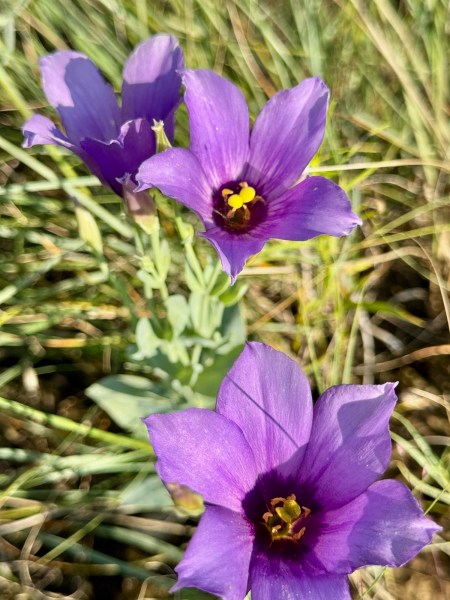

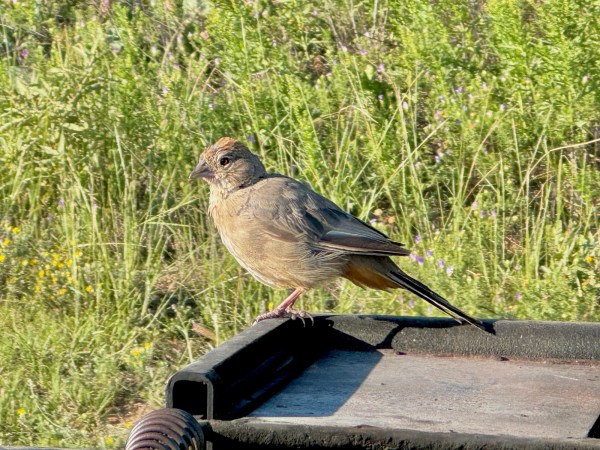
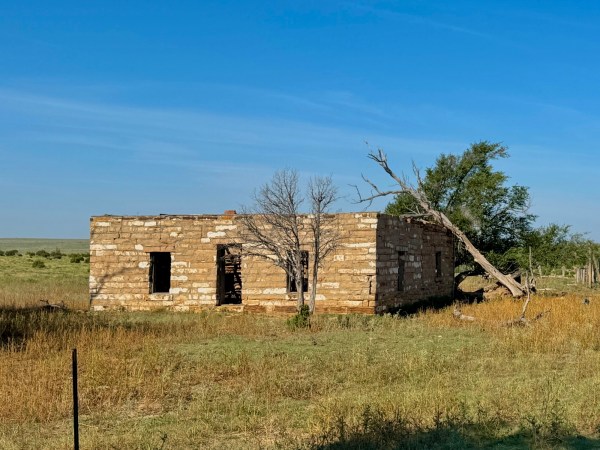





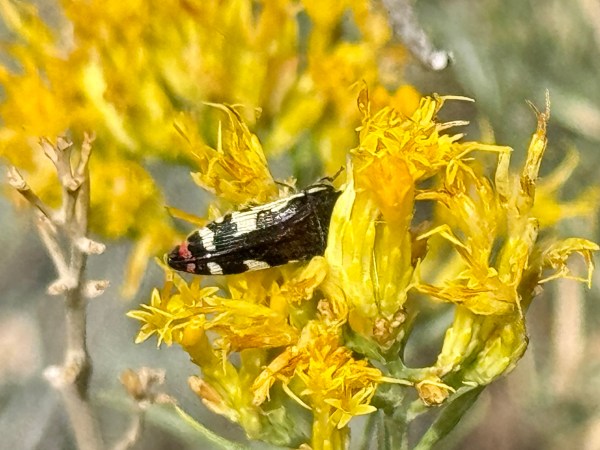





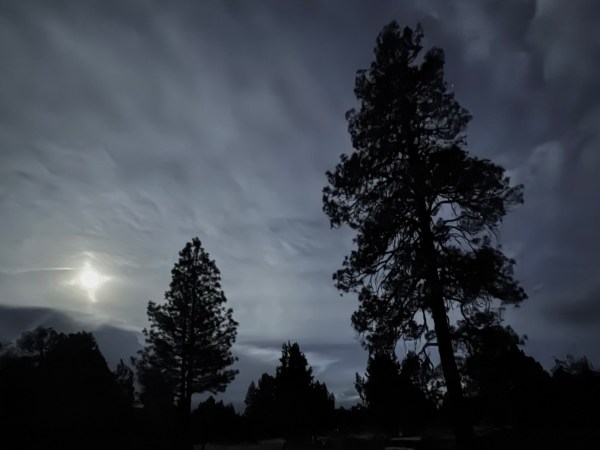
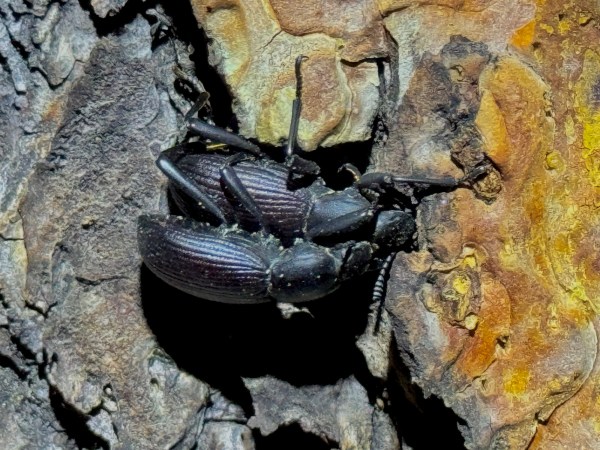
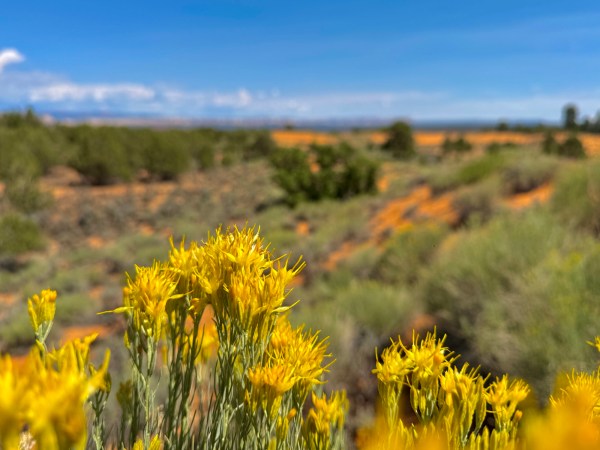
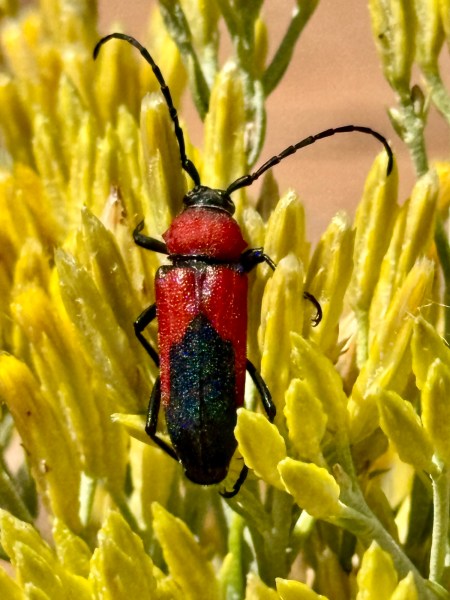
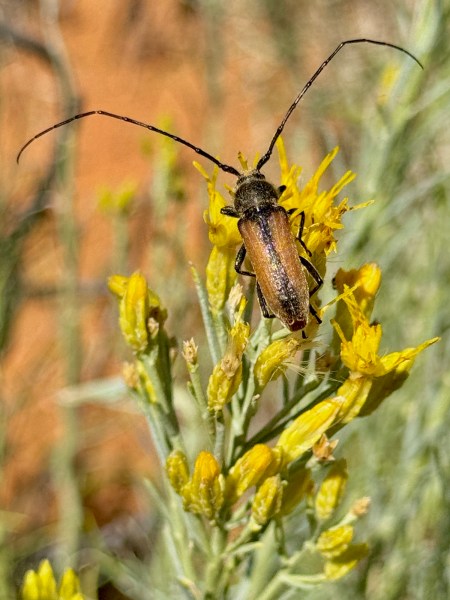


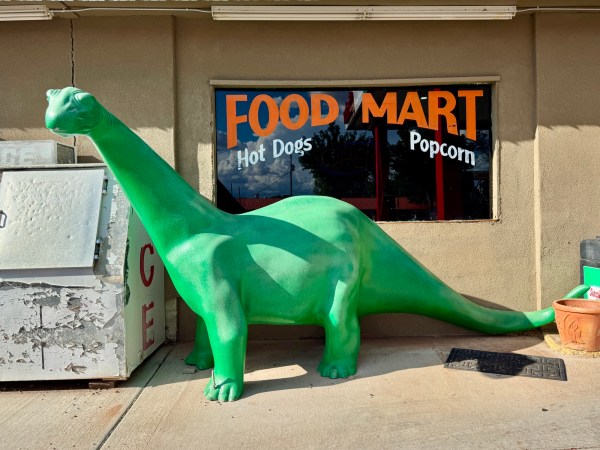


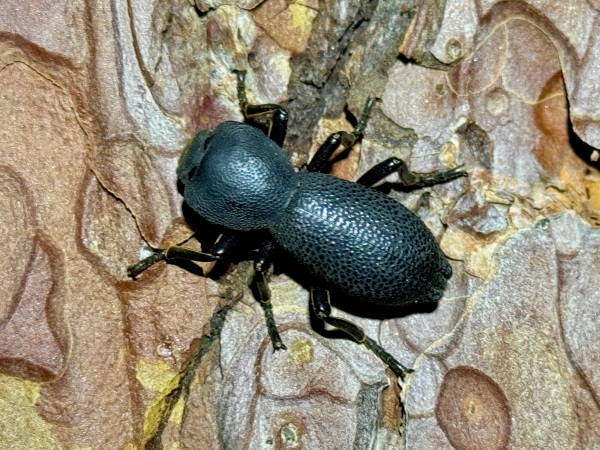
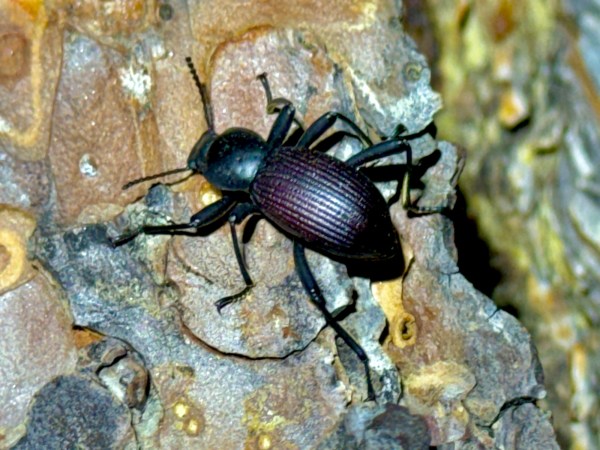


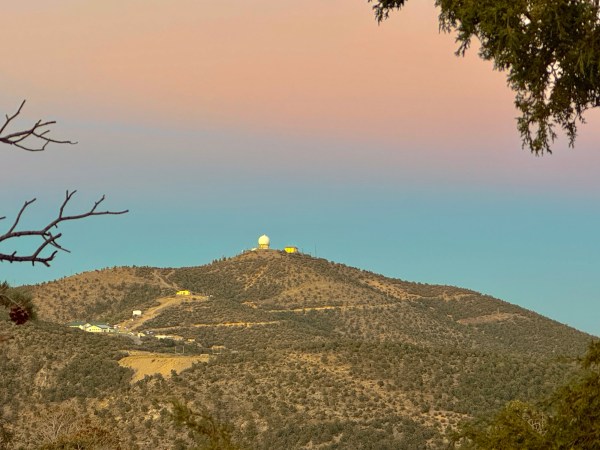
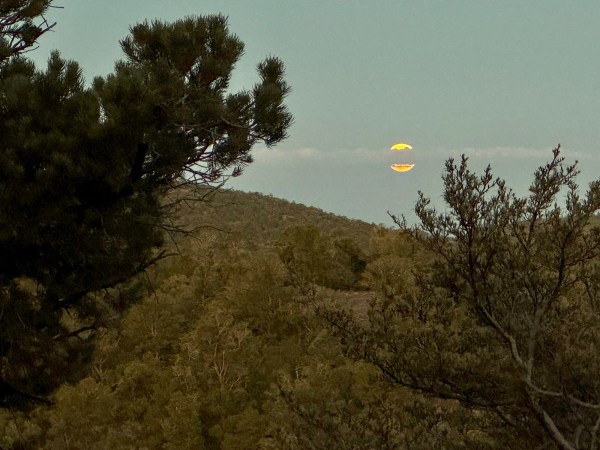


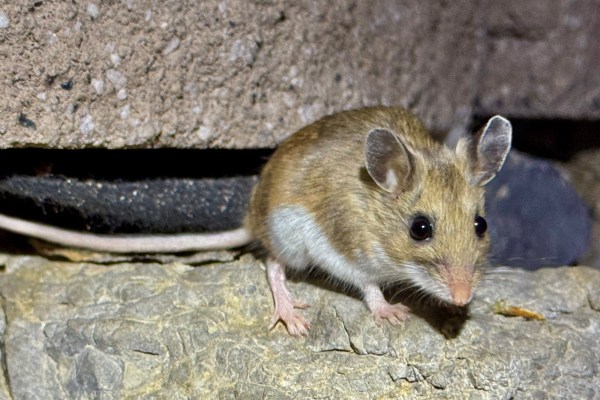

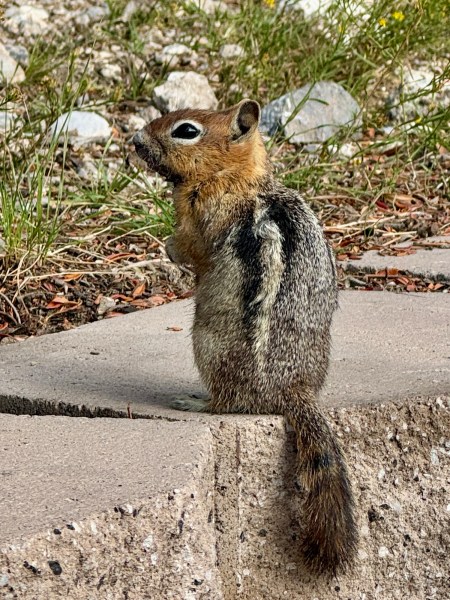
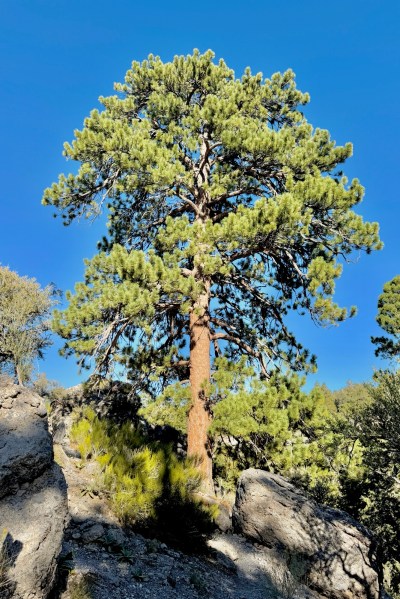


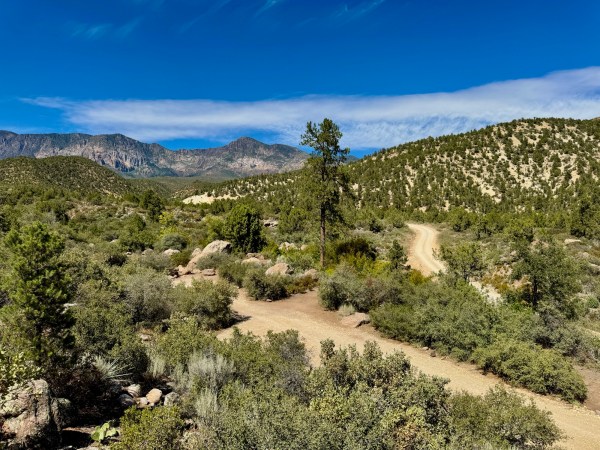
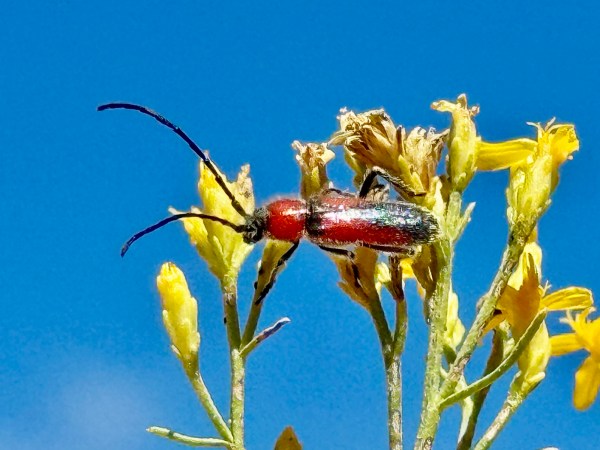
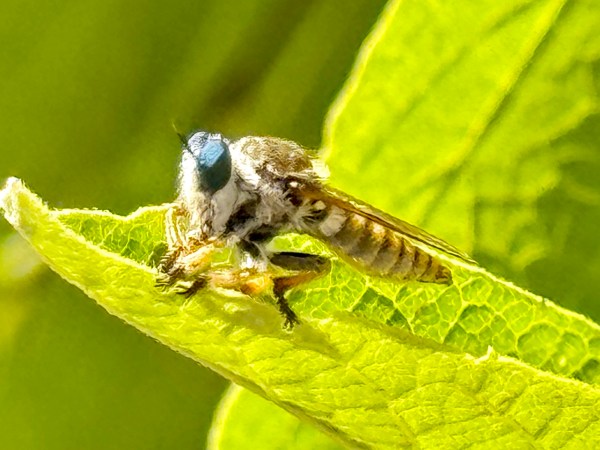

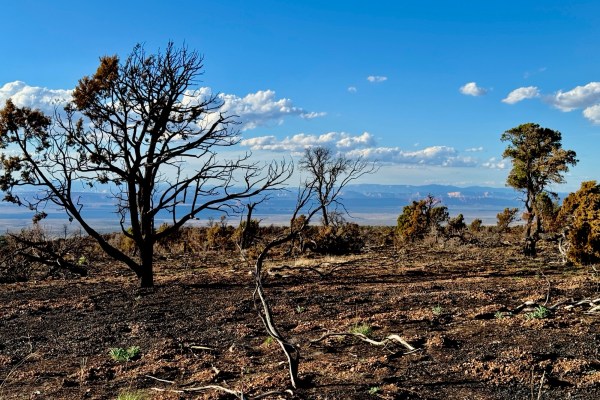


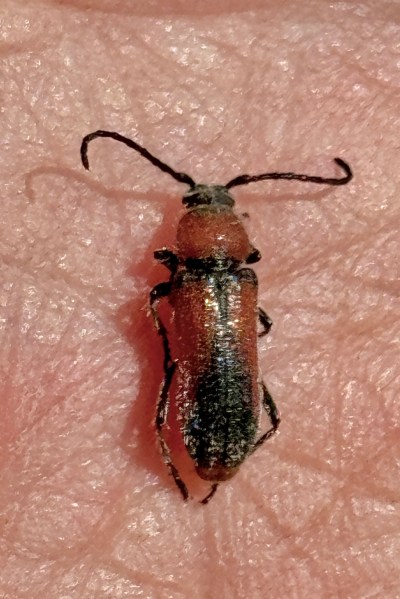
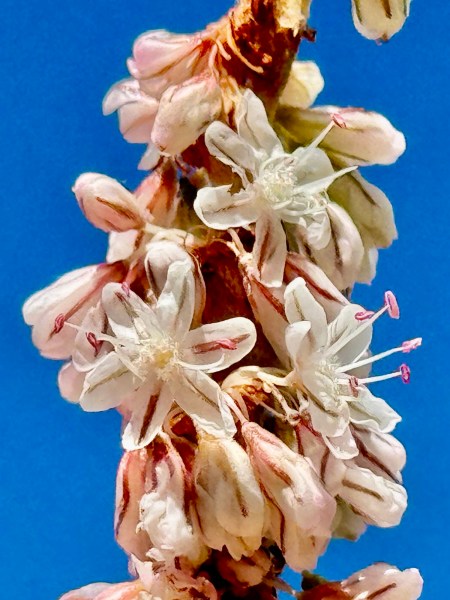


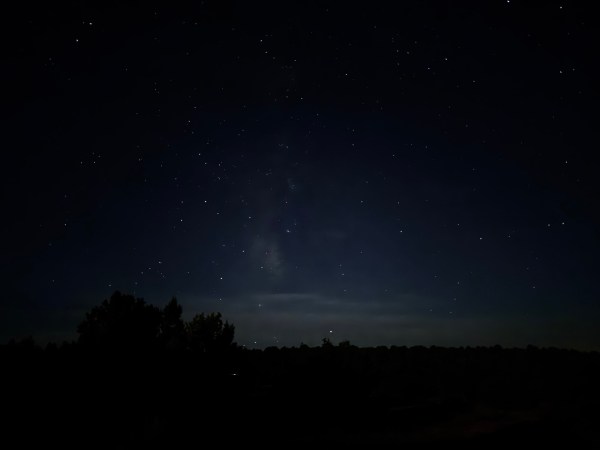
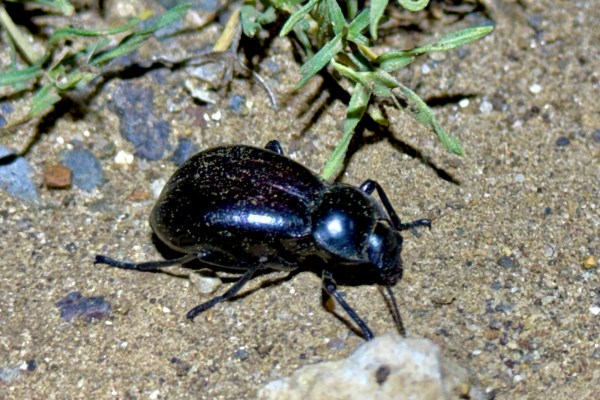

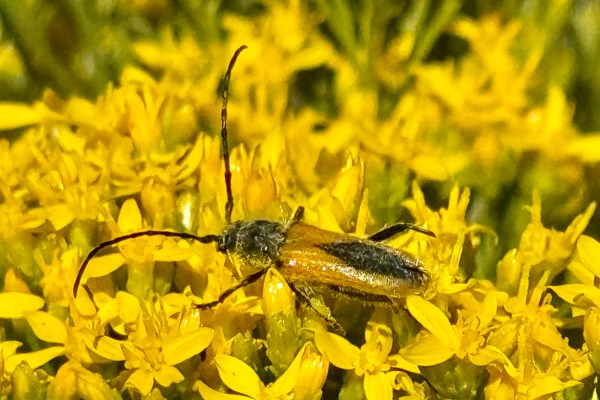
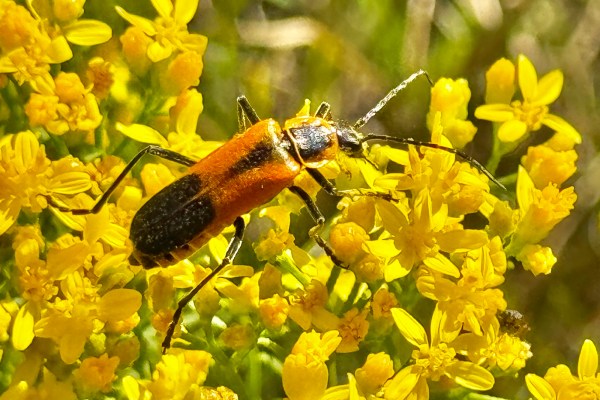
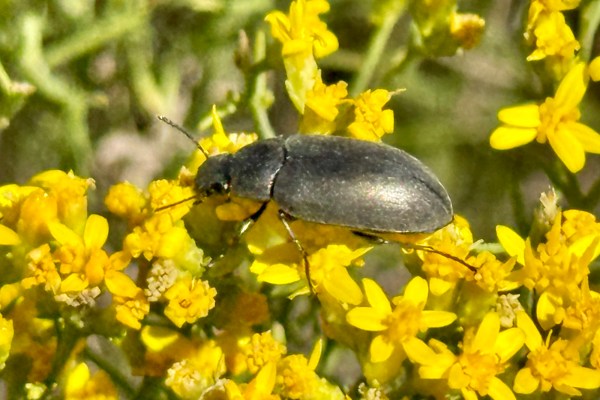


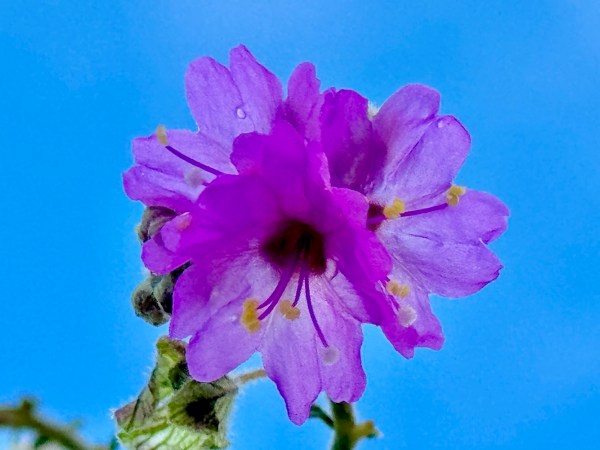


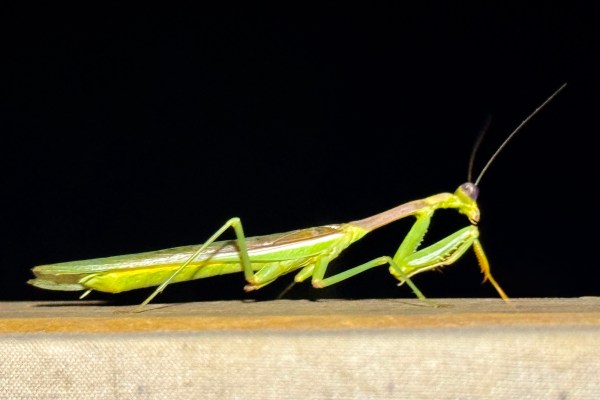
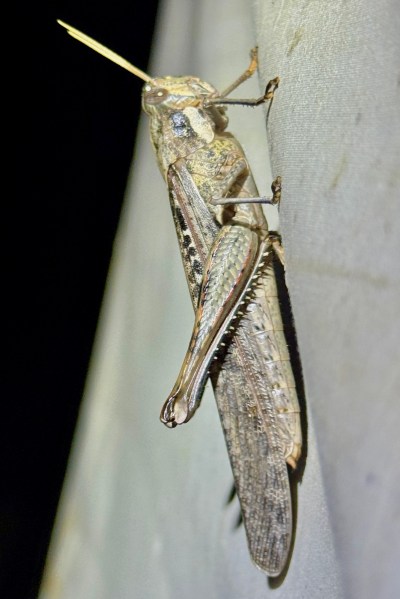
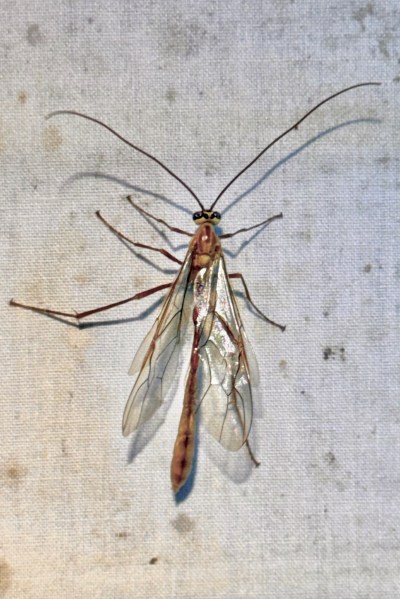

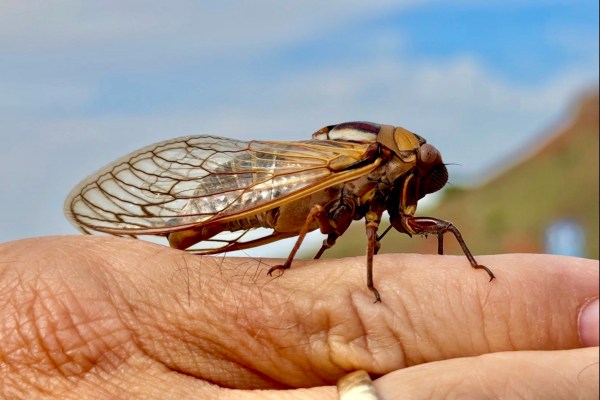



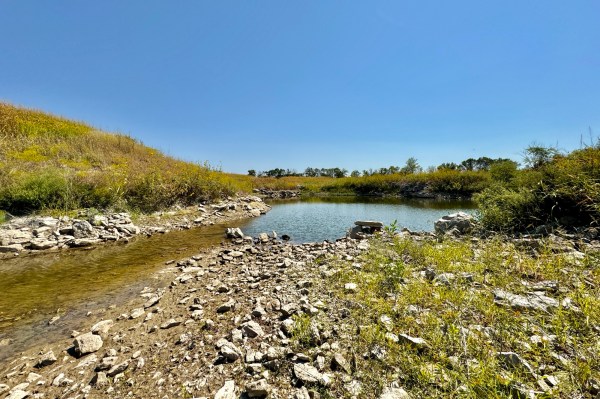
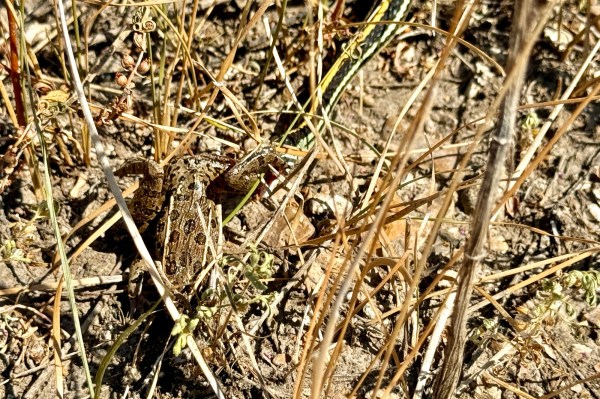


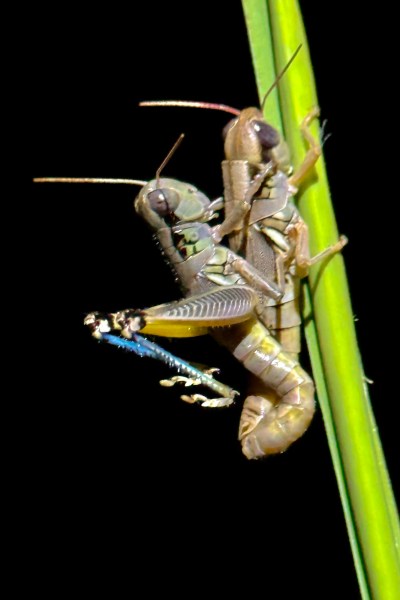
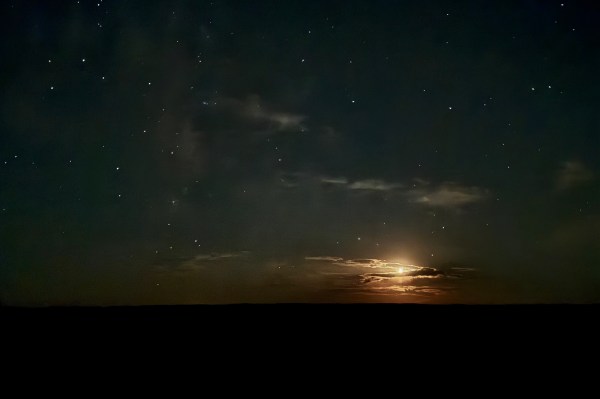


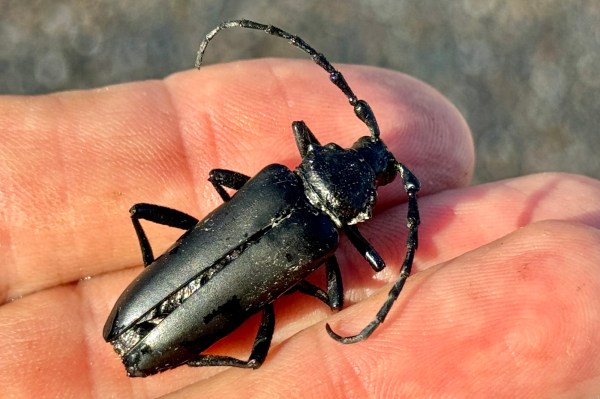





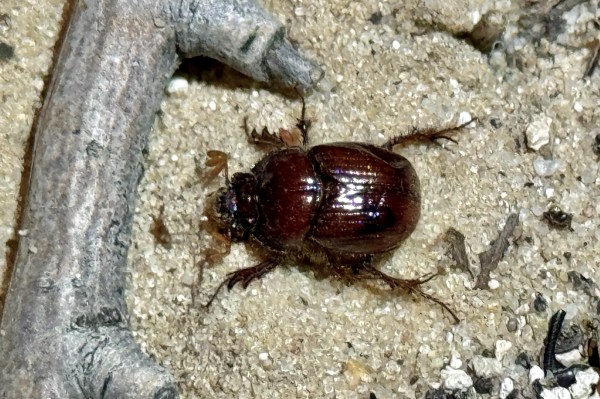



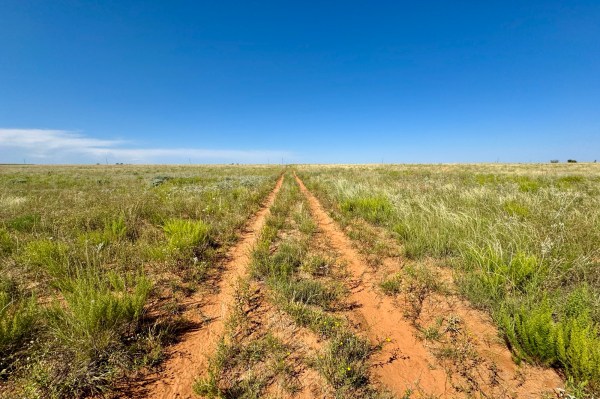


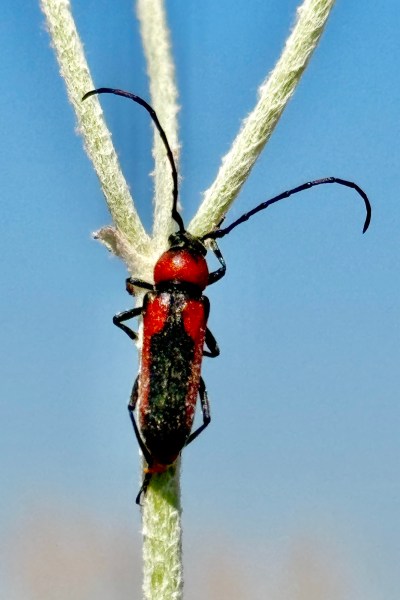

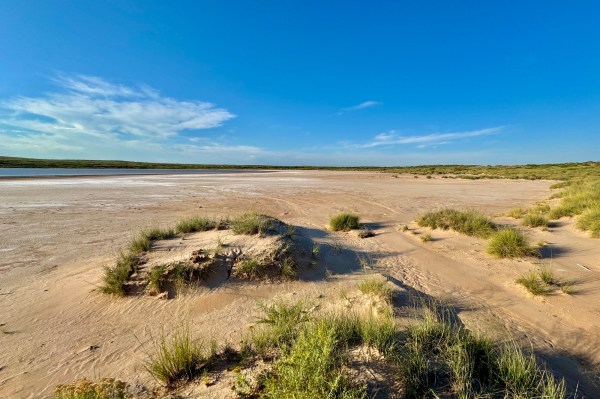


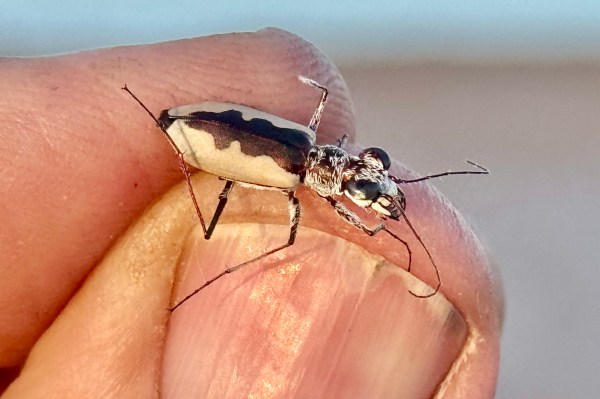

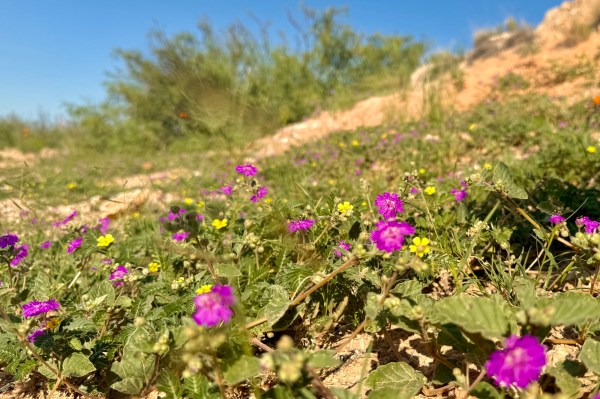
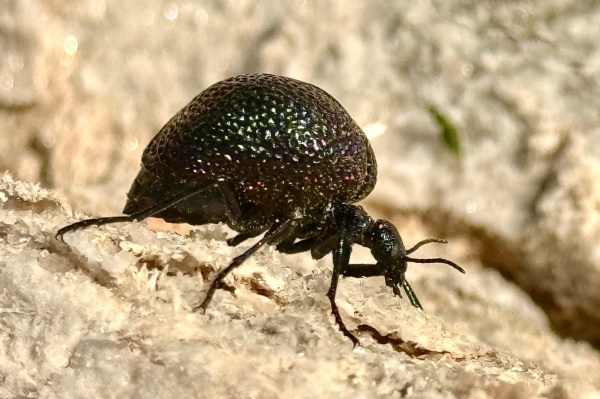
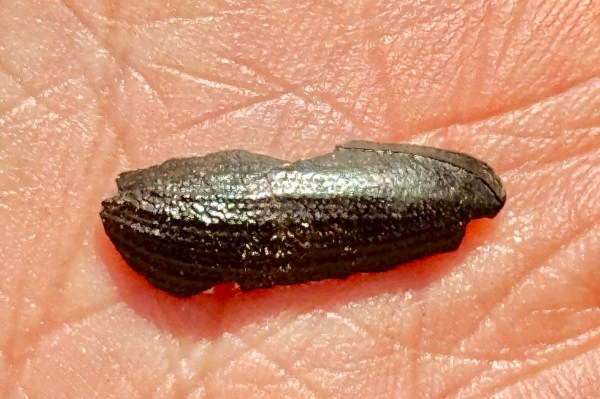

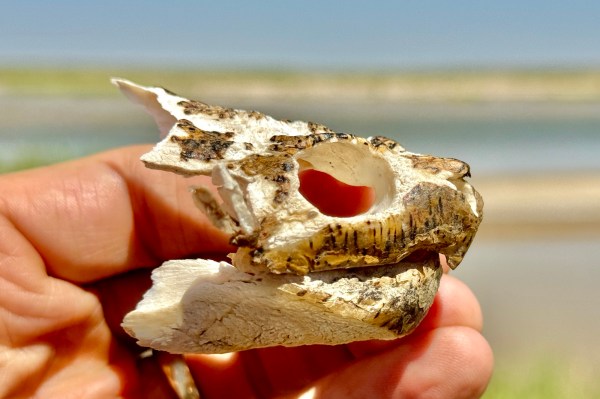
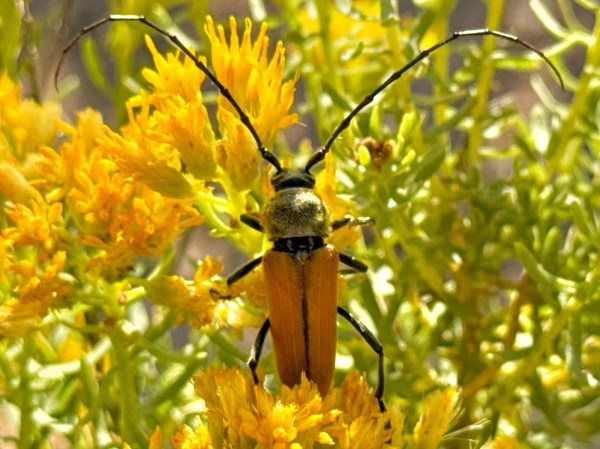

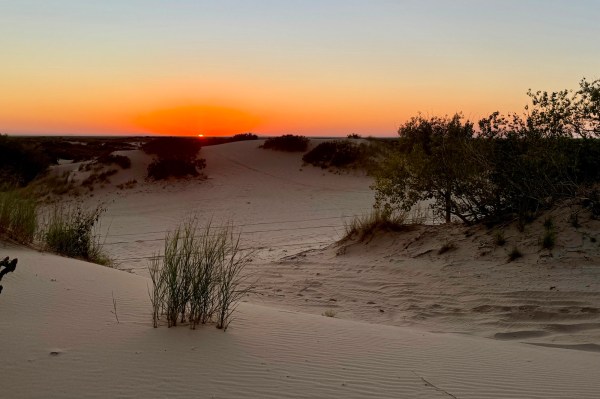



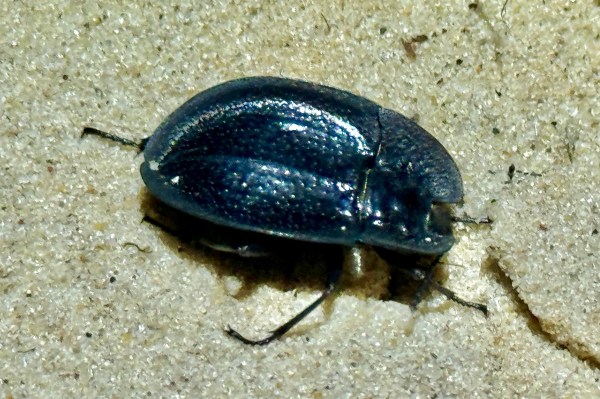


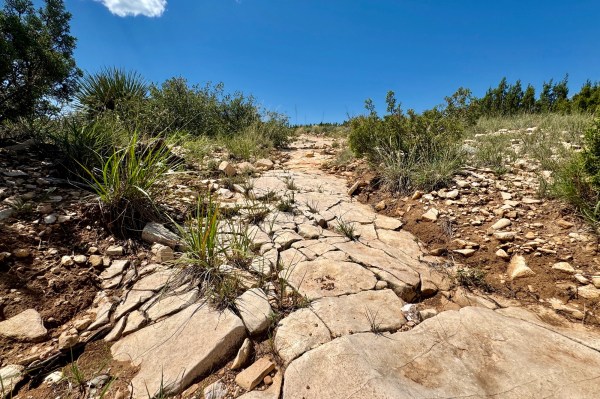

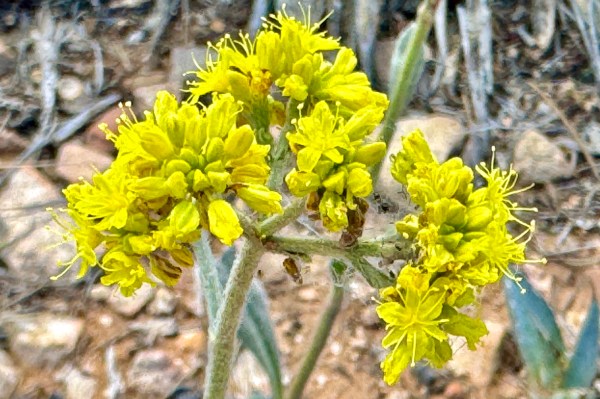

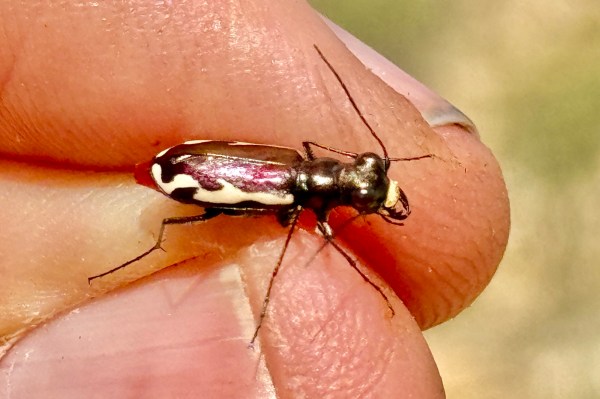


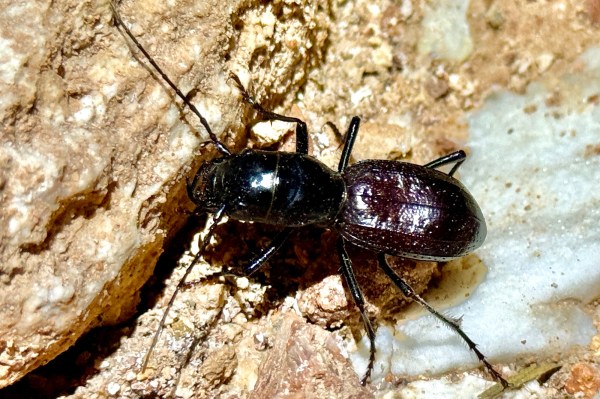
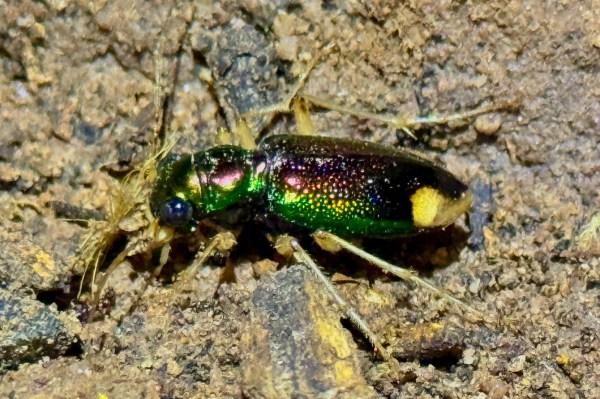
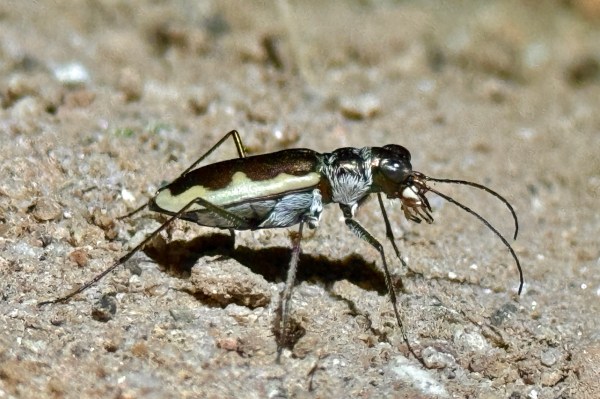
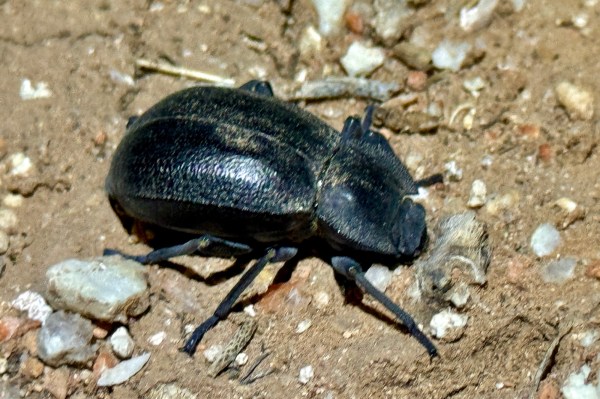

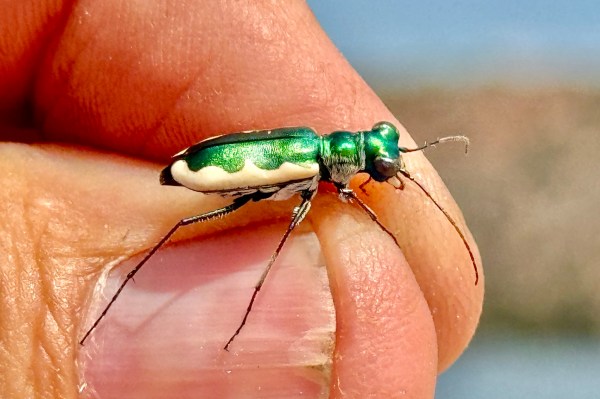


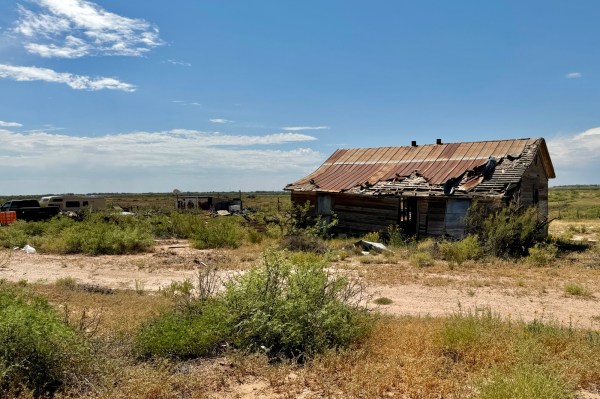

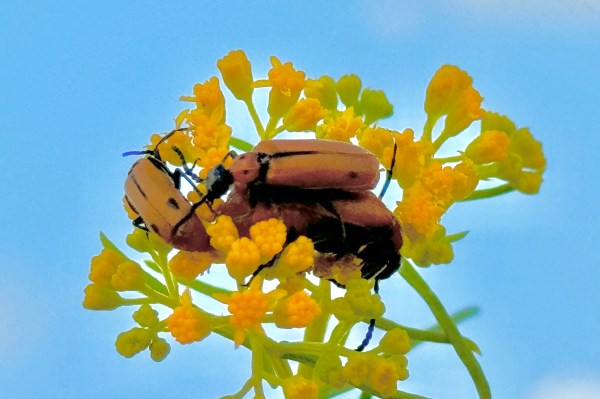

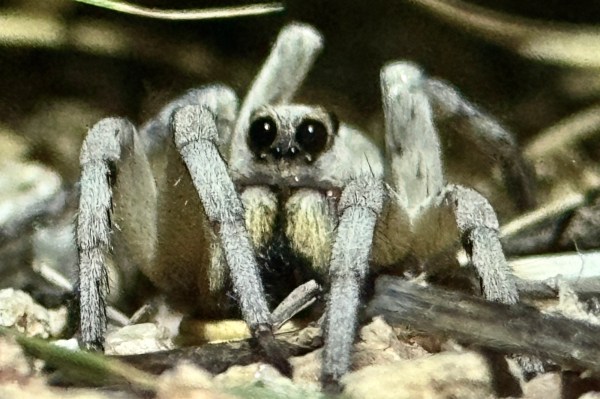
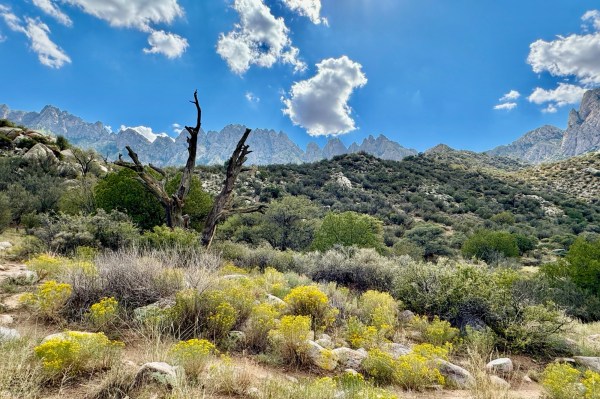

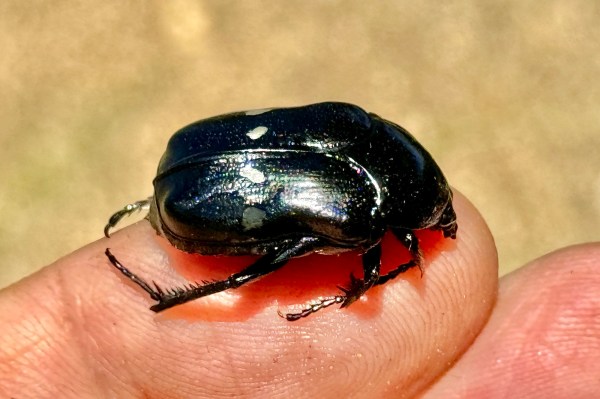
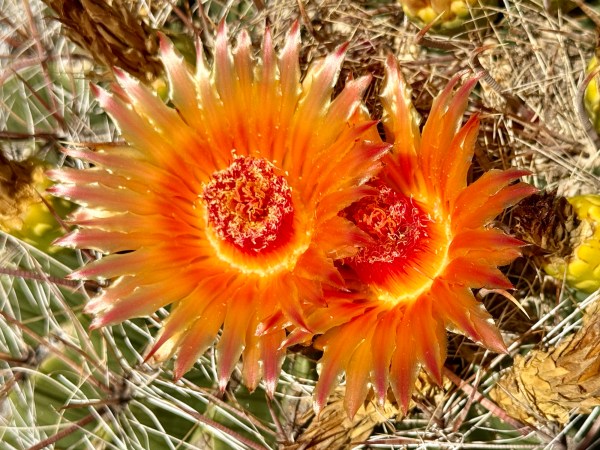

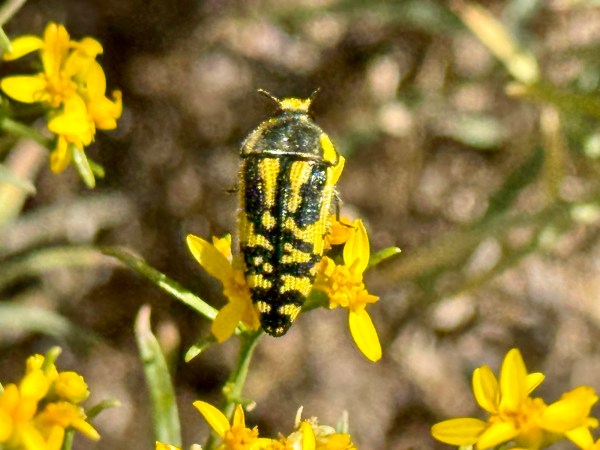

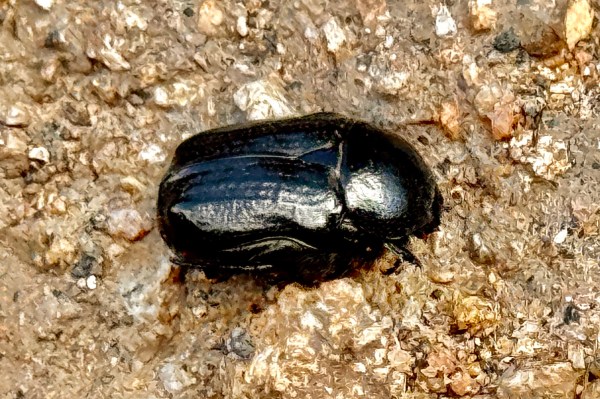
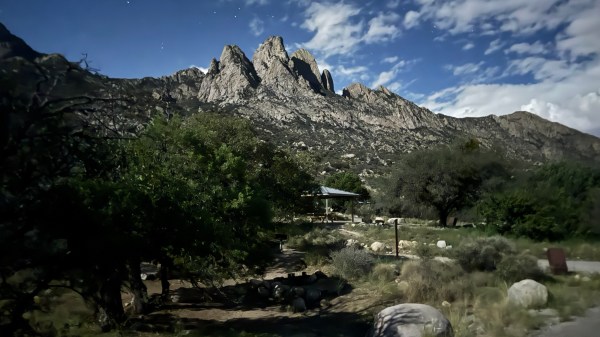
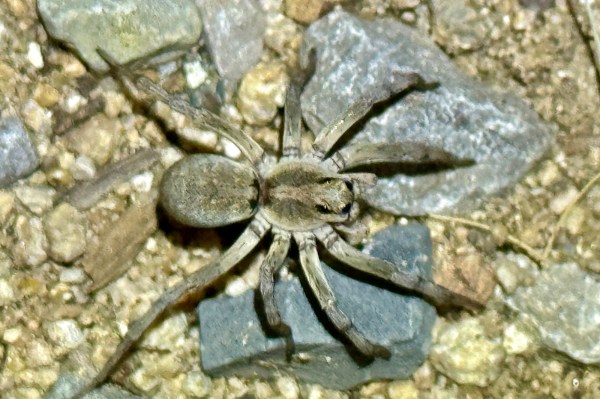
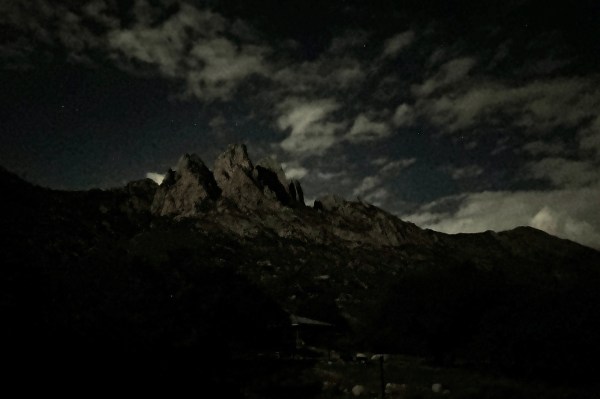


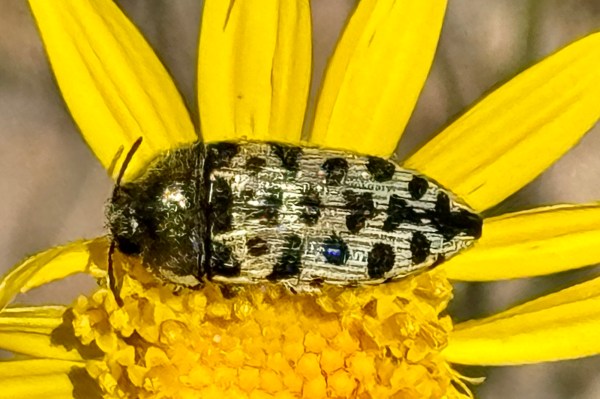


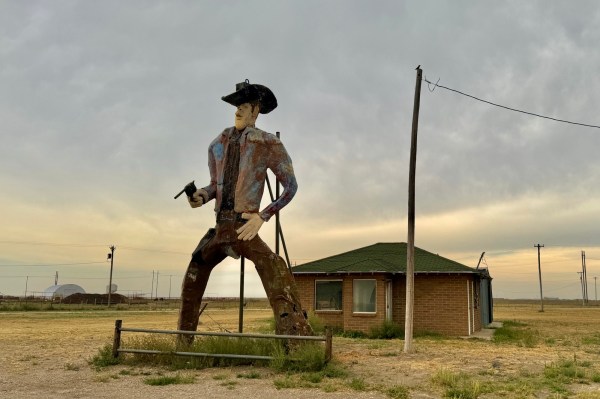


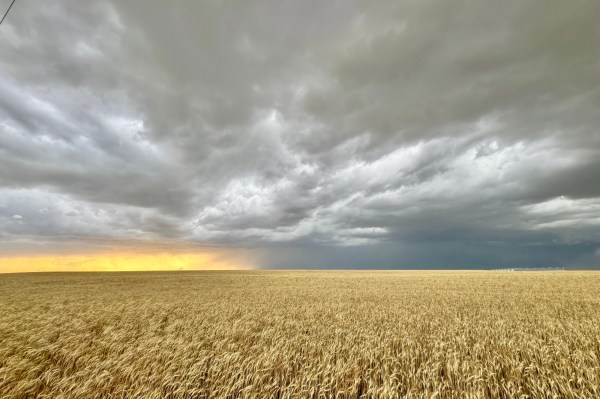
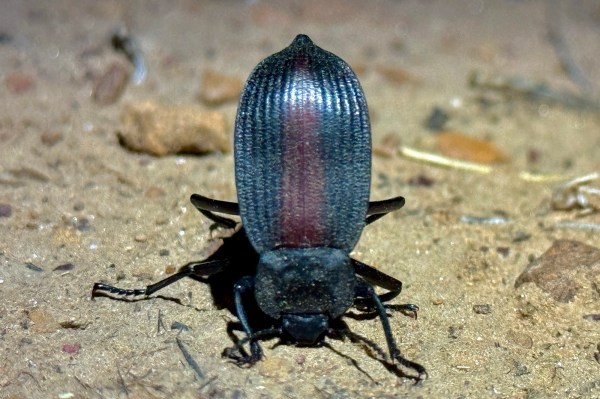
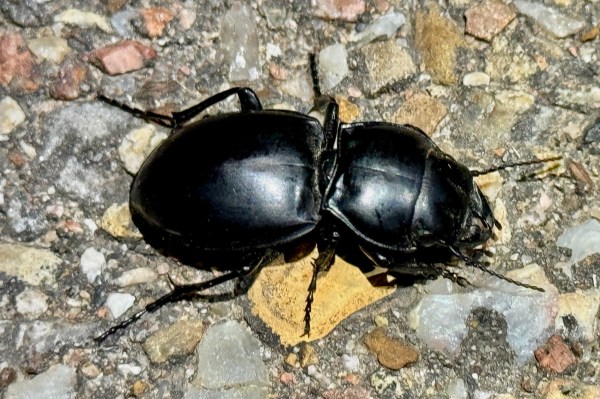
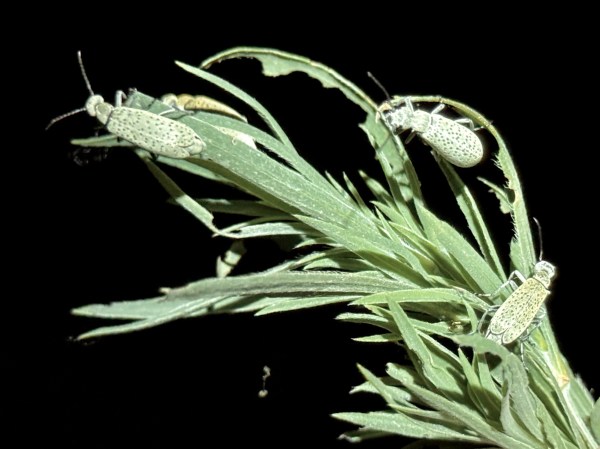

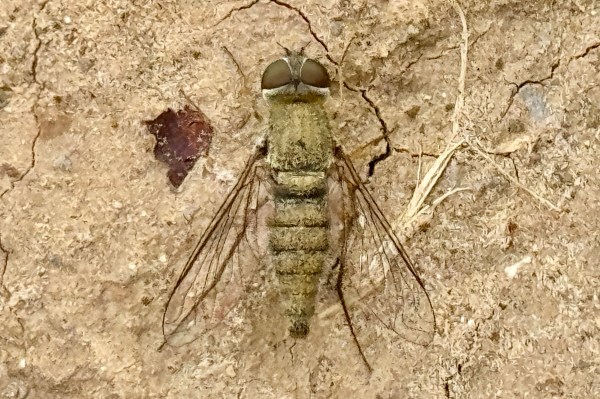
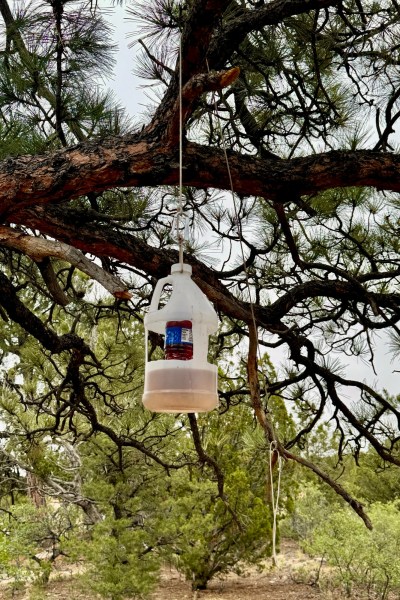
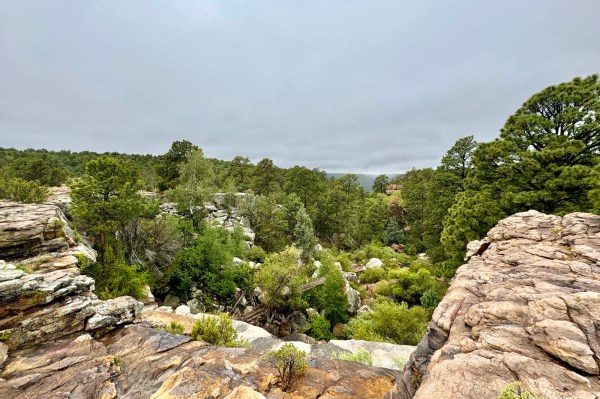

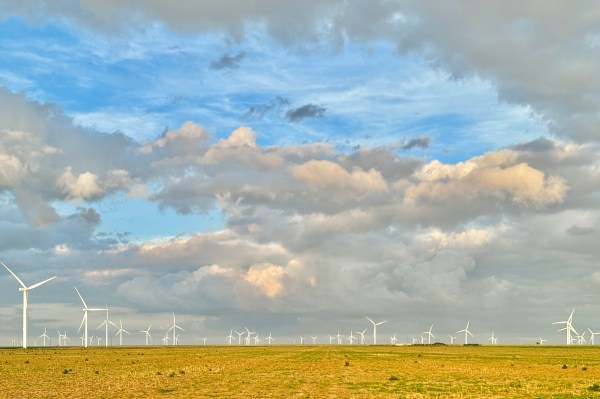
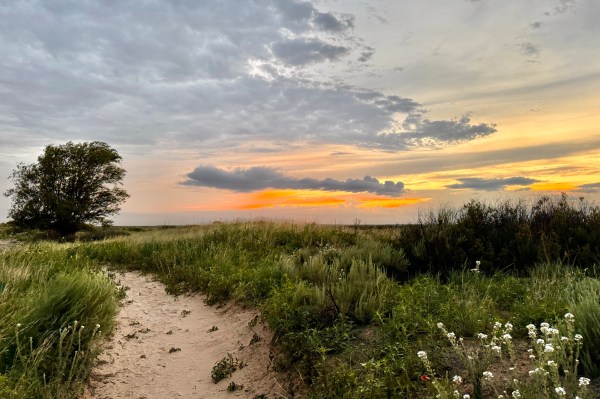
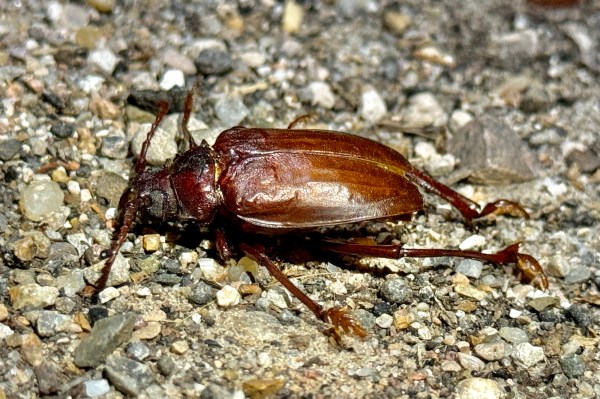


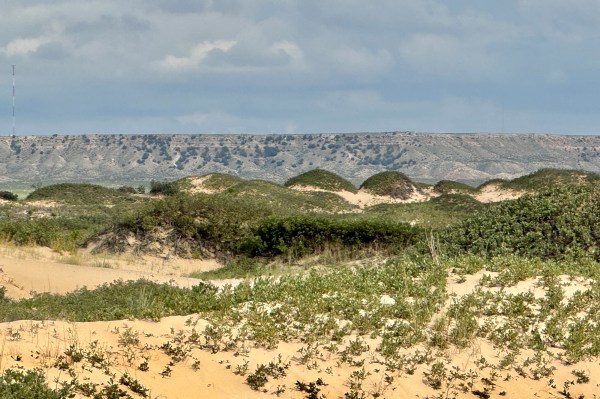

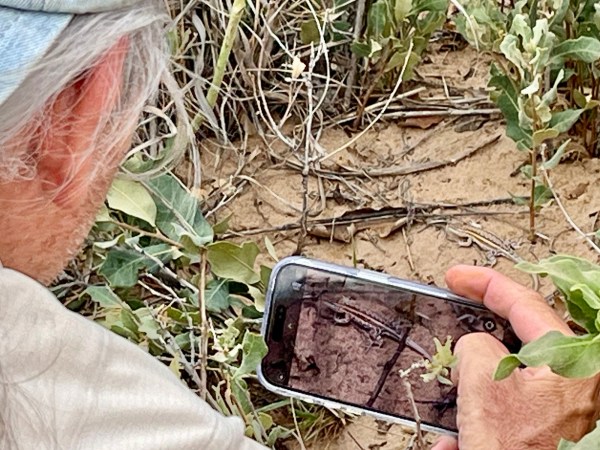
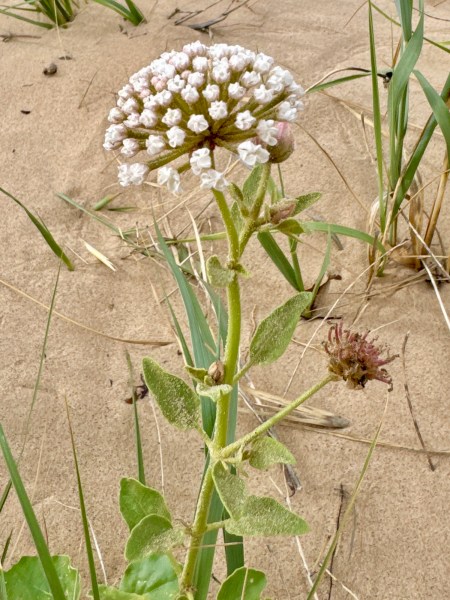


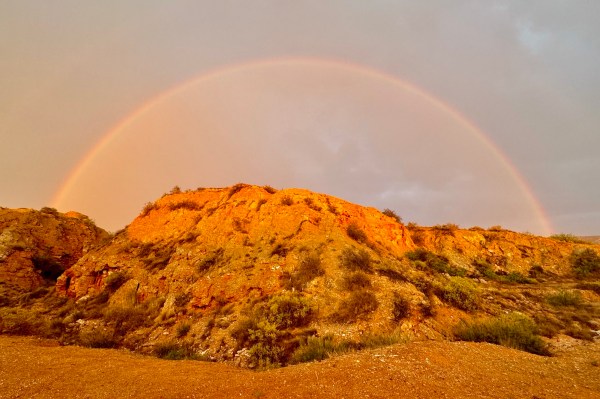


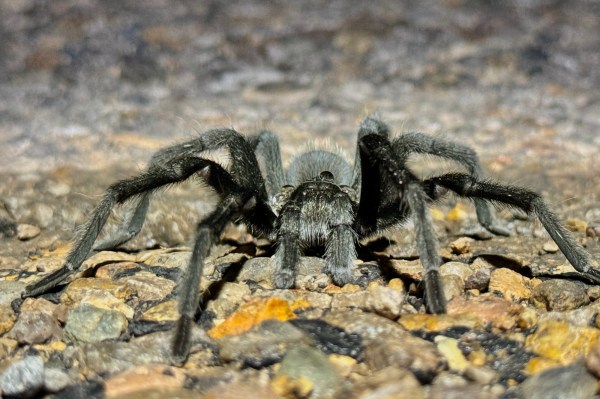


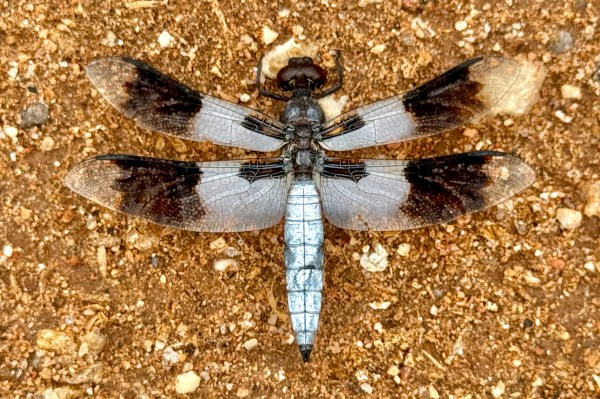


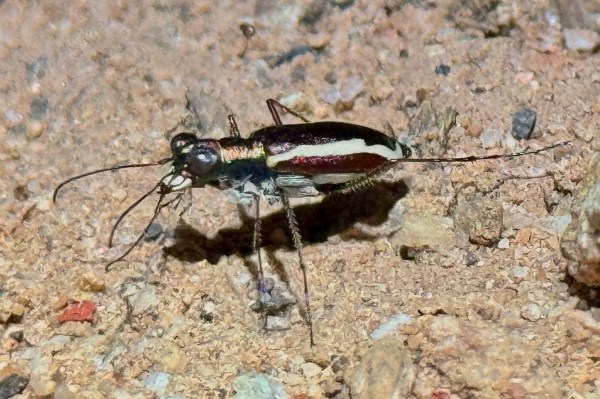


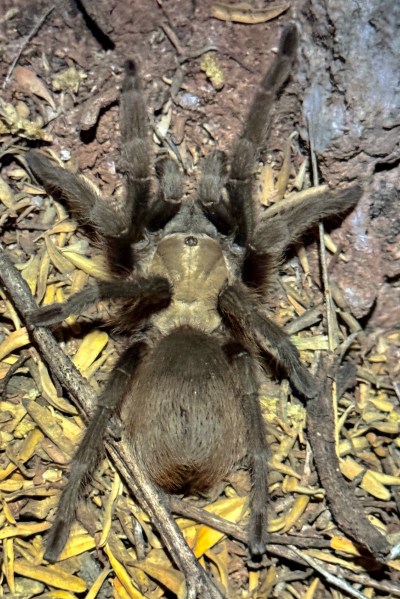


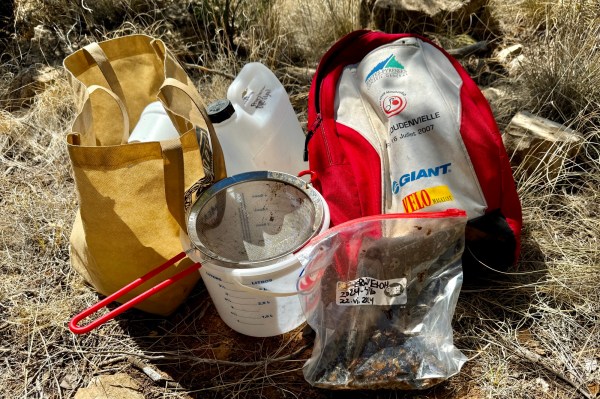
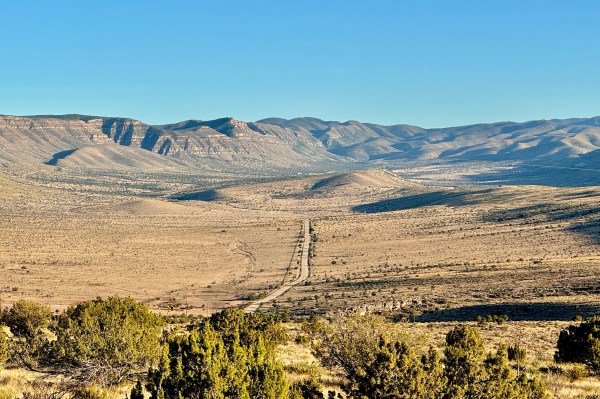


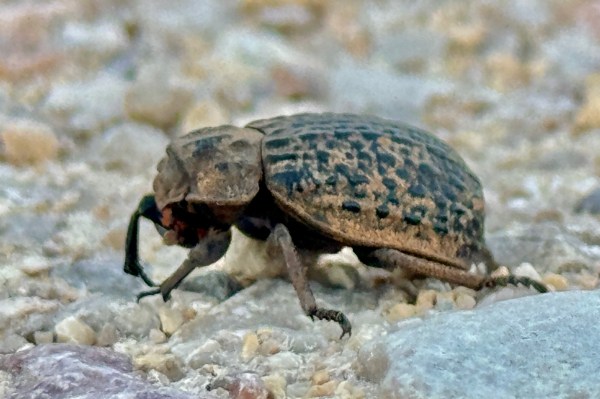


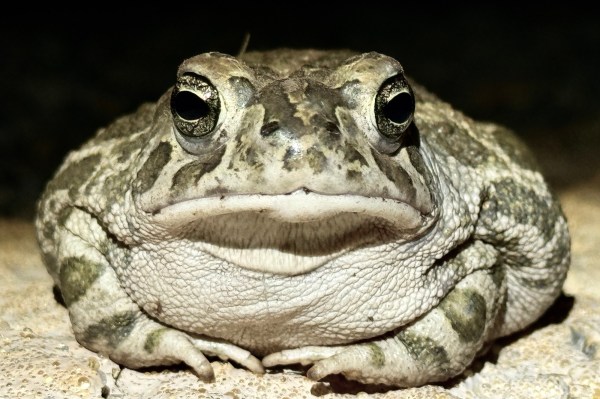


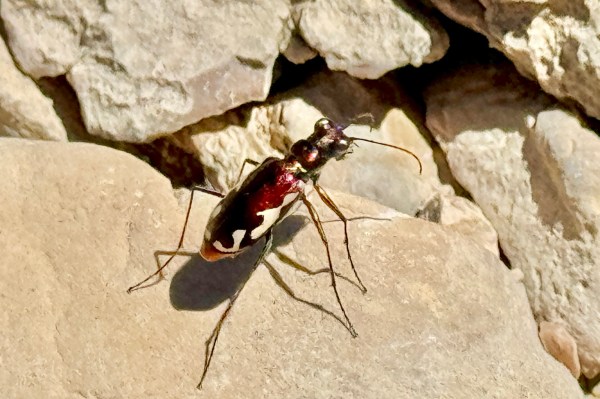


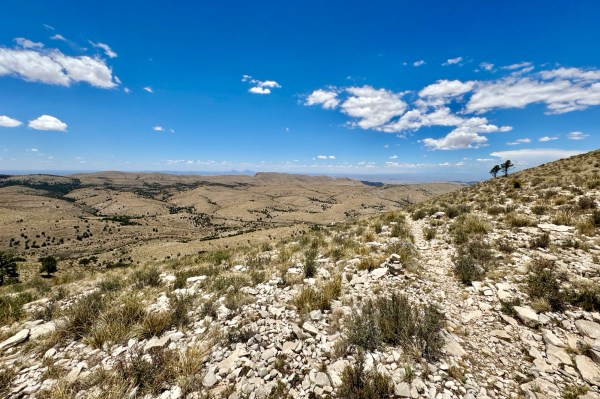
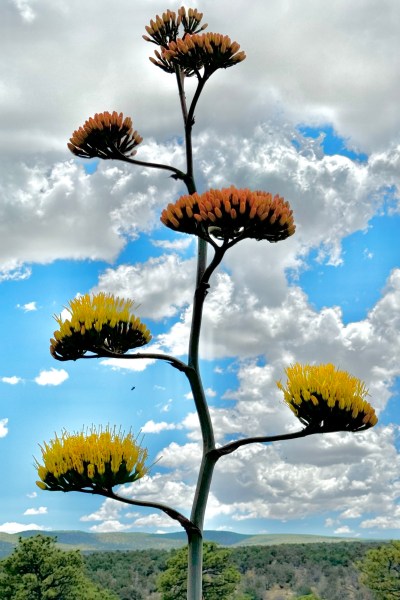
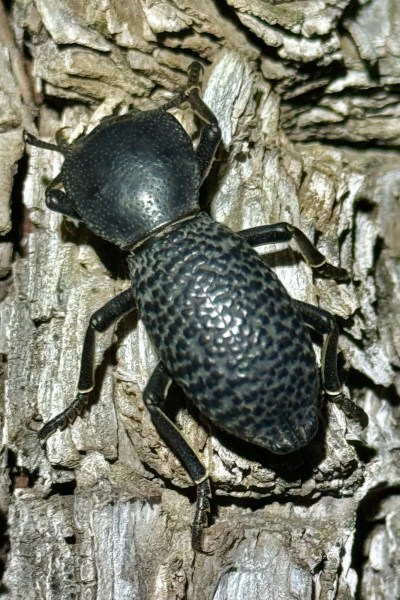


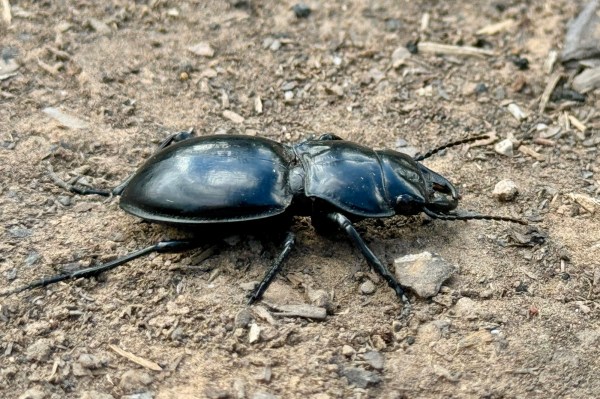


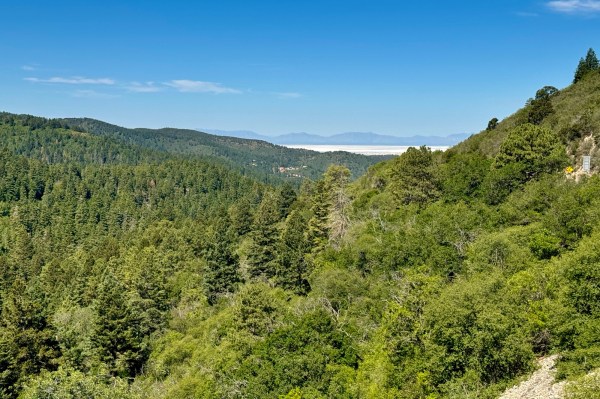
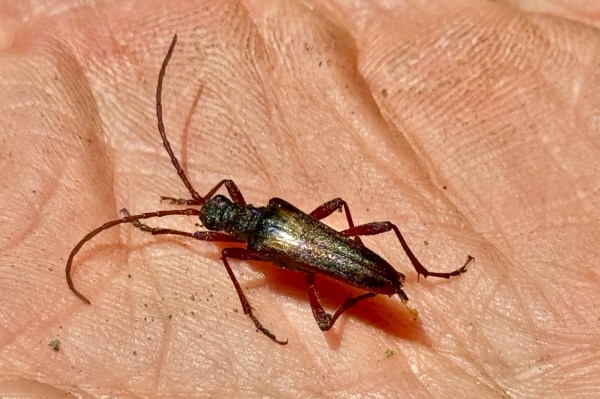


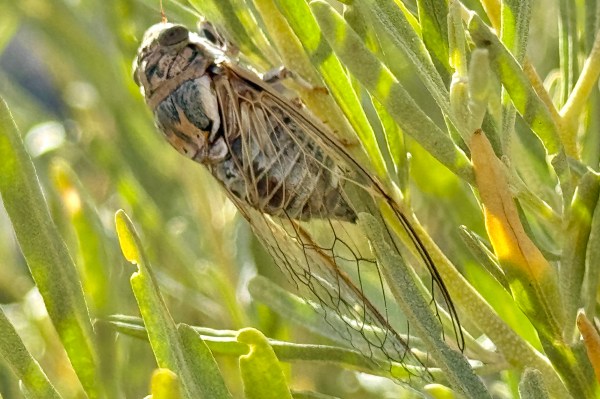

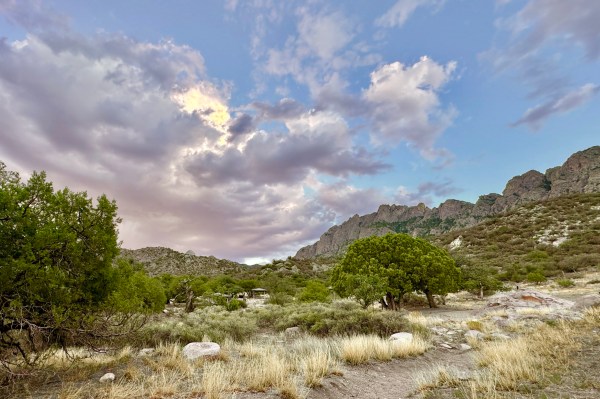


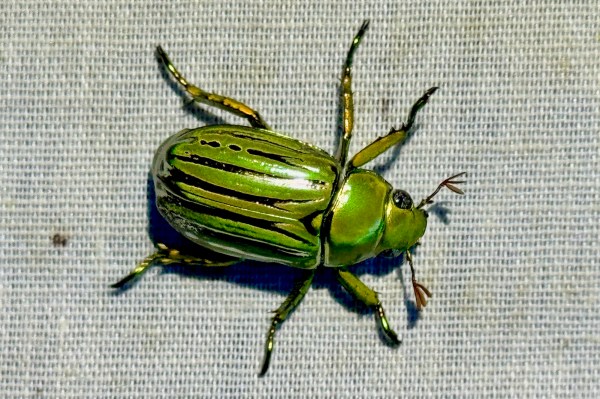
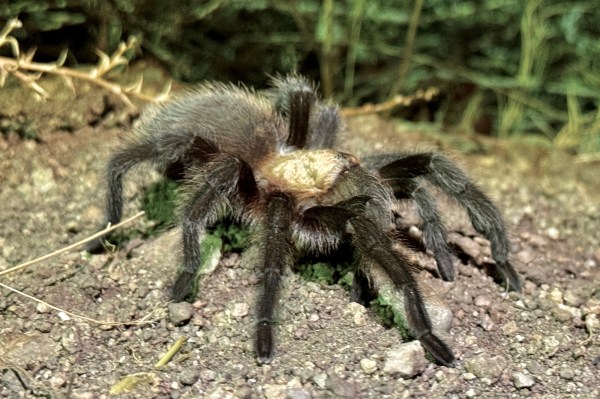


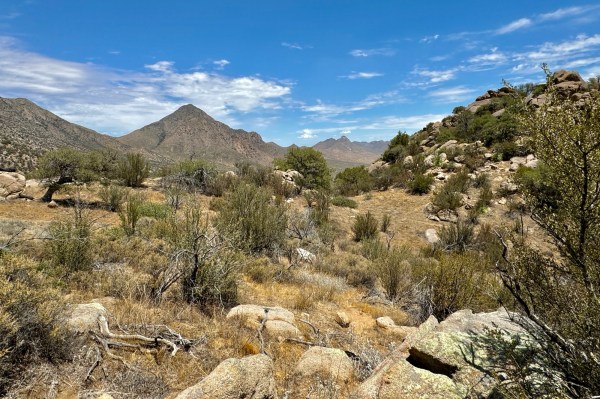

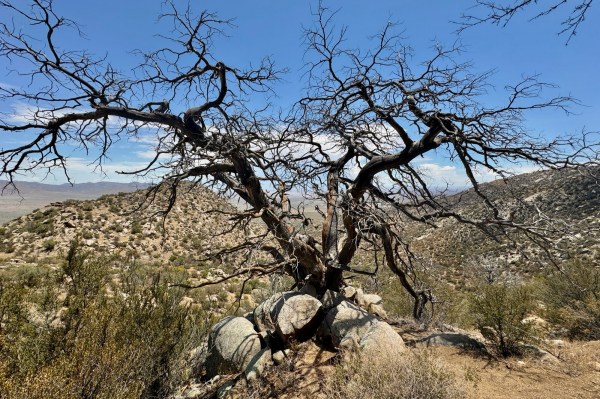


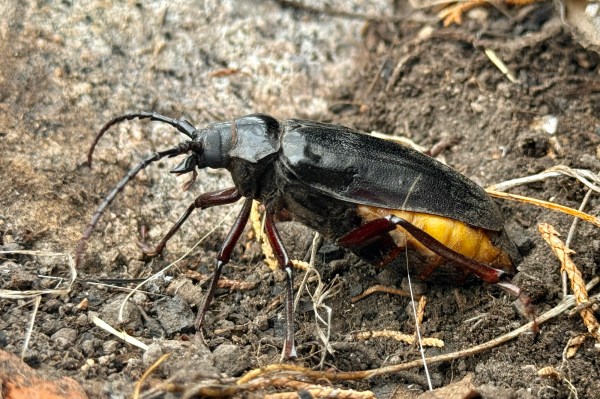


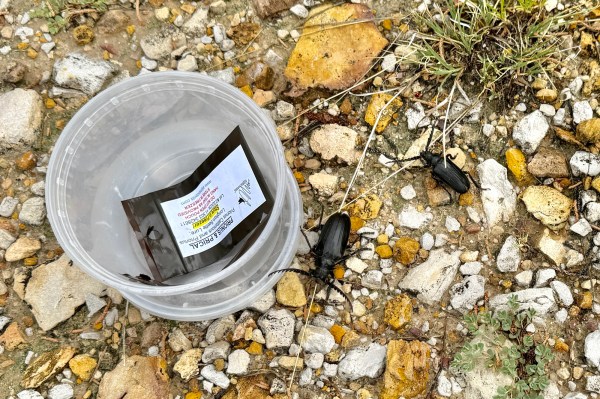


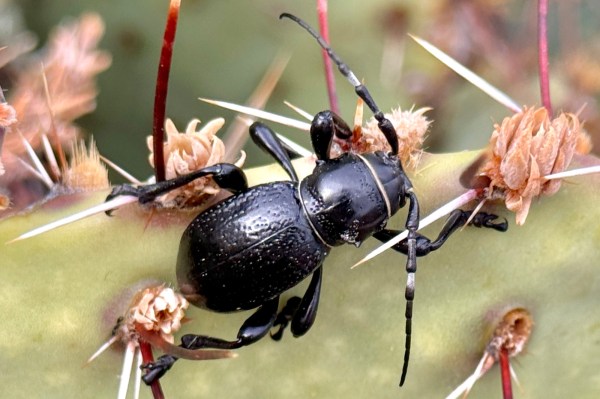


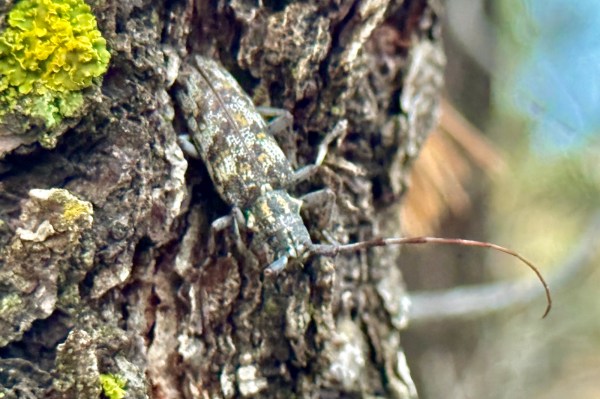


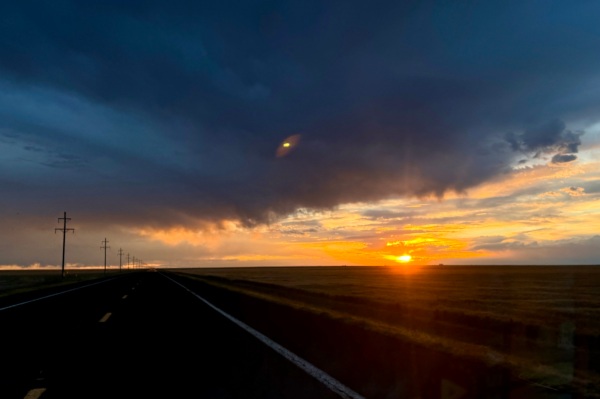
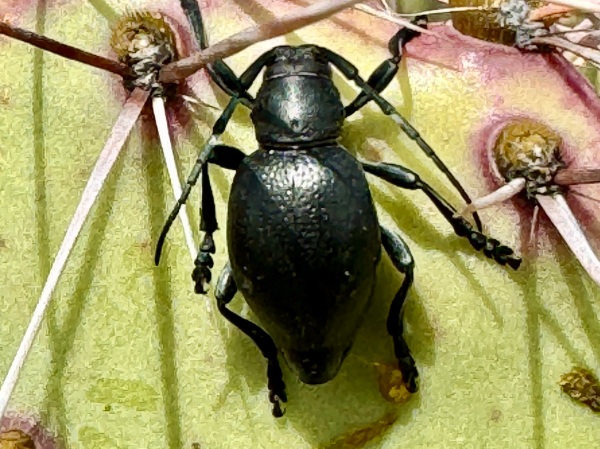
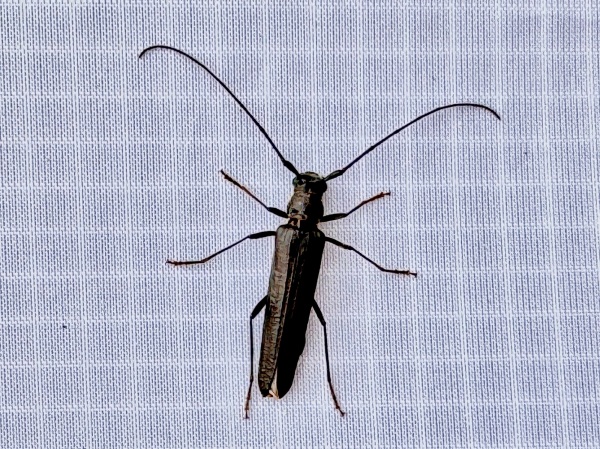
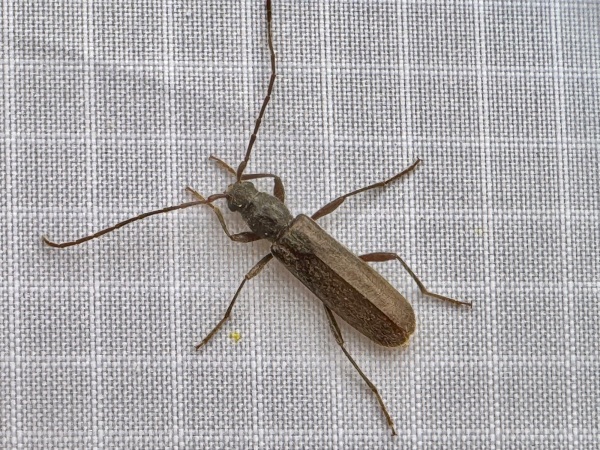
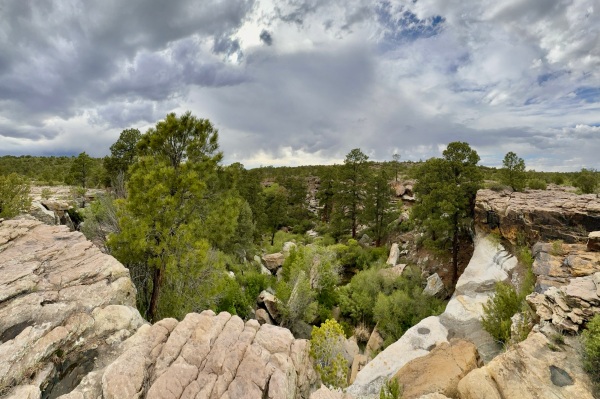
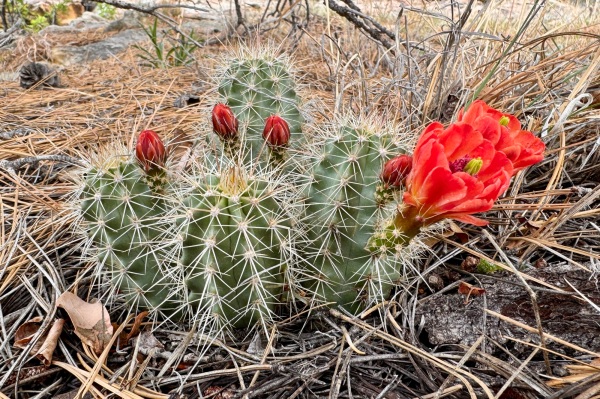
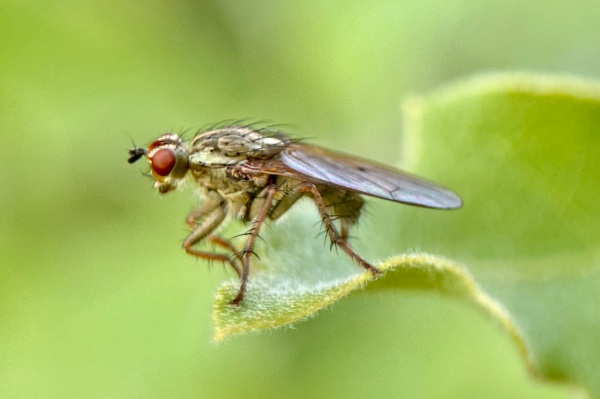
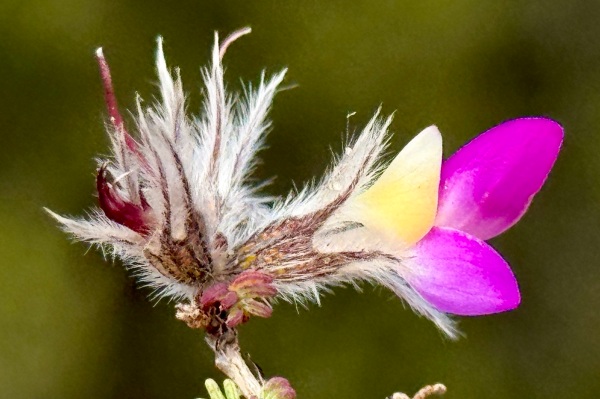
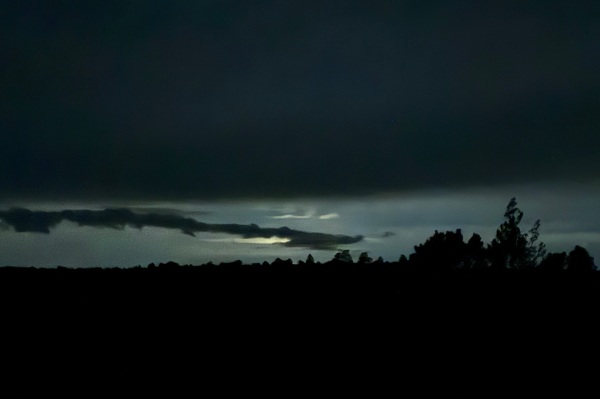
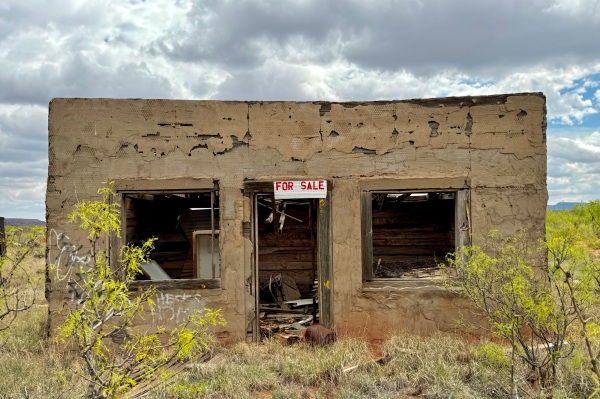
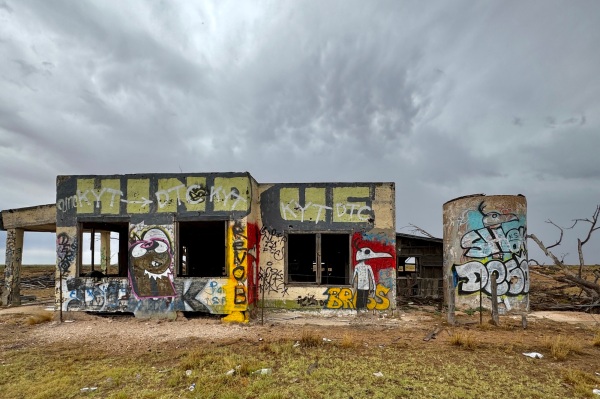
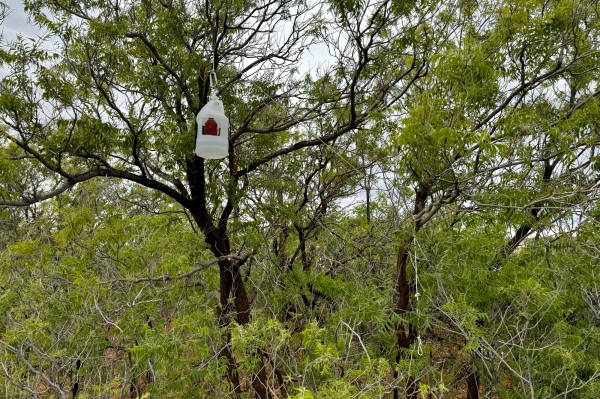
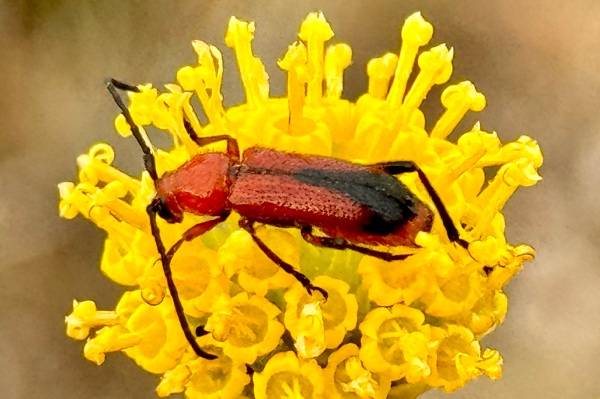
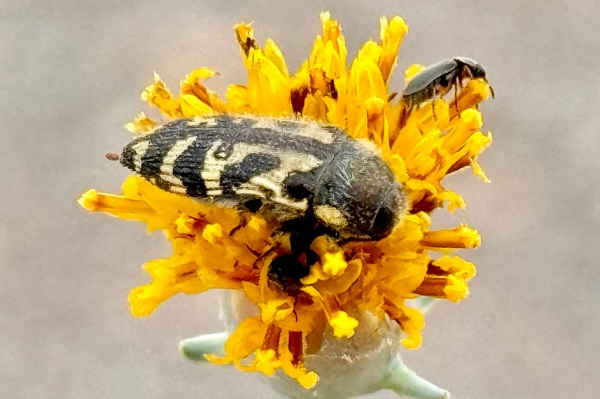
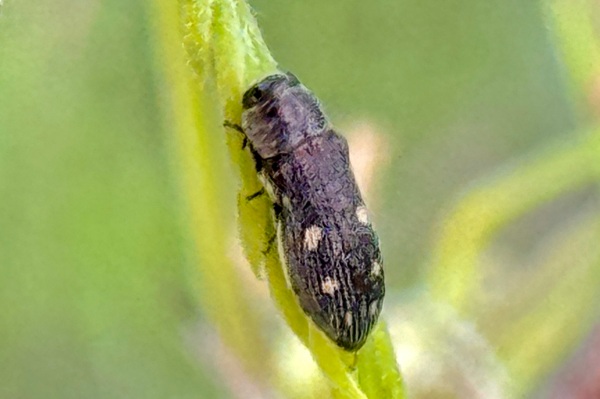
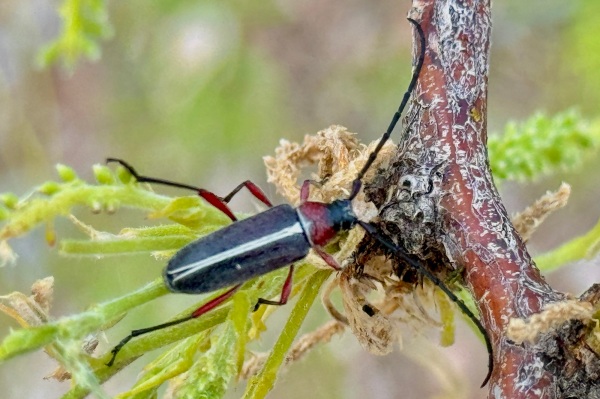
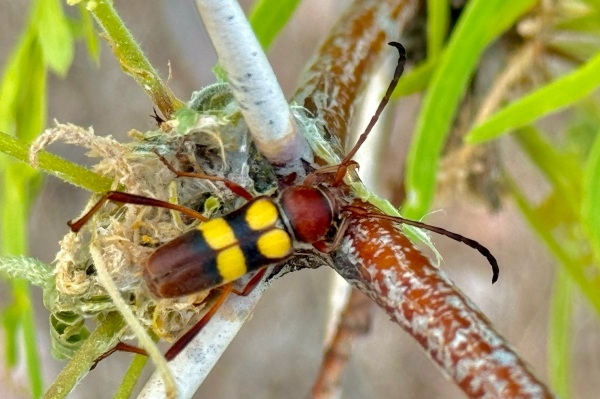
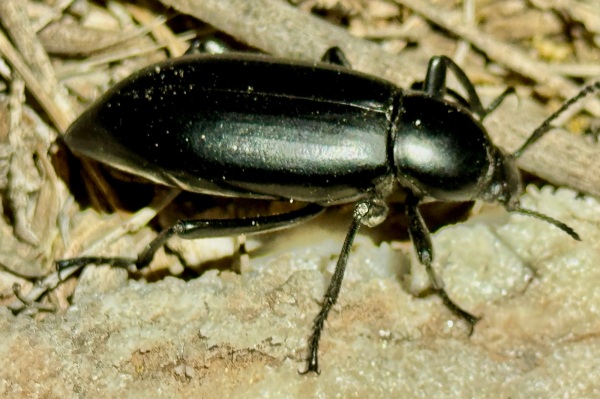
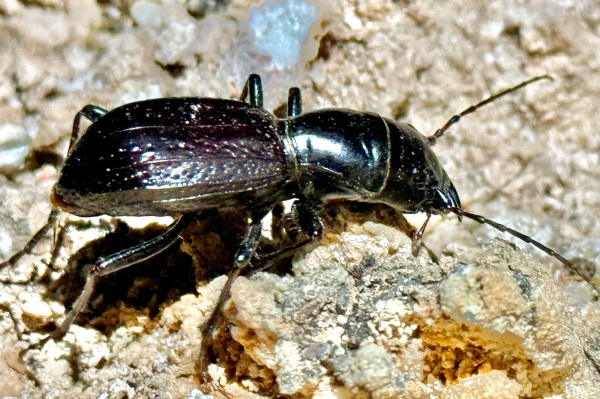
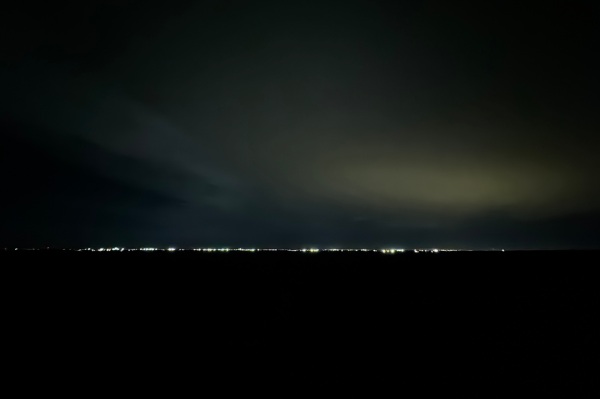
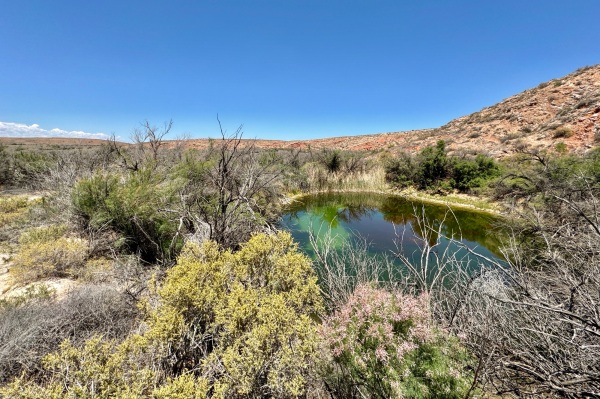
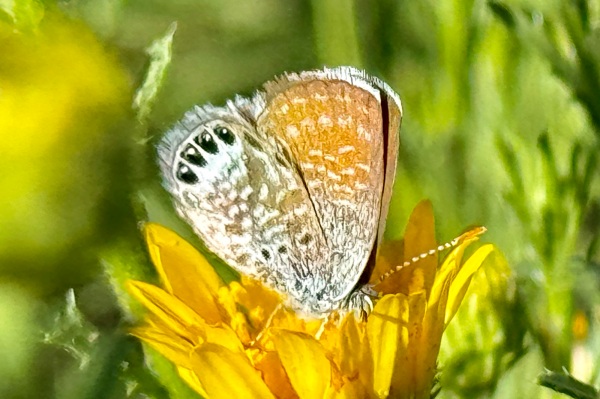
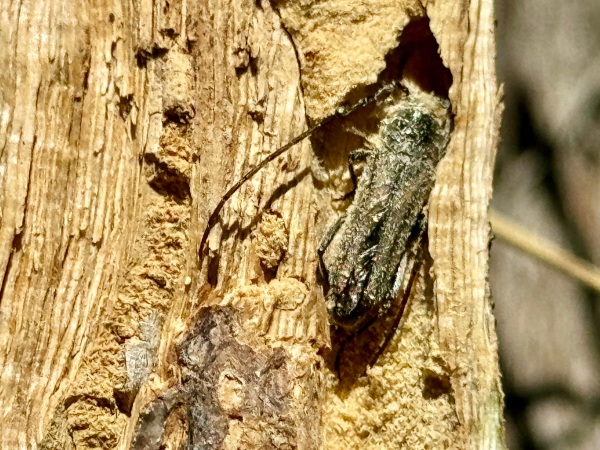
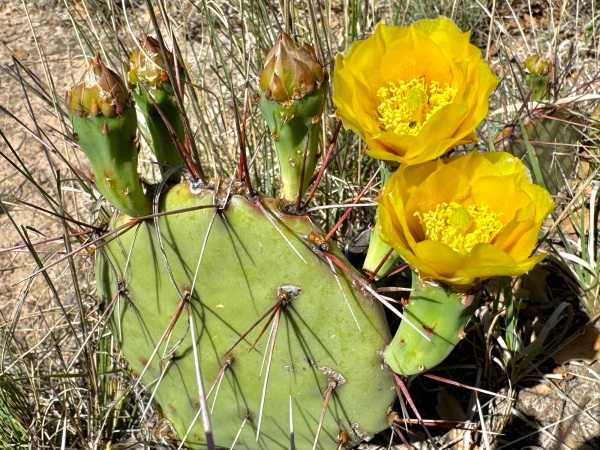
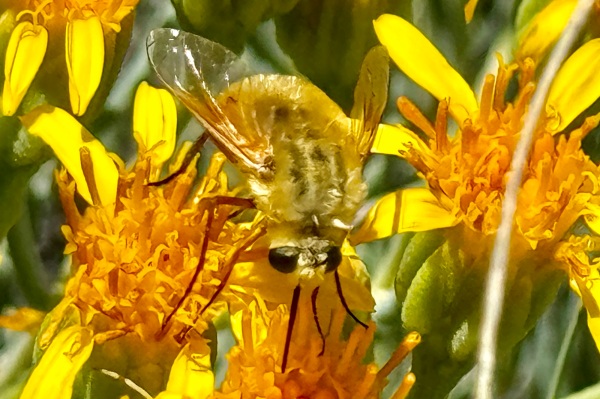
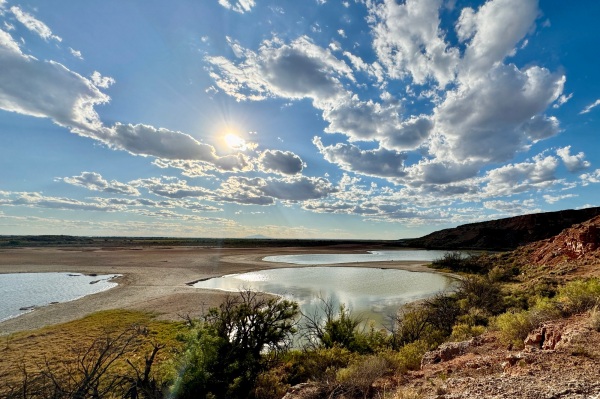
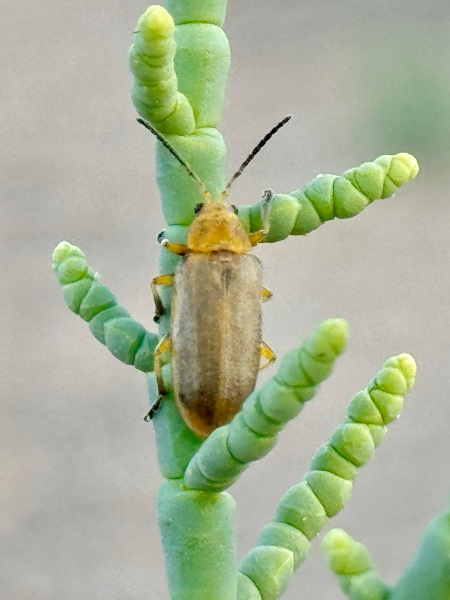
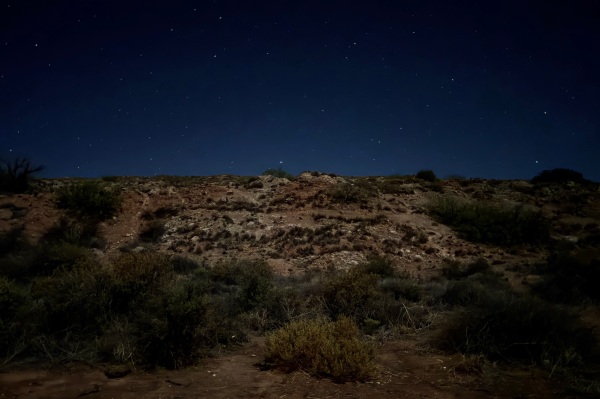
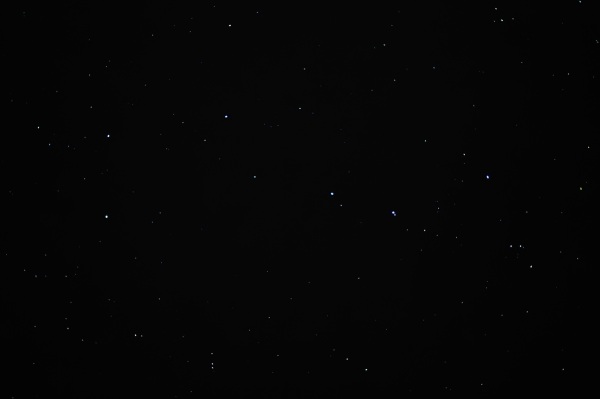
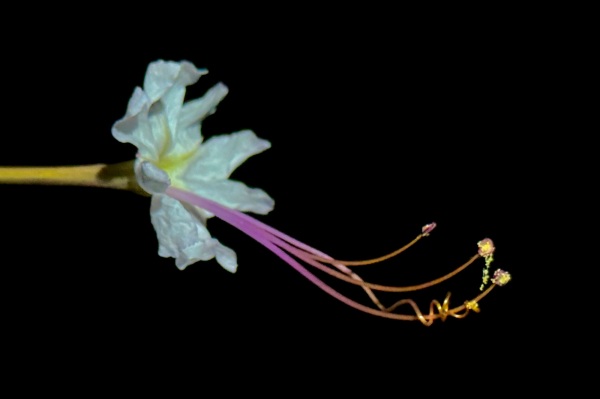
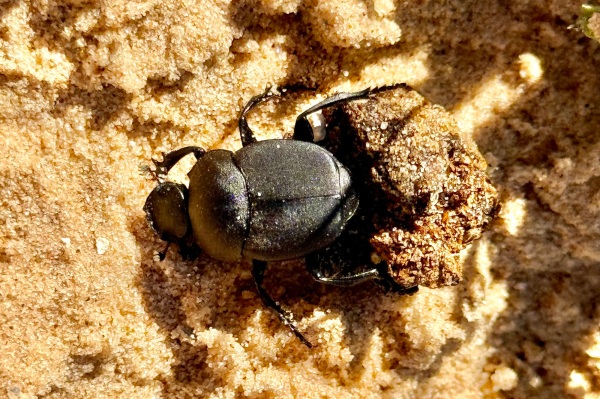
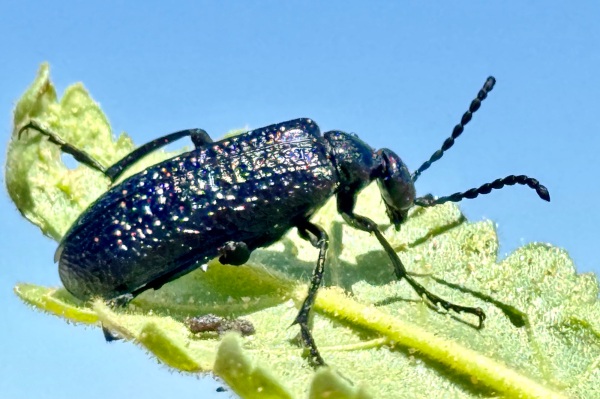
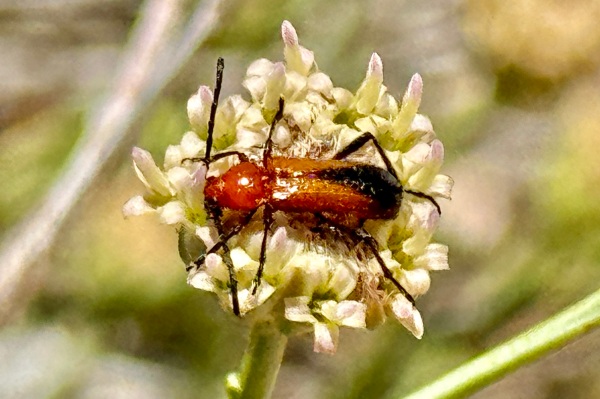
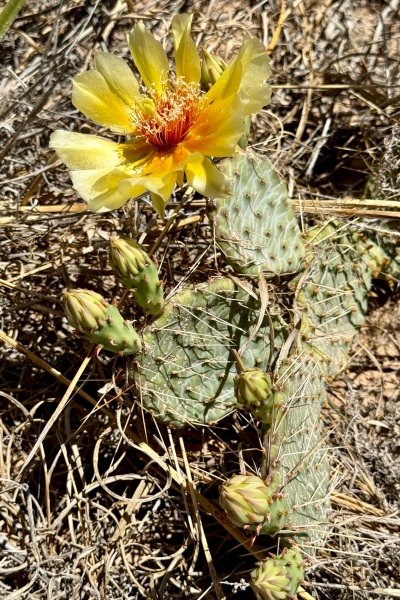
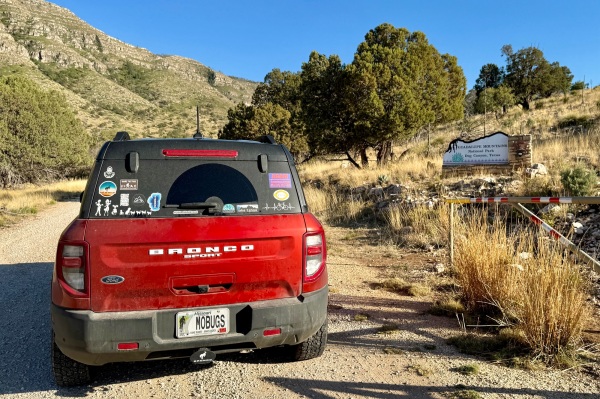
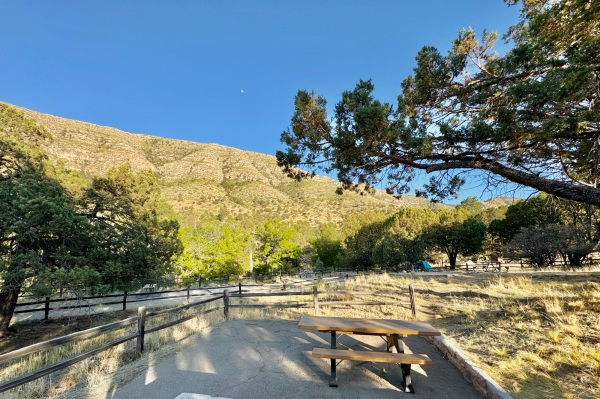
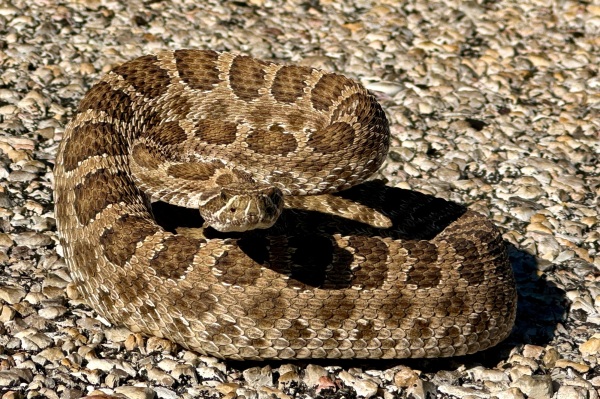
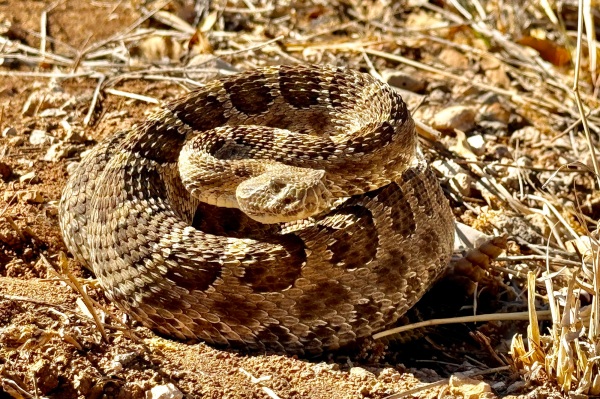
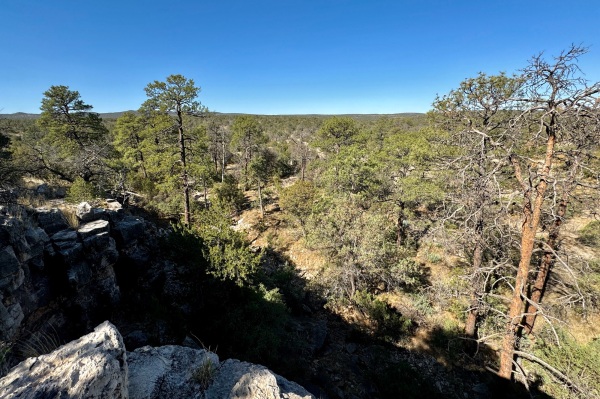
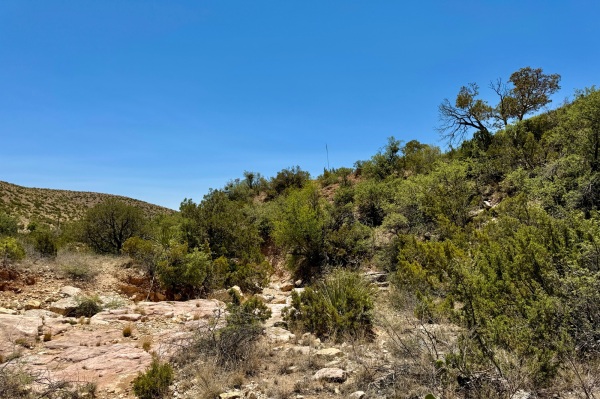
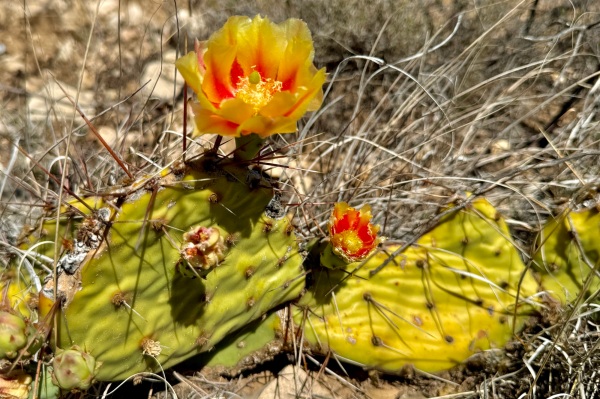
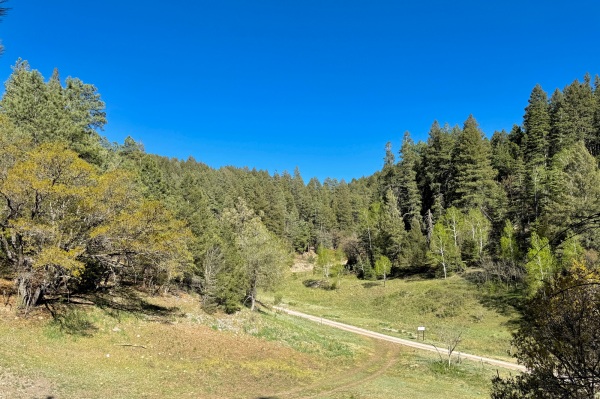
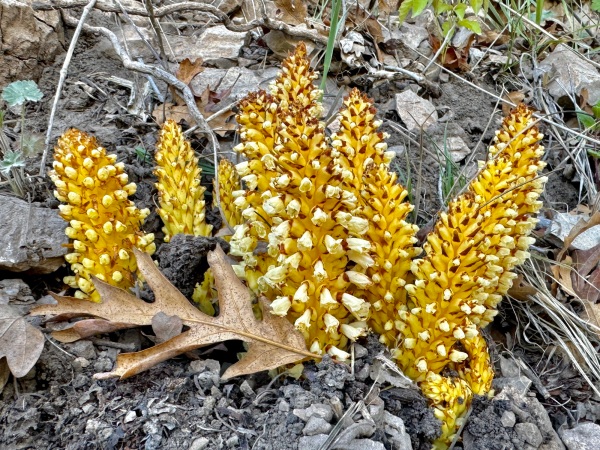
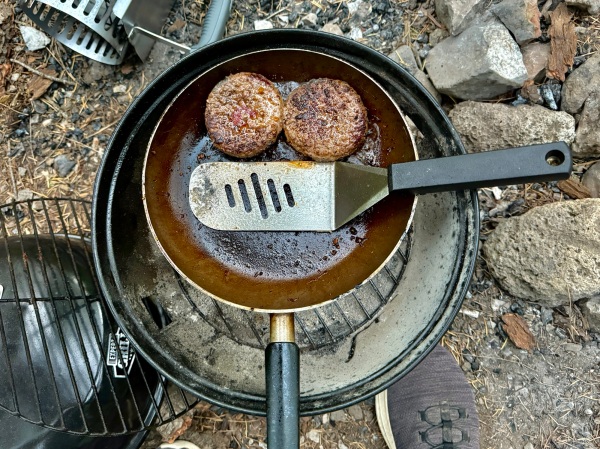
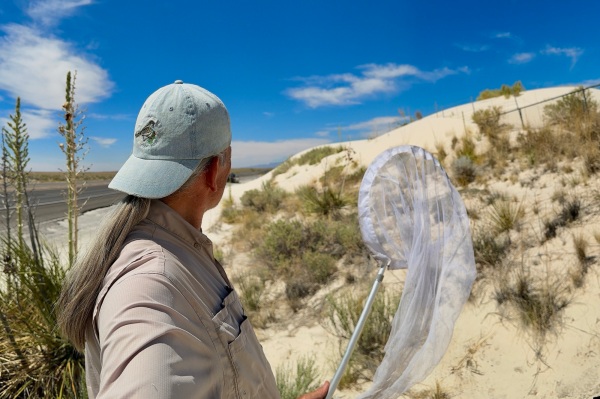
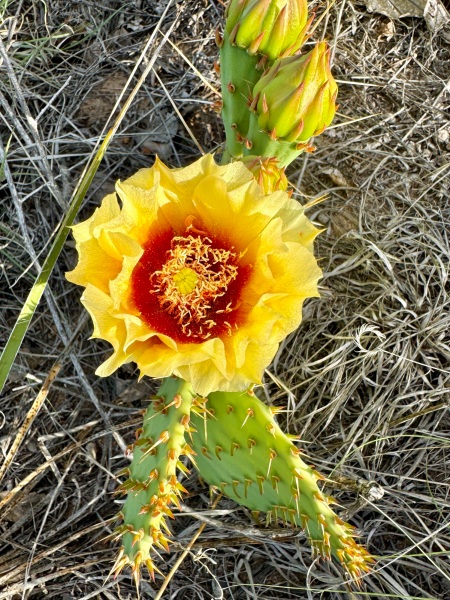
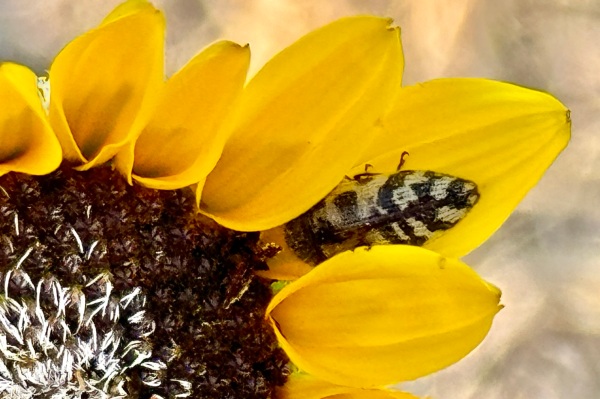
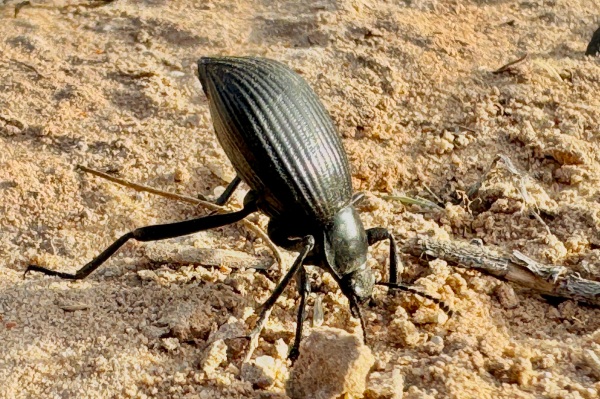

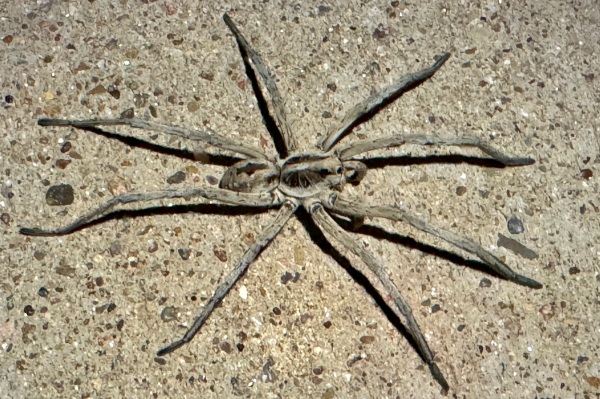
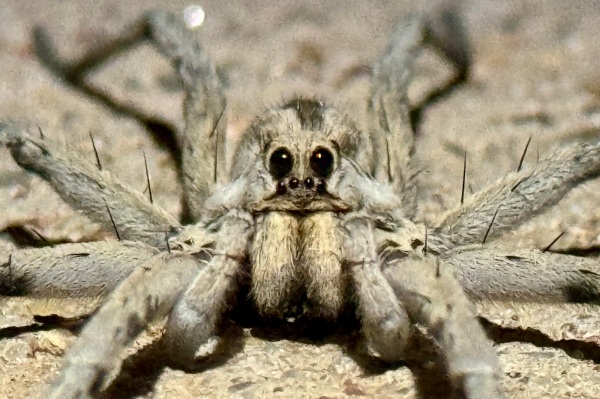
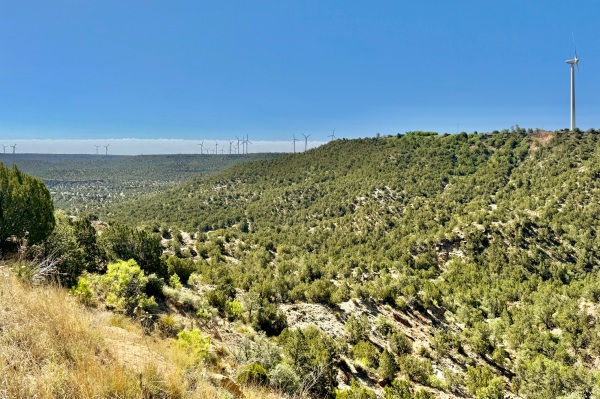
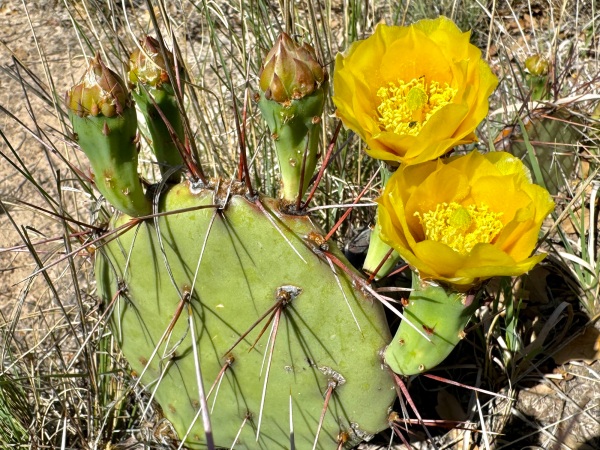
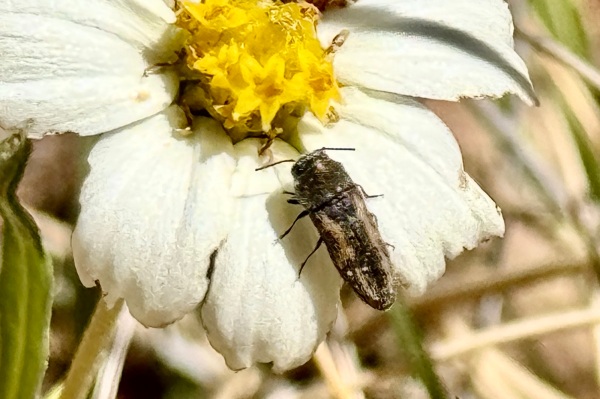
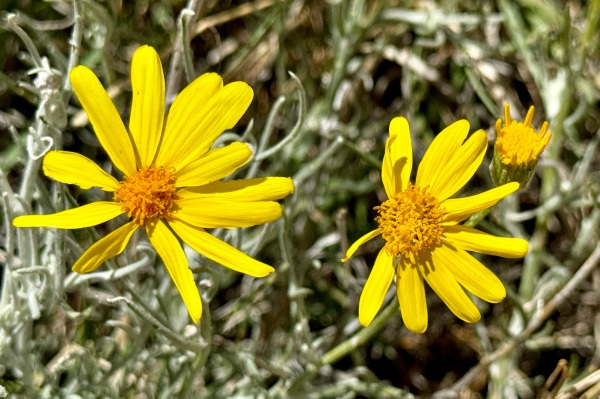
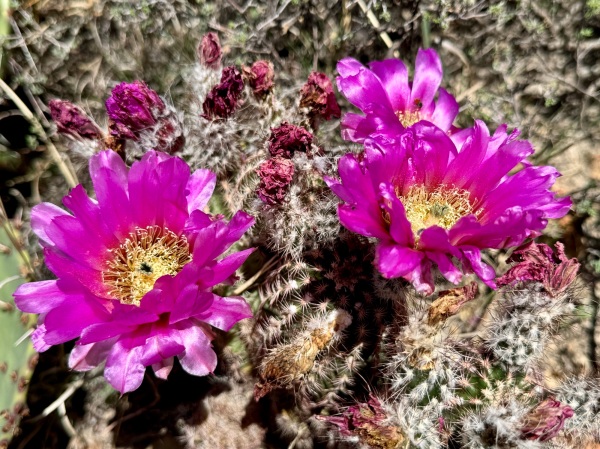
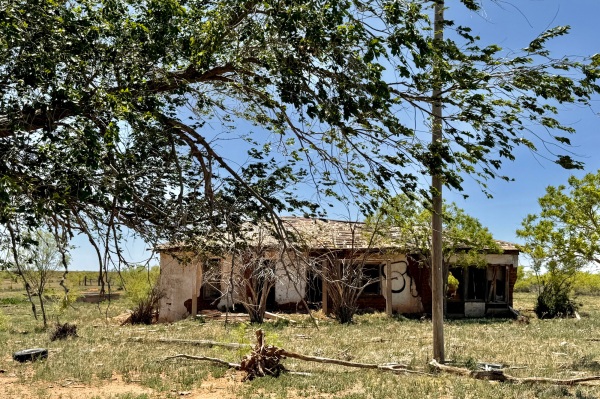
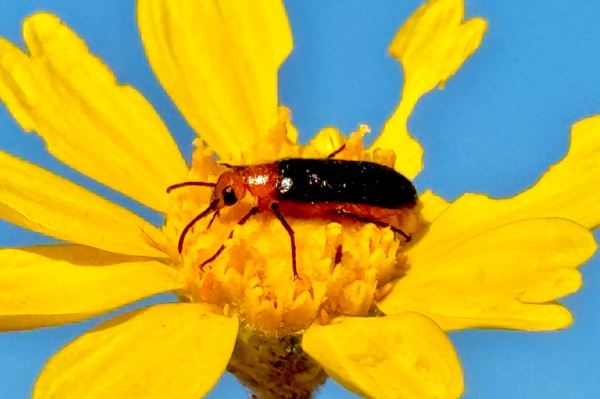
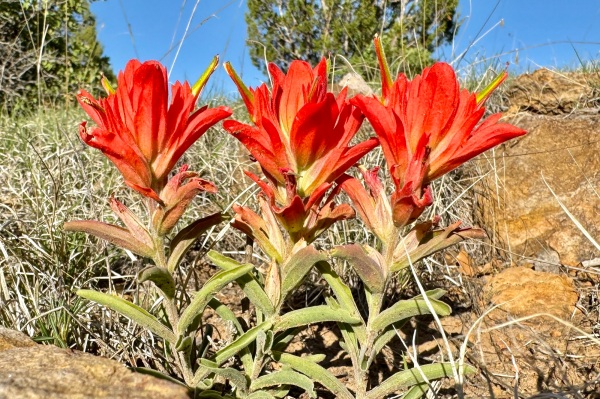
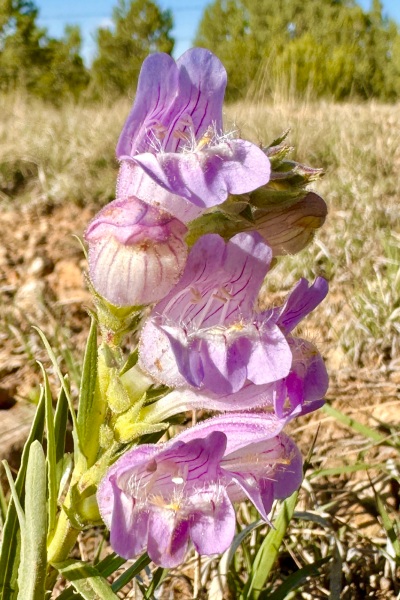
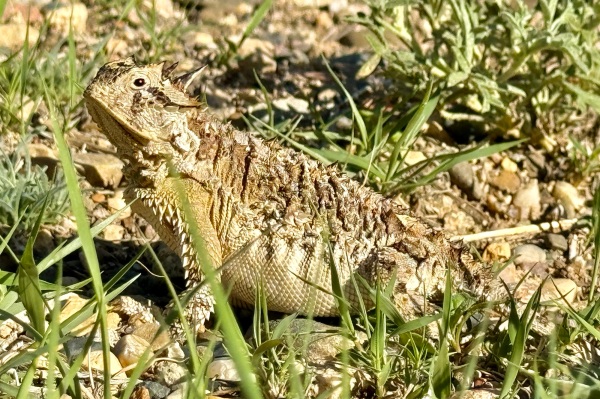
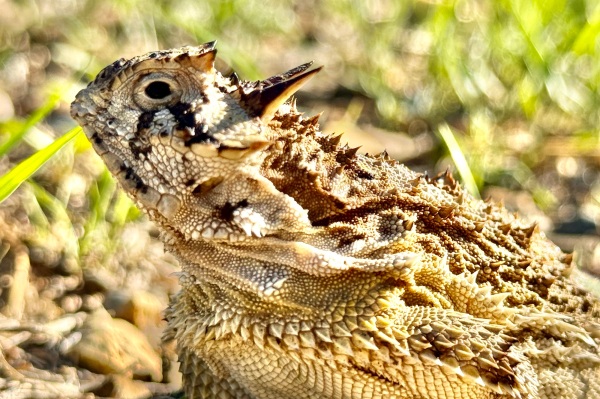
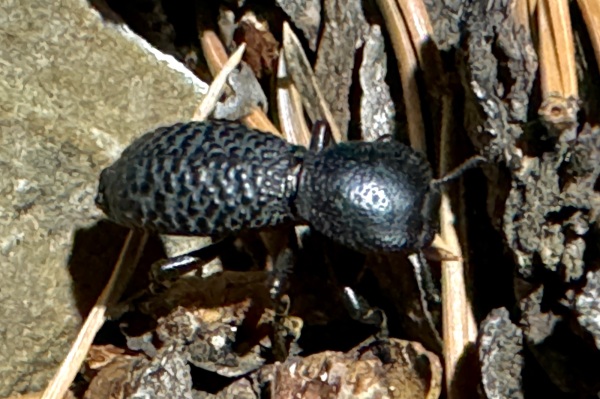
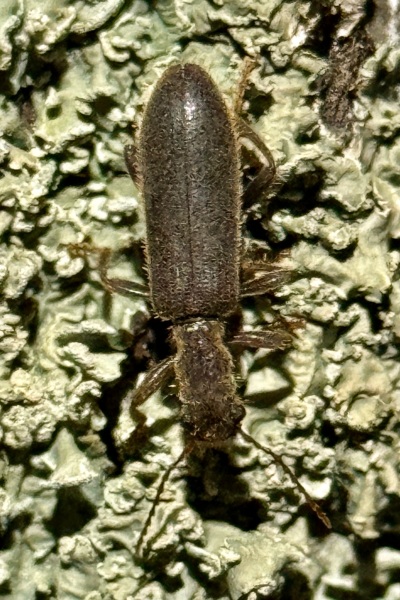
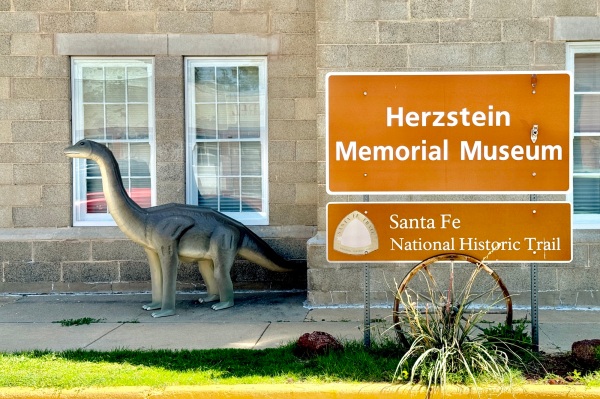
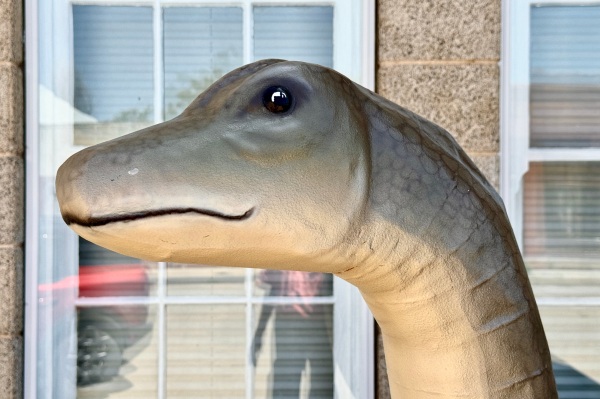
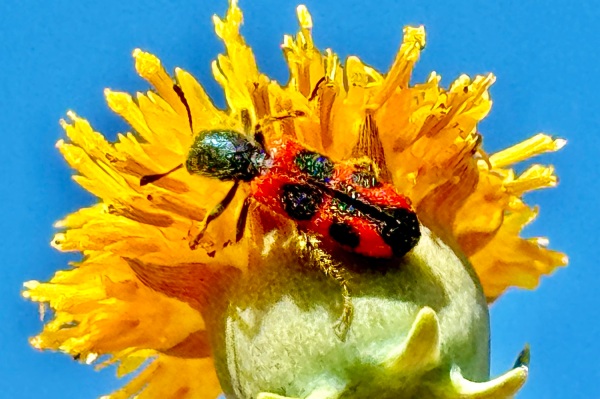
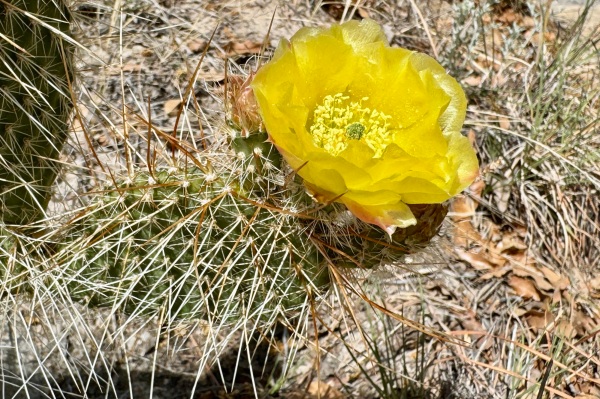

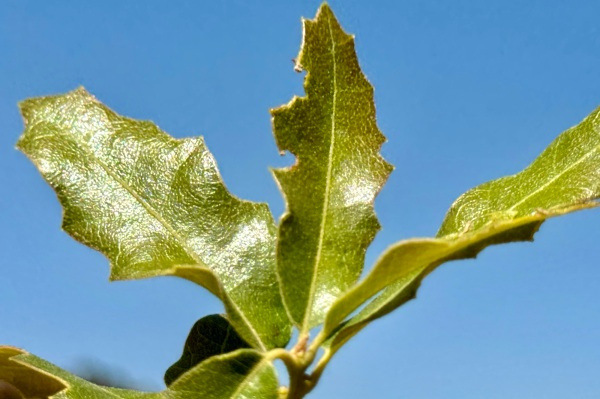
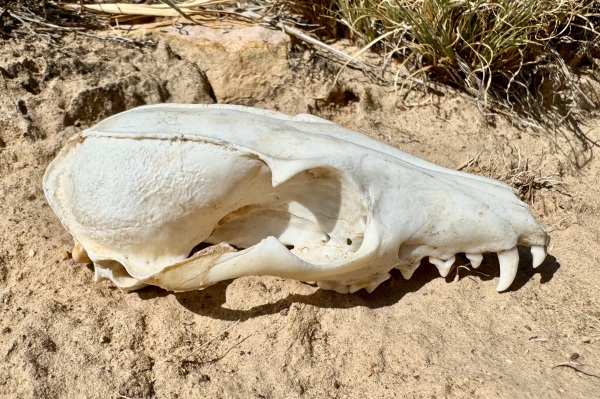
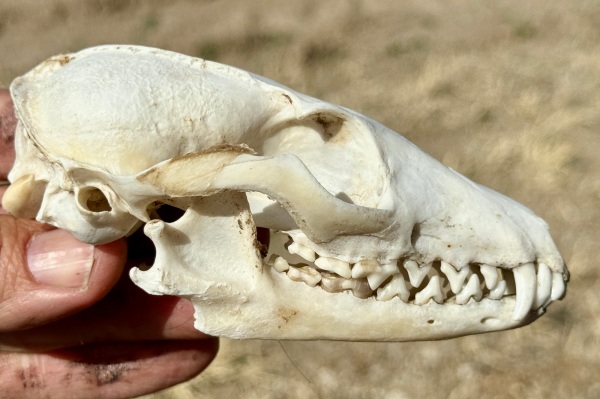
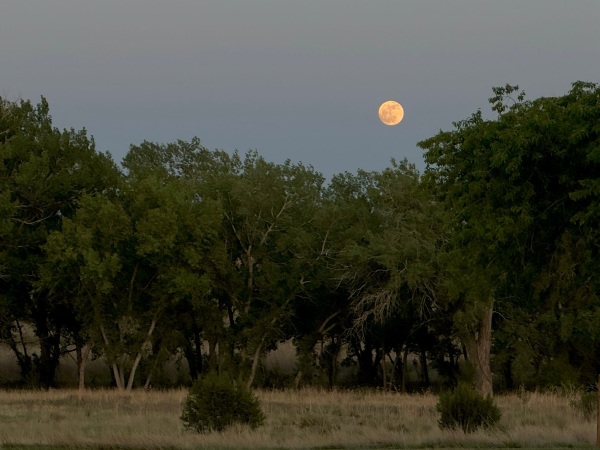
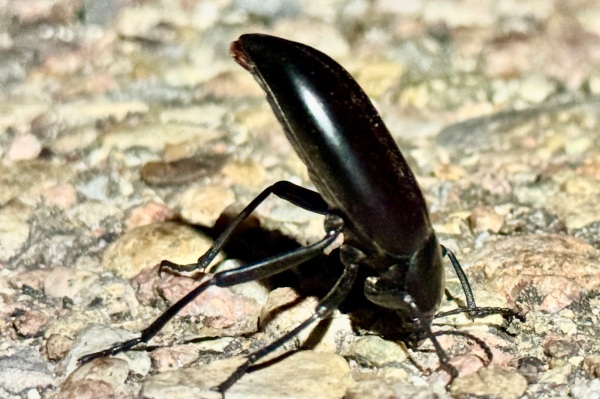
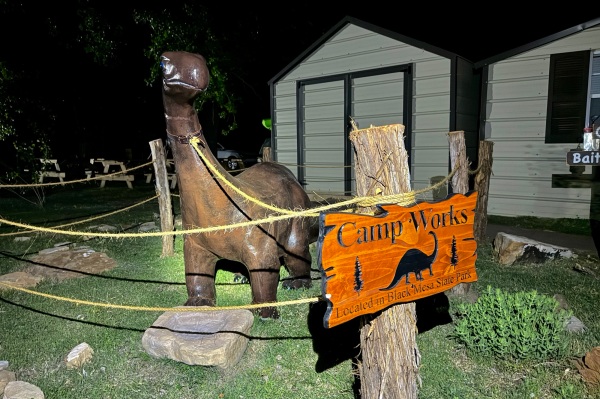
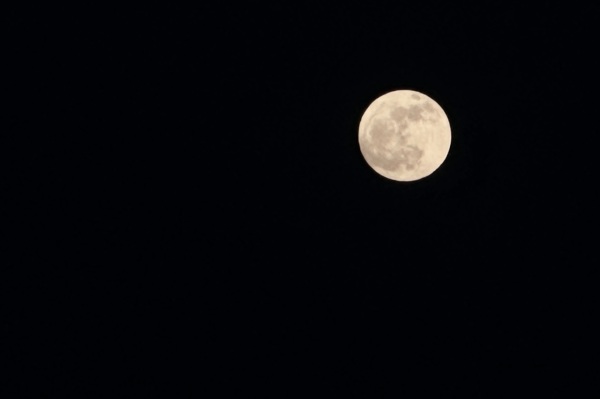
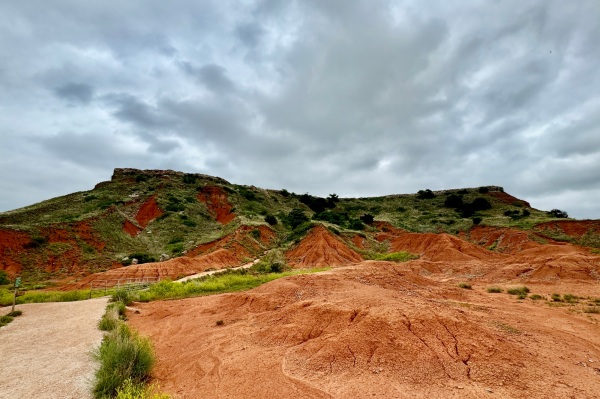
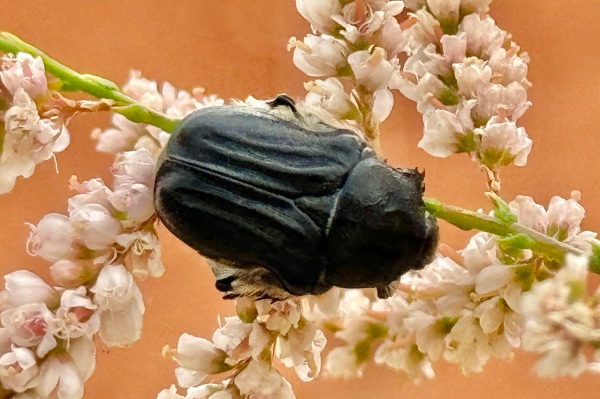
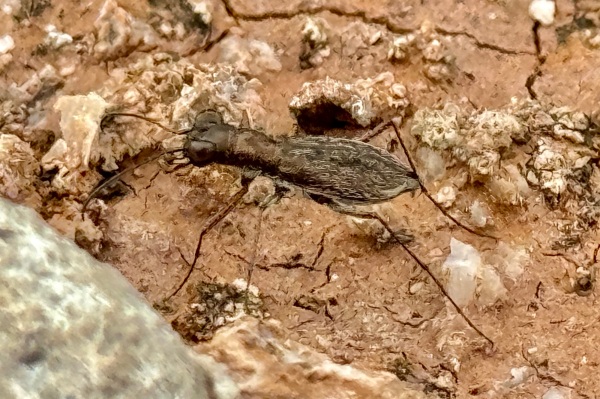
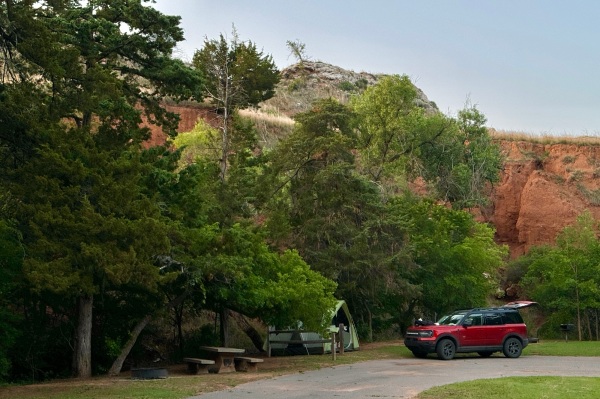
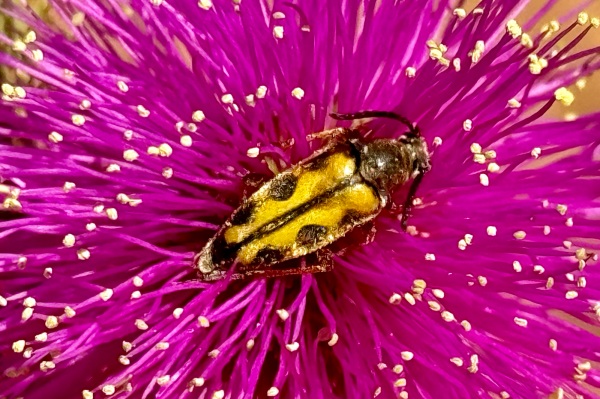
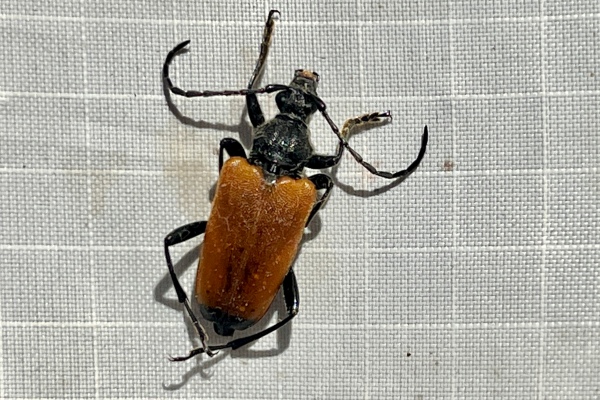
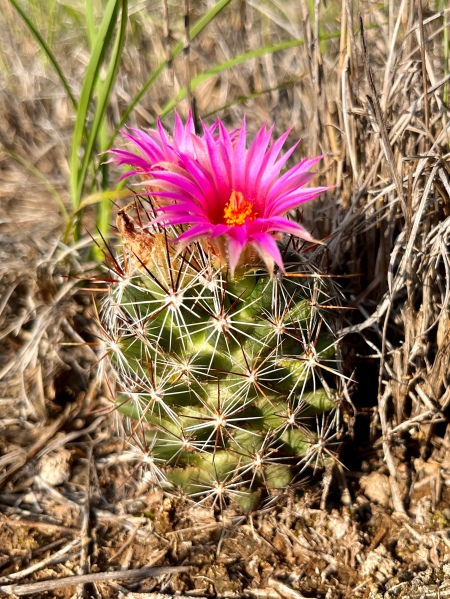

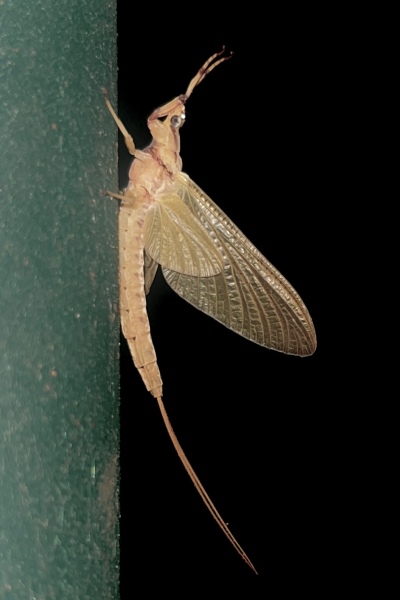


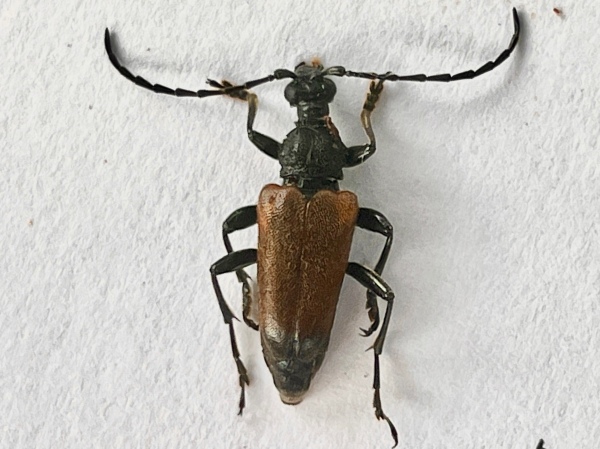

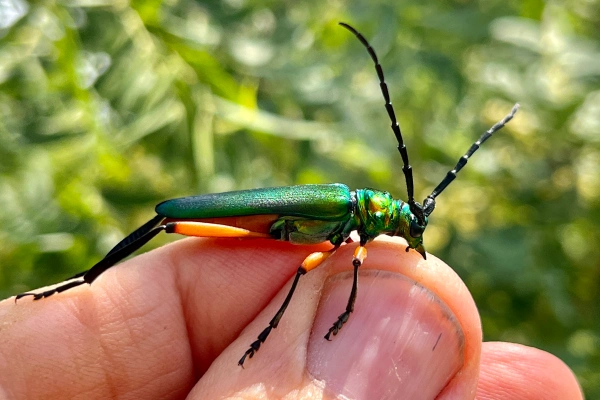

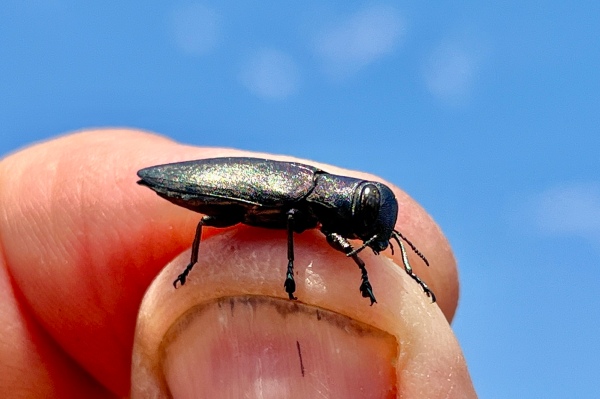

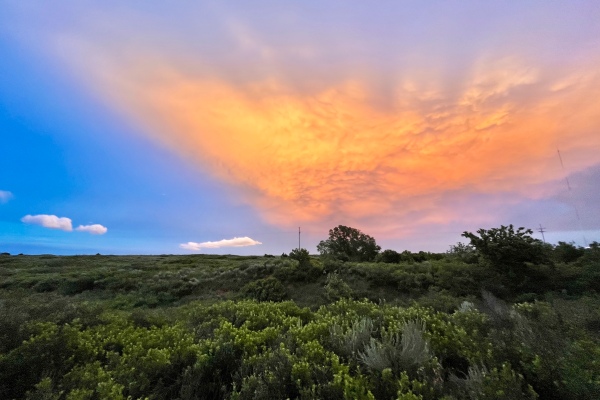


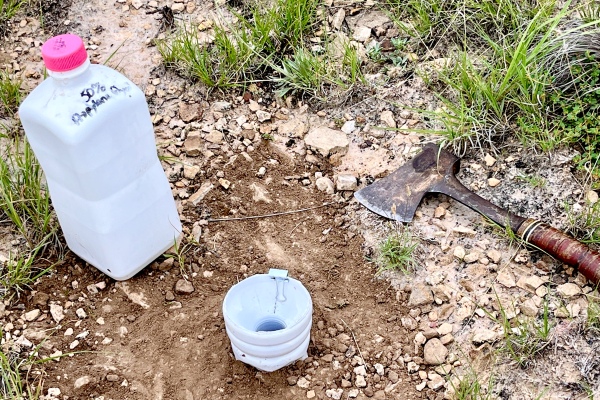
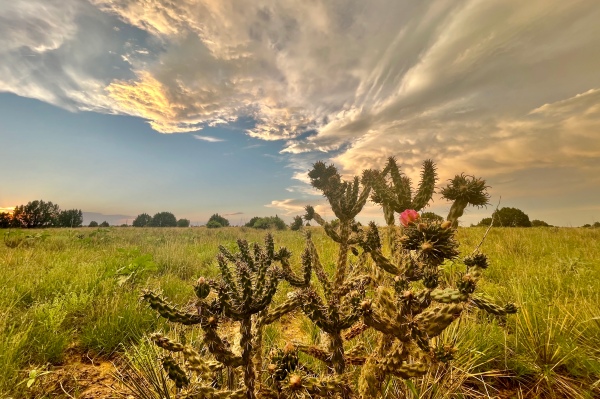
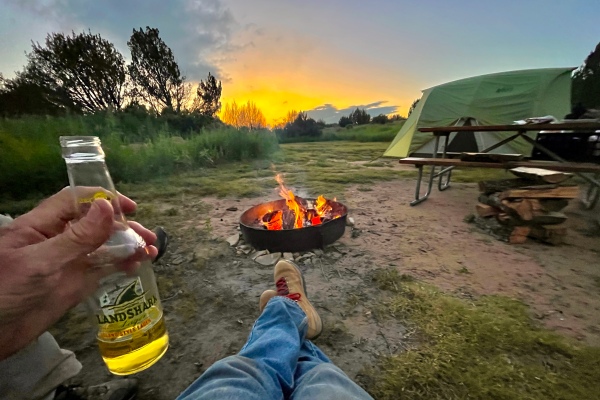

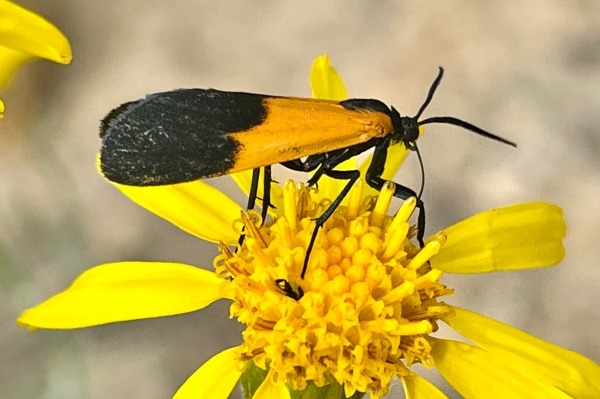
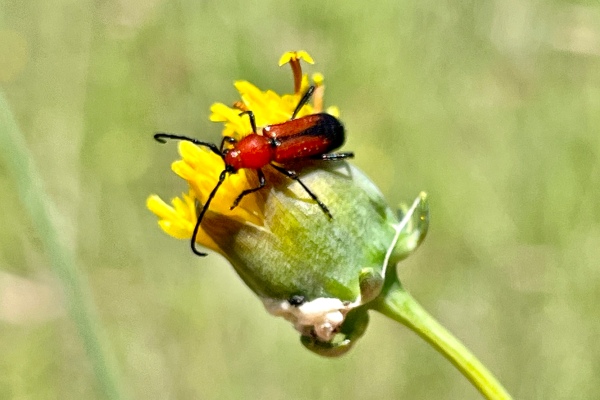
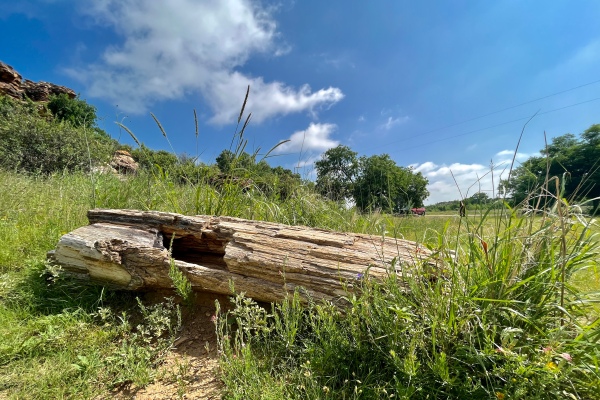

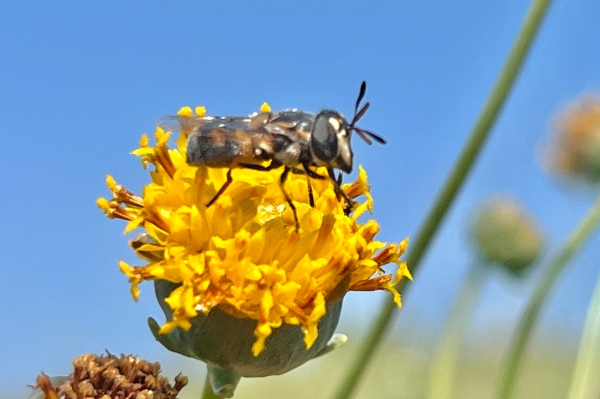
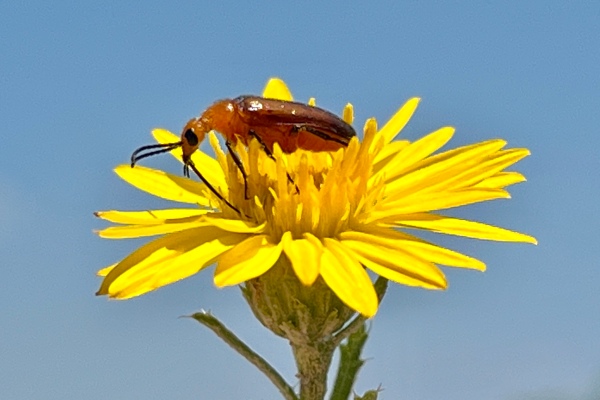
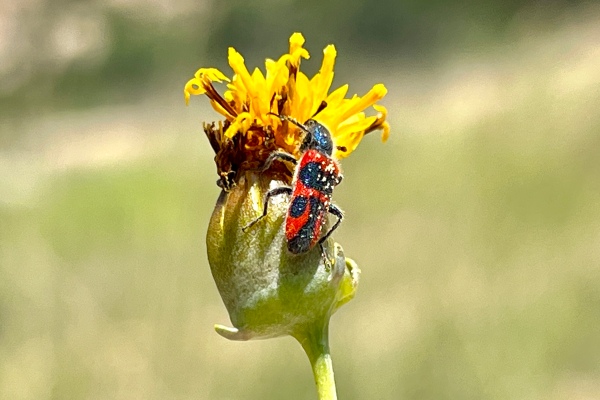
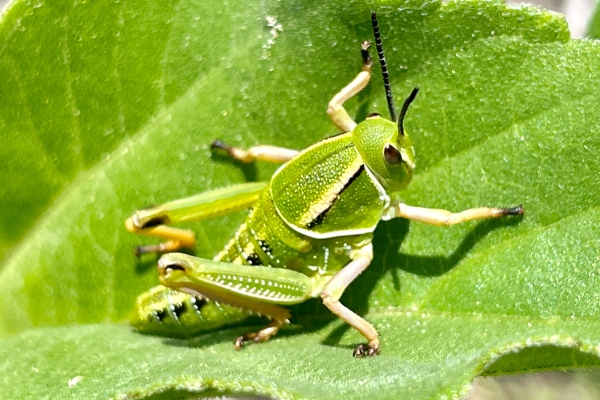

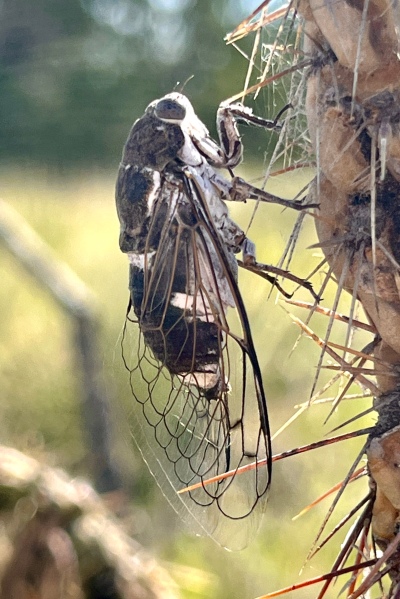
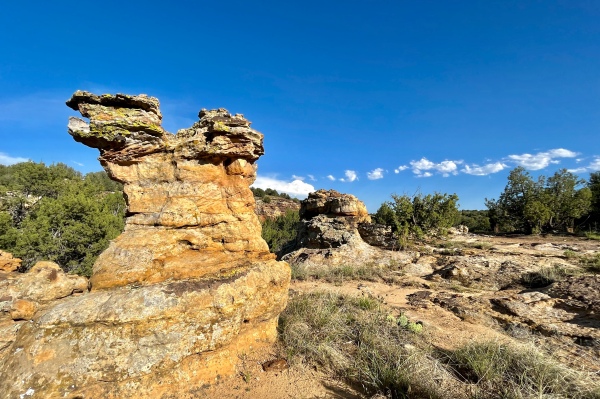
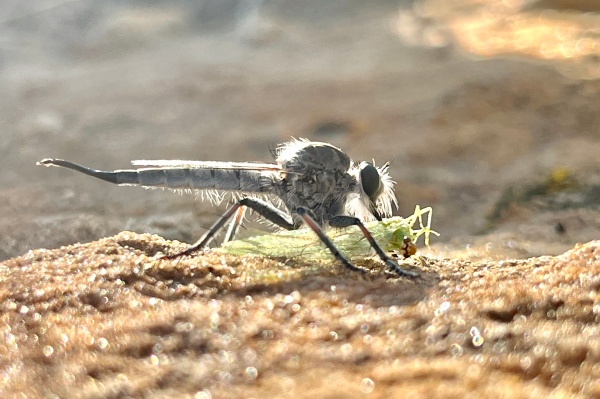

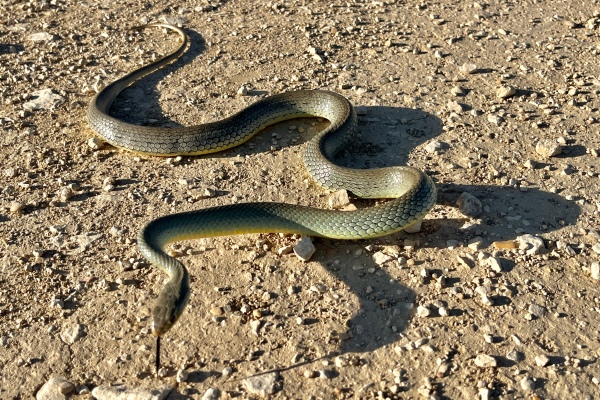


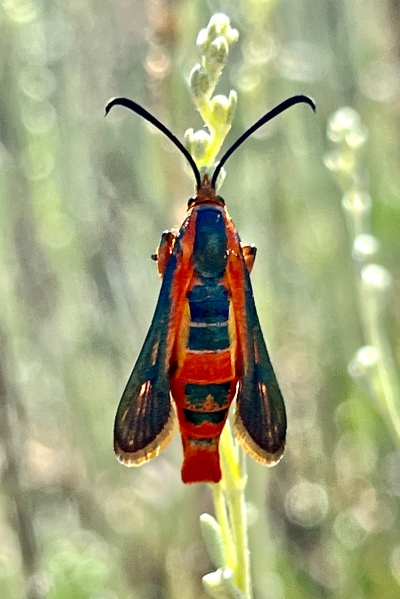
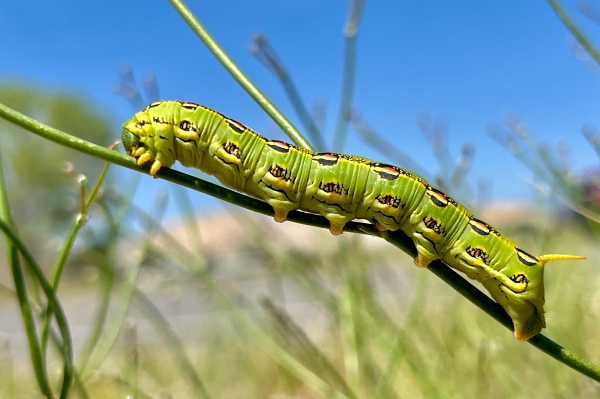
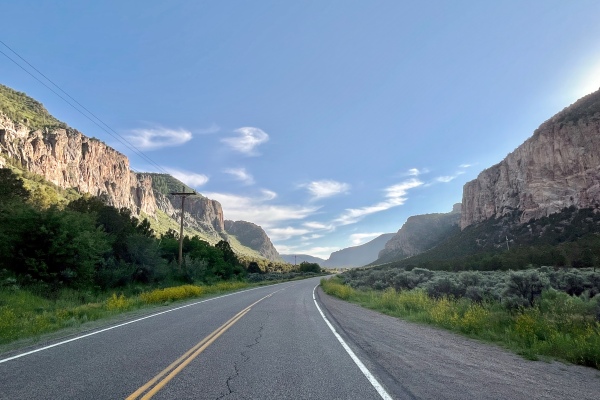
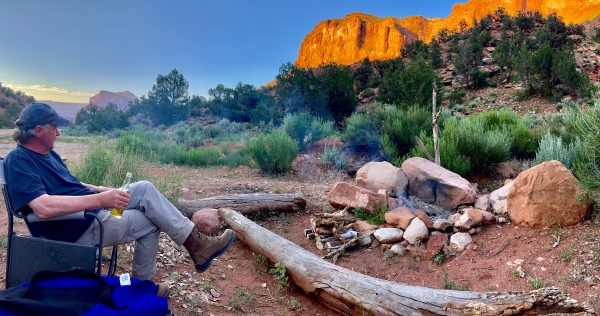


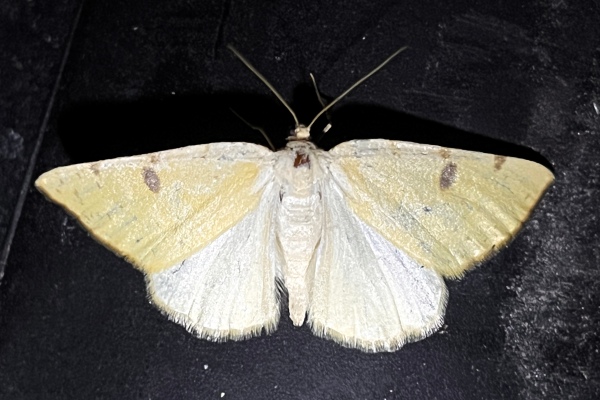
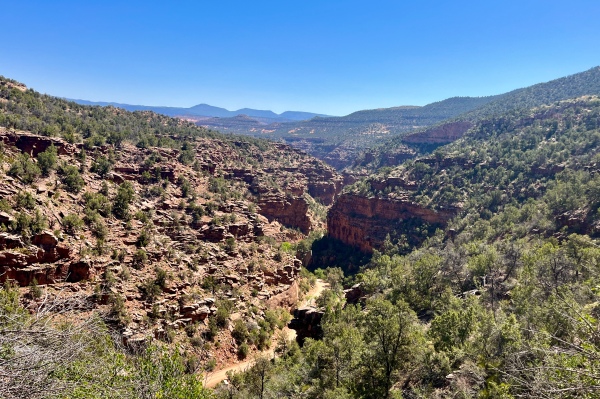


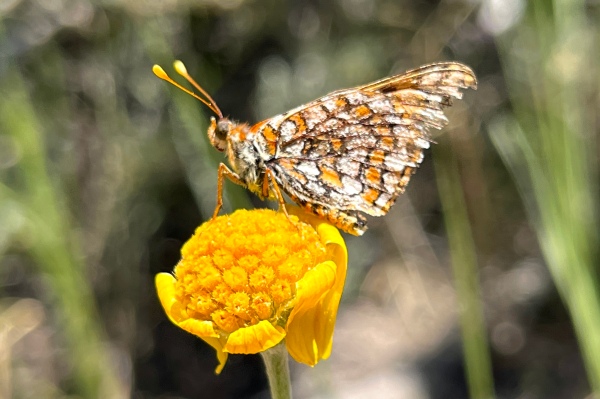
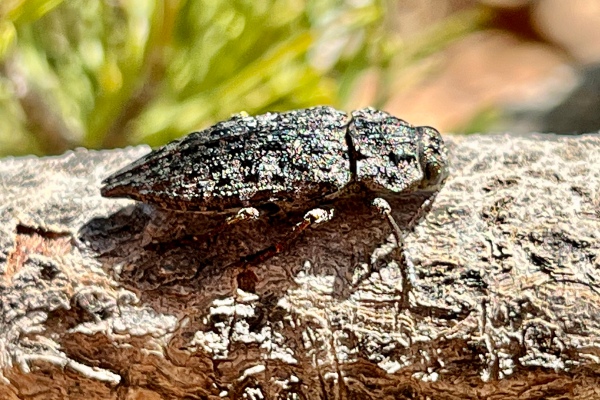
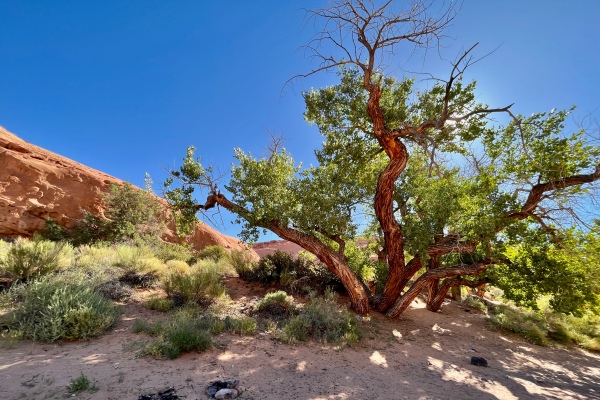

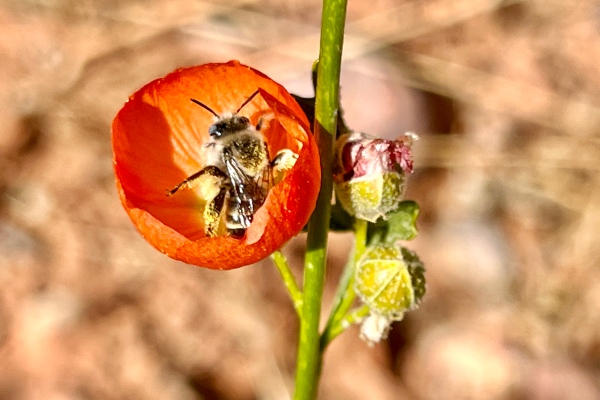
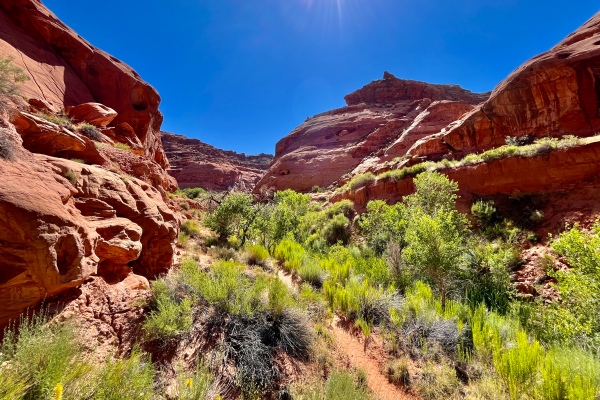
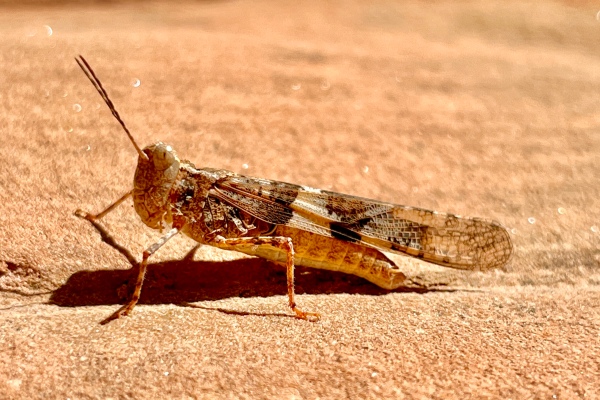
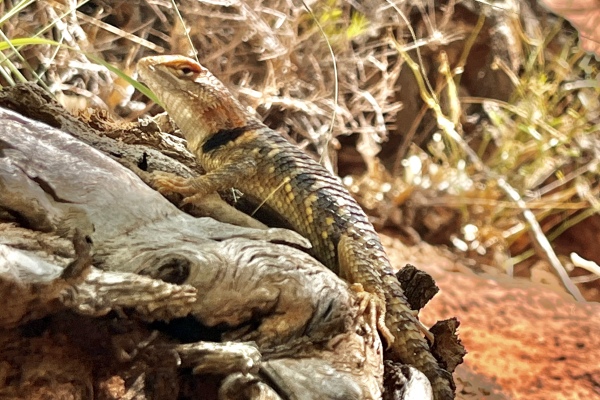
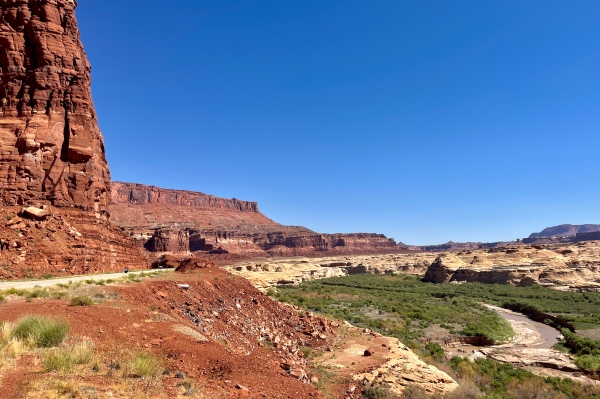
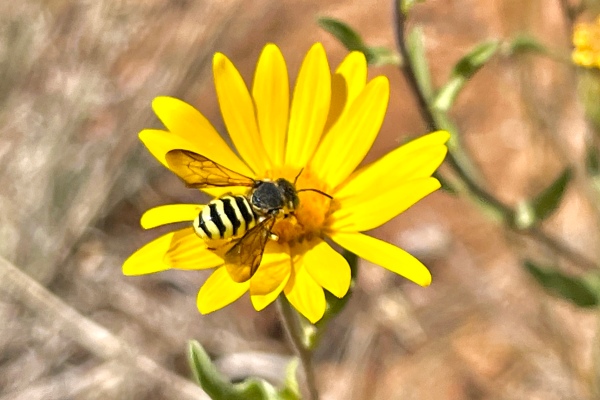

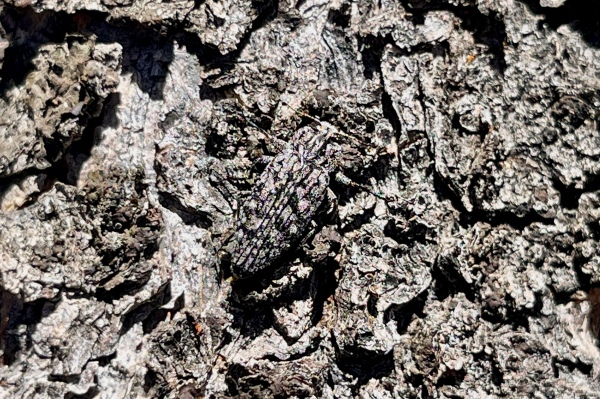
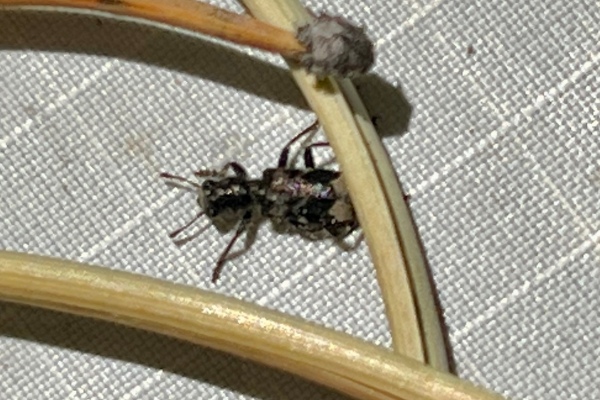
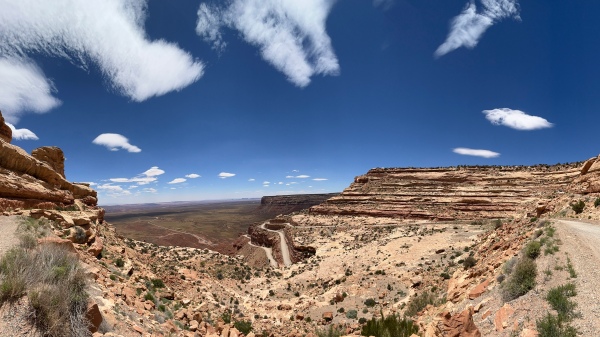
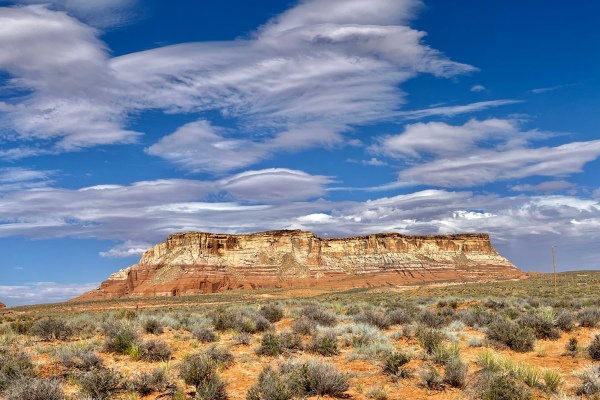

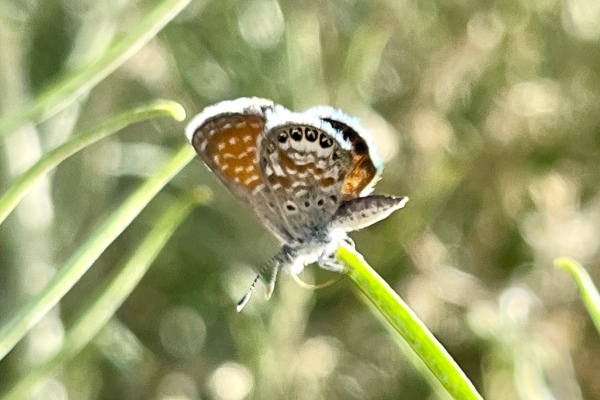

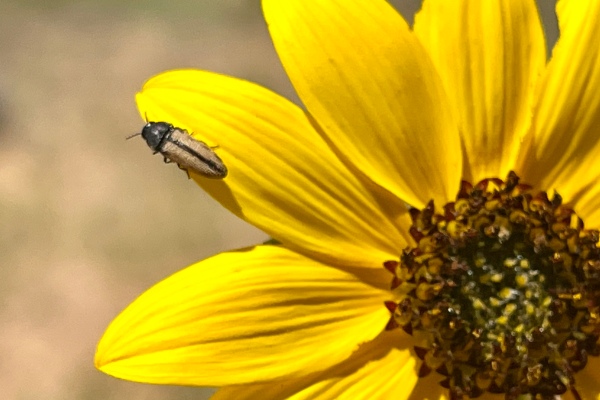

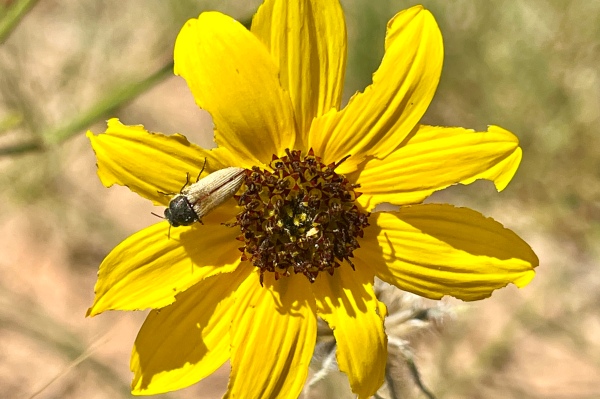
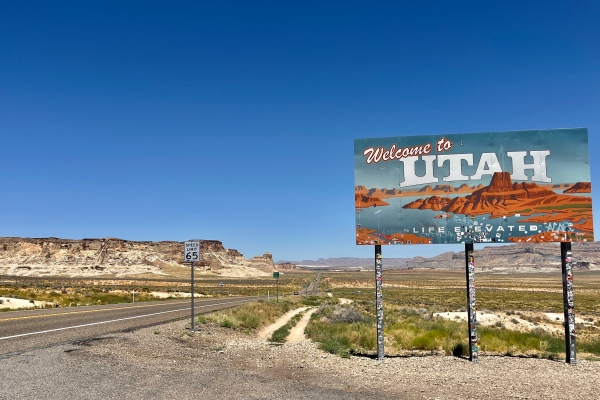
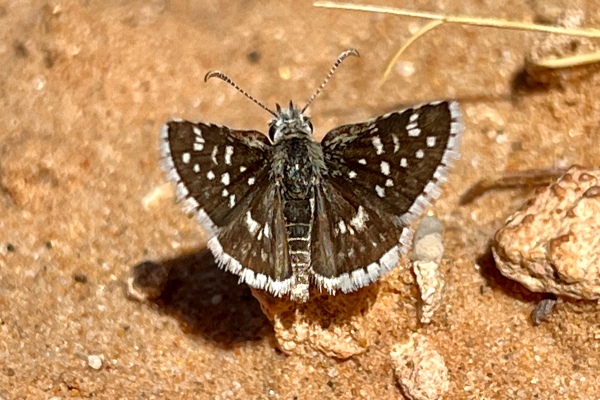
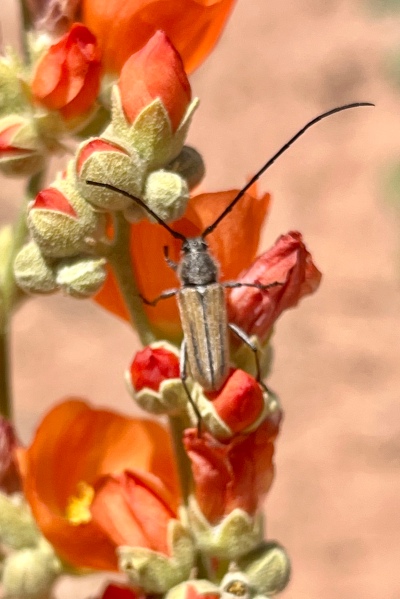
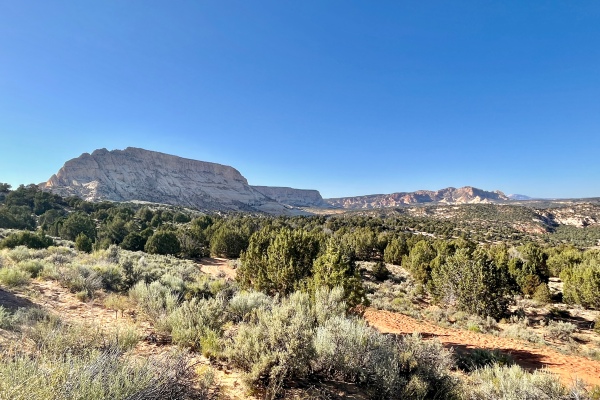
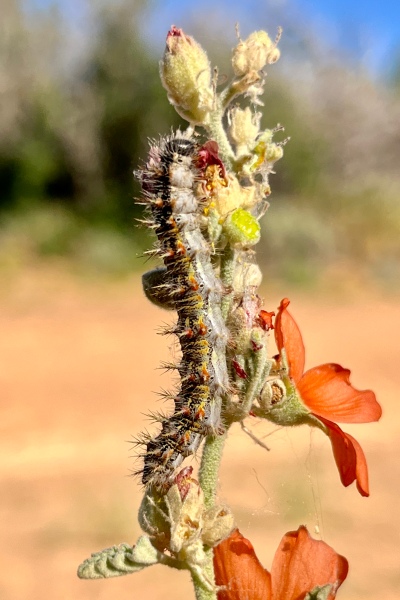

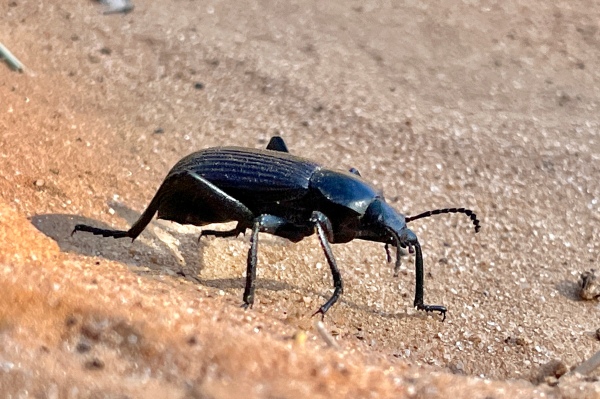
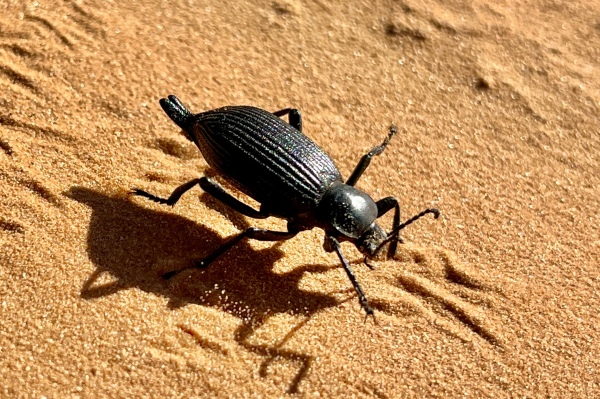


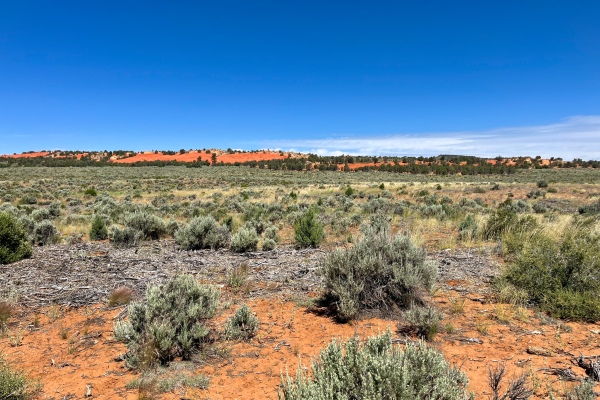


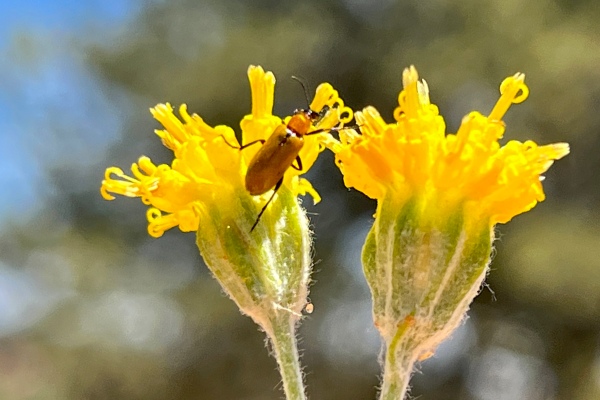
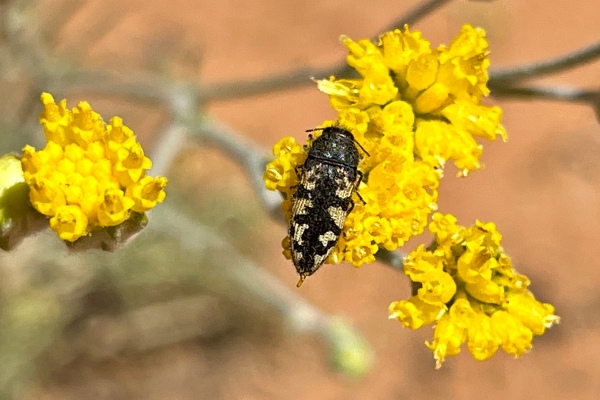
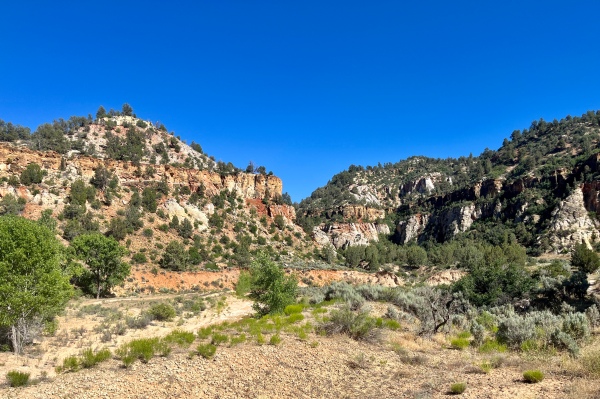
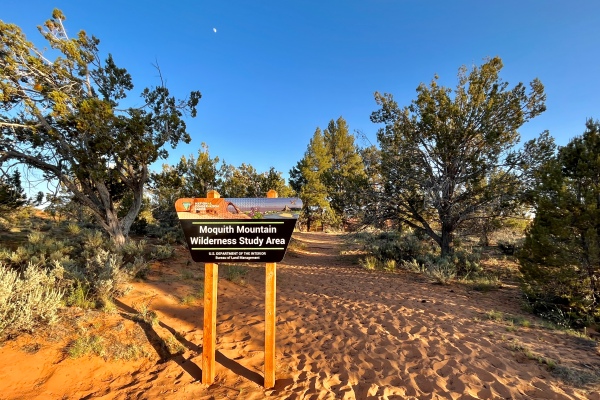
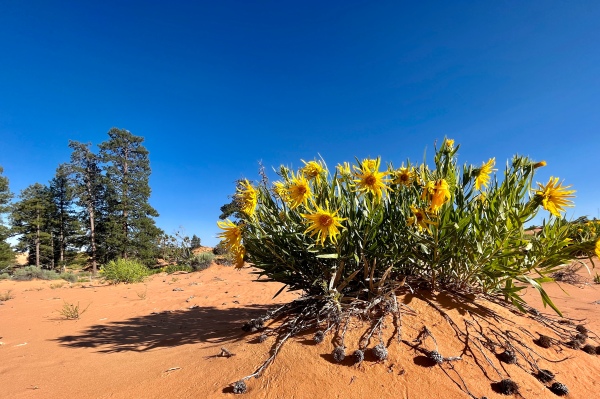
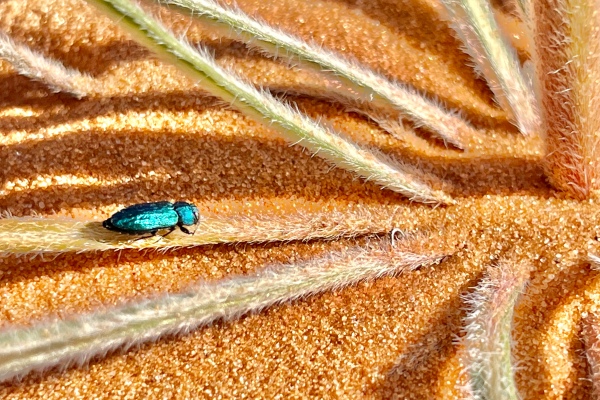
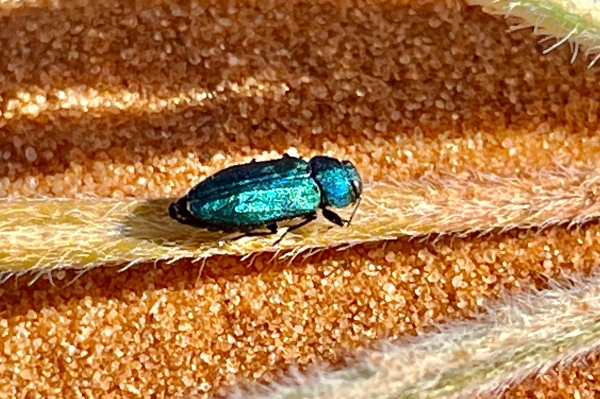


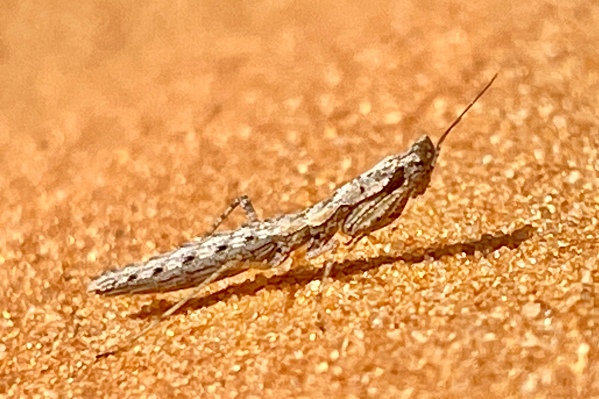
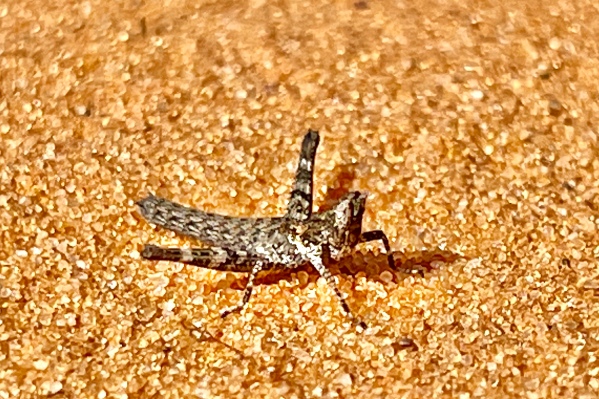
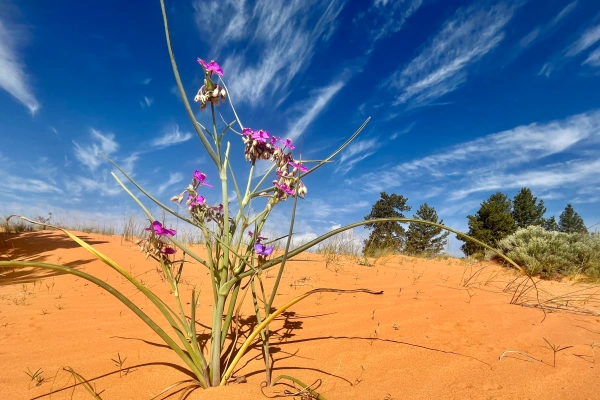


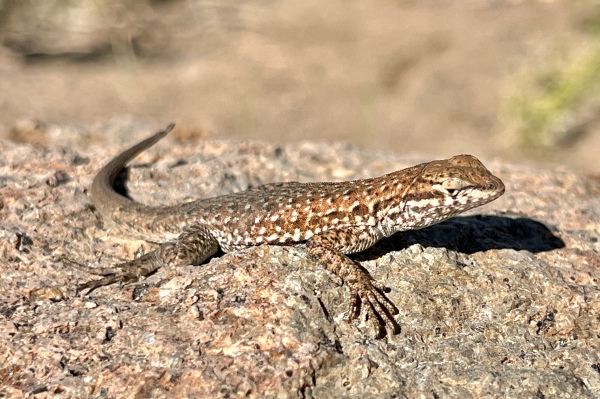
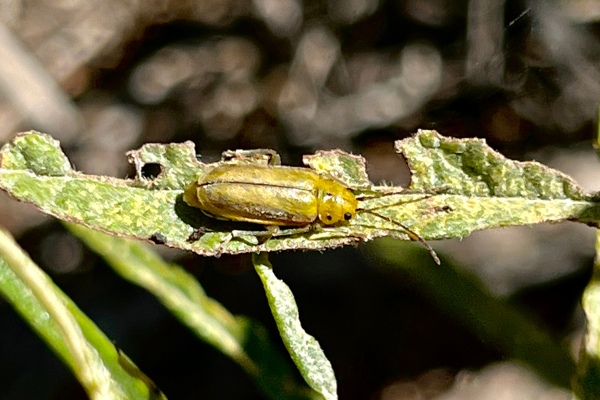
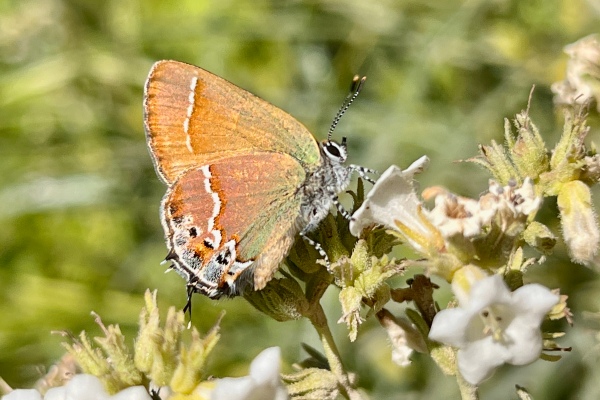

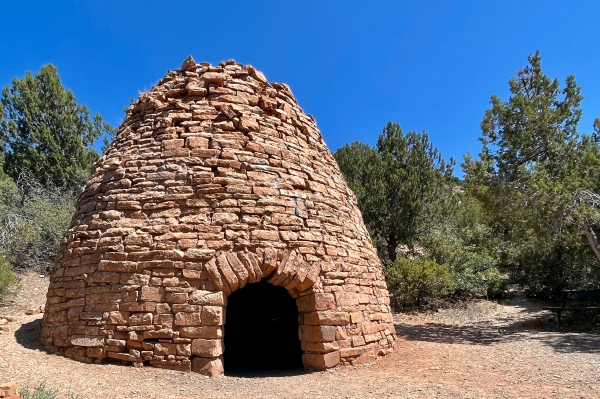

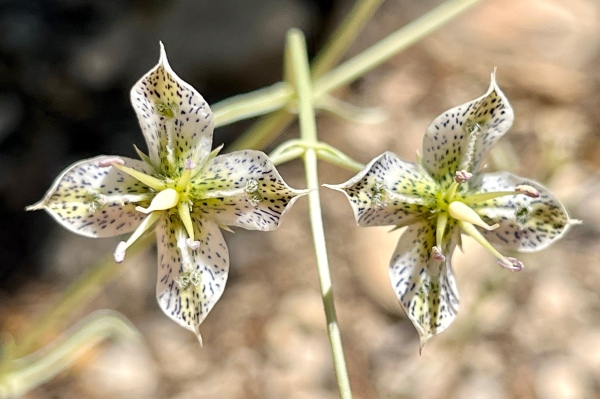
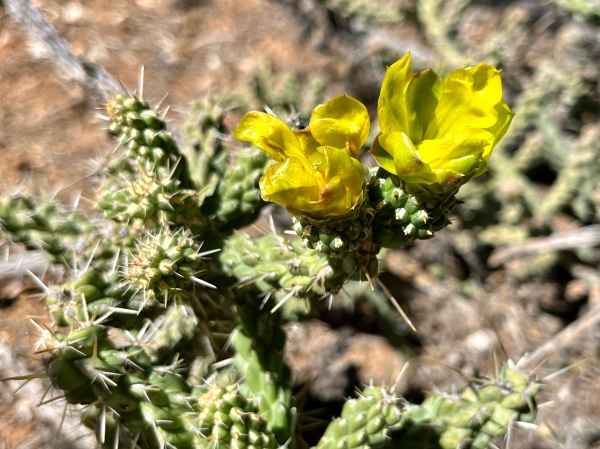


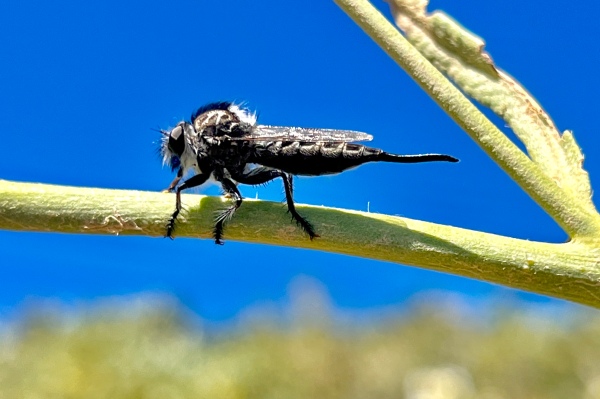
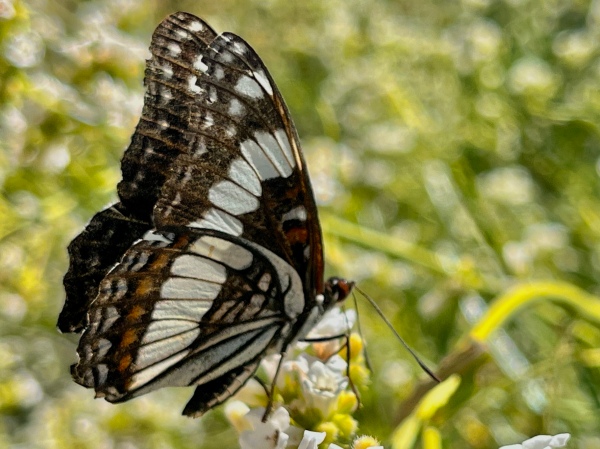
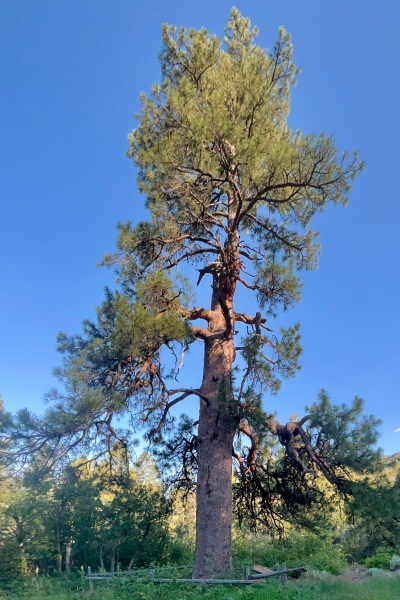
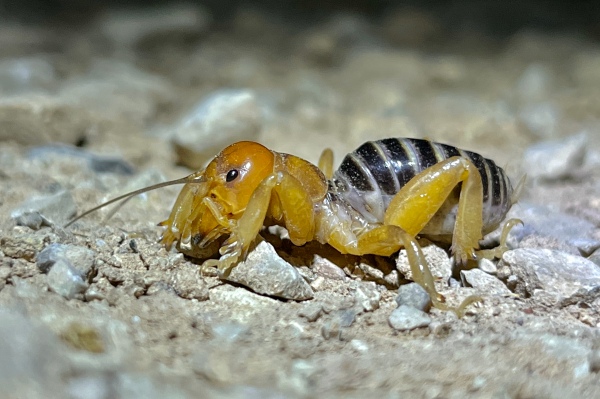
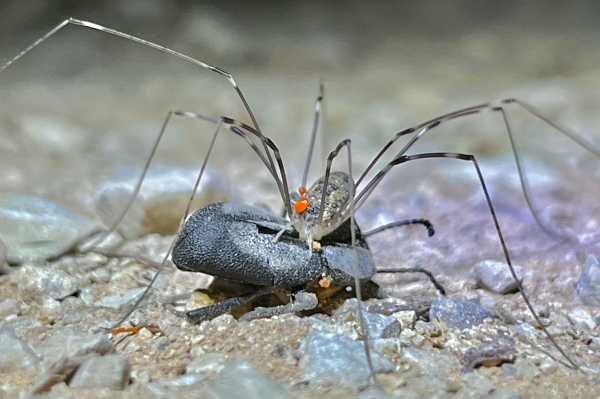
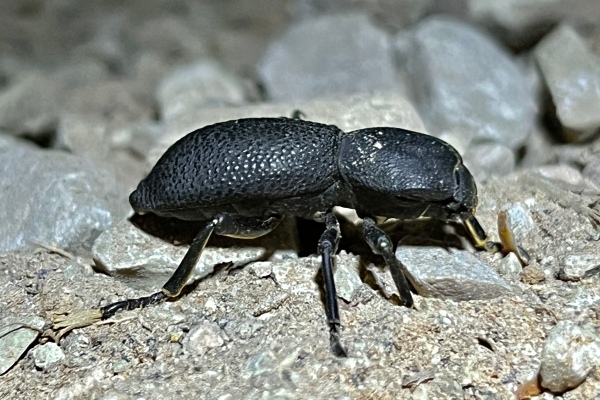
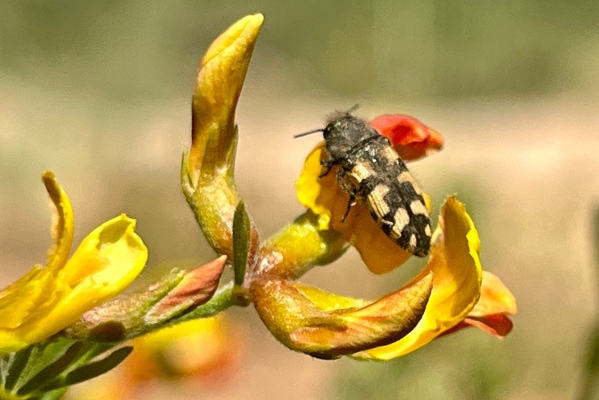
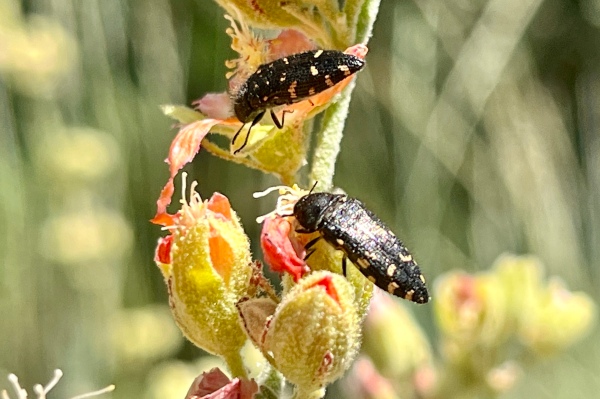

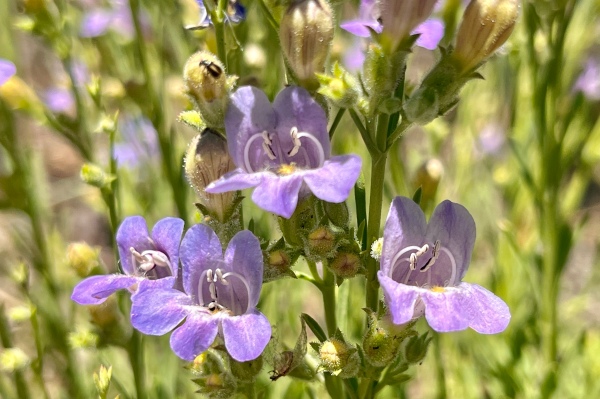
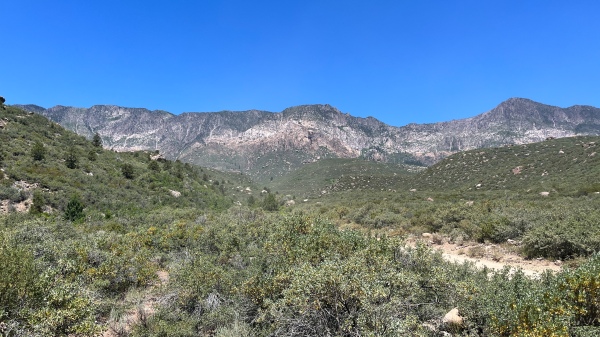
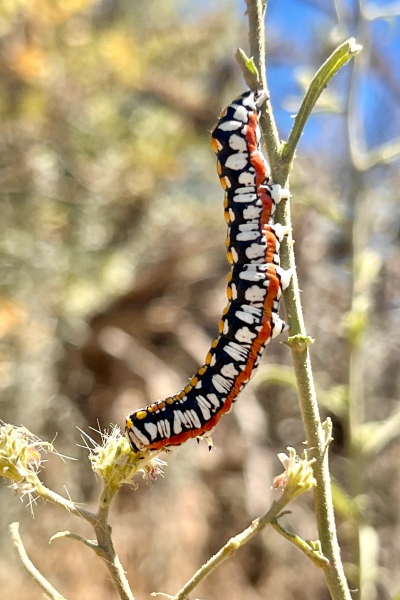

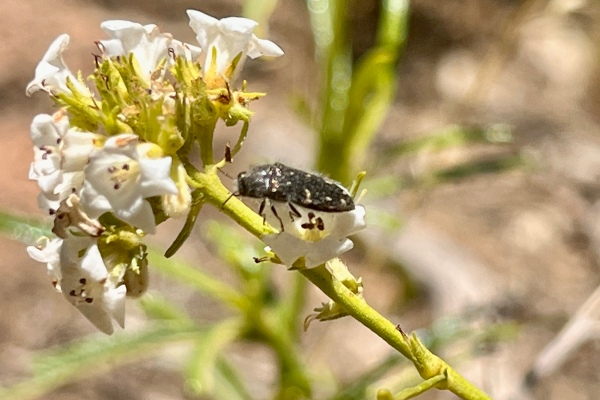
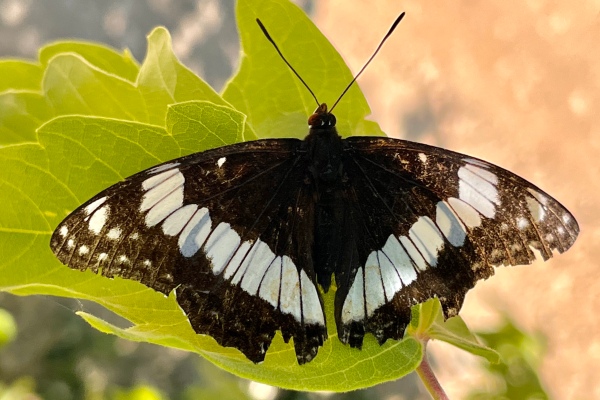
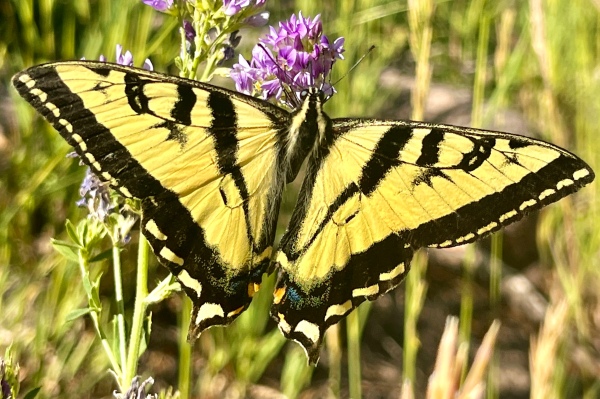

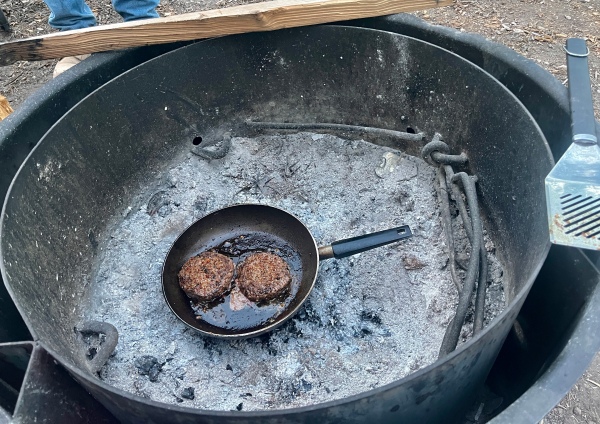
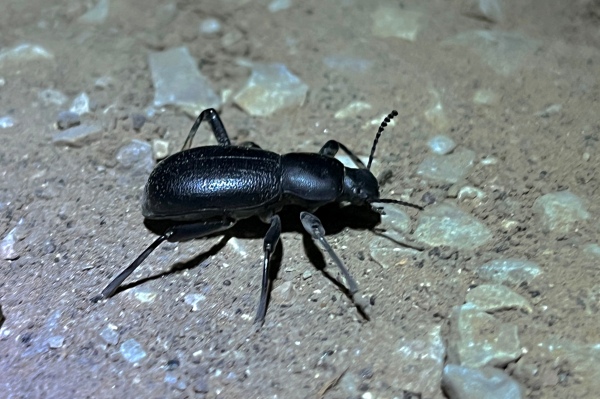
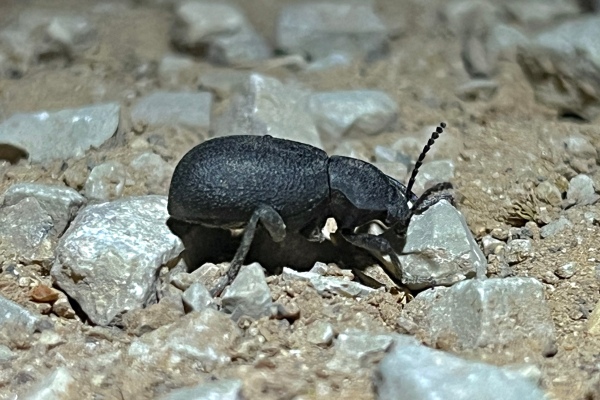
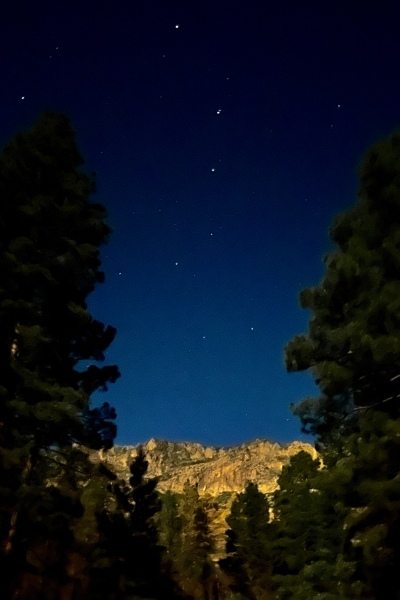




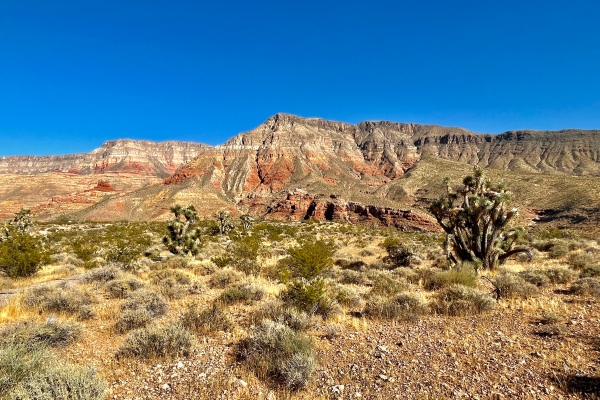

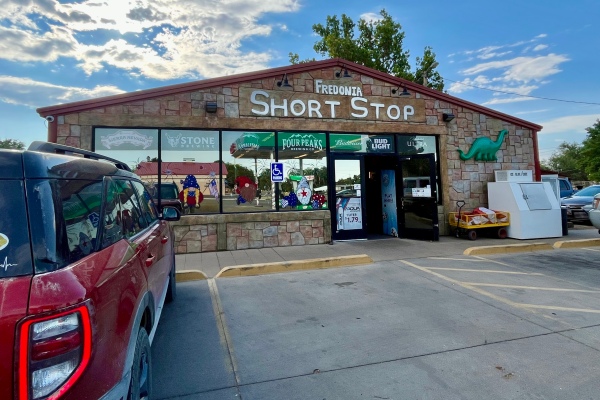
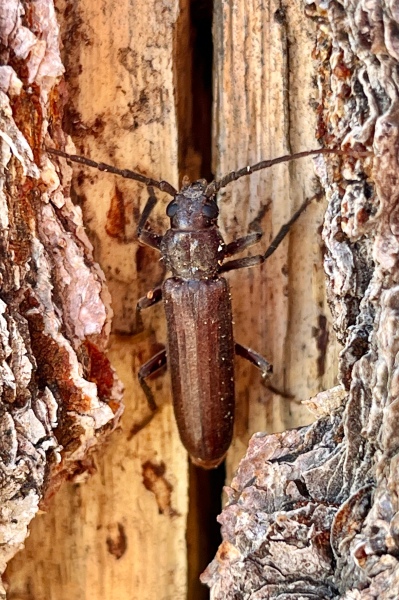

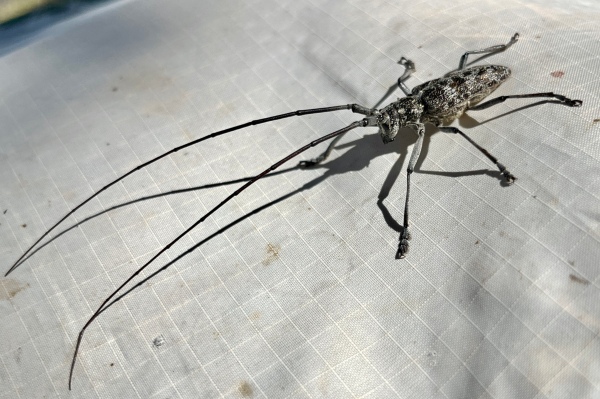

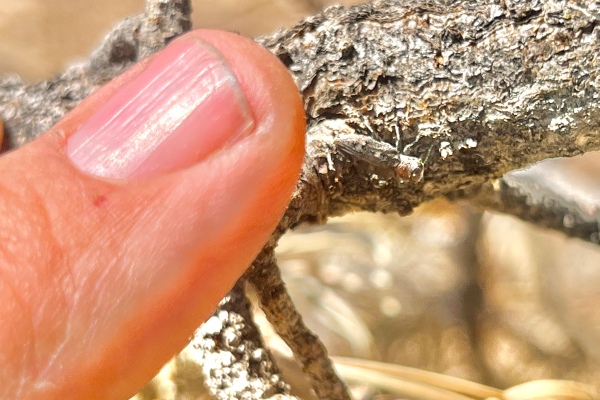
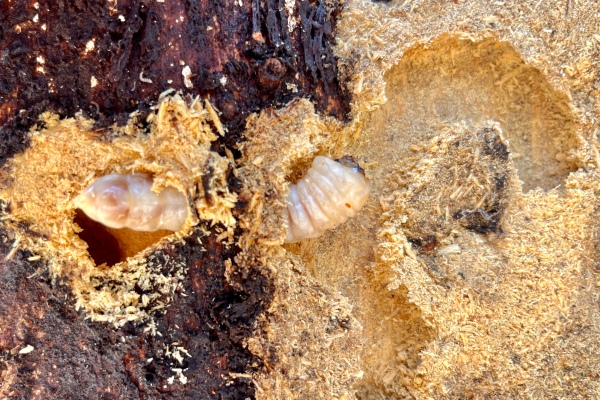
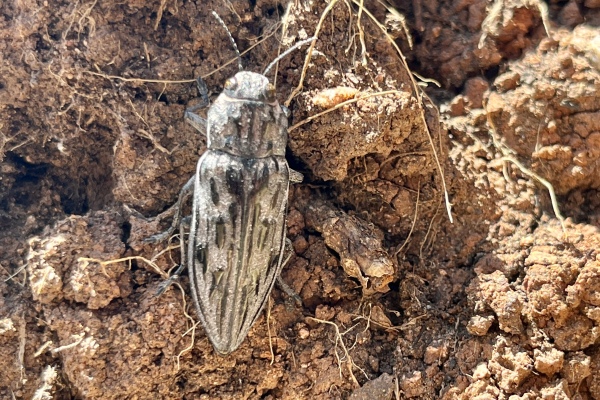
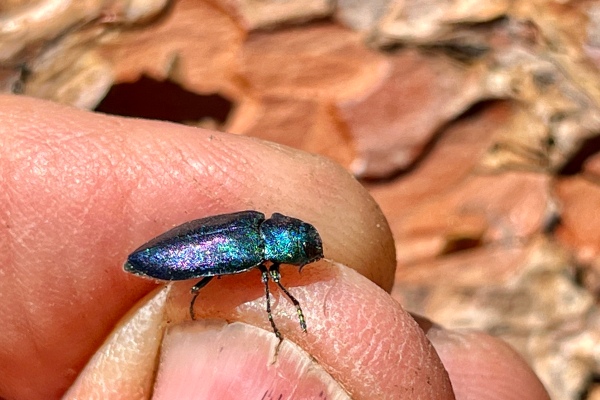
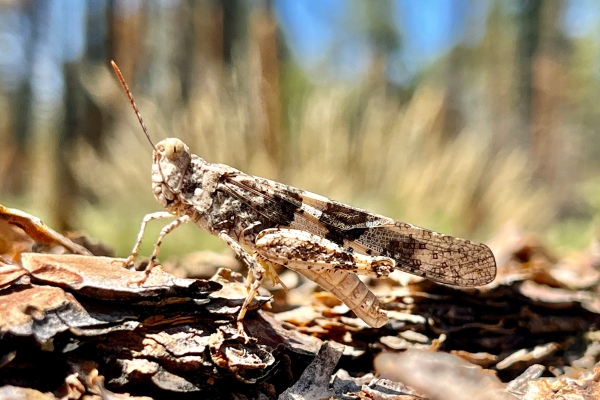

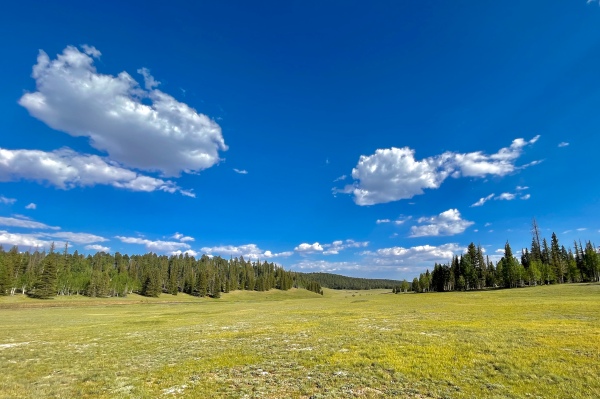
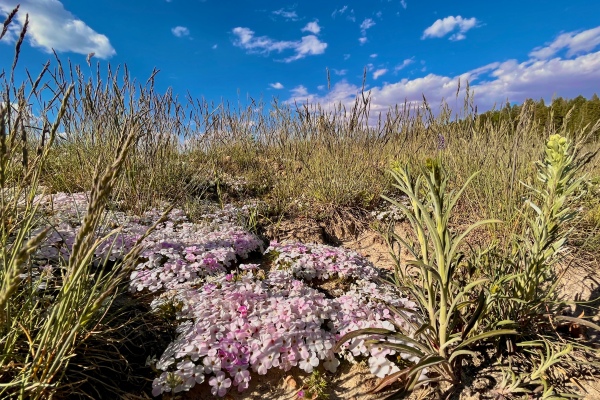
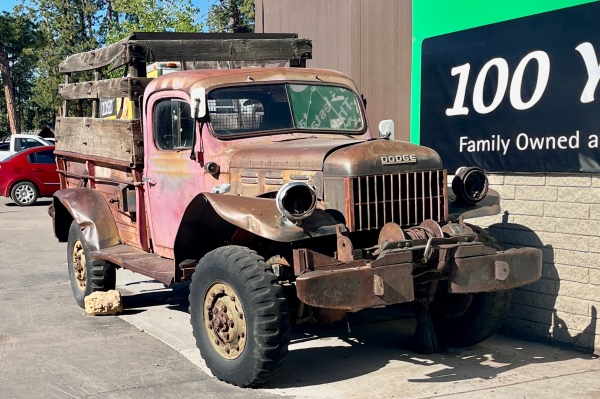

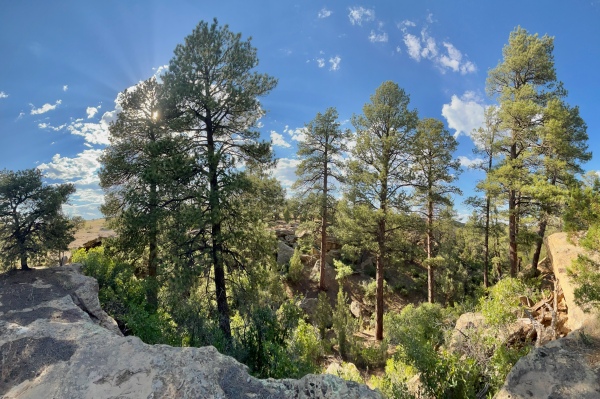
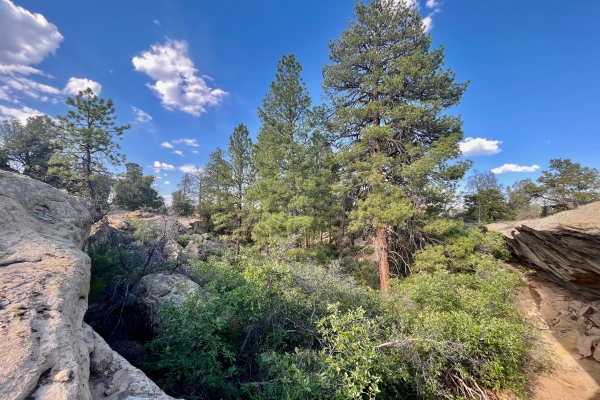
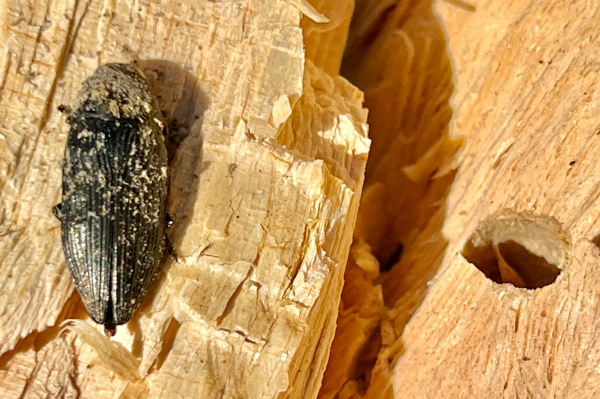
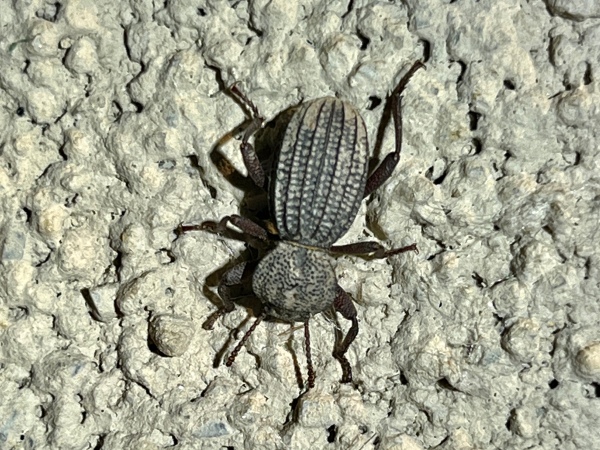


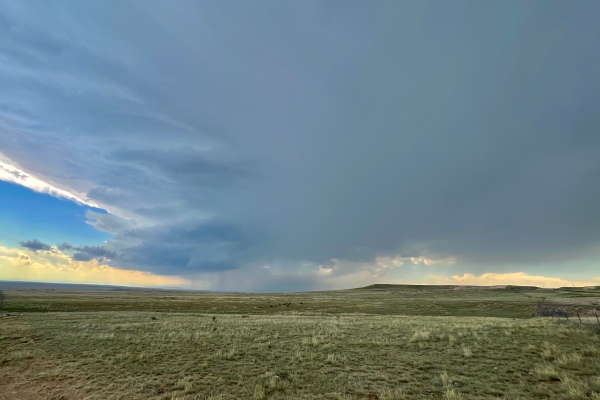
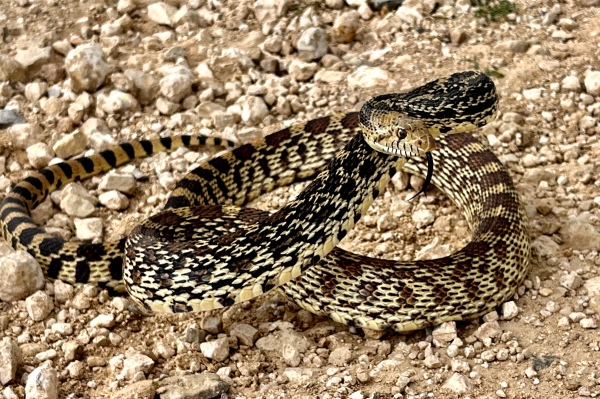
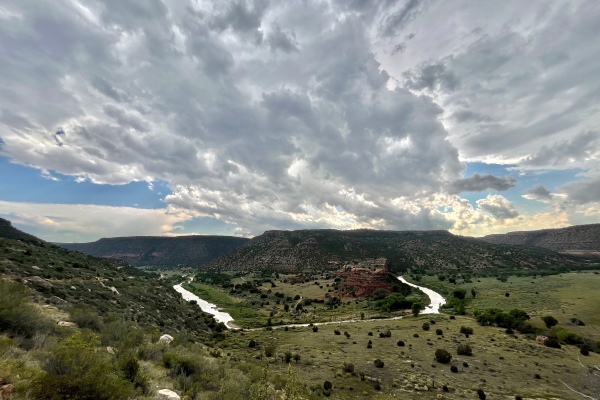


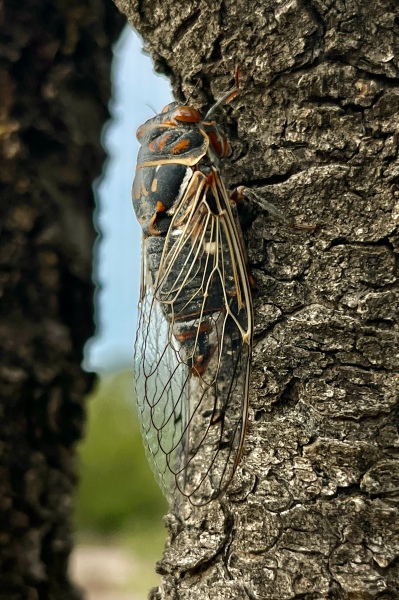
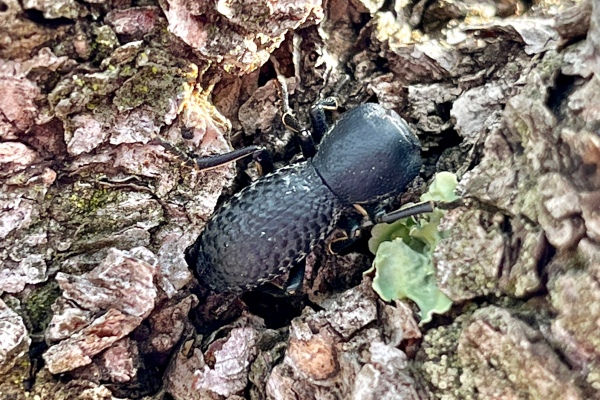
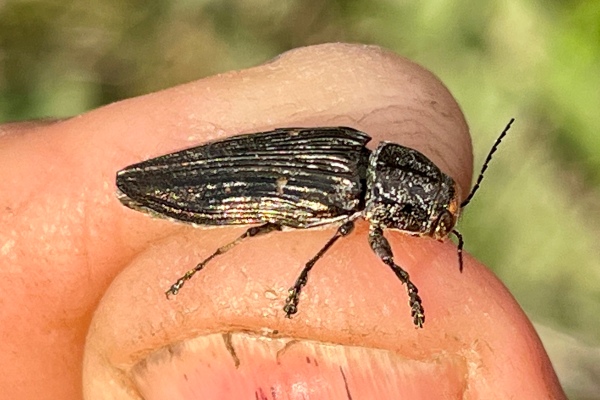
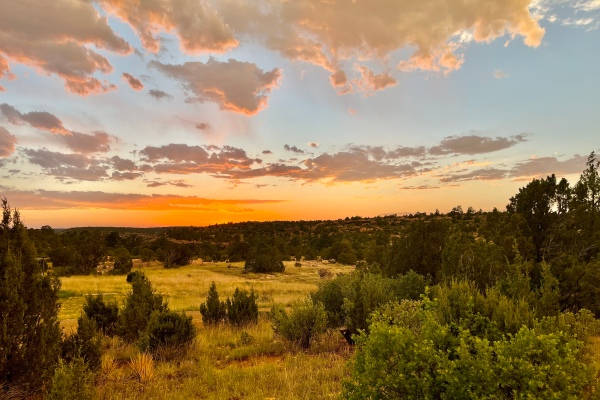


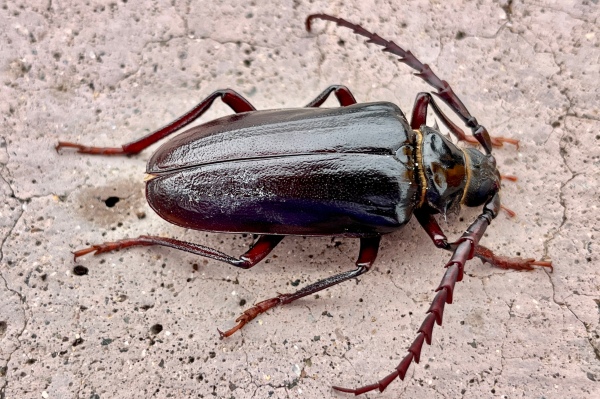
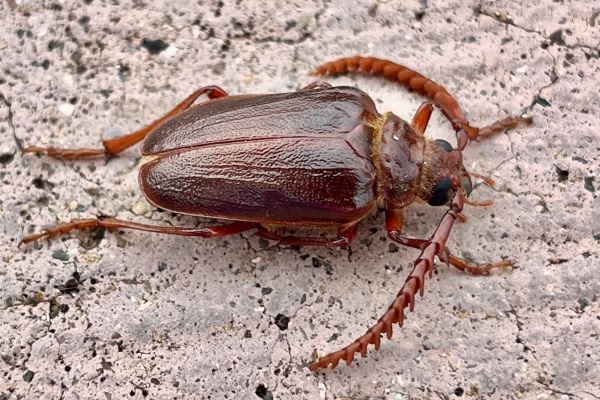
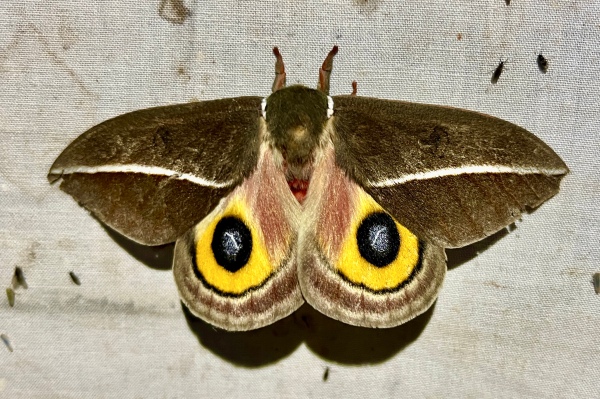
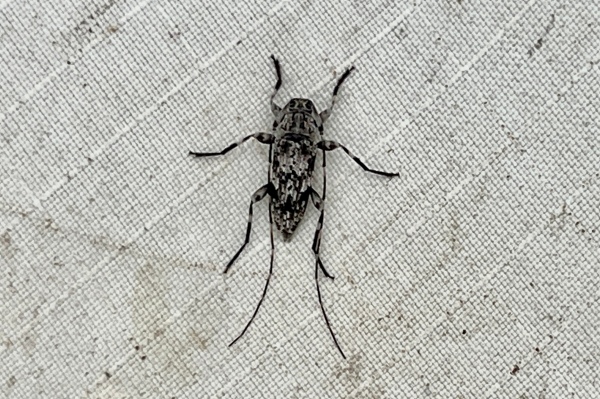
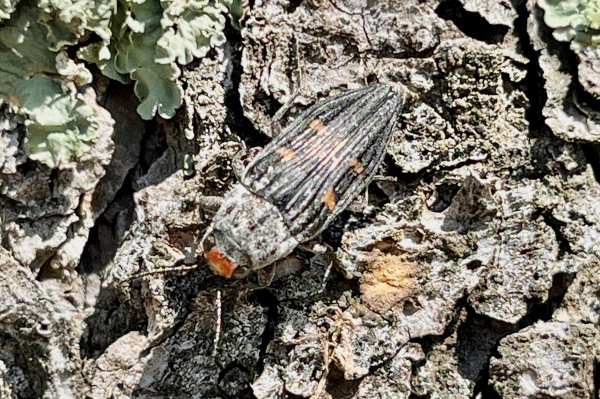
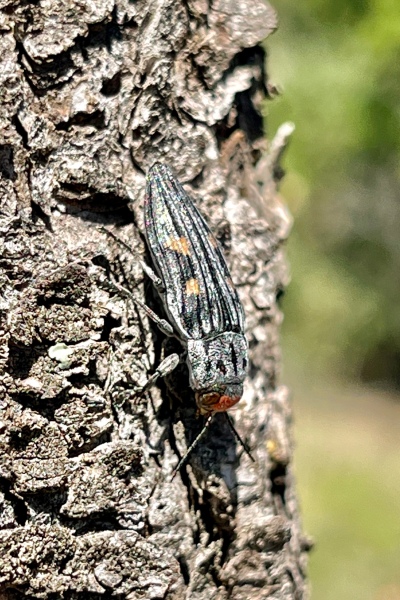
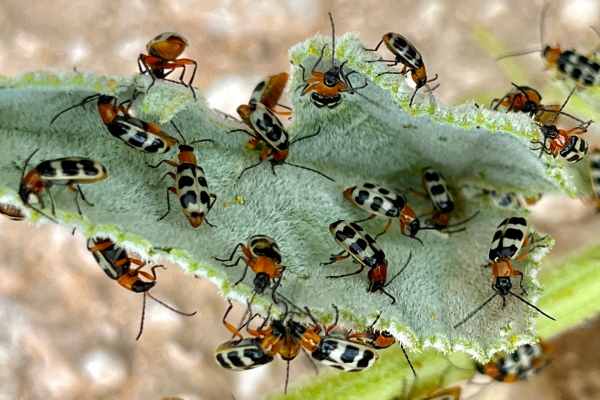


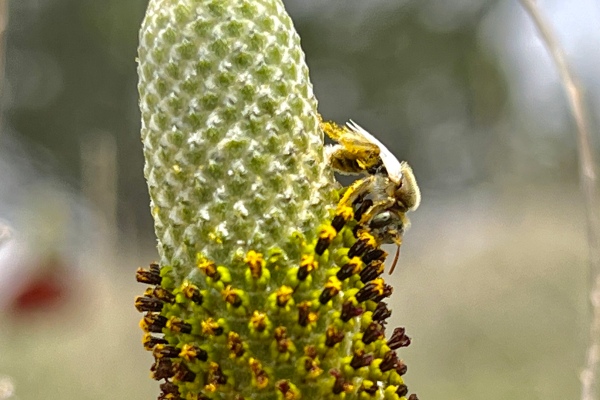
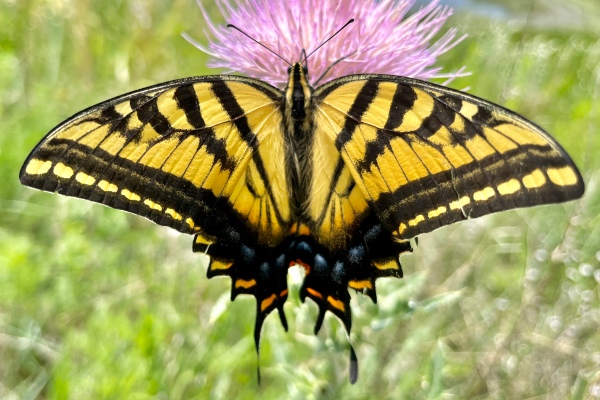


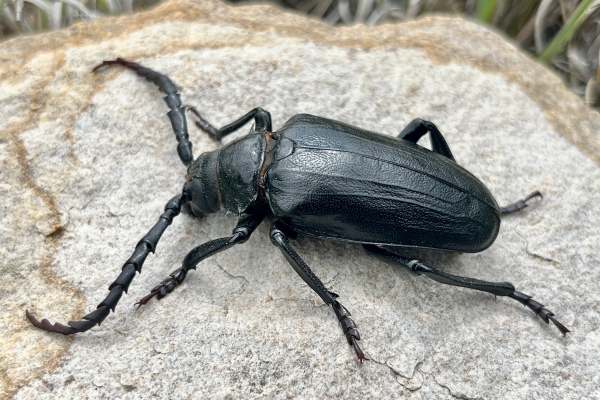
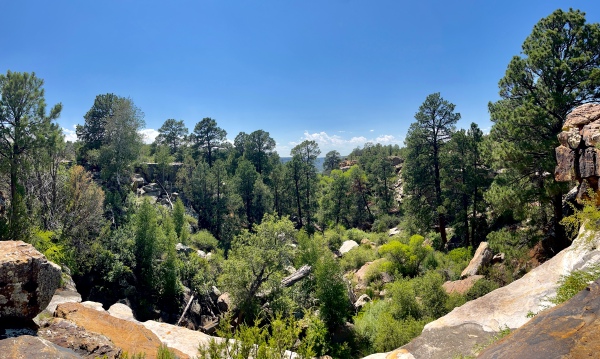
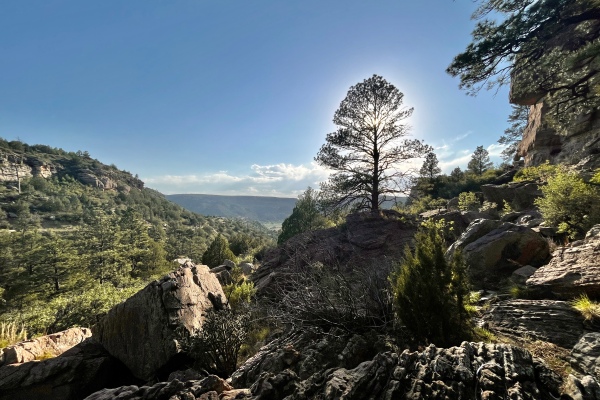

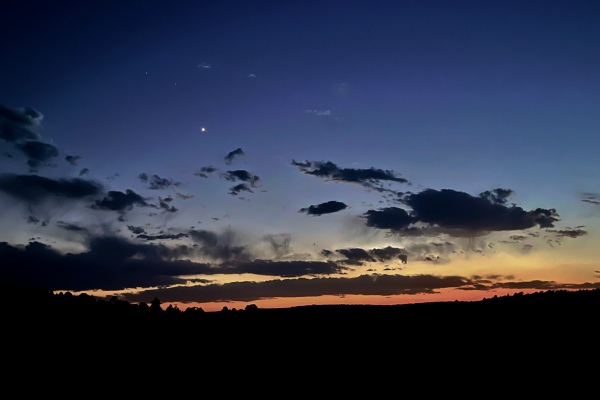
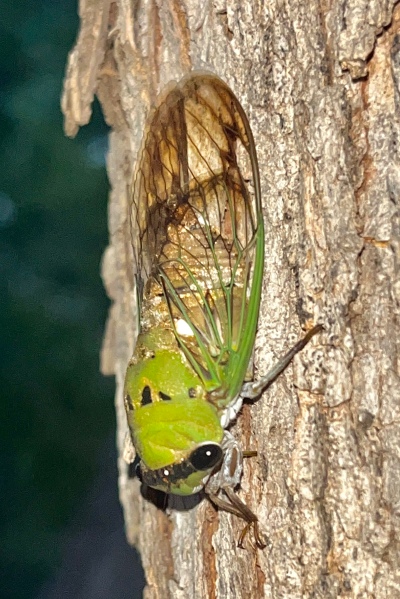
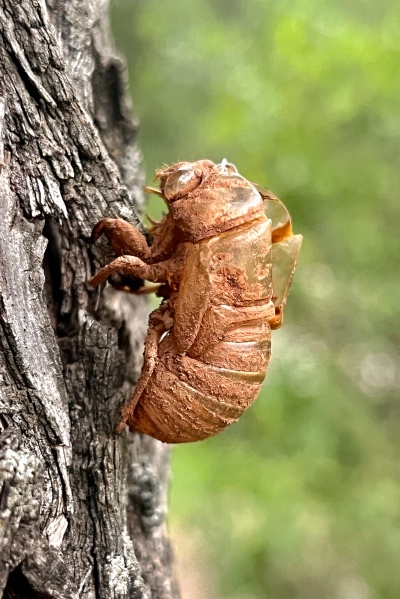


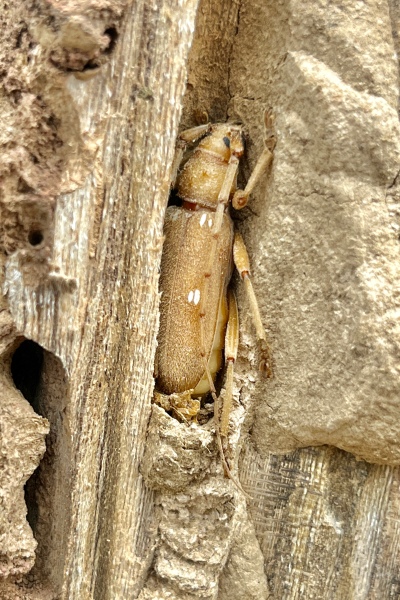
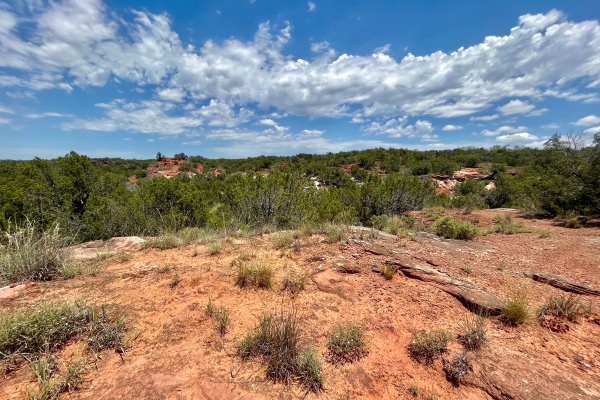
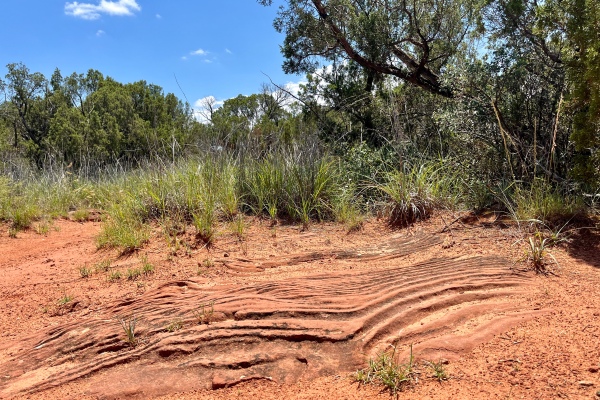
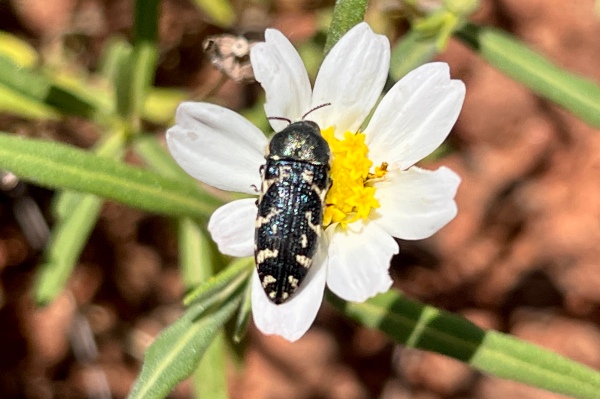
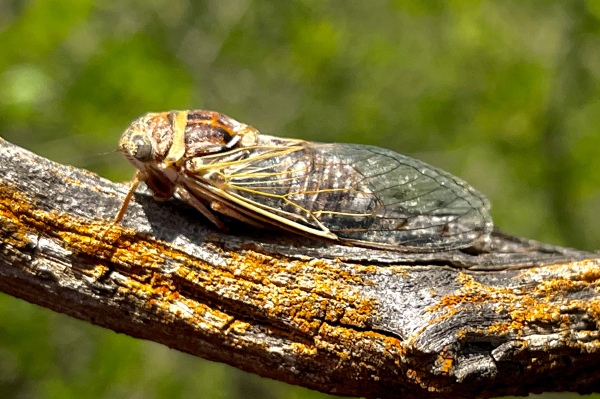

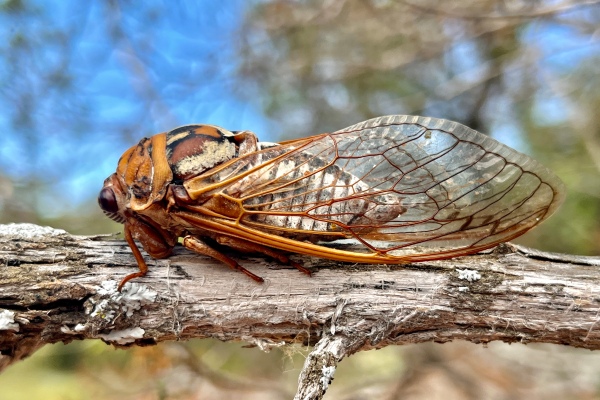


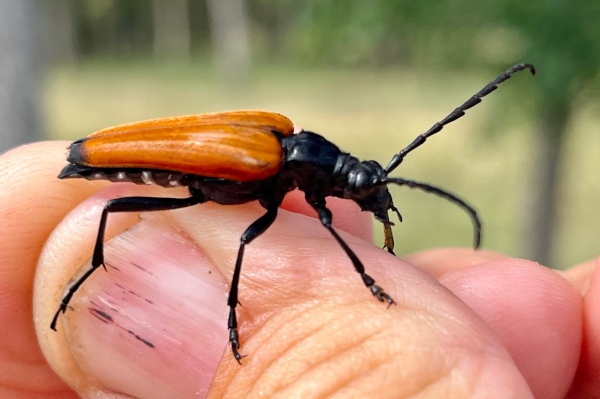
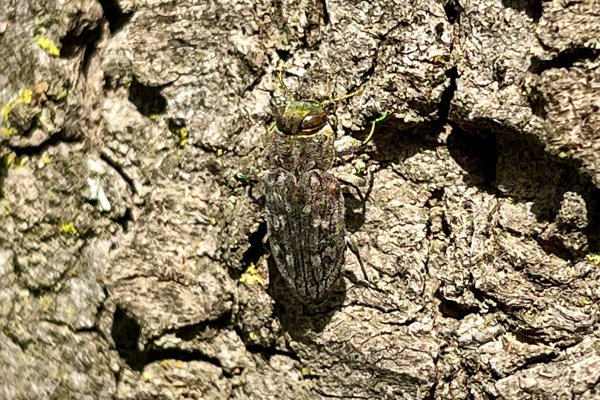

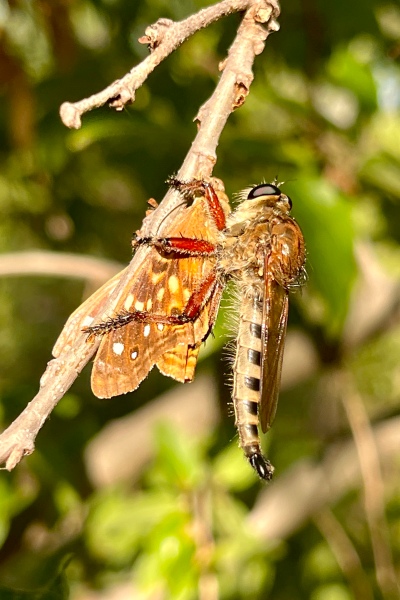
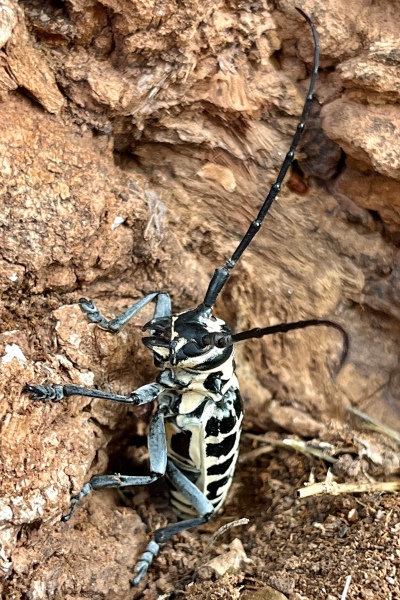
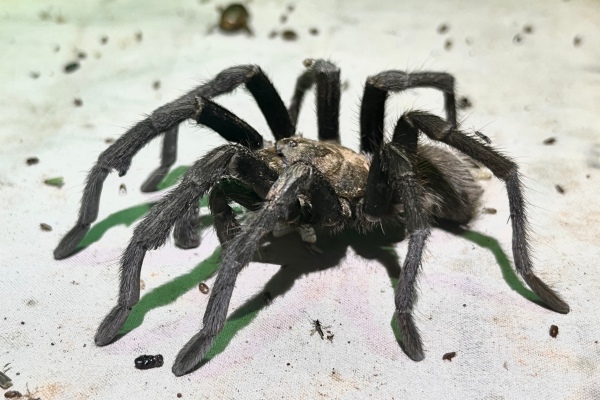


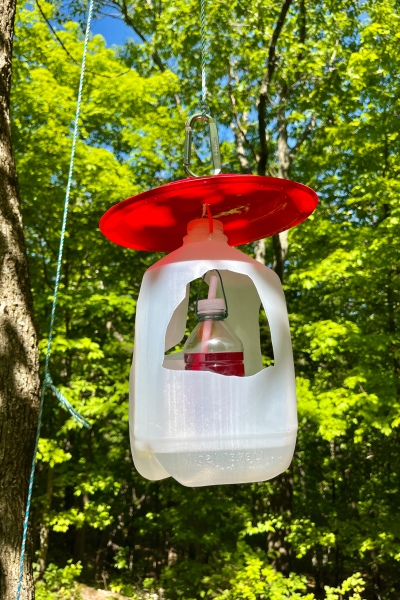


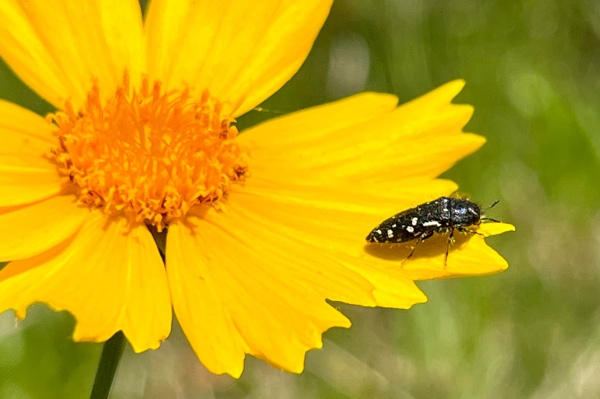

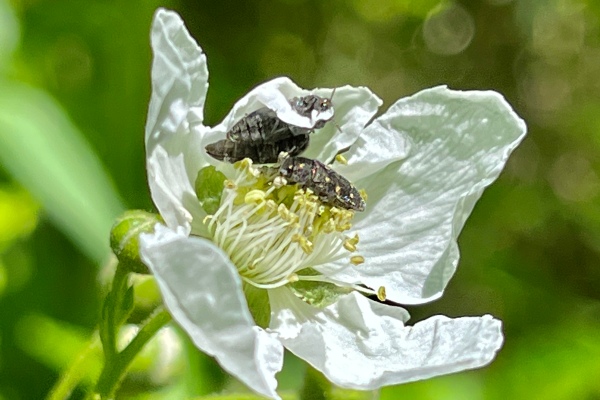
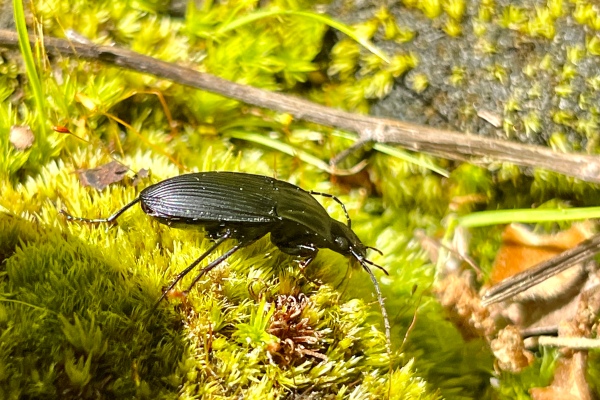
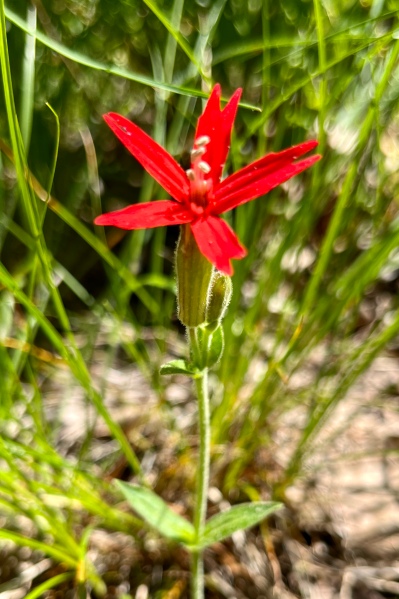
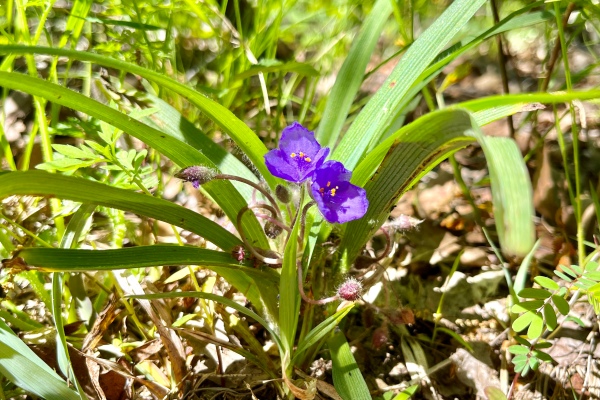

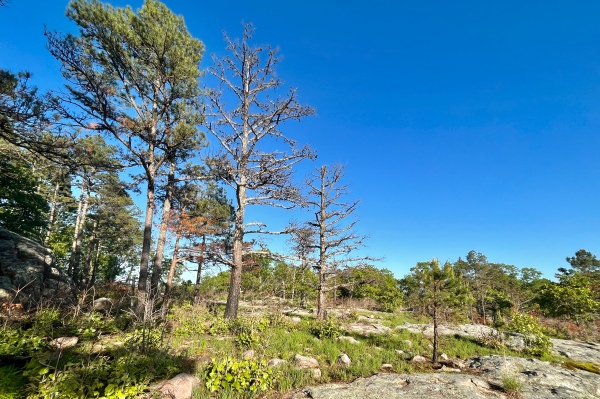

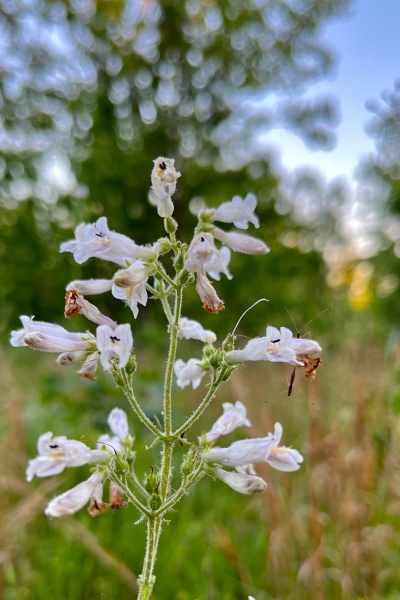


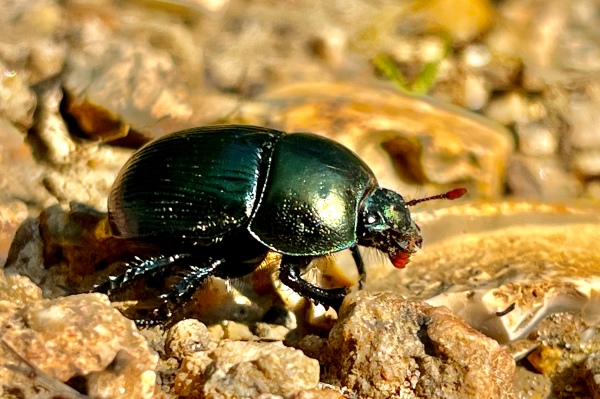
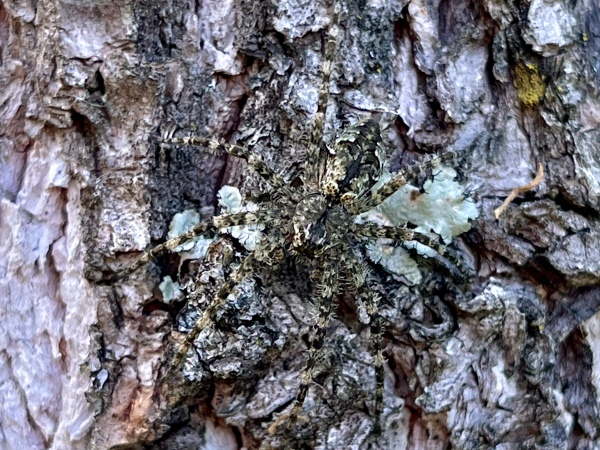
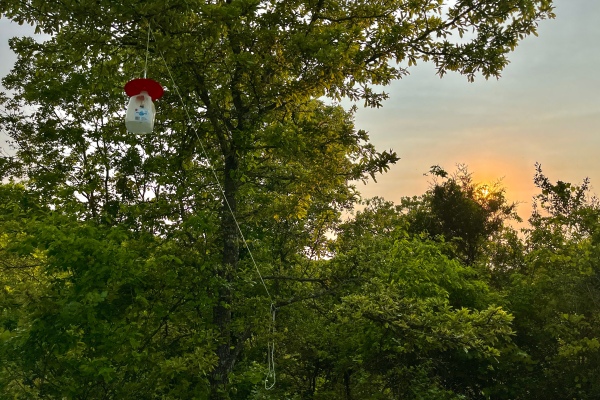
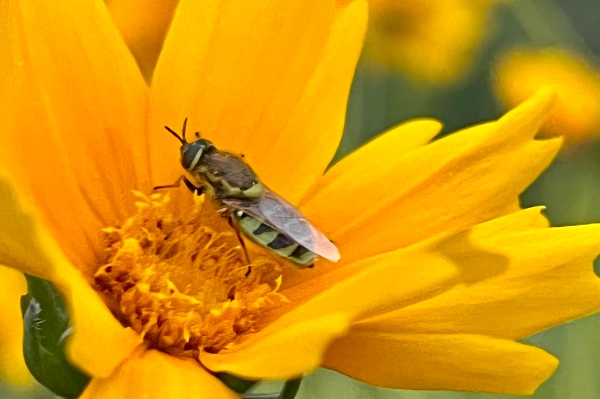
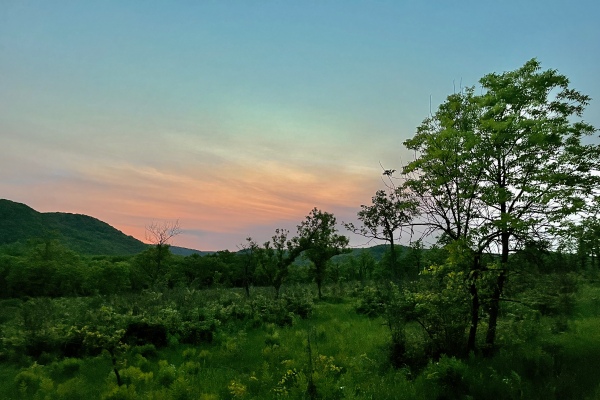
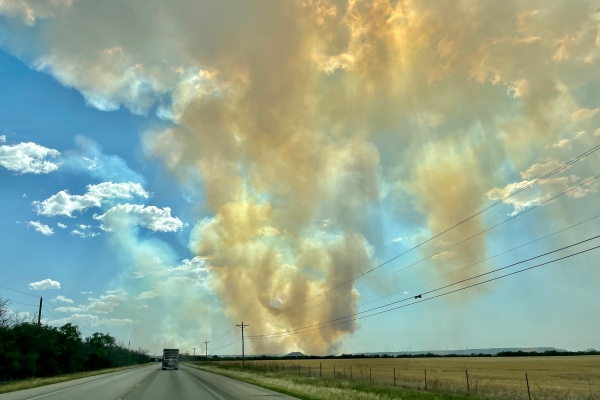
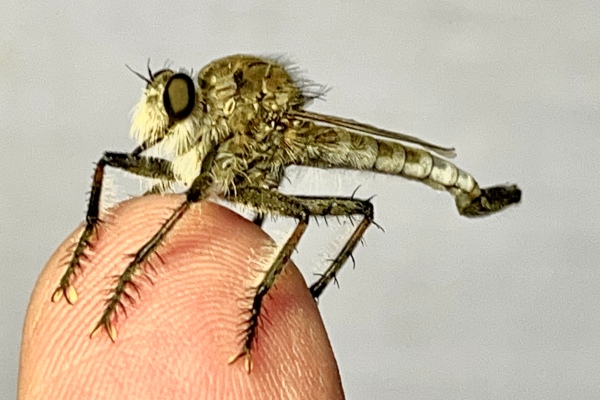
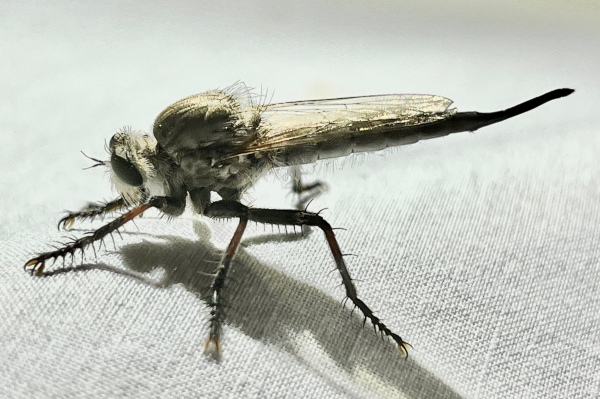

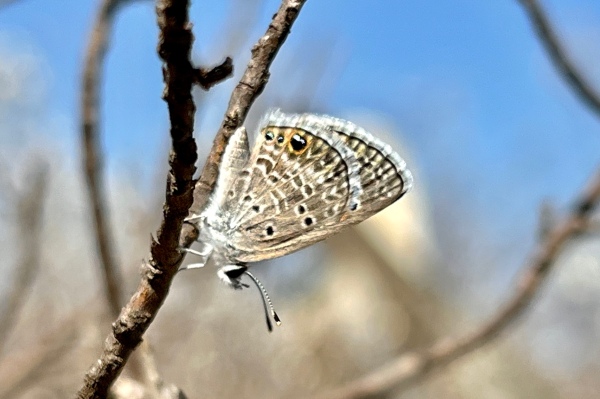
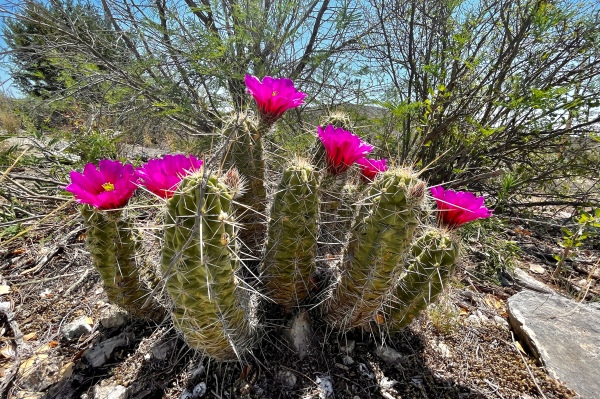
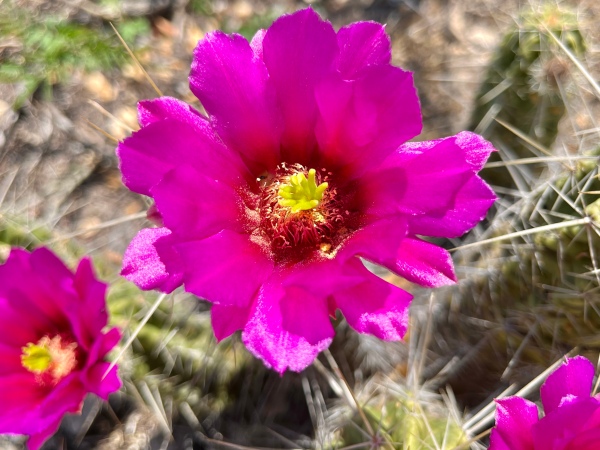
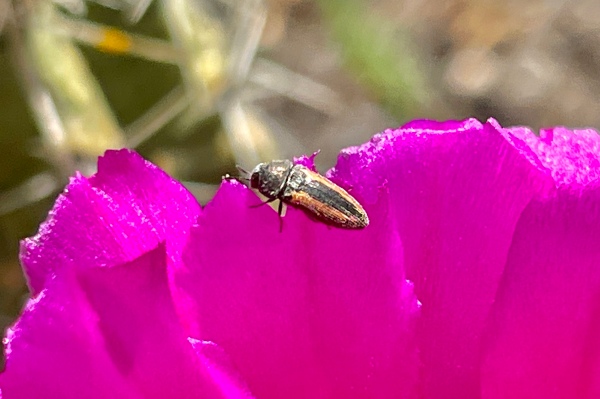

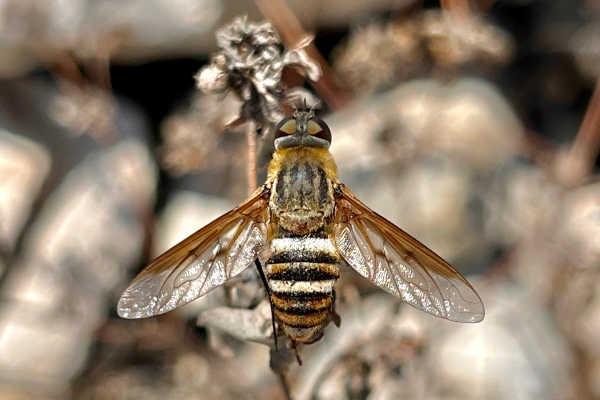


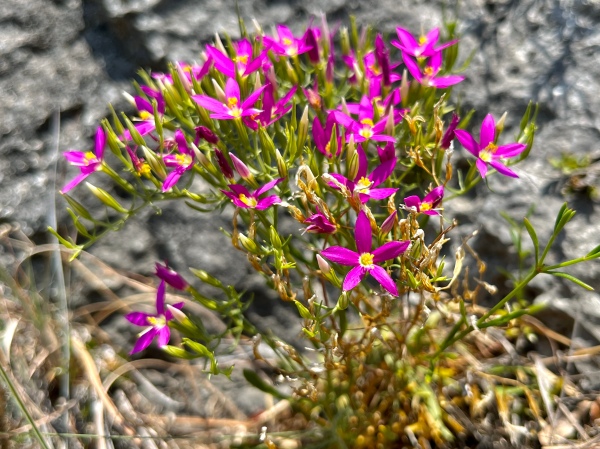


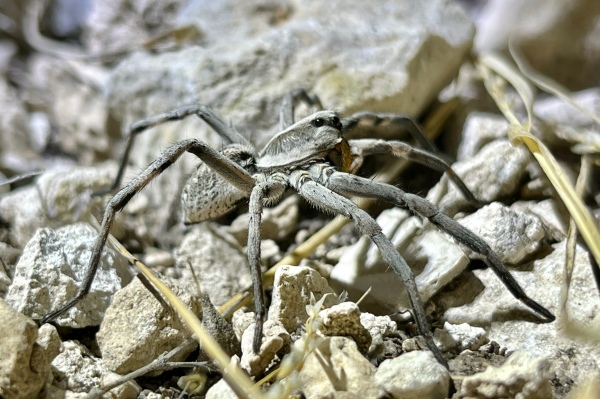
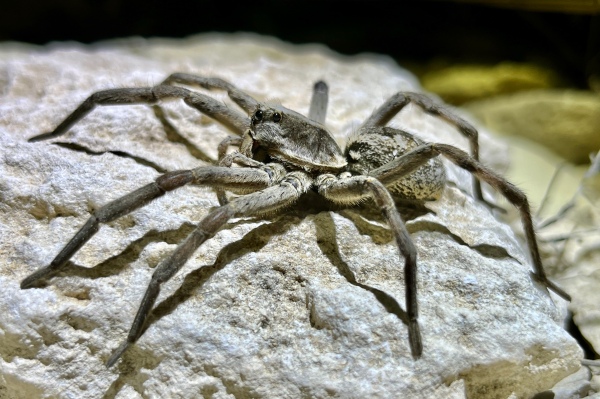
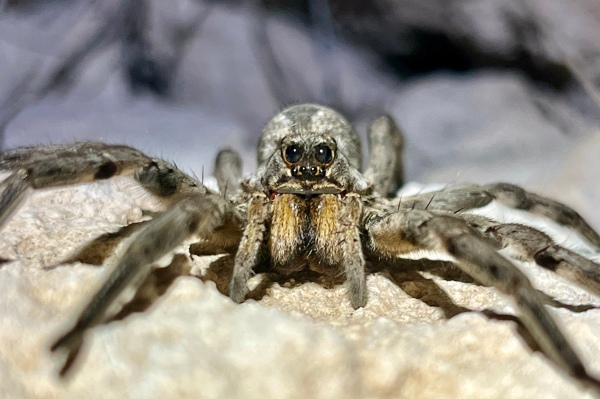
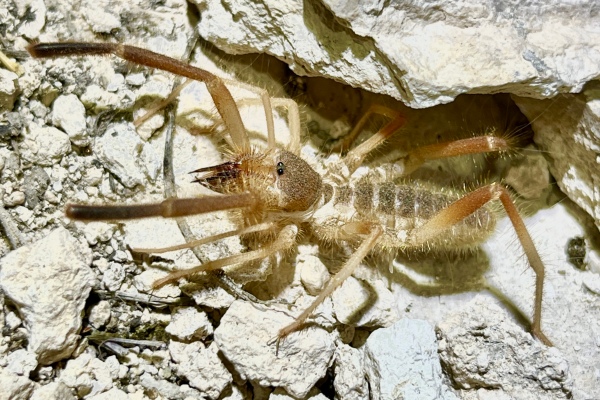
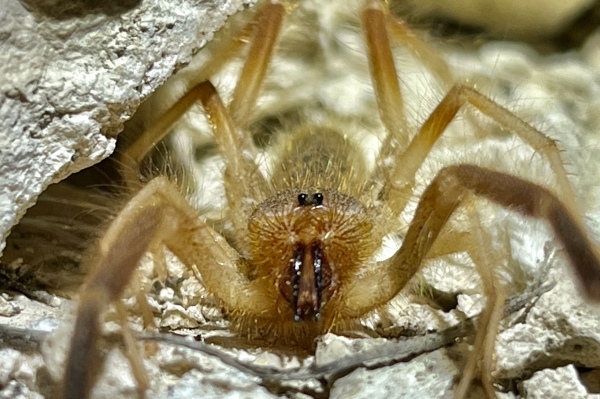


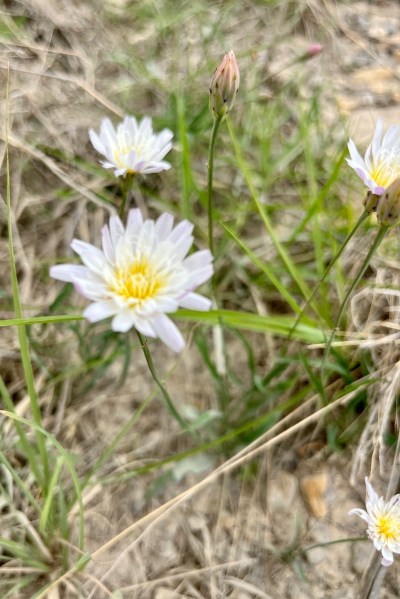

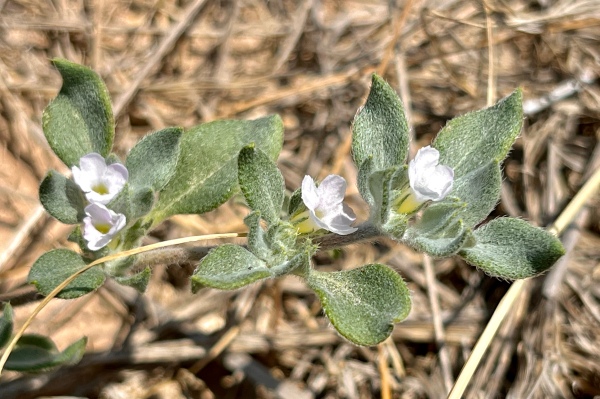
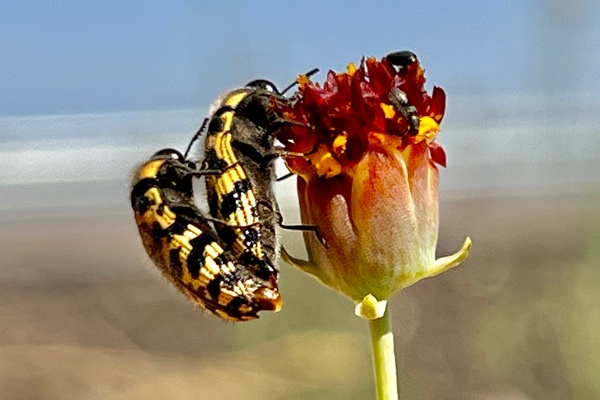


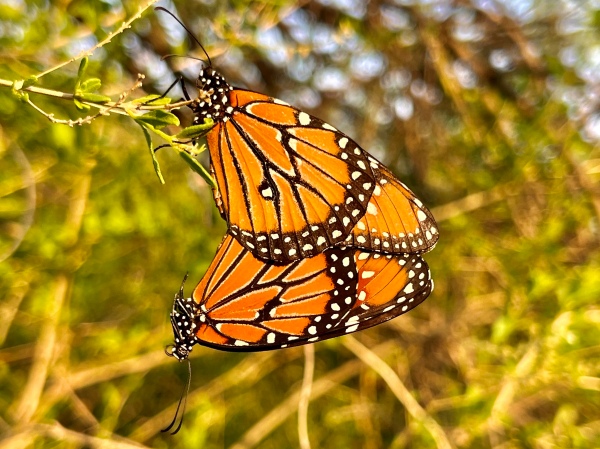
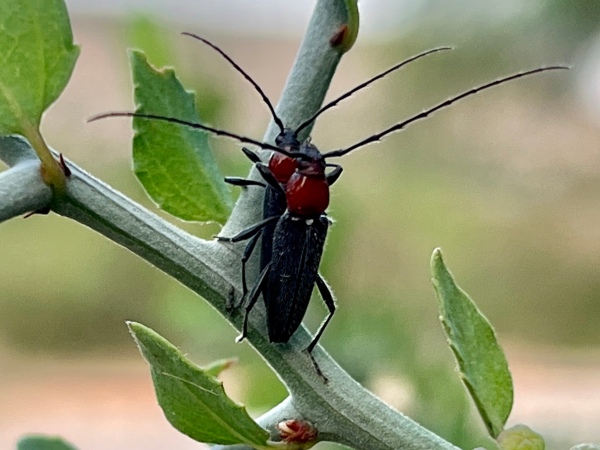


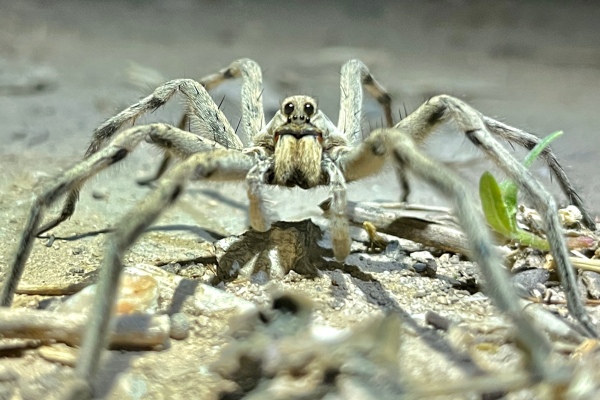
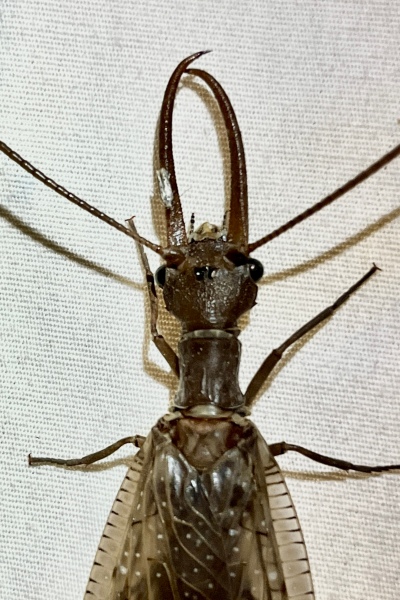


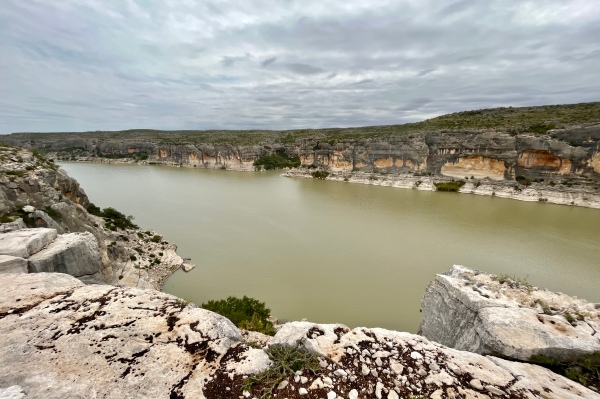


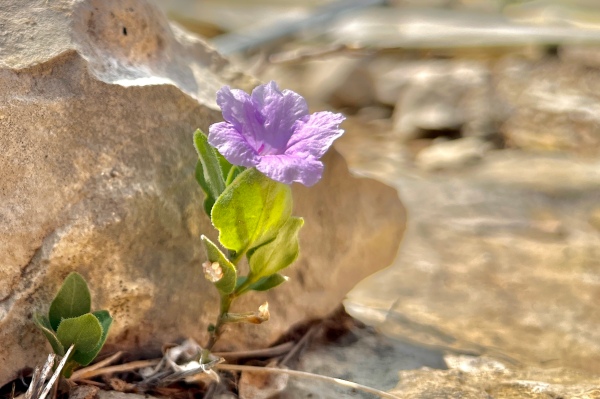
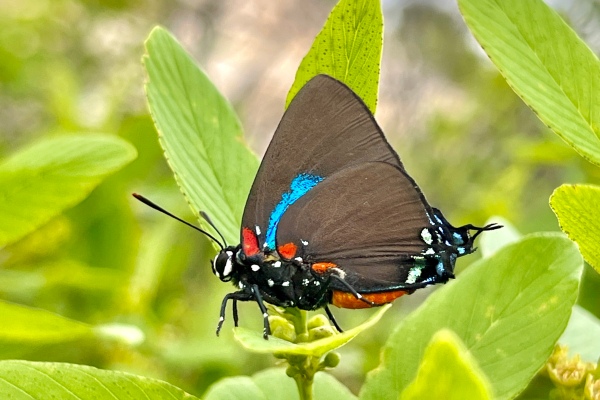



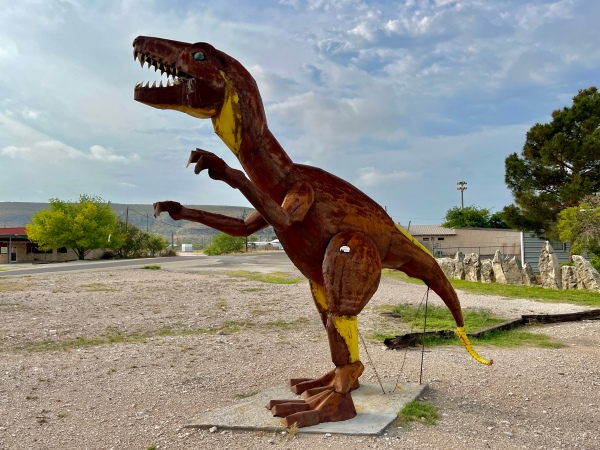
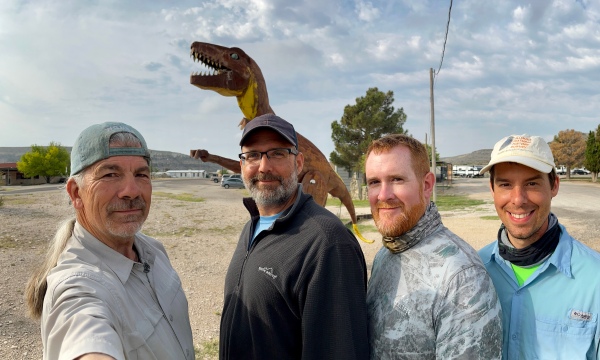

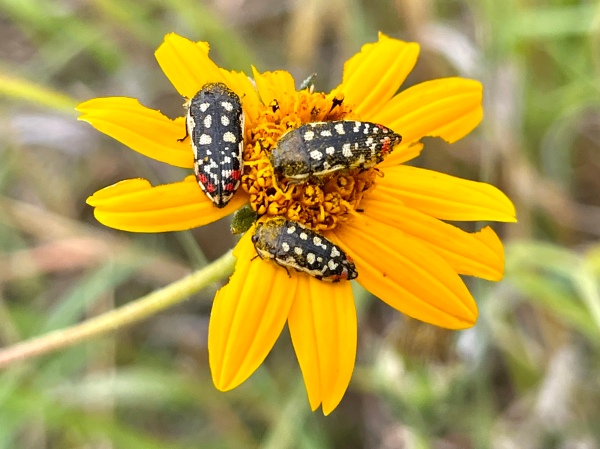
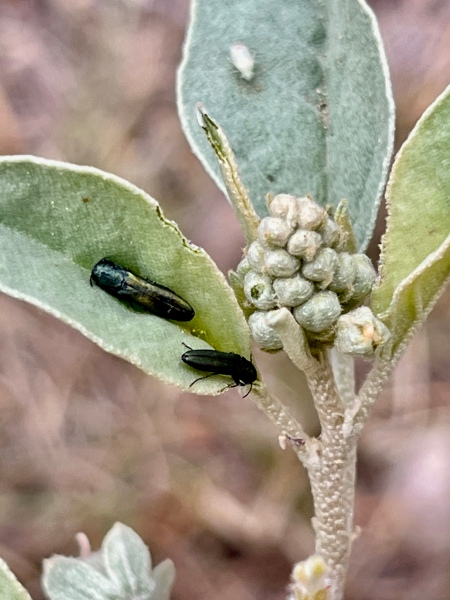
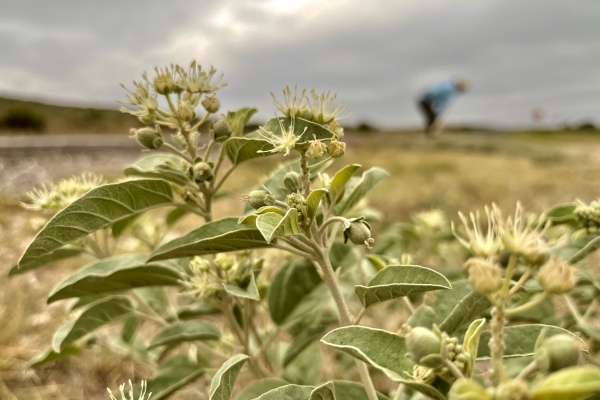
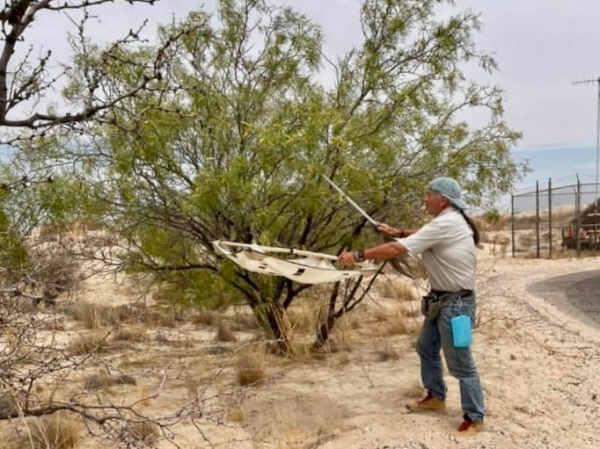
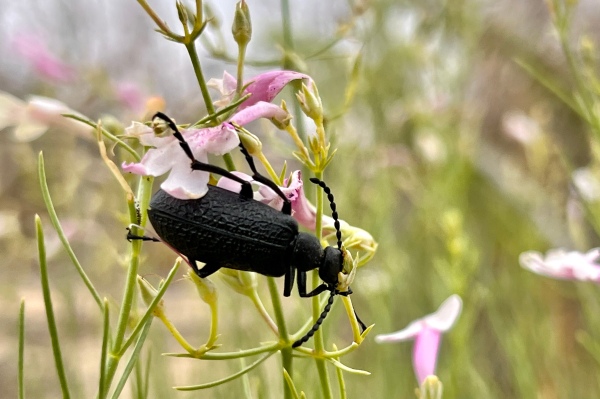


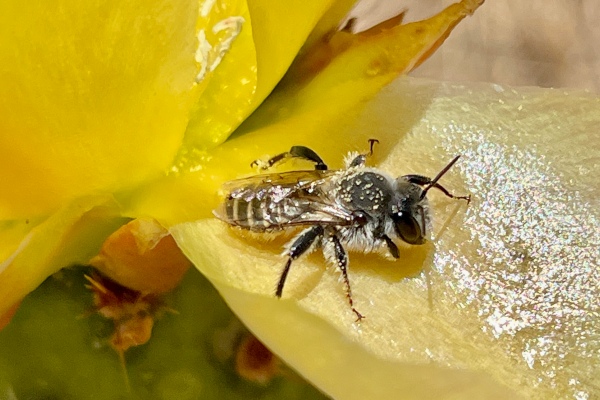
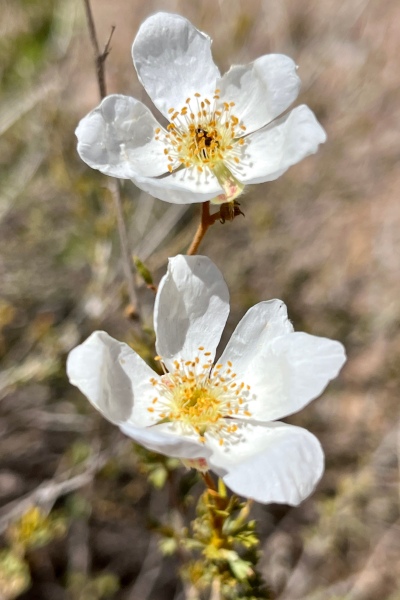
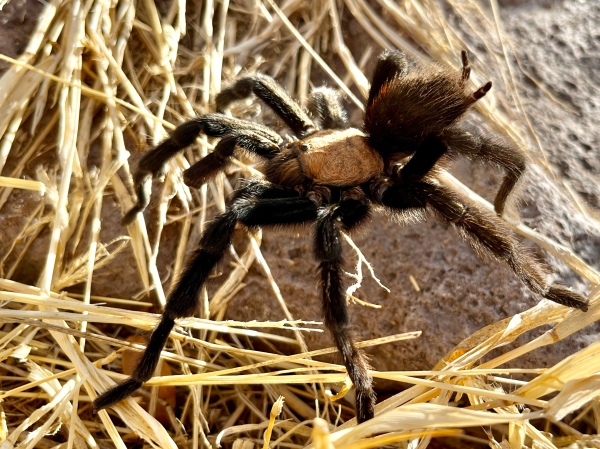
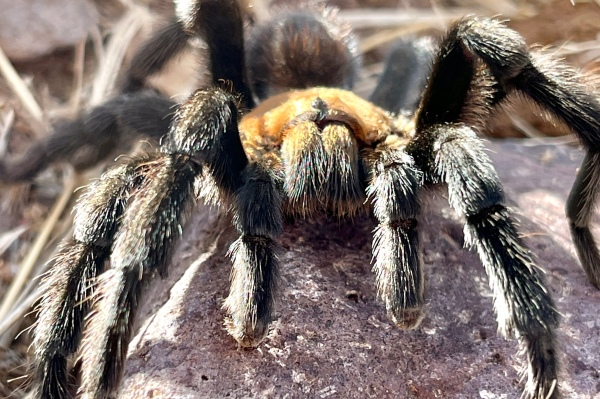
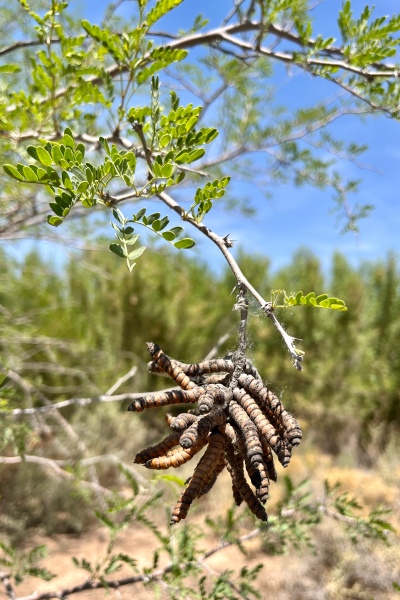


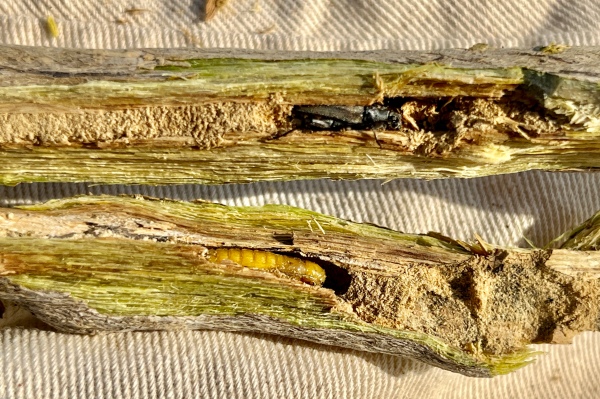

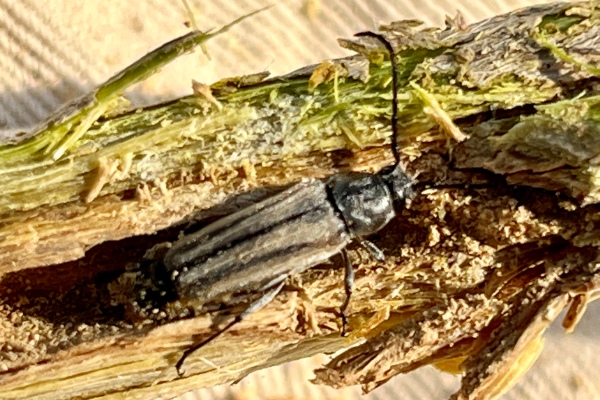


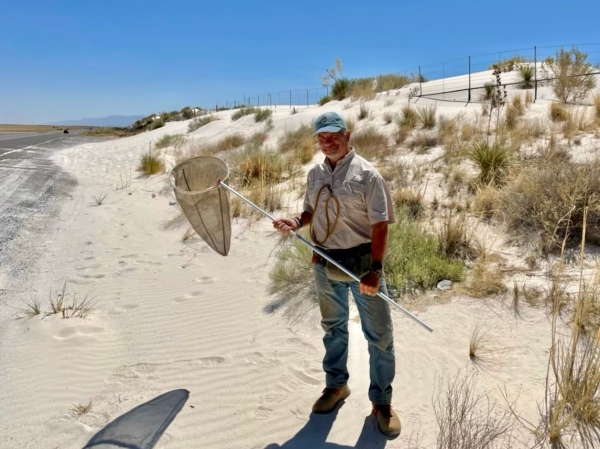

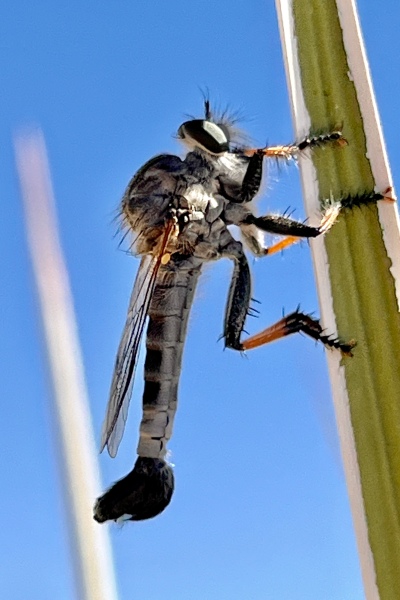
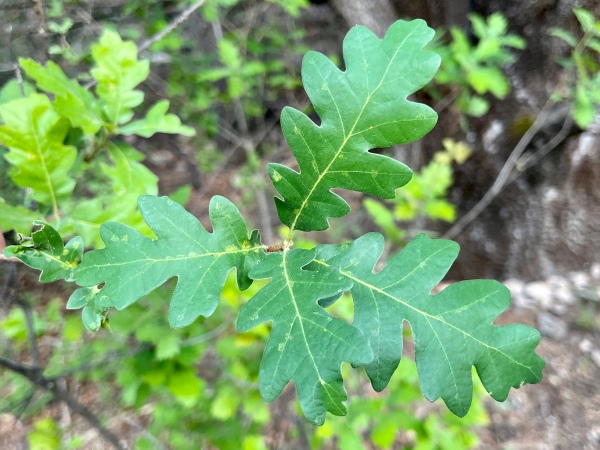
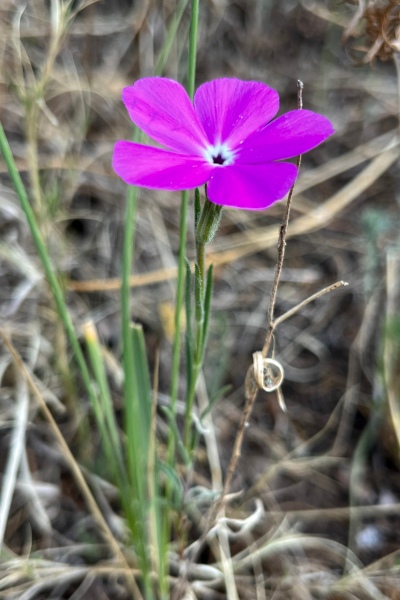
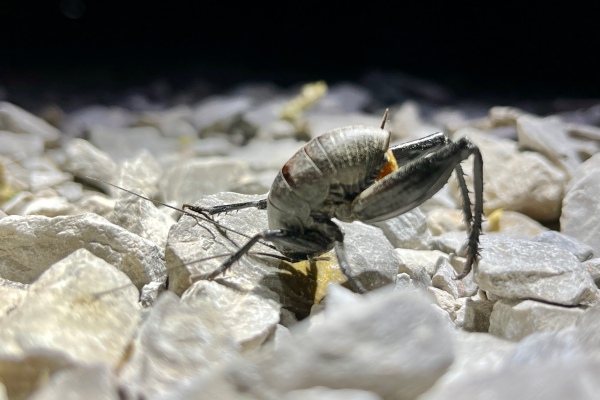
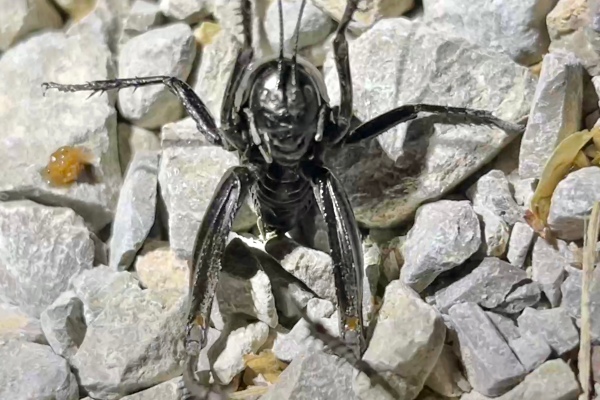


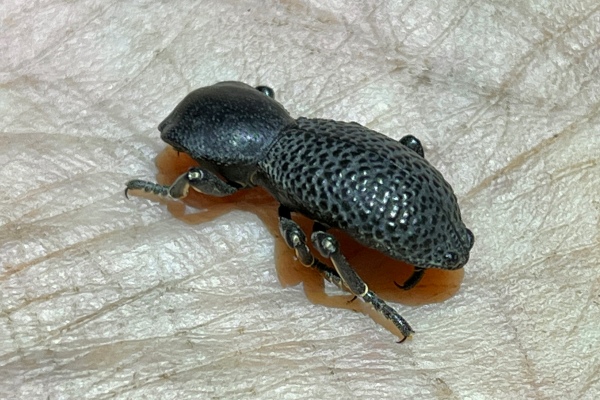

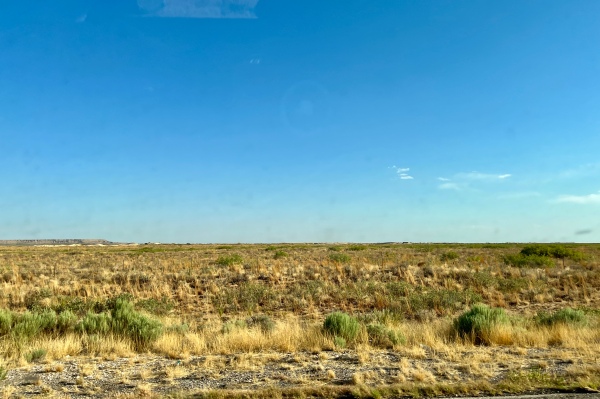
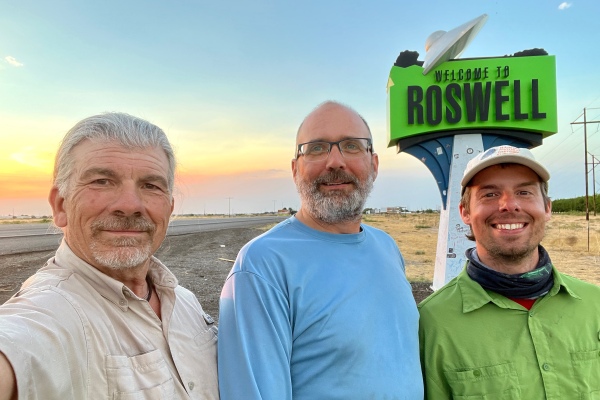
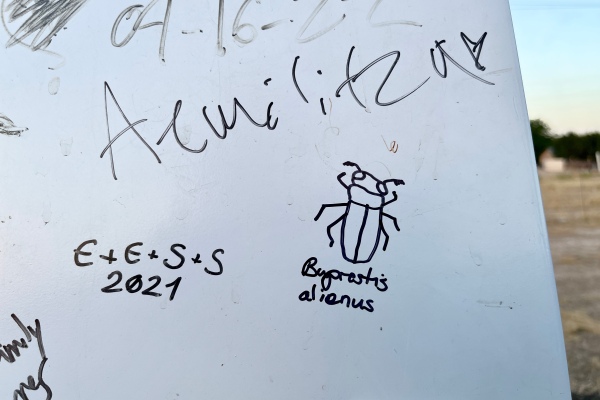
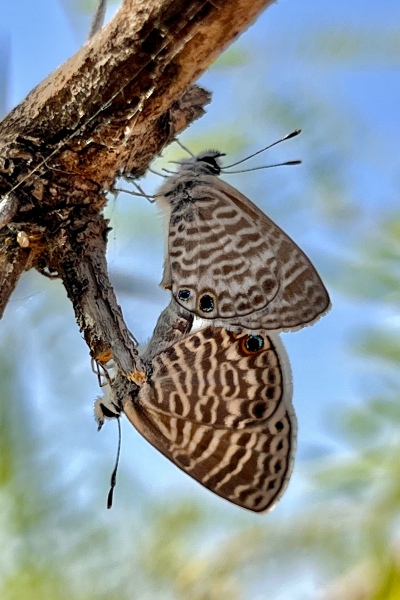


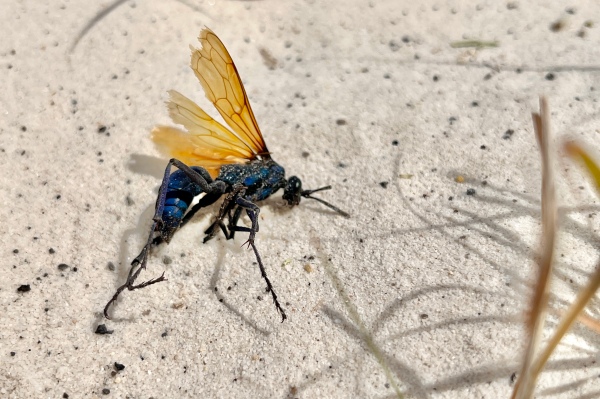

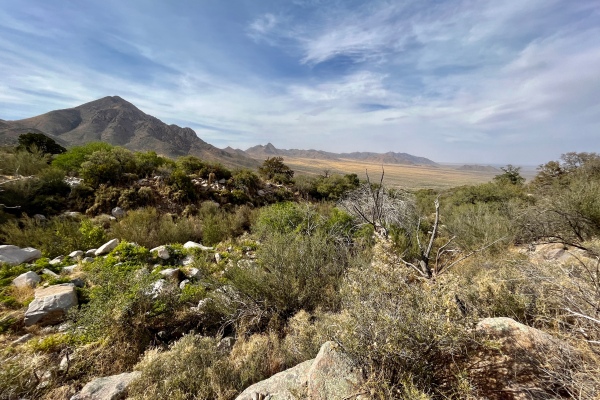
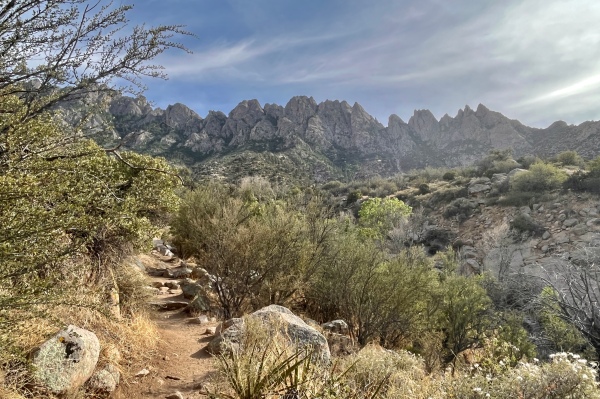
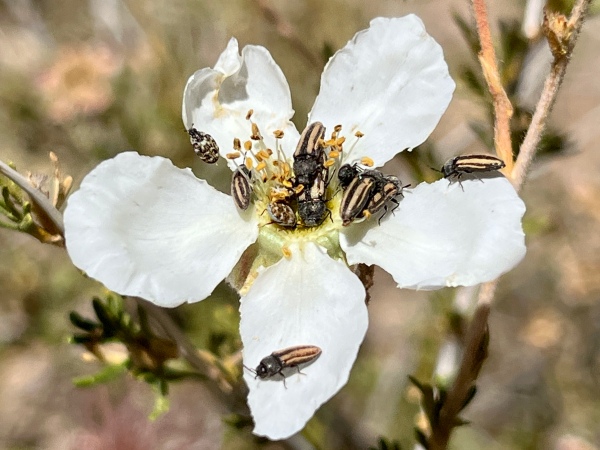
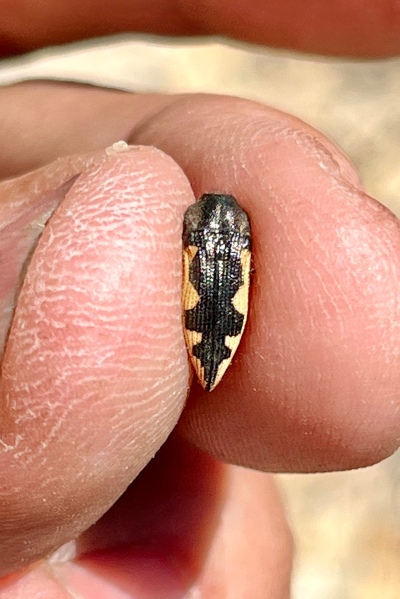
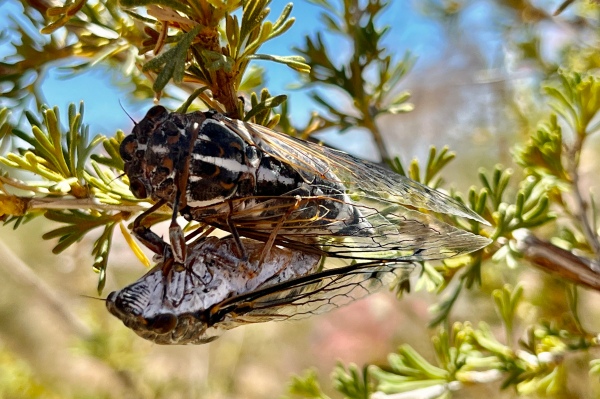
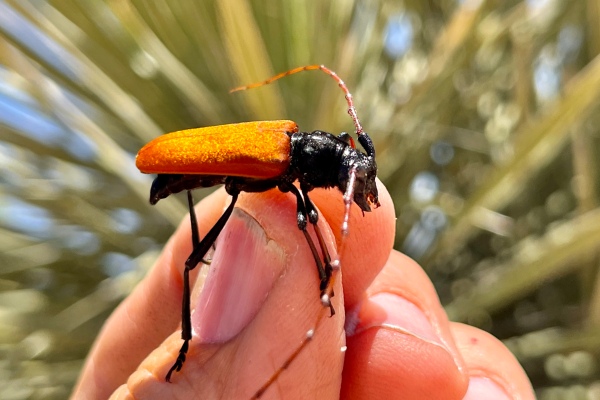

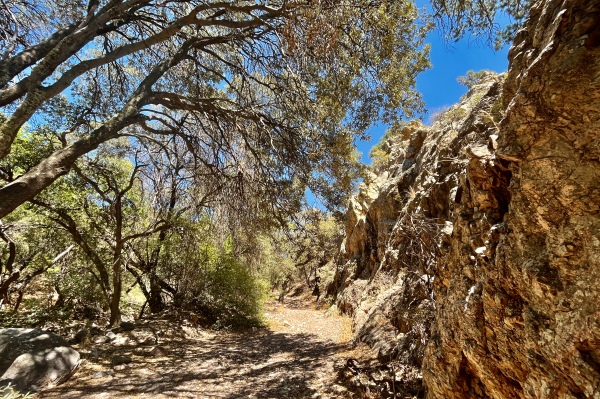


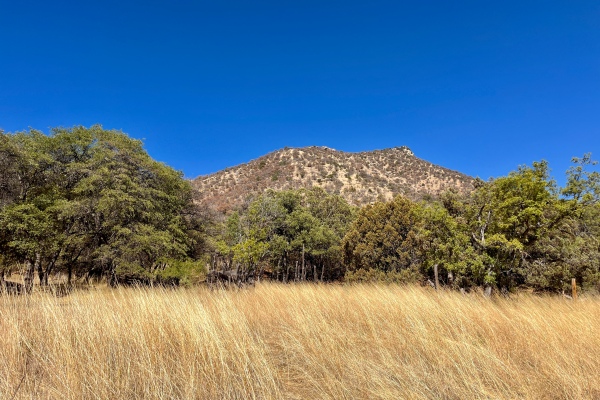
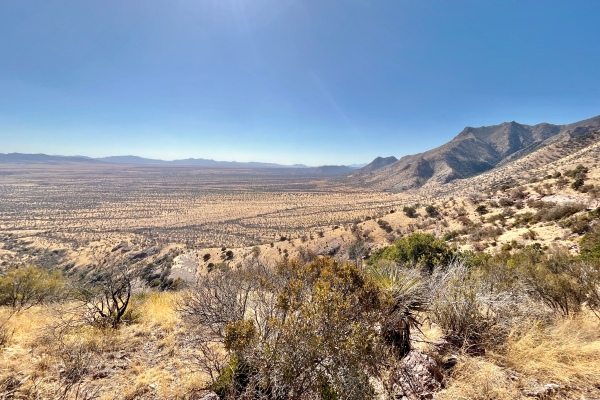
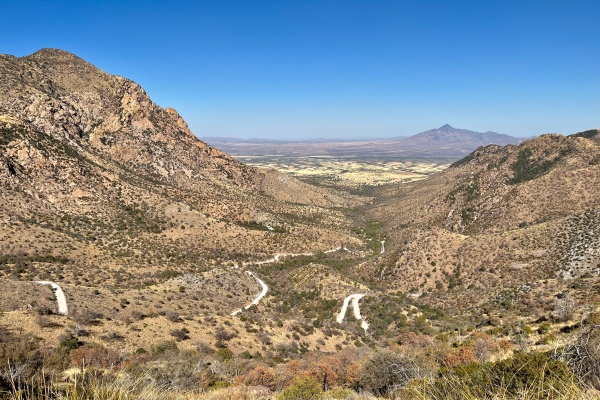
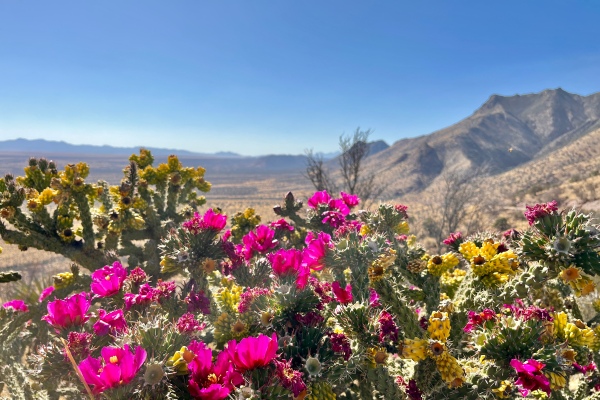
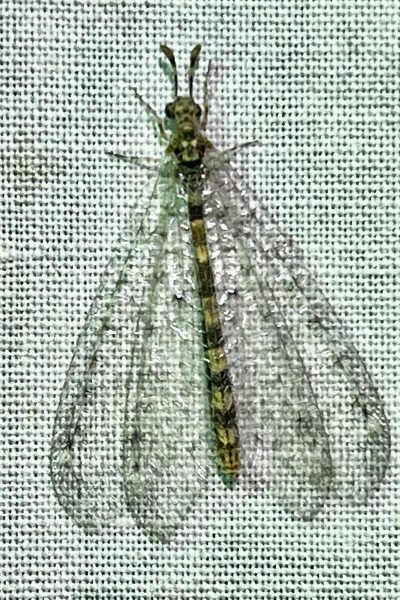


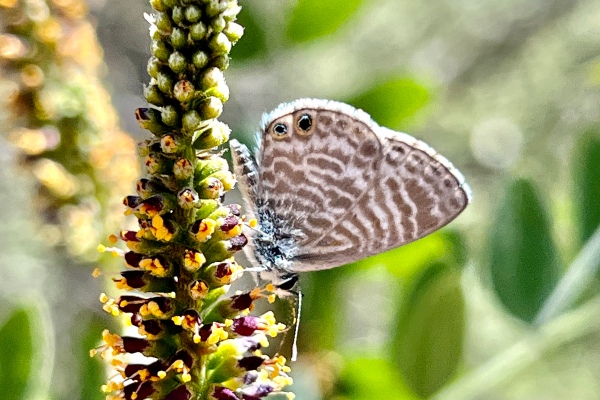
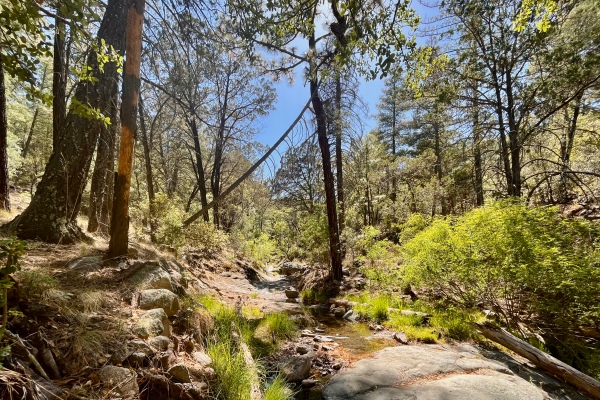


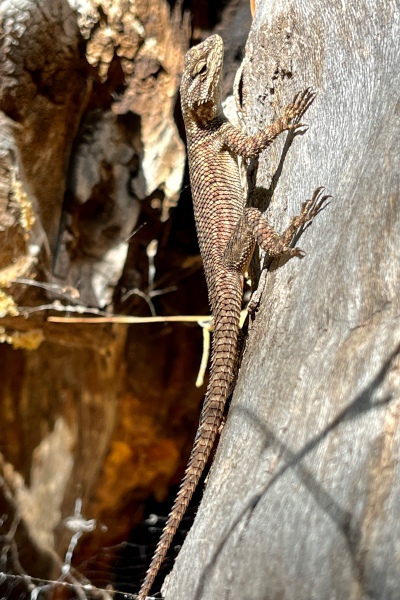

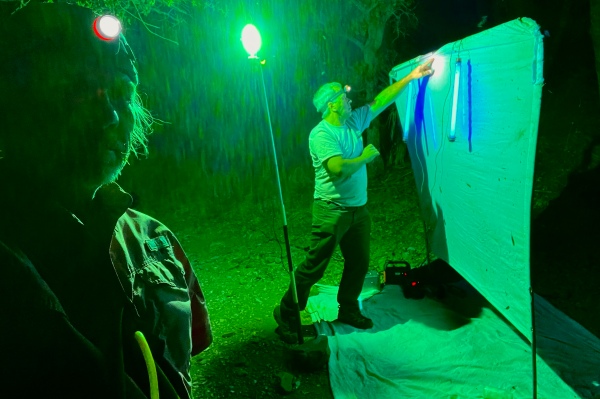
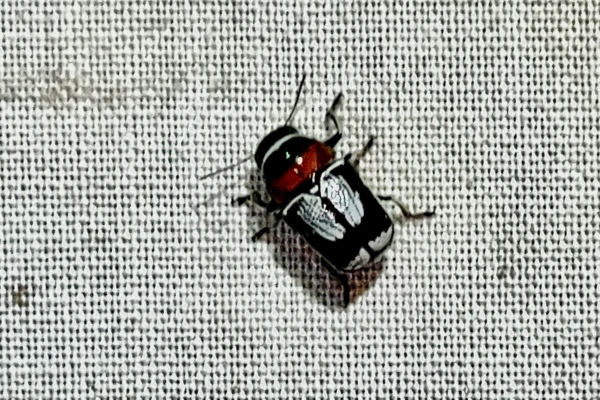

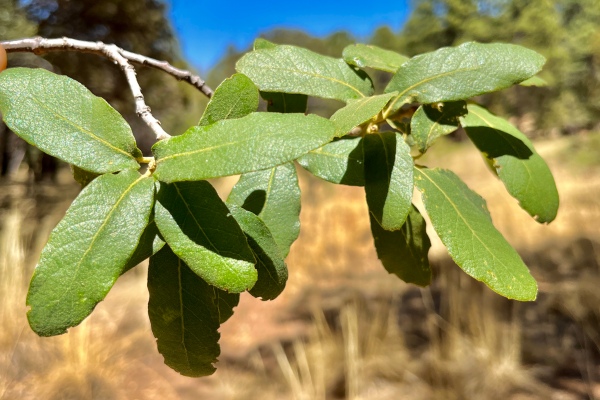




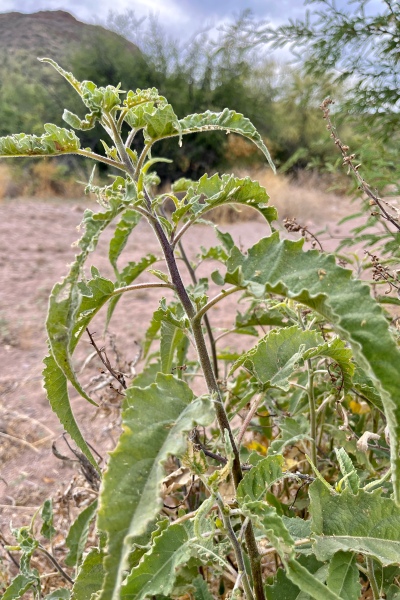

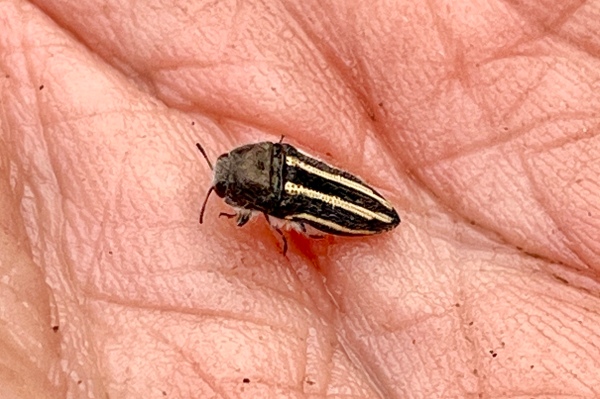
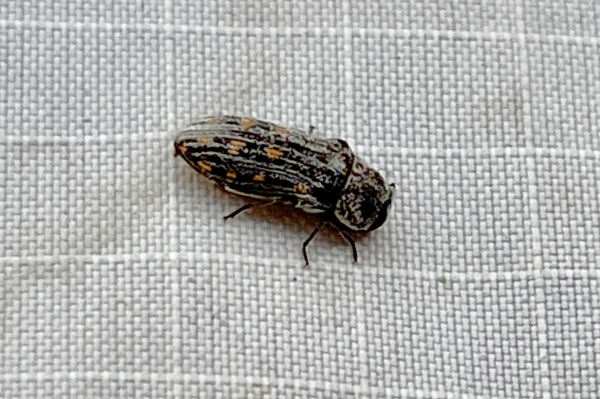
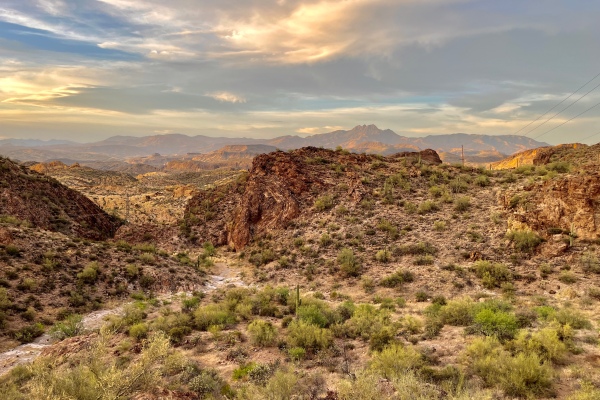

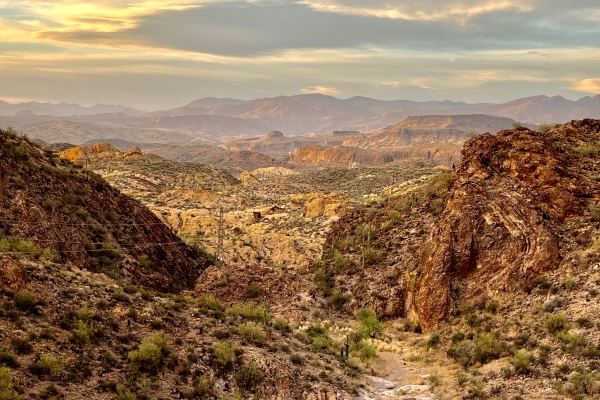
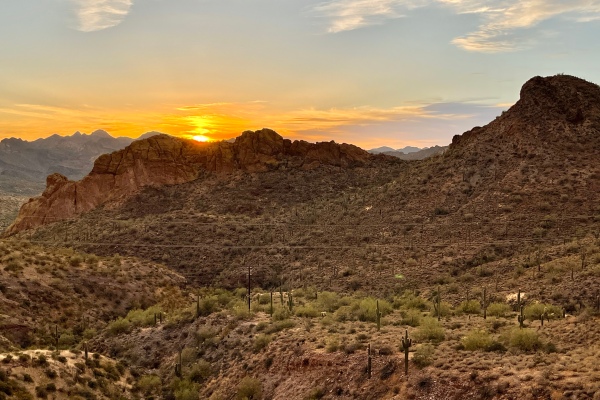
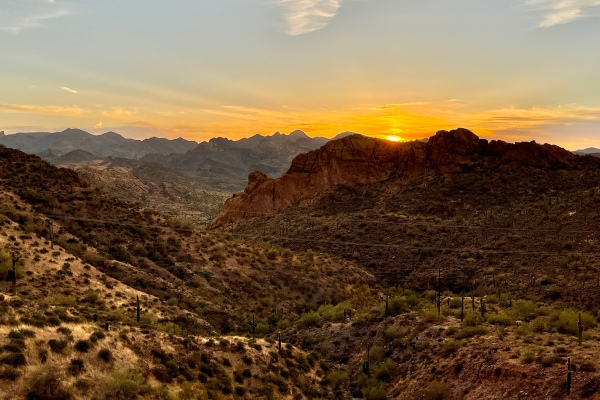
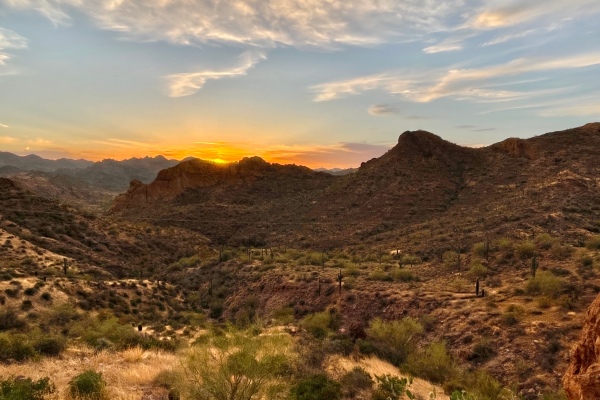
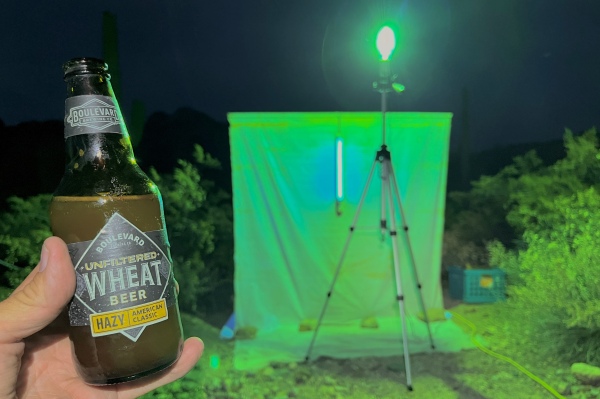
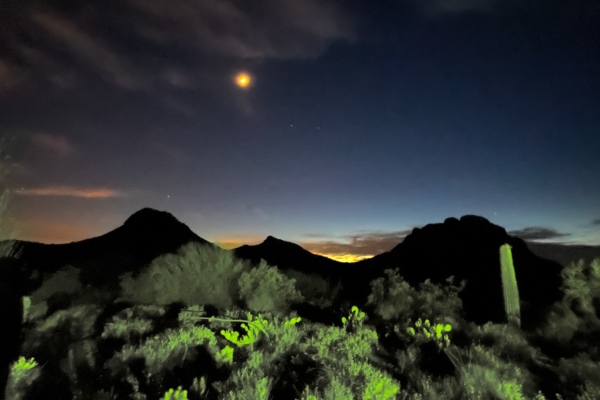

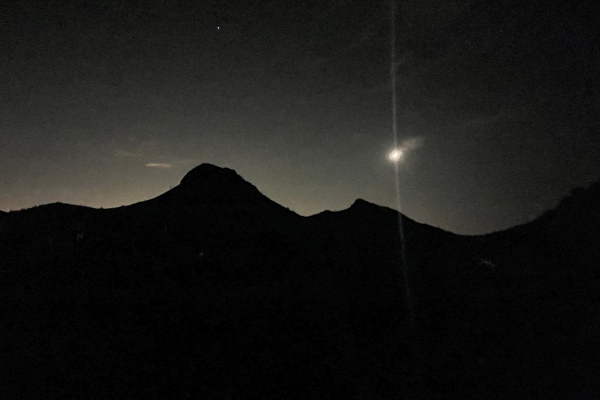
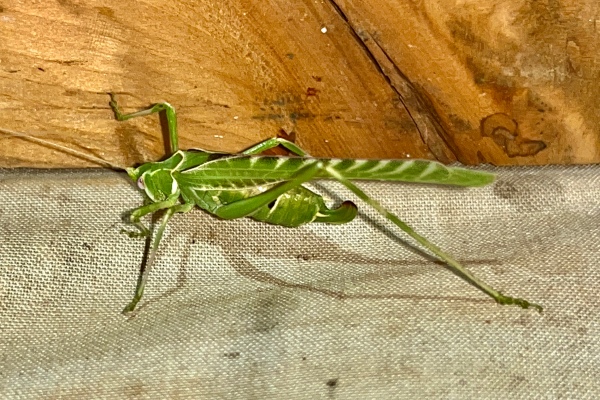

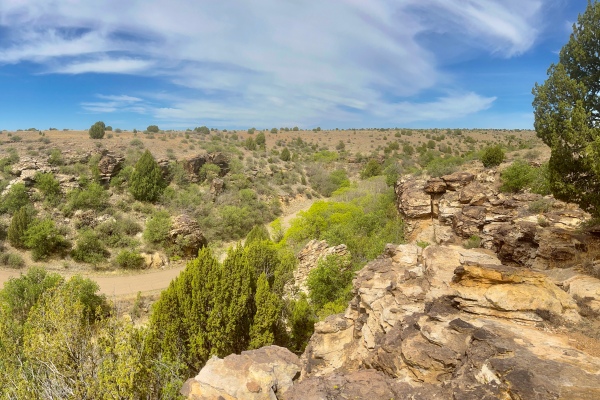
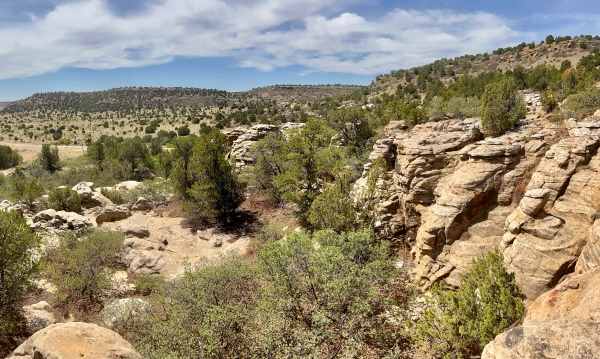
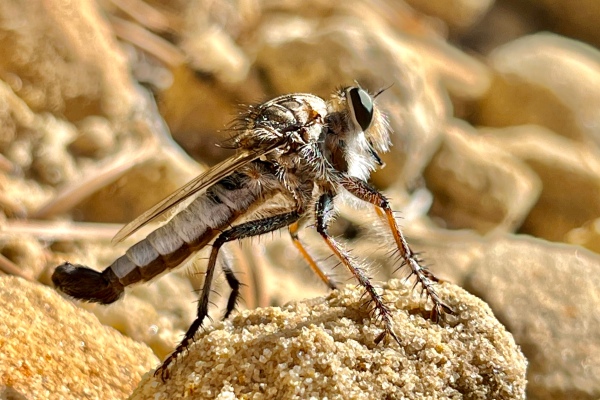

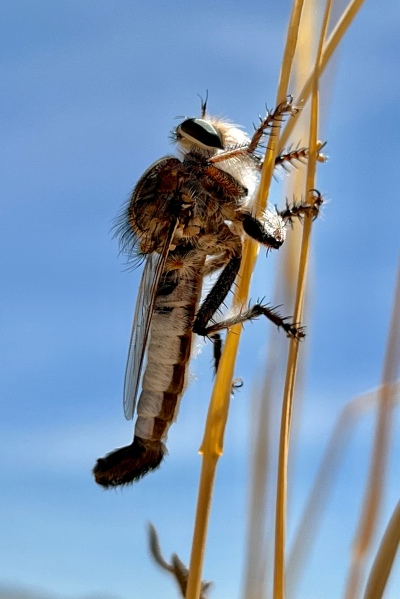
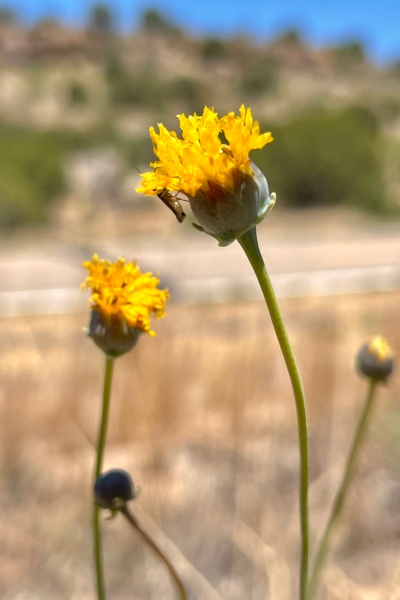
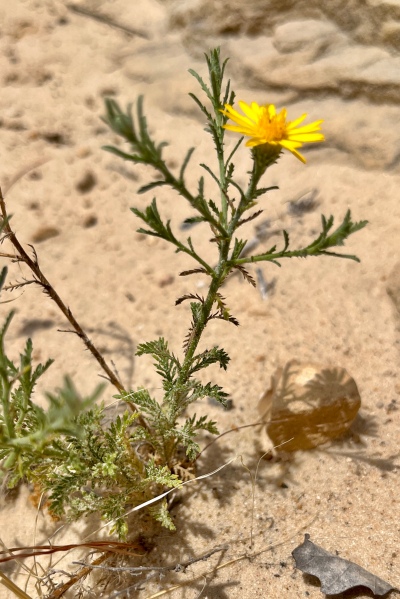
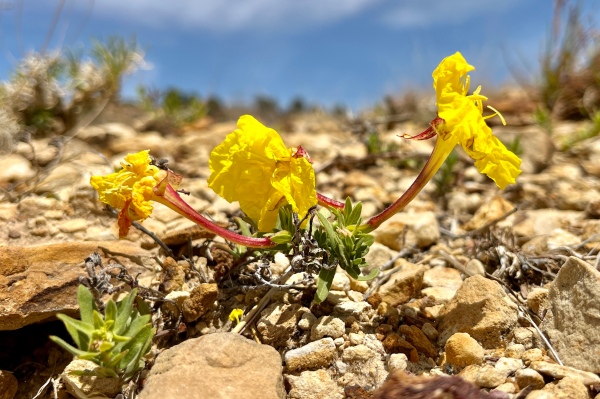
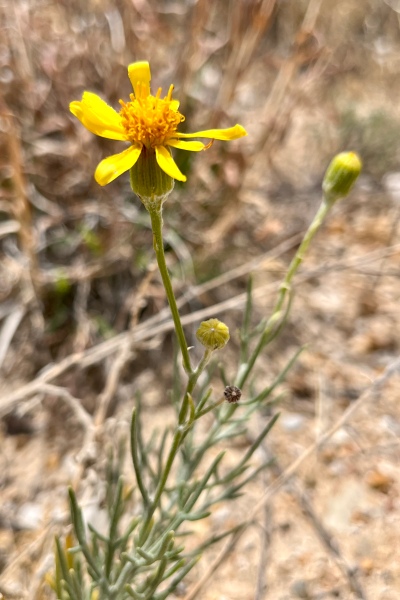
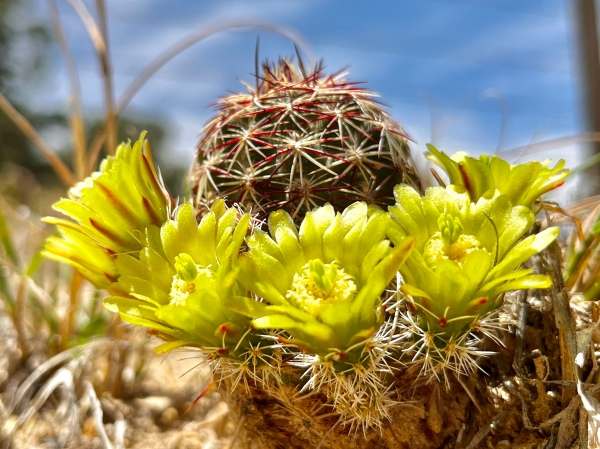
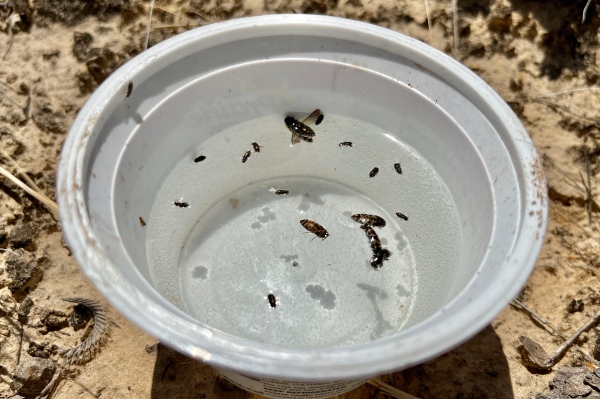
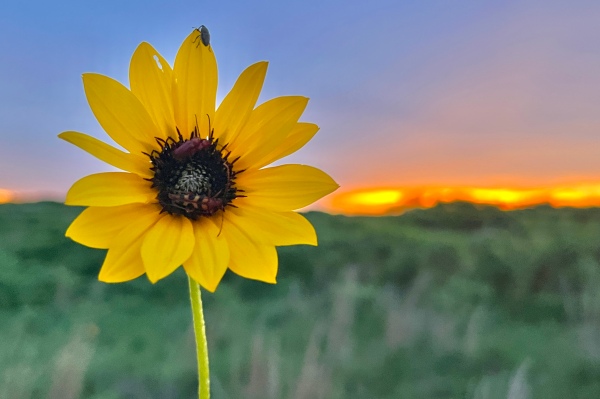





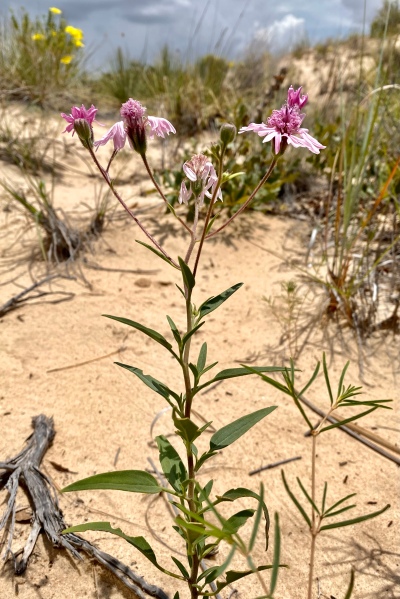


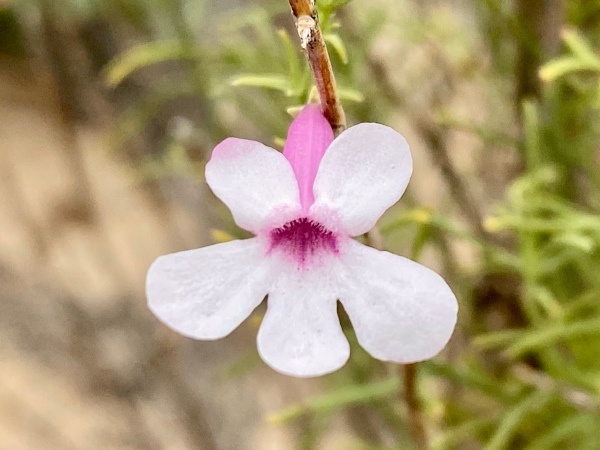
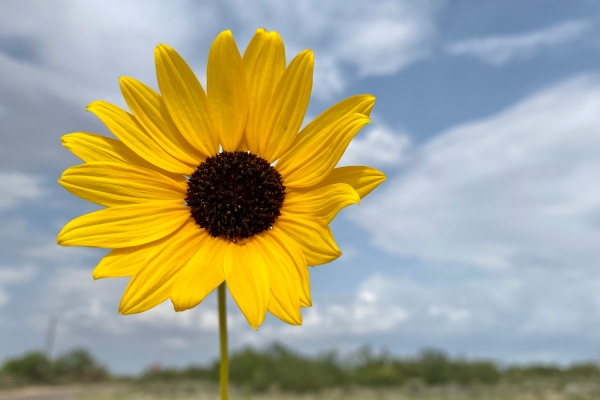
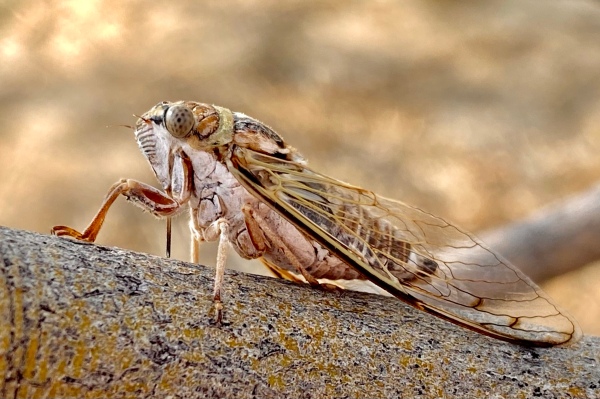


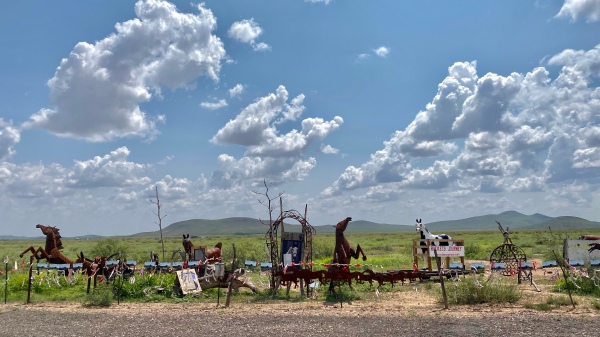


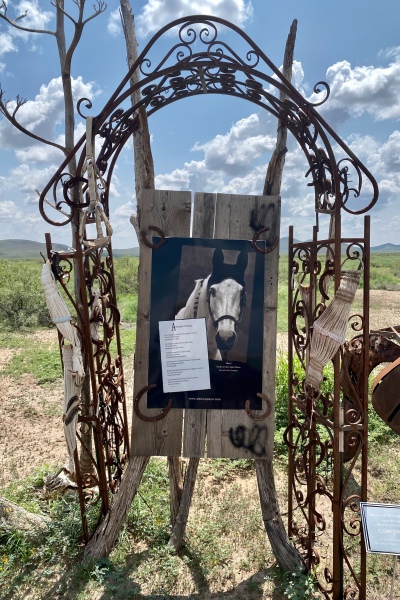


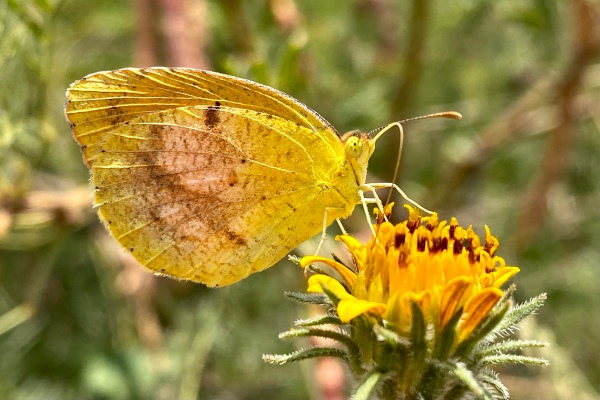


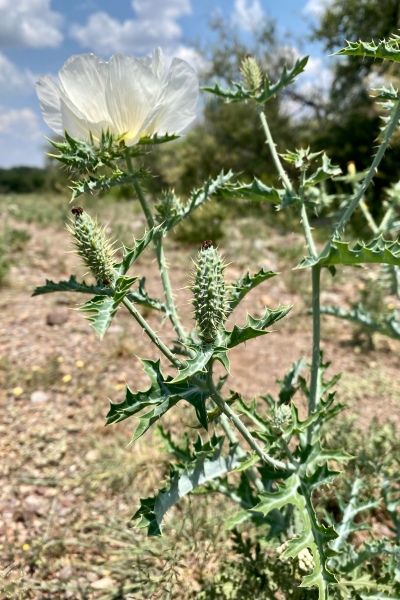

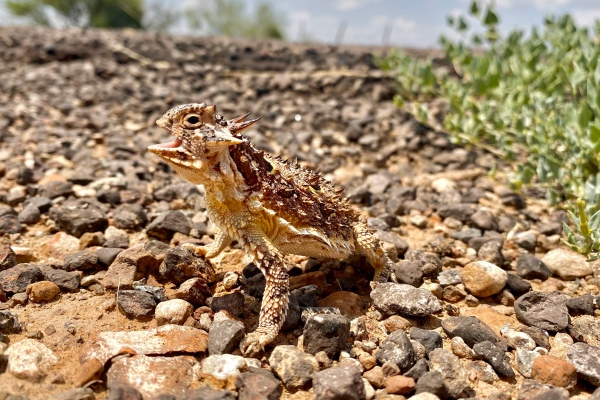
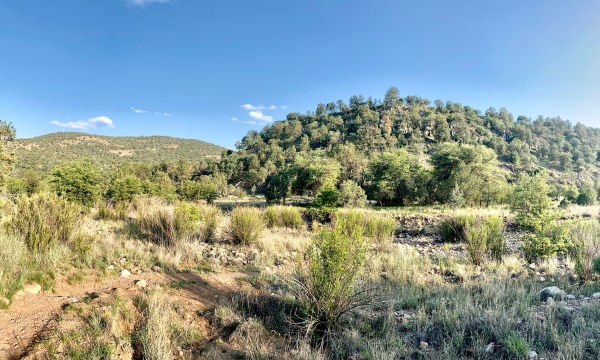
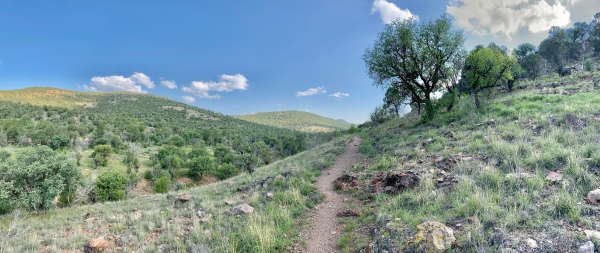
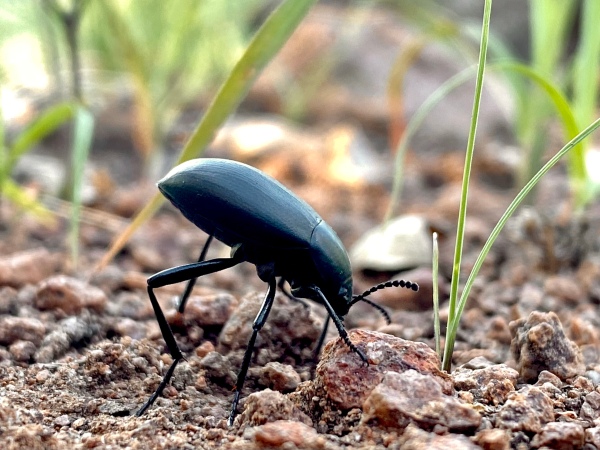
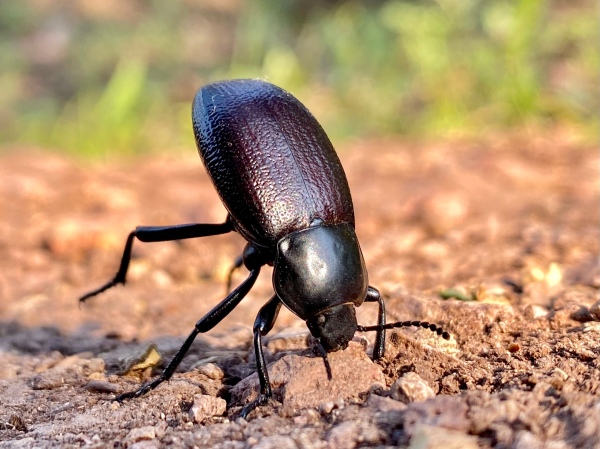
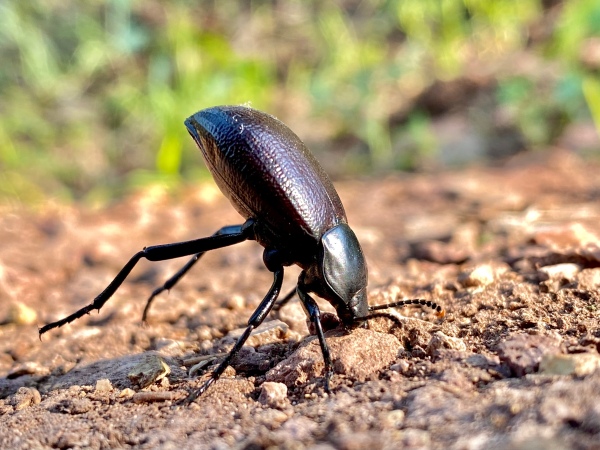


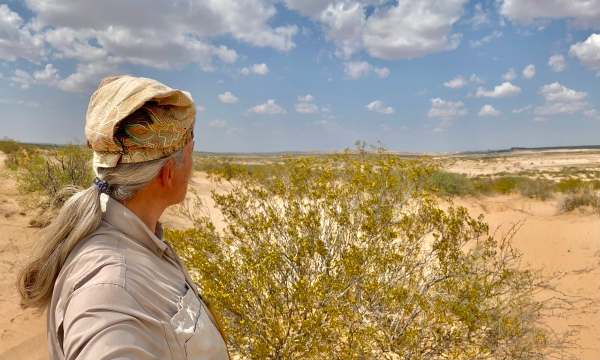
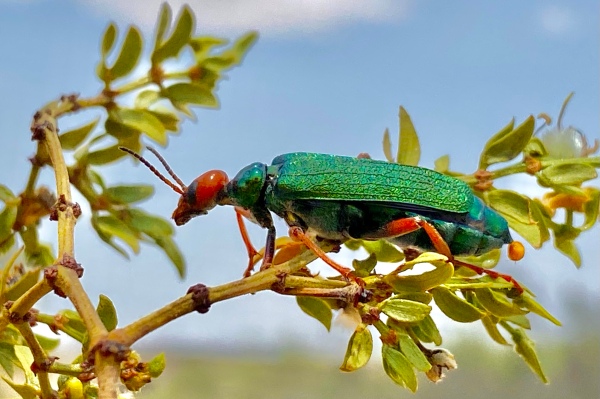

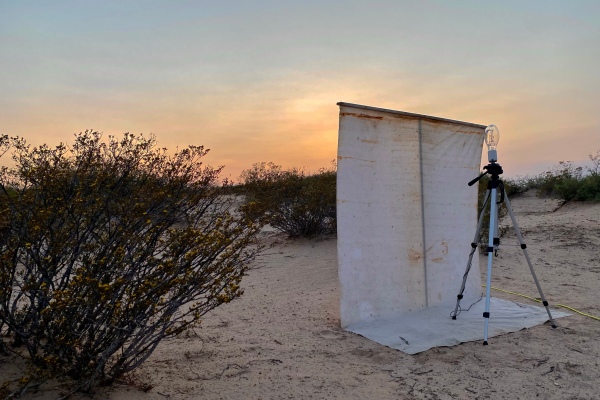


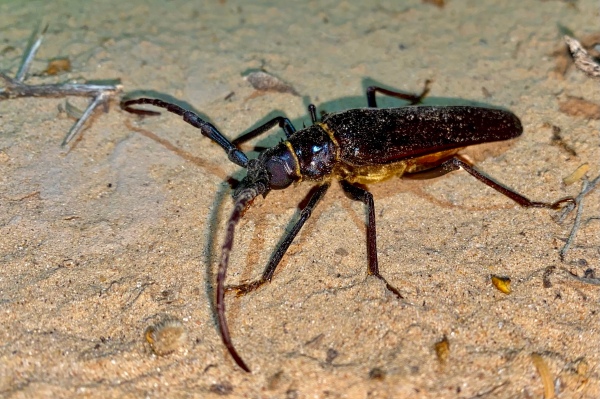


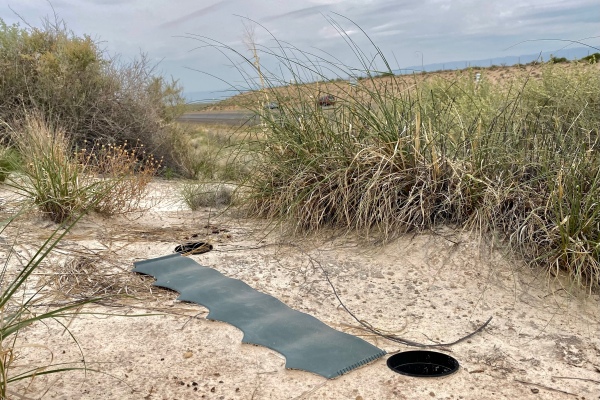



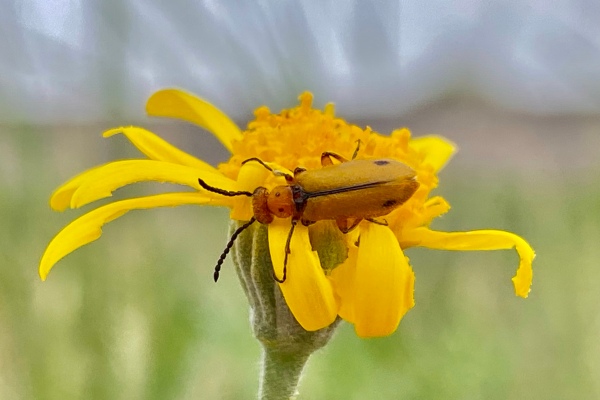


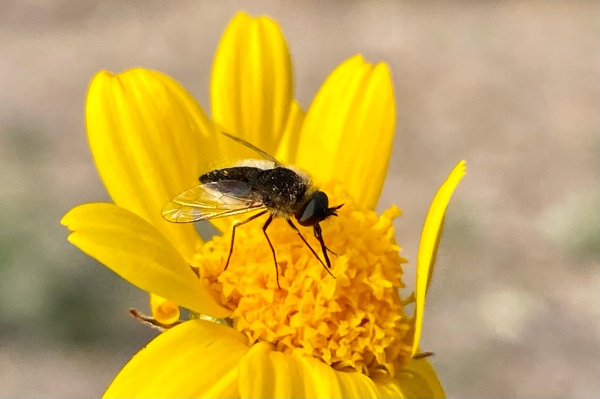
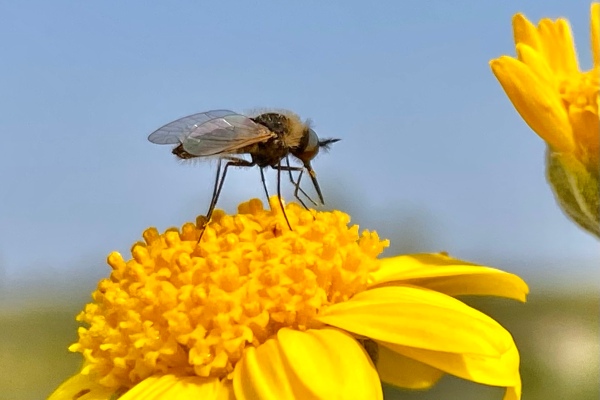
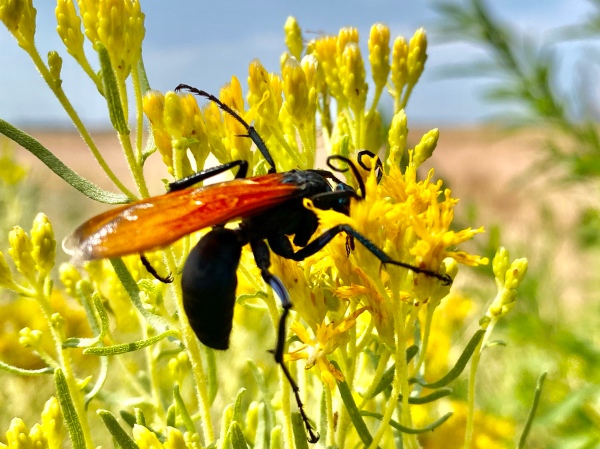
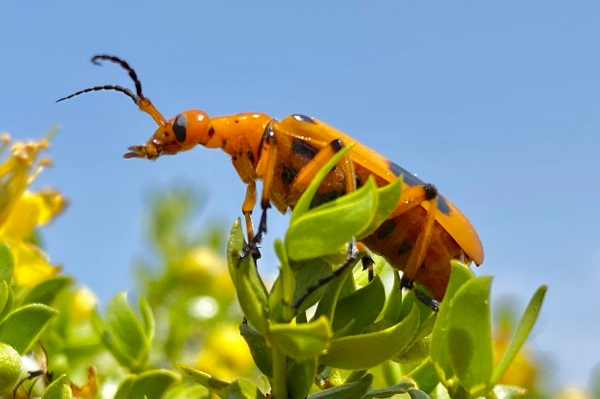
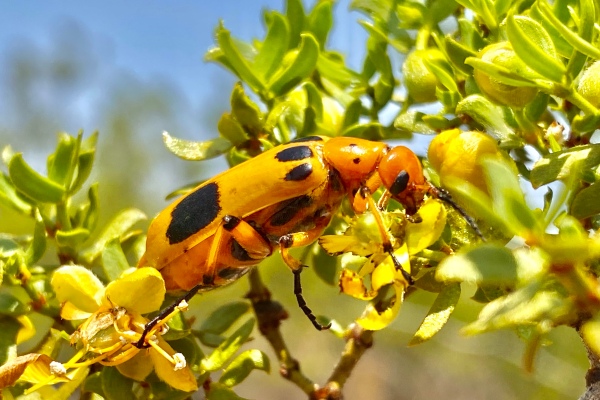


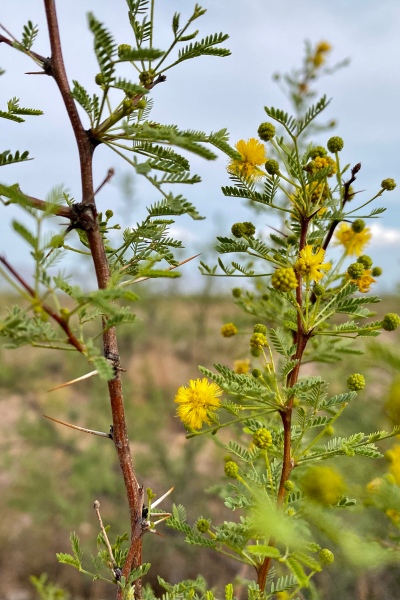
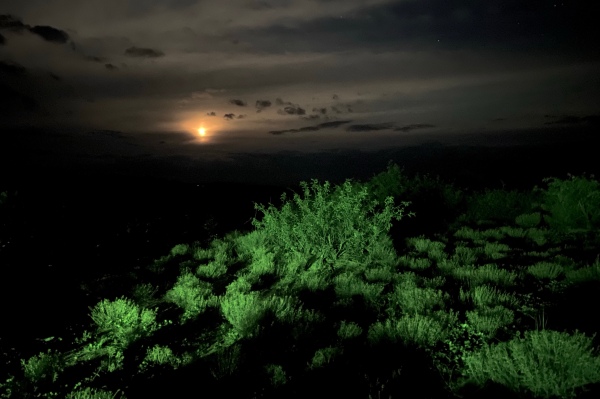




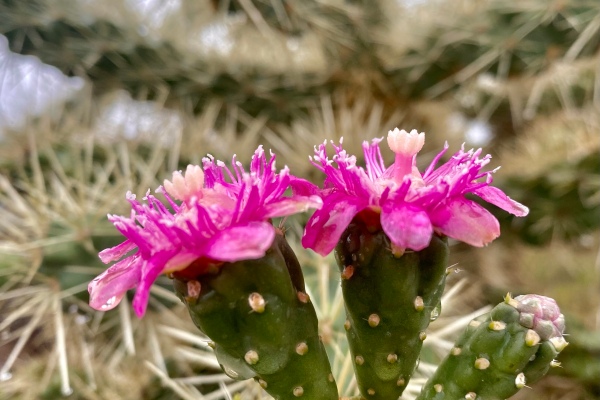
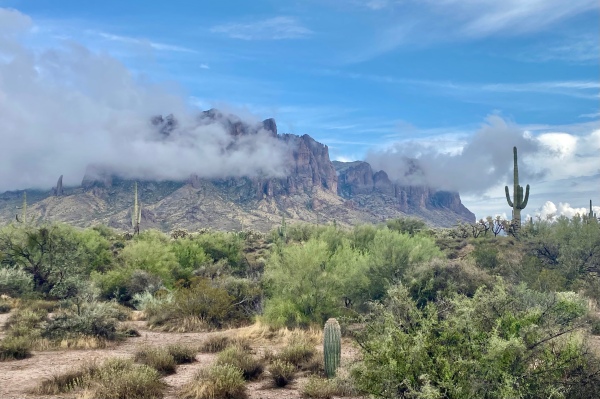
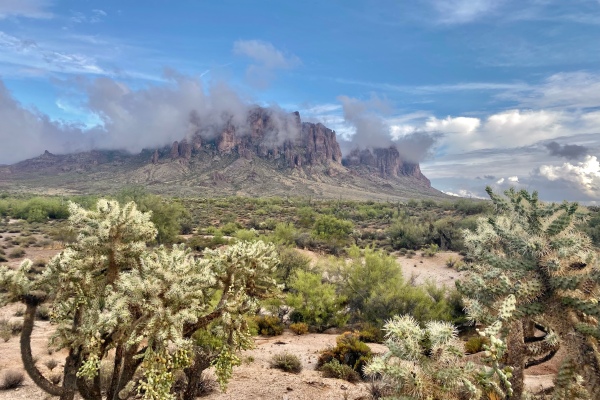
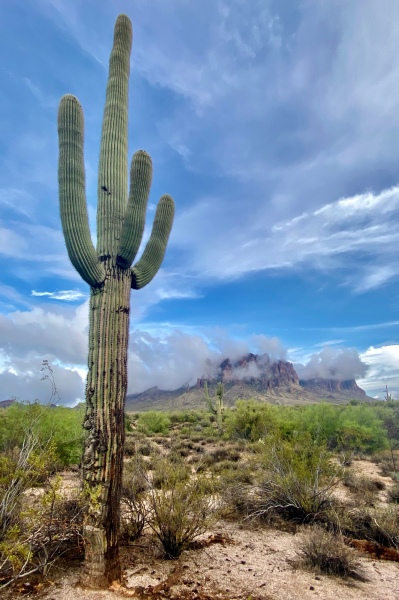


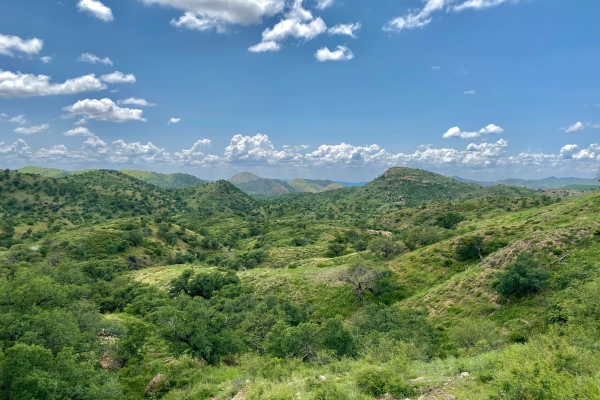

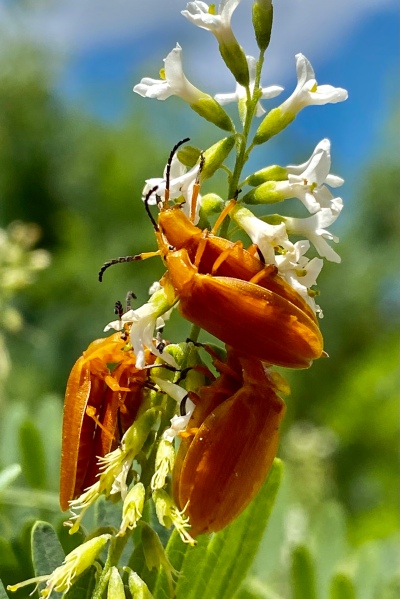


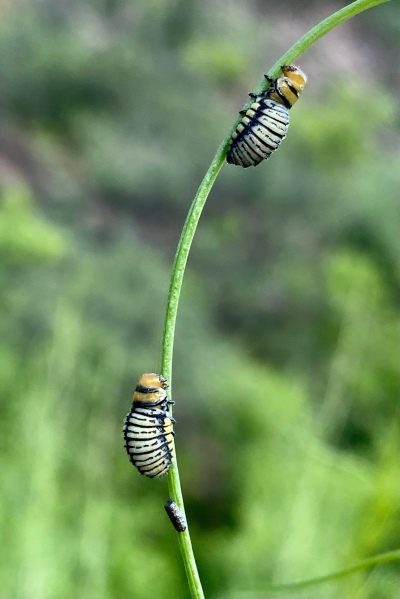


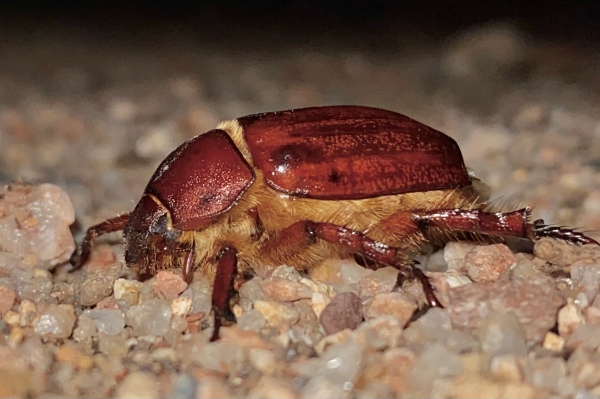

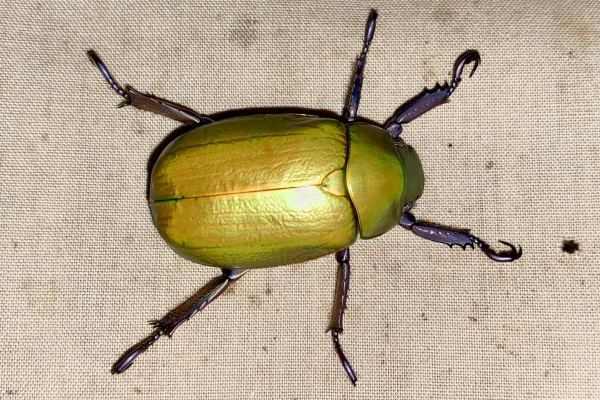
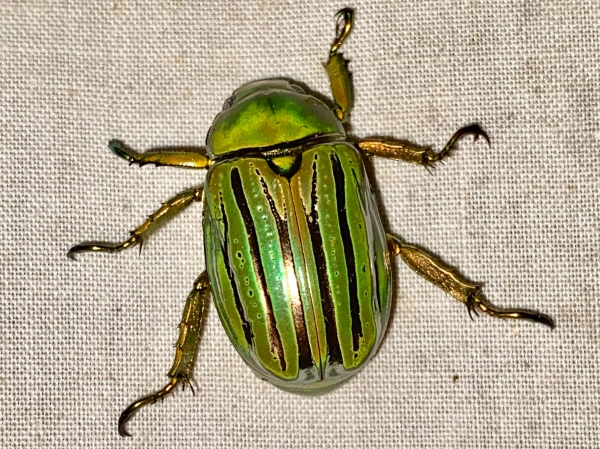
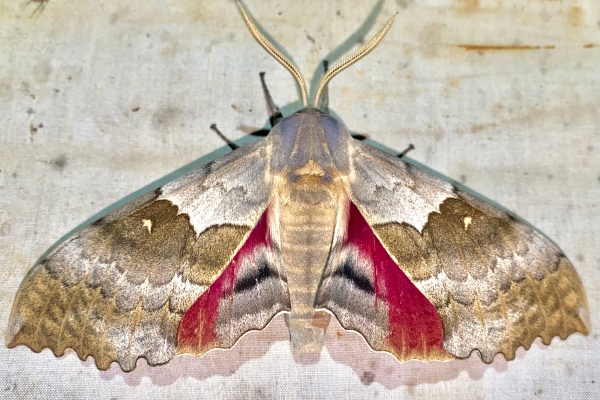
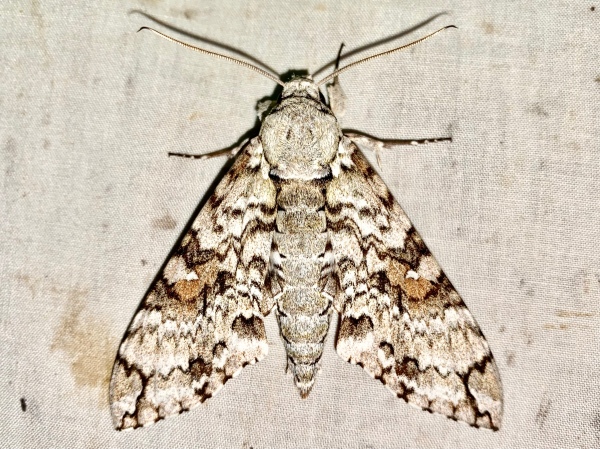
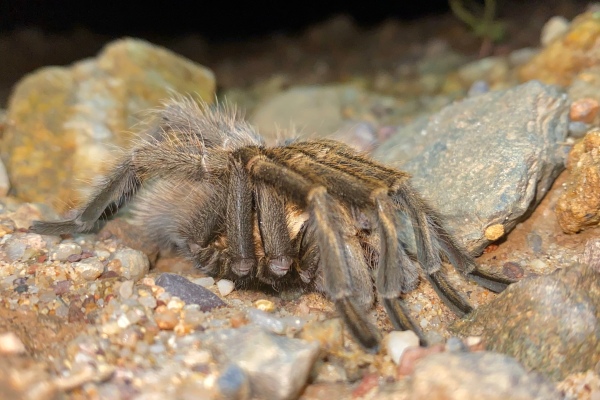
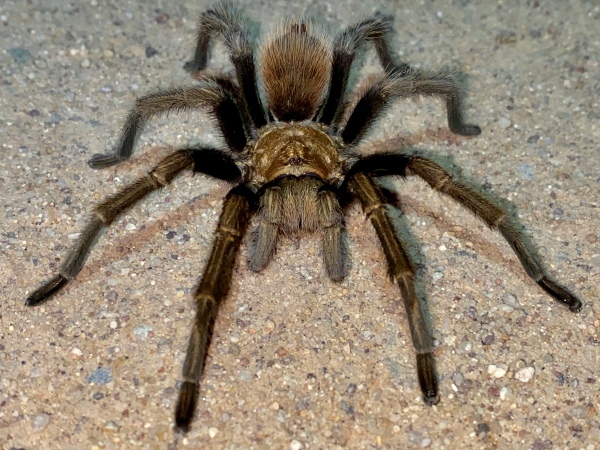

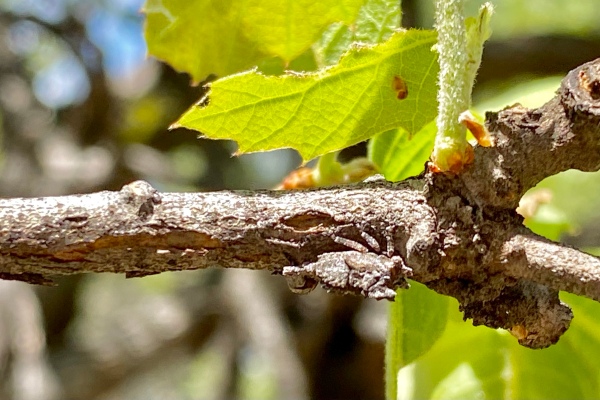

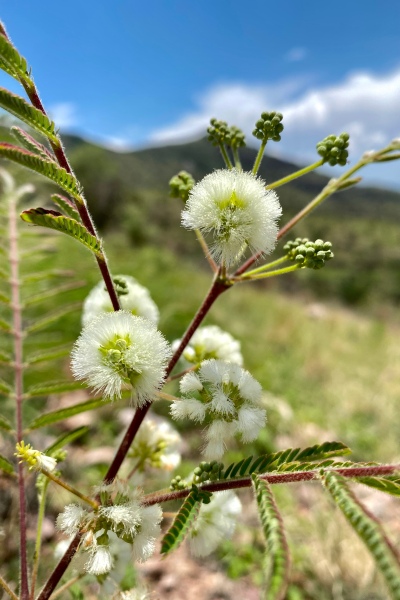

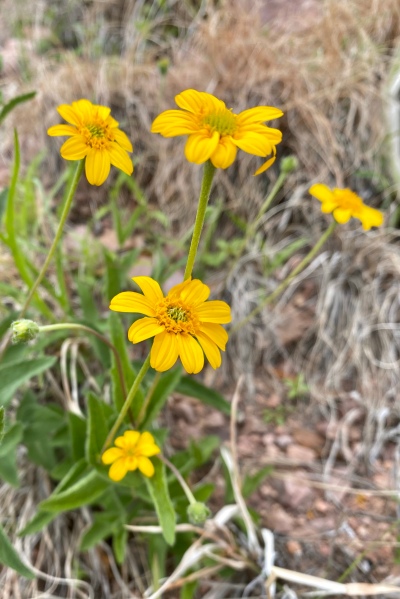
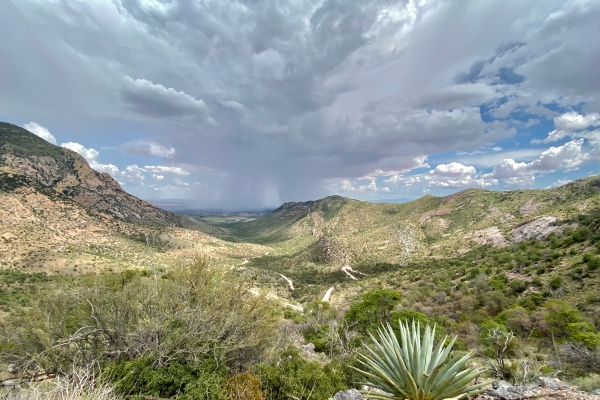
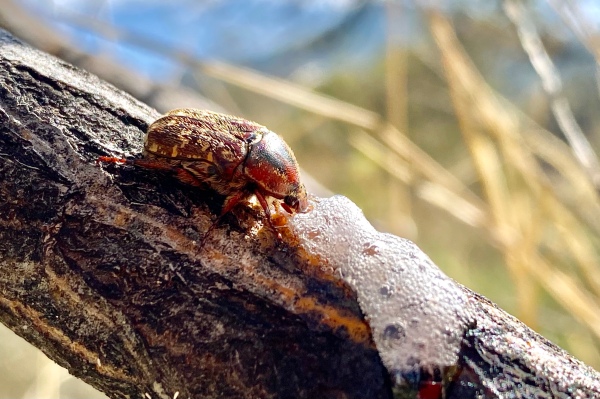
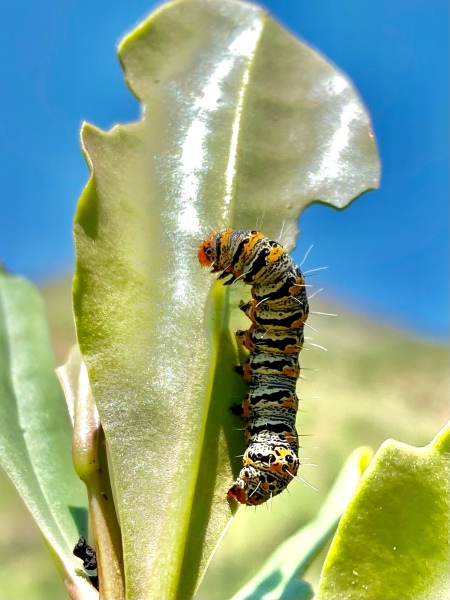

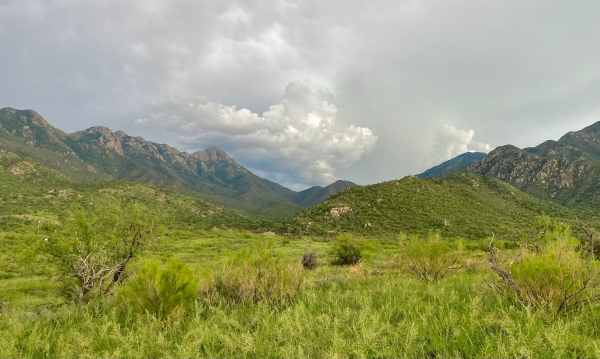
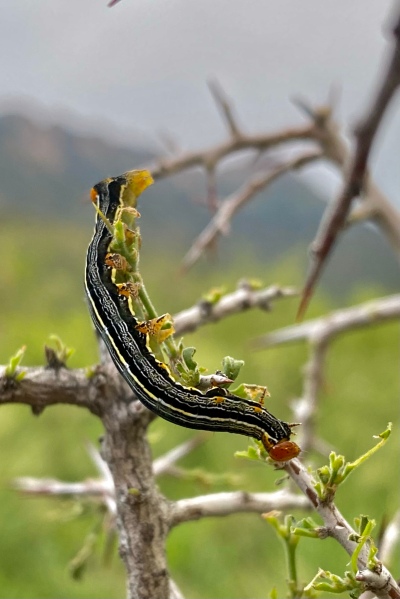
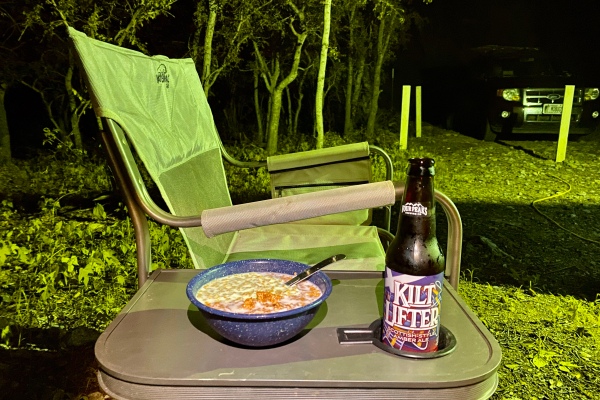
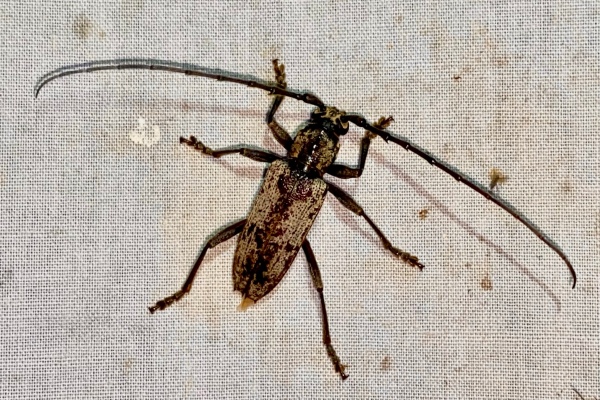
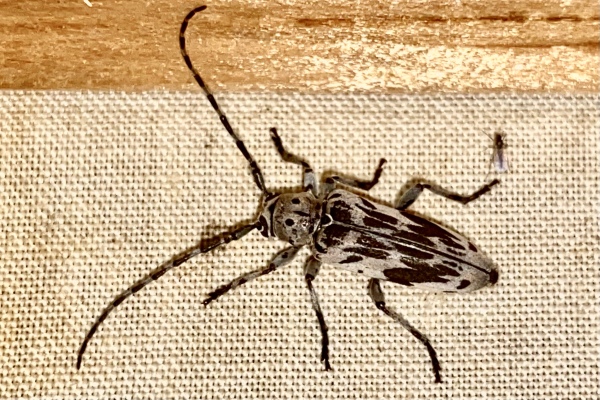
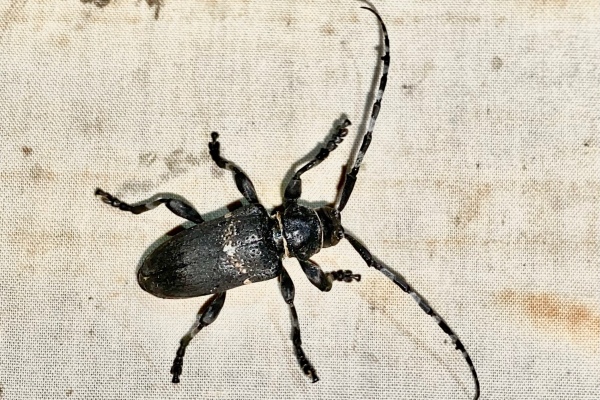


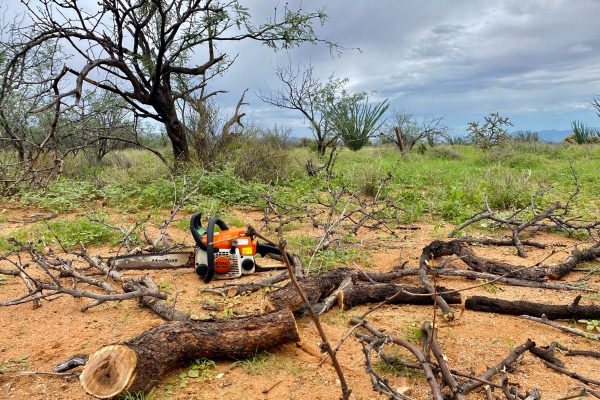


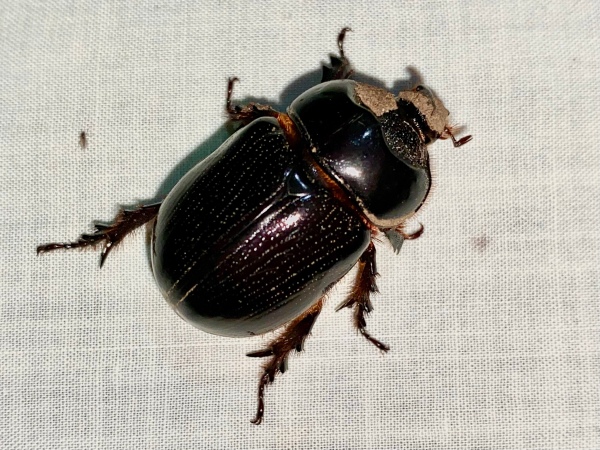


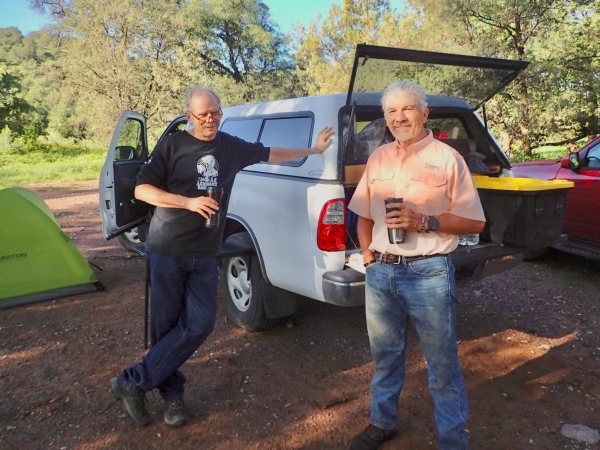
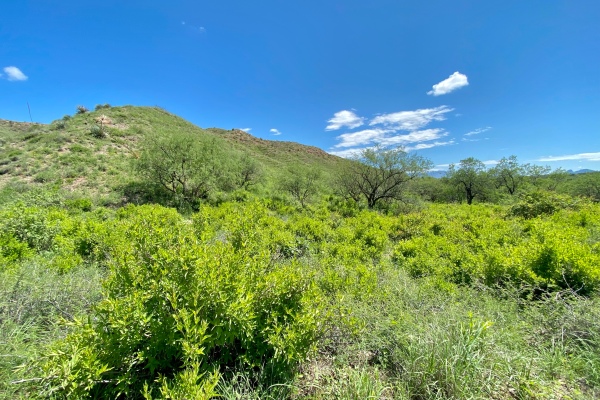
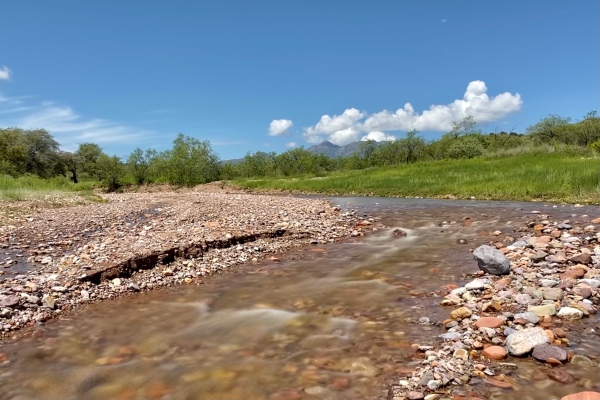
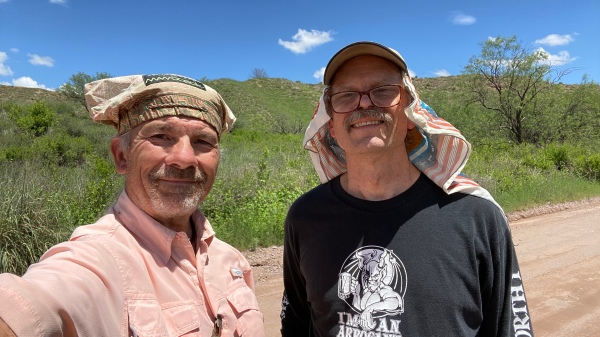


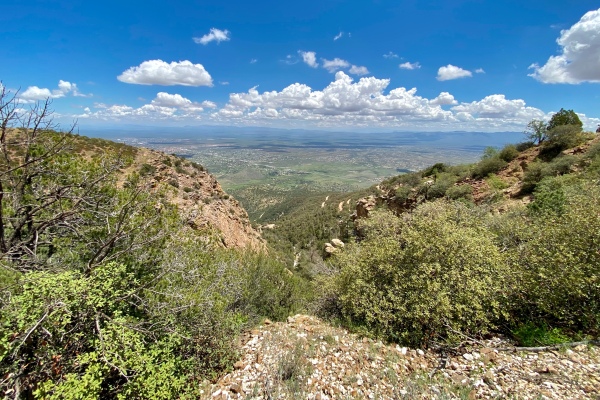
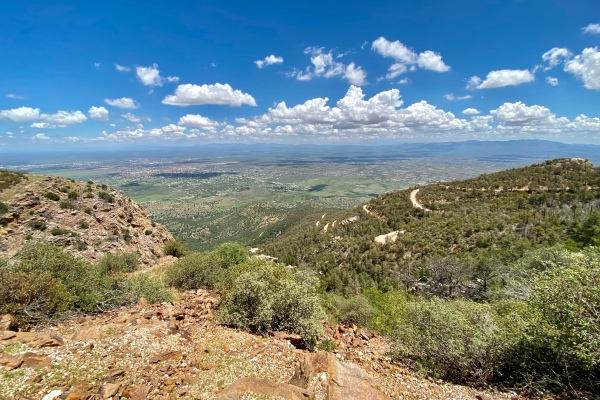
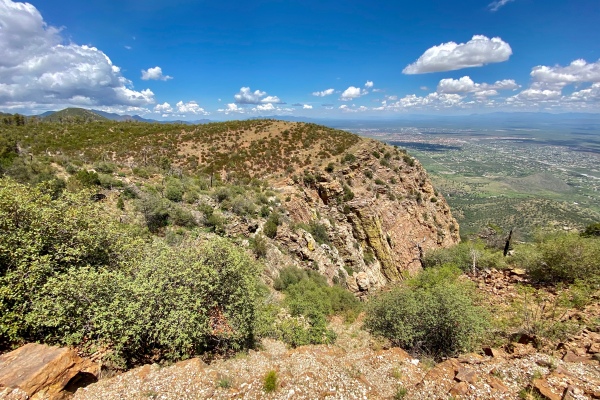


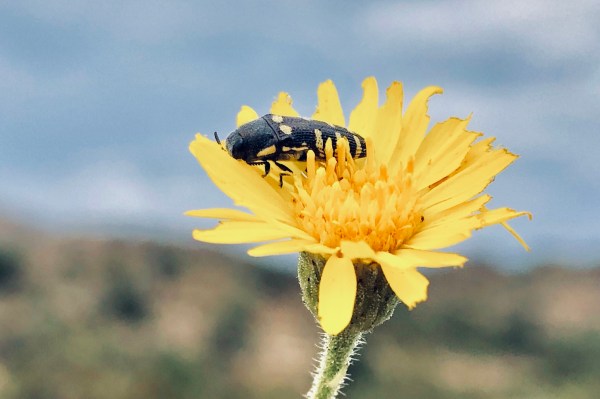


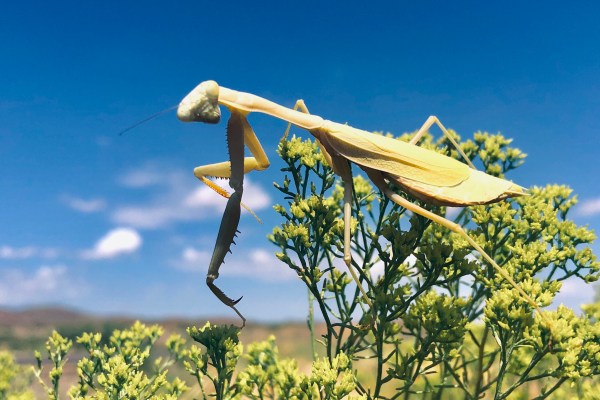


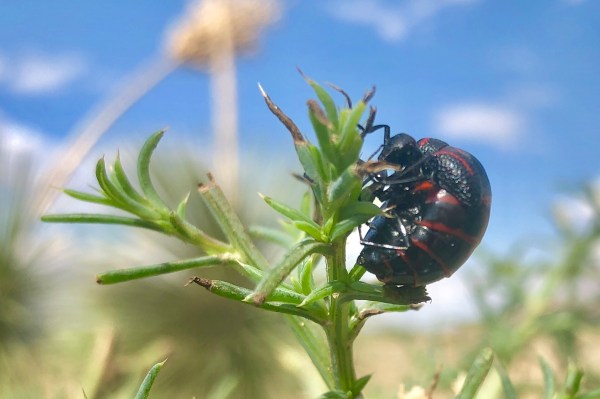
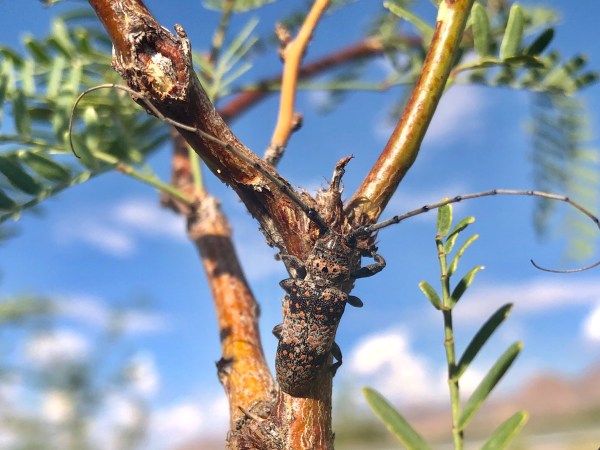


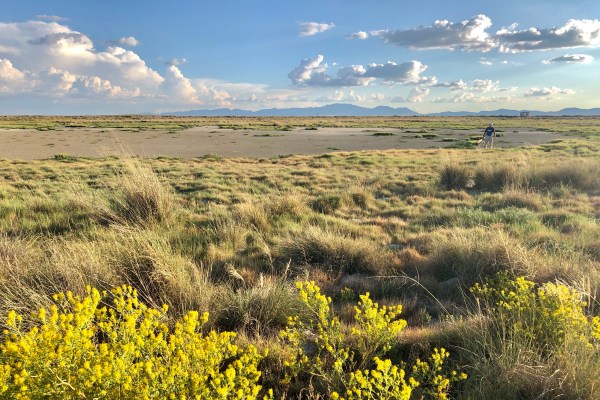
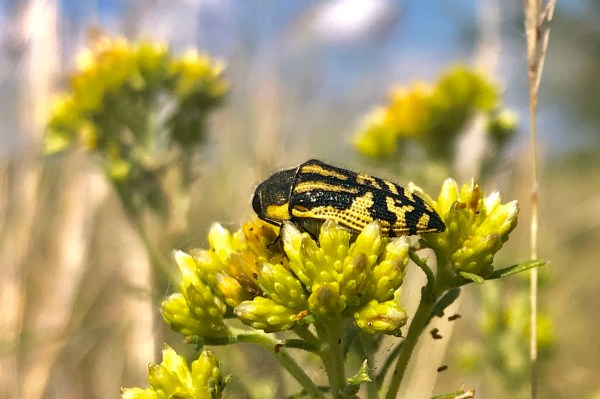


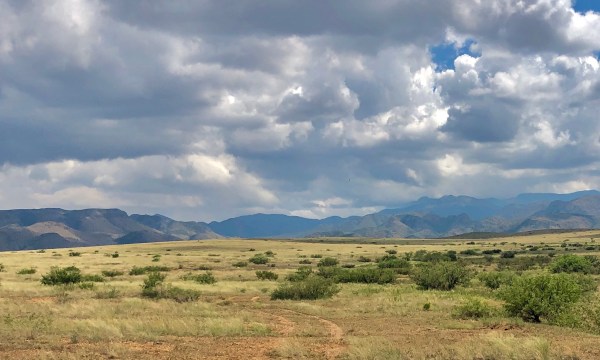

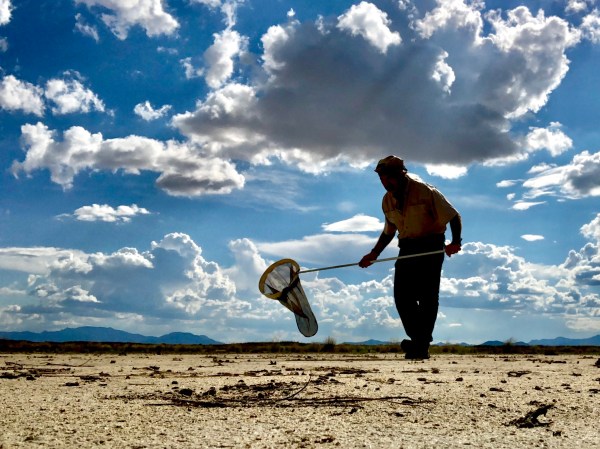


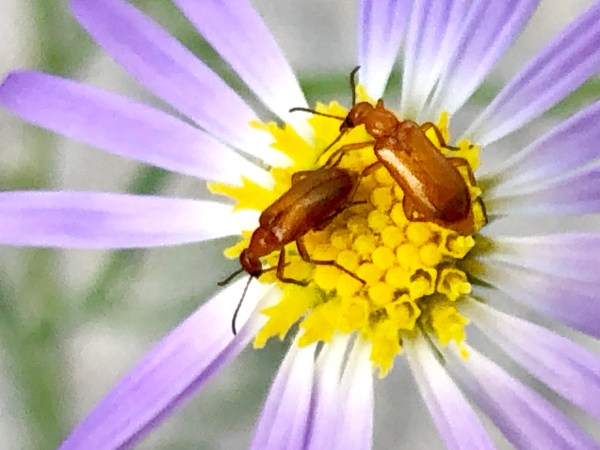


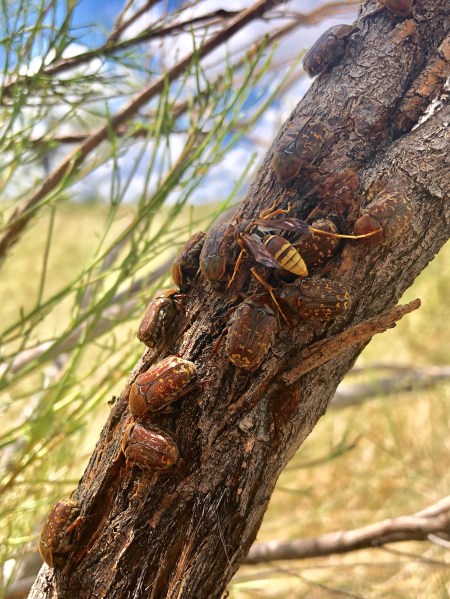

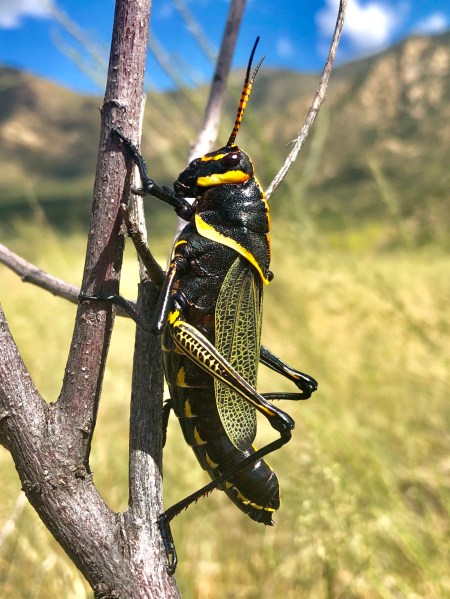


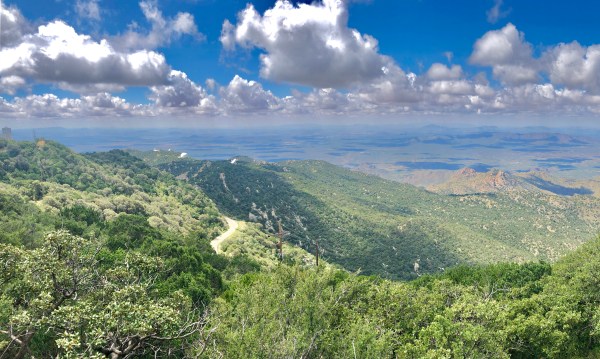


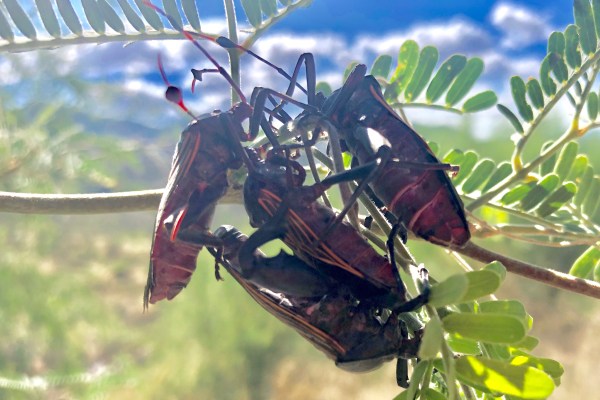


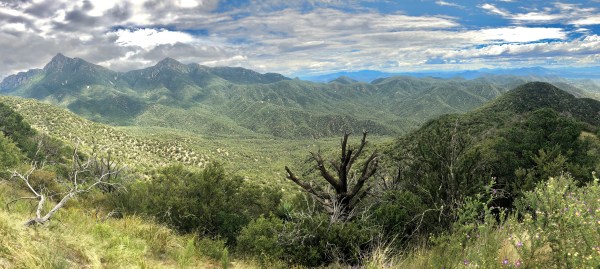


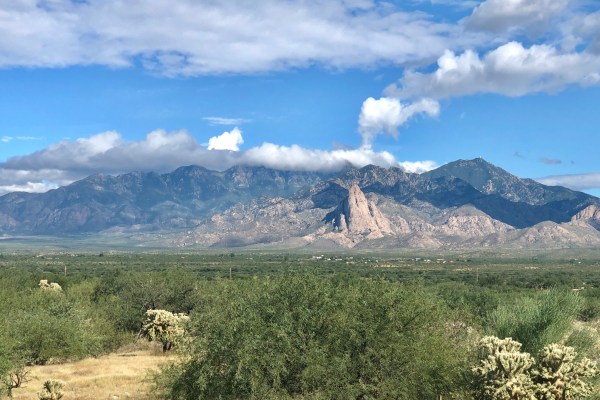

 Beetles In The Bush