Josef Knull was wrong!

A few weeks ago I received an email from Kyle Schnepp, an entomology student at Purdue University.  Kyle has taken on the rather ambitious project of developing an illustrated key to the Buprestidae of eastern North America, for which he has been spending the past year acquiring material for photographs.

During his examination of specimens in the Field Museum of Natural History, Kyle came across two examples of an extraordinarily rare species of Buprestidae, Agrilus audax Horn.  Although described more than 100 years ago from specimens collected in Texas (Horn 1891), few records have been published in the years since.  Chamberlin (1926) reported the species also from Arizona and Illinois but without further details, causing Fisher (1928), in his revision of the genus (woefully out-of-date now, but still the only comprehensive resource for identifying the North American species), to regard at least the Illinois record as probably erroneous (common for many of Chamberlin’s records).  The first undisputed report of this species from outside of Texas was by Josef Knull (1934), who reported the species emerging from living, wind-thrown branches of slippery elm (Ulmus rubra) collected in western Missouri.  More than half a century would pass before the species would turn up again – first in Oklahoma (Nelson and MacRae 1990) and twice again in Missouri through the efforts of Gayle Nelson and myself (MacRae 1991, MacRae and Nelson 2003). All but one of these specimens were beaten from bur oak (Quercus macrocarpa).

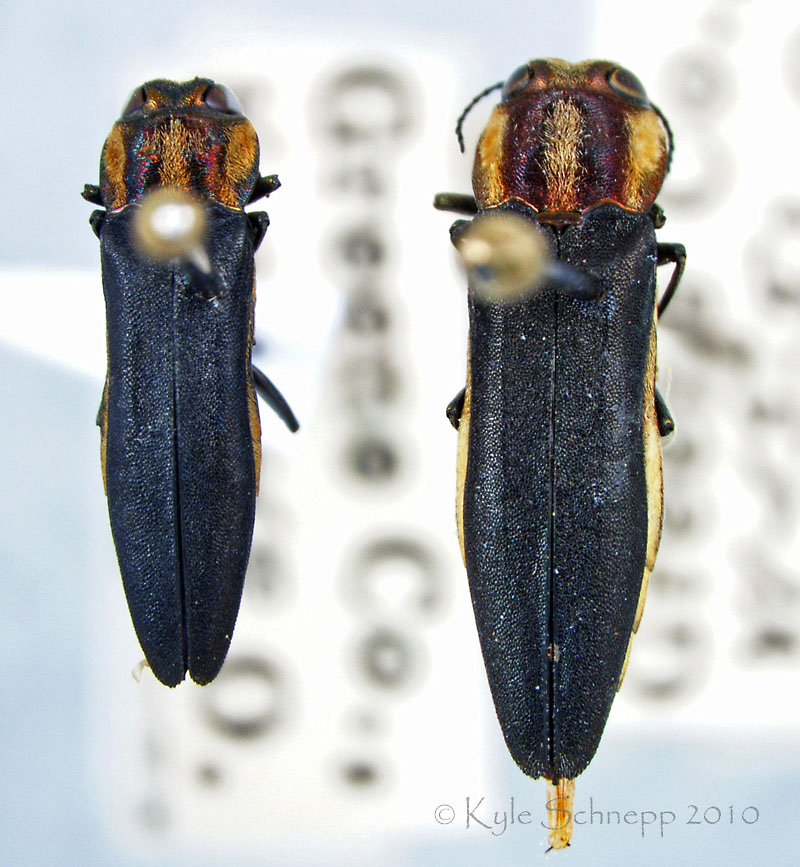
Agrilus audax Horn, 1891 – male (L) and female (R)

While the rarity of this species makes Kyle’s find significant enough, there is an even more significant – and interesting – aspect to his discovery.  Both of the specimens, one male and one female, were collected in Ohio, which is a rather extraordinary geographical range extension. Additionally, the specimens were collected by none other than Josef Knull.  To students of North American Buprestidae, the name Josef Knull is as familiar as Carl Linnaeus, Charles Darwin, or Thomas Say. A Professor of Entomology at The Ohio State University from 1934-1962, Knull published nearly 200 papers on the taxonomy, biology, and distribution of these and other families of beetles (Davidson and Bellamy 2002).  Although he lacked a Ph.D., he was an indefatigable collector and describer of beetles – to his fellow colleagues and students, he was known as “Professor” or “Doctor” as a show of respect.  He spent many of his summers traveling through the southwestern U.S. with his wife Dorothy Knull (herself an entomologist specializing in leafhoppers), and by the time he died in 1975 he had described 233 species and subspecies of beetles (as well as one species of Fulgoridae).  He was, and is, an icon among North American beetle collectors.

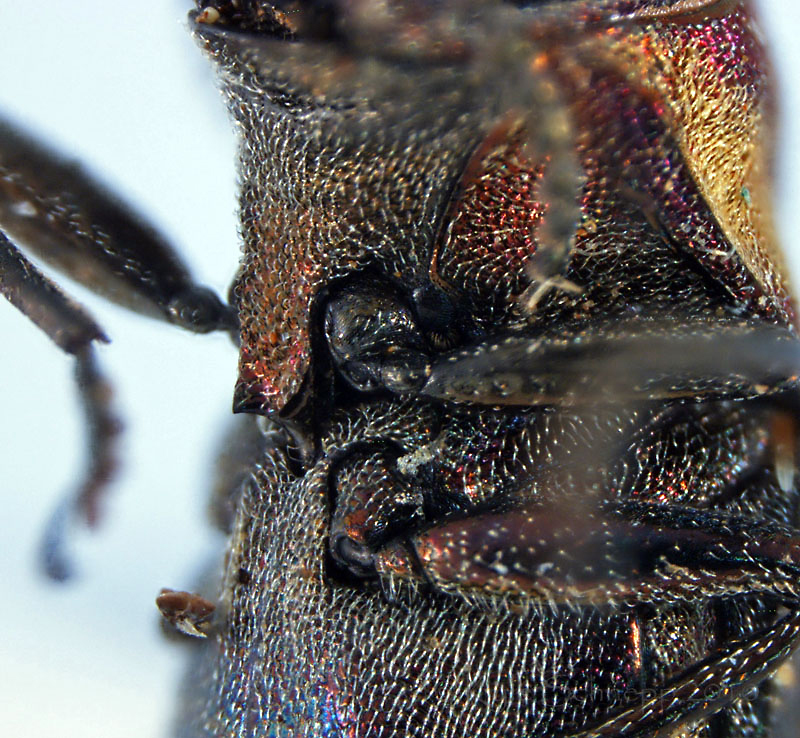
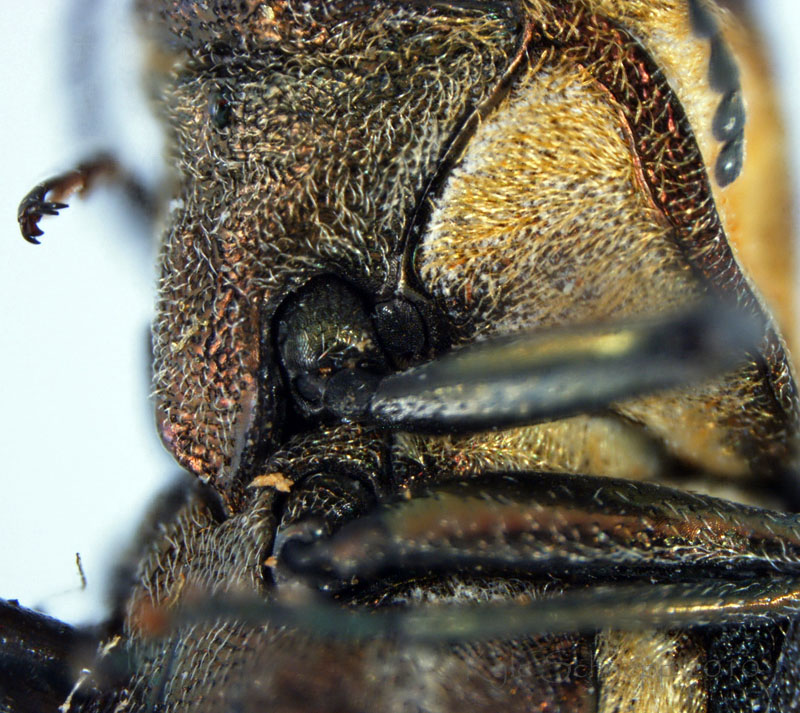
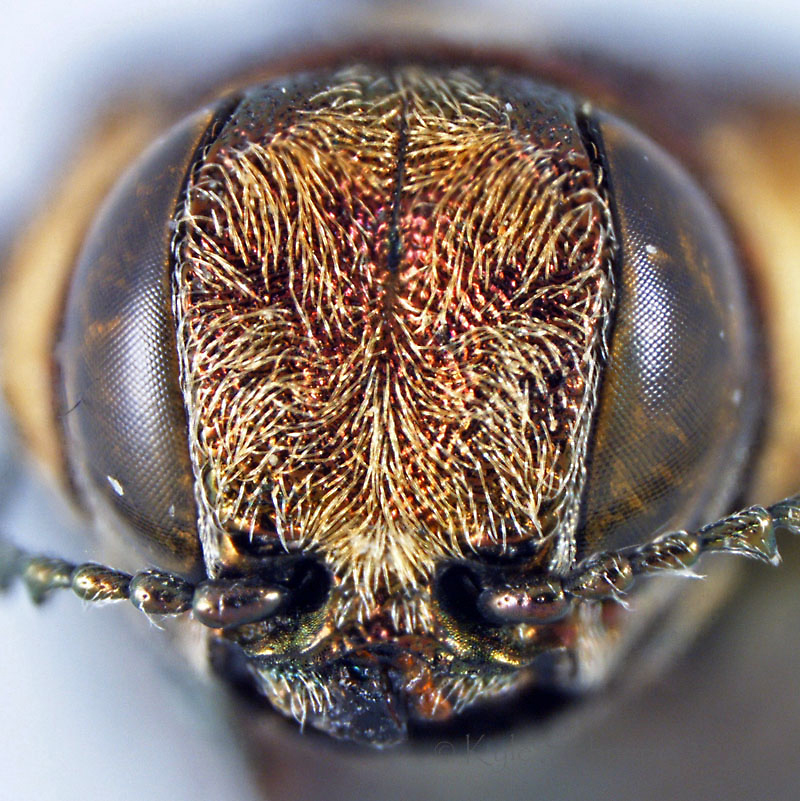
Curiously, Knull did not recognize these specimens for what they were, instead identifying them as the similar and much more widespread species, Agrilus vittaticollis.  Curious, because Knull collected these specimens in 1949 and 1953 – after first reporting the species in Missouri.  Agrilus audax belongs to a small group of species that look very similar to each other by way of their large size and striking coloration – black elytra and a red pronotum with a densely pubescent median channel.  Agrilus vittaticollis is the most common of these (though still not as commonly encountered as many other species in the genus), and the much less common A. benjamini also belongs to this group.  Kyle had sent me the above photo in an attempt to confirm their identity, but true confirmation would require examination of characters of the face and ventral surface.  Kyle quickly took additional photographs of these characters and sent them to me – they are shown below and leave no doubt as to the identity of these specimens.

Agrilus vittaticollis prosternum – note sides bent downward to sharp points.

Agrilus audax prosternum – sides normal, not bent downward to sharp points.


Agrilus audax frons is moderately depressed and uniformly pubescent (deeply depressed & pubescent only on lower half in A. benjamini).

Agrilus audax male sternite – the deep, smooth, elongate depression is diagnostic (A. benjamini males have only an obsolete depression).


Finding a new state record buprestid in Ohio – the land of Knull – based on specimens collected by Knull himself is nothing short of remarkable (almost like proving E. O. Wilson wrong¹). The occurrence of A. audax in Ohio also lends some credibility to Chamberlin’s record of the species in Illinois. Kyle is graciously allowing me to include these new records in a forthcoming publication; my thanks to him for this and also for allowing me to use his fine photographs in this post.  Kyle did also mention that these were the only misidentified specimens he saw in the Knull collection at the Field Museum of Natural History. For those interested in acquiring reprints of Knull’s papers, pdfs of the 50 papers he published in the Ohio Journal of Science may be found at this link.

¹ The title of this post is a play on the title of a recent post by Alex Wild at Myrmecos. No true disrespect is intended to Josef Knull, who’s legacy (with the possible exception of his frustratingly vague label data) is rightfully held in high regard by all who knew him or know of his work.

REFERENCES:

Chamberlin, W. J. 1926. The Buprestidae of North America, exclusive of Mexico, a catalogue including synonymy, bibliography, distribution, type locality and hosts of each species. W. J. Chamberlin, Corvallis.

Davidson, J. M., and C. L. Bellamy.  2002. The entomological contributions of Josef Nissley Knull (1891-1975).  Zootaxa 37:1-24.

Horn, G. H. 1891. The species of Agrilus of Boreal America. Transactions of the American Entomological Society 18:277-366.

Knull, J. N. 1934. Notes on Coleoptera, No. 4. Entomological News 45(10):207-212.

MacRae, T. C. 1991. The Buprestidae (Coleoptera) of Missouri. Insecta Mundi 5(2):101–126.

MacRae, T. C., and G. H. Nelson. 2003. Distributional and biological notes on Buprestidae (Coleoptera) in North and Central America and the West Indies, with validation of one species. The Coleopterists Bulletin 57(1):57–70.

Nelson, G. H., and T. C. MacRae. 1990. Additional notes on the biology and distribution of Buprestidae (Coleoptera) in North America, III. The Coleopterists Bulletin 44(3):349–354.

Copyright © Ted C. MacRae 2010

Add to FacebookAdd to DiggAdd to Del.icio.usAdd to StumbleuponAdd to RedditAdd to BlinklistAdd to TwitterAdd to TechnoratiAdd to Yahoo BuzzAdd to Newsvine

Email to a friend

North America’s largest robber fly

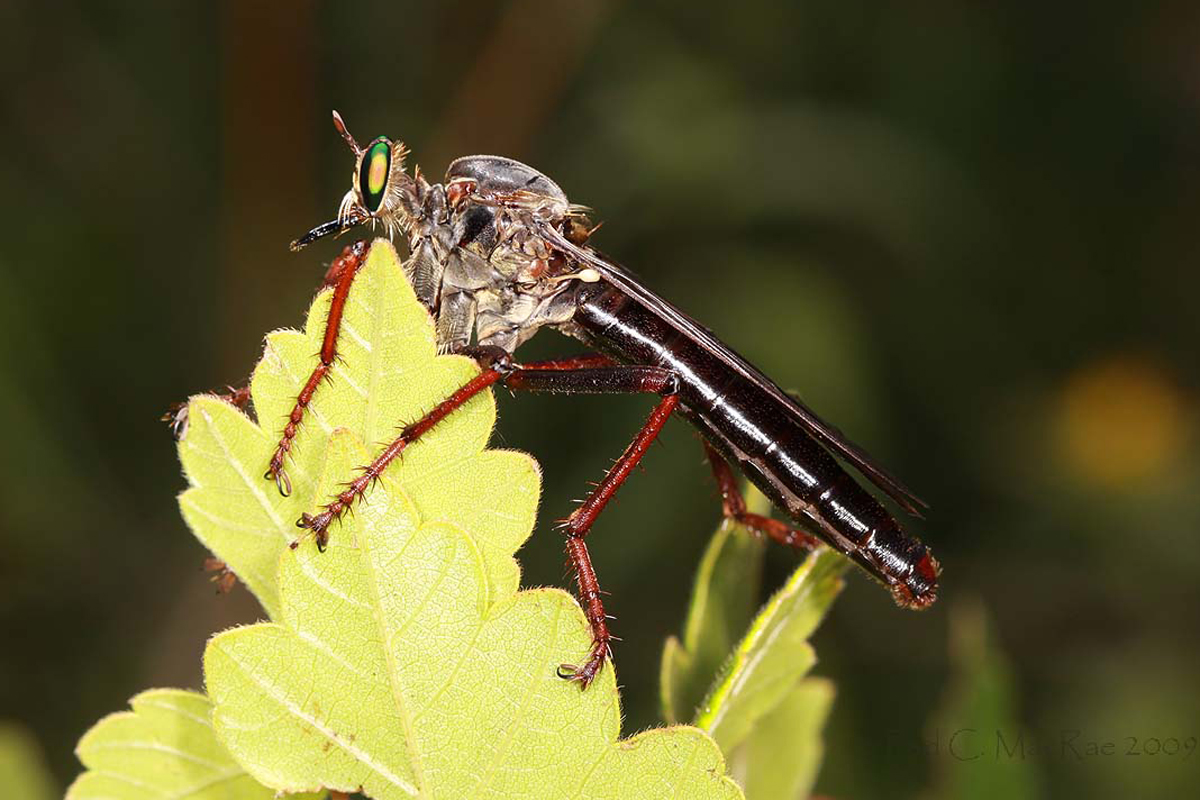
Female Microstylum morosum perched on fragrant sumac (Rhus aromatica) bush

Female Microstylum morosum perched on fragrant sumac (Rhus aromatica)

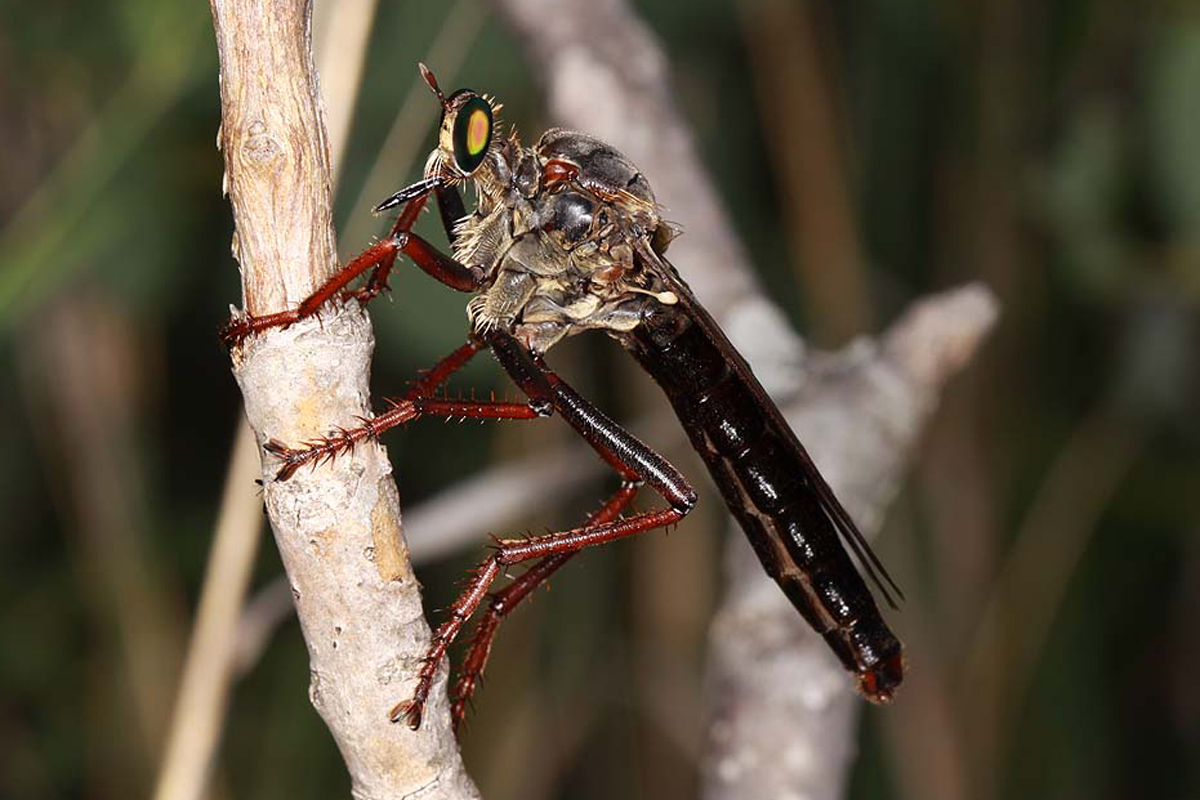
A few days ago, I featured Promachus hinei, one of the so-called “giant robber flies” and a common inhabitant of the glades and grasslands that dot Missouri’s largely forested landscape. That individual was seen at Long Bald Glade Natural Area in Caney Mountain Conservation Area, one of the many limestone glades that are a prominent feature of extreme southwestern Missouri’s White River Hills, as it snacked on a small carpenter bee (Ceratina sp.) and posed obligingly for a series of super close-up photographs. Promachus and its congeners are impressively large; however, I would see an even larger robber fly that day. I didn’t know what it was at the time, but I knew that never before had I seen such a magnificent fly, with its large, shimmering, emerald eyes, streamlined body almost devoid of setae (hairs), and ludicrously large size. These monsters were actually quite common at the glade, so I failed to appreciate the significance of what I was seeing as I chased one after another – more intent on securing photographs than specimens. This was not an easy task – they were extremely wary, rarely allowing me to approach within 12 feet no matter how cautiously and slowly I moved. Not one to back down from such a challenge (remember, I stalk tiger beetles), I persisted, traversing the rough, rock-strewn terrain amidst clumps of big bluestem (Andropogon gerardii), Indian grass (Sorghastrum nutans), and fragrant sumac (Rhus aromatica) until, at last, I got within striking distance of the impressive female shown in these photos. Taking flight before I felt assured of a good shot, I followed her repeated long, loping escape flights until I was able to get another few shots and she disappeared for good.

Same individual as in previous photo after flying to another perch.

Same individual as in previous photo after flying to another perch.

It didn’t take long after I returned home to figure out what I had seen, as there is really nothing that can be mistaken for Microstylum morosum, North America’s largest robber fly (Back 1909)¹. At 35–40 mm of length, this individual didn’t quite match the astounding 50-mm upper body length for the species (that’s 2 inches, folks!). Nonetheless, it was an impressive beast indeed! It is not surprising that North America’s largest robber fly should be a species of Microstylum, as it is this same genus that contains the world’s largest robber fly – the aptly named M. magnum from Madagascar, with a body length of 60 mm and an almost preposterous wingspan of up to 84 mm (that’s over 3 inches folks!). I don’t know if any flies exist that are larger than this, but certainly none can be more imposing.  While I’m happy with the photos that I did obtain, I must confess some disappointment that I wasn’t able to get more than these basic lateral profile shots.  Of the several photographs of this species that can be found on the web, this female, photographed by Greg Lavaty of Houston, Texas, is (in my humble opinion) certainly the most stunning.

¹ Puzzled by the use of the prefix “micro” in the genus name – hardly seeming appropriate for such an enormous fly – I asked Eric Fisher (retired, California Department of Food and Agriculture) about the name’s derivation, to which he replied, “The name refers to the quite small ‘stylus’ of the antenna apex; Macquart specifically mentions this character in his 1838 original description of the genus. (This is not a very helpful diagnostic character, as many asilids share this feature…).”

Even more significant than its size, however, was its very occurrence on this glade. Like Ospriocerus abdominalis, which I had seen just a few weeks earlier in the Loess Hills of extreme northwestern Missouri, M. morosum is a denizen of the Great Plains, and also like that species it has until now not been known from Missouri. That’s right – another new state record!  Unlike O. abdominalis, however, the Missouri occurrence of M. morosus represents a significant northeastern extension of its known range.  The species was long considered a Texas endemic until Beckemeyer and Charlton (2000) confirmed its occurrence in southeastern Arizona and documented significant range extensions into Oklahoma, Kansas, extreme southeastern Colorado, and extreme northeastern New Mexico.  Its eastern distributional limit was thought to occur along a north-south line from Douglas County, Kansas to Mayes County, Oklahoma to Brazoria County, Texas; however, Warriner (2004) documented its occurrence some 200 miles east of this line in the blackland prairies of southwestern Arkansas.  The occurrence of M. morosum in the White River Hills of Missouri represents yet another significant eastern extension of its known range – Long Bald Glade lies 185 miles NNE of the collection site in Arkansas and 155 miles ENE of the nearest known record in Mayes County, Oklahoma (Locust Grove), making it the easternmost known locality for this species.

As in Arkansas, where the collection site represents one of the highest quality blackland prairie remants in the state, Long Bald Glade represents a high quality remnant of the limestone glades that once occurrred much more extensively within Missouri’s White River Hills.  Like the blackland prairie of Arkansas, the limestone glades of the White River Hills have been dramatically reduced since EuroAmerican settlement due to land use conversion, and fire suppression and overgrazing of the remaining tracts have resulted in significant woody encroachment – chiefly by eastern red-cedar (Juniperus virginiana) – and loss of vegetational diversity. This has caused dramatic reductions in populations of the many Great Plains plant and animal species that are found here and nowhere else in the state.  Considering the overall distribution of M. morosum, it is unlikely that it occurs more extensively within Missouri than the White River Hills, emphasizing the importance of continued conservation and restoration activities in this unique part of Missouri.  However, since the White River Hills extend into northwestern Arkansas, M. morosum may occur in that part of Arkansas as well as the southwestern part of the state.

I thank Eric Fisher and Herschel Raney for confirming the identity of this species and its status as a new record for Missouri.

Photo details: Canon 100mm macro lens on Canon EOS 50D (manual mode), ISO-100, 1/250 sec, f/10-11, MT-24EX flash 1/2 power through diffuser caps.

REFERENCES:

Back, E. A. 1909. The robberflies of America, north of Mexico, belonging to the subfamilies Leptograstrinae and Dasypogoninae. Transactions of the American Entomological Society 35:137–400.

Beckemeyer, R. J. and R. E. Carlton.  2000.  Distribution of Microstylum morosum and M. galactoides (Diptera: Asilidae): significant extensions to previously reported ranges.  Entomological News 111(2):84–96.

Warriner, M. D.  2004.  First Arkansas record of the robber fly Microstylum morosum (Diptera: Asilidae).  The Southwestern Naturalist 49(1):83–84.

Copyright © Ted C. MacRae 2009

Add to FacebookAdd to NewsvineAdd to DiggAdd to Del.icio.usAdd to StumbleuponAdd to RedditAdd to BlinklistAdd to Ma.gnoliaAdd to TechnoratiAdd to Furl

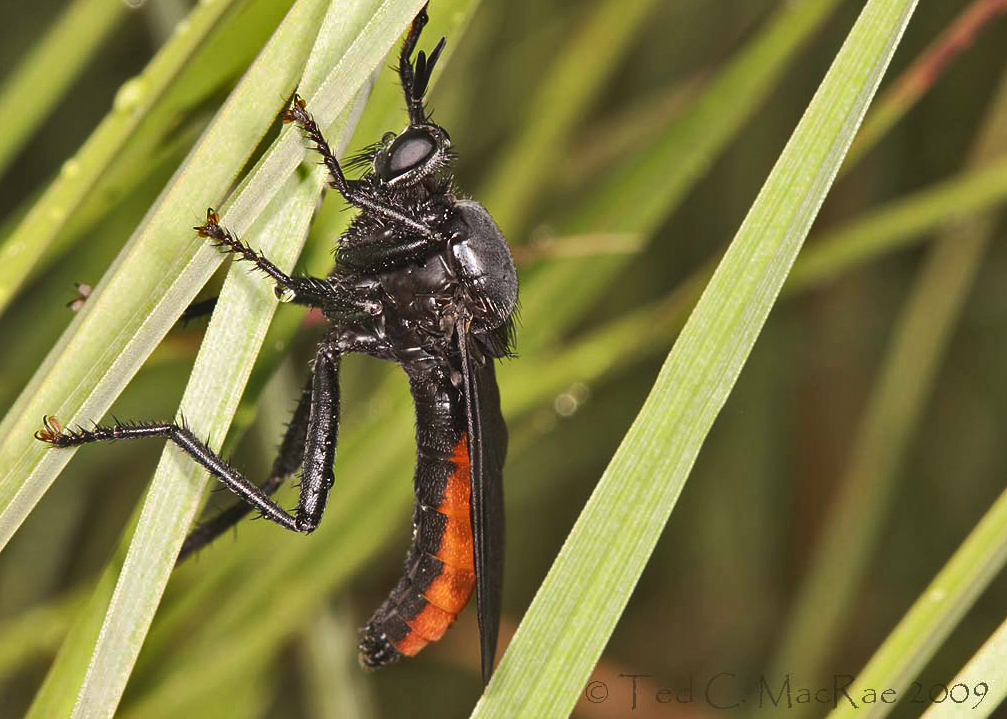
Ospriocerus abdominalis

Photo details: Canon 100mm macro lens on Canon EOS 50D, ISO 100, 1/250 sec, f/14, MT-24EX flash 1/4 power w/ diffuser caps.

Photo details: Canon 100mm macro lens on Canon EOS 50D, ISO 100, 1/250 sec, f/14, MT-24EX flash 1/4 power w/ diffuser caps.

My dipteran digression continues with this photograph of the robber fly, Ospriocerus abdominalis (Diptera: Asilidae).  More than just a pretty picture, this represents yet another apparently new state record that I and my colleague Chris Brown discovered a few weeks ago during our 2-day survey of Missouri’s critically imperiled hilltop prairies in the extreme northwest corner of the state.  Like the previously discussed Cylindera celeripes (swift tiger beetle) and Beameria venosa (a prairie-obligate species of cicada), O. abdominalis has not previously been recorded further east than Nebraska, Kansas, Oklahoma and Texas. This large fly is a grassland denizen that ranges over western North America and into Mexico (Cannings 1998, as Ospriocerus aeacus). It is somewhat suggestive of a mydas fly, although its short antennae immediately identify it as a robber fly (mydas flies have elongate clubbed antennae).  It also reminds me of the magnificent western robber fly Wyliea mydas by its mimetic, wasp-like coloration – presumably modeled after spider wasps of the genus Pepsis and Hemipepsis (Hymenoptera: Pompilidae) – but is distinguished by its black body and wings with red dorsal coloration on the abdomen (W. mydas has the abdomen wholly black and the wings red).  While not quite as handsome as W. mydas, it is impressive nonetheless.

The dry hilltop prairie remnants in which O. abdominalis, B. venosa, and C. celeripes were found are associated with the Loess Hills, a unique landform along the western edge of Iowa that reaches its southern terminus in extreme northwest Missouri.  Due to their extreme rarity and vulnerability to woody encroachment and anthropogenic degradation, these remnant habitats are considered one of Missouri’s most critically imperiled natural communities. Only about 50 acres of original habitat remain, and of this only half is in public conservation ownership.  Many of the plants and animals found in these habitats represent hypsithermal relicts that migrated eastward during a dry and warm period after the last ice age and were then “left behind” in pockets of relictual habitat as a return to cooler, wetter conditions forced the main populations back to the west.  More than a dozen plants and two vertebrates occurring in these prairies are listed as species of conservation concern.  As is typically the case, the flora and vertebrate fauna of these remnant habitats have been fairly well characterized, while precious little attention has been given to the vastly more diverse invertebrate fauna.  As we begin to study the insects of these habitats more carefully, we are almost sure to find a great many species that are more typically found further to the west and that live nowhere else in Missouri.  Their continued presence in the state will be wholly dependent upon the critically imperiled habitats in which they live, making conservation and restoration of the remaining loess hilltop prairie remnants in Missouri all the more important.

My thanks to Eric Fisher and Herschel Raney for confirming the identity of O. abdominalis.

REFERENCES:

Cannings, R. A. 1998. Robber Flies (Insecta: Diptera: Asilidae), in Smith, I. M., and G. G. E. Scudder, eds. Assessment of species diversity in the Montane Cordillera Ecozone. Burlington: Ecological Monitoring and Assessment Network.

Copyright © Ted C. MacRae 2009

Add to FacebookAdd to NewsvineAdd to DiggAdd to Del.icio.usAdd to StumbleuponAdd to RedditAdd to BlinklistAdd to Ma.gnoliaAdd to TechnoratiAdd to Furl

North America’s smallest cicada

Photo details: Canon 100mm macro lens on Canon EOS 50D, ISO 100, 1/250 sec, f/18, MT-24EX flash 1/2 power w/ diffuser caps.

Photo details: Canon 100mm macro lens on Canon EOS 50D, ISO 100, 1/250 sec, f/18, MT-24EX flash 1/2 power w/ diffuser caps.

While searching the hilltop prairies for Cylindera celeripes (swift tiger beetle) at McCormack Loess Mounds Natural Area in northwestern Missouri, I ran across a species of cicada that I’d not yet encountered in the state – Beameria venosa.  Cicadas as a rule are quite large insects, but with a body measuring only 16 mm (well under an inch) in length, B. venosa is one of – if not the – smallest species of this group in all of North America.  Had it not been for its distinctly cicada-esque call I might have thought it was some sort of fulgoroid planthopper (albeit a rather large one).  But a cicada it is, and a beautiful one at that despite its small size.

Beameria venosa is a prairie obligate species occurring from Nebraska and Colorado south to Texas and New Mexico.  To my knowledge, it has not been formally recorded from Missouri, although it is certainly already known from the state (it is listed in the 2009 issue of Missouri Species and Communities of Conservation Concern Checklist as “vulnerable” due to the restricted occurrence in Missouri of the prairie habitats in which it lives).  Froeschner (1952) listed 14 species of cicadas from Missouri but did not include this species even among those of possible occurrence in the state.  In my younger days, I managed not only to find all 14 of those species, but also a fifteenth species – the magnificent Tibicen superbus – in the southwestern corner of the state (formally recorded from the state some years later by Sanborn and Phillips 2004).  The occurrence of B. venosa in Missouri now brings to 16 the number of cicada species known from Missouri.

Despite its small size, the calling song of B. venosa is quite audible.  In fact, it was only due to its call that I noticed and began looking for this individual.  This brings up an interesting point regarding conspicuous insect songs and their role in enhancing predation risk.  Many predators are known to orient to the calls of cicadas (Soper et al. 1976), which in turn exhibit a variety of predator avoidance behaviors such as high perching, hiding, fleeing, and perhaps even mass emergence in the periodical cicadas.  Beameria venosa appears to avoid predators by producing its continuous train of sound pulses at a very high frequency.  Although audible to humans, the high frequency call apparently is not audible to birds and lizards – their chief predators (Sanborn et al. 2009).  In the open, treeless prairies where B. venosa lives, high frequency calling appears to provide the selective advantage for predator avoidance that fleeing, hiding, and high perching cannot.

REFERENCES:

Froeschner, R. C.  1952. A synopsis of the Cicadidae of Missouri. Journal of the New York Entomological Society 60:1–14.

Sanborn, A. F., J. E. Heath and M. S. Heath.  2009.  Long-range sound distribution and the calling song of the cicada Beameria venosa (Uhler) (Hemiptera: Cicadidae).  The Southwestern Naturalist 54(1):24-30.

Sanborn, A. F. and P. K. Phillips.  2004.  Neotype and allotype description of Tibicen superbus (Hemiptera: Cicadomorpha: Cicadidae) with description of its biogeography and calling song.  Annals of the Entomological Society of America 97(4):647-652.

Soper, R. S., G. E. Shewell and D. Tyrrell. 1976. Colcondamyia auditrix nov. sp. (Diptera; Sarcophagidae), a parasite which is attracted by the mating song of its host, Okanagana rimosa (Homoptera: Cicadidae).  The Canadian Entomologist 108:61-68.

Copyright © Ted C. MacRae 2009

Add to FacebookAdd to NewsvineAdd to DiggAdd to Del.icio.usAdd to StumbleuponAdd to RedditAdd to BlinklistAdd to Ma.gnoliaAdd to TechnoratiAdd to Furl

Typocerus deceptus in Missouri

It has been fifteen years now since I published an annotated checklist of the longhorned beetles (families Cerambycidae and Disteniidae) of Missouri (MacRae 1994).  That publication (and a similar one on Buprestidae) was the product of eight years of collecting – of specimens in the field and of data in any other public or private collection I could find that contained Missouri specimens – during my stint as a field entomologist with the Missouri Department of Agriculture.  I collected during the week while on my rounds.  I collected on weekends as well.  I visited every college and university in the state that had an insect collection of any size, and a few in neighboring states as well.  I made the acquaintance of private collectors with significant Missouri material – most notably Richard Heitzman, Marlin Rice, and the late Gayle Nelson.  By the time I left Missouri for a new position in Sacramento, I had documented 219 species and subspecies of longhorned beetles from the state – 66 of which were new state records.

Typocerus deceptus on flower of Hydrangea arborescens

Typocerus deceptus on flower of Hydrangea arborescens

Despite my best efforts, however, I knew the list was not complete – they never are.  In the years since returning to Missouri, I’ve documented an additional 10 species and subspecies in the state (MacRae and Rice 2007), and in a newly published paper (McDowell and MacRae 2009) the rare species, Typocerus deceptus, is documented from Missouri for the first time.  I cannot take credit for this discovery – that honor goes to the paper’s lead author, Tom McDowell of Carbondale, Illinois.  Tom first encountered this species in 2005 at Trail of Tears State Park in southeastern Missouri near Cape Girardeau while conducting routine insect surveys.  After seeing additional individuals on a subsequent visit to the park the following year, Tom contacted me to tell me of his find and graciously invited me to join him on further studies of this rarely encountered species.  I readily agreed, and in July of last year I met up with Tom at Trail of Tears to see the beetle for myself.

Typocerus deceptus on flower of Hydrangea arborescens

Typocerus deceptus on flower of Hydrangea arborescens

Typocerus deceptus has been recorded sporadically from across the eastern U.S.  Nothing is known of its biology other than adult flower hosts and activity periods, and the larva and larval host(s) remain completely unknown.  The species is aptly named, as its appearance is deceptively similar to the common and widespread species, T. velutinus.  Both of these species belong to the so-called “flower longhorn” group (subfamily Lepturinae), characterized by adults that are largely diurnal (active during the day) and attracted to a great variety of flowers upon which they feed.  Tom had found T. deceptus feeding on flowers of wild hydrangea (Hydrangea arborescens) in the company of several other flower longhorns, including T. velutinus.  The similarity of T. deceptus to T. velutinus makes distinguishing individuals amongst the vastly more abundant T. velutinus quite difficult.  However, Tom was able to recognize the species during his surveys as a result of prior experience with it in Illinois.  As Tom and I searched the wild hydrangea plants growing along an intermittent drainage between the road and the park’s unique mesic forest, we succeeded in picking out a total of four individuals of this species amongst the dozens of T. velutinus and other lepturines also feeding on the flowers.

Typocerus velutinus on flower of Hydrangea arborescens

Typocerus velutinus on flower of Hydrangea arborescens

I gradually developed a sense of the subtle differences that distinguish this species from T. velutinus and that allow its recognition in the field.  Typocerus deceptus is slightly more robust than T. velutinus, and whereas the transverse yellow elytral bands of the latter are distinct and well delimited, they are weaker and often interrupted at the middle in T. deceptus, giving the beetle a slightly darker brownish appearance.  The lateral margins of the elytra are also more strongly emarginated near the apices, giving the beetle a more distinctly tapered appearance.  Finally, while both species possess a distinct band of dense, yellow pubescence along the basal margin of the pronotum, this band is interrupted at the middle in T. deceptus. My ability to recognize this species in the field was confirmed a few weeks ago when I returned to Trail of Tears (with longtime field companion Rich Thoma) to attempt what seemed to be an impossible task – photograph these active and flighty insects in the field on their host plants.  Conditions were brutally humid, and I only saw two individuals that day – the first I immediately captured and kept alive as a backup for studio photographs should I fail to achieve my goal in the field, but the second individual (not seen until almost two hours later!) posed just long enough for me to whip off a series of frames, two of which turned out well enough to share with you here.  The first photo clearly shows the interrupted basal pubescent band, and both photos show the distinctly emarginate lateral elytral margins and weak transverse yellow bands (compare to the uninterrupted pronotal pubescent band and well developed transverse elytral bands of T. velutinus in the third photo).

Me with the discoverer of Typocerus deceptus in Missouri Trail of Tears State Park, July 2008

TCM with the discoverer of Typocerus deceptus in Missouri at Trail of Tears State Park, July 2008

It is possible that T. deceptus is not as rare as it appears and is simply overlooked due to its great resemblance to another much more abundant species. However, I believe this is unlikely given its rarity in collections of eastern U.S. Cerambycidae by casual and expert collectors alike.  Moreover, T. deceptus is not the only “rare” longhorned beetle to have been documented at Trail of Tears State Park – a number of other species have also been found there but not or only rarely elsewhere in Missouri (e.g., Enaphalodes cortiphagus, Hesperandra polita, Metacmaeops vittata, and Trigonarthris minnesotana).  This may be due to the unique, mesic forest found at Trail of Tears, being one of only a few sites in southeastern Missouri that support more typically eastern tree species such as American beech (Fagus grandifolia), tulip poplar (Liriodendron tulipifera), and cucumbertree (Magnolia acuminata).  Whether one of these trees serves as a larval host for T. deceptus is unknown.  Nevertheless, I will be returning to Trail of Tears in the future to see what other treasures remain hidden within its unique forests.

Photo details (insects): Canon 100mm macro lens on Canon EOS 50D, ISO 100, 1/250 sec, f/18-20, MT-24EX flash 1/4 power through diffuser caps.

REFERENCES:

MacRae, T. C. 1994. Annotated checklist of the longhorned beetles (Coleoptera: Cerambycidae and Disteniidae) known to occur in Missouri. Insecta Mundi 7(4) (1993):223–252.

MacRae, T. C. and M. E. Rice. 2007. Distributional and biological observations on North American Cerambycidae (Coleoptera). The Coleopterists Bulletin 61(2):227–263.

McDowell, W. T. and T. C. MacRae. 2008. First record of Typocerus deceptus Knull, 1929 (Coleoptera: Cerambycidae) in Missouri, with notes on additional species from the state. The Pan-Pacific Entomologist 84(4):341-343 DOI: 10.3956/2008-23.1

Copyright © Ted C. MacRae 2009

Add to FacebookAdd to NewsvineAdd to DiggAdd to Del.icio.usAdd to StumbleuponAdd to RedditAdd to BlinklistAdd to Ma.gnoliaAdd to TechnoratiAdd to Furl

Revisiting the Swift Tiger Beetle – Part 3

…continued from Revisiting the Swift Tiger Beetle – Part 2.

The Oklahoma trip had been an unqualified success. Not only had I managed to find the rare Cylindera celeripes (swift tiger beetle) at Alabaster Caverns, I had also determined the population there was healthy and, in fact, occurred robustly across a large swath of red clay/gypsum hill habitat in the vicinity of the Cimarron River (Woodward and Major Counties) in northwestern Oklahoma. This is good news for the species, who some have regarded as a potential candidate for federal listing on the endangered species list. There is no doubt that the species has suffered greatly in many parts of its range during the past century – most likely due to loss of habitat; however, the presence of a strong population in Oklahoma gives reason for optimism about its long-term prospects. It would have been even better had I found the species at the two Nature Conservancy preserves (Four Canyon and Tallgrass Prairie) that I had targeted, and the reasons for its apparent absence at those two sites despite an abundance of apparently suitable habitat remain a mystery to me (although I have my suspicions). Nevertheless, I returned to St. Louis happy, with new localities in my database and live individuals in containers of native soil for another attempt at rearing.

Our work with this species was not done, however. While C. celeripes has never been recorded in Missouri, my colleague Chris Brown and I have long suspected that it might occur here – most likely, we felt, in extreme northwestern Missouri where the Loess Hills landform reaches its southern terminus. We had looked for it in this area a few times before on the few remaining dry, hilltop prairie relicts that are so common further north in Iowa, and we had also looked for it in the larger tallgrass prairie remnants of west-central Missouri. None of these searches were successful, and with each unsuccessful effort it seemed less and less likely that the species actually occurred within the state – especially considering the declines that the species has experienced throughout its range. However, when we managed to find a small, newly discovered population of the species last summer in the Loess Hills of southwestern Iowa, just 60 miles north of Missouri (see The Hunt for Cicindela celeripes), we decided that one more thorough effort to locate the species in Missouri was in order.
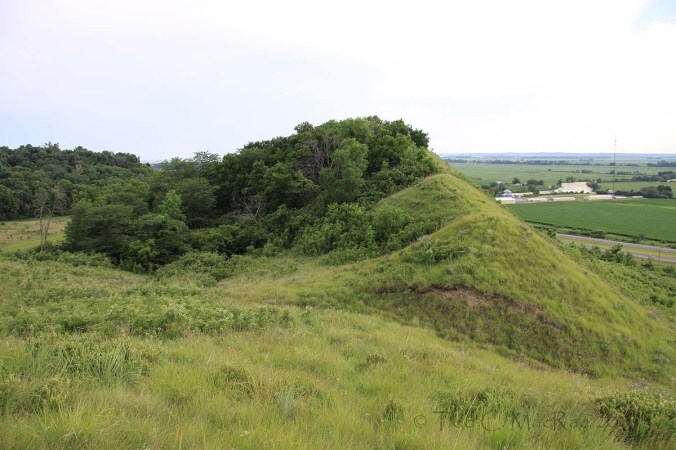
Star School Hill Prairie Natural Area (north tract), Atchison Co., Missouri.

Star School Hill Prairie Natural Area (north tract), Atchison Co., Missouri.

Our plan was straightforward – we would travel to northwestern Missouri each weekend beginning in late June and search the most promising hilltop prairie relicts that still remain in Missouri. There aren’t many of these, so I contacted Tom Nagel of the Missouri Department of Conservation – who probably knows more about Missouri’s hilltop prairie relicts than anyone else – for assistance in identifying these parcels. Tom graciously sent me descriptions and aerial photographs of the highest quality relicts still remaining in Missouri. None of these are large (12 contiguous acres or less), and all have been impacted to some degree by woody encroachment and are in various stages of restoration. We had already searched one of these tracts (Star School Hill Prairie) a few times, but two others were new to us. So, on a Friday evening before the first of three planned weekends for our study (and only two weeks after returning from Oklahoma), Chris and I made the long drive across Missouri and north along the Missouri River and began our search the next morning.

Fieldmate Chris Brown surveys loess hilltop prairie habitat at Star School Hill Prairie Natural Area, Atchison Co., Missouri

Fieldmate Chris Brown surveys loess hilltop prairie habitat at Star School Hill Prairie Natural Area (south tract), Atchison Co., Missouri

Our first stop was High Creek Hill Prairie in Brickyard Hill Conservation Area (Atchison Co.). We had been to Brickyard Hill a few times but had not previously found this particular hilltop prairie. We found the tract, a long, narrow series of ridge tops and southwest-facing slopes, thanks to Tom Nagel’s map and began searching with all the enthusiasm and optimism that accompanies any new search. Our optimism waned with each hilltop ridge that we traversed not seeing the beetle, until we reached the easternmost ridge amidst a jumble of eastern red-cedar cadavers that halted any further progress or promise. As we stood atop that last hill, we debated our next move. Chris had noted apparently good habitat on the lower slopes below us, while I had spotted another very small hilltop tract across a wooded ravine and disjunct from the main prairie. We decided these areas should be explored before moving on to the next site, but as we searched those lower slopes our optimism continued to wane. The habitat was perfect based on what we had seen in Iowa last year and what I had seen in Oklahoma earlier in the month – small clay exposures amongst clumps of undisturbed little bluestem and grama, but still no beetles. Chris, refusing to accept defeat, continued to search the slope, while I worked my way over to the smaller hilltop tract I had seen from above. After crossing through the wooded ravine, I found an old 2-track running along the base of the tract and began walking along it. The small slope above the 2-track was littered with large cadavers of the invasive eastern red-cedar (Juniperus virginiana), apparently left in place after chainsawing to provide fuel for a planned, future burn. As I walked, a white-tailed deer bolted from a nearby cadaver, giving me a bit of a start, and I veered towards the cadaver to have a look at where it had bedded down. By this time I almost wasn’t even really thinking about C. celeripes anymore – we had been there for about an hour and a half and searched the most promising habitats without success – the small tract where I was now working was almost a last gasp before moving on. As I approached the deer’s bedding site, a “flash” in the thick vegetation caught my eye, and I knew instantly what it was. Immediately I dropped to my knees and tried to “trap” the evasive little beetle (I’ve found that forming a “trap” between the crotches of my hands and gradually closing my hands together forces the beetle to run up and over one of my hands, at which time I can try to pin it down with my other). The beetle behaved exactly as expected, running over my left hand – but I missed it. I trapped it again, and once again it ran over my hand too fast to pin down. I tried to follow it as it zigzagged erratically through the thick vegetation, but in the blink of an eye it was gone. I spent the next several minutes frantically pulling apart the vegetation in a 2-foot radius around the spot in what I knew was a vain attempt to relocate the beetle before ultimately accepting that I had missed it. No matter – I had seen it and had absolutely no doubt about what it was – C. celeripes does indeed occur in Missouri! Wow – big news! I knew if I had seen one, I had a good chance of seeing another, so I began searching the area again – now with much more deliberation. I walked back and forth along the old 2-track, up and down the cadaver-littered slope, and back to the original spot several times. As time passed, a gnawing fear began to grow inside me that this new state record might lack a voucher. Suddenly, very near the original spot, I saw another. This time I pounced with authority and made no mistakes, and after securing the live beetle in a vial I gloated and congratulated myself unabashedly inside while bursting to give the news to Chris. I searched the slope some more, but I couldn’t take it anymore – I had to tell someone. I pulled out my cell phone and began texting a message to my daughter Mollie (who really doesn’t care about beetles but loves to receive text messages). As I was texting, Chris appeared on the lower slope, obviously noting that my net had been left on the ground purposely to mark a spot. As I finished texting I told Chris to come here, I wanted to show him something, and then non-chalantly handed him the vial. I would give anything to have a video of the look on Chris’ face as it changed from quizzical dumbfoundedness to shocked elation. Chris, too, had reached a low point in his optimism after thoroughly searching the previous slope without success, but now we were both as giddy as school boys – our long efforts had finally paid off with a new state record for one of North America’s rarest tiger beetles (the way we were acting, you’d have thought we’d just discovered plutonium!). We searched the slope for another half hour or so, with Chris seeing one more individual very close to where I had seen the first one. Whether it was the same or a different individual is unknown, so we decided that we had seen at least two individuals at this site. The discovery of C. celeripes here caused us to once again search the lower slope that Chris had previously searched so thoroughly, but again the beetle was not seen. Our giddiness was beginning to give way to concern over the few individuals we had seen and how localized they seemed to be. We had been at the site now for about three hours, and I was famished. I hiked back to the truck, noting some habitat at the far western end of the main prairie where we had begun our search that looked like it deserved another search. As I ate, Chris worked his way over to that spot, and after a period of time I heard him yell down to me and give me the “thumbs up.” I hurriedly finished eating and worked my way up to where he stood, and together we located two more individuals – taking one as a voucher for the site and ganging up on the other to keep it pinned into an open area where each of us could take field photographs before we finally let it “escape.” Seeing the species on the larger parcel had relieved our concern a little bit, and we felt a little less worried about its status here now.
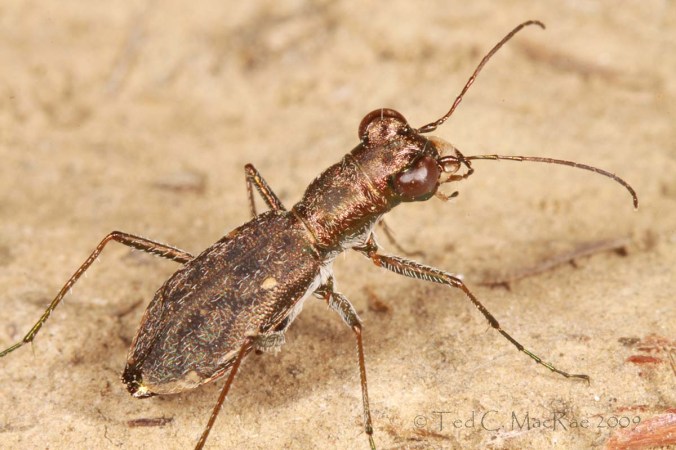
Cylindera celeripes - High Creek Hill Prairie, Brickyard Hill Conservation Area, Atchison Co., Missouri (new state record)

Cylindera celeripes - High Creek Hill Prairie, Brickyard Hill Conservation Area, Atchison Co., Missouri (new state record)

Later in the day we would see the species again at Star School Hill Prairie Natural Area , the northernmost substantial loess hilltop prairie within Missouri, and one that we had searched at least twice previously for the species. Again, we saw only two individuals in almost three hours of searching, confirming the impression first gained at Brickyard Hill that the species is not present in very high densities. Like Brickyard Hill, the beetles at this site were found in areas of undisturbed hilltop prairie with moderately thick shortgrass vegetation and were seen only when they IMG_0789_1200x800ran from one grass clump to another after being disturbed by our approach. We also looked for it at a smaller disjunct parcel just to the north, but the lateness of the hour limited the time we had to explore this site. Star School Hill Prairie is some 6 miles north of Brickyard Hill, thus, finding C. celeripes at two sites not in close proximity increased our optimism that the species might actually occur in many of the loess hilltop prairie remnants still remaining in northwestern Missouri. This optimism was further increased the next day when we saw two more individuals at one of Missouri’s southernmost hilltop prairie relicts at McCormack Loess Mounds Natural Area in Holt Co. However, our optimism is tempered by the fact that, again, we saw only two individuals, both of which were seen in a small, unburned spur extending northward off the main prairie, while none were seen in the much larger main parcel that appeared to have been recently burned in its entirety.
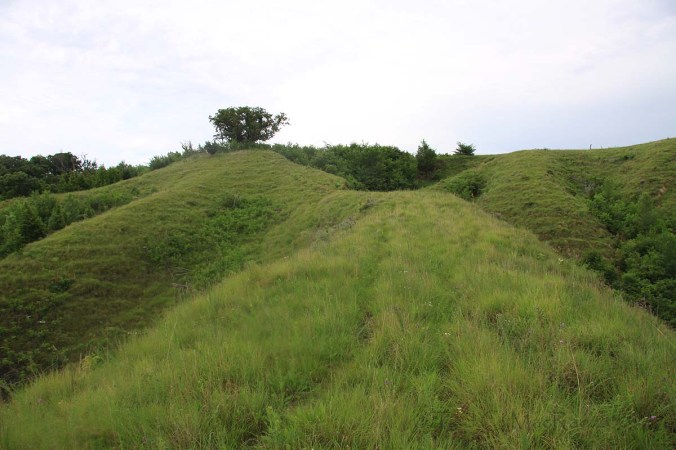
Cylindera celeripes macrohabitat at Star School Hill Prairie.  Beetles were seen along the narrow trail in the foreground and on the mild upper slopes (below bur oak in upper left).

Cylindera celeripes macrohabitat at Star School Hill Prairie. Beetles were seen along the narrow trail (foreground) and on the mild upper slopes (below bur oak, upper left).

The presence of this rare Great Plains species in Missouri’s critically imperiled hilltop prairies is cause for both excitment and concern. Cylindera celeripes represents a unique and charismatic addition to the state’s rich natural heritage. However, like soapweed yucca (Yucca glauca var. glauca), skeletonweed (Lygodesmia juncea), and the dozen or so other plant and animal species of conservation concern found within the hilltop prairies of IMG_0774_1200x800Missouri’s Loess Hills, C. celeripes appears to be entirely dependent upon these habitats for its survival within the state. Ensuring its continued survival will require careful reconsideration of the management approaches used for these rapidly shrinking natural communities. Prescribed burning has been and will continue to be an important tool in restoring our hilltop prairies; however, nonjudicious use of fire could lead to local extirpaton of C. celeripes within these habitats. Should that occur, recolonization from nearby parcels is unlikely due to the small, highly disjunct, and upland character of Missouri’s hilltop prairie remnants and the flightless nature of C. celeripes. As a result, rotational cool-season burns should be utilized as much as possible to avoid localized extirpations, especially on smaller parcels (Panzer 2002).

Hilltop prairie at McCormack Loess Mounds Natural Area, Holt Co., Missouri.  The main tract (pictured) was recently burned - beetles were found in a small unburned spur (off left center).

Hilltop prairie at McCormack Loess Mounds Natural Area, Holt Co., Missouri. The main tract (pictured) was recently burned - beetles were found in a small unburned spur (off left center).

Photo details:
Beetles: Canon 100mm macro lens w/ 68mm extension on Canon EOS 50D, ISO 100, 1/250 sec, f/18, MT-24EX flash 1/2 power through diffuser caps.
Landscapes: Same except Canon 17-85mm zoom lens (17mm at Star School, 20 mm at McCormack), 1/60 sec, f/8-9 (Star School) or f/13 (McCormack), natural light.

REFERENCE:

Panzer, R. 2002. Compatibility of prescribed burning with the conservation of insects in small, isolated prairie reserves. Conservation Biology , 16(5):1296-1307.

Copyright © Ted C. MacRae 2009

Add to FacebookAdd to NewsvineAdd to DiggAdd to Del.icio.usAdd to StumbleuponAdd to RedditAdd to BlinklistAdd to Ma.gnoliaAdd to TechnoratiAdd to Furl

Megacyllene comanchei revisited

On my recent trip, I reported finding the rarely collected Megacyllene comanchei at several localities in northwestern Nebraska and southwestern South Dakota. These are significant findings, since they not only represent new records for both states, but also an impressive 700-mile northern extension to the known range of the species (on top of a previously reported northern range extension from Texas into Kansas). The intriguing part of the situation is that these new records fall within the southern portion of the known distribution of M. angulifera, its closest relative, which has been recorded from several northern Great Plains states and provinces (although it has not yet been recorded specifically from Nebraska).

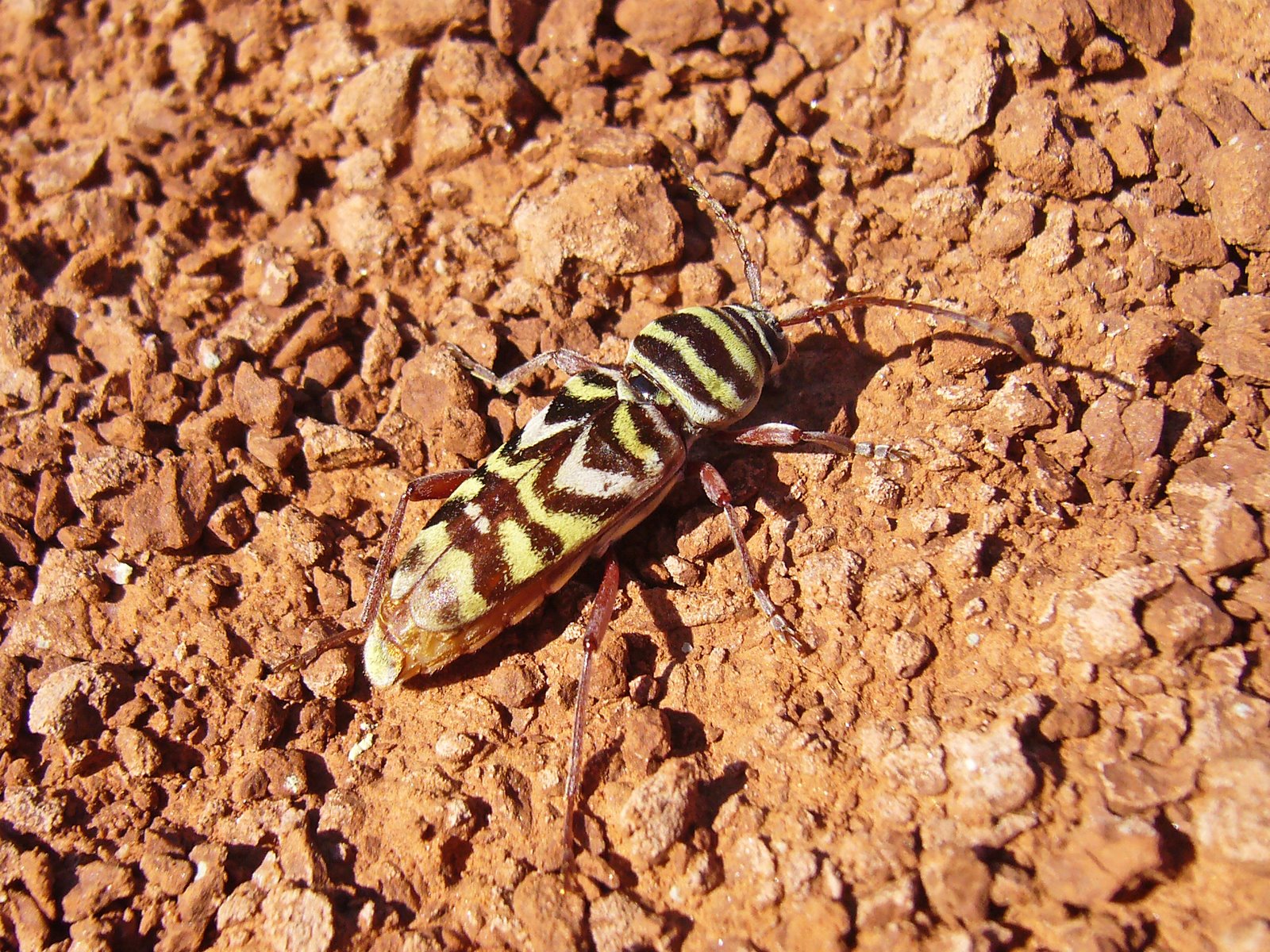
Upon reading about these findings, a friend and fellow student of Cerambycidae has expressed doubts to me about the distinctiveness of M. comanchei versus M. angulifera, regarding the slight color differences upon which it was based as insufficiently distinctive. In its original description (Rice & Morris, 1992, J. Kans. Entomol. Soc. 65:200-202), M. comanchei was distinguished from M. angulifera by a specific combination of characters, i.e., the premedian and sutural segment of the postmedian elytral bands are white, while the remaining pubescent bands are yellow. They also noted the subapical and apical bands often coalesce along the elytral suture and lateral margins. I do not have material of M. angulifera for direct comparison, but my specimens (two of which are pictured in this post) seem distinct enough from this specimen of M. angulifera pictured on Larry Bezark’s impressive website, A Photographic Catalogue of the CERAMBYCIDAE of the New World. In contrast, the pattern of coloration seen in this photo of the holotype of M. comanchei (also from that fine site) seems to agree well with my material.

Whether these color differences are significant remains to be seen. Neither species has been commonly collected, therefore large series of material have not been available for good comparative studies. However, there do seem to be significant differences in reported host plants and adult biology. Adults of M. angulifera are usually found in the fall on flowers of Solidago (goldenrod), and it was recently discovered that the larvae utilize root crowns of Dalea candida (family Fabaceae) for development (Blodgett et al. 2005). All but one of the remaining Nearctic species of Megacyllene for whom larval hosts are known also utilize fabaceous plants. These include M. robiniae and M. snowi (Robinia), M. decora (Amorpha), and M. antennata (Prosopis). A notable exception is M. caryae, which breeds in a variety of deciduous plant genera but most often Carya and is also unique in that adults occur during early spring instead of fall. Megacyllene comanchei, on the other hand, was discovered by examining the dead root crowns of Heterotheca sp. (family Asteraceae), with a few crawling on the ground in areas where such plants were growing. This is not proof that it serves as a larval host, but the repeated association of adults at the base of dead stems of this plant is highly suggestive. Additionally, no adults were encountered on goldenrod or other flowers, as is common among other members of this genus. The apparent utilization of a non-fabaceous larval host and behavioral difference exhibited by the adults seem to support its status as separate species. Again, the specimens that I collected agree not only morphologically with M. comanchei, but also behaviorally in that all of them (six specimens at three localities) were found crawling on the ground in shortgrass prairie rather than on flowers. I did note Heterotheca growing at one of the locations but did not find adults on the crowns of the few plants I inspected. I do not recall seeing any Dalea, but I wasn’t looking specifically for that plant either. Nor did I not see any goldenrod, which I would have certainly noticed had it been present.

So, for now, I’m inclined to continue calling these M. comanchei, and I’m also inclined to consider it distinct from M. angulifera. I do agree, however, that a critical examination of the distinctiveness of these two species might be warranted, and it may be worthwhile to pull together as much of the existing material of these two species as possible. I am interested in hearing other opinions about this situation.