A few more photographs from this past week in Campinas, Brazil. It rained during the afternoon but stopped by the time I arrived back at the hotel, allowing me to stroll the lavishly landscaped grounds during the mild evening hours. There is a pink-flowered shrub forming a hedge row in back of the hotel that is highly attractive to many types of insects. The identity of the shrub remains a mystery to me, and most of the insects I’m finding on it I can recognize only to family – I’m hoping the hotel staff will be able to name the former and that the readers of this blog might be able to provide IDs for the latter.
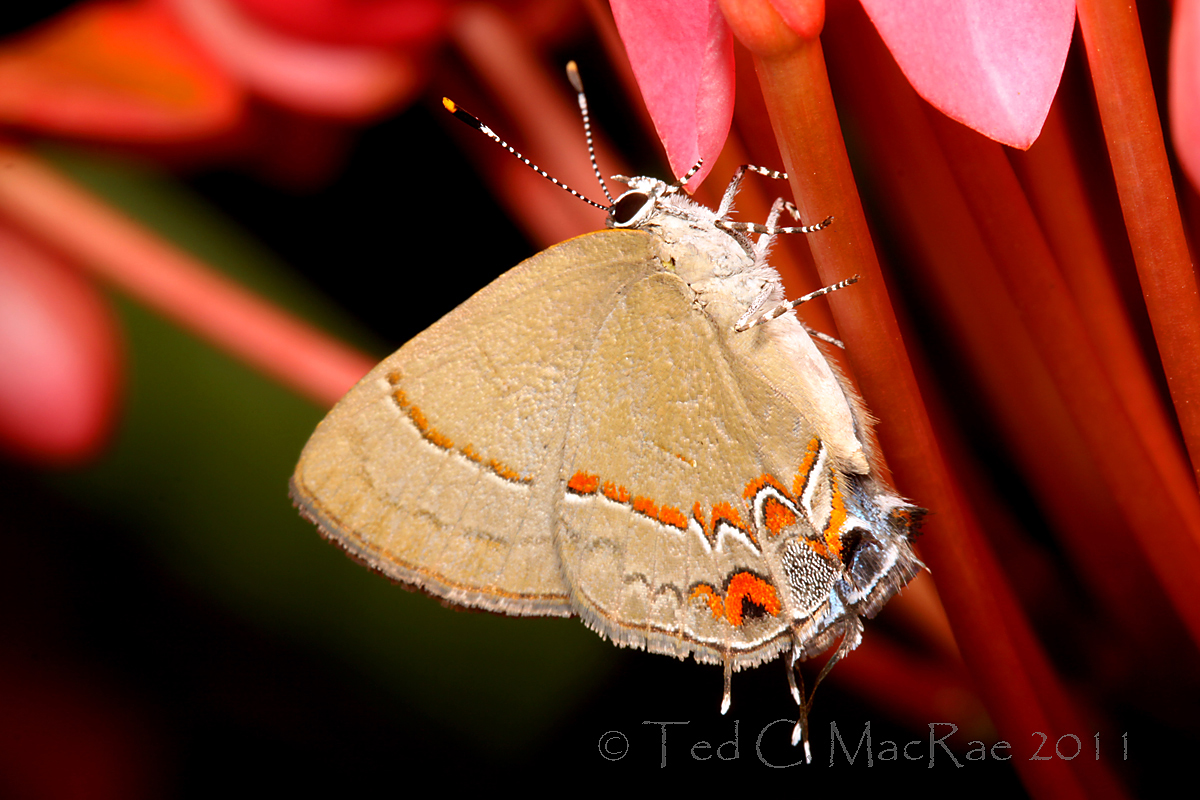
Calycopis sp. poss. origo (Lepidoptera: Lycaenidae). ID by Dave Hubble and Chris Grinter.
It took a bit of effort to find an unobstructed view of this hairstreak butterfly (family Lycaenidae) as it visited the flowers within the shrub. Every time I tried to move foliage out of the way to get a good view, the butterfly became alarmed and flew to another part of the hedge row. My antics drew the attention of a hotel worker, who was apparently interested enough in what I was doing to act as a spotter whenever the butterfly flew to help me relocate it. Eventually I got a few shots that I was happy with, including the above.
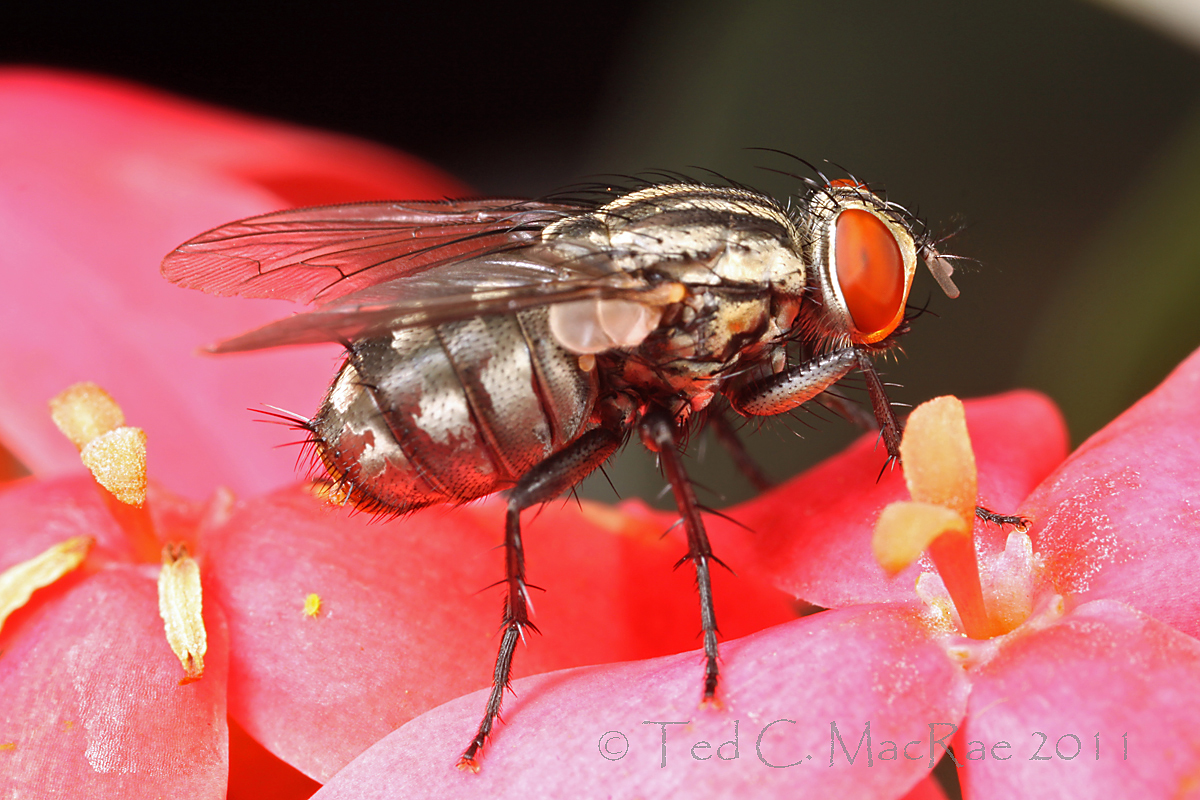
A flesh fly (Diptera: Sarcophagidae).
I presume this to be a type of flesh fly (family Sarcophagidae) based on the stout bristles and color pattern that seems typical for the family. I like the striking contrast in coloration between the fly and the flower. There are a few fly bloggers who I’m hoping might be able to give a better identification.
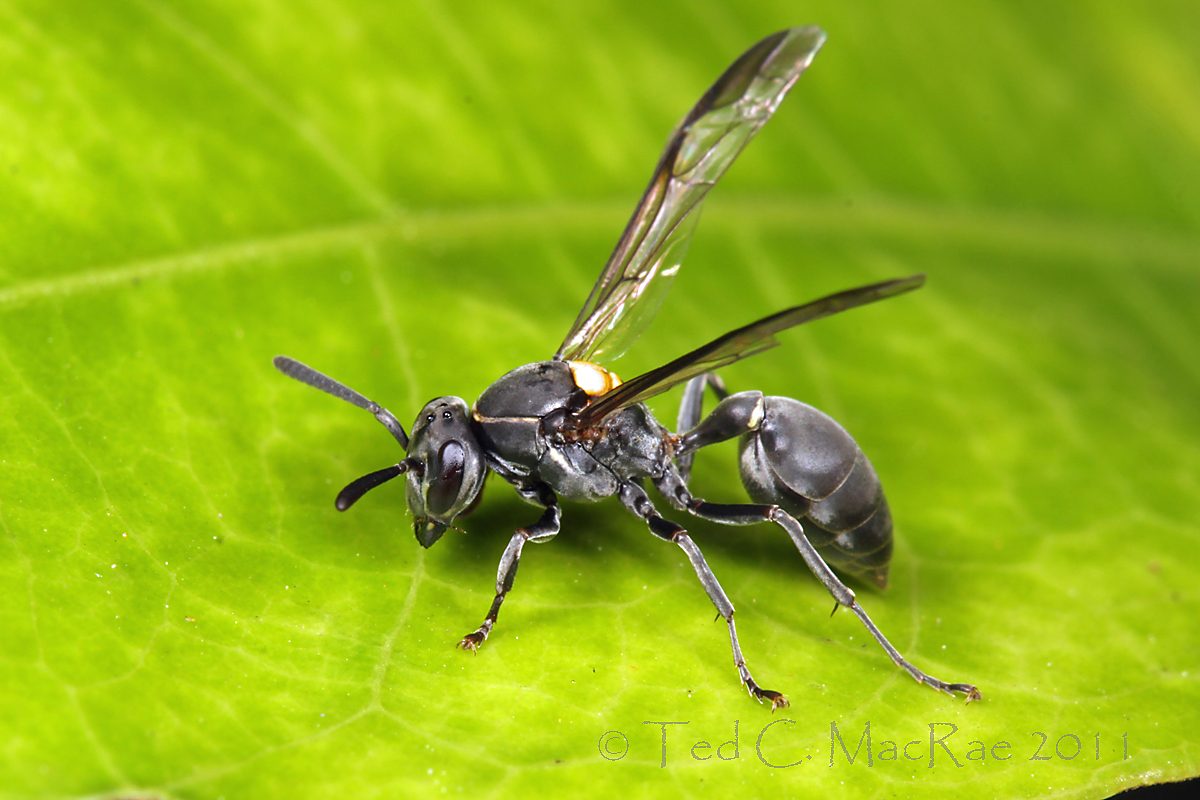
A potter/mason wasp? (Hymenoptera: Vespidae).
This appears to me to be some kind of potter or mason wasp (family Vespidae, subfamily Eumeninae) – it was a bit smallish at only about 12mm in length. I hope one of the knowledgeable wasp bloggers out there (ahem… Eric?) can at least confirm this level of identification and perhaps the tribe or genus as well.

Azya orbigera (Coleoptera: Coccinellidae). ID by Tucker Lancaster.
Every ladybird beetle (family Coccinellidae) I’ve ever seen is some variation of black and red/orange/yellow and has a smooth, glabrous appearance. This beetle is cobalt blue with a dense pubescence over the dorsal surface, but it still seems to me to be some type of ladybird beetle. It was a tiny little thing, so I suppose it could be one of the multitude of small beetle families with which I am unfamiliar.

Quedas sp.? (Hemiptera: Cicadidae).
This cast cicada exuvium was not on the shrub, but on a nearby tree at about eye level. I really wish I could have seen the cicada that emerged from it, because this is certainly the biggest cicada exuvium I have ever seen. I was about to simply label it “family Cicadidae” but seem to recall that cicada higher classification is in a bit of flux these days. At any rate, given its great size I wonder if it might represent one of the giant cicadas in the genus Quesada.
I still have many more insect photographs from the past week and will certainly increase that number over the next week as well. Stay tuned!
Copyright © Ted C. MacRae 2011
 Beetles In The Bush