Millipede assassin bug

Ectrichodia crux

I continue the hemipteran theme begun in the last post with this photograph I took in South Africa below the Waterberg Range in Northern (now Limpopo) Province. I recognized them as members of the family Reduviidae (assassin bugs), and since to my knowledge species in this family are exclusively predaceous (except for the so-called “kissing bugs” of the mostly Neotropical subfamily Triatominae, large distinctive bugs that feed exclusively on vertebrate blood), I found what I took to be a case of scavenging on a dead millipede to be rather curious.  It had rained the previous evening, resulting in a burst of millipede (and insect) activity that night, and this scene was rather commonly encountered the following morning. Of course, appearances can be deceiving, and it turns out that I actually was witnessing predation – and a most unusual case at that.  The individuals in this photo represent Ectrichodia crux (millipede assassin bug), a common species in many parts of southern Africa.  Although nearly 500 species of assassin bugs are known from the region (Reavell 2000), E. crux is easily recognizable due to its large size (adults measure up to 22 mm in length), stout form, and coloration – shiny black, with a distinctive black cross incised on its dull yellow thorax and with yellow abdominal margins (Picker et al. 2002). The nymphs as well are distinctive – bright red with black wing pads. Clearly, these insects are advertising something.

Ectrichodia crux belongs to the subfamily Ectrichodiinae, noted for their aposematic coloration – often red or yellow and black or metallic blue, and as specialist predators of Diplopoda (Heteropteran Systematics Lab @ UCR).  Species in this subfamily are most commonly found in leaf litter, hiding during the day under stones or amongst debris and leaving their shelters at night in search of millipedes (Scholtz and Holm 1985). They are ambush predators that slowly approach their prey before quickly grabbing the millipede and piercing the body with their proboscis, or “beak.”  Saliva containing paralytic toxins and cytolytic enzymes is injected into the body of the millipede to subdue the prey and initiate digestion of the body contents, which are then imbibed by the gregariously feeding assassin bugs.

Millipedes employ powerful chemical defenses – primarily benzoquinones and sometimes hydrogen cyanide gas as well, which are discharged from specialized glands along the millipede’s body – to protect themselves from predation.  Thus, specialized predation of millipedes is a niche that has been exploited by relatively few predators, and little is known about the mechanisms used for circumventing these defenses. The recently reported millipede specialist, Deltochilum valgum (order Coleoptera, family Scarabaeidae), has been observed killing its prey by violently decapitating and disarticulating it before feeding on the body contents (Larsen et al. 2009, summary here); however, the exact manner by which the beetle avoids or withstands the millipede’s chemical discharges remains unknown.  For ambush predators such as Ectrichodia crux and other ectrichodiines, a strategy similar to that described for another millipede specialist predator, larvae of the phengodid beetle, Phengodes laticollis (order Coleoptera, family Phengodidae), might be employed. This species subdues its millipede prey by piercing thinner regions of the millipede’s integument (e.g., intersegmental membranes on the ventral surface) with its hollow sickle-shaped mandibles and apparently injecting gastric fluids that abruptly paralyze the millipede, thereby preventing it from discharging its gland contents (Eisner et al. 1998).  These undischarged benzoquinones remain confined to the glands and are prevented from diffusing into the body cavity by the glands’ impervious cuticular lining, thus allowing the phengodid larva to safely imbibe the liquified systemic contents of the immobilized millipede.

REFERENCES:

Eisner, T., M. Eisner, A. B. Attygalle, M. Deyrup and J. Meinwald. 1998. Rendering the inedible edible: Circumvention of a millipede’s chemical defense by a predaceous beetle larva (Phengodidae).  Proceedings of the National Academy of Sciences USA 95(3):1108–1113.

Larsen, T. H., A. Lopera, A. Forsyth and F. Génier. 2009. From coprophagy to predation: a dung beetle that kills millipedes. Biology Letters DOI:10.1098/rsbl.2008.0654.

Picker, M., C. Griffiths and A. Weaving. 2002. Field Guide to Insects of South Africa. Struik Publishers, Cape Town, 444 pp.

Reavell, P. E. 2000. The assassinbugs (Hemiptera: Reduviidae) of South Africa. http://oldwww.ru.ac.za/academic/departments/zooento/Martin/reduviidae.html#ectrichodiinae.

Scholtz, C. H. and E. Holm (eds.). 1985. Insects of Southern Africa. Butterworths, Durbin, South Africa, 502 pp.

Copyright © Ted C. MacRae 2009

Add to FacebookAdd to NewsvineAdd to DiggAdd to Del.icio.usAdd to StumbleuponAdd to RedditAdd to BlinklistAdd to Ma.gnoliaAdd to TechnoratiAdd to Furl

Done with dung, meat please!

ResearchBlogging.orgNo feces for this species.” “Carnivorous dung beetle shuns dung and decapitates millipede.” “Little dung beetle is big chopper.” “Dung beetle mistakes millipede for dung.” These were some of the clever headlines that I had to compete with in coming up with my own opener for a remarkable beetle that titillated the science blogosphere last week. At the risk of being redundant, I’d like to revisit that beetle and offer a few (hopefully novel) thoughts of my own. I can say that I have a unique and special treat for those willing to read further.

First the background. Deltochilum valgum is a so-called “dung beetle” in the family Scarabaeidae that lives in the lowland rain forests of Peru. As suggested by its common name, it belongs to a group of beetles that are well known for their dung feeding habits. Over 5,000 species of dung beetles are known throughout the world, all of which carve out balls of dung and bury them as provisions for larval development – or so it was thought.  As reported by Trond Larsen of Princeton University and colleagues in Biology Letters, D. valgum has apparently abandoned its ancestral dung ball-rolling behavior in favor of a predatory lifestyle. Its prey – millipedes! Moreover, the species exhibits several distinct morphological traits that appear to have evolved as a direct result of their predatory behavior. Adult beetles were repeatedly observed killing and eating millipedes, and their disdain for dung was rather conclusively demonstrated by an exhaustive, year-long trapping program in which pit-traps were baited with a variety of bait types known to attract dung beetles (e.g., various kinds of dung, carrion, fungus and fruit) – and millipedes.  In all, over 100,000 dung beetles representing 132 species were trapped (what a nice collection!), 35 of which were found to scavenge on dead millipedes, but only five of these dared tackle live millipedes.  Of these, only D. valgum ignored all other foods – it only came to traps baited with live millipedes.

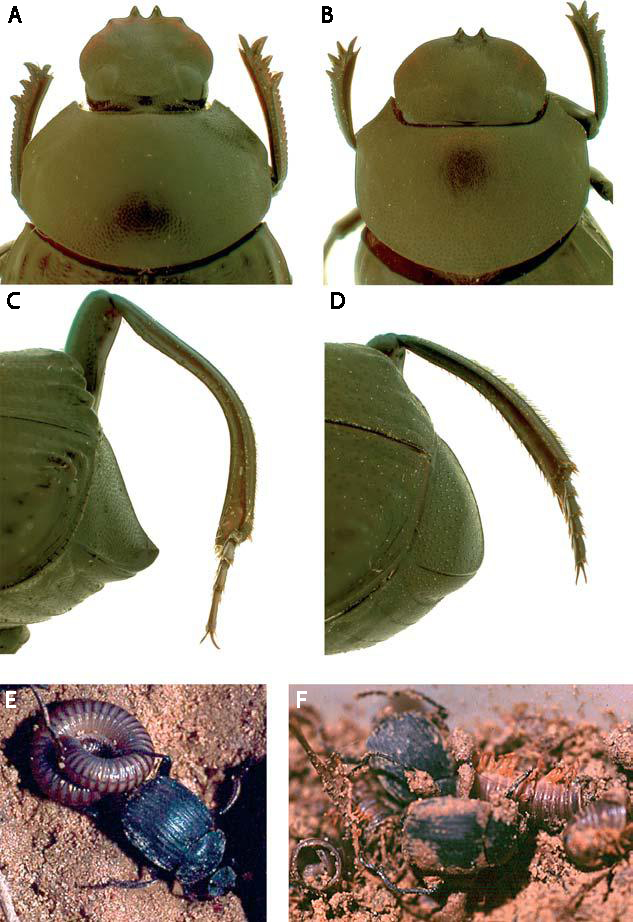
Larsen et al. determined that adults of D. valgum are opportunistic hunters and were much more likely to attack injured millipedes than healthy ones, even those weighing 14 times as much as the beetle.  Ball rolling behavior was never observed by D. valgum.  Most dung beetles have wide, shovel-shaped heads used to scoop and mold dung balls, but D. valgum has a much narrower head with sharp “teeth” on its clypeus (Fig. 1A vs. 1B).  The teeth apparently aid in killing the millipede by piercing the ventral surface behind the head and prying upwards (decapitating it), and the narrow, elongate head facilitates insertion into the millipede body for feeding.  Further, the hind tibia are elongate and curved, which are used to “grip” millipedes by holding them up against the dorsally reflexed pygidium (Fig. 1C vs. 1D).  This allows the beetle to drag its coiled up victim with one hind leg while walking forward on the other five (Fig. 1E).  Once killed, the beetles proceeded to break their prey into pieces and consume their meaty innards, leaving the disarticulated millipede exoskeletons licked clean (Fig. 1F).  One of these “attack” episodes was filmed (using infrared lighting so as not to affect their nocturnal behavior) and can be seen in this BBC News video.

Deltochilum valgum

Figure 1. (a) Dorsal view of D. valgum head. Sharp clypeal teeth and angled clypeus act as a lever to disarticulate millipede. Narrow, elongate head permits feeding inside millipede; (b) dorsal view of Deltochilum peruanum head, lacking characters described in (a), head used to mould dung balls; (c) lateral view of D. valgum pygidium and hind tibia. Dorsally reflexed pygidial lip is used to support millipede during transport. Elongate, strongly curved hind tibia is used to grip millipede. (d ) Lateral view of D. peruanum pygidium and hind tibia, lacking characters described in (c), hind tibia used for rolling dung balls. (e, f ). Predation strategy by D. valgum. (e) Dragging live, coiled millipede with one hind leg, walking forwards; ( f ) feeding on killed millipede with head inside
segments; disarticulated empty millipede pieces nearby.
Credit: Larsen et al. (2009).

Much has been made about this remarkable shift from coprophagy to predation, which Larsen et al. speculate was driven by competition for limited resources with the many other dung beetle species that occur in the Peruvian rainforests. In fact, adult dung beetles are known to feed on a variety of resources besides dung, as exemplified by the range of baits used in their survey. Thus, my first thought after reading the coverage was actually a question: “Has this species abandoned dung provisioning completely as a reproductive strategy?” Everything I had read focused exclusively (quite understandably) on the bizarre feeding habits of the adults, but there was no mention of what the species’ larval provisioning strategies were. Wanting more information about this, I contacted Trond Larsen, who graciously sent me a PDF of the paper. Unfortunately (though not a criticism of the paper), no further insight about this was found in the paper either. Indeed, in all of the observations recorded by Larsen et al., millipedes killed by D. valgum were consumed entirely by the adults, and no mention was made of how or whether millipedes were utilized for larval provisioning. I wondered if D. valgum had truly abandoned dung provisioning for larval development (a remarkable adaptive switch), or if in fact the species might still utilize the strategy for reproduction (perhaps having specialized on a dung type not included in their survey), while also exploiting millipede predation as adults for a nutritional advantage. I asked Trond about this, to which he replied with this juicy tidbit (I told you I had a special treat!):

Yes, I would very much like to know what the reproductive/nesting behavior of D. valgum is. My best guess is that they also use millipedes as a larval food source, but as you say, we haven’t observed that behavior yet. I have observed other generalist dung beetle species rolling balls out of dead millipedes, presumably to bury for the larvae, so I certainly think it would be an adequate food source. Many dung beetle species use carrion for their larvae.

I am quite confident that D. valgum does not use any kind of dung. I have sampled these dung beetle communities very thoroughly, with many dung types and other bait types, and also with passive flight intercept traps that catch all beetles. Every dung beetle species that feeds on dung is at least sometimes attracted to human dung (this is not the case in African savannahs though, but is in neotropical forests – that is a whole different story). There are still a small handful of species we catch in flight intercept traps that we don’t know what they eat, although some of these mysteries have recently been solved – many of them live in leaf-cutter ant nests for example.

While predation of millipedes by a dung beetle is itself a fascinating observation, demonstrating the abandonment of dung provisioning in favor of captured prey for larval development would be a truly remarkable example of an ecological transition to exploit a dramatically atypical niche. I hope Trond (or anybody for that matter) actually succeeds in observing millipede/prey utilization for larval provisioning by this species.

Many thanks to Trond Larsen for his delightful correspondence.

SOURCE:
Larsen, T. H., A. Lopera, A. Forsyth and F. Génier. 2009. From coprophagy to predation: a dung beetle that kills millipedes. Biology Letters DOI: 10.1098/rsbl.2008.0654.

Copyright © Ted C. MacRae 2009

Add to FacebookAdd to NewsvineAdd to DiggAdd to Del.icio.usAdd to StumbleuponAdd to RedditAdd to BlinklistAdd to Ma.gnoliaAdd to TechnoratiAdd to Furl

Afrikaans ants

A few for Alex

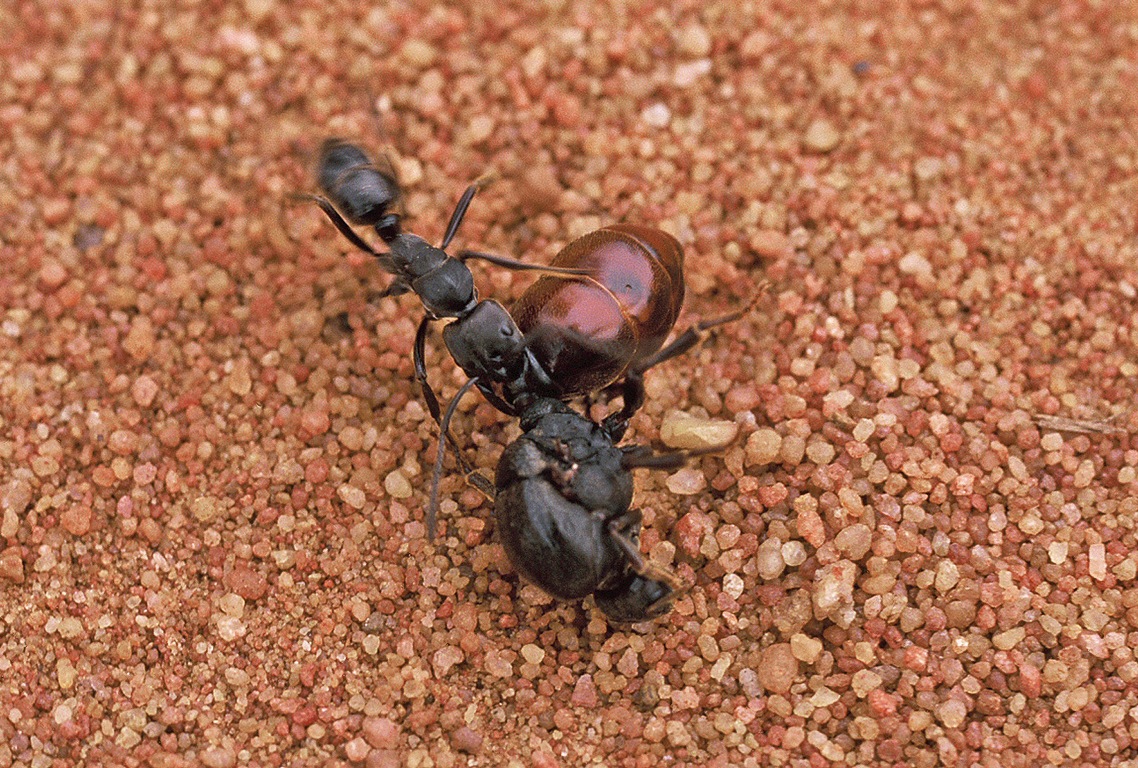
I photographed these ants in South Africa during my visit to Borakalalo National Park (North West Province) in November 1999.  Dr. Brian Taylor, author of the impressive Ants of Africa website, kindly identified and provided some information about the ants in these photos.  Pachycondyla tarsata - South Africa, North West Province, Borakalalo National Park, 25.xi.1999The first photo shows a worker ant dragging another dead ant.  Dr. Taylor identified the worker as Pachycondyla tarsata, which according to his website is known as the ‘Stink Ant’.  This pan-African species usually forages singly and nests directly in the ground, with the entrance often surrounded by excavated soil and remains of arthropods and other food. He wasn’t sure about the identity of ant being carried but guessed that it could be the queen of Camponotus (Myrmopiromis) fulvopilosus1.  That species is South African and appears to be of the right size for the individual in this photo.  Ants may have taken over the world, but at least they clean up after themselves.

1 Edit 01/17/09: Dr. Taylor sent an email to me saying that, after a second look at the above photo, he now believes the queen being carried by the Pachycondyla tarsata worker probably represents Carebara vidua, discussed below.

These next photos might have been better posted on Wednesday (ahem… “hump” day).  424046-r1-e009_009_mating_ants_21Dr. Taylor identified them as Carebara vidua. According to Lepage and Darlington (1984), colonies of this termitophagous species produce broods of alates ready to fly during the short November rains (as we experienced during our visit), as well as the longer April rains. Male and female alates are usually produced in separate nests, and after the flight the alate males seek out the females. The mating swarm I photographed shows several males attempting to mate with a single female – I counted five males at first, although one dropped off while I continued taking photos trying to get a good shot of the “lucky fellow”. 424046-r1-e010_010_mating_ants_21I am pleased that Dr. Taylor considered these photos informative enough to post on the species page at his Ants of Africa website. Lepage and Darlington (1984) reported nests of this species established in 2-10% of Macrotermes termite mounds  in Kenya, although nests can also occur well away from mounds. In the laboratory, dealate female ants exposed to Macrotermes workers remained passive and elicited no aggression. After 39 days, the mated females were capable of producing broods of about 1,000 workers, able to overpower, kill and eat the much larger Macrotermes workers.

REFERENCES:

Taylor, B. 2008. Ants of Africa. http://www.antbase.org/ants/africa/antcover.htm.

Lepage, M. G. and J. P. E. C. Darlington. 1984. Observations on the ant Carebara vidua F. Smith preying on termites in Kenya. Journal of Natural History 18(2):293-302.