The “buzzard signal fly”

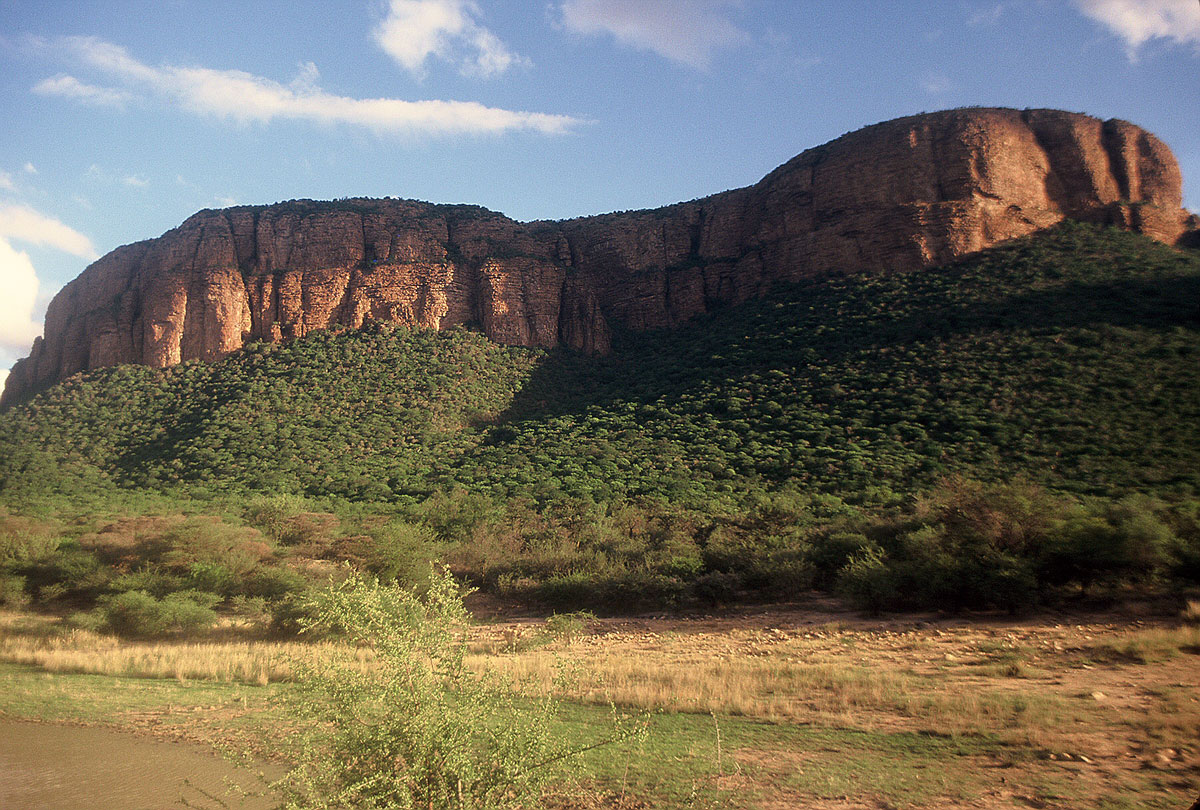
Waterberg RangeDuring our time at Geelhoutbos farm in South Africa’s Northern (now Limpopo) Province, we spent most of our time in the foothills below a magnificent north-facing escarpment of the Waterberg Mountain Range. We were here to collect Buprestidae (including the magnificent Evides, featured previously in this post), and it was in the low bushveld woodland where the greatest diversity of buprestids would be found. Many of the buprestids we encountered were associated with the acacias that abundantly dotted the landscape – especially the iconic “umbrella thorn” (Acacia tortilis) and “sweet thorn” (Acacia karoo), providing sustenance for everything from bitsy beetles (including our beloved buprestids) to giant giraffes. Still, I kept eyeing the mountains, yearning to clamber up on top of the billion year old massif for no other reason than because it was there. Chuck had the good sense to stay down below amongst the acacias and buprestids while I spent an afternoon winding my way up the escarpment in the company of our hostess, Susan Strauss. I didn’t collect many buprestids during that trek, and if success is measured solely by numbers of buprestids collected then Chuck won. But if success also includes the chance to see spectacularly endless vistas from an otherworldly landscape on a once in a lifetime trip, then I didn’t do too badly.

Bromophila caffra

While I didn’t see many buprestids during that afternoon, I did see a few other insects interesting enough to attract my attention and maybe an attempt at a photo. This stunning fly was one of those insects. Even though it exceeded a full inch in length, it still wasn’t the largest fly I had ever seen. However, with its black body, metallic blue wings and large, round, wax-red head it was certainly among the most impressive. A quick scan through my recently acquired Field Guide to Insects of South Africa (Picker et al. 2002) has at last identified this fly as Bromophila caffra. It is a member of the family Platystomatidae, commonly known as signal flies and part of the great superfamily Tephritoidea of fruit fly fame (i.e., true fruit flies – not “the” fruit fly which belongs to the family Drosophilidae and which are more properly called vinegar flies).

Signal flies are interesting on several fronts, firstly because of their catholic tastes – Sivinski (1999) records rotting tree trunks, bulbs, roots and fruit, dried flowers and dead grass stems, dung and fungus as breeding sites, and notes – gruesomely – that mass graves dug in World War II sometimes produced huge numbers of the species Platystoma lugubre. It is some of the Australasian species, however, that have truly made a name for this family. In the tropical rainforests of Guinea and Queensland, males of many species exhibit modifications of their heads that are used in agonistic interactions with sexual rivals. These vary from broadening of the face into a surface used to push against the face of another male, to extremely well-developed stalk eyes used to gauge rival male’s size and strength in face to face combat.

But what about Bromophila caffra? Aside from being one of the most recognizable of flies in Africa, it’s sluggish disposition and apparent noxiousness were obvious even to early naturalists. Marshall (1902) noted the similarity of its coloration (black body, blue wings, red or yellow head) to that of two Pompilus spp. and one sphecid wasp with which it occurred sympatrically. Regarding its habits, he also noted:

The Bromophila fly is very plentiful; it is the most sluggish fly known to me, and settles about on trees and bushes in a very conspicuous manner. It ejects a yellow liquid from the mouth when handled, and was refused when offered to my baboons and Cercopithecus monkey.

Andrew Whittington, commenting on a photo of this species posted on DipteraInfo.com, provides further clues that seem to confirm the noxious qualities of this species, explaining not only its striking color and brazen habits but also the ease with which I obtained the above photograph:

Our knowledge of larval habits is very rudimentary. There appears to be an association with the roots of Terminalia trees (Combretaceae), from which the larvae sequester various toxic compounds (probably cyclic triterpenes) possibly for defense. This may render the adults toxic too, as a defense against predation – not a thoroughly tested hypothesis.
Adults are slow moving and ponderous … and photogenic!

I find it surprising that a large, strikingly distinctive, abundant insect such as Bromophila caffra should lack a common name, but it appears this is the case. None was given in Field Guide to Insects of South Africa, nor amongst the several South African wildlife and dipteran websites which I encountered featuring photos of this insect. In thinking about what common name Bromophila caffra could have, I can’t help but draw comparisons between this insect and the turkey vulture (Cathartes aura), or “buzzard,” of North America (despite their belonging to entirely separate phyla). Both species are among the larger members of their respective orders and make their living eating repulsive foodstuffs. Hulking black with naked, red, plastic-like heads, most predators regard them as too vile and noxious to bother with, leaving them free to pass their lives in unmolested disdain. With this in mind, I hereby propose “buzzard signal fly” as the official common name for this insect 😉

Additional photographs of Bromophila caffra can be seen at Joan Young’s fine blog, South African Photographs, and at Biodiversty Explorer, the web of life in Southern Africa. This is the fifth in a series of posts covering a natural history excursion to South Africa in November/December 1999. Click on “South Africa” under “Tags” to see links and summaries for other posts in this series.

REFERENCES:

Marshall, G. A. K. 1902. Five year’s observations and experiments (1896-1901) on the bionomics of South African insects, chiefly directed to the investigation of mimicry and warning colours. Transactions of the Entomological Society of London, 1902:287-584.

Picker, M., C. Griffiths and A. Weaving. 2002. Field Guide to Insects of South Africa. Struik Publishers, Cape Town, 444 pp.

Sivinski, J. 1999. Breeding habits and sex in families closely related to Tephritidae: Opportunities for comparative studies of the evolution of fruit fly behavior, pp. 23-39. In: M. Aluja and A. L. Norrbom [eds.], Fruit Flies (Tephritidae): Phylogeny and Evolution of Behavior, CRC Press, Boca Raton, 984 pp.

Tyrant ground beetles

I return to my Afrikaans theme with a distinctive group of ground beetles (family Carabidae) called tyrant ground beetles or spotted ground beetles (tribe Anthiini). I think I prefer the former. This tribe is largely restricted to Africa and is especially diverse and abundant in the arid, sandy Karoo and Kalahari regions of southern Africa (Scholtz & Holm 1985). These beetles are large, powerful predators that rely on speed and agility for capturing prey, and since they are also flightless these characteristics come in handy for avoiding becoming prey themselves. Failing that, they employ chemical defense in the form of secretions from a pygidial gland located in the area of the ninth abdominal segment. The chemical cocktail within these secretions contains concentrated organic acids or quinone that can be squirted at potential predators in a strong jet. This is an effective deterrent to small mammalian and avian predators, and I suppose a careless beetle collector might also regret handling these beetles without due respect. These defensive spray capabilities give rise to another common name for the group, “oogpister” – an Afrikaner word that literally translates to (ahem) “eye pisser.”

Anthia (s. str.) thoracicaDuring my time in Africa, Chuck Bellamy and I were primarily focused on collecting buprestids. However, we still couldn’t resist hanging an ultraviolet light in front of a sheet and searching the ground with flashlights at night to see what diversity of other African insects we might encounter. Truth be told, one of the non-buprestid groups that I’d really hoped to encounter was a near relative of these beetles – the so-called “monster tiger beetles” of the genus Manticora (family Cicindelidae1). We never did see any monsters, but we did encounter several species of anthiine ground beetles around our encampment at Geelhoutbos farm near the Waterberg Range in Limpopo Provice. Anthia (s. str.) thoracica, the giant African ground beetle (above), was the most impressive of these. Click on the photo to see a larger version – only then will it begin to convey how truly appropriate such a common name is for this species. It is certainly the largest ground beetle that I have ever seen – a full 50 mm in length! That’s 2 inches, folks! This species is easily recognized by the depressed lateral expansions of the pronotum covered with dense white/yellow pubescence, and the slightly smaller male that I caught exhibits more elongated mandibles (though not so incredibly as in Manticora) and marvelous lobes extending backward from the pronotum.

1 Increasingly placed within the Carabidae as subfamily Cicindelinae on the basis of molecular phylogenetic analysis, along with Paussinae and Rhysodinae (e.g., Beutel et al. 2008).

Anthia (Termophilum) omoplataIn addition to true Anthia, we saw two species of the subgenus Anthia (Termophilum)2. The species shown right is A. (T.) omoplata3, with the common name “two-spotted ground beetle” (Picker et al. 2002). It was almost as large as its giant brother above, measuring 47 mm in length. Of this species, I only saw this one individual, but I did also find two individuals of a related species, T. fornasinii. Unfortunately I was unable to photograph the latter species, which is equally large but with the elytral white markings limited to a thin marginal band and the surface of the elytra bearing strong longitudinal intervals – a handsome beast, indeed! Picker et al. (2002) mention T. homoplatum being a diurnal hunter, but we found all of our anthiines active nocturnally.

2 Treated variously in the literature as either a full genus or as a subgenus of Anthia. I follow Carabidae of the World, in which it is given subgeneric status. The name is often cited as “Thermophilum” in the literature, but this is an incorrect subsequent spelling according to Alexandre Anischenko (in litt.), coordinator/editor of Carabidae of the World.

3 Usually cited as “homoplatum” or “homoplata” in the literature, but this is an incorrect subsequent spelling (Anischenko in litt.).

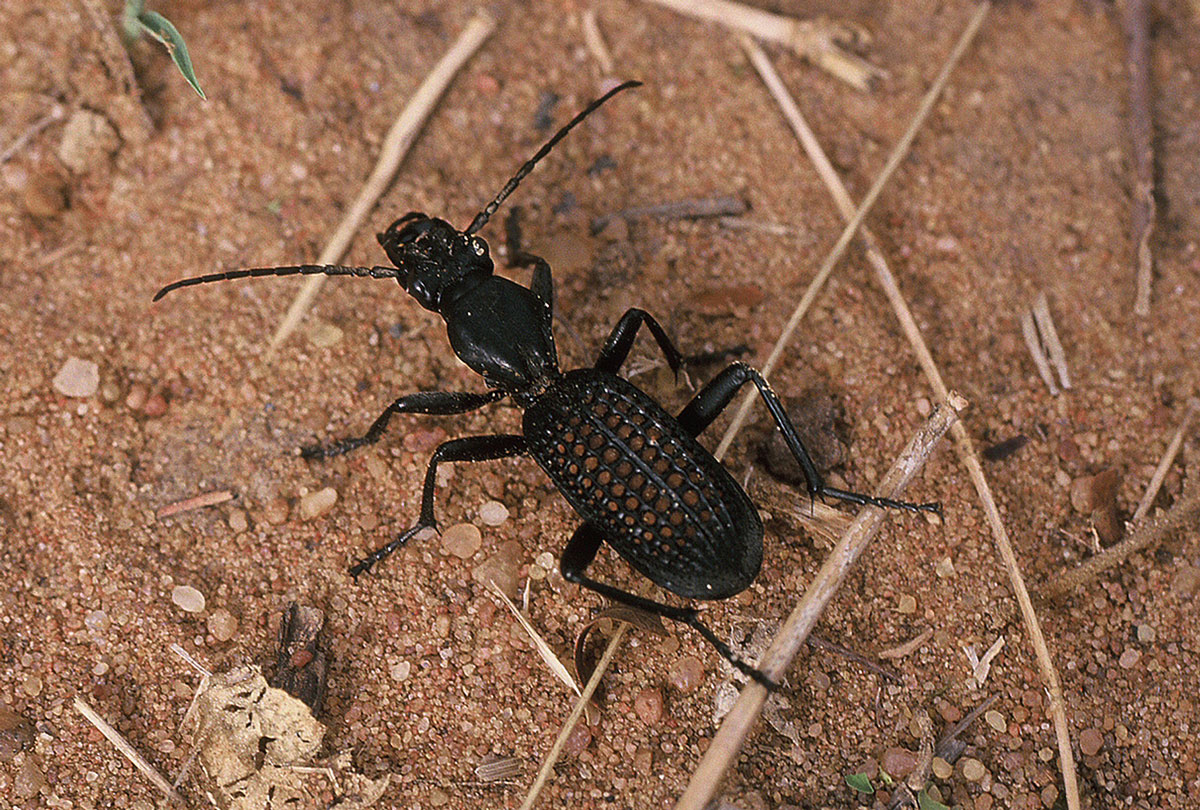
cypholoba-alveolataA second genus in the tribe is Cypholoba, represented here by C. alveolata. As far as I can tell it lacks a common name, which is not surprising since it is somewhat smaller than the Anthia species mentioned above. Still, my two specimens measure 38 and 35 mm in length – not puny by any standard. There can be no doubt as to the origin of the specific epithet of this species’ scientific name, with its marvelously alveolate elytra. I don’t think I’ve seen such an extraordinary example of this type of surface sculpturing on a beetle of this size, making the species every bit as spectacular as the larger anthiines.

A truly fascinating aspect of Africa’s tyrant ground beetles is their role as models in Batesian mimicry systems. That these beetles should serve as models is not at all surprising due to their chemical defensive capabilities and obviously aposematic coloration. What is surprising is the mimic – juveniles of the lizard species, Eremias lugubris, in what is believed to be the first reported case of a terrestrial vertebrate mimicking an invertebrate (Huey & Pianka 1977). The juveniles not only copy (roughly) the black and white coloration of anthiine beetles but also mimic their rapid, skitty movements – foraging actively with “jerky” motions and arched backs. Their tails remain somber colored, however, allowing them to blend into the sand. These adaptations combine to give the harmless little lizard the size, color, profile, and gait of the beetles. As the lizards reach adulthood (and their greater size makes them less prone to predation), they take on a more typical cryptic coloration and move in a slower, more deliberately lizard-like manner. This mimicry association effectively reduces predation of the juveniles by potential predators, who quickly learn to avoid the noxious, and more frequently encountered, anthiine models.

REFERENCES:

Beutela, R. G., I. Riberab and O. R. P. Bininda-Emonds. 2008. A genus-level supertree of Adephaga (Coleoptera). Organisms, Diversity & Evolution, 7:255–269.

Huey, R. B. and B. R. Pianka. 1977. Natural selection for juvenile lizards mimicking noxious beetles. Science, 195 (4274):201-203.

Picker, M., C. Griffiths and A. Weaving. 2002. Field Guide to Insects of South Africa. Struik Publishers, Cape Town, 444 pp.

Scholtz, C. H. and E. Holm (eds.). 1985. Insects of Southern Africa. Butterworths, Durbin, 502 pp.

Buppies in the bush(veld)

In writing an article for the most recent issue of SCARABS, I found myself reliving some long-dormant memories of my trip to South Africa. It was nine years ago right about this time of year when I made what was to become the collecting trip of a lifetime. What a completely different November/December experience compared to the gray skies and bare trees I see outside my window today. Writing that article was a lot of fun – going back through my slides (yep, slides – no digital for me then), reviewing material in my collection, and trying my best to recall some long forgotten details. Using a long-handled tropics net to collect Evides spp. from upper branch terminals of Lannea discolor at Geelhoutbos FarmOf course, scarabs were not my reason for going to Africa – buprestids were! Although I did manage to sneak a few buprestid photos into the SCARABS article, for the most part I was a good boy and kept my focus on the that newsletter’s intended subject. It wasn’t hard, given the gorgeous diversity of “dungers” (dung beetles) and flower chafers that I encountered in that spectacular country. Here, however, I offer a sampling of the Buprestidae I encountered during that trip.

Much of trip was spent in the bushveld (pronounced “bushfelt”) tropical savanna – a mix of grassland and semi-deciduous forest – below the rugged and rocky Waterberg Mountains, their rugged exposures of 2.7 billion year old sandstone and quartzite providing a spectacular backdrop. I’ve already posted a photo of Evides pubiventris, the largest and most spectacular buprestid seen there. A handsome, iridescent green that must be seen to be believed, these elusive beetles spend their days high off the ground on the upper branch terminals of their host trees, Lannea discolor. Success in collecting these beetles comes only to those willing to give it considerable effort. In this photo, I use a long-handled tropics net and tap the rim of the net on the undersides of the branch terminals. The adults are alert and quick to fly but often enough drop from the foliage into the net before taking flight. Many hours were spent during the several days we were at this spot with my neck craned upwards, but my efforts were richly rewarded with several specimens of E. pubiventris and the closely related E. interstitialis.

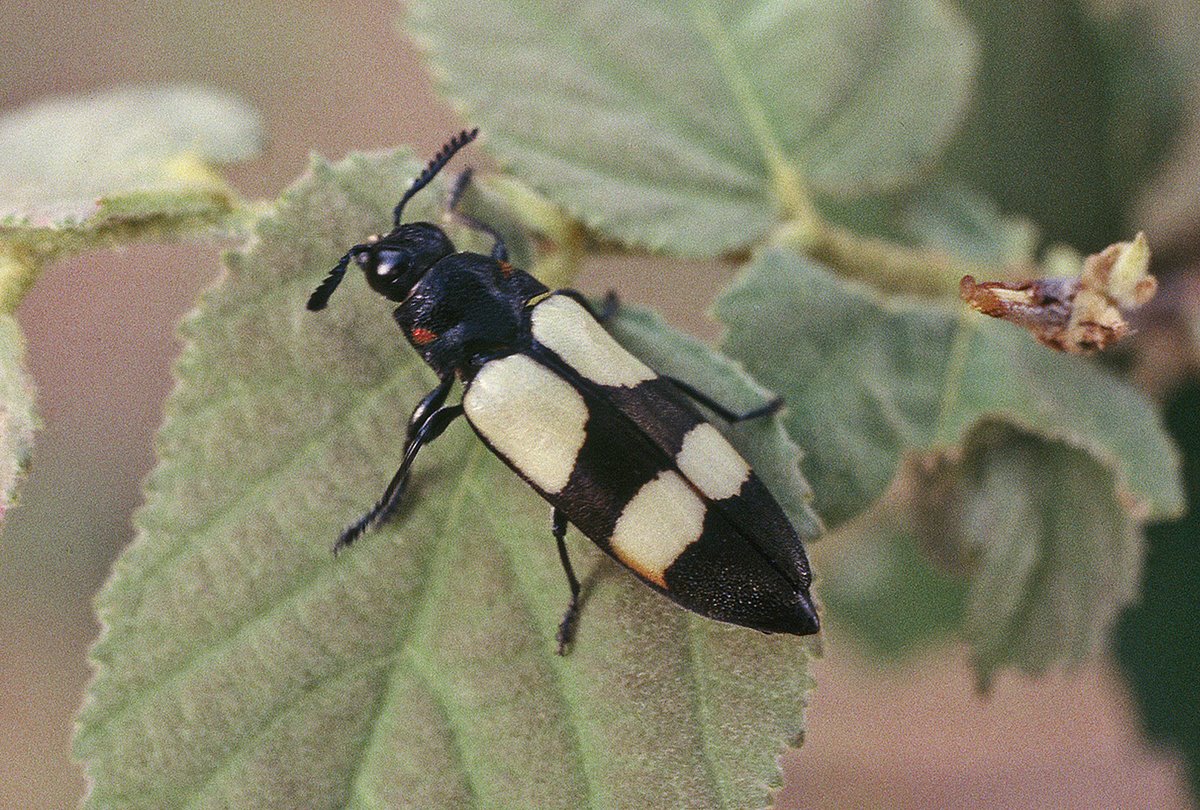
Agelia petalii - South Africa, Limpopo Province, vic. Waterberg Mountains, Geelhoutbos Farm, 30.xi.1999, on Grewia monticolaAnother of the more spectacular buprestids seen on the trip was Agelia petelii, a not too distant relative of Evides (both are in the subfamily Chrysochroinae, containing the bulk of the “classic” jewel beetles). Several individuals of this species were seen here in the Waterberg and also at Borakalalo National Park in North West Province. Their bold markings would seem to make them conspicuous targets for predation by birds but actually serve as protection by mimicking the warning coloration of Mylabris oculata, a common blister beetle in southern Africa that occasionally reaches pest status on leguminous crops and that is – like all blister beetles – largely protected from predation by the cantharidins in its hemolypmph. Many of these blister beetles were seen during the trip, and I had to pay close attention to each of them in order to secure my half dozen or so specimens of the much less common A. petelii.

Meliboeus punctatus - South Africa, Limpopo Province, 8.5 km S of Piesmoor River, 4.xii.1999, on unidentified Grewia-like shrubThis gorgeous little beetle, seen south of the Waterberg near the Piesmoor River, belongs to the enormously diverse but poorly known tribe Coraebini. This tribe – a cousin to the even more diverse genus Agrilus (see this post) – is represented by only a few species in North America but is richly represented in sub-Saharan Africa and Madagascar. Chuck Bellamy – my friend, colleague, and host during this trip – probably knows more about coraebines than anybody alive and has identified this as Meliboeus punctatus. The plant on which the beetles were found remains a mystery – it looks similar to plants in the rhamnaceous genus Grewia on which we saw so many other buprestid species but is clearly not a member of that genus. It is one of the few buprestids I collected on the trip for which I did not obtain host information (I hate that!).

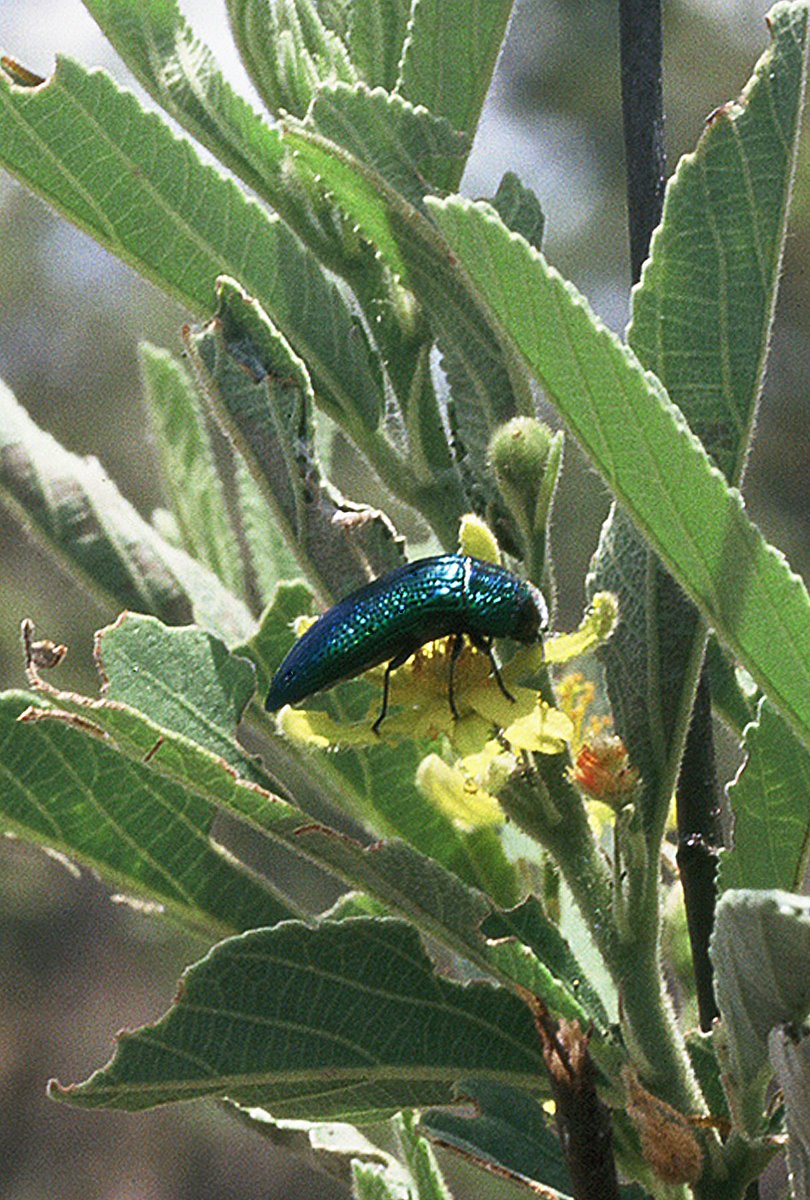
Acmaeodera (Paracmaeodera) viridaenea swierstrae - South Africa, North West Province, Borakalalo National Park, along Moratele River, 24.xi.1999, on Grewia flava blossomThe genus Acmaeodera is another of the hugely diverse groups in the family, having radiated in all the biogeographic realms except Australian. This group is especially well represented in North America, with some 150 species occurring in our desert southwest and many more occurring down into Mexico. The vast majority of these are variously patterned with yellow and/or red markings on a black background. In southern Africa the genus is also diverse but shows greater diversity of form and has, accordingly, been divided into a number of well-defined subgenera. Like our North American species, adults of many African species are frequently found on flowers, where they feed on pollen and petals. I encountered at least a dozen Acmaeodera spp. on the trip, with one of the more striking species being A. (Paracmaeodera) viridaenea. Acmaeodera (Rugacmaeodera) ruficaudis - South Africa, South Africa, Limpopo Province, vic. Waterberg Mountains, Geelhoutbos Farm, 1.xii.1999, on Grewia flava blossomLike other species in this subgenus, adults are brilliantly colored and sexually dichroic, with the individual pictured here (above, left) being a female and the males being greenish brown with coppery sides. Other species are quite somber colored, such as A. ruficaudis in the subgenus A. (Rugacmaeodera) (right). Both of these individuals were found on flowers of Grewia flava.

Discoderoides immunitus - South Africa, South Africa, Limpopo Province, vic. Waterberg Mountains, Geelhoutbos Farm, 1.xii.1999, on Grewia flavaNot all “jewel beetles” do their name justice. This small species – Discoderoides immunitus (another member of the tribe Coraebini) – appears to resemble a piece of caterpillar frass. Several individuals were seen, all sitting on the leaves of Grewia flava like this individual rather than visiting the flowers like Acmaeodera. This beetle reinforced an important lesson I have learned repeatedly about field identification – upon my return to St. Louis, when I had an opportunity to examine these individuals more closely under the microscope, I found one specimen mixed in the batch that was, in fact, not this species, but a species in the closely related genus Discoderes. Moreover, that individual appears to represent an as yet undescribed species. Pity that I found only the single individual, since describing species from such uniques is not very desireable. Regardless, I’m glad I didn’t assume this individual was yet another D. immunitis in the field and pass it by – keeping the species in the still too-swollen ranks of the unknown and unseen.

One of the most exquisite species that I collected was Anadora cupriventris – a very large (by coraebine standards), heavily sculptured species densely covered with curled swaths of gold and brown pubescence. I regret not having the opportunity to photograph the single individual that I found. Another impressive species that I was not able to photograph was Agrilus (Personatus) sexguttatus, surely close to, if not the largest species in the genus and boldly patterned with black and rust red spots on olive green. One last species for which I have no images but is worthy of mention is an undetermined species of the genus Pseudagrilus. Looking like a chunky, brilliant green Agrilus with saltorial (jumping) metafemora, adults would “pop” off the Solanum plants on which they were found as soon as I looked at them. I eventually decided that “Flipagrilus” would have been a more appropriate name for the genus. All told, I collected some 66 species of Buprestidae, including several genera not previously represented in my collection (e.g., Brachmaeodera, Brachelytrium – a few becoming paratypes of new species then being described by Chuck Bellamy and Svata Bílý, Chalcogenia, Galbella, and many of the other above mentioned species). I should mention the assistance of Chuck and Svata for helping me with some of the identifications, as well as Gianfranco Curletti who identified all of the material in the difficult genus Agrilus. I sincerely hope that I have another chance to visit this incredible land of beauty and contrast!

Two new species of Agrilus from Mexico

ResearchBlogging.orgThe enormous, cosmopolitan genus Agrilus (family Buprestidae – commonly called jewel beetles or metallic woodboring beetles) contains nearly 4,000 described species (Bellamy 2008). With many more still awaiting description, it is perhaps the largest genus in the entire animal kingdom (Bellamy 2003). Agrilus species are primarily twig and branch borers, utilizing recently dead wood for larval development – although there are notable exceptions, e.g. Agrilus anxius (bronze birch borer), A. bilineatus (twolined chestnut borer), and A. planipennis (emerald ash borer), which attack the trunks of living trees and, thus, are of significant economic importance in forest and ornamental landscapes. Host specificity among Agrilus species ranges from highly monophagous – associated exclusively with a single plant species – to rather oliphagous – utilizing several, usually related, plant genera. Adults of Agrilus species are most often found on the foliage of their larval hosts and do not generally visit flowers, as is common in some other genera (e.g., Acmaeodera and Anthaxia). Interestingly, despite the diversity and worldwide distribution of the genus, no species of Agrilus are known to be associated with coniferous plants – a fact that has limited their expansion into the vast northern boreal forests.

Texas, Bexar Co., San Antonio, nr. Fort Sam Houston, em. 25.iv-14.v.1997 ex Phoradendron tomentosum coll. ii.1997, D. Heffern & D. W. SundbergAs can be imagined by its enormity, a comprehensive understanding of the genus will remain a distant goal for many years. Progress will come incrementally, as formal descriptions of new species gradually improve our knowledge of the fauna that exists in each of the world’s main biogeographic provinces. In a recent issue of the online journal Zootaxa, Dr. Henry Hespenheide (UCLA) describes two new species of Agrilus from Mexico. These two species are interesting because of their association with ‘mistletoe’ plants in the genus Phoradendron (family Viscaceae1), obligate hemiparasites that attach to branches and stems of various woody trees and shrubs in tropical and warm temperate regions of the New World. Plants in this genus are known to support a variety of host-restricted insect herbivores, principally in the orders Hemiptera, Coleoptera and Lepidoptera. A single buprestid species has been associated with Phoradendron to this point – Agrilus turnbowi, recently described from specimens reared from dead stems of Phoradendron tomentosum attached to mesquite (Prosopis glandulosa) in southern Texas (Nelson 1990) and pictured here from a specimen in my collection that was reared from dead mistletoe collected at the type locality. At the time of its description, this species was not relatable to any of the other known species in the genus.

1 The Angiosperm Phylogeny Group (2003) includes the Viscaceae in a broader circumscription of the family Santalaceae. However, recent molecular studies suggest the Santalaceae are polyphyletic, with strong support for Viscaceae as a distinct, monophyletic clade (Der & Nickrent 2008).

The two new Mexican species – A. andersoni from Guerrero and Puebla (Figs. 1-3), and A. howdenorum from Oaxaca (Figs. 4-6) – are apparently related to A. turnbowi, which they resemble by their purplish-red coloration and complex pattern of golden setae on the elytra. They are also superficially very similar to each other but differ most notably in size and the overall color and pattern of setae on the elytra.

Figures 1–3. Agrilus andersoni Hespenheide: 1. dorsal habitus; 2. lateral habitus (scale bar indicates 2.0 mm); 3. genitalia of male (scale bar indicates 0.5 mm) (from Hespenheide 2008).

Figures 4–6. Agrilus howdenorum Hespenheide: 4. dorsal habitus; 5. lateral habitus (scale bar indicates 2.0 mm); 6. genitalia of male (scale bar indicates 0.5 mm) (from Hespenheide 2008).

Hespenheide speculates that the color and pattern of the golden setae on the elytra may serve to make the beetles less conspicuous by disruptive coloration, noting the similar coloration of the setae to the leaves of Phoradendron as seen in the photograph of Agrilus howdenorum on its host plant (Fig. 7). This form of crypsis may also be enhanced by the purplish-red ground coloration of the adult, which resembles that of the small, darkened blemishes often observed on the foliage of these plants.

Figure 7. Agrilus howdenorum adult on mistletoe host plant near Diaz Ordaz, Oaxaca, México. The golden setae on the elytra are similar in color to the leaves of the mistletoe and may function as a disruptive color pattern. Photograph by C.L. Bellamy (from Hespenheide 2008).

REFERENCES

Angiosperm Phylogeny Group. 2003. An update of the Angiosperm Phylogeny Group classification for the orders and families of flowering plants: APG II. Botanical Journal of the Linnean Society, 141: 399-436.

Bellamy, C. L. 2003. The stunning world of jewel beetles. Wings, Essays on Invertebrate Conservation, 26(2): 13-17.

Bellamy, C. L. 2008. A World Catalogue and Bibliography of the Jewel Beetles (Coleoptera: Buprestoidea), Volume 4: Agrilinae: Agrilina through Trachyini. Pensoft Series Faunistica No. 79, 722 pp.

Der, J. P. & D. L. Nickrent. 2008. A Molecular Phylogeny of Santalaceae (Santalales). Systematic Botany, 33(1):107-116.

Hespenheide, H. A. (2008). New Agrilus Curtis species from mistletoe in México (Coleoptera: Buprestidae) Zootaxa, 1879, 52-56

Nelson, G. H. 1990. A new species of Agrilus reared from mistletoe in Texas (Coleoptera: Buprestidae). The Coleopterists Bulletin, 44(3):374-376.