Spring Unfolding

For many people, spring is their favorite time of year—the long, cold winter having given way to warmth, sunshine, and flowers. I love spring as well but find myself frustrated sometimes by its Jekyll and Hyde nature. This spring was particularly frustrating—the cold and rain seemed at times interminable, delaying the onset of the spring flora several weeks past normal. Once the sun finally did appear, the entire forest exploded in a cacophony of simultaneous leaf and bloom. Plant phenologies were so compressed that there was almost no time to appreciate the season before it was over. Nevertheless, as I waited patiently for those warmer days, I was still able to find beauty in the pre-bloom forest among its nascent leaves—their development put on hold for the time being but taking on an almost floral quality in the absence of the true flowers that they preceded. As a student of wood-boring beetles, I’ve had to become also a capable botanist, at least with regards to the woody flora, and pride myself on being able to identify trees not just by their mature leaves, but also their wood, bark, growth habit, and natural community—characters that are always available when leaves may not be (as is often the case with dead trees). Nascent leaves, on the other hand, are like flowers—ephemeral and often colorful. One must make an effort to see them, but it is effort well spent.

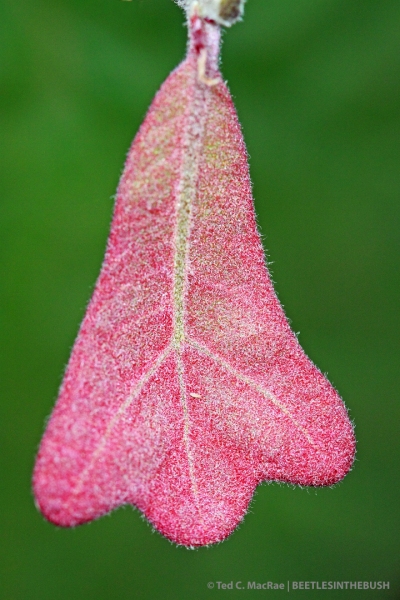
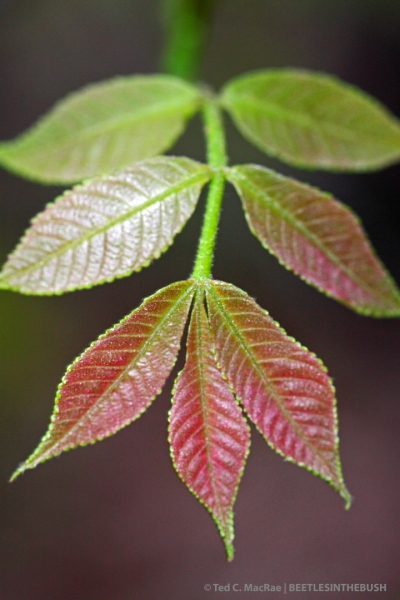
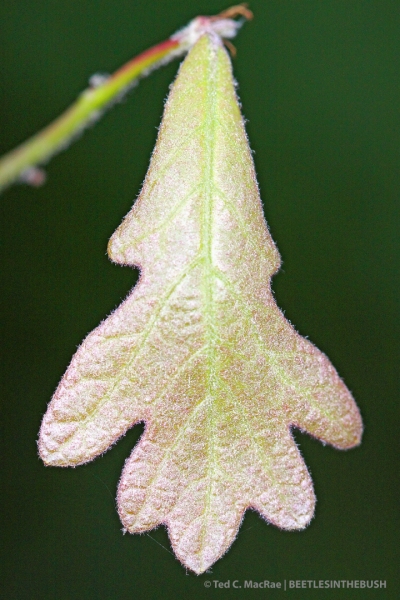
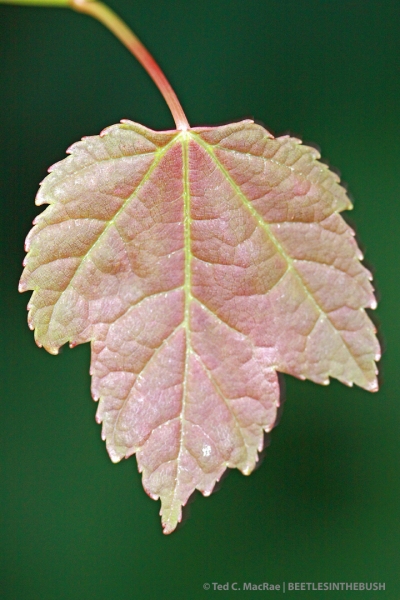
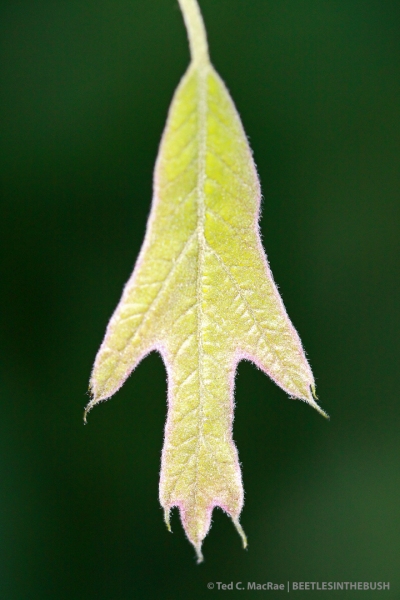
The photos below were taken on a cold, overcast day in late April at Holly Ridge Conservation Area in extreme southeastern Missouri. How many of them can you identify to species? This is an open challenge (i.e., no moderation of comments), and the first person to correctly identify all six will be declared the winner (remember, spelling counts!).


IMG_2756_enh_720x1080


IMG_2778_enh_720x1080


IMG_2789_enh_720x1080


#4

IMG_2801_enh_720x1080


#5

IMG_2816_enh_720x1080


#6

IMG_2817_enh_720X1080
Copyright © Ted C. MacRae 2013

The true Ombú

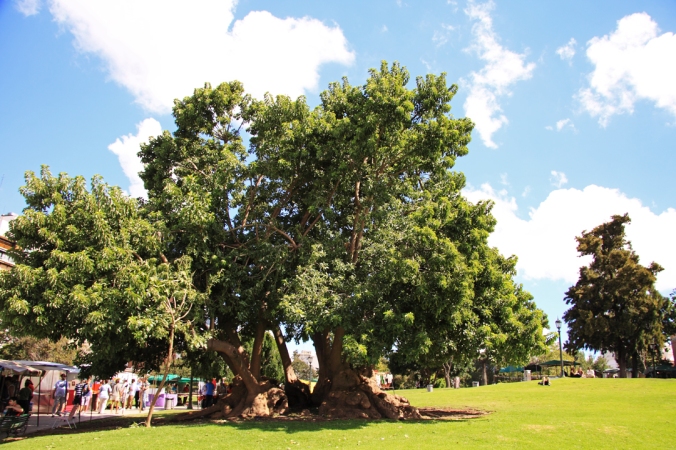
Recall ID Challenge #21, which featured a photograph of the massively buttressed trunk of a rubber tree (Ficus elastica) planted more than 200 years ago in Buenos Aires, Argentina and give the name Gran Gomero (meaning “big rubber”). There are many photographs of this tree on the internet, owing to its celebrity status, which allowed more than a few participants to properly guess its identity. Unfortunately, one participant still guessed the wrong answer despite having found an image of the exact same tree due to the tree being incorrectly identified as an Ombú tree (Phytolacca dioica). Unlike the rubber tree, which is native to south and southeast Asia, the Ombú is indigenous to South America and is, in fact, the only “tree” that occurs naturally in the South American Pampas. I place the word tree in parentheses, because this plant—also unlike the rubber tree—is not even really a tree, but rather multi-stemmed shrub (albeit a very large one) in the family Phytolaccaceae (relative of the common pokeweed). Like its North American cousin, the milky sap is laced with toxic compounds that protect it from vertebrate and invertebrate herbivores, and its massive, fire resistant trunks consist of soft water storage tissues arising from enlarged bases. These features are obvious adaptations to life on the Pampas, where rainfall is scarce (10–30 in per year) and fires are frequent.

Ombú (Phytolacca dioica) | Buenos Aires, Argentina

Ombú (Phytolacca dioica) | Buenos Aires, Argentina

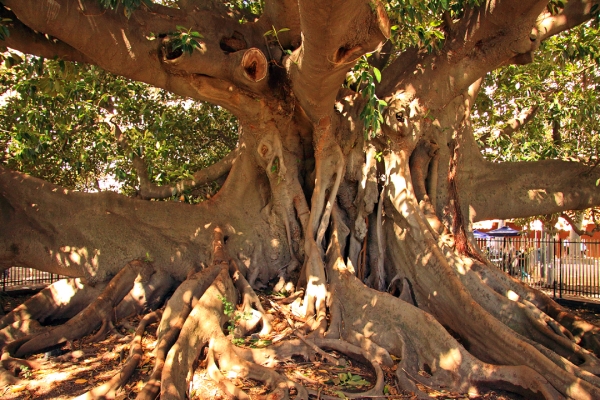
While not nearly as spectacular as El Gran Gomero, there is an Ombú growing nearby in the same very plaza adjacent to the Recoleta Cemetery (above photo) that typifies the multi-stemmed, swollen-base appearance that very large specimens assume. It is easy to see how, at least based on superficial appearance, one could mistake El Gran Gomero for an Ombú; however, it also goes to show that one should always be cautious about too quickly accepting what they find on the internet (watch somebody now point out an error in this post!).

Here is another (better) photo of the exact same tree.

Copyright © Ted C. MacRae 2013

ID Challenge #21

Time for another installment of BitB Challenge Session #7. This one is going to be a bit different from previous versions—can you identify the tree in the photo? Not the scientific name, not the common name, but the actual name of this particular tree. Include its location and any cultural significance it may have (both historical and current) and you’ll be well on your way towards winning this challenge. Points structure will be decided after I see what kind of response I get (this is also a test to see if anyone still reads this blog).

Good luck!

IMG_2332_enh_1080x720

Copyright © Ted. C. MacRae 2013

Super Crop Challenge #15

Can you identify the structure in the photo below (2 pts), what it is doing (2 pts), and the organism to which it belongs (order, family, genus, and species—2 pts each)? Comments will be held in moderation so everybody has a chance to participate, although there are early-bird bonus points on offer. Read the full rules for details on how (and how not) to earn points. Good luck!

IMG_8054_ssc_enh_1080x720

Copyright © Ted C. MacRae 2013

Mr. Phidippus gets his loot

Synoptic collection of tiger beetles

Synoptic collection of tiger beetles for Mr. Phidippus.

I’m sure by now Mr. Phidippus is wondering where his loot is. You see, some months ago Mr. Phidippus won BitB Challenge Session #5 with a solid string of 1st and 2nd place finishes in that session’s five ID and super crop challenges. The top three points earners at the end of each session are offered a variety of prizes, and among the choices offered Mr. Phidippus chose to receive a small collection of beetles from my collection. However, I’ve been remiss in my follow up, with only a heavy travel schedule and seemingly endless string of commitments when I am at home to offer as excuses for such.

At long last, however, I am making things right and have put together this small synoptic collection of tiger beetles that I hope Mr. Phidippus will find useful. Some of the species selected might be common in some areas, while others are certainly found very seldomly—and even then only by those who know what they are looking for. Nevertheless, one of the most fascinating features of tiger beetles is their extreme polytopism, so even commonly encountered species can look very different depending on what part of their range they come from. A perfect example of this is Cicindela scutellaris, represented in the box above by three individuals: one from Kansas (subspecies scutellaris), one from northeast Missouri (subspecies lecontei) and one from southeast Missouri (an unusual population representing an intergrade of subspecies lecontei and subspecies unicolor). Ranging from wine-red to blue-green to brilliant red and green, they are perhaps the best example of tiger beetle polytopism gone wild!

So, Mr. Phidippus this one is for you. Congratulations again on your win, and thank you for your patience!

Copyright © Ted C. MacRae 2013

Super Crop Challenge #14

Wow, has it really been five months since the last Super Crop Challenge?! Well, it’s time to start a new BitB Challenge Session (this will be #7), so what better way to start? Can you name the structure shown in the photo below (2 pts), the organism to which it belongs (order, family, genus, and species—2 pts each), and its significance (2 pts)?

Note: If you are not completely familiar with them, please read the full rules for details on how and how not to earn points. Good luck!

Copyright © Ted C. MacRae 2012

ID Challenge #20

Has it really been seven weeks since the last ID Challenge? BitB Challenge session #6 overall leaders Brady Richards (66 pts), Mr. Phidippus (58 pts), and Sam Heads (54 pts) must think I’m trying to duck the final standings so I don’t have to doll out any loot. Let’s finish this session with a straight up ID Challenge—3 pts for order (der!), 4 pts for family, 5 pts for genus, and (to separate the imagos from the neonates) 6 pts for species. Bonus question worth 5 pts—what is the best way to search for this species? That’s a whopping total of 23 pts up for grabs in this one challenge (not including any discretionary bonus pts that might be awarded), so not only are the leaders not safe from each other, but from any number of other participants lurking just below them in the standings.  Please read the full rules if you are not already familiar with them—good luck!

Copyright © Ted C. MacRae 2012

ID Challenge #19

We all have something in common…

Here is a bit of a different ID Challenge—can you identify the beetles represented in the photo, but more importantly can you deduce what all of these beetles have in common (other than the fact that they belong to the same family)? Obviously these are all jewel beetles (family Buprestidae), so we won’t worry about higher classification. Instead, I’ll give 1 pt for each correctly named genus (don’t bother trying to identify species) and a whopping 5 pts for figuring out what it is they have in common. Early bird pts will be given for the latter question only. Please read the full rules if you are not already familiar with them—good luck!

Copyright © Ted C. MacRae 2012