West Indian seagrape sawfly

I spent a few days in Puerto Rico last month. A quick in-and-out for work, there was little chance to do any real exploring. Nevertheless, I booked my return on the last possible flight out so that I would have at least part of a day to look around before needing to go to the airport. I’ve only been to Puerto Rico twice before—once in 1982 on a one-day visit during my honeymoon cruise (with a far-too-rushed guided tour to El Yunque), and again in 1999, also a quickie for work. Given my limited previous opportunities to explore San Juan, you might think I would choose La Forteleza and San Juan National Historic Site in Old San Juan for my day’s destination. After all, they were designated a World Heritage Site by UNESCO (United Nations Educational, Scientific, and Cultural Organization) in 1983. Tempting, but when I looked at the map of San Juan a nice, big, chunk of green immediately caught my eye—Bosque Estatal de Piñones (Pine State Forest). Call me single-minded, but not even a World Heritage Site can match the siren call of 1,500 acres of moist, subtropical forest!
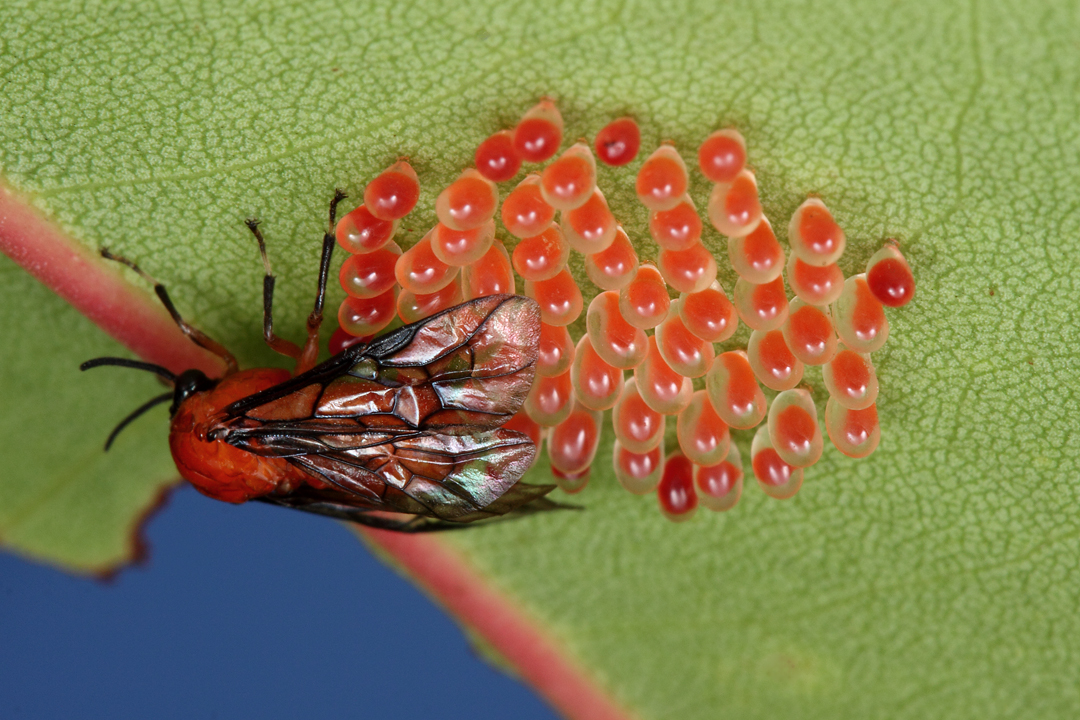
Sericoceros krugii female guarding eggs on leaf underside of sea grape (Coccoloba uvifera) | Bosque Estatal de Piñones, San Juan, Puerto Rico

Mangrove forest covers much of the reserve, accessed by a wide (and annoyingly elevated) boardwalk—an interesting stroll but unsatisfying to me since I couldn’t root around at ground level. One can get only so much enjoyment from distinguishing red, black, and white mangrove before the sameness of the canopy and exclusion from the ground flora/fauna starts to become monotonous. I went back towards the parking lot (photographing a few lizards along the way—more on them in a future post) and had just begun walking the perimeter of a picnic area when I encountered some very large seagrape (Coccoloba uvifera) plants. I’ve seen a lot of seagrape in Florida and have never found any insects on it, so I initially didn’t make much effort to go over and have a closer look at them. However, even from afar I could see that these particular plants had been very heavily damaged by some type of defoliating insect. The first few branches I looked at showed no outward evidence of who the culprit was, but I reasoned it must have been some sort of lepidopteran caterpillar. As I was inspecting the branches, the insect in the above photo caught my eye—at first I thought it was some type of “homopteran” because of the apparent egg-guarding behavior it was showing, but a closer look revealed that it was actually a sawfly! An egg guarding sawfly; who would have thought?!

Female ovipositing her clutch of eggs, which are solid red when first laid.

Predictably, subsequent identification was quite easy as there is only a single species of sawfly in Puerto Rico—Sericoceros krugii in the family Argidae. About 20 species make up this Neotropical genus, occurring from southern Mexico south to Argentina; however, S. krugii is the only species occurring in the West Indies and in addition to Puerto Rico is found in the U.S. Virgin Islands and Dominican Republic (Smith 1992). The species in this genus seem to specialize on Coccoloba spp. (family Polygonaceae) as host plants; however, one species is reported from Triplaris caracasana—also in the Polygonaceae (Smith & Benitez Diaz 2001), and another from Lonchocarpus minimiflorus in the family Fabaceae (Smith & Janzen 2003).

Larvae consume all but the largest veins of the foliage.

Wolcott (1948) describes how this species often defoliates long stretches of seagrape on the beaches of Puerto Rico, leaving “windrows of excrement on the sand underneath the naked branches and leaf midribs…” He also describes its apparent lack of natural enemies (although it has since been recorded as a host for a tachinid fly—Bennett 1999) and the fact that birds do not seem to eat them as possible reasons for its abundance and frequent outbreaks. To me, the screaming red/black coloration of the adult and apparent unpalatability to birds suggest the presence of chemical defenses, and although I couldn’t find any information on this specific to Sericoceros spp., many social species of sawflies are typically well-defended chemically and, thus, aposematic. Despite this apparent defensive capability, the remarkable maternal guarding behavior exhibited by the adult females suggests the eggs still need additional protection from predators and parasitoids. Sericoceros spp. are not the only sawflies to exhibit this behavior, which apparently has evolved across numerous sawfly lineages (see Social Sawflies, by James T. Costa).

This mature larva will soon spin a coccoon on the bark for pupation.

There were only a few, apparently mature larvae still around on the trees that I could find. Wolcott (1948) describes most outbreaks as occurring during the fall and winter months, after which the insects might completely disappear for many months or even a year. I must have caught the tail end of one such outbreak, although the number of females that I saw guarding eggs suggests another wave of defoliation would soon be occurring.

Congratulations to itsybitsybeetle, who showed up late to the party but still managed to pull out the win for Super Crop Challenge #13. Brady Richards came in a close 2nd, while Sam Heads and Mr. Phidippus share the final podium spot. The overall standings remain the same, with Sam leading Brady by a single, slim point and Mr. Phidippus only six points further back. There will be two more challenges in BitB Challenge Session #6, so it’s still possible for somebody to make a late run, especially if one or more of the leaders falters down the stretch. Remember—the top three points earners at the end of the session will get a choice of some loot, so don’t hesitate when the next challenge rolls around.

REFERENCES:

Bennett, F. D. 1999. Vibrissina sp. (Diptera: Tachinidae) a parasite of the seagrape sawfly Sericoceros krugii (Hymenoptera: Argidae) in Puerto Rico: a new record. Journal of Agriculture of the University of Puerto Rico 83(1–2):75–78.

Smith, D. R. 1992. A synopsis of the sawflies (Hymenoptera: Symphyta) of America south of the United States: Argidae. Memoirs of the American Entomological Society 39:1–201.

Smith, D. R. & Benitez-Diaz. 1991. A new species of Sericoceros Konow (Hymenoptera : Argidae) damaging villetana trees, Triplaris caracasana Cham. (Polygonaceae) in Paraguay. Proceedings of the Entomological Society of Washington 103(1):217–221.

Smith, D. R. & D. H. Janzen. 2003. Food plants and life histories of sawflies of the family Argidae (Hymenoptera) in Costa Rica, with descriptions of two new species. Journal of Hymenoptera Research 12:193–208.

Wolcott, G. N. 1948. Insects of Puerto Rico. Journal of Agriculture of the University of Puerto Rico 32(4):749–975.

Copyright © Ted C. MacRae 2012

ID Challenge #18

It’s time for another identification challenge. Currently we are in Challenge Session #6, with two challenges down (SSC#12 and IDC#17) and probably four more to go (including this one). Can you identify the critter in this photo? I’ll give 2 pts each for class, order, family and genus.

I think it would be good to restate the ground rules that I use in these challenges, as they have evolved somewhat since I first began these challenges and don’t seem to be easily accessible in their entirety to those who have begun participating more recently. They are:

  1. Points will be awarded for correctly named taxa—usually 2 pts each for order, family, genus and species.
  2. Points will only be awarded for the taxa requested.
  3. Taxa must be correctly spelled to receive full credit (this includes italicization for genus and species—and yes, italicization is easy in HTML, just look it up). Misspelled or non-italicized names may receive partial credit.
  4. Taxa must be explicitly stated to receive full credit. For example, if I request order, family, genus and species for Buprestis rufipes, but only genus and species are given in the answer, then “Coleoptera” and “Buprestidae” are “implied” taxa. I can’t give full credit for implied taxa but may give partial credit.
  5. In the case of outdated nomenclature, I won’t judge too harshly if the taxon is obscure or there is still disagreement about rank. However, obvious or easily referenced obsolescences (e.g. “Homoptera”) will get dinged.
  6. Bonus points may be given (at my discretion) for providing additional relevant information (e.g., diagnostic characters, biological/ecological uniquities, clever jokes, etc.). I’m more inclined to give bonus points for unusual features of biology/morphology/ecology, etc. that are not readily found in easily-found, Wikipedia-type summaries of the subject.
  7. Be sure to examine each post carefully in its entirety for the possible presence of clues 🙂
  8. Comments will be moderated during the 1- to 2-day open challenge period to allow all a chance to participate (i.e., you don’t have to be first to win!).
  9. In the case of multiple correct answers, “early-bird” tie-breaker points will be awarded to those that answered correctly first. The more people you beat to the punch with the correct answer, the more early-bird points you get.
  10. Submitted answers will be revealed at the end of the challenge period along with the number of points earned. This is generally followed closely by a new post discussing the subject in greater detail. Also, because I’m such a big Survivor and Jeff Probst fan, I’ll also say that “once the points are read the decision is final!”
  11. Winners of individual challenges get nothing more than my accolades; however, session winners get real loot! Thus, it pays to play consistently and try even when you don’t think you know the answer. Top three points earners at the end of each session (usually 5 to 6 individual challenges) get to choose from selection of gifts that will be communicated to the winners by email.

Copyright © Ted C. MacRae 2012

“Cochinilla australiana” in Argentina

Icerya purchasi (''cochinilla australiana'') on citrus twig | western Buenos Aires Province, Argentina

After traveling through the northern provinces during late March and early April, I returned to my home base in western Buenos Aires Province for the last two weeks of my stay in Argentina. As soon as I could, I returned to the small grove of planted citrus trees on the station grounds where I had found a rather large, beautifully cryptic fulgorid nymph (see ““). Lois O’Brien had mentioned in her response to my query about the identity of the nymph that some species of Fulgoridae tend to live on the same tree for years and years—if I could go back to the tree on which I found the nymph perhaps I could find the adult. Sadly, no adults or additional nymphs were found, either on the original tree or any in its vicinity. What I did find, however, was this strange, cocoon-like structure on one of the branches of the tree. I had no idea what it was, having never seen anything quite like it, but I figured something—pupa, eggs, parasitoid, etc.—must be inside. I cut the piece of branch with the structure and tucked it inside a vial for later.

Egg case opened to reveal eggs and newly hatched nymphs

A little bit of searching online would have quickly told me what I was dealing with, but for some reason I felt the need to go ahead and start dissecting to see what was inside. It became obvious I was dealing with an egg mass when I peeled back the outer layers to reveal the cluster of red eggs inside, and very quickly I noticed that a few of the eggs had already hatched. The red nymphs had a decidedly “homopterous” look to them, and not much effort was required to figure out that I was looking at my very first “cottony cushion scale” insect.

Closer view of eggs - newly hatched nymph can be seen at bottom.

Icerya purchasi (Hemiptera: Monophlebidae) originally hails from Australia, but its preference for citrus and the realities of global commerce have resulted in its inevitable spread across the globe wherever citrus is grown (maybe I can be forgiven for having never before seen such a widespread insect—living most of my life in Missouri and northern California, I’ve not had much opportunity to visit citrus groves). The English common name clearly references the appearance the adult female, recognizable by the white, fluted egg sac shown here, while in Argentina it is called “cochinilla australiana”—literally meaning “Australian scale insect.”

Newly hatched nymphs are bright red with dark antennae and thin brown legs.

As I dissected the egg sac, a few of the newly hatched nymphs crawled out of the sac an onto the branch. Nymphs of this stage are referred to as “crawlers” because they are the dispersal stage. It’s a good name for these tiny little bugs, as the several that I tried to photograph never stopped moving. With the lens fully extended to 5X, it was difficult enough to just find them in the viewfinder, much less compose and focus with all the movement. It became a numbers game and test of patience—how many shots could I get fired off in the amount of time that I was willing to persist? Shown here are the few shots that I was the least displeased with.

First instar nymphs are the primary dispersal stage.

Crawlers disperse not only by crawling, but also by wind. One can imagine that such tiny insects could easily be picked up by the wind and carried long distances. However, I couldn’t help but notice the very long setae on the body and outer antennal segments (visible to greater or lesser degree in these photos) and think that perhaps they have some function in aiding wind dispersal. At the very least, aerial dispersal must be as important as crawling (if not more so) for colonization by this species—only adult males have wings (but they are rare), while egg-laying females (actually hermaphrodites) are completely sessile.

Do the long setae on the body and antennae of the nymph aid in wind dispersal?

The adult female and egg case may have confused me initially, but a ton of readers had no problem figuring out what it was. A record 24 people participated in this challenge, with all but five correctly guessing the species. Winning this challenge came down to bonus points for speed and uniqueness of additional information, and Christopher Taylor did this best to earn 17 pts and the win. Three others—Brady Richards, Mr. Phidippus and bicyclebug—each finished just 1 pt back of the win, but Sam Heads’ 15 pts keeps the overall lead in his possession. BitB Challenge Session #6 is young, but already a lot of people have a lot of points in the bank. It will be interesting to see how this session develops.

Copyright © Ted C. MacRae 2012

ID Challenge #17

Super Crop Challenge #12

It’s time for a new BitB Challenge Session, and to begin the 6th edition we start off with a Super Crop Challenge. This is a combination challenge, with points on tap for naming the organism (order, family, genus) and visible structures. As always, standard challenge rules apply, including moderated comments, tie-breaker points for first correct answers, and possible bonus pts for additional relevant information at my discretion. Mr. Phidippus ran away with BitB Challenge Session #5, but Tim Eisele and Dennis Haines fought to the end for podium honors. Will one of them de-throne Mr. Phidippus, or will somebody else make a surprise run? Or, perhaps, 3-time champ Ben Coulter will return to stake his claim as the true BitB Challenge Session champion. Let’s get started!

Copyright © Ted C. MacRae 2012

Two more winners

When I announced the winner of BitB Challenge Session #5, I had forgotten about a comment I made in a previous challenge that I was considering awarding prizes to the session’s 2nd and 3rd place finalists as well as the winner. After thinking about it some more I have decided it would be a good idea—2nd and 3rd places in the final standings may lack the prestige of a BitB Challenge Session Championship (snort!), but they are certainly no small accomplishment. With that, I offer my congratulations to Dennis Haines and Tim Eisele, 2nd and 3rd place finalists (respectively) in BitB Challenge Session #5.

Gentlemen, contact me for your loot.

Copyright © Ted C. MacRae 2012
ID Challenge #16

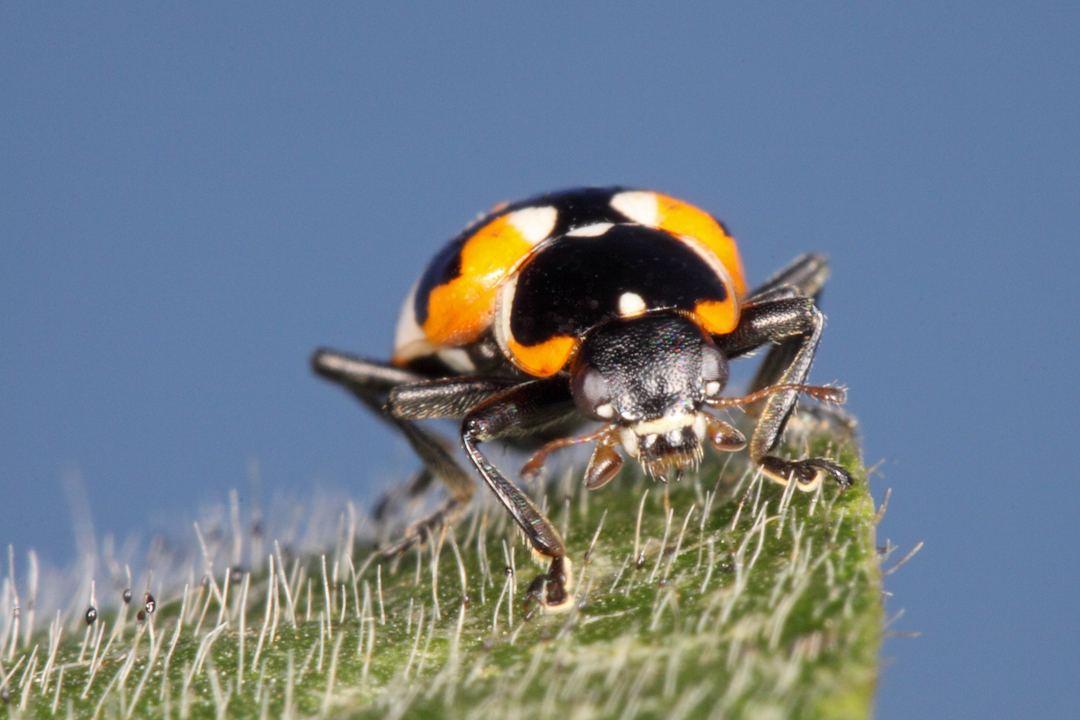
This will be the last post for BitB Challenge Session #5 (for a recap of the current standings see ). This is a straight up identification challenge, but with a twist. Can you identify the subject of this photo and its likely meal? The points will be a little different this time—only 1 pt each for order and family (because these are too easy) but 4 pts each for genus and species (because these are pretty hard). This goes for both subject and meal. Standard challenge rules apply (except as modified here), including moderated comments, tie-breaker points for first correct answers, and possible bonus pts for additional relevant information at my discretion (note: subfamilies, tribes, supergenus, hyperspecies, etc. do not constitute additional relevant information). ¡Buena suerte!

Copyright © Ted C. MacRae 2012