ID Challenge #9

Despite the super close-up nature of the photograph in today’s challenge, this is not a crop and is thus a straight up ID Challenge (making this either a very giant insect or maximum magnification of my 65mm lens).  I’ll award 2 pts each for order, family, genus, and species.  Standard challenge rules apply, including moderated comments (to give everyone a chance to take part) and possible bonus points for being the first to guess correctly (in the off chance multiple people offer the same correct answers), offering suitable relevant information, or just making me chuckle.  Reminder: nobody walks away with no points, so it pays to try even if you haven’t a clue!¹

¹ If you question the importance of this, just ask Dave, whose pity points in the last challenge helped him retain sole possession of 2nd place in the overall standings.

Who am I?

Copyright © Ted C. MacRae 2011

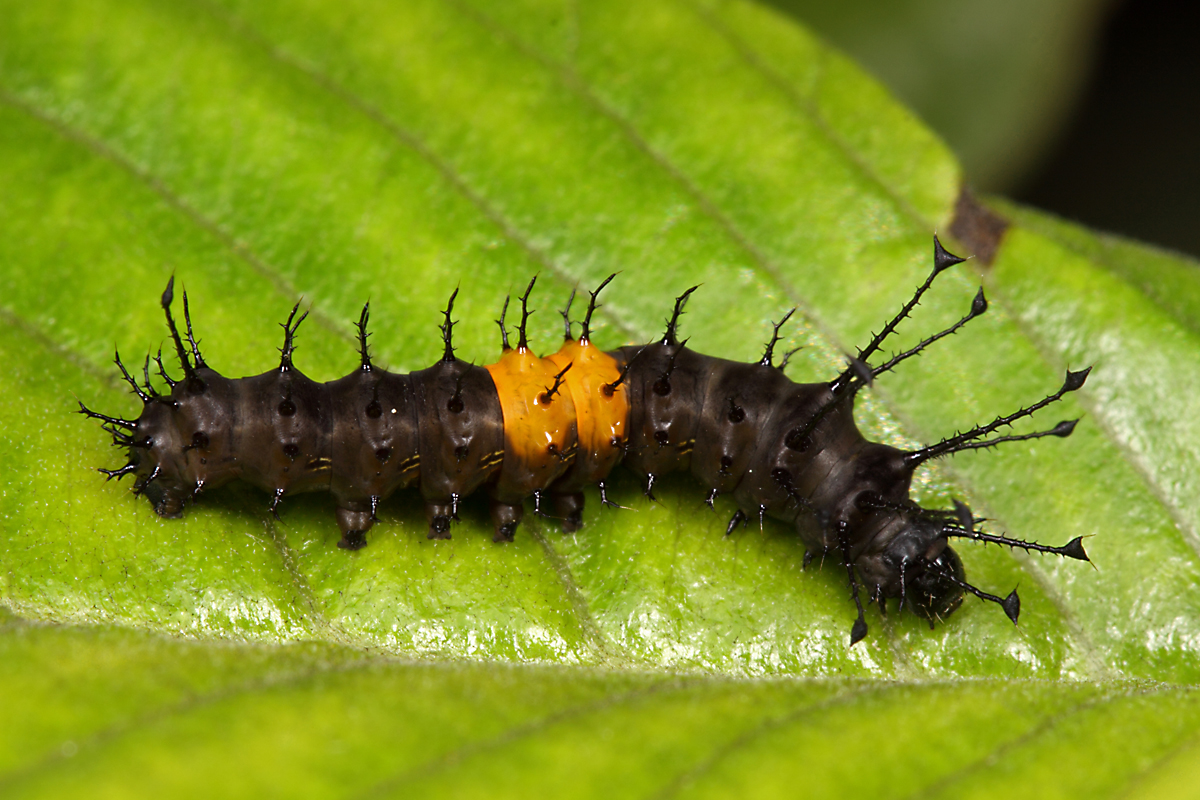
Brazil Bugs #16 – Royal Moth Larva

Citheronia laocoon? 1st instar larva | Campinas, Brazil

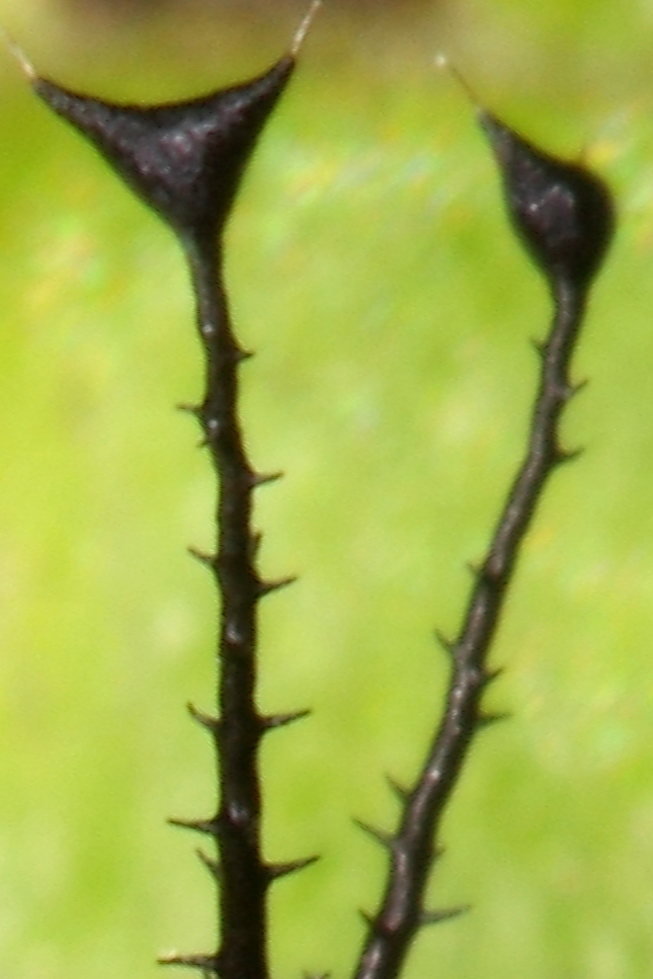
I was sure Super Crop Challenge #6 would be a win for the house, but Troy Bartlett scored an impressive points sweep by correctly deducing that the structures shown were the spines of an early instar caterpillar of “something akin to a hickory horned devil (Citheronia regalis).”  I found this caterpillar feeding on the foliage of a small tree in the Ciudad Universitaria (Distrito Barão Geraldo) area of Campinas, Brazil last January.  I must confess that I spent considerable time trying to identify it myself before I finally threw in the towel and called on the experts for help.  The spines made me think it must be some kind of nymphalid butterfly larva, although I had never seen such “fly swatter” clubs at the ends of the spines, so I sent the photo to Phillip Koenig, a local butterfly expert who has collected extensively in Ecuador.  He, too, was puzzled and forwarded the photo to Charley Eiseman, who himself didn’t know what to make of it and forwarded it on to Keith Wolfe, a lepidopterist who specializes in butterfly immatures.  After stumping his Brazilian contacts, Keith had the idea that perhaps it wasn’t a late-instar larva—as we all had assumed (this larva was a good 15–20 mm in length), but rather one in an early stadium.  A quick search of several standard websites revealed this to be the L1 or L2 larva of a species of Citheronia (Saturniidae, Ceratocampinae).  To support his ID, he provided links to larval photos of C. splendens (Arizona) and C. lobesis (Central America).  The L1 larva of both of these species bears the same “fly swatter” spines, and the latter is remarkably similar in color pattern as well.

In trying to determine what species of Citheronia occur in southeast Brazil, I came across this link with photos of a caterpillar from southern Brazil—the L1 looking nearly identical—that was eventually identified as the common Brazilian species C. laocoon.  Troy suggested C. brissotii—another good possibility as that species is found from southeastern Brazil through Uruguay to Argentina.  However, in perusing a number of online sources, it appears there are several other species of Citheronia that also occur in Brazil, so a species ID for the larva in this photo may not be possible.

Troy’s win vaults him into 3rd place in the current session overalls, but steady Tim Eisele took 2nd place with 6 pts and takes over the session lead.  Newcomer Roy rounds out the podium in 3rd place with 5 points.  Dave’s pity points are nothing to sneeze at, as they helped him retain sole possession of 2nd place in the overall standings (let that be a lesson to those who don’t play because they’re “stumped”!).  There will be at least two more challenges in the current session before a winner is crowned, so look for an opportunity to shake up the standings in the near future.

Copyright © Ted C. MacRae 2011

Super Crop Challenge #6

I thought I had everyone stumped in Super Crop Challenge #5, but Dave took advantage of the extended answer period and cracked the code for a solo win and the lead in the current session.  For this edition of Super Crop Challenge, I offer the following impossibly cryptic crop of a photo I took this past winter.  The organism is from Brazil, but that’s no excuse for punting since there are very similar North American counterparts.  Points for order, family, genus and a possible species ID are all up for grabs, as are the structures and specific life stage to which they belong.

Standard challenge rules apply, including moderated comments (to give everyone a chance to take part) and possible bonus points for being the first to guess correctly (in the off chance multiple people offer the same correct answers) or for making me chuckle.  Reminder: nobody walks away with no points, so it pays to try even if you haven’t a clue!

Copyright © Ted C. MacRae 2011

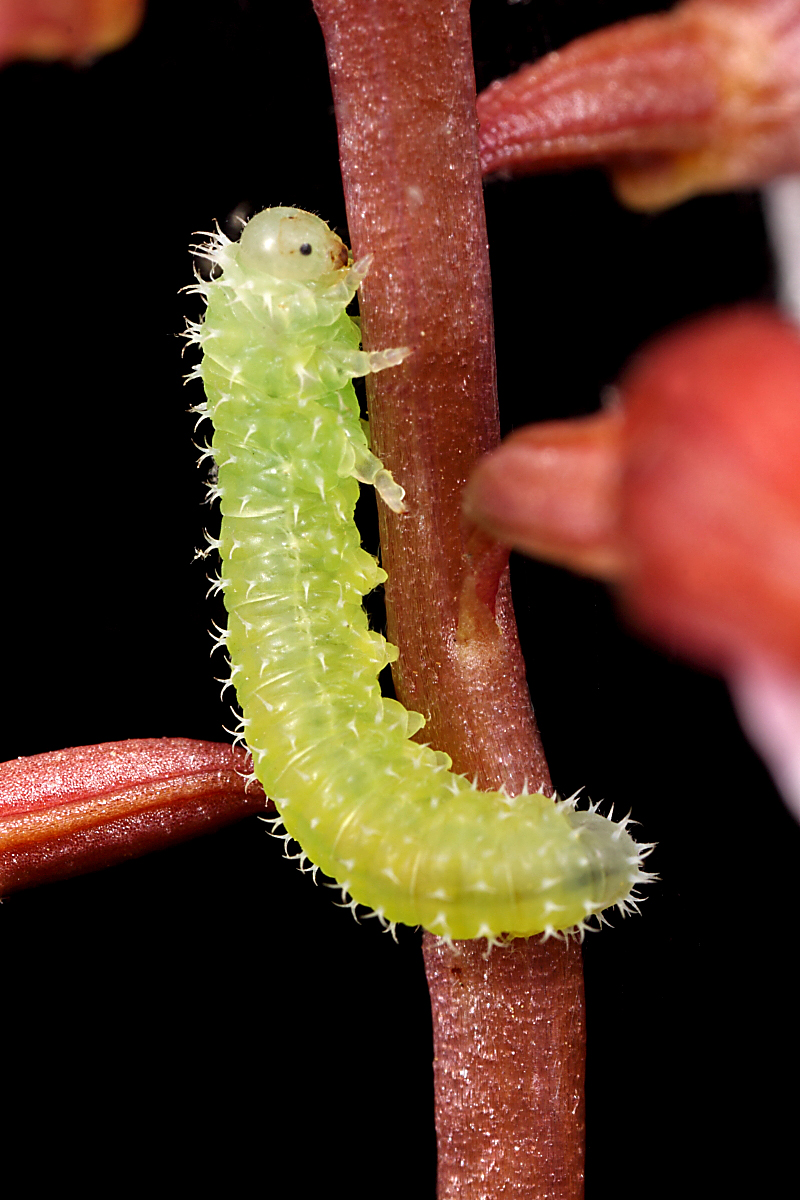
Sawfly larva – Periclista sp.


As I was photographing spring coralroot orchids in my front yard, I noticed a small green object clinging to the underside of one of the flowers.  Zooming in with the camera lens revealed the object to be a caterpillar, but this was no ordinary caterpillar (i.e., a member of the order Lepidoptera), but rather a sawfly larva.  Sawflies are not lepidopterans, but members of the order Hymenoptera, making them more related to bees and wasps while their larvae look much more like those of a moth or butterfly.  Although there are few absolutes in the world of insects, distinguishing sawfly larvae from lepidopteran caterpillars is as easy as counting the prolegs (false legs behind the three pairs of true legs)—lepidopterans have at most 5 pairs of prolegs (often less), while sawfly larvae always have 6 or more pairs of prolegs.
While its identity as some type of sawfly was immediately apparent, I wasn’t sure beyond that.  One thing I was fairly certain about was that the orchid itself was likely not its host plant.  I could see no evidence of feeding on any part of the plant on which it was resting (and orchids by the large seem relatively free of defoliating insect pests), nor could I find any other sawfly larvae on the plant or its neighbors (where there is one sawfly larva, there are usually more).  Rather, I suspected that it had fallen from one of the many native oaks and hickories that shade the front yard (and which provide the habitat that allows orchids to grow in my front yard to begin with).  Nevertheless, I Googled “orchid sawfly,” only to come up with page after page of links referring to the sawfly orchid (Ophrys tenthredinifera), native to the Mediterranean Region.  That wasn’t much help, so I began the process of slogging through the sawfly images posted at BugGuide in hopes that something close had already been posted.  Eventually I stumbled upon photos of larvae in the family Tenthredinidae, subfamily Blennocampinae that exhibited similar branched dorsal spines (including the pestiferous Monophadnoides rubi, or raspberry sawfly).  I gradually settled on a generic ID of Periclista sp. based on the resemblance of the larva in my photos to those in photos such as this one, and the fact that this genus of ~20 North American species feeds as larvae on oak and hickory seems to support to the identification.

This past week’s Super Crop Challenge was taken from the dorsal side of the caterpillar in the first photo and rotated—it apparently proved a little too tough for most people to handle.  Predictably, most participants guessed one of the different spined caterpillars of the order Lepidoptera, but Dave used the extended quiz time wisely and eventually came up with a correct ID and the challenge win.  He even suggests the species P. marginicollis, based on its widespread eastern distribution and the bifurcate processes—it’s a good guess, but the larval description in Smith (1969) is a little beyond my comprehension, so I’m leaving the ID at Periclista sp.  Dave’s win moves him into the top spot in the current overall standings, while Tim moves up to tie Alex for 2nd place with 9 pts each.

REFERENCE:

Smith, D. R.  1969.  Nearctic sawflies I.  Blennocampinae: Adults and larvae (Hymenoptera: Tenthredinidae).  U.S. Department of Agriculture, Agricultural Research Service, Technical Bulletin No. 1397, 179 pp. + 19 plates.

Copyright © Ted C. MacRae 2011
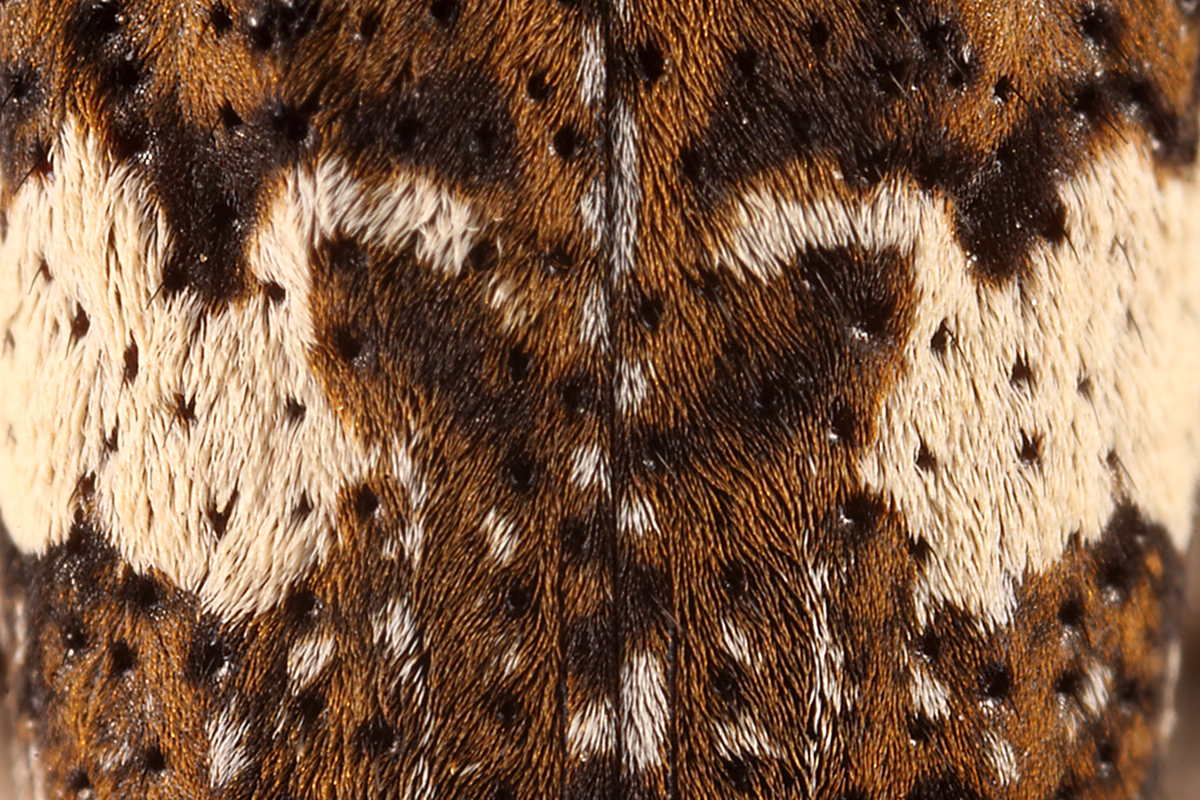
Super Crop Challenge #5

Here is the latest Super Crop Challenge – can you identify the structures and the organism (order, family, and genus) to which they belong?  Bonus points will be awarded for relevant supporting information, at my discretion.  Standard challenge rules apply, including moderated comments (to give everyone a chance to participate) and early submitter points for beating others to the same correct answer.  No need to look to exotic locations for the answer, it’s right here in the good ol’ USA.  I’ll follow up in a day or so.

Copyright © Ted C. MacRae 2011

Super Crop Challenge #4

It’s been a long time since the last Super Crop Challenge – can you identify the structures and the organism they belong to?  As always, each correct taxonomic and descriptive answer is worth 2 points, and bonus points are awarded at my discretion for extra effort.  Standard challenge rules apply.

Brazil Bugs #12 – Desafio de identificação #5

Here we go again – 2 pts each for any correct taxon name up to and including order and any supporting information you can provide.  Standard ID Challenge rules apply.  Hint: don’t take anything for granted – this one is going to separate the men/women from the boys/girls!

Edit 2/11/11, 8:32 a.m.: I should probably make points available for class as well (with the caveat that those with comments already in queue will get credit if due – no need to recomment unless you want to add something).  Also, we’ve had enough of these by now to know that common names and “taxon by implication” generally yield fewer points than correctly presented scientific names. 🙂

Copyright © Ted C. MacRae 2011

Answer to ID Challenge #4 – Aetalion reticulatum

Aetalion reticulatum female guarding her egg mass - São Paulo state, Brazil.

ID Challenge #4 seems to have been a little more difficult than I anticipated – only a few people mustered the courage to even hazard a guess, of whom TGIQ emerged with maximum points to take the win.  Looking sort of like a cross between a leafhopper (family Cicadellidae) and a treehopper (family Membracidae), Aetalion reticulatum is one of a few species and the only genus comprising the family Aetalionidae.  While lacking the pronotal processes that characterize species in the much more diverse and better known Membracidae, aetalionids are nevertheless considered treehoppers as well, along with another little-known family Melizoderidae.  As a whole, the Aetalionidae + Melizoderidae + Membracidae form a sister group to the Cicadellidae (Deitz and Dietrich 1993), which combine to form the most diverse and successful lineage of sap-sucking phytophagous insects. 

Like many treehoppers, A. reticulatum exhibits ant-mutualistic and presocial behaviors; however, it remains unclear whether these behaviors were acquired separately by each treehopper lineage or if they represent retention of a more primitive condition (sorry, Alex – it’s just easier to say it that way than deal with terms such as ‘retained plesiomorphy’ and ‘phylogenetic conservatism’).  Aetalion reticulatum occurs broadly in the New World tropics, where females can often be found perched on top of their egg masses.  Some (but not all) guarding females make periodic sweeps of the hing legs down the sides of the egg mass, apparently to dislodge egg parasitoids and discourage further attack (Preston-Mafham & Preston-Mafham 1993).  Ant-mutualistic relationships and the tendency to form colonies provide additional protection from predators.

Now is a good opportunity to summarize the ‘1st BitB Challenge Series’ overall standings – Ben Coulter maintains his overall lead by gaining points in every challenge.  TGIQ climbs into 2nd place with this week’s win, and tceisele leap frogs over several contestants to tie Janet Creamer for the 3rd podium spot (and gets the nod for more frequent participation).  It’s no real surprise that the most frequent players took the top spots.  At this point, I’m going to call a close to the 1st series and declare Ben Coulter the overall series winner – contact me for your loot!  To the rest, thanks for playing, and now that you know how this game works maybe you’ll think about making a move for the 2nd series win!

Place Commenter IDC #1 SSC #3 IDC #2 IDC #3 IDC #4 Total
1 Ben Coulter 9 14 9 4 4 40
2 TGIQ 8 5 10 23
3 tceisele 3 8 3 14
4 Janet Creamer 14 14
5 James Trager  6 5 11
6 Dave 11 11
7 Christopher Taylor 7 3 10
8 Dave Hubble 6 2 8
  JasonC 5 3 8
10 Charley Eiseman 7 7
  Delbert La Rue 7 7
  jason 7 7
  Techuser 7 7
14 Richard Waldrep  6 6
15 Alex/Watcher 2 2
  dragonflywoman 2 2
  nellie 2 2
16 Brady Richards  1 1
  Francis 1 1
  macroinstantes 1 1
  Margarethe 1 1
  Mark Deering  1 1
  Andrew 1 1

REFERENCES:

Deitz, L. L. and C. H. Dietrich.  1993.  Superfamily Membracoidea (Homoptera: Auchenorrhyncha). I. Introduction and revised classification with new family-group taxa.  Systematic Entomology 18(4):287–296.

Preston-Mafham, R. and K. Preston-Mafham.  1993.  The Encyclopedia of Land Invertebrate Behaviour.  The MIT Press, 320 pp.

Copyright © Ted C. MacRae 2011