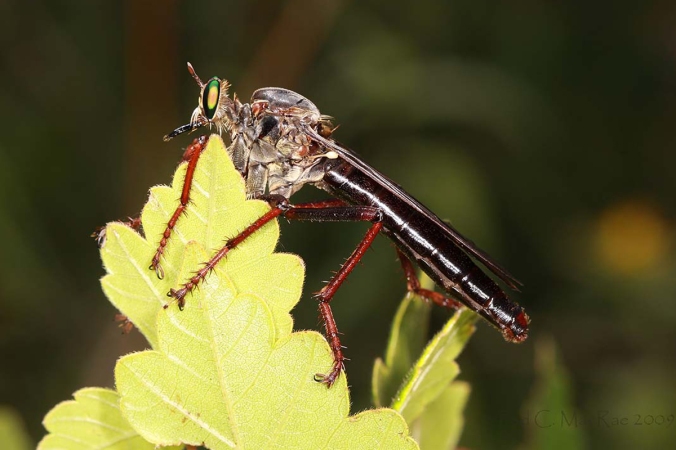
North America’s largest robber fly

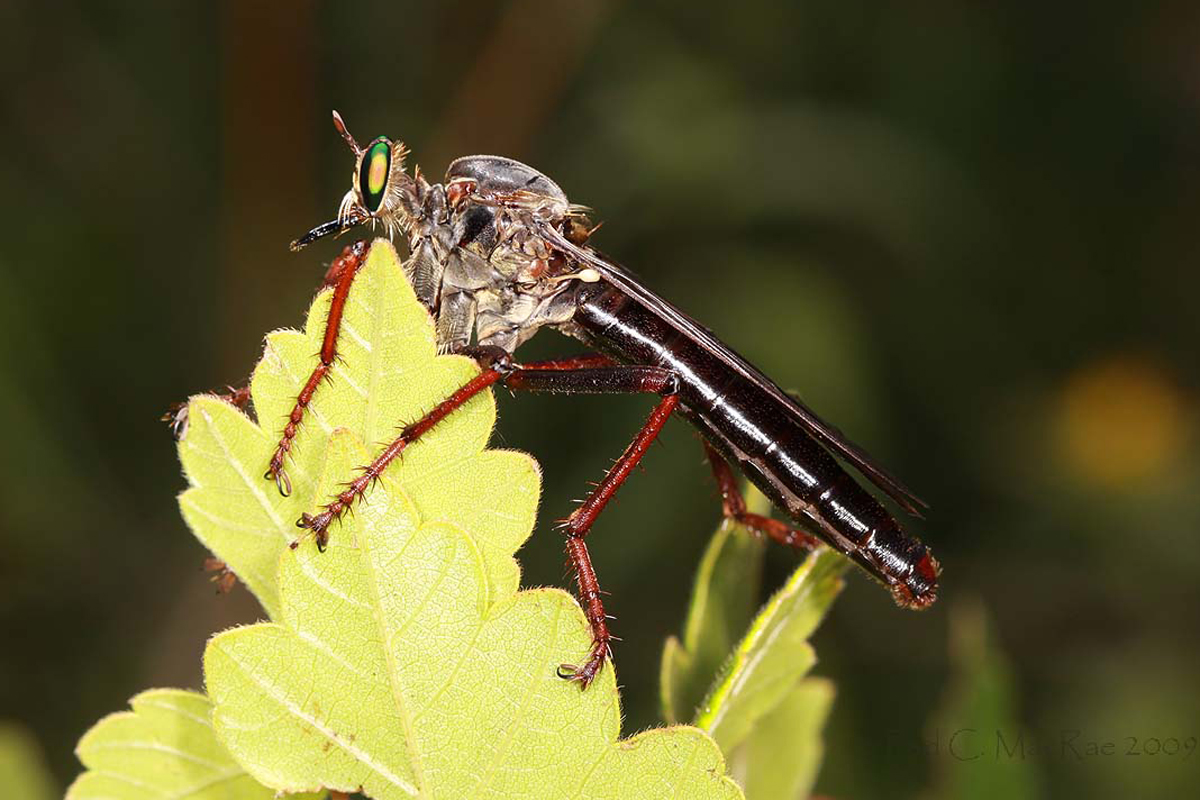
Female Microstylum morosum perched on fragrant sumac (Rhus aromatica) bush

Female Microstylum morosum perched on fragrant sumac (Rhus aromatica)

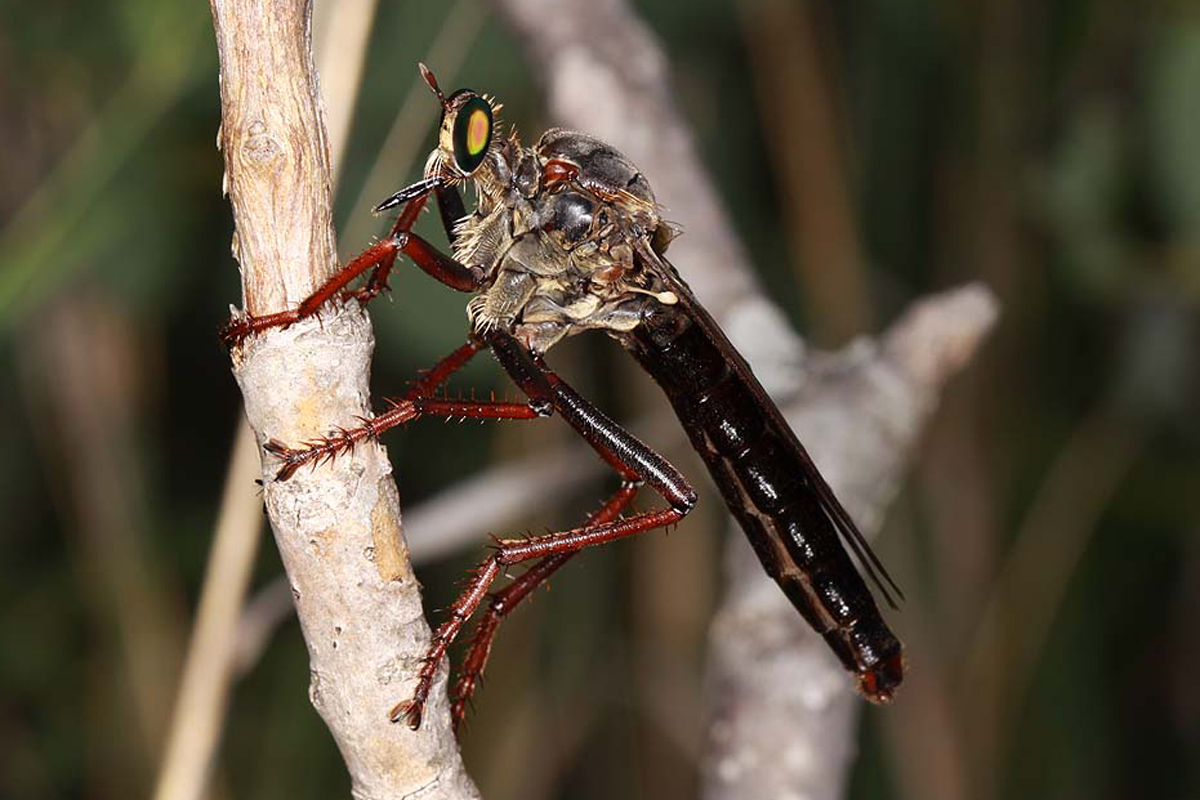
A few days ago, I featured Promachus hinei, one of the so-called “giant robber flies” and a common inhabitant of the glades and grasslands that dot Missouri’s largely forested landscape. That individual was seen at Long Bald Glade Natural Area in Caney Mountain Conservation Area, one of the many limestone glades that are a prominent feature of extreme southwestern Missouri’s White River Hills, as it snacked on a small carpenter bee (Ceratina sp.) and posed obligingly for a series of super close-up photographs. Promachus and its congeners are impressively large; however, I would see an even larger robber fly that day. I didn’t know what it was at the time, but I knew that never before had I seen such a magnificent fly, with its large, shimmering, emerald eyes, streamlined body almost devoid of setae (hairs), and ludicrously large size. These monsters were actually quite common at the glade, so I failed to appreciate the significance of what I was seeing as I chased one after another – more intent on securing photographs than specimens. This was not an easy task – they were extremely wary, rarely allowing me to approach within 12 feet no matter how cautiously and slowly I moved. Not one to back down from such a challenge (remember, I stalk tiger beetles), I persisted, traversing the rough, rock-strewn terrain amidst clumps of big bluestem (Andropogon gerardii), Indian grass (Sorghastrum nutans), and fragrant sumac (Rhus aromatica) until, at last, I got within striking distance of the impressive female shown in these photos. Taking flight before I felt assured of a good shot, I followed her repeated long, loping escape flights until I was able to get another few shots and she disappeared for good.
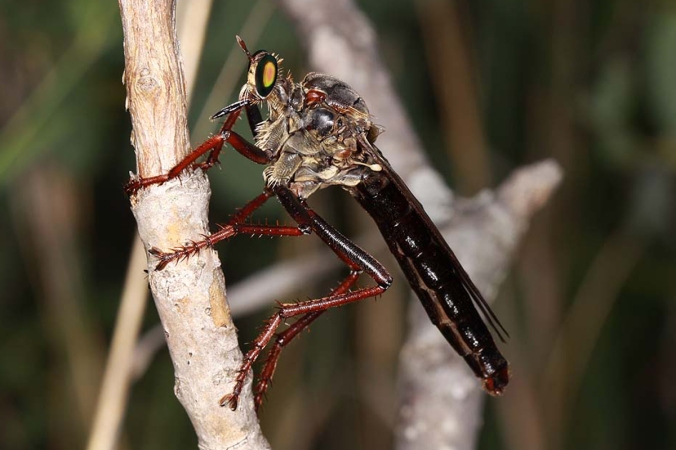
Same individual as in previous photo after flying to another perch.

Same individual as in previous photo after flying to another perch.

It didn’t take long after I returned home to figure out what I had seen, as there is really nothing that can be mistaken for Microstylum morosum, North America’s largest robber fly (Back 1909)¹. At 35–40 mm of length, this individual didn’t quite match the astounding 50-mm upper body length for the species (that’s 2 inches, folks!). Nonetheless, it was an impressive beast indeed! It is not surprising that North America’s largest robber fly should be a species of Microstylum, as it is this same genus that contains the world’s largest robber fly – the aptly named M. magnum from Madagascar, with a body length of 60 mm and an almost preposterous wingspan of up to 84 mm (that’s over 3 inches folks!). I don’t know if any flies exist that are larger than this, but certainly none can be more imposing.  While I’m happy with the photos that I did obtain, I must confess some disappointment that I wasn’t able to get more than these basic lateral profile shots.  Of the several photographs of this species that can be found on the web, this female, photographed by Greg Lavaty of Houston, Texas, is (in my humble opinion) certainly the most stunning.

¹ Puzzled by the use of the prefix “micro” in the genus name – hardly seeming appropriate for such an enormous fly – I asked Eric Fisher (retired, California Department of Food and Agriculture) about the name’s derivation, to which he replied, “The name refers to the quite small ‘stylus’ of the antenna apex; Macquart specifically mentions this character in his 1838 original description of the genus. (This is not a very helpful diagnostic character, as many asilids share this feature…).”

Even more significant than its size, however, was its very occurrence on this glade. Like Ospriocerus abdominalis, which I had seen just a few weeks earlier in the Loess Hills of extreme northwestern Missouri, M. morosum is a denizen of the Great Plains, and also like that species it has until now not been known from Missouri. That’s right – another new state record!  Unlike O. abdominalis, however, the Missouri occurrence of M. morosus represents a significant northeastern extension of its known range.  The species was long considered a Texas endemic until Beckemeyer and Charlton (2000) confirmed its occurrence in southeastern Arizona and documented significant range extensions into Oklahoma, Kansas, extreme southeastern Colorado, and extreme northeastern New Mexico.  Its eastern distributional limit was thought to occur along a north-south line from Douglas County, Kansas to Mayes County, Oklahoma to Brazoria County, Texas; however, Warriner (2004) documented its occurrence some 200 miles east of this line in the blackland prairies of southwestern Arkansas.  The occurrence of M. morosum in the White River Hills of Missouri represents yet another significant eastern extension of its known range – Long Bald Glade lies 185 miles NNE of the collection site in Arkansas and 155 miles ENE of the nearest known record in Mayes County, Oklahoma (Locust Grove), making it the easternmost known locality for this species.

As in Arkansas, where the collection site represents one of the highest quality blackland prairie remants in the state, Long Bald Glade represents a high quality remnant of the limestone glades that once occurrred much more extensively within Missouri’s White River Hills.  Like the blackland prairie of Arkansas, the limestone glades of the White River Hills have been dramatically reduced since EuroAmerican settlement due to land use conversion, and fire suppression and overgrazing of the remaining tracts have resulted in significant woody encroachment – chiefly by eastern red-cedar (Juniperus virginiana) – and loss of vegetational diversity. This has caused dramatic reductions in populations of the many Great Plains plant and animal species that are found here and nowhere else in the state.  Considering the overall distribution of M. morosum, it is unlikely that it occurs more extensively within Missouri than the White River Hills, emphasizing the importance of continued conservation and restoration activities in this unique part of Missouri.  However, since the White River Hills extend into northwestern Arkansas, M. morosum may occur in that part of Arkansas as well as the southwestern part of the state.

I thank Eric Fisher and Herschel Raney for confirming the identity of this species and its status as a new record for Missouri.

Photo details: Canon 100mm macro lens on Canon EOS 50D (manual mode), ISO-100, 1/250 sec, f/10-11, MT-24EX flash 1/2 power through diffuser caps.

REFERENCES:

Back, E. A. 1909. The robberflies of America, north of Mexico, belonging to the subfamilies Leptograstrinae and Dasypogoninae. Transactions of the American Entomological Society 35:137–400.

Beckemeyer, R. J. and R. E. Carlton.  2000.  Distribution of Microstylum morosum and M. galactoides (Diptera: Asilidae): significant extensions to previously reported ranges.  Entomological News 111(2):84–96.

Warriner, M. D.  2004.  First Arkansas record of the robber fly Microstylum morosum (Diptera: Asilidae).  The Southwestern Naturalist 49(1):83–84.

Copyright © Ted C. MacRae 2009

Add to FacebookAdd to NewsvineAdd to DiggAdd to Del.icio.usAdd to StumbleuponAdd to RedditAdd to BlinklistAdd to Ma.gnoliaAdd to TechnoratiAdd to Furl

Prey bee mine

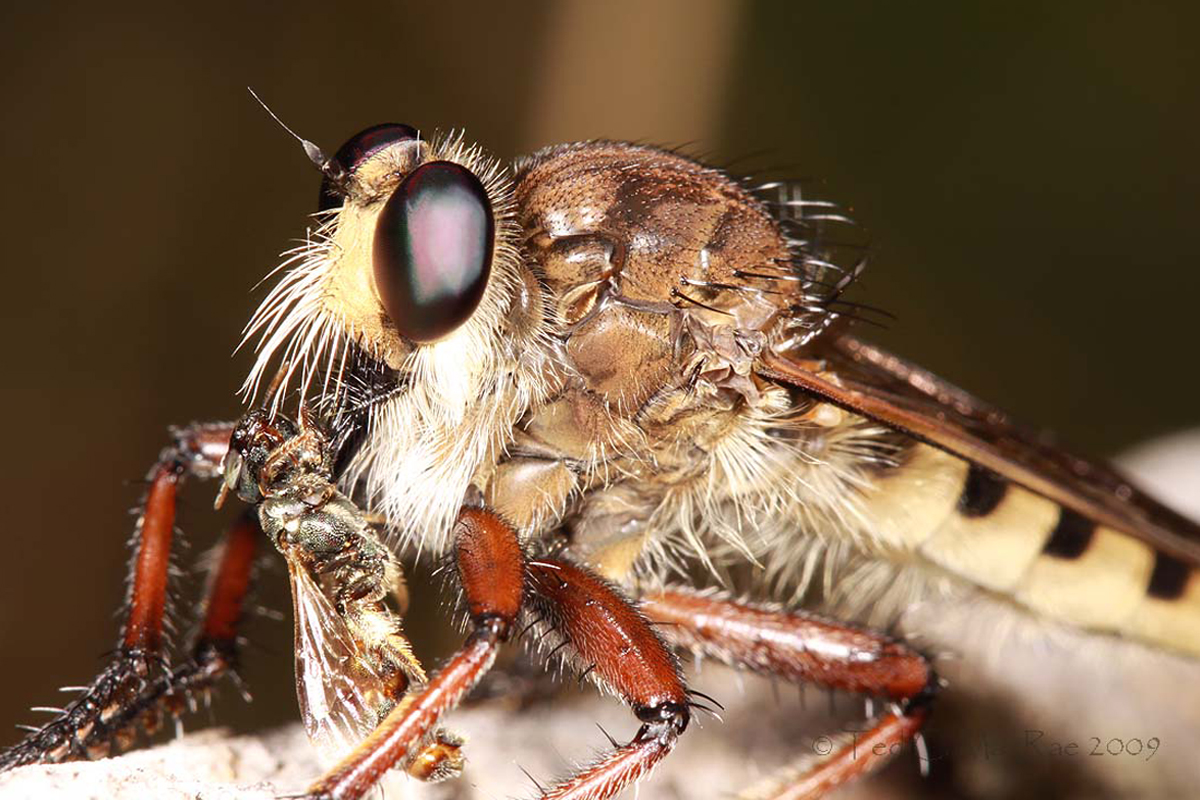
Promachus hinei preying upon a small carpenter bee

Promachus hinei preying upon a small carpenter bee

Robber flies of the genus Promachus – the so-called “giant robber flies” – are among the more conspicuous and fearless predators seen in Missouri’s glades. Able to capture almost any flying insect regardless of size, this individual – seen at Long Bald Glade Natural Area in Caney Mountain Conservation Area – was found snacking on what, according to my hymenopterist friend Mike Arduser, appears to be a female individual of the genus Ceratina (the so-called small carpenter bees in the family Apidae). Of the three “tiger-striped” (referring to the yellow and black striping of the abdomen) species of Promachus in the eastern U.S. species, P. hinei is the most common in Missouri. It is distinguished from the more southeastern P. rufipes by its reddish versus black femora and from the more northern P. vertebratus by the larger dark areas dorsally on the abdominal segments and distinctly contrasting two-toned legs. Despite their common name and impressive size, however, they are not the largest robber flies that can be seen in these glades…

Photo details: Canon 100mm macro lens on Canon EOS 50D (manual mode), ISO-100, 1/250 sec, f/13, MT-24EX flash 1/4 power through diffuser caps.

Copyright © Ted C. MacRae 2009

Add to FacebookAdd to NewsvineAdd to DiggAdd to Del.icio.usAdd to StumbleuponAdd to RedditAdd to BlinklistAdd to Ma.gnoliaAdd to TechnoratiAdd to Furl

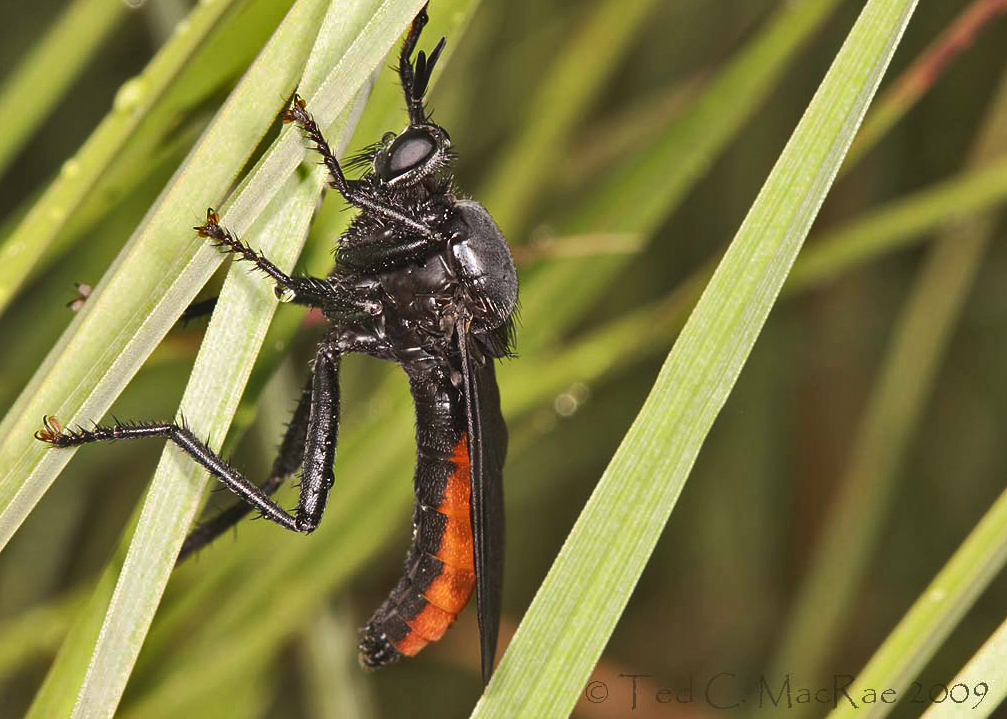
Ospriocerus abdominalis

Photo details: Canon 100mm macro lens on Canon EOS 50D, ISO 100, 1/250 sec, f/14, MT-24EX flash 1/4 power w/ diffuser caps.

Photo details: Canon 100mm macro lens on Canon EOS 50D, ISO 100, 1/250 sec, f/14, MT-24EX flash 1/4 power w/ diffuser caps.

My dipteran digression continues with this photograph of the robber fly, Ospriocerus abdominalis (Diptera: Asilidae).  More than just a pretty picture, this represents yet another apparently new state record that I and my colleague Chris Brown discovered a few weeks ago during our 2-day survey of Missouri’s critically imperiled hilltop prairies in the extreme northwest corner of the state.  Like the previously discussed Cylindera celeripes (swift tiger beetle) and Beameria venosa (a prairie-obligate species of cicada), O. abdominalis has not previously been recorded further east than Nebraska, Kansas, Oklahoma and Texas. This large fly is a grassland denizen that ranges over western North America and into Mexico (Cannings 1998, as Ospriocerus aeacus). It is somewhat suggestive of a mydas fly, although its short antennae immediately identify it as a robber fly (mydas flies have elongate clubbed antennae).  It also reminds me of the magnificent western robber fly Wyliea mydas by its mimetic, wasp-like coloration – presumably modeled after spider wasps of the genus Pepsis and Hemipepsis (Hymenoptera: Pompilidae) – but is distinguished by its black body and wings with red dorsal coloration on the abdomen (W. mydas has the abdomen wholly black and the wings red).  While not quite as handsome as W. mydas, it is impressive nonetheless.

The dry hilltop prairie remnants in which O. abdominalis, B. venosa, and C. celeripes were found are associated with the Loess Hills, a unique landform along the western edge of Iowa that reaches its southern terminus in extreme northwest Missouri.  Due to their extreme rarity and vulnerability to woody encroachment and anthropogenic degradation, these remnant habitats are considered one of Missouri’s most critically imperiled natural communities. Only about 50 acres of original habitat remain, and of this only half is in public conservation ownership.  Many of the plants and animals found in these habitats represent hypsithermal relicts that migrated eastward during a dry and warm period after the last ice age and were then “left behind” in pockets of relictual habitat as a return to cooler, wetter conditions forced the main populations back to the west.  More than a dozen plants and two vertebrates occurring in these prairies are listed as species of conservation concern.  As is typically the case, the flora and vertebrate fauna of these remnant habitats have been fairly well characterized, while precious little attention has been given to the vastly more diverse invertebrate fauna.  As we begin to study the insects of these habitats more carefully, we are almost sure to find a great many species that are more typically found further to the west and that live nowhere else in Missouri.  Their continued presence in the state will be wholly dependent upon the critically imperiled habitats in which they live, making conservation and restoration of the remaining loess hilltop prairie remnants in Missouri all the more important.

My thanks to Eric Fisher and Herschel Raney for confirming the identity of O. abdominalis.

REFERENCES:

Cannings, R. A. 1998. Robber Flies (Insecta: Diptera: Asilidae), in Smith, I. M., and G. G. E. Scudder, eds. Assessment of species diversity in the Montane Cordillera Ecozone. Burlington: Ecological Monitoring and Assessment Network.

Copyright © Ted C. MacRae 2009

Add to FacebookAdd to NewsvineAdd to DiggAdd to Del.icio.usAdd to StumbleuponAdd to RedditAdd to BlinklistAdd to Ma.gnoliaAdd to TechnoratiAdd to Furl

Collection Inventory update

The more observant – and taxonomically inclined – among my readers may have noticed the sidebar item entitled, “T. C. MacRae Collection”. The links within that item lead to Google documents detailing the species in those groups of insects that are represented within my collection. I am primarily a beetle guy, and within that vast taxon I focus mostly on the woodboring beetle groups Buprestidae and Cerambycidae and the tiger beetle family Cicindelidae. As you can see, however, I have inventories for several additional groups, including non-beetle families – a testament to my inability to suppress broad interest in insects as a whole. I don’t claim to be an expert in these other groups of insects, but I do enjoy learning about groups outside my chosen field of expertise. It’s a bit of a ‘throwback’ attitude – insect taxonomists of the 19th and early 20th centuries commonly studied multiple families or even orders of insects. This broad approach has largely disappeared in the past 50 years, as taxonomists increasingly have been forced to become narrowly focused on a single insect taxon. I can maintain this broad approach because, while I am a professional entomologist, I am a taxonomist only by avocation. My research is conducted at my own discretion and doesn’t rely on securing grants or fulfilling a departmental mission. Rather, it is directed only by what I find interesting and can reasonably afford in terms of time and expense.

The purpose of this update is twofold – to call attention to two recent additions to the list of inventories, and to explain how the inventories are constructed in the event that some future reader will want to utilize them for reference. In the past two weeks, I’ve received back material accumulated over the years in the families Mutillidae (velvet ants) and Asilidae (robber flies). This material had been sent to experts for identification – doctoral candidate Kevin Williams (Utah State University) graciously provided IDs for the velvet ants, while worldwide asilid expert Dr. Eric Fisher (California Department of Food and Agriculture) kindly identified the robber flies. For each of these groups, an inventory was constructed in which the species represented by my material are listed in the context of the group’s currently accepted higher classification. In each case, higher taxa not represented in my collection are indicated by lighter gray text. A similar approach has been used, to varying degrees, in the other listed inventories. The biggest one, Buprestoidea, represents the bulk of my collection, listing almost 1,500 species from around the world. In this case, not only is the complete higher classification indicated, but all currently recognized world genera are also listed, as well as all known North American species. Again, taxa not represented in my collection are indicated by lighter gray text. Similar inventories have been constructed for Cerambycidae and Cicindelidae, but in these cases the inclusion of taxa missing from my collection is limited to those occurring in North America – their combined worldwide fauna is simply too large for me to concern myself with, given my primary focus on the worldwide buprestoid fauna.

Regarding the Buprestoidea, Cerambycidae, and Cicindelidae – these are my chosen groups of interest in which I am actively building North American representation (worldwide for Buprestoidea). If anyone can provide specimens representing taxa not in my collection, please contact me directly. I am more than happy to exchange for such material. As for the other groups, they are primarily ‘just for fun’ – I collect them when convenient because they are interesting, but more importantly to make them available to others who might have a research interest in them. If anyone working in these groups sees species listed that are of interest to your research, please feel free to contact me for a loan or exchange. I have material in many additional groups not yet listed – inventories will be posted as they become available. If you have interest in a group not listed, please contact me and I’ll let you know what material I have available for loan/exchange.