2025 Southwestern U.S. Insect Collecting Trip iReport: Act 2 (Finale)

This—the 18th “Collecting Trip iReport”—covers the second of two insect collecting trips to the southwestern U.S. this season—this first one occurring from June 4–13, during which I placed “bottle traps” and “jug traps” at several locations, and this one from September 3–14 to retrieve the traps and take advantage of any late-season collecting opportunities. I was fortunate on this trip to have longtime collecting buddy and melittologist Mike Arduser joining me, during which we visited the same 15 localities that I visited on my precious trip back in June (one in northwestern Oklahoma, six in northern Arizona, six in southern Utah, and two in southern Nevada) plus two additional localities (one each in northwestern Oklahoma and northeastern New Mexico).

Like previous trip reports, this one assembles field notes largely as they were generated during the trip. They have been lightly “polished” but not substantially rewritten or changed based on subsequent examination of collected specimens (unless expressly indicated by “[Edit…]” in square brackets). While I did photograph a few insects in the field with my “macro” rig to feature individually in future posts, this post contains only iPhone photographs (thus the title “iReport”). Previous collecting trip iReports are:
2013 Oklahoma
2013 Great Basin
2014 Great Plains
2015 Texas
2018 New Mexico/Texas
2018 Arizona
2019 Arkansas/Oklahoma
2019 Arizona/California
2021 West Texas
2021 Southwestern U.S.
2022 Oklahoma
2022 Southwestern U.S.
2023 Southwestern U.S.
2024 New Mexico: Act 1
2024 New Mexico: Act 2
– 2024 New Mexico: Finale
– 2025 Southwestern U.S.: Act 1


Day 1

I’m on my way out west with fellow collector Mike—today being only a travel day but with a quick stop in Texas Co., Oklahoma to retrieve bottle traps set back in June and then a night of camping at Black Mesa State Park before continuing the drive west tomorrow. After 7 hours, we needed to stretch our legs and stopped at Salt Plain National Wildlife Refuge’s Sandpiper Trail—a spot we both have visited several times and know well. Recent rains had the alkaline flats filled with more water than I’ve seen during any previous visit, …

Salt Plain National Wildlife Refuge, Alfalfa Co., Oklahoma.

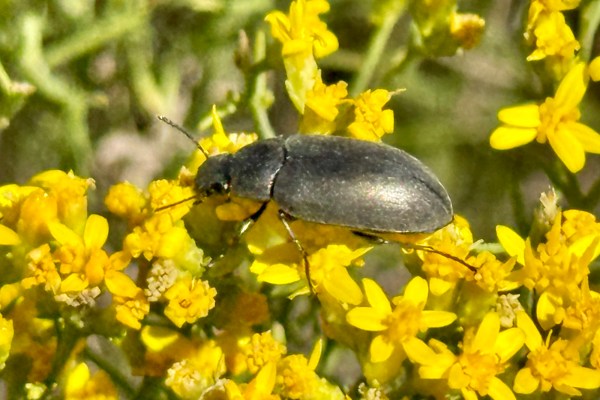
… and only a few Ellipsoptera nevadica knausi (Knaus’ tiger beetle) and Eunota circumpicta johnsoni (Johnson’s tiger beetle) were seen on the drier margins of the alkaline flats. Several Epicauta conferta (red-cornered blister beetle) were seen lumbering across the path, and a Diogmites angustipennis (prairie robber fly) posed nicely on the trail for pictures as well.

Diogmites angustipennis (prairie robber fly—family Asilidae).

Showy Eustoma russellianum (prairie gentian)—a plant I’ve never seen before—were blooming spectacularly and prolifically in the vegetated areas bordering the alkaline flats.
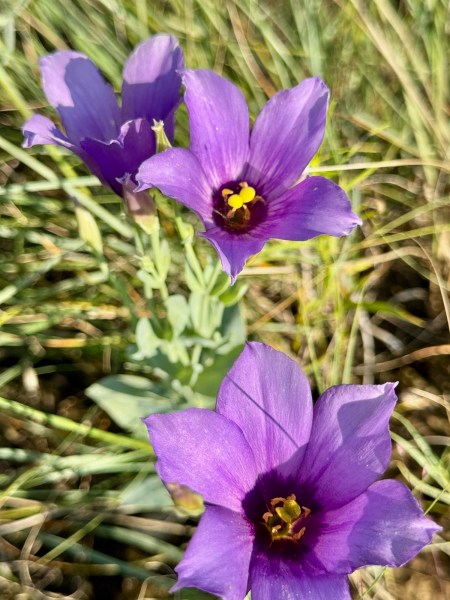
Eustoma russellianum (prairie gentian—family Gentianaceae).

It was a quick but interesting stop that rejuvenated the legs before we continued our journey westward.

The first “real” stop of the trip was ~5 miles north of Goodwell in Texas Co., Oklahoma where I placed three white bottle traps in early June hoping to capture the very rare Acmaeodera robigo, which had been photographed here on flowers of Melampodium leucanthemum (blackfoot daisy) and the photos posted on BugGuide. I was never able to contact the photographer, but since bottle traps are so effective at sampling species of Acmaeodera I reasoned placing three traps here (one at the precise spot and two more several hundred yards to the north and to the south) would give me the best chance of collecting it. It had already been dark for an hour before we reached the spot, but despite the darkness and late hour I had no trouble finding each of three traps. I was happy to see all three traps still in place, undisturbed, and filled to the brim with insects. I tried to pick out the larger insects (mostly crickets and grasshoppers) and stir through the remaining contents of each trap a bit to see if I could detect any Acmaeodera, but the majority of insects appeared to be small blister beetles, followed by bees. The darkness made further sorting impossible, so I bagged the contents of each trap and saved for later sorting. [Edit: later sorting found only a couple of Acmaeodera mixta? in just one of the traps and no A. robigo.]

We arrived at our first overnight spot—Black Mesa State Park—quite late (~11:30 pm) and quickly setup camp before retiring for the evening. In the middle of the night I got up, came out of the tent, and was greeted by an incredible amazing starscape that is normally only seen during winter. Taurus was already high in the sky, and Orion was well above the horizon with a brightly shining Jupiter not too far to its left.

Night sky at Black Mesa State Park. Orion has risen, with Taurus above and Jupiter just rising in the lower left.

Day 2

In the morning, a canyon towhee (Melozone fusca) kept us company as we prepared breakfast and then broke camp for another mostly travel day
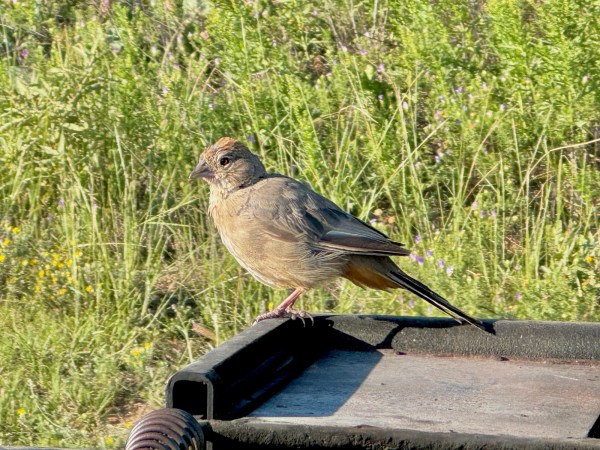
Canyon towhee (Melozone fusca).

Our destination this evening is Devils Canyon Campground near Monticello, Utah, to which we will travel by way of northeastern New Mexico and then southwestern Colorado.
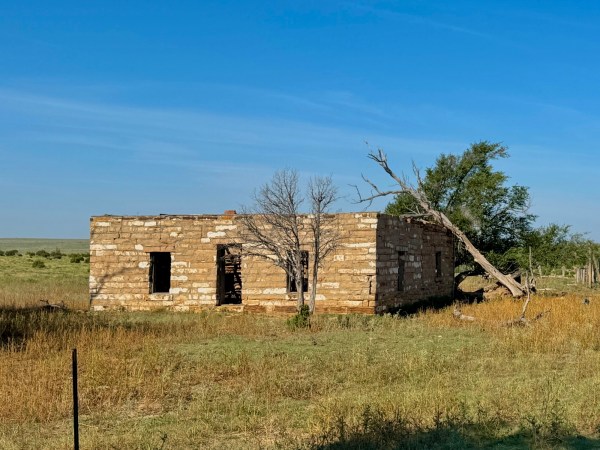
Abandoned homestead outside of Clayton, New Mexico.

Shortly after crossing into Colorado we made a pit stop for ice and I began searching the pavement around the gas station looking for beetles that may have come into the previous night’s lights. I didn’t find any cerambycids but I did find a small tenebrionid beetle that didn’t look like familiar to me.

Crossing the Sangre de Cristo and then the San Juan ranges were as spectacular a mountain crossings as any that Colorado has to offer, and a coffee stop in Pagosa Springs (at Faire Society Cafe and Patisserie) provided not only good coffee and pastries to fuel me for the rest of the drive to Devils Canyon Campground near Monticello, Utah, but interesting and creatively framed art work to treat the eyes while waiting for our orders.


“Art wall” in Faire Society Cafe and Patisserie, Pagosa Springs, Colorado.
“Butterflies”—Faire Society Cafe and Patisserie, Pagosa Springs, Colorado.
“Gentleman Frog”—Faire Society Cafe and Patisserie, Pagosa Springs, Colorado.
“Cow”—Faire Society Cafe and Patisserie, Pagosa Springs, Colorado.

Weather during the drive had been good all day, but on the final approach to Devils Canyon Campground the skies began looking worryingly threatening. The last time I came here (early June) I had intended to camp here but got rained out and took a motel in town. I did not want a repeat of that, so we kept our fingers crossed and made the final drive to the campground. Although still threatening, it was not actually raining when we arrived (unlike last time), so we took our chances and set up camp. No sooner than that did the rain start! Fortunately, the tent was already up, so it just meant that instead of cooking dinner at the site, we would instead go to town and have dinner (Dave’s BBQ). When we got back to camp, the rain had stopped (although we could tell that it had rained hard), so I decided to walk the roads looking for night-active beetles. I knew this was probably a fruitless exercise—by then the post-rain temps at this 7000’ site were already down to the mid-50s, but it would give me a chance to stretch my legs after two straight days of driving, and I could also take that opportunity to retrieve the bottle and jug traps that I had set back in June. The bottle trap was disappointing, especially after seeing the ones I’d set near Goodwell, Oklahoma filled to the brim with insects—just a handful of bees (for Mike) and no beetles of any kind. This was surprising given the many Acmaeodera I have collected in alpine habitats just like this (Ponderosa pine and Gambel oak). The SRW-baited jug trap, on the other hand, was nicely (if not overwhelmingly) productive (Tragosoma sp., Enaphalodes sp., small elaphidiines, small acanthocine with very long antennae, Xestoleptura?)—enough to make it worth the effort. I was also pleased to see that the jug trap was in still place and intact with the catch in good shape despite three months in the field. The bait bottle was still about half full of red wine, but since the propylene glycol had dried the trap was no longer trapping insects. As I’d expected, no night-active insects were seen in the way to the traps or on the way back.


Day 3

It was a chilly morning, and though it had not rained since our arrival last night the skies remained overcast. The day’s plan was to continue west to the Ponderosa Grove Campground in southwestern Utah (north of Kanab), but with only five hours of driving required to get there we would have time to make a few stops along the way. Before leaving I started checking the Ericameria nauseosa (rubber rabbitbrush), several of which had begun blooming in the campground, and found a few Crossidius coralinus and Acmaeodera amabilis on the flowers. I was tempted to suggest staying put—at least for a short time—and exploring the area a little more fully, but my real objectives were further west and I elected to stick with the plan.

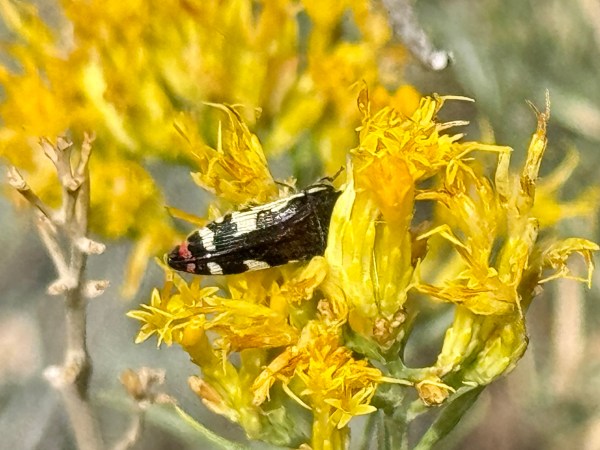
Crossidius coralinus (family Cerambycidae) on flowers of Ericameria nauseosa (rubber rabbitbrush).
Acmaeodera amabilis (family Buprestidae) on flowers of Ericameria nauseosa (rubber rabbitbrush).

One of the stops I’d made along this way last June was 4 miles east of Bluff in San Juan Co., Utah, where the famous Mont Cazier had collected what would later be described as Agrilus utahensis. I did not find it in June (nor did I fully expect to, since the record was from late July), and I was equally skeptical about my chances this time given how much later it was in the season. On the way here, we got caught behind an oversized load on the highway that was so big it required three highway patrol chaperone vehicles to clear the road ahead. Going at about half the speed limit, I worried we might have to follow it the entire way to our turnoff, which would nearly double our travel time to the first spot. Fortunately, the caravan pulled over at one point to let the long train of trsffic that had accumulated behind it pass, and we were on our way (the convoy would later pass us at the very spot where we had stopped to collect).

Oversized convoy!

The location was disappointing dry and crispy, although Gutierrezia sarothroides (broom snakeweed) was coming into bloom. Sweeping it eventually produced about a dozen Crossidius pulchellus and two other beetles (a clytrine leaf beetle and a weevil), and Mike collected a handsome series and diversity of bees off of flowering Eriogonum sp. (buckwheat).

Crossidius pulchellus (family Cerambycidae) on flowers of Gutierrezia sarothrae (broom snakeweed).

Our drive afterwards through southeastern Utah and northeastern Arizona took us through some of the most amazing scenery that the American West has to offer—red sand/siltstones sculpted through the eons by wind and rain have created a landscape that can only be described as “planetary.”

Monument Valley, southeastern Utah.

Eventually, the dramatic landscape gave way to a more monotonous series of desert plateaus periodically interrupted  by dramatic descents and canyons as we got deeper into north-central Arizona. Though pleasing to the eye, there were few signs of greenery of flowers to tempt the passing entomologist except occasional stands of Ericameria nauseosa (rubber rabbitbrush) beginning to bloom in higher elevation spots. We kept our nose to the grindstone, hoping to see better things once we passed through Page and crossed back into south-central Utah, but the landscape became even crispier, with a stop about 20 miles northwest of Page to look for Nanularia brunnea on Eriogonum inflatum (which I had found two years ago in late June) being a total bust. We expected/hoped that the higher elevations around Ponderosa Grove Campground (~6000’) would provide better collecting and continued there without haste. Our expectations/hopes proved well-founded, as blooming rabbitbrush was seen with greater frequency as we traveled north of Kanab and even more so along Hancock Rd approaching the campground. We took a few moments to scout out a good campsite and setup camp before spending the rest of the available daylight hours exploring. For me the rabbitbrush was most tempting, and scouting plants in the campground and the vicinity east produced small but nice series of Crossidius coralinus and Typocerus balteatus. As I was doing so, a sinking sun and virga to the east produced an impressive rainbow that became irresistible for photography—not only as a subject itself but as a backdrop for the beetles I was finding.

Rainbow at Ponderosa Grove Campground.
Crossidius coralinus (family Cerambycidae) on flowers of Ericameria nauseosa (rubber rabbitbrush).
Typocerus balteatus (family Cerambycidae) on flowers of Ericameria nauseosa (rubber rabbitbrush).

After some downtime back at camp (and grilled sirloin steaks for dinner), I did my customary nighttime patrol to check for night-active insects. This campground was especially productive when I did this back in June and found several Zopherus utahensis and other tenebrionids on the trunks of the massive Ponderosa pines that are the namesake of this campground.
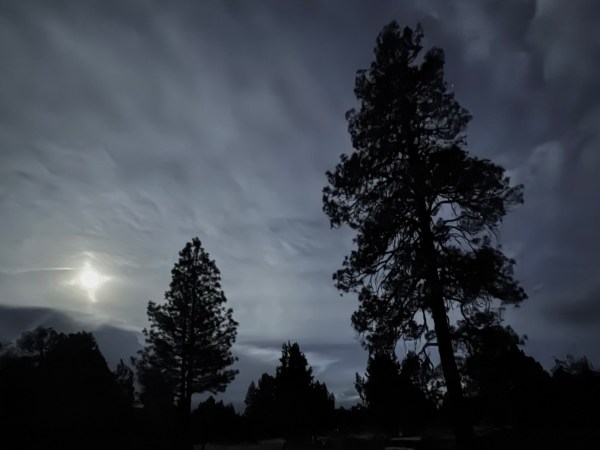
A near-full moon rises over our campsite at Ponderosa Grove Campground.

This time was no different—while I found only a single Z. utahensis, I did also find a few specimens of Coelocnemis sulcata, including a mating pair, on the trunks of the trees …
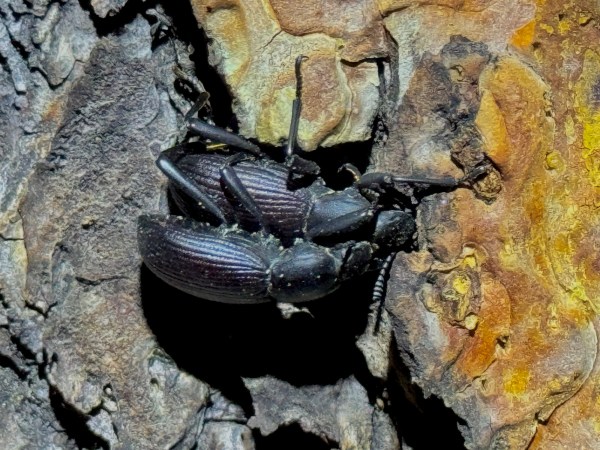
Coelocnemis sulcata (family Tenebrionidae) mating pair on trunk of Pinus ponderosa (Ponderosa pine) at night.

… and a single Embaphion sp. on the ground at the base of another. There are several massively-trunked Juniperus osteosperma (Utah juniper) in the campground as well, on which another C. sulcata was found. Despite this success and the relatively early hour, I was exhausted and called it quits for the night and retire. We will spend the entirety of the day here tomorrow, so I’ll have another chance to check the tree trunks again tomorrow night.


Day 4

After a relaxing morning at the campsite (during which time I caught up on my field notes while enjoying double-pour-through coffee), I walked over to the sand dune-adjacent woodlands to retrieve the traps that I’d set there back in June and brought them back to the campsite for sorting. I was happy to see Ericameria nauseosa (rubber rabbitbrush) and many other plants in bloom and looked forward to checking them more closely after servicing the trap catches.
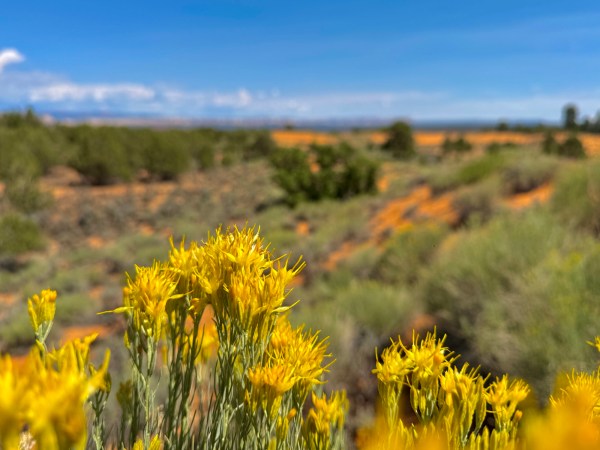
Ericameria nauseosa (rubber rabbitbrush) blooming in sand dune habitat at Moquith Mountain Wilderness Study Area.

The yellow bottle trap had ~15-20 beetles, including several Acmaeodera spp., a lepturine cerambycid, and a tiny Dichelonyx-like scarab (a relief after getting skunked with the bottle trap I’d set in Devils Canyon). There were also a fair number of bees in the trap, which I gave to Mike. The SRW-baited jug trap also did well, containing Tragosoma sp., Enaphalodes sp., several Psyrassa sp., and another colorful little lepturine along with several Euphoria inda, several small clerids, a mantispid, and numerous small beetles I take to be oedemerids. After processing the trap catch, I went back over to the woodlands and dunes, spending more than three hours collecting off the flowers of E. nauseosa and other flowers.

Typocerus balteatus was found not uncommonly on the flowers in most of the areas that I covered, while Crossidius coralinus and C. suturalis were found a bit more sparingly.
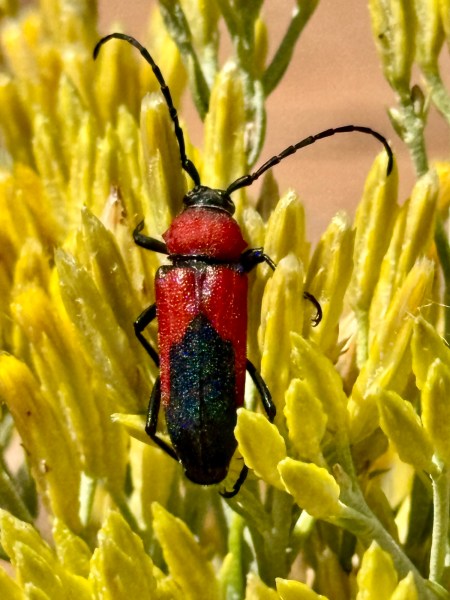
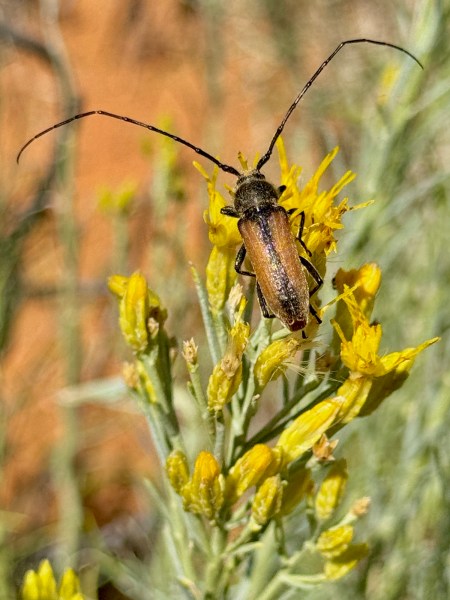
Crossidius coralinus (family Cerambycidae) on flowers of Ericameria nauseosa (rubber rabbitbrush).
Crossidius suturalis (family Cerambycidae) on flowers of Ericameria nauseosa (rubber rabbitbrush).

I also found Acmaeodera rubronotata on the flowers of Grindelia squarrosa (curlycup gumweed), Dieteria canescens (hoary tansyaster), and E. nauseosa, but they were limited to the woodlands and not seen in the dunes.

Acmaeodera rubronotata (family Buprestidae) on flowers of Dieteria canescens (hoary tansyaster).

I also found several individuals of an interesting little weevil on the rabbitbrush flowers, its gray/black longitudinally striped body making a good subject for photography (for which I also brought back a live A. rubronotata and a mating pair of ambush bugs), and spent a bit of time photographing some of the other blooming plants in the area.

Castilleja linariifolia (Wyoming paintbrush—family Orobanchaceae).

By the time I feel like I’d gotten a good enough look at the area, nearly four hours had gone by and I was famished. Sardines and Triscuits did the trick, after which we did a quick ice run into town and back—the highlights being an authentic Sinclair dinosaur (he’s smiling!) and an real (though non-functioning) pay phone.
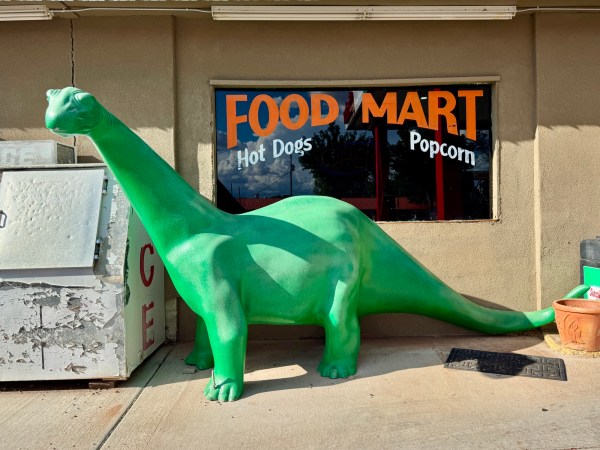
The famous “Sinclair dinosaur.”
He’s smiling!
An authentic (though non-functional) pay phone.

Returning to the campground, I walked with Mike back into the dunes to retrieve his bowl traps. I had hoped that some of them would pick up Acmaeodera (as is often the case with bowl traps and why I have started utilizing them on my own collecting trips), but the only species that would be out in this area at this time of season would be A. rubronotata, which I had already collected earlier in the day (there were none).

Mike services a “bowl trap.”

After a period relaxing (with a cold beer and burgers hot off the grill), I began my customary night walk. I have yet to find a cerambycid on tree trunks at night here, but still I enjoy night walks here as much as anywhere due to the consistent presence of ironclad beetles and other tenebrionoids on the trunks of the massive Ponderosa pine trees that give the campground its name.

Another near-full moon rises over the campsite.

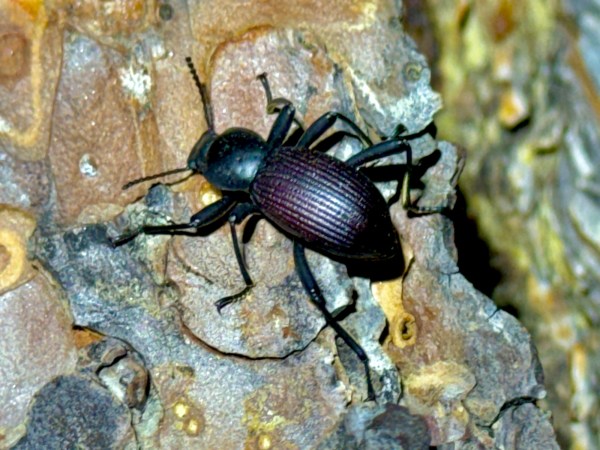
Tonight would be no different—I found Zopherus uteanus on just the second tree that I examined (right in our campsite), and I would also find two species of tenebrionids in the vicinity on the trunks of ponderosas (Coelocnemis sulcata and Eleodes obscura sulcipennis) and a third species (ID unknown) on the ground at the base of one of them.
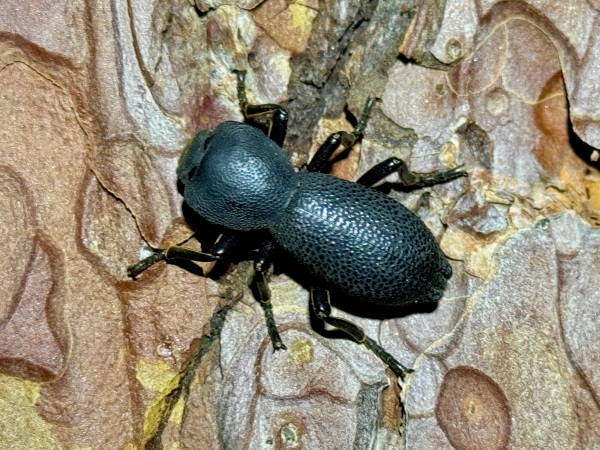
Zopherus uteanus (family Zopheridae) on trunk of Pinus ponderosa (Ponderosa pine) at night.
Coelocnemus sulcata (family Tenebrionidae) on trunk of Pinus ponderosa (Ponderosa pine) at night.
Eleodes obscura sulcipennis (family Tenebrionidae) on trunk of Pinus ponderosa (Ponderosa pine) at night.

At that point, I decided to go outside of the loop towards a couple of large P. ponderosa at the entrance, and on the way I found another E. obscura sulcipennis on the trunk of a massively old Juniperus osteosperma (Utah juniper). There was nothing on the P. ponderosa trees that I had targeted, but nearby was another large one, and high up on the trunk (as far as my fully extended net could reach) was another Z. uteanus, and several C. sulcata—including a mating pair—were found on the ground at its base.

At that point I decided to limit my tenebrionoid collecting to only Zopherus unless I saw species that I hadn’t seen before, so I passed by some additional tenebrionids of the same species as the previous on a large P. ponderosa in the RV loop, then saw a large, multi-branched Pinus edulis (Colorado pinyon pine) that I thought might be interesting to check. I did not find any beetles on it, but I did locate at eye level—with considerable difficulty!—a male Oecanthus californicus (western tree cricket). I was not only able to take a photograph of it with its wings fanned but also record an audio track up close (posted on iNaturalist).

Oecanthus californicus (western tree cricket—family Oecanthidae) male singing on trunk of Pinus edulis (Colorado pinyon pine) at night (song).

Returning to the tent loop, I checked all of the large P. ponderosa trees and junipers that had—during the past visit and last night—been so productive, but the only beetles I found was a very small tenebrionid that, fortunately, was yet another species I had not previously seen here (ID unknown). After two hours of searching tree trunks, I called an end to the night, which also meant a close to the collecting at this spot—tomorrow we will drive to Kyle Canyon in southern Nevada!


Day 5

Our exit from Ponderosa Grove took us through more of the spectacular canyonland that southern Utah is famous for and past the incredible Coral Pink Sand Dunes State Park (so spectacular it is that I think it could—despite its small size—be a national park). A dramatic descent down into the Virgin River valley and the town of Hurricane was only the first such descent—the second one being even more dramatic as I-15 dropped off the edge of the Colorado Plateau along the Virgin River Gorge. The remainder of the drive to Kyle Canyon northwest of Las Vegas was mindnumbing in its contrast—an endless stretch of interstate highway through a vast expanse of low, hot, featureless desert punctuated at regular intervals by palm tree dotted oases, each with a gaudy, glittering casino at its center. Driving up Kyle Canyon Rd put an end to this, however, as each thousand foot gain in elevation brought with it an increasingly interesting landscape. At about 4500’ elevation, I had set a couple of bottle traps—one yellow, one blue—hoping to catch the recently described Acmaeodera raschkoi (whose namesake—Mike Raschko—I had happened to meet at Ponderosa Grove Campground last June a few days before I set the traps!). Mike R. had also placed a bottle trap (white) at the site and was kind enough to reset it for me so I would have three colors sampling the area. Both of my traps were still in place, intact, and filled with numerous Acmaeodera that I take to be A. quadrivittata (along with many bees for Mike A.) and the yellow also containing a larger species that I didn’t immediately recognize (not unusual since I have never collected this area). Unfortunately, I did not see any specimens that appeared to be A. raschkoi, and even more unfortunately the white bottle trap had been pulled from the ground (although I was able to recover a few A. quadrivittata that were still inside the trap). Not much else was going on at the site—only a few things in sparse bloom but no beetles visiting the flowers, nor was there any rabbitbrush around on which to look for Crossidius.

We got a scare when we arrived at the campground and saw a sign at the entrance saying “Campground Full.” This was bad—if this campground was full, then surely the much more heavily used one down below was also full, and I didn’t look forward to spending the rest of the afternoon scrambling for a campsite somewhere in the Spring Mountains. We drove through the campground anyway, and, in fact, there were many campsites available! Looks like somebody forgot to do their job!

“Campground Full” sign at a not-full Hilltop Campground above Kyle Canyon, Nevada.

Crisis averted, we selected a nice spot overlooking the desert below and set up camp. Cool evening temps come early at this high elevation (~8300’), so with the remaining afternoon hours I retrieved and sorted my SRW-baited jug trap, finding several Tragosoma sp. but, curiously, not a single other longhorned beetle (or any beetle for that matter). Searching around the area afterwards, I extracted a dead Dicerca tenebrosa partial carcass in its emergence hole in a stump of Pinus monophylla (single-leaf pinyon pine), then went back down to the area I had collected last time, focusing especially on the two large half-dead Juniperus osteosperma (Utah juniper) trees on which I had seen damage from the rarely collected Semanotus juniperi (on one of which I collected three adults later that night). There was nothing on the first (the one on which I found the beetles), but at the second one I saw a large wind-thrown branch that I had not noticed last time. It exhibited S. juniperi damage and emergence holes on the lower part, and chopping into it I quickly recovered a dead but intact carcass of yet another S. juniperi adult. Further chopping turned up nothing, and I was about to walk away when I thought maybe I should cut into the upper part of the branch as well to look for evidence smaller woodboring species. Doing so, I quickly encountered a Chrysobothris sp. larva, and with that I decided to bring the entire upper part of the branch back for rearing. There wasn’t much else going on—few plants were in flower and nothing was seen on the trunks of trees or various pieces of downed wood that were laying about, so I went back to camp.

Alpine pinyon/juniper woodland at Hilltop Campground above Kyle Canyon, Nevada.
An elevation of 8300’ affords spectacular views into the desert below.

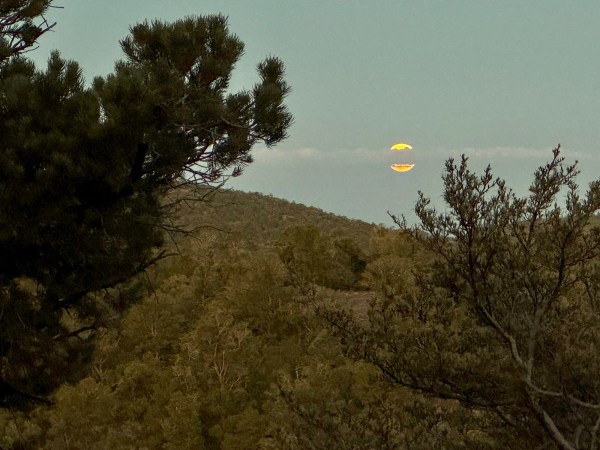
Later in the evening, we watched a spectacular moonrise, then enjoyed “surf ‘n’ turf” (grilled sirloin steak and salmon) before I started up my customary night walk to check tree trunks for night-active beetles.
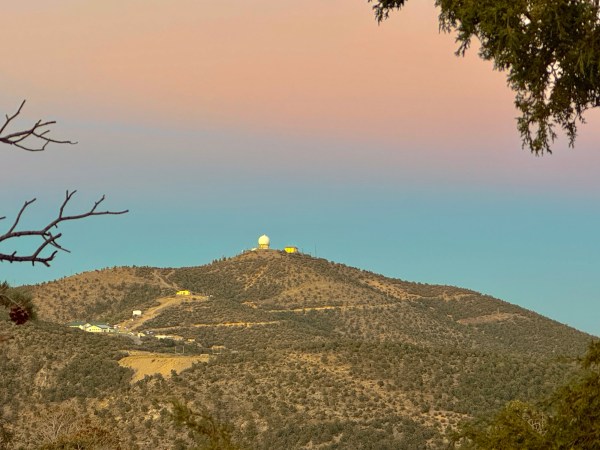
Angel Peak Radar Station at sunset.
“Corn Moon” rising.
Peeking through the trees.

Last time here when I did this, I found not only S. juniperi but also a few Zopherus uteanus, so I was hopeful for my chance tonight despite the lateness of the season. It started out well—on the first P. monophylla tree that I checked (right at our campsite), I found Oeme costata and a weevil.

Oeme costata (family Cerambycidae) on trunk of P. monophylla (single-leaf pinyon pine) at night.

Those would be the last live beetles I would see (other than an occasional tenebrionid beetle, none of which I collected). However, I would still find success—back at the J. osteosperma on which I had found three S. juniperi back in June, I found three more. They were not alive, however, but dead carcasses at the base of the tree—two nearly completely intact and the other partially so.
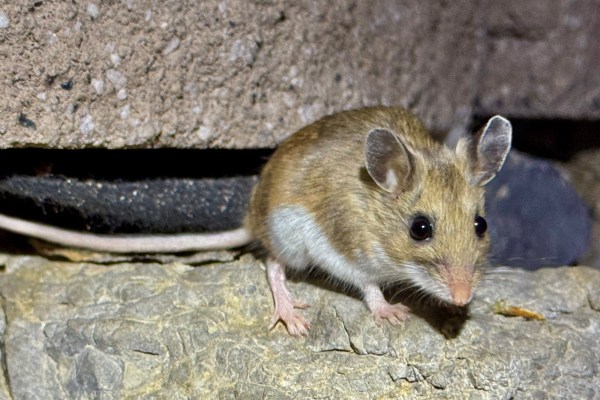
Western deer mouse (Peromyscus sonoriensis) at night.

Day 6

We had planned to visit few localities at middle and lower elevations but stopped to check out the profusely-blooming Ericameria nauseosa (rubber rabbitbrush) right outside the campground entrance for bees and beetles. Curiously, hardly anything was seen on the flowers despite the by then late-morning hour, sunny skies, and temps above 70°F. It seemed odd to me that there were no Crossidius beetles on the blooms, and the thought occurred to me that maybe the occurrence of E. nauseosa in the area itself could be a relatively recent phenomenon since it is only seen—albeit profusely—along the roads and highways in the area but nowhere further within the native habitats. With nothing going on, we pushed down to the lowest elevation point that caught our eye on the way in yesterday—the Step Ladder Trailhead at ~6700’.

Again, E. nauseosa was blooming profusely around the parking lot, but a quick perusal made it clear the situation would be similar here as well. Mike, on the other hand, was having good success collecting bees off of E. nauseosa and especially Gutierrezia sarothrae (broom snakeweed), so I was content to stay and refocus by searching for infested wood. I noticed a lot of Quercus gambelii (Gambel oak) and quickly found one with a dead but still attached, fully-barked branch. I broke the branch off the tree, and there in the broken butt of the branch was a large chrysobothroid larvae! This quickly prompted a decision to collect the infested branch and put it up for rearing. A second larvae was found in a small dead (but still fully-barked) tree nearby, which was added to the bundle. While this was going on, Mike found what seemed to be Agrilus blandus? in his net while sweeping bees from the flowers of G. sarothrae. I recall collecting this species in southern California in flowers of Eriogonum (wild buckwheat), so finding it on other flowers—particularly if Eriogonum is in the area (but not seen because it was not blooming) did not seem out of the question. My much more thorough sweeping of the plants around the area where he found it, however, produced no additional specimens. I was also interrupted in my sweeping attempts by a couple of curious bystanders—one a woman from Ukraine who wondered what the plant was that I was sweeping (I told her “broom snakeweed”) and what it was good for (“brooms” I wryly replied and then quickly clarified its role in the ecosystem), and then offered me a beetle collecting tip by telling me about large beetles they call “bombers” and that bite people sitting in spas in Southern California (I presume these are diving beetles in the family Dytiscidae); and the other a young man who was pleased to hear I was from St. Louis because he used to live there when he was married to his ex-wife. This all happened while I was in the middle of my sweeps, so I held the net bag firmly to keep insects from escaping my net until I could resume my sweeping. Eventually, I gave up the ghost and resumed my search for dead, infested wood, eventually finding a Cercocarpus ledifolius (curl-leaf mountain mahogany) tree with one recently-dead and one older dead branch, the former buprestid-infested (verified by cutting into the wood and finding young buprestid larvae) and which I collected for rearing.

View of Fletcher Peak from Step Ladder Trailhead.

After lunch back at the campground and some time spent processing specimens (as well as enjoying the antics of our resident golden-mantled ground squirrel [Callospermophilus lateralis certus]), …
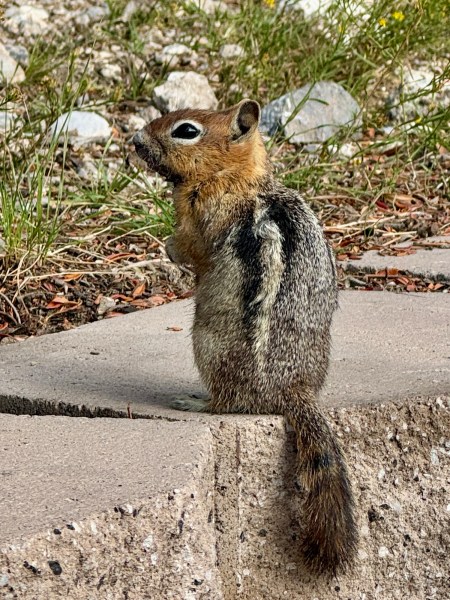
Mount Charleston golden-mantled ground squirrel (Callospermophilus lateralis certus).

… I wanted to check out the nearby Deer Creek Picnic Area where I’d seen a lot of iNaturalist observations (suggesting it might be an interesting place). At first all I saw was the massive parking lot below an equally massive road-cut slope—the only thing that looked like a trail was a steep drop down to the creek below. I checked it out, only to find it dead-ending at the creek and clambered back up.
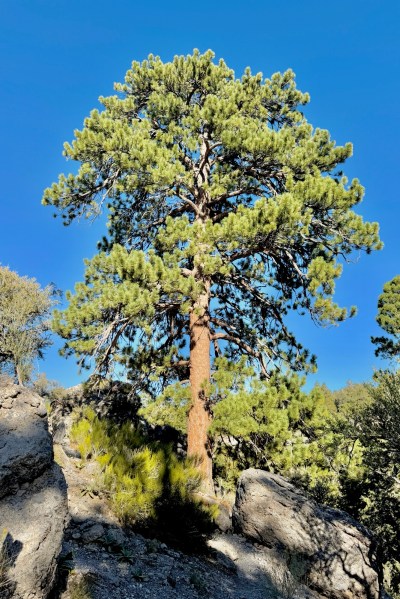
A massive Ponderosa pine looms above.

Then I saw a gravel trail behind the guardrail on the opposite side of the highway and found it leading to a paved path up the creek. Much of the trail was covered with a deep layer of gravel from flooding (and indeed some of the picnic tables were also nearly completely buried). I hiked the trail as it ascended alongside the creek under massive ponderosa pines until it dead-ended at a gravel road and turned around. The only plants in flower was Ericameria nauseosa (rubber rabbitbrush), and it was only near the highway, and while I saw no insects that I wished to collect, I did see a large Adejeania vexatrix (orange bristle fly) that frustrated my attempts to photograph it until I finally “pre-set” the focus, exposure, and zoom and quickly fired off a few shots at the distance I’d set it for as soon as the fly landed. The virtual lack of insect activity here confirmed what we’ve been seeing in the area as a whole, so I’ll be anxious to leave tomorrow and head for (hopefully) greener pastures at Leeds Canyon back in southwest Utah.

Adejeania vexatrix (orange bristle fly—family Tachinidae) on flowers of Ericameria nauseosa (rubber rabbitbrush).

Day 7

The drive from Kyle Canyon to Leeds Canyon was essentially a straight shot on I-15—normally a recipe for extreme boredom; however, coming back up through the Virgin River Gorge was a different, even more awe inspiring experience than the descent two days earlier. Ascending such a steep narrow canyon has the breathtakingly tall canyon bluffs looming high overhead, dwarfing the traffic, even the largest semi tractor trailers, snaking up below, whereas descending into a seemingly bottomless chasm feels a little more “dangerous.” We arrived at Leeds Canyon relatively early thanks to the “only” 3-hours drive. The area looked very dry, but a variety of blooming plants kept us optimistic as we made our way up the canyon road towards Oak Grove Campground at the top.

Leeds Canyon in southwestern Utah.

Sadly, optimism turned to dismay in an instant when we encountered a “Road Closed” sign about halfway up—a result of the ongoing fire risk that has bplagued the area this season. We checked to see if the campground on the other side of the mountain range was available, only to learn that it was closed due to fire damage. At that point, our decision was made for us—we would need to continue another two hours to the Kaibab Plateau where I had my last sets of traps to retrieve and where we could camp at Jacob Lake. While we were here, however, we took the opportunity to stop at a spot along Leeds Creek and see what we could find.
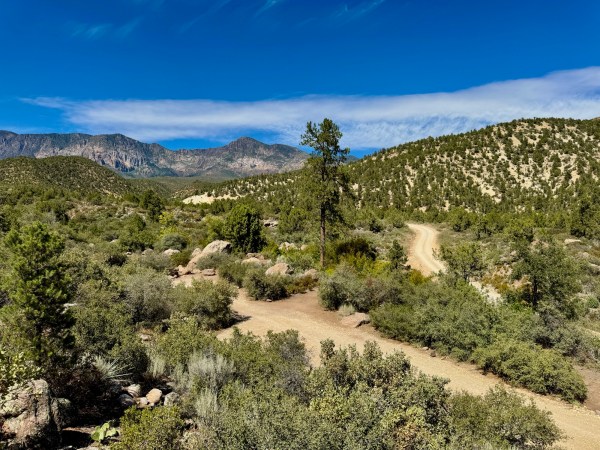
Oak Grove Rd crosses Leeds Creek in the lower part of Leeds Canyon.

Several different plants were in bloom, on which I’d hoped to find either Acmaeodera or longhorned beetles, the first that I looked at being Dieteria canescens (hoary tansyaster), but I only saw small dasytines (a few of which I collected). Nothing was seen on Solidago velutinus (velvety goldenrod) or Sphaeralcea grossulariifolia (gooseberry leaf globemallow) flowers, but then Mike came up with a Crossidius discoideus on flowers of Gutierrezia sarothrae (broom snakeweed).
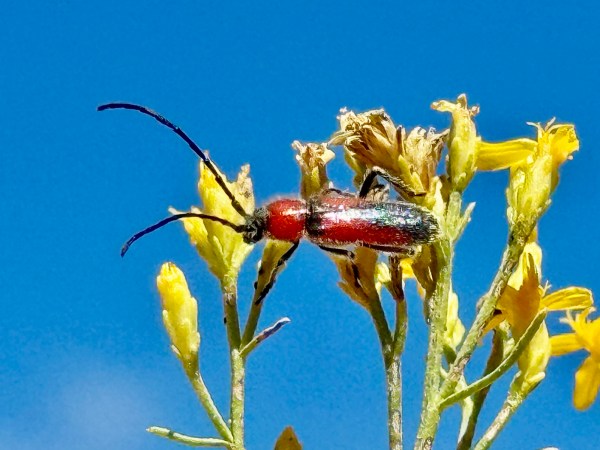
Crossidius discoideus (family Cerambycidae) on flowers of Gutierrezia sarothrae (broom snakeweed).

Careful searching of the plants in the surrounding area atop a small hill turned up an additional half-dozen individuals, but none were seen on any of the plants further up or down along the road. By this time, we’d spent about an hour and decided to finish the additional 2-hours drive needed to get to Jacob Lake.
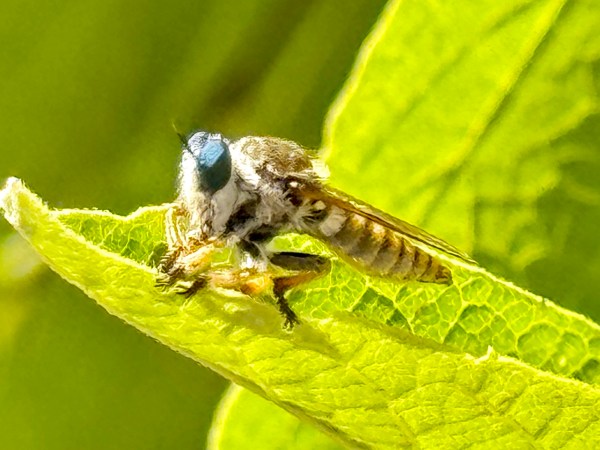
Megaphorus sp. (family Asilidae).
Historic home in nearby Harrisburg, Utah.

Some of the western U.S.’s worst fires this season occurred on Arizona’s Kaibab Plateau. The Dragon Bravo Fire destroyed over 100 structures on the Grand Canyon’s North Rim—including the historic Grand Canyon Lodge and the North Rim Visitor Center, while the White Sage Fire simultaneously burned significant areas of Kaibab National Forest north and east of Jacob Lake. It was the latter that, unfortunately, swept across both of the sites where I had placed traps a month earlier in June, so I was not optimistic about the likelihood that they had survived. Fortunately, the fires did not reach the immediate vicinity of Jacob Lake, so the campground was unaffected and—unusual in my experience—nearly devoid of people. After setting up camp, I went back north into the burn zone to see if my traps 1) had survived and 2) could be retrieved. The area around the site was almost completely destroyed, with charred black skeletons of trees dotting blackened soils devoid of any vegetation.
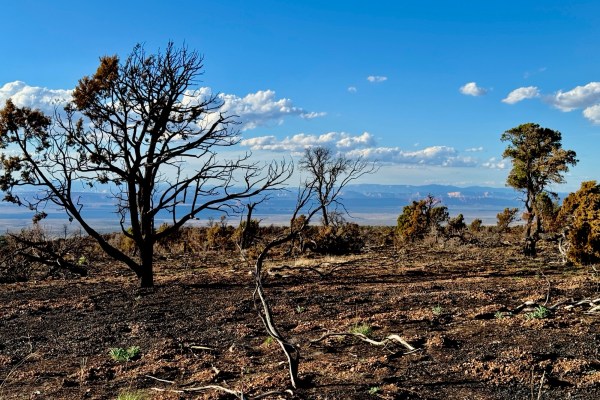
Aftermath of the White Sage Fire in the Kaibab National Forest.

I had low expectations for the traps at this site even before the fires, as the area had already burned several years early and was in the early stages of recovery (I had decided to place traps here anyway because I wanted to see what the woodboring beetle fauna in a recovering area might look like).

Blackened trunks punctuate a stark landscape.

I continued walking the 2-track toward the trap location surveying the damage, came around a bend, and saw it—a lone, still-green pinyon pine with my jug trap hanging from a branch and a bottle trap, its yellow funnel only slightly heat deformed, still planted in the soil beneath the tree!

A lone green tree amongst the destruction—with my traps in the tree and below it both intact!

At first I was elated, but then I saw the jug trap reservoir was dry and almost completely empty save for a few dried beetle carcasses—the trap had survived the fires, but the associated winds had blown the trap and dumped the contents (none of which could be detected on the ground beneath). The bottle trap, on the other had, looked to be full of insects with plenty of liquid still in the reservoir, so I was hopeful that I would retrieve some good specimens from it. This proved to be the case (sort of!) as I pulled a few Anthaxia sp., a meloid, and lots of bees (for Mike) from the trap. The dried carcasses in the SRW-baited jug trap turned out to be an elaphidiine & several silphids.

After leaving the first trap site and driving towards the second (a few miles east of Jacob Lake), I saw little to no fire impacts as I continued east of Jacob Lake. However, as I got closer to the site I began to see impacts—first along the ridge above, then down the slope and engulfing the area where I had placed my traps. Fortunately, the fire did not seem to have been as severe in the immediate area, so I remained hopeful.

Intact jug trap in burned woodland east of Jacob Lake, Arizona.

The bottle trap was found first and was in much the same condition as the bottle trap at the previous location—it’s blue funnel slightly heat-deformed, but the reservoir was filled with liquid and insects. Later sorting yielded an Acmaeodera diffusa?, a Melanophila sp., a couple of Anthaxia sp., a clerid, and lots of bees (for Mike). The Melanophila sp. was especially welcome—known collectively as “fire beetles” for their attraction to active fires, its presence in the trap may have been been a direct result of the fire. The SRW-baited jug trap was quickly found next, and much to my relief the trap was not only intact and undamaged but also filled with insects (in fact, the propylene glycol had not even completely dried). Later sorting would yield only a single longhorned beetle (plus a silphid and a Euphoria inda), but that longhorned beetle would prove to be the catch of the trip—Calloides nobilis mormonus! I have reared a single individual of the nominate subspecies from fire-damaged oak collected in Missouri, so I suspect the presence of this beetle is also a direct result of the fires that swept through the area—a satisfying irony.

Calloides nobilis mormonus (family Cerambycidae) attracted to sweet red wine-baited jug trap.

Back at camp and after another “surf & turf” dinner of sirloin steak and salmon, I did my customary nighttime walk to look for night-active beetles on the ground and in tree trunks. I had good luck with this here back in June, finding a Zopherus uteanus and several other beetles, but tonight’s catch consisted of just a single Temnochila sp. (family Trogosittidae) and a single weevil (superfamily Curculionoidea) crawling on the large trunks of Pinus ponderosa.

Unidentified weevil (superfamily Curculionoidea) on trunk of Pinus ponderosa (Ponderosa pine) at night.

Day 8

I’d seen a fair amount of Ericameria nauseosa (rubber rabbitbrush) in bloom at the second site the previous day when I retrieved my traps but didn’t see any insects (or, at least, beetles or bees) on them. I figured this was due to the early evening hour, so we decided to come back during the day to try again. The E. nauseosa flowers were still, puzzlingly, devoid of insects (save for honey bees and enormous numbers of a large, black, bristly tachinine fly—possibly Archytas metallicus or Juriniopsis adusta).

Tachinine fly (possibly Archytas metallicus or Juriniopsis adusta—family Tachindae) on flowers of Ericameria nauseosa (rubber rabbitbrush).

Like at Kyle Canyon, the absence of Crossidius spp. on E. nauseosa flowers was surprising, as I have seen them on this plant at almost every other location I have ever checked. You can’t make things appear no matter how hard you look, however, so we continued into some openings farther up the slop and encountered a few other plants in bloom. One was Dieteria canescens (hoary tansyaster), on the flowers of which I found a few small beetles of an unknown family. Nearby I saw several dead main branches in a clump of Quercus gambelli (Gambel oak)—cutting into them revealed a very small woodboring beetle larvae, so I collected several of the stems for rearing. Coming back down the slope I found a single cryptocephaline on the flower of Eriogonum racemosa (redroot buckwheat) and a single Acmaeidera rubronotata on flowers of Gutierrezia sarothrae (broom snakeweed)—the latter on which Mike had also found a single Crossidius discoideus. (This seems to be the first record of any species of Crossidius from the Kaibab Plateau! Maybe the other species are here as well but are not quite out yet at this relatively early date in fall.)
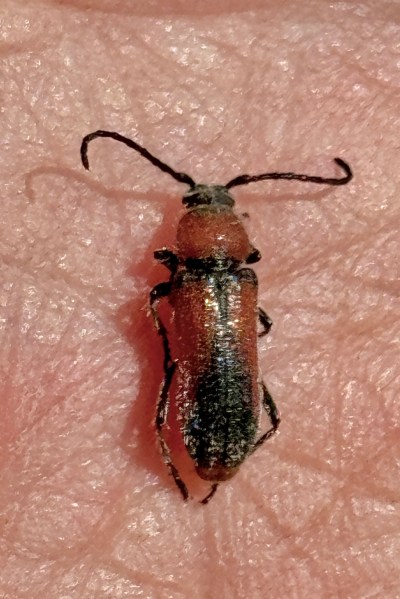
Crossidius discoideus (family Cerambycidae) collected on flowers of Gutierrezia sarothrae (broom snakeweed).

We were getting ready to leave when I spotted a large, fallen Pinus ponderosa (Ponderosa pine) with the twigs brown but still attached (indicating it might be the right “amount” of dead to host woodboring beetles. Damage by such could be seen on the smaller branches, and cutting into them confirmed the presence of larvae and led to a second wood-cutting/bundling session to bring the beetle-infested twigs and branches back for rearing.

Chasing more floriferous pastures, we went back up to higher elevations and stopped at a spot close to the campground where we 1) saw a great diversity of plants in bloom and 2) could safely pull off the highway. A huge diversity of blooming plants were seen (from which Mike collected ~20 species of bees), but the only beetles of interest that I saw and collected were numerous small black/red cryptocephalines on the flowers of Eriogonum racemosum (redroot buckwheat). After Mike was satisfied he’d sufficiently sampled the diversity of bees at the site, we looked for another place to collect.
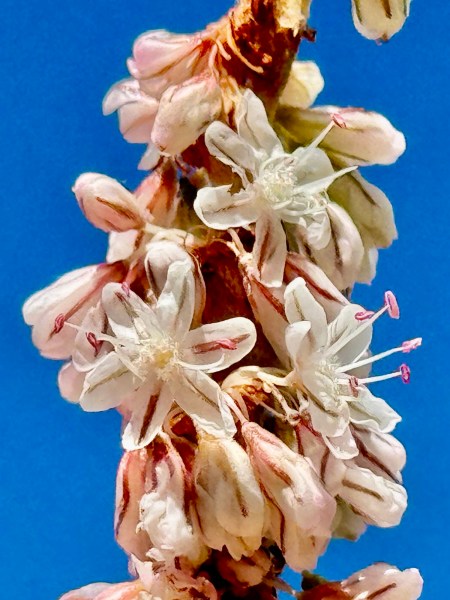
Eriogonum racemosa (redroot buckwheat—family Polygonaceae).

We drove south towards DeMotte Campground on Hwy 67, but much of the landscape was complete devastation due to the fires and no access was allowed beyond Kaibab Lodge. It was depressing to see the immense scale of destruction and loss of natural resources, but as one forest worker that Mike talked to put it, “It’s just trees, and he didn’t have to call anybody’s family [i.e., there was no loss of life].” We then drove back down past my second trap location where we had collected earlier in the day to see if we could find better stands of Gutierrezia sarothrae (broom snakeweed) on which to look for more Crossidius discoideus (still represented in the area by the single individual Mike had collected earlier). We drove through even more complete and utter destruction but eventually found undamaged areas at about 6600’ elevation. Not only was there G. sarothrae in bloom, but also Chrysothamnus visicidiorus (green rabbitbrush) and Ericameria nauseosa (rubber rabbitbrush)—all three species serving as hosts for various Crossidius and providing a perfect scenario for comparing and contrasting the sometimes-tricky-to-identify plants! The promise of Crossidius, however, would not be realized, and after an hour of searching—finding only a lone weevil on the flowers of E. nauseosa—did I finally admit defeat and concede that Crossidius from this after would have to come some other time.

Inflorescences of Gutierrezia sarothrae (left), Chrysothamnus viscidiflorus (middle), and Ericameria nauseosa (right). Note the distinct ray florets of G. sarothrae and blue-green leaves of E. nauseosa.

I hadn’t planned to do my customary nighttime walk this evening—my motivation waning after the less than meager success of the previous night, continuing relative absence of beetle life I’d seen during the day, and temps now dropping towards the 50s. A cute but shy Uinta chipmunk in our campsite captured my photographic interest as we relaxed, and the setting sun turned the clouds a stunning pink!

An Uinta chipmunk (Neotamias umbrinus) climbs a Ponderosa pine to stay as far from my camera as possible!

However, as night fell the siren song of the nighttime walk began singing its tune and I was unable to resist.

The setting sun turns the clouds an exceptional pink.

It turned out to be a more successful night than I’d expected—I found a small species of tenebrionid [Edit 10/1/25: Eleodes pimelioides] on the rocks surrounding the campsite, and there turned out to be dozens of the little buggers crawling though the pine duff in the campground.


Eleodes pimelioides (family Tenebrionidae) in alpine coniferous forest at night.

Nothing else was seen, however, and since tomorrow would be a long travel day I called it an early night.


Day 9

On a mostly travel day, we tried to take a big bite out of the many miles that still separate us from St. Louis, where we planned to be in three days time. We got another look at the devastation east of Jacob Lake before reaching the dramatic drop off the Kaibab Plateau and down into the Vermilion Cliffs National Monument—their massive red bluffs accompanying us all the way to Mojave Canyon. Just south of there as the highway climbed up and out of the valley, we made a quick stop to remove excess clothing (having gone from high elevation to low), and alongside the road I spotted a Crossidius pulchellus on the flowers of Gutierrezia sarothrae (broom snakeweed). This is the furthest southwest I have collected this species, and I was tempted to continue looking to see if I could find the other G. sarothrae associate—C. discoideus—as well. We still had a long drive ahead of us, however (destination Mills Rim Campground in northeastern New Mexico), so I resisted temptation and we continued the drive.

The Vermilion Cliffs, stunning as they were, still weren’t the highlight of the drive. That honor would come from the moonscape formations along Hwy 89 as it followed the Echo Cliffs and then turned east onto Hwy 160 towards Tuba City. We then passed through a series of stunning plateaus and drops on Hwy 264 as it passed through the Navajo and Hopi Reservations. One abandoned house as we dropped down off the Ganado Mesa was especially picture-worthy.

Abandoned home on the Ganado Plateau near Kykotsmovi Village, Arizona.

Eventually we crossed the state line at Picture Rocks into New Mexico, and, suddenly, the landscape seemed more “tame” and less hostile. I don’t normally like interstates, and the stretch of I-40 to Albuquerque did nothing to change my opinion of them, but I must admit that I-25 north towards Santa Fe was among the most picturesque I have ever seen. Eventually, we left the mountains and found ourselves once again on the western edge of the Great Plains—its vast featureless expanse a true contrast to the landscape we had witnessed throughout most of the day. This apparent homogeneity, however, is misleading—tucked away in places unknown to most are some remarkable natural areas, and Mills Rim is one such place. We arrived after dark, so the explorations of its hidden charms would have to wait until the next day, but after getting camp set up I did a short nighttime walk to see what was out and about.
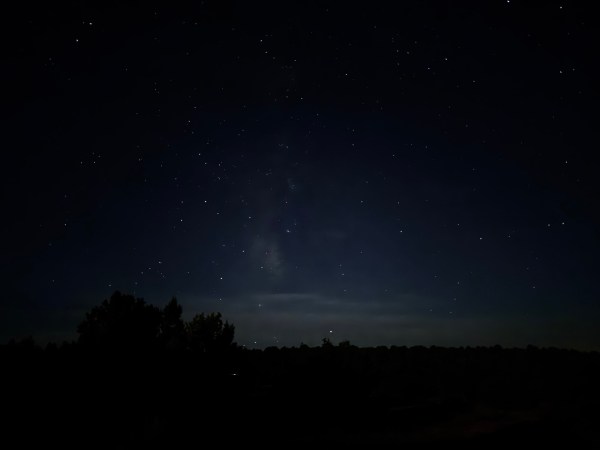
Night sky at Mills Rim Campground, Harding Co., northeastern New Mexico.

Only one beetle, Stenomorpha sp. (family Tenebrionidae) ambling across the ground, was seen.
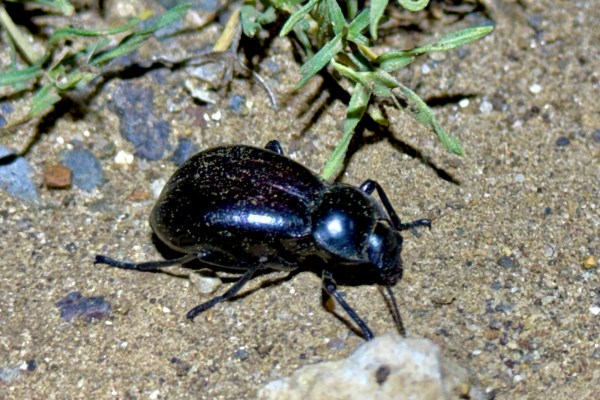
Many plants in bloom were also seen however, so I went to bed optimistic about my prospects for finding beetles the next day.


Day 10

Mosquitoes were bad during the previous night, and they were bad again the following morning, prompting liberal use of repellent to a much greater degree than I am used to. At the same time, the presence of mosquitoes indicates abundant moisture in an area, and it was with that optimism that I set about searching for jewel beetles, longhorned beetles, tiger beetles, and whatever other insects could catch my eye in this hidden jewel of a place. Surrounded by treeless grasslands (and preserved as the Kiowa National Grasslands), Mills Rim Campground sits at the edge of Mills Canyon—a chasm in the landscape at the edge of a plateau bordering the foothills of the Rocky Mountains. Firmly embedded in the Great Plains, the juniper/pine/oak woodland at the edge of and down in the canyon features plants and animals at their easternmost extent—residents of the Rocky Mountains that have found an isolated home in the middle of the grasslands. Pinus edulis (Colorado pinyon pine), Pinus ponderosa (Ponderosa pine), Juniperus monosperma (one-seed juniper), Juniperus scopulorum (Rocky Mountain juniper), Quercus grisea (gray oak), and Quercus × undulata (wavy leaf oak) all make their homes here, hosting innumerable insect species that are normally more at home in the Rocky Mountains.

View into Mills Canyon from Mills Rim Campground.

I’ve collected here several times and recorded many different western species of beetles, but the height of the season seems to be in June and July. Mid-September, in contrast, seems to be near the tail end of the season, the numbers and diversity of beetles and other insects dropping from their highs earlier in the season. The flowers of Gutierrezia sarothrae, however, were hosting lots of insects. In addition to Crossidius pulchellus, Chauliognathus basalis, Bothrotes canalicularis, and Collops sp., Mike found numerous bee species, mostly females, collecting pollen from the flowers.
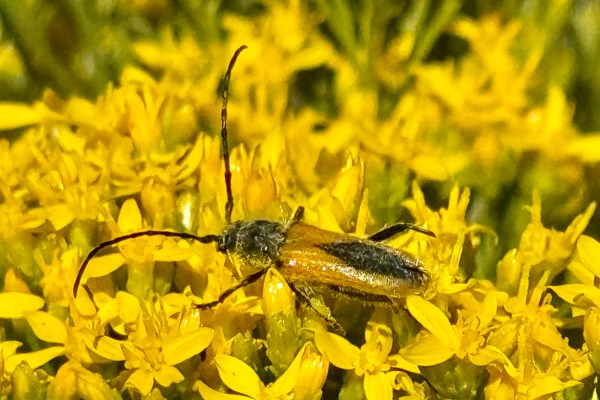
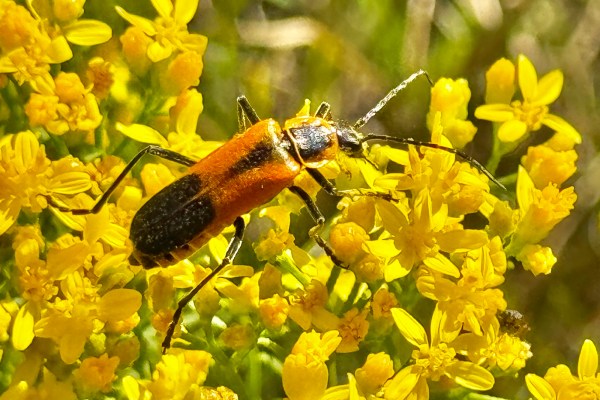
Crossidius pulchellus (family Cerambycidae) on flowers of Gutierrezia sarothrae (broom snakeweed).
Chauliognathus basalis (family Cantharidae) on flowers of Gutierrezia sarothrae (broom snakeweed).
Bothrotes canalicularis (family Tenebrionidae) on flowers of Gutierrezia sarothrae (broom snakeweed).

A couple of species of robber flies—Ospricerus sp. and Efferia sp.—were also taken in flight, presumably patrolling the flowers of G. sarothrae for bee prey.

Ospricerus sp. (family Asilidae) patrolling flowers of Gutierrezia sarothrae (broom snakeweed) for bee prey.
Nysius sp. (false chinch bugs—family Lygaeidae) on flower of Erigeron divergens (spreading fleabane).
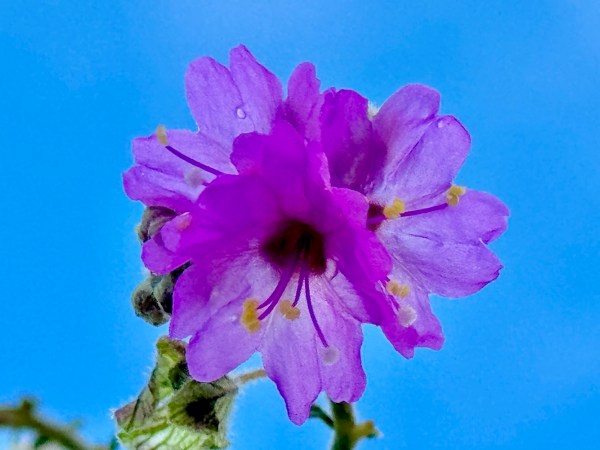
Mirabilis linearis (narrowleaf four o’clock—family Nyctaginaceae).

After a rest and rehydration break, I followed the road down Mills Canyon as it approaches the Canadian River to see if I could find Ericameria nauseosa—should I be able to, it would surely be at or near the easternmost limit of occurrence for the species in this part of New Mexico.

Mills Canyon above the Canadian River.
A bit further down Mills Canyon Road.

About half  a mile down the road I began seeing Acmaeodera rubronotata on the flowers of G. sarothrae, and I eventually secured a series of about a half dozen specimens. This is a nice record, as I found a single specimen a couple of years ago at Black Mesa in northwestern Oklahoma—a new state record and northeastern range extension, and this record helps bridge the gap between that record and the species’ more normal range of distribution across New Mexico and Arizona. Finally, nearly a mile into the canyon, I found one large blooming E. nauseosa and a smaller pre-bloom plant, but there were no Crossidius beetles on them, nor were any additional plants were seen a hundred yards or so further down the road, so I turned around.

Ericameria nauseosa (rubber rabbitbrush—family Asteraceae) along Mills Canyon Road.

On the way back out of the canyon, I collected a Calopteron sp. (family Lycidae) on senescing Melilotus alba (white clover) and photographed a female Stagmomantis limbata (Arizona mantis—family Mantidae).

Stagmomantis limbata (Arizona mantis—family Mantidae) on flowers of Gutierrezia sarothrae (broom snakeweed).

Back at camp, a couple of scarabaeoid beetles flew to the light of the lamp while we were relaxing with refreshments in hand and waiting for the coals to be ready. This suggested that maybe conditions were favorable for setting up the ultraviolet lights to attract other insects.

A final night of relaxing at camp with refreshments in hand.

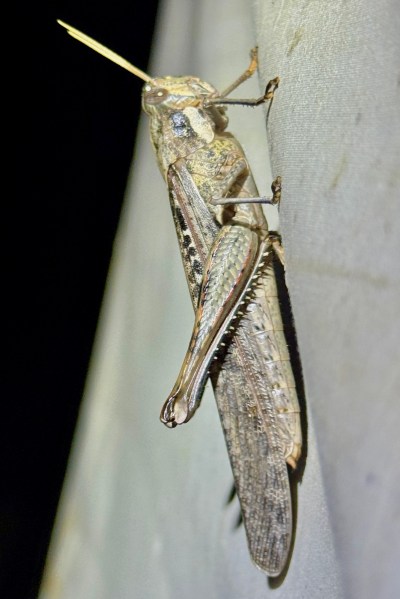
After finishing dinner, we did exactly that and saw a few interesting insects show up, but shortly after setting up the lights the wind began to kick up, the temps began to drop, and increasingly frequent gusts making further lighting impossible!
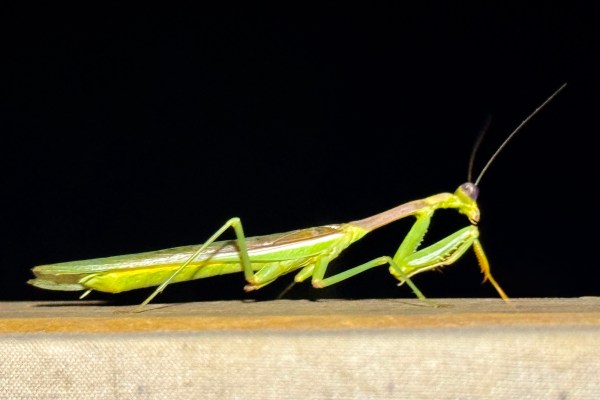
Stagmomantis limbata (Arizona mantis—family Mantidae) male attracted to ultraviolet lights.
Schistocerca nitens (gray bird grasshopper—family Acrididae) attracted to ultraviolet lights.
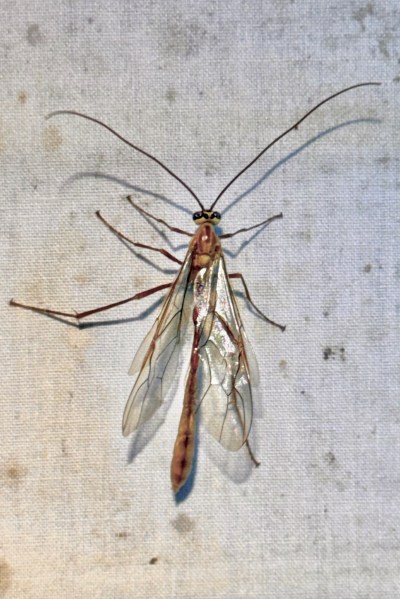
Ophion sp. (short-tailed ichneumon wasp—family Ichneumoidae) attracted to ultraviolet lights.

Day 11

It was a rather sleepless final night in the tent—winds whipped as we turned in for the night, and shortly afterwards we awoke to rain splattering our faces through the fly-less tent roof. We quick got up and put on the rain fly, then listened to light but steady rain for most of the rest of the night. By the time we got up it had mostly stopped, but cool conditions with low-hanging, fast-moving clouds caused us to quickly break camp and save coffee and breakfast for Mocks Coffee Shop in Clayton, New Mexico near the Oklahoma state line (let me tell you how difficult it was for me to drive two hours first thing in the morning without coffee!). We had wanted to make our final collecting stop at a a lot near Kenton in the Black Mesa area of extreme northwestern Oklahoma, but the forecast for the area showed only slightly warmer temperatures and very gusty winds. This would make collecting there pointless, so we instead traveled four more hours east to get in front of the cold front at another of our favorite collecting spots, Gloss Mountain State Park in Major Co.

Gloss Mountain State Park features gypsum-capped mesas atop Permian red siltstones.

I was hoping to see an attractive late-season jewel beetle—Acmaeodera macra, which I had collected here and at nearby Alabaster Caverns State Park in previous years during late September. Temps were good (well over 80°F) when we arrived but the hour was already late (near 4:00 p.m.), so we had limited time for collecting before insects would start bedding down for the evening (usually around 5:00 to 6:00 p.m. at this point in the season). Megatibicen dorsata (bush cicada) and Neotibicen aurífera (prairie cicada) males were still singing abundantly, filling the air with their distinctive songs (video of M. dorsata male singing here).
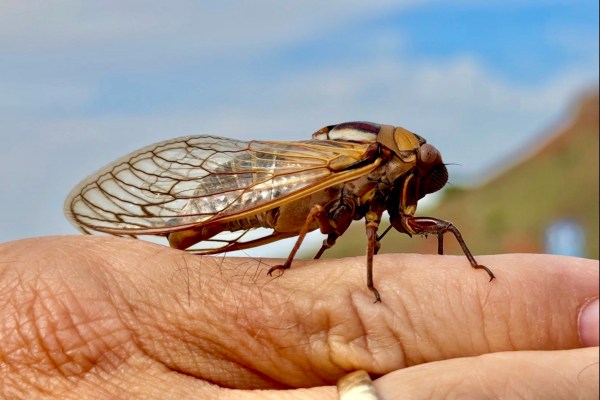
Megatibicen dorsata (bush cicada—family Cicadidae) male singing on my hand after being taken from the stem of Helianthus annuus (annual sunflower).

Helianthus annuus (annual sunflower) and Grindelia ciliata (wax goldenweed) were blooming prolifically, off the flowers of which Mike collected a fair diversity of bees. I’d hoped to find beetles on the flowers as well, but they were limited almost exclusively to Chauliognathus limbicollis.

Chauliognathus limbicollis (family Cantharidae) on flower of Grindelia ciliata (wax goldenweed).

I did collect a male/female pair of Tetraopes femoratus (red-femured milkweed borer) on the seed pod of Asclepias engelmanniana (Engelmann’s milkweed) and photographed the striking and beautiful caterpillar of Schinia gaurae (clouded crimson moth) on the stem of Oenethera glaucifolia (false gaura).

Tetraopes femoratus (red-femured milkweed borer—family Cerambycidae) on seed pod of Asclepias engelmanniana (Engelmann’s milkweed).
Schinia gaurae (clouded crimson moth—family Noctuidae) on the stem of Oenethera glaucifolia (false gaura).

After that, I went up on top of the main mesa where I expected A. macra to occur. Heterotheca stenophylla (stiffleaf false goldenaster), on the flowers of which I collected A. macra in previous years, was blooming abundantly, but intense searching their flowers produced no beetles. I also noticed that Gutierrezia sarothrae (broom snakeweed), abundant in the area as well, was in only the earliest stages of bloom, suggesting to me that it might still be a bit too early for the jewel beetles to be out. By the time the 6:00 hour arrived, insect activity was noticeably diminished, and we wrapped up this, our final, collecting stop of the trip.

No camping is available at Gloss Mountain State Park, so we knocked out another hour and a half of travel by driving to Ponca City in north-central Oklahoma and taking a hotel there. For the first time since we left, we enjoyed dinner at a restaurant (fried catfish for me!), a hot shower, and a real bed!


Day 12

The following morning, we were surprised to learn that the only coffee shops in town were Starbuck’s and drive-throughs. This just wasn’t going to cut it for us on our final travel day, so we drove 15 minutes north to the small town of Newkirk and enjoyed great coffee, breakfast sandwiches, and scones at “Savvy Cactus” (Newkirk Mercantile Boutique & Espresso Bar). (The coffee was good enough that I bought a bag of their coffee!)

“Savvy Cactus” Newkirk Mercantile Boutique & Espresso Bar in Newkirk, Oklahoma.

The rest of the drive back to St. Louis was spent reflecting on the many experiences we’d just had and synthesizing the new knowledge while enjoying the landscape as it skirted the southern edge of the Flint Hills of Kansas and traversed the familiar hills and dales of our beloved Missouri Ozarks—the end of a 3,931-mile trip!

62.3 mph average for the trip.

©️ Ted C. MacRae 2025
2018 New Mexico/Texas Insect Collecting Trip “iReport”

This is the fifth in a series of Collecting Trip “iReports”—so named because I’ve illustrated them exclusively with iPhone photographs (see previous articles for 2013 Oklahoma2013 Great Basin, 2014 Great Plains, and 2015 Texas). Note that I continue to use my “big” camera for specific insect targets—and these will be featured from time to time on this site. However, I use my iPhone camera much more during these trips for general photography to document habitats, landscapes, and miscellaneous subjects because it is so small and handy and because it is also capable of capturing reasonably good photographs (see this post for tips on making the most of the iPhone camera’s capabilities). This allows me to spend more time looking for and collecting insects—usually my primary objective on these trips! Collectively, these iPhone photos and the short narratives accompanying them form a nice trip synopsis when assembled into a single post.

This report covers a collecting trip I made with Jeff Huether from June 2–9, 2018 to southeastern New Mexico and west Texas. I’ve dabbled in this area before, primarily just a quick stop at Mescalero Sand Dunes many years ago, but not specifically targeted this area for any systematic collecting. Thus, most of the locations that we visited were new to me, which automatically means that I would find at least a few things of interest—and more probably a lot (as long as the insects are active). We had great success at many localities, having found areas where sufficient rain had occurred to trigger insect emergence despite the drought that was plaguing much of the area. Highlights were the areas along Hwy 380 between San Antonio and Bingham, the Mescalero Sand Dunes, and the dunes near Kermit, Texas. I haven’t yet tallied the number of species collected, as much of the material is still waiting to be mounted and identified. However, I estimate that it is in the neighborhood of about three dozen buprestids and maybe half that many cerambycids, including some quite charismatic species that I’d not collected previously (e.g., Prionus arenarius and Tragidion armatum).

Stay tuned, because I made a second insect collecting trip during 2018, this one with Art Evans to southeast Arizona during late July and early August.


Day 1 – Sandia Mountains, New Mexico
We flew into Albuquerque this afternoon and, after getting the car, supplies, and something to eat we came up to Sandia Crest Recreation Area looking for Cicindela longilabris (long-lipped tiger beetle). This was the first place I stopped on the first day of the trip for the first species I wanted to look for, and I found it in the first five minutes I was here!

View from near the summit of Sandia Mountain.

We stopped at the Capulin Picnic Ground on the way down the mountain. There were some oaks with fresh-looking foliage that I beat – no Buprestidae but a nice series of a treehopper (Telamonthe?) and a few odds and ends. There was also Robinia off which I beat a series of what is surely Agrilus egenus.

Penstemon sp. ID by George Yatskievych.

Day 2 – Walking Sands Rest Area, New Mexico
Quick stop to check the lights – later in the season Jeff has collected Prionus palparis here, but this time we saw nothing. Also checked the nearby vegetation, there was Dalea in bloom but no beetles on the flowers.

Hwy 380 between San Antonio & Bingham, New Mexico
We saw a few things in bloom at the Rio Grande bridge crossing so decided to stop. I took a fair series of what must be Acmaeodera mixta off of the Thelesperma flowers (along with a few mordellids for Enrico and one meloid for Jeff). Otherwise not much activity at the spot.

Bone dry Rio Grande!

There were some cool looking red sand dunes on Hwy 380 east of San Antonio, so we stopped to see if there might be any tiger beetles. There weren’t any, but I found yucca stems infested with cerambycid larvae, likely Tragidion. I collected 6–8 stems to bring back and try to rear out the adults. Jeff also found a single Chrysobothris sp. on sage, otherwise we saw few beetles.

Going east on Hwy 380 we went into an area of higher elevation with junipers. We stopped to check the Thelosperma flowers, but there were no bups on them. I collected a few noisy cicadas and some Acmaeodera quadrivittatoides on Opuntia flowers. I then started beating the junipers, however, and got a fair series of a small green Gyascutus plus two tiny Chrysobothris. They were extremely difficult to collect – winds were very stiff and the beetles were very active. I probably lost as many as I collected. To finish off I found a mating pair of Moneilema sp. on cholla.

Acmaeodera quadrivittatoides in a flower of Opuntia sp.

Yours truly standing next to a cholla (Opuntia imbricata).

In addition the the Tragidion larvae that I collected two stops back, Jeff saw one adult at the previous stop. So, when we saw thick stands of yucca along the roadsides just a few miles down the road we stopped to take a look. They were out and not uncommon on the flower stalks and down in the basal rosettes. I collected about a dozen of them and also another Gyascutus.

A Tragidion female on a yucca flower stalk.
Tragidion sp. mating pair on yucca flower stalk.

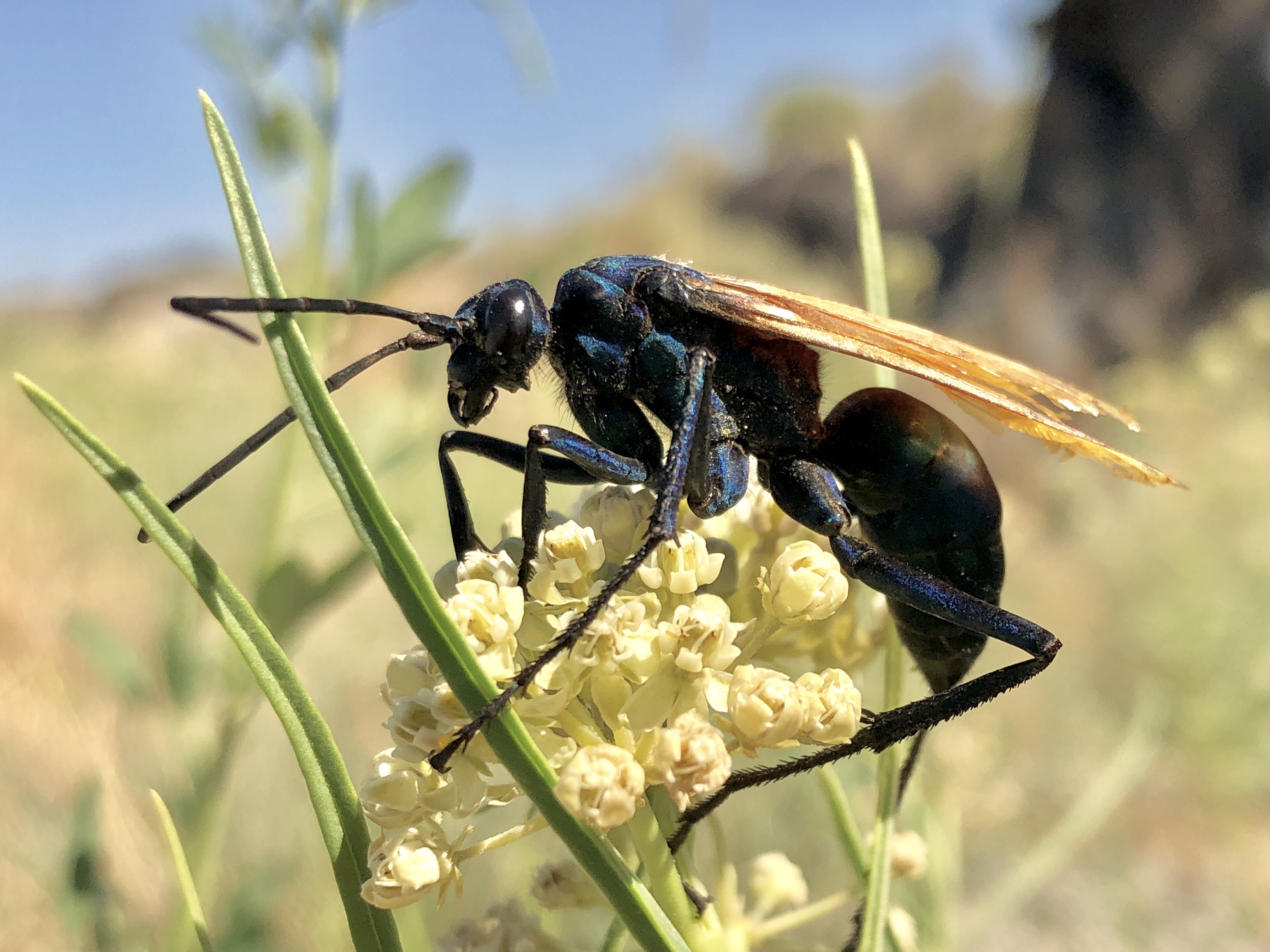
Tarantula hawk (family Pompilidae) on yucca flower stalk. This must be a mimicry model for Tragidion.

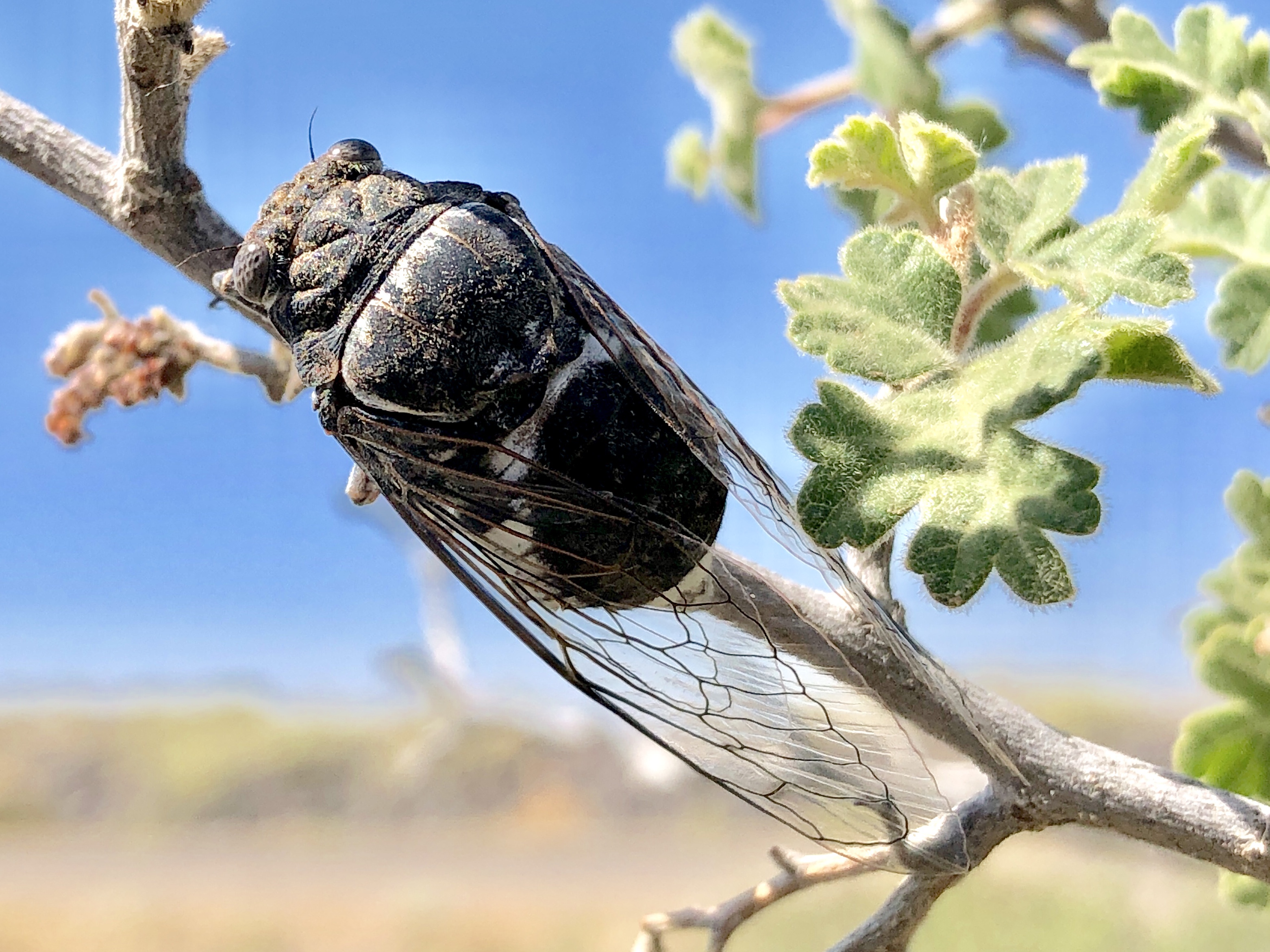
I believe this is a cactus dodger cicada (Cacama sp.).

At the last stop we noticed a lot of emergency vehicles rushing to the east. Just a couple of miles down the road we ran into an accident blockade. Since we were stopped I was tempted to look at the rock shop, but then I started looking at the cholla and found several Moneilema sp. adults on the plants.

Walking Sands Rest Area, New Mexico
We came back up to the rest stop because of the dunes – there are Prionus spp. that live in the dunes, so we put out some pheromone to see if we could attract the males which fly at dusk and early nighttime. In the meantime we walked around looking for nocturnally active beetles – found a few skin beetles (Omorgus sp.) feeding in dried dog poop and a huge tenebrionid (Eleodes sp.) strangely perched up in a bush. Also photographed a cool little sun spider (Solifugida). When we went back to check the pheromone there was one male Prionus arenarius running around under the lure!

Skin beetle (Omorgus nodosus) feeding on dried dog poop at night. ID by Bill Warner.

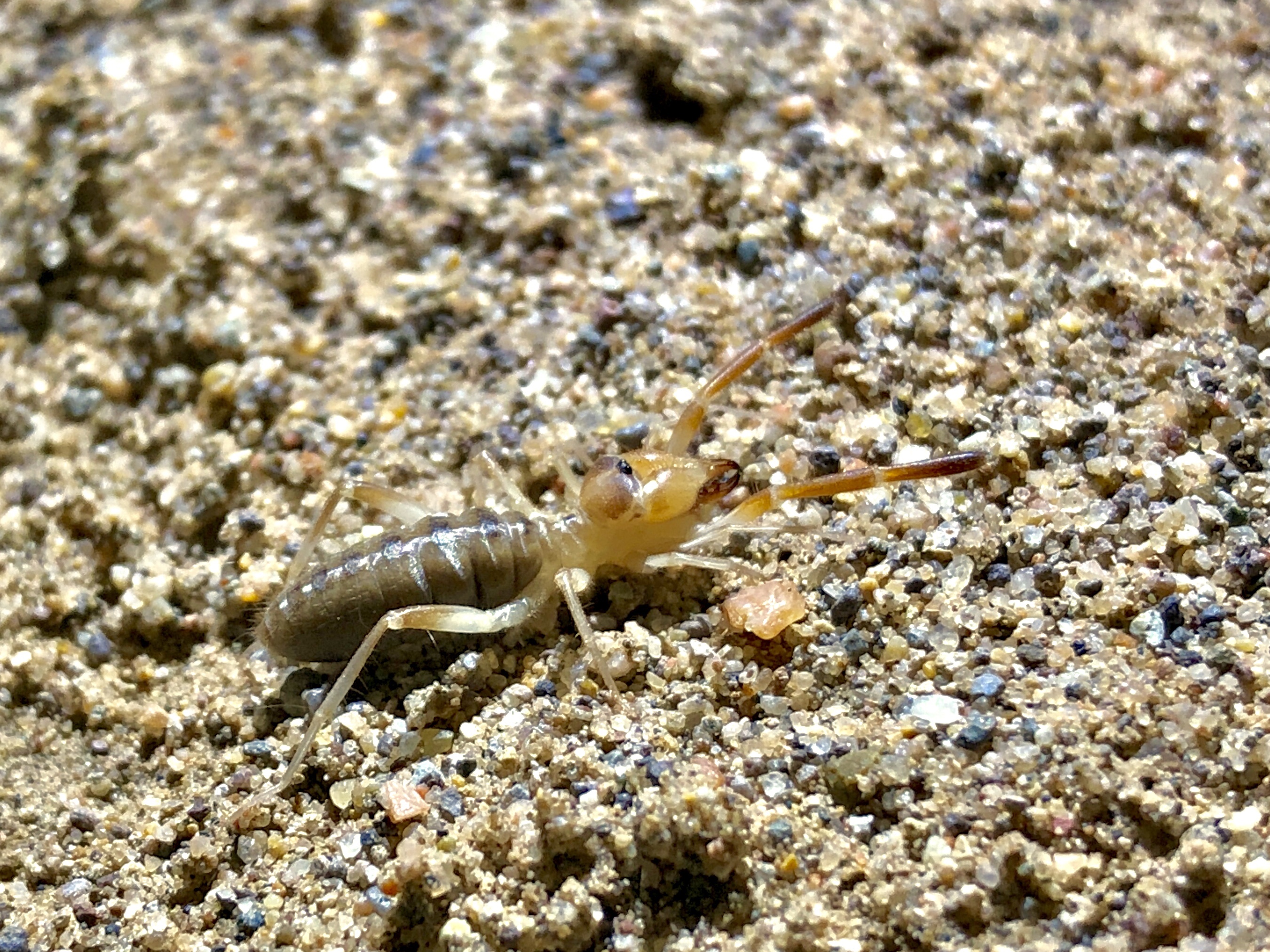
A sun spider (Solifugida) pauses briefly from its frantic search for prey.

Day 3 – Valley of Fire National Recreation Area, New Mexico
We came over the hill and saw a huge black area in the valley below. I thought it was just an area of thick woody vegetation, but it was actually a lava field! Very cool. There were tons of cicadas, I think also cactus dodgers (Cacama spp.) but look different from the one we saw yesterday. I beat a lot of Celtis and only got one Chrysobothris sp. (looks like analis), and there was nothing on the junipers. We also didn’t see any Moneilema on the abundant cholla. I did catch two Acmaeodera mixta on an unidentified white flower. I think yesterday’s rains must have missed this area!

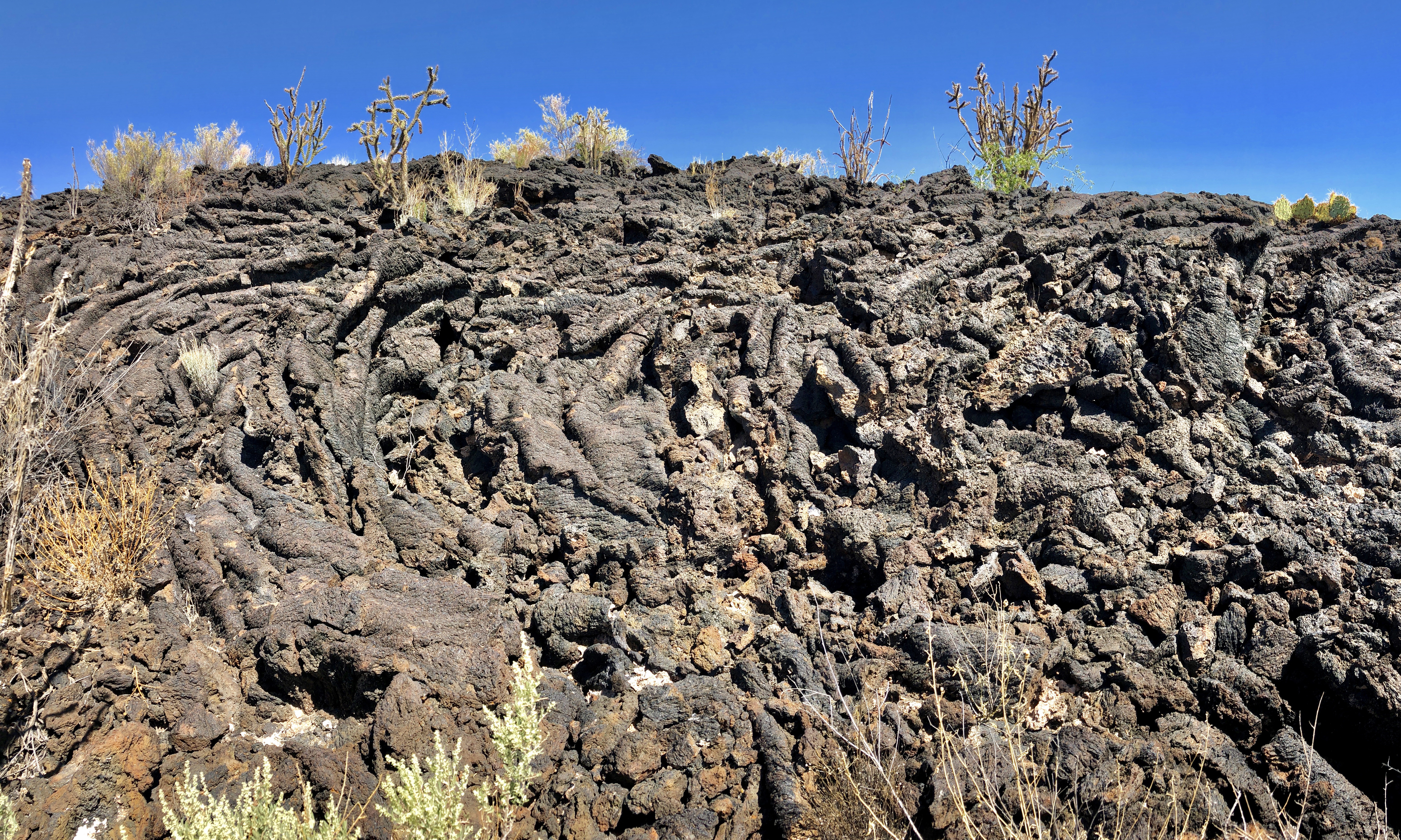
Malpais Lava Beds.

A tarantula hawk (family Pompilidae) on flowers of milkweed (Asclepias sp.).

I believe this is another species of cactus dodger cicada (Cacama sp.).

Malpais Lava Beds.

Lead-footed bugs (family Coreidae) on cholla cactus (Opuntia imbricata).
Malpais Lava Beds.
Cactus dodger cicada (Cacama sp.)?
Male cactus dodger (Cacama sp.) on cholla cactus in mid-song.

We drove a couple miles down the road and made just a quick stop to check flowers along the roadsides. No beetles seen – seems to be super dry, but I did photograph one of the tiniest butterflies (something in the family Lycaenidae) I’ve ever seen.

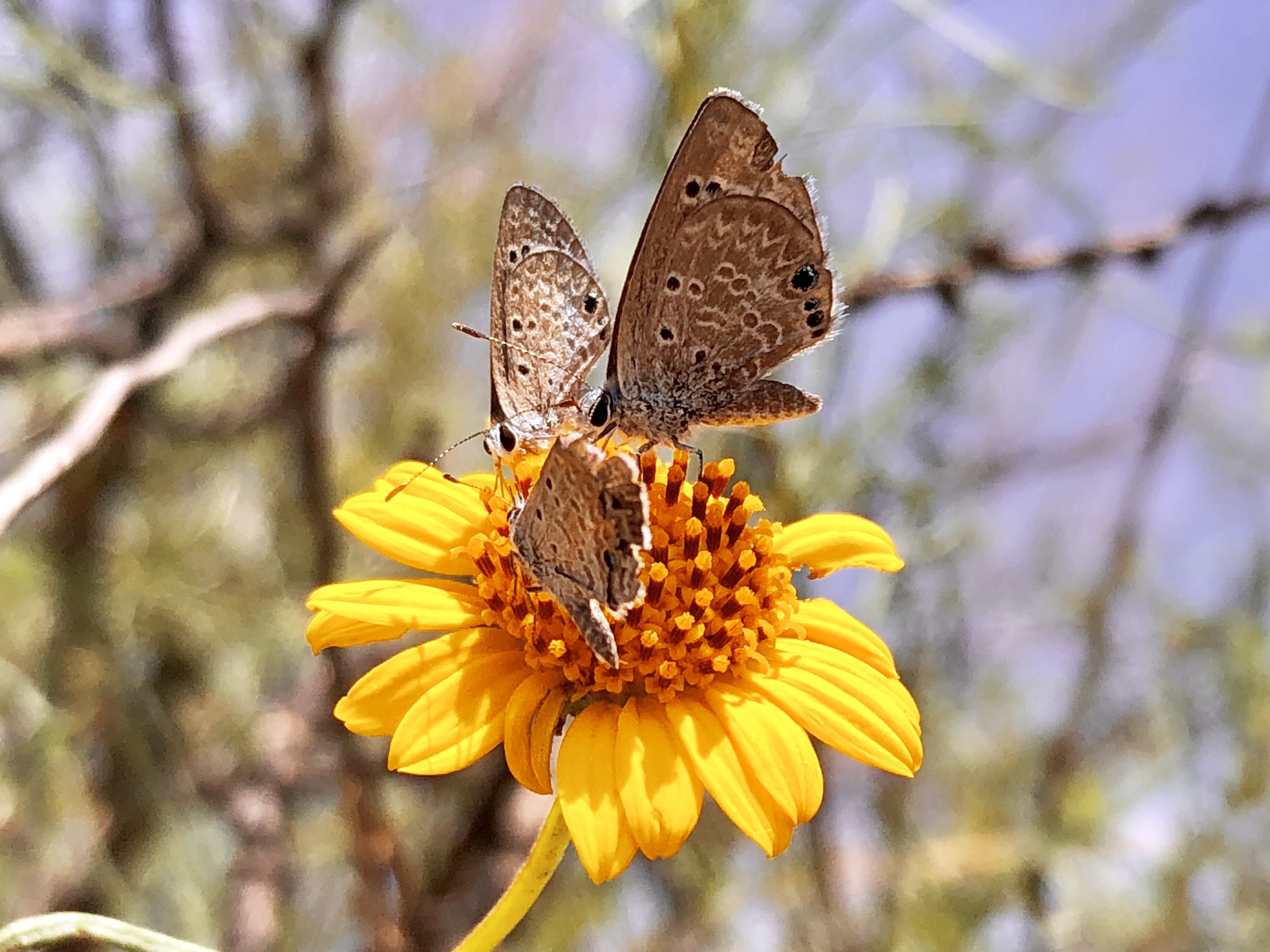
Western pygmy blue (Brephidium exilis). ID by Doug Taron.

Sierra Blanca Mountains, New Mexico
Jeff wanted to look for an Epicauta up here, but the whole drive up the mountain we could only comment on how dry it was and how extensively the area had burned. I only found two wood borers – an Anthaxia (Melanthaxia) and a lepturine cerambycid, both on iris flowers. We did find the Epicauta though, also on iris flowers.

Atop the Sierra Blanca.

Perhaps Erysimum capitatum (Brassicaceae). ID suggested by Erik Emanuelsson.

Flower longhorn (subfamily Lepturinae) on flower of iris.

Vicinity Sunset, New Mexico
There were some mallow in bloom along the roadsides, so we stopped to see if there were any Acmaeodera on them. There weren’t, just a few meloids that Jeff was interested in. I found a a single Euphoria kerni on a flower of Acacia greggii and, of course, large numbers of them on thistle flowers. The area seems to have gotten some rain, but not much activity to speak of yet.

Euphoria kernii in their typical “buried-butt-upwards” post on a thistle flowerhead.

Mescalero Sand Dunes, New Mexico
This area got rain last night, so we suspected there would be a lot of insect activity, and we were right! The place was alive when we got here at ~6 pm. I walked the area while we waited for dusk to set out pheromone. I collected a series of Enoclerus zonatus off of yucca blooms, beat an Actenodes sp. (something new for me), a Chrysobothris octocola, and a nice series of treehoppers off of mesquite, and found three Batyle suturalis ssp. on an unidentified yellow comp.

Mescalero Sands Recreation Area.

A skin beetle (Omorgus nodosus) makes tracks in the sand.

Enoclerus spinolae on yucca.

Another Enoclerus spinolae individual on yucca. Note the larger spots on this one compared to the other, an example of intraspecific variation.

As the sun began to sink lower in the sky, I hiked around to the backside of the dunes and then bushwhacked across them to get the perfect perspective for photographs when the sun hit the horizon – spectacular sunset!

Sunset on the dune.

What a sunset!

I’m happier than I look! 

By the time I got back to the car, Jeff had already placed three lures out, so we started making the rounds and found at least one or two Prionus arenarius males running frantically in circles under each one. At the second lure, I started searching the area nearby and found a female walking on the ground! (Females are very rarely encountered, and it seems a little more than coincidental to me that for each species of Prionus, whenever we have collected good numbers of males with lures we have also found at least one or a few females in the same area – maybe cheaters [in the ecological sense]?).

As we made the rounds we picked up an amazing diversity of tenebrionids and a few carabids walking in the sand, and we finished off by picking up Jeff’s light trap, which had attracted one more Prionus male and a very light-colored Polyphylla sp. male.

Incredible huge blue spider on the dune at night.

Day 4—Mescalero Sand Dunes, New Mexico

We noticed a stand of soapberry (Sapindus drumondii) along the sides of the road just west of the entrance to Mescalero Sands Recreation Area last night, and I immediately thought of Agrilus sapindi, so this morning on our our way to the dunes we stopped by. I started beating the flowering branches of the larger soapberry trees but wasn’t really getting anything. Then I noticed an A. sapindi flying to a low non-flowering plant, so I caught it and resumed beating – now with more gusto knowing they were here. I still wasn’t getting anything and, again, saw another adult fly and land on a low non-flowering plant. Lesson learned – I started sweeping the low plants and started getting them. I worked all five stands in the area and got about 3 dozen adults, plus a few A. ornatulus, one A. limpiae, and spectacular Neoclytus.

After finishing with the soapberry, Jeff had noticed some tiny Acmaeodera on an unidentified white-flowered composite. We started searching in earnest and collected several dozen adults. I’m not sure what they are, but they are tiny and vittate (maybe A. quadrivittatoides). We also did a lot of sweeping of the short shrubby oak also and came up with a couple of Brachys. Overall a great morning/early afternoon in the field!

The only thing cooler than this abandoned homestead was the squawking ravens hanging out on it!

Soapberry (Sapindus drummondii) stands along Hwy 380 – host for Agrilus sapindi.

Host for unidentified Acmaeodera sp.

We next went into the Recreation Area proper to each lunch, after which we explored the rest of the area accessible by vehicle and saw a stand of cottonwood back in the dunes. We got out to see if there might be any Buprestidae on them (e.g., Poecilonota), but they were devoid of insects. The midday heat on the dunes was extreme! I did find, however, a single Prionus elytron lying on the sand beneath the cottonwoods, so we know they are further back in the dunes as well.

Mescalero Sands Recreation Area.

Mescalero Sands Recreation Area.

We worked the variety of blooming plants in the vicinity of the entrance. I collected ~22 of the small Acmaeodera that were on the white-flowered plant at the soapberry spot on two blossoms of a single yellow-flowered pad Opuntia sp., a couple of Acmaeodera spp. on Gaillardia sp. flowers, a few more Acmaeodera spp. on Prosopis, and several Acmaeodera mixta on another as-yet-unidentified white flower. It was hotter than bejesus we later learned 103°F!) – I had wanted to check out one more stand of soapberry at the entrance, but we were exhausted and dehydrated and had to quit!

Some kind of wasp on some kind of flower.

There are four separate bird nests in the cholla plant – a veritable avian apartment!

Cholla (Opuntia imbricata) blossom.

Vicinity Hobbs, New Mexico
We got a hotel in Hobbs and grabbed a sandwich for dinner, then went out west of town to see if we could find some good habitat for evening collecting. We found a spot of open rangeland about 8–9 miles west of town, set out the pheromone lures, and began beating the mesquite (Prosopis glandulosa). We had high hopes because there was still standing water, meaning that the area had gotten good rains on Sunday night. Boy were we correct! Beating the mesquite was amazing. For buprestids I got 10 individuals of an Actenodes sp., 4 individuals of a Paratyndaris sp., 4 Chrysobothris spp., 4 Acmaeodera spp., and 1 Agrilus sp. I also got several tiny cicadas, a couple treehopper species, and a few clerids and other odds and ends. We setup a blacklight and the scarabs were quite diverse, but the only thing I took was a tiger beetle (Cylindera lemniscata). I also picked up a Phyllophaga cribrosa and a tenebrionid walking on the ground at night. No Prionus came to the lures, any my searches of the ground at night turned up no Amblycheila.
Tiny scarab beetles in the genus Diplotaxis congregate on low plants to “catch” pheromone trails in search of mates.

Giant millipedes (genus Orthoporus) were common at night, a sure sign of recent rains. ID by Derek Hennen.

Ted of Arabia and Jeff.

Day 5—Sand Dunes near Kermit, Texas
We stopped just outside the Kermit Sand Dunes to beat the mesquite (Prosopis glandulosa) to see what might be out. I collected 8 species of Buprestidae: nice series of an Acmaeoderopsis (hoping A. prosopis), 1 sp. Actenodes, 2 spp. Chrysobothris, 1 sp. Paratyndaris, 1 sp. Agrilus, and 2 Acmaeodera spp. We eventually gave up – the heat had not only wilted us, but the Acmaeoderopsis were flying away immediately upon hitting the sheet.

Updated field pic (the last one was taken in 1999!).

We drove a little further towards the heart of the dunes and found a spot where there were some blowouts and classic sand flora. Immediately upon starting out we noticed Acmaeodera mixta adults flying around commonly, so I swept through the vegetation a bit and collected a representative series. On Oenethera sp. flowers I found a single A. immaculata and later several A. mixta and a very small Acmaeodera (looked like the one we collected yesterday at Mescalero). In one spot I found a few plants of an unidentified yellow composite with a few more A. mixta, and on Baccharis I found one A. obtusa(?) along with A. mixta. Coming back to the car Jeff and I noticed huge numbers of A. immaculata flying to an unidentified shrub, from which we each swept a nice series. Eventually the heat (103°F) again overwhelmed us, and we had to get in the car, eat, and cool down for a bit on the way to another spot.

The dunes are part of an extensive series of dunes stretching from West Texas through southeastern New Mexico.

Acmaeodera mixta on flower of an unidentified yellow composite.

We returned to an area with stands of soapberry (Sapindus drummondii) that we had seen when we first arrived in the area. I swept all of the small plants on the east side of the highway and got a single Agrilus sapindi – not nearly as abundant as we had seen at Mescalero Sands.

On the west side of the highway there were some larger mesquite (Prosopis glandulosa). I found one Chrysobothris octocola on the trunk, then Jeff and I noticed Acmaeoderopsis flying to the tips of the high branches. I got my aerial net and just started betting them as they flew in while we stood and watched. I caught them from several trees, but a majority from a single tree. That worked much better than beating this morning – I probably lost as many as I collected because they flew so quickly upon hitting the sheet.

Underneath one large mesquite I found several prionid elytra – couldn’t tell if they were Prionus or Derobrachus, but then I noticed burrows in the ground very similar to those we saw for Prionus integer in Colorado (see photo). We dug a few out but found nothing. Something to keep in mind.

The high plains of west Texas.

Burrows like this one look suspiciously like those of Prionus integer in Colorado – did another Prionus make this one?

We returned to the dunes for some evening collecting. I beat the two large mesquite (Prosopis glandulosa) trees by the parking area and got an Actenodes and a few Chrysobothris octocola – no Acmaeoderopsis, I guess they hide elsewhere for the night. Once dusk fell we began checking the pheromones and light – only a single male Prionus arenarius came to the pheromone, but we got several individuals of two Polyphylla spp. (P. monahansensis – larger, and P. pottsorum – smaller) at the light. Walking around the dunes at night there were significantly fewer tenebrionids and other insects walking around, but I did pick up two cool “concave” tenebs and a Pasimachus ground beetle.

I’ve never seen a mourning dove make a nest in the ground before.
I always thought these oil pumps looked like dinosaurs bobbing up and down.

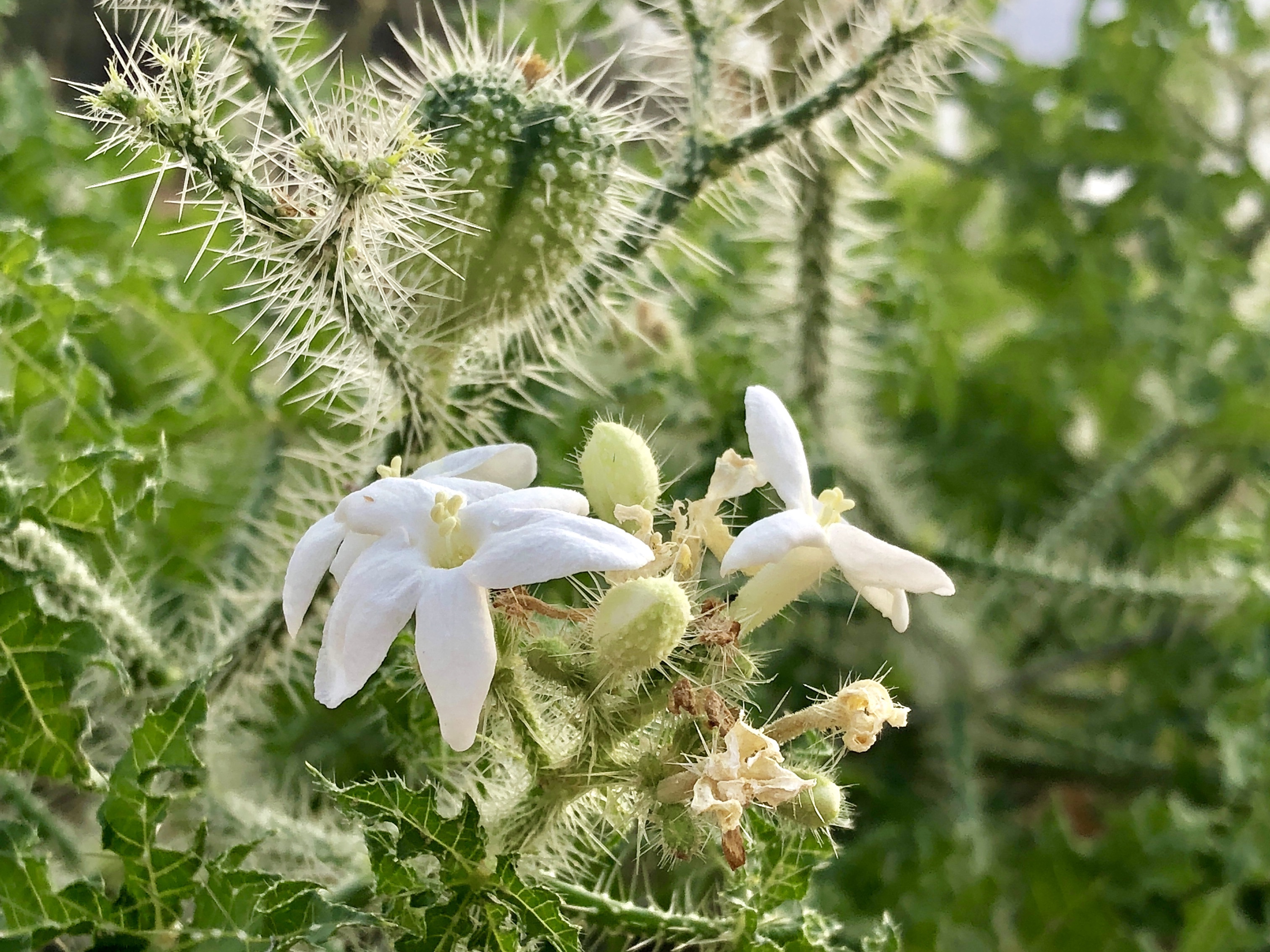
Bull nettle (Cnidoscolus texanus)—something tells me I should not touch this plant!

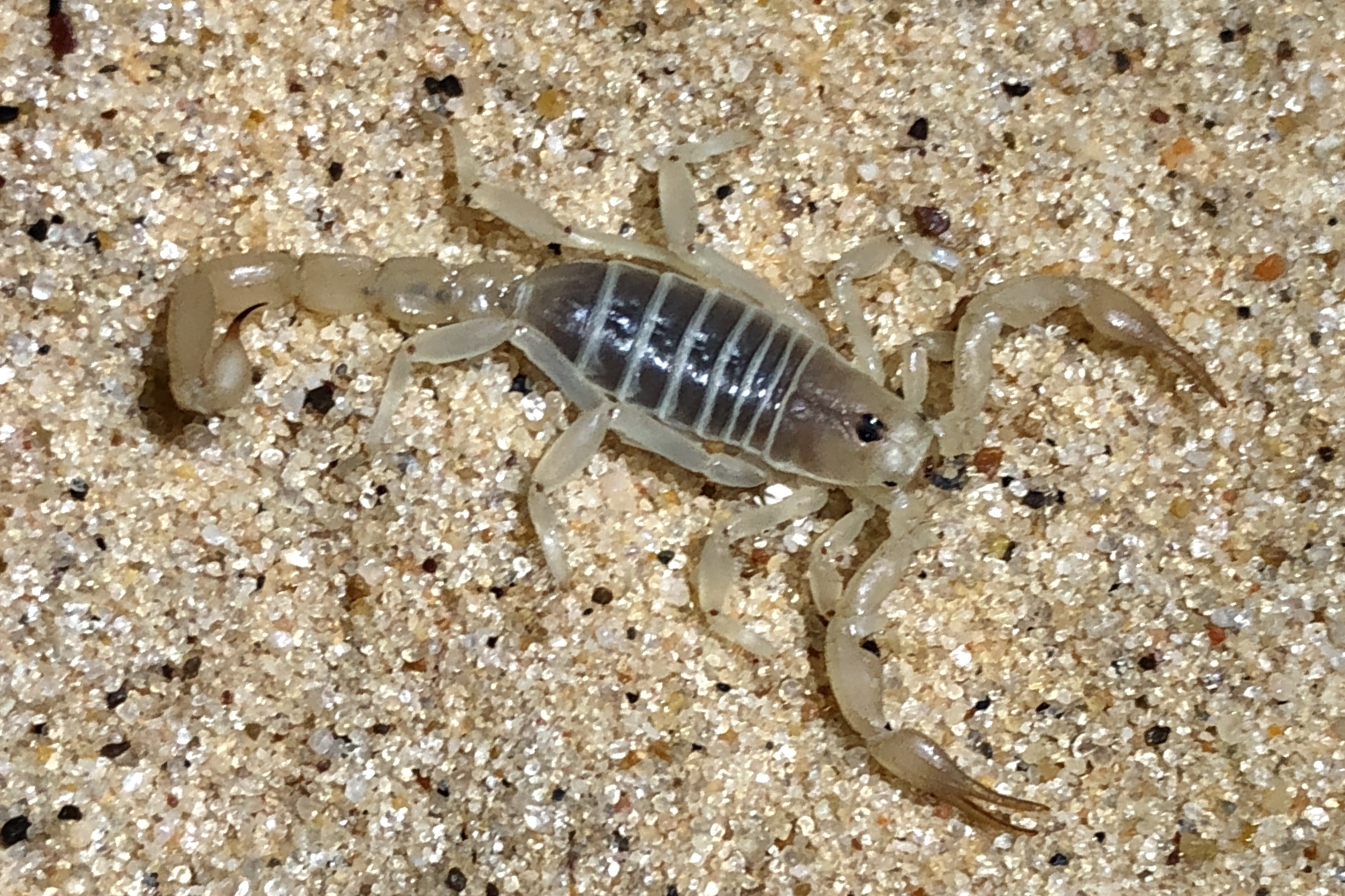
A very small (<1.5” in length) scorpion visits the light looking for a meal.

Face-to-face with a scorpion!

Day 6—I-10 Rest Area at mile marker 162, Texas
Just a quick stop to use the facilities, but I couldn’t resist the temptation to photograph these three Reakirts blues all on one flower (a fourth flew away before I could snap).

Reakirts blue (Echinargus isola). ID by Doug Taron.

San Felipe Park, near Fabens, Texas
We took a chance on going further west to the dunes near Fabens, since we’ve had such good luck with rains in the area. However, when we got here and started looking around it was apparent that nothing was happening here – dry, dry, dry with temps just over 100°F. I saw a few insects but only a single buprestid – Acmaeodera quadrivittatoides, and I missed it! We decided to cut bait and head back east and north towards Carlsbad – we should be able to get to the area in time for some late afternoon and evening collecting. You can’t win ‘em all!

This roadrunner was rather annoyed with us for intruding in his spot of shade under a Siberian elm.

A broad-nosed weevil.

A mating pair of walkingsticks. Note the great size difference between the male (smaller) and female (larger).

I think I found our retirement home!

Vicinity Carlsbad, New Mexico
After getting lost in the Fabens Sand Dunes and then a whole lot of driving back east into New Mexico, we arrived in Carlsbad with just enough time to grab a sandwich and head out to some promising habitat we’d noticed on the way in for some evening/night collecting.

The area contained a ribbon of woodland with mesquite (Prosopis glandulosa), black acacia (Acacia rigida), and catclaw acacia (A. greggii). I beat only one tiny Chrysobothris sp. off the mesquite, but off the black acacia I beat three individuals (four actually, one got away) of a large, chunky Chrysobothris sp. that I do not recognize, plus an undetermined cerambycid and a few clytrines. Actually, before I collected the Chrysobothris I had given up on the lack acacia until I was walking by one plant and saw the first one sitting on a branch. I popped it in the vial and started beating the other plants in the area with renewed enthusiasm the find the other two (three!).

We setup the lights and the pheromones, but not much came to the former and nothing to the latter (expected, since there was no sand habitat nearby). The sunset beforehand, however, was magnificent, and I did find a couple of miscellaneous beetles walking around at night.


Day 7—vicinity Loco Hills, New Mexico
We saw an area with stands of soapberry (Sapindus drummondii) alongside the road so stopped to sample it for Buprestidae. I got 3 Agrilus limpiae on trees right around the car but nothing on all the rest of the three stands nearest the car on either side of the road. I hope the south area of Mescalero Sands is not as dry as it still appears around here.

Soapberry (Sapindus drummondii).

Mescalero Sand Dunes, New Mexico
We found the central dunes of the southern area and immediately found several Acmaeodera mixta adults on mesquite (Prosopis glandulosa) flowers. I started beating the mesquite and picked up a nice series of Acmaeoderopsis, one Actenodes, and a few other miscellaneous Acmaeodera off the larger trees. There was some soapberry (Sapindus drummondii) in bloom around the dunes, but beating it produced no Buprestidae.

A lone windswept soapberry tree hangs on precariously to life in the dunes.

Acmaeodera mixta on flowers of mesquite (Prosopis glandulosa).

We stopped at a spot outside the dunes because it looked pretty green with a number of plants in bloom suggesting recent rain. I saw but did not take Acmaeodera mixta on white flowers of undetermined composite. I did collect a small series of bright red and black clerids on a small blue-green euphorbiaceous plant. Also saw a little horned lizard, who cooperated just enough to get a few snaps!

A young Texas horned lizard (Phrynosoma cornutum) tries to make himself look big!

White-flowered composite blooming in the desert.

Vicinity Carrizozo, New Mexico
We stopped at a thick stand of yucca that we’d noted on the way past here earlier in the week, the hope being that we would find Tragidion armatum on the stems. Sadly we did not see any, nor did we see more than just a couple of the pompilid wasps that the beetles mimic. Surely this is a result of the lack of rain in the area, which the hotel clerk confirmed during our earlier check in. Cicadas, on the other hand, were everywhere!

The low sun illuminates the yuccas, while the higher clouds shade the mountains behind.

The low sun illuminates the yuccas, while the higher clouds shade the mountains behind.

How many cicadas do you see on this single yucca stem?

Promising clouds tease a thirsty landscape.

For the final stop for the day we returned to Valley of Fire Recreation Area – not really to collect insects, but to look about this fascinating landscape. The Lava Beds are thought to be 5,000 years old, having formed over a 30-year period when lava poured from Black Peak to the north (not a volcano, but a volcanic vent) at a rate that would fill 15 bathtubs every second! It was a serene and otherworldly walk in the falling darkness – nice way to cap off an evening.

Towering clouds try to squeeze out some moisture.

Lots of virga, little rain.

A 400-year old juniper watches another sunset.

Day 8—vicinity Bingham, New Mexico and west on Hwy 380
We stopped at another yucca stand very near where we’d found the Tragidion armatum last weekend – no problem finding them here either. I got plenty of photographs of the beetles (despite having to go ‘au natural’ with the lighting – my flash unit had died!), as well as of cicadas, wasps, and other insects on the yucca stems and pods. Otherwise I only collected two Acmaeodera (looks like A. immaculata) on flowers of Sphaeralcea sp., what looks to be A. disjuncta/paradisjuncta on Ephedra sp., and a single Moneilema sp. on Opuntia imbricata. Nice stop!

Variety of wasps on yucca.

We then stopped by “the juniper spot” again to see if I could get a better series of the Gyascutus (G. carolinensis?) that we found on the junipers (Juniperus monosperma). Boy, did I ever! I collected about 30 specimens this time, made easier by the fact that it was cooler and not nearly as windy! I also again collected two small Chrysobothris sp. on the juniper, a single Moneilema sp. on cholla (Opuntia imbricata), and a single Acmaeoderopsis sp. beating mesquite (Prosopis glandulosa).

One of the more exciting finds of the trip – a jewel beetle in the genus Gyascutus on Juniperus monosperma (I believe this is G. carolinensis).
The greenish waxy bloom that covers the body must help the beetle blend into the foliage on which they perch.

A cactus beetle in the genus Moneilema on its host, cholla (Opuntia imbricata).

A multi-tool comes in very handy for collecting cactus beetles!

We stopped at another spot further west on Hwy 380, where last weekend when we were here we saw few beetles but I did collect yucca stems infested with Tragidion armatum larvae. It rained here later that day, so we stopped by again on our way back to see if the rains had prompted more insect activity. It didn’t seem to, but I did find a Tragidion armatum adult feeding on a yucca flower and photographed a big-as-heck katydid.

Tragidion armatum adult female feeding on a yucca flower.

Big katydid. You can tell this is a brachypterous adult because the anterior wings are on top and their costal margins oriented outside (in nymphs the posterior wings are on top and their costal margins oriented inside).

Perfect camouflage!

“The Box”, vicinity Socorro, New Mexico
Last stop of the trip – we just wanted to find some habitat to beat around in before finding a hotel in Socorro for the night. I beat a couple of small Chrysobothris sp. from the Juniperus monosperma – no Gyascutus – and a couple of treehoppers from Prosopis glandulosa – no Acmaeoderopsis, then turned my attention to the cholla (Opuntia imbricata), in what must have been the thickest stand of this plant I’ve ever seen. There were two species of cactus beetles on them – Moneilema sp. and Coenopoeus palmeri, the latter a first for the trip. After hiking up to the canyon overlook, I realized that the collecting and fun were finally over (until Arizona in August!).

“The Box.”

Cactus beetle (Moneilema sp,) on a cholla (Opuntia imbricata) skeleton.

The “other” cactus beetle (Coenopoeus palmeri).

How many cactus beetles can you count?

Last selfie of the trip. That wry smile is the satisfaction of knowing that the trip was success, I collected lots of great beetles, and I learned a ton!

© Ted C. MacRae 2019

Super duper June bugs

Last June, after spending the day collecting insects at Sand Hills State Park in south-central Kansas with Mary Liz Jameson, Jeff Huether and I setup our blacklights at the edge of the dunes. We were hoping to attract males of the genus Prionus, following a hunch that maybe the dunes—a popular historical collecting site—would prove to be the habitat for the enigmatic Prionus simplex (known only from the type specimen labeled simply “Ks.”). We knew it was a long shot, made even longer by a bright moon and the unseasonably cool temperatures that settled over the dunes as the sun dipped below the horizon, and in the end no Prionus would be seen. We did see, however, some other interesting insects, one of the more interesting being males of Hammond’s lined June beetle—Polyphylla hammondi. Almost immediately after sunset a number of these large, chunky-bodied beetles resembling super-sized versions of their far more diverse and commonly encountered relatives in the genus Phyllophaga (May beetles) began arriving at the lights—each one noisily announcing its visit by its loud, buzzing, flight and bumbling thud onto the ground nearby.

Polyphylla hammondi

Polyphylla hammondi | Sand Dunes State Park, Kansas

I’ve encountered beetles in the genus Polyphylla only occasionally over the  years, almost always at night as a result of their attraction to lights. The genus is most diverse in the southwestern U.S., and many species are found only in specific sand dune habitats (Young 1988, LaRue 1998). Their large size, relatively more restricted distributions, and less common occurrence make them interesting enough, but what made this encounter particularly interesting for me was the way the beetles—all males—held their fan-like antennae splayed out. Male Polyphylla have greatly enlarged antennae that they use to detect sex pheromones emitted by the female (Lilly and Shorthouse 1971). Many female Polyphylla are flightless, especially those restricted to sand habitats, and are rarely collected, and for some species they still remain unknown. In fact, the best way to find females is to listen for the sound of the males hitting the ground or vegetation once they have located a female (Skelley 2009).

Polyphylla hammondi

Male with antennae splayed to detect female pheromone.

It was clear to me that these males were actively searching for females. The greatly elongated antennomeres provide lots of surface area for sensory pores to detect female pheromones at low concentrations. I’d not seen this before and didn’t know how long it would last—many beetles have narrow windows of activity for mating that can be affected or restricted further by environmental cues such as temperature. I figured I’d better get some photographs on the spot while I could, and this was a smart decision as it wasn’t too long after I took these photos that the males stopped coming to the lights and those that were already there became inactive and no longer held their antennae so impressively splayed.

Polyphylla hammondi

Males cease activity after sunset.

In a recent paper describing a new western species of the genus, La Rue (1998) provided detailed notes on behavior that probably pertain to other sand dune inhabiting species as well. Males were observed to begin flying in late afternoon, making rapid, irregular flights several meters above the sand surface. However, as dusk approached, their flights became less erratic and more purposeful as they flew rapidly upwind and then returned in a slow zig-zag flight (indicative of osmoclinotaxic orientation). Mating occurred after they located a female sitting on the sand and alighted within a few centimeters of her. Several males were attracted to each female, further supporting the use of pheromones by the female to attract males. Males were also attracted abundantly to lights after dusk and ceased activity shortly to several hours after sunset, presumably because females cease releasing pheromone to attract them and burrow back into the sand.

REFERENCES:

LaRue, D. A. 1998. Notes on Polyphylla Harris with a description of a new species (Coleoptera: Scarabaeidae: Melolonthinae). Insecta Mundi 12(1–2):23–37 [pdf].

Lilly, C. E. & J. D. Shorthouse. 1971. Responses of males of the 10-lined June beetle, Polyphylla decemlineata (Coleoptera: Scarabaeidae), to female sex pheromone. The Canadian Entomologist 103:1757–1761 [abstract].

Skelley, P. E. 2009. A new species of Polyphylla Harris from peninsular Florida (Coleoptera: Scarabaeidae: Melolonthinae) with a key to species of the pubescens species group. Insecta Mundi 0085:1–14 [pdf].

Young, R. M. 1988. A monograph of the genus Polyphylla Harris in America north of Mexico (Coleoptera: Scarabaeidae: Melolonthinae). Bulletin of the University of Nebraska State Museum 11(2):vi+115 pp. [BioQuip preview].

© Ted C. MacRae 2016

North America’s most “extreme” jewel beetle

When Chuck Bellamy passed away two years ago, he left behind a remarkable legacy of study on the family Buprestidae (jewel beetles) that includes not only his insect collection—surely one of the best in the world in terms of representation of genera and species in the family—but also his extensive library of primary literature. Both of these assets, built over a period of decades, are now housed in the California State Collection of Arthropods at the CDFA Plant Pest Diagnostics Laboratory in Sacramento, California. Chuck, however, was not just a jewel beetle collector and taxonomist—he was also a skilled photographer, focusing (pun intended) largely, though not exclusively, on his beloved jewel beetles. Digital cameras were still far in the future when Chuck began photographing these beetles, and as a result the bulk of his photographic legacy exists in the form of 35mm slides. I was the fortunate recipient of his slide collection, numbering in the thousands, and have been slowly scanning his slides into digital format with the goal to eventually make them available to the larger community of buprestid workers. Some of his best photos were published in a memorial issue of The Coleopterists Bulletin (2014, volume 68, number 1), and I featured a few additional photos in this post shortly before the publication of that issue. There remain slides, however, of many additional species, a large number of which surely represent the only field photographs of live adults. As I convert his slides to digital format, I hope to share some of the more interesting here.

For the first of these featured species, I can think of no better one than Lepismadora algodones. This tiny little jewel beetle is the only representative of the genus, which was not even known until 1986 when it was discovered by Mimi & Rob Velten in the Algodones Sand Hills of southeastern California. The species and genus were described the following year (Velten & Bellamy 1987), making Lepismadora the most recently discovered new genus of jewel beetle in the U.S. The recentness of its discovery is remarkable, since southern California in general and the Algodones Sand Dunes in particular were thought to have been relatively well collected at the time of the beetle’s discovery. Also remarkable is the distant relationship of this monotypic genus to any other North American species; its closest known relative being the genus Eudiadora—known only from Argentina (Bellamy 1991).

Lepismadora algodones

Lepismadora algodones Velten, in Velten & Bellamy, 1987 (Coleoptera: Buprestidae)

Even more remarkable, however, are its highly localized distribution and extreme habitat. The entire type series (one male holotype and 159 paratypes) and all individuals collected since its description have been found only in a single old canal on the west side of the Algodones dunes. Summer temperatures in the dunes routinely reach in excess of 110°F and are even higher in the depressed canal where the beetles are found. Astoundingly, the adults are active only during the hottest hours of the day (ca. 10 a.m. to 2 p.m.), during which time they can be found on the flowers and foliage of fanleaf crinklematTiquilia plicata (Boraginaceae). The reason for the beetle’s highly restricted distribution is a mystery, as the plant on which the beetles are found is rather widespread across the southwestern U.S. and northwestern Mexico. A final mystery is the still unknown larval host plant—it could be T. plicata, but it could just as likely be something completely different.

Algodones Dunes

Old canal on the west side of Algodones Sand Hills, type locality of Lepismadora algodones.

I moved to California a few years after the species was described and, of course, soon set out to find it for myself. I had driven to southern California from my home in Sacramento to meet the late Gayle Nelson (another important mentor of mine), who told me where to find the beetle and what the host plant looked like but also warned me about the extreme heat I would encounter. His advice was to hike the canal until I had half a bottle of water, then turn around and hike back. Mindful of his advice, I arrived at the dunes the next day around mid-morning, filled my water bottle and hydrated myself as much as I could, and climbed down into the canal. The heat was overpowering—more so down in the canal and far beyond anything I had ever experienced to that point, and after quickly recognizing the host plants I began tapping their tiny, prostrate branches over my beating sheet and looking for the beetles. I went as far as I could down the canal, perhaps 200 yards, before I had to turn around, but I had not yet seen any beetles and was starting to lose hope. I continued to tap host plants on the way back, though by then not really expecting to see anything. About halfway back I saw something laying on the ground a short distance ahead. As I approached I saw it was a small plastic vial with a white cap, and when I picked it up I saw inside a dried out T. plicata twig and a dead adult beetle—unmistakably L. algodones! While excited to have found the species, it was at the same time a bit unsatisfying for the specimen to be one that somebody else had collected before me and then lost (for all I know, it could have been Chuck Bellamy, considering that the beetle was apparently intended to be kept alive, possibly for photography!). I slipped the vial into my pocket, started tapping branches again, and found three additional adults in the immediate vicinity of where I had found the vial (and doing much to soothe my dissatisfaction with the first specimen). Those would be the only specimens that I would find that day, though I would succeed in finding another individual on a subsequent visit two years later.

REFERENCES:

Bellamy, C. L. 1991. A revision of the genus Eudiadora Obenberger (Coleoptera: Buprestidae). Proceedings of the Entomological Society of Washington 93(2):409-419 [Biodiversity Heritage Library].

Velten, R. K. & C. L. Bellamy. 1987. A new genus and species of Coroebini Bedel from southern California with a discussion of its relationships in the tribe (Coleoptera, Buprestidae). The Coleopterists Bulletin 41(1):185–192 [pdf].

© Ted C. MacRae 2015

Saving endangered species with herbicides

ResearchBlogging.orgThe latest issue of Cicindela (a quarterly journal devoted to tiger beetles), which arrived in my mailbox last week, features an article coauthored by my good friends Kent Fothergill and Kelly Tindall of Portageville, Missouri, along with lead author Stephen Bouffard of Boise, Idaho (Bouffard et al. 2009).  The article reports the results of a vegetative management pilot test for using herbicides to restore habitat for the critically imperiled St. Anthony dune tiger beetle, Cicindela arenicola.  This species is endemic to Idaho, primarily the St. Anthony Dunes area in the southwestern part of the state (Pearson et al. 2006), and like the Coral Pink Sand Dunes tiger beetle (Cicindela albissima, recently covered in this post) it is restricted to sand dune habitats that are threatened by a variety of land-use practices, including motorized vehicle use, livestock trampling, intentional stabilization of dunes by grass seeding, conversion of dune habitats to agriculture, and disposal of public lands by transfer to private ownership (Idaho State Conservation Effort 1996).

Cicindela_arenicola

Cicindela arenicola, copyright © Kent Fothergill 2008

Bouffard et al. conducted their study at Minidoka National Wildlife Refuge in southern Idaho. Cicindela arenicola was recorded on small remnant sand dunes within the refuge during the mid-1990’s but had not been detected in more recent opportunistic searches. The authors noted that the sand dunes appeared to have become overgrown with the invasive annual grass, downy brome (Bromus tectorum). Their study comprised three elements: 1) herbicide treatment on dune habitats to reduce downy brome density; 2) surveys of treated versus untreated plots during the following season to assess the efficacy of the herbicide in reducing downy brome density and any effect it might have on native vegetation, as well as the presence of C. arenicola; and 3) laboratory bioassays to evaluate the acute toxicity of herbicides on a surrogate tiger beetle species, Cicindela repanda (common shore tiger beetle). The laboratory bioassays were necessary, because toxic effects by a herbicide against tiger beetles would negate its potential usefulness for habitat improvement. For the herbicide treatment plots, Imazapic (trade name Plateau®) was selected because of its effectiveness against downy brome, minimal effects on native vegetation, and low toxicity to animals, including insects. Imazapic is labeled for control of downy brome and for use on rangeland. A nonselective herbicide, glyphosate (trade name Touchdown®) was also evaluated in the laboratory bioassay, even though it was not used in the field test, because glyphosate-based herbicides also have low animal toxicity and have been shown to be effective in assisting the establishment of native plant species in prairie restorations.

The authors were successful in observing live adult C. arenicola in both of the test plots where adults of this species were last seen in the mid-1990s. Moreover, larval burrows – putatively representing this species – were also noted in the plots. No adults or larvae were seen in a third plot; however, no previous records of the species exist in the area where that plot was located. They noted the presence of residual downy brome stems from the previous season’s treatment in the sprayed plots but no new growth, while the untreated controls exhibited extensive new downy brome growth. More importantly, no negative impacts on native vegetation – principally rabbitbrush (Chrysothamnus sp.) and Indian ricegrass (Achnatherum hymenoides) – were noted in the sprayed plots. The third plot had only a light downy brome invasion prior to treatment, and no apparent negative effects were observed on the native bunchgrasses, rabbitbrush, and sagebrush (Artemisia tridentata) in this plot after treatment. In the laboratory, neither imazapic nor glyphosate showed evidence of acute toxicity against the surrogate tiger beetle, C. repanda.

While the use of herbicides for conserving endangered species may seem counterintuitive, this study demonstrates a potential use for herbicides in restoring and improving sand dune habitat for a critically imperiled species of tiger beetle. Herbicides that are effective in reducing invasive annual grasses with minimal effects on both native vegetation and tiger beetles could greatly facilitate habitat management for a number of critically imperiled western U.S. sand dune tiger beetles besides C. arenicola, including C. albissima in southwestern Utah, C. waynei (Bruneau tiger beetle) in western Idaho, and C. theatina (Colorado Great Sand Dunes tiger beetle) in southern Colorado. Where vegetational encroachment presents a threat to critical sand dune habitat, broad spectrum or grass selective herbicides may offer an effective and convenient alternative to habitat restoration. Additional research will be needed to determine if repeat applications of herbicides will be necessary to prevent reinvasion, and if so with what frequency, as well as the chronic or behavioral effects of herbicides on both larval and adult forms of the insects targeted for conservation.

I thank Kent Fothergill for allowing me to use his beautiful field photograph of C. arenicola, which also graces the cover of the current issue of Cicindela.

REFERENCES:

Bouffard, S. H., K. V. Tindall and K. Fothergill. 2009. Herbicide treatment to restore St. Anthony tiger beetle habitat: a pilot study. Cicindela 41(1):13-24.

Idaho State Conservation Effort.  1996.  Habitat conservation assessment and conservation strategy for the Idaho Dunes Tiger Beetle.  Report No. 7, Boise, ID.

Pearson, D. L., C. B. Knisley and C. J. Kazilek. 2006. A Field Guide to the Tiger Beetles of the United States and Canada. Oxford University Press, New York, 227 pp.

Copyright © Ted C. MacRae 2009

Add to FacebookAdd to NewsvineAdd to DiggAdd to Del.icio.usAdd to StumbleuponAdd to RedditAdd to BlinklistAdd to Ma.gnoliaAdd to TechnoratiAdd to Furl

Coral Pink Sand Dunes tiger beetle – range map

Those of you on RSS feed might be interested in revisiting my previous post, Coral Pink Sand Dunes tiger beetle on ARKive.  I’ve added a Google screen shot to the post that shows a visual perspective of the entire range of Cicindela albissima within a tiny inset of the state of Utah.  The image provides a sobering reminder of just how vanishingly small the range of this species is.  If we, as a society, cannot take the steps required to ensure the survival of a beautiful little species such as this one – living on only the tiniest sliver of the lands under our stewardship, it speaks ill of our ability to do so for other species with much greater habitat requirements.

Copyright © Ted C. MacRae 2009

Add to FacebookAdd to NewsvineAdd to DiggAdd to Del.icio.usAdd to StumbleuponAdd to RedditAdd to BlinklistAdd to Ma.gnoliaAdd to TechnoratiAdd to Furl

Coral Pink Sand Dunes tiger beetle on ARKive

I’ve been meaning to write about ARKive for awhile now. ARKive is a unique collection of videos, images and fact-files assembled from among the world’s very best wildlife videographers and photographers in an attempt to create a centralized digital library of life on Earth. Their short to mid-term priority is the completion of audio-visual profiles for the 16,300-plus species on The IUCN Red List of Threatened Species, before moving on to profiling all species that have ever been filmed or photographed. With backing from many of the world’s leading conservation organizations, ARKive hopes to “promote public understanding and appreciation of the world’s biodiversity and the need for its conservation, through the power of wildlife imagery.”

With tiger beetle season almost now upon us, it seems appropriate to highlight the media collection that ARKive has assembled for one of North America’s most spectacularly beautiful and critically imperiled tiger beetles, Cicindela albissima (Coral Pink Sand Dune tiger beetle). This amazing species is not only stunning in appearance, with its nearly pure white elytra, but has perhaps the most restricted habitat of any tiger beetle species in North America – the entire population being restricted to 400 hectares within coral-pink-sand-dunes_3Utah’s Coral Pink Sand Dunes State Park and the adjacent Bureau of Land Management (BLM) dune management area (Pearson et al. 2006). The Google screen shot at right shows the entire range of this species as a light pink swath (inset shown on larger map of the state of Utah).  Regarded initially as a subspecies of the widespread C. limbata (sandy tiger beetle), recent molecular studies showed this beetle to be only distantly related to that species and, thus, deserving of full species status (Morgan et al. 2000).

Unfortunately, the beetle’s highly restricted habitat continues to be adversely affected by ongoing, recreational off-road vehicle use, especially in the interdunal swales used by the larvae. Impacts occur not only by direct run-over mortality, but also through disruption of normal adult and larval activity, damage to vegetation, reduction of arthropod prey of C. albissima, and mixing of the upper soil layer which increases desiccation of the larval microhabitat (Knisley and Hill 2001). The species was nominated for federal protection under the Endangered Species Act in 1996 (when it was still considered a subspecies of C. limbata), and two years later a Conservation Agreement between BLM, U.S. Fish and Wildlife Service, Utah Department of Parks and Recreation and Kane County was established in an effort to protect the critically sensitive habitats in which this species lives. Despite these conservation measures, ongoing monitoring and research within the protected areas has documented a continuing decline in the population, suggesting that these areas may not be of sufficient size to enable the population to increase, and off-road vehicle use continues outside of the protected areas (U.S. Department of Interior, Fish and Wildlife Service (FWS) 2008). While still only a candidate for federal listing as an endangered or threatened species, the FWS now considers the magnitude of the threat from off-road vehicles, in view of these recent findings, to be high and imminent. As a result, the FWS has increased the priority of the species’ candidacy from 8 to 2 (1 being the highest priority a candidate species can receive).

While I would dearly have loved to embed one of ARKive’s extraordinary videos or photographs of C. albissima within this post, copyright considerations do not allow that.  What I can do is provide hyperlinks directly to the site, and I encourage everyone to visit ARKive and see their images of this gorgeous species.

Photos by Christine Breton: adult beetle, dorsal view, adult beetle, adults mating, habitat

Videos by Ganglion Films: overview, adults mating, adult burrowing in sand, OHVs threatening protected habit.

In addition to the ARKive images, Chris Wirth, author of the blog Cicindela, has taken photographs of this species and presents stunning examples of both the larva and the adult in his post Cicindela albissima (Re-post). I myself am making plans to visit Coral Pink Sand Dunes – perhaps this season – to find and photograph this species for myself. When I succeed, rest assured those photographs will appear on this site.

REFERENCES:

Knisley, C. B., and J. M. Hill. 2001. Biology and conservation of the Coral Pink Sand Dunes tiger beetle, Cicindela limbata albissima Rumpp. Unpublished report.

Morgan, M., C. B. Knisley and A. Vogler. 2000. New taxonomic status of the endangered tiger beetle Cicindela limbata albissima (Coleoptera: Cicindelidae): evidence from mtDNA. Annals of the Entomological Society of America 93(5):1108-1115.

Pearson, D. L., C. B. Knisley and C. J. Kazilek. 2006. A Field Guide to the Tiger Beetles of the United States and Canada. Oxford University Press, New York, 227 pp.

U.S. Department of Interior, Fish and Wildlife Service. 2008. 50 CFR Part 17. Endangered and threatened wildlife and plants; review of native species that are candidates for listing as endangered or threatened; annual notice of findings on resubmitted petitions; annual description of progress on listing actions; proposed rule. Federal Register 73(238) (December 10, 2008):75176-75244.

Copyright © Ted C. MacRae 2009

Add to FacebookAdd to NewsvineAdd to DiggAdd to Del.icio.usAdd to StumbleuponAdd to RedditAdd to BlinklistAdd to Ma.gnoliaAdd to TechnoratiAdd to Furl