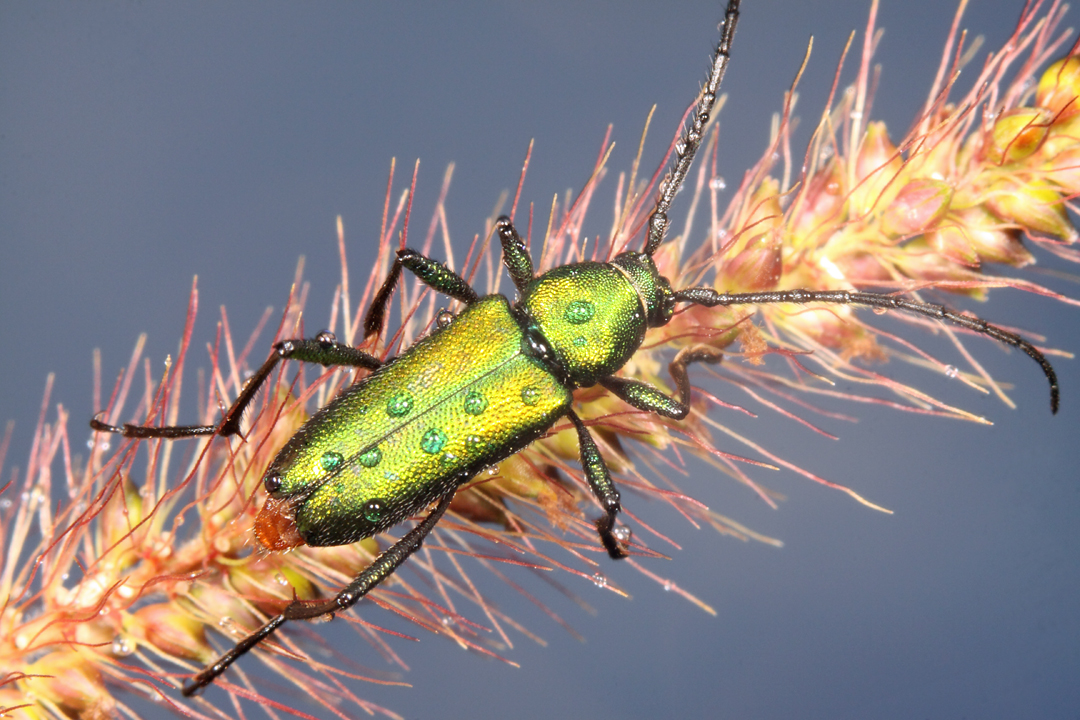
Aglaoschema rufiventre in Chaco, Argentina

Aglaoschema rufiventre | Chaco Province, Argentina

I’ve mentioned a few times that April is not a very good time to look for beetles in northern Argentina, as the months preceding April are typically hot and dry. September through January would be a much better time, especially to look for the wood boring beetles (families Buprestidae and Cerambycidae) that I am so fond of. Still, if I am in Argentina in April then I must look for beetles in April, and while I didn’t see a single buprestid during my week in Corrientes and Chaco Provinces last month I did a fair number of cerambycid beetles on stands of goldenrod (Solidago chilensis) at a few localities in Chaco Province. One particularly common species was Aglaoschema rufiventre, a beautiful metallic green species with, you guessed it, a red abdomen. Aglaoschema is a rather large (27 species), exclusively Neotropical genus whose members superficially resemble the diurnal, brightly colored species of the tribe Trachyderini but actually belong to the tribe Compsocerini. Most of the species occur in Brazil, but six extend further south into Argentina. Of these, A. rufiventre most resembles A. haemorrhoidale and A. ventrale but is distinguished by its subcylindrical antennal scape—or first segment (clavate in A. ventrale) and non-roughened elytra (roughened—or “asperate”—in A. hemorrhoidale) (Napp 2007). No hosts have been reported for A. rufiventre (Monné 2001), so my finding of adults on flowers of S. chilensis seems to be the first reported host association for the species.
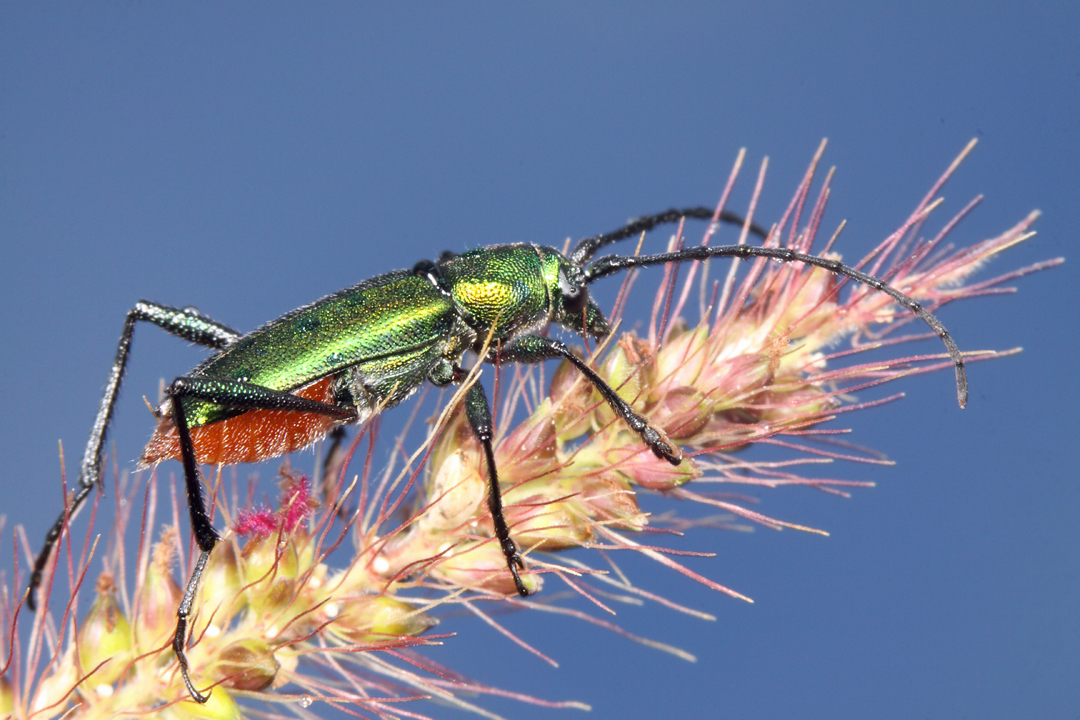
The species name refers to its “red belly”

I photographed several of these beetles on S. chilensis flowers at two locations in Chaco Province along Ruta 16 west of Resistencia, but I was generally unsatisfied with how the photos turned out. The combination of the beetles’ metallic sheen and the bright yellow color of the flowers made getting the right exposure and lighting difficult—I either blew out the yellow on the flowers or ended up with deep shadows on the beetles. One morning I encountered this female sitting on the seed head of an grass unidentified grass. Torpid from the cool temperatures and covered in morning dew, she was a most cooperative subject, and the colors of the seed head turned out to be much more complimentary for photographing the beetle that the bright yellow goldenrod flowers.

REFERENCES:

Monné, M. A. 2001. Catalogue of the Neotropical Cerambycidae (Coleoptera) with known host plant—Part I: Subfamily Cerambycinae, tribes Achrysonini to Elaphidiini. Publicações Avulsas do Museu Nacional 88:1–108.

Napp, D. S. 2007. Revisão do gênero Aglaoschema Napp (Coleoptera, Cerambycidae). Revista Brasileira de Zoologia 24(3):793–816.

Copyright © Ted C. MacRae 2012

Friday Flower: Phacelia purshii

Phacelia purshii (Miami mist) | Sam A. Baker State Park, Wayne Co., Missouri

It’s been rather a long time since I’ve featured a botanical subject here, so it seems a good time to resurrect my “Friday Flower” meme with this delightful little wildflower seen on my birthday field trip a few weeks ago. Phacelia purshii (family Hydrophyllaceae), also known as Miami mist, is one of only four species in this rather large genus (159 species in North America according to the USDA Plants Database) found in Missouri. Though the flowers are small, their deeply fringed petals are quite striking. The late Dan Tenaglia¹ notes at his Missouriplants.com website that the species is limited in Missouri to the extreme eastern portions of the state—the plant shown here was one of several I saw in rich, bottomland forest along Big Creek at Sam A. Baker State Park in Missouri’s southeastern Ozark Highlands.

¹ Dan Tenaglia was not only an expert botanist but a enthusiastic cyclist. He died in February 2007 after being struck by a car while riding his bicycle. Dan’s wife has kept Missouriplants.com up and running since then in honor of his passion for plants. You can help support its maintenance by making a donation to the “Dan Tenaglia Foundation”: 1416 Victoria Avenue, Opelika, Alabama 36801.

This particular woods is one of the richest I’ve seen in the state, and in the past two years I’ve featured a number of interesting plants (Phlox bifida and Tradescantia longipes), invertebrates (Drosphila sp., Magicicada sp.Calosoma scrutator, Pleuroloma flavipes, Graphisurus trianguliferG. fasciatus, Arrhenodes minutus, Neoclytus scutellaris, Corydalus cornutus and Panorpus helena) and even snakes (Crotalus horridus and Agkistrodon contortrix phaeogaster) from there. This year marks the third consecutive birthday that I’ve visited these woods, and since I’ve found something I’ve never seen before each time (hint: just wait till you see what I still have coming from there!), I have a feeling the trend will continue next year as well.

Copyright © Ted C. MacRae 2012
One-Shot Wednesday: Panorpa helena scorpionfly

Panorpa helena, male | Wayne Co., Missouri

Last month I introduced a new meme called One-Shot Wednesday as a fun outlet for those occasional instances where I was able to fire off just one shot of an insect before it took off. At the time I guess I was hoping it was a meme that I wouldn’t need to use frequently, as I really do like to get more than just one shot of the insects that I photograph. Eventually, however, I decided it might actually encourage me to attempt photographs of insects that I wouldn’t normally try to photograph—not because I don’t find them attractive or interesting, but rather the fear of becoming too distracted and missing opportunities for the types of insects that I prefer to photograph. Freeing myself from the “need” to spend inordinate amounts of time with every subject I try to photograph might actually make me more willing to fire off more shots willy-nilly. Most of these shots probably won’t be anything special, but a few should turn out pretty good—and what better way to get more practice and experience?

Today’s feature is my first attempt at something in the order Mecoptera. I am admittedly a novice when it comes to scorpionfly taxonomy, but after perusing The Mecoptera of North America, an excellent website by Norm Penny (Collections Manager at the California Academy of Sciences and specialist in the taxonomy, biology, and biogeography of the Mecoptera and Neuropterida), I’m fairly confident that this male represents the common and widespread species Panorpa helena Byers, 1962. Penny includes Missouri in the distribution of six species of this monogeneric family, but the three complete bands across yellow wings and presence of an anal horn on the sixth abdominal tergum seem to support my identification (although I suppose examination of the male genitalia would be required for conclusive identification).

Frankly I was surprised I even got this shot. I see scorpionflies commonly in dense, moist woods throughout Missouri—this one was seen in wet bottomland forest along Big Creek in Sam A. Baker State Park in the southeastern Ozark Highlands—and have noted their tendency to flit nervously through dense foliage when approached. I already had the camera out and with the proper lens attached, so I thought I’d take a shot—I got this one reasonably well-composed, focused, and exposed shot before it flew deeper into the foliage. That was good enough for me (I had other quarry on my mind…), so I didn’t bother to try to track it. That was on April 23 (my first official day as a ‘senior citizen’—harrumph!), and it’s interesting to note that this is nearly two weeks earlier than the first date of occurrence (May 4) recorded for the species at Penny’s website.

Copyright © Ted C. MacRae 2012

Desmiphora hirticollis: Crypsis or Mimicry?

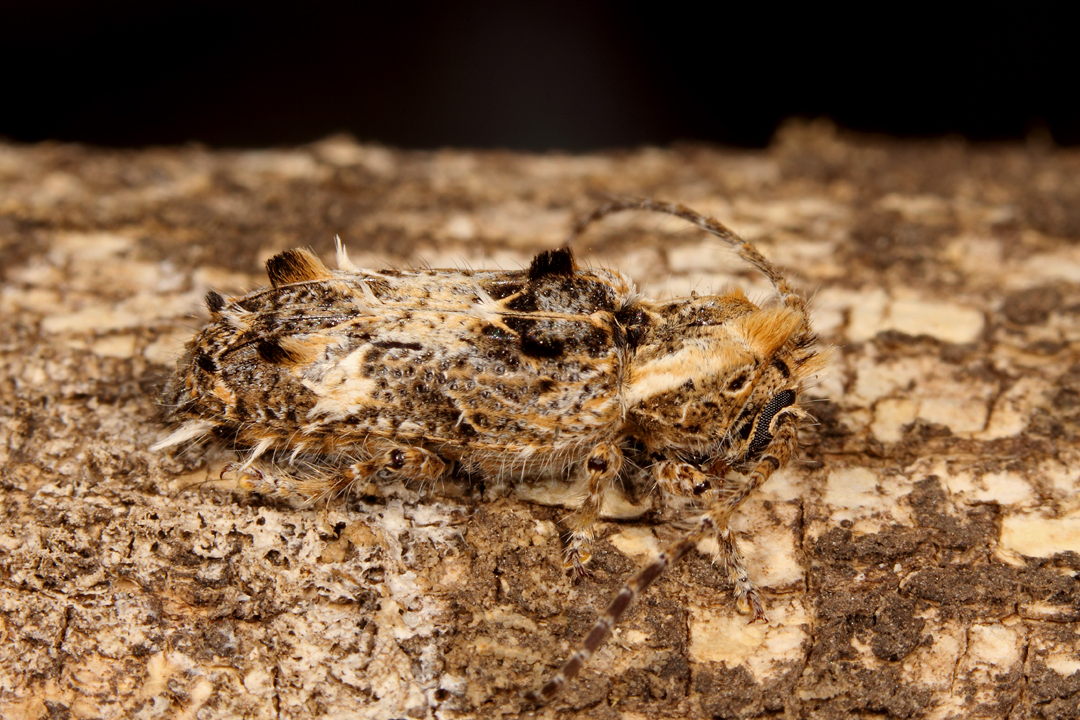
During my stay in Corrientes, Argentina last month, I was invited to spend the day with a colleague at his “camp” in Paso de la Patria. Located on the banks of the massive Rio Paraná at its junction with the Rio Paraguay, this small resort community boasts large tracts of relatively intact “Selva Paranaense,” which together with the Atlantic Forest in southeastern Brazil forms the second largest forest ecozone in South America outside of the Amazon. As my colleague skillfully prepared matambre, chorizo, and vacío (typical cuts of meat in Argentina) on the parilla (wood grill) at his camp, I explored the surrounding forest for insects. Early April is late in the season, and with generally droughty conditions in the area for the past several months there were few insects to be found. My luck improved, however, when I came upon a small area with stacks of fresh cut logs from recent wood cutting operations scattered through the area. Wood boring beetles (families Buprestidae and Cerambycidae) are often attracted to such wood piles, so approached each one slowly to look for day-active species of these beetles. After inspecting several piles without seeing anything on them, I began carefully turning over the logs to look for nocturnal species that tend to hide on the undersides during the day. Shortly I came across this highly cryptic species of cerambycid, and further searching revealed a fair number of these beetles hiding within the dozen or so log piles that I examined.

Desmiphora hirticollis on freshly cut guayabi (Patagonia americana) | Corrientes Prov., Argentina

I instantly recognized the genus as Desmiphora, an exclusively New World genus characterized by the presence of fasciculate tufts (or “pencils”) of erect or suberect hairs. Most of its nearly 50 species occur in Brazil, but two species extend as far north as southern Texas (Giesbert 1998). One of these is Desmiphora hirticollis, a widespread species found as far north as Corpus Christi, Texas and as far south as Bolivia and Argentina. I thought these beetles looked an awful lot like that species, and I later confirmed its identity as such due to its piceous (glossy brownish black) integument and the presence of small black pencils just before the elytral apices.

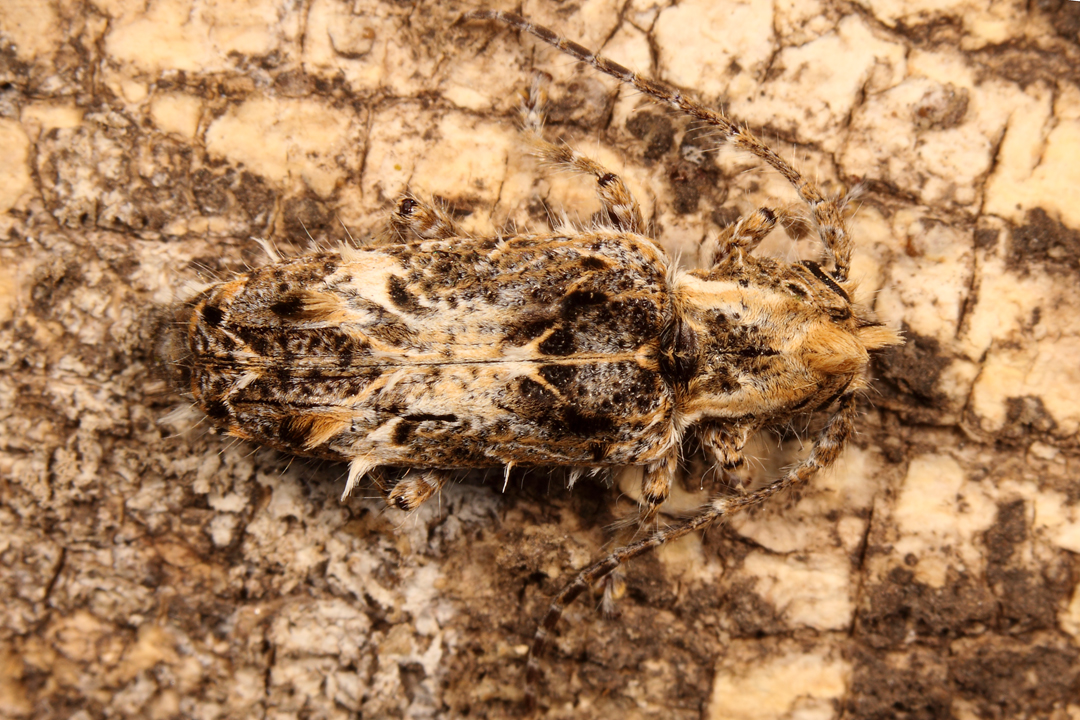
Adults are nearly impossible to see from overhead due to cryptic coloration…

The wood piles contained logs from several tree species, but all of the beetles that I encountered were on logs of guayaibi (Patagonula americana), a member of the family Boraginaceae and a characteristic component of Selva Paranaense (also an important timber species in Argentina). The number of individuals that I found and their occurrence only on guayaibi suggests it serves as a larval host for the beetle. Duffy (1960) described the larva from specimens collected out of Sapium sp. (family Euphorbiaceae), but in Texas this species is collected most often on Cordia spp. and Ehretia anacua (Rice et al. 1985)—both in the family Boraginaceae—with adults having been reared from Cordia eleagnoides (Chemsak & Noguera 1993).

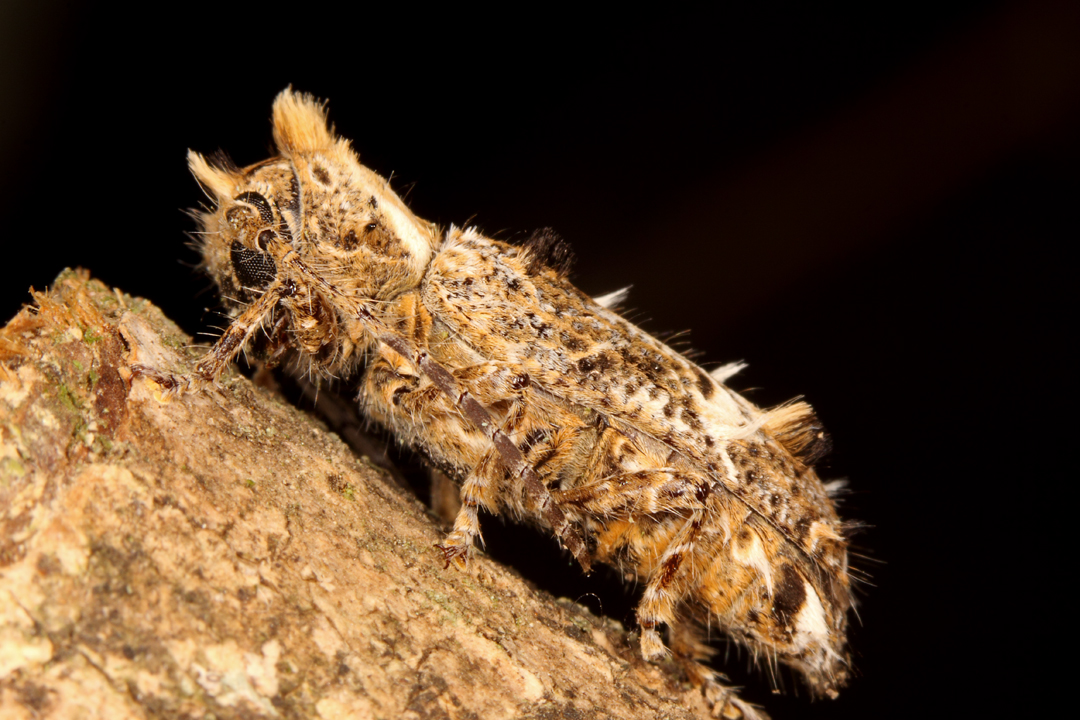
…while the hair tufts may function in obscuring the body outline…

It seems obvious that coloration of the beetle and its pencils of hair function in crypsis. From overhead the beetles are almost impossible to discern as they sit motionless on the similarly colored bark of their host trees. Even in profile or oblique views where the body becomes somewhat more visible, the pencils seem to break up and obscure the outline of the body. I wonder, however, if crypsis is the only function of the pencils—Belt (2004) described the strong resemblance of another species in the genus, D. fasciculata—a similarly penicillate species, to short, thick, hairy caterpillars (insectivorous birds often refuse to prey upon hairy species of caterpillars). That species can be seen sitting openly on foliage during the day, while D. hirticollis seems to be strictly nocturnal; however, cryptic and mimetic functions need not be mutually exclusive, so perhaps for this species the pencils function a little for both.

…or perhaps even mimicking ”hairy” caterpillars.

REFERENCES:

Belt, T. 2004. The Naturalist in Nicaragua. Project Guttenberg eBook.

Chemsak, J. A. & F. A. Noguera.  1993.  Annotated checklist of the Cerambycidae of the Estacion de Biologia Chamela, Jalisco, Mexico (Coleoptera), with descriptions of new genera and species.  Folia Entomológica Mexicana 89:55–102.

Duffy, E. A. J. 1960. A Monograph of the Immature Stages of Neotropical Timber Beetles (Cerambycidae). British Museum of Natural History, London. 327 p.

Giesbert, E. F. 1998. A review of the genus Desmiphora Audinet-Serville (Coleoptera: Cerambycidae: Lamiinae: Desmiphorini) in North America, Mexico and Central America. Occasional Papers of the Consortium Coleopterorum 2(1): 27–43.

Rice, M. E., R. H. Turnbow, Jr. & F. T. Hovore. 1985. Biological and distributional observations on Cerambycidae from the southwestern United States (Coleoptera). The Coleopterists Bulletin 39(1):18–24.

Copyright © Ted C. MacRae 2012

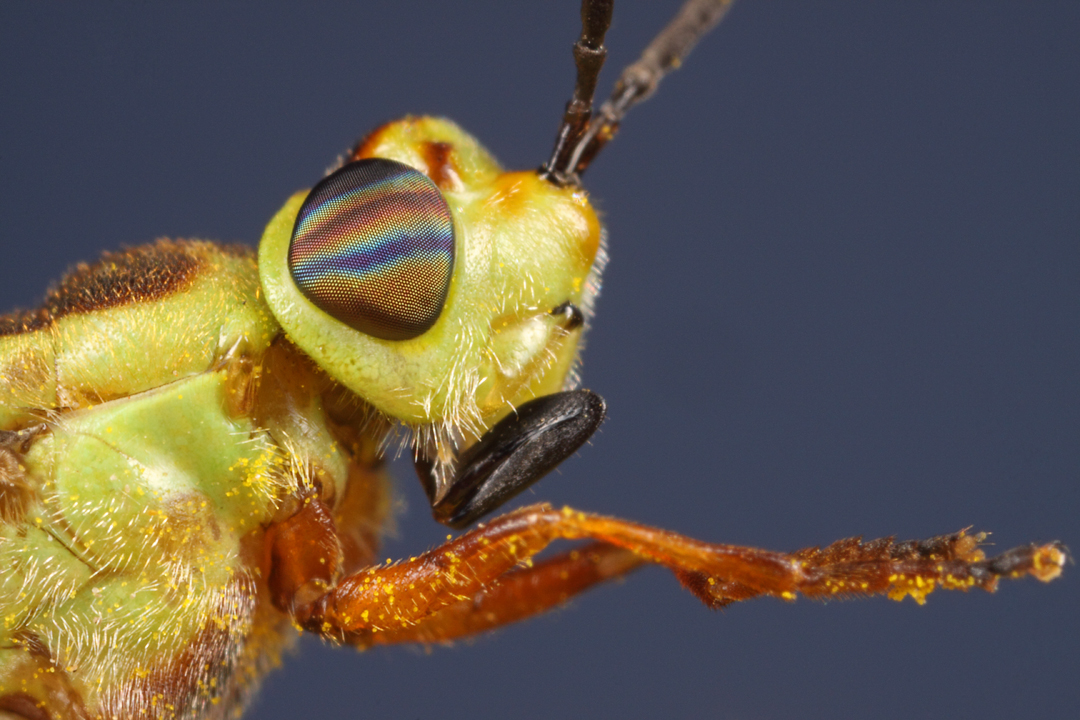
More fly got eye!

Here is another fly photographed during my recent visit to Argentina. I had little doubt when I saw it that it, too, was a member of the family Stratiomyidae; however, unlike the previous species this one was a far more cooperative subject for photographs. I have learned to carry a small utility tool in my pocket that contains an even smaller scissors—these have proven to be quite handy for gently snipping flowers or plant parts on which insects are perched without disturbing them. Holding these detached plant parts in front of the camera has several advantages, including the ability to photograph the subject while standing (or sitting) in a stable, comfortable position, providing more flexibility in choosing the background, and allowing me to “rest” some part of my hand or arm against some part of the camera or flash heads to “fix” the subject-to-lens distance. The fly remained quite calm through all these machinations, allowing me to focus on getting the composition, exposure, background, focus, and other technical aspects of the photos to my liking. Easier said than done of course, but a cooperative subject at least makes it more possible.

Psellidotus? sp. | Corrientes Prov., Argentina

I thought this fly looked an awful lot like our North American species of Odontomyia, so I sent the photos to stratiomyid expert Norman Woodley (Systematic Entomology Laboratory, Smithsonian Institution) for his opinion. Norm wrote back:

The stratiomyid fly…is in the subfamily Stratiomyinae, tribe Stratiomyini, which includes Odontomyia. I think that your fly is in the genus Psellidotus. Psellidotus is similar to another genus, Hedriodiscus…these two are easily separable in the Nearctic Region but the distinction becomes fuzzy in the Neotropics, especially in South America. We don’t have the species you photographed in the USNM collection. The majority of species in Psellidotus and Hedriodiscus in the Neotropics are very poorly known outside of their original descriptions.

Once again… fly got eye!

As before, this stratiomyid also exhibits stunningly patterned eyes, and like nearly all of the examples that I have seen the horizontal nature of the banding suggests an ability to see horizontally polarized light in similar fashion to many species of tabanids (Horváth et al. 2008). Again there seems to be a link between the ability to see horizontally polarized light and insects with aquatic lifestyles, as such visual capabilities have been demonstrated for a variety of other aquatic insects. While the biologies of most Neotropical stratiomyid species remain unknown, larvae of the subfamily Stratiomyinae are (like tabanid larvae) known to be aquatic (Brown 2009). Stratiomyine adults that exhibit these horizontal banding patterns may, like tabanids, also be able to see horizontally polarized light, which would be useful for finding mates and suitable sites for laying eggs.

REFERENCE:

Brown, V. B. 2009. Manual of Central American Diptera, Volume 1. NRC Research Press, 714 pp.

Horváth, G., J. Majer, L. Horváth, I. Szivák & G. Kriska. 2008. Ventral polarization vision in tabanids: horseflies and deerflies (Diptera: Tabanidae) are attracted to horizontally polarized light. Naturwissenschaften 95:1093–1100.

Copyright © Ted C. MacRae 2012

Adult male Hentzia palmarum jumping spider

Hentzia palmarum, adult male | Scott Co., Missouri

A brief break from photos from Argentina. Last week—just a few days after returning from my 8-week absence—I visited two of the sand prairie preserves in Missouri’s southeastern lowlands to try to photograph individuals from the unique, disjunct population the Festive Tiger Beetle (Cicindela scutellaris) found down there. Spring was well underway in the area, but several days of cold and rain seemed to have sent the tigers into their burrows until warmer temperatures returned. I spotted some Hibiscus lasiocarpus plants growing along the edge of a low wet spot adjacent to the prairie, so I started peering into their still unfurling leaves in hopes of finding the jewel beetle Paragrilus tenuis that utilizes the living stems of plants of this genus for larval development, but even they seemed to be awaiting balmier days. As I peered down into the leaves of one plant I notice a flick of movement, and carefully peeling apart the leaves revealed this adult male of the diminutive jumping spider Hentzia palmarum. Something was odd about this spider, and I finally realized the little guy was missing one of his characteristically enlarged and darkened front legs.

Note the elongated chelicerae.

Despite its missing leg, I became determined to photograph this spider. It certainly did not wish to be photographed, and perhaps that is the reason why. I gently snipped the leaf it was sitting on and held it in front of the camera, but every time I turned the leaf towards the camera it cowered and zipped around to the backside. Several times it attempted to flee by jumping off the leaf, but each time I pulled it back up by its thread before it hit the ground and lowered it back down onto the leaf again. Eventually I got a few shots I could live with. Of course, then I found this photo by Thomas Shahan (he describes it as “not a great photo…”) and almost felt embarrassed to show these here. Maybe I’d better stick to photographing tiger beetles!

The enlarged and conspicuously colored front legs of the males almost certainly serve some function in courtship. However, there seems to be no discussion of this in a recent revision of the genus (Richman 1989), and my further search for information about this only turned up one paper by Crocker & Skinner (1984). I really couldn’t understand anything the paper said, so for now I’m left with my presumptions that the legs are used as flags of sort—both to females to signal his availability and willingness as well as other males with more threatening intentions.

REFERENCES:

Crocker, R. L. & R. B. Skinner. 1984. Boolean model of the courtship and agonistic behavior of Hentzia palmarum (Araneae: Salticidae). The Florida Entomologist 67(1):97–106.

Richman, D. B. 1989. A revision of the genus Hentzia (Araneae: Salticidae). Journal of Arachnology 17:285–344.

Out with the old (but on a good note)

This past March was the warmest on record here in Missouri and that made for some nice opportunities to get out and photograph. That said, my enthusiasm for macro photography has been somewhat tempered since my camera body is getting old and showing some signs that it might be on its last leg. The mere fact that I am still using a camera from 2004 may be your first indication that I am something less than a macro photography perfectionist and this is a reflection of the equipment that I first used when I began shooting macro. I started with Canon manual equipment in the mid-1990’s because I thought this would be the best way to learn photography. My stint with a used, and malfunctioning, Canon AE-1 was thankfully short. It was stolen as I returned from a photography trip to the Chiricahua Mountains, but I still lament that the thief made off with the spent rolls of film from the trip! The experience with the AE-1 pushed me towards higher quality, more professional equipment that would stand up to field conditions better. Next up was the Canon F1 and then the wonderfully solid Canon F1N followed later with the game-changing addition of a power winder. The latter was great since insects typically didn’t wait around for me to manually wind the film, refocus, and shoot. The real challenge though was getting the lighting right. At fist I often times had the camera on a tripod which resulted in too many missed shots, restricted what I could shoot, and it didn’t meet what I later realized was my overall goal of macro photography. What I wanted was to have the ability to take satisfactory macro images while not loading myself down with equipment that would detract from also being able to conduct research or simply observe/enjoy nature without trying to capture it on film. I still have a graveyard of old flashes, brackets, and bracket parts that I employed in various combinations to get suitable lighting though it is now clear that I was never able to get the perfect balance. That changed in 2001 when Canon introduced the new MT-24EX macro twin flash and I bought a 1V body. After testing the new system a minimal amount, I realized that macro photography was now made easy relative to what I had wrestled with over the years prior. I had the complete package—no bulky brackets, no hand holding flashes, more certainty of exposure, and quick field set-up. The twin flash allowed me to fire off just the minimal amount of light to obtain my desired depth of field and the flash had sufficient battery power at the lower flash output settings to essentially shoot consecutively without having to wait for the flash to power-up.

Well, at least I thought I had the perfect setup until Ted MacRae took up macro photography and soon demonstrated that options for continuous improvement exist even for this system.

In 2004 I sadly shelved the 1V body and went digital. I briefly used the Canon 10D, which seemed inadequate for various reasons, but then jumped on the newly released Canon 1D Mark II during that same year. It was more than I wanted to spend but there weren’t many options and the benefits were too much to pass up. Most notably, I was sick of buying film, scanning slides, and most of all my hand ached from cataloguing so many slides, i.e., writing a unique code on each slide prior to archiving it in plastic. The time savings alone made the 1D Mark II price palatable and I hoped that investing in a top notch, newly released body would help it remain relevant for a while. I never looked back.

That brings me to that warm day this past March when I settled in to photograph a toad bug, Gelastocoris oculatus (Heteroptera: Gelastocoridae), along the margin of an intermittent creek in Perry Co., Missouri.  As I mentioned above I felt like I was limping along with my dated 1D Mark II but I couldn’t pass up the opportunity to again photograph an individual of G. oculatus that so superbly blended in with its substrate (Figures 1 and 2).

Figure 1. Gelastocoris oculatus, 3.13.2012, Perry Co., MO

Figure 2. Gelastocoris oculatus, 3.13.2012, Perry Co., MO

As I have mentioned before I like to take multiple shots of a subject to help tell a story (yes, including the obligatory head-on close up that Ted always mentions). One important shot in the series can be a photograph from a distance to: 1) better see the subject in its surroundings which can give more insight into its natural history; 2) offer a more artistic view, or, in this case; 3) to show the effectiveness of its cryptic coloration. The actual close-up is great for detail but only gives the viewer an idea that the subject is similarly colored to its background but only a more distant shot really conveys how well the subject melts into the substrate. In this case, Figure 3 was the next progression towards that shot but I was stopped short that day partly due to my middle son falling in the creek and partly due to the apparent malfunctioning of the camera. As you can see, I wasn’t far enough away from the subject to capture what attracted me to the bug in the first place—how well it mimicked its background. In that sense the picture is disappointing because I didn’t finish the story. But on the other hand, the malfunctioning of the camera combined with its age, made it clear that it was now time for a new camera body. So I put on my best frustrated/disappointed face and presented my case to my wife, Jess. It was an easy sell since Jess is… well… at least 95% supportive of my photography. I’ll discuss the new body and the first images soon.

Figure 3. Gelastocoris oculatus, 3.13.2012, Perry Co., MO

Below are more of the variable faces of G. oculatus that I have come across over the years (Figs. 4 – 8). Gelastocoris oculatus is one of two species of Gelastocoris that we have in North America (Arnett 2000). Gelastocoris oculatus can be found continent-wide however G. rotundatus ranges only in the southwest. I love the origin of the family name which the online Merriam-Webster dictionary mentions is from the Greek “gelastos”+ “koris” which translates to “laughable bug”, no doubt due to its odd appearance. Both species are predators that live along the margins of water. Their predaceous nature is made clear by the appearance of their powerful forlegs clearly specialized for catching and securing prey. As you can see, I do not have a picture of their forlegs so I’ve got a great reason to again get down on their level with the new camera.

Figure 4. Gelastocoris oculatus, 5.23.2010, Perry Co., MO

REFERENCE:

Arnett, R.H. 2000. American Insects: A Handbook for the Insects of America North of Mexico. Boca Raton, Florida: CRC Press.

Copyright © Christopher R. Brown 2012

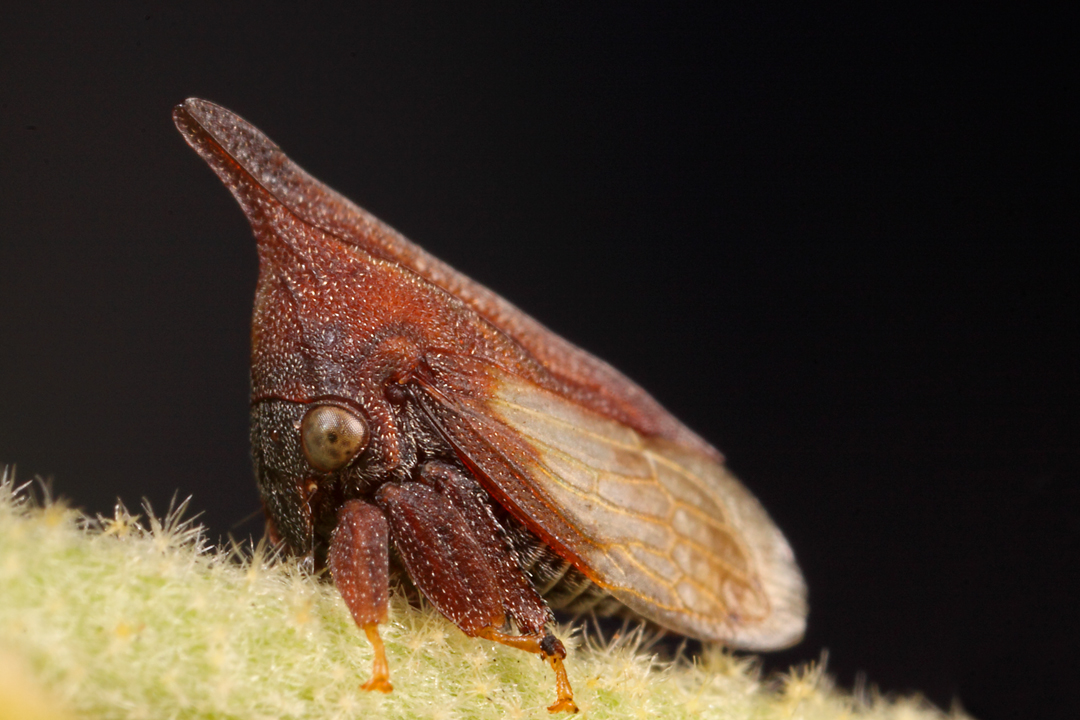
Traffic Jam Treehoppers

Sometimes photo opportunities come at the unlikeliest of times. A few weeks ago while traveling back to Corrientes, Argentina from neighboring Chaco Province, I came upon traffic at a standstill just a few kilometers from the towering Gral. Belgrano bridge that spans the massive Rio Paraná to link Chaco and Corrientes Provinces. People were already getting out of their cars and walking around, suggesting a wreck closer to (or on) the bridge had completely shut down the highway for the time being. Somebody said they heard it might be another 45 minutes before it could be opened. What to do now? It was the end of my last day after a week of insect collecting/photographing in the area, and the last thing I wanted to do was spend the evening sitting on a divided highway with nowhere to go and nothing remotely interesting to look at…

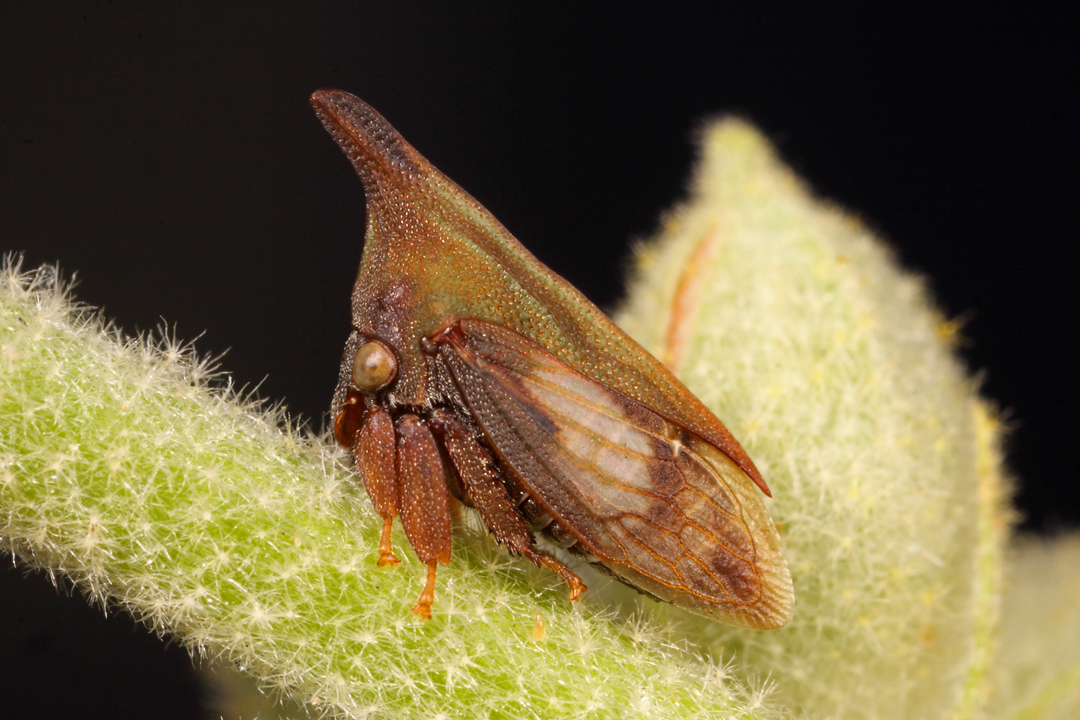
Enchenopa gracilis (Germar, 1821) | Chaco Province, Argentina

…or so I thought. While scanning the highway right-of-way to see if there might be anything possibly interesting to look at, I spotted a small clump of woody shrubs down the embankment and across the erosion gully before the fenceline. I looked around—everybody was out of their cars with the engines shut off, so I grabbed my camera (not really sure why) and started walking towards the shrubs while looking ahead every now and then for any sign that people were getting back in their cars and moving again. I reached the shrubs and saw they represented something in the mallow family (Malvaceae) due to their small, orange, über-staminate flowers. Immediately I spotted the familiar thorn-like shape of treehoppers in the tribe Membracini, probably a species of Enchenopa or related genus. I had been hoping to see more of these after photographing another species further south in Buenos Aires last year, but I hadn’t seen a single treehopper during the entire week. Fortunately I had my 65mm lens already on the camera, so I quickly snapped a few shots and collected a couple of specimens. Just as quickly as I had done that, I heard somebody yelling to me from the road above that people were getting back into their cars ahead. These few shots and specimens would have to do. (And, disappointingly, after spending the next hour creeping towards the bridge there wasn’t even a wreck to look at!)

As I did with those previous photos, I sent these to Andy Hamilton (Canadian National Collection, Ottawa), who forwarded them on to Dr. Albino Sakakibara (Universidad Federal de Parana, Brazil) and then reported back to me that:

My Brazilian colleagues…have been able to identify your “beautiful photos” as representing Enchenopa gracilis, a species that has been illustrated only once (in 1904), and certainly not by a photograph!

Another individual, this one with no trace of green colorationi and less distinctly marked wings.

The illustration referenced by Andy comes from Kellogg (1905—p. 169, fig. 239), and as he notes at BugGuide the problem with old illustrations is that many of them are either inaccurate or use obsolete names. Enchenopa gracilis does not occur in North America, thus the drawing in Kellogg (1905) probably does not actually represent this species. Nevertheless, a recent dissertation on the insect fauna associated with pigeon pea in Brazil (Azevedo 2006) shows several photographs of adults that agree nicely with these photos. Enchenopa gracilis actually seems to be a bit of a pest on that crop, and it has also been reported in association with a variety of other plants across several different families (Lopes 1995, Alves de Albuquerque et al. 2002). Interestingly, I could not find any species of the family Malvaceae recorded as a host for E. gracilis.

REFERENCES:

Azevedo, R. L. 2006. Entomofauna associada ao feijão guandu [Canjanus cajan (L.) Millspaugh] no recôncavo baiano. Ph.D. dissertation, Centro de Ciências Agrarias e Ambientais, Universidade Federal da Bahia, Cruz das Almas, 54 pp.

Alves de Albuquerque, F., F. C. Pattaro, L. M. Borges, R. S. Lima & A. V. Zabini. 2002. Insetos associados à cultura da aceroleira (Malpighia glabra L.) na região de Maringá, Estado do Paraná. Maringá 24(5):1245-1249.

Kellogg, V. L. 1905. American Insects. Henry Holt & Co., New York, 674 pp.

Lopes, B. C. 1995. Treehoppers (Homoptera, Membracidae) in southeastern Brazil: use of host plants. Revista Brasileira de Zoologia 1213:595-608.

Copyright © Ted C. MacRae 2012