“Cochinilla australiana” in Argentina

Icerya purchasi (''cochinilla australiana'') on citrus twig | western Buenos Aires Province, Argentina

After traveling through the northern provinces during late March and early April, I returned to my home base in western Buenos Aires Province for the last two weeks of my stay in Argentina. As soon as I could, I returned to the small grove of planted citrus trees on the station grounds where I had found a rather large, beautifully cryptic fulgorid nymph (see ““). Lois O’Brien had mentioned in her response to my query about the identity of the nymph that some species of Fulgoridae tend to live on the same tree for years and years—if I could go back to the tree on which I found the nymph perhaps I could find the adult. Sadly, no adults or additional nymphs were found, either on the original tree or any in its vicinity. What I did find, however, was this strange, cocoon-like structure on one of the branches of the tree. I had no idea what it was, having never seen anything quite like it, but I figured something—pupa, eggs, parasitoid, etc.—must be inside. I cut the piece of branch with the structure and tucked it inside a vial for later.

Egg case opened to reveal eggs and newly hatched nymphs

A little bit of searching online would have quickly told me what I was dealing with, but for some reason I felt the need to go ahead and start dissecting to see what was inside. It became obvious I was dealing with an egg mass when I peeled back the outer layers to reveal the cluster of red eggs inside, and very quickly I noticed that a few of the eggs had already hatched. The red nymphs had a decidedly “homopterous” look to them, and not much effort was required to figure out that I was looking at my very first “cottony cushion scale” insect.

Closer view of eggs - newly hatched nymph can be seen at bottom.

Icerya purchasi (Hemiptera: Monophlebidae) originally hails from Australia, but its preference for citrus and the realities of global commerce have resulted in its inevitable spread across the globe wherever citrus is grown (maybe I can be forgiven for having never before seen such a widespread insect—living most of my life in Missouri and northern California, I’ve not had much opportunity to visit citrus groves). The English common name clearly references the appearance the adult female, recognizable by the white, fluted egg sac shown here, while in Argentina it is called “cochinilla australiana”—literally meaning “Australian scale insect.”

Newly hatched nymphs are bright red with dark antennae and thin brown legs.

As I dissected the egg sac, a few of the newly hatched nymphs crawled out of the sac an onto the branch. Nymphs of this stage are referred to as “crawlers” because they are the dispersal stage. It’s a good name for these tiny little bugs, as the several that I tried to photograph never stopped moving. With the lens fully extended to 5X, it was difficult enough to just find them in the viewfinder, much less compose and focus with all the movement. It became a numbers game and test of patience—how many shots could I get fired off in the amount of time that I was willing to persist? Shown here are the few shots that I was the least displeased with.

First instar nymphs are the primary dispersal stage.

Crawlers disperse not only by crawling, but also by wind. One can imagine that such tiny insects could easily be picked up by the wind and carried long distances. However, I couldn’t help but notice the very long setae on the body and outer antennal segments (visible to greater or lesser degree in these photos) and think that perhaps they have some function in aiding wind dispersal. At the very least, aerial dispersal must be as important as crawling (if not more so) for colonization by this species—only adult males have wings (but they are rare), while egg-laying females (actually hermaphrodites) are completely sessile.

Do the long setae on the body and antennae of the nymph aid in wind dispersal?

The adult female and egg case may have confused me initially, but a ton of readers had no problem figuring out what it was. A record 24 people participated in this challenge, with all but five correctly guessing the species. Winning this challenge came down to bonus points for speed and uniqueness of additional information, and Christopher Taylor did this best to earn 17 pts and the win. Three others—Brady Richards, Mr. Phidippus and bicyclebug—each finished just 1 pt back of the win, but Sam Heads’ 15 pts keeps the overall lead in his possession. BitB Challenge Session #6 is young, but already a lot of people have a lot of points in the bank. It will be interesting to see how this session develops.

Copyright © Ted C. MacRae 2012

ID Challenge #17

My response to “Can you talk to 10-year-olds about science?”

The Bug Geek is becoming the champion of challenges! Last week she illustrated in clever graphical form the emotions she had encountered during the manuscript writing process, and this week she tops it with a challenge to see how well we can talk to 10-year-olds about science. I played along with the first one just for fun (see The Ups and Downs of Bug Collecting—I also earned the tag “easily-entertained professional research entomologist with too much time on his hands” for my efforts!), but the second challenge hit closer to home. You see, like the Geek I believe strongly that the responsibility for recruiting the next generation of scientists rests squarely on the shoulders of today’s scientists. Who else but us will excite them about science and show them not only the importance that science plays in our daily lives, but how cool and fun it is!

I’ve been a professional entomologist for three decades now, and for most of that time I’ve also been involved in giving presentations to children about insects and the science of entomology. I also happen to be an avocational entomologist—insects are not just my livelihood, but also my hobby! I live, breath, and eat insects (okay, maybe not so much the latter), and wherever I have lived my name has quickly made it to the local schools as someone who can keep the kids occupied for an hour or two. I have done dozens, perhaps even hundreds of “kid outreach” sessions during the past 30 years—how could I not take up the Geeks’s challenge?! The only question was which “entomologist” I should take the challenge as—the professional one who conducts insect research on biotech crops, or the avocational one who travels the country and beyond looking for new and rare beetles. Ultimately I decided to try both (you knew that was coming!), so here I present my 250-word (precisely) attempts to convince a 10-year-old in written form that science, and specifically entomology, is fun, cool, and incredibly important for the future of our planet.

Professional

I work for a company that helps farmers grow crops that don’t need to be sprayed with insecticides. These “insect-protected crops” are grown by farmers all across the world and help the environment by reducing the need for insecticides to grow our food. We create these plants by adding a small piece of DNA in the laboratory so that the plants produce a protein inside their leaves that only insects don’t like. Not all of the plants produce the protein, so we have to test the plants to make sure insects can’t feed on them. I do this by growing plants in the greenhouse, and when they are big enough I put insects that we grow in our laboratory on the plants to see if they can eat the leaves. If the plants don’t get eaten, I collect the seeds and grow them outside like a farmer would do. If the plants don’t get eaten by insects outside either, then other people in my company test the plants to make sure they grow normally and produce as much food as plants without the protein. Insects might become immune to the proteins, so I also test new proteins to find new ones we can use in case the old ones stop working. I mix the protein with a special insect diet to see how much protein is needed to make the insect stop eating. I love my job because I get to study bugs while helping to improve the environment.

Avocational

I have the best hobby in the world—I travel across the US and other countries looking for beetles! There are more kinds of beetles in the world than any other kind of animal, and most of them are unknown to science. When I find a new beetle, I get to give it whatever name I want. Even many of the ones that we know about we don’t know where they live or what they eat. The heaviest insect in the world is a beetle (the Goliath Beetle from Africa) – it weighs more than a mouse! Some of the tiniest insects of all are beetles also – it would take a quarter million feather-winged beetles to weigh as much as one Goliath Beetle! There are beetles in the Amazon rain forest that play “King of the Log.” Males find a rotten log and sit on it, and when another male comes along he knocks him off with his horns. He does this to save the log for a female beetle so she can lay her eggs in it. The baby beetles eat the rotten wood. I especially like tiger beetles – they have stripes and bright, metallic colors that glitter in the sun. They use their long legs, big eyes, and huge sickle-shaped jaws to run down and catch other insects and eat them. Many kinds of tiger beetles can live in only one place on earth – we must do everything we can to protect their habitats so they don’t go extinct.

Copyright © Ted C. MacRae 2012

Inaugural “One-Shot Wednesday”

On many occasions I have considered making my own contributions to the “Wordless Wednesday” meme. Unfortunately, I find it impossible to post photos of insects and not be allowed to say anything about them. I suppose I could follow Dragonfly Woman‘s “Well-Nigh Wordless Wednesday” example, but that seems like horning in on somebody’s trademark. At last it finally occurred to me a meme that I could use for Wednesday’s that gets around these issues—”One-Shot Wednesday”! Ever photograph an insect and only get off a single shot? Not just one keeper from a series of photos, but only one single photo of the insect, like it or lump it! That’s what I’m talking about here. The subtext, of course, is that there was only that one chance to get everything right—exposure, focus, composition, lighting, etc. Obviously, it’s not my plan to show crappy photos as part of this meme, but rather that occasional instance where I only got off a single shot, and for the most part everything worked pretty well to produce a decent photograph. I would, of course, be more than happy to see this meme take off and spread throughout the insect blogging community, but if it doesn’t and it remains a BitB exclusive then that’s fine also.

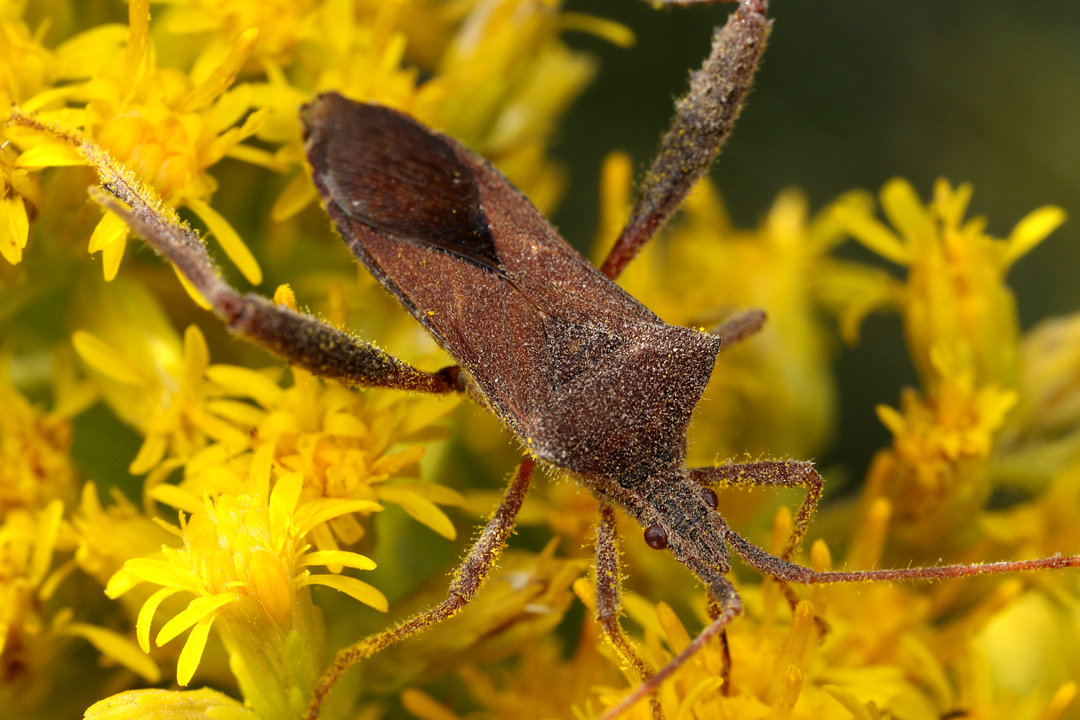
Leptoglossus sp. | nr. Corrientes, Argentina

Here is contribution #1 in the meme: a leaf-footed bug (family Coreidae) feeding on flowers of Solidago chilensis  that I photographed a couple of weeks ago near Corrientes, Argentina. According to coreid-specialist Harry Brailovsky (Universidad Nacional Autónoma de México), the expanded hind tibiae place it in the large, mostly New World genus Leptoglossus. Which one, however, is a good question—according to Coreoidea Species File Online, ten species in the genus have been recorded in Argentina, but browsing through available images didn’t immediately turn up a good match for the individual shown in this photo.

I’ve often wondered about the purpose of the leaf-like expansions of the hind tibiae of coreids—which reach truly gargantuan proportions in some tropical species—and their adaptive significance. One can imagine they might serve as a “false target” for potential avian predators, and supporting this idea is the fact that the hind legs seem to break off rather easily when handled. It’s not rare to find individuals in the field missing one or even both hind legs.

Copyright © Ted C. MacRae 2012

Fly got eye!

While walking the grounds of my company’s experiment station in Fontezuela, Argentina, I encountered a massive European elm (Ulmus laevis)—its trunk enveloped by an unidentified woody vine with large, ball-clusters of small, green flowers. Despite their inconspicuous appearance, the flowers were highly attractive to insects, primarily honey bees and smallish, black and yellow vespid wasps. One of the wasps caught my attention—it was not quite as narrow as the others, and it flew a little differently. Closer inspection, of course, revealed that it was not a wasp after all, but rather a fly. I wasn’t sure what it was, but it was extremely flighty and wouldn’t allow me to get close enough even to attempt looking at it through the viewfinder—much less going for a composed shot. Now, if it were a tiger beetle I’d probably spend the next 2 hours “working” it to get that in situ shot. But, hey, it’s just a fly (with apologies to my dipterist friends)! I trapped it in a vial and collected some flowers and foliage from the vine with hopes of giving it a day or so to settle down enough to allow a few photographs in a more controlled environment.

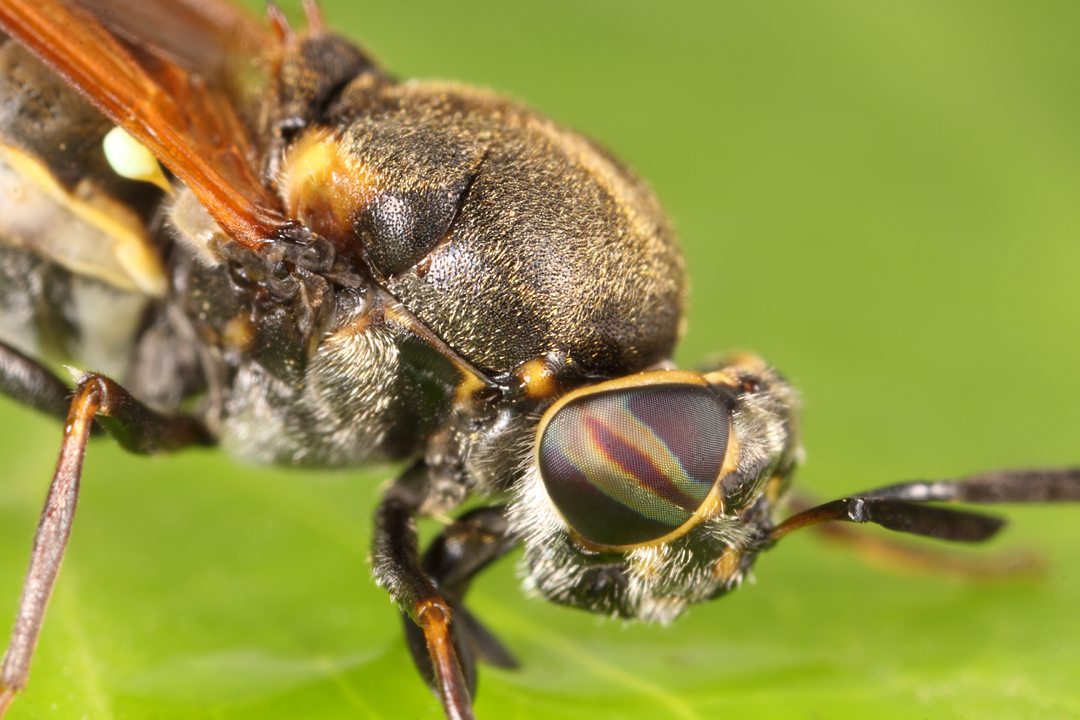
Hoplitimyia sp. poss. mutabilis | Buenos Aires Province, Argentina

That proved more difficult than expected, and a few photographs was all I could get. Even after a day in the vial it was extremely flighty, and every time I released it onto the flowers in the white box I had setup it immediately tried to take flight. I decided it must at least be hungry, so I whipped up some sugar solution and painted a small amount onto one of the leaves, then placed the open end of the vial over the leaf to let the fly find the sugar. That worked—briefly! The fly paused just long enough to allow me to fire off a half-dozen shots or so while it drank and preened before once again attempting to take flight. No amount of coaxing back to the sugar could interest the fly—she’d had enough, and so had I. I thought the fly had a soldier fly-ish look to it (family Stratiomyidae), and this was confirmed by dipterist Martin Hauser who wrote:

It is a female Hoplitimyia, maybe mutabilis…but the species are a mess. There are at least two species in the US, and more in South America. They have aquatic larvae…

Fly got eye!

Among flies, tabanids and syrphids seem to get all the attention from insect photographers because of their contrastingly colored eyes, but this fly had every bit as much eye as those better known families! Considering how broadly across the order Diptera that one finds these stunningly patterned eyes—72 species out of 23 families according to Lunau & Knüttel (1995), an obvious question is what is their purpose. Considering that the patterns and coloration are often sexually dimorphic, it’s tempting to think it has something to do with mate selection, especially with their large size and resulting prominence. However, Horváth et al. (2008) presented evidence that the ventral eye surface of many tabanids are stimulated by horizontally polarized light. Such capabilities are common in aquatic insects, suggesting some function in locating water for finding hosts, mates and suitable sites for laying eggs. This still doesn’t explain why the patterns are often sexual dimorphic, although one can imagine that males and females experience different selective pressures for specific visual cues that could have an effect on the resulting color pattern. Comments from any dipterists that happen by this blog and have greater insight into this question would be greatly appreciated.

REFERENCE:

Horváth, G., J. Majer, L. Horváth, I. Szivák & G. Kriska. 2008. Ventral polarization vision in tabanids: horseflies and deerflies (Diptera: Tabanidae) are attracted to horizontally polarized light. Naturwissenschaften 95:1093–1100, DOI 10.1007/s00114-008-0425-5.

Lunau, K. & H. Knüttel. 1995. Vision through colored eyes. Naturwissenschaften 82(9):432-434, DOI: 10.1007/BF01133678.

Copyright © Ted C. MacRae 2012

I fear no weevil…

Megabaris quadriguttatus (Klug, 1829) | Corrientes Province, Argentina

…especially when they are as colorful as these! I found this mating pair ~60 km south of Corrientes, Argentina feeding on flowers of what I presume to be the goldenrod species Solidago chilensis (family Asteraceae). Here, as in North America, goldenrod blooms in profusion along the roadsides during late summer and fall wherever moisture is to be found, and also as in North America goldenrod here is an insect magnet. During my week exploring Corrientes and Chaco Provinces, I learned to stop whenever I spotted a stand of the distinctive yellow blossoms. I found several stands and was treated to a variety of beetles, flies, and other insects that I’ll show over the coming days, with these being among the most striking that I found.

Weevils themselves may not be anything to be afraid of; however, their taxonomy is downright terrifying (and this coming from a beetle man!). With more than 40,000 described species worldwide (and who knows how many still awaiting description), the family Curculionidae (“true” weevils) may be the largest in the animal kingdom. I don’t know why, given the distinctive and striking coloration of these individuals, but I punted early and asked my friend Henry Hespenheide (a buprestid man, but knows a thing or two about weevils) if he knew what these were. Henry must have also been scared, because he went straight to the top and forwarded the photos to weevil heavy-hitters Charles O’Brien and Jens Prena, both of whom quickly replied back with an ID of Megadaris quadriguttatus (Klug, 1829). The state of weevil bionomics seems to be as incomplete as their taxonomy, as I was unable to find even the most basic information about the distribution and biology of this species (keep in mind I’m in Argentina right now with no access to libraries). As far as I can tell this is a strictly Neotropical genus.

Of course, had I checked Curculionidae de Argentina I might have noticed the photo of this species right there on the front page. Fear does strange things to one’s confidence.

Copyright © Ted C. MacRae 2012

Bicho palito, or “My longest post ever!”

The last day of my vacation week in Corrientes, Argentina got off to a bad start—heavy rain moved in during the morning, and I feared my last chance at looking for insects was about to be washed away. The weather radar, however, showed a curious, abrupt line between rain/no rain across the river in Chaco Province. At noon I decided it was do or die and played a hunch that one of my favorite spots ~50 km west might have been spared the downpour, and if not at least I tried. Yet another example of how it usually pays to play your hunches—while the skies were gray and the ground and foliage a little damp, there was plenty of insect activity afield (and perhaps even enhanced by the first significant moisture in almost two months).

Tetanorhynchus poss. n. sp. | Chaco Province, Argentina

No sooner than had I walked 20 feet from the car did I see an enormous stick insect in a low, spreading acacia tree. I don’t know why I saw it, as it’s camouflage was quite effective, but after so many years of doing this I think I’ve just developed an eye for seeing things often easily missed. This, of course, is not your normal, run-of-the-mill (at least to North Americans) walkingstick (order Phasmida), but rather a member of the curious and exclusively Neotropical grasshopper family Proscopiidae, referred to in English as “jumping sticks” and in Spanish as “bicho palito” (stick bug). I recognized the family instantly, as I had already seen one of these a number of years ago in Uruguay (though not so large as this one), and of course Alex Wild featured what has become one of his most famous photos of a species from Ecuador in one of his Monday Night Mystery posts.

The super elongate fastigium suggests this may be a new species.

Gleefully I set about taking photos, focusing almost exclusively on the head. One thing that immediately struck me was the super-elongate fastigium (frontal projection)—many proscopiids lack this elongate fastigium, and I had not recalled seeing any example as long as the one on this individual. When I saw the super-closeup I had taken of the eyes and antennal bases from the ventral view, I knew I had my own Super Crop Challenge. Of course, it was not until after I posted the challenge that I realized identifying this insect below the family level was more of a challenge than I had anticipated. How could I award points for genus when I wasn’t even sure of this myself? Eventually I enlisted the help of Alba Bentos-Pereira at São Paulo University—he and his doctoral student are perhaps the only two people in the world that are working on this family. I had suggested, based on its location in Chaco Province and consulting Orthoptera Species File Online, that it must be either Tetanorhynchus calamus or Cephalocoema daguerrei—both in the tribe Tetanorhynchini (Bentos-Pereira 2003). Alba kindly responded that it could be the former, it most definitely is not the latter, and perhaps most likely is that it represents an undescribed species (proscopiid taxonomy is still far from complete). He indicated that the presence of ventral spines on the metatibia would confirm membership in the tribe Tetanorhynchini (they are present), and provided several measurements from the male holotype of T. calamus that I could use to compare with my specimen. Although the absolute measurements might (and probably would) differ, their relative proportions should be the same as the type. Here are the results (measurements in mm):


Male type

Female

Ratio

Body

98

138

1.4

Head

18.5

32

1.7

Fastigium

9.5

19

2.0

Pronotum

20

25

1.3

Femur 1

14

17

1.2

Femur 3

28

38

1.4

Tibia 3

30

39

1.3

As can be seen, most of the measurements are consistently 1.2–1.4X that of the male type. The head, however, is proportionately longer (1.7X), primarily due to the much longer fastigium (2.0X). Is this difference significant, at least enough to consider it a different species? I am currently awaiting Alba’s opinion on that.

Like all proscopiids, the form of the face seems to be''smiling'.'

While only two species of Proscopiidae are described from Chaco Province, there are eleven species known from northeastern Argentina (which includes the provinces of Buenos Aires, Chaco, Córdoba, Corrientes, Entre Rios, Formosa, Missiones and Santa Fe)—these are shown in the following list with hyperlinks to their respective pages at Orthoptera Species File Online, along with notes on type localities for each (or synonyms) and the length of the fastigium relative to the body:  

Okay, in the title I indicated this was “My longest post ever!” Here’s why:


Congratulations to Sam Heads, whose work as a practicing orthopteran taxonomist and contributor to Orthoptera Species File Online set him up for the win with 17 points. Brady Richard takes 2nd place with 14 pts, while Chris Grinter and Dennis Haines share the final podium spot with 12 pts each. Congratulations to these folks, who jump out of the gate early in BitB Challenge Session #6.

REFERENCE:

Bentos-Pereira, A. 2003. The Tribe Tetanorhynchini, nov. (Orthoptera, Caelifera, Proscopiidae). Journal of Orthoptera Research 12(2):159–171.

Copyright © Ted C. MacRae 2012

The Ups and Downs of Bug Collecting

Recently The Geek In Question  posted an awesome graph to help visualize the stages of euphoria and despair she experiences while going through the manuscript process. Fellow grad students David Winter (The Atavism) and Morgan Jackson (Biodiversity in Focus) each took the bait and ran with their own version of the process. It has been far too many years since I was a grad student (moment of whimsy overtakes me), and I’ve gone through the manuscript process so many times now that I actually find the whole thing rather enjoyable. Presumably this results from my love of writing, combined with the sageness of having experienced most of the potential pitfalls and feeling confident in how to prevent or deal with them.

For my version of the Geek-Graph™, I thought I would take a broader look at the whole process of what it is to be a publishing Bug Collector. Here is my version:

I’ve been at this long enough to know what I like and what I don’t like, and it strikes me that I love the up front and the final product, but there are elements in between that I simply detest. I love time in the field—a bad day in the field is better than a good day of just about anything else. Some of my best field memories involved getting skunked on the collecting, just because the field experience itself was so weird, new, eventful, etc. I’ve spent days in the desert, it’s dry environs parched by drought, with nary a beetle to be had despite beating hundreds of tree branches. I hated it at the time, but I get euphoric recall of those days when I see something that reminds me of those trips. Even driving between localities, while not time “in the field,” is enjoyable for me as it’s a chance to see the landscapes. It’s only when I have to take time out to buy supplies mid-trip and, especially, hunt for hotels late in the day, that I stop enjoying my time completely.

After I’ve collected the specimens is where I hit the snag—pinning and labeling, ugh!!! It wasn’t always that way; in my younger days I rather enjoyed it. But in those days I was practicing my art and gaining skills. Now I’m as good at pinning/labeling as it gets, and my perfectionist tendencies don’t allow me to do anything less than perfect when I do do it. But it takes time—lots of time to do it perfectly, and especially when you collect the large numbers of specimens that I do. This is the point where I consistently question my decision not to pursue taxonomy as a career. I could have been enjoying the assistance of professional specimen preparators to take care of this for me, but nooo… I had to do it avocationally so I could “do my own thing”! Okay, a quick slap to the face and I’m back.

Once those specimens are pinned and labeled, it’s all fun from here on out.¹ Identifying specimens and adding my “Det. label” is enormously satisfying, even for routine, common species. Excitement mounts if the specimen turns out to be something rare, more so if it represents something I’ve not collected before. This is normal for all collectors, but for me there are additional chances for excitement if the specimens represent new information—e.g., a new state or host plant record, or (gulp!) a new species! Identified specimens also form the basis for manuscripts, and once I’m at that stage it’s pure happiness. I love writing the manuscripts. I even love revising them based on reviewers feedback (even when not very positive—hey, it makes for an improved paper). About the only negative is a little bit of post-publication depression when you realize that your paper is actually read by only a small number of specialists, and you haven’t really offered anything ground-breaking, but rather just an incremental increase in the vast, collective knowledge. But I usually don’t have time to let that get me down—by then I’m already out in the field collecting more bugs!

¹ I probably should make a confession here—sometimes I go ahead and include data in manuscripts from specimens that I haven’t even pinned and labeled yet. The siren call of the unwritten manuscript is far more irresistible than the grating nagging of the unprepared specimen!

Copyright Ted C. MacRae 2012