Brazil Bugs #16 – Royal Moth Larva

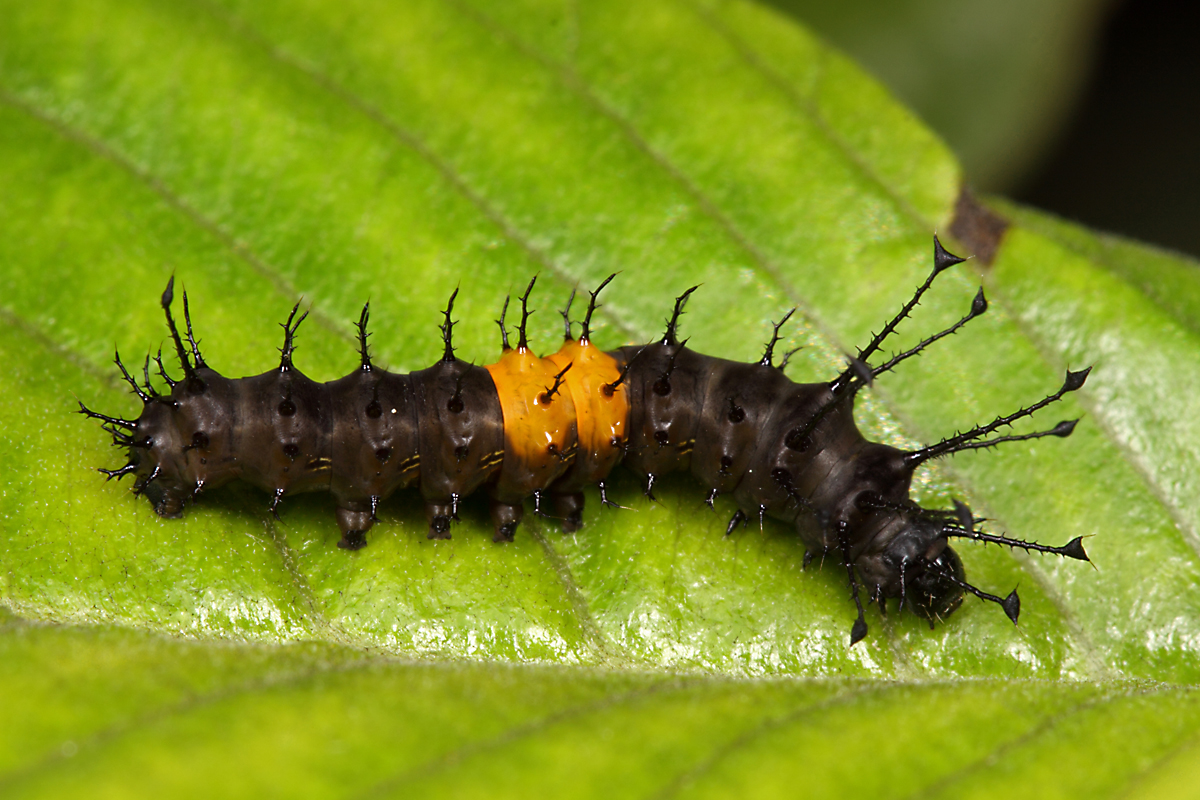
Citheronia laocoon? 1st instar larva | Campinas, Brazil

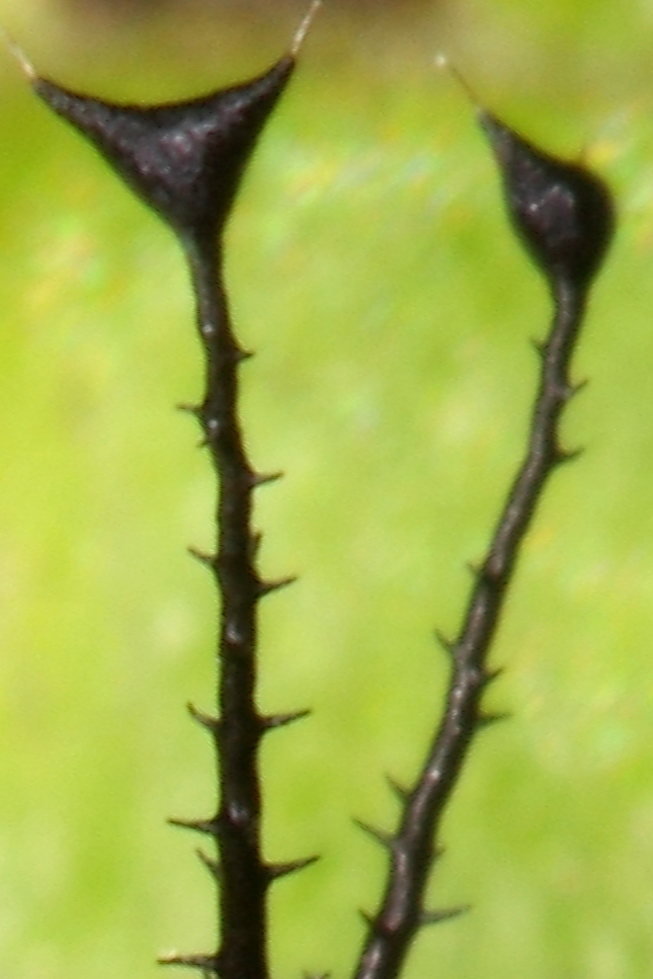
I was sure Super Crop Challenge #6 would be a win for the house, but Troy Bartlett scored an impressive points sweep by correctly deducing that the structures shown were the spines of an early instar caterpillar of “something akin to a hickory horned devil (Citheronia regalis).”  I found this caterpillar feeding on the foliage of a small tree in the Ciudad Universitaria (Distrito Barão Geraldo) area of Campinas, Brazil last January.  I must confess that I spent considerable time trying to identify it myself before I finally threw in the towel and called on the experts for help.  The spines made me think it must be some kind of nymphalid butterfly larva, although I had never seen such “fly swatter” clubs at the ends of the spines, so I sent the photo to Phillip Koenig, a local butterfly expert who has collected extensively in Ecuador.  He, too, was puzzled and forwarded the photo to Charley Eiseman, who himself didn’t know what to make of it and forwarded it on to Keith Wolfe, a lepidopterist who specializes in butterfly immatures.  After stumping his Brazilian contacts, Keith had the idea that perhaps it wasn’t a late-instar larva—as we all had assumed (this larva was a good 15–20 mm in length), but rather one in an early stadium.  A quick search of several standard websites revealed this to be the L1 or L2 larva of a species of Citheronia (Saturniidae, Ceratocampinae).  To support his ID, he provided links to larval photos of C. splendens (Arizona) and C. lobesis (Central America).  The L1 larva of both of these species bears the same “fly swatter” spines, and the latter is remarkably similar in color pattern as well.

In trying to determine what species of Citheronia occur in southeast Brazil, I came across this link with photos of a caterpillar from southern Brazil—the L1 looking nearly identical—that was eventually identified as the common Brazilian species C. laocoon.  Troy suggested C. brissotii—another good possibility as that species is found from southeastern Brazil through Uruguay to Argentina.  However, in perusing a number of online sources, it appears there are several other species of Citheronia that also occur in Brazil, so a species ID for the larva in this photo may not be possible.

Troy’s win vaults him into 3rd place in the current session overalls, but steady Tim Eisele took 2nd place with 6 pts and takes over the session lead.  Newcomer Roy rounds out the podium in 3rd place with 5 points.  Dave’s pity points are nothing to sneeze at, as they helped him retain sole possession of 2nd place in the overall standings (let that be a lesson to those who don’t play because they’re “stumped”!).  There will be at least two more challenges in the current session before a winner is crowned, so look for an opportunity to shake up the standings in the near future.

Copyright © Ted C. MacRae 2011

Super Crop Challenge #6

I thought I had everyone stumped in Super Crop Challenge #5, but Dave took advantage of the extended answer period and cracked the code for a solo win and the lead in the current session.  For this edition of Super Crop Challenge, I offer the following impossibly cryptic crop of a photo I took this past winter.  The organism is from Brazil, but that’s no excuse for punting since there are very similar North American counterparts.  Points for order, family, genus and a possible species ID are all up for grabs, as are the structures and specific life stage to which they belong.

Standard challenge rules apply, including moderated comments (to give everyone a chance to take part) and possible bonus points for being the first to guess correctly (in the off chance multiple people offer the same correct answers) or for making me chuckle.  Reminder: nobody walks away with no points, so it pays to try even if you haven’t a clue!

Copyright © Ted C. MacRae 2011

Forgotten Foto Friday: Eudioctria sp.

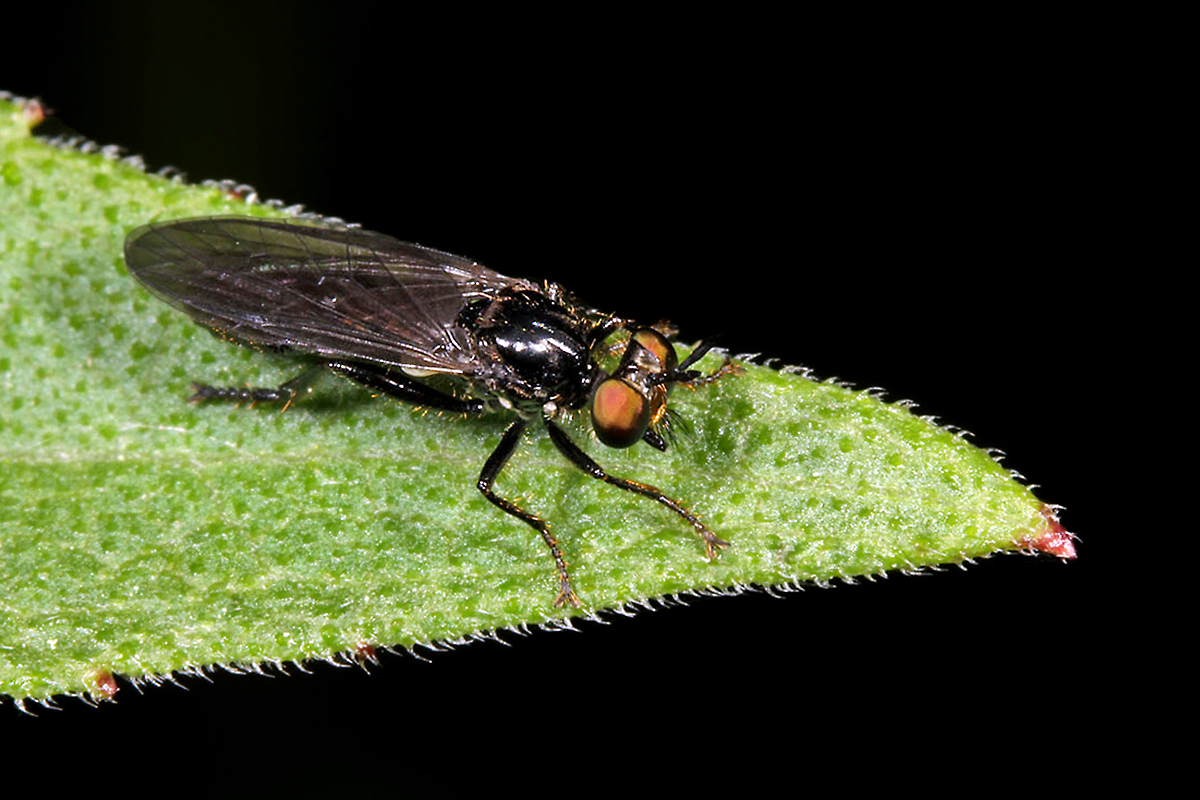
Eudioctria sp. | Shaw Nature Reserve, Gray Summit, Missouri

In keeping with my recent theme featuring insects from Shaw Nature Reserve, I present here a long-forgotten photograph that I took back in May 2009.  In fact, not only was this photo taken on the maiden voyage of my Canon dSLR setup, but it is the very first photograph of an insect that I took with the camera—image #19 (1-18 were the initial test shots and a few immediately discarded photos).  It won’t win any awards, but it’s not a bad photo, and the fact that I immediately began attempting shots with the lens dialed all the way up to 1:1 shows I had no qualms about going for broke.

As best I can tell, this is a member of the robber fly genus Eudioctria in the subfamily Stenopogoninae.  Species in this genus are among the tiniest of North American robber flies,  measuring only 6–8 mm in length (compare this with the spectacular 35–40 mm length of North America’s largest robber fly).  They superficially resemble species of the unrelated genus Cerotainia (subfamily Laphriinae) but lack the extra-long antennae. According to Norman Lavers (The Robber Flies of Crowley’s Ridge, Arkansas), Eudioctria can also be distinguished behaviorally, as it prefers flat leaves at the top of small shrubs, while Cerotainia tends to perch on twig-ends.  Eudioctria is primarily a western U.S. genus, although four of its 14 species (albius, brevis, propinqua, tibialis) occur in the eastern states (Adisoemarto and Wood 1975).  I can’t possibly determine which of those four species this individual represents, as to do so requires examination of facial gibbosities and judgements about the degree to which various body parts are pollinose(?)—perhaps I should stick with beetles!

REFERENCE:

Adisoemarto, S. and D. M. Wood.  1975.  The Nearctic species of Dioctria and six related genera (Diptera, Asilidae).  Questiones Entomologica 11:505–576.

Copyright © Ted C. MacRae 2011

A Missouri hotspot for Cylindera unipunctata

Cylindera unipunctata | Gray Summit, Franklin Co., Missouri

Cylindera unipunctata | Shaw Nature Reserve, Gray Summit, Franklin Co., Missouri

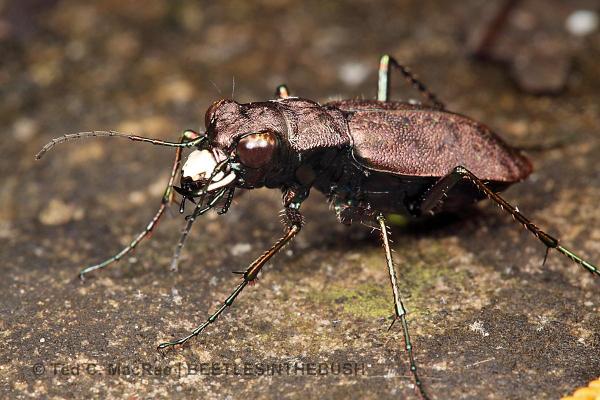
Long before I began studying tiger beetles in earnest, I became aware of one of Missouri’s more interesting species—Cylindera unipunctata (one-spotted tiger beetle).  One of my favorite woodboring beetle collecting spots back in the 1980s was Pinewoods Lake Recreation Area near Ellsinore in the southeastern Ozarks.  I had stumbled upon this spot in the beginning my beetle studies and spent countless days wandering the trails through the open forest that surrounded the relatively new lake and blacklighting in the campground at night.  I literally cut my entomological teeth at this spot.  While woodboring beetles were my quarry, I couldn’t resist the few brown, apparently flightless tiger beetles (in reality, they can fly but rarely do so) that I had seen clambering across the woodland trail in front of me during one of my first visits to the area.  That following winter, when I showed them to Ron Huber during a mutual visit at the home of long-time lepidopterist Richard Heitzman (and as far as I know, owner of the largest private insect collection in Missouri), I was pleased to see his palpable excitement at my find.  I kept an eye out for this species ever since, and while I have found them in a number of localities here in Missouri—all along the eastern edge of the Ozark Highlands south of St. Louis, I’ve never seen more than one or two, or maybe three at a time.  Even when returning to spots where I had seen them previously and looking for them specifically, they seemed a rare, elusive species.  By the time Chris Brown and I had begun our serious studies of the Missouri tiger beetle fauna, I had accumulated no more than a dozen or so specimens from places like Pinewoods Lake, Hawn State Park, and Trail of Tears State Park.  Their seeming preference for shaded, woodland habitats is unusual amongst North American tiger beetles, save for the conspicuous and commonly encountered Cicindela sexguttata (six-spotted tiger beetle), but within that habitat I had begun to notice a commonality—open woodland with steep rocky/clay slopes.

Beetles are quick to take cover in the leaf litter

Beetles are quick to take cover in the leaf litter

A few years ago, Chris Brown noticed that this species seemed to be fairly common at Shaw Nature Reserve in Gray Summit, Missouri.  I was surprised to learn of the occurrence of this species just 40 miles southwest of St. Louis (and only 15 miles from my home), and in 2009 I resolved to go there and see it for myself.  I had just begun digital insect photography at the time as well, so I was looking forward to the chance to photograph one of Missouri’s rarer tiger beetles.  On the first trip to SNR in May 2009, I searched the trails repeatedly where Chris had seen them but never saw a single one.  I thought maybe I was too early, so I went back a couple of weeks later at the end of May, and this time I found one… but just one!  I got off a series of shots before the beetle bolted and eventually disappeared, leaving me with one decent shot of the species.  The lighting and focus in the photo were good, but the photo was just… well… boring!

Adults were most frequent along sloping portions of the trail.

Adults were most frequent along sloping portions of the trail.

A few weeks ago, again near the end of May, I decided to try for the species again.  I’ve now been photographing tiger beetles for two years rather than two weeks, so perhaps I’ve learned a few tricks in locating and photographing the beetles that would give me a better variety of photos to show for my effort.  I went back to the same trail (Jane’s Wildflower Trail), and while I did have better luck (finding four beetles instead of just one) I was still not happy with the photos I had gotten to that point (only Photo #2 is from that session).  I decided to try my luck along another trail (Bluff Overlook Trail) where James Trager had seen an individual earlier just that week.  At first, the beetles seemed to have the same fairly low occurrence that they had along the first trail.  Still, I saw enough individuals to get a number of photos that I was happier with (#1, #3 and #4 in this series), and I figured the job was done.  We hiked down towards the river to see if we might find the population of Cicindela formosa generosa that Chris had seen on a sand bar in a previous year, but flooding by the Meramec River had much of the area—and certainly any open sandy areas—under water.

Beetles were less skittish when hidden amongst small plants.

Beetles were less skittish when hidden amongst small plants.

By the time we took the trail back up to the higher elevations it was getting later in the afternoon, and I returned to keeping an eye out for the tiger beetles.  As soon as we returned to the steep, rocky clay slope areas where I had seen the few earlier beetles, I started seeing them in decent numbers.  I had enough photos by then, so I collected a few more individuals to beef up the voucher series, and as we walked it seemed the beetles became more numerous with each step.  Then I saw something I had not seen all day—a mating pair!  I carefully setup for the shot, but I disturbed them in the process and they split up.  However, dejection quickly turned to elation, as almost immediately I saw another mating pair.  This time I made no mistakes and got in a few shots before they broke up and split.  As I was photographing them, I saw another mating pair perched on a nearby rock—I liked them even better, and the shot below is my favorite of that pair.  Over the next half hour, we saw countless adults and mating pairs.  Part of me wonders if it was the time of day, as the species is reported to be more active during late afternoon (Pearson et al. 2006).  I do note that all of my visits to Jane’s Wildflower Trail have been during morning and early afternoon, so perhaps they are just as common along that trail as well and I have just never been there at the right time of day to see that.

Mating pairs were seen with greater frequency during late afternoon.

Mating pairs were seen with greater frequency during late afternoon.

While most of the adults I saw were on the Bluff Overlook Trail, one thing I did find in numbers along Jane’s Wildflower Trail were larval burrows.  Their location was consistent with the habitat noted by Hamilton (1925), who described the larvae from specimens dug from bare, rocky soil on a steep, sparsely wooded hillside.  I returned the next morning to the spot where I had seen the larval burrows and was able to extract four larvae from their burrows by digging them out and have set them up in a rearing container of native soil.  I can’t yet rule out the possibility that they might represent C. sexguttata, which occurs commonly in the area; however, all signs—the depth of the burrows (only 3 to 4 inches), their occurrence on steep, rocky slopes, the open woodland—point to them belonging to C. unipunctata.

Larval burrows were located on steep rocky/clay slopes in open woodland.

Cylindera unipunctata may truly be more common across its range (eastern North American forests) than is realized.  In contrast to C. sexguttata, and despite their shared woodland habitat, C. unipunctata is somber colored, avoids sunlit spots, rarely flies, and shows a distinct preference for staying within the leaf litter.  These features make the beetles easily overlooked, even by experienced tiger beetle collectors.  Frank Guarnieri (2009) recently published a note describing a “hot spot” for this species in Maryland, in which he described an encounter with innumerable individuals in a Maryland state park from late May through June.  This encounter was all the more remarkable considering that he had only seen two individuals during the previous ten years.  I tend to agree with his assertion the scarcity of C. unipunctata is probably more apparent than real—an artifact of its cryptic habits, short temporal occurrence, and fairly specific habitat preferences that are atypical amongst most tiger beetle species.

REFERENCES:

Guarnieri, F. G.  2009.  Observations of Cicindela unipunctata Fabricius, 1775 (one-spotted tiger beetle) at Pocomoke River State Park, Worcester County, Maryland.  The Maryland Entomologist 5(1):2–4.

Hamilton, C. C.  1925.  Studies on the morphology, taxonomy, and ecology of the larvae of Holarctic tiger beetles (family Cicindelidae).  Proceedings of the U. S. National Museum 65(17):1–87.

Pearson, D. L., C. B. Knisley and C. J. Kazilek. 2006. A Field Guide to the Tiger Beetles of the United States and Canada. Oxford University Press, New York, 227 pp.
Predator Satiation

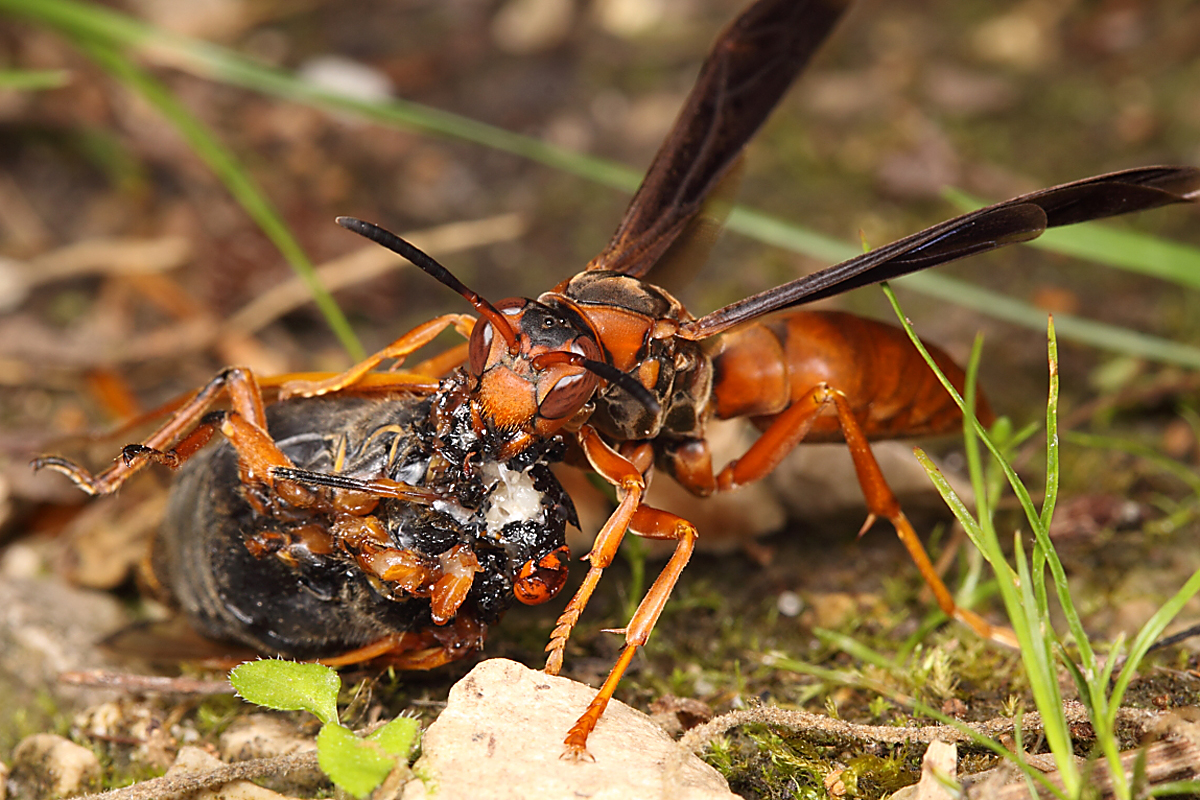
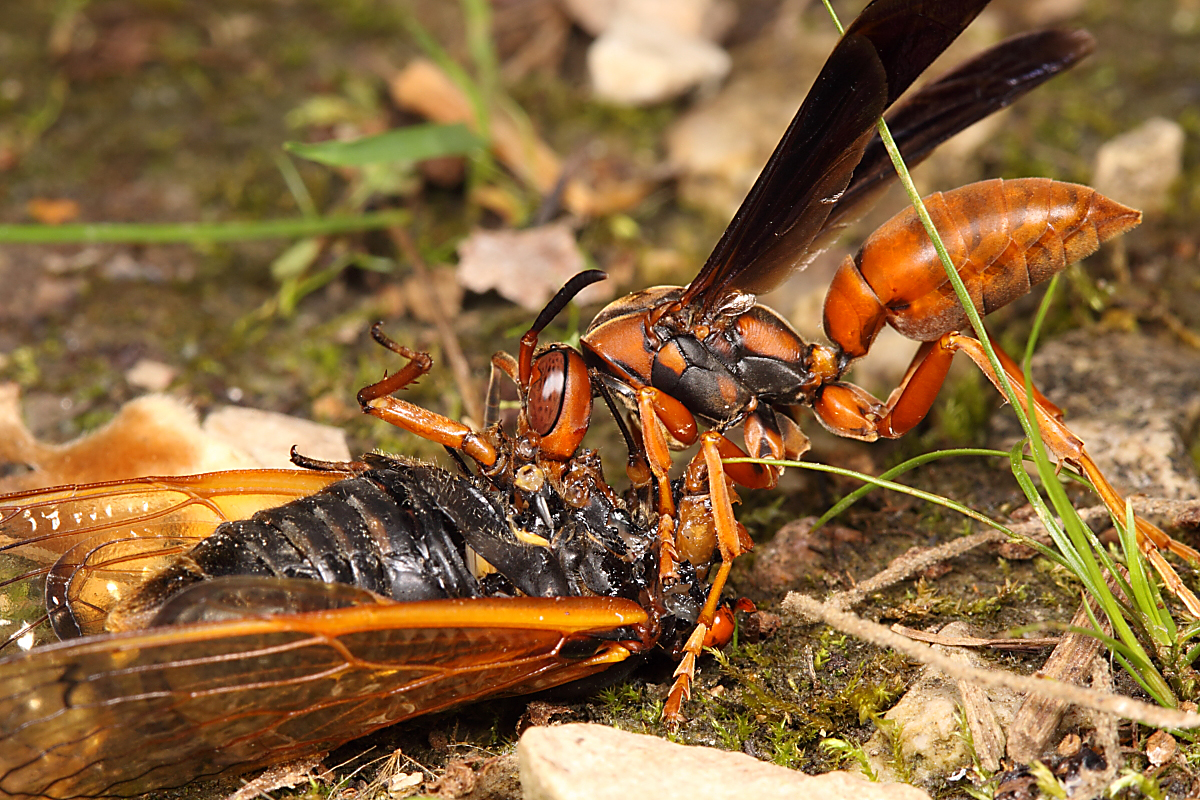
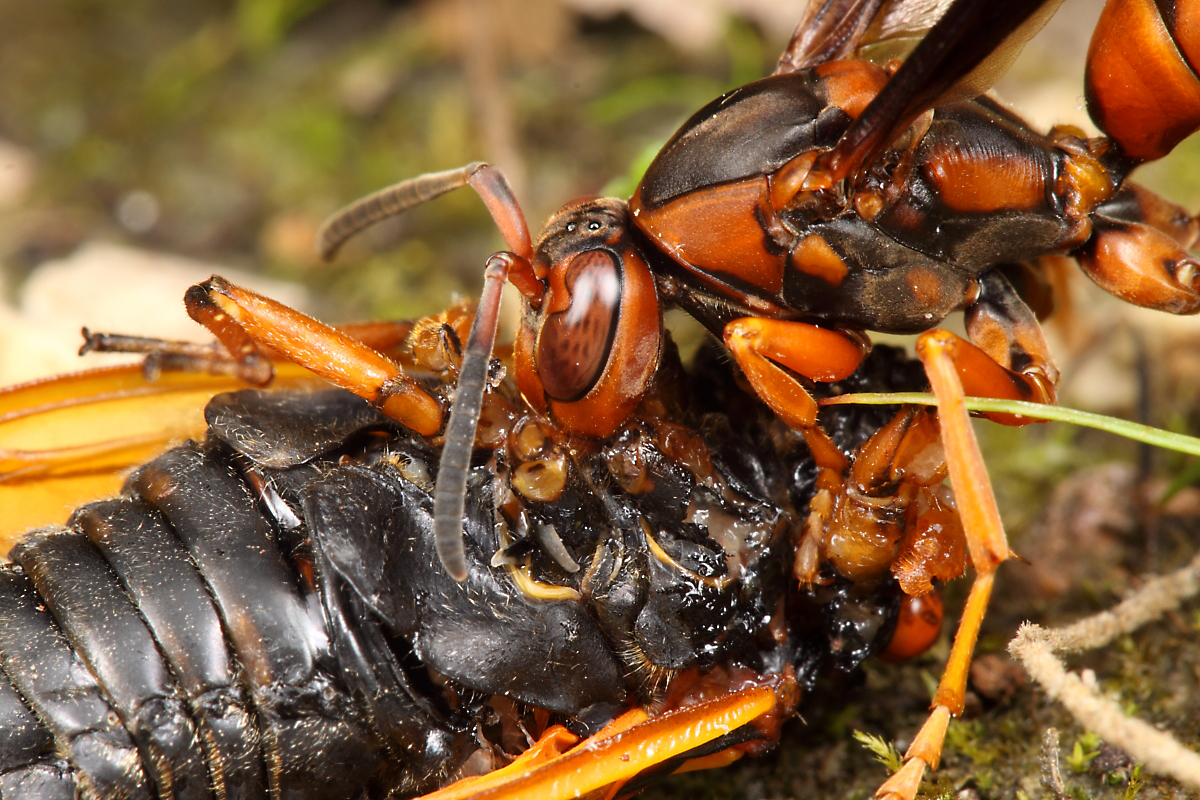
Polistes carolina/perplexus with Magicicada prey | Shaw Nature Reserve, Missouri

I’ve probably used the term predator satiation more often during the past couple of weeks than I have during the entire rest of my life.  Students of ecology know this as an antipredator adaptation in which prey occur at such high population densities that they overwhelm predator populations.¹  This ‘safety in numbers’ strategy reduces the probability that any given individual will be consumed, thereby ensuring that enough individuals survive to reproduce.  With St. Louis currently experiencing the appearance of Brood XIX of periodical cicadas, I’ve gotten lots of questions recently from many coworkers and friends wanting to know more about these cicadas.   Often the first question is “What is their purpose?”  My standard reply begins with a statement that they, like all living organisms, are the products of natural selection, which then presents an opportunity to explain how natural selection might result in such massive, temporally synchronized, multiple-species populations.  A few eyes have glazed over, but I think most have found my answer interesting, often even leading to further questions about where they lay their eggs, what is their life cycle, why are they so loud, how do they “do it” and select mates, etc.  Of course, as an entomologist with a strong natural history orientation, I’m always anxious to introduce people to ecological concepts, and right now the periodical cicada is providing a conspicuous, real-life example of such.

¹ Also called “predator saturation,” although this term might be misconstrued to mean that it is the predators that are over-abundant.

First the eyes...

A few weeks ago, right at the beginning of their emergence in the St. Louis area, my friend Rich Thoma and I observed predator satiation in action.  While hiking one of the trails at Shaw Nature Reserve, we heard the unmistakable shriek and cellophane-sounding wing flapping of a just-captured male cicada.  Tussling on the ground ahead of us was the cicada in the grasp of a Polistes carolina/perplexus wasp, which was repeatedly stinging the hapless cicada on the underside of the abdomen.  The shrieking and wing-flapping grew less frequent as the stinging continued, until at last the cicada lay quiet.  As we approached, the wasp spooked and flew off, but we knew it would be back—we parked ourselves in place while I setup the camera, and before long the wasp returned.  It took several minutes of searching from the air and on the ground before the wasp finally relocated her prey, but once she did she began voraciously devouring it.  As the wasp was searching, we hypothesized that our presence had altered the visual cues she had memorized when flying off, resulting in some confusion when she returned, and thus the long period of time required to relocate her prey.

...then the legs!

We watched for awhile—first the eyes were consumed, then the legs.  As it consumed its prey, Rich remarked that he bet he could pick up the wasp and not get stung—likely the entirety of its venom load had been pumped into the cicada.  Both of us declined to test his hypothesis.  We also wondered if the wasp would butcher the cicada after consuming part of it and bring the remaining pieces back to the nest.  We had seen a European hornet do this once with a band-winged grasshopper, consuming the head, then cutting off the legs from the thorax and flying away with it before returning to collect the abdomen as well.  No butchering took place this time, however, the wasp seemed content to continue eating as much of the cicada as possible—a satiated predator if there ever was one!

Leg after leg is consumed.

One eye and all six legs down, time to start on the abdomen.

Copyright © Ted C. MacRae 2011

Do you think I’m tasty?

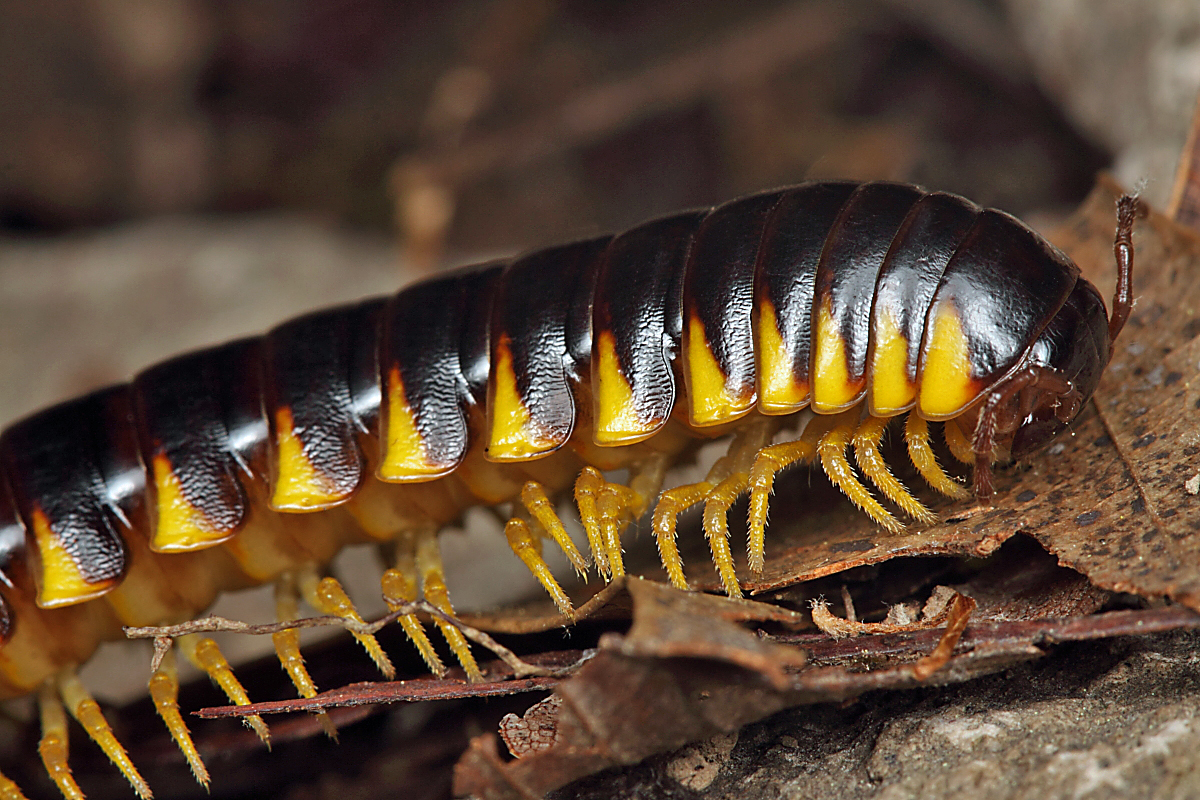
As I hiked the upper stretch of the Shut-Ins Trail at Sam A. Baker State Park in southeastern Missouri, I encountered this 2-inch long millipede slowly making its way across the rocks.  Many millipedes, of course, produce hydrogen cyanide (HCN) as their primary method of defense against predation, and the bright yellow markings of this individual were an obvious sign that this particular species is no exception.  The wrinkled dorsal surface and black coloration with yellow wedge-shaped posterolateral markings identify it as a species of Pleuroloma (BugGuide), and of the four species known from North America (Shelley 1980) only the widespread Pleuroloma flavipes (literally meaning “yellow legs”) occurs as far west as Missouri (Shelley et al. 2004).  A similar pattern of coloration is seen in a number of related genera, e.g. Apheloria, Boraria, and Cherokia—all belonging to the order Polydesmida, presumably functioning across the group as an aposematic (warning) signal to predators that they should be left alone.  Another feature shared by the members of this group is the lateral expansion of the dorsal segments into “paranota,” giving the species a much more flattened appearance than other millipedes with the more typical cylindrical shape.  While all millipedes exhibit diplosegmentation (embryonic fusion of paired body somites and associated legs, spiracles, and ventral nerve cord ganglia), members of the Polydesmida have taken this condition to its culmination with no evidence of external sutures (Myriapoda.org).

The bright coloration of this species was an interesting contrast to the cryptic invisibility of the copperhead snake I had seen just a few moments earlier during the hike—opposite strategies with identical goals.  Defense compounds are, of course, widely employed by many plants and animals; however, only millipedes and a few insects have developed the ability to utilize HCN, a highly toxic compound that halts cellular respiration in most animals through inhibition of the mitochondrial enzyme cytochrome c oxidase.  Evidence suggests that Pleuronota flavipes and other millipedes can tolerate HCN because they possess a resistant terminal oxidase that makes their mitochondria insensitive to the effects of HCN (Hall et al. 1971).

Perhaps some of you will be interested in this recent checklist of the millipedes of North and Central America (Hoffman 1999).

Update 6/13/11: My ID as Pleuroloma flavipes must be considered tentative, as Rowland Shelley has sent me an email with the following comment:

It could be Pleuroloma flavipes Rafinesque, 1820, or it could be Apheloria virginiensis reducta, I can’t really tell from the photos.


REFERENCES:

Hall, F. R., R. M. Hollingworth and D. L. Shankland. 1971. Cyanide tolerance in millipedes: The biochemical basis. Comparative Biochemistry 34:723–737.

Hoffman, R. L.  1999.  Checklist of the millipedes of North and Middle America. Virginia Museum of Natural History Special Publication No. 8, 584 pp.

Shelley, R. M. 1980. Revision of the milliped genus Pleuroloma (Polydesmida: Xystodesmidae). Canadian Journal of Zoology 58:129–168.

Shelley, R. M., C. T. McAllister, and S. B. Smith. 2004. Discovery of the milliped Pleuroloma flavipes in Texas, and other records from west of the Mississippi River (Polydesmida: Xystodesmidae). Entomological News 114 (2003):2–6.

Copyright © Ted C. MacRae 2011

Pardalophora phoenicoptera – Orange-winged grasshopper

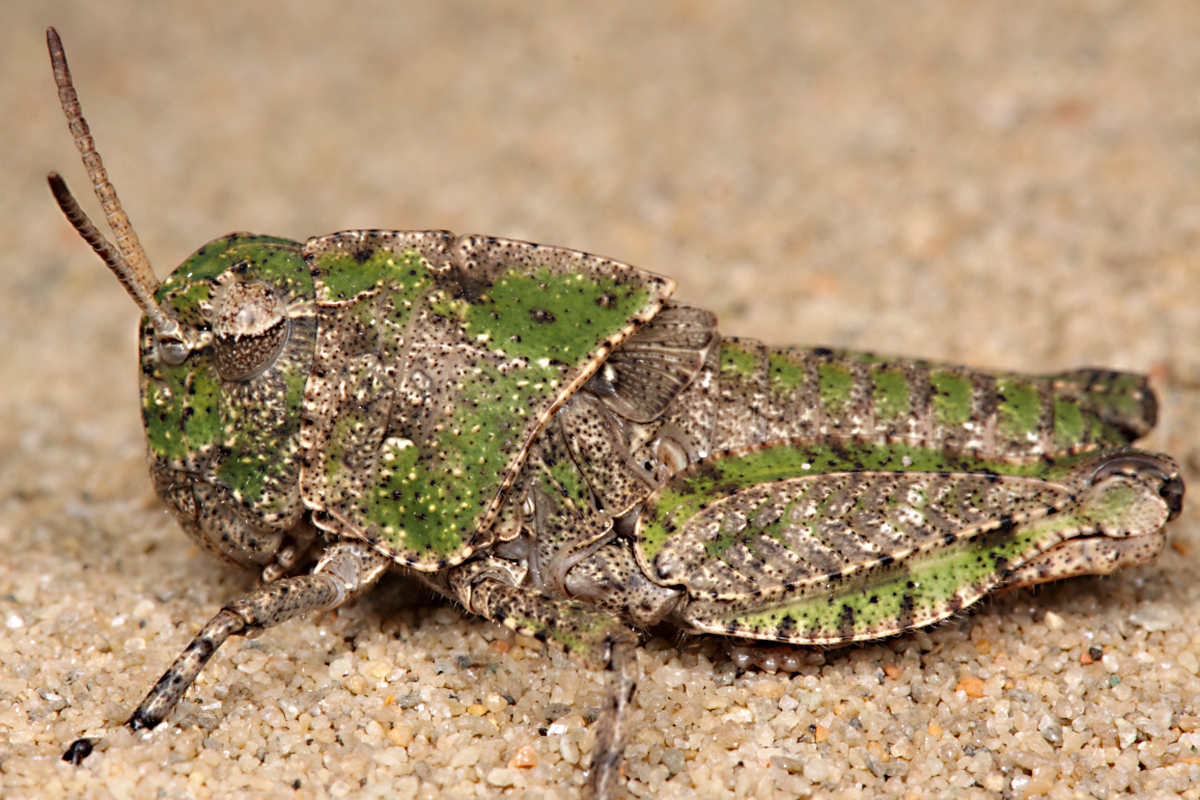
For some reason, I’ve found myself increasingly fascinated with certain grasshoppers—not just any grasshoppers, but band-winged grasshoppers (family Acrididae, subfamily Oedepodinae).  And not just band-winged grasshoppers, but band-winged grasshopper nymphs.  It began last year when I found adults and nymphs of Trimerotropis latifasciata in the Glass Mountains of northwestern Oklahoma.  I believe it has something to do with the combination of their frequent association with the same habitats where I look for my beloved tiger beetles and their marvelously cryptic coloration.  Adults themselves are cryptic enough—that is, until they flash their brightly colored hind wings, but the nymphs are positively invisible until they move.  Moreover, many species show a wonderful range of intraspecific diversity in their crypsis—Ronald Reagan may have thought every redwood tree looked the same, but when you’ve seen one band-winged grasshopper nymph, you most certainly have not seen them all.


These two band-winged nymphs were seen at St. Joe State Park (St. Francois Co., Missouri) in the vast central “sand flats” of the park (actually waste areas of crushed limestone tailings left from lead mining operations during the previous century).  At first I assumed they each represented a different species, but based on comments at BugGuide I take both of them to represent Pardalophora phoenicoptera (orange-winged grasshopper)—distinguished from Xanthippus by having only one notch in the pronotal crest and unusual amongst most grasshoppers in that the winter is passed as a nymph rather than egg.  This leads to well-developed nymphs at the beginning of spring and adults much earlier in the season than many other grasshoppers.  These photos were taken on April 28, and the size of the wing pads suggests they are not quite full-grown yet, maybe 3rd or 4th instars.  Acridoid aficionado David J. Ferguson has found this species in the Ozarks on rocky/gravelly hilltops (e.g., “cedar glades”) and on gravelly or stable sandy slopes in sunny openings in Oklahoma. He places the species (particularly the green ones) high on his favorite hopper list, and I’d have to say I agree with him (so far).

One of these days, I’m going to find and photograph the king of all green oedepodines—Trimerotropis saxatilis!

Update 6/8/11: Dave Ferguson has kindly confirmed the ID, writing:

…yes these are identified correctly.  Assuming 5 instars, they look like 4th (where there are 6 instars, numbers 4 and 5 look a lot alike).

Copyright © Ted C. MacRae 2011

They’re baaaaack… finally!

For almost a month I waited—waited for that spaceship-sounding drone from the trees; waited for their bodies to drip from the vegetation and their skins to litter the yard; waited for their delightful shrieks every time I jostle a tree branch. I had seen them mass emerging from the ground in southern Missouri in late April, but just 100 miles north in my hometown it seemed they would never show. Cold, rainy springs must not be to their liking, as it was not until the sun finally broke through and temperatures climbed into the 80s that they finally made their appearance in St. Louis—nearly a month after that mass emergence event further south had me looking and listening daily for one of North America’s most spectacular natural history events, Brood XIX of the periodical cicada!

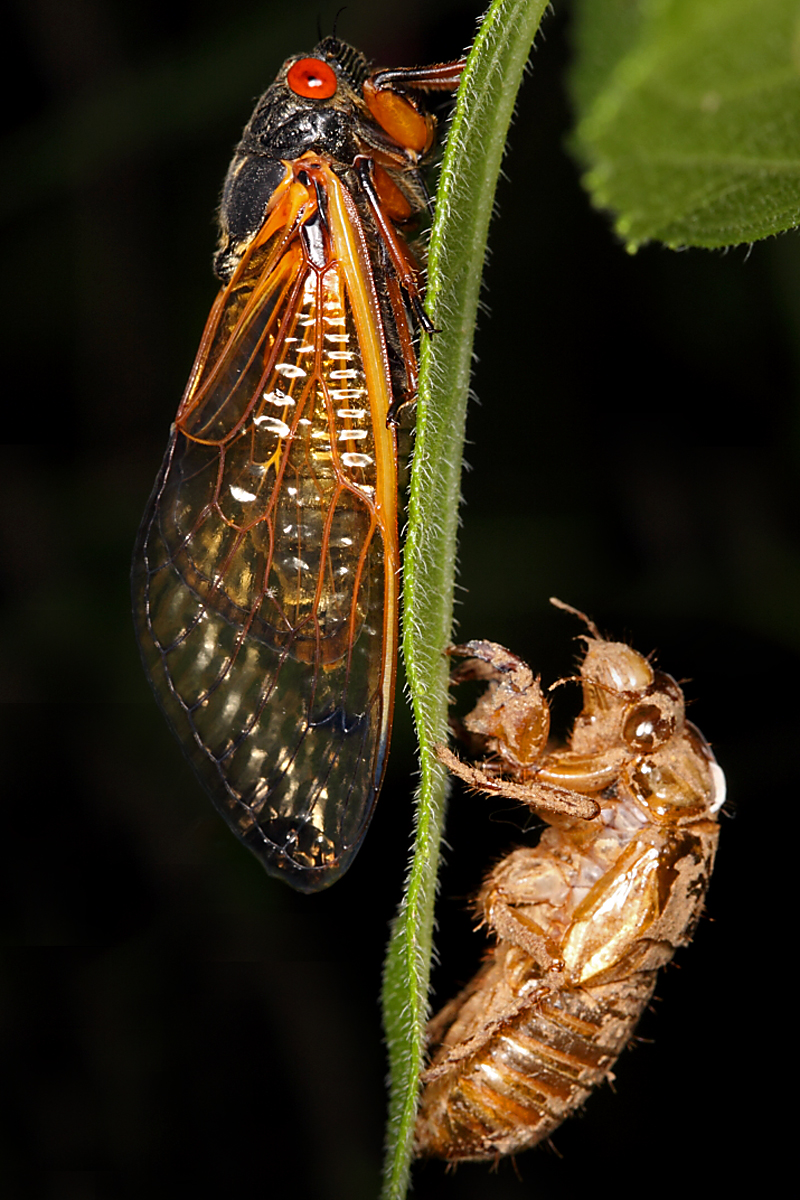
Finally, on May 21 I saw the first adults of the year at Shaw Nature Reserve not too far from my house (not intending to claim this as the date of their first appearance in my area!). They were not yet singing, but the adults were everywhere, many sitting right next to the skins they had just emerged from the previous evening. I had to travel on business through the southeastern U.S. that following week, and it was while visiting the beautiful MSU campus in Starkville, MS that I got my first taste of their late-afternoon synchronized, pulsating song. Upon my return to St. Louis at the end of the week, the eery drone filled the air as soon as I stepped out of the airport. It had been 13 years since I’d heard that sound, but euphoric recall instantly transported me back to 1998 and 1985 and my experiences with these marvels of evolution.

I don’t know that there is anything I can say about the periodical cicada that hasn’t already been said—repeatedly—by the numerous, more erudite sources that are following this event as if it were the approach of Haley’s comet. I don’t even know for sure which species are in my area and how to tell them apart. All I do know is that the constant droning of their singing is both maddening and amazing—a spectacle to behold for what it is, knowing that it will be the year 2024 before I have my next chance to witness it.

As I write this, I’m sitting in my hotel room in Salem, AR, where the cicadas are even more abundant than around my home in the woods—several stops to check building lights for beetles have ended in frustration because the cicadas were so numerous that they virtually swamped the space on the walls under the lights. There do seem to be two species here—a smaller one with a completely dark underside and the raspy, screeching sound that I am familiar with, and a larger one with the abdominal segments light along the posterior margins and a softer trill that almost reminds me of the song of an American toad. Maybe there are other species mixed in that I have not discerned, but I’ll not concern myself with that. Instead, I will continue to marvel at the extraordinary event unfolding before me, watch it as it cycles out, and chuckle at the complaints of the masses bemoaning their temporary inconveniences.

Copyright © Ted C. MacRae 2011