Do the Doodlebug Flip

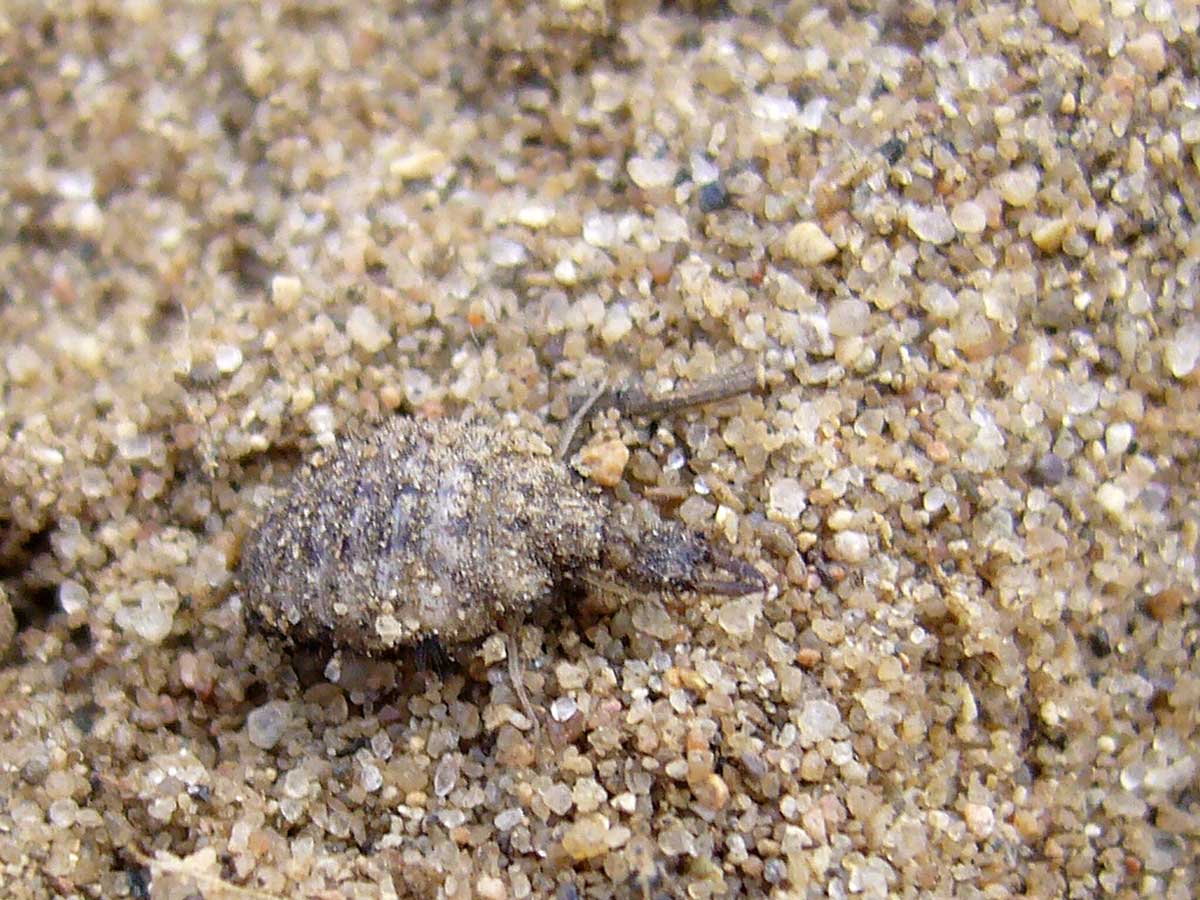
I’ve been on a doodlebug kick ever since I finally figured out how to find the little buggers on my trip down to southeast Missouri.  I even found one in one of the tiger beetle terraria that I setup with native soil brought back from that trip, so I’ll get the chance to try to rear one out.  Shortly after finding those first antlion larvae, I traveled to Rock Island, Illinois to attend the Second Illinois Hill Prairie Conference as a panelist for the insects discussion group.  During a field trip to a nearby hilltop prairie, I spotted a pit in a bed of sawdust that had the unmistakeable look of an antlion pit.  I can’t say that I’ve ever seen an antlion pit in anything but sand, so I dug up the larva to confirm that that was, indeed, what it was.  The larval pit site must have been selected by the adult female who laid the egg, so apparently the loose sawdust had the appropriate texture to induce oviposition.  The larva was fat and happy, suggesting it was feeding well in its sawdust pit.

Antlions flick sand with their head and elongated mandibles to create the pit, and they also flick it on prey that has fallen in their pit to thwart their escape.  Watch how this one also use its head flicking ability to right itself in a most humerous manner after being flipped over:

Copyright © Ted C. MacRae 2009

Add to FacebookAdd to NewsvineAdd to DiggAdd to Del.icio.usAdd to StumbleuponAdd to RedditAdd to BlinklistAdd to Ma.gnoliaAdd to TechnoratiAdd to Furl

BitB Goes dSLR

That’s right, I’ve finally acquired a bona fide digital SLR camera system and am taking the plunge into real insect macrophotography. I’ve been playing with my little point-and-shoot over the past 18 months or so, and the more I used it to take photographs of tiger beetles and other insects, the more I realized what I could do if I had a true macro system.  I made the decision several months ago and got lots of good advice on what kind of system I should put together from my colleague, field companion, and insect macrophotographer-extraordinaire Chris Brown, as well as from Adrian Thysse over at Voyages Around My Camera. For a time, I was trying to design a system on a rather tight budget, and Adrian graciously wrote an excellent post (Basic DSLR Macro System on a Budget) in response to my query.  The problem was, I could get the macro lens that I wanted but would have to really skimp on the flash and the camera body.  Or, I could get both the lens and the flash that I wanted, but then I’d have no money for a camera (kind of hard to take photographs with a lens and flash only).  I was thinking that maybe I could come up with a cheap body somewhere that I could live with for awhile, but in the end I realized that if I was going to do this I had to do it for real and find some way to scrape up the funds for a real system.  I decided to sell all of my bike racing equipment, keeping just my one really nice carbon road bike and a backup.  Happily, my equipment sold for a lot more than I thought it would, and I ended up raising enough funds not only to purchase a real system, but to purchase the system of my dreams.  I present to you the new BitB (Beetles in the Bush) insect macrophotography system¹:

Canon_P1020977_2

¹ It is ironically amusing that I had to take this photograph with my old point-and-shoot camera!

The system includes:

  • Canon EOS 50D Camera
  • Canon EF 100mm f/2.4 Macro Lens
  • Canon MP-E 65 mm 1-5X Macro Lens
  • Canon EF-S 17-85mm Zoom Lens
  • Canon MT-24EX Macro Twin Lite Flash
  • Kenco extension tubes (12mm, 20mm, 36mm)

At this point, I feel like I have just jumped into the ocean after having taken one introductory swim class at the YMCA.  I really have no experience with SLR photography since putting away my old Olympus OM-10 with a Zeiko 50mm macro lens some 20 years ago (pulling it out briefly for my trip to South Africa almost 10 years ago), and my digital experience has been limited to the Panasonic Lumix DMC-FX3 I’ve been using since I started this blog.  However, I’m a smart fellow and am reading everything I can right now, and I have the able tutelage of my colleague Chris, who has been more than willing to help show me the ropes with insect macrophotography in much the same way that I helped him get up to speed on our state’s fascinating tiger beetle fauna.

I suspect I’ll use mostly the 100mm out in the field, as most tiger beetles require slightly less than 1:1 magnification.  The extension tubes will also be useful in the field when I need to get a little more than 1:1 but don’t want to pull out the 1-5X beast.  Above 1.5, which I’ll need for many of the smaller buprestids (that the rest of the insect macrophotography world has overlooked to this point), I’ve got no choice – I’ll have to pull out the 1-5X.  I’m a little fearful of this lens (see Alex‘s fine review), which seems to have a steep learning curve (I haven’t even taken a shot with it yet), but I’ll just have to deal with it if I want to get the kind of photos I’m looking for with our beautiful, but small, jewel beetles.  Perhaps someday I’ll earn a listing under people’s “Insect Macrophotographers” blogrolls, but I doubt I’ll be posing much competition to the likes of Alex, Adrian, Chris, Kolby, Dalantech, and Mark for the time being.

For now, I present to you the very first tiger beetle photograph taken with my new system, the common spring woodland species, Cicindela sexguttata (six-spotted tiger beetle).  It’s not real close up, but it is tiger beetle photograph number one!

Cicindela sexguttata

Photo details: Canon EF 100mm macro lens on a Canon EOS 50D, ISO 100, 1/200 sec, f/18, flash at 1/4 power

Copyright © Ted C. MacRae 2009

Add to FacebookAdd to NewsvineAdd to DiggAdd to Del.icio.usAdd to StumbleuponAdd to RedditAdd to BlinklistAdd to Ma.gnoliaAdd to TechnoratiAdd to Furl

Tiger Beetle Rearing

I recently found an interesting website called Tiger Beetle Rearing.  This website by doctoral candidate Rodger Gwiazdowski in the Joseph S. Elkinton lab, University of Massachusetts, Amherst contains a wealth of information and photographs covering equipment, techniques, and methods for rearing tiger beetles from egg to adult, with a primary focus on rearing endangered and threatened species of tiger beetles for conservation and re-release into the wild.  The lab has reared a number of tiger beetle species but is particularly interested in the Puritan tiger beetle (Cicindela puritana), threatened in the northeastern U.S.  After the first year of rearing, 90 2nd and 3rd instar C. puritana larvae were obtained and, as of the last update, were overwintering in individual tubes.  You’ll need to register with the site with a username and password to access the site, but this is accomplished quickly and easily.

Welcome to the Hotel Cicindela!

Welcome to the Hotel Cicindela!

I found this website of great interest as I begin my own efforts at rearing these beetles in the laboratory.  My primary interest is in rearing larvae that I collect in the field to adulthood – adults are much more easily identified than larvae (indeed, the larvae of many species remain undescribed), and rearing field-collected larvae is one way to get around the often limited temporal occurrence that many tiger beetle species exhibit as adults.  My operation isn’t nearly as sophisticated as the one developed in the Elkinton lab, but then I’m just a working stiff trying to do this (and a million other things) on the side. Despite this, I have had my first success, rearing to adulthood a larva I collected during the summer last year (see my post It’s a girl!).  In addition, I currently have a number of larvae collected last fall in Nebraska and South Dakota, which I put in terraria of native soil and kept in a cold incubator during the winter.  I pulled them out earlier this spring, and soon afterwards a number of larvae opened up their burrows and have been feasting on fall armyworm and corn earworm caterpillars every 2-3 days or so.  The larvae were collected from a variety of habitats and soil types, including sand, alkaline seeps, and red clay banks, so I’m hopeful that the ensuing adults will represent a variety of interesting species – perhaps some that I did not encounter in the field during that trip.

Cicindela_scutellaris_rearing_P1020931_2Beyond this, however, I am also interested in trying my hand at cross-breeding experiments – particularly with Missouri’s unique population of Cicindela scutellaris (festive tiger beetle).  I’ll need to wait until fall for this, however, since adults that are active in the field right now are sexually mature and have presumably already mated.  In the fall, a new generation of sexually-immature adults will emerge and feed for a time before burrowing back in for the winter and re-emerging the following spring ready to mate.  I would like to cross individuals from southeastern Missouri – representing an intergrade between the northern subspecies lecontei and the southern subspecies unicolor – with individuals from the northern part of the state that are clearly assignable to subspecies lecontei.  If possible, I would also like to obtain individuals from even further south that are clearly assignable to subspecies unicolor and cross them with both the southern and northern Missouri populations.  These crossing experiments may provide some insight into which of the subspecies the intergrade population is more closely related to, and it will be interesting to see how closely the progeny from the lecontei x unicolor cross resemble individuals from the intergrade population and the range of variation that they exhibit.  I should mention that Matt Brust (Chadron State College, Nebraska) has done a number of these inter-subspecific crosses with C. scutellaris, with some very interesting results among the progeny.

What I can do right now is work on techniques to make sure I can get females to lay eggs and then rear the larvae all the way through to adulthood.  For this, I brought back 9-10 live individuals from two localities of the intergrade population encountered on my recent trip to the southeastern lowlands.  Adults imbibing moisture from polymer gelI put equal numbers of males and females from each locality into separate terraria – each filled with native soil and a hydrophilic polymer gel made of anionic polyacrylamide. The beetles, who normally obtain moisture from their food or by “chewing” moist soil, chew instead on the gel. This eliminates the need to maintain a water dish or cotton batting that must be changed daily in order to prevent the growth of mold and bacteria. A few of the adults in each terrarium died shortly afterwards, possibly a result of stress or dehydration during transport (the photo right shows how eagerly they imbibed moisture from the polymer gel after being placed in the terrarium), but the remainder have lived for four weeks now and have been digging burrows and feeding whenever food is offered.  According to Matt Brust, C. scutellaris does not lay eggs on the surface of the soil (as does C. celeripes), but rather lays them about 1.5 to 2 inches below the surface.  It takes 2-3 weeks before the eggs start hatching, so I am expecting to see larval burrows appearing anytime now.  Matt tells me the key to getting eggs is to feed the adults “big-time” – thus, I have been offering fat, juicy fall armyworm or corn earworm larvae to the adults whenever they are out of their burrows.  Watch this entertaining video of one adult having lunch:

Copyright © Ted C. MacRae 2009

Add to FacebookAdd to NewsvineAdd to DiggAdd to Del.icio.usAdd to StumbleuponAdd to RedditAdd to BlinklistAdd to Ma.gnoliaAdd to TechnoratiAdd to Furl

Trilogy of Terror

Last week, Alex at myrmecos tagged me with a fun new meme called These are a few of my favorite stings…. It’s simple – list the things which have stung you (biting doesn’t count), and tag three others for their tales of envenomization. Of course, being the dedicated myrmecologist that he is, Alex leads off with a most impressive list of venomous arthropods, and he selected worthy competition in buzzybeegirl and bugeric.  But me?  I have, for the most part, succeeded in avoiding stings by focusing on a group of insects (beetles) that never evolved such structures.  My domestic list is short and mundane – honey bees, paper wasps, sweat bees, fire ants – and even those not very often.  Alex, however, suspected I might have some tales from exotic lands – thus, I offer the following trilogy and tag Art, Doug, and Kolby.

Tale 1
When I made my first Neotropical collecting excursion some 20 years ago to Ecuador, I was warned by my guide about large, black ants that he called “Congas.” I later learned the species to be what many people call the bullet ant (Paraponera clavata). Now, I’m not an expert on which arthropod truly has the most painful sting, but many people knowledgeable about such matters say it is this species – and I believe them! We were camped out in Sucumbios Province east of Nueva Loja (also called “Lago Agrio”) at an Amazon forest site where recent construction had left rows of month-old slash lining both sides of a 2-km stretch of new road through the forest – can you say woodboring beetles? I roamed up and down that stretch of road, picking a wonderful diversity of longhorned beetles (Cerambycidae) and jewel beetles (Buprestidae) off the slash. At one point, I encountered a whole tree crown laying by the side of the road that required some clambering to get at the beetles crawling on its inner branches. At one point, I braced myself with my arm against a branch and immediately felt an excruciating pain. I looked at my arm and saw one of these large ants clamped onto my arm and quickly slapped it off. I really don’t think words can describe how painful that sting was, and not only did it throb for the rest of the day, but I actually felt sick for the next several days (though I still managed to keep roaming the slash rows). I don’t know if the bullet ant I captured right afterwards was the one that stung me, but I still took great delight in impaling a #2 insect pin through its thorax after I returned home.

Tale 2
Alex mentioned one plant – stinging nettle (Urtica dioica, which also lines one of my favorite mountain bike trails), but I’ve also had a run-in with a much more formidable plant in Mexico. Mala mujer (Cnidoscolus angustidens), which translates as “bad woman” in Spanish, deserves all the respect you can give it. Reported to be one of the most painful stinging nettle-type plants known, it grows commonly from the arid southwest down into the dry, tropical thorn forests of southern Mexico where my colleague Chuck Bellamy and I have made several trips in recent years to search for jewel beetles. One quickly learns to recognize this distinctive euphorbiaceous plant by its green palmate leaves with white veins and thick covering of yellow, stinging trichomes. Unfortunately, in my zeal for beating buprestids from Leucaena diversifolia (netting several of the rare Pelycothorax tylauchenioides and a now paratypical series of what was then an undescribed species of Agrilus), I forgot to maintain my lookout for this common understory plant and got a swipe across the knuckles. Not only did the extreme pain last for hours, but my ring finger began swelling so worrysomely that we stopped in a hospital looking for somebody to cut the ring off. My poor Spanish brought me no sympathy (or service), but fortunately the swelling began subsiding that evening and I didn’t lose my finger. I did, however, live with a rash for the next several days that developed into a hard, purple skin discoloration for the next several weeks.  Bad woman, indeed!

Tale 3
I debated whether to include this experience, but the terror was real so here it is. I wrote about it recently in an article called “Dungers and Chafers – a Trip to South Africa” that appeared in the December 2008 issue of SCARABS Newsletter. Enjoy this excerpt:

After arriving at the park [Borakalalo National Park, North West Province], I could hardly contain myself – I was so anxious to start collecting… We drove through the park for a little bit looking for a good spot to pull over and begin the hunt. After finding such a spot, I grabbed my trusty beating sheet and began doing what I have done so many times before – walking up to a tree, giving a branch a whack with the handle of my net, and hoping to see some prized buprestid laying on the beating sheet. The habitat was ideal for this – dominated by low, spreading acacias such as Acacia tortilis and A. karoo. Buprestids love acacias! I had already learned this in my travels through the American desert southwest and down into Mexico and South America – surely it was the same in South Africa. The first whack yielded nothing – typical. Even when collecting is good, buprestids are never “dripping from the trees,” and often one must literally beat dozens and dozens of trees to really get a good idea of the diversity and abundance of buprestid species that are active in a given area. I whacked a few more trees, with similar results. I then spotted one particularly large acacia tree – something about it said, “beat me!” I walked over to it and gave a branch a whack. All at once, it seemed as though the world was exploding! The air was suddenly abuzz with dozens of large, flying insects, whirring and swirling all around me. My first thought in that initial moment of terror was that I had whacked a hornet’s nest – who knew what kinds of deadly, venomous wasps one might encounter in Africa? Instinctively I ducked and started running, but within a few moments I realized that I was not being chased. Cautiously, I sneaked back towards the tree (after stuffing my heart back down my throat) and realized that they were not hornets after all, but instead beetles. I looked more closely and saw that the tree was literally alive with dozens and dozens of large, green cetoniines resembling our own green June beetle, Cotinis nitida (L.), which seemed to be attracted to the small, white blooms that covered the tree in profusion. I netted a few of the beetles, which I would later determine to represent the common savannah species Dischista cincta (de Geer) (Photo 2). Such was my welcome to Africa, where it seemed the trees literally are ‘dripping’ with beetles!

Disticha cincta (de Geer)

Photo 2. Disticha cincta (de Geer)

Copyright © Ted C. MacRae 2009

Add to FacebookAdd to NewsvineAdd to DiggAdd to Del.icio.usAdd to StumbleuponAdd to RedditAdd to BlinklistAdd to Ma.gnoliaAdd to TechnoratiAdd to Furl

Saving endangered species with herbicides

ResearchBlogging.orgThe latest issue of Cicindela (a quarterly journal devoted to tiger beetles), which arrived in my mailbox last week, features an article coauthored by my good friends Kent Fothergill and Kelly Tindall of Portageville, Missouri, along with lead author Stephen Bouffard of Boise, Idaho (Bouffard et al. 2009).  The article reports the results of a vegetative management pilot test for using herbicides to restore habitat for the critically imperiled St. Anthony dune tiger beetle, Cicindela arenicola.  This species is endemic to Idaho, primarily the St. Anthony Dunes area in the southwestern part of the state (Pearson et al. 2006), and like the Coral Pink Sand Dunes tiger beetle (Cicindela albissima, recently covered in this post) it is restricted to sand dune habitats that are threatened by a variety of land-use practices, including motorized vehicle use, livestock trampling, intentional stabilization of dunes by grass seeding, conversion of dune habitats to agriculture, and disposal of public lands by transfer to private ownership (Idaho State Conservation Effort 1996).

Cicindela_arenicola

Cicindela arenicola, copyright © Kent Fothergill 2008

Bouffard et al. conducted their study at Minidoka National Wildlife Refuge in southern Idaho. Cicindela arenicola was recorded on small remnant sand dunes within the refuge during the mid-1990’s but had not been detected in more recent opportunistic searches. The authors noted that the sand dunes appeared to have become overgrown with the invasive annual grass, downy brome (Bromus tectorum). Their study comprised three elements: 1) herbicide treatment on dune habitats to reduce downy brome density; 2) surveys of treated versus untreated plots during the following season to assess the efficacy of the herbicide in reducing downy brome density and any effect it might have on native vegetation, as well as the presence of C. arenicola; and 3) laboratory bioassays to evaluate the acute toxicity of herbicides on a surrogate tiger beetle species, Cicindela repanda (common shore tiger beetle). The laboratory bioassays were necessary, because toxic effects by a herbicide against tiger beetles would negate its potential usefulness for habitat improvement. For the herbicide treatment plots, Imazapic (trade name Plateau®) was selected because of its effectiveness against downy brome, minimal effects on native vegetation, and low toxicity to animals, including insects. Imazapic is labeled for control of downy brome and for use on rangeland. A nonselective herbicide, glyphosate (trade name Touchdown®) was also evaluated in the laboratory bioassay, even though it was not used in the field test, because glyphosate-based herbicides also have low animal toxicity and have been shown to be effective in assisting the establishment of native plant species in prairie restorations.

The authors were successful in observing live adult C. arenicola in both of the test plots where adults of this species were last seen in the mid-1990s. Moreover, larval burrows – putatively representing this species – were also noted in the plots. No adults or larvae were seen in a third plot; however, no previous records of the species exist in the area where that plot was located. They noted the presence of residual downy brome stems from the previous season’s treatment in the sprayed plots but no new growth, while the untreated controls exhibited extensive new downy brome growth. More importantly, no negative impacts on native vegetation – principally rabbitbrush (Chrysothamnus sp.) and Indian ricegrass (Achnatherum hymenoides) – were noted in the sprayed plots. The third plot had only a light downy brome invasion prior to treatment, and no apparent negative effects were observed on the native bunchgrasses, rabbitbrush, and sagebrush (Artemisia tridentata) in this plot after treatment. In the laboratory, neither imazapic nor glyphosate showed evidence of acute toxicity against the surrogate tiger beetle, C. repanda.

While the use of herbicides for conserving endangered species may seem counterintuitive, this study demonstrates a potential use for herbicides in restoring and improving sand dune habitat for a critically imperiled species of tiger beetle. Herbicides that are effective in reducing invasive annual grasses with minimal effects on both native vegetation and tiger beetles could greatly facilitate habitat management for a number of critically imperiled western U.S. sand dune tiger beetles besides C. arenicola, including C. albissima in southwestern Utah, C. waynei (Bruneau tiger beetle) in western Idaho, and C. theatina (Colorado Great Sand Dunes tiger beetle) in southern Colorado. Where vegetational encroachment presents a threat to critical sand dune habitat, broad spectrum or grass selective herbicides may offer an effective and convenient alternative to habitat restoration. Additional research will be needed to determine if repeat applications of herbicides will be necessary to prevent reinvasion, and if so with what frequency, as well as the chronic or behavioral effects of herbicides on both larval and adult forms of the insects targeted for conservation.

I thank Kent Fothergill for allowing me to use his beautiful field photograph of C. arenicola, which also graces the cover of the current issue of Cicindela.

REFERENCES:

Bouffard, S. H., K. V. Tindall and K. Fothergill. 2009. Herbicide treatment to restore St. Anthony tiger beetle habitat: a pilot study. Cicindela 41(1):13-24.

Idaho State Conservation Effort.  1996.  Habitat conservation assessment and conservation strategy for the Idaho Dunes Tiger Beetle.  Report No. 7, Boise, ID.

Pearson, D. L., C. B. Knisley and C. J. Kazilek. 2006. A Field Guide to the Tiger Beetles of the United States and Canada. Oxford University Press, New York, 227 pp.

Copyright © Ted C. MacRae 2009

Add to FacebookAdd to NewsvineAdd to DiggAdd to Del.icio.usAdd to StumbleuponAdd to RedditAdd to BlinklistAdd to Ma.gnoliaAdd to TechnoratiAdd to Furl

Blackjack oak “flower”

Quercus_marilandica_P1020923_2

This blackjack oak (Quercus marilandica) was found on one of southeastern Missouri’s finest sand prairie relicts a couple of weeks ago on my ‘Annual Birthday Season Opener Bug Collecting Trip.’ Growing near the edge of the prairie at the transition to dry sand forest (Nelson 1985), the arrays of soft, red, newly-expanding leaves at each branch tip had a distinctly floral quality to them. Of course, as with all oaks, the actual flowers of blackjack oak are much less conspicuous, with the staminate (male) flowers borne on drooping catkins, the pistillate (female) flowers on separate spikes on the branch, and pollination accomplished by wind.

Missouri is oak country – nearly a quarter of North America’s 90 oak species (Nixon 2009) occur naturally within the state. This high diversity is explained partly by Missouri’s ecotonal continental position – straddling the east-west transition from the great eastern deciduous forest to the western grasslands. The boundary between these two great biomes is a dynamic, ever-changing interdigitation of woodland, savanna, and prairie that ebbs and flows with the prevailing climatic conditions. Unlike the more mesic forests further east, these dry woodland habitats were often subjected to fire during presettlement times – to which oaks in general (and blackjack oak in particular) are supremely adapted with their thick bark and ability to resprout repeatedly after being burned or grazed back. Sadly, the suppression of these fires post-settlement has caused many of these unique, fire-mediated natural communities to shrink drastically amidst a choking growth of junipers (“cedars” ’round these parts), maples, and other fire-intolerant species. Only on publicly owned preserves and a few private parcels under progressive ownership (such as the sand prairie relict where this photograph was taken) is fire once again shaping the landscape.

Oaks are among my favorite trees, and among the oaks I have several favorites. White oak (Quercus alba) – tolerating many forest types but forming nearly pure stands in high-quality, mesic sites, its tall symmetrical crown, pale bark, and brilliant fall colors are unparalleled among Missouri’s other oaks. Post oak (Q. stellata) as well – lacking the elegance of white oak but achieving its greatest character in fire-adapted savannas and open woodlands as squat, gnarled, massively-trunked trees with broad, spreading crowns¹. Blackjack oak has none of these qualities, yet somehow, it is still one of my favorite Missouri oaks. Stunted and gnarled (‘scrub oak’ to some), it occurs mostly in sandstone and limestone glades, savannas and woodlands on dry, nutrient-poor soils that support few other tree species. The dark green of its tough, waxy (to limit the loss of water), pear-shaped leaves contrasts beautifully with its rough, blocky, almost black bark. Blackjack oak has virtually no timber value, although it is sometimes used for charcoal and firewood. Nevertheless, for me, it is almost an icon for the unique natural communities in Missouri in which it occurs – communities that face ever-increasing pressure from human and forest encroachment.

¹ Please refer to this lovely essay about post oaks in Missouri, by the talented Allison Vaughn.

REFERENCE:

Nelson, P. W. 1985. The Terrestrial Natural Communities of Missouri. Missouri Natural Areas Committee, Jefferson City, 197 pp.

Nixon, J. C.  2009. Quercus in Flora of North America, Vol. 3.

Copyright © Ted C. MacRae 2009

Add to FacebookAdd to NewsvineAdd to DiggAdd to Del.icio.usAdd to StumbleuponAdd to RedditAdd to BlinklistAdd to TwitterAdd to TechnoratiAdd to Furl

Now you see me…

Myrmeleon_sp_P1020915_2

…now you don’t!
Myrmeleon_sp_P1020914_2

In a previous post, I lamented the fact that I had never actually seen a live antlion larva, or doodlebug (family Myrmeleontidae). Lovers of sand, I’ve seen their famous pitfall traps many times, especially in recent years as I’ve searched sand habitats for my beloved tiger beetles. Occasionally, I’ve stopped to jab my knife under a pit, give it a quick flip, and search the freshly turned sand for the maker of the pit – never seeing anything. It never bothered me much either – there were always beetles to catch!  Two weeks ago I returned to the sand prairies of southeastern Missouri to look for additional sites for Cicindela scutellaris (festive tiger beetle), and as we searched one particular site on the Sikeston Sand Ridge I once again saw the characteristic funnel-shaped pits amongst sparse vegetation in the sandy soil.  I decided this time I needed to give it a good effort – how can any self-respecting entomologist accept not having ever seen a live doodlebug?  As I’d done many times before, I kneeled down, gently put the tip of the knife about an inch away from the edge of the pit, and then jabbed its full length assertively into the sand and under the burrow and flipped it over.  Like previous times, I studied the turned sand and saw nothing.  I stirred the sand gently with the tip of the knife and studied it again – nothing.  I tried another burrow – again, nothing.  I decided right then and there that I was doing something wrong – I could not simply be picking ’empty’ pits.  I continued staring at the turned sand, and then I saw movement – I looked closer, and it seemed as though the sand itself was moving.  At last I made out its outline – I had finally succeeded in finding a doodlebug!  I dug up another burrow, and knowing what I was looking for this time I had no problem quickly locating the little creature.  I watched it as it lay motionless – perfectly camouflaged by its color and with sand grains sticking to its body, and chuckled as it buried itself almost instantly with a quick, backwards shuffle into the sand. Who knows how many doodlebugs I’d successfully dug up in the past, completely overlooking them as they lay disguised and motionless in the sand.

More than 100 species of antlions, representing at least 19 genera, live in the Nearctic Region, although much of this diversity occurs in the southwestern U.S. and Mexico.  Despite the commonly drawn association between antlions and pitfall traps, in North America only those in the genus Myrmeleon actually exhibit this behavior.  This larva dug a pit and so must represent a species of Myrmeleon – perhaps M. immaculatus, a common species in North America and one whose adult I observed last fall on a nearby sand prairie remnant.  Species in other genera have free-living larvae that hide under objects or roam underneath the sand, from where emerge briefly to hunt for prey.

For those interested in learning more about antlions, Mark Swanson has an excellent website called The Antlion Pit.

REFERENCE:

Swanson, M.  1996. The Antlion Pit: A Doodlebug Anthology. http://www.antlionpit.com/

Copyright © Ted C. MacRae 2009

Add to FacebookAdd to NewsvineAdd to DiggAdd to Del.icio.usAdd to StumbleuponAdd to RedditAdd to BlinklistAdd to Ma.gnoliaAdd to TechnoratiAdd to Furl

Body Invaders

In keeping with the parasitic theme I established in my last two posts, I happened upon this brief video promotion for a National Geographic special called In the Womb: Extreme Animals which will air this Sunday (May 10). The video features the offspring of a parasitic wasp (Cotesia glomerata) that has injected her eggs into a caterpillar — and now they’re ready to emerge! It’s a fascinating study of parasitoid-host relationships, filmed incredibly from inside the caterpillar! Watch the whole video for the wicked, surprising ending.

Viewing tips: after beginning play, click on “HQ” in the lower right corner to view the video in high quality. Or, click on the video itself to be taken to YouTube, where you have the option to watch the video in HQ and in full screen mode (2nd button from the lower right corner). You will be amazed!

Vodpod videos no longer available.

more about “Body Invaders“, posted with vodpod

Tip of the hat to Adrian, who posted this yesterday (but I really did find it on my own).

Copyright © Ted C. MacRae 2009

Add to FacebookAdd to NewsvineAdd to DiggAdd to Del.icio.usAdd to StumbleuponAdd to RedditAdd to BlinklistAdd to Ma.gnoliaAdd to TechnoratiAdd to Furl