A “superb” southwestern Missouri cicada

Back in the summer of 2015, I made an early August trip to the White River Hills region of extreme southwestern Missouri. I was actually looking for one of Missouri’s more uncommon cerambycid beetles – Prionus pocularis, associated with shortleaf pine in the mixed hardwood/pine forests across the southern part of the state. I did not encounter the beetle in either my prionic acid-baited pitfall traps or at the ultraviolet lights I had set up the evening before, but while I was in the area I thought I would visit one of my favorite places in the region – Drury-Mincy Conservation Area in Taney Co. Sitting right on the border with Arkansas, the rolling hills of this area feature high-quality dolomite glades and post oak savannas. I’ve had some excellent collecting here in the past and hoped I would find something of interest this time as well. I didn’t arrive until after midnight, and since there are no hotels in the area I just slept in the car.

Neotibicen superbus

Neotibicen superbus

The next morning temperatures began to rise quickly, and with it so did the cacophony of cicadas getting into high gear with their droning buzz calls. As I passed underneath one particular tree I noticed the song was coming from a branch very near my head. I like cicadas, but had it been the song of a “normal” cicada like Neotibicen lyricen (lyric cicada) or N. pruinosus (scissor grinder cicada) I would have paid it no mind. It was, instead, unfamiliar and distinctive, and when I searched the branches above me I recognized the beautiful insect responsible for the call as Neotibicen superbus (superb cicada), a southwest Missouri specialty—sumptuous lime-green above and bright white pruinose beneath. I had not seen this spectacular species since the mid 1980s (most of my visits to the area have been in the spring or the fall rather than high summer), and I managed to catch it and take a quick iPhone photograph for documentation. A species this beautiful, however, deserves ‘real’ photos, so I spent the next couple of hours attempting to photograph an individual in situ with the big camera. Of course, this is much, much easier said than done, especially with this species—their bulging eyes give them exceptional vision, and they are very skittish and quick to take flight. Most of the individuals that I located were too high up in the canopy to allow a shot, and each individual that was low enough for me to approach ended up fluttering off with a screech before I could even compose a shot, much less press the shutter. Persistence paid, however, and I eventually managed to approach and photograph an unusually calm female resting – quite conveniently – at chest height on the trunk of a persimmon tree.

Sanborn-Phillips_2013_Fig-16

Source: Sanborn & Phillips (2013).

According to Sanborn & Phillips (2013, Figure 16 – reproduced above), Neotibicen superbus, is found in trees within grassland environments primarily in eastern Texas and Oklahoma, although records of it exist from each of the surrounding states – especially southern Missouri and northern Arkansas (Figure 16 below, Sanborn & Phillips 2013). Later the same day I would see the species abundantly again in another of the region’s dolomite glades – this one in Roaring River State Park further west in Barry Co., suggesting that dolomite glades are the preferred habitat in this part of its range. Interestingly, I think the Missouri records at least must be relatively recent, as Froeschner (1952) did not include the species in his synopsis of Missouri cicadas. This was all the information I had back in the 1980s when I first encountered the species in southwestern Missouri, its apparent unrecorded status in the state making it an even more exciting find at the time.
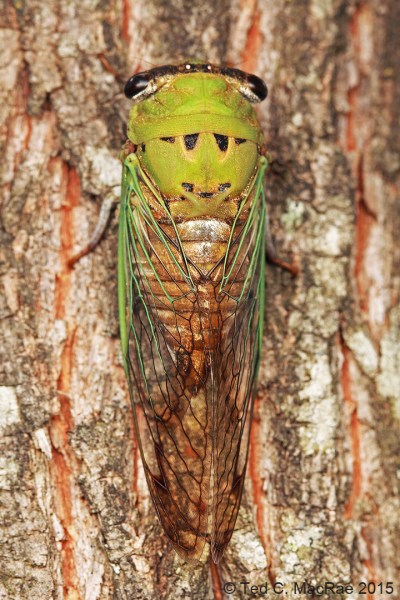
Neotibicen superbus

Neotibicen superbus

REFERENCES:

Froeschner, R. C.  1952. A synopsis of the Cicadidae of Missouri. Journal of the New York Entomological Society 60:1–14 [pdf].

Sanborn, A. F. & P. K. Phillips. 2013. Biogeography of the cicadas (Hemiptera: Cicadidae) of North America, north of Mexico. Diversity 5(2):166–239 [abstractpdf].

© Ted C. MacRae 2018

Scorching plains, screaming cactus

One of my greatest pleasures with collecting insects is not only the sights of the habitats that I visit, but the sounds. How many a night I’ve spent camped out in the Ozarks and watched royal moths fluttering at the blacklight sheet while dueling katydids traded their raspy “ch ch ch“s in the tree branches above and a whip-poor-will sang it’s haunting, eponymous song off in the distance. What joy to be hiking the canyon-lands out west and hear the musical, descending “t-te-tee-teee-teew-teeew-teeeew-teeeeew” of the canyon wren echoing off the tall, sheer rock faces. Even large-treed urban parks offer the hypnotizing “wee-er, wee-er, wee-er, weeeeeeeee” of scissor grinder cicadas (Tibicen pruinosa) on a hot summer night. Ah—cicadas! Few other animals can match their ability to fill a landscape with song, and with more than 100 species in North America it’s a safe bet that no matter where you go you can hear cicadas.

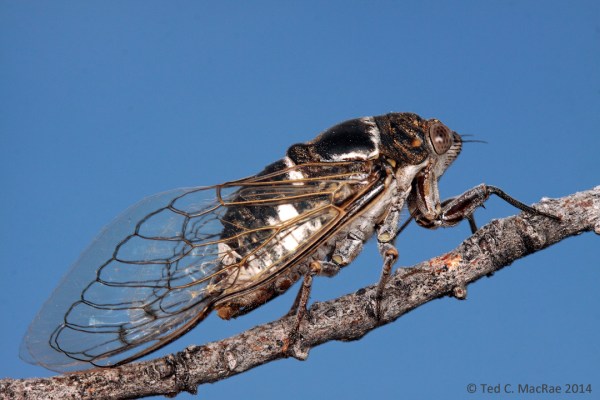
Cacama valvata

Cacama valvata (Uhler, 1888) | New Mexico, Harding Co., 5 mi W of Mills

Scissor grinders were the cicadas of my urban youth in Kansas City; I was a teenager the first time I heard the rich, pulsing buzz of bush cicadas (Tibicen dorsata) in the prairies around my house farther east in Blue Springs; and I experienced my first periodical cicada (Magicicada spp.) event as a young adult in St. Louis with Brood XIX and their whirring, “flying saucer” chorus. More recently, I’ve made several trips to the western Great Plains, where particularly large cicadas known as “cactus dodgers” (Cacama valvata) perch on prickly pear (Opuntia spp.) and cholla (Cylindropuntia imbricata) cacti and sing their loud, distinctive songs in the scorching, mid-summer heat. The male song has been described as a high pitched “metallic zing” (Beamer & Beamer 1930) or as an intense shrill, often in short bursts (Kondratieff et al. 2002); however, to me it sounds like a dull-bladed table saw cutting through a piece of ironwood and hitting a nail!

Cylindropuntia imbricata | Otero Co., Colorado.

Cholla (Cylindropuntia imbricata, Otero Co., Colorado) is a preferred host for Cacama valvata.

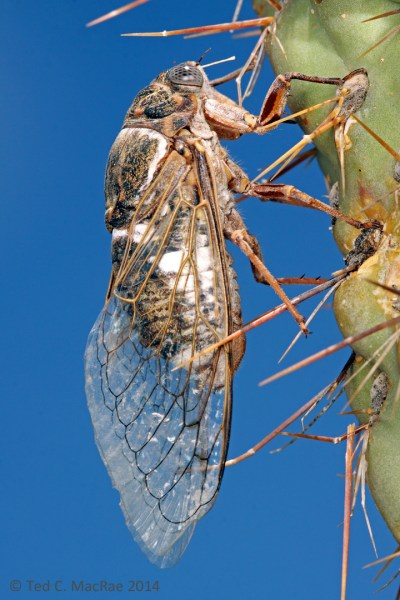
Fast flying and alert, cactus dodgers often defy the attempts of collectors (Kondratieff et al. 2002) and have the amazing ability to usually land safely on their spined hosts without becoming impaled (although occasionally this does happen—see photo below). The perils of dodging cactus spines, however, seem to pale compared with the benefits of utilizing these widespread hosts, as the association appears to have facilitated the spread of the species into a wide variety of environments across the southern Great Plains and westward to California (Sanborn & Phillips 2013).

Cacama valvata female

This female has a cactus spine impaled on her head.

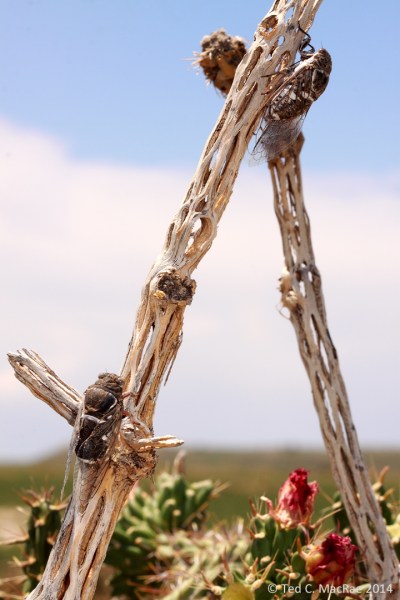
The photos in this post were taken during late June 2014 in the scorching, cholla-studded, shortgrass prairies of southeastern Colorado and northeastern New Mexico. Given their alertness and fast flying capabilities, they were a challenge to photograph before eventually finding the somewhat more cooperative subjects shown in the above photographs. Eventually, I was lucky enough to encounter two individuals sitting on a dead cholla stem in the mid-afternoon heat near Vogel Canyon, Colorado, one of which (the lower) was singing (and thus a male) and the other I surmised to be a female (this I confirmed once I got a better look through my camera viewfinder).

Cacama valvata male (bottom) & female (top)

A male Cacama valvata (bottom) sings to a female (top).

The male was creeping slowly towards the female as it sang, pausing occasionally and interrupting his song before resuming both. I presumed I was witnessing courtship singing, a behavior Kondratieff et al. (2002) have described in detail. They observed males perched on the ends of branches producing long, wavering, repeated shrills as they moved closer to the female. The song changed to a long shrill followed by shorter sequence of shrills as they made their final approach, which was followed by touching with the legs, mounting, and copulation.

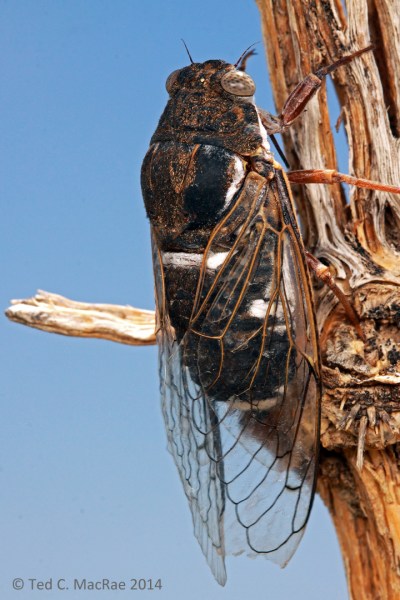
Cacama valvata male singing

Cacama valvata male singing.

Unfortunately for this male, the female was already in the act of oviposition (poor male—wasting his time flirting with a married woman!). In cactus, females oviposit almost exclusively in dry, dead, skeletonized stems and rarely utilize green material (Beamer & Beamer 1930). The eggs laid by this female might remain in the dry stem for another three months or more, where they will await a fall rainstorm to wet the stem and ground and bring cooler temperatures to improve their chances of survival before hatching, dropping to the ground, burrowing into the soil, and searching for roots upon which they can feed.

Cacama valvata female ovipositing on dead cholla stem.

REFERENCES:

Beamer, L. D. & R. H. Beamer. 1930. Biological notes on some western cicadas. Journal of the New York Entomological Society 38(3):291—305 [pdf].

Kondratieff, B. C., A. R. Ellingson & D. A. Leatherman. 2002. Insects of Western North America 2. The Cicadas of Colorado (Homoptera: Cicadidae, Tibicinidae). Contributions of the C. P. Gillette Museum of Arthropod Diversity, Department of Bioagricultural Sciences & Pest Management, Colorado State University, Fort Collins, 63 pp. [pdf].

Sanborn, A. F. & P. K. Phillips. 2013. Biogeography of the Cicadas (Hemiptera: Cicadidae) of North America, North of Mexico. Diversity 5:166–239 (doi:10.3390/d5020166) [abstract].

© Ted C. MacRae 2014