Dromochorus pruinina in Oklahoma

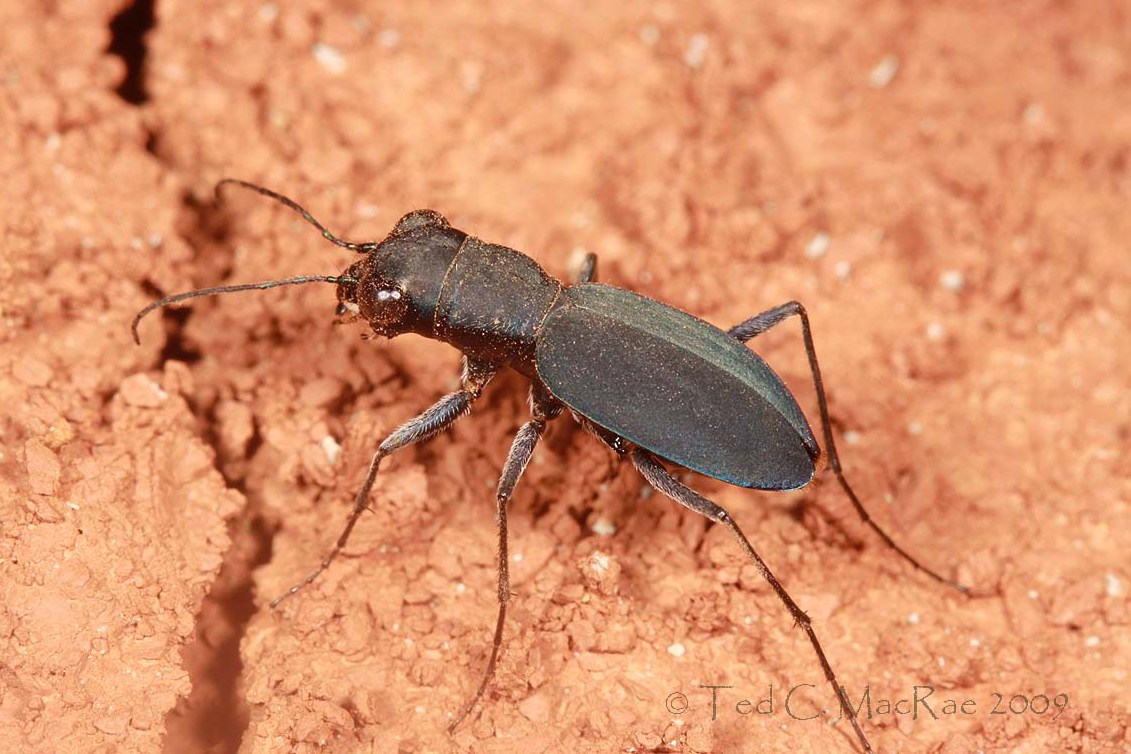
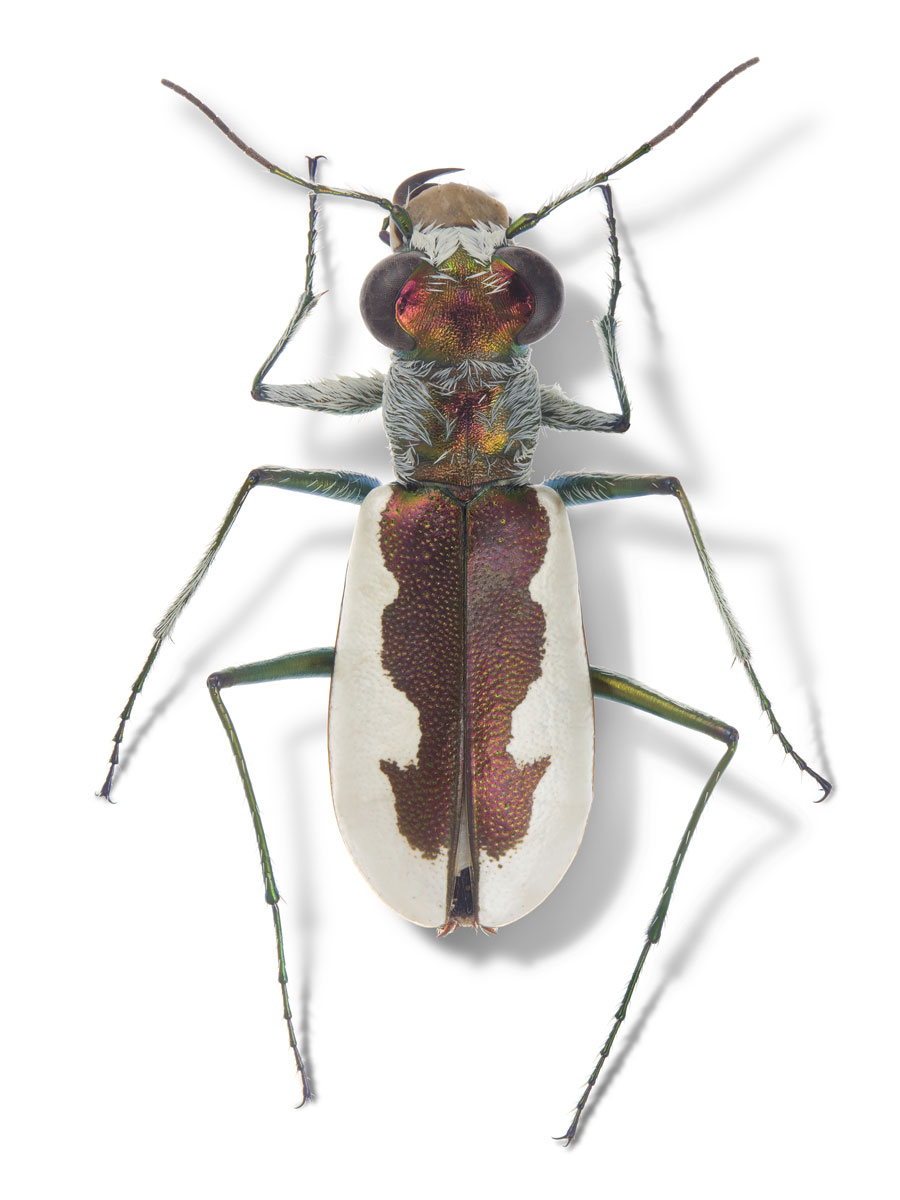
As my colleague Chris Brown and I continue to study the tiger beetle fauna of Missouri, one of the species we have become very interested in is Dromochorus pruinina (frosted dromo tiger beetle).  This is another of North America’s more enigmatic species and is one of a handful of species in Missouri – along with Cylindera cursitans (ant-like tiger beetle), C. celeripes (swift tiger beetle), Habroscelimorpha circumpicta johnsonii (Johnson’s tiger beetle), and Cicindela (Cicindelidia) obsoleta vulturina (prairie tiger beetle) – whose highly restricted distributions within the state make them worthy of special consideration for conservation (see Saving Missouri’s tigers and Revisiting the Swift Tiger Beetle – Part 3).  Of these, D. pruinina appears to be the most highly localized – thus far we have found this species only in west-central Missouri along a 2.5 mile stretch of roadside habitat in Knob Noster State Park.  This tiny population is not only the easternmost known occurrence of the species, but is also disjunct from the main population in Kansas, Oklahoma, and Texas by nearly 100 miles.  As a result of this extreme localization within the state, the species has been accorded a conservation status in Missouri of S1 – the state’s highest conservation ranking. 

IMG_0624_1200x800

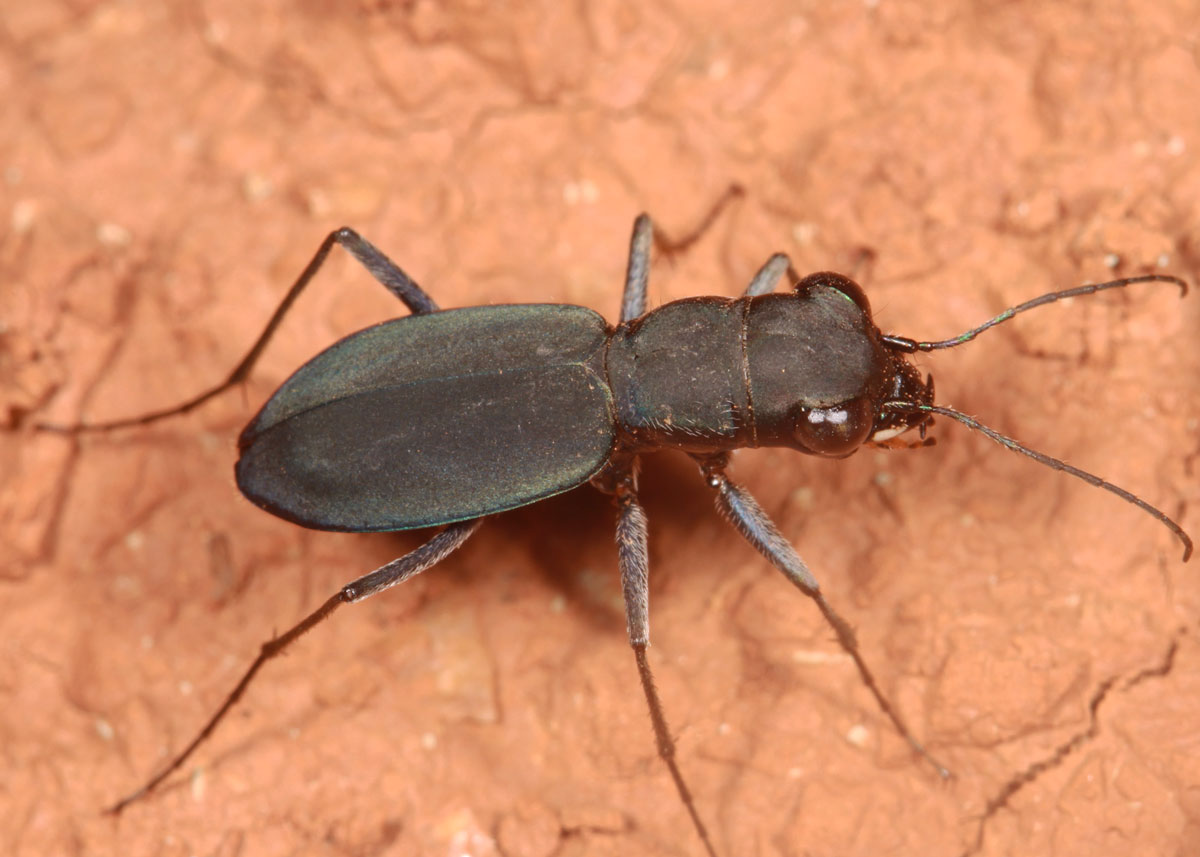
Dromochorus pruinina is secretive and easily overlooked, and as a result little is known about it – in fact, the larva was unknown until just last year (Spomer et al. 2008).  There has also been little agreement on what to call it – many authors (e.g., Freitag 1999, Pearson et al. 2006) have considered it a synonym or subspecies of D. belfragei (loamy-ground dromo tiger beetle) from Texas; however, Spomer et al. (2008) and Erwin and Pearson (2008) consider it a valid species based on its smooth elytra in contrast to the granulated elytral surface of D. belfragei and the apparent lack of intergrades in central Texas where their geographical distributions overlap.  It was one of the species I had hoped to see during my early June visit to The Nature Conservancy’s Four Canyon Preserve in northwestern Oklahoma; however, I would not see this species there despite its abundance of exposed red clay slopes.  Following that visit, as I sat in a coffee shop in north-central Oklahoma trying to predict where the pounding rainstorm outside was least likely to spoil my collecting plans for the next few days, this species again came to my mind when I decided to go back to the red clay/gypsum hills just north of Four Canyon Preserve – where I had just seen the even more enigmatic C. celeripes.  I noted that this corner of Oklahoma was just at the western edge of the distribution given by Pearson et al. (2006) for the species, but still read through the notes on its habits and habitats in the off chance that I might still encounter it.  Despite all the forethought, it was nevertheless a surprise when an adult bolted across my path soon after beginning my search of the Gloss Mountains the next day (see Revisiting the Swift Tiger Beetle – Part 2).  Like C. celeripes, this species is flightless and runs swiftly – perhaps even more so – as it dashes between clumps of vegetation before disappearing.  It’s larger size would seem to make it easier to capture than C. celeripes, but that is not the case, yet I still managed to capture all three individuals I saw during the course of the several hours I spent on the lower talus slopes at the Gloss Mountains Scenic Overlook that morning.  With none of them could I even make an attempt at field photographs – their repeated mad dashes for cover eliminated all opportunity.  I placed the three individuals into a terrarium of native soil, resigned that I would have to settle for photographs in confinement (there is nothing wrong with confined photographs, which look every bit as natural as true field photographs – still, there is just something about not succeeding in photographing the subject in its native habitat).

IMG_0622_1200x800_2I returned to the Gloss Mountains late in the day and completed my search for C. celeripes in the State Park across the highway (and also saw my first massasauga rattlesnake).  By then it was about 7:00 pm, and my thoughts turned back to the D. pruinina I had seen across the highway earlier that day.  I recalled the tendency of the Missouri population of D. pruinina to be most active in the few hours before dusk and decided to have another go at them.  No sooner than I had begun to climb the talus slope did I see another one – he bolted into a grass clump, and despite my best attempts to tear the vegetation apart he was gone.  Frustrated, I got up and started walking up the slope again – and saw another one, with the same result!  Now I was mad.  I started searching the rankly vegetated clay slope with determination, and it wasn’t long before I saw a third individual higher up on the slope.  It was then and there that I decided I was going to get a field photograph.  I stopped dead in my tracks so as not to further disturb the beetle, and carefully took off my backpack and put my camera together as I kept a watchful eye on him.  Once ready, I moved slowly toward him – and he bolted.  This time I managed to catch him before he disappeared.  Okay – I’ve got one in the hand, now what?  I decided to try the time-out trick – placing him in the middle of an open area on top of the small mesa and covering him with my camera lens cap.  With luck, being covered momentarily would cause him to “settle down” long enough for me to get some shots.  I waited a few minutes, then carefully lifted up the lens cap – out he bolted with a vengeance.  Time for a new strategy.  I started blocking his path with my free hand everytime he tried to run out of the open area I had designated for him, hoping that he would eventually tire and rest momentarily – this was the strategy I successfully employed to get my first field photographs of C. celeripes the day before at Alabaster Caverns (see Revisiting the Swift Tiger Beetle – Part 1).  I did this for several minutes, and the little bugger just refused to settle down.  Finally, as I took my eye off of him for a split second, he disappeared into an adjacent grass clump and was never seen again.  IMG_0626_1200x800By now I was so frustrated that I considered giving up. Of course, I couldn’t – there was still daylight, and if there’s one thing I’ve learned in this game, it’s persistence. I started walking back down the slope searching for another individual, and right at the edge of the vegetated area I saw one running for cover.  This time I cut him off at the pass and forced him to run back towards the more open area of the upper slope.  Once out in the open, I continued to follow him as he nervously ambled across the slope into and out of erosion channels, looking for a place to hide.  Everytime he siddled up against a chunk of clay or tried to crawl into a crack I forced him out.  In the open expanse of the upper slope where I had him trapped, he eventually started pausing – not for long, but just long enough that I could get a shot or two in before he started running again.  Eventually, I got several shots that I thought might turn out acceptable.  I briefly looked at my camera to try another setting, looked up, and he was gone!  By now it was past 8:30 pm, and the sun was sinking fast.  I decided that I had given it my best effort, and that whatever shots I had would have to do.  I share with you here three of the five shots that I kept.

Photo details: Canon 100mm macro lens on Canon EOS 50D, ISO 100, 1/250 sec, f/14-16, MT-24EX flash 1/4 power through diffuser caps.

REFERENCES:

Erwin, T. L. and D. L. Pearson. 2008. A Treatise on the Western Hemisphere Caraboidea (Coleoptera). Their classification, distributions, and ways of life. Volume II (Carabidae-Nebriiformes 2-Cicindelitae). Pensoft Series Faunistica 84. Pensoft Publishers, Sofia, 400 pp.

Freitag, R.  1999.  Catalogue of the tiger beetles of Canada and the United States.  National Research Council Canada, Ottawa, Ontario, 195 pp.

Pearson, D. L., C. B. Knisley and C. J. Kazilek. 2006. A Field Guide to the Tiger Beetles of the United States and Canada. Oxford University Press, New York, 227 pp.

Spomer, S. M., P. D. Nabity and M. L. Brust. 2008. Larval description of Cicindela (Dromochorus) pruinina (Casey) (Coleoptera: Carabidae: Cicindelinae) with notes on habitat and adult behavior. The Coleopterists Bulletin 62(1):37-41.


Copyright © Ted C. MacRae 2009

Add to FacebookAdd to NewsvineAdd to DiggAdd to Del.icio.usAdd to StumbleuponAdd to RedditAdd to BlinklistAdd to Ma.gnoliaAdd to TechnoratiAdd to Furl

Typocerus deceptus in Missouri

It has been fifteen years now since I published an annotated checklist of the longhorned beetles (families Cerambycidae and Disteniidae) of Missouri (MacRae 1994).  That publication (and a similar one on Buprestidae) was the product of eight years of collecting – of specimens in the field and of data in any other public or private collection I could find that contained Missouri specimens – during my stint as a field entomologist with the Missouri Department of Agriculture.  I collected during the week while on my rounds.  I collected on weekends as well.  I visited every college and university in the state that had an insect collection of any size, and a few in neighboring states as well.  I made the acquaintance of private collectors with significant Missouri material – most notably Richard Heitzman, Marlin Rice, and the late Gayle Nelson.  By the time I left Missouri for a new position in Sacramento, I had documented 219 species and subspecies of longhorned beetles from the state – 66 of which were new state records.

Typocerus deceptus on flower of Hydrangea arborescens

Typocerus deceptus on flower of Hydrangea arborescens

Despite my best efforts, however, I knew the list was not complete – they never are.  In the years since returning to Missouri, I’ve documented an additional 10 species and subspecies in the state (MacRae and Rice 2007), and in a newly published paper (McDowell and MacRae 2009) the rare species, Typocerus deceptus, is documented from Missouri for the first time.  I cannot take credit for this discovery – that honor goes to the paper’s lead author, Tom McDowell of Carbondale, Illinois.  Tom first encountered this species in 2005 at Trail of Tears State Park in southeastern Missouri near Cape Girardeau while conducting routine insect surveys.  After seeing additional individuals on a subsequent visit to the park the following year, Tom contacted me to tell me of his find and graciously invited me to join him on further studies of this rarely encountered species.  I readily agreed, and in July of last year I met up with Tom at Trail of Tears to see the beetle for myself.

Typocerus deceptus on flower of Hydrangea arborescens

Typocerus deceptus on flower of Hydrangea arborescens

Typocerus deceptus has been recorded sporadically from across the eastern U.S.  Nothing is known of its biology other than adult flower hosts and activity periods, and the larva and larval host(s) remain completely unknown.  The species is aptly named, as its appearance is deceptively similar to the common and widespread species, T. velutinus.  Both of these species belong to the so-called “flower longhorn” group (subfamily Lepturinae), characterized by adults that are largely diurnal (active during the day) and attracted to a great variety of flowers upon which they feed.  Tom had found T. deceptus feeding on flowers of wild hydrangea (Hydrangea arborescens) in the company of several other flower longhorns, including T. velutinus.  The similarity of T. deceptus to T. velutinus makes distinguishing individuals amongst the vastly more abundant T. velutinus quite difficult.  However, Tom was able to recognize the species during his surveys as a result of prior experience with it in Illinois.  As Tom and I searched the wild hydrangea plants growing along an intermittent drainage between the road and the park’s unique mesic forest, we succeeded in picking out a total of four individuals of this species amongst the dozens of T. velutinus and other lepturines also feeding on the flowers.

Typocerus velutinus on flower of Hydrangea arborescens

Typocerus velutinus on flower of Hydrangea arborescens

I gradually developed a sense of the subtle differences that distinguish this species from T. velutinus and that allow its recognition in the field.  Typocerus deceptus is slightly more robust than T. velutinus, and whereas the transverse yellow elytral bands of the latter are distinct and well delimited, they are weaker and often interrupted at the middle in T. deceptus, giving the beetle a slightly darker brownish appearance.  The lateral margins of the elytra are also more strongly emarginated near the apices, giving the beetle a more distinctly tapered appearance.  Finally, while both species possess a distinct band of dense, yellow pubescence along the basal margin of the pronotum, this band is interrupted at the middle in T. deceptus. My ability to recognize this species in the field was confirmed a few weeks ago when I returned to Trail of Tears (with longtime field companion Rich Thoma) to attempt what seemed to be an impossible task – photograph these active and flighty insects in the field on their host plants.  Conditions were brutally humid, and I only saw two individuals that day – the first I immediately captured and kept alive as a backup for studio photographs should I fail to achieve my goal in the field, but the second individual (not seen until almost two hours later!) posed just long enough for me to whip off a series of frames, two of which turned out well enough to share with you here.  The first photo clearly shows the interrupted basal pubescent band, and both photos show the distinctly emarginate lateral elytral margins and weak transverse yellow bands (compare to the uninterrupted pronotal pubescent band and well developed transverse elytral bands of T. velutinus in the third photo).

Me with the discoverer of Typocerus deceptus in Missouri Trail of Tears State Park, July 2008

TCM with the discoverer of Typocerus deceptus in Missouri at Trail of Tears State Park, July 2008

It is possible that T. deceptus is not as rare as it appears and is simply overlooked due to its great resemblance to another much more abundant species. However, I believe this is unlikely given its rarity in collections of eastern U.S. Cerambycidae by casual and expert collectors alike.  Moreover, T. deceptus is not the only “rare” longhorned beetle to have been documented at Trail of Tears State Park – a number of other species have also been found there but not or only rarely elsewhere in Missouri (e.g., Enaphalodes cortiphagus, Hesperandra polita, Metacmaeops vittata, and Trigonarthris minnesotana).  This may be due to the unique, mesic forest found at Trail of Tears, being one of only a few sites in southeastern Missouri that support more typically eastern tree species such as American beech (Fagus grandifolia), tulip poplar (Liriodendron tulipifera), and cucumbertree (Magnolia acuminata).  Whether one of these trees serves as a larval host for T. deceptus is unknown.  Nevertheless, I will be returning to Trail of Tears in the future to see what other treasures remain hidden within its unique forests.

Photo details (insects): Canon 100mm macro lens on Canon EOS 50D, ISO 100, 1/250 sec, f/18-20, MT-24EX flash 1/4 power through diffuser caps.

REFERENCES:

MacRae, T. C. 1994. Annotated checklist of the longhorned beetles (Coleoptera: Cerambycidae and Disteniidae) known to occur in Missouri. Insecta Mundi 7(4) (1993):223–252.

MacRae, T. C. and M. E. Rice. 2007. Distributional and biological observations on North American Cerambycidae (Coleoptera). The Coleopterists Bulletin 61(2):227–263.

McDowell, W. T. and T. C. MacRae. 2008. First record of Typocerus deceptus Knull, 1929 (Coleoptera: Cerambycidae) in Missouri, with notes on additional species from the state. The Pan-Pacific Entomologist 84(4):341-343 DOI: 10.3956/2008-23.1

Copyright © Ted C. MacRae 2009

Add to FacebookAdd to NewsvineAdd to DiggAdd to Del.icio.usAdd to StumbleuponAdd to RedditAdd to BlinklistAdd to Ma.gnoliaAdd to TechnoratiAdd to Furl

A Silver Anniversary

Twenty-five years ago tomorrow, I discovered my first new species.  I didn’t know it at the time – in fact, it would be several years later before the budding, young entomologist that I was would finally conclude that the large, spectacularly beautiful, cerambycid beetle that I was capturing in my fermenting bait traps just south of St. Louis did indeed represent a previously unrecognized species.

In my first job out of school as a field entomologist for the Missouri Department of Agriculture, I worked with nursery growers to identify insect pest problems on their crops and provide recommendations for control.  Wood boring beetles – especially the longhorned beetles – are a major problem for growers of trees, and it was that importance, combined with a latent interest in taxonomy, that led to my interest in this group (and the beginnings of my identity as a “coleopterist”).  I didn’t just work in entomology – I lived it, and when I wasn’t inspecting rows of trees, checking gypsy moth traps, or scouting for musk thistle weevil release sites in the three counties around St. Louis, I was collecting insects and the primary literature about them.  One of the early papers I came across (Champlain and Knull 1932) described the use of fermenting bait traps for collecting Cerambycidae, in particular species in the genus Purpuricenus.  I desperately wanted some of these beetles – large, showy, velvety black, with vivid red or orange basal markings on the elytra – but had not yet encountered either of the two species then known in eastern North America.   I made a batch of the stuff – basically molasses, beer, yeast, and water – and placed buckets of the slurry at a few spots that I would be able to check periodically while on my rounds.  Much to my delight, I quickly began trapping numerous species of Cerambycidae – including the two species of Purpuricenus.  Most of these specimens were coming to a trap I had placed at one of my favorite collecting spots – Victoria Glades Natural Area in Jefferson Co., some 30 miles south of St. Louis.  Over the next few weeks I acquired a nice little series of the two species, and I increased their number during the following three years with continued trapping.

purpuricenus_humeralis

Purpuricenus humeralis (Fabricius)

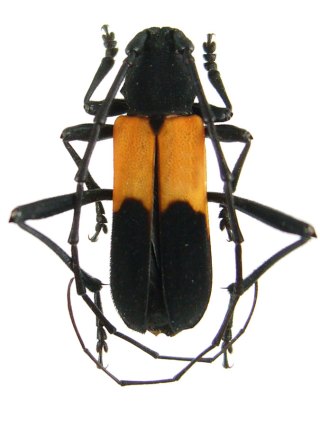
The two species were easily distinguished – in Purpuricenus humeralis the basal elytral markings were triangular and covered just the humeri, while in P. axillaris they were transverse and covered the entire basal half of the elytra.  As I studied the series of the latter, however, something seemed amiss.  Some of the specimens were distinctly larger and more robust, while others were smaller and more gracile.  Moreover, the color of the elytral markings on the larger specimens seemed to be consistently more reddish than the pale orange markings of the smaller specimens.  At first I dismissed it as variation – common among longhorned beetles, which can vary greatly in size depending on the quality of the larval host.  But as I studied them more I noted other consistent differences between the two “forms” – the larger with more well-developed pronotal tubercles (the middle one of which bore a distinctly polished apex and the lateral ones more acutely angled), a distinct “tooth” at the apex of the elytral midline, and coarser punctures at the base of the elytra.  It seemed obvious that the two forms represented two different species, but the only other species I could find in Linsley’s (1962) monograph of North American Cerambycidae (my bible!) was P. linsleyi – known then only by the holotype and one paratype from an unspecified location in Texas.  Neither series matched the description of that species very well – the shape of the elytral marking was wrong – but I concluded the larger one must be that species and the smaller was axillaris.  There was another possibility – but that young entomologist just couldn’t entertain the idea of a large, showy, longhorned beetle still undescribed in eastern North America.

purpuricenus_axillaris

Purpuricenus axillaris Haldeman

Some time later I received a series of a Purpuricenus that my colleague Dan Heffern had collected near San Antonio, Texas.  Dan had also taken up collecting cerambycids with fermenting bait traps, and while he was quite proficient with Texas species he wasn’t quite sure what to make of these particular specimens.  He sent them to me for my opinion, and it was quite clear – they were the real P. linsleyi.  The rediscovery of that rare species was an exciting find in itself, but it rekindled the puzzle of the Missouri Purpuricenus – if they were not P. linsleyi, then what were they?  The only conclusion was that two species were masquerading under a single name, and that I would have the privilege of naming one of them.  Wow, my first new species – something every amateur taxonomist dreams about, but I had no idea it would happen so soon, or with such a spectacularly beautiful species!  By then I was living in Sacramento, so I traveled to nearby Berkeley to meet with the late John Chemsak at the University of California and show him my material.  John was a longtime associate of the late, great E. Gorton Linsley, co-authoring with Linsley several later volumes of the North American Cerambycidae monograph, and had managed to borrow type material of P. axillaris from the Museum of Comparative Zoology at Harvard University.  We found that both species were present in the small type series, so together we decided which specimen should be designated as a lectotype for P. axillaris – and thus, which of the two species would be named as new.

purpuricenus_paraxillaris

Purpuricenus paraxillaris MacRae

It would take several more years before I actually published a description of the new species, naming it P. paraxillaris (meaning “near” axillaris) and selecting as holotype the very first specimen I collected – on June 25, 1984.  I wanted to know its distribution, which meant borrowing material from museums and willing individuals.  I also recognized that some collectors of Cerambycidae might view the description of a large, showy species from eastern North America with some skepticism, so I wanted to be as thorough as possible.  (There were a few private collectors that declined to loan their material to me because of such skepticism.)  During that process, I learned that P. paraxillaris is quite common across the eastern U.S. – in fact, many of the literature references to P. axillaris actually refer to this species, but it wasn’t until collectors began using fermenting bait traps widely that large series of specimens became available for study.  By examining the few available reared specimens, I learned that P. axillaris prefers hickory (Carya) as a host, while P. paraxillaris prefers oak (Quercus) and chestnut (Castanea).  With several hundred specimens of the two species at my disposal, I became more convinced than ever that they were distinct, and with the many specimens of other species in the genus that I had borrowed as well, I decided to expand the scope of the paper to a general review of the entire genus in North America.  This would allow me not only to describe the new species, but report the rediscovery of P. linsleyi as well.  Finally, after several years (remember, I was/am just an amateur), the description was published in the October 2000 issue of The Pan-Pacific Entomologist (MacRae 2000).

For those of you with an interest in such things, I include here a key to the three eastern North American species of Purpuricenus.

Key to adult Purpuricenus in eastern North America 
(adapted from MacRae 2000)

1.         Posterior margin of basal elytral markings distinctly oblique; apical dark area extending forward along suture and reaching scutellum……………. P. humeralis (Fabricius)

1′.        Posterior margin of basal elytral markings more or less transverse; apical dark area not extending forward along suture to scutellum ………………………………………………………. 2

2 (1′).   Discal calluses of pronotum weak, median callus without polished apical line; lateral pronotal tubercles small, angles obtuse; basal elytral punctation relatively finer and sparser; elytral apices subtruncate, angles not distinctly dentate; basal elytral markings yellow to orange ………………………………………………………………………. P. axillaris Haldeman

2′.        Discal calluses of pronotum distinct, median callus prominent and with polished apical line; lateral pronotal tubercles well-developed, angles acute; basal punctation of elytra relatively coarser and denser; elytral apices emarginate, angles distinctly dentate; basal elytral markings orange to red-orange ………………………………. P. paraxillaris MacRae

REFERENCES:

Champlain, A. B. and J. N. Knull. 1932. Fermenting bait traps for trapping Elateridae and Cerambycidae (Coleop.). Entomological News 43:253–257.

Linsley, E. G. 1962. The Cerambycidae of North America. Part III. Taxonomy and classification of the subfamily Cerambycinae, tribes Opsimini through Megaderini. University of California Publications in Entomology 20:1–188, 56 figs.

MacRae, T. C. 2000. Review of the genus Purpuricenus Dejean (Coleoptera: Cerambycidae) in North America. The Pan-Pacific Entomologist 76:137–169.

Copyright © Ted C. MacRae 2009

Add to FacebookAdd to NewsvineAdd to DiggAdd to Del.icio.usAdd to StumbleuponAdd to RedditAdd to BlinklistAdd to Ma.gnoliaAdd to TechnoratiAdd to Furl

Treatise of Western Hemisphere “Cicindelitae”

Sumlinia hirsutifrons

Sumlinia hirsutifrons (Sumlin). Copyright © T. L. Erwin and D. L. Pearson 2008

ResearchBlogging.orgTiger beetles have long enjoyed a popularity that is disproportionate to their diversity, abundance, and economic importance relative to other groups of beetles. This seems as much due to their charismatic behavior – toothy jawed predators in extreme habitats – as it is to their brilliant colors, dazzling designs, and penchant for polytopism. Never before has this popularity been more evident than in the past decade, during which time there has been a veritable explosion of popular and semi-popular tiger beetle books. Barry Knisley and Tom Schulz (1997) got things going with their regional guide to species occurring in the southeastern U.S., followed closely by a similar guide to the northeastern U.S. (Leonard and Bell 1998).  Both of these books featured color photographs of all species treated and supplemented species treatments with sections on biology, natural history, rearing, and conservation.  No longer were avocational or professional entomologists forced to consult dry, technical treatments in primary journals for information on these anything-but-dry, boring beetles.  These two books were, in turn, followed by several smaller regional treatments, including John Acorn’s (2001) eccentric and highly entertaining Tiger Beetles of Alberta and Paul Choate’s (2003) alternative treatment of Florida species (a silly little article about Missouri’s two dozen or so species also appeared in 2001), as well as a comprehensive summary of the group’s ecology and evolution by Dave Pearson and Alfreid Vogler (2001).  The granddaddy of all tiger beetle books – at least for U.S. cicindelophiles – appeared a few years later in the form of A Field Guide to the Tiger Beetles of the United States and Canada, by Dave Pearson and colleagues (2006).  At long last, keys, photographs, and discussions of habitats, biology, and variation of every species and subspecies known from the U.S. and Canada could be found in a single source.

The latest contribution to this growing body of literature is the most comprehensive yet.  In it, Dave Pearson has teamed up with ground beetle expert and lead author Terry Erwin to provide a synthesis of every species of tiger beetle known to occur in the Western Hemisphere.  Erwin and Pearson (2008) is a beautifully printed and handsomely bound treatise that elaborates the current classification, taxonomy, distribution at the country and/or state/provincial level, and way of life of each species and subspecies, including comments on habitats, flight and dispersal capabilities, seasonal occurrence, and behavior.  References for each species and an extensive bibliography are also provided, as are notes on threatened and endangered species and subspecies.

There is much to like about this book.  The scope of coverage to include the entire Western Hemisphere is unprecedented – few insect taxa, even popular ones, have been treated so expansively.  Those without access to comprehensive libraries of primary tiger beetle literature will appreciate having all of the available information in one book, while those with access to the literature will appreciate the references for individual species.  Even those whose interest is restricted to the North American fauna will find the historical nomenclature handy – something lacking in Pearson et al. (2006).  As a bonus, a full color plate is offered for each genus that offers a spectacular extended focus image of a representative species, along with additional photographs provided by a number of contributors (I myself provided some of the photographs used in the Cylindera and Dromochorus plates) of live beetles and their habitats.  Collectively, these images provide a comprehensive look at the diversity and habitats of New World tiger beetles that has until now not been available.

The book, however, is not without its criticisms.  There has long been controversy within the Tiger Beetle Guild regarding the relationship of tiger beetles to ground beetles and whether/which of the many described subgenera of the genus Cicindela should be accorded generic status.  Erwin and Pearson fall solidly in the camp that consider tiger beetles a subgroup of ground beetles, a position that is becoming increasingly easy to defend on the basis of molecular phylogenetic analyses (e.g., Beutel et al. 2008).  Nontheless, I suspect many will be bothered by the decision to rank tiger beetles as a supertribe – “Cicindelitae” – in the subfamily Carabinae, rather than according the group subfamilial status.  Unfortunately, no justification for such placement is offered (unless this appears in Volume 1).  Likewise with subgenera, Erwin and Pearson break ranks with the preponderance of recent North American literature (including Pearson’s own 2006 book) and accord full genus status to most of the former subgenera of the genus Cicindela, including such familiar North American taxa as Cylindera, Dromochorus, Ellipsoptera, Eunota, and HabroscelimorphaTribonia, on the other hand, is synonymized under Cicindela, leaving Cicindelidia as the only non-nominate subgenus of Cicindela.  Certain of these taxonomic acts will likely confront little opposition (e.g., Dromochorus as a full genus); however, again no justifications are provided, leaving the reader with the impression – rightly or wrongly – that the new rankings are the result of personal preference rather than new anaylsis.  I was also a bit puzzled by the inclusion of some subspecies as valid that Pearson himself had previously synonymized (e.g., Cicindela tranquebarica roguensis and C. tranquebarica lassenica).

The publisher, Pensoft, has established a reputation for quality with their previous offerings, and this book appears to continue that tradition. However, at a price of EURO 95, this book will probably not be highly sought after by the casual North American tiger beetle collector.  Nevertheless, I think any serious student of the group will want this in their library, regardless of how complete their literature collection on the group is.

I thank Terry Erwin for allowing me to use his gorgeous extended focus image of Sumlinia hirsutifrons (Sumlin), which graces the cover of this beautifully produced book.

REFERENCES:

Acorn, J.  2001.  Tiger Beetles of Alberta: Killers on the Clay, Stalkers on the Sand.  The University of Alberta Press, Edmonton, xix + 120 pp.

Beutela, R. G., I. Riberab and O. R. P. Bininda-Emonds. 2008. A genus-level supertree of Adephaga (Coleoptera). Organisms, Diversity & Evolution, 7:255–269.

Choate, P. M., Jr. 2003. A Field Guide and Identification Manual for Florida and Eastern U.S. Tiger Beetles.  University Press of Florida, Gainesville, 224 pp.

Erwin, T. L. and D. L. Pearson. 2008. A Treatise on the Western Hemisphere Caraboidea (Coleoptera). Their classification, distributions, and ways of life. Volume II (Carabidae-Nebriiformes 2-Cicindelitae). Pensoft Series Faunistica 84. Pensoft Publishers, Sofia, 400 pp.

Knisley, C. B. and T. D. Schultz.  1997.  The Biology of Tiger Beetles and a Guide to the Species of the South Atlantic States. Virginia Museum of Natural History, Martinsville, 210 pp.

Leonard, J. G. and R. T. Bell.  1998.  Northeastern Tiger Beetles: A Field Guide to Tiger Beetles of New England and Eastern Canada.  CRC Press, Boca Raton, 176 pp.

MacRae, T. C., and C. R. Brown. 2001. Missouri Tigers. The Missouri Conservationist 62(6):14–19.

Pearson, D. L., C. B. Knisley and C. J. Kazilek. 2006. A Field Guide to the Tiger Beetles of the United States and Canada. Oxford University Press, New York, 227 pp.

Pearson, D. L. and A. P. Vogler.  2001.  Tiger Beetles: The Evolution, Ecology, and Diversity of the Cicindelids.  Cornell University Press, Ithaca, New York, 333 pp.

Copyright © Ted C. MacRae 2009

Add to FacebookAdd to NewsvineAdd to DiggAdd to Del.icio.usAdd to StumbleuponAdd to RedditAdd to BlinklistAdd to Ma.gnoliaAdd to TechnoratiAdd to Furl

Brachys on oak

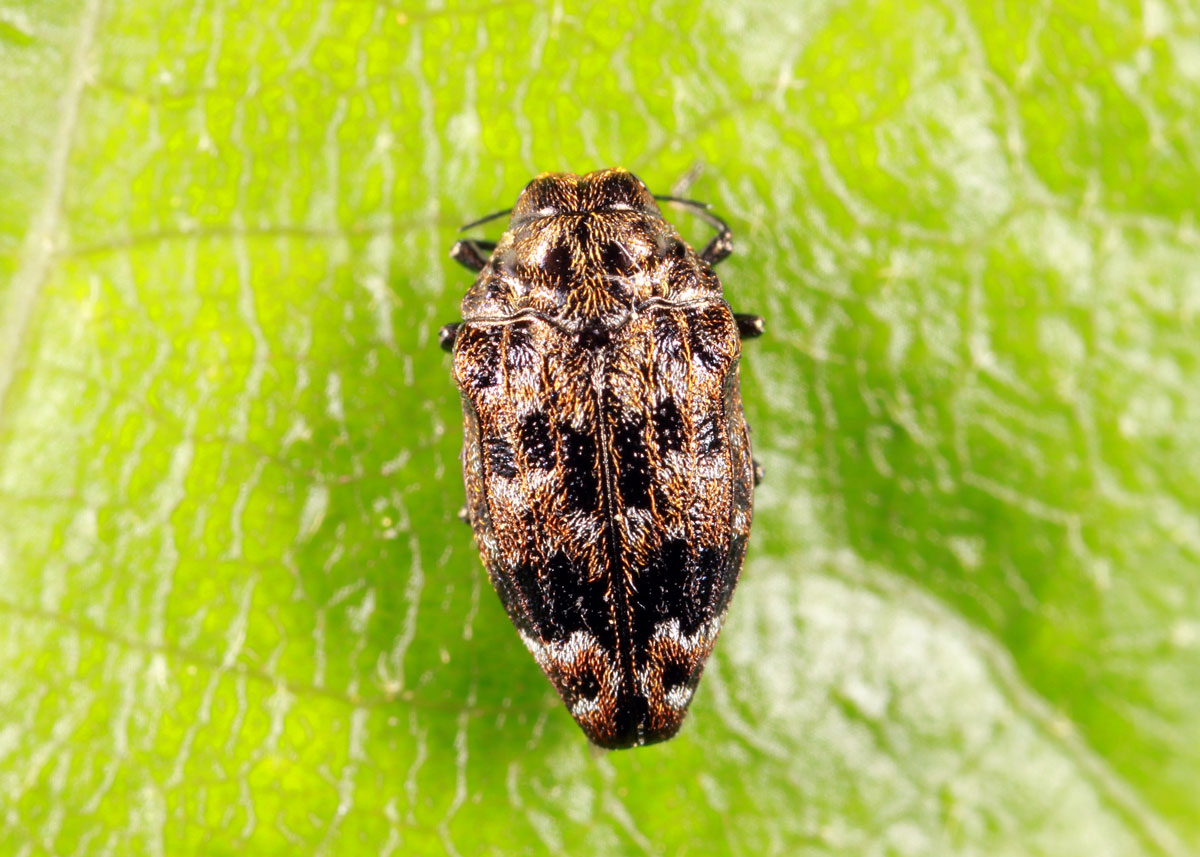
Although the beetles I photographed for my springtime Acmaeodera post are among the smaller buprestids occurring in Missouri, they are by no means the smallest. That honor belongs to the curious little genus Mastogenius, measuring only around 2 mm in length and, thus, looking for all intents and purposes like little black dots.  Slightly larger, but still smaller than our smallest Acmaeodera, are members of the tribe Trachyini.  Adults in this group exhibit a highly derived morphology compared to other groups of jewel beetles – flat, compact, and wedge-shaped rather than the elongate, cylindrical form more commonly associated with the family.  This seems in part due to their unique larval habits – mining within the leaves of their host plants rather than boring through the wood.  Three genera in this tribe occur in the U.S.¹, all of which are found in Missouri.  These include: 1) Taphrocerus, which mine the leaves of sedges (family Cyperaceae); 2) Pachyschelus, which mine the leaves of herbaceous plants in several families – primarily Fabaceae; and 3) Brachys, which mine the leaves of hardwoods, chiefly oaks (Quercus).  It was two species in this latter genus (out of three that occur in Missouri) that I encountered a couple weekends ago at Reifsnider State Forest in Warren County (noted for its high quality example of a mature white oak forest).

¹ A species in the Old World genus Trachys was introduced to North America from Europe and is established in New Jersey.

Brachys_ovatus_IMG_0193_enh2

Photo details: Canon MP-E 65mm 1-5X macro lens on a Canon EOS 50D, ISO 100, 1/200 sec, f/10, MT-24EX flash 1/8 power through diffuser caps

Brachys ovatus is the largest of the three species, usually measuring a little more than 5 mm in length. In addition to size, it can also be distinguished from Missouri’s two other species of Brachys by the dense row of long hairs occurring along the apex of the last abdominal sternum. For those of you who prefer not to have to look at the underside of its butt, the white-margined band of bronze pubescence before the apex of the elytra and longitudinal rows of bronze setae in the basal half of the elytra are usually sufficient for distinguishing this species.  Brachys ovatus is a common associate of oaks throughout Missouri during spring – I have collected it on ten of Missouri’s 21 oak species, including both ‘white oaks’ and ‘red oaks’. Despite its common occurrence on oak and the frequent reference to it in the literature as a leaf-miner of oaks, few reliable rearing records exist to document the range of hosts it actually utilizes.  There are older reports of this species mining the leaves of other hardwoods such as beech (Fagus), elm (Ulmus), hickory (Carya), and hornbeam (Carpinus); however, the veracity of these reports is questionable, and they may refer only to incidental adult associations.

Brachys_aerosus_IMG_0165_enh2

Photo details: Canon EF 100mm f/2.4 Macro Lens with Kenco extensions on a Canon EOS 50D, ISO 100, 1/200 sec, f/11, MT-24EX flash 1/8 power through diffuser caps

Brachys aerosus is another commonly encountered species.  This is a highly variable and hard-to-define species, but in general it can be recognized by the basal region of the elytra largely lacking pubesence and with a purple, blue, or green luster, and by the predominantly gold to bronze pubescence covering the apical area of the elytra.  Adult length is generally from 3 to 5 mm – somewhat smaller than B. ovatus, and differing also in that it is commonly associated with a variety of hardwoods besides oak.  In Missouri, I have primarily collected it on oaks and elms.  Literature reports – mostly old and unreliable – record as larval hosts many other hardwood genera such as chesnut (Castanea), beech, hazel (Corylus), hickory, hornbeam, linden (Tilia), poplar (Populus), and even such unlikely genera as huckleberry (Vaccinium) and grape (Vitis).  Because of its variability and the broad diversity of hosts with which it has been associated, this species is suspected of acutally being a species complex.  The late George Vogt spent many years making careful observations with reared material in an effort to determine species boundaries and their host associations. Unfortunately, Vogt passed away before publishing his observations, and his eccentric record keeping with cryptic notes (Anderson et al. 1991) makes it unlikely that they ever will be published. It will take some enthusiastic sole to repeat his work and publish it before we can ever know the true identity of the species hiding under this name.

A third species in the genus, Brachys aeruginosus, is smaller than either of the two above species – generally measuring only 3 to 4 mm in length.  This rather uncommonly encountered species is most similar to B. aerosus in appearance but can be distinguished, in addition to its generally smaller size, by the predominantly light gold to silver setae that cover the apical area of the elytra.  As with the two above species, it is most often associated with oaks but is occasionally collected on other hardwoods as well.  Whether it utilizes species beside oak for larval development is unknown.  I hope to find and photograph this species in the near future.

REFERENCE:

Anderson, D., C. L. Bellamy, H. A. Howden, and C. Quimby. 1991. George Britton Vogt (1920–1990). The Coleopterists Bulletin 45(1):93–95.

Copyright © Ted C. MacRae 2009

Add to FacebookAdd to NewsvineAdd to DiggAdd to Del.icio.usAdd to StumbleuponAdd to RedditAdd to BlinklistAdd to Ma.gnoliaAdd to TechnoratiAdd to Furl


A festive (tiger beetle) birthday

Last Thursday was my birthday, and as has become my custom, I took the day off and went on my ‘Annual Season Opening Birthday Bug Collecting Trip.’  One or two of you might remember how these plans were scrubbed last year by a last minute business trip, during which I discovered Pipestone National Monument in southwest Minnesota. That experience – and the post that I wrote about it – remain high among my all-time favorites. Despite that, nothing was going to derail my plans to go collecting this year, and at 5:30 in the morning I awoke to begin what would turn out to be as enjoyable and successful a day as I could hope for. I had convinced my colleagues and long-time collecting buddies Rich Thoma and Chris Brown to take the day off as well and accompany me down to the lowlands of southeastern Missouri to search for additional localities of the festive tiger beetle – Cicindela scutellaris.

Records of Cicindela scutellaris in southeast Missouri

Records of Cicindela scutellaris in southeast Missouri

As far as is currently known – C. scutellaris is represented in Missouri by three highly disjuct populations in the extreme northwestern, northeastern, and southeastern corners of the state.  The two northern populations are unambigously assignable to the northern subspecies lecontei, although their absence from areas further south in Missouri along the Missouri and Mississippi Rivers remains a mystery.  The southeastern population apparently represents an intergrade population with influences from both lecontei and the southeastern subspecies unicolor.  While this population was discovered many years ago (I first collected it in the mid-1980s), it remained known only from sand forests in Holly Ridge Conservation Area on Crowley’s Ridge.  A second population was discovered several years ago on sand exposures in the extreme western lowlands near the Ozark Escarpment when Chris Brown and I began our formal survey of tiger beetles in Missouri, and last year I succeeded in locating several populations of the beetle in the critically imperiled sand prairie relicts located along the spine of the Sikeston Sand Ridge.

cicindela_scutellaris_p1020910_2This year, we wanted to determine if intergrade populations also occurred on the Malden Sand Ridge – the southernmost expanse of sand exposures in the southeastern lowlands.  We didn’t know if they did – presettlement sand prairies were less abundant on the Malden Ridge due to its higher soil organic content.  As a result, no sand prairie relicts survived the Malden Ridge’s complete conversion to agriculture.  Undeterred, I got onto Google Maps and scoured satellite imagery of the ridge and located several spots that seemed to have potential – even though they were agricultural fields, they appeared to be of sufficient expanse and with enough sand to possibly support populations of the beetle.

So, on the morning of April 23, my ‘Annual Birthday Season Opening Bug Collecting Trip’ began by meeting up with Rich and Chris and driving the 223 miles from Wildwood to Kennett to explore several locations for a beetle based only on the suggestion of a flickering computer screen.  The first of these locations was a bust – there was a house constructed right in the middle of the site that wasn’t on the Google Map.  cicindela_scutellaris_p1020889_2Maybe the beetle occurred here and maybe it didn’t, but the last thing I wanted to do on a Thursday morning was interrupt a homeowner from their morning routine and ask them if we could collect bugs in their front yard.  Besides, there was another locality just a couple miles up the road that looked equally promising.  We found the spot and drove by slowly – it was an agricultural field that looked like it had been fallow for at least a short time, and although it did not look great (not as much sand as I had hoped) we eventually decided that since we were there we might as well take a look.  It wasn’t long before we saw an individual near the highest part of the field, and through a couple hours of exploring and digging adult burrows we had observed a limited number of adults.  Success!  The landowner happened by while we were there and graciously allowed us to continue our searches.  Through her, we learned that the field had been under soybean cultivation during the previous season.  This was good news to learn that beetles were inhabiting sand exposures on the Malden Ridge despite its complete conversion to agriculture.

Having confirmed the occurrence of C. scutellaris on the Malden Ridge, we then began driving to the next putative locality some miles north along the ridge.  Along the way, Chris spotted a rather large sand expanse in another agricultural field right next to the highway.  cicindela_scutellaris_p1020906_2Even though I hadn’t detected it in my Google Map search, it looked promising enough to explore, and so we did a quick U-turn and found a place to pull over.  This spot can only be described as the ‘festive tiger beetle motherlode’ of southeast Missouri!  Even though the field was obviously under active agricultural use, the beetles were abundant within the fairly large expanse of exposed sand within the field (photo below).  We were quickly able to collect a sufficient series to document the beetle’s range of variation and set about obtaining additional photographs.  I felt fortunate to be able to photograph this mating pair, which nicely illustrates the white labrum of the male (top) versus the dark labrum of the female (bottom) – one character that distinguishes this intergrade population from the similar-appearing six-spotted tiger beetle (C. sexguttata – commonly encountered along woodland trails throughout the eastern U.S., and with both sexes exhibiting a white labrum).  Note also how the male is holding his legs out horizontally (a behavior I’ve seen with other mating pairs) and the more heavily padded tarsi on his front legs. The latter specialization is thought to aid in grasping and holding the female (Pearson et al. 2006), although in this instance it clearly is not serving that function, but I have not yet determined for what purpose the horizontal posturing of the front legs is all about (perhaps it is related to alarm behavior).

cicindela_scutellaris_habitat_p1020899_2We completed the day by documenting the occurrence of this species on the third of only three sizeable sand prairie relicts that remain on the Sikeston Sand Ridge – a private parcel located a few miles south of the other two preserves.  These observations have increased our confidence that C. scutellaris is secure in Missouri’s southeastern lowlands, and that – thankfully – no special conservation measures will be required at this time to assure its continued existence.  We also now have enough material on hand to characterize the range of variation exhibited by individuals across this population.  We hope this will allow a greater understanding of the relative influence of lecontei populations to the north versus unicolor populations to the south in contributing to the makeup of this population.

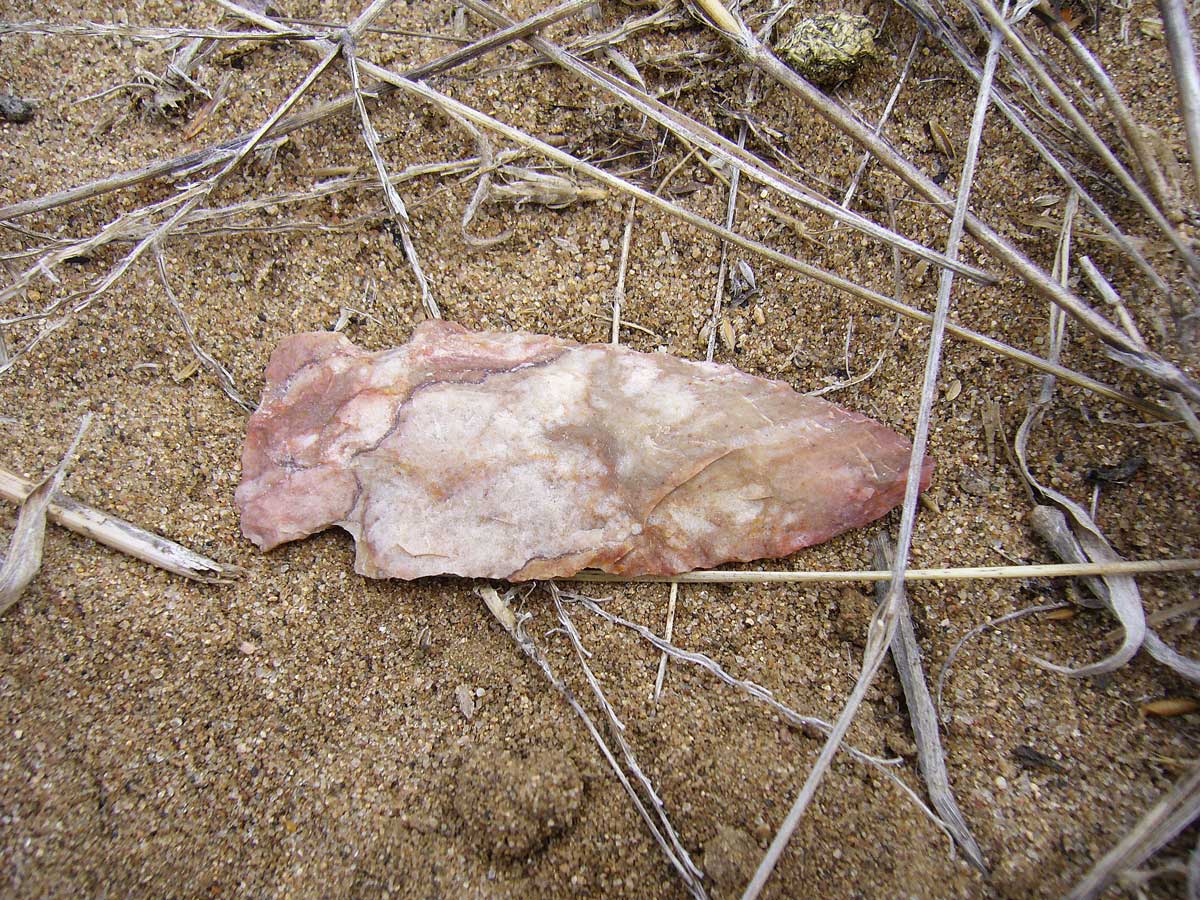
Since it was my birthday, it was appropriate that I should discover this “gift” next to the rim of my net after I slapped it over a mating pair of beetles.  I haven’t found a large number of Native American artifacts during my time in the field, but this has to be most impressive of those that I have found – it is in almost perfect condition, with only the smallest of chips off of one of the lower corners.  Edit 5/5/09: After a little research, I believe this to be a spear point from the Archaic period (12,000 to 2,500 years ago).

arrowhead_p1020900_2

p.s. – my 100th post!

REFERENCE:

Pearson, D. L., C. B. Knisley and C. J. Kazilek. 2006. A Field Guide to the Tiger Beetles of the United States and Canada. Oxford University Press, New York, 227 pp.

Copyright © Ted C. MacRae 2009

Add to FacebookAdd to NewsvineAdd to DiggAdd to Del.icio.usAdd to StumbleuponAdd to RedditAdd to BlinklistAdd to Ma.gnoliaAdd to TechnoratiAdd to Furl

Trees of Lake Tahoe – The Deciduous Trees

Alder, Maple, and Nuttall’s Flowering Dogwood make beautiful bowers over swift, cool streams at an elevation of from 3000 to 5000 feet, mixed more or less with willows and cottonwood; and above these in lake basins the aspen forms fine ornamental groves, and lets its light shine gloriously in the autumn months.–John Muir, The Mountains of California (1894).

p1020724_2

This is the third installment of a “Trees of Lake Tahoe” series summarizing the trees of Tahoe Basin. The basin forests are, of course, dominated by a diverse assemblage of conifers – eleven species in all.  These were covered in parts 1 (Trees of Lake Tahoe – The Pines) and 2 (Trees of Lake Tahoe – The “Other” Conifers ) of this series.  Yet, despite this coniferous domination, the 14 species of deciduous trees¹ that occur in the Tahoe Basin is three more than the number of coniferous tree species.  These deciduous tree species will be covered in this third and final part, including the nine species I was able to locate on my recent visit to the area back in mid-March.  Because of the timing of that trip, the trees will be discussed from a decidedly wintertime perspective that makes species identifications a little more challenging compared to the coniferous species.

¹ Admittedly, I use the term “tree” in the broadest sense, since many of these species might better be described as “tree-like shrubs” or “shrubby trees,” often representing only the largest examples of genera whose members include a number of true shrubs.  Only a handful of these species routinely form large, unmistakably tree-like forms, the largest of which still pale in comparison to the coniferous giants that dominate the basin.

Family SALICACEAE

This family of dioecious plants (male and female flowers on separate plants) is represented in the Tahoe Basin by two genera.  Two species of Populus occur here, and both decidedly trees in form.  Most of the nine species of Salix that grow in the basin grow only as shrubs, while two of them sometimes form distinct trees.

Quaking aspen (Populus tremuloides)

…in winter, after every leaf has fallen, the white bark of the boles and branches seen in mass seems like a cloud of mist that has settled close down on the mountain, conforming to all its hollows and ridges like a mantle, yet roughened on the surface with innumerable ascending spires.–John Muir, Steep Trails (1918).
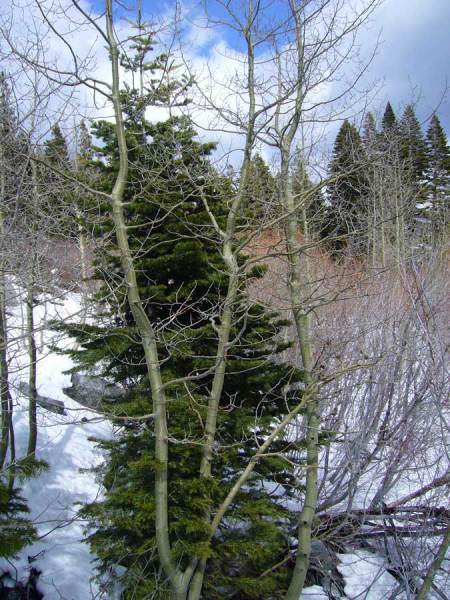
p1020610_2p1020611_2

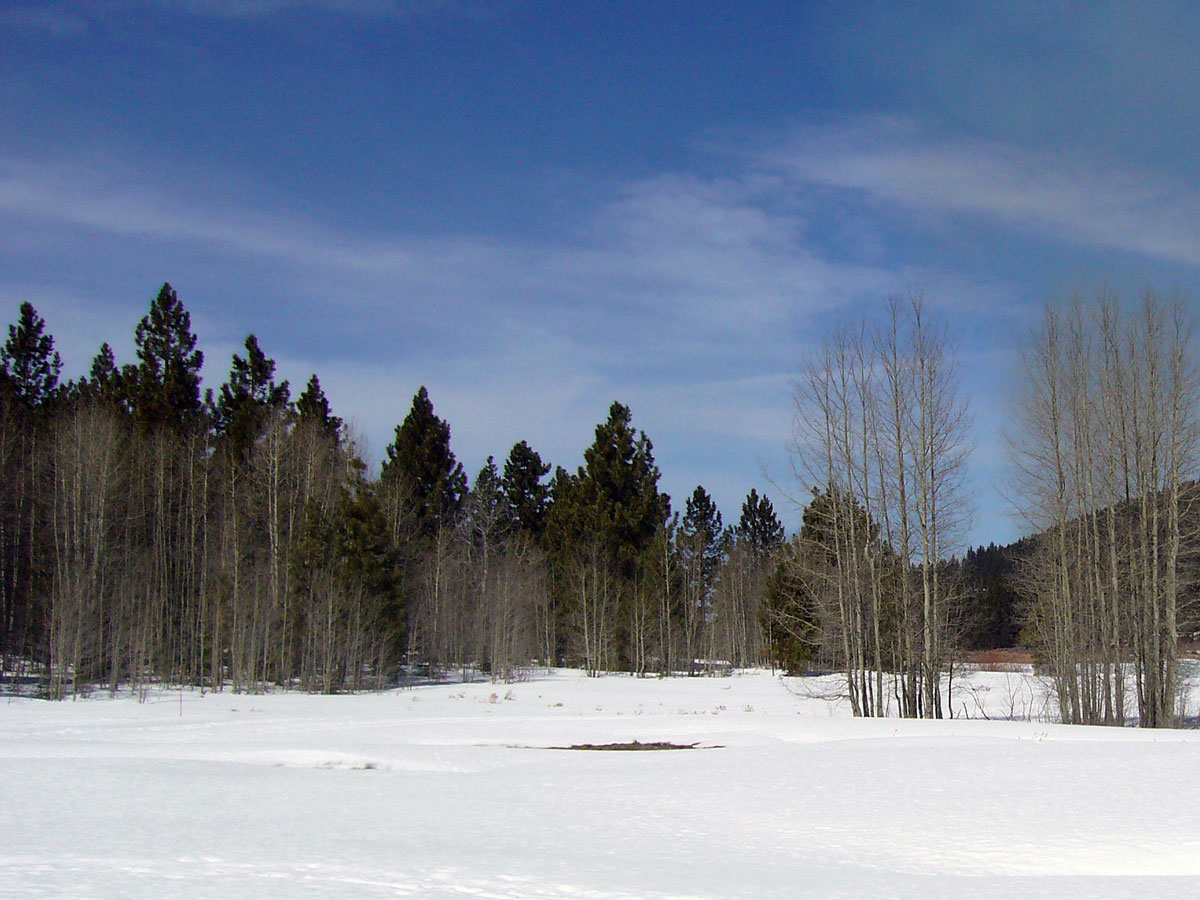
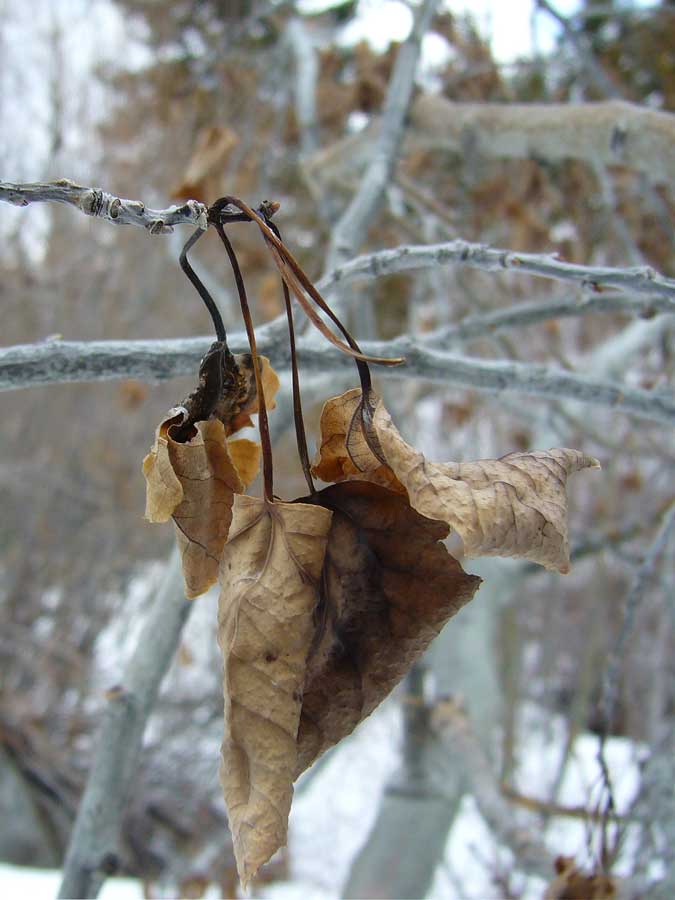
Quaking aspen is one of the most unmistakable trees of the Tahoe Basin – regardless of the season.  Famous for its shimmering foliage during summer and blazing fall colors, it is equally distinctive during winter when its smooth, creamy, greenish-white trunks stand in stark, leafless contrast to the dark green coniferous foliage that cloaks the landscape.  Thick stands of this species are common in moist meadows and stream margins, with stands typically representing clonal colonies of genetically identical trees sprouting from a common root mat.  Although another species of Populus does occur in the basin (black cottonwood – see below), that species is not nearly as abundant as quaking aspen and lacks its distinctive smooth bark.

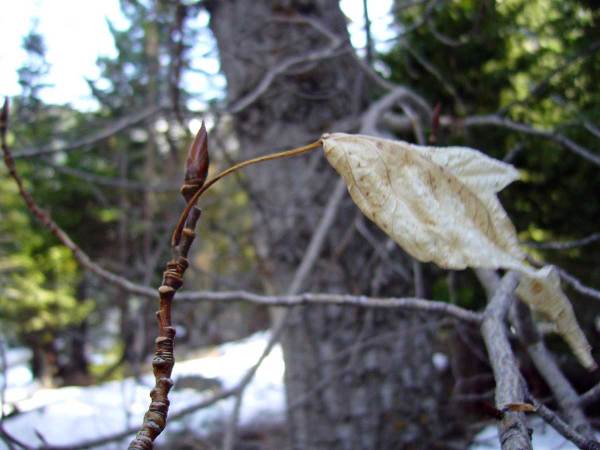
The second photo above shows some of the few, still-clinging leaves that I found, unremarkable in senescence but showing the flattened petioles that cause to summertime leaves to flutter and quiver incessantly with the summer breezes, alternately flashing their bright green upper surface and silvery underside.

Black cottonwood (Populus balsamifera ssp. trichocarpa)

p1020701_2p1020700_2

Black cottonwood is the largest American Populus and the tallest non-conifer in western North America.  Growing throughout the cool, moist Pacific Northwest, it is at its elevational limit in the Sierra Nevada along moist streams and lakeside habitats in the lower Tahoe Basin. The wonderfully knowledgeable Forest Service worker, who helped me greatly in my quest to locate all of the basin’s conifers, was skeptical about my chances of finding this species; however, while hiking the Rubicon Trail at Emerald Bay State Park I spotted the unmistakable, deeply furrowed, gray bark of this close relative of our own eastern cottonwood (Populus deltoides).  Examining the twigs revealed the large, pointed buds, sticky with resin, and a few clinging leaves whose wide, ovate shape confirmed the species’ identity.  It was the only black cottonwood I saw in the basin, although surely others exist throughout the basin at lakeside elevations.

Willows (Salix spp.)
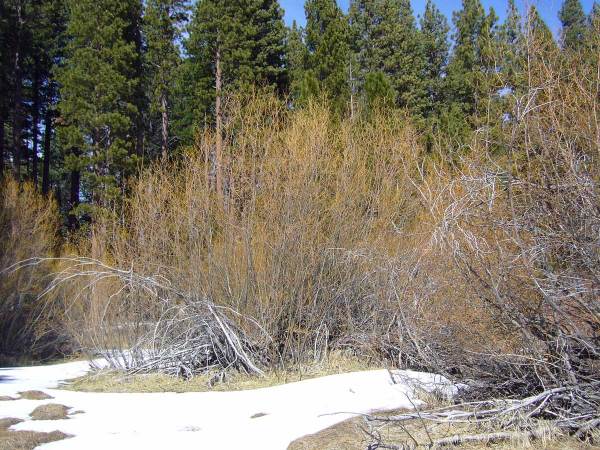
p1020673_2

As a group, willows are easily distinguished from the other deciduous trees and shrubs that occur in the Tahoe Basin.  However, discriminating among the several species can be quite difficult, even for trained botanists.  Winter is not the best time to try to identify willows, as many species are distinguished by characters of the foliage and flowers.  In some cases, examination of both male and female flowers is required – frustrating since they are borne on separate plants!  Wintertime characters normally useful for other plants such as bark and twig color are rarely informative for different species of willow, and even growth habit as trees or shrubs can vary greatly within species depending on elevation and available moisture.  All of this is a long-winded way of saying I don’t know which or how many species of willow I observed in the Tahoe Basin.
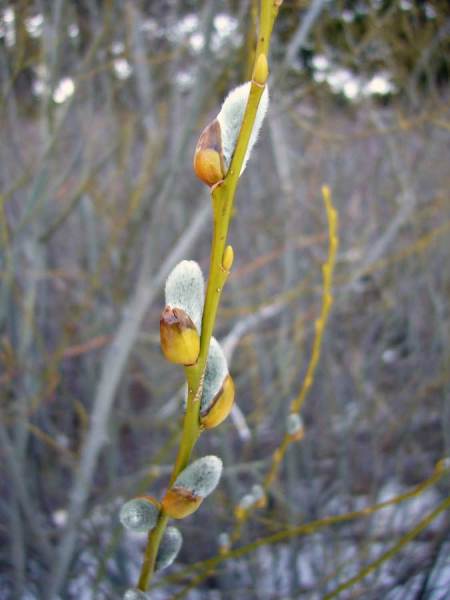
p1020705_2p1020707_2According to Graf (1999), there are nine species of willow in the Tahoe Basin; however, only two of them are trees – the abundant shining willow (S. lucida spp. lasiandra), and the more drought-tolerant Scouler’s willow (S. scouleriana).  The remaining seven species are shrubs that rarely exceed 10-12 feet in height.  Indeed, one of them – arctic willow (Salix arctica) – grows no more than 4 inches tall, occurring in seepy slopes and along lake and stream margins in the subalpine zone at Carson Pass.  Most of the willows I observed were at lower elevation along the shore of Emerald Bay and in the wet meadows around South Lake Tahoe and Spooner Lake and were growing as large shrubs or small trees and exhibited either bright yellow or red bark on the year-old branches, turning to smooth gray on older branches.  I don’t know whether these represent one or more species, or if they even represent one of the two arborescent species, but I suspect the yellow-twigged species may represent Lemmon’s willow (S. lemmonii), one of the shub species and Tahoe’s most common willow.  Perhaps a stretch goal for next year’s trip could be to find and distinguish all nine Tahoe Basin willow species, but realistically I would settle for knowing for sure what species the plants in these photographs represent (although I definitely would like to find the diminutive arctic willow).

Family BETULACEAE

Like the Salicaceae, plants in this family have male and female flowers on separate structures called catkins, but the plants themselves are monoecious (both sexes on the same plant).  Two genera – Alnus and Betula – occur in the basin, each represented by one species.

Mountain alder (Alnus incana ssp. tenuifolia)
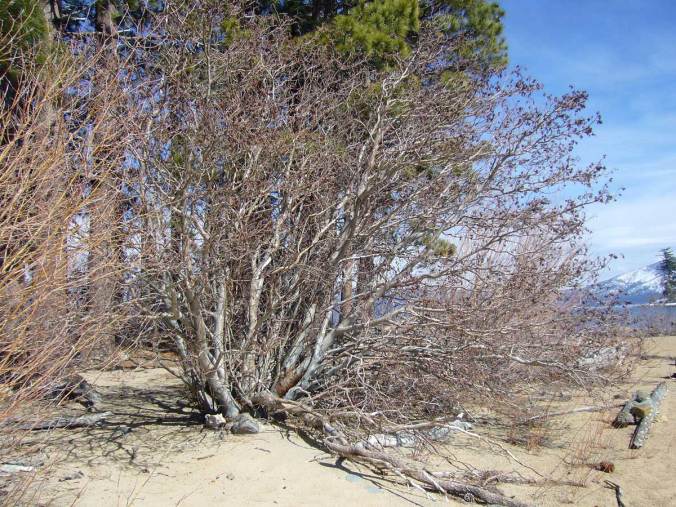
p1020675_2p1020677_2

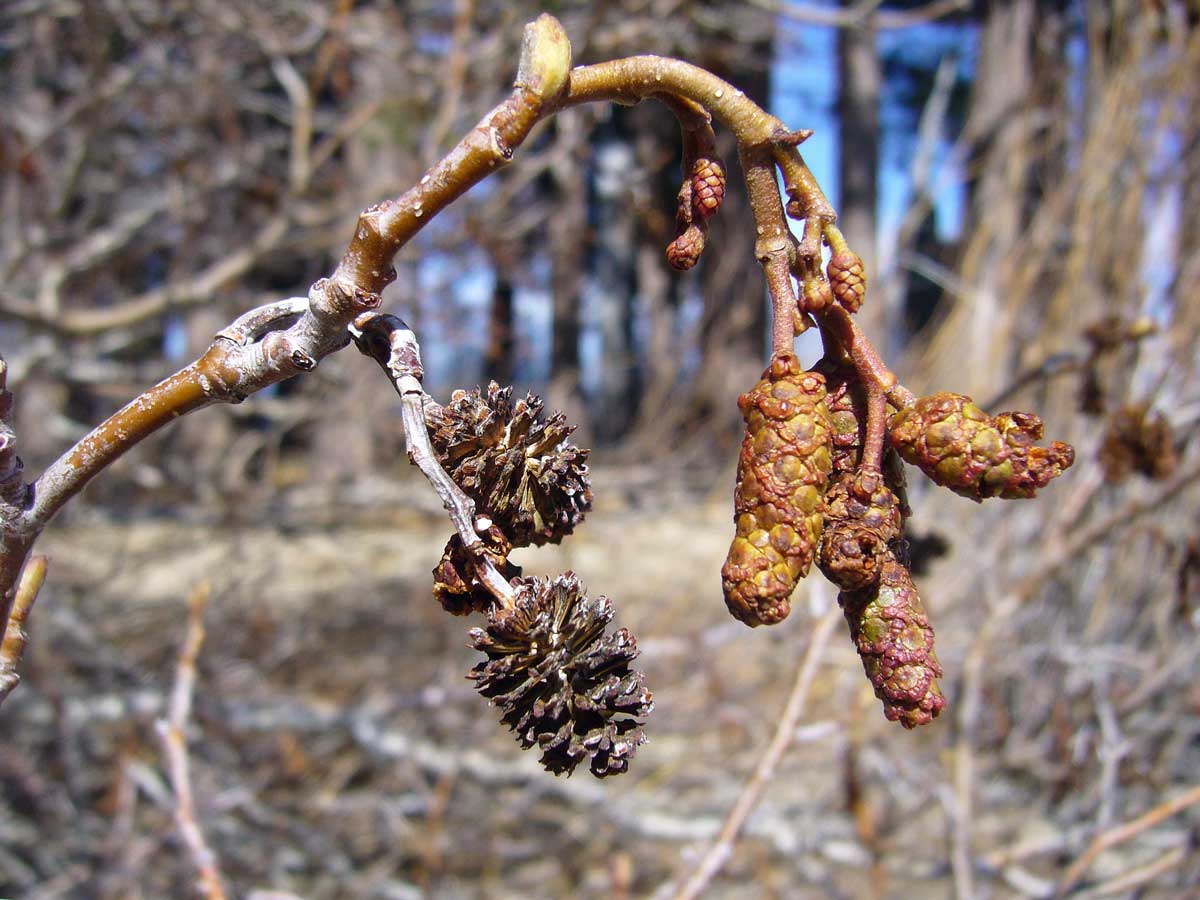
Like the willows, mountain alder is another deciduous plant that straddles the line between tree and shrub, and as is typical of most species in these two plant families (Salicaceae and Betulaceae) the species shows a high affinity for moist sites along stream and lake margins and on seepy north- and east-facing slopes.  The largest specimens I saw, as pictured above left, were found growing on the granite sand beaches along the Rubicon Trail on the western shore of Emerald Bay in Emerald Bay State Park.  Like alders anywhere, this species is immediately recognizeable in winter due to the persistent woody cones that represent the previous year’s female catkins.  Another larger species of alder, white alder (A. rhombifolia), occurs in the Sierra Nevada, but it is not clear to me whether this species actually occurs in the Tahoe Basin proper.  Graf (1999) does not include it in his rather comprehensive treatment of Tahoe Basin plants, but Peterson & Peterson (1975) and Quinn (2006) both list it from the basin (although rare). 

Water birch (Betula occidentalis)

I did not observe this species, which Graf (1999) records from Carson Pass.  The only birch occurring in the Sierra Nevada, it is more common outside the basin proper on the eastern slopes above the burning sagebrush plains.  Like alder, separate male and female catkins are borne on the same tree; however, the female catkins of birch are solitary rather than clustered and disintegrate when ripe rather than persisting as woody cones.

Family FAGACEAE

This family contains the über diverse genus Quercus – represented in California by 20 species.  However, of the five arborescent oaks that occur in the Sierra Nevada, only one has successfully penetrated the high elevations of the Tahoe Basin. A second species of Quercus also inhabits this montane region but grows exclusively as a low shrub, and another shrub in the related genus Chrysolepis also grows here – these two latter species will be treated more fully in a future post.

Canyon live oak (Quercus chrysolepis)

The trunk was all knots and buttresses, gray like granite, and about as angular and irregular as the boulders on which it was growing—a type of steadfast, unwedgeable strength.–John Muir, The Mountains of California (1894).

p1020618_2p1020614_2

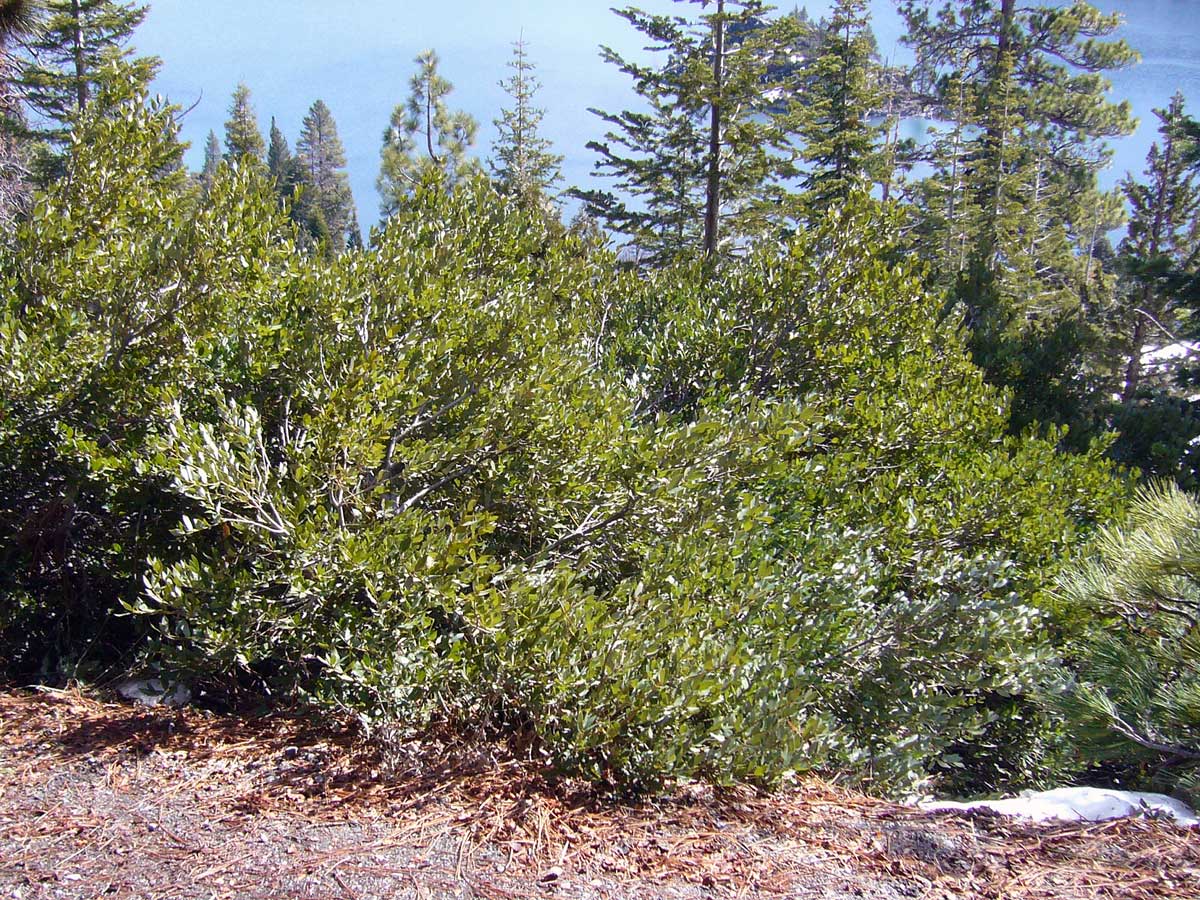
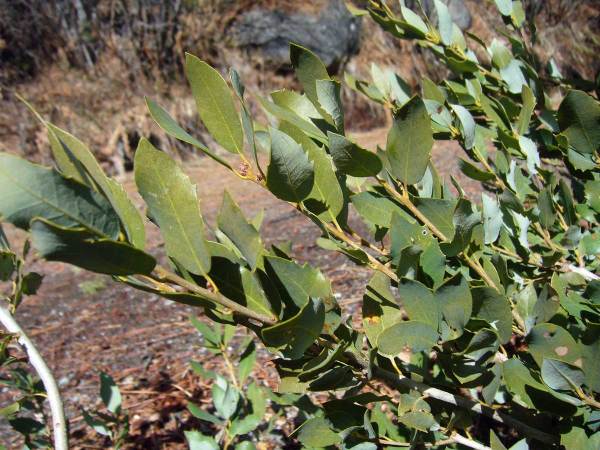
This is one of North America’s most variable oaks, exhibiting extreme variability in leaves and fruit and developing as either a tree or a shrub, depending upon the site where it grows. Slow growing and solid, it does best in sheltered locations, where it can develop an impressive, spreading crown and live a hundred years or more. On exposed slopes, it takes on a shorter, shrubbier aspect (above left) or forms dense thickets (above right).  I saw most of this species at lower elevations within the basin – along the Vikingsholm Trail in Emerald Bay State park leading down to the west shore of Emerald Bay.
p1020615_2

The leaves of this evergreen species are bluish green with numerous golden glandular hairs when young and becoming dull gray and smooth with age. Although there are no other arborescent oaks at this elevation with which it can be confused, I did find growing alongside it the strictly montane and shrubby huckleberry oak (Q. vaccinifolia).  The somewhat smaller, mostly entire leaves were the only indication it was not merely a shrub form of canyon live oak, and further study revealed that the two species can be distinguished by the presence of multiradiate glandular hairs on both leaf surfaces of canyon live oak.  These two species are closely related (both are in the Protobalanus – or “golden oak” – section of the genus), and widespread hybridization has apparently been documented in this part of the Sierra Nevada where the two species’ distributions overlap (Nixon 2002).

Family ROSACEAE

This large family of dioecious plants with usually pentamerous radial flowers is represented in the Tahoe Basin by nearly three dozen mostly perennial shrubs.  Six of these species, representing the genera Amelanchier, Cercocarpus, Prunus and Sorbus, sometimes develop a tree form.

Cherry (Prunus sp.)
p1020713_2p1020712_2

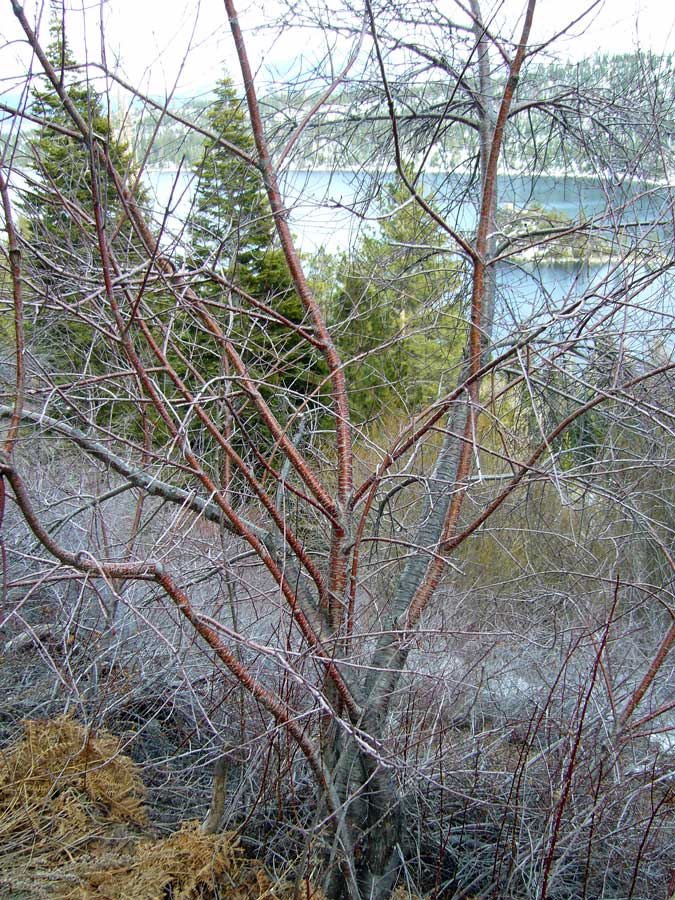
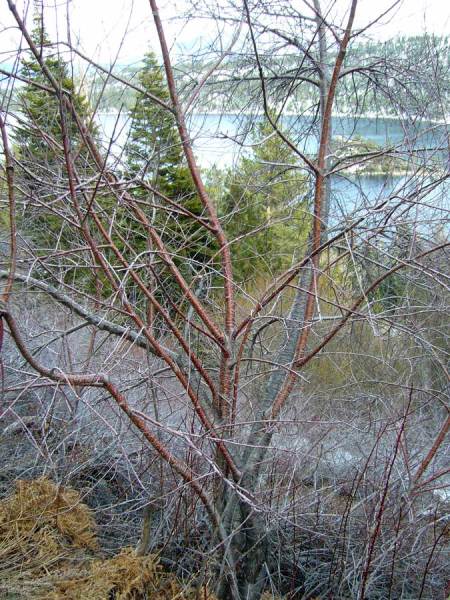
Two species of Prunus – bitter cherry (P. emarginata) and western chokecherry (P. virginiana var. demissa) – occur in the Tahoe Basin, both growing as either shrubs or small trees.  I cannot say for sure which species is represented in these photographs (taken on the slopes above Emerald Bay at Emerald Bay State Park), as the two species are best distinguished by subtle differences in their flowers and foliage.  Bitter cherry is apparently common in the Tahoe Basin and has bark that is smooth and dark brown, while chokecherry is more of a foothill species that is uncommon on the western shore (where these photos were taken) and has more grayish brown and somewhat scaly bark.  I can go either way with bark color based on these photos, so I’ll forgo an ID for the time being and seek to follow up during my next visit.  A third species of Prunus, the strictly shrubby desert peach (P. andersonii), formerly occurred at low elevations around the south shore, but it is now considered to be extirpated from the basin.

Mountain ash (Sorbus californica)

While hiking the Rubicon Trail in Emerald Bay State Park, I spotted a single, small tree with distinctive, large winter buds that reminded me immediately of the ornamental species mountain ash (Sorbus aucuparia) from my former days as a nursery inspector.  This thought seemed to be confirmed when I found a senesced but still attached leaf, pinnately compound with nine ovate, toothed leaflets.  However, my pocket copy of Native Trees of the Sierra Nevada (Peterson & Peterson 1975) included no species of Sorbus, and I concluded it must be something else.  This lone tree was located in deep shade within the white fir forest near the western shore of Emerald Bay, so I opted to find another tree in better lit conditions for taking photos – unfortunately, no other trees of this species were found.  Once I got back home, I was happy to find Sorbus californica listed in my just purchased copy of Graf (1999).  This species has attractive white flowers in small panicles during the summer that give rise to bright red berries during fall and is apparently common in mid- to higher-elevation riparian communities around the lake.

Serviceberry (Amelanchier spp.)
Curl-leaf mountain mahogany (Cercocarpus ledifolius)

I did not locate either of the two species of serviceberry that occur in the Tahoe Basin, the common serviceberry (Amelanchier utahensis) and the more localized glabrous serviceberry (A. alnifolia var. pumila).  Being highly familiar with our eastern species, A. arborea (just recently finished flowering), I suspect either of these species would be readily recognized, even in winter, by their smooth, silvery-gray bark and shrubby, small-tree form.  I also did not see curl-leaf mountain mahogany (Cercocarpus ledifolius), another species that barely qualifies as a small tree.  It is apparently more at home on the dry eastern flank of the Sierra Nevada but can be found within the basin proper sporadically in the southwest and along the southeastern lake shore and more commonly on dry slopes in the far north and south of the basin.  I have collected a number of woodboring beetles from mountain mahogany across the southwestern U.S. from the mountains of southern California to the Chisos Mountains of Texas.

Family ACERACEAE

The single North American genus, Acer, is represented in California by four species, three of which occur in the Sierra Nevada but only one occurring in the Tahoe Basin.  Plants in this family are closely related to the Hippocastanaceae, represented in the Sierra Nevada foothills by California buckeye (Aesculus californica).

Mountain maple (Acer glabrum var. torreyi)

As with mountain ash, I found a single small tree representing this species near the west shore of Emerald Bay while hiking the Rubicon Trail.  Despite lacking foliage, I recognized it immediately as a maple by its opposite, scaly buds.  Also like mountain ash, I assumed I would see more after finding the first one and thus didn’t photograph this particular tree growing in deep shade.  That’ll teach me.  This species sometimes grows as a multi-stemmed shrub in moist situations, and even when assuming tree form, as did the one I saw, it is at best a small tree with a maximum height of only around 15′.  With fall foliage in varying shades of pink to red, it must rather nicely compliment the blazing yellow cloak of the quaking aspen during September and October.  Tahoe Basin individuals are placed in var. torreyi due to their bright reddish twigs, while those on the eastern slope of the Sierra Nevada exhibit gray twigs and are placed in var. diffusum.

This concludes my “Trees of Lake Tahoe” series – at least until next year when I hope to locate some of the remaining species I did not find during this year’s visit.  However, I do have one more “flora of Lake Tahoe” post in preparation covering some of the many woody shrubs that occur within the basin.

REFERENCES:

Arno, S. F. 1973. Discovering Sierra Trees. Yosemite Association, Yosemite National Park, California, 89 pp.

Graf, M. 1999. Plants of the Tahoe Basin. Flowering Plants, Trees, and Ferns. A Photographic Guide. California Native Plant Society Press, Berkeley, 308 pp.

Muir, J. 1894. The Mountains of California. The Century Co., New York, xiii+381 pp.

Muir, J.  1918. Steep Trails. Houghton, Mifflin, Boston, ix+390 pp.

Nixon, K. C. 2002. The oak (Quercus) biodiversity of California and adjacent regions. USDA Forest Service General Technical Report PSW-GTR-184, 20 pp.

Peterson, P. V., and P. V. Peterson, Jr. 1975. Native Trees of the Sierra Nevada. University of California Press, Berkeley, 147 pp.

Quinn, C.  2006.  A Nature Guide to the Southwest Tahoe Basin: Including Desolation Wilderness and Fallen Leaf Lake: Trees, Shrubs, Ferns, Flowers, Birds, Amphibians, Reptiles, Mammals, and Fishes Inhabiting the Sierra Nevada Watershed Southwest of Lake Tahoe, California.  CraneDance Publications, Eugene, Oregon, 232 pp. 

Copyright © Ted C. MacRae 2009

Add to FacebookAdd to NewsvineAdd to DiggAdd to Del.icio.usAdd to StumbleuponAdd to RedditAdd to BlinklistAdd to Ma.gnoliaAdd to TechnoratiAdd to Furl

Winter botany quiz #5

This may be the last winter botany quiz for awhile, but I did come across this interesting little plant on my recent visit to Lake Tahoe that doesn’t fit neatly into any other category upon which I have (or will be) posting about. I was excited to see this plant, and I’ll be interested in seeing what others think about it. Hints: photograph taken on 03/17/2009 at Emerald Bay State Park, along Rubicon Trail, elev. 6,250′.  The host is ponderosa pine (Pinus ponderosa).

p1020672_2

The usual rules – I’ll leave the photo up for a couple days to give people time to research their answer, with comment moderation turned on during that time. Whoever gets it right (or is closest in case nobody gets it right) wins, and being first is always good in case of a tie-breaker!

EDIT 04/20/2009 – Wow, congratulations to, well… almost everyone, for getting this one right. I guess it was not as hard as I thought it would be, since I’d never heard of dwarf mistletoe until I ran into this plant.

To be exact (something I’m fond of being), this is western dwarf mistletoe (Arceuthobium campylopodum, arse-youth-OH-bee-um cam-pie-low-POE-dum). The term dwarf mistletoe refers to the genus as a whole, while ponderosa pine dwarf mistletoe generally refers to what is now called southwestern dwarf mistletoe (A. vaginatum) from AZ and NM. Accordingly, Kirk deserves special mention for being the first to get both the common name (spelled correctly with lower case) and the scientific name, while Doug was the first to properly italicize the scientific name. I know, I’m being really picky – it’s my nature. Also, Adrian added a nice tidbit of information regarding the impact these plants can have on their hosts.

I can be fairly certain about the ID, but not 100%. According to Hawksworth & Wiens (1998), four species of dwarf mistletoe occur within the Tahoe Basin. Of these, only western dwarf mistletoe utilizes ponderosa pine as a principal host.  There is a small chance it could be lodgepole pine dwarf mistletoe (A. americanum), which occasionally utlizes ponderosa pine but is most often (as the common names suggests) associated with lodgepole pine. The two remaining species, fir dwarf mistletoe (A. abietinum) and hemlock dwarf mistletoe (A. tsugense), are restricted in the Tahoe Basin to white/red fir and mountain hemlock, respectively.

REFERENCE:

Hawksworth, F. G., and D. Wiens. 1998. Dwarf Mistletoes: Biology, Pathology, and Systematics. Diane Publishing Company, Darby, Pennsylvania, 410 pp.

Copyright © Ted C. MacRae 2009

Add to FacebookAdd to NewsvineAdd to DiggAdd to Del.icio.usAdd to StumbleuponAdd to RedditAdd to BlinklistAdd to Ma.gnoliaAdd to TechnoratiAdd to Furl