Buppies in the bush(veld)

In writing an article for the most recent issue of SCARABS, I found myself reliving some long-dormant memories of my trip to South Africa. It was nine years ago right about this time of year when I made what was to become the collecting trip of a lifetime. What a completely different November/December experience compared to the gray skies and bare trees I see outside my window today. Writing that article was a lot of fun – going back through my slides (yep, slides – no digital for me then), reviewing material in my collection, and trying my best to recall some long forgotten details. Using a long-handled tropics net to collect Evides spp. from upper branch terminals of Lannea discolor at Geelhoutbos FarmOf course, scarabs were not my reason for going to Africa – buprestids were! Although I did manage to sneak a few buprestid photos into the SCARABS article, for the most part I was a good boy and kept my focus on the that newsletter’s intended subject. It wasn’t hard, given the gorgeous diversity of “dungers” (dung beetles) and flower chafers that I encountered in that spectacular country. Here, however, I offer a sampling of the Buprestidae I encountered during that trip.

Much of trip was spent in the bushveld (pronounced “bushfelt”) tropical savanna – a mix of grassland and semi-deciduous forest – below the rugged and rocky Waterberg Mountains, their rugged exposures of 2.7 billion year old sandstone and quartzite providing a spectacular backdrop. I’ve already posted a photo of Evides pubiventris, the largest and most spectacular buprestid seen there. A handsome, iridescent green that must be seen to be believed, these elusive beetles spend their days high off the ground on the upper branch terminals of their host trees, Lannea discolor. Success in collecting these beetles comes only to those willing to give it considerable effort. In this photo, I use a long-handled tropics net and tap the rim of the net on the undersides of the branch terminals. The adults are alert and quick to fly but often enough drop from the foliage into the net before taking flight. Many hours were spent during the several days we were at this spot with my neck craned upwards, but my efforts were richly rewarded with several specimens of E. pubiventris and the closely related E. interstitialis.
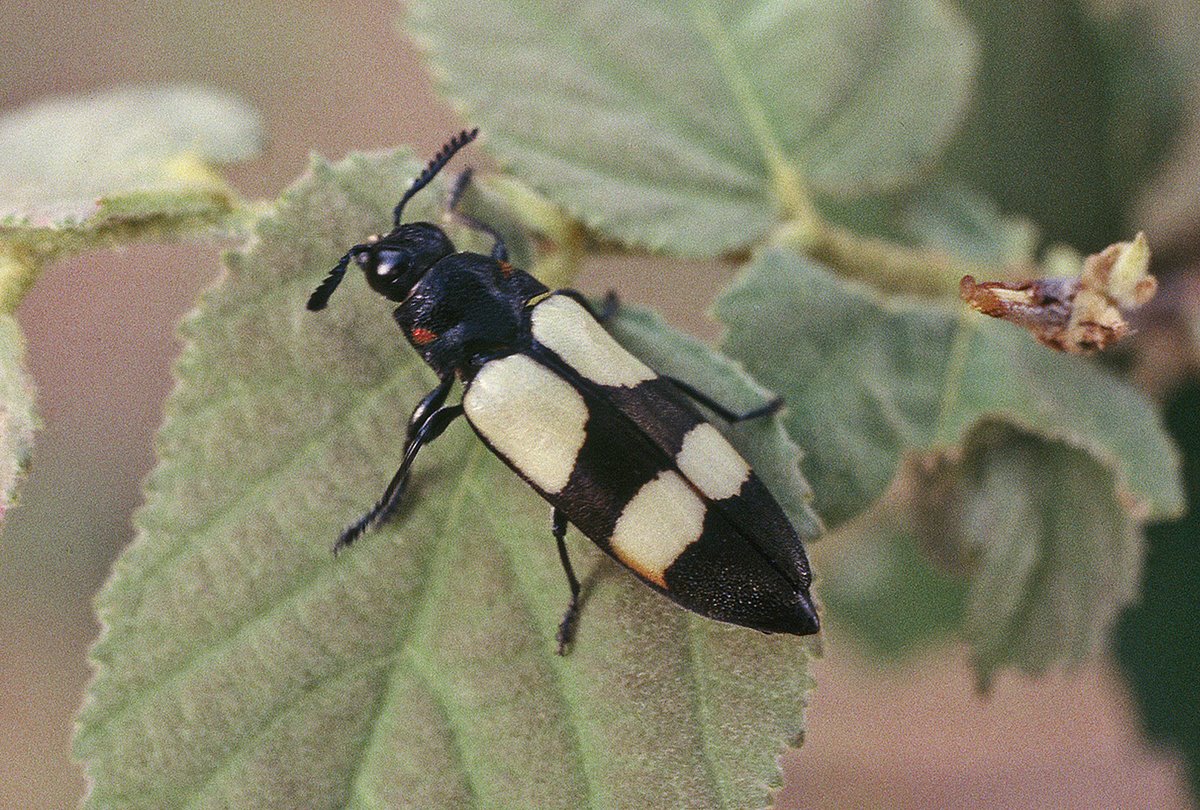
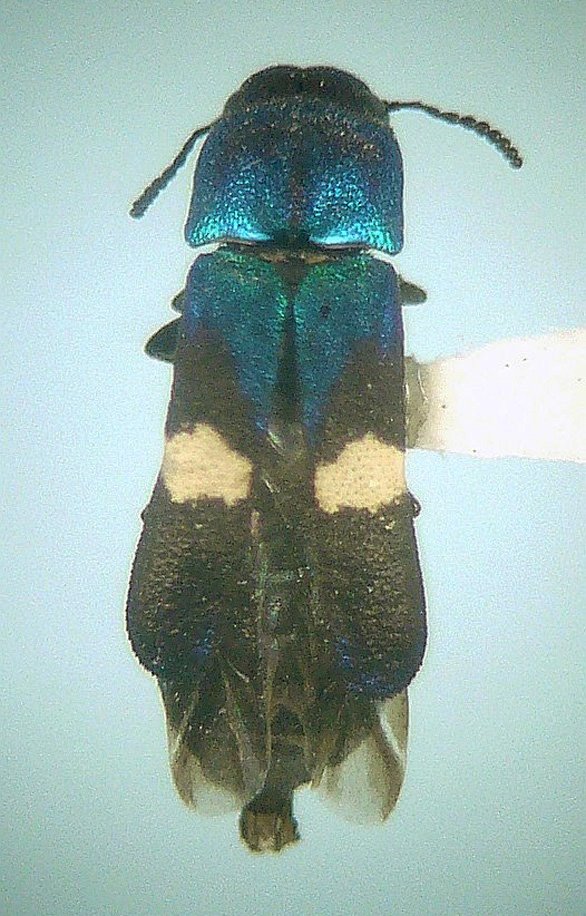
Agelia petalii - South Africa, Limpopo Province, vic. Waterberg Mountains, Geelhoutbos Farm, 30.xi.1999, on Grewia monticolaAnother of the more spectacular buprestids seen on the trip was Agelia petelii, a not too distant relative of Evides (both are in the subfamily Chrysochroinae, containing the bulk of the “classic” jewel beetles). Several individuals of this species were seen here in the Waterberg and also at Borakalalo National Park in North West Province. Their bold markings would seem to make them conspicuous targets for predation by birds but actually serve as protection by mimicking the warning coloration of Mylabris oculata, a common blister beetle in southern Africa that occasionally reaches pest status on leguminous crops and that is – like all blister beetles – largely protected from predation by the cantharidins in its hemolypmph. Many of these blister beetles were seen during the trip, and I had to pay close attention to each of them in order to secure my half dozen or so specimens of the much less common A. petelii.

Meliboeus punctatus - South Africa, Limpopo Province, 8.5 km S of Piesmoor River, 4.xii.1999, on unidentified Grewia-like shrubThis gorgeous little beetle, seen south of the Waterberg near the Piesmoor River, belongs to the enormously diverse but poorly known tribe Coraebini. This tribe – a cousin to the even more diverse genus Agrilus (see this post) – is represented by only a few species in North America but is richly represented in sub-Saharan Africa and Madagascar. Chuck Bellamy – my friend, colleague, and host during this trip – probably knows more about coraebines than anybody alive and has identified this as Meliboeus punctatus. The plant on which the beetles were found remains a mystery – it looks similar to plants in the rhamnaceous genus Grewia on which we saw so many other buprestid species but is clearly not a member of that genus. It is one of the few buprestids I collected on the trip for which I did not obtain host information (I hate that!).
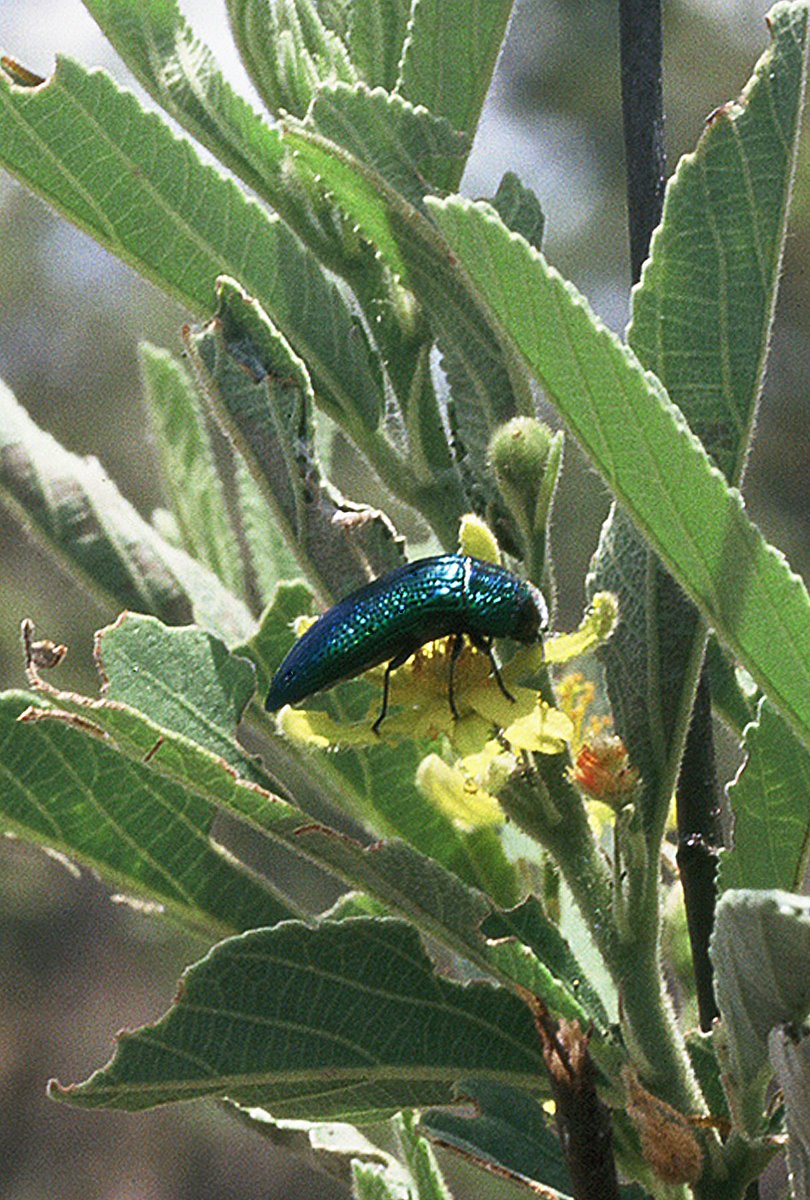
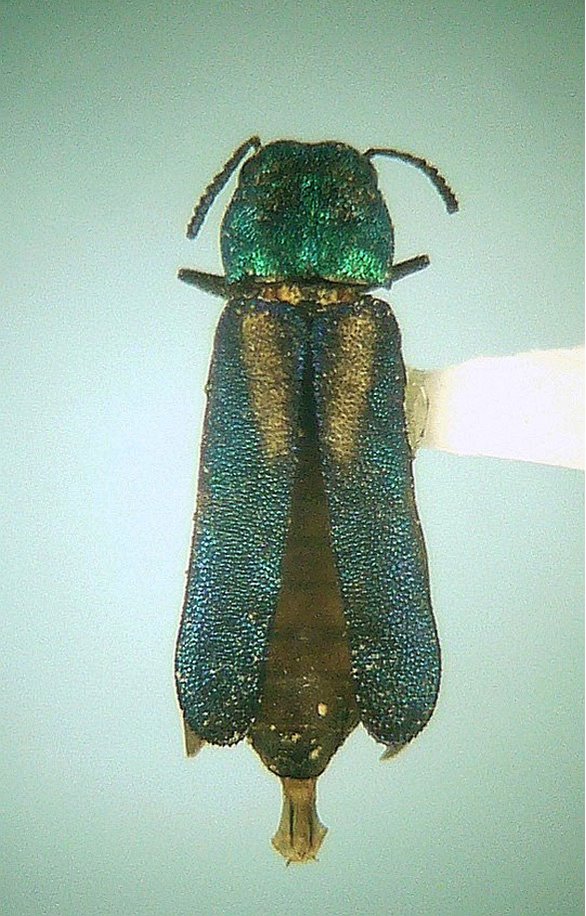
Acmaeodera (Paracmaeodera) viridaenea swierstrae - South Africa, North West Province, Borakalalo National Park, along Moratele River, 24.xi.1999, on Grewia flava blossomThe genus Acmaeodera is another of the hugely diverse groups in the family, having radiated in all the biogeographic realms except Australian. This group is especially well represented in North America, with some 150 species occurring in our desert southwest and many more occurring down into Mexico. The vast majority of these are variously patterned with yellow and/or red markings on a black background. In southern Africa the genus is also diverse but shows greater diversity of form and has, accordingly, been divided into a number of well-defined subgenera. Like our North American species, adults of many African species are frequently found on flowers, where they feed on pollen and petals. I encountered at least a dozen Acmaeodera spp. on the trip, with one of the more striking species being A. (Paracmaeodera) viridaenea. Acmaeodera (Rugacmaeodera) ruficaudis - South Africa, South Africa, Limpopo Province, vic. Waterberg Mountains, Geelhoutbos Farm, 1.xii.1999, on Grewia flava blossomLike other species in this subgenus, adults are brilliantly colored and sexually dichroic, with the individual pictured here (above, left) being a female and the males being greenish brown with coppery sides. Other species are quite somber colored, such as A. ruficaudis in the subgenus A. (Rugacmaeodera) (right). Both of these individuals were found on flowers of Grewia flava.

Discoderoides immunitus - South Africa, South Africa, Limpopo Province, vic. Waterberg Mountains, Geelhoutbos Farm, 1.xii.1999, on Grewia flavaNot all “jewel beetles” do their name justice. This small species – Discoderoides immunitus (another member of the tribe Coraebini) – appears to resemble a piece of caterpillar frass. Several individuals were seen, all sitting on the leaves of Grewia flava like this individual rather than visiting the flowers like Acmaeodera. This beetle reinforced an important lesson I have learned repeatedly about field identification – upon my return to St. Louis, when I had an opportunity to examine these individuals more closely under the microscope, I found one specimen mixed in the batch that was, in fact, not this species, but a species in the closely related genus Discoderes. Moreover, that individual appears to represent an as yet undescribed species. Pity that I found only the single individual, since describing species from such uniques is not very desireable. Regardless, I’m glad I didn’t assume this individual was yet another D. immunitis in the field and pass it by – keeping the species in the still too-swollen ranks of the unknown and unseen.

One of the most exquisite species that I collected was Anadora cupriventris – a very large (by coraebine standards), heavily sculptured species densely covered with curled swaths of gold and brown pubescence. I regret not having the opportunity to photograph the single individual that I found. Another impressive species that I was not able to photograph was Agrilus (Personatus) sexguttatus, surely close to, if not the largest species in the genus and boldly patterned with black and rust red spots on olive green. One last species for which I have no images but is worthy of mention is an undetermined species of the genus Pseudagrilus. Looking like a chunky, brilliant green Agrilus with saltorial (jumping) metafemora, adults would “pop” off the Solanum plants on which they were found as soon as I looked at them. I eventually decided that “Flipagrilus” would have been a more appropriate name for the genus. All told, I collected some 66 species of Buprestidae, including several genera not previously represented in my collection (e.g., Brachmaeodera, Brachelytrium – a few becoming paratypes of new species then being described by Chuck Bellamy and Svata Bílý, Chalcogenia, Galbella, and many of the other above mentioned species). I should mention the assistance of Chuck and Svata for helping me with some of the identifications, as well as Gianfranco Curletti who identified all of the material in the difficult genus Agrilus. I sincerely hope that I have another chance to visit this incredible land of beauty and contrast!

Cicindela limbata – epilogue

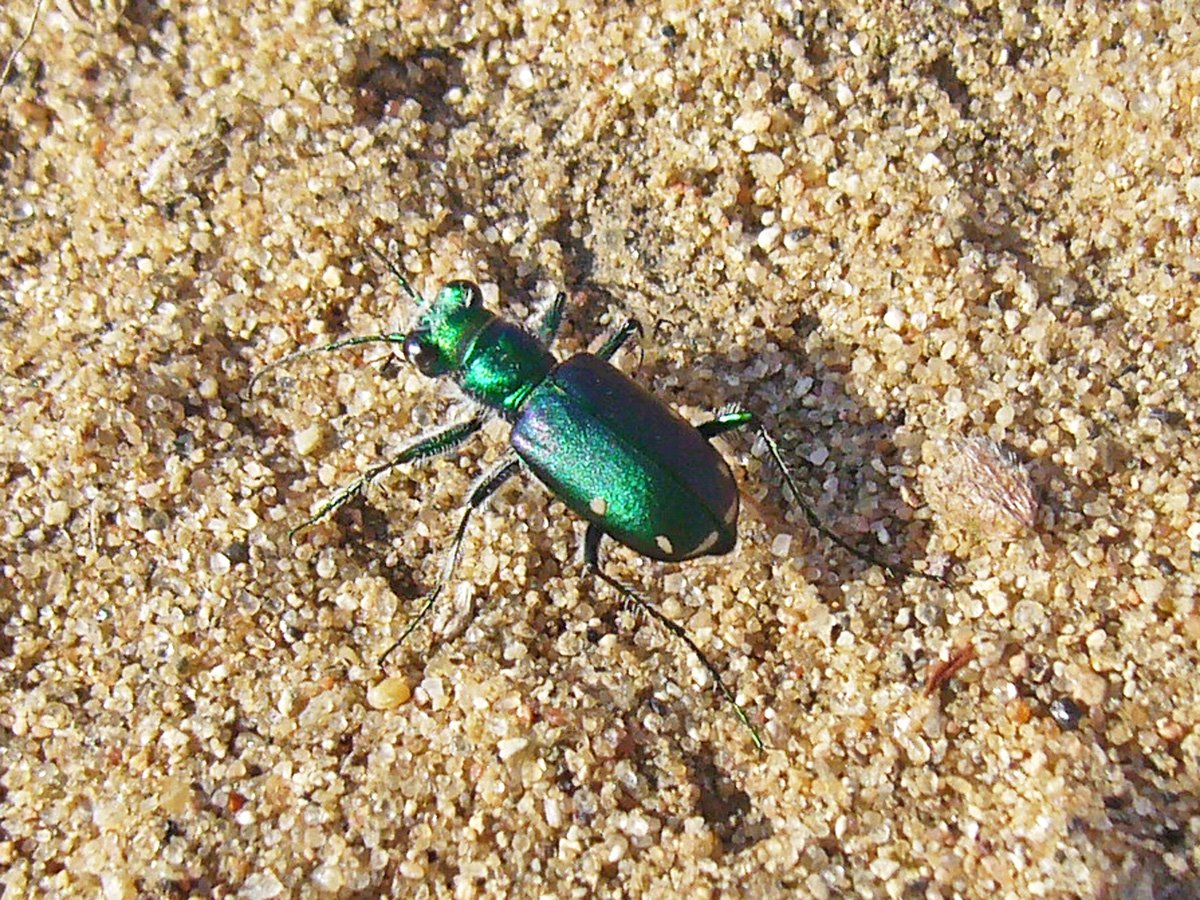
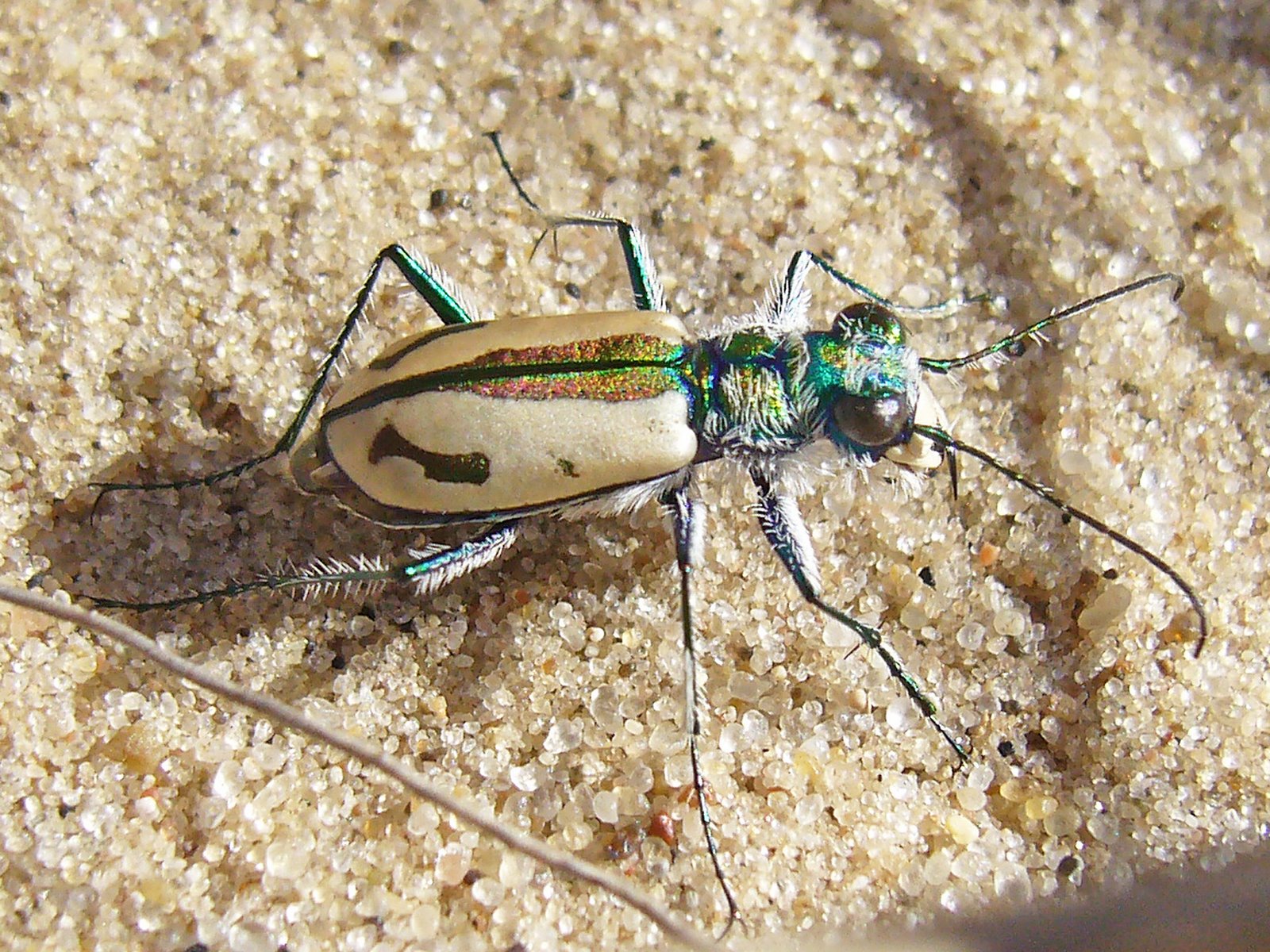
In my Lucky 13 post, I featured Cicindela limbata (sandy tiger beetle) from north of Grand Island, near the easternmost edge of the Nebraska Sandhills. This species is restricted to dry sand blow out and dune habitats away from water, thus its distribution in Nebraska largely coincides with that of the Sandhills themselves. Nebraska populations are assigned to the nominate subspecies, which is characterized by extensively developed white maculations on the elytra, Nebraska, Grant Co., nr. Hyannis, 3.4 mi S Hwy 2 on Hwy 61, 26.ix.2008, coll. T.C.MacRaewith the sutural area and small discal markings metallic green or blue. The whitish areas on the elytra and dense pilosity on the undersurface, along with their habit of digging into the sand during the midday hours, are obvious adaptations for reflecting heat and avoiding the high temperatures that occur in their white sand habitats. In the more eastern areas of the Sandhills, the green sutural areas of the elytra are suffused with a reddish cast (see this photo in Lucky 13), while in populations further to the west no such reddish suffusion is seen. The individual featured in these two photos was found in the western Sandhills (near Hyannis) and is one of the individuals that I dug from their midday burrows (see Sand Hills Success). Had I not been clued into this behavior when I visited this site, I would have left with only the single individual that was seen at the surface. That individual was captured immediately, and further searching for active adults to take photographs of were unsuccessful – until I started digging, that is. Unfortunately, adults that have just been caught or dug out of their burrows aren’t the most cooperative photography subjects, so one of them was kept alive and placed in a terrarium upon my return to St. Louis. (These photos were taken about a week after I returned, and the individual lived for another seven weeks on a diet of 3rd instar fall armyworm and black cutworm larvae. I eventually trained it to grab larvae directly from the forceps – very entertaining indeed! Also, while these photos from the terrarium confines are adequate for illustrating the species, I think they still lack that undefinable spark that is caputured in true field photographs with unmanipulated individuals – compare to this photo).

Cicindela limbata, with its five recognized subspecies1, has one of the more interesting distributions of North American species (see Pearson et al. 2006). In the main area of distribution, the southernmost populations, distributed through most of Nebraska and adjacent areas of Wyoming and South Dakota, are considered nominotypical. A distributional gap to the north separates these populations from Nebraska, Grant Co., nr. Hyannis, 3.4 mi S Hwy 2 on Hwy 61, 26.ix.2008, coll. T.C.MacRaesubspecies nympha, which occurs in sand habitats of northern Montana and North Dakota and further northward into the Canadian Prairie Provinces. Individuals from these populations exhibit even greater development of the white maculations but darker intervening areas. Another distributional gap separates nympha from subspecies hyperborea, which (as its name suggests) occurs even further north in open sand habitats in the pine and poplar forests of northern Alberta and Saskatchewan and adjacent areas of the Northwest Territories. Subspecies hyperborea is characterized by its greatly reduced white maculations (thus, exhibiting expanded dark areas) and overall smaller size, both of which may be regarded as heat conservation adaptations for the far boreal climate in which it lives.

1 Excluding the federally endangered Cicindela albissima (Coral Pink Sand Dunes tiger beetle), which was recently elevated to species status based on mitochondrial DNA evidence (Morgan et al. 2000).

The fragmented nature of the main limbata population in the upper Great Plains and into the boreal forests is, in itself, interesting enough. Even more interesting, however, are the existence of two small and highly disjunct populations far removed from the main limbata population. One of these is known from Labrador – almost 3,000 miles to the east! Originally referred to subspecies hyperborea, this population was theorized to possibly represent an accidental introduction since individuals appeared to be restricted to open sand habitats within 70 km of the Goose Bay airport (Larson 1986, Pearson et al. 2006). However, careful examination of individuals from this population revealed subspecific differences in maculation (intermediate between hyperborea and nominotypical limbata), lending support to the hypothesis that it is a naturally occurring population and resulting in its description as a distinct subspecies, labradorensis (Johnson 1990). Recent analysis of mitochondrial DNA sequences provided additional support for this subspecies as a distinct entity (Knisley et al. 2008), and newly published field observations by tiger beetle afficionados Dave Brzoska and John Stamatov (2008) conducted 19 years after the initial discovery of the population suggest it is well established in suitable habitats much more distant from Goose Bay than originally reported. This accumulation of evidence seems to increasingly support a historical isolation rather than accidental introduction hypothesis. The fifth and final subspecies is an even more recently discovered and equally disjunct population in the Nogahabara Dunes of northwestern Alaska (Pearson et al. 2006). Although individuals from this population resemble subspecies nympha, morphological and mitochondrial DNA sequence analyses support its status as a distinct subspecies, designated nogahabarensis (Knisley et al. 2008). Such an unusual and fragmented distribution for Cicindela limbata and its subspecies is likely the result of historical changes in climate that have caused expansions and contractions of open sand habitats due to fluctuations in available moisture. The current geographical subspecies may have originated at the end of the mid-Holocene hypsithermal (or Holocene Climatic Optimum) some 5,000 years ago, when previously expansive open sand habitats would have begun shrinking and fragmenting as a result of declining temperatures and increasing moisture regimes.

REFERENCES

Brzoska, D. W. and J. Stamatov. 2008. A trip to Goose Bay, Labrador, Canada. Cicindela 40(3):47-52.

Johnson, W. 1990. A new subspecies of Cicindela limbata Say from Labrador (Coleoptera: Cicindelidae). Le Naturaliste Canadien 116(4) [dated 1989]:261-266.

Larson, D. J. 1986. The tiger beetle, Cicindela limbata hyperborea LeConte, in Goose Bay, Labrador (Coleoptera: Cicindelidae). The Coleopterists Bulletin 40(3):249-250.

Knisley, C. B., M. R. Woodcock and A. Vogler. 2008. A new subspecies of Cicindela limbata (Coleoptera: Cicindelidae) from Alaska and further review of the maritima group by using mitochondrial DNA analysis. Annals of the Entomological Society of America 101(2):277-288.

Morgan, M., C. B. Knisley and A. Vogler. 2000. New taxonomic status of the endangered tiger beetle Cicindela limbata albissima (Coleoptera: Cicindelidae): evidence from mtDNA. Annals of the Entomological Society of America 93(5):1108-1115.

Pearson, D. L., C. B. Knisley and C. J. Kazilek. 2006. A Field Guide to the Tiger Beetles of the United States and Canada. Oxford University Press, New York, 227 pp.

Two new species of Agrilus from Mexico

ResearchBlogging.orgThe enormous, cosmopolitan genus Agrilus (family Buprestidae – commonly called jewel beetles or metallic woodboring beetles) contains nearly 4,000 described species (Bellamy 2008). With many more still awaiting description, it is perhaps the largest genus in the entire animal kingdom (Bellamy 2003). Agrilus species are primarily twig and branch borers, utilizing recently dead wood for larval development – although there are notable exceptions, e.g. Agrilus anxius (bronze birch borer), A. bilineatus (twolined chestnut borer), and A. planipennis (emerald ash borer), which attack the trunks of living trees and, thus, are of significant economic importance in forest and ornamental landscapes. Host specificity among Agrilus species ranges from highly monophagous – associated exclusively with a single plant species – to rather oliphagous – utilizing several, usually related, plant genera. Adults of Agrilus species are most often found on the foliage of their larval hosts and do not generally visit flowers, as is common in some other genera (e.g., Acmaeodera and Anthaxia). Interestingly, despite the diversity and worldwide distribution of the genus, no species of Agrilus are known to be associated with coniferous plants – a fact that has limited their expansion into the vast northern boreal forests.

Texas, Bexar Co., San Antonio, nr. Fort Sam Houston, em. 25.iv-14.v.1997 ex Phoradendron tomentosum coll. ii.1997, D. Heffern & D. W. SundbergAs can be imagined by its enormity, a comprehensive understanding of the genus will remain a distant goal for many years. Progress will come incrementally, as formal descriptions of new species gradually improve our knowledge of the fauna that exists in each of the world’s main biogeographic provinces. In a recent issue of the online journal Zootaxa, Dr. Henry Hespenheide (UCLA) describes two new species of Agrilus from Mexico. These two species are interesting because of their association with ‘mistletoe’ plants in the genus Phoradendron (family Viscaceae1), obligate hemiparasites that attach to branches and stems of various woody trees and shrubs in tropical and warm temperate regions of the New World. Plants in this genus are known to support a variety of host-restricted insect herbivores, principally in the orders Hemiptera, Coleoptera and Lepidoptera. A single buprestid species has been associated with Phoradendron to this point – Agrilus turnbowi, recently described from specimens reared from dead stems of Phoradendron tomentosum attached to mesquite (Prosopis glandulosa) in southern Texas (Nelson 1990) and pictured here from a specimen in my collection that was reared from dead mistletoe collected at the type locality. At the time of its description, this species was not relatable to any of the other known species in the genus.

1 The Angiosperm Phylogeny Group (2003) includes the Viscaceae in a broader circumscription of the family Santalaceae. However, recent molecular studies suggest the Santalaceae are polyphyletic, with strong support for Viscaceae as a distinct, monophyletic clade (Der & Nickrent 2008).

The two new Mexican species – A. andersoni from Guerrero and Puebla (Figs. 1-3), and A. howdenorum from Oaxaca (Figs. 4-6) – are apparently related to A. turnbowi, which they resemble by their purplish-red coloration and complex pattern of golden setae on the elytra. They are also superficially very similar to each other but differ most notably in size and the overall color and pattern of setae on the elytra.

Figures 1–3. Agrilus andersoni Hespenheide: 1. dorsal habitus; 2. lateral habitus (scale bar indicates 2.0 mm); 3. genitalia of male (scale bar indicates 0.5 mm) (from Hespenheide 2008).

Figures 4–6. Agrilus howdenorum Hespenheide: 4. dorsal habitus; 5. lateral habitus (scale bar indicates 2.0 mm); 6. genitalia of male (scale bar indicates 0.5 mm) (from Hespenheide 2008).

Hespenheide speculates that the color and pattern of the golden setae on the elytra may serve to make the beetles less conspicuous by disruptive coloration, noting the similar coloration of the setae to the leaves of Phoradendron as seen in the photograph of Agrilus howdenorum on its host plant (Fig. 7). This form of crypsis may also be enhanced by the purplish-red ground coloration of the adult, which resembles that of the small, darkened blemishes often observed on the foliage of these plants.

Figure 7. Agrilus howdenorum adult on mistletoe host plant near Diaz Ordaz, Oaxaca, México. The golden setae on the elytra are similar in color to the leaves of the mistletoe and may function as a disruptive color pattern. Photograph by C.L. Bellamy (from Hespenheide 2008).

REFERENCES

Angiosperm Phylogeny Group. 2003. An update of the Angiosperm Phylogeny Group classification for the orders and families of flowering plants: APG II. Botanical Journal of the Linnean Society, 141: 399-436.

Bellamy, C. L. 2003. The stunning world of jewel beetles. Wings, Essays on Invertebrate Conservation, 26(2): 13-17.

Bellamy, C. L. 2008. A World Catalogue and Bibliography of the Jewel Beetles (Coleoptera: Buprestoidea), Volume 4: Agrilinae: Agrilina through Trachyini. Pensoft Series Faunistica No. 79, 722 pp.

Der, J. P. & D. L. Nickrent. 2008. A Molecular Phylogeny of Santalaceae (Santalales). Systematic Botany, 33(1):107-116.

Hespenheide, H. A. (2008). New Agrilus Curtis species from mistletoe in México (Coleoptera: Buprestidae) Zootaxa, 1879, 52-56

Nelson, G. H. 1990. A new species of Agrilus reared from mistletoe in Texas (Coleoptera: Buprestidae). The Coleopterists Bulletin, 44(3):374-376.

A new species of Xenorhipus from Baja California

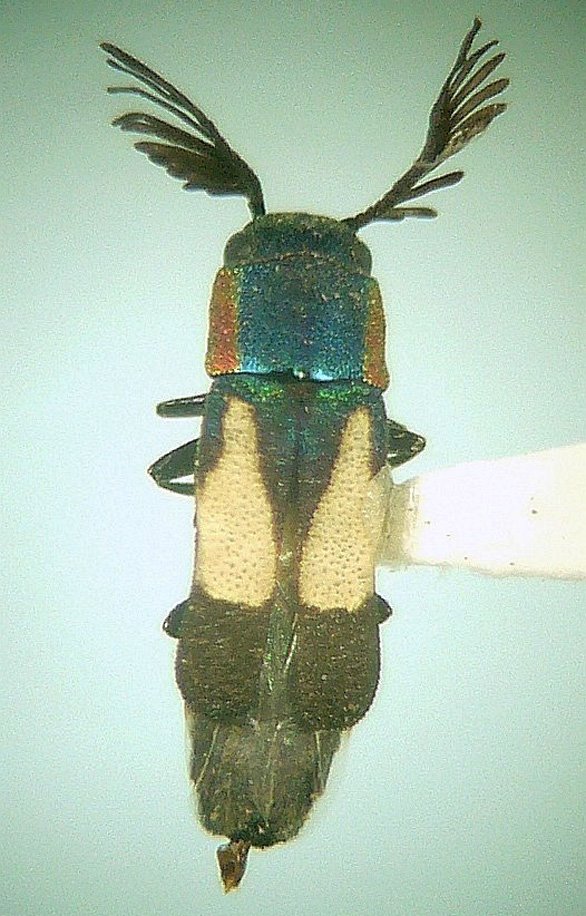
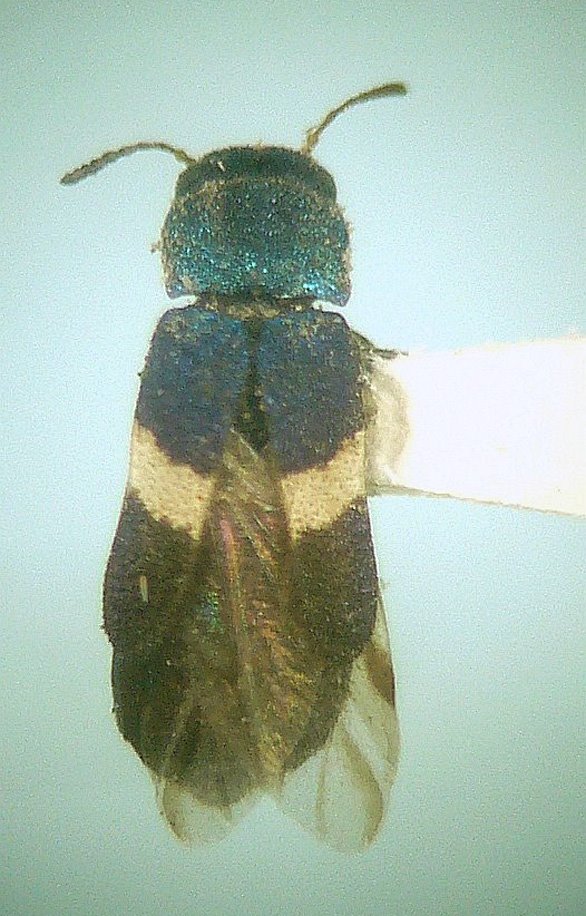
ResearchBlogging.orgA few months ago I discussed Trichinorhipis knulli of the tribe Xenorhipidini (family Buprestidae). Members of this tribe exhibit highly sexually dimorphic antennae, with the distal segments of the male antennae highly modified into a very extended flabellate or lamellate condition. The surfaces of the flabellae/lamellae are covered with numerous, presumably olfactory sensillae that are lacking on female antennae (which retain the unmodified serrate condition), strongly suggesting a function involving detection of female sex pheromones. Although chemosensory structures are present on the antennae of nearly all buprestids, the extreme modification exhibited by the males of species in this tribe is not a common occurrence. Nevertheless, similar modifications have evolved independently in a few other genera within the family, including Knowltonia (four species in western North America), Mendizabalia and Australorhipis (monotypic genera in South America and Australia, respectively), and two species of the enormous Australian genus Castiarina. Indeed, males of Knowltonia and the two Castiarina species possess what might be termed ‘bipectinate’ or ‘biflabellate’ antennae due to dual projections from the terminal antennomeres (see Bellamy & Nylander 2007 for a more complete discussion of male antennal modifications in Buprestidae). The tribe Xenorhipidini is the most diverse group in which these modifications have arisen, comprised of the monotypic Trichinorhipis from California and the closely related Hesperorhipis (four species in Arizona and California) and Xenorhipis (until now, 14 species from North and South America and the West Indies).

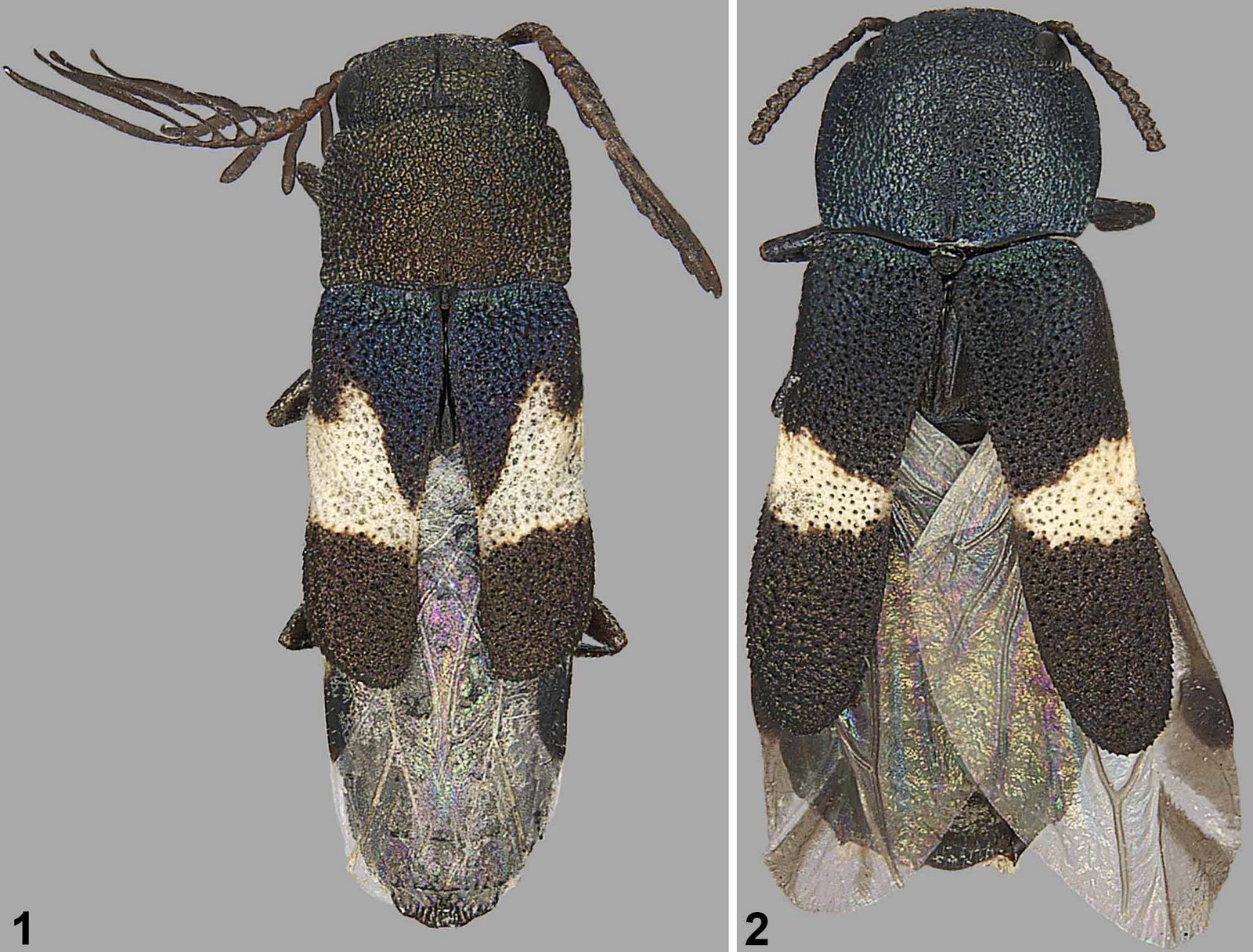
Xenorhipis bajacalifornica Westcott, 2008 – holotype ♂ (1) & allotype ♀ (2).
Photos by Steve Valley (Oregon Department of Agriculture).

In a recent issue of the online journal Zootaxa, Rick Westcott (Oregon Department of Agriculture) describes a new species of Xenorhipis from the Cape Region of Baja California Sur, Mexico. Although assigned to the genus Xenorhipis, the new species – X. bajacalifornica – seems to bridge the gap between the genera Xenorhipis and Hesperorhipis. As currently recognized, Xenorhipis is distinguished from Hesperorhipis by the shape of the posterior coxal plates, which are scarcely narrowed laterally in the former genus, while in the latter genus they are triangular and with the hind margin strongly oblique. In X. bajacalifornica the posterior coxal plates are somewhat triangular but not as acute laterally as in some species of Hesperorhipis. Xenorhipis bajacalifornica also differs from other described Xenorhipis in its strongly abbreviated elytra, which in males barely reach the second ventrite – similar to species of Hesperorhipis. Other described Xenorhipis exhibit less abbreviated elytra, which cover at least the first three ventrites and in some species almost the entire abdomen. Despite these similarities to Hesperorhipis, a consistent distinguishing character between the two genera was found in the male antenna – in Xenorhipis the flabellar processes begin with the second antennomere, while in Hesperorhipis they begin with the third. It was on this basis that the new species was assigned to the genus Xenorhipis. (The genus Trichinorhipis differs from both Xenorhipis and Hesperorhipis by its rounded rather than quadrate pronotum and its unabbreviated elytra that cover the entire abdomen and has, as a result, been placed in its own subtribe.)

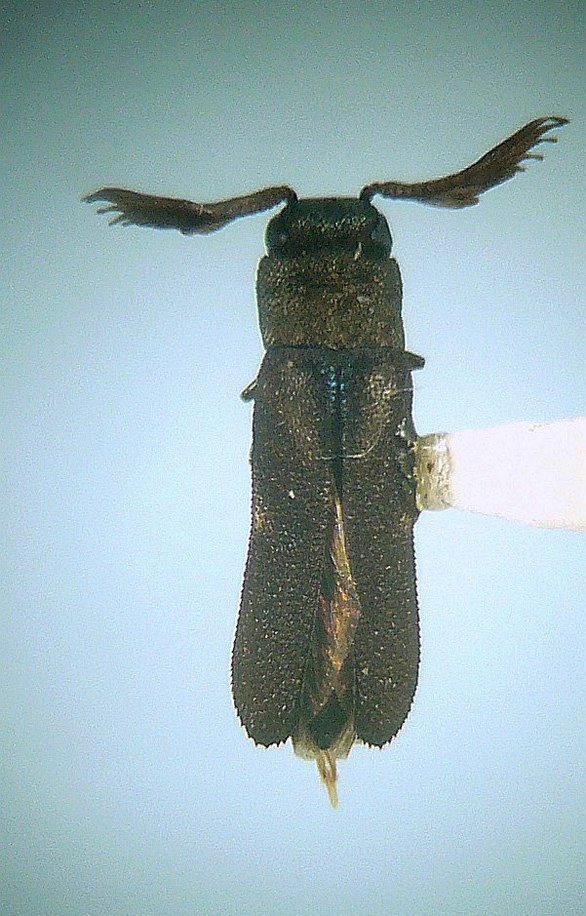
Xenorhipis brendeli ♂Xenorhipis brendeli ♀The photos left show the male (L) and female (R) of Xenorhipis brendeli, the only species in the tribe occurring in eastern North America (west to Minnesota and eastern Texas). Adults of this species are not commonly encountered and have been collected on a variety of deciduous hardwoods but reared almost exclusively from species of hickory (genus Carya). These individuals were reared from dead branches collected in southeastern Missouri – the male from pecan (Carya illinoensis) and the female from shellbark hickory (Carya laciniosa). The male exhibits the scarcely abbreviated elytra that cover almost the entire abdomen (as discussed above). Stan Wellso reported large numbers of males attracted to caged live females in Texas, apparently responding to sex pheromones released by the females.

Xenorhipis osborni ♀Xenorhipis osborni ♂This is another species in the genus – Xenorhipis osborni – known from west Texas. Joseph Knull described the species in 1936 from specimens collected in the Davis Mountains on whitethorn acacia (Acacia constricta), but larval hosts remained unknown until I reared a series of these specimens from dead branches of black acacia (Acacia rigidula) collected above the Pecos River in Val Verde County. I’ve also reared a few specimens from dead branches of catclaw acacia (Acacia greggii) collected in Big Bend National Park, and I wouldn’t be surprised if it breeds in other species of acacia. Again, in this speices the elytra are only slightly abbreviated, though more so than in Xenorhipis brendeli above and also more so in the male (L) than in the female (R). The male of this species is one of the prettiest I’ve encountered in the tribe.

Hesperorhipis albofasciatus ♂Hesperorhipis albofasciatus ♀The genus Hesperorhipis is illustrated here by these photos of H. albofasciatus. These specimens were reared by Rick Westcott from dead branches of walnut (Juglans sp.) – its only known host – collected in Tulare County, California. The elytra in this species are much more abbreviated than in Xenorhipis brendeli and X. osborni but similar to those of X. bajacalifornica – again with the male (L) exhiting greater abbreviation than the female (R). The three remaining species of Hesperorhipis exhibit even more highly abbreviated elytra than H. albofasciatus.

Dr. Charles Bellamy (California Department of Food and Agriculture) is currently revising the tribe. It will be interesting to see how, ulimately, he treats Xenorhipis and Hesperorhipis, given the blended characters exhibited by some species.

REFERENCE

Westcott, R. L. (2008). A new species of Xenorhipis LeConte and of Mastogenius Solier from Mexico, with a discussion of Chrysobothris ichthyomorpha Thomson and its allies and notes on other Mexican and Central American Buprestidae (Coleoptera) Zootaxa, 1929, 47-68

Cicindela scutellaris lecontei x scutellaris unicolor intergrades in southeast Missouri

An individual from Sand Prairie Conservation Area.  Note the uniform blue-gray coloration and complete lack of maculations, making this individual indistinguishable from true unicolor.Cicindela scutellaris (festive tiger beetle) is widely distributed in the U.S., having been recorded from most areas east of the Rocky Mountains except Appalachia, the lower Mississippi River delta, and south Florida. Within this range, the species occupies deep, dry sand habitats without standing water. It is often found in the company of Cicindela formosa (big sand tiger beetle), whose range largely coincides with that of C. scutellaris (except the southeastern Coastal Plain). More than any other North American Cicindela, populations of this species show extraordinary variability in color across its range of distribution. Seven geographically recognizable subspecies are generally accepted, with considerable variation evident within some of these and along zones of contact between them.

An individual from further south on the Sikeston Ridge (~20 mi S of Sand Prairie Conservation Area).  Note the generally blue-green coloration as in unicolor, but it also exhibits fairly well developed maculations and a suffusion of maroon color on the elytra - distinct influences from subspecies lecontei.The greatest portion of the species’ range is occupied by nominotypical populations in the Great Plains and subspecies lecontei in the Midwest and northeast. Similar to what I’ve noted in previous posts for other species, a broad zone of intergradation between these two subspecies occurs along the upper Missouri River. Other subspecies occupy more limited ranges along the upper Atlantic Coast (rugifrons), southeastern Coastal Plain (unicolor), eastern Texas and adjacent areas of northwestern Louisiana and southwestern Arkansas (rugata), and north-central Texas (flavoviridis), and the highly restricted and disjunct yampae is found only in a small area of northwestern Colorado. Populations in the upper Midwest and Canadian prairie are sometimes regarded as distinct from lecontei (designated as subspecies criddlei) due to their broadly coalesced marginal elyral maculations, and an apparently disjunct population of small, blue individuals in south Texas may also be regarded as subspecifically distinct.

Another individual from Sand Prairie Conservation Area.  It is similar to the unicolor-type individual in Photo 1 but also exhibits small maculations derived from its lecontei influence.Although Missouri lies well within the boundaries of its range, this species has been found in only three widely-separated parts of the state – near the Missouri River in the northwest part of the state, near the Mississippi River in the extreme northeast corner, and in the southeastern lowlands (formally known as the Mississippi River Alluvial Basin). The two northern Missouri populations are assignable to and typical of lecontei, with their uniform dull maroon to olive green coloration and continuous to near-continuous ivory-colored border around the outer edge of the elytra. Additional dry sand habitats occur along the lower Missouri River in central and east-central Missouri and along some of the larger rivers that drain the Ozark Highlands; however, this species has not been located in these habitats despite their apparent suitability and occurrence of C. formosa with which it frequently co-occurs. The reasons for this distributional gap between the northern and southern populations – some 400 miles in width – remain a mystery. The southeastern Missouri population is not clearly assignable to any subspecies, apparently representing an intergrade between lecontei to the north and unicolor to the south. Accordingly, individuals from this area are known by the unwieldy appellative “Cicindela scutellaris lecontei x scutellaris unicolor intergrade.” Pearson et al. (2005) states that intergrades between lecontei and unicolor are evident only in northern “Missouri” (an obvious error for Mississippi) and Tennessee. Thus, the existence of intergrades in southeastern Missouri suggests that the zone of intergradation extends further north than previously realized.

A second individual from ~20 mi S of Sand Prairie Conservation Area.  Similar to the individual in Photo 2 except with smaller maculations.  Note the gorgeous suffusion of maroon, especially on head and pronotum - a spectacular individual.Prior to this season, I had located two main population centers in the southeastern lowlands – one at Holly Ridge Conservation Area in Stoddard County, and another at Sand Pond Conservation Area in Ripley County. Holly Ridge is located on Crowley’s Ridge – an erosional remnant of Tertiary sand and aggregate sediments left behind by the late Pleistocene glacial meltwaters whose scouring action formed the surrounding lowlands, while the sandy sediments at Sand Pond were deposited west of Crowley’s Ridge along the southeastern escarpment of the Ozark Highlands during that same period. These erosional and depositional events created the deep, dry sand habitats that Cicindela scutellaris requires. I had known also about the Sikeston Sand Ridge further to the east – another erosional remnant of Tertiary sands deposited by the ancient Ohio River – but had not explored it closely until this season when I initiated my surveys at Sand Prairie Conservation Area. I expected Cicindela scutellaris might occur here, and in my first fall visit in early September I found two individuals in the sand barrens (alongside Cicindela formosa). Another individual was seen here in early October, but more robust populations were observed at a small, high-quality sand prairie remnant (last photo) further to the south along the Sikeston Ridge, and around eroded sand barrens behind private residences still further to the south. Clearly, the species is well-established in the southeastern lowlands wherever open dry sand habitats can be found.

Sand prairie habitat for Cicindela scutellaris in southeast Missouri.  Note the well-spaced clumps of grass, in this case splitbeard bluestem.The individuals shown here exemplify the range of variation exhibited by Cicindela scutellaris populations in southeast Missouri. They greatly resemble subspecies unicolor by their uniform shiny blue-green coloration. Indeed, the individual in the first photo might well be classified as such due to the complete absence of white maculations along the elytral border. Most individuals, however, show varying development of such maculations, ranging from small disconneted spots to the more developed apical “C”-shaped mark – clearly an influence from subspecies lecontei. Another apparent lecontei influence is the suffusion of wine-red or maroon coloration that can be seen on the head, pronotum, and elytra of the individuals in photos 2 and 4. These characters make this population divergent from the typically monochromic unicolor (as its name suggests). Because of their bright green coloration and white maculations, individuals in this population greatly resemble subspecies rugifrons, but that subspecies is limited to the northern Atlantic seaboard. They also resemble the common and widespread Cicindela sexguttata (six-spotted tiger beetle) but can be distinguished from that species by the more noticeably domed profile of the elytra, rounded rather than tapered elytral apex, and dark labrum of the female (both sexes of C. sexguttata have a white labrum).

There is one additional sand ridge in Missouri’s southeastern lowlands – the Malden Ridge. This sand ridge occurs south of Crowley’s Ridge and is much smaller than the Sikeston Ridge. No significant remnant habitats remain on the Malden Ridge, but it is possible that sufficient areas of open sand remain that might support populations of C. scutellaris. Determining whether this is true will require some time studying Google Earth and even more time on the ground to search them out. If they do exist, however, it will be interesting to see what level of influence by lecontei is exhibited in this most southerly of Missouri populations. Only spring will tell!

New species and a review of the genus Tragidion

ResearchBlogging.orgSpecies of Tragidion are among the larger and more attractive cerambycids in North America, making them popular among collectors. Their bright orange and black coloration clearly functions in mimicking spider wasps (family Pompilidae) in the genera Pepsis and Hemipepsis – the so-called “tarantula hawks.” Unfortunately, species of Tragidion have been difficult to identify due to a high degree of morphological similarity between species, wide range of variation across geographic areas within species, unusually high sexual dimorphism and dichromatism, and apparent potential for hybridization in areas of geographic overlap. This has confounded efforts to delimit species boundaries, resulting in a confusing assortment of names whose proper application has eluded even the most esteemed of North America’s cerambycid taxonomists. Recently, some much needed clarity was provided by Ian Swift and Ann M. Ray in the journal Zootaxa. Their taxonomic review of Tragidion – the first systematic treatment of the entire genus – recognizes seven species in North America and another four restricted to Mexico. Two species – T. agave from California and Baja California and T. deceptum from montane areas of the southwestern U.S. and northern Mexico (both pictured) – are described as new, and a third – T. densiventre from desert areas of the southwestern U.S. and northern Mexico – is raised from synonymy under T. auripenne. Four new synonymies are also proposed, and dorsal habitus photographs and a key to all species are provided. Life history information is limited for most species of Tragidion. One species – T. coquus – occurs broadly across the eastern and central U.S., where it breeds in a variety of dead hardwoods, especially oak. Several species occur in the southwestern U.S. and northern Mexico – some are found in xeric lowland desert habitats, where they breed in dead branches of Prosopis glandulosa and Acacia greggii (T. densiventre) or dead flower stalks of Yucca and Agave (T. agave and T. armatum), while a fourth (T. deceptum) is found in more montane habitats mining the heartwood of recently dead branches of Quercus. Adults of another species in California and Baja California, T. annulatum, are strongly attracted to brushfires and burning vegetation, and individuals have been observed landing on still-burning and smoldering shrubs, causing their legs and abdomens to melt to the surface of the branches. At several post-burn sites, the melted bodies of this species were common on the charred branches of their hosts, and females have been observed ovipositing on woody shrubs that have been burned. This species likely plays an important role in the decomposition of burned woody material in coastal areas of California. The remaining U.S. species – T. auripenne – is known from only a handful of specimens collected in xeric habitats in the Four Corners region of the southwestern U.S. It’s life history, as well as those of the four strictly Mexican species, remains essentially unknown.

Tragidion agaveTragidion agave Swift & Ray 2008, ♂ & ♀ – California & Baja California. Tragidion deceptumTragidion deceptum Swift & Ray 2008, ♂ & ♀ – southwestern U.S. and northern Mexico.

REFERENCE: Swift, I., Ray, A. M. (2008). A review of the genus Tragidion Audinet-Serville, 1834 (Coleoptera: Cerambycidae: Cerambycinae: Trachyderini) Zootaxa, 1892, 1-25

Collection Inventory update

The more observant – and taxonomically inclined – among my readers may have noticed the sidebar item entitled, “T. C. MacRae Collection”. The links within that item lead to Google documents detailing the species in those groups of insects that are represented within my collection. I am primarily a beetle guy, and within that vast taxon I focus mostly on the woodboring beetle groups Buprestidae and Cerambycidae and the tiger beetle family Cicindelidae. As you can see, however, I have inventories for several additional groups, including non-beetle families – a testament to my inability to suppress broad interest in insects as a whole. I don’t claim to be an expert in these other groups of insects, but I do enjoy learning about groups outside my chosen field of expertise. It’s a bit of a ‘throwback’ attitude – insect taxonomists of the 19th and early 20th centuries commonly studied multiple families or even orders of insects. This broad approach has largely disappeared in the past 50 years, as taxonomists increasingly have been forced to become narrowly focused on a single insect taxon. I can maintain this broad approach because, while I am a professional entomologist, I am a taxonomist only by avocation. My research is conducted at my own discretion and doesn’t rely on securing grants or fulfilling a departmental mission. Rather, it is directed only by what I find interesting and can reasonably afford in terms of time and expense.

The purpose of this update is twofold – to call attention to two recent additions to the list of inventories, and to explain how the inventories are constructed in the event that some future reader will want to utilize them for reference. In the past two weeks, I’ve received back material accumulated over the years in the families Mutillidae (velvet ants) and Asilidae (robber flies). This material had been sent to experts for identification – doctoral candidate Kevin Williams (Utah State University) graciously provided IDs for the velvet ants, while worldwide asilid expert Dr. Eric Fisher (California Department of Food and Agriculture) kindly identified the robber flies. For each of these groups, an inventory was constructed in which the species represented by my material are listed in the context of the group’s currently accepted higher classification. In each case, higher taxa not represented in my collection are indicated by lighter gray text. A similar approach has been used, to varying degrees, in the other listed inventories. The biggest one, Buprestoidea, represents the bulk of my collection, listing almost 1,500 species from around the world. In this case, not only is the complete higher classification indicated, but all currently recognized world genera are also listed, as well as all known North American species. Again, taxa not represented in my collection are indicated by lighter gray text. Similar inventories have been constructed for Cerambycidae and Cicindelidae, but in these cases the inclusion of taxa missing from my collection is limited to those occurring in North America – their combined worldwide fauna is simply too large for me to concern myself with, given my primary focus on the worldwide buprestoid fauna.

Regarding the Buprestoidea, Cerambycidae, and Cicindelidae – these are my chosen groups of interest in which I am actively building North American representation (worldwide for Buprestoidea). If anyone can provide specimens representing taxa not in my collection, please contact me directly. I am more than happy to exchange for such material. As for the other groups, they are primarily ‘just for fun’ – I collect them when convenient because they are interesting, but more importantly to make them available to others who might have a research interest in them. If anyone working in these groups sees species listed that are of interest to your research, please feel free to contact me for a loan or exchange. I have material in many additional groups not yet listed – inventories will be posted as they become available. If you have interest in a group not listed, please contact me and I’ll let you know what material I have available for loan/exchange.

Megacyllene comanchei revisited

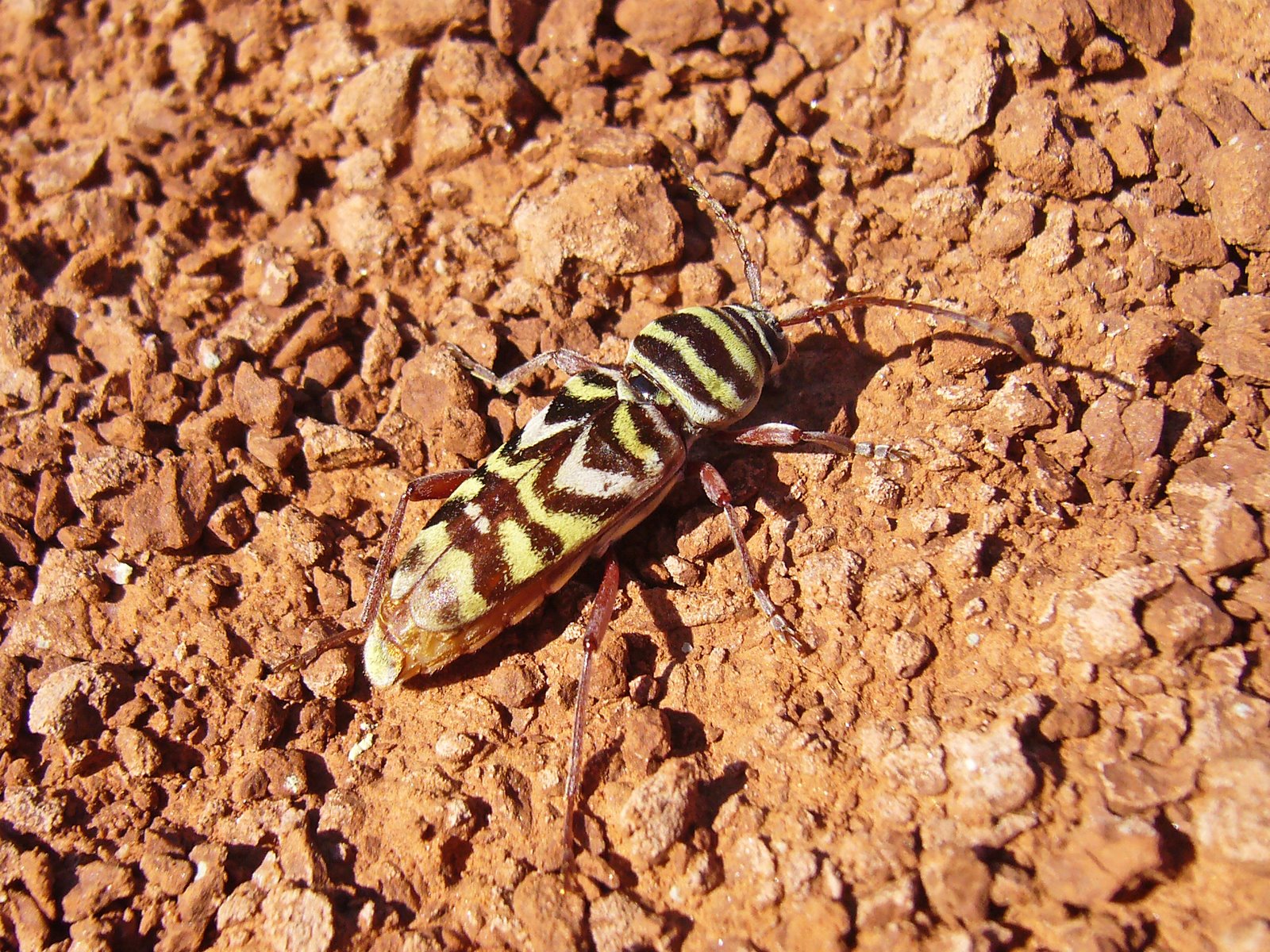
On my recent trip, I reported finding the rarely collected Megacyllene comanchei at several localities in northwestern Nebraska and southwestern South Dakota. These are significant findings, since they not only represent new records for both states, but also an impressive 700-mile northern extension to the known range of the species (on top of a previously reported northern range extension from Texas into Kansas). The intriguing part of the situation is that these new records fall within the southern portion of the known distribution of M. angulifera, its closest relative, which has been recorded from several northern Great Plains states and provinces (although it has not yet been recorded specifically from Nebraska).

Upon reading about these findings, a friend and fellow student of Cerambycidae has expressed doubts to me about the distinctiveness of M. comanchei versus M. angulifera, regarding the slight color differences upon which it was based as insufficiently distinctive. In its original description (Rice & Morris, 1992, J. Kans. Entomol. Soc. 65:200-202), M. comanchei was distinguished from M. angulifera by a specific combination of characters, i.e., the premedian and sutural segment of the postmedian elytral bands are white, while the remaining pubescent bands are yellow. They also noted the subapical and apical bands often coalesce along the elytral suture and lateral margins. I do not have material of M. angulifera for direct comparison, but my specimens (two of which are pictured in this post) seem distinct enough from this specimen of M. angulifera pictured on Larry Bezark’s impressive website, A Photographic Catalogue of the CERAMBYCIDAE of the New World. In contrast, the pattern of coloration seen in this photo of the holotype of M. comanchei (also from that fine site) seems to agree well with my material.

Whether these color differences are significant remains to be seen. Neither species has been commonly collected, therefore large series of material have not been available for good comparative studies. However, there do seem to be significant differences in reported host plants and adult biology. Adults of M. angulifera are usually found in the fall on flowers of Solidago (goldenrod), and it was recently discovered that the larvae utilize root crowns of Dalea candida (family Fabaceae) for development (Blodgett et al. 2005). All but one of the remaining Nearctic species of Megacyllene for whom larval hosts are known also utilize fabaceous plants. These include M. robiniae and M. snowi (Robinia), M. decora (Amorpha), and M. antennata (Prosopis). A notable exception is M. caryae, which breeds in a variety of deciduous plant genera but most often Carya and is also unique in that adults occur during early spring instead of fall. Megacyllene comanchei, on the other hand, was discovered by examining the dead root crowns of Heterotheca sp. (family Asteraceae), with a few crawling on the ground in areas where such plants were growing. This is not proof that it serves as a larval host, but the repeated association of adults at the base of dead stems of this plant is highly suggestive. Additionally, no adults were encountered on goldenrod or other flowers, as is common among other members of this genus. The apparent utilization of a non-fabaceous larval host and behavioral difference exhibited by the adults seem to support its status as separate species. Again, the specimens that I collected agree not only morphologically with M. comanchei, but also behaviorally in that all of them (six specimens at three localities) were found crawling on the ground in shortgrass prairie rather than on flowers. I did note Heterotheca growing at one of the locations but did not find adults on the crowns of the few plants I inspected. I do not recall seeing any Dalea, but I wasn’t looking specifically for that plant either. Nor did I not see any goldenrod, which I would have certainly noticed had it been present.

So, for now, I’m inclined to continue calling these M. comanchei, and I’m also inclined to consider it distinct from M. angulifera. I do agree, however, that a critical examination of the distinctiveness of these two species might be warranted, and it may be worthwhile to pull together as much of the existing material of these two species as possible. I am interested in hearing other opinions about this situation.