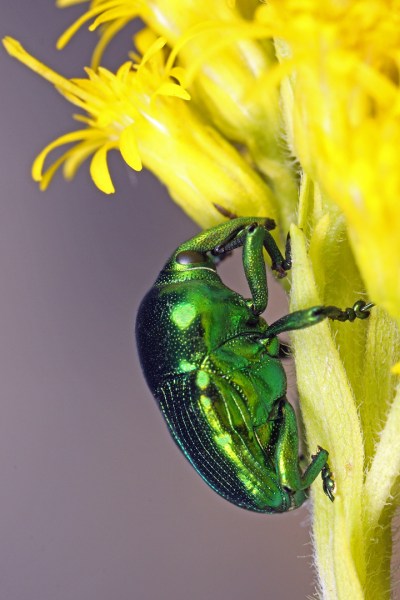
Cover photo for the June 2013 issue of The Coleopterists Bulletin

Eurhinus cf. adonis on Solidago chilensis | Chaco Province, Argentina

Did anybody think that weevil photograph on the cover of the June 2013 issue of The Coleopterists Bulletin (vol. 67, no. 2) looked familiar? If so, it’s  because you saw it first in my April 28, 2013 post,  This is Eurhinus cf. adonis (ID courtesy of Charles O’Brien), which I photographed near La Escondida in Chaco Province, Argentina on flowers of Solidago chilensis. This photo reminds me that I need to pay more attention to portrait-style photographs, as landscape oriented photos don’t often fit very well on magazine and journal covers.

Beyond being my first cover for The Coleopterists Bulletin (and I hope not the last), the issue contains a number of papers that I will be studying with interest. These include a paper describing new species of Chrysobothris (Buprestidae) from the West Indies with notes on others, a checklist of longhorned beetles (Cerambycidae) from Montana, and the synonymization of Megacyllene comanchei under M. angulifera—all by Mike Ivie and colleagues (I did have the privilege of reviewing the Chrysobothris paper, and my Megacyllene comanchei“—now M. angulifera—specimens were among those examined). Also of interest to me is a paper about wood-boring beetle emergence (including Buprestidae and Cerambycidae) from ponderosa pines killed by mountain pine beetle and fire in the Black Hills of South Dakota. Finally, Brett Ratcliffe has included a primer on best writing and curatorial practices for describing a new species of beetle—as a somewhat but not highly practiced alpha taxonomist, this should be an interesting read for me that will hopefully give me a chance to correct any nascent bad habits that I may be developing. Scarabaeologists and weevil specialists should be equally pleased with this issue, with a half-dozen or more papers in each group filling most of the remaining pages.

Copyright © Ted C. MacRae

Giving me the weevil eye!

The order Coleoptera (beetles) is, of course, the largest single group of animals on earth, and by most accounts the Curculionidae (weevils) and their close relatives are the largest family-level group within the order. At 60,000 species and counting, weevils account for approximately one out of every 20 described life forms, and as a result their diversity of forms, colors and life histories are as staggering as their numbers. Among the small slice of the group that I have seen, Megabaris quadriguttatus is without question the most colorful, but species in the related genus Eurhinus (both genera belong to the curculionid subfamily Bardinae, which I point out here for reasons discussed below) must rank as among the shiniest of all weevils. Twenty-three species, all colored brilliant metallic green, blue, purple or red, are known from this exclusively Neotropical genus (Vaurie 1982), one of which has also recently established in southern Florida (Ulmer et al. 2007). The individual featured in this post was seen April 2012 in northern Argentina near La Escondida (Chaco Province) and compares well with Eurhinus adonis (ID courtesy Charles O’Brien, Green Valley, AZ). Vaurie (1982) records that species from southern Brazil, Bolivia, Paraguay and Argentina (although only from Missiones Province in the latter) and says that nothing is known of its biology.

Giving me the weevil eye!

Eurhinus cf. adonis on Solidago chilensis | Chaco Province, Argentina

This is certainly among the most challenging insects that I’ve ever photographed. Overblown specular highlights are a constant challenge in flash macrophotography of bright, shiny, metallic beetles, and yellow flowers are prone to blown highlights as well. Add on top of that my desire for a blue sky rather than the typical black background and the usual difficulties of hand-held, field photography of an actively moving subject, and you’ve got a quadruple challenge. Adequate diffusion of the flash is critical, and although the diffusers I was using at the time weren’t perfect, they were enough in combination with intentional underexposure of the photograph to further minimize the chance of blown highlights (underexposed photographs can be relatively easily “fixed” during post-processing, as all of the information is still there, while overexposed photographs can rarely be fixed because the information is gone). Bumping up the ISO (in this case 400) also helps—higher sensitivity to light by the sensor not only allows light from the sky to register and create a blue background, but also further reduces flash duration and the risk of blown highlights. No amount of camera settings, however, can address the final challenge—getting the subject well composed and in focus within the frame. For that, the three “P”s (patience, practice, and persistence) are the only advice I can offer.

Eurhinus cf. adonis on Solidago chilensis flowers | Chaco Province, Argentina.

What’s in a name? That which we call a Eurhinus by any other name would be as shiny!

This genus of weevils was involved in one of the more interesting nomenclatural problems that I’ve encountered. The genus was originally given the name Eurhin by Illiger in 1807, but Schönherr in 1824 changed it to Eurhinus—believing (incorrectly) that Eurhin was not a properly formed name. Unfortunately, the name Eurhinus had already been used by Kirby in 1819 for a different genus of weevils in the subfamily Apioninae. The rules of zoological nomenclature, of course, prohibit the same name being used for two different genera, and several attempts were made during the following years to provide a replacement name for Schönherr’s Eurhinus. None gained acceptance, however, and eventually Schönherr in 1833—still considering justified his correction of Eurhin to Eurhinus—proposed the name Eurhynchus for Kirby’s Eurhinus. Remarkably, the name Eurhynchus also had been used previously (for a genus of birds). Nevertheless, the change gained acceptance, and both of Schönherr’s names remained in use for the next century and a half—Eurhinus in the subfamily Baridinae and Eurhynchus in the subfamily Apioninae, with both credited to Schönherr. Strict application of the rules of nomenclature would require that the name Eurhinus be transferred back to the apionine genus and credited to Kirby and the name Eurhin resurrected for the baridine genus and credited to Illiger. However, as pointed out by Zimmerman & Thompson (1983) this would not only destroy more than a century’s worth of nomenclatural stability but also complicate the formation of family-group names such as tribes—since the two original names each have the same root (Eurhin-), tribal names based on them would be identical (Eurhinini). To resolve these issues, a formal application was submitted to the International Commission of Zoological Nomenclature (ICZN) to preserve  Schönherr’s long accepted usage of Eurhinus and Eurhynchus. To do this, the ICZN would not only have to declare Schönherr’s correction of Eurhin to Eurhinus justified, but also suppress the original use of the name Eurhynchus (as a genus of birds) in order to allow Schönherr’s subsequent use for the apionine genus to stand. Fortunately, suppressing the first use of Eurhynchus had no impact on stability, since an older name was already in use for the genus of birds and the younger name had not been used since its original description. The authors of the application also noted the support of several contemporary weevil specialists (including Charles O’Brien) and that Patricia Vaurie, in her revision of the genus one year earlier (Vaurie 1982), had used the original name Eurhin with reluctance on the then-correct advice of her contemporaries. It was a classic case of priority versus stability, and while the ICZN typically is rather conservative in favoring priority, they were clearly swayed in this case by the interests of stability and impact on formation of family-group names.

REFERENCES:

Ulmer, B. J., R. E. Duncan, J. Prena & J. E. Peña. 2007. A weevil, Eurhinus magnificus Gyllenhal (Insecta: Coleoptera: Curculionidae). University of Florida, IFAS Publication #EENY-417/IN751, 6 pp.

Vaurie, P. 1982. Revision of Neotropical Eurhin (Coleoptera, Curculionidae, Baridinae). American Museum Novitates 2753:1–44.

Zimmerman, E.C. & R. T. Thompson. 1983. On family group names based upon Eurhin, Eurhinus and Eurhynchus (Coleoptera). Bulletin of Zoological Nomenclature 40:45–52.

Copyright © Ted C. MacRae 2013

Group mimicry in Cerambycidae… and more

During last year’s extended visit to Argentina, I had the chance to spend the early part of April in the northern province of Chaco. Though much of this hot, arid plain has been converted to agriculture, remnants of thorn forest remain along fence rows and in small patches of Chaco Forest. Despite the decidedly tropical latitude of the region, however, the profuse bloom of Chilean goldenrod, Solidago chilensis, along these fence rows during the Argentine autumn is reminiscent of crisp fall days here in the eastern U.S., and like the goldenrod here the ubiquitous stands of yellow blossoms stretching across the Chaco Plain are equally attractive to a multitude of insects. Among those insects are the Cerambycidae, or longhorned beetles, and while the eastern U.S. cerambycid fauna of goldenrod boasts only a few (albeit spectacular) species in the genus Megacyllene, the Argentine cerambycid fauna that I found on these flowers included at least three species in various genera belonging to two different tribes.

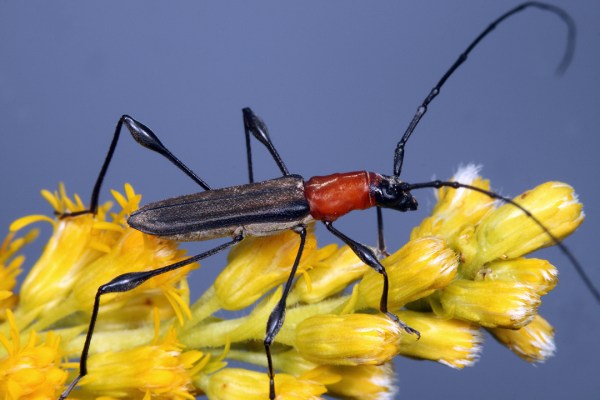
Rhopalophora collaris (Germar 1824) | Chaco Province, Argentina

Rhopalophora collaris (Germar 1824) | Chaco Province, Argentina

Two of the species I saw are shown here, and their similarity of appearance is no coincidence, as both belong to the tribe Rhopalophorini (coming from the Greek words rhopalon = club and phero = to bear, in reference to the distinctly clavate, or club-shaped, legs exhibited by nearly all members of the tribe). In fact, a great many species in this tribe exhibit the same general facies—slender in form and black in coloration with the head and/or pronotum red to some degree. Since all of these species are diurnal (active during the day) and frequently found on flowers, one can assume that the members of this tribe represent an example of what Linsley (1959) called ‘group mimicry.’ In this simple form of Batesian mimicry (harmless mimic with protected model), a group of related species within a genus or even a tribe have a general but nonspecific resemblance to those of some other group of insects—in this case presumably small, flower-visiting wasps. Although the tribe is largely Neotropical, the nominate genus Rhopalophora does extend northward with one eastern U.S. representative, R. longipes. Among the numerous species occurring in South America, the individuals I saw in Argentina can be placed as R. collaris due to the relative lengths of their antennal segments and uniquely shaped pronotum (Napp 2009).

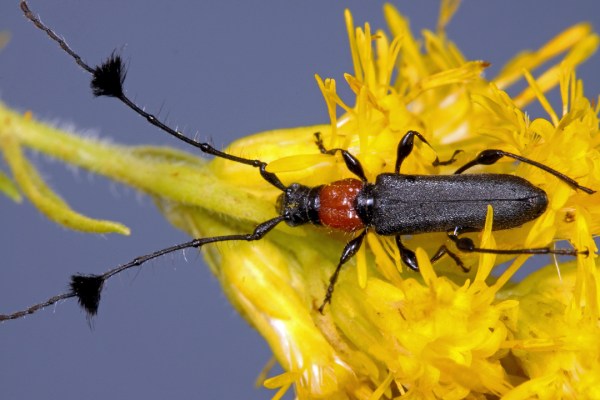
Cosmisoma brullei (Mulsant 1863) | Chaco Province, Argentina

Cosmisoma brullei (Mulsant 1863) | Chaco Province, Argentina

The second species could easily be mistaken for another species of Rhopalophora were it not for the distinct tufts of hair surrounding the middle of the antennae. These tufts immediately identify the beetle as a member of the large, strictly Neotropical genus Cosmisoma (derived from the Greek words kosmos = ornament and soma = body, a direct reference to the tufts adorning the antennae of all members of this genus). Three species of the largely Brazilian genus are known from Argentina, with the black and red coloration of this individual easily identifying it as C. brullei (Bezark 2o13). In the years since this genus was described, additional related genera have been described that bear remarkably similar tufts of hair not on the antennae, but on the elongated hind legs. The great, 19th century naturalist Henry Walter Bates “tried in vain to discover the use of these curious brush-like decorations” (Bates 1863), and nearly a century later Linsley (1959) conceded that their function still remained unknown. Antennal tufts are actually quite common in Cerambycidae, especially in Australia, and while experimental evidence continues (to my knowledge) to be completely lacking, Belt (2004) records observing “Coremia hirtipes” (a synonym of C. plumipes) flourishing its leg tufts in the air (presumably in a manner similar to waving of antennae) and, thus, giving the impression of two black flies hovering above the branch on which the beetle was sitting. This seems also to suggest a function in defense, with the tufts perhaps serving as a distraction to potential predators in much the same way that many butterflies have bright spots near the tail to draw the predator’s attention away from the head.

REFERENCES:

Bates, H. W. 1863. The Naturalist on the River Amazons. Murray, London, 2 vols.

Belt, T. 2004. The Naturalist in Nicaragua. Project Guttenberg eBook.

Bezark, L. G. 2009. A Photographic Catalogue of the Cerambycidae of the World. Available at http://plant.cdfa.ca.gov/byciddb/

Linsley, E. G. 1959. Ecology of Cerambycidae. Annual Review of Entomology 4:99–138.

Napp, D. S. 2009. Revisão das espécies sul-americanas de Rhopalophora (Coleoptera: Cerambycidae). Zoologia (Curitiba) 26(2):343–356.

Copyright © Ted C. MacRae 2013

A jewel of a beetle

I really wish I had a photomicrography setup like the one that Sam Heads has at the University of Illinois for imaging preserved specimens. Alas, insect taxonomy is “just a hobby” for me, and any specimen photography I wish to do must be done with my field camera equipment. Of course, poverty prompts creativity (not that I consider a Canon 50D with an MP-E 65mm macro lens and MT-24EX twin flash unit a sign of poverty), and after a bit of tinkering and fiddling I’ve figured out a way to setup the specimen and flash units to create images of pinned specimens that I think are more than adequate for publication in taxonomic papers.

Here is one I did recently of the jewel beetle Actenodes calcaratus (family Buprestidae). This species is broadly distributed from the southwestern U.S. through Mexico and into Central America, where it breeds in dead branches of a variety of mostly fabaceous trees such as Acacia and Prosopis. During several trips to southern Mexico in recent years, Chuck Bellamy and I collected two new species of Actenodes that look very similar to A. calcaratus but differ in several important characters, primarily surface sculpture, the form and male coloration of the face, and male genitalia. A manuscript describing these two species and containing this and similar images of the new species was recently submitted for publication. Though not quite as razor-sharp as images created through focus-stacking processes, it still shows good detail and even lighting. What do you think?¹

¹ For those who find the pin head distracting, I am not a proponent of cloning out pin heads, debris, or other imperfections on images of preserved specimens in taxonomic papers. Other enhancements such as levels, sharpness, contrast, etc. are fine since these are all influenced greatly by lighting, but otherwise I believe the specimen needs to be presented exactly as it appears. A possible alternative is to remove the pin for imaging, but this presents a risk of damage to the specimen that is of questionable benefit in the case of non-type specimens—and downright irresponsible for primary types. Another alternative is to thoroughly clean and image the specimen prior to mounting, but this is rarely feasible as in most cases it is only after the specimen is mounted and studied further that its status as a new species is realized.

Actenodes calcaratus | MEXICO: Guerrero, Hwy 95, 5 km S Milpillas, 7.vii.1992, "big dead tree", G. H. Nelson [FSCA]. Male plesiotype.

Actenodes calcaratus | MEXICO: Guerrero, Hwy 95, 5 km S Milpillas, 7.vii.1992, “big dead tree”, G. H. Nelson [FSCA]. Male plesiotype.

Copyright © Ted C. MacRae 2013

Raining spit

Cephisus siccifolia

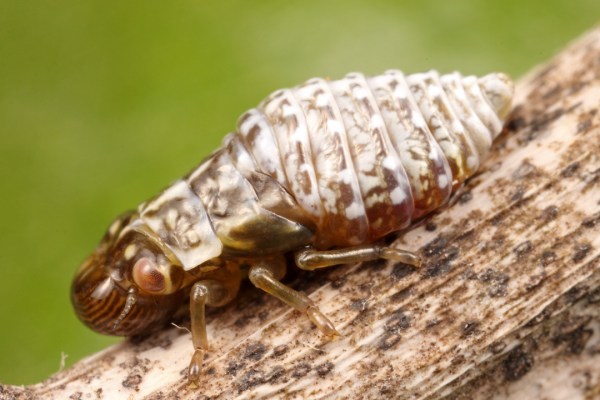
Cephisus siccifolia 3rd instar nymph | Buenos Aires, Argentina

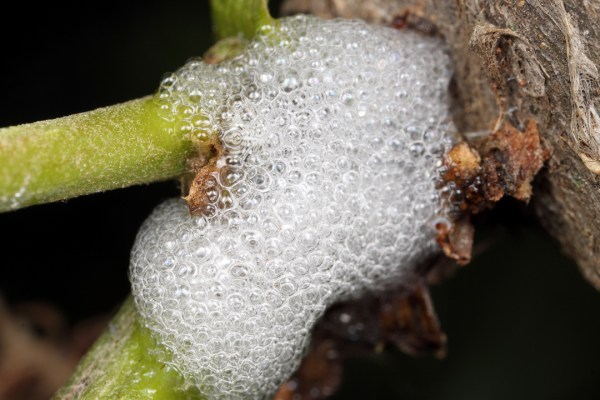
Even though it was November (and thus spring in Argentina), conditions were already unusually dry—a portent of the worst drought that would hit Argentina in 70 years. Because of this, I found the occasional wet spot on the pavement as I walked the trails in La Reserva Ecológica Costanera Sur rather odd. At first I thought they were spit—the trails were popular on this day for runners and bike riders, but I quickly realized that those would have to be some truly ginormous spit wads based on the size of the splatter. It wasn’t long before I thought to look up, and this is what I saw on the branch directly above me:

Cephisus siccifolia

Cephisus siccifolia spittle mass on unknown species of tree.

I knew right away this was the work of a froghopper, or “spittlebug,” a true bug (order Hemiptera) in the family Cercopidae. Spittlebugs are common in the eastern U.S. where I live and are famous for the spit-like wads of froth (“cuckoo spit” to some) within which the nymphs conceal themselves until they reach adulthood. Our eastern U.S. species, however, are most commonly seen on herbaceous plants rather than in trees, and the frothy masses they produce are fairly small—about the size of a real wad of spit (at least, according to my direct comparison when I was 12 years old). The spittle masses I was seeing today were enormous, frothy, liquid masses that literally dripped from the trees by their own weight—raining spit!

Cephisus siccifolia

Nymphs produce bubbles by siphoning air into a channel under the abdomen.

I was about to move on when I noticed some movement in the spittle mass. A closer look through the macro lens revealed the tip of the abdomen of a nymph slowly circling around near the surface of the spittle and creating new bubbles as it did this. As one can imagine, living inside a mass of bubbly liquid presents a challenge to breathing, and the nymphs get around this problem by protruding the tip of the abdomen outside the spittle mass and taking in air through a tubelike canal below the abdomen (Hamilton & Morales 1992). Strong contractions of the abdomen inside the spittle mass eject air from the canal, resulting in bubble formation.

Cephisus siccifolia

Nymphs partially exposed by removal of spittle mass.

I sent these photos to Andy Hamilton (Canadian National Collection of Insects, Arachnids and Nematodes), specialist in world Cercopidae, to see if there was any chance he might recognize the genus or species based on these photos. I noted that these were the biggest spittlebug nymphs I had ever seen (the individual in the first photo measuring ~10mm in length). Not only did he recognize them as belonging to the genus Cephisus, but he was actually in the process of finishing up a revision of the New World members of the tribe Ptyelini—Cephisus being the sole New World genus to represent the tribe. Based on its white coloration and occurrence as far south as Buenos Aires, Argentina, he suggested this must be C. siccifolia—a species that can sometimes achieve economic pest status (Ribeiro et al. 2005) but which still apparently needs to be properly recorded from Argentina (Hamilton 2012). Based on degree of wing pad development, Andy surmises the individual in Photo #1 represents a 3rd instar (if the 3rd instar measures 10 mm, can you imagine the size of the 5th instars?!). Andy asked me if I would grant him use of the photos in his soon-to-be-published revision (of course I agreed), and here is the plate with the photos (as well as an adult photographed by someone else) as it appears in his paper:

Hamilton_2012_Cephisus

As Andy notes in his paper, it seems rather unusual that Cephisus is the only tribal representative in the New World despite having successfully colonized all of its tropical and subtropical mainland areas. There are several other genera in the tribe in Africa, which would suggest that the Ptyelini arose prior to the late Cretaceous rifting that separated South America and Africa into two continents. It is thus puzzling why the tribe went on to further diversify in Africa but not in the New World.

A tight crop of Photo #3 above was featured in , for which Ben Coulter was the hands-down winner. Honestly I thought this might end up being a slam dunk challenge—people have gotten very good at designing Google search strings to come up with answers that in pre-internet days might have been impossible to find. Nobody stumbled upon the magic search string for this challenge—”MacRae Cercopidae” which pulls up the Hamilton paper and above plate as the very first result. Still, Ben used good old fashioned intuition based on the locality tag to correctly surmise the species and take the early lead in BitB Challenge Session #7. Congratulations, Ben!

REFERENCES:

Hamilton, K. G. A. 2012. Revision of Neotropical aphrophorine spittlebugs, part 1: Ptyelini (Hemiptera, Cercopoidea). Zootaxa 3497:41–59.

Hamilton, K. G. A. & C. F. Morales. 1992. Cercopidae (Insecta: Homoptera). Fauna of New Zealand 25, 40 pages.

Ribeiro, G. T., M. da Costa Mendonça, J. Basílio de Mesquita, J. C. Zanuncio G. S. & Carvalho. 2005. Spittlebug Cephisus siccifolius damaging eucalypt plants in the State of Bahia, Brazil. Pesquisa Agropecuária Brasileira 40(7):unpaginated.

Copyright © Ted C. MacRae 2013

The Texas Prick

Recently my friend Kent Fothergill launched a series of posts ranting about discussing the difficulties associated with common names. The inaugural post featured the insect I show here, Dectes texanus, a member of the family Cerambycidae (longhorned beetles) that has gained attention in recent years as an occasional pest of soybeans, especially in the upper Mississippi Delta (Tindall et al. 2010). As is usual, when an otherwise obscure little insect suddenly begins costing somebody money people feel compelled to give it a common name. Rather than the uninspired “soybean stem borer” or ironically Latin-ish “Dectes stem borer” monikers that seem to have taken hold for this species, Kent jokingly suggested that if people were serious about common names, this insect should actually be called the “Texas prick” as a direct translation of the scientific name.¹

¹ Actually, I couldn’t find any reference to the word “Dectes” as a Latin word or “prick” as its English translation. Rather, my copy of Brown (1956) lists dectes as a Greek word meaning “biter.” I think this must be what LeConte (1852) had in mind when he first coined the genus name, since he mentions among the characters that define the genus several features of the mandibles. If that is the case, then to be accurate the alternate common name for this beetle should be the “Texas biter.” However, that name causes nothing like the snicker that “Texas prick” elicits, and since common names are bound by no rules whatsoever, I choose levity over accuracy and stick with Kent’s proposed name.

Dectes texanus (dectes stem borer) | Washington Co., Mississippi

Dectes texanus | Washington Co., Mississippi

Being the pedantic, anal retentive, taxonomist-type that I am, it may surprise you to learn that I actually don’t have a problem with common names. To be honest, however, I will admit that this is a fairly recent change-of-mind for me—for many years I was a die-hard “scientific-names-only” type of guy. I not only thought common names were useless (for all the reasons listed by everybody who opposes them), but I even refused to learn them—my geek passive aggression, I guess. In the years since I started this blog, however, I’ve not only grown less oppositional in my stance, but have actually learned to embrace common names for what they are—comfortable names that don’t intimidate the taxonomically disinclined. Labels is all they are, and if one common name can refer to several species or several common names refer to one species, it’s not the end of the world. Common names aren’t meant to replace scientific names—how could they? Scientific names fulfill a special set of needs for a select group of people (i.e., to reflect phylogeny), and despite its flaws the Linnaean system of nomenclature that has been in use for the past several hundred years has served this purpose better than any other system devised. The reason for this is because genus and species names also provide a convenient and relatively easily memorizable system of labels that allow scientists to actually talk about organisms in a way that makes sense. This is an advantage that the Linnaean system has over any numerical phylogenetic system, no matter how much more precisely the latter can indicate phylogeny. For scientists, scientific names, in effect, serve a dual purpose. Non-taxonomists, however, don’t need dual purpose names—they just want easy-to-say and easy-to-remember labels, and if common names engage more people in a discussion about nature and its inhabitants then I’m all for it.

a.k.a. ''The Texas Prick''

Accepted common name: Dectes stem borer; BitB common name: ”Texas Prick”

This is not to say that I will ever give up scientific names. I love scientific names, and it is my goal in life to know as many of them as possible—even synonyms (I know, sick!). I also think that scientific names are not as scary as some people believe. Boa constrictor, for example (yes, that is both its common and scientific name), or gorilla (Gorilla gorilla)… or Dectes stem borer! To help bridge the gap, I have taken to mentioning, as a matter of practice, both the scientific name and—when one exists—the common name for the insects and other organisms featured on this blog. This applies not only at the species level, but families and other higher taxa also (e.g., “jewel beetles, family Buprestidae”). It is my way of talking science in a way that welcomes the interested lay person. Considering the increasingly anti-science din in our country by creationists, climate change denialists, knee-jerk GM critics, etc., I think the more we can get scientists and non-scientists comfortable talking to each other the better off we will be.

The insect featured in this post was found and photographed in a field of cultivated soybeans in northeastern Mississippi. It’s identification as Dectes texanus (other than its association with soybean) is based on the face being only slightly protruding and the relatively large lower lobe of the eye. There is one other species in the genus, D. sayi, also broadly distributed in the U.S. but distinguished from D. texanus by its distinctly more protruding face and small lower eye lobe (giving the impression of “tall cheeks”). This species, too, is known to bore in the stems of soybean but is much happier doing so in common ragweed (Ambrosia artemisiifolia) (Piper 1978). The species name—sayi—was given to honor the 19th century entomologist Thomas Say, regarded by many as the ‘Father of American entomology.’ This species also has been called “soybean stem borer” by some, which doesn’t do much to alleviate concerns about common names referring to multiple species. I am reluctant, however, for reasons of respect, to use the common name for D. sayi that results if one uses the same rationale used by Kent in coining his common name for D. texanus

REFERENCES:

Brown, R. W. 1956. Composition of Scientific Words. Smithsonian Institution Press, Washington, D.C., 882 pp.

LeConte, J. L. 1852. An attempt to classify the longicorn Coleoptera of the part of America north of Mexico. Journal of the Academy of Natural Sciences Philadelphia (series 2) 2(1):99–112.

Piper, G. L. 1978. Biology and immature stages of Dectes sayi Dillon and Dillon (Coleoptera: Cerambycidae). The Coleopterists Bulletin 32(4):299–306.

Tindall K. V., S. Stewart, F. Musser, G. Lorenz, W. Bailey, J. House, R. Henry, D. Hastings, M. Wallace & K. Fothergill. 2010. Distribution of the long-horned beetle, Dectes texanus, in soybeans of Missouri, Western Tennessee, Mississippi, and Arkansas. Journal of Insect Science 10:178 available online: insectscience.org/10.178.

Copyright © Ted C. MacRae 2013

An elegant living fossil…

In the insect world, hyperdiversity is the norm. More than a million species are known, and perhaps several million more await discovery. Beetles alone represent nearly a quarter of the earth’s described biota, with one genus (Agrilus in the family Buprestidae) bursting at the seams with more than 3,000 described species (Bellamy 2008). Biodiversity gone wild! While birders routinely field identify (and list) a majority of the birds they see to species, most insect enthusiasts are happy if they can simply identify their subjects to family—in most cases still leaving several hundred to several thousand possibilities for species identification. Even trained entomologists usually can identify only a tiny fraction of the insects they see and remain just as clueless about the vast majority of insects they encounter that don’t represent one of their limited number of study groups.

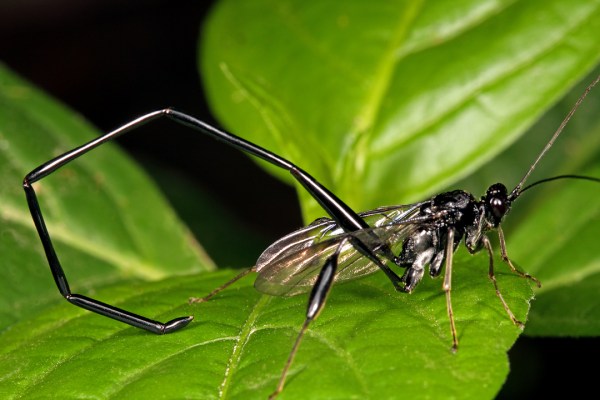
Pelecinus polyturator female | Wayne Co., Missouri

Pelecinus polyturator female | Wayne Co., Missouri

 Of course, that doesn’t mean field identification is impossible for all insects—certain groups such as butterflies, dragonflies, and tiger beetles lend themselves to field identification due to their relatively large size, bright colors, and distinctive markings. Many would also include the aculeate hymenopterans (i.e., “stinging” wasps and bees) among those groups for these same reasons. However, the vast majority of hymenopterans belong to a multitude of families characterized by tiny, parasitic species that seem (to this coleopterist’s eyes) to differ only in bafflingly minute details of wing venation and tibial spurs. (Honestly, I couldn’t tell you the difference between Tanaostigmatidae and Tetracampidae if my life depended on it!) Nevertheless, there are a small handful of parasitic hymenopterans in North America that are instantly recognizable due to their giant size (2 or more inches in length)—namely, Megarhyssa spp. (giant ichneumons) and the species shown in this post, Pelecinus polyturator (American pelecinid). Pelecinus polyturator is the only North American member of the family Pelecinidae, which itself contains only two additional species that are restricted to Mexico and Central/South America. It wasn’t always this way—fossils assignable to the family and representing 43 species in a dozen genera have been found as far back as the early Cretaceous (121–124 mya) across North America, Europe, and Asia (Grimaldi & Engel 2005). Surely this represents just the tip of the iceberg of Mesozoic and early Cenozoic pelecinid diversity, making today’s three species the last representatives of a once great lineage—”living fossils”¹ some might say.

¹ To ward off any scolding I might get from evolutionary purists, I get it; there is no such thing as a living fossil (except the T. rex skeleton in the movie “Night at the Museum”). I know that all species alive today have the same amount of evolutionary history behind them and are, if not from more immediate ancestors, highly derived compared to earlier life forms. I will admit that the term has become a bit overused as pseudoscientific shorthand for branding an organism as ‘primitive’ (another term which tends to raise hackles); however, I don’t see the problem with its use as informal reference to relatively ancient groups, usually more diverse in the past and now represented by only a few species. Innocuous shorthand is all it is.

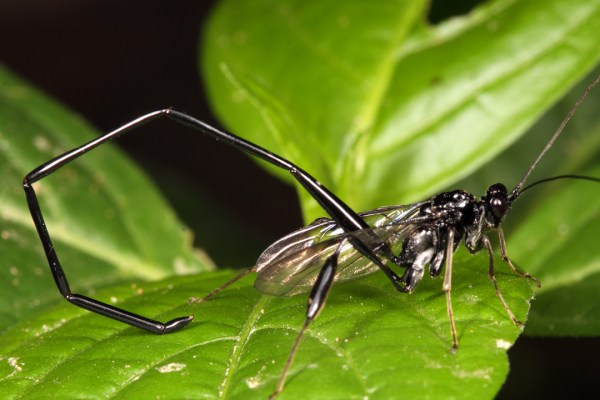
This elegant female, recognizable by her extraordinarily narrowly elongate abdomen (males have a somewhat shorter abdomen that is widened at the end), was seen back in July 2011 as she flew to a blacklight and landed on nearby foliage in a mesic bottomland forest in southeastern Missouri’s Ozark Highlands. I have seen females on occasion over the years but have not yet seen a male, which are increasingly rare in more northern latitudes of the species distribution. I missed the focus a bit on this photo (and also the other half-dozen or so shots that I took)—photographing an active subject at night on elevated foliage without a tripod is difficult to say the least! Nevertheless, after post-processing it’s a decent photograph. If you are wondering why it took me so long to post it, that’s because only recently have I gained the confidence to “clean up” poorly exposed photos where the subject and/or substrate on which they are resting is so distractingly littered with debris as this:

Yuk!!!

Yuk!!!

Compare the original photo here to the final photo above it—how many post-processing tools can you detect the use of? 🙂

REFERENCES:

Bellamy, C. L. 2008. World catalogue and bibliography of the jewel beetles (Coleoptera: Buprestoidea), Volume 4: Agrilinae: Agrilina through Trachyini. Pensoft Series Faunistica 79:1–722.

Grimaldi, D. and M. S. Engel. 2005. Evolution of the Insects.Cambridge University Press, New York, xv + 755 pp.

Copyright © Ted C. MacRae 2013

Cicindela 44(3–4) is issued

Cicindela_44(3-4)

The latest issue of the journal Cicindela arrived in my mailbox yesterday, and it’s safe to say that I’ve got the issue “covered.” The issue features three papers, one of which documents my recent encounter with Cicindelidia ocellata rectilatera (Reticulated Tiger Beetle) in Arkansas (MacRae 2012), the first confirmed occurrence of the subspecies in that state and a northeastern extension of its known range. (This paper is an expansion of my post Just repanda… er, wait a minute…) Normally restricted to (though abundant in) Texas and New Mexico (Pearson et al. 2006), the only previous records of this subspecies east of Texas are at two localities near the eastern side of the Sabine River dividing Texas and Louisiana (Graves & Pearson 1973). More recently, however, the subspecies was also recorded just north of Texas in southwestern Oklahoma Schmidt 2004). Whether these recent extensions to its known range reflect an expanding distribution or are merely artifacts of sampling is unknown; however, one of the Arkansas localities has been visited frequently by tiger beetle enthusiasts over the years, as it is a known locality for the very attractive Cicindela formosa pigmentosignata (Reddish-green Sand Tiger Beetle), lending some support to the range expansion hypothesis.

In addition to the paper, one of the photographs that I took of C. ocellata rectilatera in Arkansas graces the cover of the issue.

Two other papers are also contained in the issue, one documenting an additional occurrence of Opisthencentrus dentipennis in Brazil by Ron Huber (2012), and another by Kristi Ellingsen featuring photographs and habitat description for the first tiger beetle to be found in Tasmania, Australia (Ellingsen 2012). A truly international journal!

Lastly, please consider subscribing to Cicindela. Subscription rates are only $10 in the U.S. and $13 outside of the U.S., amounts that even the most casually interested can justify! Also, if you have a more serious interest in tiger beetles, I hope you’ll consider submitting a manuscript for consideration. Subscription information and editorial policy can be found inside the front cover of a recent issue or at this post.

REFERENCES:

Ellingsen, K. 2012. Discovery of the first tiger beetle found on the island of Tasmania, Australia. Cicindela 44(3–4):55–57.

Graves, R. C. & D. L. Pearson. 1973. The tiger beetles of Arkansas, Louisiana, and Mississippi (Coleoptera: Cicindelidae). Transactions of the American Entomological Society 99(2):157–203.

Huber, R. L. 2012. Another locality record for Opisthencentrus dentipennis (Germar) in Brazil. Cicindela 44(3–4):55–57.

MacRae, T. C. 2012. Occurrence of Cicindelidia ocellata rectilatera (Chaudoir) (Coleoptera: Cicindelidae) in Arkansas. Cicindela 44(3–4):49–54.

Pearson, D. L., C. B. Knisley and C. J. Kazilek. 2006. A Field Guide to the Tiger Beetles of the United States and Canada. Oxford University Press, New York, 227 pp.

Schmidt, J. P. 2004. Tiger beetles of Fort Sill, Comanche County, Oklahoma, with a new state record for Cicindela ocellata rectilatera Chaudoir. Cicindela 36:1–16.

Copyright © Ted C. MacRae 2013