One of the fascinating aspects of tiger beetle study is their often high degree of fidelity for specific habitats. Some species prefer wet habitats, while others frequent the drier uplands. Some like sand while others need clay. Differences in salinity, vegetational cover, and even slope dictate what species might be expected to occur in a given habitat, thus, the diversity of tiger beetle species one encounters is directly proportional to the diversity of habitats explored. Unfortunately, tiger beetles can be rather ephemeral in their occurrence as adults. Despite a life cycle that requires at least one year (and may take 2-3 years or even more), adults are often present for only for a few short weeks. Even during the time that adults are present, they often hide if conditions aren’t right (too cold, too hot, too wet, too early, too late, etc., etc. Add to that their marvelous evasive capabilities, and it’s a wonder I ever see or catch any at all!). The study of tiger beetles is not, however, entirely dependent upon the adults. The presence of larval burrows in an area is also useful information, and through understanding of the species that might occur in an area and their habitat preferences, it is possible to identify – at least tentatively – the species that might be living in them.

Cicindela lengi? (sandy tiger beetle) - Sioux Co., Nebraska
To the uninitiated, tiger beetle burrows might seem nothing more than a simple hole in the ground – anything could have made it. However, with experience one becomes able to distinguish tiger beetle larval burrows almost instantly from burrows made by other ground-burrowing organisms. The most common type of burrow is recognized by a combination of characters – almost perfectly circular except for a slight flattening on one side that gives the burrow a faint D-shape, and with the edge smoothly beveled. This is your classic tiger beetle burrow and, for most U.S. species of Cicindela and related genera, averages ~5-6mm in diameter for 3rd instar larvae (tiger beetle burrows are most often observed at 3rd instar, since it is this final instar in which the larva spends the majority of its time and the burrow becomes most noticable). The above burrow is one such burrow, found at Monroe Canyon in northwestern Nebraska last September. While a number of species are known from the area, there are only a few that make their burrows in deep dry sands such as those that occur at this site. We can eliminate Cicindela formosa (big sand tiger beetle) for reasons discussed below, and we can also dismiss Cicindela limbata (sand blow tiger beetle) because the habitat is not the barren, wind-shaped sand blow habitat that the species prefers. This leaves two possibilities – Cicindela scutellaris (festive tiger beetle), a common and widespread inhabitant of sand habitats throughout the Great Plains, and Cicindela lengi (sandy tiger beetle), a much more localized resident of sand habitats with more western distribution. The burrow likely represents the latter, since adults of this species have been found with greater frequency than C. scutellaris on the very fine-grained sands that occur in this part of Nebraska. My confidence in this ID is bolstered by the fact that a larva I collected in the area from just such a burrow successfully finished its development and emerged a few months later as an adult C. lengi.

Cicindela pulchra pulchra (beautiful tiger beetle) - Fall River Co., South Dakota
Sometimes size alone is enough to indicate the species responsible for a burrow. The above burrow was encountered last September in southwestern South Dakota on a clay/shale embankment in sage/shortgrass prairie. A number of tiger beetle species fond of clay were observed at the site, including the two generalist species Cicindela tranquebarica (oblique-lined tiger beetle) and Cicindela purpurea audubonii (Audubon’s tiger beetle). However, at ~8 mm in diameter the burrow is too large to have been made by either of these species. The only tiger beetle in the area capable of making a burrow this size is Cicindela pulchra (beautiful tiger beetle), and in fact this burrow was found at one of several sites recently discovered by Matt Brust for this species in South Dakota. Note again the classic shape – slightly flattened along the bottom side (the flattening accommodates the mandibles of the larval head – tiger beetle larvae always orient themselves in one position when sitting at the burrow entrance).

Cylindera celeripes (swift tiger beetle) - Woodward Co., Oklahoma
Just as large size was diagnostic for the previous burrow, the small size of the above burrow was also diagnostic. This burrow, found at Alabaster Caverns in northwestern Oklahoma in October, 2009, measured only 3-4mm in diameter and can only have been made by Cylindera celeripes (swift tiger beetle). This provisional ID was suggested by the fact that adults of the species had been observed abundantly in the lichen-encrusted clay exposures of this shortgrass prairie the previous June. This photo, in fact, represents the first-ever discovery of the larval burrow of this species, and the identity of the species was confirmed when the larva collected from this and neighboring burrows and placed in rearing containers in the lab later emerged as adults. I have found very similar-sized burrows in bottomland forest habitats in southeastern Missouri where the closely related species Cylindera cursitans has been seen. The burrows are identical in size and shape, but the drastic difference in habitat is enough to distinguish the species that made them.

Cicindela formosa formosa (big sand tiger beetle) - Sioux Co., Nebraska
Not all tiger beetles utilize the simple hole-in-the-ground style of burrow, but rather incorporate some rather unique engineering features that make specific identification much easier. This burrow can only be made by Cicindela formosa (big sand tiger beetle), a common resident of a variety of dry sand habitats throughout the Great Plains and eastern U.S. The burrow entrance is on the large size for U.S. Cicindela (~6mm in diameter), and rather than opening flush on the ground it is directed horizontally and opens into a pit that is excavated to one side and underneath the burrow entrance. No other U.S. tiger beetle makes a burrow quite like this (although I have noted Cicindela limbalis (common claybank tiger beetle) burrows on steep clay banks with a similar but much less distinct excavation on their lower side). The pit apparently functions as a trap for potential prey, and since I have most often encountered burrows of this species in areas with some slope, I suspect the pit may help the larva capture its prey by preventing the prey from tumbling down the slope at the first sign of trouble.

Cicindela formosa 3rd instar larvae - Sioux Co., Nebraska
This is a different burrow by the same species, also at Monroe Canyon last September, that shows a 3rd instar larva sitting at the burrow entrance. The sickle-shaped mandibles are resting against the slightly flattened lower edge of the burrow entrance, while the round pronotum fills the rest of the entrance profile. The upper pair of eyes can be seen above the mandibles, but the lower pair (between the upper pair and the mandibles) are not visible in this photo due to the downward-facing angle of the burrow entrance. I waited for quite some time with camera in position in hopes that I could photograph the larva, and when it did return to the burrow entrance I had time enough to fire off just a couple of shots before it retreated once again to safety in the depths of its burrow.

Cicindela fulgida fulgida (crimson salt flat tiger beetle) - Sioux Co., Nebraska
This unusual-looking burrow was found in a dry clay saline creek bed in the Badlands of northwestern Nebraska last September. The turret structure is unique, but the nearly perfectly round and smoothly beveled burrow entrance identify it, nevertheless, as that of a tiger beetle larva. These burrows can only be made by Cicindela fulgida (crimson salt flat tiger beetle). There are several other saline-tolerant tiger beetles species in Nebraska, but most such as Ellipsoptera nevadica knausii (Knaus’ tiger beetle), Eunota togata (cloaked tiger beetle), and Habroscelimorpha circumpicta johnsonii (Johnson’s tiger beetle) require much more moisture than was found in this bone-dry creek bad. I’ve found two other much more widely distributed clay-associated species – Cicindela tranquebarica and Cicindela purpurea audubonii – at this and other sites where I’ve seen C. fulgida; however, the larvae of those species do not utilize this unique turret-shaped structure for their burrows. The turret is thought to have a cooling function for the larva during the heat of summer by raising it above the hottest layer of air against the white salt-encrusted ground and by aiding in the dissipation of heat from the larval burrow. I wanted to photograph the larva sitting at the burrow entrance and spent quite a bit of time stalking out this and nearby burrows for a chance to do so. Alas, however, on this day the larvae had greater patience than I!
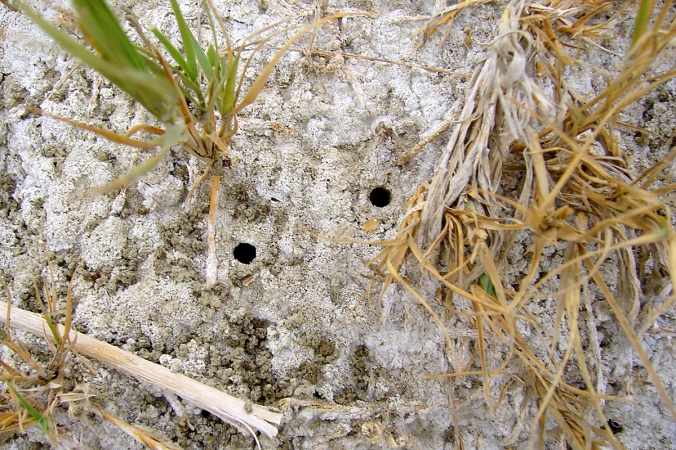
Cicindela tranquebarica kirbyi (Kirby's tiger beetle) adult & larval burrows - Sioux Co., Nebraska
The above burrow entrances were photographed in September 2008 at the same dry saline creek bed in Sioux Co., Nebraska. I mentioned above that Cicindela tranquebarica kirbyi and Cicindela purpurea audubonii both occurred commonly at this site along with Cicindela fulgida; however, these burrows likely represent the former. That species seems to be found more consistently in high saline environments than the latter, which in this case probably have their larval burrows in the more normal clay soil further away from the creek bed. During that 2008 trip, I did collect larvae from burrows like these in several similar, high saline habitats in Nebraska, South Dakota, and Oklahoma, and in each case adults of C. tranquebarica kirbyi were what emerged. I have also reared this species from larvae collected on clay banks and wet sand habitats – in all cases, the burrows are a tad larger than those I have seen for other species in the genus that I have reared, such as Cicindela limbalis and Cicindela repanda (common shore tiger beetle) – logical since adults of C. tranquebarica tend to be a little more robust than these other species (but smaller than Cicindela pulchra and Cicindela obsoleta vulturina (prairie tiger beetle)). In the above photo, I believe the the upper-right burrow is that of a larva, while the the lower-left one is that of an emerged adult – note the not-perfectly-circular opening and more ragged edge to the burrow. In fact, the latter burrow looks very much like the adult emergence burrow that I saw at this very location last September, in which the still unemerged adult was seen sitting! Granular chunks of soil can be seen scattered about the latter burrow, but I believe these were actually tossed by the larva rather than the adult as a result of burrow excavation – the amount of soil an adult would need to remove to re-open its burrow for emergence would probably be far less than what can be seen in this photo. I did not search the surrounding grasslands for larval burrows, but if I had done so, it is likely that I would have found similar burrows that belonged to the larvae of Cicindela purpurea audubonii – the only other tiger beetle that we have seen in this inhospitable place!
Copyright © Ted C. MacRae 2011
 In late June I visited Chalk Bluff Natural Area in northeastern Arkansas. Situated at the northeastern-most corner of the state, it is here where the St. Francis River enters Arkansas from Missouri, slicing through the loose Tertiary conglomerates of Crowley’s Ridge before settling into its lazy, meandering course between the two states in the Upper Mississippi Alluvial Plain. The site’s geological history, however, is not what attracted me to it, but rather its status as the state’s only known locality for Cylindera cursitans (ant-like tiger beetle). It was the existence of this population that convinced my colleagues Chris Brown and Kent Fothergill and I that the species must occur in southeast Missouri not only along the Mississippi River, but also along the St. Francis River some 50 miles to the west. Persistence eventually paid off last year when Kent captured a single individual on the Missouri side of the river at Chalk Bluff Access in Dunklin Co. (MacRae et al. 2011).
 Kent had to really work for that specimen, spending several hours crawling through the underbrush in wet, bottomland forests before eventually finding the lone individual. I was confident, however, that my search at the Arkansas site would require far less effort, as Kent had also observed this population during his attempts to locate the species on the Missouri side of the river, writing “I saw more cursitans in an hour than I have seen lifetime total!” The playground/picnic area where Kent had seen them sits right next to the parking lot and is as un-curitans a habitat as one can imagine—tidy and neat, with a nicely-mowed grass lawn under the shade of large oak trees rather than the sweltering, poison ivy choked understory habitats with their attendant swarms of mosquitoes and deer flies that we’ve braved in order to find the species in Missouri. Only the small, intermittent patches of barren sandy loam soil gave a clue that this might be good tiger beetle habitat, and even then one might expect only the more pedestrian species such as Cicindela punctulata and Tetracha virginica and not something as exciting as C. cursitans.
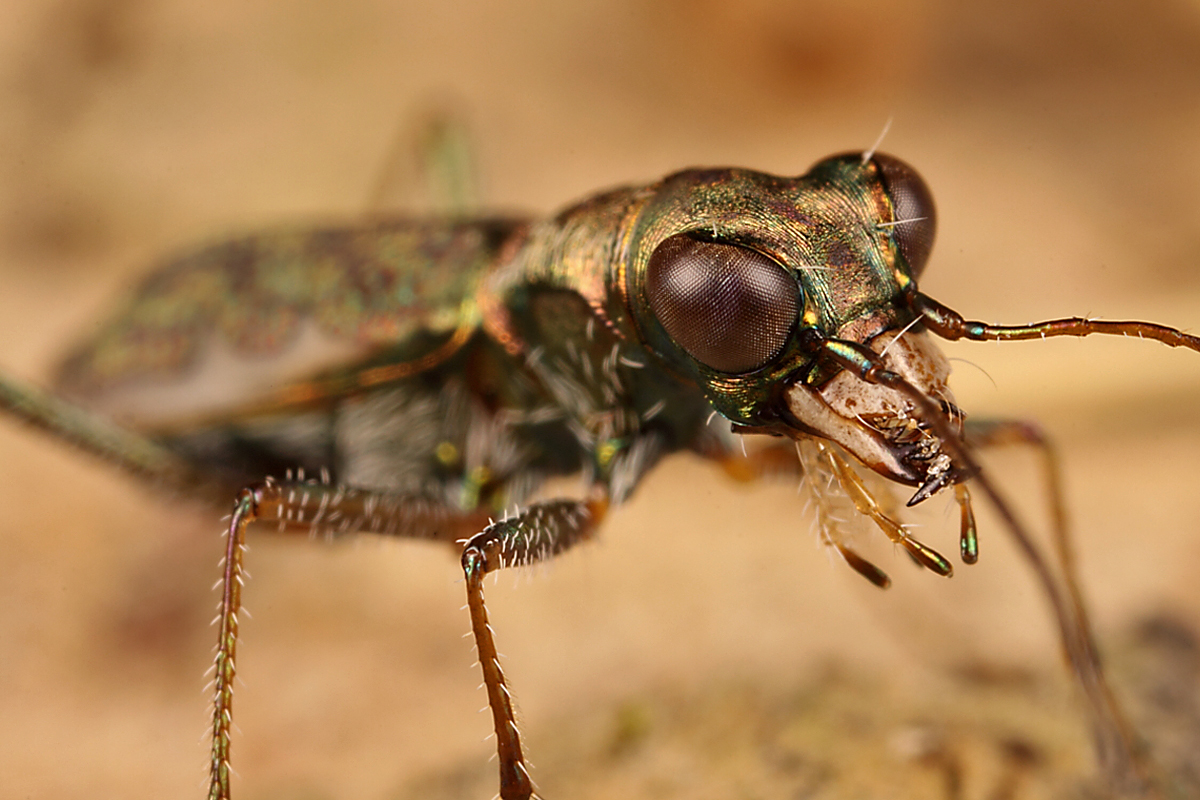 But occur there it does, and hardly a few steps had been taken from the parking lot before I saw that familiar “dash” of movement, looking for all intents and purposes at first like a small spider. A closer look confirmed its true identity, and during the next hour or so I would see countless such individuals—all scrambling rapidly for cover on my approach. I have seen a number of cursitans populations during the course of our surveys for this species in southeastern Missouri, and this population was as robust as any of them.
 Despite my earlier work with this species, I still lacked photographs I was completely happy with—i.e., field photographs of unconfined beetles taken with a true macro lens and flash to control lighting. All of my previous photographs were either taken with a small point-and-shoot camera or had to rely upon beetles confined in a terrarium. The species is not easy to photograph in the field—the small size of the adults (6–8 mm in length) and their cryptic coloration matching the soil surface makes them almost impossible to see until they move. They are also very skittish and are quick to flee when approached, necessitating very slow, deliberate movements in order to approach them closely enough for photographs. Oftentimes adults will run towards and hide up against the base of a clump of grass, where they are even more difficult to photograph, but sometimes they will hide beneath fallen leaves or other debris. Interestingly they do not flee immediately if the leaf/debris is very carefully lifted up and removed—almost as if they think they’re still hidden. I’ve found exposing adults hiding under leaves to be an easier way to get field photographs of the species, although I have noted that some individuals (but not others) seem eventually to adjust to my presence and resume normal activity despite having a camera lens hovering inches away from them.
 Once I had my fill of photographs, I walked the trail to the river and back but did not see any beetles along the trail within the forest (too much leaf litter) or along the river. Surely the beetles occur in these other areas and are not confined in the area just to that small, man-made habitat that is the picnic ground. Seeing this population gives me greater confidence that the species does indeed occur more broadly along the St. Francis River in Missouri than suggested by single individual caught on the Missouri side by Kent.




 Beetles In The Bush