A new look at an old friend

Chris Wirth just wrote a nice post summarizing the use of digital SLR camera systems for insect macrophotography.  Having just gone through the process of upgrading to a dSLR system from a point-and-shoot myself, I can relate to much of what he discusses.  The advantages are clear – higher image quality, far greater magnification capabilities, and control over lighting, shutter speed, aperture, etc.  He also discusses the disadvantages – chiefly co$t, weight, and initial learning curve.  He ends with this recommendation:

…if you are serious about insect photography and have the monetary resources, a DSLR is your only choice. Again, as of yet, nothing else provides similar quality or control.

Although I dabbled in insect photography many years ago with an Olympus OM-10 SLR film camera and a Zeiko 50mm macro lens, it wasn’t until I started this blog 18 months ago that I started making a real effort to photograph insects, using a Panasonic Lumix DMC-FX3 point-and-shoot that my dad had given to me for my birthday earlier that year. At first, I was amazed at the macro capabilities of this little camera – point, autofocus, and shoot! Yes, the photo needed to be cropped, and the reliance on natural light was not only limiting but often resulted in deep shadows – but nothing a little Photoshop couldn’t fix! It wasn’t long, however, before I began to see the limitations – not just on size, with tiger beetles being near the lower end of the size of subject I could photograph, but also with the quality of the images themselves. The perfectionist in me started envisioning what I could do if only I had the equipment. Mind you, I’m proud of the photographs I’ve acquired over the past months, given what I had to work with. But now that I have the equipment to do it right, I see a conflict on the horizon – do I attempt to go back and re-photograph all of those species that I’ve already photographed, or do I move on and and not look back? Perhaps a little of both is the best approach.
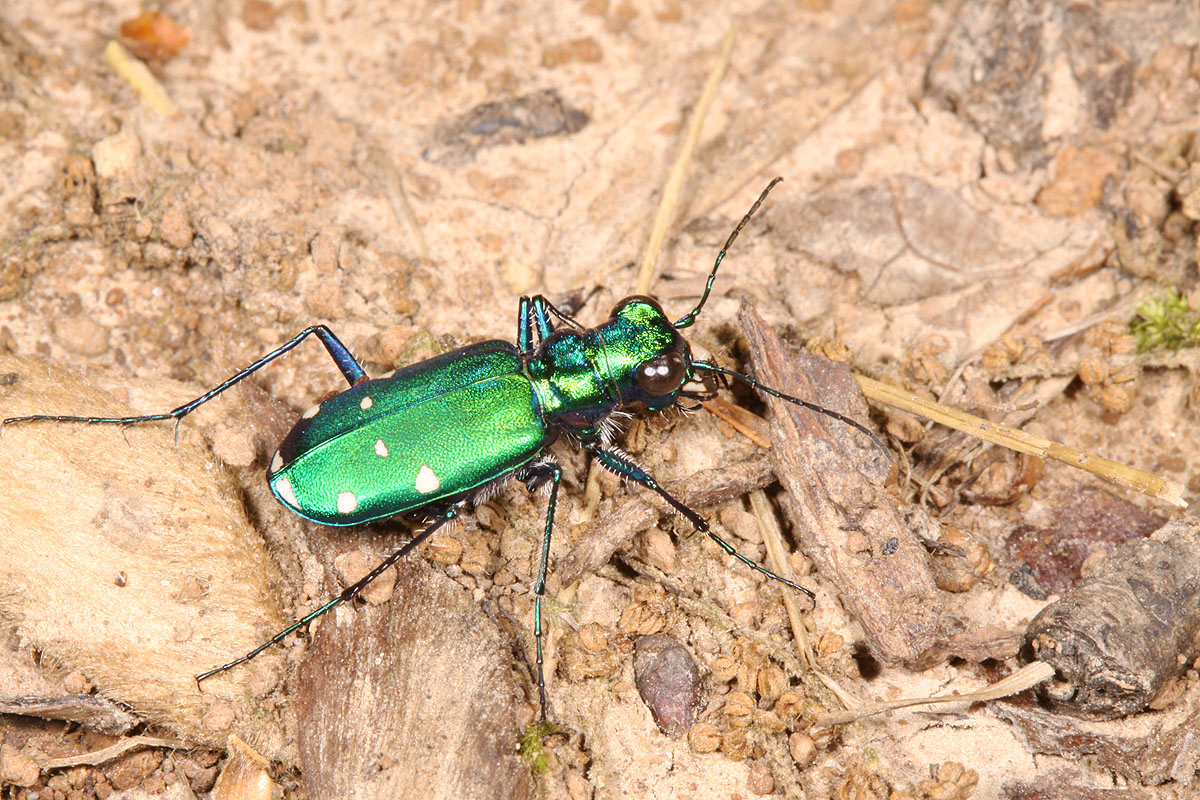
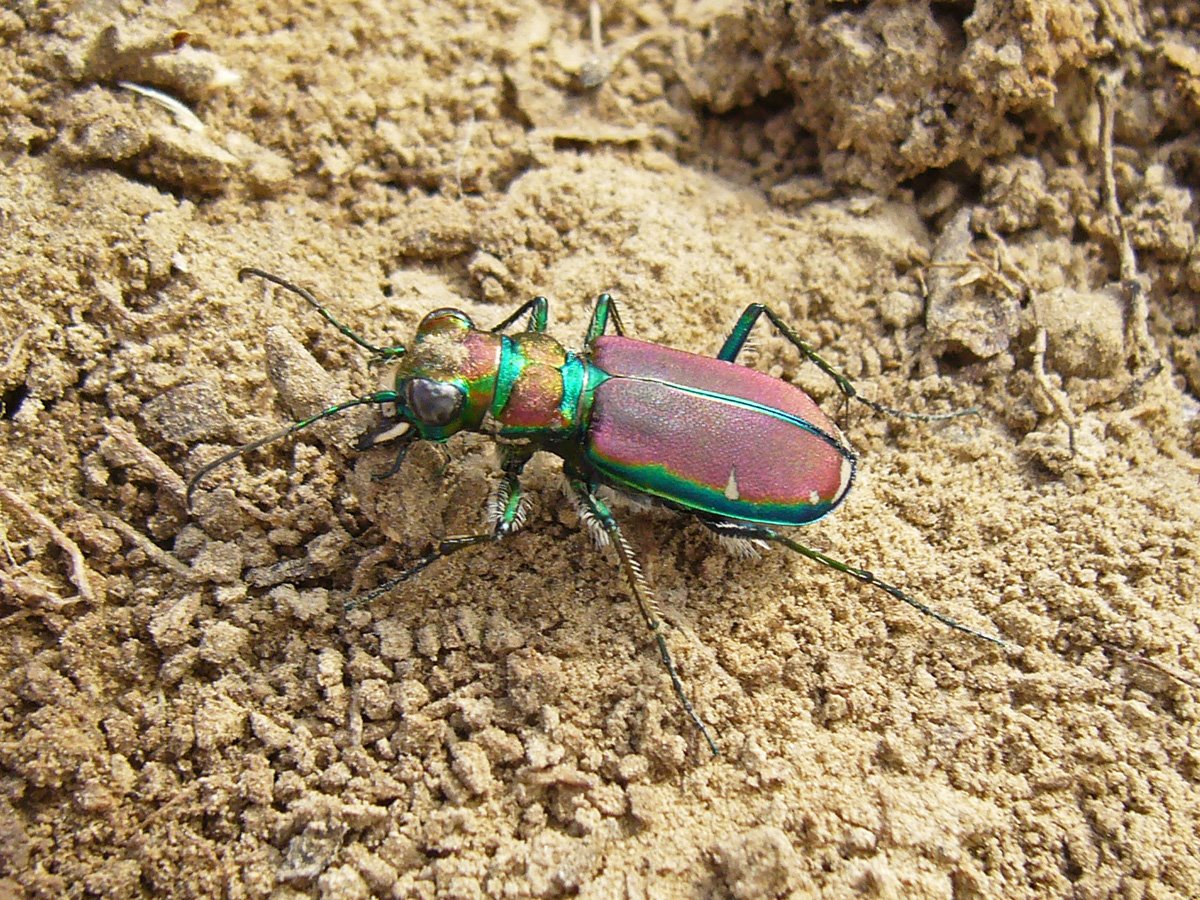
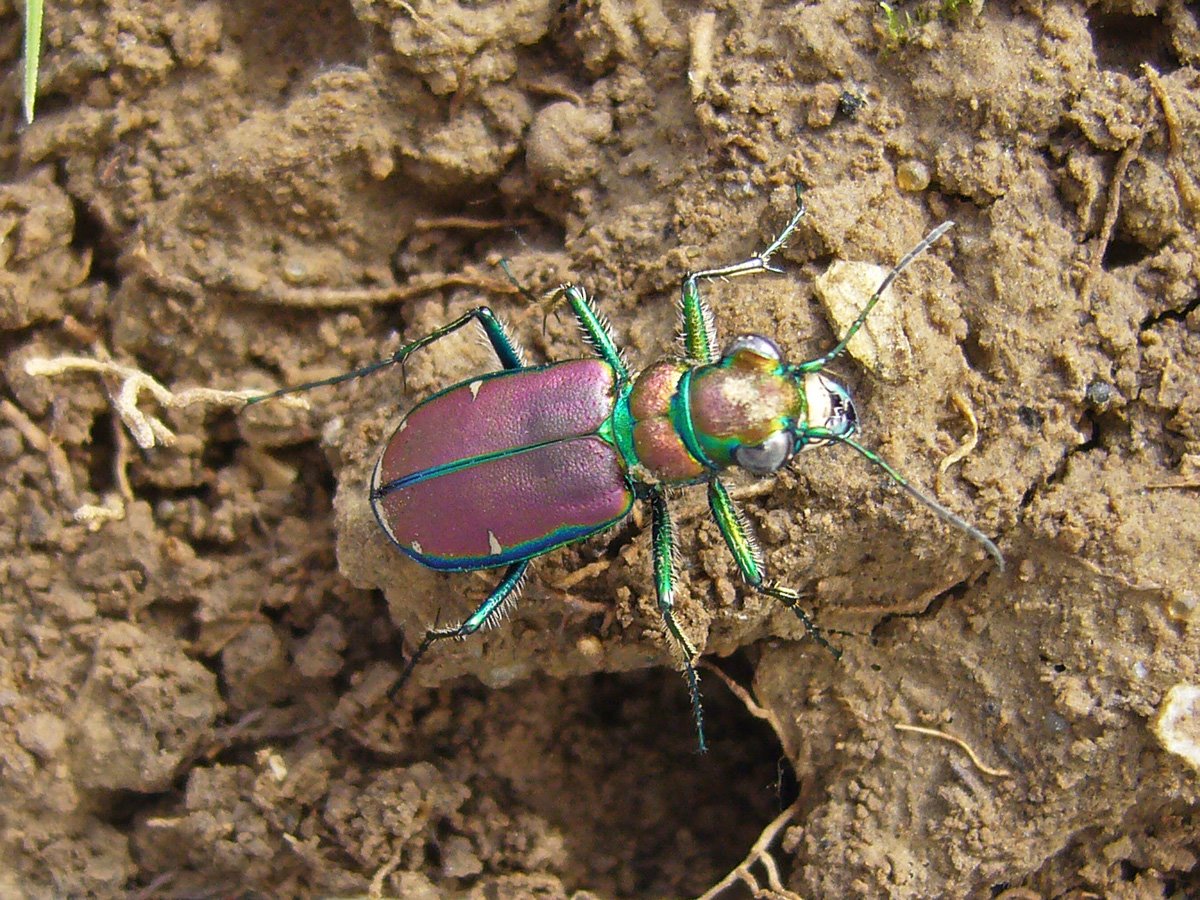
Cicindela sexguttataIn the meantime, I’ve got to learn how to use this camera. The first weekend I had it, I accompanied my friend and colleague, Chris Brown, to nearby Shaw Nature Reserve, where Chris had previously noted good populations of the very uncommon Cicindela unipunctata (one-spotted tiger beetle) [now Cylindera unipunctata, fide Erwin & Pearson 2008 – more on this in a future post] – what a fantastic species for my first photo shoot with the new setup. Unfortunately, we did not find this species (although I will eventually). Instead, I focused on the very prolific population of Cicindela sexguttata (six-spotted tiger beetle) that we found at this site. Cicindela sexguttata is the one tiger beetle that is, more than any other North American species, known by entomologists and non-entomologists alike. Cicindela sexguttataAnyone who has ever taken a walk in the eastern forests during spring has encountered this beetle – flashing brilliant green in the dappled sunlight, always a few yards ahead on the path. While belonging to the “spring/fall” group of species, adults of this species break ranks and stay put in their burrows during fall while other spring/fall species come out and explore for a bit before digging back in for the winter (Pearson et al. 2006). While many individuals do show the six white spots on the elytra that give the species its common name, this character is actually quite variable, with some northern populations completely lacking spots.
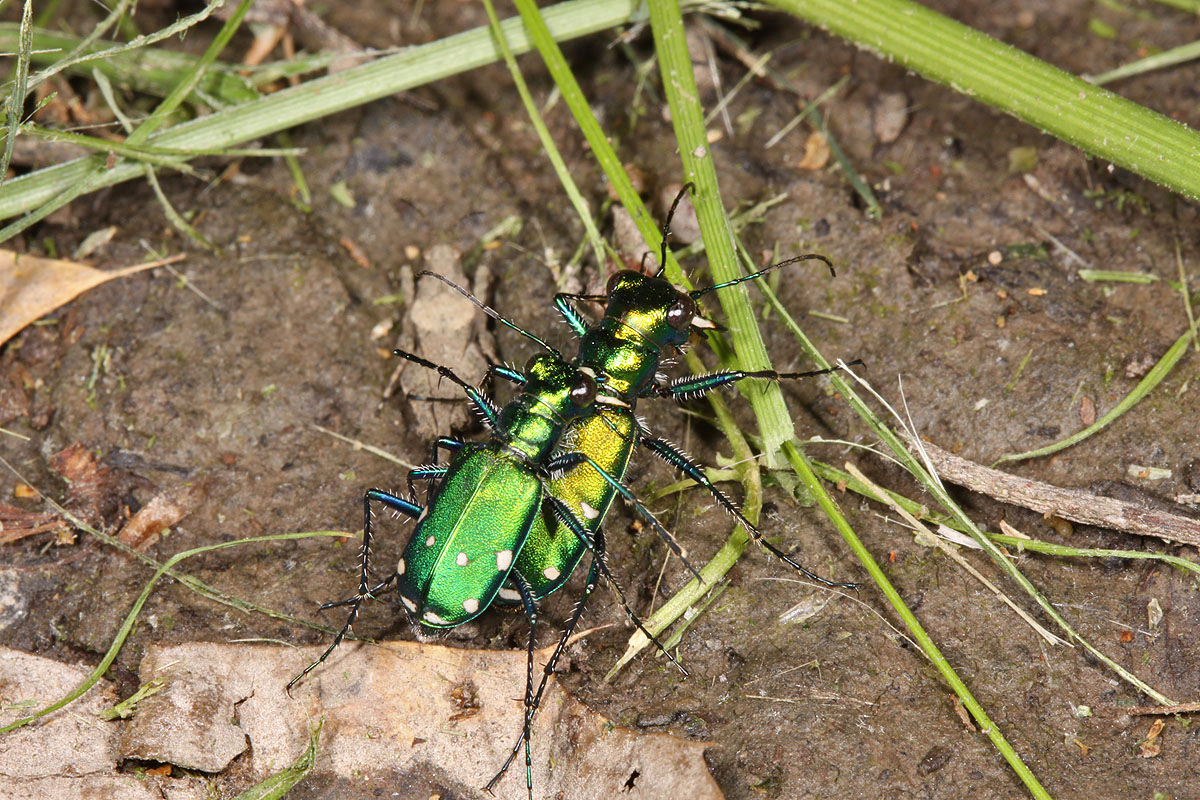
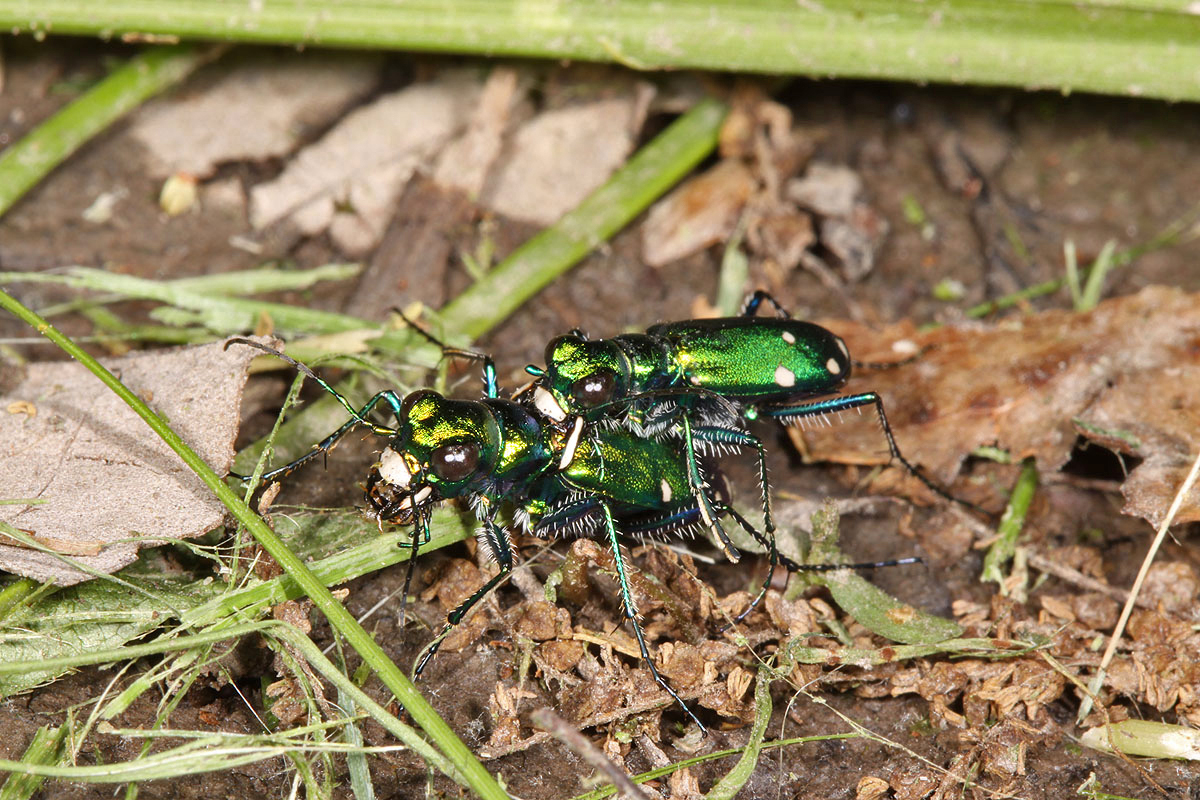
Cicindela sexguttataAs tiger beetles go, it’s one of the more difficult to photograph because of its shiny, metallic coloration (as opposed to the flat, dull coloration of Cyl. unipunctata). This was probably a good thing in terms of starting the learning process. I limited myself during this session to the 100mm macro lens (leaving the 1-5x beast for another day), with the photographs shown here being some of the better ones. While I like them, I also see a few things I did wrong. First was the flash – I set the flash units to 1/4 power and didn’t use any kind of diffusers, and as a result the lighting turned out harsh – especially for this brilliantly-colored, metallic species. Cicindela sexguttata I’ve softened the highlights a little bit in Photoshop, but the results are still not as good as if I had used a lower power and diffused the light, and ultimately my goal is to achieve well lit photographs that do not need post-processing to make them look right. Other than that, the day was mostly about getting used to handling the camera and learning how to judge f-stop based on my manual settings for exposure (1/200 sec) and ISO (100). The single individuals (above) were taken in full sunlight, and in that situation my f-stops tended to be too low (resulting in overexposure), while the mating pair was in shade where my f-stops tended too high (underexposed). Next time, I’ll try the diffusers I bought, use less flash power, and do more f-stop bracketing until I get a good feel for what I need in a given situation.
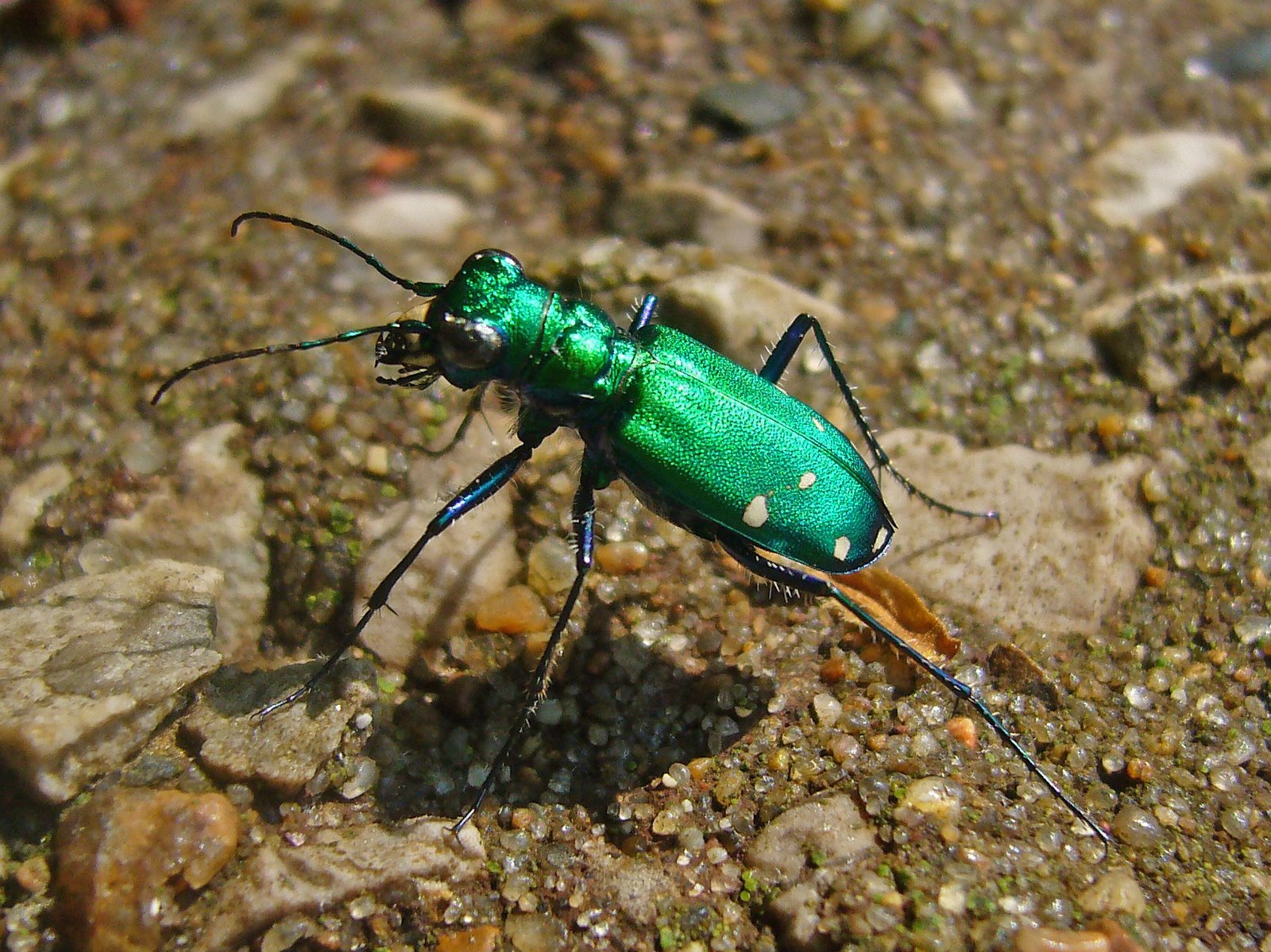
For comparison, here is the one C. sexguttata photograph I took with the point-and-shoot last year. This is about as good a photograph as I could get of this species using that camera. Besides being heavily cropped, it differs by being not very well exposed (despite post brightening), showing heavy shadows (despite post lightening), and lacking detail.
Cicindela sexguttata

REFERENCES:

Erwin, T. L. and D. L. Pearson. 2008. A treatise on the Western Hemisphere Caraboidea (Coleoptera). Their classification, distributions, and ways of life. Volume II (Carabidae-Nebriiformes 2-Cicindelitae). Pensoft Series Faunistica 84. Pensoft Publishers, Sofia, 400 pp. + 33 color plates.

Pearson, D. L., C. B. Knisley and C. J. Kazilek. 2006. A Field Guide to the Tiger Beetles of the United States and Canada. Oxford University Press, New York, 227 pp.

Copyright © Ted C. MacRae 2009

Add to FacebookAdd to NewsvineAdd to DiggAdd to Del.icio.usAdd to StumbleuponAdd to RedditAdd to BlinklistAdd to TwitterAdd to TechnoratiAdd to Furl

BitB Goes dSLR

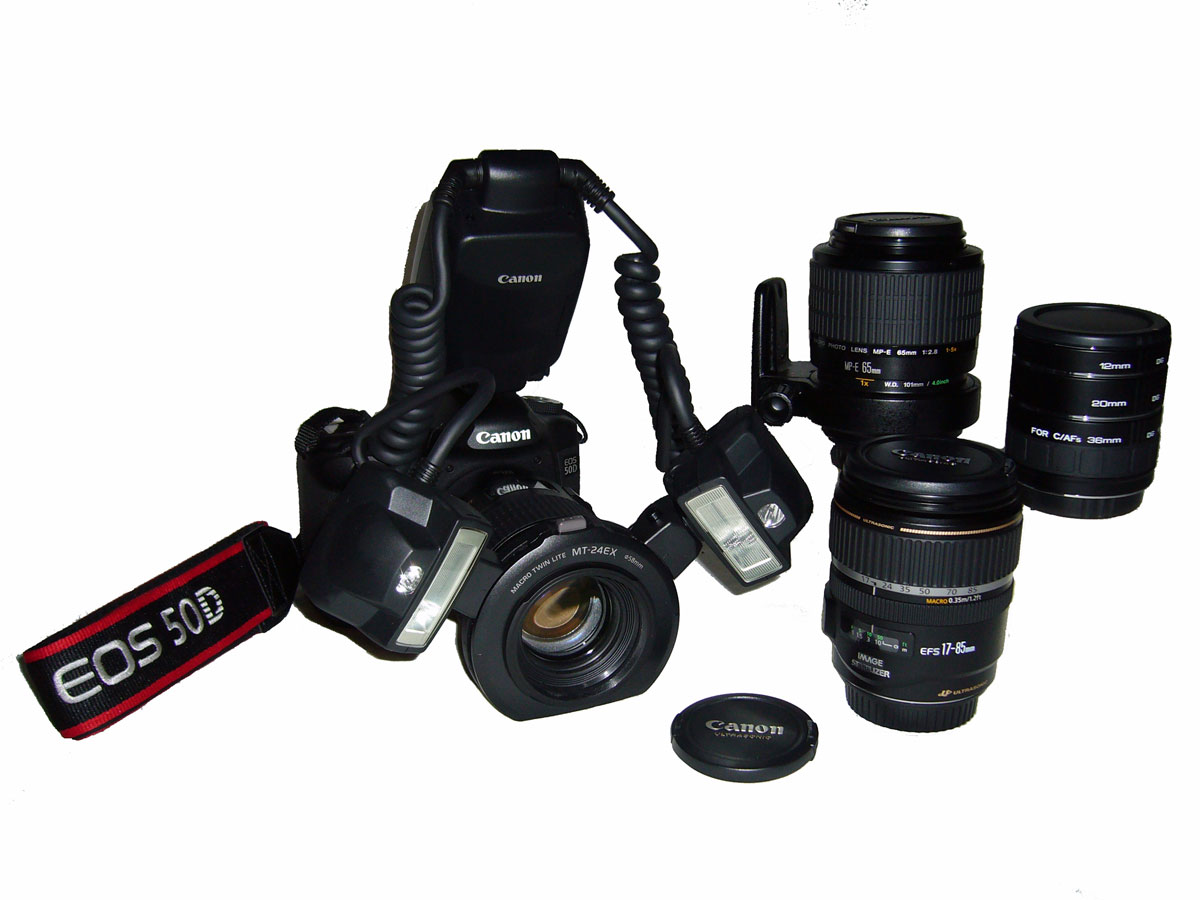
That’s right, I’ve finally acquired a bona fide digital SLR camera system and am taking the plunge into real insect macrophotography. I’ve been playing with my little point-and-shoot over the past 18 months or so, and the more I used it to take photographs of tiger beetles and other insects, the more I realized what I could do if I had a true macro system.  I made the decision several months ago and got lots of good advice on what kind of system I should put together from my colleague, field companion, and insect macrophotographer-extraordinaire Chris Brown, as well as from Adrian Thysse over at Voyages Around My Camera. For a time, I was trying to design a system on a rather tight budget, and Adrian graciously wrote an excellent post (Basic DSLR Macro System on a Budget) in response to my query.  The problem was, I could get the macro lens that I wanted but would have to really skimp on the flash and the camera body.  Or, I could get both the lens and the flash that I wanted, but then I’d have no money for a camera (kind of hard to take photographs with a lens and flash only).  I was thinking that maybe I could come up with a cheap body somewhere that I could live with for awhile, but in the end I realized that if I was going to do this I had to do it for real and find some way to scrape up the funds for a real system.  I decided to sell all of my bike racing equipment, keeping just my one really nice carbon road bike and a backup.  Happily, my equipment sold for a lot more than I thought it would, and I ended up raising enough funds not only to purchase a real system, but to purchase the system of my dreams.  I present to you the new BitB (Beetles in the Bush) insect macrophotography system¹:

Canon_P1020977_2

¹ It is ironically amusing that I had to take this photograph with my old point-and-shoot camera!

The system includes:

  • Canon EOS 50D Camera
  • Canon EF 100mm f/2.4 Macro Lens
  • Canon MP-E 65 mm 1-5X Macro Lens
  • Canon EF-S 17-85mm Zoom Lens
  • Canon MT-24EX Macro Twin Lite Flash
  • Kenco extension tubes (12mm, 20mm, 36mm)

At this point, I feel like I have just jumped into the ocean after having taken one introductory swim class at the YMCA.  I really have no experience with SLR photography since putting away my old Olympus OM-10 with a Zeiko 50mm macro lens some 20 years ago (pulling it out briefly for my trip to South Africa almost 10 years ago), and my digital experience has been limited to the Panasonic Lumix DMC-FX3 I’ve been using since I started this blog.  However, I’m a smart fellow and am reading everything I can right now, and I have the able tutelage of my colleague Chris, who has been more than willing to help show me the ropes with insect macrophotography in much the same way that I helped him get up to speed on our state’s fascinating tiger beetle fauna.

I suspect I’ll use mostly the 100mm out in the field, as most tiger beetles require slightly less than 1:1 magnification.  The extension tubes will also be useful in the field when I need to get a little more than 1:1 but don’t want to pull out the 1-5X beast.  Above 1.5, which I’ll need for many of the smaller buprestids (that the rest of the insect macrophotography world has overlooked to this point), I’ve got no choice – I’ll have to pull out the 1-5X.  I’m a little fearful of this lens (see Alex‘s fine review), which seems to have a steep learning curve (I haven’t even taken a shot with it yet), but I’ll just have to deal with it if I want to get the kind of photos I’m looking for with our beautiful, but small, jewel beetles.  Perhaps someday I’ll earn a listing under people’s “Insect Macrophotographers” blogrolls, but I doubt I’ll be posing much competition to the likes of Alex, Adrian, Chris, Kolby, Dalantech, and Mark for the time being.

For now, I present to you the very first tiger beetle photograph taken with my new system, the common spring woodland species, Cicindela sexguttata (six-spotted tiger beetle).  It’s not real close up, but it is tiger beetle photograph number one!

Cicindela sexguttata

Photo details: Canon EF 100mm macro lens on a Canon EOS 50D, ISO 100, 1/200 sec, f/18, flash at 1/4 power

Copyright © Ted C. MacRae 2009

Add to FacebookAdd to NewsvineAdd to DiggAdd to Del.icio.usAdd to StumbleuponAdd to RedditAdd to BlinklistAdd to Ma.gnoliaAdd to TechnoratiAdd to Furl

Tiger Beetle Rearing

I recently found an interesting website called Tiger Beetle Rearing.  This website by doctoral candidate Rodger Gwiazdowski in the Joseph S. Elkinton lab, University of Massachusetts, Amherst contains a wealth of information and photographs covering equipment, techniques, and methods for rearing tiger beetles from egg to adult, with a primary focus on rearing endangered and threatened species of tiger beetles for conservation and re-release into the wild.  The lab has reared a number of tiger beetle species but is particularly interested in the Puritan tiger beetle (Cicindela puritana), threatened in the northeastern U.S.  After the first year of rearing, 90 2nd and 3rd instar C. puritana larvae were obtained and, as of the last update, were overwintering in individual tubes.  You’ll need to register with the site with a username and password to access the site, but this is accomplished quickly and easily.

Welcome to the Hotel Cicindela!

Welcome to the Hotel Cicindela!

I found this website of great interest as I begin my own efforts at rearing these beetles in the laboratory.  My primary interest is in rearing larvae that I collect in the field to adulthood – adults are much more easily identified than larvae (indeed, the larvae of many species remain undescribed), and rearing field-collected larvae is one way to get around the often limited temporal occurrence that many tiger beetle species exhibit as adults.  My operation isn’t nearly as sophisticated as the one developed in the Elkinton lab, but then I’m just a working stiff trying to do this (and a million other things) on the side. Despite this, I have had my first success, rearing to adulthood a larva I collected during the summer last year (see my post It’s a girl!).  In addition, I currently have a number of larvae collected last fall in Nebraska and South Dakota, which I put in terraria of native soil and kept in a cold incubator during the winter.  I pulled them out earlier this spring, and soon afterwards a number of larvae opened up their burrows and have been feasting on fall armyworm and corn earworm caterpillars every 2-3 days or so.  The larvae were collected from a variety of habitats and soil types, including sand, alkaline seeps, and red clay banks, so I’m hopeful that the ensuing adults will represent a variety of interesting species – perhaps some that I did not encounter in the field during that trip.

Cicindela_scutellaris_rearing_P1020931_2Beyond this, however, I am also interested in trying my hand at cross-breeding experiments – particularly with Missouri’s unique population of Cicindela scutellaris (festive tiger beetle).  I’ll need to wait until fall for this, however, since adults that are active in the field right now are sexually mature and have presumably already mated.  In the fall, a new generation of sexually-immature adults will emerge and feed for a time before burrowing back in for the winter and re-emerging the following spring ready to mate.  I would like to cross individuals from southeastern Missouri – representing an intergrade between the northern subspecies lecontei and the southern subspecies unicolor – with individuals from the northern part of the state that are clearly assignable to subspecies lecontei.  If possible, I would also like to obtain individuals from even further south that are clearly assignable to subspecies unicolor and cross them with both the southern and northern Missouri populations.  These crossing experiments may provide some insight into which of the subspecies the intergrade population is more closely related to, and it will be interesting to see how closely the progeny from the lecontei x unicolor cross resemble individuals from the intergrade population and the range of variation that they exhibit.  I should mention that Matt Brust (Chadron State College, Nebraska) has done a number of these inter-subspecific crosses with C. scutellaris, with some very interesting results among the progeny.

What I can do right now is work on techniques to make sure I can get females to lay eggs and then rear the larvae all the way through to adulthood.  For this, I brought back 9-10 live individuals from two localities of the intergrade population encountered on my recent trip to the southeastern lowlands.  Adults imbibing moisture from polymer gelI put equal numbers of males and females from each locality into separate terraria – each filled with native soil and a hydrophilic polymer gel made of anionic polyacrylamide. The beetles, who normally obtain moisture from their food or by “chewing” moist soil, chew instead on the gel. This eliminates the need to maintain a water dish or cotton batting that must be changed daily in order to prevent the growth of mold and bacteria. A few of the adults in each terrarium died shortly afterwards, possibly a result of stress or dehydration during transport (the photo right shows how eagerly they imbibed moisture from the polymer gel after being placed in the terrarium), but the remainder have lived for four weeks now and have been digging burrows and feeding whenever food is offered.  According to Matt Brust, C. scutellaris does not lay eggs on the surface of the soil (as does C. celeripes), but rather lays them about 1.5 to 2 inches below the surface.  It takes 2-3 weeks before the eggs start hatching, so I am expecting to see larval burrows appearing anytime now.  Matt tells me the key to getting eggs is to feed the adults “big-time” – thus, I have been offering fat, juicy fall armyworm or corn earworm larvae to the adults whenever they are out of their burrows.  Watch this entertaining video of one adult having lunch:

Copyright © Ted C. MacRae 2009

Add to FacebookAdd to NewsvineAdd to DiggAdd to Del.icio.usAdd to StumbleuponAdd to RedditAdd to BlinklistAdd to Ma.gnoliaAdd to TechnoratiAdd to Furl

Now you see me…

Myrmeleon_sp_P1020915_2

…now you don’t!
Myrmeleon_sp_P1020914_2

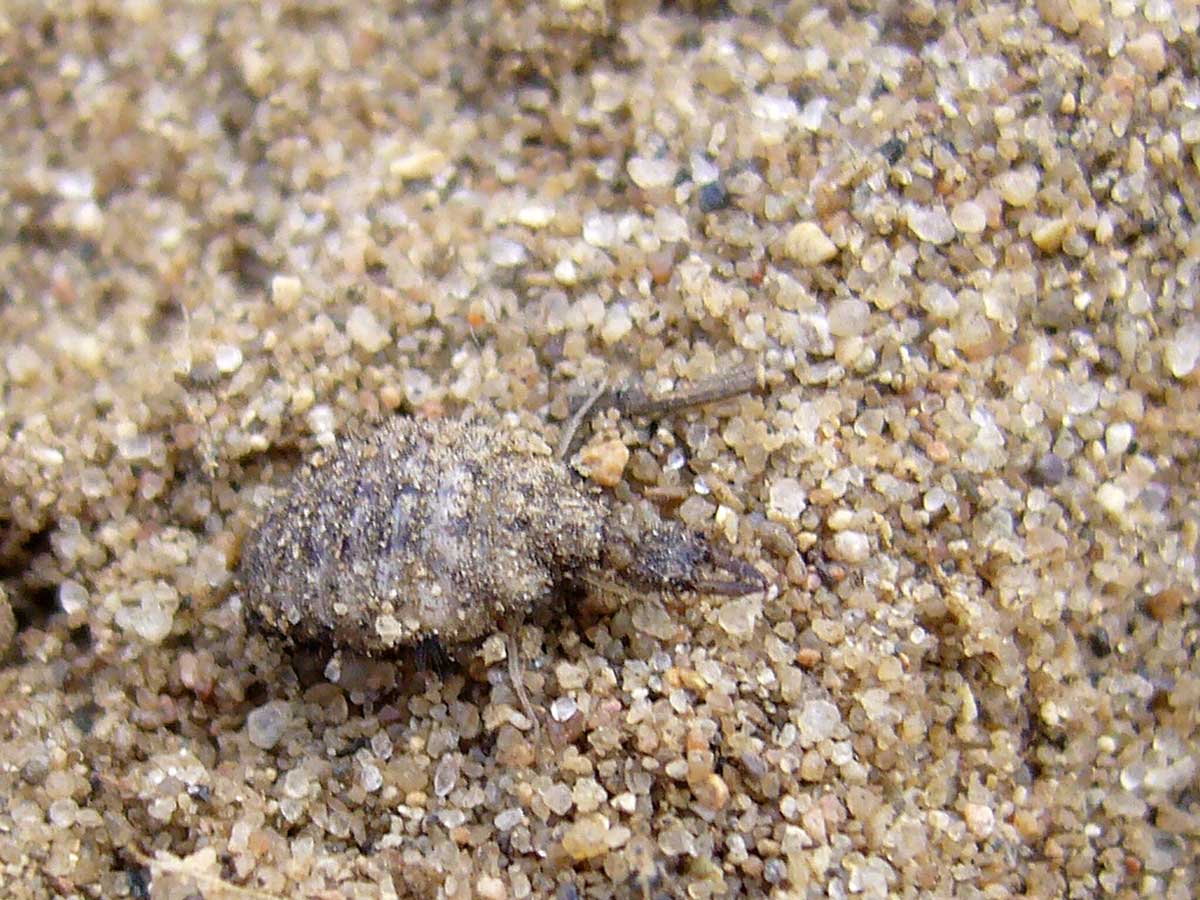
In a previous post, I lamented the fact that I had never actually seen a live antlion larva, or doodlebug (family Myrmeleontidae). Lovers of sand, I’ve seen their famous pitfall traps many times, especially in recent years as I’ve searched sand habitats for my beloved tiger beetles. Occasionally, I’ve stopped to jab my knife under a pit, give it a quick flip, and search the freshly turned sand for the maker of the pit – never seeing anything. It never bothered me much either – there were always beetles to catch!  Two weeks ago I returned to the sand prairies of southeastern Missouri to look for additional sites for Cicindela scutellaris (festive tiger beetle), and as we searched one particular site on the Sikeston Sand Ridge I once again saw the characteristic funnel-shaped pits amongst sparse vegetation in the sandy soil.  I decided this time I needed to give it a good effort – how can any self-respecting entomologist accept not having ever seen a live doodlebug?  As I’d done many times before, I kneeled down, gently put the tip of the knife about an inch away from the edge of the pit, and then jabbed its full length assertively into the sand and under the burrow and flipped it over.  Like previous times, I studied the turned sand and saw nothing.  I stirred the sand gently with the tip of the knife and studied it again – nothing.  I tried another burrow – again, nothing.  I decided right then and there that I was doing something wrong – I could not simply be picking ’empty’ pits.  I continued staring at the turned sand, and then I saw movement – I looked closer, and it seemed as though the sand itself was moving.  At last I made out its outline – I had finally succeeded in finding a doodlebug!  I dug up another burrow, and knowing what I was looking for this time I had no problem quickly locating the little creature.  I watched it as it lay motionless – perfectly camouflaged by its color and with sand grains sticking to its body, and chuckled as it buried itself almost instantly with a quick, backwards shuffle into the sand. Who knows how many doodlebugs I’d successfully dug up in the past, completely overlooking them as they lay disguised and motionless in the sand.

More than 100 species of antlions, representing at least 19 genera, live in the Nearctic Region, although much of this diversity occurs in the southwestern U.S. and Mexico.  Despite the commonly drawn association between antlions and pitfall traps, in North America only those in the genus Myrmeleon actually exhibit this behavior.  This larva dug a pit and so must represent a species of Myrmeleon – perhaps M. immaculatus, a common species in North America and one whose adult I observed last fall on a nearby sand prairie remnant.  Species in other genera have free-living larvae that hide under objects or roam underneath the sand, from where emerge briefly to hunt for prey.

For those interested in learning more about antlions, Mark Swanson has an excellent website called The Antlion Pit.

REFERENCE:

Swanson, M.  1996. The Antlion Pit: A Doodlebug Anthology. http://www.antlionpit.com/

Copyright © Ted C. MacRae 2009

Add to FacebookAdd to NewsvineAdd to DiggAdd to Del.icio.usAdd to StumbleuponAdd to RedditAdd to BlinklistAdd to Ma.gnoliaAdd to TechnoratiAdd to Furl

Bon appétit!

I collected this larva in northwest Nebraska during last year’s Fall Tiger Beetle Trip.  I collected an adult Cicindela lengi (blowout tiger beetle) at the spot – a species that greatly resembles but is much less common than the ubiquitous C. formosa (big sand tiger beetle – see my post Cicindela lengi vs. Cicindela formosa for a comparison of the two species).  Before finally finding that adult, however, I had fished out several larvae from the site in the hopes that they represented that uncommon species (see how I did this in my post Goin’ fishin’).  After collecting the larvae and placing them in a small terrarium with native sandy soil, they burrowed in but then closed up shop – I wasn’t sure whether they had survived or not.  In early December I put the terrarium in a 10°C incubator for the winter and brought it back out earlier this month.  Yesterday, happily, this larva and one other opened up their burrows again, so with any luck I’ll feed them well and they’ll complete their development.  While I do hope they represent C. lengi, other possibilities include C. scutellaris (festive tiger beetle), which would not be exciting, and C. nebraskana (prairie long-lipped tiger beetle), which would be VERY exciting.  One species I do not have to worry about it being is C. formosa, as the larvae of that species make very unique excavations in the sand with the burrow opening directed towards the excavation (I don’t believe I’ve posted photos of that here, yet – I’ll have to do so soon).

In the meantime, here is a closeup of the larva in the video prior to feeding. Those of you who have ever reared or photographed tiger beetle larvae will know just how easily “spooked” these larvae can be – any sudden movement will cause the larva to “drop” into its burrow and sit there for awhile. As a result, it was a real challenge to go through the whole process of taking first the photos and then the video while feeding it without causing it to drop.

cicindela_sp_larva_p1020936

Coming soon – lunchtime for adults!

Copyright © Ted C. MacRae 2009

Add to FacebookAdd to NewsvineAdd to DiggAdd to Del.icio.usAdd to StumbleuponAdd to RedditAdd to BlinklistAdd to Ma.gnoliaAdd to TechnoratiAdd to Furl

An extendable handle for insect nets

For many years, my standard insect collecting gear has been a beating sheet and a short-handled aerial net (see small photo at right in “The Author” or the full-sized version under About). From the deciduous forests of the Ozark Highlands to the tropical bushveld of South Africa, these two pieces of equipment have been all that I’ve needed to collect the woodboring beetles that have dominated my interests. The beating sheet is, of course, an absolute necessity for anyone interested in jewel beetles (family Buprestidae), longhorned beetles (family Cerambycidae), and the many other insects that tend to be found on tree branches. Woodboring beetles are most frequently, but not exclusively, found on dead branches of their host trees, but regardless of whether the branches are alive or dead, the concept for collecting beetles off of them is the same – a beating sheet is held underneath the branch, and the branch is given a decisive whack with a stick of some kind. This dislodges any beetles that may be foraging or resting on the branch and causes them to drop onto the sheet, where they can be spotted easily and picked off before (hopefully) they escape. For my “stick” I like to use the handle of an aerial net, as the net itself is quite handy to have in case I stumble upon some of the many flower-feeding species or for more general collecting (my inability to focus exclusively on any one taxon is by now well documented). Using a net handle as a beating stick, unfortunately, forces one to compromise on the length of the handle – the handle must be relatively short (no more than 3′ long) to be effective as a beating stick, but such a short handle severely limits reach when the net is being used.  This problem has become even more apparent during the past few years as I have become increasingly interested in tiger beetles (family Cicindelidae).  There is no way around it – you need a long-handled net to have any hope of collecting tiger beetles, and the longer the better (ideally about 6′).  Thus my quandary – I needed a short-handled net to best collect woodboring beetles, but a long-handled net to best collect tiger beetles.

Enter the extendable handle for insect nets, available from BioQuip Products.  This ingenious net handle consists of two telescoping aluminum tubes with a clutch-lock device.  When fully collapsed the handle measures only 36″ in length – perfect for use as a beating stick and when extra length is not needed.  When a longer net handle is needed, however, a quick turn of the clutch-lock frees the inner section, allowing the handle to be extended to nearly 6′ in length – perfect for those fast-moving tiger beetles. Once extended, another quick twist of the clutch-lock secures the handle in place, and that Cicindela is mine!  To cap it all off, the handle is fully compatible with standard insect net rings and bags, including the red “T” knob for ring attachment. It was almost as if the handle had been designed specifically for my purposes.

I purchased mine at the beginning of the last field season. While the design seemed a perfect solution for my short handle-long handle quandary, I wasn’t convinced it would be able to withstand the rigors of field use. Specifically, I questioned whether the inner section would remain firmly seated within the outer section after a few slams of the net against the ground with the handle fully extended (for example, when using the ‘slap’ method for those tiger beetles I hadn’t yet figured out). I expected that repeated flexing of the handle would eventually cause the joint to fail and the handle to lose its rigidity. I also wondered how quickly and easily the handle would extend – especially after seeing some wear and tear. Any difficulty in this regard would quickly negate the convenience offered by an extendable handle.

I was immediately impressed with this handle upon its very first use, and after one full season of heavy use, it appears my concerns about its durability were unfounded. Weighing only 12 oz, it is extremely lightweight and easy to carry, and I am also pleased at how easily the handle extends and collapses – the clutch-lock disengages completely with a single twist, and the inner section slides into and out of the outer section smoothly and quickly. The true test of its durability, however, came during last year’s annual fall tiger beetle trip – a test that it passed with flying colors. I really put the net handle to hard use, and despite repeatedly slapping the net ring against the ground with the handle fully extended, the joint remained solid and rigid. I was able to swing the net with just as much assertion at the end of the trip as at the beginning.

Even during those times when I wasn’t carrying a beating sheet, I found myself routinely preferring to carry the extendable handled-net rather than the long-handled net. It was easier to carry and use when a short handle was sufficient, yet it could be extended quickly and easily when the extra length was needed. At $22.95, I consider its cost to be rather modest compared to the convenience and versatility it offers. For those of you who need a long-handled net but don’t want to wield a long handle all the time (and for the one or two other people in the world who use their net handle as a beating stick), this is the handle for you.

Copyright © Ted C. MacRae 2009

Add to FacebookAdd to NewsvineAdd to DiggAdd to Del.icio.usAdd to StumbleuponAdd to RedditAdd to BlinklistAdd to Ma.gnoliaAdd to TechnoratiAdd to Furl

Tiger Beetle Safari

In looking back at my posts over the past few weeks, I realized that it has been far too long since I’ve actually talked about beetles.  Perhaps “Petals In The Bush” would be a better name for this blog!  I still have some botanical thoughts to get off my chest before the insect season starts in earnest, but until then, and in anticipation of the upcoming summer’s hunts, I offer this fun, light-hearted introduction to collecting and keeping tiger beetles by Peter Schriemer.  Pay particular attention to the method he uses to capture these elusive little creatures:

Tiger Beetles are my favorite type of beetle! Entomologist John Acorn got me hooked on these little guys. They live across the country in various habitats, so you may not need to travel far to go on a Tiger Beetle Safari of your own!

Vodpod videos no longer available.

more about “Tiger Beetle Safari“, posted with vodpod

Capturing tiger beetle adults can a little (lot) more difficult than implied by this video. Adults have excellent eyesight, and many species are extremely wary. It takes practice, patience, and lots of second chances. The collecting method shown in the video is what I refer to as the “stalk and slap” method – the beetle is slowly stalked until within net reach, and the net bag is slapped over the beetle.  This method works well enough, but it has its limitations.  If there are any gaps between the ground and the net rim, the beetle will quickly dart through them and fly away.  This is easy to prevent on sandy and soft clay substrates, as the net rim can be sealed against the ground by kneeling quickly on each side of the rim to embed it slightly and using the hands to hold up the net bag and locate the beetle.  Still, there are a few things I don’t like about this method – the beetle may hide against the inside of the rim and be difficult to locate, and once found it may be difficult to grab the beetle through the net if it is against the ground (don’t even try lifting the rim and reaching under – the beetle will zip out and be gone).  This method can also be taxing on the legs, as each attempted capture involves kneeling and standing back up (getting harder and harder for these 50+ year old knees to do).

The major limitation of the slap method, however, is that it doesn’t really work on hard, uneven surfaces. Many species are found in glades and other habitats with exposed rock substrates. In these types of habitats, the net rim simply cannot be clamped tightly enough to eliminate the gaps (not to mention the added difficulties in kneeling on these surfaces).  Because of this, I have adopted a technique that I call the “tap and swipe” method.  Here again, the beetle is stalked until within net reach (made easier with a longer handle), but rather than slapping the net bag over the beetle, the rim of the net is tapped against the ground next to the beetle and then assertively swiped sideways to catch the beetle just as it starts flying.  A quick 180° flip of the net rim closes the opening to prevent the beetle from escaping, and it is easily seen in the hanging net bag, where it can be grabbed from outside the net bag with one hand to secure it before reaching into the net bag with the other hand.  With a little practice, one eventually learns to reach down into the open net bag and grab the beetle while preventing it from flying up and out.  All of this can be done while standing, so it’s easier on the knees.

The tap method does require more knowledge about the beetle’s escape behavior in order to anticipate how quickly and in which direction the beetle will fly – some species delay take off just slightly, thus requiring a slight “pause” between the tap and the swipe. However, once their behavior is learned I have found this method to be more consistently successful than the slap method – even on soft substrates.  For species that I haven’t encountered in the field before, I use the slap method at first (if I can) until I have a feel for their escape behavior. If I can’t, I use the tap method and hope for the best!

Copyright © Ted C. MacRae 2009

Add to FacebookAdd to NewsvineAdd to DiggAdd to Del.icio.usAdd to StumbleuponAdd to RedditAdd to BlinklistAdd to Ma.gnoliaAdd to TechnoratiAdd to Furl

It’s a girl!

I’ve been interested in collecting insects since I was 10 years old, and my current collection dates back to spring semester 1978 when, after finally declaring a major, I kicked off my life as an entomologist with Entomology 101. I did my graduate work on the now-defunct Homoptera (I just can’t call them hemipterans), using laboratory rearing to figure out life history details of several species of leafhoppers. Although my allegiance would soon switch to beetles (where it has remained ever since), my interest in rearing insects would persist. It wasn’t long before I began rearing wood boring beetles as a way of studying their distributions and host plant associations. I’ve reared beetles from literally hundreds of batches of wood – buprestids, cerambycids, bostrichids, clerids, ostomids, you name it – if it breeds in wood, I’ve reared it. Not to mention the parasitic hymenopterans and even predaceous asilids associated with them. Rearing has been part of my professional life as well. In the early part of my career in industry, I supervised an insectary that maintained laboratory colonies of nearly two dozen arthropod species to support research. We reared moths, beetles, flies, roaches, aphids – even mites and nematodes. However, despite having reared hundreds of species of insects, I had never reared a tiger beetle – until now!

This little gal – a gorgeous individual representing Cicindela limbalis (common claybank tiger beetle) – was waiting for me when I returned from my recent trip to western Nebraska and South Dakota. I had collected her as a 3rd instar larva from her burrow atop a steep clay bank in western Missouri, where my colleague and I were conducting our survey for Cicindela pruinina (now Dromochorus pruininus). I had entertained the hope that it might prove to be that species, but the abundance of larval burrows within this patch of habitat – where C. pruinina had not been seen – and the fact that they contained mostly 3rd instars suggested it would prove to be one of the spring-fall clay associated species. After fishing her from her burrow, I filled an empty Starbuck’s Frappucinno bottle (there is, apparently, only one place in the Ozarks where availability of good coffee obviates the need to resort to a cold, sugary, “coffee-flavored” drink in the morning) with native clay and dropped her in, where she immediately proceeded to dig a new burrow. She was thoughtful enough to dig her burrow right down along the glass so that I could keep an eye on her over the next several weeks, occasionally dropping in a fat fall armyworm larva and watching it meet its gruesome yet mercifully quick death. A few weeks before my trip, she sealed up her burrow and disappeared from view. Curious (and impatient), I emptied the soil from the bottle and found her down at the bottom, quiescent but apparently healthy. I put the soil back into the bottle and dropped her in, and she immediately dug a new burrow, sealed it up, and disappeared from view once again. My curiosity satisfied, I had an easier time leaving her alone after that, and when I returned from my trip, there she was.

Cicindela limbalis occurs throughout Missouri on eroded or sparsely vegetated clay soils, although it is less common in the southern Ozark Highlands – being largely replaced by Cicindela splendida (splendid tiger beetle). I’ve most often encountered C. limbalis on roadside embankments, along 2-tracks through open forest and woodland, and in glade habitats. This individual shows the greatly reduced elytral maculations that are typical of populations found throughout most of Missouri – only in the extreme northern tier of counties is the full pattern of maculation expressed (as exemplified by this individual from central Nebraska). At one time, this reduced maculation was the basis for recognition as a separate subspecies (C. limbalis transversa); however, no distinct geographical forms are currently recognized for this species (unusual in cicindelid taxonomy). Regardless of her taxonomic identity, I’m enjoying watching my new pet – she now occupies a larger, roomier terrarium filled with native clay, into which she has dug a burrow and spends most of her time sitting at its entrance. As she did when she was a 3rd instar, she enjoys a fat fall armyworm larva for lunch every few days. She will eventually take up permanent residence in a neat row inside a wooden, glass-topped box, but for now I’m going to do everything I can to delay that fate. Of all the many thousands of insects that I’ve reared over the years, she is my favorite.