A tortoise beetle gift

Chelymorpha varians | northwestern Buenos Aires Province, Argentina

A few days after returning from travel through northern Argentina, I found a jar on my desk with this beetle in it. One of my colleagues has seen it in the field while I was away and figured I would be interested in seeing it. Although I’m half-a-world away from home, I immediately thought of our North American species Chelymorpha cassidea when I saw it. Armed with this hunch, I typed “Chelymorpha Argentina” into Google, and the first result that came up was a paper by Hamity & Neder de Román (2008) about the species Chelymorpha varians in Argentina and its potential as a biocontrol agent for the widespread weed Convolvulus arvensis. Included in the paper was a plate showing variability of coloration and maculation in the adults, and my individual was a dead ringer for the species. Still, getting a species ID on the very first hit of the very first search attempt just seemed too easy, so I consulted the wonderfully comprehensive Cassidinae of the world – an interactive manual. This site, too, contained multiple images of Chelymorpha varians showing an extraordinary range of variability in color (from yellow to red) and degree of maculation (from immaculate to heavily maculated). A quick perusal of other species indicated as similar or also occurring in Argentina turned up nothing nearly as similar and convinced me that I had, indeed, arrived at a correct ID.
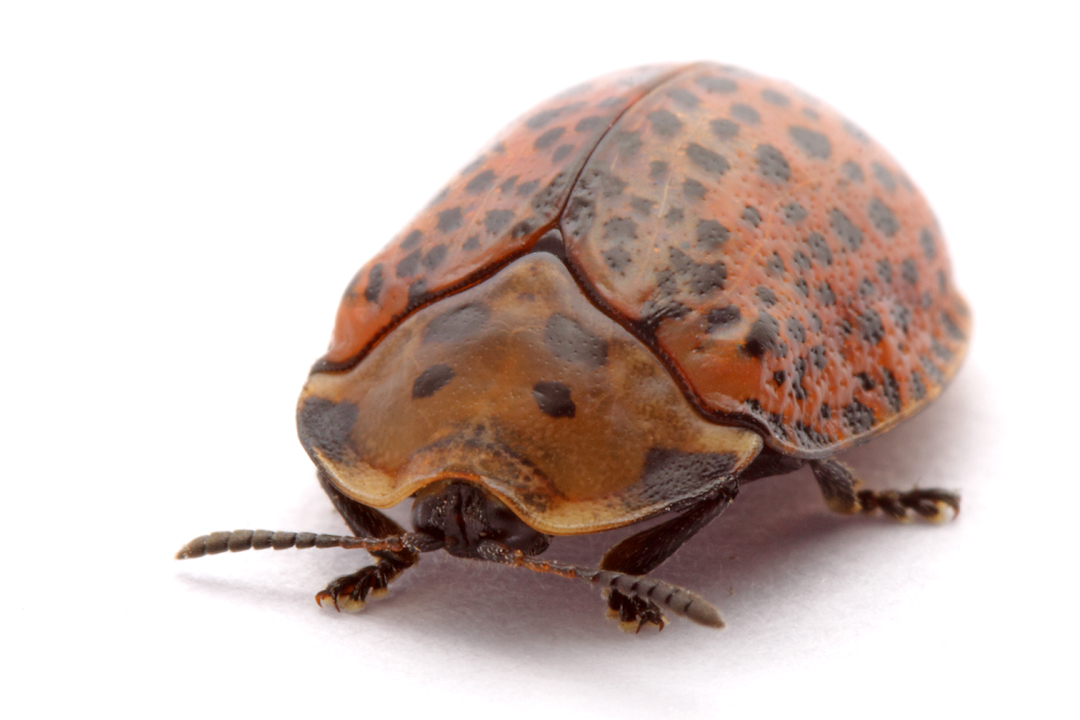
As the name suggests, markings are highly variable in shape and degree of development.

As indicated in the above cited paper, and like our own C. cassidea, species in the genus Chelymorpha are associated almost exclusively with plants in the genus Convolvulus. I would have preferred to photograph the beetle on foliage of this plant, but not knowing precisely where I might find it I decided to do white box instead. I got some printer paper and was looking for a cardboard box to line the inside with it when I spotted a styrofoam cooler of just the right size.

The scientific name translates literally to ''variable turtle-body''

These are okay white box photos, but I’ve decided if I want to do white box right I need to get a larger flash unit that is a little easier to work with off the camera. Right now I have only the small twin-flash heads from my MT-24EX—their small size makes them difficult to manipulate off the camera, and leaving them attached to their bracket limits the directions in which they can be oriented relative to the subject. As a result, I had to use more heavy-handed post-processing in these photos than I normally like to do in order to get the levels right. Hmm, I have a birthday coming up in about a month…

REFERENCE:

Hamity, V. C. & L. E. Neder de Román. 2008. Aspectos bioecológicos de Chelymorpha varians Blanchard (Coleoptera: Chrysomelidae, Cassidinae) defoliador de convolvuláceas. Idesia 26(2):69–73.

Copyright © Ted C. MacRae 2012

Retrachydes thoracicus – times four!

Disclaimer—these are not great photos!

A few days ago I posted this little quip as my status on Facebook: “Cool! Found a Retrachydes thoracicus thoracicus on the sidewalk outside my hotel!” I chuckled a little as I posted it, knowing that only a select few who read it would know what the heck I was talking about (of course, a right click to select “Search with Google” reveals the answer instantly). Of course, it is a species of longhorned beetle (family Cerambycidae) that apparently is found commonly in South America. I wanted to take some photographs of the beetle to show those who didn’t do the Google search just what it looked like. Unfortunately, the beetle was already somewhat moribund when I found it, and no matter how much I coaxed and prodded it on the stick I placed it on, it just looked… well, dumb. Legs out of position, antennae hanging limply, and the beetle itself laying prostrate on the branch, as if it barely had the strength to hang on (which actually was the case). Shame—it sure is an attractive species, with its densely pubescent and transversely gibbous pronotum (obviously the source of its name) and striking orange-banded antennae. C’est la vie!

Lately I’ve been trying to get a better handle on choosing backgrounds when I photograph insects, no longer content with the often busy and distracting backgrounds that show up in photographs taken completely in situ. It’s often a simple matter to hold the object on which the insect is sitting in front of something that gives the desired background effect, and having this perfectly calm yet strikingly attractive beetle to work with seemed to invite experimentation. I’m also trying to get a better feel for how to use higher ISO settings to make it easier to get these various “non-black” backgrounds while still using flash to get acceptable depth of field with the subject itself. Below are four of the better shots that came out of the session (yes—sadly, these are the “better” ones). I’m loathe to go below 1/160 sec exposure because of motion blur and would like to keep aperture settings quite small, so fairly high ISO settings are required to get the background effects I’m looking for. I think I’ve learned that ISO 1000 is about as high as I can go before the background gets unacceptably noisy—at small sizes the photos look fine, but open them up larger size and you’ll see what I mean. Anyway, ignoring the composition and noise issues, which background do you like best?

ISO 1000, 1/160 sec, f/14 - cloudy sky background

ISO 1600, 1/160 sec, f/14 - pavement background (close)

ISO 1600, 1/160 sec, f/14 - pavement background (more distant)

ISO 1600, 1/160 sec, f/14 - pavement background (foliage)

Copyright © Ted C. MacRae 2012

Something for Adrian

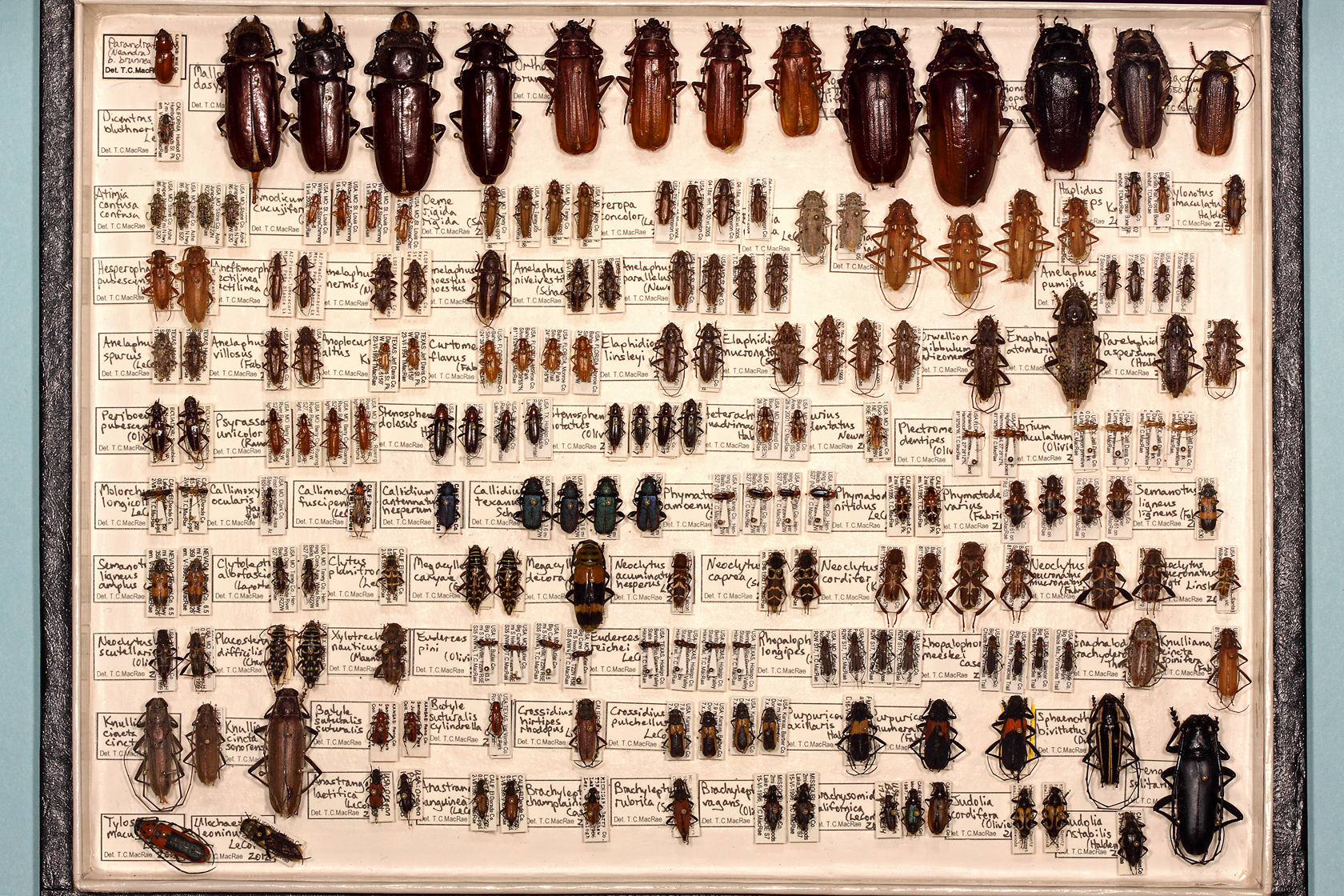
Miscellaneous North American Cerambycidae - click for larger version (1680 x 1120).

In a comment on my  post, Adrian Thysse asked to see hi-res images of specimen drawers from my own collection. Like any good North American entomologist, Adrian was a little bothered by the card-mounting technique used by the sender of the specimen box featured in that post and wanted to see what a nice collection of properly pinned specimens might look like. It’s actually not the first time he’s made this request—back when I first moved this blog to WordPress (more than three years ago) he did so when I put up my Collection page featuring a photo of my “Oh wow!” insect drawer. I’ve thought about doing this ever since he first made this request, but the problem, or at least my problem, with photographing specimen drawers from my main collection is a combination of large drawer size (reducing the size of the specimens in an image of the drawer) and long series of a relatively small number of species in the same genus or closely related genera (making the drawer contents look rather uniform in appearance). I suppose some might still be interested in seeing drawers from a “working collection” such as mine, but I just never had enough motivation to start pulling out drawers and taking photos.

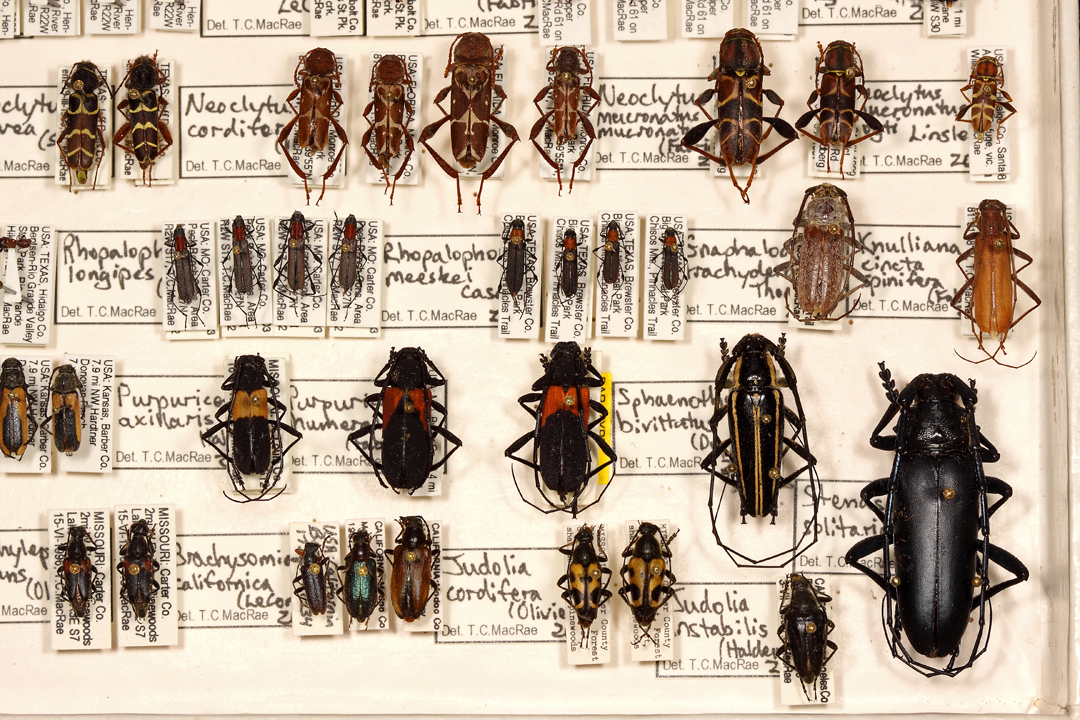
Adrian is in luck, however, as I just happened to be putting together a shipment of miscellaneous North American Cerambycidae for a collector in Europe (to whom I’ve owed insects for longer than I like to admit). The box I’m using for the shipment is smaller than a normal collection drawer and is packed with close to 100 species of this diverse beetle family. There might be a specimen here and there that was collected by someone else, but the vast majority were collected, mounted, labeled, and identified by me. I show this as an example of my curatorial technique, and as a bonus the above image is linked to a fairly large version (1680 x 1120) for those who might be interested in getting a really close look at the specimens and their labels. Here also are closer looks at the specimens in the bottom left and bottom right corners, respectively:

Hmm, is that a wasp at the bottom?

What species is that without the ''normal'' ID label?

Copyright © Ted C. MacRae 2012

Buprestidae exchange

With my queue of specimen identifications now clear, I can turn my attention to another major backlog that I haven’t been able to give proper attention recently—exchanges. For those of you not into insect collecting, exchanging is something that most collectors eventually end up doing, especially if the goal is to build a taxonomic reference collection within one’s chosen group that has broad representation of species and higher taxa from multiple geographical regions. Truthfully, I don’t do nearly as much exchanging as some collectors I know. It’s not that I don’t want to, but simply a matter of time—receiving and incorporating shipments while preparing and sending out returns is not as quick and easy as it might seem, not to mention the time involved in mining and corresponding with prospective exchange partners. I wish I could do more, but since I can’t I deal with it by limiting myself almost exclusively to exchanging Buprestidae (although I’ve been known to do a tiger beetle exchange or two). I focus on Buprestidae because that is my primary group of taxonomic interest.

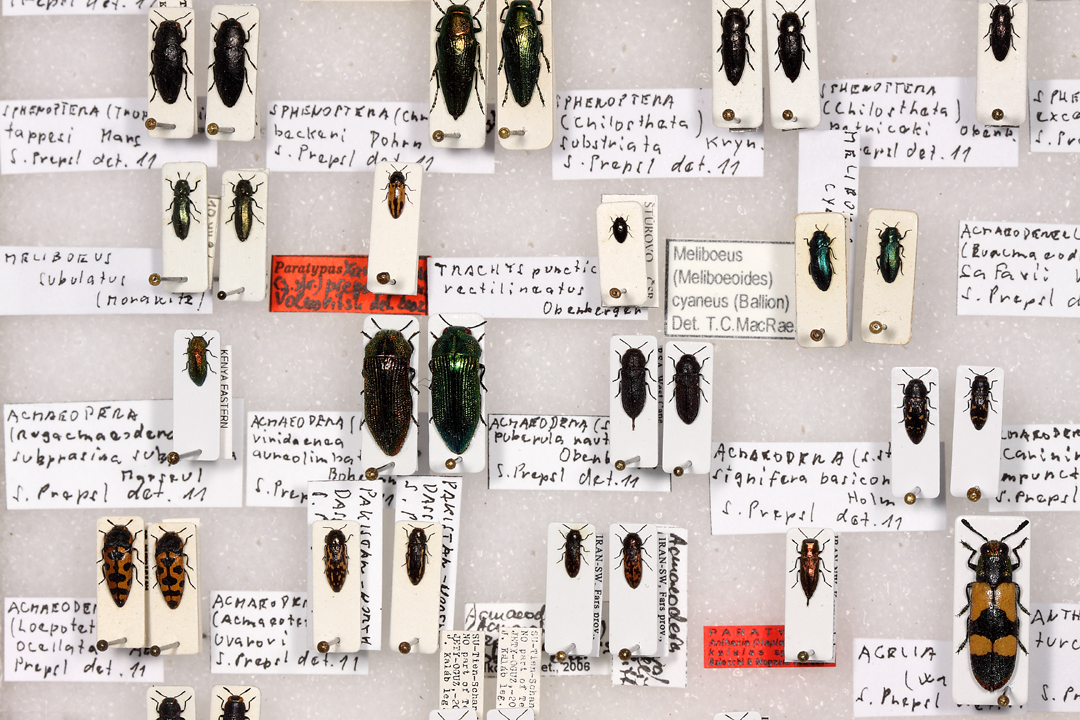
Buprestidae received in exchange from Stanislav Prepsl, Czech Republic

These photos show some of the Buprestidae I received this past year, this particular box coming from Stanislav Prepsl in the Czech Republic. This is the first time that I’ve exchanged with Stan, and I must say I am impressed with the quality and taxonomic diversity of his buprestid holdings. In this exchange, I received 73 species, most of which are represented by a male/female pair and four represented by paratype specimens. These are all Old World species, and while a few are from the well-known fauna of Europe most were collected in countries seldom visited by (or even off limits to) American collectors such as the former USSR, Iran, Pakistan, Kurdistan, Turkey, etc. There are a nice few species also from Namibia, Kenya and Ethiopia. In return, I sent to Stan more than 100 species of Buprestidae from mostly the southwestern U.S. and Mexico where I have done a large part of my collecting. Stan was less demanding about receiving both one male and one female for each species, thus the larger number of species I was able to send him for approximately equal numbers of specimens.

Close-up view of lower left corner of box

Some collectors avoid Buprestidae because of their taxonomic difficulty and the overwhelming numbers of small, difficult-to-identify species. I think this is exactly why I like the group, and though many of the species are small they are certainly no less beautiful than their larger, flashier, more ostentatious brethren. I include this close-up view (you might recognize the specimen in the lower right corner as the previously featured Agelia lordi) to show the meticulous preparation of the specimens included in the shipment—an example of a well-curated collection by someone who knows what they are doing. Incidentally, the cards on which the specimens are mounted are standard fare among European collectors, and although as an American I prefer direct pinning of larger specimens and mounting smaller specimens on points versus cards, I’ve come to appreciate the exacting care with which some Europeans practice this card-mounting technique.

It’ll take me a few hours of dedicated attention to move all of these specimens into the main collection—not only must their proper placement be determined, but there is usually a lot of reshuffling of specimens within and amongst unit trays whenever such a large number of specimens is incorporated into it. With 15,000 described species and counting, this sending of Buprestidae represents only a modest increase (0.5%) in my representation of species; however, it adds representation from geographical areas that previously had virtually no representation in my collection at all. I hope Stan is as pleased with the material that I sent to him as I am with this material, and I look forward to the opportunity to exchange again with him in the near future.

Copyright © Ted C. MacRae 2012

A Riot of Colors

Turkey tails (Trametes versicolor) on lichen-encrusted trunk of fallen post oak (Quercus stellata)—ventral view.

For my friend Rich and I, Thanksgiving week marks the official beginning of the winter hiking season.  Fifteen years ago we began our quest to hike the entirety of the Ozark Trail, and with only ~50 of the 350 miles constructed to this point in Missouri to go we find ourselves tantalizingly close to reaching that goal. This year we started the season with 10+ miles of the northernmost Courtois Section. The rains of the previous few days had stopped, but the moisture-laden air still hung heavy under gray, overcast skies.  Such a day may not be considered optimal for photography, but nothing could be further from the truth. Lichens and fungi, normally muted and inconspicuous, spring to life when awash with moisture and splash the woodlands with a riot of colors rarely seen on dry, sunny days. The dark, almost black, color of the wet bark adds to the contrast and further emphasizes the ubiquity of these “lower forms of life” amongst the now leafless trees.

Among the most distinctive of these is turkey tail (Trametes versicolor), an extraordinarily common polypore fungus that grows on the trunks of declining and dead deciduous trees—especially oaks. Like all polypore fungi, turkey tail feeds saprophytically within dead and dying wood but is more familiar to us by way of its externally produced reproductive structures, or “tails,” for the release of spores. As the specific epithet suggests, turkey tail comes in a variety of colors ranging from gray through browns to black, and the association of older tails with algal growth even adds greens to the mix. The diversity of colors is found not only within a single locality, but even on a single tree! The especially colorful example shown in these photos, made even more so by its intermixture with green crustose lichens, was found on the trunk of a post oak (Quercus stellata) tree that had fallen across the trail, and I couldn’t help but marvel at the range of colors present and the contrast between the dorsal and ventral surfaces.

Update 30 Dec 2011: Kathie Hodge has provided the following correction to my identification:

Hate to tell you, but the turkey tails in your post aren’t turkey tails, alas, they’re Trichaptum biforme. It’s one of a bunch of shelf fungi that resemble true turkey tails.  You can tell them apart by the small, regular pores of Trametes, whereas Trichaptum has a rugged toothy thing going on.  Also, T. biforme is paler on top, not as strongly zonate, and has a distinctly purple growing edge (and sometimes the hymenium is delightfully purple too).

Thank you, Kathie, for keeping me on the straight and narrow (and maybe I should stick with beetles in these quizzes!).

Natural light (ISO1600, f/5.6, 1/60 sec)

Full flash (ISO160, f/16, 1/200 sec)

Of course, color is a matter of perception, and I wondered what effect lighting would have on this. When it comes to macrophotography I’m an unapologetic flash-man, preferring the flexibility and sharpness of detail that flash lighting offers over the dreamier “natural” images produced with strictly ambient light. The above comparison, looking at the dorsal surface of the tails with their characteristic concentric zones of colors, did nothing to change that opinion. While some might insist that the natural light photo is a truer representation of the actual colors witnessed, to me it looks gray and faded—no doubt a result of illumination by a large gray light source (the cloudy sky). While my eyes might have seen muted shades of gray and brown, my mind saw vivid shades of rust, orange, and green—colors captured more faithfully by the full-flash illuminated photo.

The strikingly zonate upper surfaces present contrasts in texture as well as color

Congratulations to those of you who guessed some kind of polypore fungus in Super Crop Challenge #10, although nobody correctly deduced an ID below the family level. I fear my challenges have gotten too difficult, as this is the  in which nobody arrived at the correct answer. Nevertheless, on points Mr. Phidippus takes top honors with 11, while Roy, Tim and John earned enough points to receive podium mentions. Session 5 overall leader, Marlin, didn’t play this time, so Mr. Phidippus now takes over the top spot—can he hold onto it as the session plays out?

Copyright © Ted C. MacRae 2011

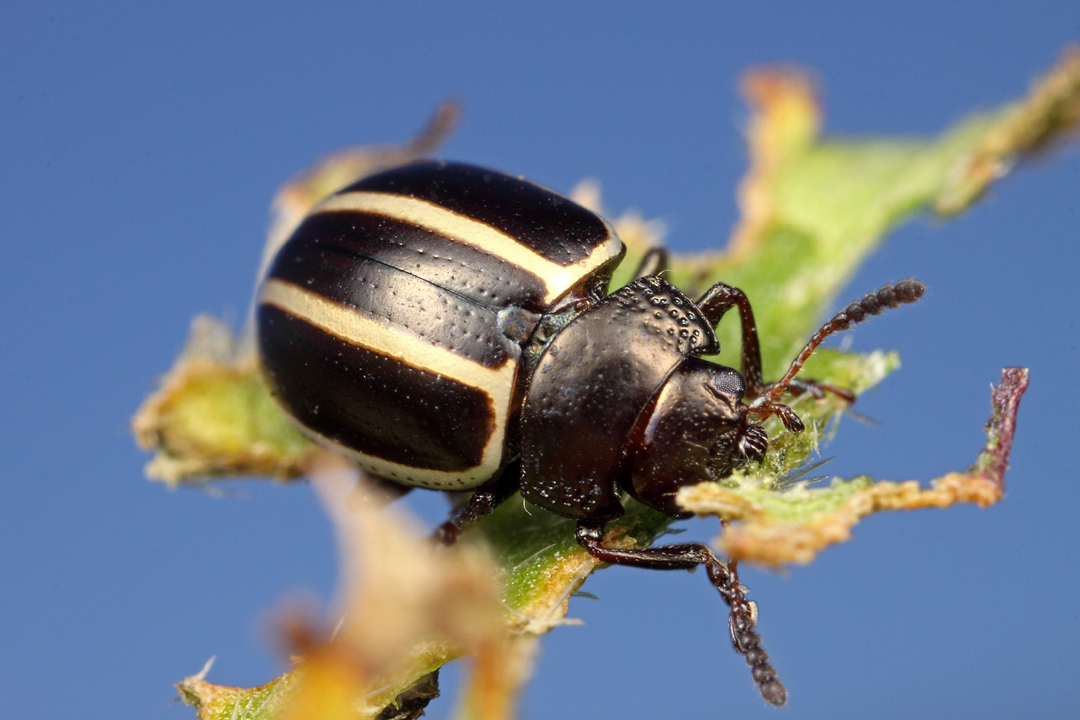
Zygogramma Desmogramma leaf beetles in Argentina


The east end of  in Buenos Aires offers a quiet contrast to the more populated central and western areas. Few people leave the levee-trail system that surrounds the famous wetlands and pampas grass stands in those latter areas; however, those that do find in the east a mosaic of pastures and young woodlands that offer a greater diversity of sights and invite a more leisurely pace. November is spring in Buenos Aires, and as such there were a number of plants beginning to bloom in the Reserve. One plant I found blooming in abundance in one small part of the east area was a member of the family Malvaceae that I take to be Abutilon pauciflorum, a few of which were being devoured by these leaf beetles (family Chrysomelidae).


These beetles are clearly members of the subtribe Doryphorina within the nominate subfamily, looking very similar to the North American species Zygogramma suturalis (ragweed leaf beetle) or the vittate species of Calligrapha (subgenus Bidensomela), e.g. Calligrapha bidenticola. Both of these genera are represented in Argentina, and at first I was inclined to believe the beetles belonged to the latter genus since its Central and South American members are associated almost exclusively with malvaceous plants (North American species of Calligrapha have adapted to plants in several other families). However, a view of the tarsus in the last photo suggests that the claws are joined at the base, a character that immediately separates members of the genus Zygogramma from the genus Calligrapha (species of Doryphora also have fused tarsal claws but exhibit a completely different gestalt). Eight species of Zygogramma have been recorded from Argentina, but I wasn’t able to find photographs of any that look reasonably similar to the individuals in these photos.  The identification will have to remain, frustratingly, non-specific.

Update 12/6/11: I just received an email from Shawn Clark (Brigham Young University, Provo, Utah) saying that he suspects the beetles belong to the genus Desmogramma. This genus is distinguished from both Zygogramma and Calligrapha by having the prosternum sharply angled upward anterior to fore coxae or mesosternum with a distinct horn directed anteriorly (Flowers 2004) and the claws widely separated and unarmed. Unfortunately, neither character is visible in these photos. Three species of Desmogramma are recorded from Argentina, and the coloration of these individuals resembles that described by Stål (1862) for D. striatipennis (D. semifulva and D. nigripes have the 3rd, 5th and 9th elytral interstices light).


These photographs represent continued efforts with the so-called ‘blue sky background’ technique that I’ve been trying to perfect as an alternative to the black background one typically gets in insect macrophotography with full-flash illumination of the subject. All of these photos were taken at ISO 640 using an MP-E 65mm lens at f/13 with 1/160 sec (1st photo) or 1/125 sec (2nd and 3rd photos) exposure and F.E.C. -1. These are similar settings to those used in my previous and not as satisfactory attempt, but this time the results were much better. Not only is the color of the sky spot-on blue, but these photos have much better detail than the previous. In this case, I believe “locking'” the subject relative to the lens to prevent motion blur was the key—I used my left hand to hold the leaf with the beetle towards the bluest area of the sky, rested the camera lens on my left wrist, used my fingers to fine tune the leaf position as I looked through the viewfinder, and held my breath!

REFERENCE:

Flowers, R. W. 2004. The genera of Chrysomelinae (Coleoptera: Chrysomelidae) in Costa Rica. Revista de Biología Tropical 52(1):77–83.

Stål, C. 1862. Monographie des Chrysomélides l’Amérique. C. A. Leffler, Upsal, 365 pp.

Copyright © Ted C. MacRae 2011

Return to La Reserva Ecológica Costanera Sur

Last March I discovered —a gem of natural beauty in the heart of Buenos Aires, Argentina.  Though its origins are semi-artificial, its biota a mix of native and introduced species, and its pathways continually choked with pedestrians and cyclists, for me it is a refuge—a place where I can spend an entire day looking for insects without ever retracing my footsteps.  Last Sunday after arriving in Buenos Aires, I couldn’t check into my hotel and change into my “bug collecting clothes” fast enough before making a beeline to the Reserve just a few blocks away.  I “discovered” a huge area on the east side of the Preserve that I hadn’t found during my last visit that was devoid of paved paths—and thus people—and spent the next several hours rummaging through the brush looking for insects to photograph.  Early November is early spring in Buenos Aires, and insect activity was still just beginning.  I did find a number of insects to photograph, though not as many as I had found during my early March visit.

This butterfly, which I regard as Actinote carycina (Yellow Lazy), was common around stands of a purple-flowered plant.  I watched this particular individual flit endlessly back and forth in front of one particular stand, rarely pausing long enough to allow a shot or two before resuming its patrols.  Vigorous aerial battles ensued every time another individual approached the stand, and although I can’t say for sure that it was this individual that always won, the same patrolling flight pattern resumed as soon as one of the contestants flew away.

Beetles were scarce, but I saw this particular species of Melyridae (presumably in the genus Astylus, and thus a close relative of Astylus atromaculatus or “spotted maize beetle”).  I don’t normally do random “bug-on-a-flower” photos, but I’ve recently become enamored with the use of “blue sky technique” for insect macrophotography and thought the red and black color of the beetle against the yellow flower it was feeding on was well suited for a blue background.  The beetle was quite small (only ~6 mm in length), thus requiring the 65mm 1–5X lens and full-flash illumination.  Normally this would result in a black background unless something is placed behind the subject, and I suppose I could just carry around a colored cards for placing behind subjects to get whatever color background I want.  However, there is something appealing to me in having the ability to achieve a blue sky by actually using the sky, despite the trickiness of the technique.  In this case, I  played with ISO settings of 400–640 and shutter speeds of 1/100 to 1/125 sec (settling at the high end of each range for this photo) to get the color of the sky true, then used low F.E.C. settings (-1 2/3 in this case) to temper the illumination of the subject.  I’m still not completely happy with the results—there is more motion blur in the photo than I would like, and I burned the yellows a little too much as well.  I think ISO800 and F.E.C. -2 or even lower would have given better results.  At any rate, this photo was the best of the bunch, and it will have to do.

Copyright © Ted C. MacRae 2011

Isn’t she splendid?!

Cicindela splendida | Bald Hill Glade Natural Area, Ripley Co., Missouri

This gorgeous female Cicindela splendida emerged recently from one of my rearing containers.  She was one of several 3rd instar larvae that I collected this past June from their burrows in a dolomite glade in southeastern Missouri.  I had suspected they might represent this species because of the bright, metallic sheen on their heads and decided to rear them out to find out for sure.  Rearing tiger beetles is fun and easy—all you have to do is fill a container with native soil, make a “starter” burrow¹ and drop them in. In this case, I also partially sunk a native rock into the soil in the center of the container, something I have started doing recently as it gives the emerged adult an elevated and more visually appealing surface on which to perch than the soil should I desire to take photographs.

¹ Larvae will dig new burrows on their own, but starter burrows allow you to place the burrow where you want it.  They are essential if more than one larva is introduced to the container, as wandering larvae will fight when they encounter each other. I like to start the burrow in a corner of the container (a pencil works great for this) and push down to the bottom of the container so I can see into the burrow from outside to monitor the larva as it develops.  After introducing the larva to its burrow, I push the soil around the entrance to seal it lightly to keep the larva from immediately crawling back out.  The larva will eventually reopen the burrow but generally accepts it, digging it out further to its liking and shaping the entrance to precisely fit the size and shape of its head.

Reared from 3rd instar larva, burrow in sparsely vegetated clay exposure of dolomite glade.

With tiger beetle rearing, feeding time is fun time! Our lab rears insects for testing in abundance, and there are always leftovers. Really just about any insect that can be pulled into the burrow will be acceptable as prey, but lepidopteran caterpillars are my favorite. I use mostly early instar tobacco hornworm larvae, choosing the size as appropriate for the size of the tiger beetle larva—the big ones (e.g. 3rd instar Tetracha) can handle caterpillars 35-40 mm in length and 6-8 mm in diameter, while neonates must be used for the smallest ones (e.g. 1st instar Cylindera celeripes and C. cursitans). I find it endlessly entertaining to sneak up on the larva sitting at the entrance of its burrow, slowly position a caterpillar above the burrow entrance with forceps, and dangle it to entice the tiger beetle larva to lurch out, grab the caterpillar, and drag it down into its burrow—all in a split second! If the larva drops down from the burrow entrance during my approach I just drop the caterpillar into the burrow (though this isn’t nearly as much fun).

Copyright © Ted C. MacRae 2011