And the winner is…

Okay, time to fess up on which of my photos was selected for the 2013 ESA World of Insects Calendar, but before I do let me say that getting readers’ comments on which one they thought was selected proved to be a very interesting exercise. The final tally is as follows (I gave ½ a vote for mentions of a photo as a second choice):

1. Trimerotropis saxatilis nymph – 4½ votes
2. Crossidius coralinus fulgidus – 3½ votes
3. Tetracha floridana – 3 votes
4. Buprestis rufipes – 2 votes
4. Edessa meditabunda eggs – 2 votes
6. Megaphasma denticrus – 1 vote

My personal favorites were Buprestis rufipes, Crossidius coralinus fulgidus and Tetracha floridana, with the second having what I thought was the best “calendar appeal.” I also thought the Trimerotropis saxatilis was strong for its natural history back story. It thus comes as no surprise that these were the top four vote-getters among those who commented.

The two photos that did not receive any votes are interesting—Spissistilus festinus, because the post containing that photo is one of the Top 5 posts on this blog (based on page views); and Cicindela formosa generosa, because that was the photo selected by ESA for their 2013 Calendar! I went back and forth on whether to include the photo in the final selections, but it won out over some others I was considering because of its composition—not many tiger beetle closeups contain as much scale and depth. I guess that’s what ESA like about it as well, but whatever the reason it seems I need to develop a better sense of what photo judges are looking for.

Since nobody guessed the correct photo, I’m going to give all who commented 5 “participation” points, and those of you who used italics with scientific names will get an additional 2 bonus points. Brady Richards maintains his spot atop the overalls in BitB Challenge Session #6 with 66 points, but Mr. Phidippus‘ 58 points moves him into second place over Sam Heads with 54 points.

For those who did not vote for this photo (or, everybody!), maybe access to this 1680×1120 version of the photo (click to enlarge) will help change your minds.

Cicindela formosa generosa (Coleoptera: Carabidae: Cicindelinae) – eastern big sand tiger beetle

Copyright © Ted C. MacRae 2012

2013 ESA World of Insects Calendar Selection

Today I received word from Richard Levine at the Entomological Society of America that one of my photos had been selected for the 2013 version of their famed World of Insects Calendar!

Excuse me for a moment please… (pumps fist, stirs the pot, does a very bad moon walk…)

Okay, I’m back. Honestly, this is an honor that I did not expect—at least not yet. Historically dominated by such giants in the world of insect macrophotography as Piotr Naskrecki,  Thomas Myers, and others, competition for ESA’s World of Insects Calendar is fierce. Last year more than 500 photographs were submitted for 13 slots (12 months and an introductory page) by 98 photographers from around the world. I was one of those photographers, though not selected (no surprise as I was a first-time submitter). However, I took great pleasure in seeing fellow bug blogger Adrian Thysse nab two of the 2012 slots, and I increased my resolve to try again for next year with a selection of eight mostly newer photographs.

At the suggestion of Dave Stone, I present each of those photos below along with a short description of why I submitted it. However, I’m not going to tell you which photo ultimately was selected—I thought it might be fun to see which photo you think was selected and why. As added incentive for guessing, I’m going to award 10 BitB Challenge points to each person who correctly picks the selected photograph. BitB Challenge Session #6 is coming down to the wire, so this could have a big impact on the overall standings.

The 2013 Calendar will become available for sale later this year (probably October) at the ESA website—last year’s version cost only $12 (discounted to $8 for ESA members, and free for those attending the annual meeting [which I will be attending this year]).


Megaphasma denticrus (Phasmida: Diapheromeridae) – giant walkingstick

From North America’s longest insect (21 Aug 2009).  This is one of my earlier super-closeup attempts. I liked the combination of blue and brown colors on the black background.


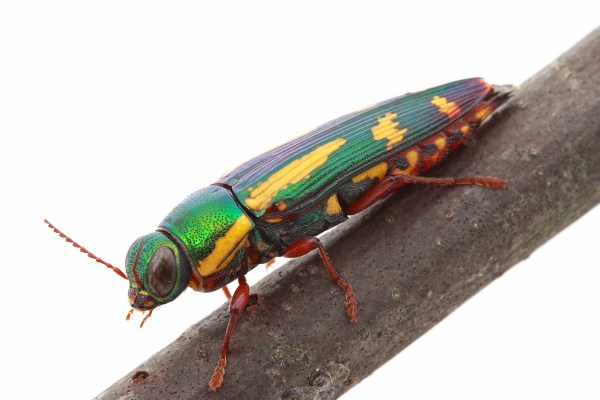
Buprestis rufipes (Coleoptera: Buprestidae) – redbellied Buprestis

From Special Delivery (13 July 2010).  The use of a white box shows off the brilliant (and difficult-to-photograph) metallic colors well, and I like the animated look of the slightly cocked head.


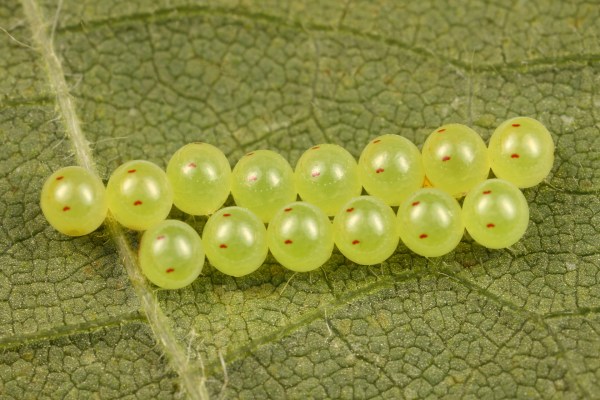
Edessa meditabunda (Hemiptera: Pentatomidae) – alquiche chico

From  (18 May 2011). I found these Edessa meditabunda stink bug eggs on the underside of a soybean leaf in Argentina almost ready to hatch. The developing eye spots in each egg gives the photo a “cute” factor rarely seen in such super close-ups.


Cicindela formosa generosa (Coleoptera: Carabidae: Cicindelinae) – eastern big sand tiger beetle

From  (10 May 2011). I like this slightly panned out view because of the sense of scale and landscape created by the inclusion of the plantlets and the view over the small rise.


Trimerotropis saxatilis (Orthoptera: Acrididae) – lichen grasshopper

From  (15 July 2011). Some of my favorite insect photos are not only those that show the bug in all its glory, but also tell a story about its natural history. This nymph is almost invisible when sitting on the lichens that cover the sandstone exposures in its preferred glade habitat. 


Tetracha floridana (Coleoptera: Carabidae: Cicindelinae) – Florida metallic tiger beetle

From  (23 August 2011). I used extension tubes to improve the quality of flash lighting (decreased lens to subject distance results in greater apparent light size), and I like the symmetry of the composition.


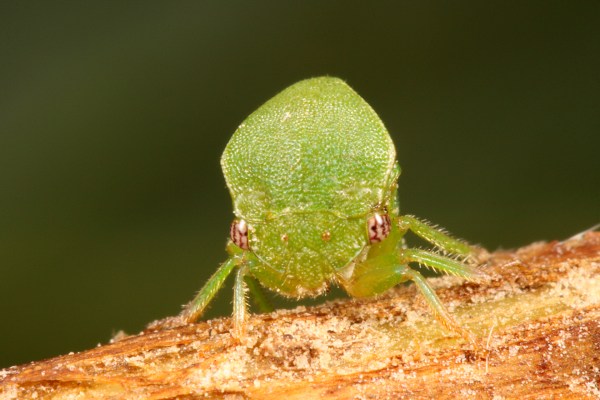
Spissistilus festinus (Hemiptera: Membracidae) – threecornered alfalfa hopper

From  (17 September 2011). Even though both the insect and the background are green, there is sufficient value contrast to create a pleasing composition, punctuated by the bizarre zig-zag pattern of the eyes.


Crossidius coralinus fulgidus (Coleoptera: Cerambycidae) – a rabbitbrush longhorned beetle

From  (4 October 2011). The blue sky background provides a pleasing contrast with the colors of this particular beetle and flowers.

Copyright © Ted C. MacRae 2012
Planet’s Coolest Critters – Tiger Beetles

Cicindela scutellaris rugifrons – photo by Harry Zirlin.

Readers of this blog know well (and hopefully share) my affection for tiger beetles (family Cicindelidae). That should come as no surprise, as tiger beetles rank among the most popular of all beetle groups. The reasons for this are many—for me it is their extreme polytopism (geographically based variation in coloration and markings), affinity for extreme habitats, and charismatic behavior (both adults and larvae), while for others it may be from a more basic research perspective (e.g., thermoregulatory behaviors, molecular phylogeny, and visual physiology) or as models for conservation research. I think most, however, will simply declare that tiger beetles are just… well, cool! That is the perspective of Harry Zirlin, who wrote this charming little article entitled, Planet’s Coolest Critters – Tiger Beetles at PetsLady. After introducing the group and its diversity, lifestyles, and behaviors, Harry notes the increasing popularity of tiger beetles with birders, butterfly watchers and nature photography buffs and the recent proliferation of field guides that have enabled their elevation to the ranks of “watchable wildlife.” Maintaining tiger beetles in terraria allows an even closer look at their beauty and behaviors, and Harry gives some useful tips on how best to accomplish this. It’s a pleasant little read, and I recommend you check it out!

Copyright © Ted C. MacRae 2012

Working with Cerceris fumipennis—Part 2

During the 6-week period from late May to early July this year, I collected ~400 jewel beetle specimens representing at least 20 species (see Working with Cerceris fumipennis—Part 1). A final accounting of the species represented won’t be done until this winter, but the genera represented include Acmaeodera, Actenodes, Agrilus, Anthaxia (Haplanthaxia), Buprestis (Knulliobuprestis), Chrysobothris, Dicerca, Poecilonota, and Spectralia. Perhaps two-thirds of the specimens were “ground-picked”¹, while most of the remaining third were “stolen” directly from wasps by netting wasps in flight as they returned to their nest carrying prey.

¹ It’s not clear to me why I found so many abandoned buprestids at nest entrances. The wasps are known to drop prey when threatened and, rather than search for and relocate the prey, fly off to look for a new beetle(Careless et al. 2009). I observed this myself in several cases when I missed netting the wasp but swiped the net close enough to scare it, at which time it dropped the beetle and flew off (and I popped the beetle in a vial). However, the bulk of the beetles I found on the ground were not only at the nest entrance, but even mixed within the diggings surrounding the nest. My first act when checking each field was to check each nest, pick up any adults lying on top of the burrow diggings, and then carefully spread out the diggings with a knife or trowel to collect the beetles hidden within them. One nest contained as many as 13 Agrlus obsoletoguttatus inside the diggings. I wondered at one point if the wasps were leaving the beetles at the burrow entrance and then digging out the burrow before coming back to retrieve them, but I never actually witnessed this. On the other hand, I observed numerous wasps approaching their burrows while carrying prey, and every time the wasp dropped directly into the burrow. In fact, I could even predict what beetle species I was likely to find inside the nest based on the species I found around the entrance (more on that below).

This ball field with contains several dozen Cerceris fumipennis nests.

There is a third method that I used to collect beetles that I haven’t yet discussed, and that is digging them out of nests. In the latter part of the survey period (late June and early July), beetle numbers dropped rapidly, as did apparent wasp activity. As mentioned in the previous post, this drop off in activity came precisely at the time of season when I have observed buprestid beetle activity to decline in Missouri. As the drop off in activity was taking place, I began wondering what I would find if I tried digging up some of the burrows. Of course, digging up a nest takes much more effort than netting wasps or picking beetles up off of the ground, so it becomes important not only to identify whether a nest actually belongs to C. fumipennis and if it is active and likely to contain freshly captured beetles.  In addition, I observed the burrows of a variety of other insects in these fields as well, some of which are shown here and which might be confused with burrow entrances of C. fumipennis.

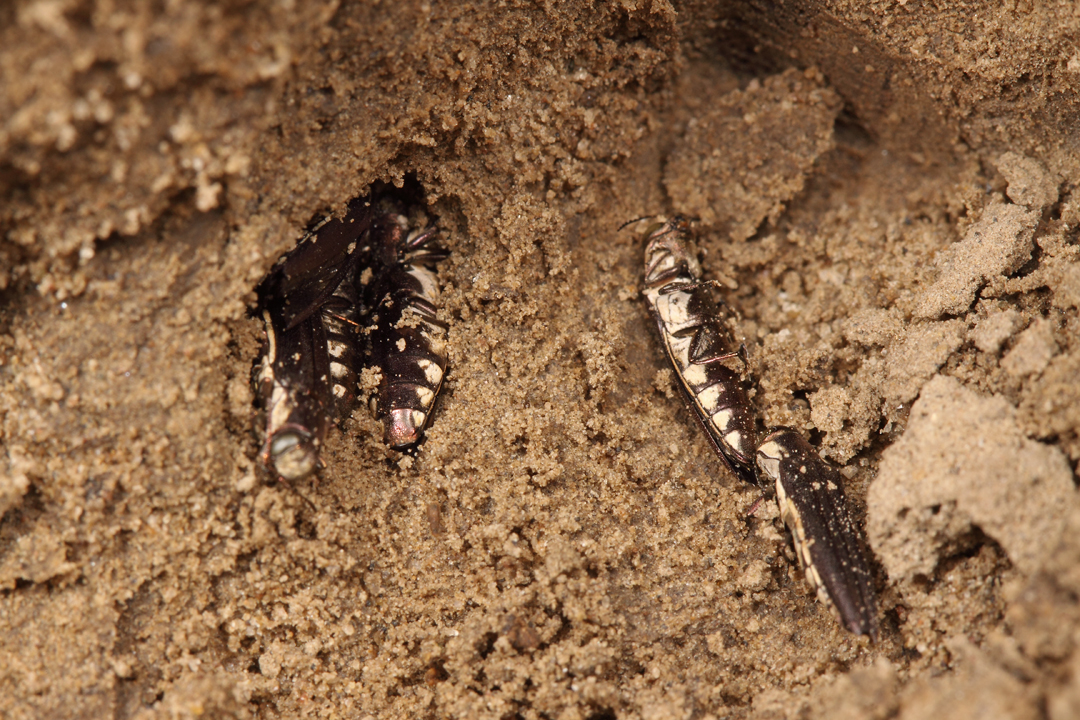
Cerceris fumipennis nest with Chrysobothris sp. adult left on diggings.

Cerceris fumipennis burrows exhibit perfectly circular, pencil-sized entrances surrounded by a symmetrical mound of diggings with a fine rather than granular texture. There are other Cerceris species that make nearly identical burrows, but they prey on other insects rather than buprestid beetles. At my site I found C. bicornis, a weevil specialist, almost as common as C. fumipennis. Their burrow entrances on the whole seemed slightly larger, but I could not use this as consistent distinguishing character. What I could use, however, was the presence of weevils rather than buprestids lying on the ground near the nest entrance. (I also observed this species returning to its nest and noted a rather faster, more powerful flight that made them even more difficult to capture than C. fumipennis). In contrast, there can be no doubt that the burrow above, with a buprestid beetle lying on the ground near the entrance, belongs to C. fumipennis

² The white plastic tag marks the burrow to facilitate locating nests on subsequent visits. It is secured with a golf tee and also can be rotated so that the hole covers the entrance. The hole is large enough to allow the wasp to leave but too small for a returning wasp to enter while carrying a beetle. The idea was to rotate the tags when I first entered a field to cover all the burrow entrances, watch for wasps returning with prey, and then net the wasps as they tried (in vain) to enter the burrow. However, I never actually observed a wasp trying to enter a covered burrow, even after leaving a field and returning 20–30 minutes later.

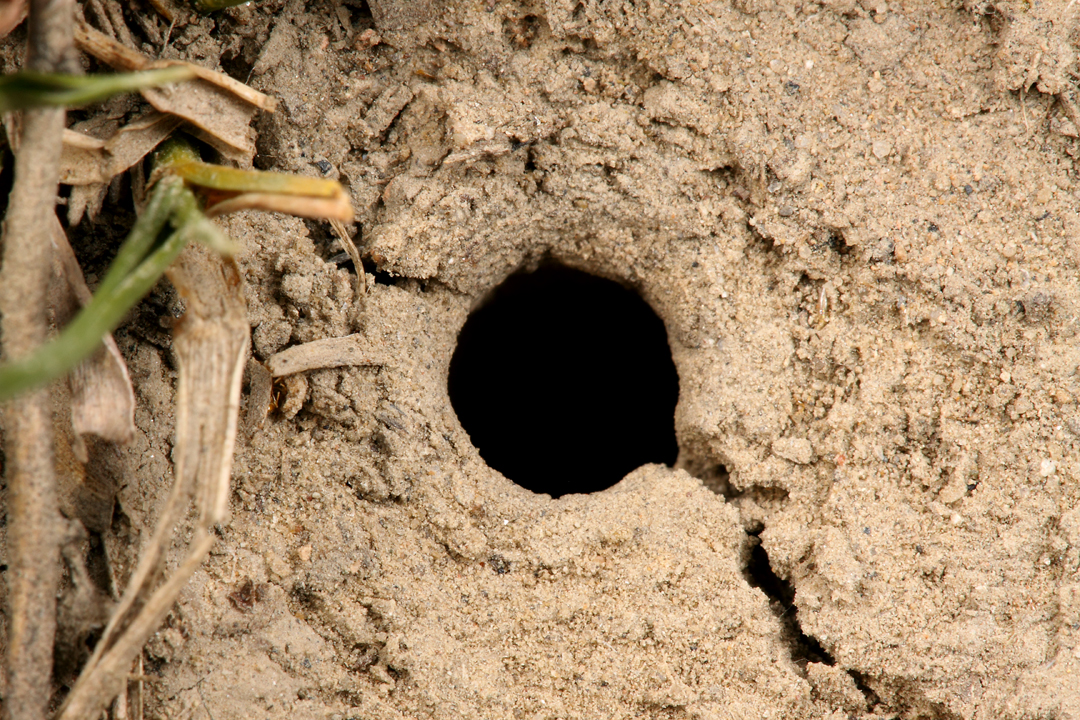
I presume this nest to be that of Bembix americana (sand wasp).

For the first few weeks, I thought the burrows such as that shown in the above photo also belonged to C. fumipennis. However, I never found beetles lying on the ground near the entrance, nor did I ever observe a wasp to enter or leave the burrow. I eventually noticed several distinct differences in burrow architecture—the burrow entered the ground at an angle rather than straight down, the diggings were distributed asymmetrically to one side of the entrance, and the latter seemed consistently a little larger than those of C. fumipennis. In addition, these burrows always seemed to be in the sandier portions of the fields. While I never associated any insect directly with these burrows, I did observe sand wasps (perhaps Bembix americana) in the vicinity and have seen similar-looking burrows dug by these wasps at Sand Prairie Conservation Area.

Larval burrows of Cicindelidia punctulata and other tiger beetles lack diggings around the entrance.

Tiger beetle larval burrows might also be confused with C. fumipennis burrows, especially after rain or high winds which can wash/blow away the diggings from around the entrance. I found adults of the punctured tiger beetle, Cicindelidia punctulata, fairly commonly at the site and presume the numerous tiger beetle larval burrows that were also present belong to that species. Larval tiger beetles burrows also enter the ground straight down and are, at first appearance, also perfectly round, but they are usually a little too small for C. fumipennis (those of Tetracha spp. being an exception)—the presumed C. punctulata burrow in the above photo measures about 5 mm in diameter. In addition, closer examination reveals a slight “D” shape to the burrow entrance (upper right in the above photo—the tiger beetle larva rests its jaws against the flat side) and, more distinctively, beveling of the ground around the rim of the burrow entrance. Cerceris fumipennis nests lack the slight D-shape and distinctive beveling.

Use a grass stem as a guide while carefully digging away the surrounding soil.

Years of practice digging up tiger beetle burrows prepared me well for my first attempts at digging up C. fumipennis burrows. While it might seem an easy task to follow a hole into the ground while digging soil away from it, in practice the burrow can be quickly lost after even a few inches due to falling soil covering the hole and making it impossible to relocate. I use a thin, flexible but sturdy grass stem to preserve the burrow path, inserting the stem into the burrow and down as far as it will go and then removing the soil carefully from around the hole with a knife or trowel. I try to avoid letting soil fall over the hole by prying the soil away from the hole, but if the hole does get covered the grass stem allows it to be easily relocated.

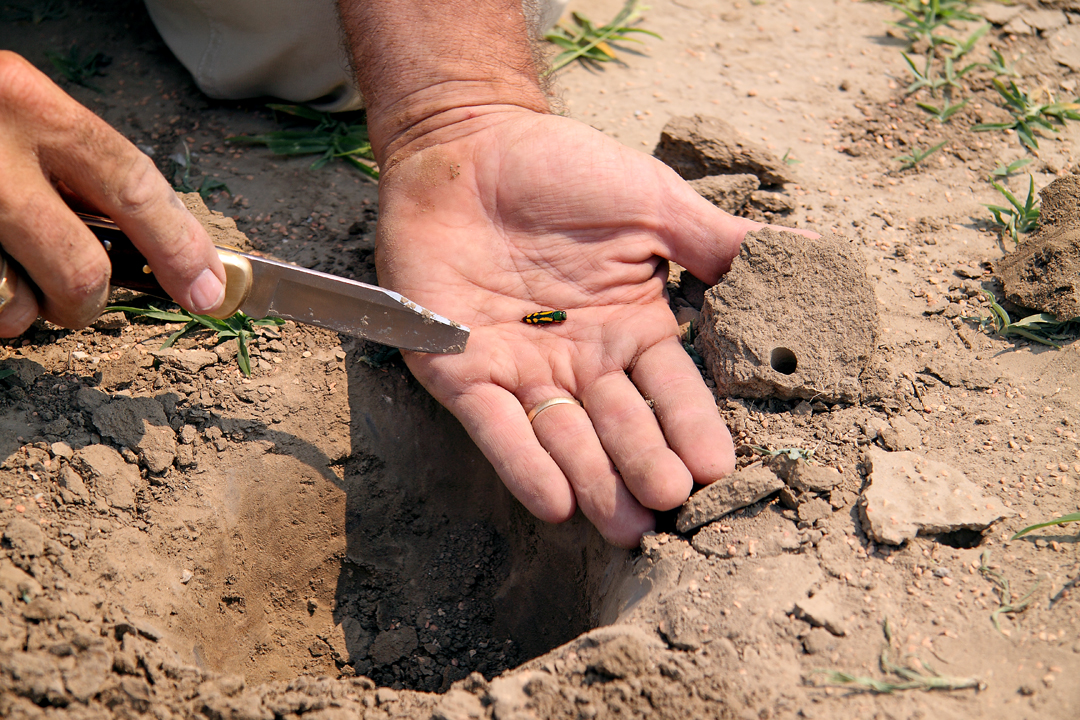
This nest contained a single Buprestis rufipes

Cerceris fumipennis burrows are not very deep—only 10–15 cm, and angle to one side a few cm below the surface before leveling out near the bottom. I noticed the nest in the above photo because I saw a wasp fly into it. When I went over to look at it I found a Buprestis rufipes lying on the ground near the entrance and so decided to dig it up. As I expected, I found another B. rufipes at the bottom of the burrow (two above photos courtesy of Madison MacRae).

…while this one contained a cache of seven Agrilus quadriguttatus.

The above photo shows a cache of seven Agrilus quadriguttatus that I found at the bottom of another burrow. In this case, the prey is rather small compared to large prey such as Buprestis and Dicerca. While nests provisioned with species in these latter genera often contained only a single beetle in them, I nearly always found multiple beetles in nests provisioned with the smaller Agrilus species. One nest contained as many as 13 Agrilus obsoletoguttatus, among the smallest of the species I found utilized by C. fumipennis at this site.

Buprestidae taken from five different Cerceris fumipennis nests.

Some of the nests I dug up contained multiple species of beetles, but far more commonly I found only a single species in a given nest. The photo above shows the diversity and number of beetles found on one date after digging up five different nests. From top left the beetles are: 1) 1 Buprestis rufipes; 2) 2 Agrilus quadriguttatus and 1 A. obsoletoguttatus; 3) 2 A. quadriguttatus and 1 A. obsoletoguttatus; 4) 8 A. obsoletoguttatus; and 5) 2 Poecilonota cyanipes, 2 A. quadriguttatus, and 1 A. pseudofallax. It would make sense for wasps to provision nests with greater numbers of smaller beetles to ensure adequate food for their larvae to complete development. How the wasps actually locate their prey, and why this species has specialized almost exclusively on buprestid beetles, is a mystery (at least to me); however (and here comes the speculation du jour), I suspect the wasps may have keyed in on volatiles used by the beetles—either those released by suitable hosts or by each other to facilitate mate location. Use of buprestid pheromones or freshly dead host volatiles would allow wasps to more efficiently locate buprestid prey and, once locating a source (a tree harboring a particular beetle species), could return repeatedly to provision their nest fully. It seems less likely that wasps rely exclusively on visual location of prey, as this would involve a large amount of random searching through trees and passing up numerous, seemingly equally suitable prey.

REFERENCE:

Careless, P. D., S. A. Marshal, B. D. Gill, E. Appleton, R, Favrin & T. Kimoto. 2009. Cerceris fumipennis—a biosurveillance tool for emerald ash borer. Canadian Food Inspection Agency, 16 pp.

Copyright © Ted C. MacRae 2012

Just published: Cicindela 44(1) March 2012

Issue 44(1) of the journal Cicindela is now hitting mailboxes. This one-paper issue features an article by Chandima D. Dangalle and Nirmalie Pallewatta (University of Colombo, Sri Lanka) and Alfred P. Vogler (The Natural History Museum, London) reporting the results of a survey of tiger beetles of Sri Lanka and analysis of their habitat specificity. The authors sampled 94 locations on the island representing six habitat types: coastal and beach habitat, river and stream banks, reservoir systems, urban man-made sites, agri-ecosystems and marshy areas, finding ten species in the genera Cylindera, Calomera, Hypaetha, Lophyra and Myriochile at 37 locations representing all habitat types except the last two. The study further revealed that the species of tiger beetles were restricted to different habitat types, with most displaying a high degree of habitat specificity. Statistical analysis revealed significant differences between two or more species in four factors: solar radiation (i.e., sun or shade), soil salinity, soil moisture and wind speed. This suggests that these are the key factors involved in habitat selectivity in Sri Lankan tiger beetle species. Other factors such as temperature, relative humidity, soil type and soil color did not differ significantly between habitats for the different species, suggesting that these criteria are essential for tiger beetle survival in any habitat type.

You may also notice that my photo of Cicindela arenicola, taken last fall in Idaho Falls, graces the cover of this latest issue. Contact Managing Editor Ron Huber to begin your subscription—membership is a very nominal $10 per year in the U.S., a little more elsewhere to cover additional postage.

REFERENCE:

Dangalle, C. D., N. Pallewatta & A. P. Vogler. 2012.  Habitat specificity of tiger beetle species (Coleoptera, Cicindelidae) of Sri Lanka. Cicindela 44(1):1–32.

Science Outreach in Action

This evening I had the distinct pleasure of presenting to the Missouri Master Naturalist™ program, a community-based natural resource education and volunteer service program for adults whose mission is to “engage Missourians in the stewardship of our state’s natural resources through science-based education and volunteer community service.”  The purpose of this organization is to develop a corps of well-informed volunteers to provide education, outreach and service to benefit natural resources and natural areas management within the community. Master Naturalists receive training and contribute volunteer service to become a certified Master Naturalist™.

There are several chapters serving different areas of the state—my presentation was made to the Miramiguoa Chapter serving Franklin County in east-central Missouri. My talk was titled, “Tiger Beetles of Missouri,” and, as an “expert” in my chosen field, attendees received advanced training credit in addition to the basic training they receive in more general aspects of Missouri ecosystems. It is tempting to think that attendees were there just to get the credit, but what I found was one of the most engaged and interested audiences to which I’ve had the pleasure to speak in quite a long time. Naturally, it is not difficult for me to show a lot of passion when I get to present on something as dear to my heart as tiger beetles, but as a presenter I feed off audience enthusiasm as well. As a result, the combination of subject and audience engagement made for a fun discussion, and I only hope the audience enjoyed the 90 minute session as much as I did.

I write about this because I see Science Outreach by practicing scientists as critical to advancing appreciation of and participation in science by the general public—not just because I think they will have fun, but because a science-friendly community tends to make community and policy decisions favorable to and based on science. You might call it my brand of politics! I’ve been heavily involved in science outreach for many years now, talking to everyone from pre-schoolers to secondary school science classes to natural history organizations. The specifics of my message are tailored to the audience, but the underlying principle is the same—to help the audience gain appreciation of entomology in particular and science in general. I think I will chalk up tonight’s presentation as another win!

For those interested, here is a link to a PDF version of the presentation, which provides the best ‘snapshot’ look at the tiger beetle fauna of Missouri available so far:

Miramiguoa – May 2012 – TB of Missouri

Copyright © Ted C. MacRae 2012

My response to “Can you talk to 10-year-olds about science?”

The Bug Geek is becoming the champion of challenges! Last week she illustrated in clever graphical form the emotions she had encountered during the manuscript writing process, and this week she tops it with a challenge to see how well we can talk to 10-year-olds about science. I played along with the first one just for fun (see The Ups and Downs of Bug Collecting—I also earned the tag “easily-entertained professional research entomologist with too much time on his hands” for my efforts!), but the second challenge hit closer to home. You see, like the Geek I believe strongly that the responsibility for recruiting the next generation of scientists rests squarely on the shoulders of today’s scientists. Who else but us will excite them about science and show them not only the importance that science plays in our daily lives, but how cool and fun it is!

I’ve been a professional entomologist for three decades now, and for most of that time I’ve also been involved in giving presentations to children about insects and the science of entomology. I also happen to be an avocational entomologist—insects are not just my livelihood, but also my hobby! I live, breath, and eat insects (okay, maybe not so much the latter), and wherever I have lived my name has quickly made it to the local schools as someone who can keep the kids occupied for an hour or two. I have done dozens, perhaps even hundreds of “kid outreach” sessions during the past 30 years—how could I not take up the Geeks’s challenge?! The only question was which “entomologist” I should take the challenge as—the professional one who conducts insect research on biotech crops, or the avocational one who travels the country and beyond looking for new and rare beetles. Ultimately I decided to try both (you knew that was coming!), so here I present my 250-word (precisely) attempts to convince a 10-year-old in written form that science, and specifically entomology, is fun, cool, and incredibly important for the future of our planet.

Professional

I work for a company that helps farmers grow crops that don’t need to be sprayed with insecticides. These “insect-protected crops” are grown by farmers all across the world and help the environment by reducing the need for insecticides to grow our food. We create these plants by adding a small piece of DNA in the laboratory so that the plants produce a protein inside their leaves that only insects don’t like. Not all of the plants produce the protein, so we have to test the plants to make sure insects can’t feed on them. I do this by growing plants in the greenhouse, and when they are big enough I put insects that we grow in our laboratory on the plants to see if they can eat the leaves. If the plants don’t get eaten, I collect the seeds and grow them outside like a farmer would do. If the plants don’t get eaten by insects outside either, then other people in my company test the plants to make sure they grow normally and produce as much food as plants without the protein. Insects might become immune to the proteins, so I also test new proteins to find new ones we can use in case the old ones stop working. I mix the protein with a special insect diet to see how much protein is needed to make the insect stop eating. I love my job because I get to study bugs while helping to improve the environment.

Avocational

I have the best hobby in the world—I travel across the US and other countries looking for beetles! There are more kinds of beetles in the world than any other kind of animal, and most of them are unknown to science. When I find a new beetle, I get to give it whatever name I want. Even many of the ones that we know about we don’t know where they live or what they eat. The heaviest insect in the world is a beetle (the Goliath Beetle from Africa) – it weighs more than a mouse! Some of the tiniest insects of all are beetles also – it would take a quarter million feather-winged beetles to weigh as much as one Goliath Beetle! There are beetles in the Amazon rain forest that play “King of the Log.” Males find a rotten log and sit on it, and when another male comes along he knocks him off with his horns. He does this to save the log for a female beetle so she can lay her eggs in it. The baby beetles eat the rotten wood. I especially like tiger beetles – they have stripes and bright, metallic colors that glitter in the sun. They use their long legs, big eyes, and huge sickle-shaped jaws to run down and catch other insects and eat them. Many kinds of tiger beetles can live in only one place on earth – we must do everything we can to protect their habitats so they don’t go extinct.

Copyright © Ted C. MacRae 2012

Tiger beetles in southeast Missouri

Figure 1. Sites surveyed in southeastern Missouri for Cylindera cursitans during 2007–2010. Site numbers are referenced in Table 1 (CRP = Cape Rock Park), with red stars indicating sites where C. cursitans was observed. Black box on inset map of Missouri denotes main map area (bordering states include AR to the south and TN, KY, and IL to the east).

ResearchBlogging.orgVolume 43(3) of the journal CICINDELA was published a few weeks ago, and I can truly lay more claim to the issue than anybody else (except perhaps Managing Editor Ron Huber). In addition to having one of my photos (a face-on shot of Tetracha carolina) featured on the cover, I was coauthor on the first of two papers included in the issue and lead author on the second. (And to complete my stamp of ownership, I did the final assembly of the issue as the journal’s Layout Editor.) The two included papers each report the results of surveys conducted in the Mississippi Alluvial Plain of southeastern Missouri (also called the “bootheel” in reference to its shape—see Fig. 1) for tiger beetles whose occurrence in that part of the state was previously not well known. In the first, Fothergill et al. (2011) used a novel survey technique that involved searching beneath irrigation polypipe in agricultural fields to find Tetracha carolina (Carolina Metallic Tiger Beetle); while the second paper (MacRae et al. 2011) reports the results of a multi-year survey to characterize the distribution, habitat associations and conservation status of Cylindera cursitans (Ant-like Tiger Beetle). Together with our three papers on Habroscelimorpha circumpicta johnsonii (Saline Spring Tiger Beetle), Dromochorus pruinina (Loamy Ground Tiger Beetle) and Cylindera celeripes (Swift Tiger Beetle)—all published in the past year—these two papers officially complete the battery of publications that describe our survey efforts for the five tiger beetle species considered of potential conservation concern in Missouri when Chris Brown and I began our faunal studies of the group more than ten years ago.

The first three papers clearly painted a rather gloomy picture—H. circumpicta johnsonii is possibly extirpated from saline spring habitats in central Missouri, D. pruinina is limited to a 2.5 mile stretch of roadside habitat in western Missouri, and C. celeripes is restricted to a few patches of critically imperiled loess hill prairie habitat in extreme northwestern Missouri. Happily, prospects for T. carolina and C. cursitans in Missouri are much better. While both are limited in the state to the southeastern lowlands, our surveys indicated that populations are sufficiently robust and widespread in the area to alleviate any concerns about the potential for extirpation. Tetracha carolina in particular was found abundantly in agricultural habitats and appears to have adapted well to the extensive modifications caused by conversion of the cypress-tupelo swamps that formerly covered the region. Cylindera cursitans (Fig. 2) hasn’t shown nearly the same adaptive capability as T. carolina; however, it has nevertheless found suitable refuge in the ribbons of wet, bottomland forest that persist between the Mississippi River and the levee systems that protect the region’s farmland. For a time it seemed that the same habitats along the St. Francois River that bound the western side of the region weren’t suitable for the species, but after much searching (in often tough conditions!) Kent finally managed to locate a population on the Missouri side of the river opposite a known population in Arkansas.

Figure 2. Cylindera cursitans in southeast Missouri: a) New Madrid Co., Girvin Memorial Conservation Area, 6.vii.2007; b-c) Mississippi Co., Dorena Ferry Landing, 6.vii.2008; d) Mississippi Co., Hwy 60 at Mississippi River bridge, 20.vi.2009. Photos by CRB (a) and TCM (b-d).

Both of these species illustrate how healthy populations of insects are able to hide right beneath our noses. Previous to our surveys, records of T. carolina and C. cursitans in southeastern Missouri were scarce (the latter consisting of a single specimen in the Enns Entomology Museum at the University of Missouri in Columbia, and with considerable searching required before the first field population was finally located). In both cases, perceived rarity was a result not of actual rarity, but rather specific habitat requirement or unusual behavior. While I get great satisfaction out of finding populations of “rare” species and increasing our understanding of their habitat requirements, I also can’t help but wonder if they truly are rare and how many populations I might still have missed—populations that I would have found had I searched in a slightly different manner or at a slightly different time.

REFERENCES:

Fothergill, K., C. B. Cross, K. V. Tindall, T. C. MacRae and C. R. Brown. 2011. Tetracha carolina L. (Coleoptera: Cicindelidae) associated with polypipe irrigation systems in southeastern Missouri agricultural lands. CICINDELA 43(3):45–58.

MacRae, T. C., C. R. Brown and K. Fothergill. 2011. Distribution, seasonal occurrence and conservation status of Cylindera (s. str.) cursitans (LeConte) (Coleoptera: Cicindelidae) in Missouri. CICINDELA 43(3):59-74

Copyright © Ted C. MacRae 2012