Friday Flower – Ozark Witch Hazel

Spring is beginning its “march” across the nation, and in typical fashion the month started out with the promise of pleasant weather but is throwing a few tantrums before giving way to April. For most folks in the lower Midwest, spring began a week or so ago when daffodils began popping up from nowhere and dotting the suburban and semirural landscapes with their yellow smiles. Forsythia are also set to burst forth, their appearance temporarily put on hold by this latest cold/wet snap, but when they do most people here will be satisfied that spring has finally come. For me, spring comes much earlier, and it’s not planted ornamentals that mark its beginning, but native trees.  Silver maples (Acer saccharinum) and American elms (Ulmus americana) are first, bursting open in the very first warm days of early March.  These are followed by the sugar maples (A. saccharum) and red maples (A. rubrum) that are in full bloom now, which will themselves give way to the redbuds (Cercis canadensis) and serviceberrys (Amelanchier arborea) that will close out the month before flowering dogwood (Cornus florida) dominates the area’s understories in April.

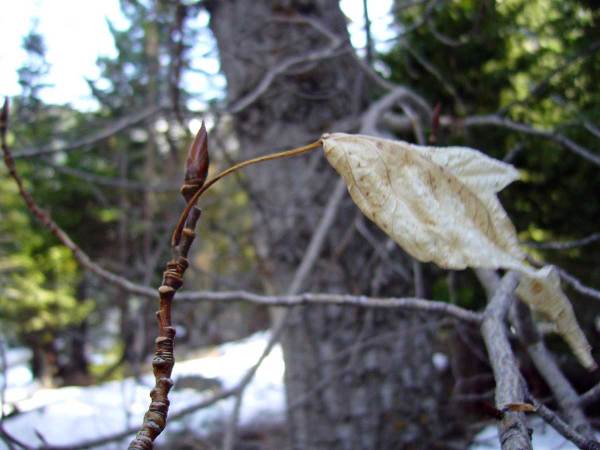
There is one tree in this part of the country, however, that shows its amazing blooms in January and February while winter’s grip is still strong.  Ozark witch hazel (Hamamelis vernalis) is restricted to the Ozark Highlands of Missouri and Arkansas, where it grows along the rocky creeks and streams that dissect this ancient landscape.  I have long wanted to see its striking blooms, but despite my many wintertime hikes throughout the Ozarks, I have never found myself in the right place at the right time – until a few weeks ago when I hiked the Mina Sauk Trail at Taum Sauk Mountain State Park.  I found these plants growing below Mina Sauk Falls and along Taum Sauk Creek below, and even though it was the first weekend of March (and the very first warm day of the season), many of the plants had already passed their peak bloom.  Fortunately, I was able to find these several plants with flowers still in good shape.

There is only one other species in the genus – eastern witch hazel (Hamamelis virginiana).  Although distributed widely across eastern North America, it is restricted in Missouri to these same St. Francois Mountains where I saw H. vernalis.  The two species are very similar by the characteristics of their foliage but can be easily distinguished by floral characters.  Hamamelis virginiana blooms in fall rather than winter, and its flowers, while nearly twice the size, rarely show the amount of red on the inner calyx that is seen in this species.  Hamamelis vernalis flowers are also quite fragrant, having what has been described as a “vanilla” scent.  The photographs here show the rather unusual color range of the flowers of this species, which can vary from orange to deep red to deep yellow.  I suspect that flower color also changes with age, in that petals are initially deep red and later fade to yellow, as in the photo below.  It’s difficult to explain why H . vernalis is restricted to the Ozark Highlands while H. virginiana occurs so broadly, but the Ozarks are a well-known refugium for a number of other plants and animals, especially Ice Age relicts.

Sitting on a rhyolite ledge overlooking Taum Sauk Creek as I ate lunch, I wondered about the pollination biology of a plant that flowers during winter.  It was a warm day – certainly an unusual occurrence during the period in which this plant flowers – and even still it was too early in the season for a lot of insect activity.  I watched one of the nearby plants as I ate to see what insects came to the flowers, and for a time all I saw were a couple of European honey bees.  Clearly, the plant did not evolve in association with this now ubiquitous insect.  I continued watching, and at last I saw a native insect visiting the flowers – a large species of hover fly (family Syrphidae), perhaps something in the genus Helophilus.  After taking a few more photographs (unfortunately, none of the fly), another of the same species visited the plant.  Flies in general are famous for appearing during warm days in winter, and I wonder if the unusually extended bloom period of this species is intended to take advantage of those few, unpredictable days during winter when temperatures are sufficient for flies to become active.

Photo Details: Canon 100mm macro lens on Canon EOS 50D
Photo 1: ISO 100, 1/200 sec, f/11, MT-24EX flash w/ Sto-Fen-Puffer diffusers.
Photo 2: ISO 200, 1/200 sec, f/5.6, ambient light.
Photo 3: ISO 100, 1/60 sec, f/9, flash w/o diffusers.
Photo 4: ISO 200, 1/250 sec, f/5.6, ambient light.

Copyright © Ted C. MacRae 2010

Add to FacebookAdd to DiggAdd to Del.icio.usAdd to StumbleuponAdd to RedditAdd to BlinklistAdd to TwitterAdd to TechnoratiAdd to Yahoo BuzzAdd to Newsvine

Email to a friend

Lake Tahoe – 2010 Preview

How does an entomologist/wannabe botanist-ecologist-geologist-cyclist-nature photographer spend his time on a family vacation?

  • Thursday evening to Saturday late afternoon:
    – Drive from St. Louis to Lake Tahoe.  In between driving shifts:
    – Complete manuscript on Cylindera cursitans surveys
    – Complete manuscript on Dromochorus pruinina surveys.
    – Arrive late afternoon, quick 1-hr bike ride before dark.
  • Sunday:
    – Cross-country skiing with the family: Spooner Lake (~6 miles).
    – Sight-seeing: Sand Harbor Overlook on the east shore.
    – Hang out at the hot tub with the family and a glass of wine.
  • Monday:
    – Drive to Sacramento with the family.
    – Visit buprestid-colleagues Chuck Bellamy (CDFA) and Mark Volkovitsh (Russian Academy of Science).
    – Private lesson from Mark on how to dissect buprestid larvae for taxonomic description.
    – Dinner with my favorite brothers-in-law.
    – Drive back to Lake Tahoe.
  • Tuesday:
    – Snowshoe hike with the family: Emerald Bay to Eagle Lake and back (2 miles, 1,900′ of climbing).
    – Bike ride: South Lake Tahoe to Bliss State Park and back (33 miles, 1,100′ of climbing).
  • Wednesday:
    – Bike ride: all the way around Lake Tahoe (72 miles, 3,500′ of climbing).
    – Hang out at the hot tub with the family and a glass of wine.
  • Thursday:
    – Botanizing and hiking with daughter Madison at Mt. Rose (4 miles, 1,300′ feet of climbing).
    – Hang out at the hot tub with the family and a glass of wine.
  • Friday:
    – Alpine skiing with the family at Heavenly Ski Resort.
    – Join a 2-hour ski tour with US Forest Service rangers discussing natural and cultural history of Lake Tahoe.
    – Hang out at the hot tub with the family and a glass of wine.
  • Saturday morning to Sunday night:
    – Drive from Lake Tahoe back to St. Louis.  In between driving shifts:
    – Process/file photographs from trip (~250).
    – Complete reports for 2009 collecting permits.
    – Complete new applications for 2010 permits.
    – Begin manuscript on Cylindera celeripes conservation status.
  • Monday:
    – Return to work mentally refreshed!

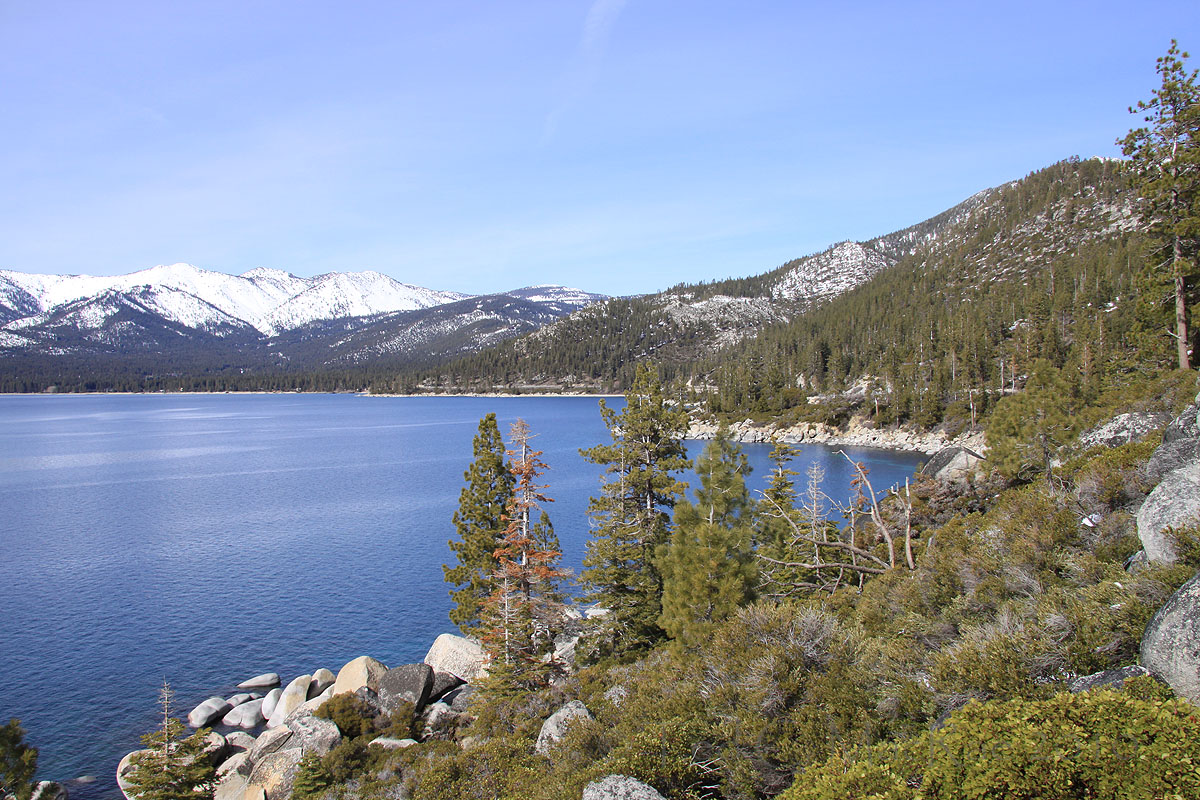
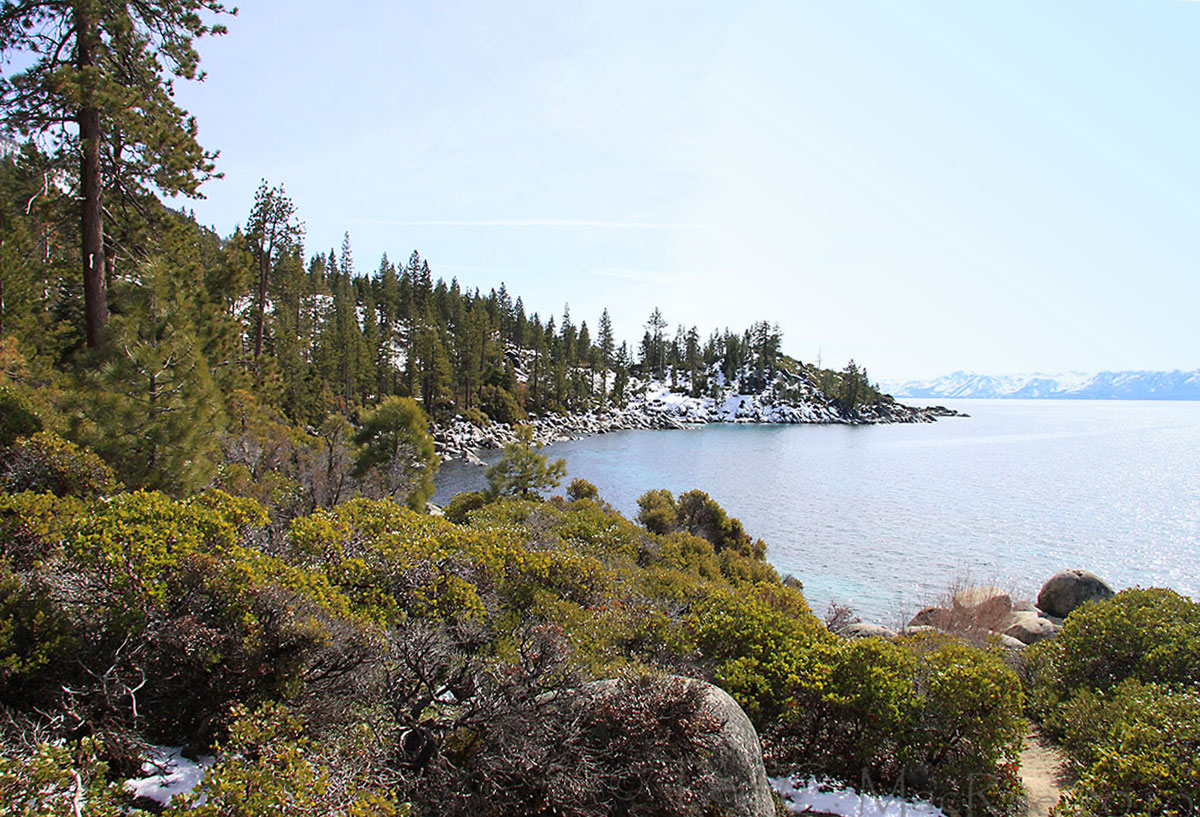
I’ve already shared a bit of the trip with a view of Mt. Rose from 7,000′ and ensuing pismire quagmire.  Today I share some views of one of the most scenic of lakeside spots on the east shore – Sand Harbor Overlook.  I featured this spot in this post from last year’s trip due to its stunning beauty, and this year I was no less impressed.  I still had that same, annoying, afternoon sun to deal with (next year I’ve resolved to get here during the morning) but managed to get some passable photographs.  The one above is my favorite, and I hope you enjoy the following as well. (p.s. if someone knows how to fix a sun-blown sky in Photoshop Elements, please let me know).

Copyright © Ted C. MacRae 2010

Add to FacebookAdd to DiggAdd to Del.icio.usAdd to StumbleuponAdd to RedditAdd to BlinklistAdd to TwitterAdd to TechnoratiAdd to Yahoo BuzzAdd to Newsvine

Email to a friend

North America’s most beautiful longhorned beetle

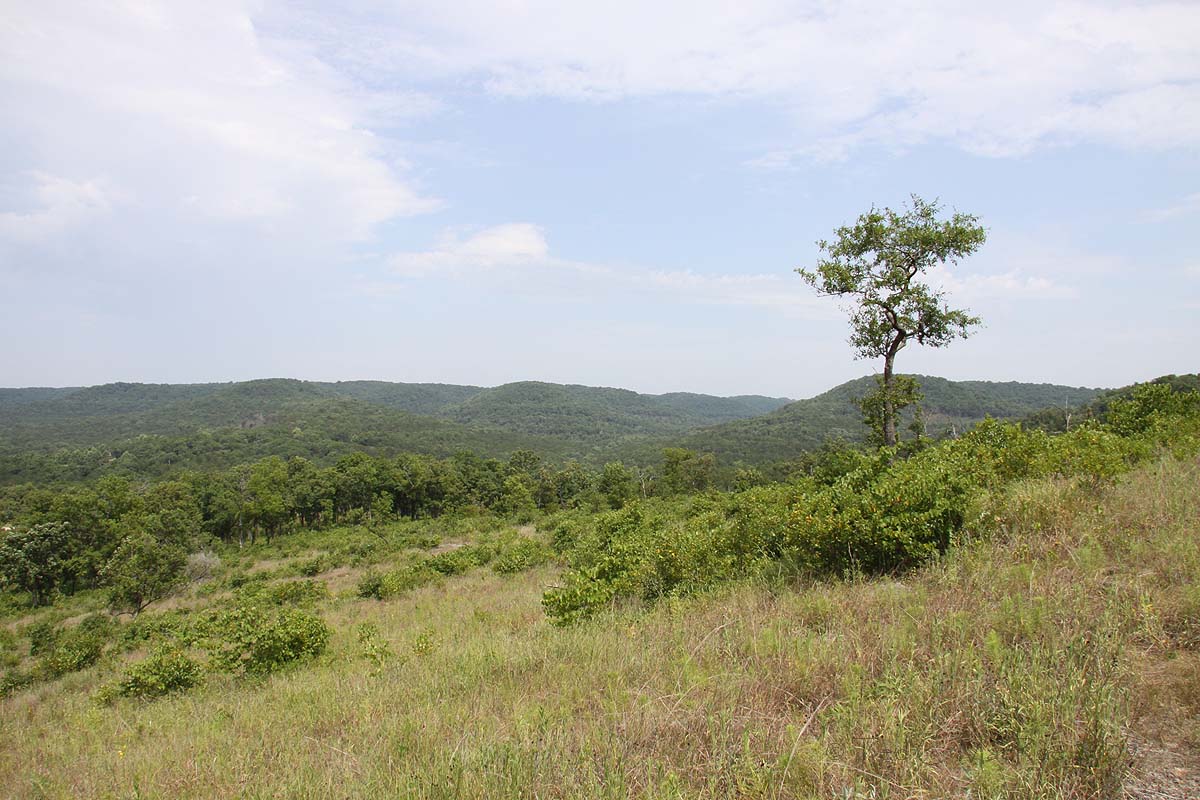
I’ve written a few posts in recent weeks highlighting some of the more interesting finds encountered during two visits this past July to the White River Hills region of extreme southwestern Missouri. It’s a land of extremes, with deeply dissected layers of limestone/dolomite bedrock supporting xeric glades, dry woodlands and riparian watercourses. The hilltop glades (“balds”), in particular, feature prominently in the region’s natural and cultural history and are the most extensive system of such habitat in Missouri. They support a number of plants and animals more characteristic of the grasslands of the south-central U.S., such as the recently featured Megaphasma denticrus and Microstylus morosum, North America’s longest insect and largest robber fly, respectively. Sadly, the glades in this region are much reduced in size and quality compared to their pre-settlement occurrence, primarily due to overgrazing and suppression of fire. These anthropogenic forces have combined to reduce overall vegetational diversity and accelerate encroachment by woody species (chiefly eastern red-cedar, Juniperus virginiana). Nevertheless, there still remain several high quality glade remnants in the area, and the public agencies charged with their conservation are increasingly utilizing mechanical removal of woody growth, controlled burns, and managed grazing in an effort to simulate the natural forces that mediated this landscape for thousands of years.

IMG_0871_1200x800

Chute Ridge Glade, Roaring River State Park, Barry Co., Missouri

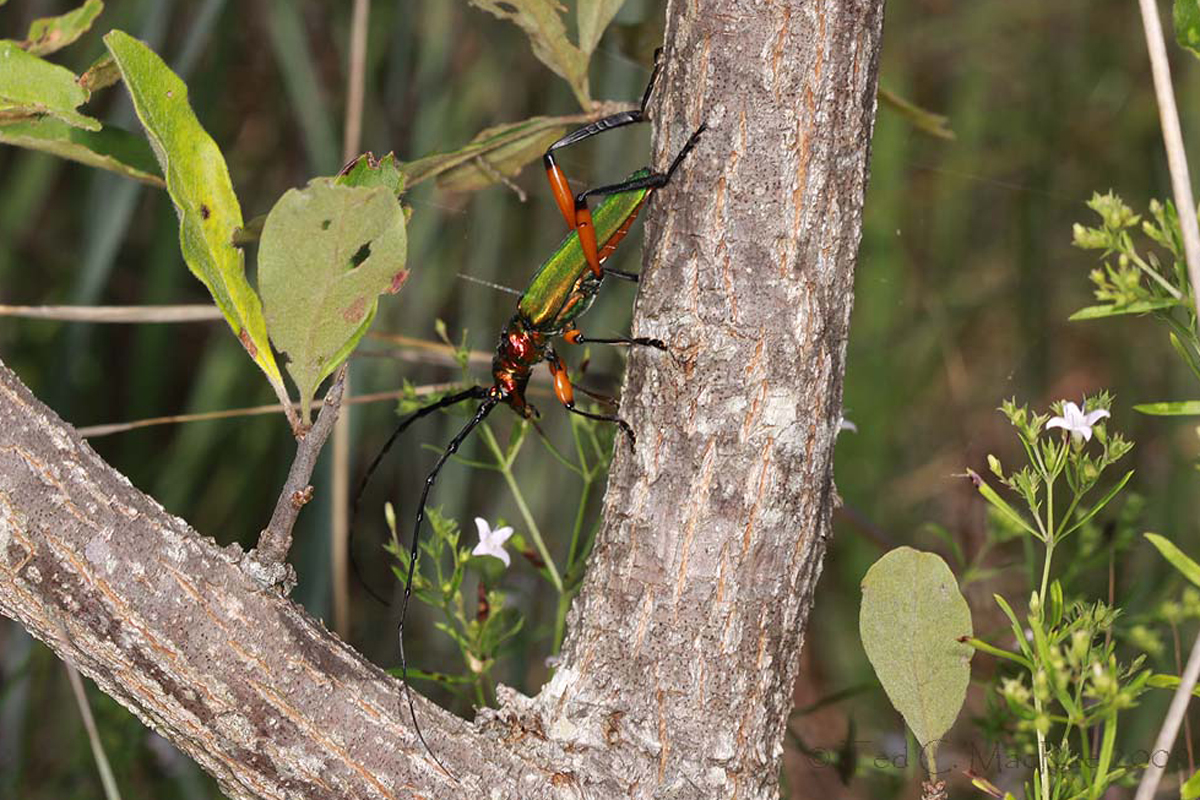
My reason for returning to the White River Hills this year was simple—find and photograph the magnificent longhorned beetle, Plinthocoelium suaveolens (family Cerambycidae). This species, occurring across the southern U.S. from Florida and Georgia west to New Mexico and Arizona, is truly one of North America’s most beautiful longhorned beetles due to its large size, brilliant iridescent green coloration, and super-elongate wildly-contrasting orange and black legs.  Until recently, this species was known in Missouri only from sporadic records across the southern part of the state (MacRae 1994). I knew of its association with gum bumelia (Sideroxylon lanuginosum [= Bumelia lanuginosa], also called gum bully and woolly buckthorn), which was first noted by Missouri’s first State Entomologist, C. V. Riley (1880) and later discussed in detail by Linsley and Hurd (1959) and Turnbow and Hovore (1979); however, my repeated searches over the years whenever I encoutered this plant came up empty.  A few years ago, Chris Brown and I were conducting a survey of tiger beetles in the White River Hills and noted the relatively common occurrence of bumelia on these glades.  Bumelia, like P. suaveolens, is one of only a few North American representatives of a largely tropical group, and it is one of the few woody species naturally adapted to the xeric conditions found on these glades.  Recalling the association of P. suaveolens with this plant, and also recalling that adults could be attracted to fermenting baits of the type described by Champlain and Knull (1932), we placed fermenting bait traps on several glades in the area and succeeded in trapping a number of individuals during the month of July.  When I began searching the bumelia trees at these glades, I found adults perching on the lower trunks of several trees. It was the first time I’d seen live individuals of this species in Missouri.  At the time I was not a photographer, and that experience became one of the many moments that I would later look back upon and think, “If only I’d taken a picture of that!”  Thus, at the end of June this year, having successfully found Cylindera celeripes in Missouri on the first day of a planned 3-week search, my attention immediately turned to the new goal of finding P. suaveolens and photographing it on its host plant.

IMG_0929_1200x800

Sideroxylon lanuginosum (gum bumelia) at Blackjack Knob, Taney Co., Missouri

I knew this wouldn’t be easy—the beetles were not abundant when I had last observed them, and those that I did find were quite wary to my approach.  Getting within striking distance with a net was one thing; doing so with a camera and macro lens would be another thing entirely.  In my first trip to the area (early July), I went to Chute Ridge Glade, a magnificently restored glade in Roaring River State Park where I had seen the greatest number of individuals before.  I was full of optimism on that first day as I zigzagged across the rough terrain from one bumelia tree to the next, but my optimism began to wane as I cautiously approached each tree and saw nothing.  Within an hour, I’d looked at every bumelia tree I could find on the glade and not even seen a beetle, much less attempted a photograph.  It would take a 2-hour drive along twisting back roads to reach the other sizeable glade complex where I had seen beetles before (Blackjack Knob in Taney County), and another hour of searching on several dozen trees would again yield nothing.  By now I was feeling rather frustrated—the day’s oppressive heat and humidity had taken its toll, and my 4.5-hour drive from St. Louis was looling like it would be for naught.  I had noted that the bumelia flowers were almost but not quite open yet—perhaps it was too early in the season still?  

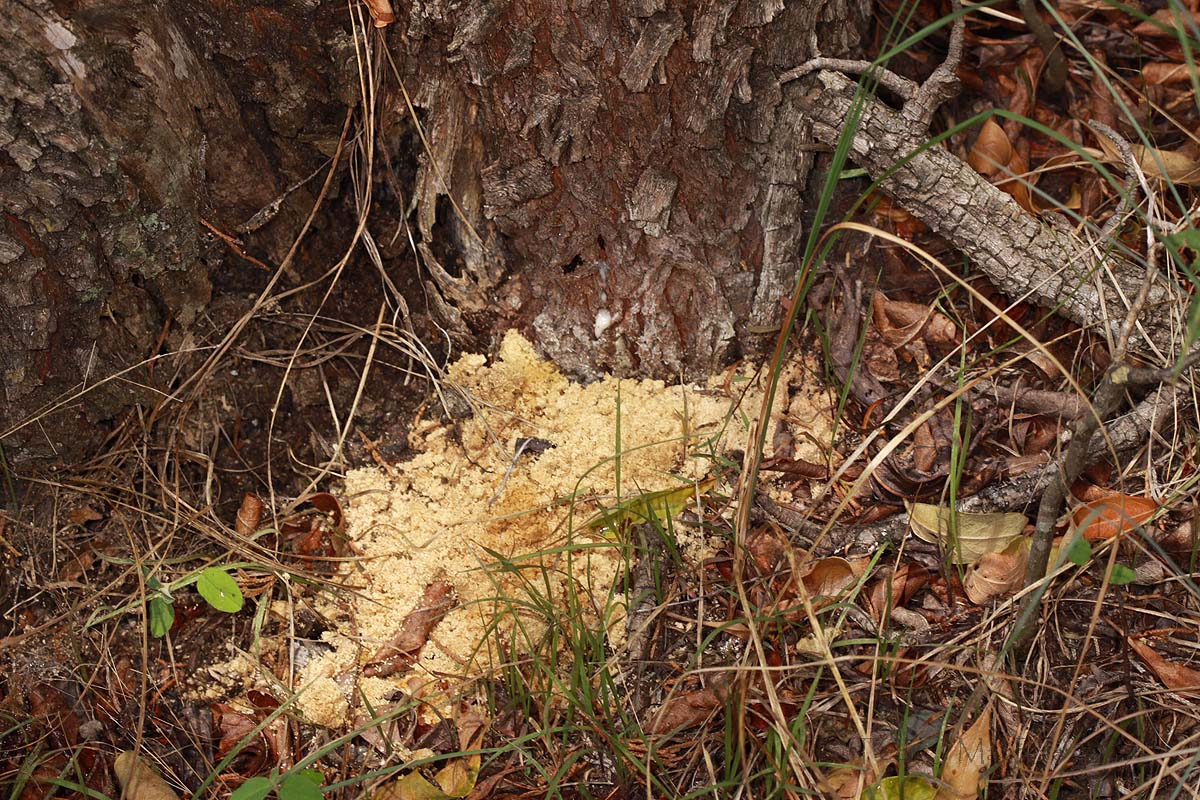
Plinthocoelium suaveolens larval frass pile at the base of living Sideroxylon lanuginosa

Plinthocoelium suaveolens larval frass pile at trunk base of living Sideroxylon lanuginosum

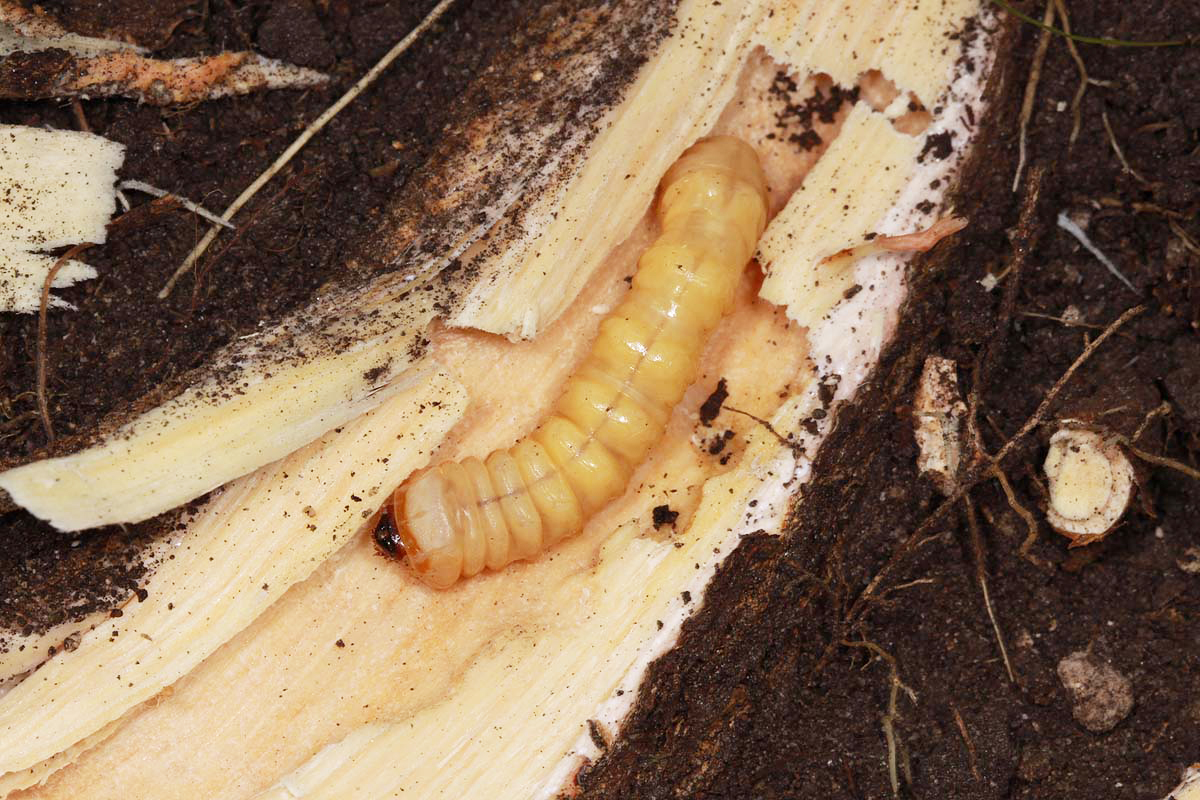
The remnant glades at Blackjack Knob are more extensive than those at Chute Ridge, so many more trees still awaited examination—if I could only muster the energy!  I trudged back to the truck, guzzled a nice, cold Powerade, and started off in another direction.  I looked at a number of trees and still had seen no sign of the beetle, but on one particular tree I noticed an enormous pile of sawdust on the ground at the base of the tree.  I looked at it more closely and saw that it had the rough, granular texture so characteristic of longhorned beetle larvae that like to keep their galleries clean, and its bright, moist  color suggested that it was being ejected by a larva tunneling through living wood.  I looked up into the tree above the pile to find where it was coming from but could find no ejection hole.  I checked the base of the trunk itself and still couldn’t find anything.  Then I started poking into the pile and felt a root.  Further poking revealed a soft spot on the root, and I immediately knew that I had found a P. suaveolens larval gallery—no other cerambycid species is known to bore in roots of living Sideroxylon, especially one as large as this based on the size of the frass pile.  I hurried back to the truck and grabbed my hatchet, returned to the tree, and scraped away the soil above the root to find an obvious ejection hole a few inches away from the base of the trunk.  I started chipped into the root at the ejection hole and found a large, clean gallery extending down the center of the root away from the trunk.  About 18” away from the trunk I found it—a large, creamy-white cerambycid larva.

Plinthocoelium suavelones larva in root of living Sideroxylon lanuginosa

Plinthocoelium suaveolens larva in root of living Sideroxylon lanuginosum

Plinthocoelium suavelones larva in root of living Sideroxylon lanuginosa

Plinthocoelium suaveolens larva in root of living Sideroxylon lanuginosum

Finding a P. suaveolens larva was gratifying, but it wasn’t what I had come here to do, which was photograph the adult. After placing the larva live in a vial for preservation later on (dropping into scalding water to “fix” the proteins and prevent discoloration when stored in 70% ethanol), I continued searching the trees for adults.  I found one tree on which the flowers were just barely beginning to open and collected a few of the pedestrian species of scarabs that are attracted to bumelia flowers in droves when fully open (e.g. Cotinis nitidus and Trigonopeltastes delta)—for the record.  There was still no sign of adult Plinthocoelium, and I was on the verge of calling it a day when I approached another tree and saw it!  I froze, then slowly geared up with the camera and started stalking slowly towards it.  It was not in a very convenient location, down low on the trunk and partially screened by foreground vegetation.  I got close enough to start attempting some shots—not ideally composed, but just to ensure that I had something before I tried to get any closer.  After the third shot, however, it became alarmed and started to flee, and I had no choice but to capture it for a “studio backup.”  That taste of success gave me the motivation to resume my search, but no additional beetles were seen before a dropping sun put an end to the day.

Plinthocoelium suaveolens on lower trunk of living Sideroxylon lanuginosum

Plinthocoelium suaveolens on lower trunk of living Sideroxylon lanuginosum

Not entirely satisfied with the shots that I’d gotten, I returned to Blackjack Knob the following day and also searched some of the extensive habitat at nearby Hercules Glades Wilderness.  I wouldn’t see another beetle the entire day, although encountering a nice series of Cicindela rufiventris (red-bellied tiger beetle) was some consolation for suffering the day’s oppressive heat and humidity.  I still had the live beetle, so I placed my hopes on getting better photographs of the beetle in confinement after returning home.  That would not come to pass—the beetle refused to sit obligingly on the stick I placed in the large screen cage, and instead clung to the cage itself.  For days I watched it, giving it honey-water for sustenance and waiting for an opportunity to photograph it on the stick on which it refused to sit.  It became clear to me that studio photographs, at least in the manner I was attempting, would not be possible.  Not entirely satisfied with having seen only a single beetle on my trip, and thinking that I may have been too early based on the flowering phenology of the bumelia host trees, I did what any dedicated entomologist would do—I made a second trip to the area two weeks later!

I didn’t mess with Chute Ridge Glade this time, instead making a beeline for Blackjack Knob right away.  Unfortunately, the weather was uncooperatively drizzley (I would have preferred hot and humid to rain!).  Nevertheless, daughter Madison and I made our way to the glades and began inspecting the trees that I had just examined two weeks earlier.  I noted immediately that the bumelias were now in full flower, and it wasn’t long before I saw the first adult flying into these flowers.  Exciting for sure, and this was a good sign to see an active adult despite the drizzly weather, but the situation of the beetle on a high branch left no possibility for photographs (and only with a rather acrobatic swing of my fully extended net handle amidst a jumble of dead branches was I able to capture it).  This same scenario would replay several times over the next two hours before rain finally drove us back to the car.  In total, we saw half a dozen active adults, but in each case they were seen flying to flowers on high branches and could not be photographed.  Despite that disappointment, I’ll never forget the spectacularity of seeing these beetles in flight—shimmering green and bold orange, with legs and antennae spread wide in all directions.  I was also fortunate to find another tree with a fresh frass pile at its base indicating an active larva.  This time, I cut the tree some inches above the ground and extracted the trunk base and root intact for transplanting into a large soil box upon my return home.  The appearance of new frass on the soil surface afterwards confirmed that I had gotten the root containing the larva and that it had survived the extraction and transplanting.  Hopefully I will be able to successfully rear this individual to adulthood.

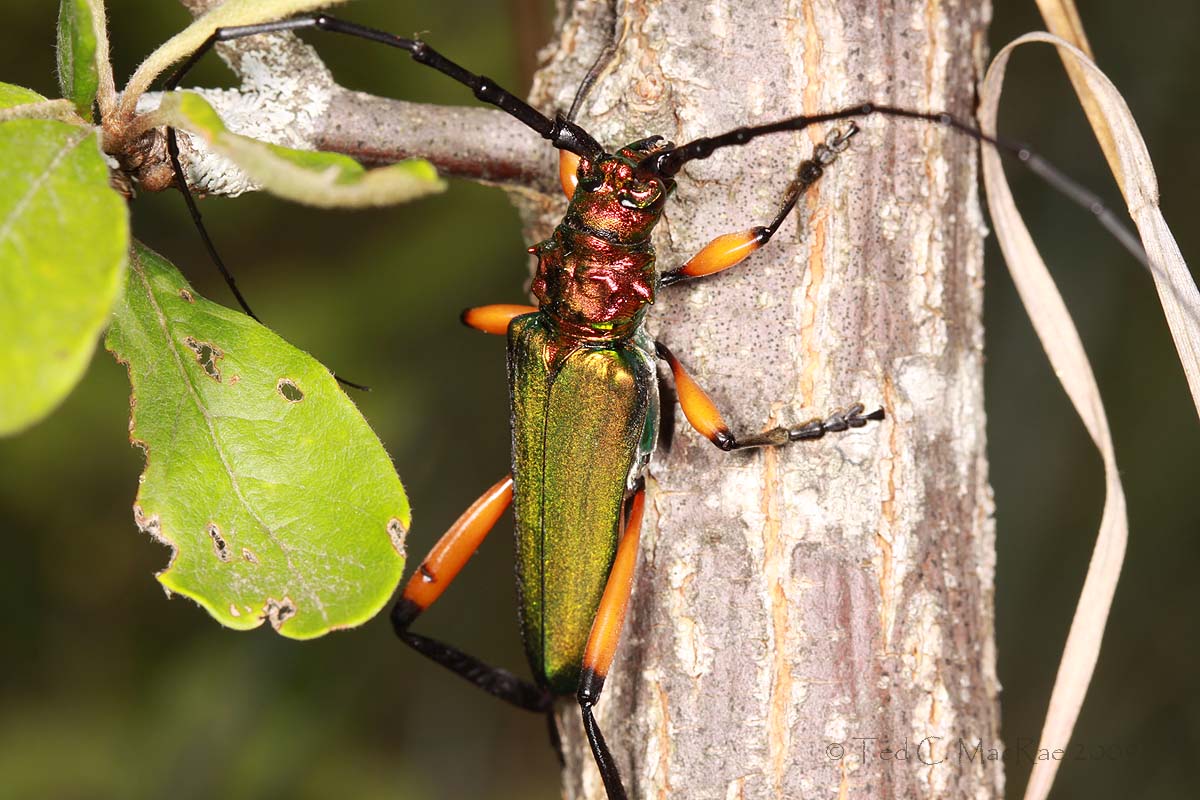
Despite the rain, we then went back to Hercules Glades Wilderness to see if luck would follow suite there as it had at Blackjack Knob.  It didn’t, as rain continued to doggedly pursue us, but the day was not a total loss as daughter and I got in a nice 7-mile hike through some of Missouri’s most ruggedly scenic terrain and were rewarded with the sighting of a western pygmy rattlesnake.  The next day was sunny, much to our delight, and I considered going back to Blackjack Knob where we had seen a good number of adults the previous day.  In the end, I decided I’d played that card and rather than continue trying for photographs I’d rather see if the beetle could be found at another glade complex further to the east at Long Bald Glade Natural Area in Caney Mountain Conservation Area.  Things didn’t look promising, as I found bumelia trees occurring only sporadically across the main glade complex—with no sign of the beetles.  Nevertheless, we enjoyed the day and spent a bit of time chasing after some enormous robber flies that later proved to be Microstylum morosum, a new record for Missouri and a significant northeastern range extension.  I thought that would be the highlight of the day, but as we were heading back to the car I spotted a small glade relict on the other side of the road.  It was overgrown and encroached, apparently not receiving the same management attention as the glades in the main complex. Regardless, I went over to check it out and immediately spotted several bumelia trees amongst the red-cedars, and within minutes I saw a beetle—low on the trunk of a very small bumelia tree!  Once again I froze, then slowly geared up with the camera and began my ultra-cautious approach (remember, this was only my second photo chance after a combined four days in the field).  Like last time, I took one shot while still some distance away, then moved in for closer attempts.  Unlike last time, there was no bothersome vegetation cluttering the view, and when I moved in for closeups the beetle turned around, crawled up the trunk a short distance, and then paused.  I snapped off a small series of shots while it sat there, and then suddenly it became alarmed and flew away.  Though still not perfect, these photographs were better than the previous ones I had obtained (check out the pronotal armature in the last photo!), and the finding of this species at Long Bald Glades also represented a new county record.

Plinthocoelium suaveolens on trunk of living Sideroxylon lanuginosum

Plinthocoelium suaveolens on trunk of living Sideroxylon lanuginosum

Plinthocoelium suaveolens on trunk of living Sideroxylon lanuginosum

Plinthocoelium suaveolens on trunk of living Sideroxylon lanuginosum

Missouri populations are assignable to the nominotypical subspecies (southeastern U.S.), which is distinguished from subspecies plicatum (Texas, New Mexico, Arizona, and northern Mexico) by the bronze or cupreous tints and weak transverse rugae on the pronotum (Linsley 1964).  The distributional ranges of the two subspecies intermingle in northeastern Texas.

Photo details:
All photos: Canon 100mm macro lens on Canon EOS 50D
Photo 1 (Chute Ridge Glade): normal mode, ISO-400, 1/250 sec, f/16, natural light.
Photo 2 (Sideroxylon lanuginosum): landscape mode, ISO-100, 1/160 sec, f/6.3, natural light.
Photos 3 (P. suaveolens larval frass pile), 6—8 (P. suaveolens adult): manual mode, ISO-100, 1/250 sec, f/9-11, MT-24EX flash 1/2 power through diffuser caps (photo 7 slightly cropped).
Photos 4—5 (P. suaveolens larva): manual mode, ISO-100, 1/60 sec, f/14 (closeup f/25), MT-24EX flash 1/2 power through diffuser caps.

REFERENCES:

Champlain, A. B. and J. N. Knull.  1932.  Fermenting bait traps for trapping Elateridae and Cerambycidae (Coleop.).  Entomological News 43(10):253–257.

Linsley, E. G. 1964.  The Cerambycidae of North America. Part V. Taxonomy and classification of the subfamily Cerambycinae, tribes Callichromini through Ancylocerini.  University of California Publicatons in Entomology, 22:1—197, 60 figs., 1 pl.

Linsley, E. G. and P. D. Hurd, Jr.  1959.  The larval habits of Plinthocoelium suaveolens plicatum (LeConte).  Bulletin of the Southern California Academy of Sciences 58(1):27–33.

MacRae, T. C. 1994. Annotated checklist of the longhorned beetles (Coleoptera: Cerambycidae and Disteniidae) known to occur in Missouri. Insecta Mundi 7(4) (1993):223–252.

MacRae, T. C. and M. E. Rice. 2007. Distributional and biological observations on North American Cerambycidae (Coleoptera). The Coleopterists Bulletin 61(2): 227–263.

Riley, C. V.  1880.  Food habits of the longicorn beetles or wood borers.  The American Entomologist 3(10):237–239.

Turnbow, R. H. Jr. and F. T. Hovore.  1979.  Notes on Cerambycidae from the southeastern U. S.  Entomological News 90(5):219–229.

Copyright © Ted C. MacRae 2009

Add to FacebookAdd to NewsvineAdd to DiggAdd to Del.icio.usAdd to StumbleuponAdd to RedditAdd to BlinklistAdd to TwitterAdd to TechnoratiAdd to Furl

Typocerus deceptus in Missouri

It has been fifteen years now since I published an annotated checklist of the longhorned beetles (families Cerambycidae and Disteniidae) of Missouri (MacRae 1994).  That publication (and a similar one on Buprestidae) was the product of eight years of collecting – of specimens in the field and of data in any other public or private collection I could find that contained Missouri specimens – during my stint as a field entomologist with the Missouri Department of Agriculture.  I collected during the week while on my rounds.  I collected on weekends as well.  I visited every college and university in the state that had an insect collection of any size, and a few in neighboring states as well.  I made the acquaintance of private collectors with significant Missouri material – most notably Richard Heitzman, Marlin Rice, and the late Gayle Nelson.  By the time I left Missouri for a new position in Sacramento, I had documented 219 species and subspecies of longhorned beetles from the state – 66 of which were new state records.

Typocerus deceptus on flower of Hydrangea arborescens

Typocerus deceptus on flower of Hydrangea arborescens

Despite my best efforts, however, I knew the list was not complete – they never are.  In the years since returning to Missouri, I’ve documented an additional 10 species and subspecies in the state (MacRae and Rice 2007), and in a newly published paper (McDowell and MacRae 2009) the rare species, Typocerus deceptus, is documented from Missouri for the first time.  I cannot take credit for this discovery – that honor goes to the paper’s lead author, Tom McDowell of Carbondale, Illinois.  Tom first encountered this species in 2005 at Trail of Tears State Park in southeastern Missouri near Cape Girardeau while conducting routine insect surveys.  After seeing additional individuals on a subsequent visit to the park the following year, Tom contacted me to tell me of his find and graciously invited me to join him on further studies of this rarely encountered species.  I readily agreed, and in July of last year I met up with Tom at Trail of Tears to see the beetle for myself.

Typocerus deceptus on flower of Hydrangea arborescens

Typocerus deceptus on flower of Hydrangea arborescens

Typocerus deceptus has been recorded sporadically from across the eastern U.S.  Nothing is known of its biology other than adult flower hosts and activity periods, and the larva and larval host(s) remain completely unknown.  The species is aptly named, as its appearance is deceptively similar to the common and widespread species, T. velutinus.  Both of these species belong to the so-called “flower longhorn” group (subfamily Lepturinae), characterized by adults that are largely diurnal (active during the day) and attracted to a great variety of flowers upon which they feed.  Tom had found T. deceptus feeding on flowers of wild hydrangea (Hydrangea arborescens) in the company of several other flower longhorns, including T. velutinus.  The similarity of T. deceptus to T. velutinus makes distinguishing individuals amongst the vastly more abundant T. velutinus quite difficult.  However, Tom was able to recognize the species during his surveys as a result of prior experience with it in Illinois.  As Tom and I searched the wild hydrangea plants growing along an intermittent drainage between the road and the park’s unique mesic forest, we succeeded in picking out a total of four individuals of this species amongst the dozens of T. velutinus and other lepturines also feeding on the flowers.

Typocerus velutinus on flower of Hydrangea arborescens

Typocerus velutinus on flower of Hydrangea arborescens

I gradually developed a sense of the subtle differences that distinguish this species from T. velutinus and that allow its recognition in the field.  Typocerus deceptus is slightly more robust than T. velutinus, and whereas the transverse yellow elytral bands of the latter are distinct and well delimited, they are weaker and often interrupted at the middle in T. deceptus, giving the beetle a slightly darker brownish appearance.  The lateral margins of the elytra are also more strongly emarginated near the apices, giving the beetle a more distinctly tapered appearance.  Finally, while both species possess a distinct band of dense, yellow pubescence along the basal margin of the pronotum, this band is interrupted at the middle in T. deceptus. My ability to recognize this species in the field was confirmed a few weeks ago when I returned to Trail of Tears (with longtime field companion Rich Thoma) to attempt what seemed to be an impossible task – photograph these active and flighty insects in the field on their host plants.  Conditions were brutally humid, and I only saw two individuals that day – the first I immediately captured and kept alive as a backup for studio photographs should I fail to achieve my goal in the field, but the second individual (not seen until almost two hours later!) posed just long enough for me to whip off a series of frames, two of which turned out well enough to share with you here.  The first photo clearly shows the interrupted basal pubescent band, and both photos show the distinctly emarginate lateral elytral margins and weak transverse yellow bands (compare to the uninterrupted pronotal pubescent band and well developed transverse elytral bands of T. velutinus in the third photo).

Me with the discoverer of Typocerus deceptus in Missouri Trail of Tears State Park, July 2008

TCM with the discoverer of Typocerus deceptus in Missouri at Trail of Tears State Park, July 2008

It is possible that T. deceptus is not as rare as it appears and is simply overlooked due to its great resemblance to another much more abundant species. However, I believe this is unlikely given its rarity in collections of eastern U.S. Cerambycidae by casual and expert collectors alike.  Moreover, T. deceptus is not the only “rare” longhorned beetle to have been documented at Trail of Tears State Park – a number of other species have also been found there but not or only rarely elsewhere in Missouri (e.g., Enaphalodes cortiphagus, Hesperandra polita, Metacmaeops vittata, and Trigonarthris minnesotana).  This may be due to the unique, mesic forest found at Trail of Tears, being one of only a few sites in southeastern Missouri that support more typically eastern tree species such as American beech (Fagus grandifolia), tulip poplar (Liriodendron tulipifera), and cucumbertree (Magnolia acuminata).  Whether one of these trees serves as a larval host for T. deceptus is unknown.  Nevertheless, I will be returning to Trail of Tears in the future to see what other treasures remain hidden within its unique forests.

Photo details (insects): Canon 100mm macro lens on Canon EOS 50D, ISO 100, 1/250 sec, f/18-20, MT-24EX flash 1/4 power through diffuser caps.

REFERENCES:

MacRae, T. C. 1994. Annotated checklist of the longhorned beetles (Coleoptera: Cerambycidae and Disteniidae) known to occur in Missouri. Insecta Mundi 7(4) (1993):223–252.

MacRae, T. C. and M. E. Rice. 2007. Distributional and biological observations on North American Cerambycidae (Coleoptera). The Coleopterists Bulletin 61(2):227–263.

McDowell, W. T. and T. C. MacRae. 2008. First record of Typocerus deceptus Knull, 1929 (Coleoptera: Cerambycidae) in Missouri, with notes on additional species from the state. The Pan-Pacific Entomologist 84(4):341-343 DOI: 10.3956/2008-23.1

Copyright © Ted C. MacRae 2009

Add to FacebookAdd to NewsvineAdd to DiggAdd to Del.icio.usAdd to StumbleuponAdd to RedditAdd to BlinklistAdd to Ma.gnoliaAdd to TechnoratiAdd to Furl

Four Canyon Preserve, Oklahoma

IMG_0295_1200x800

Looking SE into lower Horse Canyon towards Canadian River

On my recent week-long collecting trip, the first three days were spent at Four Canyon Preserve in far northwestern Oklahoma.  This nearly 4,000-acre preserve features a stunning landscape of rugged, wooded canyons dissecting ridges of mixed-grass prairie which provide critical habitat for several rare plants and animals.  Despite years of overgrazing, fire suppression, and invasion by exotic plants, The Nature Conservancy (TNC) recognized the restoration potential of this landscape and began management practices to restore its ecological function and integrity after acquiring it in 2004.  The land was rested until April 2008, at which time a wildfire swept through the area and burned approximately 90% of the property.  This event was actually welcomed by TNC, who was already in the process of initiating a prescribed burn – they simply pulled back and let it rip!  The burn, combined with mechanical removal of eastern redcedar (Juniperus virginiana) that had invaded many areas of the preserve, did much to confine woody growth to the canyons proper, and good rains during the past two springs following that burn have resulted in a lush, green, diverse landscape brimming with prairie wildflowers.  The vivid contrast between the green vegetation and the red clay canyons with their white gypsum exposures has created spectacular vistas of a rugged landscape.  This year, cattle have been reintroduced at low levels to simulate the irregular, patchy disturbance experienced in pre-settlement times when native grazers (bison and elk) dotted the landscape.

The flora (Hoagland and Buthod 2007) and avifauna (Patten et al. 2006) of the preserve are well characterized, but (as nearly always seems the case) arthropod and other micro faunas need much additional study.  My hymenopterist colleagues and I were welcomed enthusiastically by TNC staff, who are anxious to incorporate the results of our insect surveys into an overall fauna.  Apoid hymenopterans appear to have benefited greatly from the recent rejuvenation of the preserve’s floral character.  Results for the beetle populations that I encountered, however, were more mixed. Certain groups, such as scarabaeine dung beetles, were quite abundant and diverse (due to the reintroduction of cattle), but others, including the tiger beetles, jewel beetles, and longhorned beetles that I was most interested in finding, existed at rather low and not very diverse levels.  I had hoped to find the very rare Cylindera celeripes (swift tiger beetle) running amongst the clumps of vegetation on the preserve’s red clay exposures but instead saw only the ubiquitous Cicindela punctulata (punctured tiger beetle), and the few jewel beetles that I managed to beat off the lower branches of hackberry (Celtis laevigata) and soapberry (Sapindus saponaria var. drummondii) trees were found only in the small parts of the preserve that escaped last year’s burn.  This seems fairly typical – I generally don’t find many insects in these groups whenever I survey areas that have experienced a significant amount of recent burning.  Some ecologists might take exception to this statement, and they would have little difficulty citing studies that show rapid recolonization of prairies by a majority of prairie insect specialists within two years after a prescribed burn.   Nevertheless, the impact of prescribed burning on invertebrate populations and its potential for causing local extirpations has become a contentious issue among ecologists and entomologists in recent years.  While my experience hardly passes for rigorous investigation, I am becoming increasingly convinced that a certain amount of caution is warranted when designing burn management plans for prairie relicts.

I’ll discuss more about the beetles and other insects (and even some vertebrates) that I saw during my three-day visit to Four Canyon Preserve in future posts.  In the meantime, I share with you some of my photos of this spectacularly beautiful landscape (note the abundance of woody cadavers from last year’s burn in some of the photos).

IMG_0382_1200x800

Looking S into upper reaches of Mulberry Canyon

IMG_0384_1200x800

Looking S into upper reaches of Mulberry Canyon

IMG_0399_1200x800

Looking E across upper Harsha Canyon

IMG_0402_1200x800

Looking SE into Harsha Canyon towards Canadian River

IMG_0403_1200x800

Looking E across lower Harsha Canyon

View of Mulberry Canyon bluffs from Canadian River valley

Looking NE towards Mulberry Canyon bluffs from Canadian River valley

REFERENCES:

Hoagland, B. W., and A. K. Buthod.  2007.  Vascular flora of the Four Canyons Preserve, Ellis County, Oklahoma.  Journal of the Botanical Research Institute of Texas 1(1):655–664.

Patten, M. A., D. L. Reinking, and D. H. Wolfe.  2006.  Avifauna of the Four Canyon Preserve, Ellis County, Oklahoma.  Publications of the Oklahoma Biological Survey (2nd Series) 7:11-20.

Copyright © Ted C. MacRae 2009

Add to FacebookAdd to NewsvineAdd to DiggAdd to Del.icio.usAdd to StumbleuponAdd to RedditAdd to BlinklistAdd to Ma.gnoliaAdd to TechnoratiAdd to Furl

Blackjack oak “flower”

Quercus_marilandica_P1020923_2

This blackjack oak (Quercus marilandica) was found on one of southeastern Missouri’s finest sand prairie relicts a couple of weeks ago on my ‘Annual Birthday Season Opener Bug Collecting Trip.’ Growing near the edge of the prairie at the transition to dry sand forest (Nelson 1985), the arrays of soft, red, newly-expanding leaves at each branch tip had a distinctly floral quality to them. Of course, as with all oaks, the actual flowers of blackjack oak are much less conspicuous, with the staminate (male) flowers borne on drooping catkins, the pistillate (female) flowers on separate spikes on the branch, and pollination accomplished by wind.

Missouri is oak country – nearly a quarter of North America’s 90 oak species (Nixon 2009) occur naturally within the state. This high diversity is explained partly by Missouri’s ecotonal continental position – straddling the east-west transition from the great eastern deciduous forest to the western grasslands. The boundary between these two great biomes is a dynamic, ever-changing interdigitation of woodland, savanna, and prairie that ebbs and flows with the prevailing climatic conditions. Unlike the more mesic forests further east, these dry woodland habitats were often subjected to fire during presettlement times – to which oaks in general (and blackjack oak in particular) are supremely adapted with their thick bark and ability to resprout repeatedly after being burned or grazed back. Sadly, the suppression of these fires post-settlement has caused many of these unique, fire-mediated natural communities to shrink drastically amidst a choking growth of junipers (“cedars” ’round these parts), maples, and other fire-intolerant species. Only on publicly owned preserves and a few private parcels under progressive ownership (such as the sand prairie relict where this photograph was taken) is fire once again shaping the landscape.

Oaks are among my favorite trees, and among the oaks I have several favorites. White oak (Quercus alba) – tolerating many forest types but forming nearly pure stands in high-quality, mesic sites, its tall symmetrical crown, pale bark, and brilliant fall colors are unparalleled among Missouri’s other oaks. Post oak (Q. stellata) as well – lacking the elegance of white oak but achieving its greatest character in fire-adapted savannas and open woodlands as squat, gnarled, massively-trunked trees with broad, spreading crowns¹. Blackjack oak has none of these qualities, yet somehow, it is still one of my favorite Missouri oaks. Stunted and gnarled (‘scrub oak’ to some), it occurs mostly in sandstone and limestone glades, savannas and woodlands on dry, nutrient-poor soils that support few other tree species. The dark green of its tough, waxy (to limit the loss of water), pear-shaped leaves contrasts beautifully with its rough, blocky, almost black bark. Blackjack oak has virtually no timber value, although it is sometimes used for charcoal and firewood. Nevertheless, for me, it is almost an icon for the unique natural communities in Missouri in which it occurs – communities that face ever-increasing pressure from human and forest encroachment.

¹ Please refer to this lovely essay about post oaks in Missouri, by the talented Allison Vaughn.

REFERENCE:

Nelson, P. W. 1985. The Terrestrial Natural Communities of Missouri. Missouri Natural Areas Committee, Jefferson City, 197 pp.

Nixon, J. C.  2009. Quercus in Flora of North America, Vol. 3.

Copyright © Ted C. MacRae 2009

Add to FacebookAdd to NewsvineAdd to DiggAdd to Del.icio.usAdd to StumbleuponAdd to RedditAdd to BlinklistAdd to TwitterAdd to TechnoratiAdd to Furl

Trees of Lake Tahoe – The Deciduous Trees

Alder, Maple, and Nuttall’s Flowering Dogwood make beautiful bowers over swift, cool streams at an elevation of from 3000 to 5000 feet, mixed more or less with willows and cottonwood; and above these in lake basins the aspen forms fine ornamental groves, and lets its light shine gloriously in the autumn months.–John Muir, The Mountains of California (1894).

p1020724_2

This is the third installment of a “Trees of Lake Tahoe” series summarizing the trees of Tahoe Basin. The basin forests are, of course, dominated by a diverse assemblage of conifers – eleven species in all.  These were covered in parts 1 (Trees of Lake Tahoe – The Pines) and 2 (Trees of Lake Tahoe – The “Other” Conifers ) of this series.  Yet, despite this coniferous domination, the 14 species of deciduous trees¹ that occur in the Tahoe Basin is three more than the number of coniferous tree species.  These deciduous tree species will be covered in this third and final part, including the nine species I was able to locate on my recent visit to the area back in mid-March.  Because of the timing of that trip, the trees will be discussed from a decidedly wintertime perspective that makes species identifications a little more challenging compared to the coniferous species.

¹ Admittedly, I use the term “tree” in the broadest sense, since many of these species might better be described as “tree-like shrubs” or “shrubby trees,” often representing only the largest examples of genera whose members include a number of true shrubs.  Only a handful of these species routinely form large, unmistakably tree-like forms, the largest of which still pale in comparison to the coniferous giants that dominate the basin.

Family SALICACEAE

This family of dioecious plants (male and female flowers on separate plants) is represented in the Tahoe Basin by two genera.  Two species of Populus occur here, and both decidedly trees in form.  Most of the nine species of Salix that grow in the basin grow only as shrubs, while two of them sometimes form distinct trees.

Quaking aspen (Populus tremuloides)

…in winter, after every leaf has fallen, the white bark of the boles and branches seen in mass seems like a cloud of mist that has settled close down on the mountain, conforming to all its hollows and ridges like a mantle, yet roughened on the surface with innumerable ascending spires.–John Muir, Steep Trails (1918).
p1020610_2p1020611_2

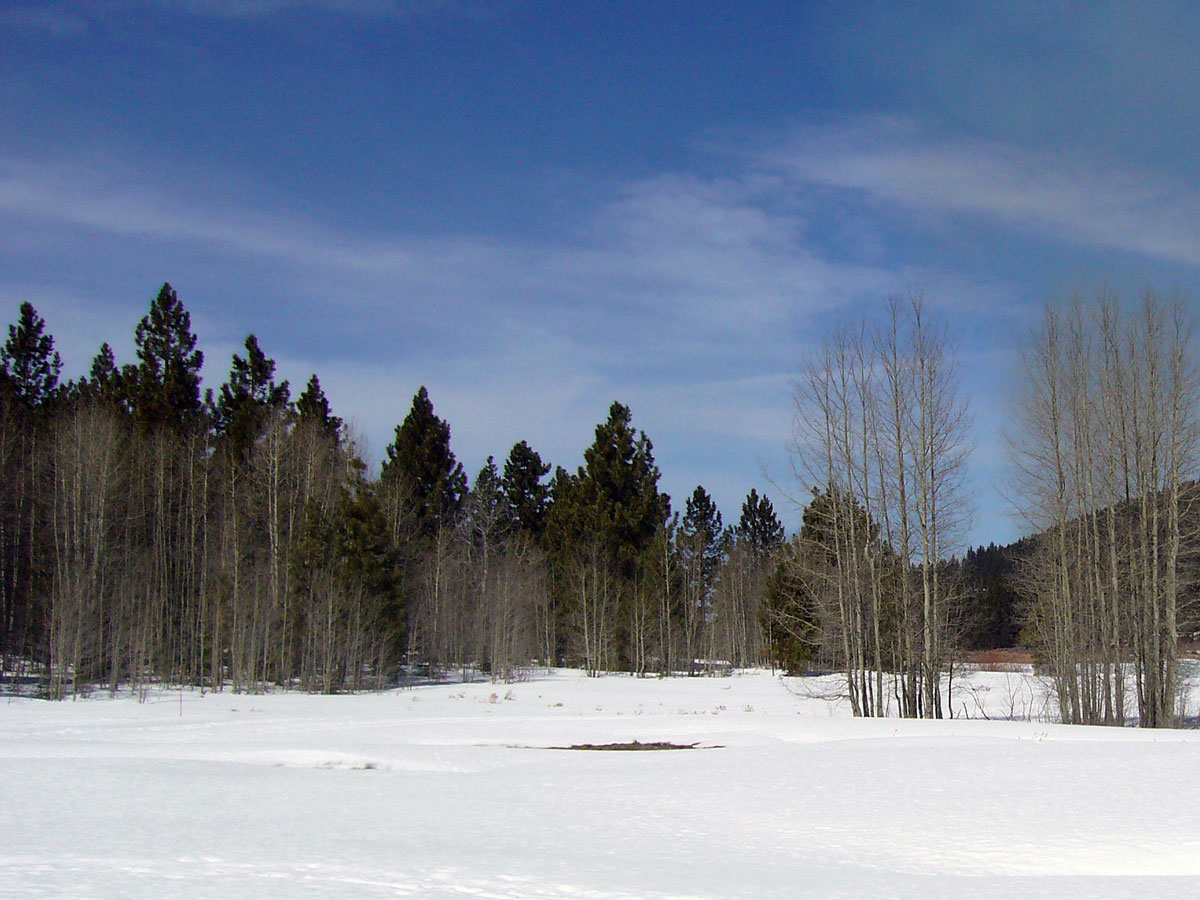
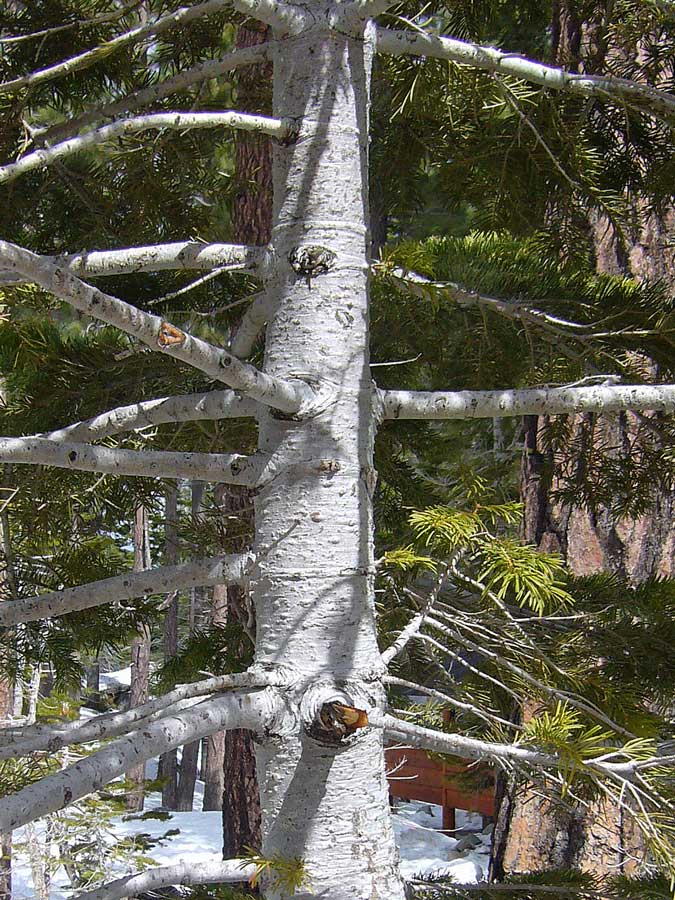
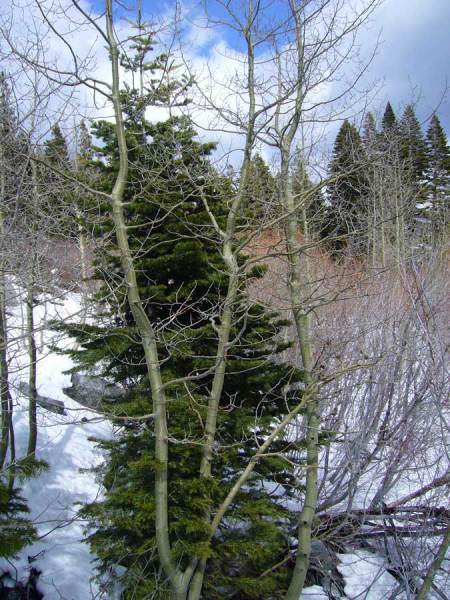
Quaking aspen is one of the most unmistakable trees of the Tahoe Basin – regardless of the season.  Famous for its shimmering foliage during summer and blazing fall colors, it is equally distinctive during winter when its smooth, creamy, greenish-white trunks stand in stark, leafless contrast to the dark green coniferous foliage that cloaks the landscape.  Thick stands of this species are common in moist meadows and stream margins, with stands typically representing clonal colonies of genetically identical trees sprouting from a common root mat.  Although another species of Populus does occur in the basin (black cottonwood – see below), that species is not nearly as abundant as quaking aspen and lacks its distinctive smooth bark.

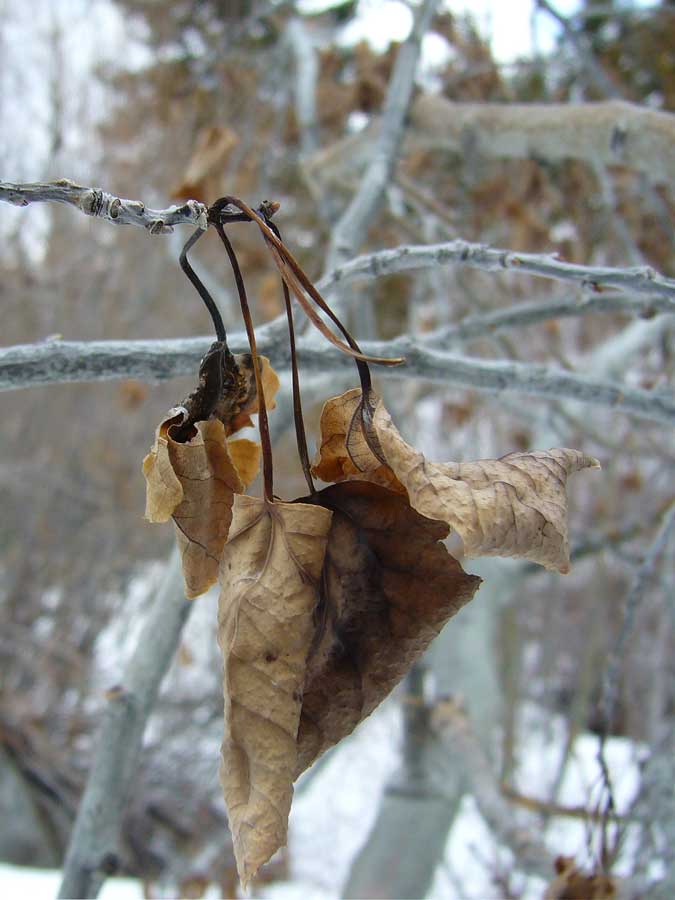
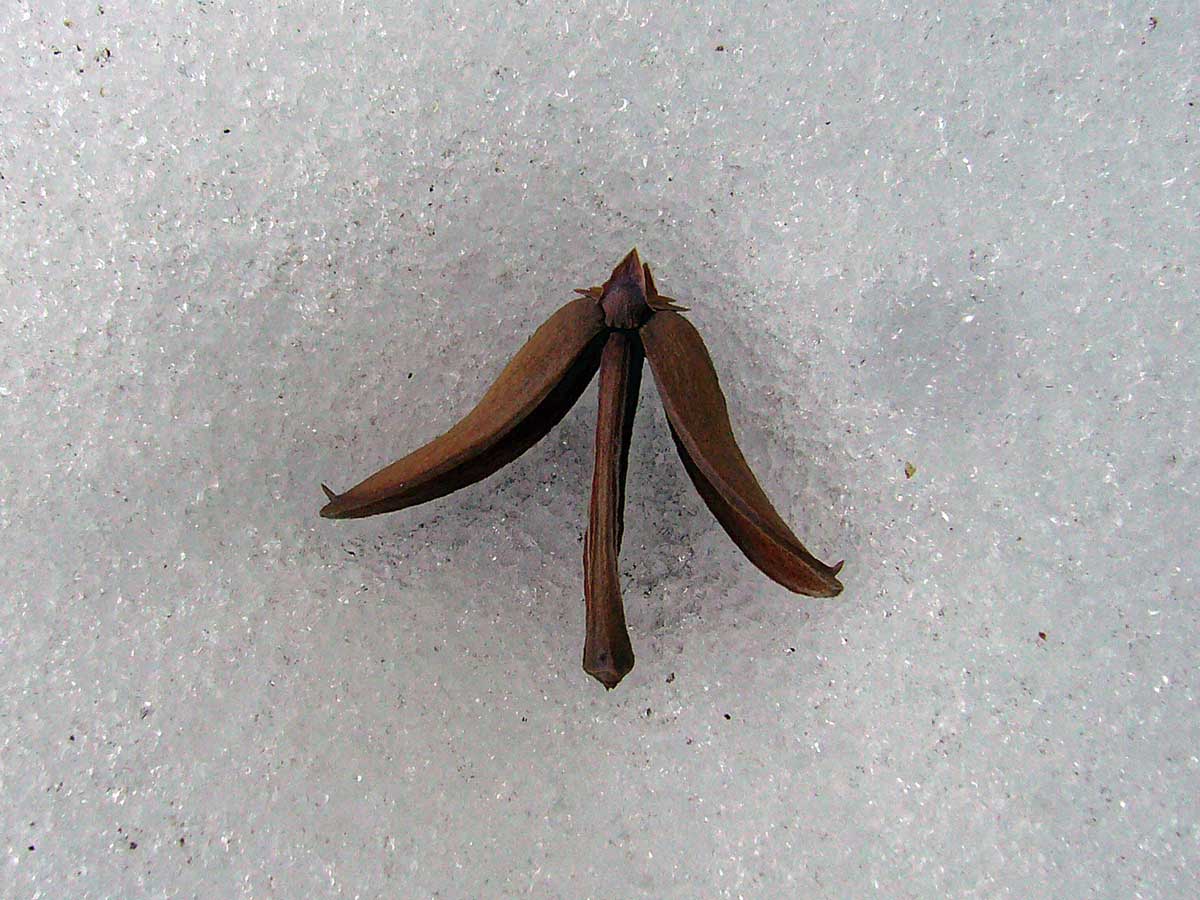
The second photo above shows some of the few, still-clinging leaves that I found, unremarkable in senescence but showing the flattened petioles that cause to summertime leaves to flutter and quiver incessantly with the summer breezes, alternately flashing their bright green upper surface and silvery underside.

Black cottonwood (Populus balsamifera ssp. trichocarpa)

p1020701_2p1020700_2

Black cottonwood is the largest American Populus and the tallest non-conifer in western North America.  Growing throughout the cool, moist Pacific Northwest, it is at its elevational limit in the Sierra Nevada along moist streams and lakeside habitats in the lower Tahoe Basin. The wonderfully knowledgeable Forest Service worker, who helped me greatly in my quest to locate all of the basin’s conifers, was skeptical about my chances of finding this species; however, while hiking the Rubicon Trail at Emerald Bay State Park I spotted the unmistakable, deeply furrowed, gray bark of this close relative of our own eastern cottonwood (Populus deltoides).  Examining the twigs revealed the large, pointed buds, sticky with resin, and a few clinging leaves whose wide, ovate shape confirmed the species’ identity.  It was the only black cottonwood I saw in the basin, although surely others exist throughout the basin at lakeside elevations.

Willows (Salix spp.)
p1020673_2

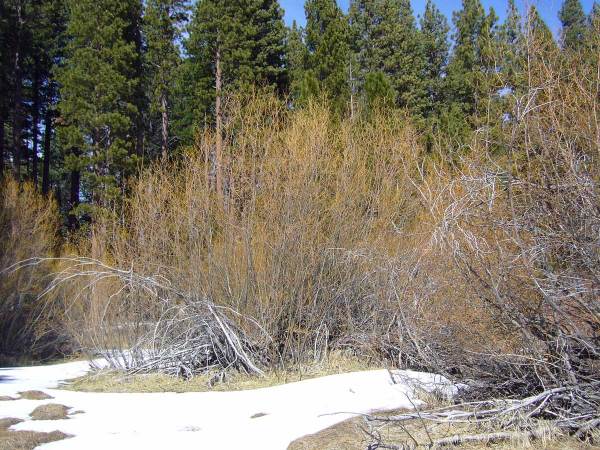
As a group, willows are easily distinguished from the other deciduous trees and shrubs that occur in the Tahoe Basin.  However, discriminating among the several species can be quite difficult, even for trained botanists.  Winter is not the best time to try to identify willows, as many species are distinguished by characters of the foliage and flowers.  In some cases, examination of both male and female flowers is required – frustrating since they are borne on separate plants!  Wintertime characters normally useful for other plants such as bark and twig color are rarely informative for different species of willow, and even growth habit as trees or shrubs can vary greatly within species depending on elevation and available moisture.  All of this is a long-winded way of saying I don’t know which or how many species of willow I observed in the Tahoe Basin.
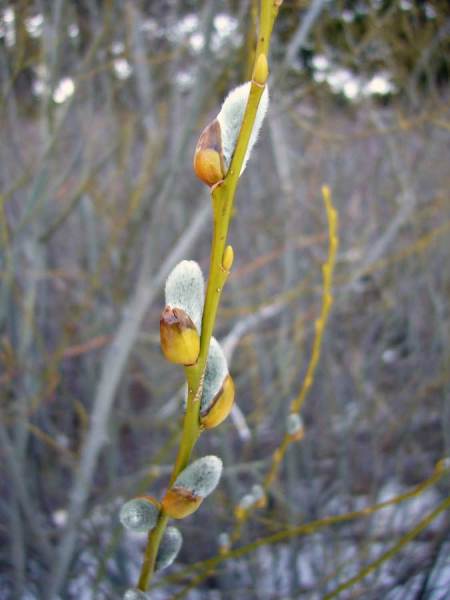
p1020705_2p1020707_2According to Graf (1999), there are nine species of willow in the Tahoe Basin; however, only two of them are trees – the abundant shining willow (S. lucida spp. lasiandra), and the more drought-tolerant Scouler’s willow (S. scouleriana).  The remaining seven species are shrubs that rarely exceed 10-12 feet in height.  Indeed, one of them – arctic willow (Salix arctica) – grows no more than 4 inches tall, occurring in seepy slopes and along lake and stream margins in the subalpine zone at Carson Pass.  Most of the willows I observed were at lower elevation along the shore of Emerald Bay and in the wet meadows around South Lake Tahoe and Spooner Lake and were growing as large shrubs or small trees and exhibited either bright yellow or red bark on the year-old branches, turning to smooth gray on older branches.  I don’t know whether these represent one or more species, or if they even represent one of the two arborescent species, but I suspect the yellow-twigged species may represent Lemmon’s willow (S. lemmonii), one of the shub species and Tahoe’s most common willow.  Perhaps a stretch goal for next year’s trip could be to find and distinguish all nine Tahoe Basin willow species, but realistically I would settle for knowing for sure what species the plants in these photographs represent (although I definitely would like to find the diminutive arctic willow).

Family BETULACEAE

Like the Salicaceae, plants in this family have male and female flowers on separate structures called catkins, but the plants themselves are monoecious (both sexes on the same plant).  Two genera – Alnus and Betula – occur in the basin, each represented by one species.

Mountain alder (Alnus incana ssp. tenuifolia)
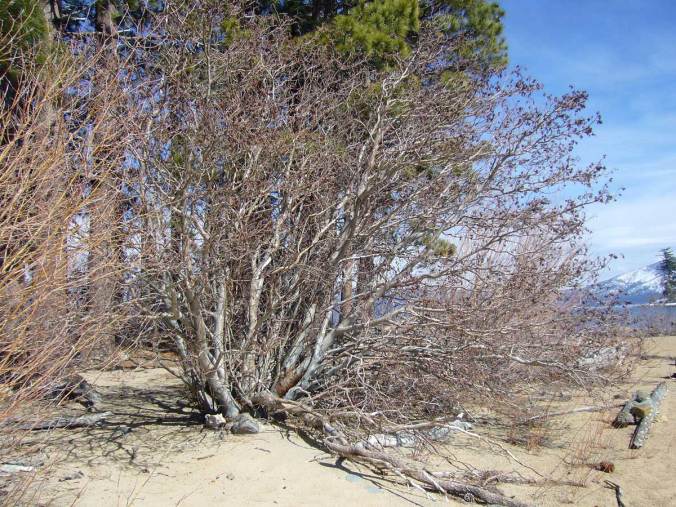
p1020675_2p1020677_2

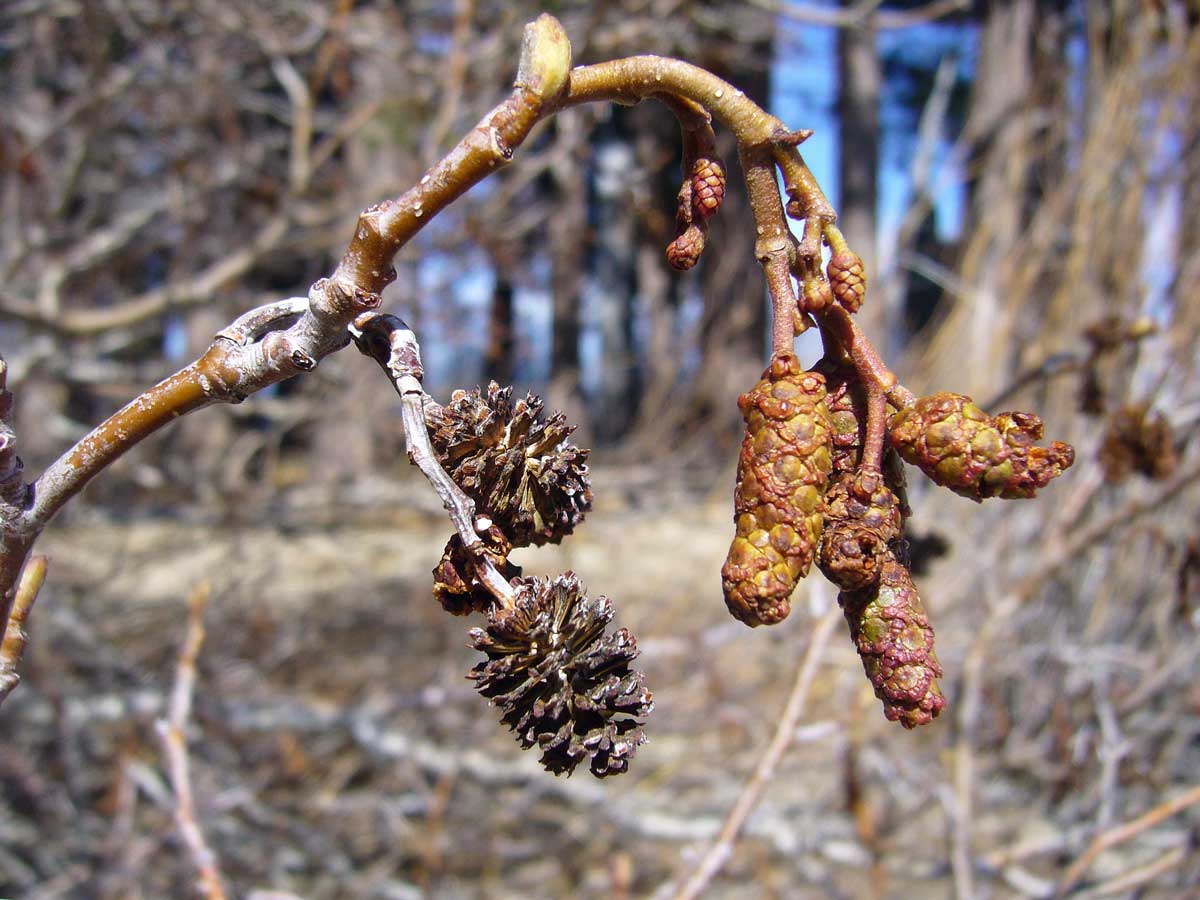
Like the willows, mountain alder is another deciduous plant that straddles the line between tree and shrub, and as is typical of most species in these two plant families (Salicaceae and Betulaceae) the species shows a high affinity for moist sites along stream and lake margins and on seepy north- and east-facing slopes.  The largest specimens I saw, as pictured above left, were found growing on the granite sand beaches along the Rubicon Trail on the western shore of Emerald Bay in Emerald Bay State Park.  Like alders anywhere, this species is immediately recognizeable in winter due to the persistent woody cones that represent the previous year’s female catkins.  Another larger species of alder, white alder (A. rhombifolia), occurs in the Sierra Nevada, but it is not clear to me whether this species actually occurs in the Tahoe Basin proper.  Graf (1999) does not include it in his rather comprehensive treatment of Tahoe Basin plants, but Peterson & Peterson (1975) and Quinn (2006) both list it from the basin (although rare). 

Water birch (Betula occidentalis)

I did not observe this species, which Graf (1999) records from Carson Pass.  The only birch occurring in the Sierra Nevada, it is more common outside the basin proper on the eastern slopes above the burning sagebrush plains.  Like alder, separate male and female catkins are borne on the same tree; however, the female catkins of birch are solitary rather than clustered and disintegrate when ripe rather than persisting as woody cones.

Family FAGACEAE

This family contains the über diverse genus Quercus – represented in California by 20 species.  However, of the five arborescent oaks that occur in the Sierra Nevada, only one has successfully penetrated the high elevations of the Tahoe Basin. A second species of Quercus also inhabits this montane region but grows exclusively as a low shrub, and another shrub in the related genus Chrysolepis also grows here – these two latter species will be treated more fully in a future post.

Canyon live oak (Quercus chrysolepis)

The trunk was all knots and buttresses, gray like granite, and about as angular and irregular as the boulders on which it was growing—a type of steadfast, unwedgeable strength.–John Muir, The Mountains of California (1894).

p1020618_2p1020614_2

This is one of North America’s most variable oaks, exhibiting extreme variability in leaves and fruit and developing as either a tree or a shrub, depending upon the site where it grows. Slow growing and solid, it does best in sheltered locations, where it can develop an impressive, spreading crown and live a hundred years or more. On exposed slopes, it takes on a shorter, shrubbier aspect (above left) or forms dense thickets (above right).  I saw most of this species at lower elevations within the basin – along the Vikingsholm Trail in Emerald Bay State park leading down to the west shore of Emerald Bay.
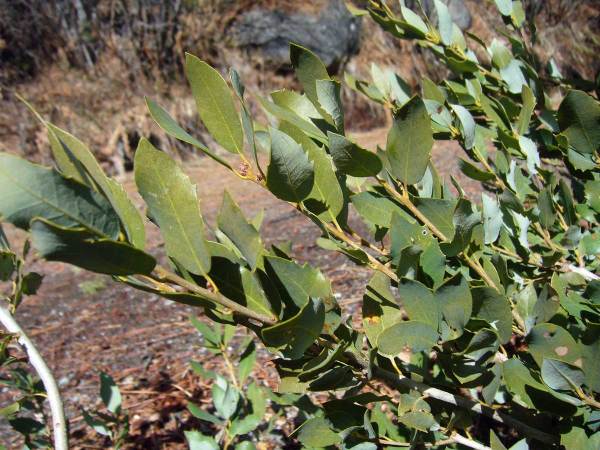
p1020615_2

The leaves of this evergreen species are bluish green with numerous golden glandular hairs when young and becoming dull gray and smooth with age. Although there are no other arborescent oaks at this elevation with which it can be confused, I did find growing alongside it the strictly montane and shrubby huckleberry oak (Q. vaccinifolia).  The somewhat smaller, mostly entire leaves were the only indication it was not merely a shrub form of canyon live oak, and further study revealed that the two species can be distinguished by the presence of multiradiate glandular hairs on both leaf surfaces of canyon live oak.  These two species are closely related (both are in the Protobalanus – or “golden oak” – section of the genus), and widespread hybridization has apparently been documented in this part of the Sierra Nevada where the two species’ distributions overlap (Nixon 2002).

Family ROSACEAE

This large family of dioecious plants with usually pentamerous radial flowers is represented in the Tahoe Basin by nearly three dozen mostly perennial shrubs.  Six of these species, representing the genera Amelanchier, Cercocarpus, Prunus and Sorbus, sometimes develop a tree form.

Cherry (Prunus sp.)
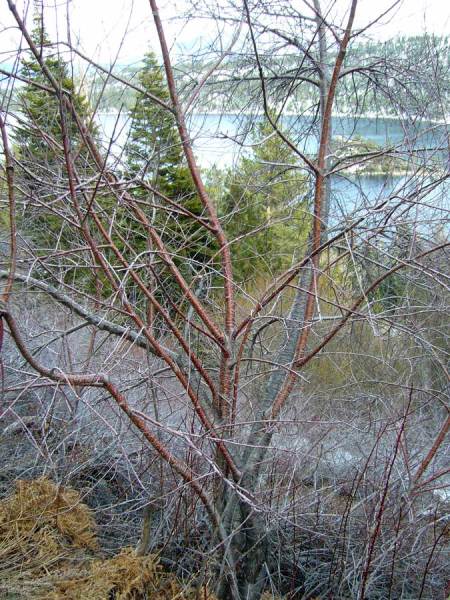
p1020713_2p1020712_2

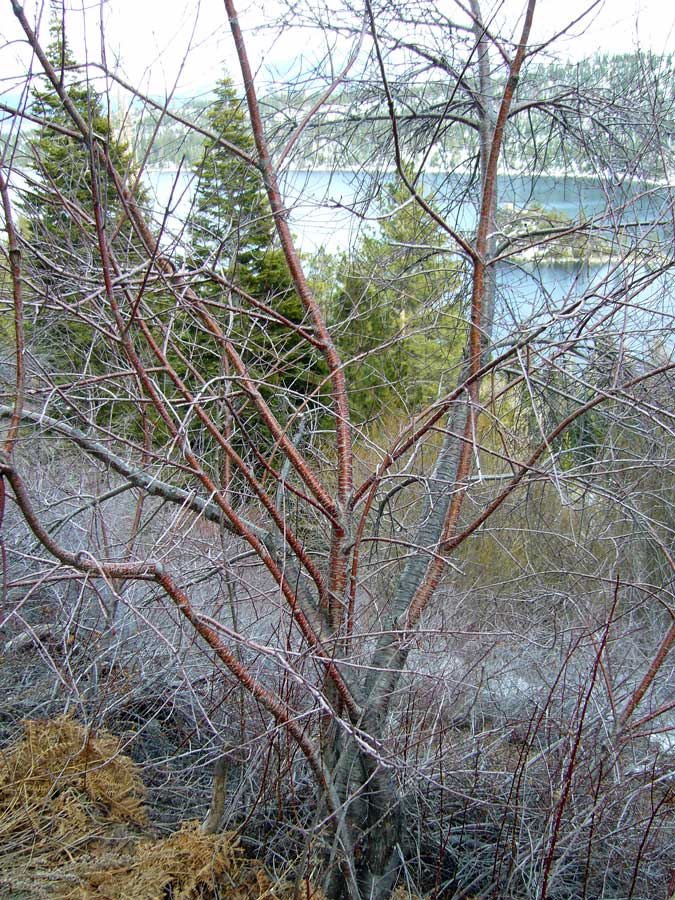
Two species of Prunus – bitter cherry (P. emarginata) and western chokecherry (P. virginiana var. demissa) – occur in the Tahoe Basin, both growing as either shrubs or small trees.  I cannot say for sure which species is represented in these photographs (taken on the slopes above Emerald Bay at Emerald Bay State Park), as the two species are best distinguished by subtle differences in their flowers and foliage.  Bitter cherry is apparently common in the Tahoe Basin and has bark that is smooth and dark brown, while chokecherry is more of a foothill species that is uncommon on the western shore (where these photos were taken) and has more grayish brown and somewhat scaly bark.  I can go either way with bark color based on these photos, so I’ll forgo an ID for the time being and seek to follow up during my next visit.  A third species of Prunus, the strictly shrubby desert peach (P. andersonii), formerly occurred at low elevations around the south shore, but it is now considered to be extirpated from the basin.

Mountain ash (Sorbus californica)

While hiking the Rubicon Trail in Emerald Bay State Park, I spotted a single, small tree with distinctive, large winter buds that reminded me immediately of the ornamental species mountain ash (Sorbus aucuparia) from my former days as a nursery inspector.  This thought seemed to be confirmed when I found a senesced but still attached leaf, pinnately compound with nine ovate, toothed leaflets.  However, my pocket copy of Native Trees of the Sierra Nevada (Peterson & Peterson 1975) included no species of Sorbus, and I concluded it must be something else.  This lone tree was located in deep shade within the white fir forest near the western shore of Emerald Bay, so I opted to find another tree in better lit conditions for taking photos – unfortunately, no other trees of this species were found.  Once I got back home, I was happy to find Sorbus californica listed in my just purchased copy of Graf (1999).  This species has attractive white flowers in small panicles during the summer that give rise to bright red berries during fall and is apparently common in mid- to higher-elevation riparian communities around the lake.

Serviceberry (Amelanchier spp.)
Curl-leaf mountain mahogany (Cercocarpus ledifolius)

I did not locate either of the two species of serviceberry that occur in the Tahoe Basin, the common serviceberry (Amelanchier utahensis) and the more localized glabrous serviceberry (A. alnifolia var. pumila).  Being highly familiar with our eastern species, A. arborea (just recently finished flowering), I suspect either of these species would be readily recognized, even in winter, by their smooth, silvery-gray bark and shrubby, small-tree form.  I also did not see curl-leaf mountain mahogany (Cercocarpus ledifolius), another species that barely qualifies as a small tree.  It is apparently more at home on the dry eastern flank of the Sierra Nevada but can be found within the basin proper sporadically in the southwest and along the southeastern lake shore and more commonly on dry slopes in the far north and south of the basin.  I have collected a number of woodboring beetles from mountain mahogany across the southwestern U.S. from the mountains of southern California to the Chisos Mountains of Texas.

Family ACERACEAE

The single North American genus, Acer, is represented in California by four species, three of which occur in the Sierra Nevada but only one occurring in the Tahoe Basin.  Plants in this family are closely related to the Hippocastanaceae, represented in the Sierra Nevada foothills by California buckeye (Aesculus californica).

Mountain maple (Acer glabrum var. torreyi)

As with mountain ash, I found a single small tree representing this species near the west shore of Emerald Bay while hiking the Rubicon Trail.  Despite lacking foliage, I recognized it immediately as a maple by its opposite, scaly buds.  Also like mountain ash, I assumed I would see more after finding the first one and thus didn’t photograph this particular tree growing in deep shade.  That’ll teach me.  This species sometimes grows as a multi-stemmed shrub in moist situations, and even when assuming tree form, as did the one I saw, it is at best a small tree with a maximum height of only around 15′.  With fall foliage in varying shades of pink to red, it must rather nicely compliment the blazing yellow cloak of the quaking aspen during September and October.  Tahoe Basin individuals are placed in var. torreyi due to their bright reddish twigs, while those on the eastern slope of the Sierra Nevada exhibit gray twigs and are placed in var. diffusum.

This concludes my “Trees of Lake Tahoe” series – at least until next year when I hope to locate some of the remaining species I did not find during this year’s visit.  However, I do have one more “flora of Lake Tahoe” post in preparation covering some of the many woody shrubs that occur within the basin.

REFERENCES:

Arno, S. F. 1973. Discovering Sierra Trees. Yosemite Association, Yosemite National Park, California, 89 pp.

Graf, M. 1999. Plants of the Tahoe Basin. Flowering Plants, Trees, and Ferns. A Photographic Guide. California Native Plant Society Press, Berkeley, 308 pp.

Muir, J. 1894. The Mountains of California. The Century Co., New York, xiii+381 pp.

Muir, J.  1918. Steep Trails. Houghton, Mifflin, Boston, ix+390 pp.

Nixon, K. C. 2002. The oak (Quercus) biodiversity of California and adjacent regions. USDA Forest Service General Technical Report PSW-GTR-184, 20 pp.

Peterson, P. V., and P. V. Peterson, Jr. 1975. Native Trees of the Sierra Nevada. University of California Press, Berkeley, 147 pp.

Quinn, C.  2006.  A Nature Guide to the Southwest Tahoe Basin: Including Desolation Wilderness and Fallen Leaf Lake: Trees, Shrubs, Ferns, Flowers, Birds, Amphibians, Reptiles, Mammals, and Fishes Inhabiting the Sierra Nevada Watershed Southwest of Lake Tahoe, California.  CraneDance Publications, Eugene, Oregon, 232 pp. 

Copyright © Ted C. MacRae 2009

Add to FacebookAdd to NewsvineAdd to DiggAdd to Del.icio.usAdd to StumbleuponAdd to RedditAdd to BlinklistAdd to Ma.gnoliaAdd to TechnoratiAdd to Furl

Trees of Lake Tahoe – The “Other” Conifers

The inviting openness of the Sierra woods is one of their most distinguishing characteristics. The trees of all the species stand more or less apart in groves, or in small, irregular groups, enabling one to find a way nearly everywhere, along sunny colonnades and through openings that have a smooth, parklike surface.–John Muir, The Mountains of California (1894)

p1020595_2

In a previous post (Trees of Lake Tahoe – The Pines), I discussed the six species of pine that can be found within the Tahoe Basin. These include Jeffrey pine (Pinus jeffreyi) – dominant around the lake at lower elevations, lodgepole pine (P. contorta ssp. murrayana) – common in meadows at lower elevations and replacing Jeffrey pine at higher elevations, ponderosa pine (P. ponderosa) – uncommon in the basin due to its preference for lower elevations, sugar pine (P. lambertiana) – the magnificent giant of high quality mesic sites along the western shore, western white pine (P. monticola) – co-occurring with lodgepole pine at higher elevations, and whitebark pine (P. albicaulis) – covering the highest peaks with its gnarled and twisted form.  In this post, I will cover the five “other” coniferous trees that can be found growing in the Tahoe Basin.  These other conifers belong to several different genera in two gymnospermous families – the Pinaceae and the Cuppressaceae.  Together with the pines, these trees comprise what John Muir described as one of the most diverse and appealing coniferous forests in the world. I am most inclined to agree with him.  The diversity of conifers found in the Tahoe Basin is reflective of the wide range of conditions occurring there as a result of differences in elevation (from 6,200 ft to more than 10,000 ft), exposure, and moisture.

Family-level identification of Tahoe Basin conifers is relatively straightforward – those with needle-shaped leaves belong to the Pinaceae (the pine family), while those with scale-like leaves belong to the Cuppressaceae (the cypress family).  There are other characters that distinguish members of these two families, but leaf shape is the most useful for purposes of field identification.  Nine of the eleven species of conifers found in the Tahoe Basin belong to the Pinaceae, while only two are members of the Cuppressaceae.  Within the families, the genera can be distinguished most readily by the following characters:

Pinaceae

  • Pines (Pinus) – needles linear, arranged in bundles or clusters of up to 5 needles held together at the base by sheath of papery bark (discussed in Trees of Lake Tahoe – The Pines).
  • Firs (Abies) – needles more or less flattened, growing directly and singly from the branch and with a plump base that leaves a round depression on the branch.  Cones upright, on upper branches.
  • Hemlocks (Tsuga) – needles more or less flattened and growing directly and singly from the branch like firs, but narrowly stalk-like at the base where they are joined to tiny wooden pegs.  Cones pendant, on outer branches.

Cuppressaceae

  • Incense-cedars (Calocedrus) – scale-like leaves 4-ranked, twigs branching in one plane to form flat sprays, cones > ½” in length, consisting of two large scales separated from a closed center.
  • Junipers (Juniperus) – scale-like leaves arranged in circles of 3, twigs not forming flat sprays, cones < ½” in length, berrylike.

There are three additional coniferous genera in the Sierra Nevada – each represented by a single species and found along the western slope – that do not occur in the Tahoe Basin.  These include: Douglas-fir (Pseudotsuga menziesii) – widespread at elevations from 2,500 ft to 6,000 ft (higher at the southern end of its range); giant sequoia (Sequoiadendron giganteum) – primarily in Giant Sequoia National Monument, and California nutmeg (Torreya californica) – of scattered occurrence.

White fir (Abies concolor)

As old age creeps on, the bark becomes rougher and grayer, the branches lose their exact regularity, many are snow-bent or broken off,…but throughout all the vicissitudes of its life on the mountains, come what may, the noble grandeur of the species is patent to every eye.

p1020574_2p1020575_2p1020587_2

White fir is second only to Jeffrey pine as the dominant conifer at the lower elevations within the Tahoe Basin¹.  It is immediately recognizable as the only non-pine member of the Pinaceae to occur at these elevations – red fir and mountain hemlock are found only at higher elevations in the basin.  Young trees have a nearly perfect pyramidal shape, with silvery gray bark that is thin, smooth, and p1020588_2covered with resin-filled blisters that can be “popped” to shoot out the resin. Older trees develop a more cylindrical and slightly irregular crown, and the bark becomes thick and roughly furrowed, changing to a dark gray or brown color. The foliage has a gray frosted appearance from below, and crushing the needles releases a delightful citrus smell that I found myself partaking in repeatedly. In the narrow elevational zone where white fir and red fir co-exist, white fir may be recognized by its more flattened needles (cannot be “rolled” in the fingers) which are distinctly twisted near the base, causing them to appear 2-ranked. White fir was seen throughout the Tahoe Basin at elevations below around 7,500 ft, and especially along the western shore and southern shores where the greater moisture and protection of north and east facing slopes are to this species liking.

¹ This post by Watching The World Wake Up provides an excellent introduction to the characteristics and distribution of white fir and its relatives. It also contains what must be the best tangent to ever appear in a botanical blog – the connection made between white fir and the alluring Salma Hayek (annoyingly mispelled “Selma” Hayek), softly singing Siente Mi Amor, is pure brilliance!

Despite its “noble grandeur,” white fir may be regarded as somewhat of a pest species. The suppression of fires that have been the hallmark of 20th century forest management have encouraged the replacement of pines throughout the Sierra Nevada by this species. White fir does not tolerate fire as well as the pines with which it occurs, but unlike those species it does well in shadier conditions. The suppression of fires has resulted in dense stands of white firs growing up in the spaces between the pines. Since it tends to retain its lower branches as it grows, when fires do occur the white firs can act as “fire ladders” that allow the fires to reach the upper canopies of the pines. Pines are not as shade tolerant as firs and are thus unlikely to become established beneath the dense canopy of firs. The result of these fire suppression policies are mixed-conifer forests that are denser and contain a much higher proportion of white fir than in the past, making the forests more vulnerable to stand-replacing fires as well as stress-induced insect and disease outbreaks. These counterproductive management policies are beginning to change – and I saw two controlled burns taking place during the week while I was in Lake Tahoe – but there is still much progress yet to be done if we are to once again see large expanses of the “inviting openness” that so captivated John Muir.

Red fir (Abies magnifica)

This is the most charmingly symmetrical of all the giants of the Sierra woods, far surpassing its companion species [white fir] in this respect… Happy the man with the freedom and the love to climb one of these superb trees in full flower and fruit.

p1020785_2I suspected I had seen this magnificent relative of the white fir in the higher elevations at Heavenly Ski Resort on my first trip back to the area last year, but lacking any real knowledge or field guides at the time it remained only a suspicion. When I returned to Heavenly this year, I was ready for it, and I recognized it instantly when I reached elevations around 8,000 ft. The massive trees with deeply reddish bark were unmistakable, and my only disappointment in seeing this species was that I was unable to approach them closely enough to allow a more thorough examination of their needles and bark. Like the white firs I saw at lower elevations, these massive trees had developed a bit of irregularity in their long, cylindrical crowns.

Younger trees can appear more similar to white fir because of their thin, smooth gray bark with elliptical resin blisters. However, in trees both young and old, the foliage is a more boldly colored blue-green than the paler foliage of white fir. p1020784_2Both species develop thick, deeply furrowed bark as they age, but the bark of red fir is distinctly reddish-brown or reddish purple, compared to the dark gray or brown bark of white fir – almost ashen in appearance. In the hand, the needles are not so flattened as white fir – almost quadrangular in cross-section and able to be rolled in the fingers – nor are they distinctly twisted near the base. The photo at right shows a stately red fir on the left next to a Jeffrey pine on the right at Lakeview Lodge on the California side of Heavenly (elevation 8,250 ft – the highest at which I saw the latter species).  I found this species growing in the company of western white pine (Pinus monticola), lodgepole pine (P. contorta ssp. murrayana), and mountain hemlock (Tsuga mertensiana), as well as in groves of its own kind (unfortunately, seen only from my perch upon a ski lift).

Mountain hemlock (Tsuga mertensiana)

The Hemlock Spruce is the most singularly beautiful of all the California coniferæ. So slender is its axis at the top, that it bends over and droops like the stalk of a nodding lily. The branches droop also, and divide into innumerable slender, waving sprays, which are arranged in a varied, eloquent harmony that is wholly indescribable.

p1020804_2I hadn’t a clue whether I would succeed in finding mountain hemlock – I knew it was a denizon of the snowy high mountains, though less common than some of the other high country conifers, and I didn’t recall noticing anything that might be this species during last year’s visit to the slopes of Heavenly. Of course, being a long-time resident of the Midwest I have little experience with hemlocks in general – eastern hemlock (T. canadensis) is on occasion planted in urban landscapes here, but mountain hemlock is markedly different from that species, as well as its Pacific counterpart western hemlock (T. heterophylla), due to its needles growing out of the twigs in all directions rather than in two flat planar sprays. Additionally, the needles are square in cross-section like spruce (Picea), a genus that does not now occur in the Sierra Nevada. These features caused 19th century botanists to suspect that mountain hemlock might have originated from an intergeneric hybridization event, as evidence by John Muir’s reference to it as “Hemlock Spruce.” However, no crosses between genera in the Pinaceae have ever been substantiated, and no compelling evidence of the presumed crossing events proposed for mountain hemlock has been brought forth (Lanner 1999).

p1020803_2Perhaps being primed by the readings I had done beforehand, I knew instantly I had found this species while riding a ski lift and seeing what looked at first like small junipers, but with a Tolkienesque appearance due to the gracefully nodding leader and drooping branch tips.  My hurried attempts to snap photographs of the trees from the moving ski lift produced nothing but skewed views marred by lift cables and passing cars, but once at the summit I was able to ski down to a little grove next to the ski run for closer inspection.  I immediately noticed the many cones clustered at the branch tips and was struck by their pine cone-like appearance. They were quite large – nearly 2” long (massive by hemlock standards).  Sadly, the only examples I would see of this species would be these small trees that only hinted at the charms of the massive specimens with trunks up to six feet in diameter that so enamoured John Muir.  Like the rare Washoe pine (Pinus washoensis) that occurs just outside Tahoe Basin on the eastern slopes of Mt. Rose, attempts to find some of these graceful 100-footers will have to await my next year’s visit.

Incense-cedar (Calocedrus decurrens)

Casting your eye over the general forest from some ridge-top, the color alone of its spiry summits is sufficient to identify it in any company.

p1020687_2p1020688_2p1020693_2

The incense-cedar is my favorite of all the Tahoe Basin conifers. The bright, cinnamon-red bark of mature trees, deeply-furrowed, fibrous and peeling, is reminiscent of California’s two most iconic conifers – redwood (Sequoia sempervirens) and giant sequoia (Sequoiadendron giganteum), respectively the world’s tallest and most massive trees. Incense-cedar is neither as tall as redwood nor as massive as giant sequoia – p1020590_2indeed, it is not even very closely related (redwood and giant sequoia belong to yet another coniferous family, the Taxodiaceae, containing also the graceful but much smaller resident of southeastern U.S. swamps, baldcypress – Taxodium distichum). Nevertheless, old trees – veterans of centuries of fires and storm damage – are stunning specimens to behold, their massive, buttressed trunks often draped in yellow-green mosses and bearing deep basal fire scars, their spired crowns often broken and forked.  Their flattened sprays of foliage give the tree a delicate, lacy appearance in beautiful contrast to its grizzled, gnarled bark. Indeed, even in death these trees stand out for their stark beauty.

Incense-cedar is common at lower elevations in the Tahoe Basin, especially down close to the lake and in the communities ringing the shore. It rarely forms “stands” like white fir and the pines, p1020670_2but rather most often occurs singly – as if to emphasize their distinctiveness. I found it most common along the western shore, where it grows scattered amongst white fir and Jeffrey, sugar, and ponderosa pines. Some of the most massive incense-cedars I have ever seen were found down near the lakeshore along the Rubicon Trail in Emerald Bay State Park. Common on these trees were what I take to be incense-cedar mistletoe (Phoradendron libocedri) (family Santalaceae), which is apparently rare in the Tahoe Basin but known to occur in the mesic forests of the west shore.

Incense-cedar is another of the so-called “wrongly named” conifers – it is not a true cedar (thus, the hyphen in the name), a group of conifers belonging to the genus Cedrus in the family Pinaceae that is found across Eurasia². While somewhat resembling the true cedars, incense-cedar’s closest relatives are restricted to China and Taiwan. p1020640_2Early botanist-explorers, when they first encountered this tree, named it for what it most resembled to them – the old world cedars. This distinctiveness makes older trees the easiest Tahoe Basin conifer to identify. Even it’s cones that litter the ground under mature trees are unique – slender, spindle-shaped, and about an inch long, with the two longest scales bending back at maturity in a manner resembling a wide-open duck’s bill with the tongue sticking out. Young trees resemble Sierra juniper by their scale-like leaves and peeling bark, but the flattened, yellow-green sprays of incense-cedar and shiny reddish coloration of the bark of twigs and younger branches are immediately distinctive.

² There are actually numerous examples of such wrongly named conifers – Douglas-fir (Pseudotsuga menziesii) is not a true fir; eastern redcedar (Juniperus virginiana), western redcedar (Thuja plicata) and Alaska-cedar (Chamaecyparis nootkatensis) are not true cedars; and baldcypress (Taxodium distichum) is not a true cypress. Long live scientific names!

Like white fir, the Sierra Nevada has seen a bit of a population explosion of incense-cedar due to the fire-suppressive forest management practices of the past century. Despite the thick, fire-resistant bark of older trees, the thin-barked seedlings and saplings are intolerant of fire and grow more slowly than the fire-adapted pines. As a result, the frequent low-intensity fires of the past kept seedling establishment to a minimum, resulting in spot occurrences of mature, fire-resistant specimens. The suppression of these fires, combined with the ability of incense-cedar to germinate in shade and thick layers of duff, have allowed this species to increase in incidence throughout the Sierra Nevada. Along with white fir, it is gradually replacing the pines. This may seem like a good thing from the perspective of foresters and loggers, who value the wood of incense-cedar for its use in making pencils and cedar chests, but from an ecological perspective this has the same negative consequences discussed above for white fir.

Sierra juniper (Juniperus occidentalis ssp. australis)

Its fine color and odd picturesqueness always catch an artist’s eye, but to me the Juniper seems a singularly dull and taciturn tree, never speaking to one’s heart.

p1020766_2p1020600_2p1020603_2

This was another conifer that I didn’t recall seeing on my previous visits, but from what I had read I really hoped I did. Gnarly and burly, mature specimens have a weather-beaten, picturesque quality that is unmatched by any other Tahoe Basin conifer save whitebark pine (P. albicaulis). While I did not find this tree to be common in the Tahoe Basin, I did find it in the most surprising of places – Emerald Bay overlook, where I had gazed in admiration at Lake Tahoe on so many previous occassions. This enduring dweller of exposed granite crags grows where no other trees can, anchored to crevices with only the tracest amounts of soil, p1020613_2seemingly thriving on nothing more than rock, snow, and sunshine. Old trees, with their massively short trunks supporting wind-pruned crowns, cannot be mistaken for any other Tahoe Basin conifer. The wood, it seems, is almost as hard as the granite upon which the trees grow, accounting for John Muir’s impression of this tree as without expression – not even the strongest Sierra winds evoke the slightest of shudders or the quietest of whispers in its unyielding bows.

I did not find this species commonly in the areas of the Tahoe Basin that I visited (which were mostly lower elevation sites below 7,000 ft). In addition to the specimens seen at Emerald Bay State Park, I also found this species near Upper Truckee River before the climb to Echo Summit, and I found a number of fine mature specimens outside of the basin proper at Pyramid Creek Geological Area.  Where I did find it, Jeffrey pine was the most common associate, but in most cases the trees stood alone in their own starkness.  Among the Tahoe Basin conifers, the small scale-like leaves are recognizable to almost any easterner as those of juniper, immediately placing it in the family Cuppressaceae alongside incense-cedar.  Even the young trees can be distinguished from that species by their non-glossy foliage borne on twigs that radiate out from the branches in all directions.  p1020602_21The bark of young trees is shreddy and peeling like that of incense-cedar, but it is dull brown to reddish-brown rather than the shiny purple-red color of incense-cedars.

Sierra Nevada populations of Juniperus occidentalis are considered a separate subspecies due to differences in reproduction and elevational preference.  Trees in nominotypical populations, found in northeastern California and up through eastern Oregon and Washington, are found at somewhat lower elevations (4,000 ft to 5,000 ft) and have cones of both sexes on the same tree; while those of subspecies australis, limited to higher elevations (usually from 6,500 ft to over 10,000 ft) in the Sierra Nevada, have either all male cones or all female cones.

REFERENCES:

Arno, S. F. 1973. Discovering Sierra Trees. Yosemite Association, Yosemite National Park, California, 89 pp.

Graf, M. 1999. Plants of the Tahoe Basin. Flowering Plants, Trees, and Ferns. A Photographic Guide. California Native Plant Society Press, Berkeley, 308 pp.

Muir, J. 1894. The Mountains of California. The Century Co., New York, xiii+381 pp.

Lanner, R. M. 1999. Conifers of California. Cachuma Press, Los Olivos, California, 274 pp.

Peterson, P. V., and P. V. Peterson, Jr. 1975. Native Trees of the Sierra Nevada. University of California Press, Berkeley, 147 pp.

Copyright © Ted C. MacRae 2009

Add to FacebookAdd to NewsvineAdd to DiggAdd to Del.icio.usAdd to StumbleuponAdd to RedditAdd to BlinklistAdd to Ma.gnoliaAdd to TechnoratiAdd to Furl