Best of BitB 2012

Welcome to the 5th Annual “Best of BitB”, where I pick my favorite photographs from the past year. 2012 was one of the most intensive travel years I’ve ever had—I spent 8 weeks in Argentina from February through April, made separate trips to Puerto Rico and Arkansas in May (bracketing a personal week in California), traveled almost weekly to Illinois and Tennessee from June to September (interrupted by a personal week in Florida in July), toured the southeastern U.S. (Arkansas, Louisiana, Mississippi and Georgia—great food!) in early September, chased tiger beetles in Oklahoma, Texas and Arkansas in late September, went back to Argentina for a week in October, and capped off the travel year by attending the Entomological Society of America Annual Meetings in Knoxville, Tennessee (for the first time in more than 10 years!)—whew! While many would cringe at such a travel load, I am among the lucky few who actually get paid for doing something that is also my hobby—entomology! This gives me ample opportunity to further hone my photography skills (nine of the 13 photos I’ve selected below were actually taken while I was on business travel), resulting in two key accomplishments this year—my first ever photography talk at the ESA’s insect photography symposium and my first commercial sales (look for the BitB commercial site to go online in 2013).

Enough blather! Here are my favorite BitB photographs from 2012. Click the link in the text below the photo to see the original post. I would greatly appreciate knowing if you have a favorite (and why)—your feedback will be enormously helpful to me as I continue to learn and develop as a photographer.  For those interested, here are my previous year picks for 2008, 2009, 2010 and 2011. And, as always, thank you for your readership!
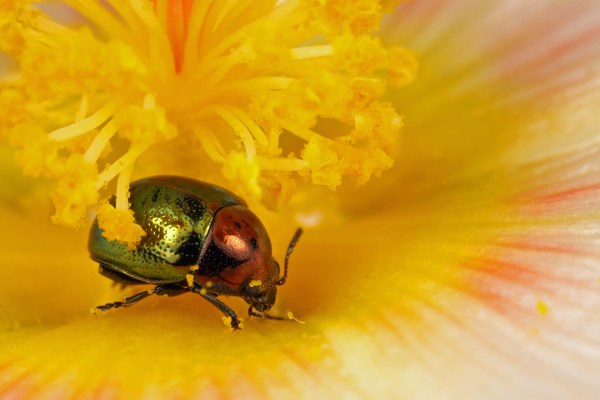

Spintherophyta (?) sp. in flower of Abutilon pauciflorum | Buenos Aires, Argentina

From  (posted 2 Feb). One of my 2012 learnings was that sometimes a photograph that is not so close is more effective than one that is as close as possible. In one of my earlier attempts at “not-so-close” macrophotgraphy, the soft colors of the flower compliment the brash shininess of the tiny leaf beetle that has been feeding on its pollen. Pink lines lead the eye directly to the subject and create a pleasing composition, and pollen grains stuck to the beetle—a distraction in some situations—add to the miniature natural history story of the photo.


Apiomerus flavipennis with stink bug prey and kleptoparasitic flies | Chaco Province, Argentina

From  (posted 11 Mar). I selected this photo solely for the complex natural history story drama it shows—stink bug (Piezodorus guildenii) feeding on soybean becomes prey of an assassin bug (Apiomerus flavipennis), with volatiles from the chemicals it emitted in a vain attempt to defend itself serving as cues to kleptoparasitic flies (families Milichiidae and Chloropidae) that benefit from the assassin bug’s labors.


Planthopper nymph | Buenos Aires Province, Argentina

From  (posted 26 Mar). Another learning that I began putting into practice in 2012 was the use of low perspective for compositional impact. The cryptic coloration of this planthopper nymph (family Fulgoridae) made it almost invisible on the branch on which it was sitting when viewed from a normal “top-down” human perspective. Getting “down under” it, however, brought the nymph to life and emphasized its unusual form.
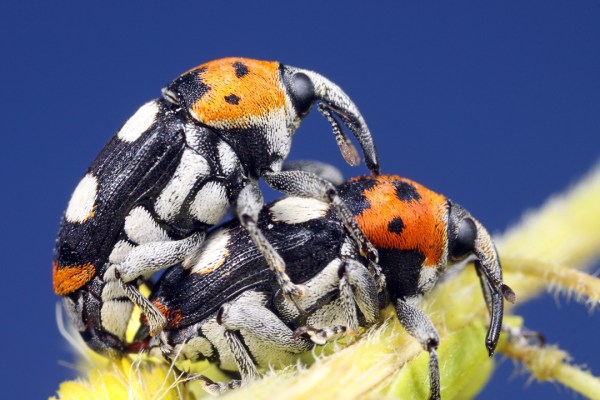

Megabaris quadriguttatus | Corrientes Province, Argentina

From  (posted 12 Apr). I spent much of 2012 working on the “blue sky background” technique, with these weevils from northern Argentina representing one of my better attempts. Macrophotography of insects with a blue sky background involves setting exposure, ISO, and aperture to achieve two separate exposures—full flash illumination of the subject for maximum depth-of-field, and ambient light from the sky to create a clean, uncluttered, natural-looking background. In this shot I managed to achieve an almost ideal shade of blue to compliment the wild black, white and red colors of the beetles. (My one criticism of the photo is having clipped one of the beetle’s feet.)


Bombylius sp. cf. mexicanus | Scott Co., Missouri

From  (posted 16 May). This photo is unusual if nothing else. Focus, lighting, depth-of-field, and composition are all better than can be hoped for in a single shot, but the subject—perfectly alive—is in a most unusual position. Read the original post to find out how this happened.


Perisphaerus sp. (a pill roach) | Vietnam (captive individual)

From  (posted 27 May). White-box photography is an excellent technique for clean, uncluttered photographs of insects, but it also isolates them from their natural surroundings and limits their natural history appeal. The best white-box photos are those that highlight a key feature or behavior of the subject—in this case a pill roach’s comically conglobulating defensive posture.


Micronaspis floridana (Florida intertidal firefly) larva | Pinellas Co., Florida

From  (posted 31 July). Here is another photo whose back story played a big part in its selection. This firefly larva not only represents a rare Florida-endemic species but was also first seen by my then 12-year old nephew, who willingly accompanied me through a dark, spooky salt marsh in the middle of a humid Florida night to see what he could learn. The lesson here for budding natural historians (and old-timers like me) cannot be overstated!


Arctosa littoralis (beach wolf spider) | Lewis Co., Missouri

From  (posted 23 Aug—prelude to  posted 28 Aug). Those who follow this blog know of my obsession with close-up portraits, and while tiger beetles are the subjects I most commonly photograph in this manner, I am always on the lookout for good subjects in other taxa. This wolf spider “face” almost looks human, with “two” eyes, two “nostrils” and a shiny upper lip above huge (albeit hairy) buck teeth! It’s enough fill-the-frame spidery goodness to melt (or explode) the heart of even the most ardent arachnophobe!
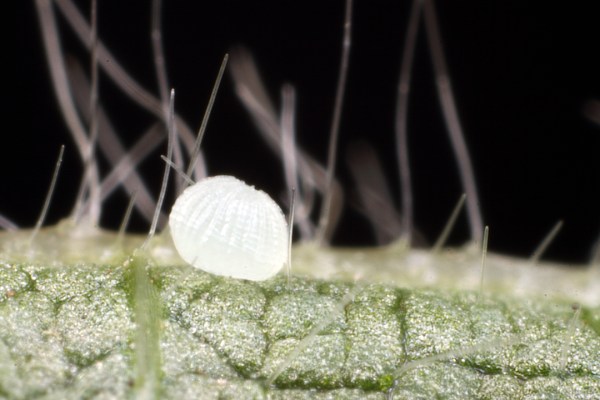

Anticarsia gemmatalis (velvetbean caterpillar) egg on soybean leaf

From Life at 8X—Guide to lepidopteran eggs on soybean (posted 3 Sep). “Life at 8X” was a new series I introduced this year, featuring insects photographed at magnifications testing the upper limit of my equipment and photographic skills. Diffraction is the chief difficulty with magnifications as high as this and is the primary flaw in the above photograph. Nevertheless, such view of a moth egg on the underside of a soybean leaf provides a spectacular view of the otherwise unseen micro-world that lives right beneath our noses.


Megacyllene decora (amorpha borer) on snakeroot flowers | Mississippi Co., Missouri

From  (posted 12 Sep). This second example of “blue sky background” was taken later in the year and was considerably more difficult to capture than the first because of the larger size of the subject and resulting need for a longer focal length macro lens. Getting a well-lit, focused, and composed image with a desirable shade of blue in the background depended not only on finding the proper camera settings, but also secure body and camera bracing techniques for this completely hand-held shot.


Cicindelidia politula politula (Limestone Tiger Beetle) | Montague Co., Texas

From  (posted 28 Sep). I will go ahead and say it—this is my favorite photograph of 2012. As discussed under the first entry, panning back from the subject can allow for some very interesting compositions. This photo combines charismatic pose by a wary subject with panning back and low perspective to create an image that scores high in both natural history and aesthetic appeal.


Calosoma sayi (black caterpillar hunter) | New Madrid Co., Missouri

From Black is beautiful! (posted 7 Nov). Of course, close-as-possible can also be used to create striking photos, especially if the subject exhibits features that are best seen up close. Anything with jaws fits the bill in my book, and highlighting the mandibular sculpturing of this caterpillar hunter (a type of ground beetle) required precise angling of the flash heads for maximum effect.


Cicindela repanda (Bronze Tiger Beetle) | St. Louis Co., Missouri

From  (12 Nov). This final selection is not a rare species, but it is as close as I have come to what I consider the “perfect” tiger beetle macrophotograph—a close, low angle, lateral profile of an adult in full-stilt posture (a thermoregulatory behavior), well lit, perfectly focused, and with a dynamic but pleasingly blurred background. It’s a perfect storm of a photo that took the better part of two hours to achieve—rarely do all of these elements come together in a hand-held photograph of an unconfined tiger beetle in its native habitat.


Well, there you have it. I hope you’ve enjoyed my selections, and again please do let me know if you have a personal favorite. See you in 2013!

Copyright © Ted C. MacRae 2012

Shooting 8X hand-held in the field

Just to prove it can be done, here is an uncropped photograph of the seed weevil Althaeus hibisci (or the closely related A. folkertsi) (order Coleoptera, family Chrysomelidae, subfamily Bruchinae). Adults of these species measure only 1.5–2.5 mm in length (Kingsolver 2004), yet this individual almost completely fills the frame:

Althaeus hibisci/folkertsi on Hibiscus moscheutos lasiocarpus | Route 66 State Park, St. Louis Co., Missouri

I achieved 8X magnification by stacking 68 mm of extension tubes under my Canon MP-E 65mm 1–5X macro lens and extending the bellows of the lens out to its maximum. Shooting 8X is not for the timid—the small subject to lens distance complicates lighting (full flash required), and even finding the subject in the viewfinder can be next to impossible. However, doing it hand-held in the field requires more than just courage and patience—good bracing techniques to minimize movement by and between the camera and the subject are essential. Here is how I do it:

  • I sit down, prop my knees up, and rest the camera in the crotch between my knees (the camera quickly becomes very heavy since it’s being held by only one hand—see next bullet) while positioning it near my face. If possible, I lean back against something as well to provide even more stability, although this is often not possible depending on field conditions.
  • I hold the leaf or flower supporting the subject in my left hand. Subjects this small are rarely going anywhere (or if they are skittish then I use the same slow, deliberate techniques that I use with larger skittish insects), so it is possible to hold the leaf or flower and position the subject right in front of the lens. Hand holding the subject’s support also affords the ability to micro-adjust the position and angle of the subject for optimum composition or to adjust for movement by the subject (easier than trying to track it by moving the lens). In this case of the photo featured here, I detached the leaf with the beetle from the plant (use small scissors to snip the leaf petiole, as this avoids the “jolt” that happens if you try to pick the leaf and which usually results in the subject fleeing). In other cases, I leave the leaf attached and carefully “pull” it towards me to hold it steady.
  • I look through the viewfinder and brace my left wrist (yes, the same hand that is holding the subject) on the underside of the lens, then slowly move the subject towards the lens with my fingers until I see movement and can micro-adjust for proper focus. Bracing your wrist against the lens is key—it is nearly impossible to hold the subject steady in front of the lens without bracing your wrist against it. In effect, this “fixes” the subject to the lens. Also, before I begin looking for the subject through the viewfinder I study its position on the leaf and look for “landmarks” that I can recognize when looking through the viewfinder to minimize the time needed to find the subject (the more time you spend looking for the subject, the greater the chance it will move or flee). Again, the subject to lens distance is very small, but with practice you’ll get a feel for precisely how far from the lens you need to place the subject.
  • I hold my breath and micro-adjust the subject position to nail the focus (usually on the eye) and then fire a shot. If it takes too long to get the focus I exhale and try again, as body shake will only get worse once it starts. Important: After taking the first shot, do not move the hand holding the subject as you look at the image preview and/or histogram—the first shot rarely has the settings precisely where you need them, and keeping the subject in place prevents a lot of re-searching after making the needed setting adjustments with the right hand.

Other than lighting, nailing the focus is the most difficult aspect of shooting hand-held at such high magnifications. The more relaxed and stable you can keep the rest of your body, the less hand movement you’ll experience while holding the subject and the greater chance you have of hitting the focus. Again, a fully extended MP-E lens on 68 mm of extension tubes becomes very heavy very quickly when held in one hand (even when resting on your knees), so expect your forearm muscles to give out quickly until you have a chance to strengthen them through practice.

I use these same techniques to some degree at lower magnifications as well—certainly for anything above 2X. I’m interested in doing a lot more 8X photography, however, because there is a whole world of tiny insects that are not being photographed due to their very small size. These insects are no less fascinating and beautiful than their larger, more oft photographed brethren.

Finally, you might be asking why I don’t just carry a tripod or collect subjects and bring them back to the studio for more controlled conditions. There are many photographers who advocate the use of tripods, but I’m not one of them. I am first and foremost an entomologist, and when I’m in the field I’m generally already carrying at least a net and other equipment for collecting insects. There are opportunity costs involved if I also try to lug a heavy tripod with me. What’s that? I could leave it in the car and then go get it when I need it? Honestly, I would pass on a lot of shots if I had to go back to the car to get something for it. The same goes for studio photography—there are many shots I would simply pass on if getting them meant that I needed to collect subjects, keep them in good condition for the duration of the trip (which might be days or more), and then setup in a studio. Moreover, there are many shots—specifically regarding behavior—that would be impossible with collected subjects. But really, it has mostly to do with what I want to be and portray as an insect photographer, and that is somebody who has the ability to photograph unconfined subjects exhibiting natural behaviors in their native habitats. Having the ability to shoot 8X hand-held in the field if I want to gives me more options and makes me a better photographer.

Do you have any special bracing or stabilizing techniques that you use for high-mag hand-held macrophotography? If so I’d love to hear about them.

REFERENCE:

Kingsolver, J. M. 2004. Handbook of the Bruchidae of the United States and Canada. U.S. Department of Agriculture, Technical Bulletin 1912, 2 volumes, 536 pp.
 
Copyright © Ted C. MacRae 2012

I fear no weevil…

Megabaris quadriguttatus (Klug, 1829) | Corrientes Province, Argentina

…especially when they are as colorful as these! I found this mating pair ~60 km south of Corrientes, Argentina feeding on flowers of what I presume to be the goldenrod species Solidago chilensis (family Asteraceae). Here, as in North America, goldenrod blooms in profusion along the roadsides during late summer and fall wherever moisture is to be found, and also as in North America goldenrod here is an insect magnet. During my week exploring Corrientes and Chaco Provinces, I learned to stop whenever I spotted a stand of the distinctive yellow blossoms. I found several stands and was treated to a variety of beetles, flies, and other insects that I’ll show over the coming days, with these being among the most striking that I found.

Weevils themselves may not be anything to be afraid of; however, their taxonomy is downright terrifying (and this coming from a beetle man!). With more than 40,000 described species worldwide (and who knows how many still awaiting description), the family Curculionidae (“true” weevils) may be the largest in the animal kingdom. I don’t know why, given the distinctive and striking coloration of these individuals, but I punted early and asked my friend Henry Hespenheide (a buprestid man, but knows a thing or two about weevils) if he knew what these were. Henry must have also been scared, because he went straight to the top and forwarded the photos to weevil heavy-hitters Charles O’Brien and Jens Prena, both of whom quickly replied back with an ID of Megadaris quadriguttatus (Klug, 1829). The state of weevil bionomics seems to be as incomplete as their taxonomy, as I was unable to find even the most basic information about the distribution and biology of this species (keep in mind I’m in Argentina right now with no access to libraries). As far as I can tell this is a strictly Neotropical genus.

Of course, had I checked Curculionidae de Argentina I might have noticed the photo of this species right there on the front page. Fear does strange things to one’s confidence.

Copyright © Ted C. MacRae 2012

Best of BitB 2011

Welcome to the 4th Annual BitB Top 10, where I get to pick my 10 (more or less) favorite photographs of the year. As an insect macrophotographer I still feel like a relative newcomer, although with three seasons under my belt fewer and fewer people seem to be buying it anymore. Granted I’ve learned a lot during that time, but the learning curve is still looking rather steep. I don’t mind—that’s the fun part! With that said, I present a baker’s dozen of my favorite photographs featured here during 2011. I hope they reflect the learnings I’ve had the past year and maybe show some progress over previous years (2009, 2008 and 2010).

One more thing—I’m including a special bonus for the first time in this year’s edition. Each of the photos shown below is linked to a 1680×1120 version that may be freely downloaded for use as wallpaper, printing in calendars, or any other use (as long as it’s personal and non-profit). It’s my way of saying thanks for your readership and support.


From  (posted 8 Jan). I’ve done limited photography with prepared rather than live specimens. However, the recreated aggressive-defensive posture of this greater arid-land katydid (Neobarrettia spinosa)—or “red-eyed devil”—was too striking to pass up. A clean background allows every spine and tooth to be seen with terrifying clarity.


From  (posted 6 Feb). I had never seen a cactus fly until I encountered this Nerius sp. I’m especially fond of the bizzarely-shaped head and un-fly-like spines on the front legs.


From  (posted 17 Feb). This photo of a fungus weevil, Phaenithon semigriseus, is one of the first where I nailed the focus right on the eye at such a magnitude of closeup (~3X) and also got the composition I was looking for. I didn’t notice at the time, but the beetle seems to be “smiling.”


From  (posted 28 Mar). One of the field techniques I’ve been practicing this year is actually holding the plant with the subject in one hand, resting the camera on my wrist and controlling it with the other hand, and manipulating the position of the plant to achieve a desired composition. It’s a difficult technique to master, but the results are worth it. The jumping spider, Euophrys sutrix, represents one of my earliest successful attempts with this technique.


From  (posted 30 Mar). This South American tree fruit weevil looks like it is sitting quite calmly on a branch. In reality, it never stopped crawling while I attempted to photograph it. Crawling subjects are not only difficult to focus on but also almost always have a “bum” leg. I achieved this photo by tracking the beetle through the lens and firing shots as soon as the center focus point flashed, playing a numbers game to ensure that I got at least one with all the legs nicely positioned. I’d have been even happier with this photo if I had not clipped the antennal tip.


From  (posted 4 May). Face shots of predatory insects are hard to resist, and in this one of the fiery searcher beetle, Calosoma scrutator, the angle of the subject to the lighting was perfect for showing off every ridge and tooth in its impressive mandibles.


From  (posted 10 May). I’ve taken plenty of lateral profile shots of tiger beetles, but I like this slightly panned out one especially because of the sense of scale and landscape created by the inclusion of the plantlets and the view over the small rise.


From  (posted 18 May). I found these Edessa meditabunda stink bug eggs on the underside of a soybean leaf in Argentina almost ready to hatch. The developing eye spots in each egg gives the photo a “cute” factor rarely seen in such super close-ups.


From  (posted 15 July). Some of my favorite insect photos are not only those that show the bug in all its glory, but also tell a story about its natural history. This nymphal lichen grasshopper, Trimerotropis saxatilis, is almost invisible when sitting on the lichens that cover the sandstone exposures in its preferred glade habitat. 


From  (posted 23 Aug). I know this is the second beetle face shot I’ve included in the final selections, but it was while photographing this rare Florida metallic tiger beetle, Tetracha floridana, in the middle of the night that I discovered the use of extension tubes to improve the quality of flash lighting (decreased lens to subject distance results in greater apparent light size). This is perhaps one of the best illuminated direct flash photographs that I’ve taken, and I also like the symmetry of the composition.


From  (posted 17 Sep). The three-cornered alfalfa hopper (Spissistilus festinus) is a common pest of alfalfa and soybean in the U.S. However, despite its abundance, I’ve never noticed the bizarre zig-zag pattern of the eyes until I took this photo. Even though both the insect and the background are green, there is sufficient value contrast to create a pleasing composition. Bumping up the ISO and a lower FEC setting prevented overblowing the light greens—easy to do with full flash macrophotography.


From  (posted 4 Oct). This longhorned beetle had settled in for the night on its Ericamera nauseosa host plant, allowing me to use higher ISO and lower shutter speed settings with a hand-held camera to achieve this very pleasing blue sky background, while retaining the sharpness of detail of the subject that comes from full-flash illumination. The blue sky background provides a more pleasing contrast with the colors of this particular beetle and flowers than the black background that is more typically seen with full-flash macrophotography.


From  (19 Dec). An uncommon underside view of these purple tree fungus (Trichaptum biforme) caps and use of flash illumination allows the colors to literally glow against the bright green lichens also growing on the tree. Keeping aperture at a moderate setting allows blurring of the caps further back, adding three-dimensionality to the photo and preventing it from looking ‘flat.’


Well, there you have it, and I hope you’ve enjoyed my selections. Please do tell me if you have a favorite among theses (and if there were other photos posted during 2011 that you think deserved making the final selections).

Copyright © Ted C. MacRae 2011

Different Jaws for Different Jobs

Arrhenodes minutus (oak timberworm) | Wayne Co., Missouri

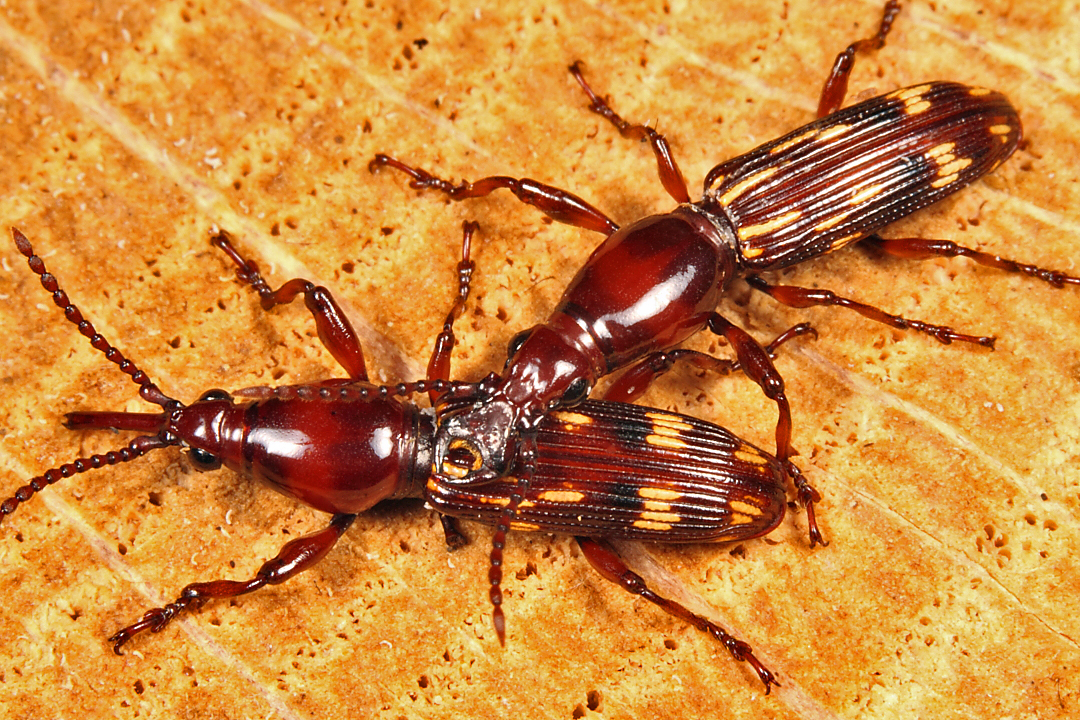
If you’re interested in wood boring beetles and live in the eastern  U.S. like I do, you’re sure to encounter sooner or later the region’s sole¹ “primitive weevil” (family Brentidae), the oak timberworm (Arrhenodes minutus).  This beetle develops as a larva in the wood of living trees exposed by wounding, creating numerous small “worm holes” that can occasionally degrade the value of wood grown for timber.  Females are presumably attracted to volatiles given off by wounded wood for oviposition, thus they are also commonly attracted to the trunks and stumps of trees harvested for lumber or cut for some other reason.  Cut trees are also highly attractive to wood boring beetles in the families Buprestidae and Cerambycidae—my primary taxa of interest, so I’ve seen more than a few oak timberworms over the years, including this male and female that I found on the cut stump of a large black oak (Quercus velutina) in Sam A. Baker State Park, Wayne Co., Missouri.

¹ Actually, there are three other species in eastern North America as well, but all are Neotropical species that occur no further north than the southern tip of Florida (Thomas 1996).

Female - beak thin and elongate

Male - beak short w/ robust mandibles

An interesting feature of oak timberworms and related species of primitive weevils is the rather extreme sexual dimorphism exhibited in the shape and function of the mandibles.  Mandibular sexual dimorphism is actually quite common across many groups of beetles, but in most cases the males simply have proportionately larger mandibles than females due to their use in sexual combat (think stag beetles, for example).  Oak timberworm males also have enlarged mandibles for combat with other males (males are territorial and guard females during oviposition).  The females, however, rather than simply having smaller yet similarly shaped versions of the male mandibles, instead have tiny little mandibles at the end of a greatly narrowed and elongated rostrum (beak).  This is because, unlike most other beetles in which the female mandibles lack a specific purpose, female oak timberworms use their mandibles to “drill” holes into the wood in which they will insert their eggs.  Different forms for different functions!

Mate-guarding behavior

I have read reports of males assisting females in removing her beak if stuck in the wood while drilling an egg hole by “stationing himself at a right angle with her body and pressing his heavy prosternum against the tip of her abdomen, her stout fore legs thus serving as a fulcrum and her long body as a lever” (Riley 1874, as quoted in Thomas 1996), making this a rare instance of tool use by insects.  I have not observed this behavior myself, but it is common to find the males in various mate guarding positions over the female as pictured above.

REFERENCE:

Riley, C. V. 1874. The northern brenthian—Eupsalis minutus (Drury). (Ord. Coleoptera; Fam. Brenthidae). Sixth Annual Report on the Noxious, Beneficial, and Other Insects, of the State of Missouri. Began and Carter, Jefferson City, Missouri, 169 pp.

Thomas, M. C. 1996. The primitive weevils of Florida (Coleoptera: Brentidae: Brentinae). Florida Department of Agriculture & Consumer Services, Division of Plant Industry, Entomology Circular No. 375, 3 pp.

Copyright © Ted C. MacRae 2011

Sugarcane Weevil in Brazil

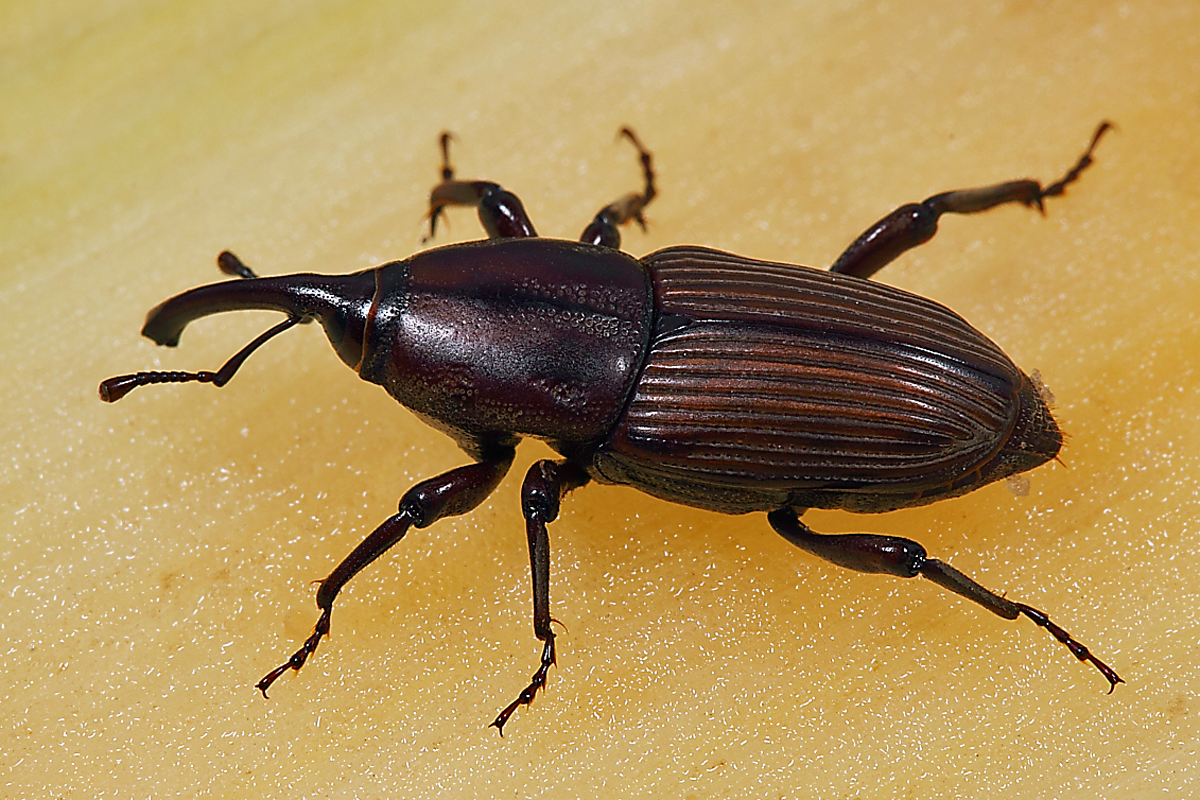
Sphenophorus levis (sugarcane weevil) | Conchal, Brazil.

Brazil is one of the world’s top producers of sugarcane, and they have the Middle East to thank for it.  While the U.S. was responding to the 1973 OPEC oil embargo by building bigger and bigger SUVs, Brazil aggressively developed an alternative fuels industry based on sugarcane for ethanol production.  Today, about half of Brazil’s sugarcane is milled for ethanol, yet despite this enough raw sugar is produced from the remaining sugarcane crop to rival India as the world’s top producer.

The large acreage devoted to sugarcane and tropical climate in which it is grown make Brazil’s crop especially vulnerable to infestation by insect pests—and there are many!  One of the most important is Sphenophorus levis (sugarcane weevil, or “bicudo da cana-de-açúcar”).  Larvae bore in the roots and crown of the plant, reducing biomass accumulation and longevity.  This feature of the insect’s biology also makes the larvae extraordinarily difficult to control, since they are largely protected from chemical applications by surrounding plant tissues.  This adult beetle was captured in a field trap placed in a sugarcane field in Conchal, approximately 175 km N of São Paulo.  The traps consist of split sugarcane stalks buried under debris within crop rows—adults are attracted to the cut surface of the stalks, where they congregate in numbers.  Traps are used not only to monitor beetle occurrence and abundance in fields, but also to provide a source of insects for laboratory rearing and evaluation of control test agents.

Copyright © Ted C. MacRae 2011

Bichos Argentinos #7 – Naupactus xanthographus

Naupactus xanthographus (South American fruit tree weevil) | Buenos Aires, Argentina

This weevil (family Curculionidae) was one of just a few beetle species that I encountered earlier this month in Buenos Aires, Argentina at La Reserva Ecológica Costanera Sur.  Weevils are, of course, one of the most taxonomically diverse and difficult groups of Coleoptera, making species IDs based purely on photographs quite challenging.  Nevertheless, I am reasonably confident that this individual represents Naupactus xanthographus, or the South American fruit tree weevil.  This name, it seems, has also been applied to a variety of other weevils photographed in South America and posted on the web, but the images I found at a few seemingly more authoratative sites give me confidence that this is the true N. xanthographus.  The narrow form suggests this individual is a male.

The genus, known collectively as “white-fringed weevils” is a large genus of exclusively Neotropical species – several of which have been introduced to North America (e.g., N. cervinus, Fuller rose beetle, and N. leucoloma) and which were, until recently, placed in a separate genus Graphognathus (Lanteri and Marvaldi 1995) (apparently the reduced humeri and lack of metathoracic wings were deemed insufficient for generic distinction).  In South America some of the species have become pests as well, with N. xanthographus becoming a problem for growers of grapes and other fruits and, thus, earning the names “burrito de la vid” (Chile) and “mulita de la vid” (Argentina) (both roughly translating to “grapevine little donkey”).

This was not an easy photograph to get – I found the weevil clinging to the underside of a leaf above my head.  It was impossible to photograph it in situ, so I moved it to a low twig away from other foliage where I could get the black background I desired.  Once moved, however, the weevil just never… stopped… crawling.  Snapping shots of an actively crawling insect is a crap shoot at best – not only are focus and framing more difficult to nail, but subjects photographed while moving almost always have one or two “bum” legs (lifted or cocked out of position).  A number of attempts were required to get a photo I was happy with (save for the slightly clipped antennal tip).  In such situations, I’ve found it best to track the beetle as it moves and as soon as the center focus point of the lens flashes take the shot.  This at least gives the best chance for nailing the focus, and then it’s simply a numbers game to get a shot with good framing and composition and all the body parts well placed.  Of course, I could’ve zoomed out and just cropped to perfection, but this feels a little like cheating – I’d rather put in the time and practice perfecting my game out in the field as much as possible.  An occasional clipped antenna, tarsus, etc. now will lead to better results down the line.

REFERENCE:

Lanteri, A. A. and A. E. Marvaldi. 1995. Graphognathus Buchanan a new synonym of Naupactus Dejean and systematics of the N. leucoloma species group (Coleoptera: Curculionidae). Coleopterists Bulletin 49(3): 206-228.

Brazil Bugs #13 – Gorgulho do fungo

Phaenithon semigriseus (Anthribidae) - Parque Municipal, Distrito Barão Geraldo, São Paulo, Brazil. ID by Jose Ricardo M. Mermudes.

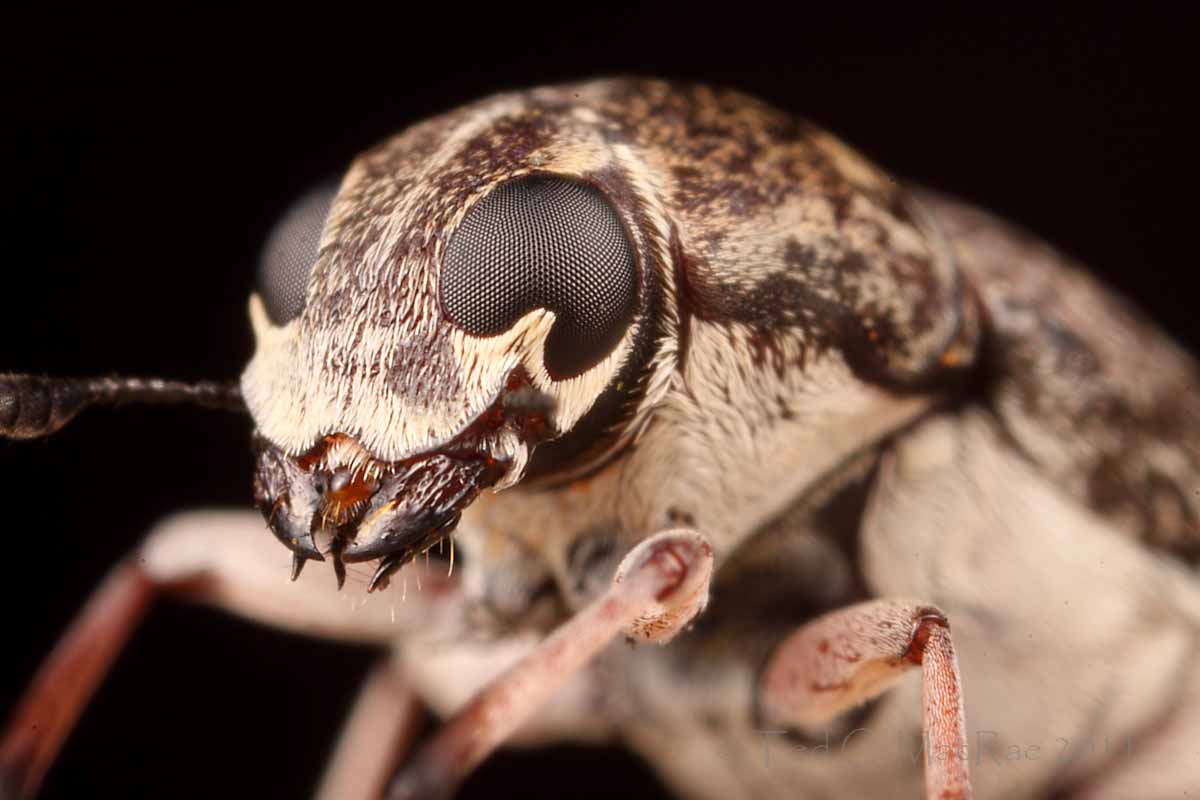
Over the weekend during my trip to Brazil last month, I took a walk in the municipal park near my colleague’s home in Barão Geraldo. There was a rather large lake with a walking trail going around it, and although much of the vegetation was planted, there were some less kempt and more native-looking sections along the trail where I hoped to find some insects to photograph. As it turned out, there weren’t a whole lot of interesting insects, but I did see a capybara (“capivara” in Portuguese) – the largest rodent species in the world (picture a guinea pig the size of a small real pig) – for a brief moment before it splashed in alarm into the lake and swam away. One of the few interesting insects I did see was this little fungus weevil (family Anthribidae) on the bark of a large, recently felled tree. At only ~3-4mm in length, it was a rather tiny species as anthribids go – especially in the tropics – and lacked the comically elongated face that some species possess. Still, there is something humorous in its portrait.

Fungus weevils differ from true weevils (family Curculionidae) by having the antennae unelbowed.  I have no clue about the identity of this individual below family level, and there don’t seem to be a whole lot of entomologists that study this group of weevils (should anybody have a clue, please do leave a comment).  I simply must post these photos, however, because I think it is the first time I actually nailed the focus right on the eye with a closeup of this magnitude (~3X).  I actually took some closer shots also (in the 4X range), but I really didn’t care for the composition with the lens zoomed in to that degree.

Update 02/17/11, 9:53 a.m.: I just received an email from Jose Ricardo M. Mermudes (Universidade Federal do Rio de Janeiro), who informs me that the species is Phaenithon semigriseus (Germar, 1824). It would seem that this photo at Coleoptera Neotropical has, until now, been the only image of this species on the web.

My thanks to Dr. Mermudes! 

Copyright © Ted C. MacRae 2011