🌿 Botanizing w/ the WGNSS Botany Group at Victoria Glades Preserve

6 Oct 2025—Fall continues to advance in the St. Louis area, and despite very dry conditions during the past two months the fall bloomers continue to make their appearance. One of the area’s most reliable and interesting places to see fall blooms is Victoria Glades south of Hillsboro, where orchids, gentians, and asters anchor a unique suite of fall-blooming plants that are rarely seen elsewhere in our mostly forested environs.

The group chose the Nature Conservancy portion of the complex to explore, as it was in the mesic forest along the riparian corridor below the glade on this side that the first of two orchids—the charmingly diminutive and seldom-seen Spiranthes ovalis (lesser ladies’ tresses)—was expected to be seen in bloom. Despite having recently taken GPS coordinates for the plants, it took several minutes of the group scouring the area around the coordinates before the tiny plants were finally found. Its delicate blooms, fall flowering season, small size, presence of basal and cauline leaves at anthesis, and preference for mesic habitats all serve to identify this species. Missouri’s populations are considered var. erostella, which lack certain essential flowering organs and are, thus, self-pollinated (cleistogamous).

Spiranthes ovalis var. erostellata (lesser ladies’ tresses—family Orchidaceae).

Clambering up and out of the creek bed and onto the open glade, the group found, again with some difficulty, the second orchid we were looking for—Spiranthes magnicamporum (Great Plains ladies’ tresses). Unlike S. ovalis, however, this species is much more commonly seen on dolomitic glades throughout the state, and there have been fall seasons at Victoria Glades featuring spectacular displays of it. Sadly, it does not appear that this will be one of those falls, almost surely because of the near absence of rain in recent months. The first two plants were found under and next to a cut eastern red-cedar, whose cadaver perhaps provided just enough protection to prevent a complete drying of the soil underneath and allowed the two plants to proceed to flowering. Of the nine species of Spiranthes presently known to occur in Missouri, S. magnicamporum is among the showiest due to its robust, often doubly helical inflorescences and relatively large flowers with spreading and arching lateral sepals. It is also among the most fragrant, with a sweetish fragrance of coumarin, which some people liken to vanilla.

Spiranthes magnicamporum (Great Plains ladies’ tresses—family Orchidaceae).

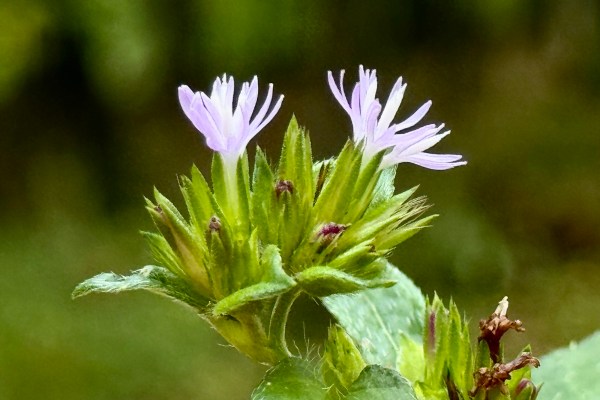
I’ve been visiting Victoria Glades for more than 40 years, yet I continue to see things I haven’t previously notified. This time it was Trichostema coeruleum (pennyroyal bluecurls), a member of the mint family (Lamiaceae). [Note: Trichostema coeruleum was known until recently as Trichostema brachiatum—now a synonym of Trichostema dichotomum.] Unlike Trichostema dichotomum (bluecurls), which prefers glades and other dry habitats with acidic substrates (e.g., sandstone), T. coeruleum prefers such habitats with calcareous substrates (e.g., dolomite). A third species of the genus, Trichostema setaceum (narrow-leaf bluecurls), also occurs in Missouri but is restricted to sand prairies in extreme southeastern Missouri.
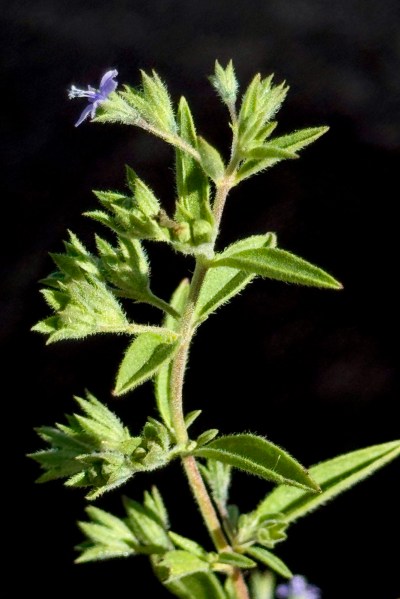
Trichostema coeruleum (pennyroyal bluecurls—family Lamiaceae).

Dolomite glades are also the preferred habitat for many species of plants in the family Orobanchaceae, a bizarre family of mostly hemiparasitic plants that derive at least some of their nutrition not from the sun, but by tapping into the roots of nearby plants. Castilleja coccinea (scarlet paintbrush) is perhaps the best known of these, in most years joining the cacophony of wildflowers that form colorful displays across Victoria Glades during spring and early summer. There are, however, several less conspicuous but equally beautiful wildflowers in the family that are restricted in the area almost exclusively to the dolomite glades of Jefferson Co. One of these is Agalinis skinneriana (Skinner’s or pale gerardia/false foxglove), which the group found sporadically still in bloom across the open glade. There are several species of Agalinis in Missouri, some of which are quite common. However, A. skinneriana can usually be recognized by the characteristic habitat and generally upward-facing flowers with spreading to reflexed upper corolla lobes. The plants are also relatively slender and fewer-branched than the more common A. tenuifolia (common gerardia/false foxglove) and A. gattingeri (rough-stemmed gerardia/false foxglove).

Agalinis skinneriana (Skinner’s or pale gerardia/false foxglove—family Orobanchaceae).

Another plant in the family Orobanchaceae that the group saw was Buchnera americana (American bluehearts), represented by a single plant still bearing two worn blossoms. Normally blooming from June through September, plants in full bloom have no look-alikes and are not likely to be confused with anything else. Despite this, the vervain-like fruit-bearing structure of this late straggler fooled the group into at first thinking it was a species of Verbena until its true identity was realized.
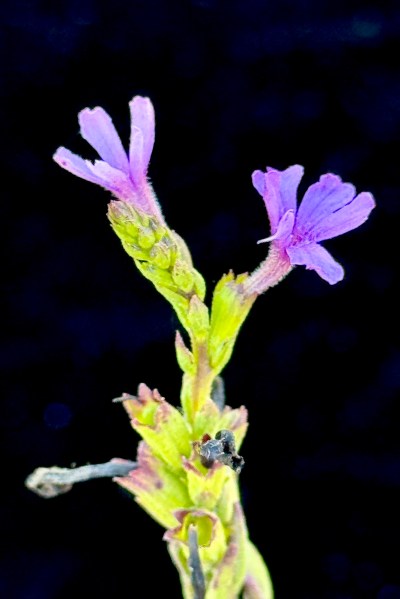
Buchnera americana (American bluehearts—family Orobanchaceae).

No group of plants more iconically represents fall than goldenrods (genus Solidago) and true asters (genus Symphyotrichum), and no place allows as many uncommonly seen species to be seen together as the dolomite glades. Three species of goldenrods were seen during the day—the super common Solidago nemoralis (old field goldenrod), the less common but more showy Solidago rigida (stiff goldenrod), and the highly restricted Solidago gattingeri (Gattinger’s goldenrod) (we were not able to locate a fourth species—Solidago radula [rough goldenrod], which we have observed during previous visits on the MDC portion of Victoria Glades). It was the true asters, however, that truly tested our plant identification abilities. Relatively easier are the purple asters, of which we found three species. The first and most abundant was Symphyotrichum oblongifolium (aromatic aster), recognized by its recurved phyllaries and branched habit with narrow, linear leaves that become more numerous and smaller in the upper plant. If one is still in doubt as to its identity, however, one needs only to crush the leaves between the fingers and enjoy its distinct aroma.
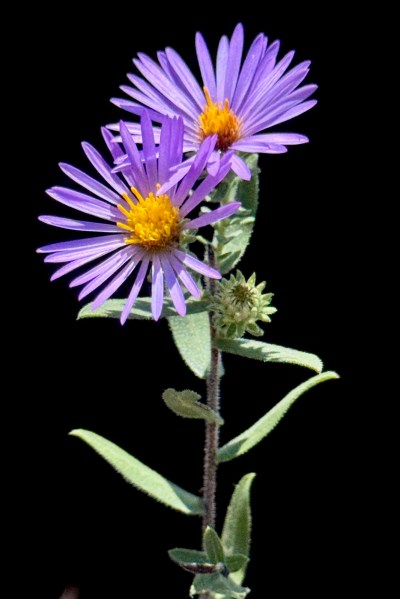
Symphyotrichum oblongifolium (aromatic aster—family Asteraceae).

Along the intermittent creek and near the interface with the dry post oak woodland on the north of the glade, we encountered a second species—Symphyotrichum oolentangiense (azure aster). Identification of this species came only near the end of the outing, as a key identifying characteristic of this species—the presence of distinctly petiolate cordate basal leaves that are rough to the touch—was not seen on any of the plants examined before then. At that point, we suspected Symphyotrichum turbinellum (prairie aster) due to the vase-shaped involucres. While that species has been found at Victoria Glades, it is usually a much more highly branched plant associated with more wooded habitats (despite the common name). Finally, we found a plant with such leaves present, albeit dried up, and then another with the leaves present and still fresh to confirm the identification.
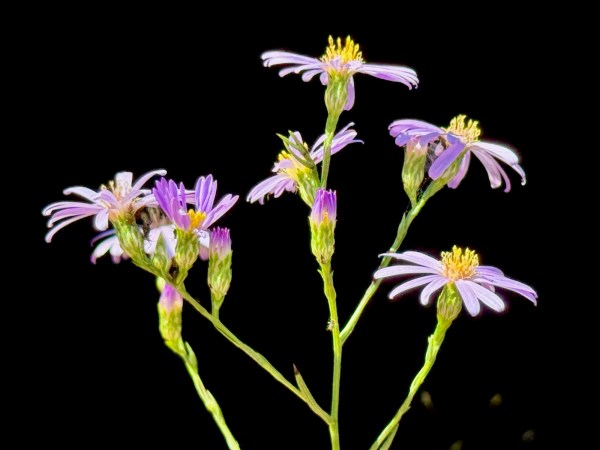
Symphyotrichum oolentangiense (sky blue aster—family Asteraceae).

In a small area at the northernmost point of the glade, we found Symphyotrichum sericeum (silky aster). This species is immediately recognizable from afar by the silvery cast to the foliage—this, combined with its highly preferred habitat of glades or dry prairies are usually enough to identify the species, although it is said that the flowers are often more purple and less bluish than other “purple asters.”
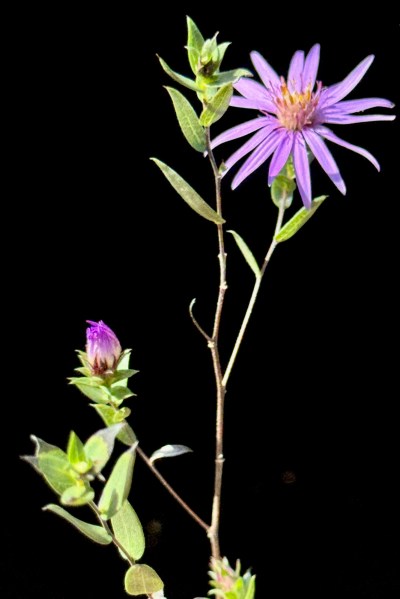
Symphyotrichum sericeum (silky aster—family Asteraceae).

As we walked the margins of the glade, the group kept their collective eyes out for Gentiana puberulenta (downy gentian), a striking and rarely seen fall flowering species that has been found on several occasions at Victoria Glades. The species has been seen at Victoria Glades on a few occasions in past years, and the locations of these sightings were scoured thoroughly but without success. Unexpectedly, near the end of the outing, a single plant in flower was located—its perfectly fresh blossom initially hidden from view underneath fallen leaves. One of three members of the genus Gentiana in Missouri, this species is easily differentiated by having the corolla spread open at maturity. Missouriplants.com notes “The rich, deep blue color of the corollas is a striking and uncommon hue among our flora.” A strikingly beautiful final find of the day indeed, and a perfect note on which to gather for lunch at historic Russell House in nearby Hillsboro.

Gentiana puberulenta (downy gentian—Gentianaceae).

For me, no botany outing is strictly about plants (just as no entomology outing is strictly about insects), so there were a few interesting insect observations on the day. On our way to look for Spiranthes ovalis (lesser ladies’ tresses), June noticed a caterpillar on the Ulmus rubra (slippery elm) that we decided must represent Halysidotus tessellaris banded tussock moth).

Halysidota tessellaris (banded tussock moth—family Erebidae) on Ulmus rubra (slippery elm).

Later, after lunch with the group, I returned with the goal of more closely inspecting Physocarpus intermedius (Midwest ninebark) along the glade toeslopes and intermittent creek to see if Dicerca pugionata was out. It has been many years since I’ve seen this species in the fall (but it has also been many years since I’ve really tried to look for it during the fall). I started first with the plants along the moist toeslopes along the west side of the glade, checking several of the now very scraggly-looking plants without success. Along the way, I encountered an especially beautiful Spiranthes magnicamporum, so I paused to take photos. While doing so, I noticed a cryptically-colored crab spider on its blossoms—Mecaphesa asperata (northern crab spider)—the first time I’ve ever seen a spider hunting on the flowers of an orchid.
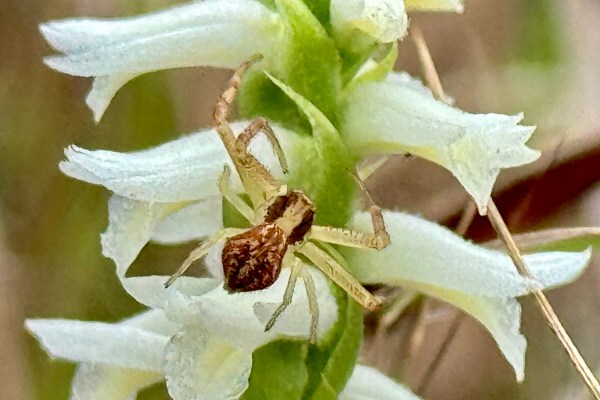
Mecaphesa asperata (northern crab spider—family Thomisidae) on flowers of Spiranthes magnicamporum (Great Plains ladies’ tresses).

Towards the end of the toeslopes, finally, two D. pugionata plopped onto my sheet. The plant they were on was near the far end of the toeslopes, and if I hadn’t seen any beetles by the time I reached the far end I would have given up the search. Finding them, however, motivated me to hike over to and continue looking along the intermittent creek, where I saw three more beetles in three different spots, the last one—satisfyingly—on the very last plant I checked before the creek disappears into denser woodland.

Dicerca pugionata (ninebark borer—family Buprestidae) beaten from living Physocarpus intermedius (Midwest ninebark).

Mission accomplished, I enjoyed one more leisurely stroll across the glade before calling it another (successful) day in the field.

©️ Ted C. MacRae 2025
Botanizing w/ the WGNSS Botany Group at Salt Lick Point

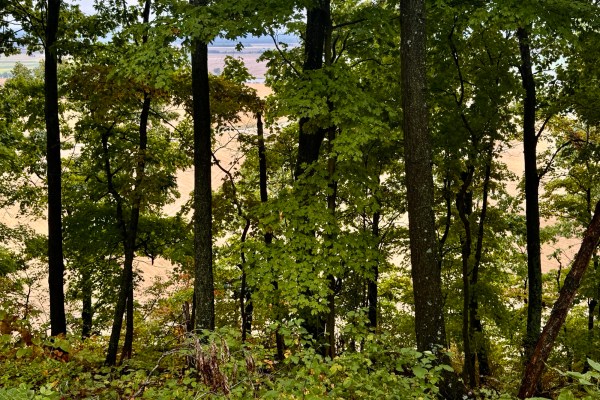
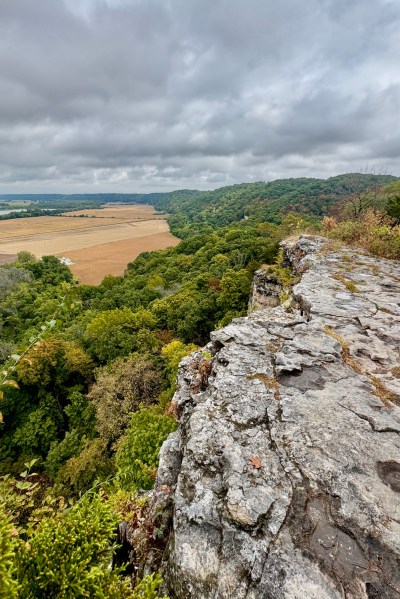
After missing the last three weeks, I was happy to rejoin the WGNSS botanists on their regular weekly outing this past Monday. This week’s destination—Salt Lick Point Land & Water Reserve in western Monroe Co., Illinois—features a mosaic of loess hill prairie and limestone glades amidst dry to dry-mesic upland forest atop limestone bluffs towering up to 400 feet above the Mississippi River valley below.

View from the Newman Trail at Salt Lick Point.

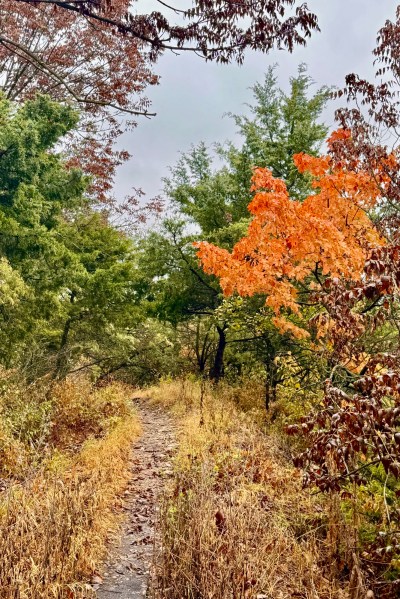
It has been an exceptionally dry August and September, so much that fall blooming plants are noticeably delayed and sparse in their blooms. Nevertheless, welcome rains just in the past few days have breathed some “fall life” into the woods and brought with them the pungent, earthy aromas that one expects to accompany a landscaping morphing from the dull greens of summer to the vibrant ambers, tawnies, and golds of fall.

View from the Salt Lick Trail at Salt Lick Point.

The group first explored the upland and blufftop habitats along the challenging terrain of the Salt Lick and Newman Trails, then returned through flat lowlands along the bluff bottoms via the Johnson Trail. Although still just beginning to bloom, a diverse palette of “fall asters” gave us an opportunity to reacquaint ourselves with the characters that distinguish these often “easy-to-identify-to-genus but difficult-to-identify-to-species” plants. The bulk of these fell into one of two groups—the true asters (genus Symphyotrichum) and the goldenrods (genus Solidago).

Salt Lick Trail at Salt Lick Point.

Symphyotrichum patens (late purple aster) was the first true aster that we noticed, a rather common species distinguished by its purple (of course) flowers with loose but not recurved phyllaries and leaves broadly clasping the stem. It wasn’t long before we had a chance to test our knowledge when we encountered the similar appearing Symphyotrichum anomalum (manyray aster), also with purple flowers but distinguished from S. patens by its distinctly recurved phyllaries and petiolate rather than clasping leaves. Eventually, we would encounter a third species of the genus—Symphyotrichum lateriflorum (calico aster), distinguished by its numerous small white flowers at the tips of numerous lateral branches rather than the terminus of the stem.

View from the Newman Trail at Salt Lick Point.

Goldenrods, on the other hand, were not only more diverse but also comprised some quite conservative species. The first of these was Solidago drummondii (Drummond’s goldenrod). This near-endemic species is restricted to eastern Missouri and adjacent parts of Illinois and Arkansas and grows almost exclusively on limestone or dolomite bluffs. However, we found it growing on limestone boulders placed at the trailhead next to the parking lot. Its wide, toothed leaves on short petioles (along with habitat) make this species easy to identify. Another quite conservative goldenrod was found as we entered the dry to dry-mesic forest further up the trail—Solidago buckleyi (Buckley’s goldenrod). Restricted to the Ozarks and adjacent areas, it is a showy species with relatively large flowers and spready phyllaries. In this and other respects, it greatly resembles the much more common Soldago petiolaris (downy goldenrod); however, it differs from that species by its narrower leaves that lack distinct teeth. A third species was seen as we approached one of the larger loess hilltop prairie remnants—Solidago altissima (tall goldenrod). Unlike the previous two species, this is one of the commonest and weediest species of goldenrod in the region. Relatively tall and with pyramidal inflorescences, this species often aggressively monopolizes roadsides and fallow fields. It greatly resembles another fairly common species—Solidago gigantea (late goldenrod), which we would later see during the return hike along the edge of the river valley. Leaf texture, however, differs between these two species—S. altissima has leaves with rough surfaces (caused by stiff, unidirectionally recurved hairs that cause the leaf to move only one direction when rubbed between the thumb and forefinger), while S. gigantea has smooth leaves (that move in any direction when rubbed).

Elephantopus carolinianus (Carolina elephantsfoot, leafy elephant’s foot—family Asteraceae).

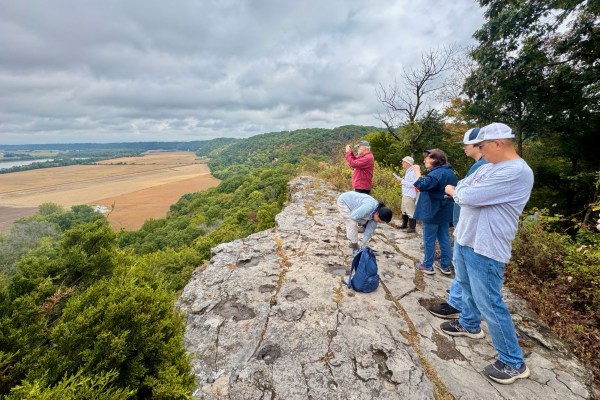
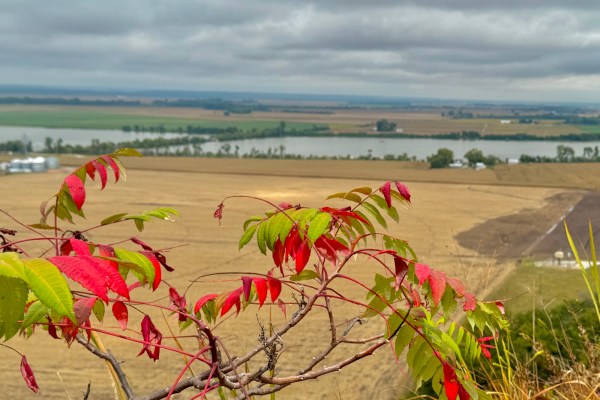
The group not only spent its time with its eyes down, but also out—across the vast Mississippi River valley spread out below the several lookout points dotting the trails. Tawny fields of near-ready-to-harvest corn provided a beautiful backdrop against the resplendent red sumacs and brilliant orange maples lining the blufftops.

Members of the WGNSS Botany Group admire the view from the Newman Trail at Salt Lick Point.
View from the Newman Trail at Salt Lick Point.

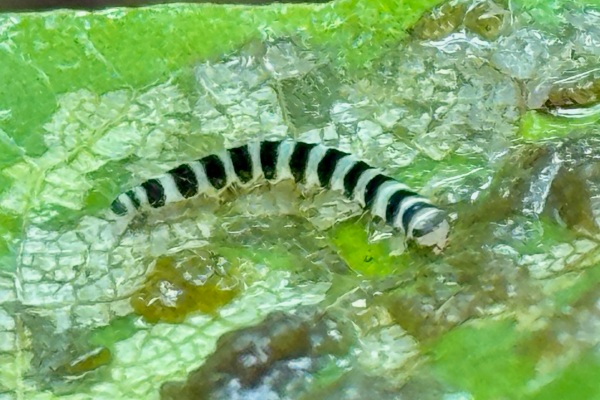
As the group’s lone entomologist/botanist (“entomotanist”?), I also kept an eye out for insects and was richly rewarded. A tiny “thorn” on the stem of S. buckleyi proved to be Enchenopa latipes (wide-footed treehopper), and unfolding the “folded” leaves of Cercis canadensis (eastern redbud) revealed the culprits—zebra-striped caterpillars of Fascista cercerisella (redbud leaffolder moth).

Enchenopa latipes (wide-footed treehopper—family Membracidae) on stem of Solidago buckleyi (Buckley’s goldenrod).
Fascista cercerisella (redbud leaffolder—family Gelechiidae) on Cercis canadensis (eastern redbud).

A spectacular earth boring beetle, Geotrupes splendidus, was seen lumbering clumsily along the trail in its endless quest for mammal dung to bury and lay an egg upon, while Bombus impatiens (common eastern bumble bee) worked the flowers of Eupatorium altissimum (tall boneset) and Eupatorium serotinum (late boneset).

Geotrupes splendidus (splendid earth-boring beetle—family Geotrupidae) on trail through dry-mesic loess woodland.
Bombus impatiens (common eastern bumblebee—family Apidae) on flower of Eupatorium altissimum (tall boneset).

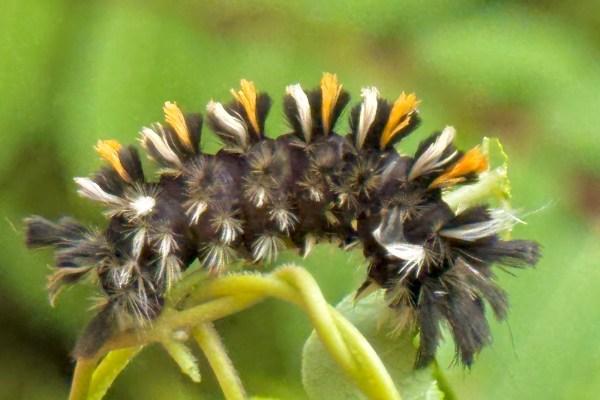
A nearly mature Euchaetes egle (milkweed tussock moth) consumed the dwindling foliage of Cynanchum laeve (climbing milkweed), and Piezogaster calcarator (leaf-footed bugs) congregated on the inflorescences of Verbesina alternifolia (yellow ironweed).

Euchaetes egle (milkweed tiger moth, milkweed tussock—family Erebidae) on Cynanchum laeve (climbing milkweed).
Piezogaster calcarator (leaf-footed bug—family Coreidae) on flower of Verbesina alternifolia (yellow ironweed).

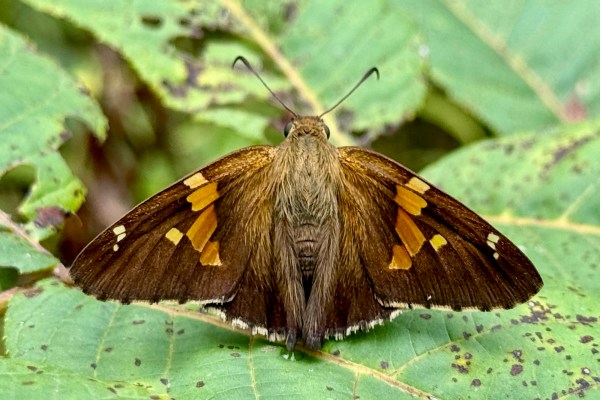
Nowhere, however, was insect activity more abundant than on the goldenrods, particularly the abundant stands of S. altissima in the uplands and S. gigantea below. Overwhelming numbers of Chauliognathus pennsylvanicus (goldenrod soldier beetles) and Lycomorpha pholus (black and yellow lichen moths) were accompanied by a cacophony of bees, wasps, and flies—a situation tailor made for Phymata sp. (jagged ambush bugs) to lay in wait while Epargyreus clarus (silver-spotted skipper) flew erratically overhead.

Phymata sp. (jagged ambush bug—family Reduviidae) mating pair on flower of Solidago altissima (tall goldenrod).
Epargyreus clarus (silver-spotted skipper—family Hesperiidae) perched on Solidago altissima (tall goldenrod).

Even in the deeply shaded mesic forest, Cyllopsis gemma (eastern gemmed satyrs) flitted deftly through the undergrowth.

Cyllopsis gemma (eastern gemmed satyr—family Nymphalidae) in mesic riparian forest.

The most unusual find, however, was a bizarre, green, jewel of a caterpillar found crawling on the forest floor—Isa textula (crowned slug moth or skiff moth), fringed with lacy projections that make it look more like a sea slug than an insect!

Isa textula (crowned slug moth, skiff moth—family Limacodidae) in leaf litter of mesic riparian forest.

Of course, a Monday WGNSS Botany Group outing isn’t truly consummated until it has enjoyed lunch at a local establishment—the choice this time being Tequila Mexican Restaurant in nearby Waterloo (best fish tacos I’ve ever had!).

©️ Ted C. MacRae 2025

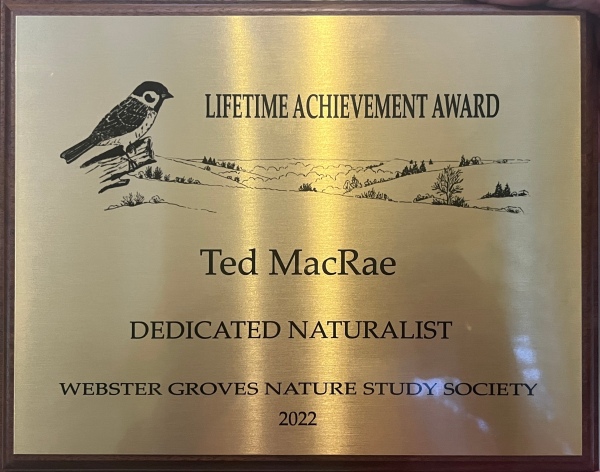
WGNSS 2022 Lifetime Achievement Award

Earlier this month on May 10th, the Webster Groves Nature Study Society (a.k.a., “WGNSS”) held its annual Spring Banquet at the Palm House in Tower Grove Park, St. Louis, Missouri—-the first Spring Banquet since 2019 (the last three years having been cancelled due to the COVID-19 pandemic). It was a lovely event in a beautiful venue with fantastic food, and I think all in attendance were happy to resume this annual society tradition. Part of this tradition includes announcing the year’s recipient of the WGNSS Lifetime Achievement Award—given to individuals that have made significant and sustained contributions to the Society. With three “lost” years to make up for, the WGNSS Board selected three individuals as recipients for those years. The 2020 recipient was the night’s featured keynote speaker and Past-President, George Yatskievych, formerly Curator of Botany at the Missouri Botanical Garden and now at the University of Texas in Austin. The 2021 recipient was my longtime friend and collecting partner, Richard Thoma, also Past-President, former leader of the Entomology Natural History Group, and current Society Historian. The 2022 recipient was, well… me! It was a complete surprise (at least until Rich began his introduction and it became clear who he was talking about), so I gave only a few short remarks in appreciation of the award. I am deeply grateful to the Society for the honor, and I can only thank their membership and the deep natural history talent that so many of them possess for helping me become the naturalist that I am.

©️ Ted C. MacRae 2023

Botanizing at St. Joe State Park

Dry post oak woodland.

This week’s destination for the WGNSS Botany Group outing was St. Joe State Park, where the western portion of the Bicyle/Hiking Trail runs along a prime example of dry post oak woodland. Such woodlands were common in Missouri during pre-settlement times but have been largely eliminated from the present-day landscape due to incompatible land management practices, including fire suppression. Post oak woodlands depend upon periodic fires to maintain an open canopy, allowing a rich ground layer of native grasses and forbs to flourish in the abundant sunlight. In pre-settlement times, this happened naturally as a result of lightning strikes; however, remnant post oak woodlands exist today largely as a result of active landscape management including the use of prescribed burns and selective thinning. Evidence of these practices was easy to find in this remarkably restored example of an original post oak woodland.

Prescribed burns help to maintain an open canopy and a rich herbaceous ground layer.
Selective girdling optimizes species composition while minimizing ground layer disturbance.

At the end of January, there is still a lot of winter left to endure—far too early to be thinking about the still-distant-spring even at our “middlin’ latitudes.” Nevertheless, even at this early date, the buds of Ulmus rubra (slippery elm) are noticeably swollen. (I’ve always felt “slippery” was a misnomer for this species. I know it refers to the slippery texture of the inner bark when chewed, but the leaves are rough, and the twigs are rough, and the buds are rough as well—and who even does that [chews the inner bark] anymore?!) It is this roughness to the leaves that most easily distinguishes U. rubra from the similar U. americana (American elm), but during winter it’s fuzzy, rusty-red buds provide the clue instead. If one has a pocketknife, a slice into the bark to look for alternating light/dark layers (the absence of which signifies U. rubra) can also be used.

Ulmus rubra (slippery elm).

The rich ground layer of a post oak woodland dazzles during spring and summer, the temporal sequence of floral displays belying the diversity that produces it. This diversity does not disappear during the winter, nor does the evidence of it—it merely expresses itself in different form. To recognize the plants that are there, one must train their eyes to see these different versions of them. Bright yellow flowers are replaced by dry seed boxes… fleshy green leaves with purple ball inflorescences are replaced by naked stems with dehiscent pods… delicate white petals are replaced by prickly pods. The ability to recognize the elements of a landscape at any moment—not just at their most beautiful—makes it easier to enjoy the landscape itself at any moment. Following are some of the plants we saw, no doubt distinctive when in bloom, but also recognizable when not if one knows what to look for.

Dasistoma macrophylla (mullein foxglove).
Anemone virginiana (tall thimbleweed).
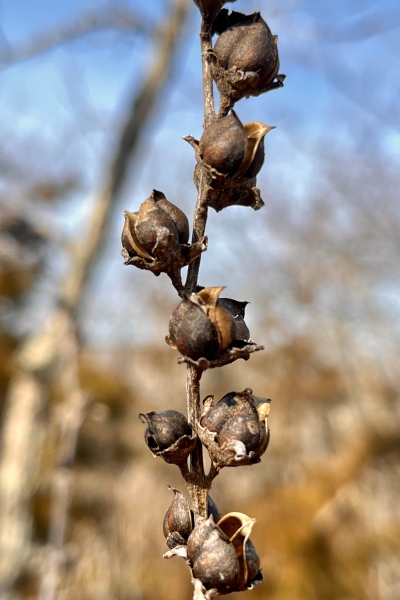
Manfreda virginica (formerly Aloe virginica—false aloe, rattlesnake master, Virginia agave).
Dioscorea villosa (wolf yam).
Asclepias purpurascens (purple milkweed).

During the previous week’s outing at Hawn State Park, the group spent a fair amount of time distinguishing Missouri’s five species of Betulaceae—all of which can be found growing together along the banks of Pickle Creek. One is not likely to see three of them along the margins of a dry post oak woodland, but the two remaining—Corylus americana (American hazelnut) and Ostrya virginiana (American hop hornbeam), both much more tolerant of drier situations—were seen in abundance. These two species also happen to be the two that are most often confused with each other—especially during winter, giving the group another opportunity to study their subtle differences. Both develop male catkins during the winter, but those of C. americana tend to be larger, lighter in color, and frequently occurring singly along the branch. The winter twigs are a bit more distinctive—with tiny hairs and rounded buds in the former, versus hairless with pointed buds in the latter. Of course, of the two, only O. virginiana produces the distinctive hops-like fruits that often persist into the winter, so their presence immediately identifies any plant possessing them.

Corylus americana (American hazelnut) (L) versus Ostrya virginiana (American hophornbeam) (R) – male catkins.
Corylus americana (American hazelnut) (L) versus Ostrya virginiana (American hophornbeam) (R) – winter buds.
Ostrya virginiana (American hophornbeam) (R) – last season’s fruit.

Direct comparisons of winter twigs proves to be a useful identification technique for other similar species pairs—even those in the same genus. Acer saccharum (sugar maple) and A. rubrum (red maple) often grow in close proximity and are similar enough to be frequently confused. When twigs of the two are placed next to each other, however, the differences are apparent. Color alone—A. rubrum usually exhibiting a reddish tinge to the twigs and buds—is not always diagnostic, and both species have what could be called pointed buds. Touch the tips, however—the buds of A. saccharum are sharp enough to prick the finger, while those of A. rubrum are blunted just enough to avoid feeling the prick.

Acer saccharinum (sugar maple) (L) versus Acer rubrum (red maple) (R) – winter buds.

Along the length of the trail, I noted an abundance of dry, persistent flower stalks of Hydrangea arborescens (American hydrangea) colonizing the bordering rock ledges. Normally found in moist (and frequently inaccessible) situations, its presence in a dry post oak woodland suggests drainage through the layers of dolomite underneath the woodland reaches the surface in these exposed toe-slopes, keeping them persistently moist. While the promised floral display in June is reason enough to return, my interest in woodboring beetles provides additional motivation, as its flowers are a favorite of a diverse group of woodboring beetles call flower longhorns (subfamily Lepturinae)—some of which having been associated only with this plant. Time to mark the calendar!

Members of the WGNSS Botany Group (L–R): Keith Woodyard, Eileen & Tom Buescher, Alan Brandt (hidden), John Oliver, Kathy Thiele (hidden), Burt Noll, Michael Laschober, Pete Kozich.

©️ Ted C. MacRae 2022

Seminar on Oklahoma’s Glass Mountains

Earlier this week I gave a seminar to the Entomology Group of the Webster Groves Nature Study Society. Founded in 1920 and known locally as “WGNSS”, the organization seeks “to stimulate interest in nature study on the part of adults and children, to cooperate with other organizations in nature study, and to encourage amateur research in the natural science.” I’ve been an active member in the society’s Entomology Group since the early 1980s, and for almost five years now I have also served as editor for the society’s newsletter, Nature Notes (see this archive of recent issues). Occasionally they invite me to talk—sometimes to just the Entomology Group and other times to the Society as a whole—about my entomological exploits. This time I chose to focus on my several visits to the Glass Mountains in northwestern Oklahoma over the past few years, which readers of this blog may remember has been the source of an inordinate number of new state records and other significant finds for the beetles I study. The presentation provided an overview of the insects I’ve encountered during these visits, and for those who might be interested a PDF version of the presentation is posted here. 

Natural History of Oklahoma’s Glass Mountains…

Copyright © Ted C. MacRae 2014