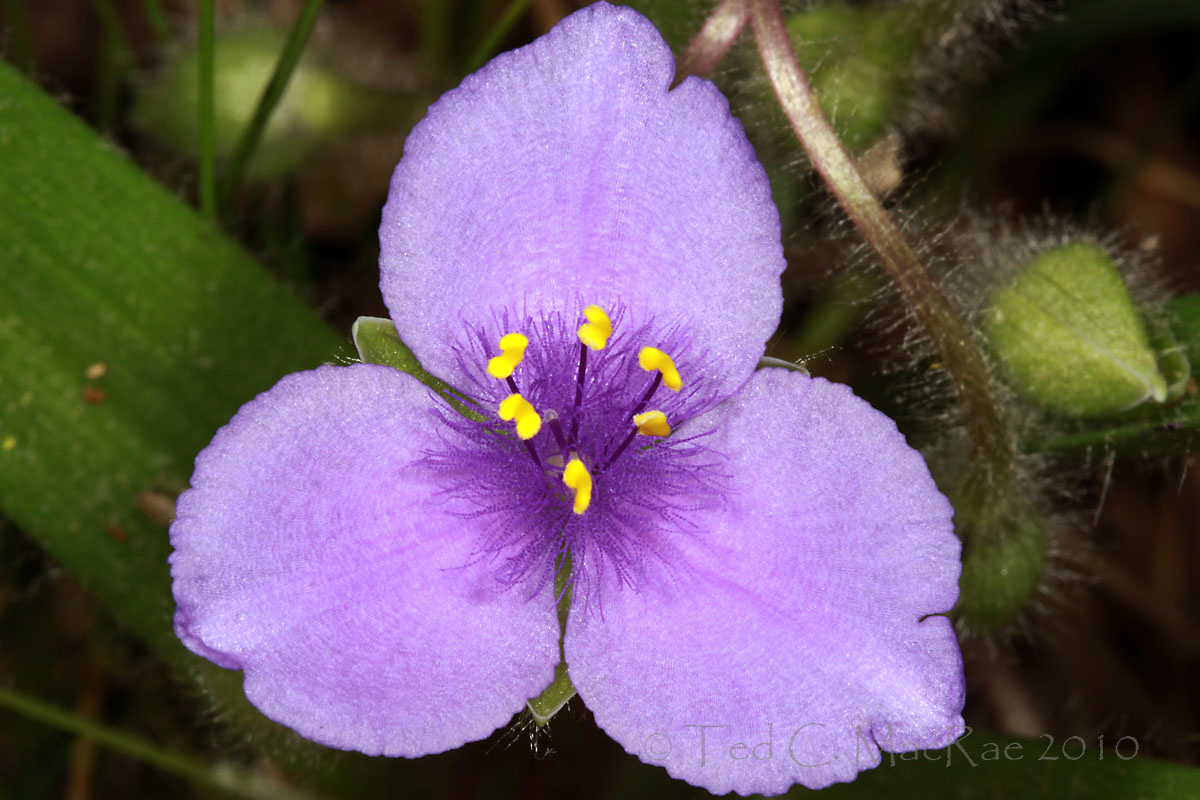
Friday Flower – Dwarf Spiderwort

Living at the foothills of the Ozark Highlands, I sometimes forget how unique the biota of this ancient landscape truly is. More than 200 species of plants and animals are largely restricted to the region, with around 160 of these being true Ozark endemics found nowhere else on earth. The biodiversity of the region stems from the landform’s unusual geology, topography and hydrology, it’s ectotonal position within the North American continent, and its distinction as the only significantly elevated landform between the Appalachian and Rocky Mountains. Many Ozark endemics are found in the region’s abundant caves and sinkholes, formed by underground dissolution of its massive limestone/dolomite bedrocks. Others represent isolated populations of more typically northern plants and animals that found refuge here during the Pleistocene glacial advances. Still others evolved during periods of isolation when vast inland seas covered much of the continent’s interior.

Tradescantia longipes, known locally as dwarf spiderwort or wild crocus, is a particularly exquisite Ozark endemic found scattered in dry igneous woodlands of the Missouri’s St. Francois Mountains and Arkansas’ Ouachita Mountains. I first saw this species two years ago in May at Crane Lake in the heart of the St. Francois Mountains, and the plants shown here were seen this past April in the igneous woodlands of Sam Baker State Park at the southernmost extent of the St. Francois Mountains’ igneous exposures. The genus to which this plant belongs contains some much more widely distributed (though no less striking) members (e.g. T. ohioensis, which I featured in my first “Friday Flower” post). Tradescantia longipes flowers are similar to those of T. ohioensis, but the plant differs from most others in the genus by its short, squat habit of growth and strictly basal leaves.

One feature shared by T. longipes with all other members of the genus is the dense fringe of hairs arising from the stamen filaments.  I discussed these in my first Friday Flower post, noting that each of the 70-100 hairs per filament is composed of a chain of about 20 large, single cells – easily seen with low magnification. While their sensitivity to radiation and chemical mutagens has been recognized for many years (the hairs turn pink when exposed to radiation), less seems to be known about their natural function for the plant.  It is interesting to note, however, that the flowers of Tradescantia and related genera rely heavily on insects for pollination (primarily bees and bee flies), yet they do not produce nectar.  Faden (1992) has speculated that the stamen hairs might combine with floral scents and the nearly pollenless anthers to deceptively attract insects, provide footholds, retain pollen fall, and influence the pollen-collecting behavior of the insects.

Photo Details: Canon 50D (ISO 100, 1/250 sec, f/14-18), Canon 100mm macro lens, Canon MT-24EX flash (1/4 ratio) w/ Sto-Fen diffusers. Post-processing: levels, unsharp mask, minimal cropping.

REFERENCE:

Faden, R. B.  1992. Floral attraction and floral hairs in the Commelinaceae.  Annals of the Missouri Botanical Garden 79(1):46–52.

Copyright © Ted C. MacRae

Add to FacebookAdd to DiggAdd to Del.icio.usAdd to StumbleuponAdd to RedditAdd to BlinklistAdd to TwitterAdd to TechnoratiAdd to Yahoo BuzzAdd to Newsvine

Email to a friend

An irresistible sight!

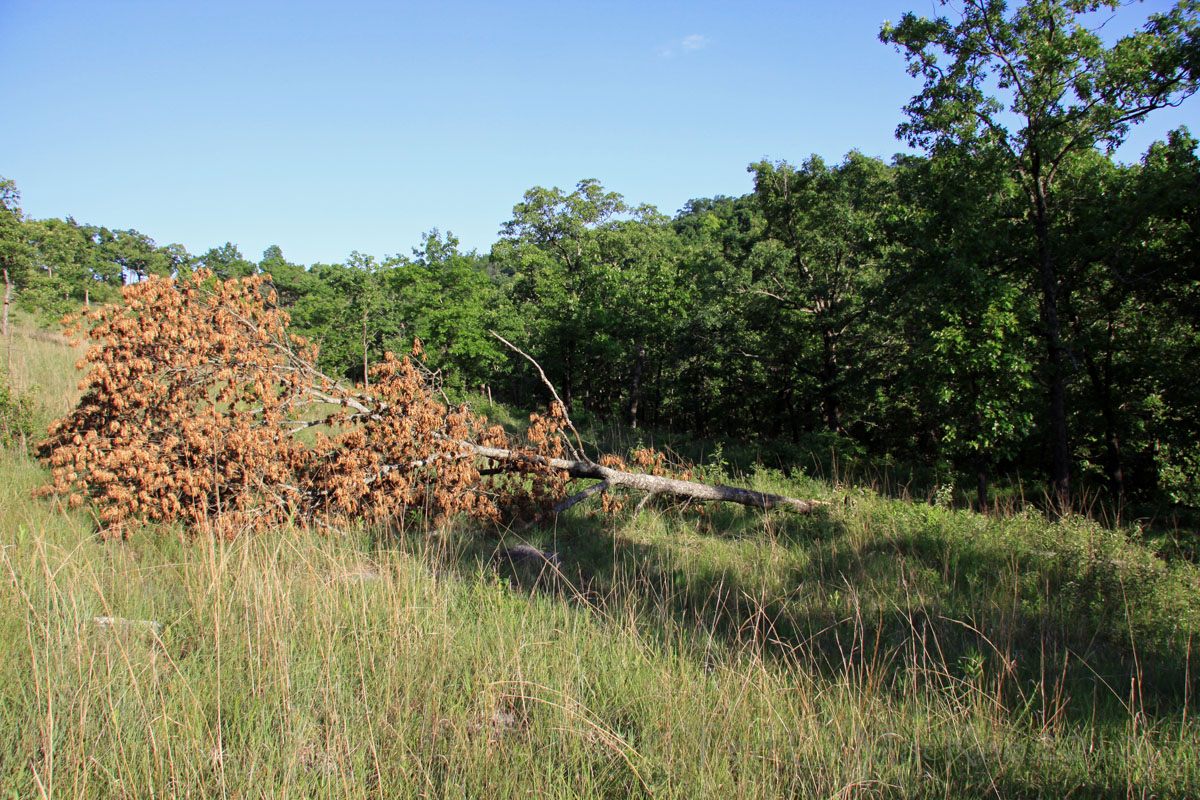
One of the few highlights of my Memorial Day weekend collecting trip came in the earliest moments of my visit to Ha Ha Tonka State Park.  My destination was Ha Ha Tonka Savanna Natural Area, and a short walk through fire-restored woodland led me to the open glade where just a few years earlier a UMC student had collected the rare and little-known Agrilus impexus.  Entering the glade, I was all set to begin sweeping the vegetation along the woodland/glade interface, paying special attention to any honey locust (Gleditsia triacanthos) that I might happen to find in the area as a potential host for the beetle.  What I saw instead as the glade opened up in front of me was a sight that any collector of wood-boring beetles will find almost irresistable – a recent wind-throw!  In this case, it was a black oak (Quercus velutina) laying in full sun – its bright brown leaves suggesting that it had fallen within the past few weeks (and would thus still be emitting the volatiles that wood-boring beetles find so attractive).  I wanted to begin looking for A. impexus, but I knew there would be beetles actively crawling on the trunk and branches of that tree.  I couldn’t resist it – I dropped my sweep net and beating sheet and made my way to the tree (in the end it didn’t matter, since no other beetles – including A. impexus – would be seen that day).

I already had an idea what I might find.  Recent wind-throws are the domain of Chrysobothris, and if the tree is a deciduous species then this means members of the Chrysobothris femorata species-group.  I recently featured one of six newly described members (C. caddo) of this taxonomically challenging group (Wellso and Manley 2007), providing a synopsis of the now twelve species in the group and their primarily host preferences.  Fully half of these are associated primarily or exclusively with oaks four occurring in Missouri (quadriimpressarugosiceps, shawnee, and viridiceps).  Of these, C. quadriimpressa is the most commonly encountered (although the others are by no means uncommon), and all of the nearly dozen or so beetles I found on this particular tree in fact represented that species. Confirmation of my ID would require microscopic examination of the female pygidium (which is shallowly impressed on each side of the middle) and male genitalia, but in general this species can be distinguished in the field by its smallish size (~10-12 mm in length – rugosiceps and shawnee tend to be larger) and the post-median pair of foveae (circular impressions) on the elytra being joined (they are distinctly separated in viridiceps).

As we’ve seen with other species of jewel beetles (e.g., C. caddo, Dicerca lurida, D. obscura), adults of C. quadriimpressa are incredibly cryptic and nearly impossible to see on the bark of their hosts – at least until they move.  They are notoriously difficult to approach – their large eyes and penchant for rapid escape flights suggesting excellent vision.  This is a useful capability for insects that must expose themselves to would-be predators (and beetle collectors) during daylight hours while actively searching dead trees for mates and oviposition sites.  One thing I can’t figure out, however, is the role of the intensely blue feet in this and other cryptically colored Chrysobothris species (see also C. caddo).  Any ideas?

Photo Details (insect): Canon 50D (ISO 100, 1/250 sec, f/16), Canon 100mm macro lens w/ Kenco extension tubes (68mm), Canon MT-24EX flash (1/4 ratio) w/ Sto-Fen diffusers.  Post-processing: levels, unsharp mask, minimal cropping.

REFERENCES:

Wellso, S. G. and G. V. Manley. 2007. A revision of the Chrysobothris femorata (Olivier, 1790) species group from North America, north of Mexico (Coleoptera: Buprestidae). Zootaxa 1652:1–26 (first page only).

Copyright © Ted C. MacRae 2010

Add to FacebookAdd to DiggAdd to Del.icio.usAdd to StumbleuponAdd to RedditAdd to BlinklistAdd to TwitterAdd to TechnoratiAdd to Yahoo BuzzAdd to Newsvine

Email to a friend

When is a locust borer not a locust borer?

…when it is a hickory borer!

Hickory borer (Megacyllene caryae) mating pair on trunk of fallen mockernut hickory (Carya alba).

The hickory borer, Megacyllene caryae, is perhaps the most frequently misidentified beetle in eastern North America due to its almost perfect resemblance to the closely related locust borer, M. robiniae.  Unlike the latter species, however, which is encountered abundantly during the fall on flowers of goldenrod (Solidago spp.) and attacks living black locust (Robinia pseudoacacia), the hickory borer is active only during the spring and breeds in the dead wood of hickories (Carya spp.).  Adults emerge from the wood as soon as temperatures begin to warm in early spring, a fact which causes it to be most frequently encountered during winter when it emerges indoors from firewood brought in from outdoors.  Many times this causes the alarmed homeowner to post a photo of the insect on BugGuide and ask if it will cause damage to their home.  So close is its resemblance to the locust borer that novice insect enthusiasts often identify it as such based on comparison to photos and refuse to believe it is not that species, even when told otherwise.

Of course, there are distinguishing characters that, with a little practice, become quite obvious – the legs of the hickory borer are often distinctly reddish (as seen in the above photo), and the bands of the elytra will many times show an alternating pattern of yellow and white (not quite so apparent in the above photo).  The elytral bands are also slightly narrower and often broken and incomplete in this species, while in the locust borer they are wider and nearly always extend completely across the elytra.  Lastly, the pronotum of the locust borer is narrowly margined with yellow on the anterior edge, while in the hickory borer the anterior margin is black.  That’s a tough character to see without magnification, and all of these characters really are only necessary when examining specimens in a collection (and even then only if there is no date on the collection label).  Season is the easiest distinguishing character – if it occurs during spring it is the hickory borer, and if it occurs during fall it is the locust borer.  There are several other species in the genus that can be confused with these two, but they do not occur in eastern parts of North America.

This mating pair was encountered on the trunk of a recently wind-thrown mockernut hickory (Carya alba) during our early April hike of the lower Wappapello Section of the Ozark Trail.

Photo Details: Canon 50D (ISO 100, 1/250 sec, f/14), Canon 100mm macro lens, Canon MT-24EX flash (1/4 ratio) w/ Sto-Fen diffusers. Typical post-processing (levels, unsharp mask).

Copyright © Ted C. MacRae 2010

Add to FacebookAdd to DiggAdd to Del.icio.usAdd to StumbleuponAdd to RedditAdd to BlinklistAdd to TwitterAdd to TechnoratiAdd to Yahoo BuzzAdd to Newsvine

Email to a friend

Are we loving our prairies/glades/woodlands to death?

I had such high hopes for last weekend’s collecting trip – late May is boom time for insects across Missouri, we have had good moisture this spring, and I would be visiting some high-quality natural communities that I had not visited for a long time.  My stated goals (the jewel beetles, Agrilus impexus and A. frosti) were long shots – I knew that and would have been fine coming home without those species (which I did) had the the collecting been otherwise productive (which it was not).  Still, I’ve been doing this for a long time now, and I’ve learned to draw on my accumulated experience when things don’t go as planned to give myself the best shot at turning a bad collecting trip into a decent one when things don’t go as planned.  The itinerary with which I start is rarely the one that I actually follow, and this past weekend was a good example of such.

My first stop was Ha Ha Tonka State Park, one of Missouri’s premier parks, boasting high-quality chert, dolomite, and sandstone savanna interspersed with dolomite glades.  It is on these glades and savannas that I hoped to find Agrilus impexus, or failing that at least collect a nice diversity of other jewel beetles on the oaks and hickories of the savannas and surrounding woodlands.  However, it was with some reservation that I even came here after being told by my colleague at the Department of Natural Resources just 2 days before my trip that 75% of the park’s grasslands and woodlands had been burned within the past two years.  For an insect collector, this is never good news – in all my years of collecting insects, my experience in relatively recently-burned habitats has been consistent: collecting sucks!  I decided, however, to visit Ha Ha Tonka anyway because of the quality of the natural communities it contains, thinking perhaps I might be able to find pockets of unburned habitat supporting good insect populations.  This was not to be. I beat oak after oak in the savannas and woodlands – nothing!  I swept little bluestem and Indian grass in the glades – nothing!  The foliage was lush and green and the savanna and glade landscapes highly diverse – given the time of season the place should have been teeming with insect life, yet it almost seemed sterile. Were it not for a few Chrysobothris quadriimpressa jewel beetle adults that I found attracted to a recently wind-thrown black oak tree, I would not have seen any insects here at all.  It appeared my fears about park-wide depression of insect populations had been realized.  However, not one to waste a visit I decided to explore some of Ha Ha Tonka’s fascinating geological features.  Ha Ha Tonka contains one of Missouri’s best examples of karst geology, with complex structures formed from the collapse of a major cave system.  The Devil’s Promenade is one of the more spectacular examples of such, its horseshoe-shaped cliff representing the former interior walls of a now-collapsed cave.  As dusk approached, the day’s poor insect collecting caused me to abandon my plans to stay here and blacklight for nocturnal beetles.  Instead, I decided to break from the itinerary, drive further west and explore Lichen Glade Natural Area in the morning before heading to the Penn-Sylvania Prairie BioBlitz later that afternoon.
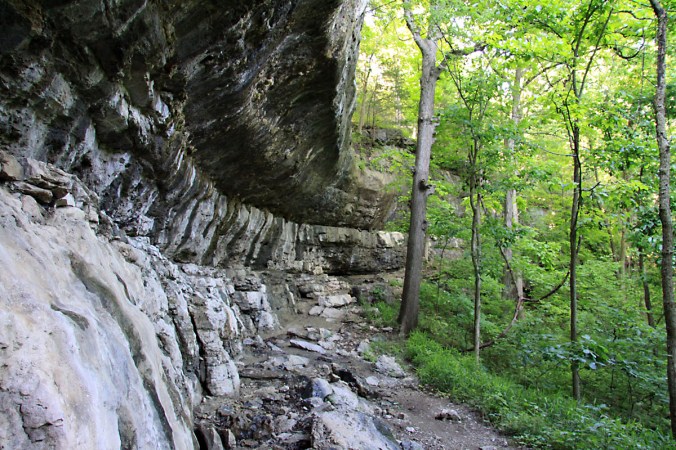
Devils Promenade, Ha Ha Tonka State Park

Lichen Glade Natural Area is a small area owned by The Nature Conservancy that boasts a high-quality sandstone glade surrounded by post oak/black jack oak forest.  My first visit to the area more than 20 years ago was during May, and it was one of the most productive collecting trips I’ve had with a number of Agrilus spp. (including A. frosti) beaten from post oak (Quercus stellata) along the woodland edge.  I didn’t visit again until fall of 2002, when Chris Brown, Rich Thoma and I found claybank tiger beetles (Cicindela limbalis) sunning on the exposed sandstone outcrops, and I made one more visit the following May to beat more insects off of post oak.  The Lichen Glade that I returned to this past weekend was a very different place from when I last visited – the surrounding woodlands had been extensively opened (I would guess within the past few years based on the size of the post oak resprouts), and fire had been used throughout the area.  Anticipation turned to frustration when no amount of beating of the woodland vegetation and sweeping of the glade vegetation turned up beetles in any appreciable numbers (or any insects for that matter) and two hours worth of effort yielded not a single buprestid beetle!
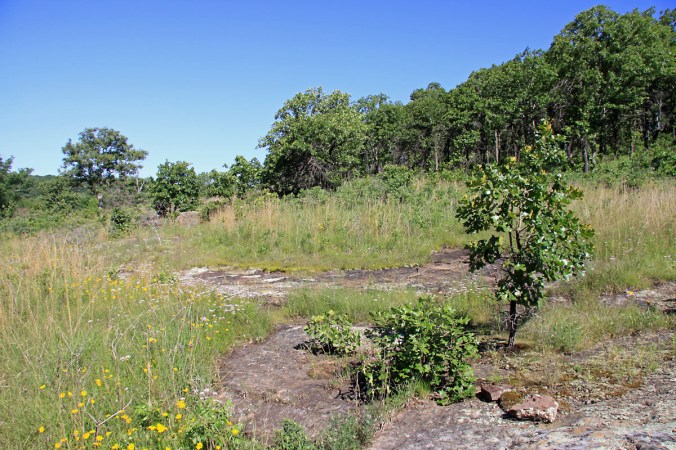
Sandstone glade community, Lichen Glade Natural Area

With resignation, I headed on over to Penn-Sylvania Prairie, where during the introduction to the BioBlitz I learned that nearly half of the 160-acre prairie was burned last December and all of it had been burned within the past few years.  I knew what I was going to find – nothing!  Okay, I shouldn’t say nothing, as there actually were some beetles present.  However, the numbers and diversity were low, with all of the species encountered representing common, widespread species.  Moreover, it was not just beetles – all of the invertebrate group leaders (which included experts on snails, ants, butterflies, and bees) reported low overall abundance and diversity in their groups of interest.  Only the vascular plants – the metric by which the value of prescribed burning is always assessed – showed high diversity, with 300 species of mostly native prairie plants recorded for the site.  It was a fun event, with probably ~75 attendees and a delicious pot luck dinner that evening; however, it would have been more enjoyable had there actually been a nice diversity of insects present to document for the preserve.

My comments may make it seem that I am against the use of prescribed burning.  This is not true – I understand the critical role that fire as a management technique plays in restoring and maintaining examples of Missouri’s historically fire-mediated landscape. Without fire and other processes to mimic natural disturbance factors, most of Missouri’s historical grasslands and woodlands suffer relentless encroachment by woody vegetation. However, the modern landscape is very different from the historical landscape, where fires of unpredictable scale, intensity, and frequency operated within a vastly larger scale to create a shifting mosaic of natural communities in various stages of ecological succession. Such processes cannot be recreated on today’s severely fragmented landscape, where the precious few remaining tracts of native habitat are relatively to extremely small and more often than not separated from each other by vast expanses of homogeneous and “inhospitable” habitat (e.g., agricultural, urbanized, or severely degraded lands).  It is in that context that I have great concerns about how aggressively fire has been used in recent years on our state’s natural areas and the impact this is having on insect populations – specialist and generalist alike.  Fire proponents will point to published studies that show little to no effect by the use of fire for managing small, isolated remnants on specialist insects (see review in Henderson 2010).  However, there are an equal number of studies that suggest such concerns are well-founded (see review in Panzer 2002). A consistent limitation in all of the studies that have been conducted is the lack of very large and long un-burned remnants.  Prescribed burning has been adopted so rapidly and pervasively that there just aren’t any significant un-burned remnants left to properly include as controls in such studies.  As a result, the insect fauna present at a given site at the start of such a study is already skewed towards those species that successfully recolonized the area post-burn.  At a minimum, the data to this point are inconclusive, and certainly the potential for impacts has not been given the consideration it warrants in designing fire-management plans for our own state’s prairies and glades. Furthermore, as rapidly and aggressively as fire has been adopted on our few, small, widely disjuct remnants, the opportunity for proper investigation of those potential effects may be gone.  A particularly egregious example of the lack of consideration being given to prairie invertebrates in designing fire management plans is shown in these photos of Iowa’s Sylvan Runkel State Preserve before and after a late May burn and the impact of that burn on a resident population of Nevada buck moths (Hemileuca nevadensis).

Here in Missouri, as in Iowa, it’s a problem of scale – the landscape is too fragmented and remnants too disjunct to manage based strictly on floristic response.   Populations of generalist insect species will recover, and even specialist species may be able to overcome such management practices if they are widely distributed and sufficiently mobile. But what about conservative species with low vagility, such as the swift tiger beetle (Cylindera celeripes) and our disjunct population of the frosted dromo tiger beetle (Dromochorus pruinina), flightless species restricted in Missouri to the few tiny remnants of loess hilltop prairie in northwestern Missouri and a single 2.5-mile stretch of roadside habitat in west-central Missouri?  Until directly relevant data, gathered here in Missouri, are forthcoming to suggest otherwise, I believe the most judicious use of fire possible should be practiced in restoring and maintaining our grasslands and woodlands.  In-season burns may have been a part of the historical landscape, but their use today has great potential to result in local extirpations and should be used only after the most careful consideration.  Leaving un-burned refugia within remnant habitats to accelerate recovery would also be prudent – yet many land managers disregard this practice because of its logistical difficulties. This is especially true in small parcels, yet it is precisely these remnants that have the most to gain from their use (or lose from not doing so!).  In the historical landscape, every burn was a patch burn – no matter what its size, there were always adjacent or proximal unburned habitat from which recolonization could occur.  Elk and bison, too, were integral components of the presettlement prairie landscape – their roamings caused intermittent, localized disturbances that were likely not only crucial to the tiger beetles that I study but may also have contributed to vegetational diversity through patch succession.  Techniques that mimic these natural disturbance factors include mowing, haying, and managed grazing.  They can be utilized to mimic those disturbances as well as delay woody encroachment, and their use in land management should be considered for their ecological value rather than deprioritized because of their relatively greater complexity and cost to implement. Mechanical removal and selective use of herbicides offer additional tools for addressing woody encroachment while minimizing potential impacts to insect populations. An effective management program that considers all of the flora and fauna of a remnant may not be possible unless all of these management tools are utilized, or at least properly considered. As my good friend James Trager said in a recent email (quoting Andrew Williams), habitat restoration “cannot rest on any single management practice, nor practicing it too extensively.”

REFERENCES:

Henderson, R. A.  2010. Influence of Patch Size, Isolation, and Fire History on Hopper (Homoptera: Auchenorrhyncha) Communities of Eight Wisconsin Prairie Remnants.  Wisconsin Department of Natural Resources, Research Report 189, 22 pp.

Panzer, R. 2002. Compatibility of prescribed burning with the conservation of insects in small, isolated prairie reserves. Conservation Biology, 16(5):1296-1307.

Copyright © Ted C. MacRae 2010

Add to FacebookAdd to DiggAdd to Del.icio.usAdd to StumbleuponAdd to RedditAdd to BlinklistAdd to TwitterAdd to TechnoratiAdd to Yahoo BuzzAdd to Newsvine

Email to a friend

Critters, and berries, and trees! (Oh, my!)

Several of my favorite blog carnivals have posted new issues this week – should make for some good reading over the weekend. If you’ve not yet had the chance to explore these carnivals, they are a nice way to find blogs of interest that you may not otherwise encounter. If you have, then you know the quality and diversity of their contributions make them an easy way to catch up on the latest thinking in their respective subjects. Head on over and explore the links – and as always, don’t forget to tip the waiter!

Circus of the Spineless #51 is up at Deep-Sea News.  Against the backdrop of the sickening and ongoing debacle in the Gulf Coast, Kevin Zelnio reminds us that it is not just fish, birds, and dolphins that are/will be suffering for a long time to come, but the unsung invertebrates as well. (Personal opinion – somebody better go to prison over this!). It is in this context that 19 contributions are presented, spanning 4 phyla and 3 arthropod classes. Insects, as always, are well represented (for my part, I temporarily set aside my beetle-myopia to promote a new ant paradigm).

Berry Go Round #28, titled “The best of the best in plant biology, conservation, photography, and evolution”, can be found at Greg Laden’s Blog. It’s nice to see heavy-hitter Greg giving some much needed support to this delightful blog carnival – not just by providing a well-organized collection of links to recent blog posts about plants, but also in discussing the value of blog carnivals – regardless of their size – and ways to make them more useful. I especially like this suggestion:

And, if you are engaged in social networking in any way (Facebook, Twitter, Whatever) please send this carnival out on that network, and at least a selection of the blogs linked herein.

I haven’t featured this blog carnival in awhile, but Casey has posted a fine Festival of the Trees #48 at Wandering Owl Outside. Liberally sprinkled with his own tree photographs, Casey presents an issue focused on the uses of trees – both by wildlife and, most interestingly, by the indigenous cultures of North America.  Another intriguing post shows the current state of worldwide deforestation – “the numbers are UGLY!”

Copyright © Ted C. MacRae

Add to FacebookAdd to DiggAdd to Del.icio.usAdd to StumbleuponAdd to RedditAdd to BlinklistAdd to TwitterAdd to TechnoratiAdd to Yahoo BuzzAdd to Newsvine

Email to a friend

“Trying” to photograph whirligig beetles

Nobody figured out exactly what I was doing in the photograph shown in the previous post (does anybody now see the whirligig beetles in the lower left corner of the photo?), but I sure enjoyed the guesses.  Several people alluded to dropping the camera or falling into the water, while others mentioned my heretofore unrevealed contortionist abilities.  However, Morgan Jackson‘s tale of trying to photograph Platypsyllus castoris has it all – rarely photographed species and the inordinate lengths we go through to get the shot.

Of course, whirligig beetles (family Gyrinidae) are much more commonly encountered than Platypsyllus castoris, but they can’t be any easier to photograph.  I spotted them as Rich and I balanced our way across a massive sycamore tree trunk while crossing the Black River during our early April hike of the lower Wappapello Section of the Ozark Trail.  I don’t know much more about whirligig beetles (or aquatic insects in general) than your average land-lubbin’ entomologist (in fact, I don’t think I’ve collected any since college systematics – yes, that long ago!), but for some reason I felt the need to try to photograph them.  Sure, the fallen tree provided a rare opportunity to get reasonably close to these very skittish insects without having to wade, but I think it was actually just the challenge of trying to photograph something in constant zigzagging motion that appealed to me.  Rich’s warnings that I would drop my camera were not enough to dissuade me, and after reaching the other side I ditched the backpack and tiptoed out with just my camera.

It seems like I’ve said this often in recent months, but these are my new hardest insect to photograph.  Not only are there the usual difficulties of framing and focusing a subject that is always in motion, but that motion is fast, erratic, and unpredictable, making tracking through the lens an extraordinary challenge.  Moreover, balancing precariously on a debris pile in the middle of the river strains the body and adds an element of danger (yes, I would be in deep doodoo if I dropped that camera).  I kept my eye on one particular individual that was swimming nearest to me, and after watching for a bit I saw that it was making a relatively predictable circuit that passed fairly close to me each time around.  I started trying to follow it through the lens and snap shots as it passed by – most of them turned out like this (actually, most of them turned out worse than this):

However, with each pass I got better, and I started getting shots with at least part of the beetle in focus.  So intent I was on what I was doing that I didn’t even know Rich had taken the photograph of me in the previous post until he showed it to me afterwards (he said he wanted to document the camera drop!).  Eventually I got this shot:

It’s far from a perfect photo – I had to adjust the levels because I hadn’t figured out the best lighting to use for something on the water’s surface, and the specular highlights from the flash on the forward elytron are rather extreme.  But the entire beetle is in focus, and we can make a reasonable guess as to its identity.  There are only two genera of whirligig beetles in Missouri – Dineutus and Gyrinus – and the large size (~12 mm in length) and hidden scutellum clearly identify this individual as something in the former genus.  Moreover, the rounded elytral apices (seen on other individuals as well) narrow it down even further to just a few possible species.  Unfortunately, they are distinguished primarily by ventral coloration; however, the bad first photo clearly does show dark legs, suggesting this may be D. ciliatus and not the orange-legged D. emarginatus.  I don’t even really care what species it is (did you ever think you’d hear me say that?), I’m just happy to have gotten a reasonably good photograph of an insect that surely few people have photographed well.

Copyright © Ted C. MacRae 2010

Add to FacebookAdd to DiggAdd to Del.icio.usAdd to StumbleuponAdd to RedditAdd to BlinklistAdd to TwitterAdd to TechnoratiAdd to Yahoo BuzzAdd to Newsvine
Email to a friend