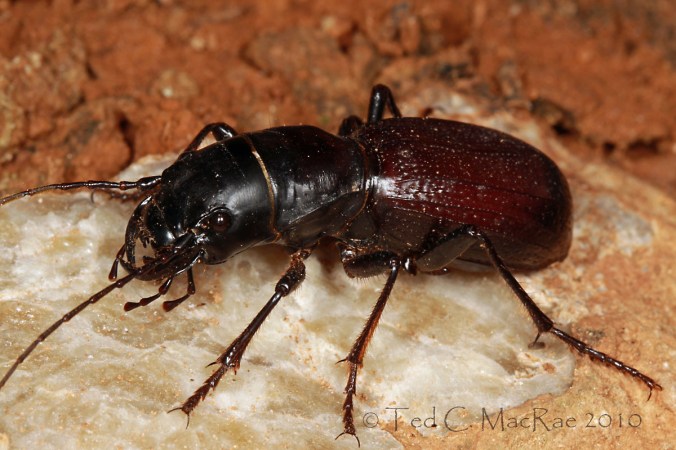
In the early 1980s, I was a young, green entomologist, fresh out of school with a budding interest in beetle taxonomy, a zeal for collecting, and a desire to meet other like-minded individuals. Among the first collectors I had the good fortune to meet was Ron Huber, one of the country’s leading tiger beetle experts and co-founder of the journal CICINDELA (now 42 years as co-editor). Although my interests had by then already begun narrowing to woodboring beetles, I liked tiger beetles well enough and managed to secure from him a single specimen of what Erwin and Pearson (2008) would later dub the “Great Plains giant tiger beetle,” Amblycheila cylindriformis – the largest tiger beetle in North America. I don’t remember what prompted Ron to part with this spectacular specimen – perhaps it was the lone Proserpinus gaurae (Lepidoptera: Sphingidae) adult that I possessed, which I had reared from a field-collected larva around that time, or maybe Ron had such a nice series of the species that making the day of a young collector was in itself reward enough. While clearly a tiger beetle, it was still so different by virtue of its enormous size (the species ranges from 25-38 mm in length), somber coloration, small eyes, and strictly nocturnal habit. For much of the past 25 years, that specimen has sat in my cabinet amongst a small assortment of other, mostly mundane tiger beetles that I had opportunistically taken on my woodboring beetle-focused collecting trips. While I longed to someday see the species for myself, to do that would mean making a special trip out to the Great Plains – woodboring beetle desert that it is – during the middle of summer and stumbling through the prairie in the dark with a flashlight. Such an effort always seemed too great for the sole purpose of finding a single species, and not even a woodboring beetle at that.
Interests evolve, however, and while I still consider woodboring beetles to be my primary interest, tiger beetles have increasingly occupied my attention over the past several years. Contrary to woodboring beetles, the Great Plains are a mecca for tiger beetle diversity, and in recent years I’ve made a number of trips to Nebraska, Kansas, South Dakota, and Oklahoma specifically to look for them. Such was the case in June of last year when I went to the Glass Mountains in northwestern Oklahoma on a hunch and found Cylindera celeripes, Dromochorus pruinina, and a large tiger beetle larva that I just recently concluded must represent A. cylindriformis. I had been rearing the larva for a year by the time I figured out its identity, and when I did I sudden found myself facing a “perfect storm” – an upcoming holiday weekend, adults presumably in peak adult activity, and I knew exactly where to look for them. Impulsively, I decided to use my July 4th weekend to make the 525-mile drive from St. Louis to the Glass Mountains – this would give me 2 nights to look for them and still allow me to make it back to work on Tuesday morning. Anything else I could find during the day would be icing on the cake, but even if I found nothing, the chance to see A. cylindriformis in the wild seemed worth the gamble.
I made it to Joplin, Missouri near the Oklahoma border by midnight on Friday but awoke to threatening skies the next morning. The threat of rain became a promise as I drove further west, and by the time I arrived in Enid, Oklahoma – just 30 miles from the Glass Mountains – it was raining heavily. I stopped at a coffee shop to access Wi-Fi, and checking the radar showed a line of storms moving up through Texas and western Oklahoma into Kansas – sitting right over the Glass Mountains! The forecast gave no reason for optimism, with a 50% chance of thunderstorms through the weekend. Smartly, I had recorded the locality of the Huber-specimen – collected in northwestern Kansas – and checked the forecast for that area, but it was even worse (50% chance of thunderstorms through Sunday and 80% Sunday night). Clearly this was not good, but I had made the drive and was determined to make something happen. I decided the best thing to do would be to just continue driving west – however far that was – until I got past the storm system and see what was around – wherever that might be. I gassed up amidst a gusty, torrential downpour and headed west out of town. As I drove, the rain lightened up and eventually ceased. The roads were wet, but at least it wasn’t raining, and when I arrived at the Glass Mountains even the roads seemed to be drying. Winds were still strong, but the clouds had broken somewhat, allowing brief periods of sun to further dry things out, and what followed was a most fascinating day on top of one of the Glass Mountain mesas (highlights include C. celeripes, D. pruinina, Microstylus morosus, Trichodes sp. – look for these in future posts). As dusk approached I searched the grasslands below hoping to see a rattlesnake or two – I had seen a western pygmy rattlesnake here last year, and western diamondbacks are also in the area, but I saw none.

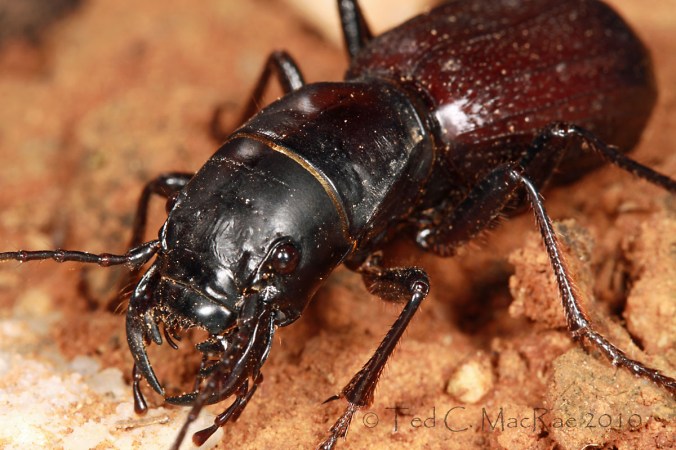
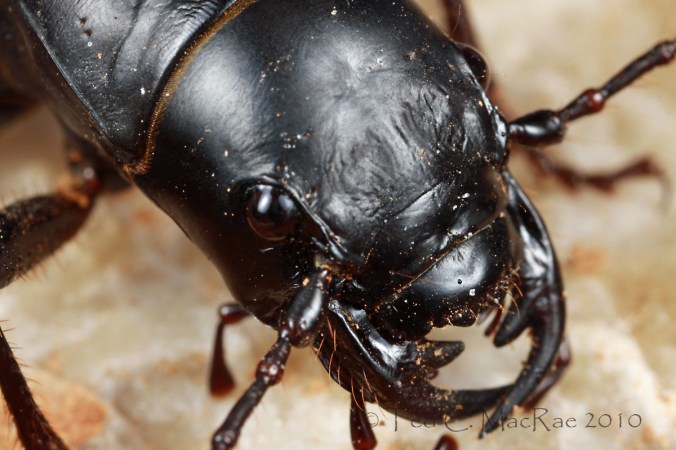
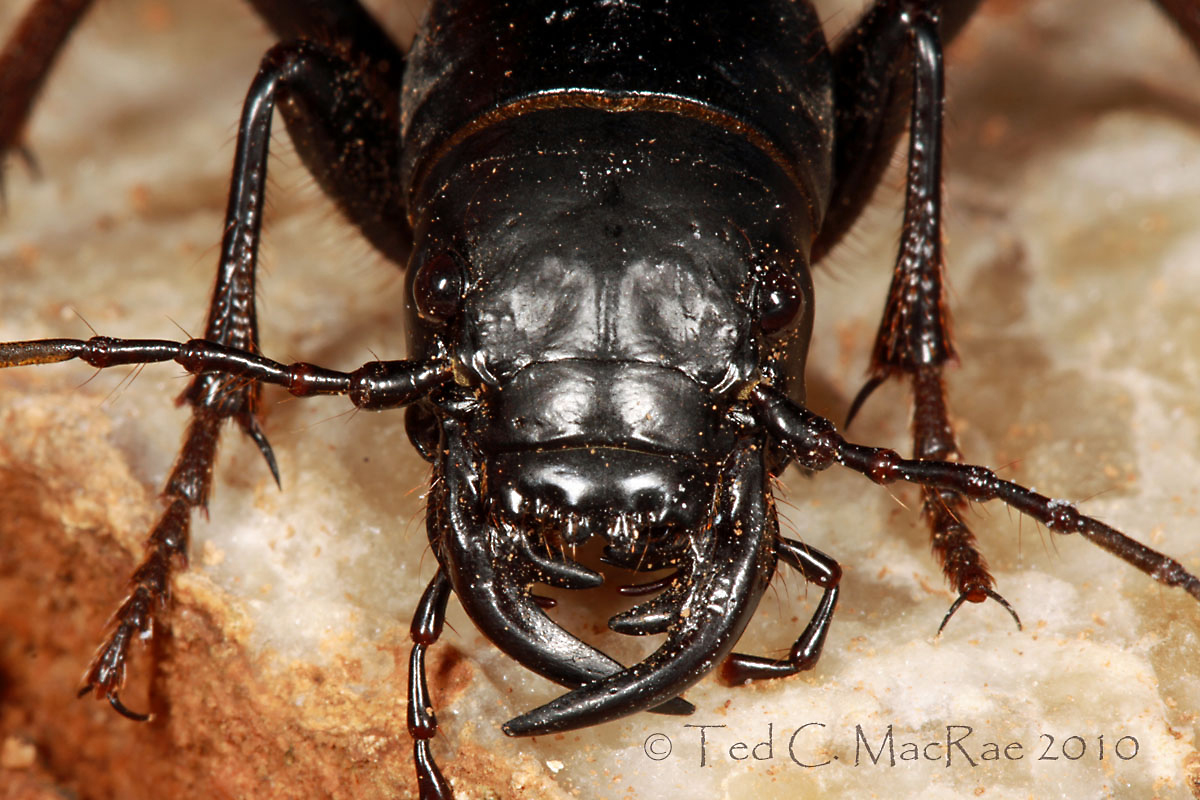
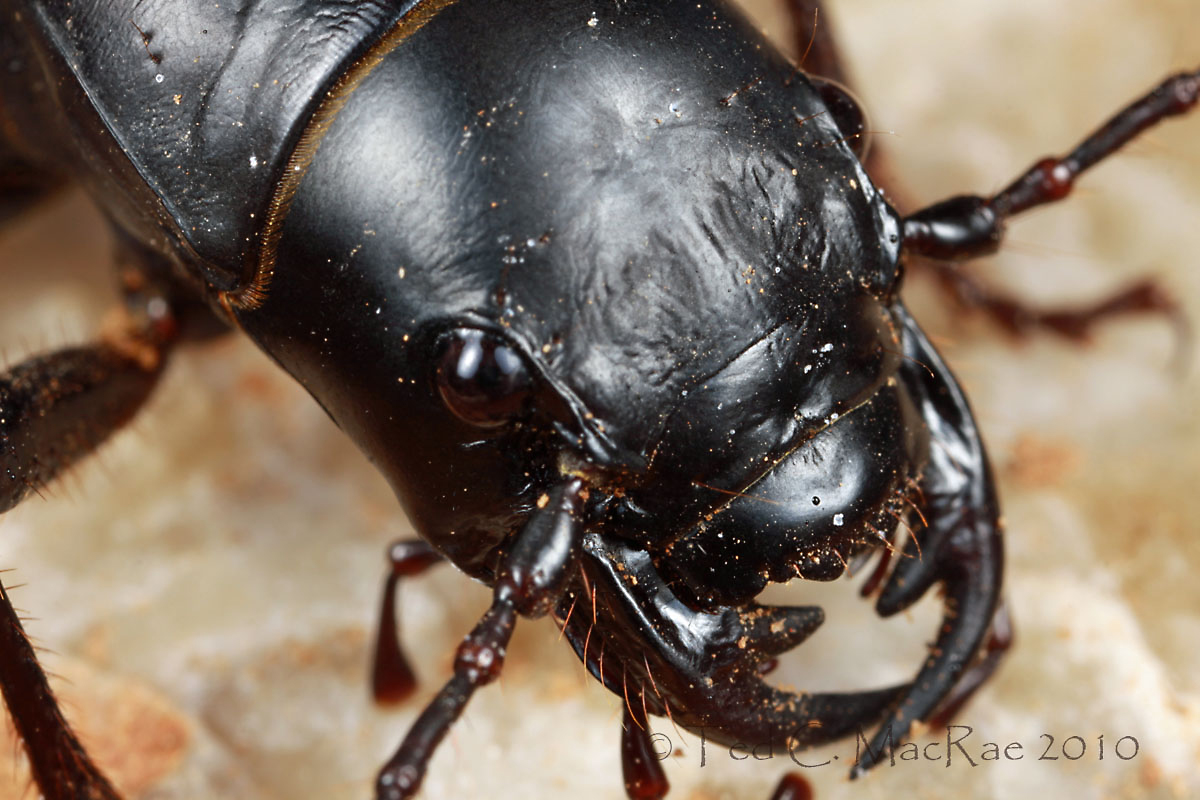
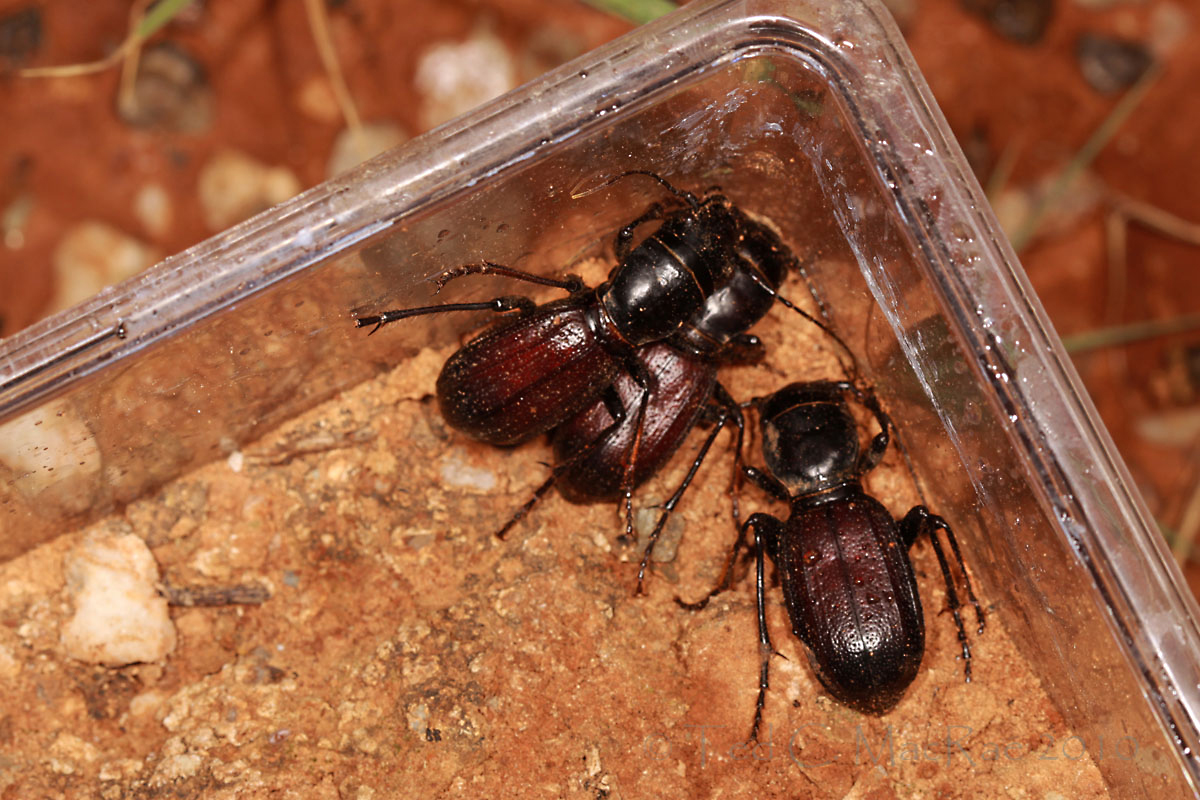
Of course, all this was really just passing time – waiting for nightfall and hoping the rain continued to hold off so I could begin searching the prairie down below for A. cylindriformis. It had sprinkled once or twice during the day, and I couldn’t tell if the darkening western sky was truly rain or the just the coming dusk. At 9pm, with darkness fast approaching, I set out with my headlamp and made a beeline for the native prairie habitat on the lower talus slopes where I had last year collected the larva and observed additional larval burrows that I took to be the same species. I must admit that the thought of walking alone through the prairie at night in western diamondback rattlesnake habitat made me more than a little nervous, and I kept just as much an eye out for them as I did the tiger beetles that I was looking for. As the night wore on, my hopes began to dim – I had searched for almost an hour and had covered most of the area where I had seen larval burrows last year. With no sign of the beetle, the negative thoughts started to enter my head – did I make this drive for nothing? How sure was I that the larva really represented Amblycheila? Did I have the right search image? I mean, they’re huge black beetles – they should be easy to spot, right? Oh great, I made all this fuss on my blog about looking for the species – how embarrassing to have to say, “Uhm, well, I didn’t find it.” Just as I began wrapping back around the bottom of the talus slope, there it was – no doubt about it! I just watched it for a while and noted that it moved with some urgency, but it was not the speedy, jerking walk of ‘regular’ tiger beetles – rather, it was more lumbering, seeming to pick each foot up rather high, like a cat with rubber bands on its feet (how would I know about that?). There seemed little risk of it escaping me, so I got out the camera and began following it to take photographs – no way! While it may have lacked the speed of other tiger beetles, it also lacked their propensity to occasionally pause long enough to allow a shot or two. Add the darkness, fear of rattlesnakes, and constant bumping of the flash unit on my headlamp, and it was soon apparent that getting good field photographs was going to be a low percentage proposition. I resigned myself to taking photographs later in a terrarium (several shown here) and spend my time in the field more productively looking for additional individuals.
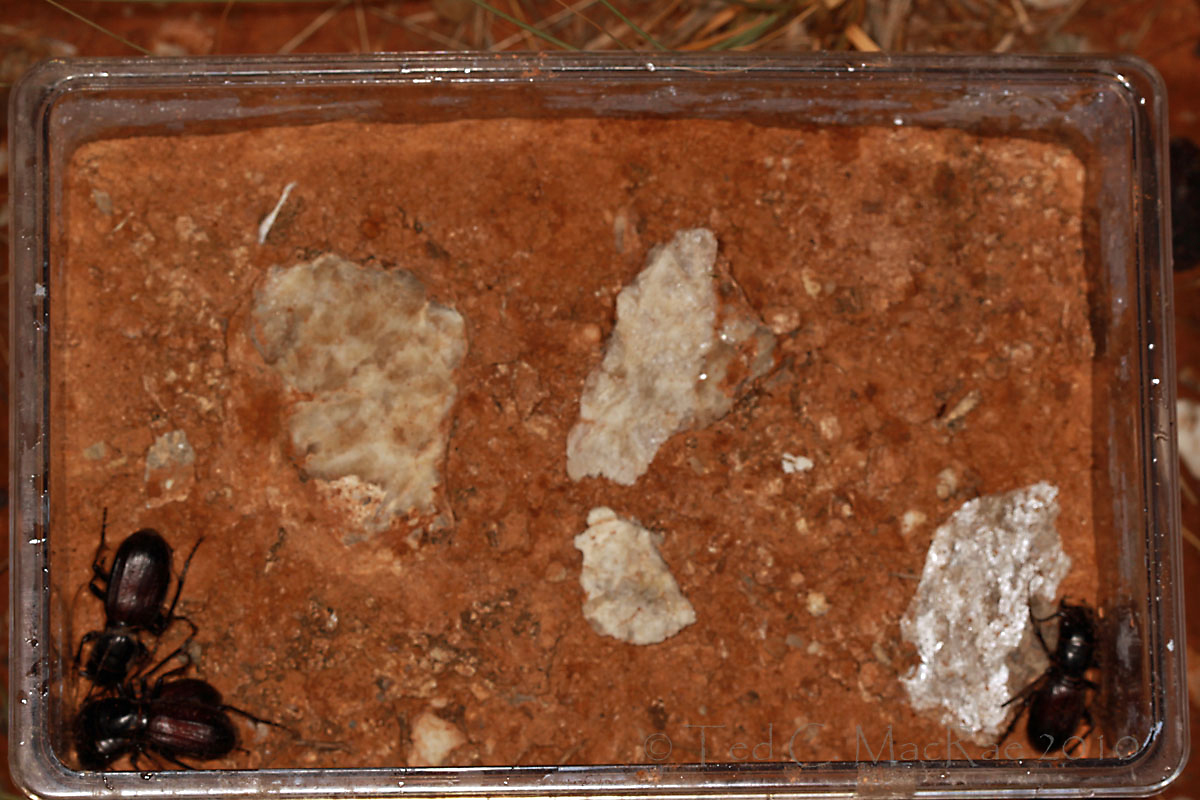
Finding the first individual did wonders for my motivation, and though still nervous about the potential for rattlesnakes I continued searching an ever-widening swath of the talus slope and adjacent areas. Another hour passed, and I had searched not only the native prairie below the talus slopes, but clay exposures on adjacent somewhat altered habitat. Again, the negative thoughts started creeping back into my mind – am I really gonna walk away from here with a single individual? I can say I found it, but that was a long drive for one beetle! I continued searching along an adjacent drainage ditch, and by 11:30pm I conceded that my victory was small and walked back to the truck to get a container to fill with native soil for a terrarium. Though it was a bit of a walk back up to the talus slope where I had seen the larval burrows, I wanted to take soil from that area specifically to give myself the best shot at obtaining eggs from my single (hopefully female) individual for an attempt at rearing more specimens from larvae. As I approached the exact spot where I had collected last year’s larva, I saw another, even larger adult! I don’t know which was greater – my excitement at finding such a large individual, or my relief in knowing that I would not go home with only one. Of course, with the second individual came a new shot of motivation, so once again I scanned across the talus slopes, and during the next half hour I found two more very near to where I had found the second one. By then it was past midnight, so I set about the business of digging soil for the terrarium. I finished the job (getting stung something terrible by three red, big-headed ants that had crawled up my pant leg while I was digging), took one last sweep across the immediate area, and turned to walk back to the truck when I saw the biggest one of all – I later determined it to be a male measuring 35 mm in length (that’s just about an inch and a half, folks!). With five individuals now, the urgency to find more was gone, and I decided I’d done what I needed to do and should get into town and find a hotel room. As I walked back to the truck, rain began to fall – lightly at first but ever increasing. Once back at the truck it was raining persistently enough that I could only hurriedly take some quick photographs of the beetles in their terrarium as in situ documentation of the momentous occasion!
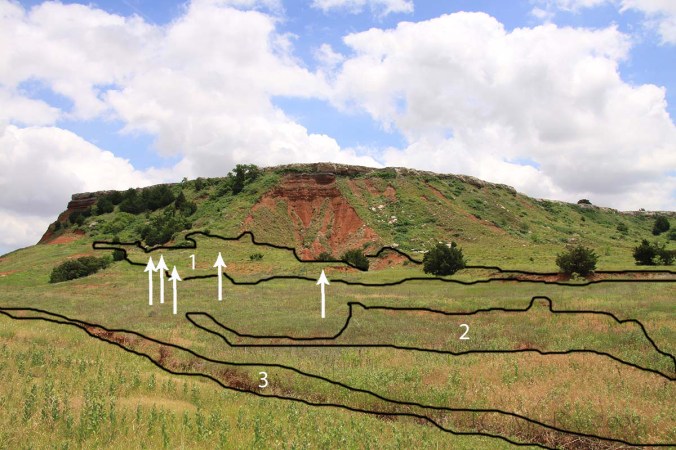
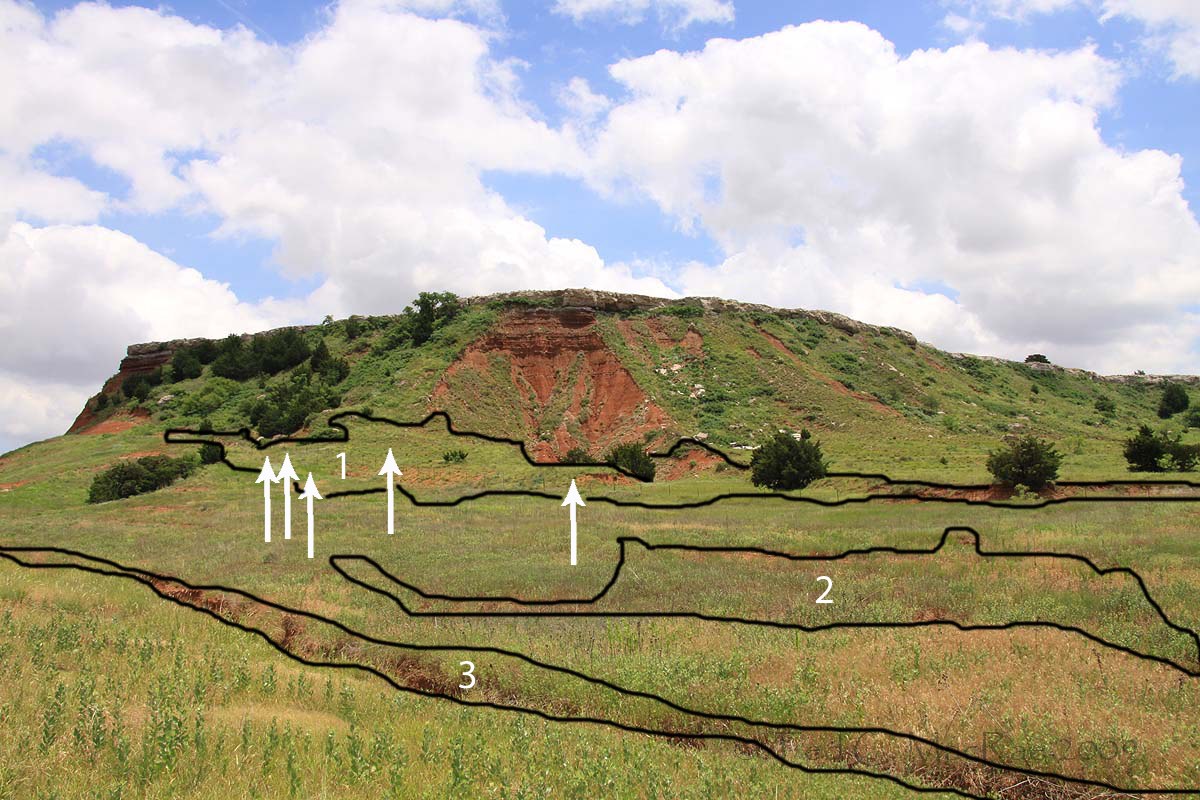
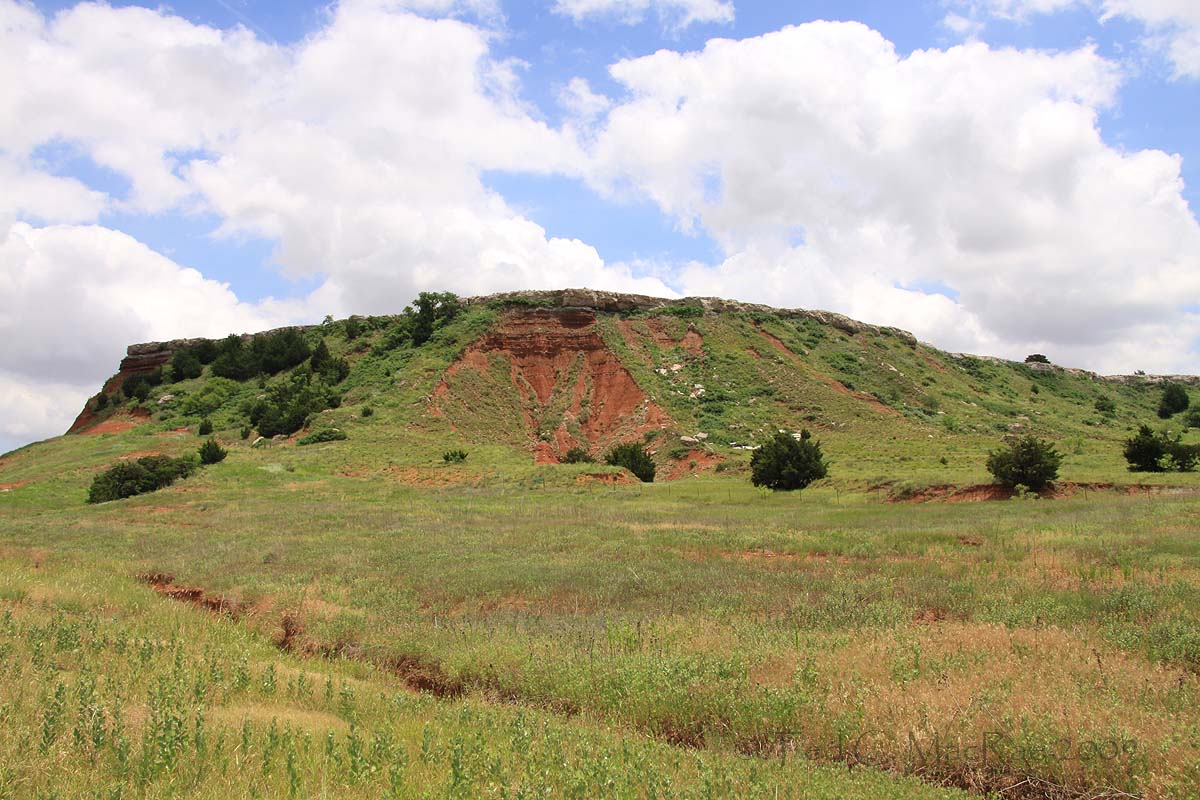
Occurrence of Amblycheila cylindriformis. White arrows indicate where adults were found, all of which were on red clay/gypsum exposures on lower talus slopes in native prairie habitat. No adults were seen in clay/gypsum exposures further below the slopes in either native (zone 1) or altered prairie (zone 2) or further down in roadside drainages (zone 3).
Although I had accomplished my main goal, I looked forward to the opportunity the next day to search for C. celeripes at other nearby sites to better understand the extent of the area’s population. Sadly, the rain that had held off for nine hours before returning just after midnight was back for good, with radar the next morning showing a broad swath of rain extending across the entire western part of Oklahoma and north into Kansas. There wasn’t much for me to do but savor the previous day’s experience while I made the 525-mile drive back east. This may represent a significant record for the species – Vaurie (1955) in her review of the genus did not see any specimens from Oklahoma (although she did examine a few specimens from adjacent areas of Kansas), and Drew and Van Cleave (1962) reported only a single specimen from the state in nearby Woodward County. Significant record or not, it was an experience that I’ll not soon forget.
Photo Details: Canon 50D (ISO 100, 1/250 sec), Canon MT-24EX flash.
Photos 1-3: Canon 100mm macro lens (f/14-20), flash 1/4 power w/ Sto-Fen diffusers.
Photo 4: Canon MP-E 65mm 1-5X macro lens (f/14), flash 1/8 power w/ Sto-Fen + Gary Fong Puffer diffusers.
Post-processing: levels, unsharp mask, slight cropping on photo 1.
Note to self: clean specimens with moist brush to remove dirt before photographing them!
REFERENCES:
Drew, W. A. and H. W. Van Cleave. 1962. The tiger beetles of Oklahoma (Cicindelidae). Proceedings of the Oklahoma Academy of Science 42:101–122.
Erwin, T. L. and D. L. Pearson. 2008. A Treatise on the Western Hemisphere Caraboidea (Coleoptera). Their classification, distributions, and ways of life. Volume II (Carabidae-Nebriiformes 2-Cicindelitae). Pensoft Series Faunistica 84. Pensoft Publishers, Sofia, 400 pp.
Vaurie, P. 1955. A review of the North American genus Amblycheila (Coleoptera, Cicindelidae). American Museum Novitates 1724:1–26.
Copyright © Ted C. MacRae 2010


 Email to a friend
 Despite the fact that I have a beetle blog and Alex has an ant blog, it is the latter where the regular series Friday Beetle Blogging resides (hmm, I wonder if I should start a Myrmecine Monday series?). Alex has perhaps the best science-based entomoblog out there, so I’m thrilled to contribute today’s edition – check it out: Friday Beetle Blogging – the Swift Tiger Beetle.




 I sent this information to Mike Arduser, who replied as follows:
 Beetles In The Bush